






Abstract
Public governance is increasingly mediated by algorithmic decision systems and artificial intelligence (AI). While public governance refers to the broader institutional practices through which collective authority is exercised, AI governance designates the more specific arrangements—ethical, technical, and regulatory—through which algorithmic systems themselves are managed; the two are connected because AI governance now reshapes the communicative conditions under which public governance is legitimated. Although prior research has examined AI governance from ethical, technical, and regulatory perspectives, limited attention has been given to how algorithmic authority is communicatively constructed and evaluated. This article reconceptualizes public relations (PR) in algorithmically mediated public-sector environments as legitimacy infrastructure rather than symbolic communication. Drawing on legitimacy theory and core PR traditions—including dialogic communication, organizational listening, transparency, and relationship management—the article argues that in the algorithmic state, PR evolves from strategic messaging to legitimacy infrastructure, becoming embedded in the conditions under which algorithmic authority is experienced and evaluated. It introduces the Legitimacy Infrastructure Model (LIM), which identifies four relational domains—value framing, justificatory signaling, narrative positioning, and trust calibration—through which legitimacy is formed when authority is embedded in socio-technical systems and encountered through system outputs prior to dialogue. The model extends PR theory by reframing legitimacy as a continuous relational accomplishment under infrastructural authority, articulating testable theoretical propositions, and clarifying the advisory and design-sensitive role of communication leadership in AI-enabled public institutions. In doing so, the article positions PR as a constitutive capability shaping how institutional authority is interpreted and evaluated in datafied governance contexts.
Introduction
Public relations (PR) scholarship has long examined how institutional authority is constructed, interpreted, and stabilized through communication. Questions of legitimacy—how authority becomes acceptable, trustworthy, and morally defensible—remain central to PR theory (Heath, 2001; Suddaby et al., 2017). Today, these questions unfold within governance environments increasingly shaped by algorithmic decision systems, data-driven administration, and artificial intelligence (AI). Although algorithmic authority cuts across both corporate and public-sector communication, this article focuses on its expression in public institutions, where consequential decisions about welfare allocation, taxation enforcement, predictive policing, and public health surveillance directly affect citizens’ lived experiences. In these contexts, governments frequently frame AI adoption not only as an efficiency-enhancing reform but also as a signal of modernization, innovation, and responsiveness to complex social demands (Afgiansyah et al., 2026; Akter et al., 2022).
For PR scholarship, this development represents a shift in the communicative conditions under which legitimacy is constructed. As algorithmic systems expand, PR confronts a transformed legitimacy landscape. Concerns about bias, opacity, data misuse, and automated authority circulate rapidly across media systems and civil society networks (Alon-Barkat and Busuioc, 2023; Angerschmid et al., 2022). What emerges is not simply a policy debate but a relational dilemma: the more technologically sophisticated decision-making becomes, the more socially fragile its legitimacy may appear.
Much of the existing scholarship addresses this challenge through ethical guidelines, regulatory oversight, and technical interventions such as explainable AI and fairness auditing (Aoki, 2021; Aoki et al., 2024). Research in public administration and digital governance similarly emphasizes transparency standards, impact assessments, and accountability mechanisms as safeguards against automated harm (Atuhaire and Kimani, 2025; Aysolmaz et al., 2023). While indispensable, these approaches often assume that legitimacy can be restored primarily through improved system design or enhanced disclosure. Legitimacy is implicitly treated as an attribute internal to the technology: something that can be engineered through accuracy, bias mitigation, or explainability enhancements.
From a PR perspective, this assumption is insufficient. Legitimacy does not reside inside algorithms; it is communicatively constructed. Increasingly, publics encounter institutional authority through system outputs—risk scores, eligibility determinations, automated classifications—before direct communicative engagement occurs. Authority is framed at adoption, interpreted through explanation interfaces, circulated and contested within mediated narratives, and evaluated through publicly disclosed performance signals. Legitimacy is therefore assembled through communicative environments that shape how algorithmic authority is encountered.
Recent research in AI-mediated communication underscores this point. Transparency signaling, interface design, and communicative framing significantly shape trust judgments and relational evaluations (Beer, 2017; Bennett and Livingston, 2018). Studies of AI adoption in communication practice further demonstrate that perceptions of responsibility and accountability depend less on technical features than on how organizations publicly position and contextualize those features (Bennett and Segerberg, 2014; Bignami, 2022). At the same time, a growing body of critical PR scholarship cautions that the communication profession has too often acted as an uncritical advocate for AI rollouts, urging instead a more reflexive ethical orientation alongside attention to AI’s relational and reputational risks (Bourne, 2019; Bowen, 2024; Nies and Zhao, 2025; Swiatek et al., 2024). Bourne (2019), in particular, argues that PR’s professional habitus—shaped by an ideological commitment to optimism and futurity—has rendered the profession structurally inclined to act as a “cheerleader” for AI under neoliberal capitalism, helping to naturalize AI as “common sense” and a “public good” rather than to subject its political-economic conditions to scrutiny. This article takes seriously the warning that infrastructural legitimacy work risks recapitulating cheerleading dynamics if it is not held to a critical standard. The model developed below is therefore offered as a normative framework for PR’s engagement with AI, rather than as a description of how the profession currently operates. Within hybrid media environments, legitimacy is continuously negotiated through interpretive struggles that extend beyond technical architecture (Bowen, 2008). For PR theory, the critical insight is that legitimacy risks do not originate solely from system malfunction; they emerge from how algorithmic authority is communicatively structured and interpreted.
Against this backdrop, this article argues that in the algorithmic state, PR evolves from strategic messaging to legitimacy infrastructure. This claim is not that PR has previously been confined to message production: senior PR leaders have long performed advisory, ethics-counsel, and strategic relationship-management functions across organizational life (Bowen, 2008; Heath, 2001). Rather, the claim is that algorithmic governance significantly extends the conditions under which those functions must operate: PR becomes embedded in the conditions under which algorithmic authority is experienced and evaluated, rather than functioning as a peripheral communication layer activated after policy implementation. Governments operationalize legitimacy through data-informed listening systems, justificatory interfaces, narrative alignment strategies, and the communicative interpretation of trust and fairness metrics. These mechanisms are not supplementary to governance; they are constitutive of how authority becomes socially acceptable.
By integrating insights from government communication research, algorithmic legitimacy theory, and recent studies of AI in public-sector communication (Buhmann and White, 2022; Busuioc, 2021; Coombs and Holladay, 2010), this article advances both theoretical and applied contributions to PR scholarship. It reconceptualizes legitimacy in algorithmically mediated environments while proposing a practice-oriented framework—the Legitimacy Infrastructure Model—that extends core PR concepts such as framing, accountability signaling, relationship management, and stakeholder interpretation into data-driven contexts.
In moving beyond message-centered paradigms, this article repositions PR as a design-sensitive and infrastructure-aware legitimacy function. The aim is less to declare a wholesale departure from earlier PR theory than to offer a framework that helps practitioners and scholars navigate the new communicative conditions created by AI in public institutions. Many of the capabilities the framework foregrounds—advisory engagement with senior leadership, ethics counsel, anticipatory issue framing, and relationship management—are continuous with long-standing strategic functions of PR (Bowen, 2008; Heath, 2001). What is new is the infrastructural environment in which they must operate. For PR scholarship, the rise of algorithmic governance is therefore not an external technological development but a theoretical inflection point: one that requires rethinking how legitimacy is produced when authority is increasingly mediated by data, code, and automated systems.
The remainder of the article proceeds in seven parts. Section two revisits four core PR traditions—two-way symmetry, organizational listening, dialogic communication, and transparency—and shows how each requires extension under infrastructural authority. Section 3 conceptualizes the algorithmic state as a communicative condition, identifying infrastructural authority, epistemic mediation, narrative circulation, and perceived legitimacy as four communicative pressures that reshape the legitimacy environment. Section 4 introduces the Legitimacy Infrastructure Model (LIM) and specifies its four relational domains: value framing, justificatory signaling, narrative positioning, and trust calibration. Section 5 sets out the model’s theoretical implications for dialogic theory, listening, and transparency scholarship. Section 6 develops practical implications for public-sector PR leadership, including the integration of human-in-the-loop oversight in AI-mediated decision-making. Section 7 outlines a future research agenda, and Section 8 concludes by situating PR as legitimacy infrastructure in datafied governance.
Rethinking core PR traditions under algorithmic authority
Traditional PR theory conceptualizes legitimacy as an institutional achievement produced through communicative alignment and relationship cultivation (Couldry and Mejias, 2019; Deephouse and Suchman, 2008). Foundational frameworks—including two-way symmetry, dialogic communication, organizational listening, and transparency-based trust—share a relational premise: legitimacy emerges through reciprocal engagement, stakeholder inclusion, and ethically grounded disclosure. Communication is treated as the primary arena in which institutional authority is interpreted and stabilized (Diakopoulos, 2016; Feng and Chandra, 2025; Fitzpatrick et al., 2013).
Algorithmically mediated governance does not invalidate these traditions; it exposes their structural limits. In many contemporary decision environments, publics encounter binding outputs—risk scores, eligibility determinations, automated classifications—before communicative engagement occurs (Flyverbom et al., 2019; Fu and Yang, 2025). Authority is increasingly embedded upstream in data architectures and model parameters (Gillespie, 2014; Glikson and Woolley, 2020). For PR theory, this shift is consequential because legitimacy judgments are now often formed in response to system outputs prior to dialogic exchange. The relational encounter increasingly becomes interpretive rather than co-decisional.
Symmetry under infrastructural authority
Two-way symmetry presumes identifiable actors capable of mutual adjustment and policy recalibration through dialogue (Grimmelikhuijsen and Meijer, 2022). Legitimacy is stabilized when organizations demonstrate responsiveness and shared problem solving. However, algorithmic governance distributes discretion across agencies, vendors, and technical infrastructures (Grimmelikhuijsen et al., 2013; Grunig, 2001). Citizens encounter what has been described as “authority without presence” (Hallahan, 1999), where consequential judgments appear impersonal even when institutional responsibility persists.
Relationship management theory emphasizes attributable agency and mutual responsiveness as foundations of trust (Harris and St John, 2025; Heath, 2001). When decision logics are embedded in technical systems, responsibility becomes communicatively contested rather than clearly attributable. For PR scholarship, the implication is structural: symmetrical communication cannot be theorized independently of infrastructural design constraints that shape revisability and accountability.
Listening in datafied environments
Organizational listening foregrounds recognition and responsiveness as ethical foundations of democratic legitimacy (Hillo et al., 2025; Iwanowska, 2025). Yet in algorithmic governance, listening is increasingly operationalized through predictive analytics and behavioral inference (Johnston, 2014; Kent and Taylor, 2002). Modeled sentiment may substitute for expressed voice (Ki and Hon, 2007).
Procedural justice research underscores that fairness perceptions depend on experienced participation (Kitchin, 2017; Kizilcec, 2016). From a PR perspective, legitimacy depends not simply on data acquisition but on perceived inclusion. When computational listening is experienced as extractive monitoring rather than dialogic recognition, relational trust may weaken. This distinction between relational listening and computational listening extends contemporary PR discussions of engagement and stakeholder voice (Koa et al., 2025).
Dialogic communication and machine-mediated reciprocity
Dialogic theory centers mutuality, empathy, and vulnerability to revision as defining features of ethical communication (Ledingham, 2003). In algorithmic governance contexts, AI-mediated interaction can enhance perceived responsiveness and immediacy (Longoni et al., 2019; Maas, 2025). Yet automated interfaces operate within preconfigured parameters optimized for stability and efficiency, meaning that reciprocity may be simulated without enabling substantive institutional revision.
PR research on digital engagement underscores that interactivity does not automatically translate into dialogic quality (Macnamara, 2016, 2018). Contemporary critiques similarly caution that reciprocity in mediated environments is often structurally constrained rather than fully open (Maragno et al., 2023). In algorithmic settings, these constraints are embedded in design architectures that delimit how and whether feedback can influence underlying decision logics. Openness thus becomes partially a property of infrastructural configuration rather than solely an outcome of relational exchange. Dialogic theory, in this context, requires extension to account for machine-mediated reciprocity and the structural conditions that shape revisability.
Transparency beyond disclosure
Transparency has traditionally been linked to trust through disclosure (Matthews et al., 2025). However, PR scholarship increasingly recognizes transparency as relational and interpretive rather than purely informational (Metcalf et al., 2021; Millán Vargas et al., 2024). Algorithmic governance research demonstrates that explanation effects are contingent and mediated (Miller, 2022; Moynihan, 2008). Explanation interfaces shape fairness perceptions, but their effects depend on contextual credibility and cognitive processing (Okoronkwo, 2024; Papagiannidis et al., 2025).
From a PR perspective, explainability becomes a form of accountability signaling rather than disclosure volume. Legitimacy hinges on how transparency is framed, contextualized, and relationally interpreted, an insight aligned with recent communication-centered approaches to transparency in corporate and public-sector contexts (Schnackenberg and Tomlinson, 2016; Zamoum, 2026).
From episodic adjustment to embedded legitimacy
Across symmetry, listening, dialogue, and transparency traditions, legitimacy has often been treated as stabilized through discrete communicative interventions. Algorithmic governance complicates this episodic logic. Legitimacy risks emerge through design decisions, implementation structures, and interpretive media environments that shape how authority is encountered long before formal communication occurs (Park and Yoon, 2024; Pasquale, 2015; Schillemans, 2014).
For PR scholarship, this shift indicates that legitimacy cannot be reduced to communicative adjustment alone. Engagement remains normatively central, yet its conditions are increasingly structured by infrastructures that precede and configure exchange. Engagement research likewise conceptualizes participation as an ongoing relational process rather than an episodic event (Schnackenberg and Tomlinson, 2016), reinforcing the need to theorize legitimacy as continuously mediated rather than periodically repaired.
The algorithmic state as a communicative condition
Building on these limitations, algorithmic governance transforms the communicative conditions under which institutional authority is interpreted. Legitimacy is mediated not only through episodic engagement but across infrastructures, interfaces, narratives, and performance signals.
Communication scholarship recognizes algorithms as forces shaping visibility and interpretive pathways (Shin, 2021; Suchman, 1995; Suddaby et al., 2017). In public-sector contexts, AI systems restructure organizational processes and redefine how institutions are experienced (Taylor and Kent, 2014; Theocharis and Jungherr, 2021). Implementation research further indicates that legitimacy depends less on the mere adoption of AI than on how automated systems are relationally encountered (Theunissen and Wan Noordin, 2012).
Infrastructural authority
Authority is increasingly embedded in socio-technical infrastructures (Veale and Zuiderveen Borgesius, 2021; Yang and Kent, 2014). Publics encounter decisions as outputs, while consequential discretion resides upstream in design, data governance, and model configuration (Yuwono et al., 2023; Zamoum, 2026). When authority is infrastructural and distributed, institutional responsibility becomes less immediately attributable. Under such conditions, legitimacy hinges on whether accountability and agency are rendered intelligible within communicative contexts (Afgiansyah et al., 2026; Akter et al., 2022).
Epistemic mediation
As discretion becomes infrastructural, intelligibility becomes interface-based. Publics encounter algorithmic decisions through communicative artifacts: letters, portals, dashboards, and automated systems. Explanations influence trust primarily through heuristic and relational cues rather than deep technical comprehension (Alon-Barkat and Busuioc, 2023; Angerschmid et al., 2022), and explanation type shapes fairness perceptions (Aoki, 2021; Aoki et al., 2024; Atuhaire and Kimani, 2025). Interfaces thus function as accountability signals, structuring how authority is interpreted and evaluated.
Narrative circulation
Legitimacy unfolds within hybrid media systems characterized by rapid amplification and interpretive polarization (Aysolmaz et al., 2023; Beer, 2017). Algorithmic bias operates not only as a technical issue but as a narrative construct shaping institutional character (Bennett and Livingston, 2018). Institutional framings compete with media and activist interpretations, and legitimacy crises intensify when dominant public frames consolidate around opacity or injustice (Bennett and Segerberg, 2014; Bignami, 2022). At a deeper level, the very narratives through which AI is rendered intelligible to publics are themselves politically and economically loaded. Bourne (2019) shows that PR has historically participated in naturalizing AI as “common sense” and as a “public good,” thereby embedding neoliberal logics of optimism, efficiency, and futurity into public discourse about automated systems. Narrative positioning under algorithmic governance therefore involves not only managing competing frames after the fact but also reflexively contesting taken-for-granted assumptions about AI’s desirability and inevitability.
Perceived legitimacy
Institutional trust depends on fairness cues, visible accountability, and accumulated relational experience rather than on performance outcomes alone. Under algorithmic governance, evaluation becomes continuous as media scrutiny, audit practices, and stakeholder interpretation persist over time.
Legitimacy is therefore shaped through ongoing relational interpretation rather than secured through isolated communicative interventions. This perspective aligns with organization–public relationship (OPR) research demonstrating that trust and commitment function as central evaluative anchors in broader institutional judgments (Bowen, 2008). Prior PR research further shows that the quality of communicative interaction significantly influences trust formation and behavioral intentions (Buhmann and White, 2022), underscoring that legitimacy in algorithmic environments remains grounded in relational experience, even when authority is technologically mediated.
The legitimacy infrastructure model: Reframing algorithmic governance through public relations
The Legitimacy Infrastructure Model (LIM) advances a clear claim: in algorithmic governance contexts, legitimacy is not secured by technical accuracy or procedural compliance alone. It is a relational and interpretive achievement constructed through ongoing PR processes. Although algorithmic systems structure decision outputs, judgments about fairness, accountability, and institutional trust are formed within communicative relationships (Busuioc, 2021; Coombs and Holladay, 2010).
From this perspective, PR is not peripheral to algorithmic governance. It operates as a constitutive mechanism through which algorithmic authority becomes intelligible and normatively acceptable. Public evaluations of algorithmic authority are mediated through four communicative practices that PR shapes directly: framing, explanation, narrative alignment, and trust interpretation.
Accordingly, the LIM reconceptualizes PR as an embedded legitimacy practice operating across four relational domains, as shown in Figure 1: value framing, justificatory signaling, narrative positioning, and trust calibration. As Figure 1 illustrates, these domains do not function as isolated communicative tasks. They are arrayed around the algorithmic system itself and connected by continuous relational feedback, indicating that legitimacy work is layered (operating across socio-technical infrastructure, communicative interfaces, narrative environments, and performance metrics) and ongoing rather than episodic. Each domain extends foundational PR theory into environments where authority is mediated through data infrastructures rather than solely through interpersonal exchange. The legitimacy infrastructure model: A public relations framework for algorithmic governance.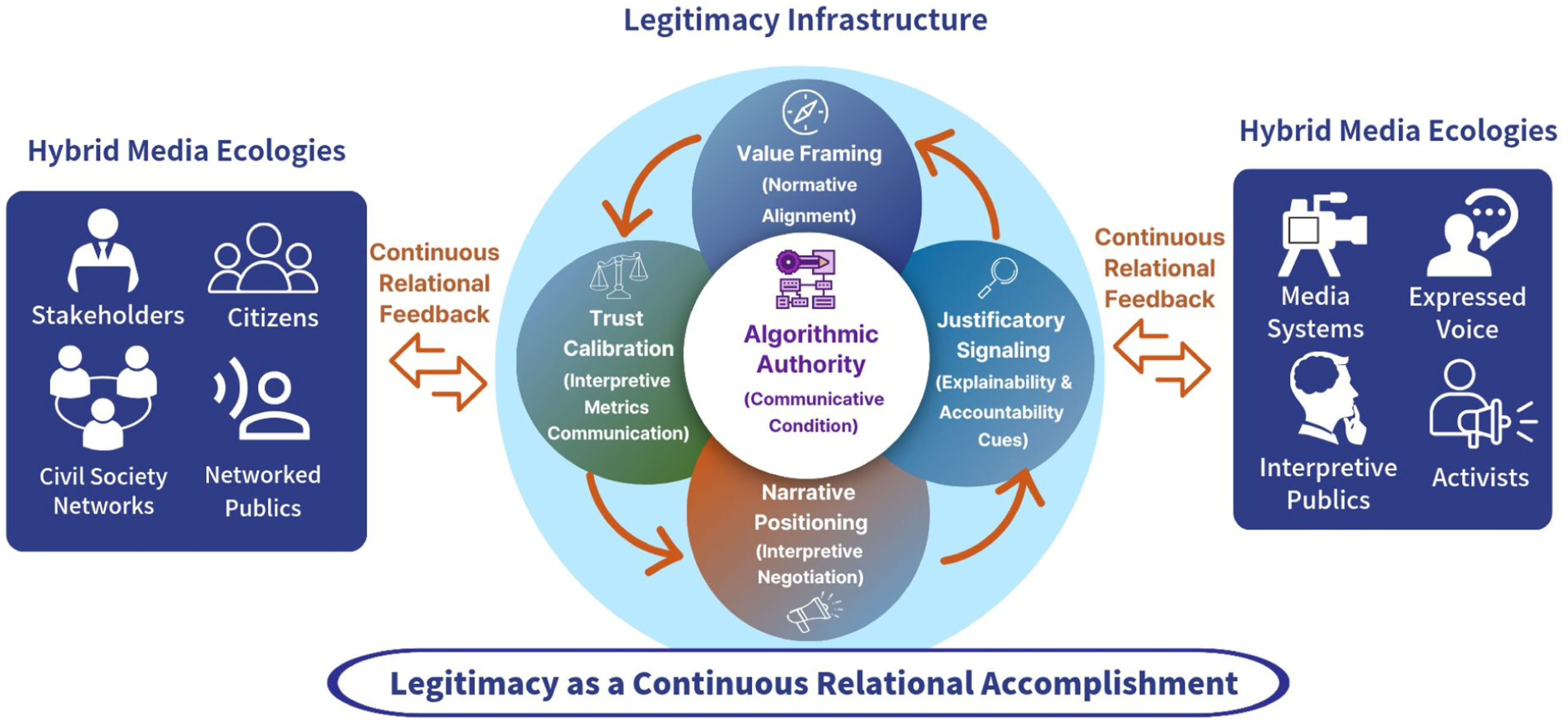
Value framing: Institutional identity under algorithmic modernization
PR scholarship has consistently argued that legitimacy depends on alignment between institutional behavior and socially constructed expectations (Couldry and Mejias, 2019; Deephouse and Suchman, 2008). Framing theory further demonstrates that meaning precedes evaluation; publics interpret institutional actions through schemas shaped by prior communicative positioning (Diakopoulos, 2016).
The introduction of AI in public institutions is therefore not a neutral technical shift but a communicative act. Adoption signals commitments—to modernization, efficiency, innovation, equity, or responsiveness (Feng and Chandra, 2025)—and establishes the normative horizon within which subsequent outcomes are judged.
Value framing functions as anticipatory legitimacy work. It articulates institutional identity and ethical commitments at the moment of technological transition. Research shows that AI implementation is often contested and capacity-dependent (Fitzpatrick et al., 2013; Flyverbom et al., 2019). When performance falters, publics interpret discrepancies relative to previously articulated commitments. In algorithmic governance contexts, infrastructural framing operates as identity work embedded in technological change.
Justificatory signaling: Explainability as relational accountability
PR theory has long associated transparency with trust formation (Fu and Yang, 2025), while relational scholarship underscores that legitimacy depends on perceived accountability and procedural fairness (Gillespie, 2014; Glikson and Woolley, 2020). Transparency, therefore, is not reducible to disclosure volume; it operates as relational signaling.
In algorithmic governance, such signaling is enacted primarily through communicative interfaces: decision letters, portals, chatbots, and automated notifications. Empirical research indicates that trust judgments are shaped less by deep technical comprehension than by cues of oversight, fairness, and institutional responsibility (Grimmelikhuijsen et al., 2013; Grimmelikhuijsen and Meijer, 2022). Moreover, explanation type and format significantly influence perceived legitimacy and procedural justice (Grunig, 2001; Hallahan, 1999).
Explainability thus functions as justificatory signaling. Interfaces communicate whether authority is contestable, attributable, and accountable. Explanations that clearly assign responsibility and acknowledge limitations tend to reinforce relational legitimacy, whereas defensive or overly technical disclosures may weaken it (Harris and St John, 2025). This emphasis on communicative accountability is consistent with ethical governance scholarship in PR, which positions transparency as a moral obligation central to sustaining legitimacy (Heath, 2001). Under algorithmic governance, justificatory interface design becomes a core PR competence.
Narrative positioning: Legitimacy in hybrid media ecologies
PR theory has long emphasized that legitimacy is negotiated within mediated environments (Hillo et al., 2025). In algorithmic governance, controversies over predictive systems and data bias circulate rapidly across hybrid media ecologies characterized by amplification and polarization (Iwanowska, 2025; Johnston, 2014). Research demonstrates that “bias” operates not only as a statistical condition but as a narrative construct through which institutional character is publicly defined (Kent and Taylor, 2002). Legitimacy therefore hinges less on technical error alone than on how responsibility is attributed and moral meaning assigned.
Algorithmic systems themselves increasingly mediate communicative encounters. AI-enabled chatbots and service portals shape perceptions of warmth, competence, and trustworthiness (Ki and Hon, 2007; Kitchin, 2017), while digital dialogic research shows that mediated platforms reshape the conditions of reciprocity and responsiveness (Kizilcec, 2016). Narrative positioning in algorithmic governance thus requires anticipatory issue framing and ongoing alignment between institutional narratives and evolving public expectations. Crisis communication scholarship further underscores that narrative framing significantly shapes attributions of responsibility and legitimacy during contested events (Koa et al., 2025). Legitimacy crises intensify when institutional framing diverges from dominant public interpretations circulating within these hybrid media ecologies.
Trust calibration: Relational metrics in data-driven governance
The final domain concerns trust calibration: the relational interpretation of performance signals. Organizational listening scholarship underscores that legitimacy depends on responsiveness rather than mere data extraction (Ledingham, 2003). The critical issue is not whether institutions measure sentiment, but how quantified indicators are contextualized within ongoing relationship management.
Algorithmic governance institutionalizes metrics—fairness audits, compliance dashboards, and trust indicators—as evidence of accountability. Yet implementation research shows that legitimacy depends on organizational capacity, human oversight, and adaptive competence (Longoni et al., 2019; Maas, 2025). When communicative promises outpace operational readiness, metrics may amplify skepticism rather than reinforce credibility.
Metrics function symbolically as well as operationally. Research on algorithmic trust transfer demonstrates that perceptions of fairness and transparency can extend to broader institutional trust, or erode it when misalignment is perceived (Macnamara, 2016, 2018). OPR scholarship similarly indicates that trust and commitment shape broader institutional evaluations (Maragno et al., 2023). PR therefore influences whether quantified indicators are interpreted as accountability commitments or as impression management. Expanding evaluation beyond data extraction toward meaningful listening remains central to democratic legitimacy (Matthews et al., 2025).
Figure 1 visualizes the LIM as a relational architecture. At its center sits algorithmic authority—embodied in the algorithmic decision system itself—which generates the binding outputs (e.g., risk scores, eligibility determinations, automated classifications) that publics directly encounter. Surrounding it are the four relational domains discussed in Sections 4.1 to 4.4—value framing, justificatory signaling, narrative positioning, and trust calibration—each labeled with its associated communicative mechanism (i.e., normative alignment, explainability and accountability cues, interpretive negotiation, and interpretive metrics communication). The bidirectional arrows linking each domain to the algorithmic system and to the surrounding stakeholder environment indicate that legitimacy work is not unidirectional disclosure but continuous relational feedback: institutional commitments shape how outputs are interpreted, while public interpretations and contestations recursively shape subsequent framing, signaling, positioning, and calibration. The figure thus depicts PR as embedded in—rather than appended to—the communicative architecture through which algorithmic authority is rendered intelligible and evaluable.
Theoretical implications
The LIM advances a structural reorientation of PR theory for algorithmically mediated environments. Its central claim is direct: in the algorithmic state, PR is not merely boundary-spanning communication; it is infrastructural legitimacy architecture. Legitimacy is not the downstream effect of messaging, dialogue, or disclosure alone. It is a layered communicative accomplishment shaped across infrastructures, interfaces, narratives, and metrics.
Classical legitimacy theory conceptualizes legitimacy as a generalized perception that organizational actions are appropriate within socially constructed systems of norms and values (Metcalf et al., 2021). Organizational scholarship emphasized symbolic management and discursive alignment as mechanisms of institutional stabilization (Millán Vargas et al., 2024; Miller, 2022), and PR theory extended this insight by foregrounding framing, relationship management, and strategic communication (Moynihan, 2008; Okoronkwo, 2024). In these traditions, legitimacy is primarily negotiated through discourse.
Algorithmic governance does not displace these insights; it exposes their limits. The LIM specifies communicative mechanisms—framing, signaling, positioning, and calibration—through which legitimacy is constituted in contexts where authority is infrastructurally embedded (Papagiannidis et al., 2025; Park and Yoon, 2024). Legitimacy is therefore shaped not only by what organizations say, but by how communicative architectures structure visibility, contestability, and explanation. By incorporating infrastructural authority, the model extends public relations beyond rhetorical alignment toward design-sensitive legitimacy work.
This shift carries implications for core PR theories. First, dialogic theory requires extension. The LIM specifies that dialogic quality in algorithmic contexts should be evaluated not by interactional openness alone, but by the degree to which feedback mechanisms can substantively influence underlying decision parameters, a criterion that generates testable propositions about interface design and institutional responsiveness.
Second, organizational listening must be reconceptualized (Shin, 2021). The model advances a distinction between relational listening and computational listening (Suchman, 1995; Suddaby et al., 2017), proposing that legitimacy effects differ systematically depending on whether stakeholders perceive data collection as participatory engagement or extractive monitoring, a distinction with implications for how public institutions design feedback systems (Taylor and Kent, 2014; Theocharis and Jungherr, 2021).
Third, transparency scholarship requires recalibration. Traditional PR research links disclosure to trust (Theunissen and Wan Noordin, 2012), yet algorithmic governance demonstrates that transparency operates through interpretive mediation rather than linear information transfer (Veale and Zuiderveen Borgesius, 2021; Yang and Kent, 2014). Explanation interfaces shape fairness perceptions depending on contextual credibility and cognitive processing (Yuwono et al., 2023; Zamoum, 2026). Transparency thus becomes a matter of communicative design rather than informational volume.
More broadly, the model repositions PR within the communicative architecture through which institutional authority is experienced. Rather than operating solely at the organizational boundary (Afgiansyah et al., 2026), PR functions within the structural conditions that shape interpretation and evaluation. Legitimacy pressures in algorithmic environments are continuous, amplified by media scrutiny, digital mobilization, audits, and performance metrics (Akter et al., 2022; Alon-Barkat and Busuioc, 2023). PR participates in value framing, Taken together, these refinements extend rather than replace existing PR theory. PR has long been theorized as an embedded strategic and ethics-counsel capability rather than a peripheral messaging function (Bowen, 2008; Heath, 2001), and the LIM does not contest this lineage. What it contributes is a structural reorientation specific to algorithmic governance: under such conditions, legitimacy cannot be reduced to persuasion, dialogue, or disclosure alone. It is co-produced through socio-technical design, communicative interfaces, narrative contestation, and interpretive metrics. The LIM positions PR as a constitutive communicative capability embedded in how institutional authority is experienced, and evaluated.
Practical implications
The transformation of governance through algorithmic systems amplifies long-standing demands on public-sector PR leadership. In algorithmically mediated environments, legitimacy risks do not arise simply from technical design choices; they emerge through how those design choices are communicatively framed, interpreted, and relationally experienced by stakeholders. Legitimacy concerns are shaped not only by data governance practices or automated thresholds, but by the meanings attached to them within hybrid media ecologies (Angerschmid et al., 2022; Aoki, 2021; Aoki et al., 2024). Senior PR leaders have long performed advisory and ethics-counsel roles within dominant coalitions, shaping institutional decisions before they are publicly enacted (Bowen, 2008; Harris and St John, 2025; Heath, 2001). Under algorithmic conditions, that advisory function is not displaced; it is intensified. Rather than entering only after implementation, PR is most effective when integrated into upstream design and oversight conversations, functioning as an embedded strategic relationship-management capability that shapes how algorithmic authority is perceived across its lifecycle.
A first practical implication concerns early-stage strategic framing and value articulation. PR leaders should engage stakeholders before system deployment to establish shared expectations about fairness, accuracy, and accountability. Algorithmic controversies frequently escalate not only because systems malfunction, but because publics perceive a mismatch between communicated commitments and subsequent outcomes (Atuhaire and Kimani, 2025; Aysolmaz et al., 2023). When AI initiatives are framed narrowly as efficiency reforms, later fairness disputes may be interpreted as evidence of institutional indifference to equity. PR leaders therefore engage in anticipatory legitimacy work, constructing value narratives that articulate fairness, accountability, and proportionality as central commitments before algorithmic outputs are publicly encountered. Here, framing does not merely support policy; it establishes the relational horizon within which institutional character will be judged.
A second implication concerns justificatory communication as strategic accountability signaling. PR practitioners should collaborate with system designers to ensure that decision interfaces clearly communicate who is responsible, how decisions can be contested, and what oversight mechanisms exist. Research on procedural justice indicates that perceptions of fairness depend on perceived opportunities for voice and review (Beer, 2017; Bennett and Livingston, 2018). From a PR perspective, explainability becomes a relational signaling practice.
The critical issue is not the volume of disclosure but whether explanation architectures visibly communicate responsibility, oversight, and contestability. Explainability thus becomes strategic transparency, designed to sustain trust and reinforce institutional sincerity rather than merely to release technical information.
Third, PR leadership must proactively shape narrative environments in digitally networked publics. This requires establishing monitoring systems for emerging algorithmic controversies, developing pre-approved response frameworks for bias incidents, and cultivating relationships with key stakeholders who can provide credible third-party validation. PR practice therefore involves continuous issue mapping, stakeholder sensemaking analysis, and narrative alignment work. The challenge is not reputational repair after controversy, but sustained engagement with the moral frames—fairness, equity, accountability—that structure legitimacy judgments. Narrative positioning becomes an ongoing relational practice through which institutional identity is stabilized within evolving media ecologies.
Fourth, legitimacy metrics must be approached as communicative trust signals rather than neutral performance tools. Quantification research shows that metrics shape perception as much as they reflect performance (Bowen, 2008). Trust scores, bias audits, and compliance dashboards are interpreted within stakeholder relationships. Their legitimacy effects depend on how they are contextualized and explained. PR leaders therefore perform interpretive mediation, framing what metrics mean, acknowledging methodological limits, and aligning performance indicators with previously articulated values. In relational terms, metrics communication is not data disclosure; it is trust calibration.
Fifth, PR leadership must address the ethical implications of AI integration within communication practice itself. As organizations deploy generative AI and automated engagement tools, stakeholder trust depends on disclosure clarity and accountability attribution (Buhmann and White, 2022; Busuioc, 2021). The legitimacy risk lies less in the use of AI per se than in perceived concealment or authorship ambiguity. Critical PR scholars have already argued for an activist and ethically reflexive orientation toward AI in strategic communication, calling for clear standards of transparency, human oversight, and communicative responsibility (Bourne, 2019; Bowen, 2024; Nies and Zhao, 2025; Swiatek et al., 2024). The LIM is consistent with this call and locates such standards specifically within infrastructural legitimacy work: PR professionals translate these normative commitments into concrete framing, interface, narrative, and metrics practices through which relational authenticity is preserved. Crucially, this also entails resisting what Bourne (2019) calls the “cheerleader” role: PR leadership in algorithmic governance must avoid uncritical promotion of AI as inevitable progress and instead surface the political-economic interests that shape adoption decisions. Anticipatory framing should make space for democratic contestation rather than narrowing public deliberation around predetermined narratives of efficiency and modernization.
Sixth, PR leadership has a distinctive role in operationalizing human-in-the-loop oversight as a communicative commitment. Research on human-in-the-loop and meaningful human control argues that visible, substantive human judgment at consequential decision points is necessary to preserve accountability and to mitigate the risks of opaque or biased automated outputs (Aoki, 2021; Aoki et al., 2024; Grimmelikhuijsen and Meijer, 2022). Public assurance that humans remain in the decision loop has been shown to bolster trust in AI-mediated public-sector decisions (Aoki, 2021), and irresponsible AI use can invite regulatory scrutiny, damage relationships, and undermine legitimacy (Bowen, 2024; Busuioc, 2021; Swiatek et al., 2024). Within the LIM, human-in-the-loop oversight is therefore not merely a technical or legal safeguard but a communicative resource: it must be visibly enacted in justificatory interfaces, narratively reinforced in public communication, and reflected in the metrics through which institutions account for their use of AI. PR leaders are well placed to ensure that human oversight is not only present but legible and credible to publics, by aligning interface design, public statements, and performance reporting around clearly attributable human responsibility.
Collectively, these implications situate public-sector PR leaders not simply as implementers of communication strategy after governance decisions are made, but as advisors and architects of the relational legitimacy conditions within which those decisions become socially intelligible. In algorithmically mediated environments, PR operates as communicative infrastructure: shaping how authority is framed, interpreted, contested, and recalibrated across stakeholder networks. Legitimacy depends not only on technical accuracy, but on how socio-technical arrangements are communicatively constructed and relationally experienced.
Future research agenda
Future research should empirically examine the relational mechanisms specified in the LIM across diverse algorithmic governance settings. First, experimental and longitudinal studies are needed to assess whether early-stage value framing moderates the legitimacy impact of subsequent algorithmic failures, thereby testing anticipatory legitimacy effects. Second, comparative research on explanation interfaces should investigate how different forms of justificatory signaling—such as acknowledgment of uncertainty, visible human oversight, and structured contestability pathways—shape procedural justice perceptions across institutional and cultural contexts. Third, media-analytic and network-based studies should examine narrative alignment dynamics, identifying the conditions under which algorithmic controversies escalate into broader institutional legitimacy crises within hybrid media environments. Fourth, integrative research combining survey measures, behavioral indicators, and qualitative inquiry is necessary to evaluate trust calibration processes, particularly the relationship between quantified legitimacy metrics and stakeholders’ lived relational experiences. Collectively, these directions would move public relations scholarship toward a structurally grounded and empirically testable theory of legitimacy in algorithmically mediated environments.
Conclusion
The expansion of algorithmic governance marks a significant shift in how public authority is constituted and evaluated. As decision-making becomes embedded in data infrastructures and automated systems, legitimacy is no longer secured primarily through persuasive messaging or episodic engagement. Instead, it is shaped by how authority is framed, explained, contested, and interpreted within mediated environments. This article has conceptualized the algorithmic state as a communicative condition and introduced the LIM to clarify how legitimacy is produced across design, interface-level justification, and narrative interpretation. In doing so, it extends PR theory into contexts where authority precedes dialogue and is encountered through system outputs rather than interpersonal exchange. For practice, the implication is straightforward: legitimacy cannot be retrofitted onto algorithmic systems after controversy emerges. Ethically oriented PR leadership must therefore be embedded in the anticipatory framing, justificatory design, and ongoing interpretation of automated decision-making processes, including the visible communication of human-in-the-loop oversight, through which institutional accountability for AI-mediated decisions is rendered legible to publics. In datafied societies, sustaining institutional trust depends not only on what organizations say, but on how communicative environments structure the experience of authority. PR, understood as legitimacy infrastructure, is central to that task.
Footnotes

Ethical considerations
Ethical approval was not required for this study as it does not involve human participants, human data, or human tissue.
Funding
This research was conducted with the support of the 2027 research grant from the KDI School of Public Policy and Management. I extend my deepest appreciation for their generous support.
Declaration of conflicting interests
The author declared no potential conflicts of interest with respect to the research, authorship, and/or publication of this article.
Data Availability Statement
No new data were generated or analysed in support of this research. This is a conceptual article and does not involve empirical data collection.