






Abstract
Keywords
Introduction
Coronary heart disease is a major cause of morbidity and mortality worldwide. 1 The population surviving an acute coronary syndrome (ACS) is growing larger, and those patients are globally considered at high risk for subsequent cardiovascular (CV) events. 2 Indeed, intensive pharmacological therapy and lifestyle intervention (optimal medical therapy, OMT) has proven to be effective in reducing morbidity/mortality after ACS, along with optimized acute management.3–5 Residual risk factor assessment is regularly performed to verify whether or not secondary prevention goals are reached, as recommended. 6 However, even in populations in whom recommended secondary prevention drugs are prescribed, a subset of patients still experience CV events. 2 Whereas risk models have been constructed in primary prevention to sort individuals into low-, intermediate-, or high-risk patients, 7 the problem of predicting complications over the long term in coronary patients remains critical.8,9
Very little is known about the prognostic influence of CV risk factors when treated and at low levels, in patients after ACS. As such, there is a need to identify a means of predicting future CV events in this subset of patients, which could lead to improved prognosis assessment and management.
Non-traditional risk factors, biomarkers (high-sensitivity C-reactive protein, hsCRP) and vascular markers (intimal medial wall thickness, IMT; carotid atheroma, peripheral arterial disease, PAD; number of arterial beds) have been tested in order to improve evaluation of prognosis of post-ACS patients.2,10–20 Nevertheless, regardless of the risk factor marker used, there is still a paucity of information available on previously reported treatment and risk factor control in the post-ACS patient population.
The Center of Exploration, Prevention and Treatment of Atherosclerosis (CEPTA) programme has been designed to meet the needs of patients with an ACS in terms of drug prescription, patient education, and control of long-term risk factors. The design and results of this programme have been reported elsewhere, and the programme has proved to be successful in terms of long-term secondary prevention. 5 The aim of the present study was to evaluate the predictive value of traditional cardiovascular risk factors and non-traditional risk markers in determining the residual risk of CV events in post-ACS patients receiving acute and chronic OMT. We hypothesized that traditional risk factors would not be reliable predictors in patients on OMT, and searched to determine other risk markers in the evaluation of residual CV risk of coronary patients.
Patients and methods
Between January 2004 and June 2008, this study enrolled a cohort of consecutive patients, hospitalized for an established ACS in Bordeaux heart hospital, receiving optimal acute phase treatment, including a coronary angiogram performed during the acute phase, and who were referred to the CEPTA 3 days after ACS for optimization of long-term post-ACS management. The CEPTA programme has been previously described. 5 Briefly, it comprises initiation of secondary prevention measures before hospital discharge, including prescription of optimal treatment, and an extensive evaluation of cardiovascular risk factors, myocardial disease, and atherosclerotic burden 3 months post ACS, together with educational classes designed for high-risk patients. Discharge therapy was adapted to cardiac and vascular status and risk factors in accordance with international guidelines.6,21
As previously reported in this cohort, treatment at 20-month follow up showed a high level of prescription of guideline-recommended secondary prevention drugs, and >80% of the patients reached the recommended secondary prevention goals. 5
Acute phase management
ACS was defined and treated according to guidelines of the American College of Cardiology. A coronary angiogram was performed for each patient included in the study, allowing precise evaluation of coronary lesions, and optimized acute phase management with a very high percentage of coronary revascularization in this cohort. The most suitable treatment was delivered during the first week, according to the guidelines. 21
Intervention at 3 months
Assessment of left ventricular ejection fraction and residual myocardial ischaemia
An echocardiogram was performed at rest to assess left ventricular ejection fraction (EF) and wall motion abnormalities. Residual myocardial ischaemia was evaluated by thallium-201 perfusion single-photon emission computed tomography (SPECT) during exercise and considered to be positive if ≥1 segment indicated ischaemia. For patients presenting a myocardial ischaemia in >2 segments, we performed a new catheterization and revascularization, if required.
Assessment of atherosclerosis burden
A 50% or more diameter reduction of one of the epicardial vessels on angiogram was considered a significant coronary stenosis, in addition to the lesion responsible for ACS. Carotid ultrasound duplex imaging measured the IMT of the far wall of the common carotid arteries, and the percentage of internal carotid artery stenosis. An ankle brachial index (ABI) <0.9 defined the presence of PAD. 22
Risk factor management and medical treatment
Height and weight were measured and body mass index was calculated. Blood pressure was monitored during 1 hour in the supine position and the mean of these measurements was used in data analysis. A blood sample was drawn after a 12-hour fast to measure lipids (total cholesterol, high-density and low-density lipoprotein cholesterol, triglycerides), glucose (fasting glucose, HbA1C), creatinin clearance, and hsCRP).
Treatment at patient discharge was adapted to cardiac and vascular status, risk factors, and recommended goals to be attained. The aim of dietary intervention was a total daily intake of fat less than 30% of the daily energy intake and an intake of saturated fatty acids less than 10% of the daily energy intake. A dietician provided patient-specific weight management guidance. Educational classes were given with regard to all aspects of high-risk coronary artery disease (CAD) patients. Light-to-moderate exercise for at least 30 minutes three times weekly was recommended.
Follow up of the patients and definition of end point
Follow-up was conducted with a standardized questionnaire previously validated in clinical trials.5,16,23 The endpoint was a composite of cardiovascular events during follow up (cardiovascular death, acute coronary syndrome, stroke, or transient ischaemic attack, congestive heart failure, secondary coronary revascularization, or peripheral vascular surgery). All medical records of the subjects who died, or who reported on the questionnaire that they had experienced symptoms of any of the clinical endpoints between baseline and follow-up evaluations, were reviewed by one of the investigators, and the patient practitioners were contacted.
Definition of variables and statistical analysis
For statistical analysis, variables were defined as follows: diabetes mellitus (fasting glycaemia ≥7 mmol/l in two consecutive measures, or patient taking anti-diabetic drugs), hypercholesterolaemia (low-density lipoprotein cholesterol >3.35 mmol/l), hypertension (systolic pressure ≥140 mmHg and/or diastolic pressure ≥90 mmHg), elevated hsCRP (>3.3 mg/l corresponding to the third tertile of hsCRP of this cohort), PAD (ABI <0.9), presence of carotid stenosis (>50%). Disease in 3-vascular-beds defined as association of CAD, carotid stenosis, and PAD, disease in 2-vascular-beds defined as CAD and carotid stenosis or PAD, and disease in 1-vascular-bed defined as CAD alone.
Baseline characteristics, ACS management, cardiac status, atherosclerotic lesions, treatment, and risk factors for the population are reported as mean ± SD. Cox proportional-hazards regression analysis in univariate and multivariate models was used for analysis of independent variables predicting the occurrence of events at follow up after adjusting for potentially confounding variables. Two models were constructed; model 1 was used to evaluate the influence of traditional CV risk factors on prognosis of the post-ACS population. Variables included in this model were: age, sex, hypercholesterolaemia, hypertension, presence of diabetes, current smoking status, and elevated hsCRP. Model 2 evaluated the influence of atheroma disease markers and cardiac status on the prognosis of post-ACS patients receiving OMT, after adjustment for CV risk factors. Variables included in this model were; PAD, IMT >0.7 mm, carotid stenosis, 3-vessel and/or left main coronary disease, residual myocardial ischaemia, EF <40%, with the addition of variables included in model 1. A p-value of 0.20 in univariate analysis was considered for entry in multivariate models. Cox proportional-hazard regression was then used to assess the risk of CV events in patients with disease in 3-vascular-beds, those with disease in 2-vascular-beds, with hazards ratios given in comparison with those who had disease in 1-vascular-bed as a reference group, after adjustment for CV risk factors.
The software used for statistical analysis was NCSS (NCSS Statistical Software; Utah, USA).
Results
From January 2004 to June 2008, 1020 consecutive men and women surviving an ACS and referred to the CEPTA were hospitalized for an optimized atherosclerosis management programme for secondary prevention and enrolled in the study. Those who did not complete the 3-month evaluation were excluded from the study: 26 patients refused to continue the programme, and four patients died over the initial 3 months of follow up.
Baseline characteristics and evaluation at 3 months
Baseline characteristics of patients 3 months after an acute coronary syndrome
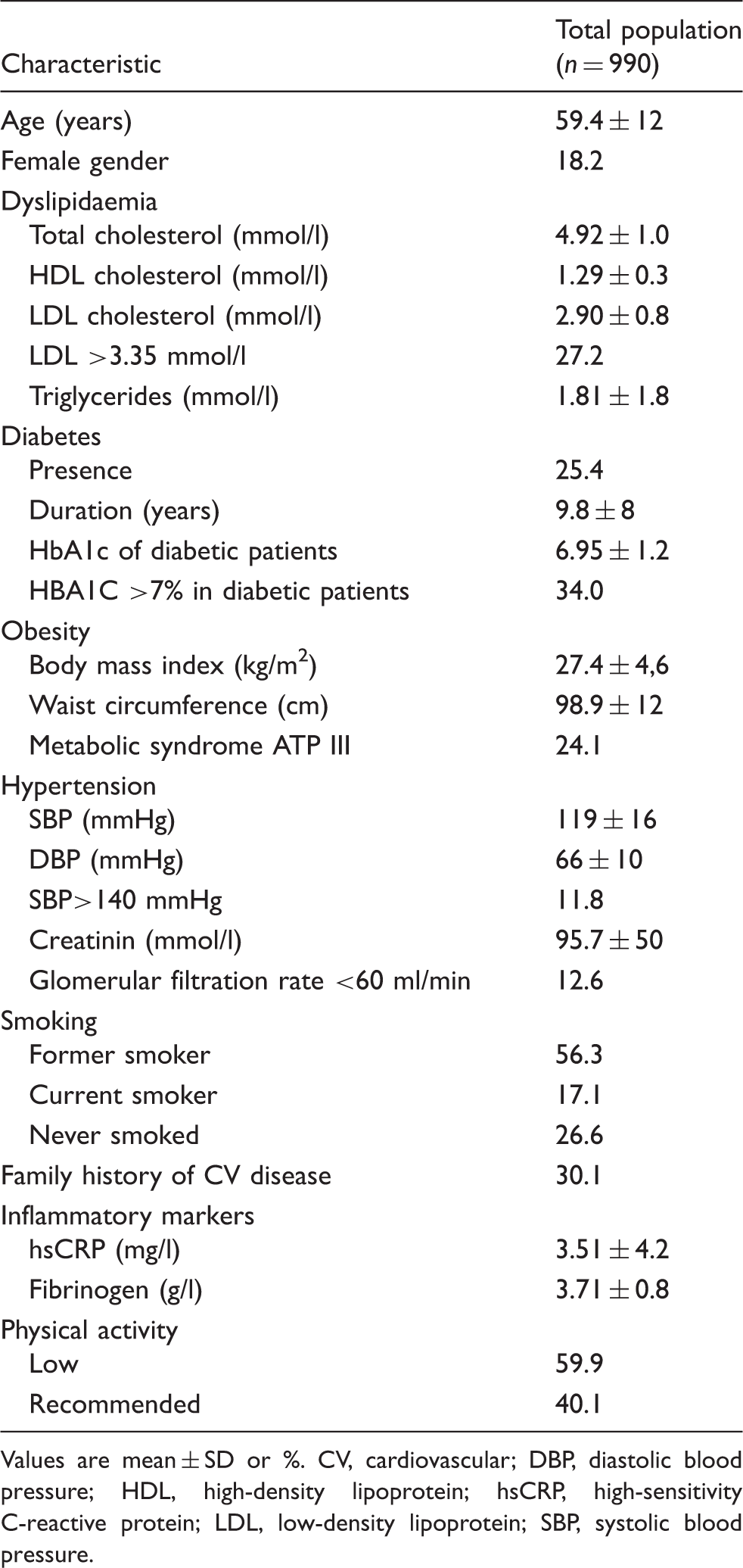
Values are mean ± SD or %. CV, cardiovascular; DBP, diastolic blood pressure; HDL, high-density lipoprotein; hsCRP, high-sensitivity C-reactive protein; LDL, low-density lipoprotein; SBP, systolic blood pressure.
Acute phase management and early complications of acute coronary syndrome (ACS), atherosclerosis burden, and cardiac status
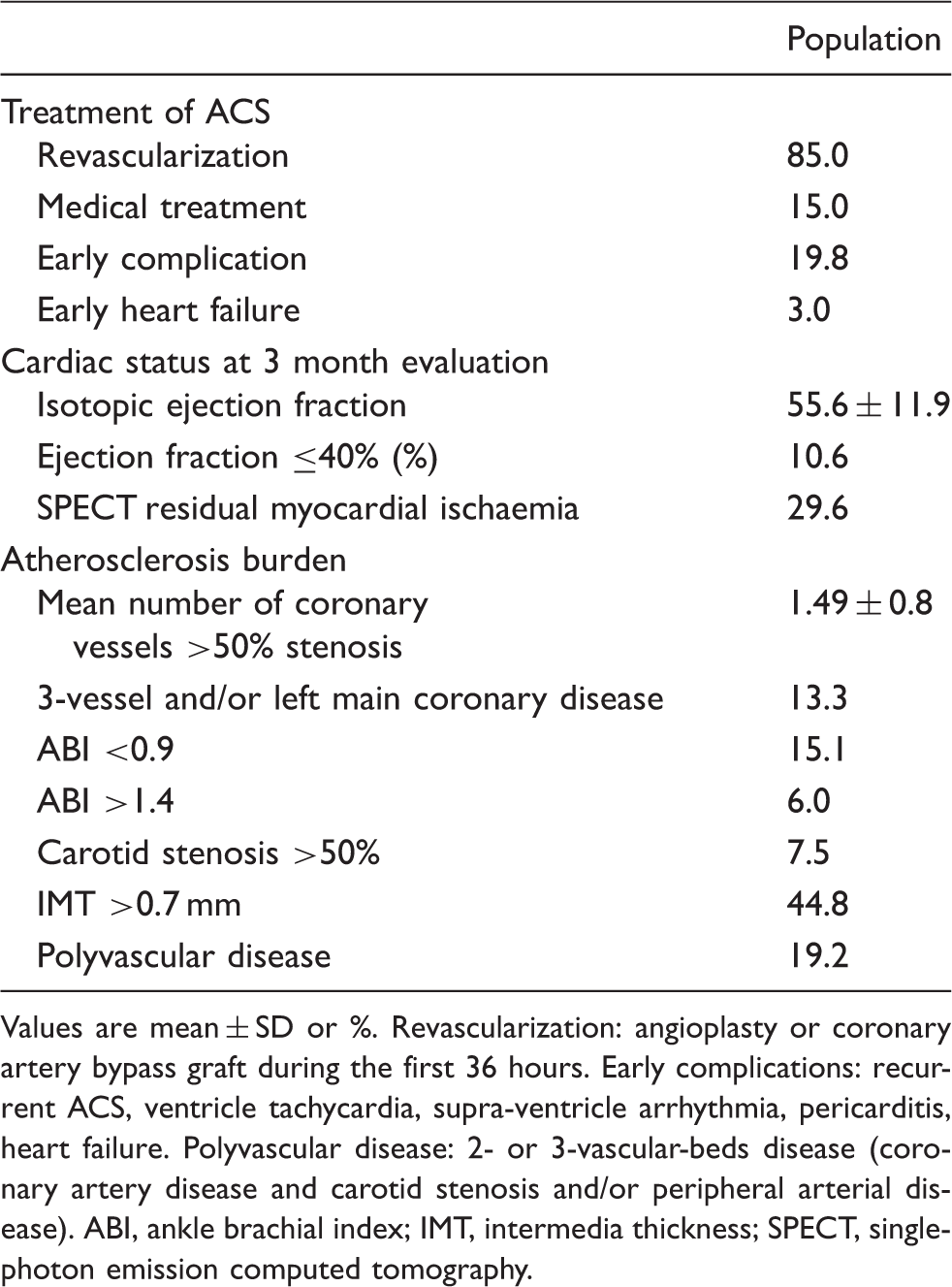
Values are mean ± SD or %. Revascularization: angioplasty or coronary artery bypass graft during the first 36 hours. Early complications: recurrent ACS, ventricle tachycardia, supra-ventricle arrhythmia, pericarditis, heart failure. Polyvascular disease: 2- or 3-vascular-beds disease (coronary artery disease and carotid stenosis and/or peripheral arterial disease). ABI, ankle brachial index; IMT, intermedia thickness; SPECT, single-photon emission computed tomography.
Follow-up results
Follow-up was obtained in 957 patients (96.7%) (median follow up of 22 months, interquartile range 15.6–29.5): 33 patients were lost to follow up (3.3%) and 31 patients died during the follow-up period, 21 from CV causes (2.2%). CV events occurred in 12.1% of patients during the follow-up period.
Proportional-hazards regression analysis for total events during follow up in post-acute coronary syndrome patients
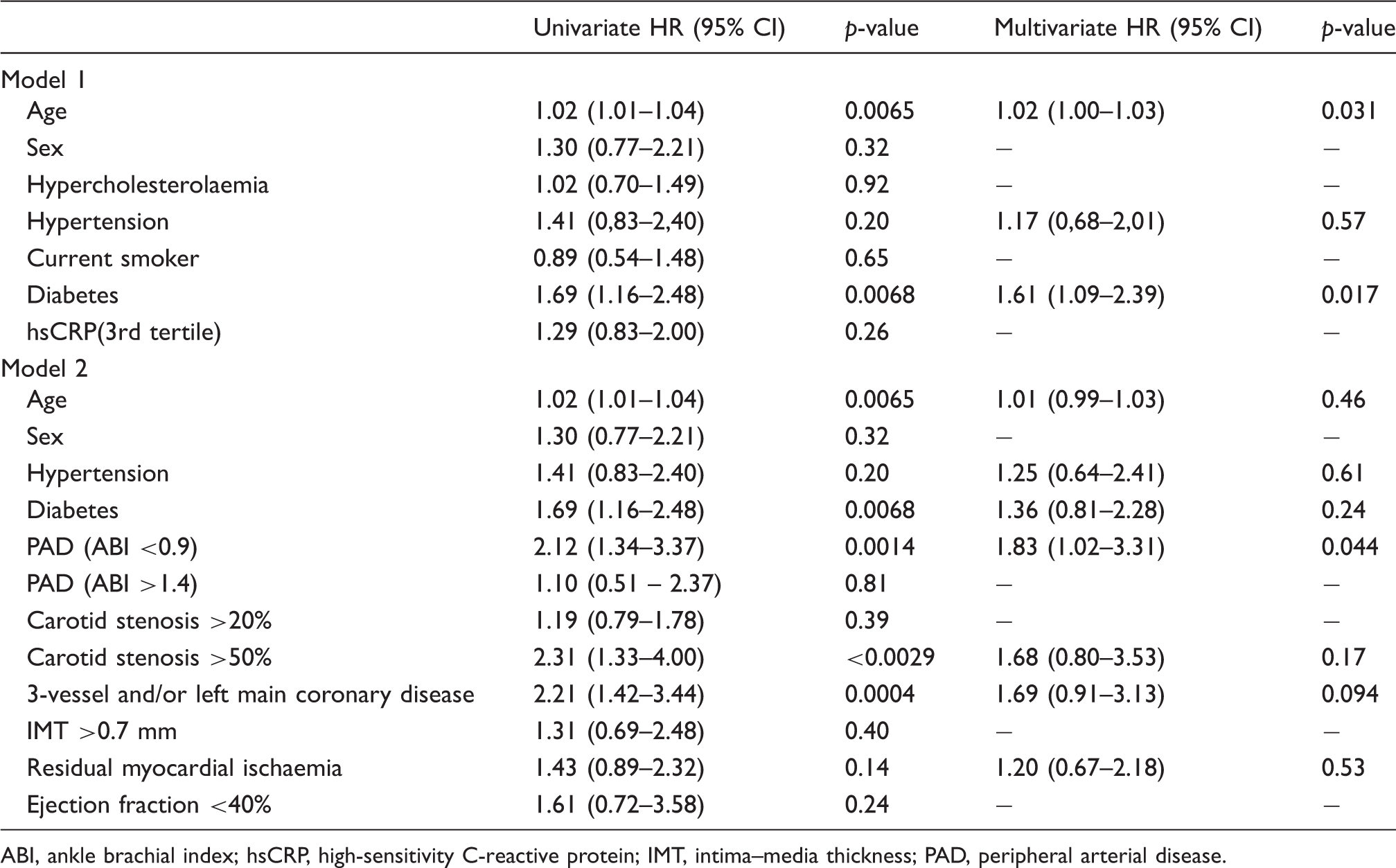
ABI, ankle brachial index; hsCRP, high-sensitivity C-reactive protein; IMT, intima–media thickness; PAD, peripheral arterial disease.
In model 2, univariate analysis showed that PAD (ABI <0.9), carotid plaque >50%, and 3-vessel and/or left main coronary disease were significantly associated with CV events, whereas IMT >0.7 mm, myocardial ischaemia (as measured by SPECT) or ejection fraction <40%, were not associated. In multivariate analysis, only the presence of a PAD (ABI <0.9) remained independently associated with the occurrence of any CV event. In this model, traditional CV risk factors including diabetes showed no significant influence on the prognosis of patients.
As shown in Table 3, 3-vessel and/or left main coronary disease emerged also as a potential relevant determinant of outcomes. In order to elucidate its predictive value, we performed further analysis. We evaluated the impact of 3-vessel disease when secondary peripheral revascularizations were eliminated from the composite end point and found an HR of 2.06 (95% CI 1.11–3.85; p = 0.022); PAD had then an HR of 1.44 (95% CI 0.74–2.78; p = 0.28). These results confirmed that diffuse atheroma burden, strongly correlated with 3-vessel disease or PAD, emerged in this cohort as powerful prognosis markers.
Hazard ratios for the occurrence of total cardiovascular events during follow up after acute coronary syndrome according to the number of vascular beds involved
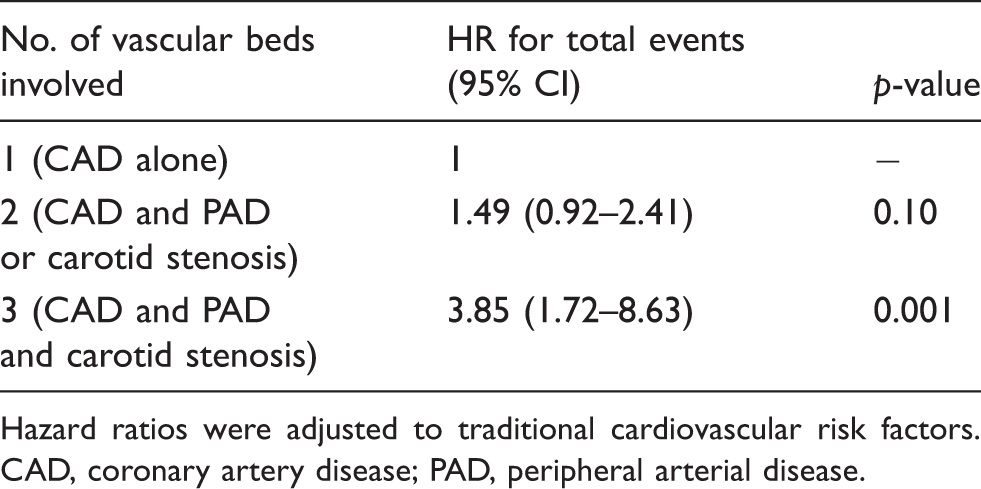
Hazard ratios were adjusted to traditional cardiovascular risk factors. CAD, coronary artery disease; PAD, peripheral arterial disease.
Thus, in this cohort of post-ACS patients receiving secondary prevention drugs, atheroma burden represented the most powerful prognostic marker of CV events, while diabetes remained the only independent marker of CV events among traditional modifiable risk factors.
Discussion
This study is relatively unique in examining the relationship of cardiovascular risk factors, biomarkers, cardiac status, and atheroma burden with the CV outcome of well-treated acute and chronic post-ACS patients.
Our observational data demonstrate the following in a post-ACS cohort receiving OMT:
traditional CV risk factors, when treated and at relatively low levels, are not associated with CV outcomes, with the exception of diabetes atheroma burden, particularly PAD or 3-vascular-beds disease, is a powerful and independent prognosis marker
Traditional risk factor contribution in CV risk evaluation
Secondary prevention goals have been set up on the basis of large study results demonstrating CV event reduction, and efforts are still being made to improve long-term risk factor control.4,24–26
Previous studies of coronary patients found an association between cholesterol, hypertension, or persistent tobacco use with the occurrence of CV events after ACS, in univariate analysis. 9 After adjustment to other risk factors or medication use, their predictive value was poor. 8 We found that in patients receiving OMT, traditional CV risk factors, when treated and brought to low levels by secondary prevention drugs, are no longer associated with CV outcome, with the exception of diabetes. However, the influence of diabetes was no longer significant when adjusted to atheroma burden, in particular presence of PAD.
As previously demonstrated, low levels of risk factors are maintained over at least 2 years after ACS in this population. 5 We also previously reported efficacy of our global risk factor management programme on the prognosis of diabetic patients. In particular, diabetic patients without PAD did not suffer from more CV events rate than non-diabetic patients. However, patients with both diabetes and PAD still carried a lower prognosis than those with either PAD or diabetes alone, emphasizing the need for additional research on care reinforcement on this specific very high-risk population. 16
Non-traditional risk factor contribution in risk evaluation
High-sensitivity CRP and intima media thickness
We found no association between IMT or elevated hsCRP in long-term prognosis evaluation of coronary patients on optimal medical therapy.
Atheroma burden
Carotid stenosis screening, in contrast to IMT, appears to have more value in identifying high-risk patients. 12
Patients with large coronary atheroma extension are known to have poorer prognosis after ACS than monotroncular patients. Most recently, the Prospect study investigated the use of intravascular ultrasound in addition to conventional coronary angiography to assess the coronary lesions of patients successfully treated for ACS, focusing on atheroma characteristics, and concluded that large plaque burden, a small luminal area, and thin-cap fibroatheromas were predictive of recurrent events at 3.4 years. 27 They did observe a significant higher risk of recurrent events in patients with two or three diseased arteries, representing patients with higher atheroma burden, but unfortunately, the authors’ multivariate analysis and discussion did not account for this observation. We confirmed that patients with markers of diffuse atherosclerotic disease, i.e. significant >50% lumen diameter reduction of the left main coronary, or tritroncular patients had a higher risk of CV events, but this higher risk did not remain significant after adjustment to atherosclerotic lesions in other territories (due to adjustment for patients with PAD and >50% carotid stenosis, which are known to have a higher percentage of 3 vessel-disease). Myocardial ischaemia, in a cohort of treated patients receiving a high rate of β-blockers, was not associated with poorer prognosis.
A powerful marker of more advanced atheroma disease, i.e. PAD (ABI <0.9), was a risk marker in our cohort. Despite secondary prevention treatment, it remained independently associated with CV events. In the literature, PAD is known to be an excellent marker of high-risk patients with more pronounced risk factors, less recommended drug prescriptions, and a higher risk of CV events than patients with CAD alone.28,29 The progression of coronary atherosclerosis has been shown to be greater in patients with concomitant PAD. 30 We previously showed that optimized medical care lowered the risk of PAD patients without diabetes, but patients with both PAD and diabetes carried a 2.6-fold increased risk of CV events at follow up compared to CAD alone. 16
Finally, in addition to PAD, we demonstrated that atheroma burden, i.e. extension of the disease in several territories as measured by evaluation of the number of vascular bed diseased, remains the most useful risk marker after ACS in patients receiving OMT with low residual risk factors.
Strengths and limitations of the study
Strengths
We describe the prognosis of 990 patients who survived a hospitalized for ACS between 2004 and 2008, treated during the acute phase, in a specialized institute with a high percentage of revascularization procedures, receiving long-term medical treatment with care of a specialized team in preventive cardiology, including patient education. Additionally, this cohort of French patients has the benefit of free access to medications and other aspects of medical care. 5 Thus, this cohort does not reflect the general post-ACS population, but represents a unique model of the impact of ‘real-life’ optimized post-ACS patient evaluation and care during the past decade. Recent publications have emphasized the need for narrowing the gap between evidence and practice worldwide in post-ACS populations. 19 The strength of this study is that it includes systematic and complete evaluation of all patients in terms of risk factors, cardiac status and vascular atheroma, 3 months after ACS, limiting bias and allowing more robust statistics. In the Reach registry, polyvascular disease was the most powerful prognosis marker of high-risk patients: 20 a result we were also able to show in a younger and smaller cohort of patients with OMT, confirming the overall positive demonstration on the interest of atherosclerosis markers in coronary patients, whatever the residual risk profile.
Limitations
This cohort is a monocentric, standardized, high-quality cohort which followed recommendations in both the acute and chronic phases. Acute management of this monocentric university hospital ICU is not comparable to any multicentre registry, namely GRACE (100% of the patients are catheterized and 85% are revascularized). In this cohort, patients are included if they completed the 3-month evaluation. So, patients who deceased between ACS and 3 months are not presented in this cohort and results are analysed based on this ‘chronic’ population.
Although this study is among the first to evaluate risk factors for subsequent CV events after ACS in a cohort of patients with optimized secondary prevention, one limitation is represented by the small number of events at 20 months (12.1% of total CV events, including 2.2% of CV death) compared to previous studies of post-ACS patients (4.8% of CV death and 19% of urgent readmission for cardiac events at 6-month follow up in GRACE registry; 6% of CV death at 1 year in a French nationwide post-myocardial infarction registry).3,26
Conclusion
In post-ACS patients with OMT, atheroma burden (as measured by PAD, 3-coronary vessel disease or 3-vascular-beds extension) represent powerful prognostic markers of CV events, while diabetes remains the only independent marker of CV events among traditional CV risk factors.
As the majority of traditional or non-traditional risk markers in this cohort demonstrated poor prognostic value, our study strongly suggests evaluation of atheroma burden, including detection of peripheral vascular disease, and reinforcement of medical care for polyvascular disease and/or diabetes in post-ACS patients.
Footnotes
Funding
This research received no specific grant from any funding agency in the public, commercial, or not-for-profit sectors.
References
Supplementary Material
Please find the following supplemental material available below.
For Open Access articles published under a Creative Commons License, all supplemental material carries the same license as the article it is associated with.
For non-Open Access articles published, all supplemental material carries a non-exclusive license, and permission requests for re-use of supplemental material or any part of supplemental material shall be sent directly to the copyright owner as specified in the copyright notice associated with the article.
