







Abstract

Skeletal muscle dysfunction (dynapenia) is often present in patients with heart failure. 1 However, the association of dynapenia with diaphragm muscle dysfunction remains undefined.
Sixty-two patients hospitalized for heart failure were enrolled. Diaphragm muscle function was assessed by ultrasonography, and impaired diaphragm function was defined as diaphragm muscle thickness at the end of inspiration below the median value (i.e. <4.0 mm) as previously described. 1 Dynapenia was classified into two phenotypes: muscle weakness with low muscle mass (i.e. sarcopenia) and muscle weakness despite normal muscle mass. Muscle weakness and muscle loss were defined according to the criteria of the Asian working group for sarcopenia. 1
Dynapenia with muscle loss and dynapenia with normal muscle mass were present in 32.3% and 40.3% of patients, respectively. Compared with patients without dynapenia, patients with either type of dynapenia were older, had significantly reduced knee extensor muscle strength, impaired diaphragm muscle function and a significantly shorter six-minute walk distance (6MWD) (Figure 1(a)). Reduced diaphragm muscle function was associated with a further decrease in the 6MWD of patients with either type of dynapenia (Figure 1(b) and (c)). In multivariate analysis, increased age, reduced diaphragm muscle function and decreased knee extensor muscle strength were independent determinants of short 6MWD in heart failure patients with dynapenia.
Effect of dynapenia and diaphragm dysfunction on six-minute walk distance in patients with heart failure. No dynapenia versus either type of dynapenia (a); diaphragm dysfunction versus normal diaphragm function in patients with dynapenia and muscle loss (b), and those with dynapenia and normal muscle mass (c).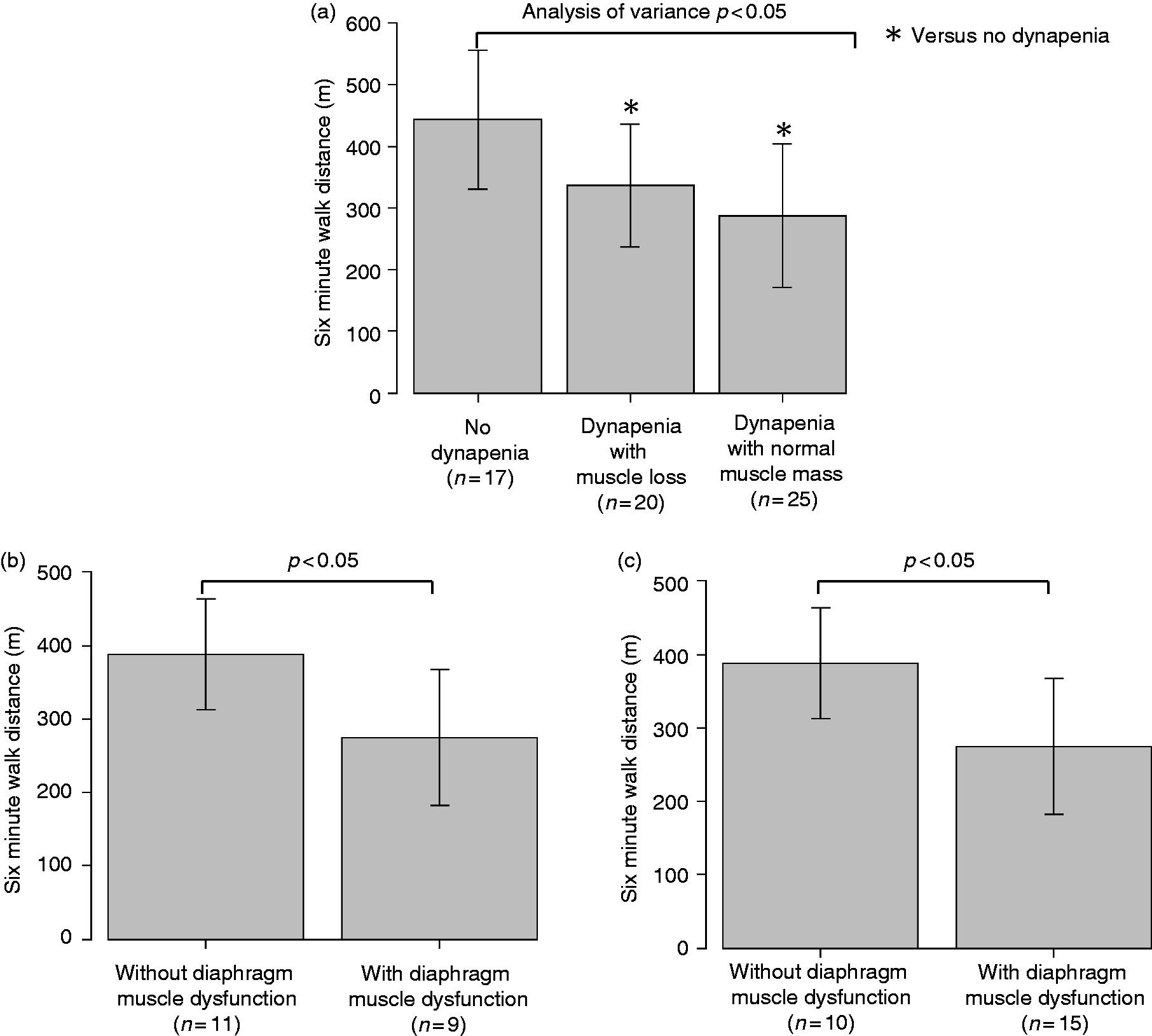
The present study demonstrated that ultrasound-proven diaphragm muscle dysfunction was often present in heart failure patients with dynapenia and was a significant determinant of exercise intolerance regardless of the dynapenia phenotype. Independent effect of diaphragm muscle dysfunction on exercise intolerance in heart failure patients with dynapenia may be partly explained by the limb muscle dysfunction induced by the inspiratory metaboreflex. 1 Diaphragm muscle fatigue during exercise is likely to induce sympathetic activation and peripheral vasoconstriction, resulting in fatigue of peripheral skeletal muscles and an impairment of their endurance. A previous study demonstrated the beneficial effects of inspiratory muscle training on exercise capacity along with improved diaphragm muscle function and attenuated inspiratory metaboreflex in patients with heart failure. 1 Thus, in addition to conventional rehabilitation programs, 2 inspiratory muscle training may be a therapeutic option for heart failure patients with dynapenia.
Footnotes
Author contribution
YK and TS had the original idea for the study; YK, MM, TS, KY, TI, MH, KM, NH, KM, MK and KY contributed to the acquisition, analysis and interpretation of the data; YK and MM drafted the manuscript; and TS, KY, TI, MH, KY, NH, KM, MK and KY critically revised the article. All authors have read and approved the final article.
Acknowledgement

Declaration of conflicting interests
The author(s) declared the following potential conflicts of interest with respect to the research, authorship, and/or publication of this article: The authors reported receiving lecturer’s fees from Ono Pharmaceutical Co., Ltd, Otsuka Pharmaceutical Co., Ltd, Bristol-Myers Squibb Co., Ltd, and Abbott Vascular Japan Co., Ltd, as well as research grants from St Jude Medical Japan Co., Ltd, Otsuka Pharmaceutical Co., Ltd, Daiichi-Sankyo Co., Ltd, Boston Scientific Co., Ltd, Johnson & Johnson, Biotronik Japan Inc., Japan Lifeline Co., Ltd, Astellas, Teijin Pharma Ltd, Mitsubishi Tanabe Pharma Co., Ltd, Fukuda Denshi, Takeda Pharmaceutical Co., Ltd, Ono Pharmaceutical Co., Ltd, Public Health Research Foundation, Nihon Kohden Co., Ltd, and Novartis.
Funding
The author(s) disclosed receipt of the following financial support for the research, authorship, and/or publication of this article: This study was supported by grants from the Japan Society for the Promotion of Science (JSPS KAKENHI grant nos. 26350566 and 17K00855).