







Abstract
Introduction
As reported by the World Health Organization (2024), noncommunicable diseases accounted for seven of the top 10 global causes of mortality in 2021, with ischemic heart disease being the leading contributor, accounting for 13% of total deaths. 1 Cardio-cerebrovascular diseases, a major category of noncommunicable diseases, account for the deaths of 17.7 million people annually, representing 31% of all global fatalities. In addition, the number of deaths is increasing each year. For example, the deaths attributed to ischemic heart disease are 2.7 million in 2000 and 9.1 million in 2021, respectively. Presently, it is widely recognized that genetic factors play a significant role in the etiology of cardio-cerebrovascular diseases. An increasing number of genetic variants associated with cardio-cerebrovascular diseases have been identified through recent genome-wide association studies (GWASs) and large-scale collaborative research.
Histone deacetylases (HDACs) genes regulate the enzymatic activity that controls the acetylation state of lysine residues in proteins, particularly those found in the N-terminal extensions of core histones. 2 Recently, HDACs have been characterized as being potentially associated with cardio-cerebrovascular diseases. 3 The initial potential of HDACs for treating heart disease was demonstrated through studies utilizing a mouse model of aortic constriction. 4 Previous animal experiments found that HDACs could improve cardiac performance in two different models of diastolic dysfunction and promote decreases in cardiac hypertrophy and cardiac fibrosis. 5 Presently, more than five GWAS reported the relationship between HDACs genes region and cardiovascular disease involving large artery atherosclerosis, ischemic stroke (IS), large-vessel stroke, moyamoya disease, intracranial aneurysms and coronary artery disease from European and Asian populations.6–8
HDACs are the key regulators in cardiac development and essential for promoting cardiogenesis in stem cell-derived models. 9 The presence of common variants associated with such tightly related diseases prompted us to investigate whether there is one or more shared susceptibility variants in different cardio-cerebrovascular diseases. Although some studies have been conducted to evaluate the association between variants in the HDACs genes and sub-types of cardio-cerebrovascular diseases, the findings were limited, and the mechanisms remained unclear. Therefore, to confirm and replicate these results, a larger sample was deemed necessary. In addition to some common cardiovascular diseases, such as stroke, myocardial infarction etc., other cardio-cerebrovascular diseases should also be included to provide a broader picture of the associations. However, relevant systematic reviews and meta-analyses regarding multiple cardio-cerebrovascular diseases were sporadic recently. Furthermore, a systematic functional annotation of the targeted variants was not considered in these meta-analyses. This study, firstly, aimed to systematically review all studies exploring the association between HDACs genes and cardio-cerebrovascular diseases; then, conducted meta-analyses on variants with sufficient available datasets to gather cumulative epidemiological evidence regarding the significant effects contributed by these variants to different cardio-cerebrovascular diseases; finally, a systematic functional annotation was conducted to provide a synopsis of the relationship between variants in the HDACs genes and targeted diseases susceptibility.
Materials and methods
All analyses were conducted in accordance with the guidelines established by the Human Genome Epidemiology Network 10 for systematic review of genetic association studies and adhered to the Preferred Reporting Items for Systematic Reviews and Meta-Analyses guidelines. We registered this protocol in the PROSPERO database (CRD420251010100).
Search strategy
Scopus, PubMed and Web of Science are widely used databases in the medical and life sciences. Therefore, a comprehensive literature search was conducted in the three databases to identify genetic association studies (case–control studies, cohort studies, GWAS) published prior to 27 June 2025 using keywords “hypertension or heart disease or CHD or artery disease or coronary artery disease (CAD) or coronary disease or coronary atherosclerosis or myocardial infarction or angina or aneurysm or cerebrovascular disease or stroke or cerebral infarction or subarachnoid hemorrhage or intracerebral hemorrhage or cardiometabolic disease” AND “histone deacetylase or HDAC or HDAC4 or HDAC5 or HDAC6 or HDAC1 or HDAC2 or HDAC3 or HDAC8 or HDAC7 or HDAC9 or HDAC10.” Additionally, we screened the references of all included studies, meta-analyses, and reviews to identify potentially relevant publications.
Selection criteria
Studies were included according to the following criteria: (i) were published in the English peer-reviewed journals; (ii) evaluated the relationships between genetic variants in the HDACs genes and cardio-cerebrovascular diseases; (iii) provided the odds ratios (ORs), regression coefficients, 95% confidence intervals (CIs), or standard errors, or contained sufficient data to calculate these risk estimates.
Studies were excluded according to the following criteria: (i) lacked adequate data for analysis; (ii) were not published in other publication types (e.g. comments, conference abstracts, or letters to the editor); (iii) focused primarily on survival status, treatment outcomes, and disease mortality. Two investigators (D.G. and R.L.) independently evaluated the eligibility of each article, and any disagreements were resolved through discussion with the principal investigator (Z.Z.).
Data extraction
Two investigators (R.L. and D.G.) independently extracted data, which was subsequently verified by two additional researchers (K.D. and Z.Z.). Data were collected utilizing the pre-designed standard forms. Ethnic groups were divided into four categories: Caucasian (European descent), Asian (Asian descent), African (African descent), and mixed (including Caucasian, Asian, African and other population). When data from the same study population were reported in multiple publications, the most recent or the largest publication was selected.
Statistical analyses
We pooled the risk estimates of variants from each of the included studies using a random-effects model to combine the data. Meta-analyses were conducted exclusively for variants with a minimum of two independent datasets. Each study or stage in the publications which contained multiple studies or stages was treated as an individual dataset. Additionally, subgroup analyses based on ethnicity and sub-types of diseases were conducted if sufficient data were available.
Assessment
We employed Cochran's Q statistic to assess heterogeneity 11 and the I2 statistic to quantify it. 12 In addition, prediction intervals (PIs) was calculated and showed the range of true effects in future studies. The sensitivity analyses were conducted to determine whether the association would be affected by the exclusion of a single study (dataset). Potential publication bias was assessed using Begg's test 13 and funnel plots, while the potential small-study bias was evaluated with Egger's test.14,15
For the statistically significant associations identified through meta-analyses, we applied the Venice Criteria to evaluate the epidemiological credibility.16,17 We also performed false-positive report probability (FPRP) test to assess whether a significant association could be ruled out as a false-positive finding. We employed the method developed by Wacholder and colleagues to calculate the FPRP at a prior probability of 0.05 for the significant associations and established a FPRP cut-off value of 0.20. 18
Statistical analyses were conducted using Stata/MP, version 18.0 (Stata, College Station, TX, USA).
Functional annotation
The significant variants identified in this study will be analyzed further in order to provide biological insights. The single-nucleotide polymorphisms (SNPs) were mapped to their corresponding genes and performed functional annotation using the Encyclopedia of DNA Elements (ENCODE) tool, HaploReg v4.2, 19 and the University of California, Santa Cruz (UCSC) Genome browser (http://genome.ucsc.edu/). The regions of promoter or enhancer activity, DNase I hypersensitivity, proteins bound to these regulatory sites, local histone modifications, transcription factor binding motifs, and the genetic structure of this region across different populations were analyzed.
Results
Characteristics of the included studies
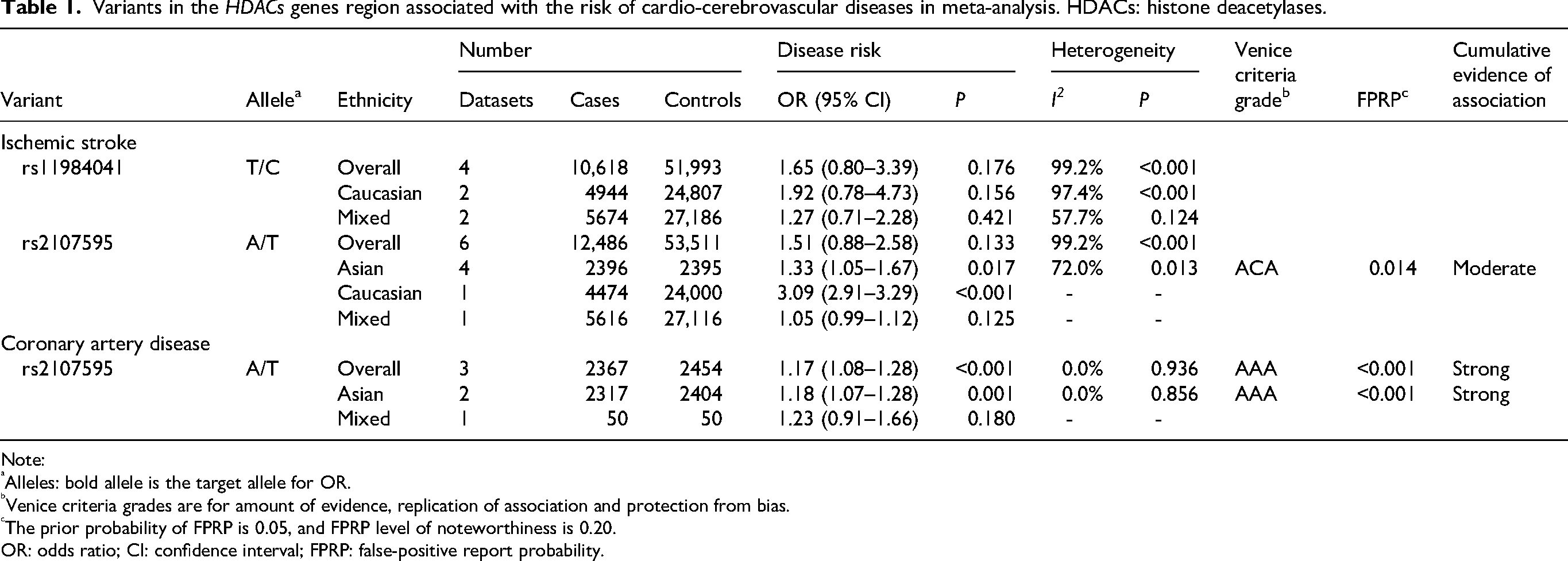
The literature search process was shown in Figure 1. Consequently, 34 articles, comprising a total of 160 datasets, were selected to examine the associations between variants and targeted diseases. The characteristics of the included studies are shown in S1 Table . Meta-analyses were conducted in variants with no less than two datasets. Among those datasets, four datasets including 23,104 cases and 105, 504 controls, were for two variant and IS, three datasets including 2367 cases and 2454 controls were for one variant and CAD (Table 1). In addition, 10 datasets from GWAS including 54,358 cases and 473,978 controls reported statistically significant associations between two variants in HDACs genes and intracranial aneurysm (IA), four variants and Moyamoya disease, one variant and IS, one variant and large artery atherosclerosis, one variant and large-vessel stroke, and one variant and large-vessel disease (LVD) (Table 2).
Variants in the HDACs genes region associated with the risk of cardio-cerebrovascular diseases in meta-analysis. HDACs: histone deacetylases.
Note:
Alleles: bold allele is the target allele for OR.
Venice criteria grades are for amount of evidence, replication of association and protection from bias.
The prior probability of FPRP is 0.05, and FPRP level of noteworthiness is 0.20.
OR: odds ratio; CI: confidence interval; FPRP: false-positive report probability.
Susceptible loci of cardio-cerebrovascular diseases identified by genome-wide association studies.

HDAC: histone deacetylase; GWAS: genome-wide association study; OR: odds ratio; CI: confidence interval.
The results of meta-analyses
The results of meta-analyses are shown in Table 1. SNP rs2107595 was found to be significantly associated with IS in Asian (OR = 1.33, 95% CI: 1.05–1.67) and Caucasian (OR = 3.09, 95% CI: 2.91–3.29) with the risk allele A, while the associations were not found in overall and mixed populations. A similar result was found in dominant model in Asian population (OR = 1.36, 95% CI: 1.07–1.73), but not found in recessive model (S3 Table). As shown in Table 1, one another variant rs11984041 was analyzed in meta-analysis and no significant results were found in Caucasian and mixed population in allele model, as well as in dominant and recessive models (S3 Table).
Two variants in HDAC9 were investigated for CAD, only one with three datasets was conducted meta-analysis. SNP rs2107595 (A) was found to be a risk factor of CAD in Asian population (OR = 1.18, 95% CI: 1.07–1.28), but the association was not found in a mixed sample of 50 cases. The similar result was reported in dominant model in Asian population, but not found in recessive model (S3 Table).
Variants identified by genome-wide association study
Four variants were identified to be associated with moyamoya disease in Asian populations at GWAS significant level. Specifically, rs2107595 (OR = 1.64, 95% CI: 1.51–1.79; P = 1.49 × 10⁻²⁹) and rs12530920 (OR = 1.56, 95% CI: 1.43–1.70; P = 5.66 × 10⁻²⁵) were identified to be risk factors, while rs12533919 (OR = 0.70, 95%CI: 0.63–0.78; P = 1.70 × 10⁻¹⁰) and rs73307079 (OR = 0.77, 95%CI: 0.71–0.84; P = 4.83 × 10⁻¹⁰) were found to be protective factors. Rs2192476 (OR = 1.26, 95%CI: 1.16–1.36; P = 3.51 × 10⁻⁹) and rs10230207 (OR = 1.27, 95%CI: 1.17–1.38; P = 9.91 × 10⁻¹⁰) were significantly associated with the incidence of IA. Furthermore, for rs2107595, the A allele was also considered as the risk allele for LVD in Caucasian population (OR = 1.31, 95% CI: 1.21–1.43; P = 2.50 × 10⁻¹⁰) and IS (OR = 1.24, 95%CI: 1.15–1.33; P = 4.52 × 10⁻⁹) in mixed population. Rs11984041 was found to increase the risk of both large artery atherosclerosis (OR = 1.09, 95%CI:1.06–1.12; P = 8.60 × 10⁻¹⁰) and large-vessel stroke (OR = 1.42, 95%CI:1.28–1.57; P = 1.87 × 10⁻¹¹) (see Table 2).
Heterogeneity, sensitivity analysis and bias
As shown in Table 1, the heterogeneity varied across different variants and diseases. No heterogeneity was found in the association of rs2107595 with CAD, and high heterogeneity was observed in other significant associations (Table 1). Subgroup analyses were conducted to investigate the sources of heterogeneity. In some subgroups, the high heterogeneity was reduced. PIs were calculated and reported in forest plots (Figures 2 and 3) shown the associations might change in the future.
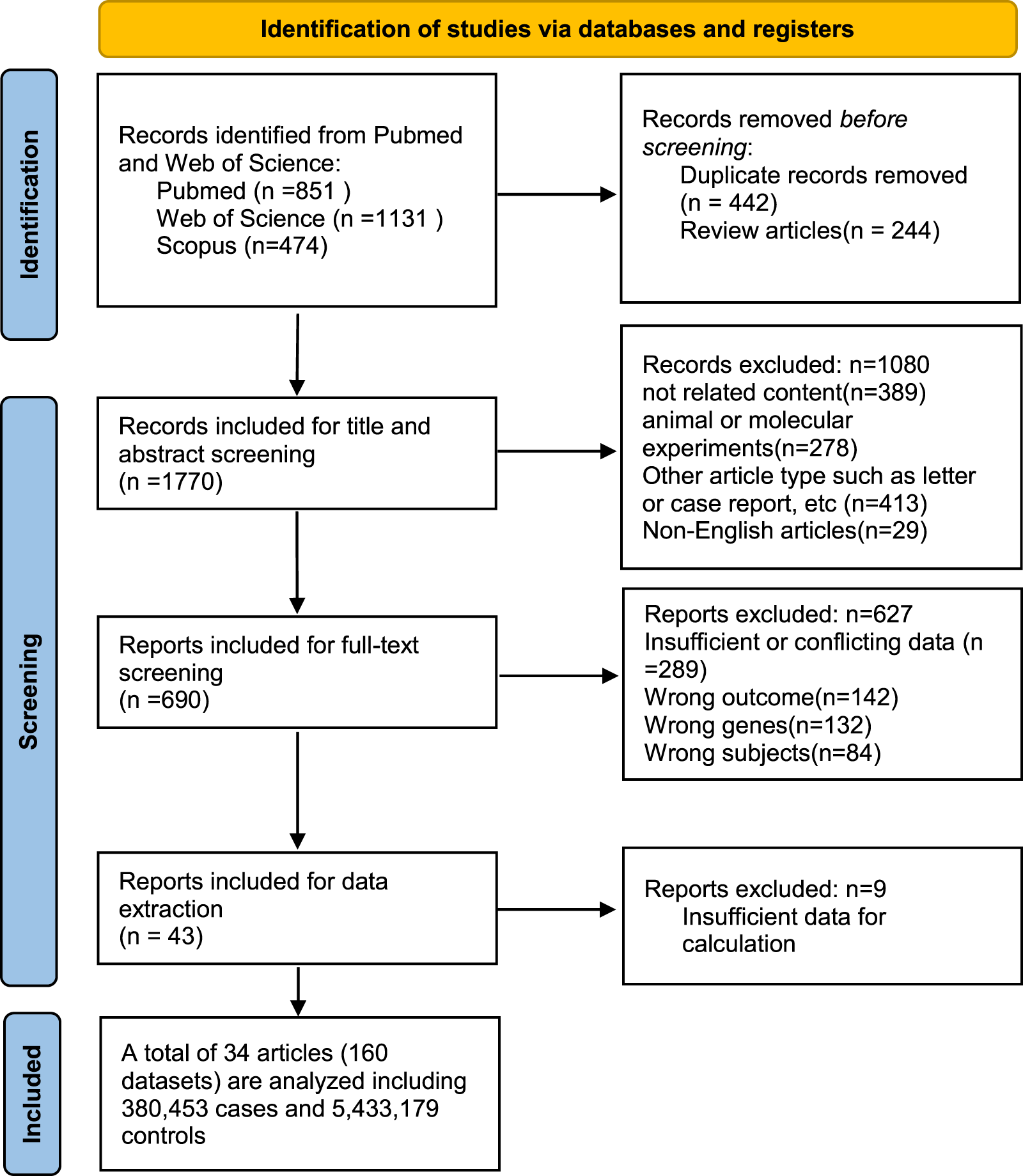
Literature search results.
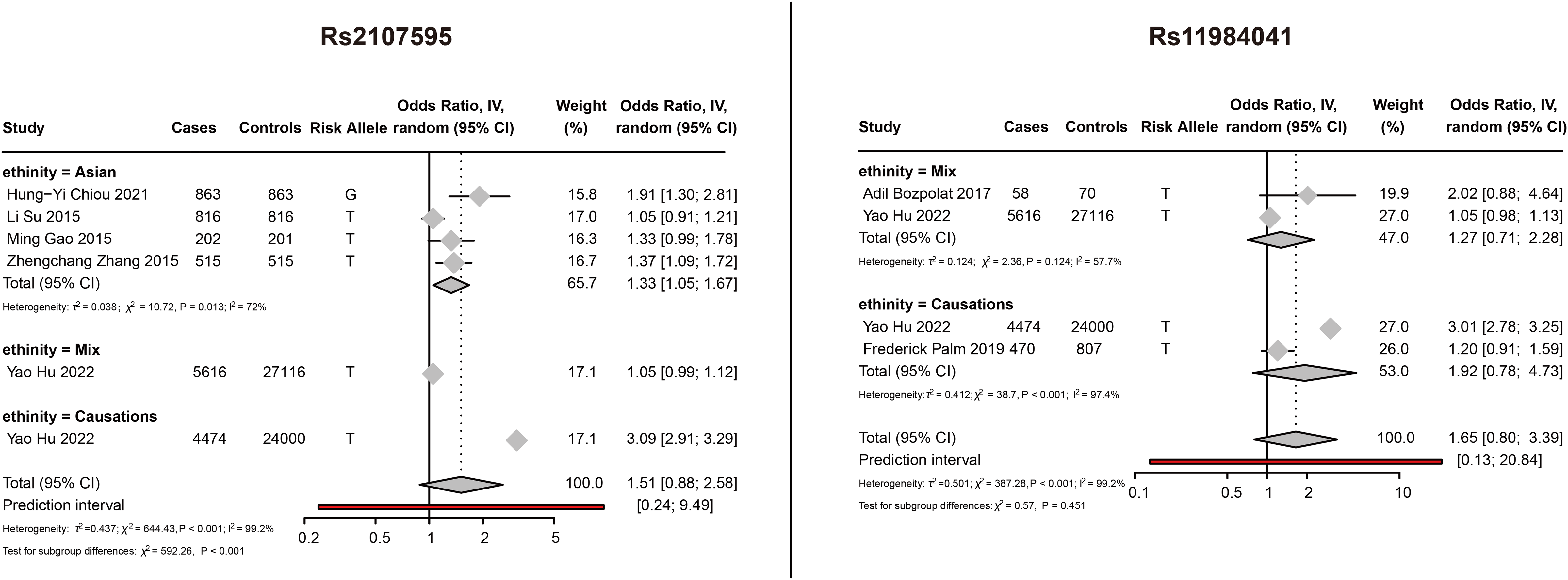
The forest plots of association between variants and ischemic strok

The forest plots of association between rs2107595 and coronary artery disease.
We conducted sensitivity analyses to assess the stability of these results ( S1-3 Figure ). The pooled ORs remained consistent for most variants, except for the association of rs11984041 and rs2107595 with IS. This finding indicates that the results were generally stable, with only a few exceptions requiring further validation. Begg's and Egger tests were conducted to evaluate small-study and publication bias ( S4 Table ). No significant publication was observed for other variants ( S5-12 Figure ). The small-study bias was identified in the association between rs2107595 and IS (P = 0.047). Owing to the insufficient data on genotype counts, the excess of significant findings could not be evaluated.
Cumulative evidence of association
The epidemiological credibility of the significant associations reported in the meta-analyses was evaluated. Venice Criteria were first applied to assess the strength of these associations where applicable. Among the evaluated variants, based on the FPRP values, two associations were graded as strong, two as moderate, and one as moderate based on these criteria (see Table 1).
Functional annotation
Seven variants with significant results from meta-analyses were evaluated and annotated putative functional effects using data from ENCODE. Of those variants, rs11984041 are located in intronic region ( S5 Table ). Rs2192476, rs11984041, and rs2107595 are potentially positioned within a region characterized by enhancer activity and the presence of a DNase I hypersensitivity site ( S5 Table ). In addition, the genetic structure of this region varied across populations of Asian, European and African ancestries demonstrated by the linkage disequilibrium (LD) plots ( S4 Figure ).
Discussion
Our analyses provide novel and comprehensive evidence to the association between variants in HDACs genes and cardio-cerebrovascular diseases. Some previous studies have been also conducted to evaluate the association between HDACs genes and cardio-cerebrovascular diseases; 7 however, these results lacked functional annotation and rarely discussed the common variants of varied cardio-cerebrovascular diseases and only limited variants and one or several sub-types of cardio-cerebrovascular diseases were paid attention. 20 We conducted a research synopsis and meta-analysis to systematically evaluate association between HDACs genes and six cardio-cerebrovascular diseases, including seven variants from 34 articles with total 380,453 cases and 5,433,179 controls. The findings could provide summary evidence on associations between variants and common sub-types of cardio-cerebrovascular diseases; furthermore, some novel correlations between different sub-types of cardio-cerebrovascular diseases would be reported plainly. Among seven variants included in our whole meta-analyses, six variants with significant results were examined using Venice criteria and FPRP tests.
HDACs genes play a critical role in the incidence and development of cardio-cerebrovascular diseases. In this study, we summarized variants of HDACs genes with more than three datasets and all those variants located near HDAC9 gene. Rs2107595, located 7.3 kb downstream of HDAC9 and GS1-465N1 was frequently studied in four diseases, including IS, , CAD, moyamoya disease, and LVD rs2107595(A) allele was related to the increased risk of these diseases.. Several studies have disclosed that HDAC9 is present in both endothelial and vascular smooth muscle cells, and the risk allele of the HDAC9 gene exerts its influence via the up-regulated expression of HDAC9. 21 As a result, the associations of the HDAC9 gene with the risk of atherosclerosis, heart attack and stroke were reported in previous studies. 22 Furthermore, multiple studies indicated that the HDAC9 gene and its SNPs play an important role in cardio-cerebrovascular diseases. It has been reported that the rs2107595 risk allele is linked to the over-expression of genes associated with interleukin-6 signaling, chronic inflammation, leukocyte recruitment, cholesterol efflux, and platelet aggregation. 23 Additionally, HDAC9 represents a pivotal gene within the pathophysiological pathways culminating in the formation of atherosclerotic plaque. 24 Our results are in line with these studies and also suggest an association of rs2107595 with cardio-cerebrovascular diseases even though the results might be varied in different ethnic population. Rs10230207, located nearby the HDAC9, FERD3L, and TWIST1 genes, was investigated frequently to be associated with IA. 25 The combined results in this study are consistent with these studies and confirmed in different ethnic populations except in Asian population. In previous studies, this variant was studied to be related to multiple cardiovascular diseases, such as atherosclerosis, 26 large-vessel atherosclerotic stroke, carotid plaques 27 and IS, 26 etc.. But in previous studies, the results might not be consistent. HDAC9, a subtype within the extensive family of HDACs, exerts a crucial influence on both pathological and physiological processes. It achieves this by interacting with tissue-specific transcription factors, thereby either repressing or derepressing target genes in specific cell types. 28 Animal experiments conducted in HDAC9 knockout and transgenic mice suggested that it might play a critical role in the development of cardiac muscle, as well as in myocyte and adipocyte differentiation. 29 HDAC9 has been also found to have effects via endothelial-mesenchymal transition (EndMT). In atherosclerosis-prone mice, the knockout of HDAC9 in endothelial cells inhibited EndMT and maintained a more endothelial-like phenotype. This finding suggested that HDAC9 contributes to vascular pathology through promoting EndMT. 30
Previous research investigated the shared genes and variants of different type of cardio-cerebrovascular diseases. In this study, we focus on HDACs genes, especially HDAC9, cluster at chromosome 7p21.1, variant rs2107595 may be the linkage of several cardio-cerebrovascular diseases in Caucasian and Asian population. Rs2192476, rs11984041 and rs2107595 potentially reside within a region exhibiting enhancer activity and a DNase I hypersensitivity site. LD plots have demonstrated that the genetic structure of this region varies across populations of European, Asian, and African ancestries. Collectively, these preliminary data imply that these variants, either directly or in association with other correlated variants, might be accountable for the associations with the incidence and progression of cardio-cerebrovascular diseases.
Limitation
There are, however, several potential limitations in this study. Firstly, although we searched three commonly used databases, some relevant studies from other sources may still have been missed. In addition, certain related publications might have been overlooked because our search strategy did not include key cardiac conditions such as heart failure, arrhythmia and cardiomyopathy. Secondly, some raw data from the original publications is inaccessible and the analysis standards across studies could not be unified. To minimize the bias, we prefer to include studies with multivariate-adjusted risk estimates. Thirdly, high heterogeneity was observed among published data in several meta-analyses. Fourthly, due to insufficient data, we were unable to assess the publication bias regarding the associations between several variants in this region and disease risks, nor could we evaluate the excess of significant findings. Finally, our meta-analysis was conducted based on the unified allele of a variant. As a result, the estimates of some variants might differ from those presented in the original articles. Nevertheless, most of these limitations are intrinsic to meta-analyses. Therefore, future studies incorporating a larger number of research works and much larger sample sizes are essential to confirm or refute these associations.
Conclusion
In this large-scale research synopsis and meta-analysis, we have identified seven variants within the HDACs genes that exhibit robust evidence of an association with the sub-types of cardio-cerebrovascular diseases. Our study provides comprehensive evidence indicating that variants in the HDACs genes are linked to the risk of common sub-types of cardio-cerebrovascular diseases. Notably, we emphasize the association of rs2107595 with IS, moyamoya disease, CAD, and LVD. However, further functional studies are imperative to explore the precise mechanisms underlying these associations across diverse populations.
Footnotes
Acknowledgments
We gratefully acknowledge all research assistants for their contribution to this study.

Ethical approval
This study is a meta-analysis, and all data used are derived from publicly available literature and datasets. Therefore, the ethical approval is not required.
Authors contributorship
Authors made substantial contributions to this manuscript as follows: conception and design of the study: authors ZZQ and GDQ, data acquisition and analysis: GDQ, LR and DKW, drafting the article: ZZQ, GDQ, and LR, revising it critically for important intellectual content: HB and CWZ.
Funding
Work of this study is supported by the research fund of science and technology department of Sichuan Province (24NSFSC5345).
Declaration of conflicting interests
None.