







Abstract
This article presents the attitudinal response of rural villagers in Papua New Guinea to mobile telephony, based on a threshold study made during the early stages of its adoption. The research indicates that the introduction of mobile telecommunications has generally been viewed positively, with mobile phones affording social interaction with loved ones. Nonetheless, negative concerns have been strongly felt, notably financial costs and anxiety about mobile phones aiding in the coordination of extramarital liaisons and criminal activities. The communities investigated previously had scant access to modern communication technologies, some still using traditional means such as wooden slit drums, known locally as garamuts. The expansion of mobile network coverage has introduced into communal village life the capability to communicate dyadically and privately at a distance. Investigation into the adoption of mobile phones thus promotes understanding about traditional means of communication and notions of public and private interactions.
Keywords
Introduction
The voice of a traditional communication drum can be heard over great distances, but in contemporary Papua New Guinea (PNG), it is hearing the voice of a loved one living far from home for work, marriage, or studies which brings greatest delight. Before 2007, most of PNG had no form of telephony. Apart from radio, modern communication forms were restricted to the urban areas where only a small percentage of the people reside. Such devices as landline telephones, television, Internet, or facsimile machines have never reached the majority of inhabited areas.
However, a mixed system of market competition with public and private providers was introduced to the mobile telecommunication sector from July 1st, 2007, resulting in a rapid extension of mobile network coverage to rural areas. This article reports on a threshold study conducted during that earliest stage of mobile phone adoption. It examines the role of mobile telephony in rural communities in PNG, with emphasis on the reported experience and attitudes expressed by rural villagers.
PNG, situated east of Indonesia and north of Australia, though culturally rich (Reilly, 2004, p. 480), remains a developing country (Watson, 2011b, p. 170; Watson, 2012, p. 44), even while the economy is growing, largely due to resource extraction (Gouy, Kapa, Mokae, & Levantis, 2010). There are approximately seven million people (Australian Government, 2014), mostly living in rural areas (Watson, 2011b, p. 170; Watson, 2012, p. 44), where there is often very limited access to services, including transport, health, education, or banking. Until 2007 such regions fell outside of mobile phone coverage.
In the years when smartphones were taking off in Japan and Korea, most people in PNG were only just starting to gain initial access to telephony. When field research for this study was being conducted (2009), nearly half of the adults surveyed owned a mobile phone; in most cases, cheap, basic handsets. PNG as one of the last countries to achieve widespread mobile phone coverage is an opportune field for research. The developed nations and most of the developing world took up mobile telephony as a “greenfields” experience, but the next phase, digitisation, was launched against a background of far-reaching experience of the medium. PNG can still show initial impacts of mobile telephony per se. In adjusting immediately, as well, to advanced global systems, it may provide a rare window on early effects of mobile phones on human societies. This article on mobile phones during early adoption in rural PNG will provide a theoretical framework, introduce the research design, outline the results, discuss the findings in relation to the body of literature on mobile phones in PNG and elsewhere, and offer conclusions.
Theoretical basis for study
Communicative ecology is defined by Tacchi, Slater, and Hearn as the range of communications in a given setting (2003, p. 15). The concept includes “the complete range of communication media and information flows within a community” (Horst & Miller, 2006, p. 12), such as mass media and traditional communication. Studying the mobile phone in isolation would not adequately convey the “repertoire of communications skills and resources” (Tacchi et al., 2003, p. 15).
Traditional communication methods vary across PNG. In Madang Province, a key method involves drumming on a large, wooden drum or slit gong (Leach, 2002) known locally as a garamut. 1 This instrument is made from a “hollowed tree trunk” (Blades, 1975, p. 44; also Herzog, 1964, p. 313; Leach, 2002, p. 713) which has, when struck with a wooden stick, “a resonant sound with considerable carrying power” (Blades, 1975, p. 44), reaching many kilometres in favourable conditions (Leach, 2002, p. 718). These have often been used “to communicate over distance utilising a series or code of beats” (Leach, 2002, p. 715), and for centuries have “enabled limited messages to travel very rapidly over great distances” (Unwin, 2009a, p. 17). The continued use of the garamut in some parts of Madang Province provides an aspect of continuity to the introduction of the mobile phone. Through using the garamut, people in many parts of Madang Province “have never actually needed to move physically to be able to communicate with one another” (Unwin, 2009a, p. 18), so “very rapid communication over considerable distances is not a particularly new concept” (Unwin, 2009a, p. 18).
However, while mass media provides an opening to the world (Hamelink, 1995, p. 2), “for most people even this is not available since they live in rural poverty without electricity supply, movie theatres or transmitters” (Hamelink, 1995, p. 2). That gap in access to media and communication technologies demonstrates the “digital divide” between those who do, or do not have access to modern communication technologies (van Dijk, 2005, p. 1). Residents of rural parts of PNG and other developing nations have missed many stages of technological development (see Harvey, 2000, p. 62; Unwin, 2009a, p. 19).
Most of rural PNG continues to be without landline telephones, a postal service, or an electricity grid. The latter is highly expensive (Day & Greenwood, 2009, p. 331), while constructing mobile phone towers costs far less than laying landline telephone cables (Donner, 2008b, p. 33; Levinson, 2004, p. 126; Srivastava, 2008, pp. 15, 23).
This article foregrounds a two-way interaction between technology and society—an approach advocated by the leading mobile phone scholar Jonathan Donner (2008a, p. 143) and used in other mobile phone literature (e.g., de Bruijn, Nyamnjoh, & Brinkman, 2009b)—in an effort to understand effects of a foreign technology entering a set of village societies, while also considering how those societies utilise the new tool for their own purposes.
Much early mobile phone research was conducted in the developed world (Donner, 2008a, p. 140; Goggin, 2006, p. 13; Goggin & Newell, 2006, p. 155; Kavoori & Chadha, 2006, p. 227). As with previous technologies (Levinson, 2004, p. 121), mobile phones were widely available in the developed world much earlier than in developing nations (Goggin, 2006, p. 1; Hawk & Rieder, 2003, p. xi; International Telecommunication Union [ITU], 2010). Developing nations have experienced significant growth in mobile telecommunication markets, particularly since 2000 (ITU, 2010), but the Pacific region, including PNG, has lagged behind that trend.
Many mobile phone studies have found that users identify social uses of mobile telephony as amongst the most important (Aakhus, 2003, p. 30; Bakke, 2010, p. 365; Bell, 2005, pp. 71–72; Donner, 2008a, p. 150; Heeks, 2008; Johnsen, 2003, pp. 163–166; Law & Peng, 2008, p. 55; LIRNEasia, 2007; Pelckmans, 2009, p. 30; Souter et al., 2005; Walsh, White, & Young, 2007, p. 126), over and above business uses or other ostensibly more functional practices. This finding goes against expectations in some literature that mobile telephony will aid in business success, job-seeking, and income generating activities (e.g., Belt, 2008; Brinkman, de Bruijn, & Bilal, 2009, pp. 74, 87; “Calling an End to Poverty,” 2005; Jensen, 2007; “Less is More,” 2005; Mariscal & Bonina, 2008, p. 76; “To Do With the Price of Fish,” 2007). Insightful papers on mobile phones in PNG have been published in recent years (Andersen, 2013; Groupe Speciale Mobile Association [GSMA], 2014; Jorgensen, 2014; Lipset, 2013; Logan, 2012; Singh & Nadarajah, 2011; Sullivan, 2010; Suwamaru, 2014; Telban & Vavrova, 2014; Temple, 2011; Yamo, 2013) and as will be outlined in the Discussion section of this paper, these in the main support the findings of this study.
Research design
In setting out to determine the roles of mobile phones in the “communicative ecologies” of rural villages in PNG, this research addressed the attitudes, behaviours, and experiences of people and communities during the earliest phase of adoption. It sought to identify changes in social relationships or economic activities. The key research question was: What are the roles of mobile phones in the “communicative ecologies” of rural villages in PNG? Ethical clearance for the study was granted by the research ethics committees of two universities 2 and consent processes adhered to both standard accepted practice and locally appropriate protocols. 3 The approach was characterised by flexibility, appropriate in the situation where the research subjects represent diverse cultural tendencies, live in rather inaccessible places, have no experience as research participants, and may be unable to read survey documents.
The research engaged two methods: the survey method and interviews. Using a combination of these two methods enhanced the findings, as “interviews and survey responses may provide different lenses on people’s perceptions of some particular event or state of affairs” (Irwin, 2008, p. 415). Data collection took place in 2009 across 10 villages in three districts of Madang Province, employing 748 individual orally administered survey questionnaires and semistructured interviews with 17 people. The map in Figure 1 shows the locations of the villages in this study, and the town of Madang, the only urban centre in the province (also named Madang), where services such as public phones and banking are available.
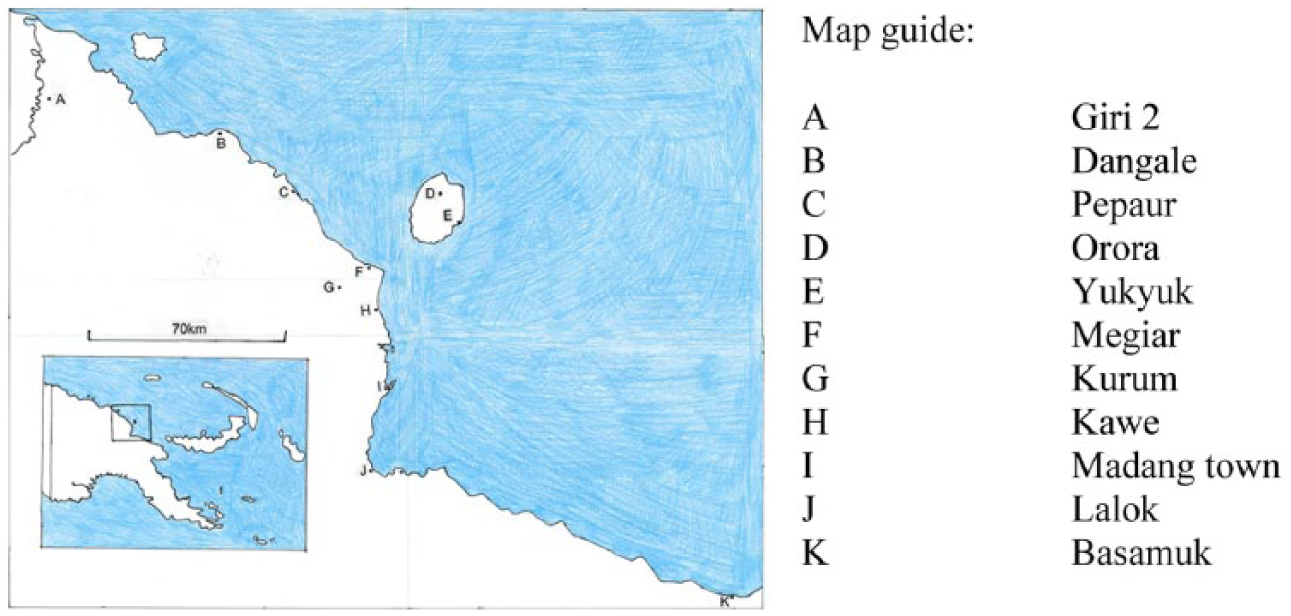
Map of Madang Province field sites.
The primary author administered survey questionnaires in two villages: Orora on Karkar Island and Megiar on the mainland coast (see Watson, 2011b). Complementing this work, eight trained research assistants selected from amongst full-time, undergraduate university students from Madang Province conducted survey research in their home villages (see Watson, 2013).
Data collection instruments were designed to gather information on mobile phone ownership; usage; usage motivations; attitudes towards mobile phones; media access and usage; 4 and computer, email, and Internet access and usage. Both, the survey questionnaire and interview guides, were pretested in Madang town. The survey questionnaire designed for this research included both quantitative and qualitative questions such as closed, 5 numerical, 6 and open answer questions. 7
All survey questionnaires were administered verbally in Tok Pisin, a common language across PNG 8 and the answers were written down by the researcher. Respondents were chosen informally, appropriate in a village setting, although an effort was made to ensure that the sample each time was representative of the population, regarding age range, mobile phone ownership, gender, and housing location. In Orora and Megiar, information was obtained from nearly every household; the other villages were generally small so the coverage there was similarly thorough.
The interviews were semistructured, designed to be flexible and responsive; most were in Tok Pisin, some in English, and all were audio recorded and later transcribed. Of the 17 interviews, seven were in villages, four were with senior managers of PNG telecommunication companies, and six with other such informed respondents. Questioning consistently focused on the expansion of mobile phone service across PNG since 2007 and the person’s experiences and opinions of this phenomenon.
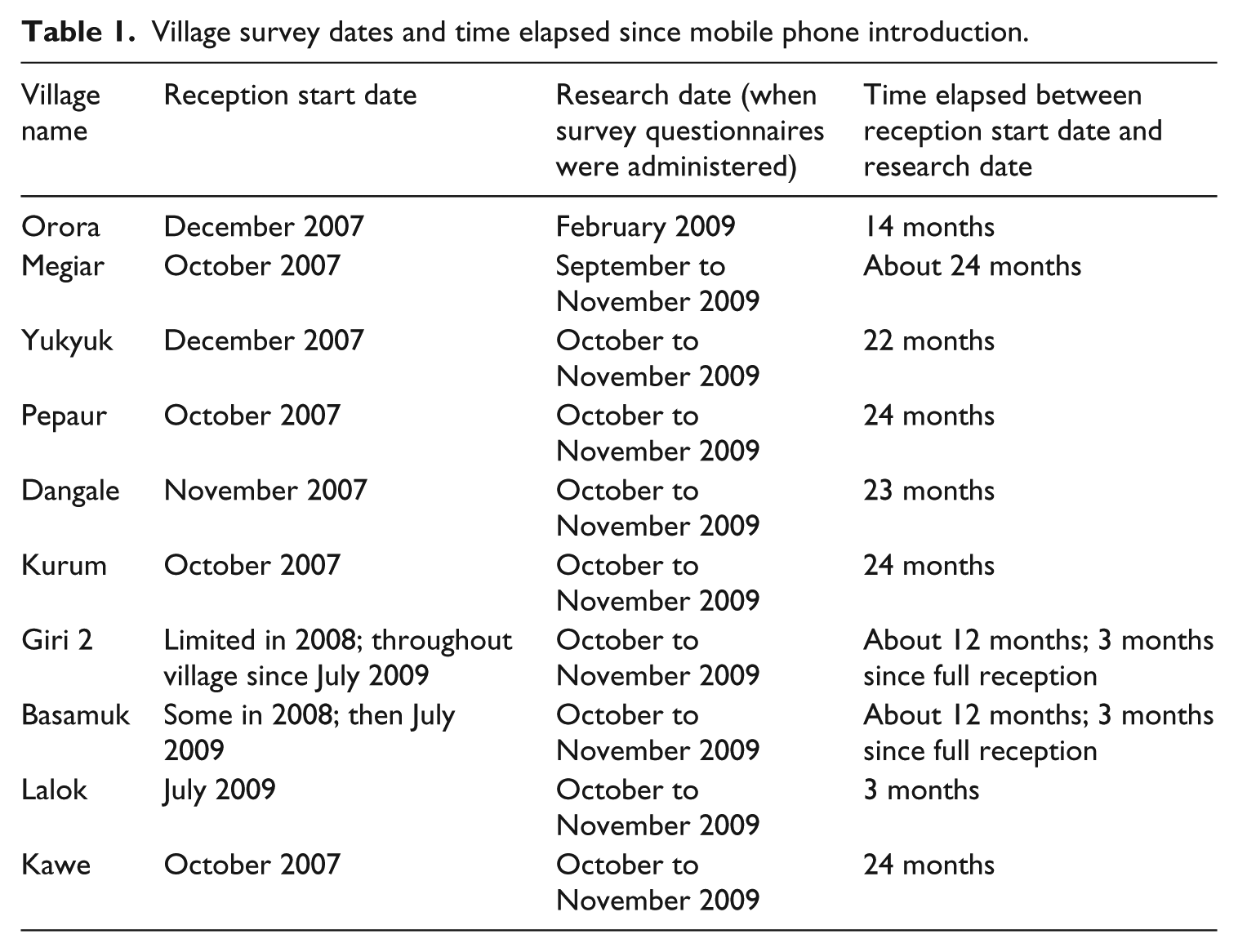
The research occurred in the early stages of mobile phone adoption. Table 1 shows the dates when each village gained mobile phone reception and dates of the survey research.
Village survey dates and time elapsed since mobile phone introduction.
The primary author spent time in two villages, Orora (nine night stay) and Megiar (daily visits over a fortnight, then seven night stay), behaving in culturally appropriate ways and watching the use of mobile phones and other communication means by community members. Through the research interviews and observations, rich data were available; and keeping data specifically on these two villages accords with the local worldview, entailing a strong identification with the home village (Vallance, 2007, pp. 6–8). For these reasons, reporting of certain findings will refer only to Orora and Megiar, as distinct from the eight villages where research assistants conducted surveys.
Results
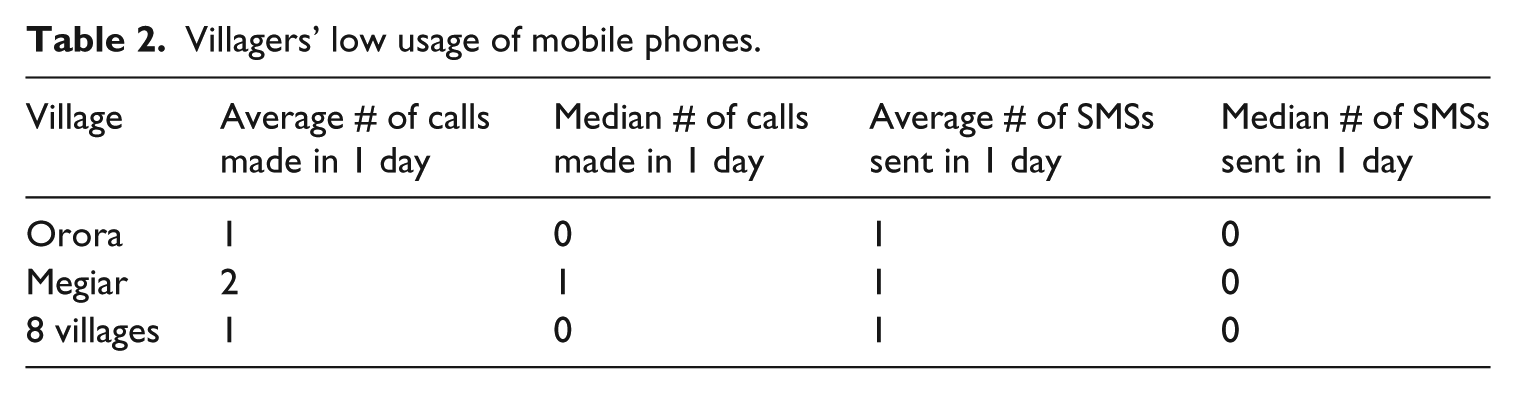
None of the 10 villages under study has ever had landline telephone infrastructure, so the research on mobile phones documents the first ever access there to any kind of phone. About half the respondents owned a mobile phone (25.0% in Orora, 50.0% in Megiar, and 50.2% in the other villages). However, there was low usage overall, when looking at calls and text messages on the day preceding interview, as shown in Table 2.
Villagers’ low usage of mobile phones.
Most commonly, relatives in PNG urban centres were phoned, usually to check on the recipient’s wellbeing, so for social reasons only. None of the mobile phone owners had used BSP (Bank of South Pacific) SMS (short message service) banking, the only mobile banking service in PNG at the time. 9 Most handsets used were basic models suited to low income customers, lacking advanced capabilities like Internet surfing or video capture; the most popular being the Nokia 1200 or 1202 series.
Survey respondents were asked to assess their usage of handset features. The most popular were: the torch, sending and receiving credit, checking the time, the alarm clock, the calendar, games, and the calculator. Very few owners had used a handset camera (not asked, nor observed in Orora, 7.8% of owners in Megiar, and 6.6% of owners in the remaining villages). Almost no-one had accessed the Internet through their mobile device. People found it difficult and often costly to recharge the batteries in their mobile phone handsets.
Respondents who were not mobile phone owners reported use of phones (46.3% of nonowners in Orora, 43.1% in Megiar, and 36.7% in the other villages), but tended to ring rarely, less than five times monthly. They usually used relatives’ mobile phones, free of charge. When asked to pay, they most often bought their own flex card (mobile phone credit) to key into the handset.
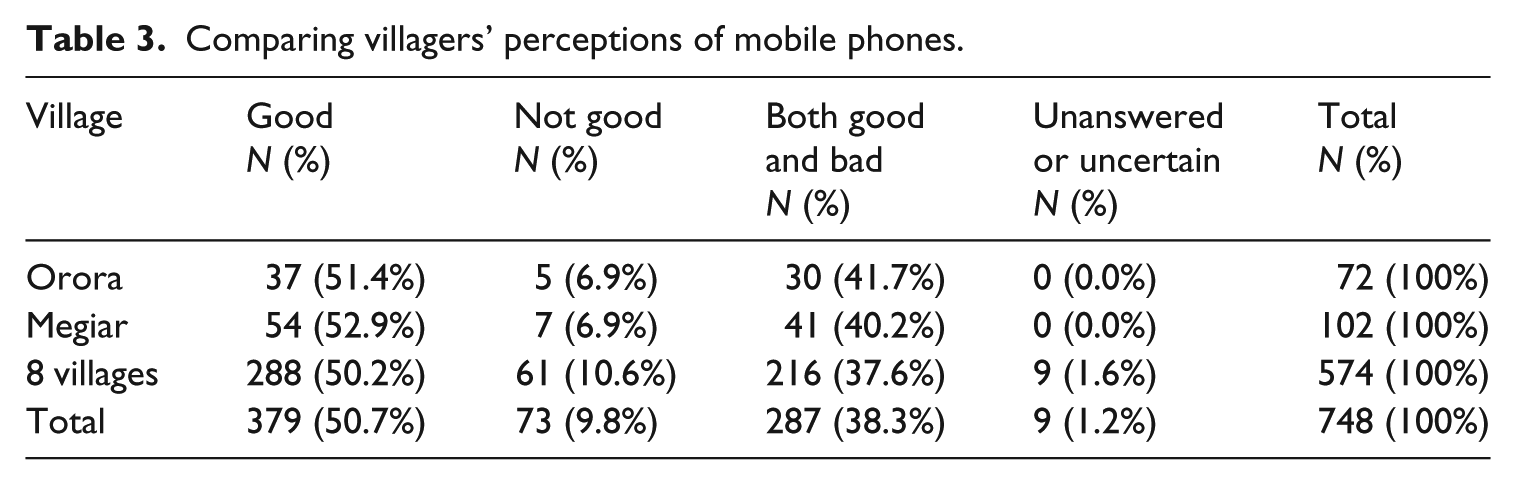
Asked whether they thought the introduction of mobile phones was a positive or negative development, responses were similar for each village. About half said the new service was beneficial, a small number were negative, and a sizeable group expressed mixed feelings (see Table 3). A Pearson chi-square test was performed (Moore, McCabe, & Craig, 2009, p. 531) to see if the proportions differed between Orora and Megiar. This test showed no evidence of any differences between the two villages (p-value > .95). A Pearson chi-square test was then performed to see if the proportions differed between two samples: the eight villages sample group and the combined data from Orora and Megiar. This indicated no evidence of any differences in proportions between the two sample groups (.4 > p-value > .3). Thus research in the 10 villages generally found the same attitudes about mobile telephony.
Comparing villagers’ perceptions of mobile phones.
The most common benefits of mobile phones were seen as social. It is now easier to talk to family members and friends who are far away, and communication in general is easier and quicker. The social value of the mobile device far outweighed the perception of other benefits, such as use in emergencies and business transactions. The most common negatives expressed were the same for all 10 villages: concerns about the cost; beliefs that use of these devices was causing more adultery and sexual promiscuity; and concerns that criminals might use mobile phones to plan illegal acts such as roadside hold-ups.
In Orora, the researcher frequently heard rhythms being beaten on garamuts, indicating regular, almost daily use for messaging. Specific rhythms indicate particular, differing messages. Local leaders and interview participants likened the garamut to the mobile phone.
The garamut is the mobile belonging to the people of Papua New Guinea. And the mobile which has come in now, it comes from you people. . . . So now if you’re in Australia, I will be able to contact you easily. . . . The garamut is ours, it is our mobile phone. If we want to ask everyone to come to work, attend a meeting or a gathering and so on. . . . We’ve got a garamut and if we drum it, everyone will come and gather.
10
(Interview respondent, 2009)
When the garamut is used to call people together, the particular timbre of the garamut can indicate to whom the message applies. Orora has five clans within the village, and different drums, with different sounds, for each clan. An integral part of the communication system based on the garamut is that individuals can recognise their own instrument at some distance. A person hearing their own garamut being beaten may understand this as a signal to hurry home. One interviewee said the garamut was called a village mobile phone because of that. Each had their own garamut signal, or “mobile phone number,” although, many others would know when they were getting a “call”:
If it’s a mobile, you have to contact one person and speak to them. When the garamut is beaten, everybody hears it at the same time. So people down at [other villages], if the garamut is beaten at my house, my compound, everybody around Orora and down at the school . . . can hear and say “alright, that’s the message,” or “they’re calling for help” or “they’re celebrating something” or “there is a death.” (Interview respondent, 2009)
The garamut is no longer used for communication at Megiar, though it can still be used to provide the beat for the music at a traditional song and dance performance. The reasons why it was discontinued for messaging, which predated the introduction of mobile telephones, are unclear. One Megiar interviewee suggested that the garamut had not been used as a communication tool since about 1970, with none constructed since then. He wondered if the construction of a road network might have caused the garamut to fade from daily life. In the remaining eight villages where research was conducted, data was not collected on traditional communication techniques.
In eight of the 10 villages, mains power supply was not available at the time of the research. Megiar and Kawe village had mains power, although not all homes were connected. Most of the respondents did not have electricity at home (97.2% without in Orora, 68.6% in Megiar, and 83.3% of others). Of those with electricity, the most common power source was a generator, although not all had fuel for the generator at the time of the survey. A small number of homes had solar panels. The use of kerosene lamps for lighting was extremely common (98.6% in Orora, 66.7% in Megiar, and 88.2% in the other villages).
The survey established that villagers had limited access to media and extremely limited access to computers. No-one had a landline phone or Internet connection at home. Very few had a computer at home (0.0% in Orora, 5.9% in Megiar, and 1.2% elsewhere). A few had a television set at home (0.0% in Orora, 7.8% in Megiar, and 7.7% elsewhere), getting a satellite service or peripheral reception from town. Radio was the most popular established medium (among respondents who had listened to the radio within the last month, 37.5% in Orora, 60.8% in Megiar, and 75.8% in the other villages surveyed); an outcome consistent with other research on the importance of radio in PNG (InterMedia, NBC, ABC International Development, & AusAID, 2012, p. 10). Few people regularly read newspapers (percentages who had read a newspaper within the last month, 15.3% in Orora, 69.6% in Megiar, and 40.4% elsewhere). Newspapers generally are not delivered in rural areas of PNG (InterMedia et al., 2012, p. 10). There was very limited usage and little understanding of computer-based communication technologies (respondents who had used a computer, Internet, or email within the last month: 0.0%, 0.0%, and 0.0% in Orora; 7.8%, 2.0%, and 2.9% in Megiar; and 3.0%, 1.2%, and 1.0% elsewhere, respectively).
Discussion
This research records the first uptake of mobile phone technology in communities, all the findings conditioned by that fact. Further, uses and impacts of mobile phones identified in the study are those of a community making first contact with a technology in a developed form—digital with several capabilities and functionalities. In most countries mobile phone use is already pervasive, so comparable opportunities to understand a fresh impact of the technology have been lost.
Since this 2009 field work, several other studies have been published, which in the main support the findings of the present research. Regarding positive perceptions, communication with relatives far away is mentioned in several articles (see following lines) and emergency use of mobile phones is cited (GSMA, 2014, p. 23; Sullivan, 2010, p. 9; Yamo, 2013, p. 83). Two papers suggest that increased access to mobile telephony could empower women (GSMA, 2014; Logan, 2012, p. 8), although they are less likely to own handsets than males in their families (GSMA, 2014, p. 5; Watson, 2011b, p. 174; Watson, 2013, p. 166). It is suggested that increased access to mobile phones, the Internet, Facebook, Twitter, and other forms of social media could increase political engagement through greater transparency, a new sense of collective political identity, and participation of more people in democratic debates (Logan, 2012). Mobile phone services also may be used in development work (Watson, 2014), including in the health (Suwamaru, 2014; Yamo, 2013) and education sectors (Suwamaru, 2014).
Regarding negative concerns, three articles discuss high costs of mobile telephony for people in PNG (GSMA, 2014, pp. 5, 40; Singh & Nadarajah, 2011, p. 6; Sullivan, 2010, p. 9), three mention concerns about criminals utilising mobile phones (GSMA, 2014, p. 39; Lipset, 2013, pp. 344, 350; Sullivan, 2010, p. 10), and several articles discuss concerns about marital discord (Andersen, 2013, pp. 323, 329; GSMA, 2014, pp. 5, 30–39; Jorgensen, 2014, pp. 9–10; Lipset, 2013, pp. 344–345; Sullivan, 2010, pp. 9, 10; Watson, 2011b, p. 176). Other negative concerns raised in the literature include students being distracted at school (Sullivan, 2010, p. 11; Watson, 2011a, pp. 178–180, 249; Watson, 2013, p. 165), lack of electricity for recharging mobile phone handset batteries (GSMA, 2014, pp. 30–31, 38–40; Sullivan, 2010, p. 10; Yamo, 2013, pp. 96–97), and phone handset keypads inadequate to accommodate tonal languages in text messaging (Temple, 2011, p. 61).
This study adopts the communicative ecology concept to understand the place of mobile telephony within the broader communication context in each setting. It is highly useful to the researcher that understanding the context or the “communicative ecology” will help to understand mobile phone use. For example, kerosene lamps in regular use, give only a soft light and are awkward to carry; therefore people appreciate having torches (or flashlights) in their mobile phone handsets when walking at night (also Telban & Vavrova, 2014, p. 226).
In the villages studied, modern communication forms were not widely accessible or commonly used. As outlined before, the surveys confirmed that villagers had limited access to media and especially to computers, with little understanding of computer-based communication technologies such as Internet or email (see also Temple, 2011, p. 61). The introduction of mobile telephony represents the first major shift in these communicative ecologies since radio began in PNG several decades earlier (see Issimel, 2011, p. 148; Nash, 1996).
Through having almost no access to mass media and modern communication devices, PNG rural areas have been situated on the far side of the “digital divide.” The introduction of mobile network coverage has begun to alter that, with people in these places “leapfrogging” (Sanzogni & Arthur-Gray, 2006, p. 671) the telegram, the pager, public phones, and landline telephone infrastructure; becoming able to use portable, digital communication devices in their rural home settings.
Contrary to a dominant view generated by a body of literature that communication technologies will lead to economic improvement (for more information, see Unwin, 2009b, p. 1; von Braun & Torero, 2006, pp. 4–5; Weigel, 2004, p. 16), poverty reduction was not a perceived benefit mentioned by villagers, at least not in the early days of mobile phone uptake. Services offered by financial institutions had not been adopted by rural villagers at the time of the field research, although people frequently used mobile phone credit facilities, thus demonstrating a propensity of communities to adapt to technology for their own purposes. While this study found very little increased income generation or business uses of mobile phones, later studies have identified this possibility (GSMA, 2014, p. 22; Sullivan, 2010, p. 21; Suwamaru, 2014, p. 1).
Social uses of mobile phones, not to do with business or obtaining services, have been repeatedly referred to by users as the main benefit of mobile phone access. Thus, the research adds weight to mobile phone studies which suggest the primary advantages of mobile phones in many settings are for social interaction among loved ones, particularly those residing far away (findings from other countries were listed earlier; in PNG, see Andersen, 2013, p. 319; GSMA, 2014, p. 22; Jorgensen, 2014, p. 3; Lipset, 2013, p. 341; Singh & Nadarajah, 2011, p. 6). In rural PNG, the mobile phone provides people in marginalised communities with a much-appreciated ability to communicate more widely. Communication itself is plainly an important gain for respondents, countering the lack of modern communication tools up until 2007.
Network coverage is very clear all the way right into the very rural villages, where it used to be very hard for years. . . . And they can speak to the world too. So communication is very important now. (Interview respondent, 2009)
Miller and others have argued that communication itself should be viewed as an essential human need (Douglas & Ney, 1998, pp. 46–73; Harms, Richstad, & Kie, 1977; Horst & Miller, 2006, pp. 2, 89, 173; Miller, 2006, pp. 41, 47–48), so studies should include “the evaluation of communication in its own right” (Miller, 2006, p. 41). Consistent with that, this research has found many respondents who see getting access to mobile phones as primarily an opportunity for reaching out to communicate with others, an important, intrinsic benefit. The new technology was viewed much less as a means for addressing more “pragmatic” needs like obtaining additional income or material goods.
Here might be considered Lipset’s “attributes intrinsic to the new technology” (Lipset, 2013, p. 336) which enable new ways of interacting with others, as with private communication, not previously possible in many PNG village communities. In modern PNG, most families are split between the home village and the nearest town (Jorgensen, 2014, p. 3; Watson, 2011a, p. 239). The mobile phone has helped to link family members in these two locations, and this key aspect of communication was prominent in the research data.
So communication, enhanced, might adopt new forms. A common practice of people dialling random mobile phone numbers, hoping to make new acquaintances has been explored in two key papers (Andersen, 2013; Jorgensen, 2014) and mentioned elsewhere (GSMA, 2014, p. 31; Lipset, 2013, p. 350; Sullivan, 2010, pp. 10, 23; Watson, 2011a, pp. 169–170). Having private communication creates an opportunity to dissemble and present a “new” persona, where, “the lure of the phone friend operates by disguising social differences as well as through the contraction of physical distance” (Andersen, 2013, p. 331).
At this point, Anderson identifies an emotional edge to the new situation, where people indicate enjoyment at being able to talk privately, and from far away. Due to the difficulties and costs of travel, “the mobile phone’s capacity to facilitate intimate contact across geographical and social distance is perhaps particularly exciting in PNG” (Andersen, 2013, pp. 318–319). The privacy factor is seen as an important advantage of mobile phones (Jorgensen, 2014, p. 3), particularly for young people in rural, communal villages, looking to form new friendships without the oversight of elders (Jorgensen, 2014, p. 11; Watson, 2011b, p. 173). Obviously it can be a source of tension as well, where there may be anxiety among the older generations about loss of long-standing controls.
In this project, the first use of the mobile phone as a metaphor for the garamut was by an informant in Orora (Watson, 2010, pp. 117–118). Both devices have played an important role of connecting people within family, extended family, and community networks. In fieldwork by Sullivan in the Sepik area, an informant wondered whether garamuts would continue to be relevant in the wake of spreading mobile phone reception (2010, p. 9). Telban and Vavrova argue, also with reference to the Sepik, that the phones should not be seen simply as “‘modern’ replacements” (2014, p. 226), because garamuts were viewed as more than material instruments, rather as “powerful spirits, with their own names” (2014, p. 226). Further research in PNG village contexts may determine whether penetration by mobile phones will reduce the use of traditional communication methods. Such discussion might help to identify any large and enduring impacts on culture and on daily living.
Not all communication via garamuts is public. A message might be for one person or for one particular clan (Telban & Vavrova, 2014, p. 226; Watson, 2010, p. 118; Watson, 2011a, p. 100). Likewise, not all communication through mobile phones is private. For example, a villager can use the loudspeaker function for others to listen in (Telban & Vavrova, 2014, p. 228; Watson, 2012, p. 45). Nonetheless, communication using garamuts tends to be more public. They are private in the sense that knowledge of them is traditionally owned by particular men (not women) and shared by a kinship group, but everyone in the community might hear the garamut beats and interpret their meaning.
Mobile phones have introduced the ability to conduct communication at a distance in private. The communication will be dyadic, in that sense alone more private than the garamut. Telban and Vavrova address complexities involved in this comparison, explaining how in the Sepik society of Ambonwari village, secrecy formed an important part of traditional practices (2014, p. 228) and garamuts were part of a secret sphere of senior male leaders. The secrecy of traditional rituals is described as comparable to the private nature of mobile phone calls and the secret storage of mobile phone numbers (Talban & Vavrova, 2014). One change in the movement from the earlier technology to mobile phones will be that both genders are eligible to speak through the latter. Despite differences between mobile phones and communication drums, both are mediums which help to fulfil an enduring human need for communication.
On the evidence available now it might be surmised that in future, increasing use of mobile phones may well invoke change in society. If not the potentially shattering impact of “first contact” with Europeans and their possessions, it would see involuntary shifts in social relations. The instance is given of the change from garamut to phone, as a manifestation of a shift from public to private social interactions. Further, disruptive sexual relations would form part of the same dynamic. In both situations persons once susceptible to being regulated in their behaviour within the community, might now act privately and individualistically—a situation very likely to have social consequences.
The garamut met communication needs in an effective manner during earlier times as its voice was heard over a wide area and it conveyed key messages quickly. In a previous era, the garamut’s voice reached far enough to encompass all the members of the extended family group. In contemporary PNG, as families find themselves dispersed across the nation, the mobile phone fulfils a felt need to be able to keep in touch and check up on one another. Both devices would have shortcomings. The drum did not afford people a means of private communication and its use has died out in many places. The mobile phone enables communication over greater distances and fits in with the literacy and numeracy taught in schools, but it does not operate without the availability of some form of electric power. Nor, not even with the advent of “social media” in the offing (Logan, 2012), can it be expected to directly broadcast community-wide messages. The two are not the same but the mobile phone has not entered a void; instead it has joined communities where people have been using their voices for centuries.
Conclusion
This research was undertaken during the very early days of mobile phone network expansion in PNG. During fieldwork in Orora in 2009, the researcher was told by the elderly matriarch of the host family that she remembered when the first metal axes came to the village. In her lifetime, she has witnessed Orora change from being, as it were, literally in the “Stone Age,” to being within the coverage area of handheld devices that enable conversations with people worldwide. Under observation for this study, the response of village people to the arrival of mobile phones has been to adapt. They have depicted themselves as adopting and applying the new technology by stages, to absorb it into the pattern of daily life.
Some scholars argue that “society and technology are interdependent” (de Bruijn, Nyamnjoh, & Brinkman, 2009a, p. 11), meaning that “the way in which the phone has been integrated into society cannot be separated from the specific culture, economy and history of a society” (Nkwi, 2009, p. 51; also Pfaff, 2009, p. 139). This article similarly envisages a two-way model in which community members remake technology for their own purposes. It foregrounds the attitudes of villagers and examines their communicative ecologies. It also draws on previous technology research, including notions of digital divides and leapfrogging. Overall its findings are supported by the body of literature on mobile phones in PNG. Some differences exist particularly over the potential for economic benefits and business uses of mobile phones, not observed in this study.
As this research was conducted at such an early stage of mobile phone adoption, it would be opportune to revisit the villages to ascertain how communication practices and attitudes towards and uses of mobile phones might be evolving. The current findings provide firm information about the uptake and use of mobile phones in broader communication settings. For example, community leaders in Orora were observed to be still using communication drums often to convey messages in 2009, and potential exists to monitor whether the new telephony might affect that practice over time.
The article provides information about the diffusion of mobile phones in rural areas of PNG in the context of local communicative ecologies, including people’s access to and use of mass media and traditional communication techniques. During the early adoption period, villagers were adjusting to a change from public communication forms to the capability to communicate privately, and this was already causing some unsettling of social mores. It might be surmised that essential changes may follow, for example from public and consensus-based resolution of social differences, towards more private practices. The research may be regarded as offering universalistic insights into the experience of “early adopters,” when much that happened in the rush to take up mobile telephony elsewhere, may have gone unrecorded.
Footnotes
Acknowledgements
The authors thank the community leaders and villagers where the research was conducted. The authors sincerely appreciate the contribution of the research assistants. A version of this paper will appear in L. E. Dyson, S. Grant, M. Hendriks. (Eds.). (2015). Indigenous people and mobile technologies, Routledge.
Declaration of Conflicting Interests
The author(s) declared no potential conflicts of interest with respect to the research, authorship, and/or publication of this article.
Funding
The author(s) disclosed receipt of the following financial support for the research, authorship, and/or publication of this article: This work was supported by an Australian Postgraduate Award and an Endeavour Research Fellowship.