







Abstract
The emergence of location-based real-time dating (LBRTD) apps such as Tinder has introduced a new way for users to get to know potential partners nearby. The design of the apps represents a departure from “old-school” dating sites as it relies on the affordances of mobile media. This might change the way individuals portray themselves as their authentic or deceptive self. Based on survey data collected via Mechanical Turk and using structural equation modeling, we assess how Tinder users present themselves, exploring at the same time the impact of their personality characteristics, their demographics, and their motives of use. We find that self-esteem is the most important psychological predictor, fostering real self-presentation but decreasing deceptive self-presentation. The motives of use—hooking up/sex, friendship, relationship, traveling, self-validation, and entertainment—also affect the two forms of self-presentation. Demographic characteristics and psychological antecedents influence the motives for using Tinder, with gender differences being especially pronounced. Women use Tinder more for friendship and self-validation, while men use it more for hooking up/sex, traveling, and relationship seeking. We put the findings into context, discuss the limitations of our approach and provide avenues for future research into the topic.
Back in 1994, around the time when Match.com was registered as the first dating website, online match-making seemed more likely to belong in a Hollywood movie (such as You’ve Got M@il, from 1998) than in the daily experiences of the average citizen. A lot has changed since then. A 2013 study from Pew Research found that an estimated 5% of married or committed couples in the US met their partner online, and that 11% of the online adult American population claims to have used a dating site at least once in their lifetime (Lenhart & Duggan, 2014). While less data is available for the rest of the world, the market for online dating has seen a similar trend of dramatic growth in countries such as India (Joshi & Kumar, 2012) and the UK (Kee & Yazdanifard, 2015). As online dating becomes more common, the associated level of negative stigma seems to shrink. Consequently, more and more Internet users claim they consider online dating “a good way of meeting new people” (Smith & Anderson, 2015). Part of this change in attitude could be due to the evolution of dating sites into dating apps. Being mobile, in fact, suggests more flexible boundaries between online and offline, yielding opportunities for a “cosituation”, that is, the parallel existence of two individuals in a place that is both physical and virtual (van de Wiele & Tong, 2014). LBRTD (location-based real-time dating) apps like Tinder or Grindr have this mechanism at their core, employing the geographical distance between users as a key variable on the basis of which possible partners can be found. Once users have set their demographics of interest, the algorithm can identify potential dates (“matches” in Tinder-lingo) as near as the same block or even building (David & Cambre, 2016; Duguay, 2016). GPS-based dating apps, more so than traditional dating sites, strengthen the connection between online and offline, giving users an incentive to meet “in real life” (Cohen, 2015; Gibbs, Ellison, & Lai, 2011). This has reinforced the perception of LBRTD as the cradle of casual, sexual, and short-lived relationships. Media have further strengthened this idea, electing Tinder as the flagship of hook-up culture (Sales, 2015).
While the worries of media do not necessarily mean that LBRTD is revolutionary for how individuals meet and fall in love, nonetheless it signals the cultural importance of apps like Tinder and Grindr. Research has so far concentrated on the gay dating app Grindr because of its creation of a community despite the lack of a shared physical geography (Blackwell, Birnholtz, & Abbot, 2014; Fitzpatrick, Birnholtz, & Brubaker, 2015). While a few studies have recently emerged (e.g., David & Cambre, 2016; Duguay, 2016), Tinder remains relatively understudied. We wish to cover this gap, approaching Tinder as a platform for self-presentation, and addressing the level of authenticity of users who participate.
The goal of the article is thus to explore Tinder users’ self-presentation on the app, shedding light on how they portray themselves and what shapes the different modes of self-presentation. In more detail, we focus on motivational and psychological antecedents (self-esteem, loneliness, narcissism). Since Tinder is a mobile and location-based app, we will also consider specific mobile affordances that are unique to this type of dating service. We will first discuss literature on the affordances of mobile media and LBRTD as well as previous research on online identity and impression management in a dating context. The theoretical foundation for the empirical parts of this paper is built upon this literature. After presenting the sample, measures, and method, we will discuss the results. We will then conclude with a short summary of the results, implications, and limitations of our approach.
Theoretical background
Affordances of mobile media and Tinder
LBRTD apps such as Tinder make use of mobile media. They therefore represent a distinct type of online dating, with partly different communicative affordances 1 from traditional online dating via portals such as Match.com and OkCupid (Marcus, 2016). Summarizing the previous literature, Schrock (2015) proposes four affordances of mobile media: portability, availability, locatability, and multimediality. Tinder relies on all four of these communicative affordances. The portability of smartphones and tablets permits the use of Tinder in a variety of locations, from private to semipublic and public spaces. By contrast, the use of traditional desktop-based dating sites is mostly restricted to private spaces. Moreover, the availability affordance of mobile media increases the spontaneity and use frequency of the app. The locatability affordance enables matching, texting, and meeting with users in close proximity—one of the key aspects of Tinder. Finally, the multimediality affordance, while seemingly limited on Tinder, relies on at least two modes of communication (texting and photo sharing). Users can also link their Instagram profiles with Tinder, enabling a more sophisticated self-presentation. Once matched, they can then carry the conversation on to other media such as phone calls, video messaging, or snapchatting (Marcus, 2016).
Next to these generic communicative affordances of mobile media, Tinder has a number of more specific affordances (David & Cambre, 2016; Duguay, 2016; Marcus, 2016). The requirement for users to access Tinder via a Facebook profile is a constraining element mentioned in all Tinder studies. According to Marcus (2016), this affordance of “convergenceability” decreases the effort for users in that they do not have to invest as much time in creating a profile as with traditional online dating. In addition to the Facebook login requirement, the strong reliance on visual self-presentation through photos is a strong communicative affordance of Tinder (David & Cambre, 2016). Because of the heavy emphasis on photos, users typically rely on limited cues to make swiping decisions (Marcus, 2016).
Marcus (2016) also discusses a mobility affordance and a synchronicity affordance. The mobility affordance is in line with Schrock’s (2015) portability affordance of mobile media: Tinder is suitable for use in trains, buses, bars, restaurants, and other public and semipublic places. Thus, this affordance seems to invite more social uses than traditional dating, for example by making swiping and gossiping about profiles a fun activity among friends (Sales, 2015; “Women use Tinder together,” 2015). Finally, the synchronicity affordance describes “the short amount of time in which messages are sent” (Marcus, 2016, p. 7). This affordance requires spontaneity and availability from users, who need to make quick judgments and display specific self-presentation skills. The affordances of Tinder—especially synchronicity and limited information availability—pose particular constraints on the users, leading to issues like information overload, distraction from “real life,” and a feeling of competition due to the large numbers of users (Marcus, 2016).
Online together: Identity and dating sites
Since their emergence, social network sites (SNS) have represented a space for individuals to express and experiment with their identities (Kendall, 1998; Manago, Graham, Greenfield, & Salimkhan, 2008; Valkenburg, Schouten, & Peter, 2005). While some researchers find elements of self-presentation also in forms of digital communication previous to social media (Bechar-Israeli, 1995; Manago et al., 2008; Smahel & Subrahmanyam, 2007), the establishment of nonymous online profiles has strengthened the bond between online identities and offline individuals (Zhao, Grasmuck, & Martin, 2008). In fact, as SNS like Facebook or LinkedIn have become a norm in personal communication, online self-expression seems to have lost some of its potential for identity experimentation (Strano, 2008; Zhao et al., 2008), favouring instead the tension between the portrayals of actual and ideal selves (Ellison, Hancock, & Toma, 2012; Lampe, Ellison, & Steinfield, 2007; Manago et al., 2008).
Dating sites are similar to social networks in their aim to foster connections between users, and in how they affect their priorities when it comes to their self-presentation (Toma, Hancock, & Ellison, 2008; Whitty, 2008). However a substantial difference remains between dating and social network sites: while the nature of, for example, Facebook incentivizes users’ “anchored relationships”, that is, relationships that already exist outside of the medium (Zhao et al., 2008), dating sites pressure users to project an identity that is desirable for persons they do not know yet, and wish to attract (Ellison, Heino, & Gibbs, 2006). Behind their online impression management therefore is a relational objective that crosses the online/offline barrier, and this substantially changes the type and amount of self-disclosure (Gibbs, Ellison, & Heino, 2006).
Previous research on dating sites suggests that part of this more strategic impression management might derive from the structure of the website itself: Users must summarize their identity through the “reduced cues” offered by the platform (Ellison et al., 2012). On the basis of such cues, the choices of potential partners are made (Antheunis & Schouten, 2011; Lampe et al., 2007; Walther, Anderson, & Park, 1994), estimating the success of an encounter before it even takes place.
Because of this marked strategic drive to self-presentation, research on dating sites has concentrated on users’ degrees of authenticity and deception. The work of Bargh, McKenna, and Fitzsimons (2002), for example, building on Higgins (1987) and Rogers (1951), has identified four types of self-presentation on dating sites: true selves, actual selves, ought-to selves, and ideal selves. In a qualitative study conducted by Whitty (2008), actual selves were found as prevailing, signalling a precarious equilibrium between authenticity and self-promotion as the interaction of couples moves from the website to a real meeting offline. This seems to match the several quantitative studies that have highlighted a generalized authenticity from users of dating sites (Ellison et al., 2006; Ellison et al., 2012; Fahimy, 2011; Hancock, Toma, & Ellison, 2007; Toma et al., 2008). According to Ellison et al. (2012), it is precisely the potential of a future encounter that drives individuals towards an authentic self-presentation. The profiles of dating sites users draft a promise (Ellison et al., 2012, p. 12): Users promise to each other that “future face-to-face interaction will take place with someone who does not differ fundamentally from the person represented by the profile.”
Tinder, together with all other LBRTD apps, brings an interesting perspective into this framework, as its cosituational potential hints at a further incentive to authentic self-presentation (Blackwell et al., 2014). The app’s reliance on login, network, and picture data from Facebook, and hence its adoption of Facebook’s strict name requirements, would suggest a minimization of the opportunities for deception (Duguay, 2016). Research on Grindr, however, confirms this finding only for users looking for a long-term relationship. Motivations might therefore still be more important than the app design when it comes to influencing how individuals present themselves (van de Wiele & Tong, 2014).
Impression management, personality, and gender
Among the metaphors used to describe self-presentation online, Erving Goffman’s depiction of human interaction as a theatre stage (1959) has perhaps been the most successful. Several authors have stated how an individual’s digital interactions, as well as physical ones, are actual performances in which the self is constructed through both strategized (“given”) elements and spontaneous (“given off”) manifestations (Hewitt & Forte, 2006; Tufekci, 2008; Vitak, Lampe, Gray, & Ellison, 2012; Zhao et al., 2008).
Impression management takes place differently online and offline. However, in a similar fashion, strategy is employed in directing identities towards how individuals want others to see them (Ellison et al., 2006; J. Rosenberg & Egbert, 2011). Even unintentionally shared information, such as bad grammar, is interpreted by a person’s network contextually (Walther & Bunz, 2005). This is similar to what happens offline to gaffes falling into Goffman’s (1959) given-off category.
In the context of dating sites and apps, impression management takes an even more important role as it allows users to highlight information that can be desirable to potential partners. Users appear to be employing strategic authenticity (Gaden & Dumitrica, 2014). Rather than openly lying, users put their best face forward (Weisbuch, Ivcevic, & Ambady, 2009), even literally by altering personal photos to hide characteristics making them feel anxious or insecure (Kapidzic & Herring, 2015; Reich, 2010).
Surprisingly, the volume of research on personality traits and impression management on dating sites does not (yet) match its social-network-based counterpart. While narcissism has been extensively connected to photographic self-presentation on Facebook (Eftekhar, Fullwood, & Morris, 2014; Mehdizadeh, 2010), its study in connection with online dating is very limited (Zerach, 2016). Similarly, while a connection has been found between (low) self-esteem and strategic self-presentation on Facebook (Bareket-Bojmel, Moran, & Shahar, 2016; Mehdizadeh, 2010), research has only established a connection between higher self-esteem and use of dating sites (Kim, Kwon, & Lee, 2009). The relationship of individual personality to impression management within online dating remains therefore understudied.
Gender has been substantially more studied in its relation to impression management on dating sites, with a primary focus on its impact on authenticity (Ellison et al., 2006; Hancock & Toma, 2009; Toma et al., 2008). Studies in deceptive self-presentation have found minor differences in how men and women misrepresent themselves. Women tend to be more strategic about their visual appearance (Hancock & Toma, 2009) and lie about their weight (Hall, Park, Song, & Cody, 2010; Hancock et al., 2007). Men, on the other hand, are more deceptive around their relationship status (Whitty, 2008) and relationship goals (Hall et al., 2010). Because of the predominantly heteronormative nature of most dating sites, sexual orientation has never been studied in connection with gender and online self-presentation.
In order to provide a broad exploration of self-presentation practices on Tinder, we will find empirical answers to the following research questions: How authentically do individuals present themselves on Tinder? How are authentic and deceptive self-presentation techniques influenced by demographic, motivational, and personality characteristics?
Figure 1 shows the overarching research model.
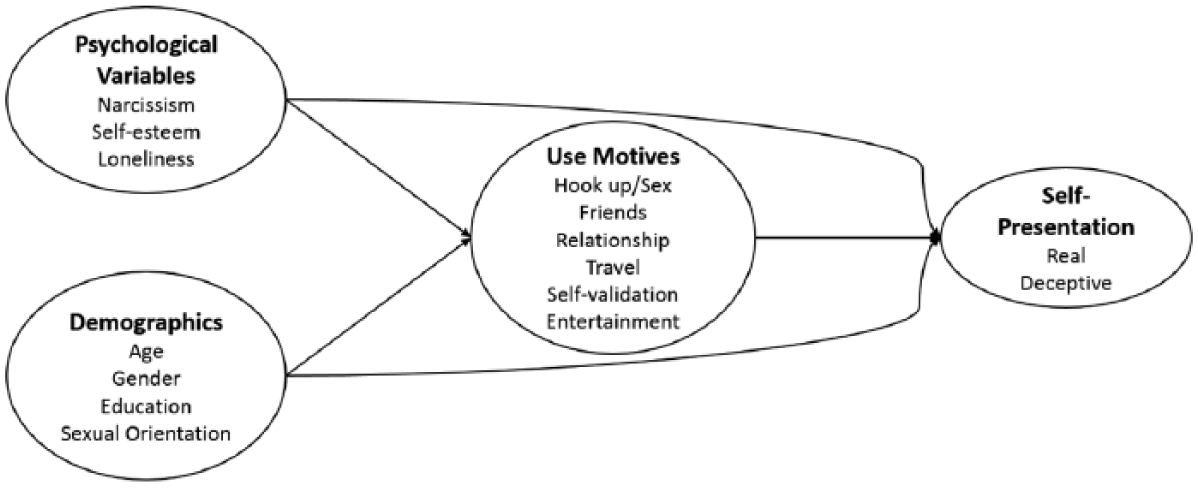
Structural model tested.
Methodology
Data and sample
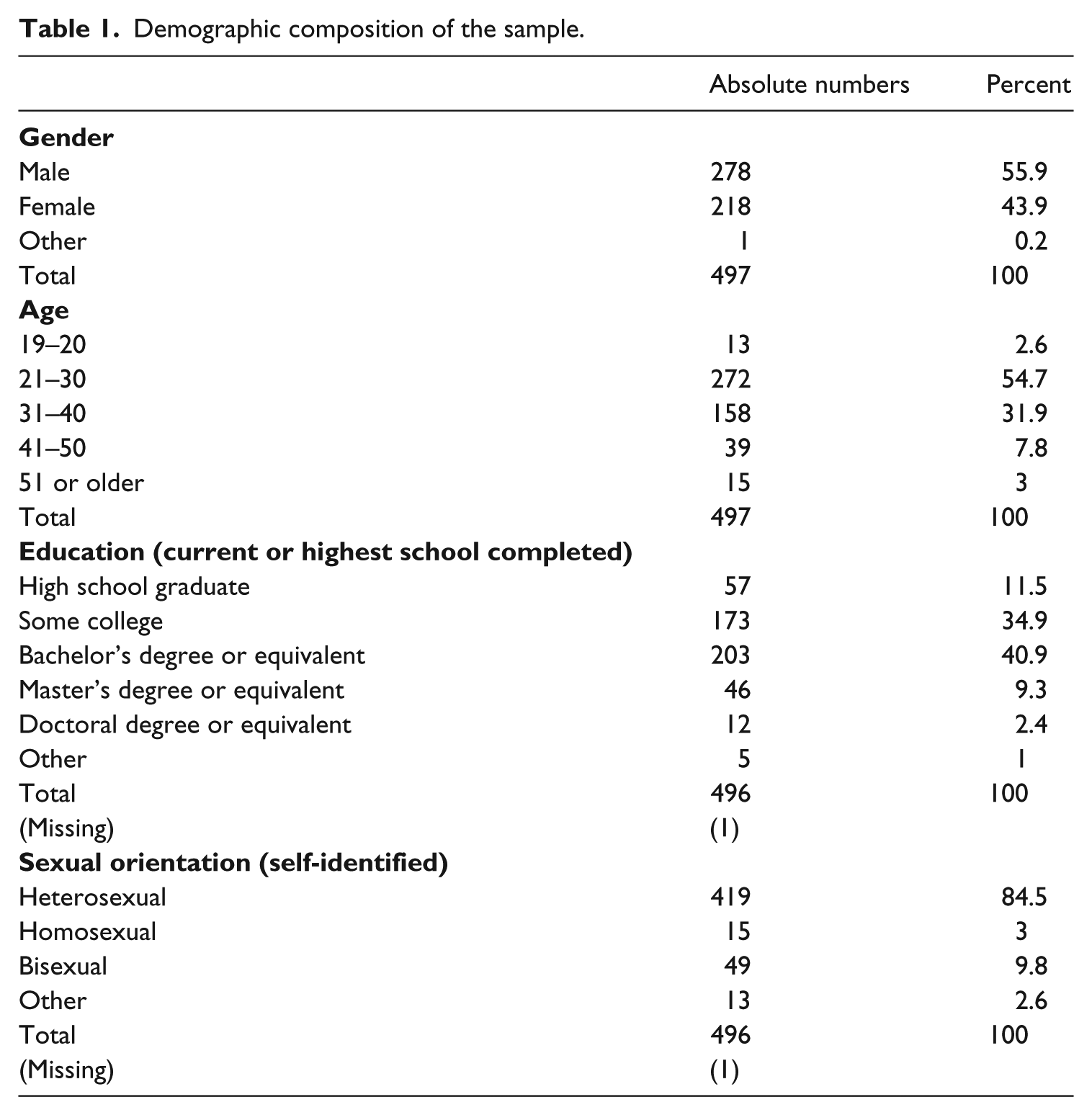
We conducted an online survey of 497 U.S.-based respondents recruited through Amazon Mechanical Turk in March 2016. The survey was programmed in Qualtrics (2016) and took an average of 13 minutes to fill out. We posted the link to the survey on Mechanical Turk and had the desired number of respondents within 24 hours. We consider the recruiting of participants on Mechanical Turk appropriate as these users are known to “exhibit the classic heuristics and biases and pay attention to directions at least as much as subjects from traditional sources” (Paolacci, Chandler, & Ipeirotis, 2010, p. 417). Table 1 shows the demographic profile of the sample. The average age was 30.9 years, with a standard deviation of 8.2 years, which indicates a relatively young sample composition. The median highest degree of education was 4 on a 1–6 scale, with relatively few participants in the extreme categories 1 (no formal educational degree) and 6 (postgraduate degrees). Despite not being a representative sample of individuals, the findings allow limited generalizability and go beyond mere convenience and student samples.
Demographic composition of the sample.
Measures
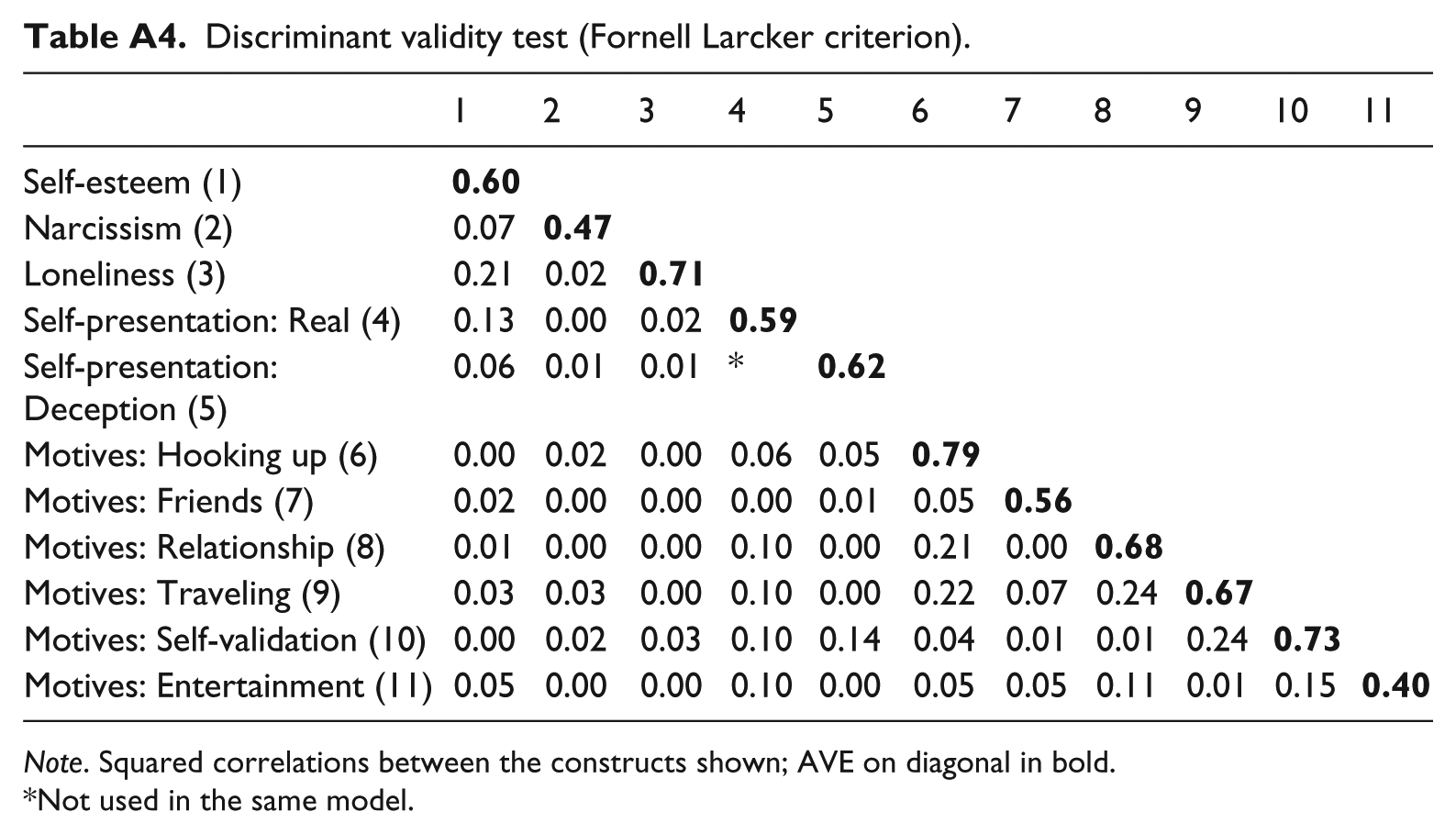
The measures for the survey were mostly taken from previous studies. We used four items from the Narcissism Personality Inventory (NPI)-16 Scale (Ames, Rose, & Anderson, 2006) to measure narcissism and five items from the Rosenberg Self-Esteem Scale (M. Rosenberg, 1979) to measure self-esteem. Loneliness was measured with five items out of the 11-item De Jong Gierveld Scale (De Jong Gierveld & Kamphuls, 1985), one of the most established measures for loneliness (see Table A3 in the Appendix for the wording of these constructs). We used a slider with fine-grained values from 0 to 100 for this scale. The narcissism, self-esteem, and loneliness scales reveal sufficient reliability and validity (Cronbach’s α is .78 for narcissism, .89 for self-esteem, and .91 for loneliness; convergent and discriminant validity given), so that we can proceed to interpret the structural model. Table A2 in the Appendix reports the full measurement model and Table A4 the discriminant validity test (Fornell & Larcker, 1981).
For the dependent variables of self-presentation we used a scale by Michikyan, Dennis, and Subrahmanyam (2014) that was originally developed to measure self-presentation on Facebook. 2 We adapted this scale to the Tinder context. Michikyan et al. (2014) distinguish five modes of self-presentation on Facebook: real self, ideal self, false self – deception, false self – compare/impress, and false self – exploration. We decided to compare only two of these five modes: real self and false self – deception. Due to the partial use of the scale, the subscale false self – deception was renamed deceptive self. The categories of ideal self, false self – compare/impress, and false self – explore were excluded from the analysis because they resulted hard to distinguish between and highly correlated (Michikyan et al., 2014, p. 5). These three scales also exhibited low reliability in our sample (Cronbach’s α below .7). Table A3 in the Appendix shows the wording of the two self-presentation scales used. Both scales revealed good reliability (Cronbach’s α of .84 for real self and .86 for deceptive self).
We included a wide range of variables on the motives for using Tinder. The use motives scales were adapted to the Tinder context from van de Wiele and Tong’s (2014) uses and gratifications study of Grindr. Using exploratory factor analysis, van de Wiele and Tong (2014) identify six motives for using Grindr: social inclusion/approval (five items), sex (four items), friendship/network (five items), entertainment (four items), romantic relationships (two items), and location-based searching (three items). Some of these motives cater to the affordances of mobile media, especially the location-based searching motive. However, to cover more of the Tinder affordances described in the previous chapter, we adapted some of the items in van de Wiele and Tong’s (2014) study. Appendix A3 shows the use motive scales in our study. These motives were assessed on a 5-point Likert scale (1 = completely disagree to 5 = completely agree). They reveal good reliability, with Cronbach’s α between .83 and .94, except for entertainment, which falls slightly short of .7. We decided to retain entertainment as a motive because of its relevance in the Tinder context. Finally, we used age (in years), gender, education (highest educational degree on an ordinal scale with six values, ranging from “no schooling completed” to “doctoral degree”), and sexual orientation (heterosexual, homosexual, bisexual, and other) as control variables.
Method of analysis
Structural equation modeling (SEM) was used to answer the research questions. SEM is superior to other explanatory approaches, such as linear regression, because it allows the inclusion of latent constructs, the easy testing of indirect effects, and the specification of measurement errors. In our case, the inclusion of latent constructs made this method suitable.
Results and discussion
Table A1 in the Appendix shows construct descriptives and Table A3 presents the arithmetic mean and standard deviation for each item of the dependent constructs. The respondents in our sample scored higher on authentic self-presentation than deceptive self-presentation, with an arithmetic mean of close to 4 (on a 1–5 Likert scale) for real/authentic self-presentation and of between 2 and 3 for deceptive self-presentation. Thus, users report relatively authentic self-presentation. However, arithmetic means of close to 3 and a substantial number of “somewhat agree” and “strongly agree” for two deceptive self-presentation items (“I sometimes feel like I keep up a front on Tinder,” 37% agreement; “I sometimes try to be someone other than my true self on Tinder,” 36% agreement) indicate a certain propensity to present deceptive selves. 3 Concerning the motives, we find that Tinder is used for a variety of purposes, with all six motive factors reaching above average agreement, that is, arithmetic means larger than 3. Entertainment is the most pronounced motivation for the respondents and self-validation the weakest. That entertainment and traveling—both motivations which tap strongly into the affordances of Tinder—have high agreement values points to the usefulness of considering aspects of mobility in the context of LBRTD.
Table 2 shows the results of the SEM. Real/authentic self-presentation is positively influenced by the friendship motive and negatively influenced by the self-validation motive. The other motives do not have a significant effect on real/authentic self-presentation. Thus, having a relational motivation in the use of Tinder might represent an incentive for a more authentic self-presentation. This would be coherent with previous findings on dating sites (Ellison et al., 2012; Hancock et al., 2007; Toma et al., 2008). Sexual orientation has a small negative effect: Homosexuals and bisexuals tend to portray themselves in a less authentic manner than heterosexuals. This might be due to the fact that Tinder is perceived as a largely heterosexual app, and hence might come with pressures to limit visibility and try to contain stigma (Boulden, 2001; Kirby & Hay, 1997). Neither narcissism nor loneliness exerts a significant effect on real/authentic self-presentation. However, self-esteem affects real/authentic self-presentation significantly and positively. Users with more self-esteem portray themselves in a more authentic fashion. Of the demographic characteristics, only education has a significant effect. Higher educated users score lower on real/authentic self-presentation.
SEM path coefficients.
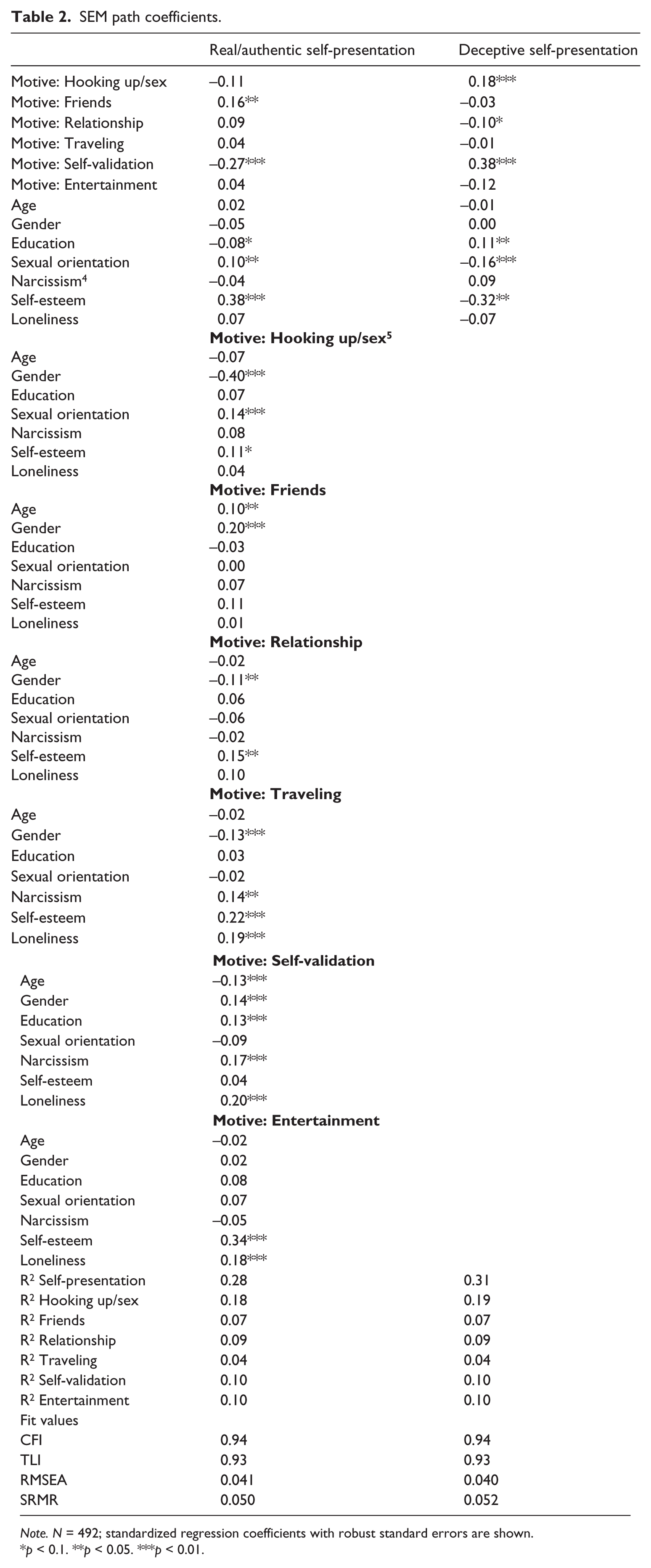
Note. N = 492; standardized regression coefficients with robust standard errors are shown.
p < 0.1. **p < 0.05. ***p < 0.01.
Deceptive self-presentation is significantly influenced by self-esteem, education, and sexual orientation. Higher educated users scoring low on self-esteem and identifying as homosexual, bisexual, or “other” are most likely to exhibit deception in self-presentation. Respondents with higher levels of self-esteem seem to present themselves in a less deceptive way on Tinder. More confidence in their real/authentic self-presence might explain this finding. At the same time, actions aimed at improving the likelihood of attracting a match, including presenting a deceptive version of oneself, could be beneficial for users with low self-esteem (Krämer & Winter, 2008). Concerning the motives, we find that both hooking up/sex and self-validation have a strongly positive and significant impact on deceptive self-presentation. Thus, the reasons for deceptive self-presentation can vary from more explicit strategic considerations (presenting a deceptive self-image to attract sexual partners) to more implicit emotional motives (presenting a deceptive self-image to get self-validation). Finally, we find that relationship-seeking negatively influences deceptive self-presentation. Individuals who use Tinder for relationship-seeking might be more authentic in their self-presentation because of their long-term perspective and the likelihood that deceptive self-presentation could backfire on them.
Looking at the social structuration of the motives, we find a range of significant demographic effects. Gender significantly affects five of the six motives. Men score higher on using Tinder for hooking up/sex, traveling, and relationship-seeking. Women score higher on self-validation and friendship-seeking. No significant gender difference is detected for entertainment. These findings reveal that Tinder is used in strongly gendered ways, possibly reaffirming patterns displayed in the popular media and in previous research on online dating. Other variables reveal noteworthy tendencies. Older individuals use Tinder significantly more for friendship-seeking and significantly less for self-validation than younger users. Higher educated users score higher on self-validation than less educated ones. Finally, sexual orientation influences the hooking up/sex motive, with homosexual and bisexual users scoring higher than heterosexual ones. With the psychological drivers, we find that self-esteem is significant for four out of six motives, narcissism for two, and loneliness for three. Narcissism positively influences the traveling and self-validation motives. Self-esteem promotes the use of Tinder for hooking up/sex, traveling, finding a relationship, and entertainment. The range of these motives shows that self-esteem is a driver of motives across the board, indicating its importance in the Tinder context. Finally, loneliness affects self-validation and entertainment positively and significantly. Lonely users tend to use Tinder especially for these two purposes, showing that Tinder can be a means to distract them from their loneliness in immediate ways (not so much for making new contacts but more for the quick gratification of diverting them from their loneliness).
Overall, we are able to explain 28 (real) and 31 (deceptive) percent in the variance of self-presentation and between 4 (traveling) and 19 (hooking up/sex) percent in the motives. This leaves room for the inclusion of additional variables in the future. Considering personality traits, we are slightly better able to predict deceptive self-presentation. Self-esteem and the motives of use were the strongest elements to define users’ self-presentation. This points to the value of including motivational aspects in the analysis of online dating. As for the demographic predictors, the most remarkable finding is the strong gender effect for the various motives. However, the education effects also reveal interesting—and somehow counterintuitive—patterns.
Conclusion
This contribution has investigated self-presentation on Tinder with a sample of almost 500 users recruited through Amazon Mechanical Turk and covering a broad age spectrum and demographic profile. Going back to previous research on online dating and impression management in computer-mediated communication, as well as the affordances of mobile media, we distinguished two modes of self-presentation: real/authentic and deceptive. We then attempted to explain self-presentation by testing the influence of motivational, psychological, and demographic predictors for both modes. By applying SEM, we could show that self-esteem and the motive or purpose of Tinder use are the strongest predictors of self-presentation. Users with high self-esteem tend to reveal more authentic and less deceptive selves. In terms of motives, self-validation turned out to be the antecedent with the strongest effect on self-presentation. Hooking up/sex, friendship, and relationship-seeking were (partly) significant predictors as well, whereas traveling and entertainment were not. These findings point to how dating apps might extend the motives of use traditionally associated with dating sites. In our case, the “new” and playful motives (traveling, entertainment), which make special use of the mobile affordances of Tinder, were popular among the respondents but did not affect their self-presentation. While these “new” and playful motives might be a main reason to start using the app and to use it in a broader range of settings than traditional dating sites, users’ overarching—and maybe overriding—motives for presenting themselves in an authentic or deceptive way come with a strongly social connotation: finding new contacts (be it for casual dating, friendship, or long-term relationships) and leaving a certain impression in them.
Moreover, we found noteworthy demographic and psychological effects on the structuration of the motives. Most notably, clear gender patterns emerged, with men using the app more for hooking up/sex, traveling, and relationships, and women rather for friendship and self-validation. This connects well to the literature on self-objectification and social media (e.g., De Vries & Peter, 2013). Moreover, heterosexual users—the presumed core target group for Tinder—present themselves in a more authentic fashion compared with homosexual, bisexual, and “other” users. A possible interpretation for this can be attributed to Tinder’s perceived heteronormativity (Shaw & Sender, 2016), which could make LGBT users more self-conscious over their presentation. Furthermore, there exist other platforms that specifically target these groups (e.g., Grindr for homosexual daters), where it might be easier to present an authentic self.
Our study is one of the first to empirically investigate Tinder and to shed light on the relatively new phenomenon of LBRTD. Moreover, most previous research on Tinder (David & Cambre, 2016; Duguay, 2016; Marcus, 2016) has used qualitative methods that do not allow for the quantification of certain aspects, like self-presentation and use motivations. We think that the lens of self-presentation with a quantitative research design is a useful one and that the results have several implications for research on online dating and impression management. In particular our results on deceptive self-presentation, which emphasize a predominance of personality traits, motivation, and sexual orientation over gender and age, might reveal something about the nature of the LBRTD apps, which we hope is further investigated in the future.
Our study is subject to a number of limitations, providing ample opportunities for future LBRTD research. Firstly, our sample was relatively small, cross-sectional, and recruited via Mechanical Turk. This limits the generalizability of the results and might explain some of the findings. Future research is encouraged to use a larger sample and, if possible, with a user base that is representative of the current Tinder user population. Secondly, we relied on self-reported data, which is subject to a number of problems, such as social desirability, memory bias, and response fatigue (Podsakoff, MacKenzie, Lee, & Podsakoff, 2003). Unfortunately, we could not collect observational or trace data from the respondents. Future research might use mixed-methods approaches and combine different data sources to investigate the phenomenon more holistically. This could be done by conducting qualitative interviews and including users’ data in this process (Dubois & Ford, 2015), for example, by securing informed consent to use the profile picture and/or descriptions. Other promising approaches are big data analyses of user profiles, ethnographic inquiries of specific user groups—such as obsessive Tinder users—and experimental studies that manipulate the constraints and opportunities of self-presentation. Thirdly, with narcissism, self-esteem, and loneliness we only considered three psychological antecedents. Future research should rely on a more holistic set. Finally, we could not do justice to contextual factors, such as the cultural background and location of users. A recommendable next step would be to systematically compare different countries and/or regions within a country (e.g., rural vs. urban areas) in terms of Tinder use and self-presentation. Such comparative analyses might shed light on the cultural contingencies of LBRTD and provide useful guidance and much needed empirical material to better understand the phenomenon.
Footnotes
Appendix
Discriminant validity test (Fornell Larcker criterion).
| 1 | 2 | 3 | 4 | 5 | 6 | 7 | 8 | 9 | 10 | 11 | |
|---|---|---|---|---|---|---|---|---|---|---|---|
| Self-esteem (1) |
|
||||||||||
| Narcissism (2) | 0.07 |
|
|||||||||
| Loneliness (3) | 0.21 | 0.02 |
|
||||||||
| Self-presentation: Real (4) | 0.13 | 0.00 | 0.02 |
|
|||||||
| Self-presentation: Deception (5) | 0.06 | 0.01 | 0.01 | * |
|
||||||
| Motives: Hooking up (6) | 0.00 | 0.02 | 0.00 | 0.06 | 0.05 |
|
|||||
| Motives: Friends (7) | 0.02 | 0.00 | 0.00 | 0.00 | 0.01 | 0.05 |
|
||||
| Motives: Relationship (8) | 0.01 | 0.00 | 0.00 | 0.10 | 0.00 | 0.21 | 0.00 |
|
|||
| Motives: Traveling (9) | 0.03 | 0.03 | 0.00 | 0.10 | 0.00 | 0.22 | 0.07 | 0.24 |
|
||
| Motives: Self-validation (10) | 0.00 | 0.02 | 0.03 | 0.10 | 0.14 | 0.04 | 0.01 | 0.01 | 0.24 |
|
|
| Motives: Entertainment (11) | 0.05 | 0.00 | 0.00 | 0.10 | 0.00 | 0.05 | 0.05 | 0.11 | 0.01 | 0.15 |
|
Note. Squared correlations between the constructs shown; AVE on diagonal in bold.
Not used in the same model.
Acknowledgements
We would like to express our gratitude to Marjolein Gouderjaan for her help in the initial formulation of the research project. Two anonymous reviewers provided very helpful and constructive feedback which substantially improved the quality of the article. Finally, we thank Gemma Newlands for proofreading the paper and coming up with its title.
Declaration of Conflicting Interests
The author(s) declared no potential conflicts of interest with respect to the research, authorship, and/or publication of this article.
Funding
The author(s) disclosed receipt of the following financial support for the research, authorship, and/or publication of this article: We thank the Research Council of Norway for the generous funding within the SAMANSVAR project “Fair Labor in the Digitized Economy” (247725/O70).