







Abstract
India is a rapidly growing youth market for smartphone technology. Accompanying the spike in Indian youths’ smartphone use is a proliferation of media coverage on the purported impact of smartphones on youths’ physical, psychological, and social well-being. We use a qualitative media analysis to show that the online and print media narratives around this issue reveal widespread fear and anxiety about youths’ smartphone use. We argue that this stems from a moral panic reaction to youths’, particularly young women’s, potential exercise of agency using their smartphones and accessing forbidden content over the internet. This narrative fails to include the potential affordances of internet access for youth and other marginalized people while also failing to address deeper concerns about digitization.
Introduction
The streets, trains, and markets in any Indian city are teeming with people making calls, receiving and forwarding messages, listening to music, watching videos, scrolling through the newsfeed, taking selfies, or checking transit apps for the next arriving train. With approximately 291 million smartphone users in urban India, half of whom are under the age of 25, India is poised to be the largest youth 1 smartphone market in the world (Internet and Mobile Association of India, 2018). Simultaneously, the IT sector has been positioned as the nation’s engine of growth; the emergence of information technology hubs—or cyber cities—seen as India’s entry into urbanized modernity (Aneesh, 2015).
Indeed, smartphone culture is an intrinsic part of youth culture for this generation, which has grown up with internet technology and who are sometimes dubbed “digital natives” (Prensky, 2001). But how does the emergence of this aspirational, technology-based youth lifestyle interact with social cultures of control? Looking to mainstream news narratives as a reflection of dominant ideologies, we examine the discourses of opportunity and threat that swirl around youths’ smartphone use. Mapping the apparently contrasting influence of global techno-capitalism on the one hand and cultural heteropatriarchy on the other, we find that the agency of youth, particularly young women, is increasingly stifled when caught between the two.
In this paper, we first introduce the backdrop of technology-spurred moral panics, of which smartphones have become a recent focus. Next, we examine how news media both reflect and shape cultural discourses of moral panic, thus representing a fruitful site for the study of these narratives in the Indian context. We present the qualitative media analysis method used and its advantages, before examining our findings. The news media analysis reveals the interplay of panic in media and in society, enacted by authorities who infantilize youth by banning, penalizing, and restricting their access to smartphones. We find the voices of youth, women, and other marginalized groups significantly missing in media narratives and consider the underlying power structures reflected by these gaps in media coverage. We conclude by mapping the modern media panic ecosystem in India which has been the result of the advent of information technology—including smartphones— where the state and global technology corporations have greater power over citizens, particularly youth.
Smartphones and moral panics
Undeniably, smartphones have radically redefined how youth form identities, socialize, and engage with popular culture (Jouhki, 2013). After all, mobile internet access and instantaneous, geographically-unlimited communication allows rapid coordination of social activity, initiation and development of platonic, romantic, and sexual relationships, creation of private spaces hidden from parental control, and awareness and engagement with the latest cultural and consumer trends. For digital natives, smartphones have brought a swell of new opportunities for knowledge, pleasure, communication, and exchange. These opportunities are also accompanied with many risks such as exposure to pornography, 2 bullying, violence, and disturbing content (Lim, 2013). These risks are perennial concerns for parents, educators, policy makers, health providers, and cultural commentators and are often amplified by mass media (Livingstone, 2008). However, how much of the discourse around the risks of smartphones is warranted and how much is a symptom of moral panic?
First introduced by Cohen (1972), “moral panic” describes a periodic, recurring phenomenon that consists of the following components: a concern that can be a person, group, or collection of events; hostility towards the concern; consensus among society that the concern is negative; disproportionality of the response to the real risk, if any, of the perceived threat; and volatility of the discourse around the concern, particularly as exemplified by a flurry of media reporting (Goode & Ben-Yehuda, 1994; Marwick, 2008). Moral panics reflect the anxiety of dominant social actors that the established system of values is under threat and a cherished way of life is in jeopardy. The key aspect of moral panics is that the targets are selected to be cultural scapegoats for collective, often unconscious anxieties that underlie the outcry.
Another important feature of moral panics is their tendency to recur across time with new avatars of the same underlying anxieties. For instance, Cassel and Cramer (2008) point out that with the advent of each new technological innovation that opens communication for women and girls, whether for the telegraph, telephone or internet, there has been a recurring moral panic throughout history. Currently, anxiety over smartphones represents modern media panics (Drotner, 1992) or “technopanics” (Marwick, 2008) in which forms of new media are both the source and the medium for the spread of moral panic. The influence of new, smartphone-enabled media have expanded the scope of modern media panics by allowing individuals to themselves broadcast moral panic narratives, resulting in a perpetual state of moral panic permeating online media platforms (Ingraham & Reeves, 2016). Our analysis of news articles explores the media panic narratives around Indian youths’ use of smartphones, revealing the ongoing, often contradictory, interplay between young people, state entities, and corporate interests.
News media: The moral panic pipeline
News media content is a vital component of the ecology of human communication and therefore a useful site of inquiry. By highlighting certain issues and agendas, news broadcasts create frames that provide powerful discursive cues which impact cognition, determine group alignments, influence public discourse, and ultimately shape multiple levels of social reality (Entman, 1993; D’Angelo, 2002; Gitlin, 1980). However, news media do not just communicate meaning to an audience, but also acts as a product and depiction of culture—the symbols, processes, and meanings that make up a society’s reality (Hall, 1982). Therefore, the content and ideology of media can be analyzed for significant features of public life that show how public discourse and cultural logics contribute to social meanings (Macnamara, 2005).
From a methodological standpoint, news reports and articles are a type of document that reflect the context and process that has produced them (Altheide & Schneider, 2013). The primary definitions of emergent social phenomena are created in the media, therefore shaping the dominant ideology. News reports covering youths’ use of new technology such as smartphones and social media reveal the production of new definitions as they are woven into the fabric of mainstream social thought (Stern & Burke Odland, 2017). Furthermore, as a part of the modern media panic ecosystem, news media are principal brokers and beneficiaries of moral panic narratives (Drotner, 1992; McRobbie & Thornton, 1995). The titillation and interest of a new moral panic entertains consumers, generates further commentary and news cycles, and creates a profitable feedback loop reflected in increased sales, clicks, and ratings.
Of course, smartphones go hand-in-hand with new social media platforms where moral panic narratives can form and spread. Therefore, while news media shape the mainstream discourse around topical debates by filtering who gets a say in the issue, social media provides the opportunity for individuals to make themselves heard—or at least provides the illusion of power through free speech (Ingraham & Reeves, 2016). Often in mainstream news media, the most scrutinized groups get little say in their representation while powerful socio-political and economic interests exert great influence on media narratives. While social media platforms are likely to provide insights into these missing voices, they fall outside the scope of this inquiry, in which we are specifically interested in how these moral panic narratives have filtered into mainstream discourse in news media. Against this backdrop, mass media content is a useful collection of primary documents to critically probe for institutional, hegemonic perpetuation of moral panic phenomena around Indian youth’s use of smartphone technology. In this study, we use qualitative media analysis to examine how Indian youths’ use of smartphones and social media is covered by Indian news media, as a reflection of mainstream discourses surrounding technology-mediated social change.
Methods
Ethnographic content analysis
To examine Indian news media’s representation of the impact of smartphones and social media on adolescents, this study employed the qualitative ethnographic content analysis (ECA) methodology (Altheide, 1987; Altheide & Schneider, 2013), which is unique due to the central, reflexive, and interactive role of the investigator. According to the ECA methodology, documents, in this case news reports, are studied to understand culture—the sum of objects, symbols, and meanings that make up social reality. The primary goal of ECA is to allow for the emergence of culturally-based meaning through the researcher’s iterative analysis of documents. The approach is ethnographic due to the researcher’s immersion in the relevant texts, situating the analysis in the cultural milieu and providing a rich understanding of the emerging themes, frames, and discourse. In contrast to quantitative content analysis, ECA emphasizes the latent meaning of content and its contextualization in the social processes through which meaning is produced (Kort-Butler, 2016).
After identifying the topic of interest and conducting the literature review, the first step of the ECA protocol is the researcher’s familiarization with the relevant context and sources of information. Then, the researcher reviews a few sample documents to create an initial draft protocol specifying document collection and coding parameters. Based on these criteria, the first documents are coded and key themes are identified for further analysis, which are incorporated into the subsequent draft protocol. A key component of ECA is the iterative revision of this draft protocol over multiple rounds of document collection, coding, and analysis (Altheide & Schneider, 2013). Through the recursive rounds of ECA, themes, narratives, and frames emerge from the sampled documents coalescing into overall findings. To illustrate these, representative case studies are selected for in-depth analysis and incorporation in the report. Other studies have used the ECA methodology to study messages in crime films (Welsh, Fleming, & Dowler, 2011), meaning in social movement pamphlets (Bernard, Futrell, & Harper, 2010), and constructions of race and policing in newspaper op-eds (Dawson, 2018).
Protocol
Following ECA, we drew from the literature review and research question to compile a list of primary keywords (Table 1). These keywords were searched for using the electronic databases LexisNexis and Google News which are both comprehensive archives for print and online news articles (for comparable methods see Lynch & Morrison, 2016; Moghimi & Wiktorowicz, 2019). We used search queries with the format: “India*” AND “smartphone*” AND “youth*”. The latter two terms were interchanged with other keywords from columns 1 and 2 in Table 1, respectively. The searches were limited to articles published between 2014 to 2018, and to English-language sources due to the language backgrounds of the authors and the limitations of the databases. 3 The resulting corpus of collected documents provided an immersive framework for ECA, albeit from a perspective with inherent biases, which we examine in the analysis.
Primary and secondary keywords used in database queries.
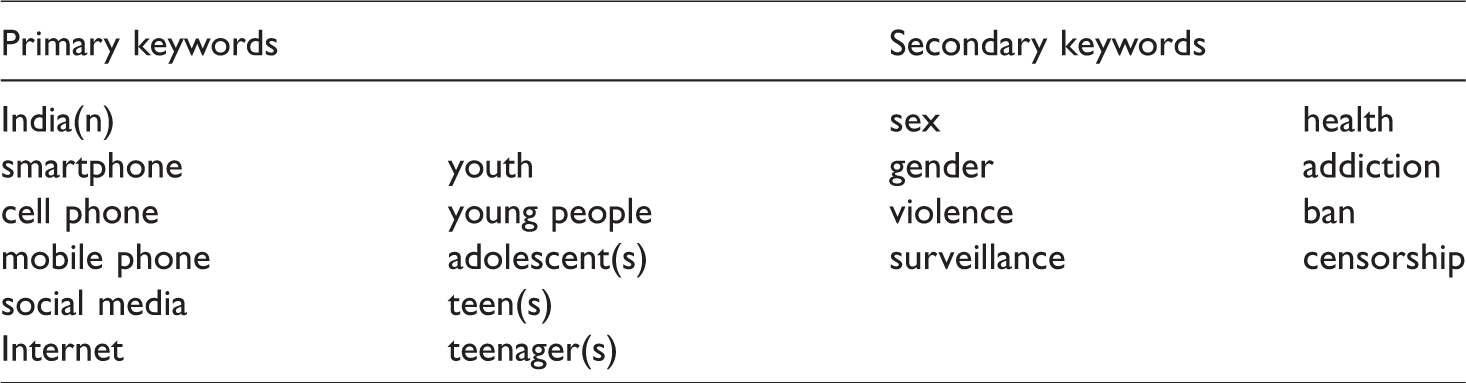
Articles that met the selection criteria were compiled and annotated according to an initial draft protocol (e.g. title, publication, date). Following the ECA method, each article was then closely re-read and further annotated according to a more detailed, updated draft protocol that included coding themes, such as topics of gender, addiction, health, etc., commonly found throughout articles. These themes were coded as secondary keywords. A second search for primary and secondary keywords (see Table 1) was performed with the databases and within the news sources. Each news article was closely re-read and further annotated according to a third draft protocol that noted the broader thematic frames (e.g. psychological harm, interpersonal relationships, gender-based risks) and the perspectives represented (e.g. medical expert, government official).
In order to meet inclusion criteria, news articles had to a) include at least one of the primary keywords from each of the first two columns in Table 1, and b) be published by Indian news sources. In total, 91 news articles were coded and analyzed, 70 of which met the inclusion criteria. 4 Of these, 20 news articles were selected as representative case studies for in-depth analysis (see Figure 1). These articles form the basis of the subsequent discussion, organized according to the overarching themes found in the analysis. We approach the analysis from a critical constructionist perspective, working from a feminist framework. In examining case studies, we draw from theories of communicative generalization (Flyvbjerg, 2001; Cornish, 2020) in which the significance of the case is found through constructing rich representations of unique perspectives and problematizing assumptions taken for granted.
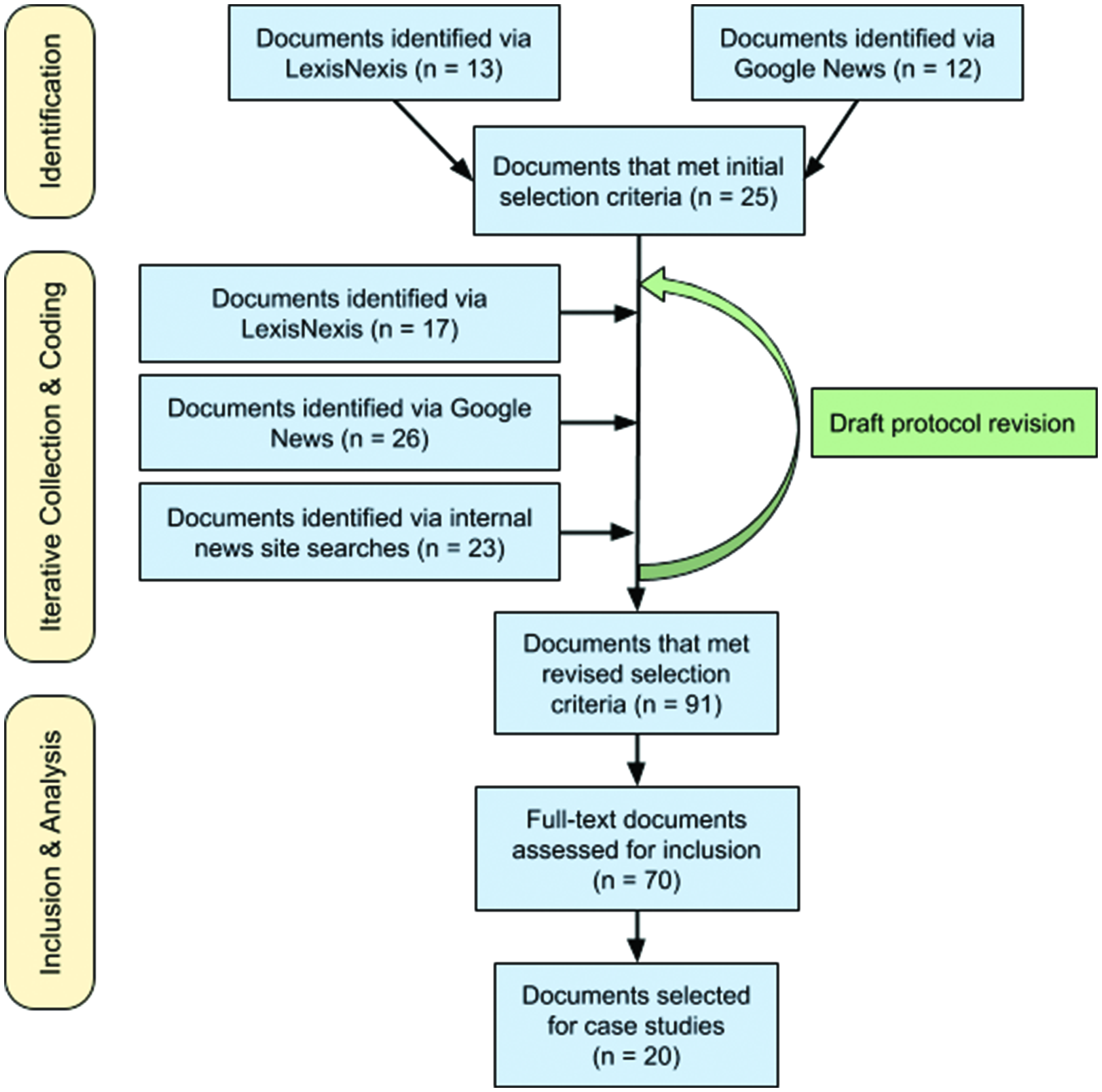
Flowchart outlining the selection of news documents included in the analysis.
Discussion
In the following section, we examine the narratives emerging from Indian news stories that featured youths’ smartphone usage, noting that we do not make claims about narratives featuring other smartphone user demographics or other social technologies popular with youth. Another important factor in the analysis is that all sampled Indian news media sources are from English-language publications. We consider English-language Indian news, with its connotations of postcolonial, middle-class cosmopolitanism (Brosius, 2012), to reflect a close affiliation with the state apparatus. These news media sources are positioned in the ‘mainstream,’ in that they are aligned with state, corporate, and institutional interests. Through the analysis, we found that three primary perspectives—of experts, authority figures, and youth—drove news media coverage of youth’s smartphone use. In the discussion below, we address each of these narratives in turn, first outlining how media stories featuring expert opinions from doctors and psychiatrists contribute to building a moral panic about smartphones. The second section explores the discourse from authority figures, such as the state, which is reactive to the perceived threat posed by smartphones. Media representations of youth voices on the issue, or the lack thereof, are examined in the last section.
Expert proof constructing the panic
Media narratives of Indian youth’s smartphone use deploy expert opinions on physical health, mental health, and addiction to emphasize the risk of the new technology. One way this manifests itself is through articles that feature extreme, often gruesome, incidents such as: 9-year-old boy had to be admitted to a city hospital after he cut his arm with a kitchen knife because his parents took away his cell phone (Dutt & Pandit, 2017). The case of a child who started getting seizures because of lack of sleep due to addiction to Facebook (Rajagopal, 2014).
In another news story, Dr. Anand Kumar, professor and head of the neurology department at Amrita Institute of Medical Sciences, Kochi, comments: Constant exposure to electromagnetic radiation interferes with cognitive memory and sleep. The heat generated from the gadget irritates the surface tissues of the skin. We have no concrete evidence yet to link tumours to mobile radiation (Pai, 2015).
Another misleading association occurs when the media directly or indirectly compare smartphone use to drug use. Cluttering the text of media articles relating to young people and smartphones are terms such as “internet addiction,” “technology addiction,” “digital addiction,” “online addiction,” “mobile dependence,” and “Internet Gaming Syndrome,” in addition to “digital detox,” “internet detox,” “internet rehabilitation centres,” and “clinics for online de-addiction” (Dutt & Pandit, 2017; Pai, 2017; Afternoon Voice, 2017; Rajagopal, 2014). The variety of new jargon to describe the problems and solutions of smartphone misuse shows that the discourse around this subject is still emerging and is not yet formalized. While much of the terminology focuses around addiction to the internet and technology, none of the source articles managed to note that addiction is a strictly defined medical term and “internet addiction” is not recognized as a legitimate condition or disorder by the fifth and most recent edition of the Diagnostic and Statistical Manual of Mental Disorders [DSM-5](American Psychiatric Association, 2013). By inaccurately using a medical term that refers to a severe condition, the media strengthen the narrative that internet and smartphone use has medical repercussions.
Beyond the misleading usage of the term addiction, Dr. C. J. John, the president of the Indian Psychiatric Society goes further to say: Lack of supervision and monitoring at home lets children get their way with Internet and substance abuse. Every child is at risk. Sometimes peer pressure alone could be a factor for addiction (Rajagopal, 2014). [Internet use is] like a drug, but it is digital (Pai, 2015).
Panic about smartphone addiction fuels more media coverage demonizing the new technology. This is exemplified in an anonymous editorial titled “Phoney Pursuits”: Mobile phones may seem cool, but they are actually making our teenagers unsmart, especially those in the age group of 14-18 who are unable to read a basic text in their vernacular languages. The Annual Status of Education Report 2018 (ASER) for the rural populace, drawn from the survey carried out in 28 districts over 24 states, throws up many shocking details. It shows how addiction to phones has clouded the youngsters’ minds and ruining [sic] their future (DNA India, 2018).
5
Media and news articles gloss over the complexities and uncertainties of scientific studies on issues like addiction in favor of controversial reaction-seeking headlines. A recent summary of the research on technology addiction notes: “There’s no solid evidence that people get addicted to social media—and using it could actually be beneficial” (Brodwin, 2018). Other studies also show that smartphone use does not have the neurological effects of addiction (Kardefelt-Winther, 2017), screen-time is not harmful to most teens (Przybylski & Weinstein, 2017) and, in fact, teens are using digital communication to deepen and strengthen existing in-person relationships (Yau and Reich, 2017). However, these counter-panic narratives are notably absent from Indian media coverage.
In fact, only one article of the 70 analyzed cited scientific evidence to support its assertion that smartphones negatively impact physical well-being due to the link between smartphone use and lack of sleep. However, the substantiated point made by this news article is lost in the wave of inflated and exaggerated claims that produce and contribute to moral panic frames. By emphasizing extreme incidents, misusing terminology, distorting expert testimony, and ignoring firm evidence, media narratives inflate anxiety over youth’s smartphone use.
State-sanctioned moral panic
The panic about youth well-being stirred up by media coverage of smartphones is reflected by concern from authority figures. The reactions of such figures, often government officials, shifts from anxiety over physical and mental health concerns into full-blown moral panic about the social impacts of the new technology on the character and safety of youth. The primary responses of authorities to the perceived threat of smartphones include censorship, bans, and surveillance.
Moral panic over technology and youth is apparent in the steps that state authorities have taken to limit youth’s access to mobile and smartphones across the nation. The reason for banning mobile phones in all state government schools and colleges, as given by Shakuntala Shetty, Head of Karnataka Legislature’s Committee on Women and Child Welfare
6
is: We have found during our interactions that mobile is the reason behind kidnap and rape among school and college going girls… When I did go through two or three rape cases of minor girls, what they told me was that they had got a missed call and out of curiosity they wanted to find out about it and it started from there… As we found several such incidents, we in the committee decided to recommend a ban on mobiles; …it is not necessary for students, so we have mentioned that it should be banned (The Hindu, 2014). Out of sight, out of touch, parents are often anxious about their daughters staying in distant hostels. Mobile phones, that now ubiquitous mode of communication, would have clearly kept them in touch, whenever, wherever (Kappan, 2015).
While the Karnataka ban was particularly sweeping and controversial, mobile phone bans in schools and colleges are the norm throughout India. In order to understand the prevalence of mobile phone bans, we collected data from a thorough search of news and government reports. It was determined that out of 36 Indian states and union territories, 26 had state-level bans on students’ use of mobile phones in schools as of 2018. According to provisional data from the 2011 census, these 26 states make up 95.61% of India’s population (Census of India, 2011). Furthermore, 20 states had bans on teachers, and 5 states had bans on use within certain communities or villages. Figure 2 shows bans on students in government schools and colleges in blue, bans on teachers in blue, and community bans in red (i.e. khap panchayat bans 7 ). Our research did not go into depth on the topic of community cell phone bans in rural Northern India—more on these can be found in the extensive research of The Internet Democracy Project (Kovacs, 2017). Instead, we focused on how the reasoning behind cell phone bans in schools reveal government perceptions of the impact of cell phones on young people.
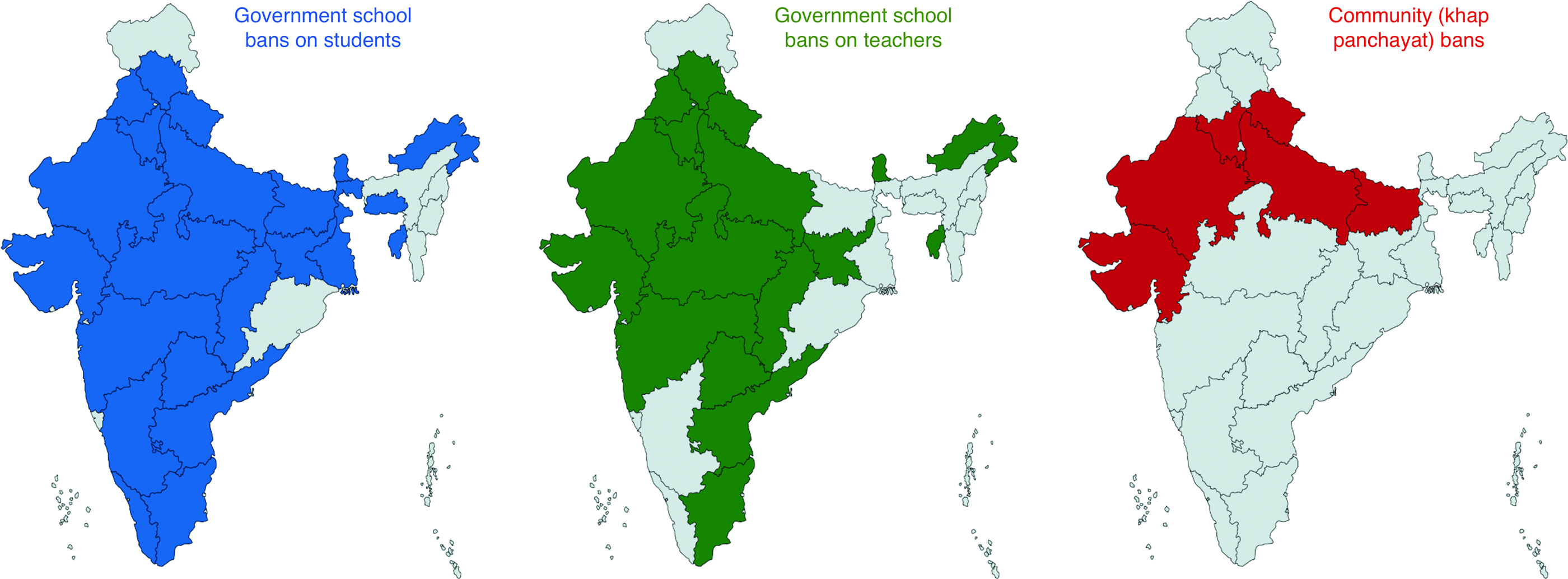
Maps of known mobile phone bans in Indian states.
While the most common reasoning cited for banning cell phones in schools (see Figure 3) was their potential to distract students and teachers from focusing on classwork, this was often coupled with objections about phones endangering moral decency and creating risk for female students. 8 Thus, our research indicates that phone bans in schools are motivated by a sense of protectionism and fear of losing control over the sexuality of young women. These bans predate the emergence of smartphones, showing that moral panic over youths’ access to technology has been simmering across the country. The new internet connectivity feature of smartphones adds a new layer of concern to the pre-existing fear.
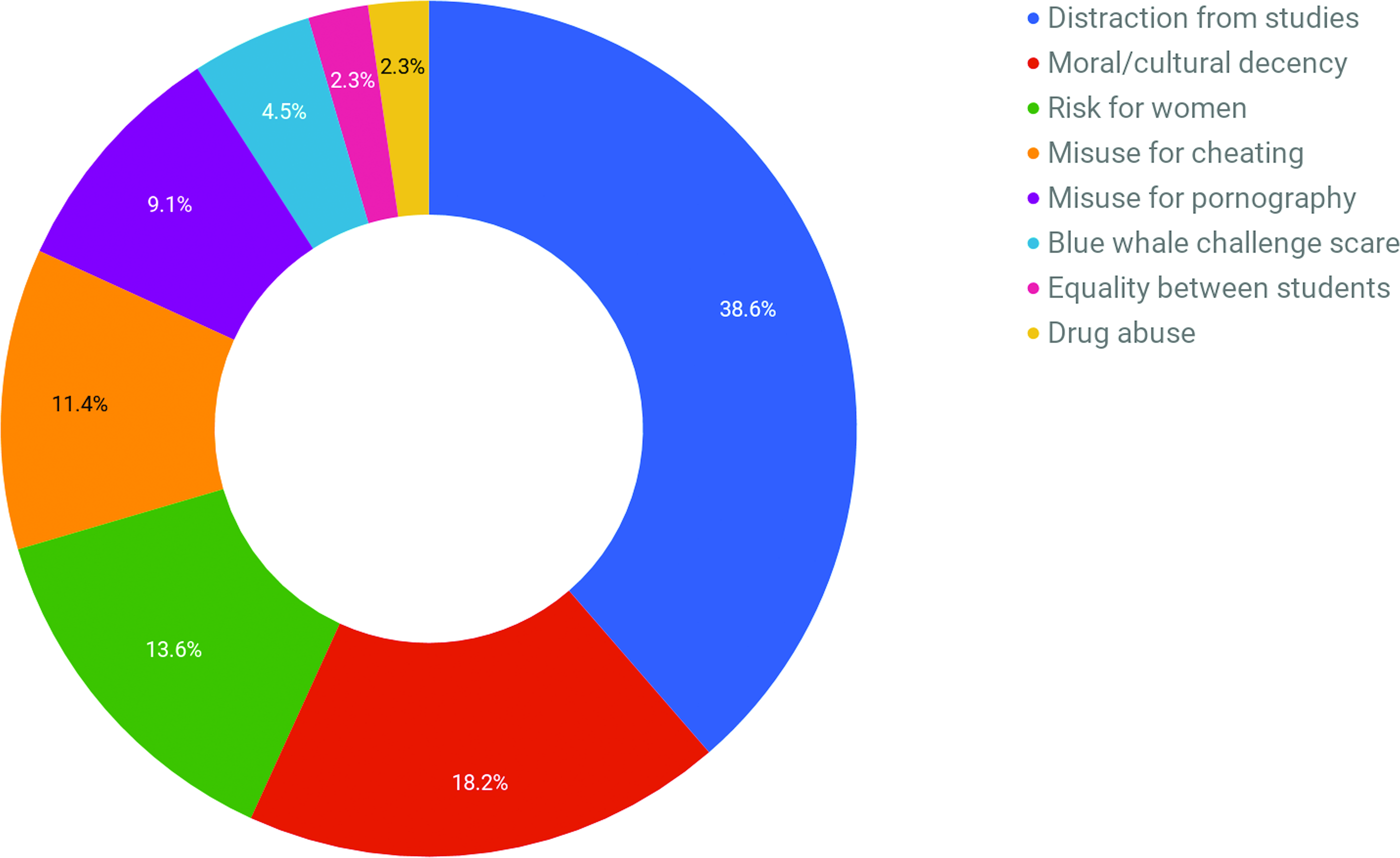
Various reasons for cell phone bans in schools cited in government and news reports.
Although mobile phone bans have been prevalent for some time, a new use of smartphone technology is its cooptation as a means of surveillance. One recent article states: Last month, Delhi Chief Minister Arvind Kejriwal announced that all government schools in the city would be fitted with CCTV cameras for round-the-clock surveillance of students. Parents could at any time check in on their children via a phone app that would offer them a real-time view of the classroom (Das, 2018).
Another incidence of government cooptation of technology is demonstrated in a press release from the Government of India’s Ministry of Women and Child Development, which reads: All feature phones will have the facility of panic button configured to the numeric key 5 or 9 and all smartphones [sic] will have the panic button configured to three times short pressing of the on-off button. Further, w.e.f. 1.1.2018, all mobile phones will be required to have the facility of identifying the location through satellite based GPS (Press Information Bureau, 2016). Instances of children committing suicide while (trying) Blue Whale challenge (sic) have been reported in India… [Internet companies] are hereby requested to ensure that any such link of this deadly game in its own name or similar game is immediately removed from your platform (Lakhani, 2017).
Taken together, these examples of school CCTV smartphone apps, GPS-tracking panic buttons, scattered censorship of disturbing content, and blanket bans on phones in colleges, show that protectionism by parental and governmental authorities is pervasive in the lives of today’s youth. But rather than answering safety concerns, a culture of surveillance and censorship threatens the basic rights to privacy and dignity for citizens of all ages. Meanwhile, the media’s positive framing fails to capture that state authorities that are more tech-savvy are also more capable of technology-enabled exploitation. Technology companies work hand-in-hand with the government to enact smartphone-based surveillance and censorship, but are excluded from media inquiry despite their central role.
Missing youth perspectives
Just as the perspective of technology companies is missing from media coverage, so are the voices of youth, despite their smartphone use featuring as the central concerns in the selected news articles. One exception is the piece “What schoolgirls in India can teach us about social media” by Sheena D’Lima for the feminist news site, Deep Dives. D’Lima carries out conversations with young girls and women who reveal that they consider inappropriate and unwanted male attention online inevitable. Through in-depth interviews, teen girls from upper-middle-class enclaves in Pune99 describe their strategies for navigating risks and safety online. Sachi, a 15-year-old girl, says: This one time, I clicked something on Facebook and my number went up by mistake. A friend of mine called me and told me to take it down” (D’Lima, 2015). This guy in our building messaged me on Facebook once saying, “Hi sweetheart, you look very pretty in that dress.” I just blocked him straight away (D’Lima, 2015).
Despite the risks, youth and young women continue to explore the Internet because of the opportunities that online spaces present. The plethora of interest groups and activities available online—from widely popular to highly niche—make it the perfect place for young people beginning to explore their individuality and build relationships, platonic and romantic. The interviews with teenage girls in Pune show that, rather than meeting strangers, most of the teens’ social internet use revolves around maintaining and reaffirming real-life friendships. Maria, a 13-year-old, uses a different name online: [Maria’s] Instagram moniker is Tara, a name that she has always liked and wishes she could use in everyday life. “Maria prefers gaming and Tara is into beauty and makeup stuff.” She’s not self-conscious at all about this dual identity (D’Lima, 2015). “Look,” demands Sachi, waving her phone at me. “Look at the lame things Kavita sends us.” Indeed Kavita has sent out a message to a bunch of classmates asking them to pick her best characteristics from a given list. “I just reply saying ‘all’ and then she replies saying, ‘aaaaw’.” They laugh. Replying to a forward, no matter how silly, is a testament to love and friendship (D’Lima, 2015).
Conclusion
The exploding availability of smartphones in India, along with Wi-Fi and cheap data, means that the vast, uncurated resources of the Internet are now accessible at the click of a button, anytime, anywhere. This unfettered access seems to be at the root of widespread anxiety reflected in mainstream news media narratives. Further, the media’s framing of market research, medical studies, government policies, and hyperbolic public discourse all contribute to panic about the apparent threat of Indian youths’ smartphone use.
Close analysis of representative news articles suggests a general concern and worry about the safety of adolescents, particularly adolescent girls. These perceptions of online risk mirror the risks perceived in the offline world. Likewise, the same hegemonic structures that limit Indian women’s independent access to public space (Phadke et al., 2011) constrain her online activity. This fear and anxiety over the well-being, safety, and sexuality of young smartphone users is identifiable as a moral panic. Like preceding moral panics that have emerged when the social hierarchy is threatened by the appearance of a new technology (Cassel & Cramer, 2008), the Indian media panic surrounding the risks of smartphone is spurred by the perceived threat to a moral, cultural order in the face of social change, globalization, and new media.
A powerful force in the smartphone media panic ecosystem—but one that was remarkably absent from the analyzed news documents—is global technology corporations. These corporations have major interests in the proliferation of smartphone technology in India—one of the largest markets in the world, particularly in the youth demographic. Besides profiting from the sale of smartphones and related commodities, global technology corporations also acquire value from the resulting pool of monetizable data gathered through built-in smart surveillance (Zuboff, 2018). Aside from the ongoing debate about the opportunities and risks young people navigate while exploring culture and identity online, we must also consider that these digital identities are now susceptible to global corporate surveillance that operates on the currency of personal data and captured attention.
The Indian state plays an important role in the smartphone media panic, negotiating between the need to preserve hegemonic structures on one hand and the interests of global techno-capitalism on the other. The vitality of the IT sector is integral to India’s positioning as a modern developing economy and links the nation to globalized capitalism (Rai, 2015). The current Indian government is invested in propagating an IT-fueled national economy, exemplified by the “Digital India” promise to achieve universal internet access by 2020 (The Economic Times, 2019). To that end, the Indian state encourages the adoption of new technology and the accompanying social changes but only within the strictures of the status quo. In fact, the Indian state leverages access to technology as a form of social control—shutting down internet networks, limiting the number of Whatsapp message forwards, and instating new rules to make internet companies screen “unlawful” content (Wagner, 2019). Technology becomes another tool in perpetuating hegemony and disempowering already marginalized groups—including youth—through censorship, surveillance, and even phone and Internet bans. The absence of global tech companies as active voices in news media stories about youths’ smartphone use is particularly notable in this context. Their silence signals a covert complicity with government efforts to control technology use while still profiting from a new market of users.
However, technology also provides the opportunity for the subordinated to intervene in their own subordination (Rai, 2015). Mainstream media do not reflect that smartphones provide space for crucial individual development for young people, as they form and strengthen friendships online and explore multiple emerging identities. Girls, particularly, may thrive online by venturing into virtual spaces with forbidden content, exploring their identity, and engaging in social “play” online in a way they are unable to in a tightly monitored, physically threatening reality (Phadke et al., 2011). Of course, these opportunities for social and cultural exploration are happening in a hostile arena—the current iteration of the Internet. Ingraham and Reeves (2016) make the case that social media platforms and online connectivity only provide the illusion of effective free speech to digital citizens, who ultimately remain politically powerless. Additionally, even while youth attempt to intervene in their own subordination and subvert smartphone technology, techno-capitalist corporations repackage these subversions as a marketable feature of the next generation of commodities while continuously extracting value through surveillance and data harvesting (Rai, 2015; Zuboff, 2019).
In our analysis, we follow in the steps of the originators of moral panic theories by considering the mainstream media as an extension of state structures and media panics as a mechanism of state and cultural control over “folk devils” (Cohen, 1972; Hall et al., 1978). We argue that the moral panic scapegoating perpetrated by mainstream Indian news media is a facet of the ongoing processes of subordination, subversion, and exploitation enacted through smartphone users’ technology-mediated interactions with the techno-capitalist state. This media panic both enables and reveals state and corporate efforts to retain the cultural status quo while reaping the productivity of a digitizing society. However, modern scholars of media panics rightly point out that the advent of new media has fragmented the production and dissemination of information to individual media users (Ingraham & Reeves, 2016). Therefore, our analysis of mainstream media coverage found heavy emphasis on the perspectives of authoritative experts while only one news article from an alternative, feminist news site featured youth perspectives on their own smartphone use (D’Lima, 2015). As a result, the perspectives of non-female, non-urban, non-upper caste/class Indian youth are missing from our research due to their absence in the mainstream media. Perhaps these missing voices are to be found on the new, smartphone-enabled social media platforms that are the very target of media panics. Further research involving ethnographic work on Indian social media or directly with young, rural, low-income, and low-caste communities would reveal and center the experiences of Indian smartphone users on the margins.
Footnotes
Acknowledgements
The authors wish to acknowledge UNICEF, Mumbai for supporting the larger project titled “Adolescent Subcultures and Smartphones: Exploring the Implications on Gender, Sexuality and Rights.” This paper is based on one component of the project.
Data availability statement
The data that support the findings of this study are available from the corresponding author upon reasonable request.
Funding
The author(s) disclosed receipt of the following financial support for the research, authorship, and/or publication of this article: The authors received financial support for the research from UNICEF, Mumbai.
