







Abstract
The COVID-19 pandemic saw the digital amplify all aspects of our lives—work, sociality, health, intimacy, care, and inequality. In a time of restrictions and physical distancing, the role of the digital for social inclusion—especially for older adults—was heightened with many having to care at a distance. Our study focuses on older adults from Wuhan and the role of the dominant social media app, WeChat, for intergenerational informal care through digital literacy during and after the pandemic. Often characterized in global media as the place where the virus began, many of the quotidian experiences of Wuhan people have been overlooked. We reflect upon ethnographic fieldwork conducted in Wuhan in 2020–2021 with 10 households. We are particularly interested in how kinship care practices in Wuhan households—as sites for complex configurations of intergenerational practices that converge digital, social, and material worlds—have shifted during the pandemic. We ask: what are the learnings, opportunities and limitations around smartphone apps like WeChat for informal care as part of filial piety? In sum, what are the possibilities and limitations for mobilizing care?
In the everyday rhythms of contemporary households, mobile media play an increasingly complex and yet mundane role in familial informal care. From smartphones to smart devices, the home is a complex configuration of digital, social, and material practices. This area of digital technologies and bodily care systems has taken various routes—from apps for carers of older people and wearable devices for promoting health and fitness (Lupton, 2015) to robotic technologies for care in elderly care homes (Robinson et al., 2014). Although there is concern about asymmetrical power relationships in the datafication of care for older people through surveillance health technologies in institutional settings (Dalmer et al., 2022), in private homes these forms of digital care are often about creative and participatory ways for intergenerational relationality in the form of “digitised caring intimacies” (Hjorth & Lupton, 2020). Much of these mundane practices occur in, around, and with mobile media.
Mobile media emphasize sensory experiences such as seeing, hearing, and touch. Previously, it became apparent that there were limitations in employing mobile media to “care at a distance” (Pols, 2012). Once a concept defined by Jeanette Pols in telecare settings to explore the role of technology to enhance relationships when used in unison with—not replacing—people, care at a distance has become a key rubric to consider the tacit, informal and mundane ways in which mobile media (often) do invisible care work in everyday intimate relations, especially intergenerational care through mobile media. And, in the era of COVID-19, we need more work in this field to glean understandings of care at a distance in ways that are framed beyond just health and are more about social inclusion. During the pandemic, the role of mobile media for care and connection takes on greater nuance—becoming a vehicle for “ways of feeling” (Jewitt et al., 2020, p. 1).
Throughout the pandemic, the limitations and possibilities of mobile media in intergenerational informal care—between grandchildren, children, parents, and grandparents—took on greater gravity. When face-to-face (f2f) is not an option, mobile media play a crucial role in caring at a distance and enhancing the relationality that is called digital kinship. The concept “kinship” draws on a rich tradition exploring biological and, more recently, cultural relations (Baldassar & Wilding, 2020; Carsten, 2020; Hjorth et al., 2020; Horst & Miller, 2005; Miller, 2007). While scholars such as Lim (2019) and Clark (2012) have observed the key role of mobile media in contemporary parenting, the role of mobile media-based communication across the generations has been less documented.
In particular, the informal qualities of care that families at a distance elicit through mobile media are growing exponentially and yet are less studied, particularly during the COVID-19 pandemic and global lockdowns. COVID-19 has profoundly transformed popular perceptions about mobility and staying in place. The illusion of mobility in the COVID era of immobility has not only reversed what Sheller and Urry (2006) termed the “mobility turn,” but also prompted us to study new modes of (im)mobility and immobile mobility (Martin & Bergmann, 2021; Wallis, 2013). Staying in place, or immobility, becomes a norm. And the “immobile mobility” is no longer the plight of a marginalized population as captured by Wallis (2013), but the fate of the whole nation characterized by compulsory geo-fixed and intensified digital-mobile lives. For most residents in Wuhan, for example, mobile media played a crucial role in enacting new social relations amid the different modes of immobile mobility and micro-coordinating quotidian tasks and informal care at a distance among families, friends, and neighbors during its infamous lockdown in 2020 (January 23 to April 8). From helping each other with buying groceries or medicine to seeking information about vaccination or mental health issues, not only is mobility re-imagined, the role of digital kinship is also redefined.
In this paper, we focus on the digital experiences of older Wuhan residents and informal care practices within and beyond the Chinese traditional family/kinship that emerged and strengthened during the 2020 lockdown. Through qualitative methods involving interviews both online and face-to-face, participant observation, and WeChat walkthrough, we seek to bring these experiences to life. In particular, we focus on the role of WeChat for intergenerational care and digital kinship during the pandemic lockdowns.
Situating Wuhan: ground zero?
Wuhan—a metropolis in central China's Hubei province with a population of about 11 million—went into a 76-day lockdown in 2020. During the lockdown, apart from the essential workers (such as health workers and utility workers who carried special permits), most residents could not leave their homes, building complexes, or designated quarantine zones, with building management, community workers, and volunteers guarding exits at all times. The home quarantine was strictly enforced without overt resistance. People were not even allowed to leave home for exercise, and shopping for essentials supplies like food, medicine, and other everyday essentials were mostly delivered via governmental and community organizations as well as private platforms such as ele.me. Many young people moved into their parents’ home at the start of the lockdown out of convenience and necessity: to see each other, share meals, and help each other out. Grandparents were also asked to move in with adult grandchildren. The extended family co-inhabiting under the same roof reappeared during this special time, and thus kinship rituals became magnified in and through the digital.
Often characterized in global media as the original epicenter of the outbreak and first COVID lockdown, the events of Wuhan lockdown were well documented (e.g., de Kloet et al., 2021; Yang, 2022). However, the more intimate firsthand experiences are much less understood (Li, 2022; Murong, 2022; Renaud & Zhang, 2021). While acknowledging the groundwork on the macro-politics of the lockdown supplied by earlier works, we are particularly interested in Wuhan households as sites for complex configurations of intergenerational practices as digital, social, and material worlds converged during and after the lockdown.
The pandemic has brought into stark relief key issues around digital access, inclusion, and literacy, which can be witnessed across generations. It magnified the continuity and disjuncture in mundane practices of informal kinship care, in the context of lockdown and social distancing. Older people are known to be vulnerable to both the coronavirus and technological dominance in everyday life. Numerous media reports in 2020 showed that older people had become not only vulnerable to the virus, but also a social liability for their inability to use the contactless technologies (J. Zhang & Liu, 2021). They were denied access to social services (e.g., banks) for failing to pay their fees and bills electronically, or to public transport for failing to show their health codes—such stories were regularly seen on social media and mobilized a public outcry. The Chinese government responded in 2021 by implementing services to support older adults to cross the digital divide and cope with the digital new normal as per COVID lockdowns (Gill, 2021). Yet much of the real story was in the hands of communities and families who supported older adults to become digital literate (especially on WeChat) and live through the lockdown.
This research is based on interviews with 15 people from 10 households in Wuhan. The interviews were conducted from late 2020 to mid-2021 by one of the authors during three fieldwork visits to the city. The researcher, a Wuhan resident, lived through the 2020 lockdown and thus formed a strong bond with interviewees who shared the same kind of stress, grief, and trauma unique to Wuhan residents. The 10 Wuhan households were all families of three generations. They were recruited via fieldwork connections and via neighborhood WeChat groups formed during the Wuhan lockdown. The 10 households traverse diverse socioeconomic backgrounds—seven interviewees lived through the lockdown in small flats of less than 20 square meters, while the other three households lived in spacious high-rise apartments in self-contained complexes. The geographical zoning during the lockdown significantly impacted specific lockdown experiences—poorer areas with low-rise older buildings (located in the historical districts of Hankou) were often hit with more stringent quarantine measures (barricades and checkpoints) as they were harder to regulate, while the enclosed high-rise neighborhood unit (or xiaoqu) enjoyed relatively lax quarantine measures depending on the specific building management.
The interviews often began with interviewees reflecting on their lockdown experiences before responding to questions about intergenerational care. We were particularly interested in how older adults adopted digital media; how kinship care was re-configured during this process; and what we can learn from the Wuhan case study about the role of mobile media as a vehicle for digital kinship care. The interviews were conducted in Mandarin and local Wuhan dialect and mostly in the participants’ home settings. In four of the 10 households, we interviewed both parents and their adult children. Such interviews were conducted separately whenever possible to avoid potential emotional uneasiness and facilitate opportunities for reflecting on their own, often conflicting, perspectives.
In the following analysis we begin with contextualizing aging, digital kinship, and the role of WeChat in China. Then we turn to the empirical fieldwork reflecting on the use of WeChat for digital kinship care in Wuhan. In particular, we focus on how digital kinship is fostered through community group buying and intergenerational digital literacy. While some of these findings are culturally specific, others can be transferred to other contexts when considering the complex intergenerational use of mobile technologies for connection and care.
Aging, digital kinship, and WeChat in China
In this section, we contextualize the shifting family structure in China, which is characterized by a rising aging population with predominantly one-child families. We also discuss how this has changed notion of kinship and how intergenerational care is carried out on or mediated via WeChat.
The aging society
China is currently facing a future of aging population—the country is becoming an “aging giant” (Flaherty et al., 2007). According to the United Nations, an aging society is a society with at least 7% of its population aged 65 and older. China already reached 7.6% in September 2005 (Flaherty et al., 2007). The figure went up to 14% in 2015, and is estimated to be 44% by 2050 (Rapoza, 2017)—that is, at least one-third of the population will be over 65 years old by the mid-21st century (P. Zhang, 2019). With a massive aging population, China faces a wide range of challenges, from economic productivity to social service provision. In the area of social service provision, aged care has come to the fore, as the elderly population has created the largest demand for health care services, and its health needs and medical security have become a key area in policymaking (Y. Chen & Xu, 2011).
Today the extended family structure—grandparents, parents, and children living under the same roof—is mostly replaced by the new normal of the nuclear family structure with parents and their married children living on their own. Many of the older urban population do not live with their children. With the migration of adults and often single children to other cities or countries for education and work, they are adversely affected as the so-called “left-behind elderly” (liushou laoren) or “empty-nest elderly” (kongchao laoren). In major cities such as Wuhan, older adults are more likely to be economically independent and the co-residence of older people with adult children is declining (Zimmer et al., 2007). According to a national survey on the living status of older adults, the average rate of the “empty nest” family has reached 49.7% in China's urban areas by 2007, with a 7% increase since 2000 (China National Committee on Ageing, 2007). The figure increased to 51.3% by the end of 2016 (Ni, 2018). Although older people in urban China fare much better than their rural counterparts (Connelly & Maurer-Fazio, 2016), caring for the left-behind elderly has been a social-policy challenge as well as a moral one (Xinhua, 2019).
The one-child policy and subsequently the upside-down pyramid known as “4-2-1” (i.e., each child faces supporting two parents and four grandparents) are further complicated by the increasing mobility among the younger generation who often live away from their parents and natal homes while the burden of caring for the elderly continues to fall upon their shoulders. The abolition of the one-child policy in 2019 and the announcement of the three-child policy in 2021 to curb the declining birth rate in the country are yet to see the expected results. The cost of raising children and the pressures of life and the workplace have steered young people toward pursuing a life of “quality” (in terms of living standards) rather than “quantity” (in terms of having a large family). This is especially true when the Chinese government is yet to roll out social policies that ease the double burden of working adults who have to care for their children and parents at the same time, at a time when China's aged care reform is still underway.
The changing concept of kinship care
Given the above contexts of aging population and shifting family structures, we can reconsider the concept of filial piety or xiao. China is traditionally known as a patriarchal-feudal social system, which underpins the unwritten norms in intergenerational relationships within the family and community. This system is characterized by the concept of “filial piety” as the foundation of Chinese domestic and civic morality. As illustrated by Horst Helle (2017, p. 137), “in China refusing to move into the clinic with your sick father to take care of him while he is hospitalized is like trying to drive on the wrong side of the road in London.” The concept is so deep-rooted in Chinese culture that it is even written into the law that one must take care of one's parents (Sheng, 2005).
Filial piety not only serves as a central norm of intergenerational relationships, but also plays an institutional and structural function for social security for later life. Kinship care is viewed as the foundation of aged care. This is despite the transformations of family and social structures from Mao to post-Mao reform eras. Chinese family sociologist Xuewen Sheng's (2005) work has highlighted some of the significant changes in Chinese family and kinship structure, including the meaning of having children, living arrangements, parent–child relations, and care for later life. As Sheng argues, the seemingly archaic concept of filial piety is still honored in public discussions on aged care as caring for the elderly is expected of children and family members. The expectations of interdependence, frequent interaction and support, and continual intergenerational kinship care within the family are seen as a viable alternative to community and institutional care. Children are still regarded as part of many parents’ retirement and aged care plans, despite the gradual transitions and interruptions in kinship relationships along with the significant transformation of the Chinese family structure.
While considering filial piety as a backdrop to the discussion, kinship care in contemporary urban China has two new features: the importance of emotional care, and care at a distance. As discussed earlier, filial piety is highly regarded as a traditional value and a power-knowledge regime in the Chinese culture to organize family and social relationships. It is often gendered, with the expectation of sons (and sons-in-law) to take on material/financial care and daughters (and daughters-in-law) to take on the emotional and everyday care of their parents (and parents-in-law).
As a result of the one-child policy, however, such a gender division in the care of the elderly is less practiced in urban China. Often the single child—irrespective of their gender—takes on both material and emotional care of parents. Since the urban elderly are mostly financially independent (with their own pensions and/or savings), communication and emotional support are now regarded as essential in expressing filial piety by children toward their parents, as well as an important means of kinship care by parents toward children. Such emotional kinship care in the family among children, grandchildren, and parents or grandparents—even care at a distance—is often regarded as the most valuable form of care for the empty-nest elderly. As a result, the need for communication and care across generations who may not live in the same district, city, province, region, or even country makes the micro-dynamics of kinship through digital media especially important.
Practices of kinship and filial piety coevolve with the rise of digital media and mediated communication. Scholars such as Baldassar and Wilding (2020, p. 319) have highlighted the importance of the anthropological concept of kinning (Howell, 2003)—a concept used in transnational adoption and kinship care, referring to incorporating adoptees into a network of significant and permanent relationships with a group of people or a network of kinship beyond biogenetic connectedness—as a rubric to understanding transnational digital media practices for distant care. The intertwining of kinning and digital media is taken up by Hjorth et al. (2020) in their examination of intergenerational relationships in digital households, such as those in Shanghai and their use of WeChat. They argue that digital media practices have not only transformed how households are understood, articulated, and defined, but also intergenerational care at a distance. Care at a distance takes on a distinctive feature when combined with Chinese traditional values of filial piety. It is dubbed “long-distance filial piety” by Ho and Chiang (2017) and Hsu (2021). The concept is deployed to describe the information and communication technologies (ICT)-based filial practices among transnational Chinese/Taiwanese families—particularly among female adults—toward their left-behind aging parents in their hometowns.
WeChat and the elderly in Wuhan
Long-distance filial piety is mediated by social media and smartphone apps, and, in the Chinese context, mostly by WeChat—which is often synonymous with mobile media and a digital lifestyle for older generations. The take-off of mobile communication in China started in the early 2000s with QQ (originally a personal computer [PC]-based instant messaging client developed by Tencent in 1999, modeled on the then popular ICQ)—colloquially known as the grandfather of Chinese social media—as an early entrance into the internet as “social media for the people” (Hjorth & Arnold, 2013; Koch et al., 2009, p. 280). Twelve years later in 2011, Tencent released Weixin, and in 2013 its international version, WeChat. Weixin/WeChat has since superseded QQ as the most popular social media platform among Chinese-speaking populations around the world. It has become the lifeline for Chinese people during the COVID lockdowns and since 2020, as we will illustrate later.
WeChat is a one-stop, all-in-one, and super application known as a “digital Swiss Army knife for modern life” (K. F. Lee, 2018) or “infrastructural platform” (Plantin & de Seta, 2019). With its repertoire of mini apps (plug-ins within the app), WeChat Pay, and third-party public utility functions, it basically incorporates most aspects of public and digital everyday life, from messaging and social networking to payment and e-commerce, from health and mobility to public services and governance. Like the ride-hailing platform Didi (J. Y. Chen & Qiu, 2019), it is a digital utility and part of the essential infrastructure in contemporary Chinese society (Plantin & de Seta, 2019) and an essential service platform and portal in China's COVID-19 new normal.
In cities like Wuhan, WeChat is the one-stop portal for healthcare, utilities, and public services, through WeChat official accounts, mini programs, and services. Health-related services are especially attractive to older people. It is reported that by the end of 2019, “38,000 healthcare service providers have opened Official Accounts on WeChat… Around 24,000 (2%) of the 1.2M Mini Programs are health- and wellness-related” (CBinsights, 2020). Through city services or health under WeChat Pay, people can book doctor's appointments, access their medical reports, and pay their medical bills. Adding to the public service repertoire on WeChat is the health code, which was rolled out in February 2020 and has become a nationwide requirement for monitoring mobility and contract tracing (Liang, 2020). All our interviewees mainly use WeChat “for payment as well as the health code, not much Alipay” (as stated by one of our interviewees, 60-year-old Liu). Showing a green health code is a prerequisite for mobility, from getting out of one's residential compound to taking a bus or train or airplane. For contact tracing, scanning venue QR codes via the health code function is an essential entry requirement in most public places such as subways, supermarkets, schools, hospitals, and government agencies.
For those not having a smart phone or unable to use WeChat, the inconvenience was progressively becoming untenable, with most companies only accepting digital payment and all public service venues requiring the green health code for entry. In this sense, WeChat is not just a platform of preference—for instance, choosing one social media platform over another—but one of necessity. Not using WeChat is viewed as “social suicide”—not simply in the sense that one is cut off from social media updates, but also, perhaps more importantly, prevented from fulfilling the most basic social needs such as processing payments, accessing public spaces, and booking doctor visits. This has posed a huge challenge to older people who are the majority of the non-netizens. According to China Internet Network Information Center (CNNIC) survey data, 27.2% of non-netizens believed that their inability to enter or exit public places due to the lack of health codes was ranked first in inconvenience, followed by the inability to make cash payments (25.8%) and to buy tickets or handle registration (24.9%) (CNNIC, 2021). It is important to note that 24.6% of surveyed participants who were non-Internet users reported having difficulty in accessing social services due to the reduction or shutdown of offline service outlets.
The COVID-19 pandemic has accelerated the mobile Internet adoption among the older adult population in China (Wang & Jia, 2021). Their Internet adoption rate increased from 14.2% in 2020 to 41.8% in 2021. While older adults might not be digitally literate across a variety of software, devices, and platforms, WeChat is viewed as essential. A feeling of the WeChat determinism was constantly brought up in our interviews, as captured by 60-year-old Tiangong: “I believe people around my age … as long as they can master WeChat, they should have no problems with other things.”
Non-WeChat-using older adults often found themselves “immobilized” (to quote Liu), as they cannot scan QR codes to go to places or “even take the bus without the digital health code” (Liu). Learning to use WeChat beyond its basic function of (text and voice) messaging services can be a big learning curve for some. As Liu commented: “Obviously, a lot of elderly people were really mad at the time … they could not even get into the park without the health code … I just saw an old man arguing with security at the gate of a park.” Such a personal account has been echoed in private and public spaces.
As one older person commented on WeChat in 2020, “fighting with technologies adds another level of stress when it's already hard (for us) to fight the virus” (quoted from one author's WeChat groups). There is also public attention to narrowing the grey digital divide, with first-tier cities like Wuhan leading other cities, particularly on issues concerning the use of health code, social media, and online insurance services among the elderly population (Yuan & Jia, 2021). Most Wuhan elderly residents had to resort to their own means—including family, friends, and neighbors—to face the challenges imposed by the lockdown and WeChat tyranny. It is in this context that we examine WeChat as an instrumental agent in in fostering and re-fashioning intergenerational digital kinship in contemporary China.
From community group buying to digital connectivity
Wuhan is a megacity consisting of three formerly separate cities divided by the Yangtze River but connected via bridges, tunnels, and ferries. At the beginning of the lockdown, not only were all checkpoints to leave the city (airport, highways, and railway) sealed off, the city itself was also subdivided into zones; each zone was barricaded and only allowed vehicles with special permits to pass through. The processes of geographical zoning did not take place overnight but were gradually implemented and adjusted during the first two or three weeks of the lockdown. People's lockdown experiences were quite disparate as different zoning or district-specific policies were taking shape during that time.
Following this zoning logic, some districts or residential blocks were fairly well organized to ensure basic supplies for residents. For example, in the neighborhood of Lu, a 48-year-old office worker who lived in a high-rise tower in the city center, the building management and her local communities responded swiftly to the lockdown restrictions and organized community group buying and deliveries via WeChat groups. On the contrary, it took more than a week for Hankou's riverside old district—which used to be European concessions in the early 20th century—to eventually formulate a complete plan in micro-zoning the extremely complex geography of one-way streets, back alleyways, pedestrians-only streets, and very old two- or three-story buildings. This is the district where 60-year-old Tiangong lives. It is the same for other old residential communities, where the initial disorganization was settled after one or two weeks. It was the residents themselves who initiated group-buying (tuangou) groups on WeChat to meet their own basic needs.
During the Wuhan lockdown, grocery community group buying with neighbors became the main channel for acquiring food and other essentials (Cachero, 2020). The group-buying model, although it had started to emerge prior to the COVID-19 outbreak, has swept across China since the Wuhan lockdown and dominated the Chinese e-commerce market (E. Lee & Shi, 2021). Community group buying is facilitated by WeChat via WeChat groups, and organized by volunteers and entrepreneurial individuals (sometimes shop owners themselves) based on the zoning logic in the government's pandemic management. That is, the group-buying WeChat groups are composed of one's neighbors and local residents in the same residential building and compounds. Such an organization not only benefits bargain-hunting buyers with cheaper fresh food, but also enables the convenience of dropping and collecting groceries within the same residential compounds.
Community group-buying companies and platforms rely on mini programs on WeChat, mediated by group-buying organizers who earn a commission from sales. It thrives on the supporting infrastructure in mobile payments and fast delivery in China's booming e-commerce industry. Mini programs are housed within WeChat, similar to standalone apps without the hassle of downloading anything extra. Together with WeChat Pay, QR code, subscription accounts, and a plethora of add-on and bundling services, group-buying mini programs have consolidated WeChat as essential not only to people's everyday lives but also to brands, small businesses, and organizations who want to reach out to consumers directly (Figure 1).

Screenshots of Lu's tuangou group, showing the group name, mini programs, products, and the ‘Go Wuhan’ logo (the top left corner).
As community group buying became a necessity and a trend during the lockdown, Wuhan residents often had to join multiple WeChat groups to source and facilitate different kinds of products and delivery from different companies. An easy task such as placing an online order and using WeChat Pay to finalize the transaction could be a huge hurdle for the elderly who did not have smartphones, use WeChat, or know how to make and process an order. The basic need for survival, as exemplified in the lockdown-necessitated grocery community group buying, had forced many elderly Wuhan residents to upskill their digital literacy and become connected to the digital lifestyle, by themselves, with the help of their friends, children, or grandchildren, or assisted by neighbors.
Teaching and learning are both constituents of intergenerational care practices. The care practices and the process of (re)connecting with family members, neighbors, friends, and community social workers through engagement with digital technologies form the fabric of digital kinship for the older Wuhan residents in our study. Although the modus operandi of their digital connectivity and digital literacy upskilling are very different, the informal care practices of digital kinship have incorporated an extended dimension of “kinning” for the purpose of offering mutual support, expressing cultural identity (filial piety), and maintaining community self-sufficiency in times of emergency like the lockdown. The following analysis focuses on three modes of digital kinship to illustrate how informal care practices, such as teaching and learning how to do community group buying on WeChat, are part and parcel of digital kinning in the context of Wuhan lockdown.
Digital kinship mode 1
Most of the younger cohort of the older people (in their late 50s and 60s) were already using WeChat for communication prior to the lockdown. Since the lockdown, they had to update their basic digital skills to a “standard” level—meaning being able to do online shopping, make digital payments, and scan the health code. Many of them managed to improve their digital skills, either by watching the so-called “science-popularization” short videos on Douyin or asking fellow older friends to help. Quite often, older people would team up to figure out the details together instead of asking for help from their children.
Tiangong, for example, is adamant in his belief that independent learning is a pathway toward a healthy relationship with his daughter. As he puts it, “teaching your parents can be quite challenging as you [young people] tend to be more straightforward [and] therefore sound more aggressive [meaning a lack of patience and hence unacceptable to parents].” He prefers to ask his friends instead of his daughter if he needs help to troubleshoot a technical problem on his phone. Instead of using a hand-me-down phone from his children or a laorenji/phone for older people (featuring large buttons, a loud ringer, and simple and basic functions)—common among Chinese elders—Tiangong bought himself the latest iPhone and is adept at using WeChat and Douyin. He even taught his primary-school-age granddaughter how to use WeChat, as her mother (his daughter) was too busy with work and did not think it necessary for a primary-school child to have WeChat on her phone.
Da Xian (in her late 50s, a retired self-employed entrepreneur) also refused to seek help from her daughter and insisted on figuring out how to navigate the various WeChat functions such as group shopping on her own—by fiddling with the app, talking to friends, and watching short videos that people posted on social media on how to navigate the different functions on WeChat. Furthermore, she even tried to form a WeChat group to facilitate community shopping among her neighbors in the same building. She lives in a very old residential block built in the 1980s with no active building management. Most residents are older people with little digital literacy or without smartphones, who prefer the traditional ways of life.
Therefore, it was a struggle to add everyone in the same building to the WeChat group since they were all stuck at home and not connected on WeChat prior to the lockdown. It took her almost two weeks to form a WeChat group for her residential building, with the help of community volunteers who were affiliated with the local branches of the Communist Party and mobilized during the lockdown as volunteer social workers. Da Xian inadvertently became a WeChat coach and activist for her neighbors: at her initiative. and with her help and that of the volunteers, many of her older neighbors were not only connected to the Internet for the first time, but also started to enjoy the benefit of a WeChat-facilitated digital lifestyle by joining the community buying group. What is mundane for the younger generation can be monumental for the previous non-netizen elderlies. And they have managed to connect with others and embrace digital lifestyle on their own initiatives.
Digital kinship mode 2
While Da Xian was able to figure out how to navigate WeChat and even went further to set up a neighborhood WeChat group for her building, her 85-year-old mother (grandmother to her 30-year-old daughter Xiaoxian) was more than happy to become a keen student of digital technologies of her granddaughter. Teaching her grandmother how to use WeChat is a bonding exercise for both. Whenever the grandmother needs help with basics like troubleshooting, Xiaoxian is always the first person to go to or who will come to help. With the help of Xiaoxian, the grandmother has learnt to navigate all the intricacies of WeChat and even Douyin. She can also use the health code, as it was initially set up by her granddaughter (Figure 2).
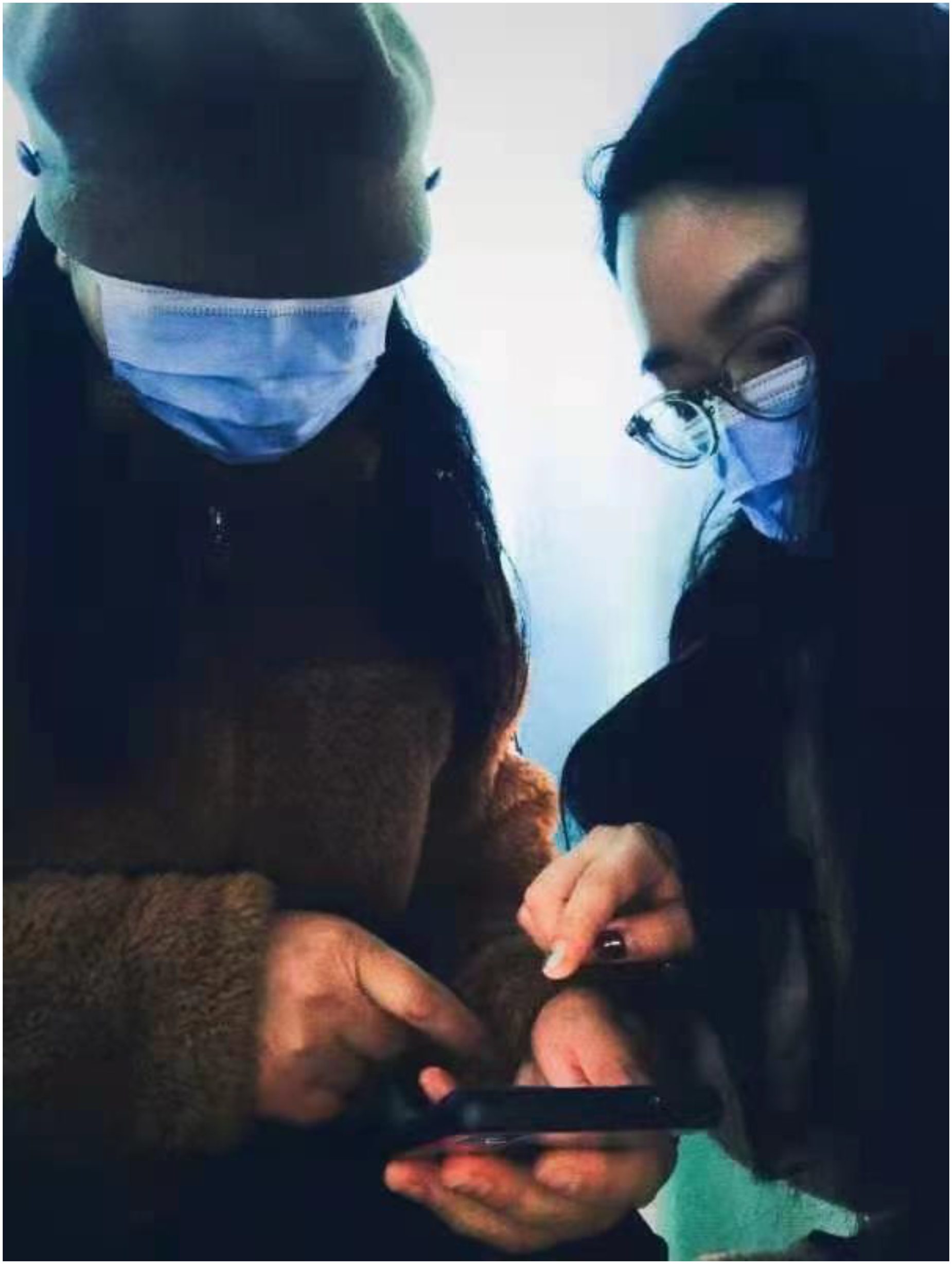
Xiaoxian teaching her grandma how to navigate WeChat.
Another example is the 30-year-old daughter of Mei Ran (55 years old) and her 80-year-old mum. Mei Ran was very proud of her daughter when recounting how the girl helped her and her mother to improve their digital skills. “I consider my daughter to be a good kid of filial piety,” she said. Her daughter was patient with her, “not much so in daily lives but in teaching us how to navigate smartphones (especially WeChat)” and much more patient with the grandmother. Due to the daughter's effort, the grandmother “adopted smartphones early on and was always eager to learn.”
The above two examples of intergenerational kinship care between granddaughters and grandmothers are regarded as a continuity of the traditional practices of filial piety. This kind of intergenerational kinship care via WeChat literacy—that is, the “digital natives” teaching the “digital immigrants”—was not an isolated practice during the Wuhan lockdown, when some adult children moved back to their parents’ home. The care-at-a-distance dynamic was changed when two or three generations co-habited in tight living quarters. WeChat literacy is part of the new intergenerational dynamics, which evolved naturally and informally in the everyday interactions among family members as they cooked and shared food together and as they helped each other to upskill their digital literacy.
Digital kinship mode 3
During the lockdown, kinship care also extended beyond immediate family members to neighbors and community social workers. As mentioned earlier, community volunteers helped Da Xian to set up the neighborhood WeChat group to facilitate pandemic information sharing and community group buying. These community volunteers, as well as social workers from the neighborhood committee, had access to household registration records and would call the building residents on the phone to ask them to join the WeChat group. The security guards in residential communities are often asked for help by older people for WeChat troubleshooting, such as setting up the health code or making an order in one of the grocery community buying groups. This is the case mostly for older people without their children around.
Kang is an 80-year-old woman mostly living alone, with only one daughter living in Wuhan (but not in the same residential community) and other children and grandchildren all overseas. She was able to manage her digital life fairly well, with the help of volunteers on the neighborhood committee who went over her to help her set up broadband in her unit and WeChat on her phone (given by her daughter) in 2020. The pandemic and lockdown have leapfrogged her into the digital era. Now Kang has a smartphone, is connected to the Internet, and can talk to her families overseas. She even knows how to use the TV set-top box. She is very proud of herself and continues to ask for help with technical troubleshooting, as she tends to forget how to use certain functions on WeChat and needs repeated instructions. She would ask for help from volunteers, neighbors, security guards, and anybody who came her way (our interview with her became a WeChat tech troubleshooting session).
For the older adults living by themselves without smartphones, or WeChat, or being connected to the neighborhood groups, life often became a struggle at the basic level of survival during the lockdown. Fifty-five-year-old Ma Ran lived in an old residential community with a similar situation to Da Xian: old buildings, older demographics, and lack of community organizations. The community volunteers were not as effective and helpful as in Da Xian's community. When the lockdown started, Ma Ran's community group was formed mainly through snowballing among residents themselves to facilitate food purchase and distribution. One of her neighbors, a single man in his 60s with a physical disability and living by himself, was left on his own to sort out his basic needs, until Ma Ran called him to invite him to join the group-buying WeChat group. However, only joining the WeChat group did not solve the problem, as the neighbor never used WeChat Pay nor had online banking, so he could not order any food through group buying. Ma Ran lent a helping hand again: he would ring her, and she would then order and pay for his orders throughout the lockdown. He kept a written record of all the payments that Ma Ran made on his behalf and paid her back in full (in cash) after the lockdown.
The above examples of digital literacy acquisition among the elderly in Wuhan—from self-help and peer help to kinship care and community/neighbor mutual help—are illustrative of old and new forms of intergenerational literacy and sociality among and beyond the immediate family members. This in turn prompts us to reflect on the meaning of re-fashioning kinship care mediated by WeChat. Digital kinship is both continuity and expansion of tradition (e.g., filial piety); it is multi-directional—from digital natives to digital immigrants and vice versa, and digital immigrants to digital immigrants—and beyond immediate family members. It is the community binding agent in the pandemic lockdown.
Conclusion
In this paper we have reflected upon the role of WeChat for intergenerational digital literacy as well as technology-facilitated informal kinship care during the 2020 Wuhan lockdown. We have illustrated how WeChat has become an essential tool for quotidian practices of sociality and filial piety from grocery shopping to sharing tips on digital literacy, thus keeping people connected and socially included. The pandemic saw the digital infiltrate all aspects of our lives—work, sociality, health, and intimacy—voluntarily or otherwise. It has also reignited traditional kinship care as the new norm.
The article has demonstrated the uneven ways in which digital connectivity and literacy were experienced by the digitally left-behind population—in this case, the elderly population. In a time of spatial restrictions and physical distancing, the role of digital technologies for social inclusion, especially for older adults, became particularly imperative. As our analysis of digital kinship and informal care between Wuhan older adult parents, their adult children or grandchildren, and neighbors highlights, the use of WeChat plays a crucial role for community bonding and community-based informal kinship care. We see how WeChat literacy is mobilized as a means toward the end of meeting human basic needs for food and connectivity that go beyond the Chinese traditional kinship system.
The use of WeChat during the pandemic has demonstrated its role to enhance existing social relations and connections. Filial piety can be maintained as part of the continuity of digital kinship. Much like LINE in Japan (Ohashi et al., 2017), WeChat in China reflects and enhances a digital genealogy whereby filial piety can move beyond blood ties and immediate families—highlighting the changing notion of kinship as it becomes redefined through the digital. Community support, including neighbors and neighborhood committee volunteers, is also part of the extended kinship care during the pandemic. It is especially a lifeline for the left-behind elderly who are socially isolated and live on their own. One of the crucial learnings from this time is the need to address the inequalities around digital access and literacy among the elderly population in practical and effective ways—taking into consideration the geographical, socioeconomic, and age differences—and thinking through the implications of WeChat (mediated) kinship in aging China.
While there are many successful stories of intergenerational teachings, there are also other stories about the perceived barriers or anxieties in adopting new technologies among the elderly. It can be hard for adult children to take on the role of teacher for their older adult parents, for lack of time or “patience”—a point often raised in our interviews. Sometimes barriers like impaired vision or hearing as well as psychological barriers such as older people's refusal to adapt to anything new make teaching and comprehension harder and hence cause tension between older adult parents and their adult children. Such a tension between parents and children is less a problem between grandchildren and grandparents. Instead, we have witnessed that digital kinship creates a special tie between grandparents and grandchildren through the troubleshooting process of navigating smartphone operation.
In our case study, we have chosen WeChat group buying as an entry point to illustrate how a necessity (for ordering food and hence basic survival) can be transformed into a new kinship practice in and beyond individual families. In the era of social commerce, mobile social media like WeChat act as an interface between culture and commerce. The community group buying is a social-commercial activity of micro-commerce on WeChat (Peng & Wang, 2021). It is enabled by the super app's technical affordances (such as the merging of social networking, e-commerce, and fintech), “communicative affordances” (Schrock, 2015), and “transactional affordances” (Manzerolle & Daubs, 2021). These affordances constitute the “infrastructural affordances” of WeChat (de Seta, 2020). WeChat and its various affordances can facilitate and mobilize informal care and digital kinship practices. However, the nature and appreciation of digital kinship depend a lot on cultural and affective capital, a topic that deserves further empirical analysis.
Footnotes
Funding
The author(s) received no financial support for the research, authorship, and/or publication of this article.

Author biographies
Haiqing Yu is a professor of Media and Communication and an ARC Future Fellow at RMIT University, Australia. She is a critical media studies scholar with expertise on Chinese digital media, technologies and culture and their sociopolitical impact in China, Australia and the Asia Pacific. Her current projects examine the social implications of China's social credit system, technological innovation, and digital transformation; China's digital presence in Australasia; and Chinese-language digital/social media in Australia.
Ge Zhang is a media anthropologist and non-fiction writer. His current research focuses on socio-technics, aesthetics, and affective ecologies of contemporary streaming media/platforms in the Sinophone world. His experiences during the Wuhan lockdown have prompted him to critically reflect on lockdowns' profound impacts on Chinese society.
Larissa Hjorth is a Distinguished Professor, digital ethnographer and socially-engaged artist In the School of Media & Communication at RMIT University. She is an Australian Research Council (ARC) Future Fellow exploring contemporary grief rituals in media cultures.