







Abstract
Older adults – meaning people over the age of 65 – are the first generation to grow old in a digital data-saturated world and represent a diverse range of digital literacies. Some have a long history of mobile media adoption, interest, and play, while others are less digitally familiar or literate. When it comes to older adults and artificial intelligence (AI), research has explored how the health and wellbeing of older adults can be optimized and improved through mobile AI. At the same time, the World Health Organization has warned of the risks of ageism in developing AI-based technologies that rely on ageist assumptions about the role of technology in the lives of older adults. Researchers, policymakers, and technology developers must work collaboratively and ethically with older people to build or adapt AI technologies that meet their needs while being cognizant of concerns and risks. To that end, there is little empirical evidence of older adults’ quotidian practices with mobile AI, their attitudes toward it, and what they think the future of mobile AI might hold. In this commentary paper, which draws on ethnographic and creative methods data from a larger study, we argue that the heterogeneous perspectives, perceptions, and practices of older adults must be included in the design, policy, and regulation of mobile AI.
Introduction
Older adults – meaning people over the age of 65 – are the first generation to grow old in a digital data-saturated world and represent a diverse range of digital literacies. Some have a long history of mobile media adoption, interest, and play, while others are less digitally familiar or literate (Fondevila Gascón et al., 2015; Nimrod, 2016). When it comes to older adults and artificial intelligence (AI), research has explored how the health and wellbeing of older adults can be optimized and improved through mobile AI (e.g., Shade et al., 2025; Wolfe et al., 2025). The World Health Organization (WHO) has warned of the risks of ageism in developing AI-based technologies that rely on “preconceived, often flawed assumptions of how older people wish to live or interact with technology in their daily lives” (2022, p. 5).
For the WHO, the onus is on researchers, policymakers, and technology developers to work collaboratively and ethically with older people to build or adapt AI technologies to meet their needs. There is little empirical evidence exploring older adults’ quotidian practices with mobile AI, their attitudes toward it, and what they think the future of mobile AI might hold (Shandilya & Fan, 2022). In this commentary paper, we build on the WHO's concerns, providing empirically grounded insights around older adults’ perceptions, practices, and predictions with mobile AI. We argue that the heterogeneous perspectives of older adults must be included in the policy, regulation, and design of mobile AI – that is, acknowledging the co-constitution of ageing and technology (Peine & Neven, 2021). Our commentary draws on data from a larger ethnographic and creative methods project investigating how Australian older adults’ ageing in place practices are imbricated with data and technology.
Despite encompassing an enormous array of digital-material systems, processes, and outputs (Crawford, 2021), AI has recently been used to describe generative products such as chatbots sold by corporations that use large language models (LLMs) and machine learning (ML) to produce written, audio, and visual outputs (Brennan et al., 2025). Previous studies on the datafication of everyday life have highlighted how algorithms are a form of AI through enabling automated decision-making (Avnoon et al., 2024; Burgess et al., 2022), changing the lives of countless people through systems that can be both visible and opaque. Mobile AI is “AI designed for, integrated in and associated with mobile technologies and mobilities” (Goggin, 2025, p. 3), that is, the ubiquity and propinquity of forms of AI capability embedded in smartphones and wearables.
From generative products such as chatbots to AI mechanisms such as mobile apps using algorithmic decision-making and automation, our participants referred to a range of devices, applications, and uses for mobile AI. As mobile AI technologies become more popular and seamless, it is important to not only differentiate between different applications of AI but also remain open to the diverse and nuanced perspectives of different users. We note this is especially important for older adults whose views on technology can be ignored, overlooked, or rejected outright (Rosales & Fernández-Ardèvol, 2019, 2020). The use of AI in mobile media devices, applications, and mobility systems is a rapidly developing area, and while guardrails and regulations are still emerging (Judge et al., 2025; Smuha, 2021), we use this commentary paper to suggest that older adults’ perspectives must be included in the design, development, and implementation of mobile AI systems to avoid embedding ageism and inequality.
Our research was conducted in 2024 with 23 home ethnography participants and 52 creative workshop participants aged 65 to 93 living in various locations in the state of Victoria, Australia (RMIT Human Research Ethics approval ID 26667). Our primary research question centered on quotidian encounters with data and datafication. The increased availability and visibility of generative AI products and services such as Chat GPT meant that both we and participants raised questions, concerns, or ideas about AI during our research. In our data analysis, we found that participants referred to mobile AI without explicitly naming it as such (e.g., social media algorithms or automated decision-making systems).
There is a wide array of knowledges, attitudes, and uses of mobile AI among older adults. When participants discussed using AI, they most often interacted with it via their smartphones, such as through social media algorithms, automated mobile apps, and chatbots. The intersection between mobile media and AI goes further, as participants frequently referred to reading news reporting on AI through a mobile device. These quotidian encounters with AI reinforce the seamlessness of its integration with mobile media (Cumiskey & Humphreys, 2023; Goggin, 2025). While there has been research on how mobile AI apps, tools, and services might improve the health outcomes of older adults (Wong et al., 2025), there is limited research that explores the encounters, attitudes, and expectations older adults have with mobile AI, especially from an everyday perspective. Such quotidian practices are essential to developing a holistic understanding of the possibilities and limitations of mobile AI. As mobile AI safety mechanisms, guardrails, and regulation are discussed and developed at national and international levels, it is vital to integrate the everyday practices and attitudes of a diverse range of people, including older adults.
To surface the everyday ways mobile AI is understood and used, we deployed a range of ethnographic and participatory action research techniques, including home interviews (Pink et al., 2016), creative, play-based workshops (Wohlwend & Medina, 2013), and cultural probes (Gaver et al., 1999). Creative, arts-based and ethnographic methods can help uncover tacit feelings, assumptions, and practices that can be difficult to express, including unspoken beliefs or attitudes. Ethnography is a method of writing up fieldwork that reflexively explores power in people's culture, rituals, and practices (O’Reilly, 2012). The ethnographic focus on everyday life allows for a detailed exploration of that which is taken-for-granted and mundane. Creative practice ethnographic methods include techniques such as multisensorial mapping and postcards, which can help elucidate affective affinities between people and digital technologies (Hjorth et al., 2020). In our project, we deployed creative and arts-based techniques alongside semi-structured ethnographic interviews with older adults to explore how they are incorporating technology into their ageing in place practices and plans.
Throughout these encounters and conversations with older adults, AI was variously discussed as something to be worried about, something with which to creatively play, and something that could shape the future of care. The variety of perspectives and practices demonstrates the importance of deploying creative methods with a diverse range of participants to capture the ways in which older adults are “active, discerning, and critical users with their own preferences, skills, and life goals” (Fernández-Ardèvol & Taipale, 2026, p. 8). The aim of this commentary paper is to argue that older adults’ discerning, critical perspectives must be included in the design, policy, and regulation of mobile AI. Mobile AI was imagined by some of our participants to have the potential to benefit older adults, but it must be deployed with their everyday uses and needs in mind. Below, we outline our three key themes and conclude with a provocation for the future.
Perceptions: how are older adults thinking about mobile AI?
Participants’ perceptions about mobile AI were varied, reflecting the ongoing and uneven nature of AI's integration into everyday life. Mobile AI-facilitated harms are perceived by some older adults as real threats to society and democracy that must be addressed through adequate research, policy, and design (Chu et al., 2022). For some participants, however, AI was exciting and a great opportunity; one participant described it as a “boon” and compared it to the development of other tools throughout human history. Including the perspectives of a diverse range of older adults can result in more adequate and responsive technologies and governance systems, better equipped to respond to technological developments, including post-smartphone technologies (Goggin, 2025). Algorithmic decision-making embedded in social and mobile media were frequently invoked by participants as having significant impacts on politics and public discourse.
Participant Zofia, who is an activist for refugees seeking asylum in Australia, said it was important to focus on the human element in how such tools were deployed. As she said, we must be attuned to the “potential harm that can come from humans using [AI].” Zofia's circumspect remarks about AI systems were reflected by other participants, who discussed how AI was being reported and regulated in Australia and its implications for society.
There has been a great deal of news media reporting on generative AI, which several participants told us was intriguing and concerning. Participant Wendy said she had seen news on her phone about teenagers acting dangerously after conversing with AI chatbots. Attitudes of worry and fear toward AI were referenced by participants George and Veronica in relation to the role of media reporting and government regulation of AI.
Neither George nor Veronica had used generative AI, but they had been shown examples and said they believed the media was playing a big role in overhyping its importance (Figure 1). As George said, “I think a lot of the media are like sheep. They just jump on board. They’ll follow each other and just regurgitate each other. You get bombarded.” For George, it was imperative that new technologies such as generative AI chatbots be effectively critiqued and regulated. His perception was informed by reading news reports and analysis suggesting AI-powered technology, including data-driven predictive technologies, were being implemented in Australia without adequate regulation or oversight (see Australian Government, 2024; Reset Australia, 2024).
George's extensive library of news apps where he learns about AI.
Most of our participants believed that more regulation was needed to ensure guardrails and ethics were incorporated into the roll out of generative AI products and services. Participants’ concerns about mobile AI suggest, as other researchers have highlighted (Elliott, 2019), that these perspectives must be incorporated into policy and regulation to make technologies safer. While many participants had concerns around the ways mobile AI is being integrated into everyday life, at the same time, other participants described using mobile AI in creative ways.
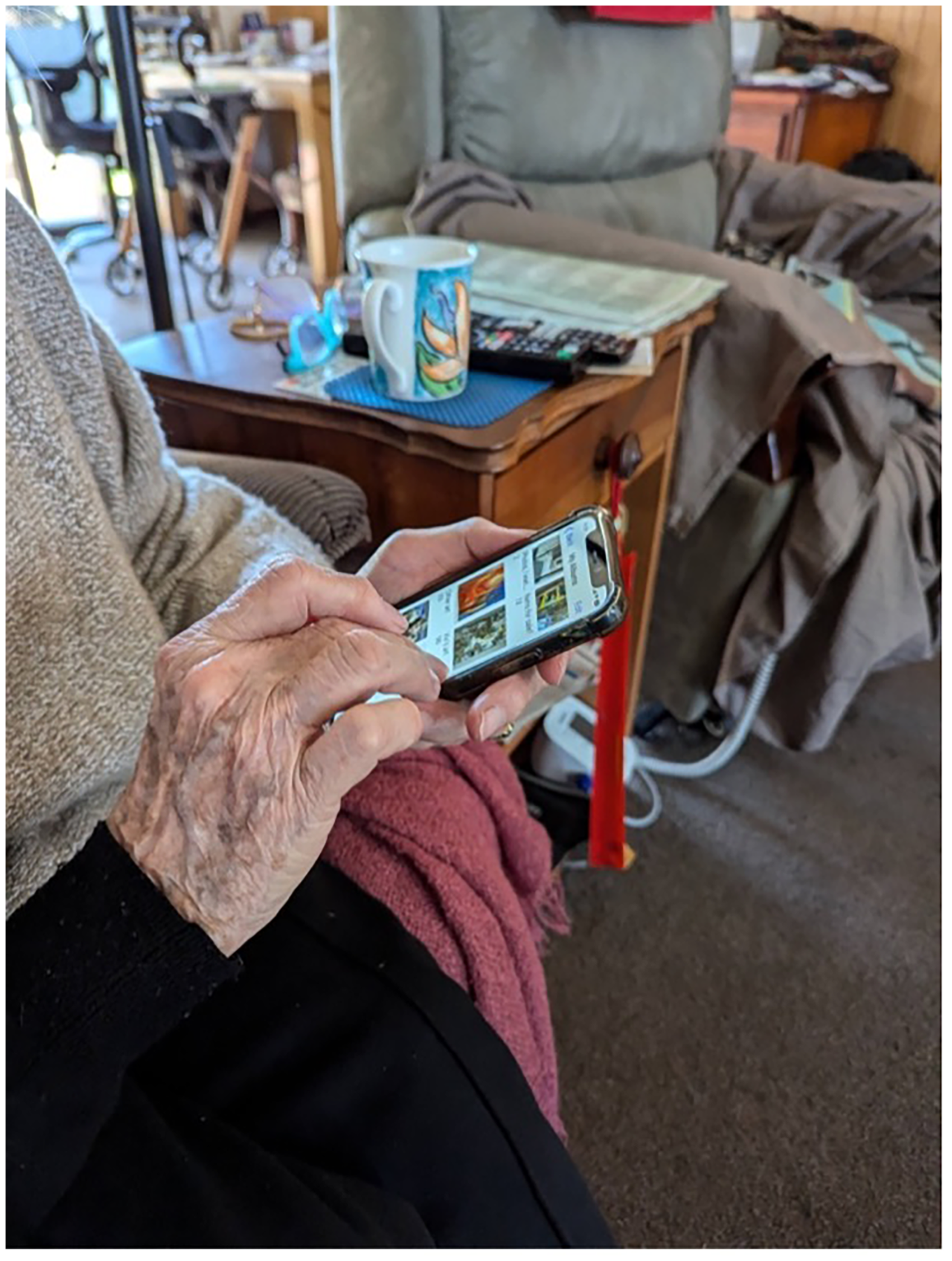
Miriam selecting artworks that need titles.
Practices: what are older adults’ everyday mobile AI practices?
Older adults’ everyday practices with mobile AI include daily convenience tasks, health and safety, and playful interactions. Previous research has found that older adults incorporate AI into a variety of everyday tasks, while grappling with the supposed intelligence of these systems (Shandilya & Fan, 2022). While we remain skeptical and critical of the influence of inadequately regulated AI technologies and industries, we also recognize that these technologies can make life easier for many. At the same time, AI systems have been shown to be built on ageist assumptions, beliefs, and attitudes that need urgent redress (Stypińska, 2021). The prudent incorporation of some AI-powered technologies into everyday life can assist older adults to age well and in place (Rubeis et al., 2022), yet we recognize the need for caution and care in such integration.
Some participants described taking up mobile AI for a range of purposes, thereby rejecting ageist assumptions about older adults’ non-use of technology. For several participants, AI enabled quotidian conveniences and facilitated playful encounters. Participants cited smart home systems, chatbots, automated banking, and shopping services facilitated by AI-enabled mobile apps. For instance, participant Wendy, who lives with disability, used an internet-connected cooking device to automate her shopping via a mobile app. The integrated system allowed her to schedule grocery shopping delivery, and plan and cook her weekly meals. Elsewhere, energy enthusiast participant Gerhard used a range of mobile apps to remotely monitor and control his electric car, his home energy consumption, and his solar electricity generation system. Artist participant Miriam experimented with using generative AI to help her title her paintings (Figure 2). Wendy, Gerhard, and Miriam's anecdotes point to how older adults can be enthusiastic adopters of technology, countering ageist narratives and assumptions about older people being techno-phobic (Rosales et al., 2023). Their insights are important because they foreground the usefulness of some mobile AI systems. Elsewhere in our research, we have found that older adults have important suggestions for how future technologies might deploy mobile AI.
Predictions: what could the future look like for older adults and mobile AI?
While it is wise to be cautious about those who claim to be able to predict the future, we have found it useful to deploy methods inspired by speculative thinking (Dunne & Raby, 2013) to capture imaginative possibilities for the future of living with technology. In our creative methods workshops, some participants were concerned about the rise of AI – they predicted dystopian futures where humans would be at risk. These visions of the future contrasted with some of our ethnographic participants, who were interested in how AI-powered mobility systems and devices, including robots (Lutz et al., 2019), could help care for them as they aged. The diversity of perspectives on the future of AI demands further investigation, especially as AI becomes integrated even further into mobile technologies (Goggin, 2025; Shandilya & Fan, 2022). As our participants make clear, while the future is yet to be determined, the agency of older adults must be prioritized in relation to technologies that will particularly affect them.
For some of our participants, social robots – a form of robotic home care – may afford them greater independence and improved quality of life. Social robots are “a ‘physically embodied, autonomous agent that communicates and interacts with humans on an emotional level’” (Darling, 2012, p. 4 cited in Lutz et al., 2019, p. 414) that often rely on AI to create a sense of social interaction. Participant Annisa positively anticipated robotic home help and mobility aides. She wanted a “robot driving [my] car so I can be a passenger in my own car” and “more robots in the house – doing the cleaning, carrying heavy things … I would like to see more robotic use for assistance under our control” (emphasis added). For Annisa, the benefit of social robots would be to enact a care regimen similar to that provided by home aged care workers, though it was important not to lose her agency.
Robotic care assistance powered by AI raises pressing questions around how policy and regulation can ensure that the privacy, dignity, and agency of older adults are not compromised. As Jeannette Pols (2012) has argued in relation to telehealth devices in palliative care settings, the line between “cold technology” and “warm care” is nebulous, as the attitudes and needs of patients or those receiving care play a significant role in the ways that care is received and understood. Older adult voices, desires, ideas, and concerns should be at the forefront of the development and regulation of mobile AI in social robotics and care.
Conclusion
In their introduction to a special issue of New Media & Society exploring mobile media research trajectories, Cumiskey and Humphreys (2023) note that the future of mobile communication research needs to focus on the ethical implications of seamless infrastructures and automaticity (p. 837). Similarly, in a special issue of this journal, Fernández-Ardèvol and Taipale (2026) argue that we need “a reassessment of prevailing assumptions of what mobile communication is all about in later life” (p. 4). We are in a moment of rapid development in mobile AI, which requires careful attention to the everyday practices, perceptions, and predictions of people who can be overlooked in research, such as older adults. Incorporating these perspectives is essential as mobile AI becomes seamlessly integrated into everyday life. In this commentary paper, we have outlined how our older adult participants perceive mobile AI, how they incorporate and play with it, and how mobile AI might shape the future of care. As ageing in place continues to shape and be shaped by technology, we have argued that older adults’ real-world, everyday concerns and needs must be included in design and regulation to ensure just digital futures.
Footnotes

Ethical approval and informed consent statements
Ethics approval for the research was obtained through RMIT University's Human Research Ethics (Approval ID: 26667). Written informed consent for audio and visual data collection was obtained from participants before any data collection commenced.
Funding
The authors disclosed receipt of the following financial support for the research, authorship, and/or publication of this article: Funding for this research was provided by the Australian Research Council through the Discovery Project DP230103075 “Ageing in and through data: What data can tell us about ageing.”
Declaration of conflicting interests
The authors declared no potential conflicts of interest with respect to the research, authorship, and/or publication of this article.
Data availability statement
Data from this project is not able to be shared because the research is still in progress.