






Abstract
Integrating a techno-embodied perspective, mobile affordance theory, and critical disability studies, this study investigates how people with disabilities navigate everyday smartphone practices. Using a mixed-method design—combining smartphone log analysis (n = 90), field observations, and in-situ interviews (n = 20)—the study identifies four recurring smartphone use patterns: deeply embedded use, path-dependent use, hyper-checking practices, and digital disengagement. Critically, these patterns emerge from ongoing negotiations among embodied differences (e.g., physical, cognitive, and sensory conditions), mobile affordances (e.g., modality, portability, and navigability), and broader socio-technical contexts. The findings suggest that smartphone use among people with disabilities extends beyond traditional accessibility frameworks, functioning instead as a vital infrastructure of embodied governance—supporting cognitive and emotional regulation, sensory curation, and the maintenance of autonomy. By advancing the concept of embodied affordances, this study foregrounds the reciprocal relationship between diverse embodied experiences and mobile media design. Conceptualizing disability as a socio-embodied-technical condition, the study highlights how digital interactions can simultaneously enable participation and obscure durable, latent forms of exclusion in digitally saturated environments.
Introduction
With the ubiquitous diffusion of smartphones into the fabric of everyday life, the relationship between communication technology and disability has emerged as a dynamic arena for complex socio-technical negotiation. Rather than treating disability as a fixed medical deficit or an individual impairment, contemporary scholarship increasingly conceptualizes it as a relational, evolving experience. This experience is co-constituted through the ongoing friction between sensory bodies, mobile technologies, and the normative social structures that govern their use (Alper, 2018).
These socio-technical interactions give rise to diverse smartphone practices rather than uniform patterns of use. For many people with disabilities (PWDs), the smartphone serves as a vital instrument for regulating cognitive, sensory, and emotional demands—offering a sense of predictability and safety in overstimulating or inaccessible environments (Alper, 2023). However, these practices do not exist in a vacuum; they unfold within digital architectures embedded in ableist social arrangements that often prioritize a standardized, ideal user body. Consequently, mobile design can impose hidden burdens of effort and friction, effectively masking latent forms of exclusion even as it promises digital inclusion (Ellis et al., 2024; Garland-Thomson, 2011).
Despite a growing acknowledgment of this tension, a gap remains in understanding how heterogeneous usage patterns emerge from the interplay of diverse bodily experiences—defined here as the lived, phenomenological reality of physical, sensory, and cognitive difference—and the specific affordances of mobile media. Without attending to these dynamics, research risks oversimplifying the digital lives of PWDs, overlooking how access and agency are unevenly produced. To address this, the present study employs a mixed-methods approach to investigate the everyday mobile practices of a diverse cohort, including individuals with sensory, motor, and cognitive disabilities. By bridging disability culture with mobile culture, we examine how PWDs adapt, negotiate, and at times subvert normative technological (Peters, 2000; Vanden Abeele, 2016).
To guide this inquiry, the study addresses four central research questions.
By integrating scholarship about embodied communication, mobile affordances, and critical disability studies, this study moves beyond simple accessibility issue to reveal the nuanced ways in which technology and embodiment are inextricably linked among PWDs.
This paper proceeds as follows. First, we review the literature on mobile communication and disability, with a particular focus on disability media studies and the misfit between bodies and design. Second, we present findings from Study 1 (smartphone log analysis), which identifies four recurring usage patterns. Third, we draw on Study 2 (in-situ interviews) to examine how these patterns emerge from the relational negotiation between users’ embodied needs and specific sets of affordances. Finally, we discuss the theoretical and practical implications for inclusive, user-centered design and the future of mobile communication scholarship.
Literature Review
Heterogeneous Smartphone Use Among PWDs
As smartphones have become deeply integrated into the infrastructure of daily living, ownership is no longer the primary driver of digital inequality. Instead, substantive variance now emerges from the nuanced patterns of device uptake and usage (Alper, 2021). Investigating how digital access is negotiated through the dynamic relationship between users, technologies, and everyday contexts has therefore become a central concern for disability research (Locke et al., 2022).
Despite growing recognition of usage heterogeneity in the general population (Brinberg et al., 2021; Peng and Zhu, 2020), research focusing on PWDs remains fragmented. Existing studies suggest that PWDs often engage with smartphones more intensively and for more social and recreational purposes than their non-disabled counterparts (Jenaro et al., 2018). However, media usage varies significantly across disability groups. For instance, Deaf individuals with strong community identities were more proactive in sharing emergency information on social media than hard-of-hearing individuals navigating between Deaf and hearing cultures (Morris J et al., 2014), 1 whereas users with mental health conditions exhibited higher sensitivity to social media popularity metrics than those with physical disabilities (Johnson, 2019). To date, no study has systematically examined the full spectrum of smartphone behaviors across multiple disability groups within a single analytic framework.
Furthermore, prior research (Johansson et al., 2021; Mokhtarinia et al., 2022) has relied heavily on isolated metrics of smartphone use—such as screen time or app categories—which fail to capture the complexity of daily practice. To address this, we propose a holistic framework comprising three interrelated indicators: amount, diversity, and fragmentation of usage. The amount of usage quantifies a user’s overall reliance on the device (Parry and Toth, 2024). Diversity of usage indexes behavioral flexibility, distinguishing between users who navigate a broad array of digital functions and those who rely on a narrow set of functions (Gong and Huskey, 2023). Fragmentation of usage—measured by daily unlocks—captures the rhythmic sequentiality of interactions, distinguishing sustained, task-oriented sessions (e.g., drafting manuscripts) from habitual micro-engagements (e.g., smartphone alert checks) (Kim et al., 2019). By synthesizing quantity, variety, and rhythm, we offer a practice-oriented understanding of smartphone engagement as a socially embedded experience (Vanden Abeele, 2016). Our first research question asks the following.
Linking Embodied Experiences to Smartphone Use
Smartphone practices are fundamentally anchored in the body; mobile engagement is not merely a technical preference but a techno-embodied negotiation (Farman, 2020; Rettie, 2005). The body is not erased in digital space; rather, it is reshaped and resituated. As Ihde (2002) notes, the “here-body”—the physically grounded self—acts as the anchor for all digital experiences, meaning technologies are perceived and used based on specific bodily contexts.
Disability encompasses a wide spectrum of sensory, motor, cognitive, and communicative bodily experiences. For instance, individuals with speech impairments may bypass voice calls in favor of video-mediated communication (Morris JT et al., 2017), while Deaf or hard-of-hearing individuals often report high levels of nomophobia (Awed & Hammad, 2022). Crucially, disability does not simply impact a single sense; it functions as a sensory ensemble, reorganizing the entire physical-sensory-affective-cognitive system (Alper, 2023). For autistic children, the smartphone can act as a tool for sensory curation, providing a reliable source of regulation and safety in their environments (Harrison et al., 2019). Despite these insights, the linkage between diverse usage patterns and these varied embodied experiences remain underexplored. Our second research question asks the following.
Smartphone Use Within Mobile Affordances and Social-Technical Systems
Understanding these practices requires a relational view of affordances—the action possibilities that emerge from the interaction among a material artifact, a user, and their context (Evans et al., 2017; Gibson, 2014). This perspective is especially important for examining how PWDs engage with smartphones, as affordances are not inherent features of devices but are realized through embodied and situated use.
Such relationality becomes particularly visible in disability contexts. For a user without upper-limb mobility, portability is not simply a technical feature of carrying a device in one’s pocket; rather, it becomes an embodied practice of stabilizing the device and adopting alternative gestures, such as nose-based touch (Kar et al., 2021). Similarly, modality may shift from a visually dominant interface to one organized around audio and haptic feedback for blind users (Goggin, 2017). In these cases, affordances are enacted differently because bodily capacities and environmental conditions shape how interaction unfolds.
Yet digital inclusion is never guaranteed. Mobile design often reflects normative assumptions about standard bodies, producing “misfits” that impose additional burdens on PWDs (Ellis et al., 2024; Garland-Thomson, 2011). Accessibility, therefore, is not a stable property of a device but an uneven and negotiated achievement shaped by power relations and ableist infrastructures (Alper, 2021). At the same time, PWDs are not merely positioned as passive recipients of design constraints. Many develop vernacular strategies or personalized adaptations that appropriate and sometimes subvert intended functionalities (Goggin, 2008; Herskovitz et al., 2023). These practices illuminate the ongoing tension between individual agency and structural limitation within mobile socio-technical systems. To further uncover this dynamic, we propose the following research questions.
Study1
Methods
Participants and Ethical Considerations
Both Study 1 and Study 2 received Institutional Review Board (IRB) approval prior to data collection. Given the vulnerability of the population, we implemented rigorous ethical protocols: written informed consent was obtained from the partner organizations, all individual participants, and—in cases involving intellectual or mental disabilities—their legal guardians. Participants were explicitly informed of their right to withdraw at any time without penalty. Study 1 collected smartphone log data from 90 individuals with disabilities, including 40 females, with an average age of 55 years (median = 56, range: 23–79). Data collection spanned an average of 2 weeks (median = 12 days, range: 6–54 days). The sample comprised participants from four general disability groups: visual (n = 6), 2 hearing/speech (n = 27), physical (n = 29), and intellectual/mental (n = 28). 3
Recruitment and Research Context
Participants were recruited between December 2021 and October 2022 through a large-scale smartphone training program in Shanghai. This initiative was a collaboration between the Shanghai Disabled Persons’ Federation (SDPF)— the official administrative body for registered PWDs in the city—and JinChang Public, a social enterprise specializing in smartphone maintenance and training for the community of PWDs. The third author, serving as chief executive officer (CEO) of JinChang Public, coordinated the technical logistics.
The training curriculum was designed to bridge the usage gap by teaching essential digital skills for daily living, including social networking (e.g., WeChat), mobile commerce (e.g., MeiTuan), and e-government services (e.g., paying utility bills and accessing public services through SuishenBan). Instructions included step-by-step explanations of technological interfaces, embedded functions (e.g., WeChat group chats, location sharing, digital red packets, Moments posting, and mini programs), and hands-on practice (exemplar course content is provided in Table 1 in the supplemental material). The training was organized into disability-specific cohorts of 20–30 members ensure pedagogical accessibility.
Data Collection and Instrumentation
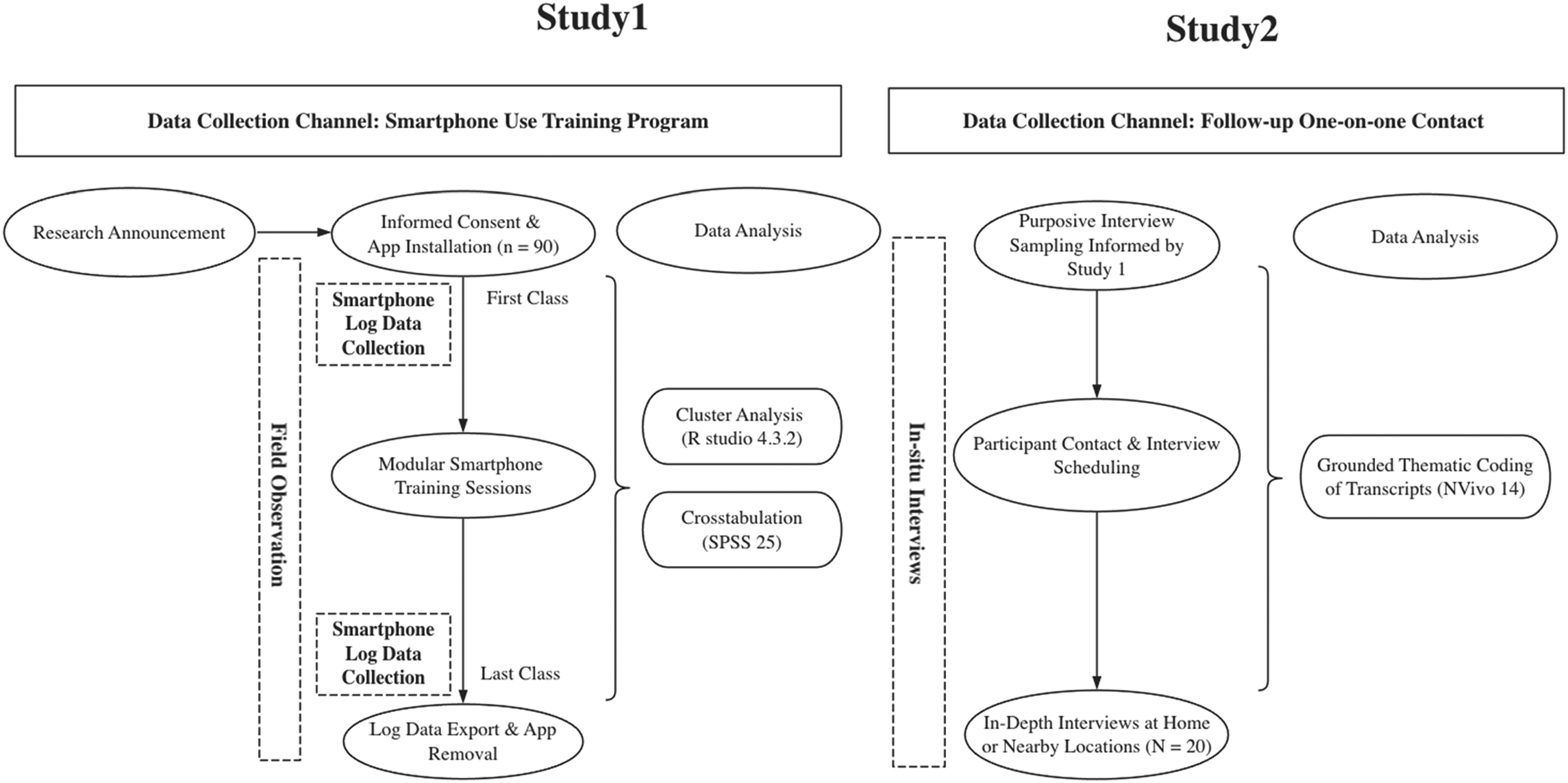
During the initial sessions, we recruited volunteers for the log-data study. Because the vast majority of participants used Android devices, we utilized “Screen Time,” a secure application verified by Tencent Mobile Butler and available for direct download from the app stores of mainstream Android phones. 4 The app ran non-intrusively in the background, recording objective usage metrics without disrupting the users’ natural digital environment. At the conclusion of the program, data were exported and the application was uninstalled (see Figure 1 for the methodological flowchart).
Results: Quantitative Findings.
To capture the complexity of smartphone patterns, we operationalized three core metrics. Amount of usage was calculated as the total daily screen time spent on the device. We utilized Shannon’s Entropy (H) to calculate the diversity of app category usage (Brinberg et al., 2021). This metric is defined as

where
Results: Quantitative Findings
Heterogeneity of Smartphone Usage
To identify distinct patterns of engagement, we analyzed three smartphone use indicators: amount (mean = 6.62 h, median = 6.15, min = 0.93, max = 16.44, SD = 3.53), diversity (mean = 0.40, median = 0.41, min = 0.08, max = 0.70, SD = 0.116), and fragmentation (mean = 32.39, median = 28.2, min = 2.17, max = 163.75, SD = 23.62). Using K-means cluster analysis—validated by an elbow plot (see Appendix A in the supplemental material), within-cluster sum of squares (WCSS), and qualitative interpretability—four distinct usage patterns emerged, as presented in Table 1.
Smartphone Usage Pattern Clusters.
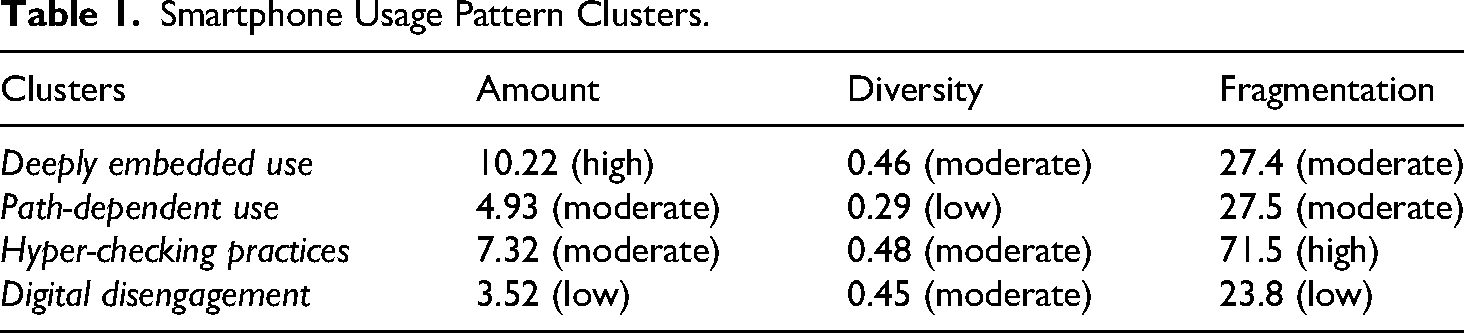
The pattern of deeply embedded use (n = 29) is characterized by extensive daily screen time and moderate levels of diversity and fragmentation. This pattern involves sustained engagement across multiple application categories and relatively long session durations. Path dependent use (n = 26) reflects more concentrated engagement, with activity clustered within a limited range of applications, resulting in the lowest diversity scores among the four groups. Hyper checking practices (n = 11) are marked by high fragmentation, with frequent device unlocking throughout the day, indicating rhythmic and intermittent engagement patterns. Digital disengagement (n = 24) demonstrates lower overall activity levels and fewer daily unlocks. See Figures 1–4 in Appendix B for 24-hour level bar plots of smartphone usage category trajectories across the four identified patterns.
Although these patterns may also be observed in the general population, within this cohort of PWDs they are better understood as functional or compensatory strategies, particularly when considered alongside our qualitative findings, rather than as mere habits. We elaborate on this interpretation in the following sections. Moreover, these patterns should be conceptualized as configurations of practice rather than fixed identities. Participants may shift across patterns or exhibit multiple patterns depending on situational demands and evolving socio-technical contexts.
The Interplay Between Disability and Smartphone Patterns
To investigate how these patterns correlate with embodied conditions, we conducted a descriptive cross-tabulation of clusters by disability group. Crucially, these distributions reveal overlapping tendencies rather than deterministic links; no usage pattern was exclusive to a single disability category.
The deeply embedded use pattern predominantly featured participants with hearing or speech impairments (62.1%), followed by those with physical disabilities (20.7%) and mental or intellectual disabilities (13.8%). The path-dependent use pattern showed a higher concentration of participants with physical disabilities (50.0%), followed by hearing or speech impairments (19.2%), mental or intellectual disabilities (15.4%), and visual impairments (15.4%). The hyper-checking pattern was notably skewed toward participants with mental or intellectual disabilities (72.7%), whereas participants with hearing or speech and physical disabilities were less represented. The digital disengagement pattern reflected a more mixed distribution, primarily comprising participants with mental or intellectual disabilities (45.8%) and physical disabilities (33.3%), followed by those with hearing or speech impairments (16.7%) and visual impairments (4.2%) (see Table 3 in the supplemental material for more details).
These indicative trends demonstrate that although disability does not dictate a single type of use, it significantly shapes the disposition toward specific patterns. These findings provided an empirical basis for our purposive sampling in Study 2, allowing us to explore the “why” behind these patterns through in-situ interviews.
Study 2: Qualitative Inquiry
Method
Purposive Sampling and Participants
To move beyond quantitative patterns and uncover the “why” behind the identified patterns, we conducted in-depth, semi-structured interviews with 20 households. Participants were selected through purposive sampling from the Study 1 cohort to ensure representation across all four usage patterns and all four disability categories. We conducted five interviews per pattern group, prioritizing individuals whose log data represented prototypical cases of their respective clusters (see Appendix C for participant metadata).
The Home as a Situated Research Site
Interviews were conducted primarily in participants’ homes to capture the situated nature of smartphone use. The home environment allowed us to observe the physical and infrastructural contexts of mobile practices, such as specialized charging stations, wheelchair mounting brackets, or the proximity of the device to other assistive technologies. This approach aligns with the social model of disability, viewing the device not in isolation but as part of a broader lived ecosystem. For participants who preferred not to be interviewed at home, interviews were conducted in nearby quiet public spaces of their choosing.
Accessibility and Facilitation
To ensure full participation and minimize communicative friction, we utilized specific facilitation strategies based on the participants’ embodied needs. For Deaf participants, a certified bilingual translator proficient in both Mandarin and Chinese Sign Language (CSL) facilitated the dialogue. For elderly participants who primarily spoke the Shanghai dialect, an assistant fluent in both Mandarin and Shanghainese assisted the first author to ensure no nuance was lost in translation. Interviews were conducted in the presence of guardians or caregivers to provide emotional support and assist in clarifying complex questions when necessary.
Interview Protocol and Data Collection
The interview guide was iteratively developed based on the findings of Study 1. Questions focused on the way the smartphone integrates into or disrupts the rhythm of the day, specific physical or cognitive challenges when navigating interfaces, and the role of the device in maintaining social networks and community identity (see Appendix D for interview question outline).
All interviews (averaging 60-90 min) were recorded and transcribed verbatim, resulting in over 400 pages of text.
Data Analysis
The analysis proceeded in three phases following reflexive thematic analysis (Braun and Clarke, 2021). The first and second authors independently coded four transcripts to identify recurring concepts related to effort, emotional regulation, and affordance-misfits. Codes were grouped into higher-level themes (e.g., sensory curation). We cross-referenced interview findings with the log data from Study 1 and the field notes. For example, “Hyper-checking” logs were compared against interview accounts of environmental reassurance to validate the functional meaning of the fragmentation metric. NVivo 14 was used for data management and to ensure a transparent audit trail of the coding process.
Results: Qualitative Findings
The following sections detail the four smartphone usage repertoires identified in Study 1, illustrating how they emerge through the negotiation of embodied conditions, mobile affordances, and socio-technical contexts.
Deeply Embedded Use: The Paradox of Sensory Accessibility
Although Study 1 identified many Deaf and hard-of-hearing users as “deeply embedded,” our interviews reveal that this intensity is not merely a choice, but a necessity for sustaining peer relationships grounded in the Deaf identity. Historically, literacy barriers—often resulting from the misalignment between sign-language-based cognitive patterns and phonetic —have isolated older Deaf individuals (Paul, 2018). Four out of five older deaf participants reported that many of their deaf peers are illiterate or semi-literate, posing enormous challenges to maintain peer-group connections when leaving their familiar neighborhoods. The emergence of visual-synchronous modality (video calling) on platforms like WeChat has provided a revolutionary fit for this group. Three of our deaf interviewees shared similar experiences: With the advent of social media, especially the widespread use of WeChat video calls that allow sign language communication, my life has changed. I regularly video call different deaf friends, and I have several deaf friends with whom I maintain a routine connection. It enables us to stay connected over long distances. Whether reach out to each other for help or just for a casual chat, we simply give each other a video call.3
Compared to text or voice messaging, visual modality featured by video calls uniquely align with deaf users’ communicative preferences. By providing a higher level of social presence, this preferred communication mode possibly fostering more focused and immersive interaction sessions, developing deeper emotional bonds, and reinforcing Deaf cultural identity (Bitman and John, 2019). In this way, video calling functions not just as a technical tool but as a culturally embedded medium of relational maintenance and creates ideal alignment between mobile affordances and users’ sensory needs. However, this fit is conditional and carries significant economic and physiological costs:
Data Poverty
Unlike text or voice, video calling consumes massive amounts of cellular data. Participants like Du must ration their social lives, concentrating communication at the start of the month when data quotas reset—a cyclical pattern of forced silence that hearing users rarely experience: As video-calling costs more mobile data traffic than messaging, I usually keep in very close touch with my deaf friends during the first several days each month as the quota for my data traffic at that time started anew, whereas I try to reduce communication with friends via video call towards the end of each month as the data traffic were running out. Unless there are some emergencies where I must use video call, I’ll purchase an extra cellular data package.
Visual Exhaustion
Because Deaf users cannot rely on dual-sensory input, they experience embodied exhaustion. Zhang, a 67-year-old participant, suffered deteriorating vision and “dry eye syndrome” from the intense visual scrutiny required to parse gestures and subtitles on Douyin (TikTok): We deaf people are different from hearing people. We rely more on our eyes. During the pandemic, I got addicted to watching videos on my phone. Since I couldn’t hear, I had to focus all my energy on watching to understand the content. Eventually, my eyesight got worse. (Zhang) More than 90% of our deaf patients report vision-related issues. They communicate almost entirely through smartphones and watch a lot of videos. It's very straining because they can only rely on their eyes. (Her care doctor)
Zhang’s story illustrates how digital overreliance, when channeled exclusively through the visual modality, can damage other senses and create unintended health consequences. Zhang’s deteriorating eyesight suggests that for the Deaf community, digital inclusion is achieved through a sensory trade-off, where social connectivity is purchased at the expense of bodily fatigue and extra financial burden.
Path Dependence: The “Good Enough” Stabilization
Path-dependent use is characterized by engagement that is temporally intensive yet narrow in functional scope. Our findings suggest that this pattern represents a form of socio-technical stabilization, where users establish a “good enough” digital pathway that supports immediate needs within the boundaries of constrained environments.
Embodied Limits and Localized Routines
For Zhao, a participant with a mild mobility impairment, path-dependent use emerged as a rational response to a localized lifestyle. Although Zhao was able to walk independently, his limited physical stamina confined most daily activities—shopping, socializing, and running errands—to a small geographic radius. In this localized context, the smartphone did not function as an essential compensatory bridge to the outside world but rather as a supportive tool integrated into deeply entrenched local routines. As Zhao explained: I usually spend several hours on group chats every day. When I see something I like, I just call the seller and go to the shop nearby to pay in cash. I don’t go far because my legs get tired easily.
Zhao described his smartphone use as unproblematic, a perception grounded in the fact that a small set of functions (WeChat group chats, voice calls, and proximity-based coordination) adequately supported his neighborhood-centered life. Here, path dependence was sustained by the sufficiency of these familiar affordances. This functional satisfaction reduced both his need and motivation to explore additional applications, illustrating how users in marginalized communities may remain unaware of the full capabilities of their devices when their immediate socio-technical environment feels settled (Dalvit, 2019).
Cognitive Management and Material Constraints
Feng’s case reveals a contrasting pathway into the same usage pattern, shaped by the friction between cognitive–sensory needs and technological materiality. Feng, a 41-year-old man with mild intellectual disabilities, exhibited extremely intensive smartphone use—logging 8 to 10 hours per day— that was nevertheless concentrated almost entirely within the Baidu search engine.
Feng lived with his elderly parents in a small apartment, using an older 16 GB smartphone passed down from his mother This limited storage capacity acted as a material barrier, effectively narrowing his digital environment by constraining the installation of new applications. Within these boundaries, Baidu became a multifunctional gateway. He used its search interface for information seeking, entertainment, and emotional regulation—navigating layered hyperlinks, shifting between topics, and playing embedded games.
In Feng’s case, path-dependent use did not reflect a lack of curiosity or engagement. Instead, it emerged as a consolidation of exploration within a single, cognitively manageable interface that combined multi-mediality with easy navigability. The internal diversity of the search engine allowed for prolonged engagement, sustaining Feng's sense of connection to a broader world despite the lack of digital guidance, parental guardianship, and device-level constraints that prevented wider experimentation across platforms.
Convergent Negotiations and Latent Vulnerabilities
Taken together, Zhao’s and Feng’s cases demonstrate how path-dependence arises through different but convergent negotiations. For Zhao, it was anchored in embodied mobility constraints and neighborhood-based social infrastructures; For Feng, it was anchored in cognitive considerations, device materiality, and family-mediated access. In both instances, smartphone practices became organized around “good enough” pathways that effectively supported everyday life within bounded contexts.
However, this stabilization also generated latent vulnerabilities that remained largely invisible within routine engagement. As long as users remained within familiar social networks and well-rehearsed digital tracks, their practices appeared sufficient and even empowering. Yet when they encountered situations outside these routines, their limited engagement with the broader digital ecosystem became a source of sudden constraint.
This vulnerability became visible when Zhao encountered an unexpected charge on his phone bill. He attempted to resolve the issue through his established method—calling customer service—only to be redirected to an online appeal system that fell entirely outside his digital repertoire. Zhao’s response was telling: “They asked me to submit an appeal online, but I didn’t know how to do that, so I just let it go.” Critically, Zhao’s decision to “let it go” should not be interpreted as passivity. Rather, it reflects a learned accommodation to exclusion, whereby individuals adjust their expectations downward in response to recurring structural barriers. In this sense, path-dependent use can mask exclusion by rendering it episodic rather than systemic, allowing users to remain functionally engaged while privately absorbing the costs of technical breakdowns.
Zhao’s case thus illustrates how path-dependence can produce a false sense of digital adequacy. In highly digitized urban environments like Shanghai—where civic and financial interactions increasingly require sophisticated platform-based participation—these breakdowns are not merely anomalies; they are inevitable moments where “good enough” pathways fail to meet the demands of a normative digital society.
Hyper-Checking: Intersectional Positioning and Sensory Regulation
Findings from Study 1 indicate that participants with mental or intellectual disabilities were more likely to engage in hyper-checking practices—a pattern characterized by highly fragmented, repetitive, and short-duration interactions. Rather than reflecting random or inefficient use, this pattern emerged through situated negotiations among embodied cognitive-sensory experiences, smartphone affordances, and intersectional socio-technical conditions, including family support, economic resources, and institutional exclusion.
Sensory Seeking and Emotional Reassurance
Kuan, a 34-year-old man with impaired brain function resulting from accidental suffocation at birth, provides a poignant illustration of how hyper-checking practices are meaningfully embedded in everyday life. Kuan lives with his parents and attends a community-based day-care center for adults with mental and intellectual disabilities. He described a daily routine of frequent, brief voice calls with classmates, often initiated in response to passing thoughts or immediate environmental cues: I usually talk to my classmates on WeChat voice calls or by phone for a few dozen seconds—one minute at most. Whenever something comes to mind, I’ll just call them. For example, if XiaoJun and XiaoDe didn’t come to class today, but the teacher arranged a movie screening, I’ll call XiaoJun first to let him know, then hang up. After that, I’ll call XiaoDe and repeat the same information. A bit later, if I think of something new, I’ll call them both again.
5
Kuan’s repeated calling behavior was not oriented toward efficiency or task completion, but toward continuous engagement and reassurance. His interactions were often triggered by immediate sensory or cognitive stimuli—new thoughts, minor changes in routine, or perceived social obligations—reflecting heightened sensitivity to environmental input. Such sensory-seeking and stimulus-responsive behaviors are well documented in research on mental and intellectual disabilities (Mazefsky et al., 2013) and resonate with Alper's (2023) conceptualization of self-stimulatory media practices among autistic individuals. From an embodied cognition perspective, the fragmentation of Kuan’s smartphone use acts as an external expression of how his embodied mind processes and responds to a complex world (Farina, 2021).
The “Availability” Affordance and its Material Costs
Within this context, the availability affordance of the smartphone—specifically, the ability to initiate immediate, low-threshold communication—played a central role. The device enabled Kuan to act on fleeting impulses and emotions without the cognitive burden of planning extended interactions. These affordances facilitated a mode of engagement that felt manageable and emotionally regulating. However, this techno-embodied alignment carried tangible material consequences: Kuan’s monthly phone bills frequently reached several hundred yuan due to the sheer volume of calls and data usage.
Intersectionality: Support, Privilege, and Revaluation
Crucially, the implications of hyper-checking practices were shaped by Kuan’s intersectional socio-technical position. Unlike some other participants in this study who faced financial precarity, Kuan’s parents were highly educated and economically secure; his mother is a retired journalist and his father a university professor. This relative privilege enabled the family to absorb the financial costs associated with Kuan's smartphone usage and to interpret his practices in a non-deficit lens. Kuan’s mother reflected on his life trajectory: We used to spend a lot of time taking care of him. I even quit my job when he was young to take him to see different doctors. His disability affects both his body and his thinking—he is afraid of crowded environments and once fell in the subway. He tried simple jobs but was always dismissed. But when he stays at home, he is much calmer and more confident. He is very caring and always willing to help me with digital errands. He manages everything in our family that requires online arrangements and never feels impatient. That quality is rare among young people today. We have shifted from mourning his loss to appreciating his uniqueness.
Kuan’s experience reflects a condition of simultaneous marginalization and privilege (Alper, 2021). Although he faced exclusion from formal employment and public spaces due to cognitive and sensory challenges, his supportive family resources allowed him to cultivate a sense of digital competence. Within this protected socio-technical environment, traits often framed as stagnation or inefficiency in productivity-oriented contexts—such as repetition, meticulousness, and patience—were reinterpreted as valuable capacities. By managing the family's digital errands, Kuan's hyper-checking disposition was transformed from a disability into a functional asset in domestic life.
Digitally Disengaged: Reimagining the Visual Interface
Although the digital disengagement pattern was distributed across various disability groups in Study 1, the data revealed that visually impaired individuals spend significantly less time on smartphone usage compared to any other cohort. Given the overwhelming dominance of the visual modality in mobile design, those with visual impairments are frequently pushed toward a form of voluntary digital disengagement as a strategy of self-preservation (Brady et al., 2013).
Disengagement as Bodily Protection
For Rong, who suffers from retinitis pigmentosa, disengagement is not a lack of interest but a deliberate, health-oriented calculation. He described a conscious effort to limit his interaction with the screen to protect his remaining sight: “I’ve been trying to reduce time spent on my smartphone these years as I must protect my eye from being harmed; otherwise, it will be dramatically deteriorated in a predictable way.” Rong’s narrative highlights the physiological stakes of digital engagement for those with degenerative conditions. His awareness of potential harm leads to self-imposed restrictions, suggesting that for some PWDs, low usage is actually a form of embodied risk management. In this context, disengagement is an active response to a technological environment that demands a sensory price he is increasingly unable or unwilling to pay.
Adaptive Reuse and the “New Radio”
In contrast to Rong’s withdrawal, Li—who also has a severe visual impairment—demonstrated how disengaged users might actually be reinventing platforms through adaptive reuse. Li’s engagement with Douyin (Chinese counterpart to TikTok) illustrates a radical negotiation of mobile affordances. Despite Douyin being marketed as a premier visual medium, Li treats it as a purely auditory experience: I usually “listen” to Douyin and take it as background sound without looking at it. I stay longer on those videos who describe the scenario in voice. It’s like a new version of radio, but with many more channels that keep changing as I scroll.
Li’s case is a powerful example of how individuals negotiate mobile affordances to align with their lived sensory reality. By transforming an ostensibly visual-dominant platform into an audio-centric radio, Li subverts intended design of the app. This suggests that multi-modality is not a static feature of an app, but a relational property that users can reconfigure. Li is not disengaged in the sense of being absent; rather, she has remixed the platform’s affordances through user agency to meet her specific bodily needs.
Embodied Expertise and the Haptic Language
The case of Wu, who is blind, further demonstrates the profound embodied expertise required to transform standard mobile interactions into an accessible, non-normative system. Wu shared how he developed a unique “language” of interaction that prioritizes haptic and auditory synchronization over visual navigation: I use apps like WeChat, Douyin, Alipay, and QQ Music, and over time, I’ve developed gestures that differ from standard smartphone interactions. I instinctively hold the phone close to my ear, listening as the screen reader converts text into speech at high speed. Although I was excited when I first discovered screen readers, it took me about a month to adapt to this new “communication language” based on sound and touch rather than visuals.
Wu’s practice of holding the phone to his ear while processing high-speed auditory output represents adeep customizationof the devices’ materiality. By rendering the visual interface irrelevant, he prioritizes the smartphone’s portability and auditory modality. This “completely different” gesture system challenges normative touchscreen designs (e.g., standard swipes, taps), aligning instead with what Goggin (2017) describes as “haptic media.” The synchronization of his finger movements with accelerated speech output creates aproprioceptive rhythmunique to his embodied needs.
The Paradox of Effort
However, Wu’s experience also highlights a significant tension. His initial “thrill” at discovering assistive features was tempered by the grueling month-long period of embodied rehearsal required to master them. This reveals a fundamental paradox in disability media: although smartphone affordances have the potential to enhance accessibility, the current order of sightedness in design inevitably places a disproportionate burden on blind users. Unlike sighted users, who are invited to find interfaces intuitive, users like Wu must invest significant cognitive and physical effort to explore, learn, and maintain a sensory-based system of interaction. Achieving even an average level of use requires an extraordinary investment in developing non-normative communication styles. Ultimately, the interview data suggest that what appears as disengagement or low usage in quantitative logs is often a complex site of negotiation, reinvention, or exhaustion.
Discussion and Concluding Remarks
By examining vernacular smartphone practices among PWDs, this study advances a nuanced understanding of heterogeneous smartphone use as a process of situated negotiation among embodied conditions, mobile affordances, and socio-technical environments. Drawing on smartphone log data (Study 1), we identified four recurring smartphone use patterns—deeply embedded use, path-dependent use, hyper-checking practices, and digital disengagement. These patterns are distinguished by differences in the intensity, diversity, and fragmentation of engagement, echoing the importance of recognizing intra-disability diversity (Locke et al., 2022).
Importantly, these patterns do not map onto disability categories in a one-to-one fashion. Instead, they are indicatively associated with lived embodied experiences, offering an analytic entry point for understanding how smartphone practices take shape under varying conditions of physical capacity and cognitive-sensory processing. When examined alongside the in-situ interviews in Study 2, these patterns illuminate how everyday smartphone use is continuously negotiated within users’ broader socio-technical ecosystems.
Anchoring Embodied-Affordances Relations in Heterogeneous Smartphone Practices
Central to this negotiation process is how PWDs perceive and actualize mobile affordances. Although affordances have long been understood as relational and perception-dependent, our findings demonstrate that, for PWDs, affordance perception is deeply intertwined with non-normative embodied experiences. These experiences cannot be reduced to diagnostic labels; rather, they encompass integrated physical, cognitive, sensory, and emotional dimensions of everyday well-being. To capture this intimacy, we advance the concept of embodied affordances, emphasizing the reciprocal relationship between bodily experience and mobile media design. Digital engagement, therefore, is an act of embodied governance where users remix technology to survive and thrive.
Consistent with perspectives on media sensory curation (Alper, 2023), participants actively curated the intensity, pace, and scope of mediated sensory, cognitive, and emotional experiences to regulate identity, affect, relationships, and comfort. Through selective engagement with affordances such as multi-modality, availability, multi-mediality, portability, and navigability, smartphones functioned not merely as communication tools but as infrastructures for everyday embodied governance. They supported users in coping with stress, loneliness, and uncertainty, while facilitating the maintenance of autonomy.
Importantly, embodiment emerged not only as a site of constraint but also as a generative force in media innovation. Echoing prior work on haptic and touch-based interaction, our findings illustrate how disability actively shapes both the experience and evolution of mobile media. Inclusive and innovative design thus unfolds over time through collective processes of experimentation, adaptation, misalignment, coordination, and reimagination. Taken together, the lens of embodied affordances foreground how smartphones invite, enable, or discourage particular practices depending on how bodies sense, move, attend, and feel within everyday environments. This perspective highlights the mutual shaping of non-normative bodies and mobile media, positioning embodiment as both an analytic lens and a driver of socio-technical change.
Subtle Forms of Exclusion in Digitally Saturated Space
Although embodied affordances help explain how smartphone practices are sustained, they are also entangled with subtle and often invisible forms of digital exclusion, particularly within broader socio-technical systems. For PWDs living in digitally saturated cities such as Shanghai, digital inclusion is no longer primarily defined by device ownership or basic connectivity. Instead, exclusion increasingly operates through differences in the breadth and depth of supported exploration, as well as through the uneven—and often private—burdening of vulnerability.
Our findings show that certain smartphone practices, such as reliance on video calling as a primary communication mode or frequent short phone calls for emotional regulation, carry additional economic, cognitive, and emotional costs. Similarly, path-dependent or otherwise restricted use patterns, although often sufficient for managing everyday routines, may inadvertently limit users’ ability to access public services, navigate institutional processes, or respond to unexpected digital demands.
Echoing Dalvit (2021), although contexts such as higher education have previously demonstrated institutional support, they remain structured around covert ableist assumptions during a specific period like the COVID-19 pandemic. New challenges such as navigating visually dense digital platforms emerged for visually impaired groups, although voice-based and text-to-speech-accessible practices aligned with their daily audio-oriented communication mode when universities switched to online teaching by default. In these cases, exclusion does not manifest as an outright denial of access, but as a quiet withdrawal from full participation. In this state, PWDs absorb the consequences of technical misfits individually, often without explicit recognition of their disadvantage. Such forms of exclusion are particularly insidious because they are durable, normalized, and difficult to perceive—both for society at large and for PWDs themselves. This underscores the importance of moving beyond celebratory narratives of digital inclusion and attending instead to how exclusion operates through mundane, routine interactions.
Reorienting Social Support: From Tangible Provision to Meaningful Recognition
Against this backdrop of persistent and often covert normative structures, social support emerged as a decisive mediating force shaping how smartphone practices are interpreted, sustained, and revalued. Crucially, social support cannot be reduced to the provision of material resources, expressions of sympathy, or basic digital access that frame PWDs as passive recipients of assistance. Rather, meaningful social support operates by shaping the social meanings attached to everyday smartphone practices.
In this sense, meaningful social support opens space for non-normative modes of participation, challenging dominant expectations of efficiency, productivity, and independence embedded in contemporary digital systems. From this perspective, inclusion cannot be achieved through technological design alone. Instead, it emerges from collective socio-technical arrangements—including support from families, peer communities, caregiving organizations, and other social institutions—intersecting with mobile affordances and ableist environments. It is through these arrangements that diverse ways of engaging with mobile media are recognized, sustained, and ultimately valued.
Supplemental Material
sj-docx-1-mmc-10.1177_20501579261448862 - Supplemental material for Situated Embodied Affordances: Navigating Smartphone Use Practices Among People with Disabilities
Supplemental material, sj-docx-1-mmc-10.1177_20501579261448862 for Situated Embodied Affordances: Navigating Smartphone Use Practices Among People with Disabilities by Jingshi Kang, Daxi Chen, Shuichang Ke, and Shaojing Sun in Mobile Media & Communication
Footnotes

Funding
This work was supported by China National Social Science Foundation (grant no. 22BXW045).
Declaration of Conflicting Interests
The authors declare that they have no known competing financial interests or personal relationships that could have appeared to influence the work reported in this paper.
Data Availability Statement
Data will be made available on request.
Supplemental Material
Supplemental material for this article is available online.
Notes
References
Supplementary Material
Please find the following supplemental material available below.
For Open Access articles published under a Creative Commons License, all supplemental material carries the same license as the article it is associated with.
For non-Open Access articles published, all supplemental material carries a non-exclusive license, and permission requests for re-use of supplemental material or any part of supplemental material shall be sent directly to the copyright owner as specified in the copyright notice associated with the article.
