






Abstract
Mobile media are embedded in adolescents’ everyday lives in ways that extend beyond platform features or usage volume, reshaping how time, emotion, and legitimacy are negotiated in routine contexts. Drawing on in-depth qualitative interviews with adolescents and contextual adult participants in Bangladesh, this study develops a mechanism-centered explanation of mobile media use that foregrounds everyday sociomaterial decision environments rather than outcomes or effects. The analysis identifies six interacting mechanisms that organize adolescents’ mobile media practices: session expansion through temporal drift, affect regulation via intra-session content switching, household legitimacy governance distinguishing study-sanctioned from leisure-contested use, divergence in content filtering outcomes, access ecology shaped by shared devices and time windows, and sleep displacement as a downstream outcome.
Rather than treating mobile media use as uniformly immersive or harmful, the findings show how similar platforms generate divergent trajectories depending on how mobility, availability, household governance, and access conditions structure everyday routines. Session expansion and late-night use emerge not as inherent properties of mobile apps, but as conditional outcomes activated during unregulated temporal windows and constrained by legitimacy and supervision. By situating adolescents’ experiences within Bangladesh as a Global South context, the study offers an explanatory account of how mobile communication reorganizes everyday decision-making and temporal awareness.
Keywords
Introduction
Mobile communication has become a routine condition of everyday life rather than a discrete activity, shaping how time, attention, and social legitimacy are negotiated across ordinary moments. For adolescents, the ability to remain continuously connected through personal or shared mobile devices reorganizes daily rhythms between study and leisure, presence and absence, regulation and autonomy. These reorganizations unfold unevenly across contexts where access, supervision, and temporal structure vary.
Research in mobile media and communication has long shown how constant connectivity reshapes social coordination, temporal awareness, and expectations of availability. Foundational work on perpetual contact and connected presence describes how mobile communication normalizes continuous accessibility and ongoing relational maintenance (Katz & Aakhus, 2002; Licoppe, 2004; Ling, 2004). More recent studies examine how mobile media afford particular forms of interaction and availability across contexts (Schrock, 2015), while mobile youth research shows how mobile communication becomes embedded in everyday routines, peer relations, and identity practices (Vanden Abeele, 2016). Yet much of this literature continues to approach mobile media engagement either through technological affordances or individual choice, offering limited explanation for why similar platforms generate divergent trajectories of use within the same social and cultural setting.
Adolescents’ mobile media practices are often discussed through polarized framings. Youth are positioned either as vulnerable to immersion and distraction or as capable of self-regulation through awareness and coping strategies (Livingstone, 2016). Both perspectives foreground individual attributes while leaving underexamined the everyday conditions under which mobile routines are sustained, constrained, or interrupted. What remains insufficiently theorized is how mobile media use unfolds within decision environments shaped by household norms, access arrangements, and temporal rhythms.
Recent scholarship has further complicated exposure-based accounts of adolescent digital media use. Large-scale and review-based studies have found that associations between digital technology use and adolescent wellbeing are often small, inconsistent, or context-dependent, suggesting the limits of explaining outcomes through screen time or platform exposure alone (Odgers & Jensen, 2020; Orben & Przybylski, 2019; Valkenburg et al., 2022). These debates point to the need for research that examines how mobile media use is organized within everyday routines, social expectations, and situational constraints.
This study addresses that gap by developing a mechanism-centered account of adolescent mobile media use grounded in qualitative interviews with adolescents, parents, a teacher, and nongovernmental organization (NGO) personnel in Bangladesh. Rather than evaluating mobile media use as beneficial or harmful, the analysis examines how mobile communication is incorporated into everyday routines under conditions of mobility, legitimacy governance, and unequal access. Prior research on parental mediation has shown that rules and supervision are negotiated, situational, and relational rather than uniformly enforced (Livingstone & Helsper, 2007; Symons et al., 2017). Building on this work, the present study shifts attention from mediation as episodic restriction to governance as an ongoing routine logic that adolescents anticipate and navigate.
The findings show that adolescents’ mobile media practices are organized through interacting mechanisms activated or constrained by temporal windows, spatial context, access arrangements, and anticipated supervision. Extended engagement and late-night use emerge not as inherent consequences of mobile applications, but as contingent outcomes shaped by periods of unregulated availability and constant connectivity.
By situating adolescents’ experiences within the social and spatial conditions of mobile availability in a Global South context, this article contributes to mobile media scholarship by explaining how everyday decision environments, rather than devices or platforms alone, shape the lived experience of being able to communicate while mobile. This focus responds to calls for greater attention to adolescent digital media experiences beyond predominantly Global North evidence bases (Ghai et al., 2022). Research on shared device use and uneven access in Bangladesh and comparable contexts shows how household arrangements condition visibility, interruption, and justification of mobile use (Ahmed et al., 2017; Haddon, 2011). Taking these conditions seriously allows mobile media theory to account for how mobility, access, and governance interact to reorganize adolescents’ temporal awareness, affective regulation, and everyday practices. Taken together, these concerns lead to the study's guiding question: How do everyday sociomaterial decision environments shape the interacting mechanisms through which adolescents’ mobile media routines begin, expand, are governed, and end?
This article makes three contributions to research on mobile media and communication. First, it advances a mechanism-based explanation that shifts analysis away from platform features or screentime metrics toward the everyday decision environments in which mobile communication is embedded.
Second, the study introduces legitimacy governance as a central organizing force in adolescents’ mobile media use. Rather than treating parental mediation as episodic restriction, the findings show how study-sanctioned and leisure-contested uses function as a household governance regime that structures when mobile communication is permissible, prolonged, or curtailed. This logic operates through both direct intervention and anticipatory self-regulation, reshaping mobile routines without eliminating use.
Third, by foregrounding access ecology and mobility in a Global South context, the article demonstrates how shared devices, time windows, and spatial routines condition the operation of mobile media mechanisms. Session expansion and sleep displacement emerge as contingent outcomes shaped by unregulated availability rather than inherent properties of mobile applications, extending mobile media scholarship on how being mobile reorganizes everyday practice.
Methods
Study Design and Analytic Orientation
This study employed a qualitative, explanatory research design to examine how adolescents’ mobile media use is organized within everyday routines and decision environments. Rather than measuring frequency, duration, or platform-specific effects, the study aimed to identify the mechanisms through which mobile media sessions begin, expand, and terminate under conditions of constant availability. The analytic focus was how temporal context, household governance, and access conditions shape mobile use in practice.
The study adopted an interpretive orientation grounded in participants’ accounts of their daily lives. Mobile media use was approached as a situated practice embedded in household routines, social expectations, and temporal rhythms, with the aim of explaining how divergent trajectories emerge through recurring configurations of everyday conditions.
Research Context
The study was conducted with adolescent and adult participants in Bangladesh, in settings where mobile and social media use was common among adolescents but access to devices varied. Some adolescents had relatively continuous access to personal devices, while others relied on shared household devices, most often a parent's phone. These access arrangements shaped when, why, and how mobile media use became permissible, visible, or interruptible within everyday household routines.
This context was analytically productive for examining how mobility, availability, and legitimacy organize mobile media routines without treating Bangladesh as an exceptional case, but as a setting that makes these mechanisms especially visible.
Participants and Sampling Strategy
A total of 16 participants were recruited through purposive sampling to capture variation in everyday mobile media experiences rather than to achieve representativeness. The sample included:
Ten adolescents aged 13–17 (four female, six male); Three parents (all female); One secondary school teacher; and Two NGO personnel (1 female, 1 male).
Adolescent participants came from middle- to lower-middle-income households and varied in school performance and access to mobile devices. Parents were primary caregivers, and the teacher and NGO personnel were selected due to their direct engagement with adolescents’ education and wellbeing.
Adolescents constituted the primary analytic focus of the study. Adult participants were included to provide contextual insight into household norms, governance practices, and observed routines that shaped adolescents’ decision environments. Recruitment was guided by the logic of analytic saturation rather than numerical representativeness. Saturation was assessed in relation to recurring patterns in the mechanisms under study, particularly temporal drift, legitimacy governance, access constraints, and interruption across adolescent accounts and contextual interviews with adults.
Recruitment and Data Collection
Participants were recruited through local community networks with the assistance of facilitators trusted by families. Teacher and NGO participants were recruited via professional contacts. Data collection consisted of semistructured, in-depth interviews conducted in Bangla. Interview guides were tailored to each participant group. Adolescent interviews focused on entry into mobile sessions, continuation, interruption, and disengagement. Parents, the teacher, and NGO personnel were asked about observed adolescent use, household expectations, and mediation strategies.
Rather than asking participants to report screen time or describe specific platforms, interviews emphasized routines, temporal windows, access conditions, and governance contexts. Participants were invited to describe typical school days and holidays, daytime versus nighttime use, and situations involving shared access or anticipated supervision.
Interviews lasted approximately 30–60 minutes, were audiorecorded with consent, and transcribed verbatim. Transcripts were anonymized, and identifying details were removed prior to analysis.
Analytic Strategy
Analysis followed an iterative qualitative approach informed by thematic analysis and oriented toward mechanism identification. Transcripts were read repeatedly, and initial open coding focused on actions, decisions, and situational cues such as entry points, continuation, interruption, and exit.
Through successive rounds of analysis, recurrent processes were identified across cases, including session expansion, affect regulation, legitimacy governance, filtering outcomes, and access-related constraints. These processes were then clustered into mechanisms that recurred across interviews. Particular attention was paid to the conditions under which mechanisms were activated, constrained, or failed to produce disengagement. Candidate mechanisms were retained only when they appeared across multiple accounts or were supported by triangulation across adolescent and adult participants. The analysis treated mechanisms not as individual traits, but as recurring process patterns linking situated conditions to mobile media trajectories.
Analysis emphasized comparison across routines and contexts rather than individual differences. Divergent trajectories were identified by examining how similar mechanisms operated differently across temporal windows, access ecology, and household governance. Coding and analytic interpretations were reviewed by multiple members of the research team, and deviant cases were examined to test and refine analytic boundaries. For reporting, translated excerpts were selected to illustrate mechanisms and their interactions, with attention to preserving participants’ intended meaning rather than literal word-for-word equivalence. Translated excerpts were checked against the Bangla transcripts by bilingual members of the research team to preserve meaning, tone, and analytic relevance.
Reflexivity and Researcher Positioning
The analysis was informed through awareness of the researchers’ interpretive role in constructing explanations from participants’ accounts. Care was taken to avoid moralized or deficit-oriented interpretations of adolescents’ mobile media use. Interpretations remained grounded in participants’ descriptions rather than attributing outcomes to individual self-control or technological influence alone.
Reflexive memoing was used to examine assumptions, assess alternative interpretations, and ensure consistency with the study's explanatory aims.
Ethical Considerations
Informed consent was obtained from all adult participants. For adolescents under 18, parental or guardian consent was obtained alongside adolescent assent. Participants were informed that participation was voluntary and that they could withdraw at any time without explanation.
Interviews were conducted with sensitivity to household dynamics and personal routines. Discussions of late-night use, family rules, or access restrictions were approached nonjudgmentally. Audio recordings were securely stored and deleted following transcription. Pseudonyms were used in all transcripts and reports to protect participants’ anonymity.
Trustworthiness and Rigor
Thick description was employed to situate mobile media practices within participants’ everyday routines. Cross-case comparison enabled the identification of mechanisms across different access and governance conditions.
The study does not aim for statistical generalization. Instead, it seeks analytic transferability by offering a mechanism-based explanation that can be examined in other contexts where everyday routines, mobility, and access conditions shape communication practices. The qualitative sample is therefore evaluated by depth of accounts, cross-case comparison, and consistency of mechanism patterns across differently situated participants rather than population-level representativeness, consistent with saturation-oriented qualitative research (Hennink & Kaiser, 2022; Saunders et al., 2018).
Findings
Decision Environments of Mobile Media Use
Adolescents’ mobile media use unfolded within recurring decision environments shaped by temporal context, spatial setting, access conditions, and household norms. These environments did not directly determine behavior. Instead, they structured when mobile communication was permissible, visible, and interruptible, thereby conditioning how subsequent mechanisms operated.
Participants consistently distinguished between temporal contexts of use, particularly school days, holidays, and nighttime. School days were described as time-bound, with mobile use occurring in short intervals around study-related tasks or coordination needs. Holidays and free days, by contrast, were characterized by loosely structured time and fewer external constraints, which participants associated with longer and more flexible engagement.
One adolescent described this contrast directly: on regular days, social media use remained limited because “there is not enough time,” while on holidays “there is no study, no pressure,” allowing use to extend whenever the opportunity arose, “sometimes eight hours” (A02).
Nighttime emerged as a distinct temporal window. Some adolescents described intentional limits on school nights, while others reported continued use into late hours when no immediate task or supervision was anticipated. Across accounts, temporal context shaped expectations about session duration and the likelihood of interruption.
Mobile media use was embedded primarily within domestic spaces, most often shared with family members. Adolescents described adjusting their practices based on visibility and co-presence, particularly when parents were nearby. Use in shared spaces tended to be cautious and task-oriented, while private or semi-private settings allowed greater flexibility and longer engagement.
Access to mobile devices constituted a further dimension of the decision environment. Some adolescents had continuous access to personal devices, while others relied on shared devices, most commonly a parent's phone. Shared access introduced structural limits around duration and purpose, often requiring justification for use and increasing the likelihood of interruption.
Shared access was especially visible among adolescents without personal devices. One participant explained, “I don’t have a personal mobile; I use my mother's phone,” usually after school and private tutoring, and “mostly for study” when she needed to review material online (A03). This illustrates how localized educational obligations and shared household infrastructure co-produced constrained access windows.
Time windows associated with access shaped expectations even before sessions began. Borrowing a device for a specific purpose or duration influenced how adolescents paced their engagement and anticipated exit.
Finally, adolescents referred to implicit household norms distinguishing acceptable from contested mobile use. Study-related activities were widely perceived as legitimate and attracted minimal scrutiny. Leisure-oriented use, particularly entertainment, was more likely to be monitored, questioned, or interrupted.
These norms operated not only through direct intervention but through anticipated supervision. Adolescents described adjusting entry points, timing, and duration based on how they expected their use to be perceived, even in the absence of immediate oversight. This anticipatory regulation contributed to patterned routines across everyday contexts.
Session Expansion Through Temporal Drift
Adolescents commonly described mobile media use as beginning with a bounded intention but extending beyond the initially expected duration. This expansion was rarely experienced as a deliberate decision to continue. Instead, it unfolded through a gradual loss of temporal awareness, particularly within routine contexts characterized by unstructured time or reduced supervision.
Initial engagement was typically framed as purposeful and time-limited. Adolescents reported entering mobile sessions to check messages, coordinate activities, search for school-related information, or engage briefly with entertainment during breaks. These entry points were often described as short and easily interruptible, reflecting an expectation of quick disengagement.
Once engaged, however, continuation required little effort. Participants described moving seamlessly from one piece of content to the next through scrolling, autoplay, or recommendations. This progression was not narrated as an intentional choice to extend use but as a natural flow of attention across content. As a result, sessions often continued without clear moments of reassessment.
As engagement persisted, awareness of elapsed time weakened. Adolescents frequently reported that what they perceived as brief use turned into much longer sessions, especially when no external cues intervened. Scheduled tasks, parental presence, or access limits were commonly cited as factors that restored time awareness and prompted exit. In their absence, sessions were more likely to expand.
Temporal drift was not uniform across contexts. On school days or during periods of anticipated supervision, adolescents described monitoring time more closely and exiting earlier. In contrast, holidays, free days, and late-night hours were associated with weaker time awareness and fewer interruptions. These unregulated temporal windows allowed sessions to extend with minimal resistance.
One adolescent highlighted how these relaxed structural boundaries accelerate the process of drift: “On holidays there is no study, no pressure,” allowing use to accumulate throughout the day, “sometimes [reaching] eight hours” (A02). The account demonstrates that session expansion is supported by loosely structured time rather than a single, conscious choice to prolong use.
When sessions did end, exit was usually prompted by external or embodied cues rather than deliberate time management. Parental intervention, reminders about responsibilities, device unavailability, eye strain, or sleepiness were commonly cited interruption points. Internal decisions based solely on time awareness were reported less frequently.
Exit was more often triggered when another household demand became visible. As the same participant explained, when prolonged use created a gap in study, “family scolds me,” after which “I turn it off and do the study work” (A02). This illustrates interruption as a situated stopping cue rather than a stable self-management strategy.
External interruptions often truncated individual sessions without reshaping expectations about future duration, suggesting that session expansion remained tied to recurring routine conditions.
Affect Regulation as Intra-Session Switching
Beyond initial entry into mobile media use, adolescents described managing their emotional states through actions taken within ongoing sessions. Affect regulation did not function only as a reason for beginning use. It operated as an intra-session process through which adolescents adjusted engagement in response to how content made them feel, often by switching material rather than disengaging altogether.
Participants frequently linked mobile use to moments of boredom, irritation, or low mood, particularly during unstructured time. Entering a mobile session was described as a readily available way to pass time or momentarily alleviate discomfort. These affective orientations shaped initial engagement but did not fully account for how sessions unfolded.
One adolescent described TikTok as a resource for moments of low mood: “TikTok is used when our mood is bad … when we don’t feel good, we watch videos there” (A09). This positions mobile media not simply as entertainment, but as an immediately available means of affective adjustment.
As sessions progressed, adolescents remained attentive to their emotional responses. When content provoked irritation, sadness, or discomfort, participants described actively seeking alternative material. Switching to humorous, light, or familiar content was framed as a purposeful attempt to restore a more tolerable affective state. This adjustment was often described as intentional, even when the broader session continued without close monitoring of time.
The same participant described becoming irritated by certain relational content, but instead of leaving the application, he shifted to humorous or prosocial videos: “When I feel irritated, I watch funny videos so that my mood becomes better” (A09). This shows how negative affect could produce content switching rather than session exit.
In this sense, affect regulation functioned as a practice within sessions rather than as a trigger for exit. Switching content allowed adolescents to manage discomfort while remaining engaged.
In other cases, affective stabilization supported continued immersion. When switching produced enjoyable or soothing content, adolescents often remained engaged, allowing sessions to extend further. Relief reduced the salience of stopping cues, particularly during unregulated temporal windows such as holidays or late-night hours.
These patterns indicate that affect regulation does not operate as a uniformly protective or risky process. Adolescents demonstrated awareness of their emotional responses across both trajectories. What differed was whether surrounding conditions supported exit once affective needs were met.
Importantly, recognizing negative emotional responses did not consistently lead to disengagement. Several participants described repeated switching in response to discomfort without leaving the session. This distinction between affective awareness and behavioral exit underscores the role of routine conditions in shaping outcomes, as awareness alone was insufficient to interrupt engagement when external constraints were weak.
Legitimacy Governance and the Organization of Mobile Routines
Adolescents’ mobile media use was structured by shared understandings of what constituted legitimate and contested use within the household. These understandings functioned as a form of everyday governance, shaping when mobile communication was acceptable, how long it could continue, and how visible it should be. Rather than operating primarily through direct restriction, legitimacy governance organized mobile routines through norms that adolescents anticipated and internalized.
Across interviews, study-related mobile use was consistently framed as acceptable. Activities such as searching for academic information, coordinating schoolwork, or accessing educational content were rarely questioned. This perceived legitimacy granted greater temporal flexibility and reduced scrutiny, allowing mobile use to proceed with fewer interruptions, particularly in shared household spaces.
Legitimacy also functioned as a justificatory resource. Adolescents described invoking educational purposes when initiating or extending mobile use, especially when parents were nearby. In these moments, legitimacy was not only attached to specific activities but actively mobilized to negotiate duration and access.
One adolescent described this negotiation directly: when he needed the phone for schoolwork, he showed his parents, “Look, I am doing a class, this is necessary,” and promised, “When it is finished, I will give it back to you” (A09). This illustrates how study-related use operated as a legitimating claim through which adolescents could temporarily secure access and reduce scrutiny.
In contrast, leisure-oriented mobile use was more frequently treated as contestable. Entertainment and scrolling attracted closer monitoring and were more likely to be questioned or interrupted, especially during periods associated with academic responsibility such as school days or exam preparation. As a result, leisure use was often managed through timing and concealment rather than elimination.
Importantly, legitimacy governance operated even in the absence of direct parental intervention. Adolescents adjusted entry points, duration, and visibility based on how they expected their use would be perceived.
Self-regulation under legitimacy governance was uneven. Some adolescents described internalizing household norms and using them to disengage during study periods. Others acknowledged these norms while continuing to use mobile media, particularly during unregulated temporal windows. These differences indicate that legitimacy governance establishes conditions for regulation but does not guarantee compliance.
When direct parental intervention did occur, it typically took the form of abrupt session termination, such as verbal reminders or removal of the device. While effective in ending individual sessions, these interventions rarely altered adolescents’ broader expectations about mobile use. Similar patterns often recurred once constraints were relaxed, underscoring the distinction between episodic restriction and routine governance.
Such interventions were effective as immediate interruptions, but they did not necessarily alter the underlying legitimacy structure. As one participant explained, when prolonged use disrupted study, “family scolds me,” after which he turned the phone off and returned to schoolwork (A02). The episode ended the session, but the broader routine remained organized around the same distinction between acceptable study use and contested leisure use.
Filtering Divergence: Exit Versus Continued Engagement
Adolescents demonstrated consistent awareness of content they perceived as inappropriate, misleading, or emotionally unsettling. However, this awareness did not produce uniform behavioral responses. Instead, participants described divergent filtering outcomes. In some cases, recognition of undesirable content prompted disengagement. In others, it coexisted with continued scrolling. This divergence reflects differences in whether decision environments supported or undermined exit.
Across interviews, adolescents articulated evaluative judgments about content using moral and qualitative language, referring to material as “bad,” “fake,” repetitive, or emotionally draining. Such recognition often emerged mid-session, as participants encountered content that conflicted with personal values or produced discomfort.
For some adolescents, this recognition functioned as an effective stopping cue. They described exiting applications, closing sessions, or shifting attention to offline activities shortly after encountering content they wished to avoid. Exit was often framed as intentional and aligned with internalized norms or a desire to protect mood, concentration, or time.
One participant described this explicit form of value-based avoidance when encountering unsettling domestic conflict content: “Unwanted [videos] come sometimes, but I remove them” (A04). In these cases, evaluative awareness became actionable because the surrounding context supported disengagement.
Effective filtering was more frequently reported in regulated contexts. During school days or when household norms were salient, moral discomfort reinforced existing constraints, making disengagement both feasible and socially supported. In these situations, recognition and exit were closely aligned.
In contrast, other adolescents described remaining within mobile sessions despite acknowledging dissatisfaction or discomfort with the content encountered. These accounts highlighted a separation between evaluative awareness and behavioral exit. Participants reported continuing to scroll while recognizing that content was repetitive, irritating, or misaligned with their values.
Another participant described being drawn beyond educational material despite recognizing the shift in content: “Educational content is about 40%; the other 60% are other videos,” with captions often attracting attention to unrelated material (A05). This illustrates how recognition of lower-value content could coexist with continued engagement when the session environment still supported scrolling.
This pattern was especially common during unregulated temporal windows such as holidays or late-night hours. In these contexts, filtering often took the form of content switching rather than exit. Adolescents attempted to avoid undesirable material by seeking alternative content, allowing sessions to persist without resolving the underlying discomfort.
The contrast between exit and continued engagement indicates that filtering divergence is not a matter of moral capacity or information deficit. Adolescents across both trajectories demonstrated awareness; what differed was whether decision environments supported disengagement.
When legitimacy governance, temporal structure, or access constraints were present, filtering mechanisms were more likely to result in exit. In their absence, awareness alone was insufficient to interrupt session expansion. Filtering divergence thus reflects a mechanism-level outcome shaped by routine conditions rather than individual disposition.
Access Ecology as a Structuring Mechanism
Adolescents’ mobile media practices were shaped by the conditions under which access to devices was granted, shared, or restricted. Access ecology, defined by device ownership, availability, and time windows, structured how mobile routines unfolded by shaping entry, visibility, and interruption rather than by simply limiting use.
Participants described varied access arrangements, ranging from continuous access to personal devices to conditional use of shared devices, most commonly a parent's phone. Shared access introduced structural constraints that shaped engagement from the outset. Adolescents using shared devices frequently needed to justify use, negotiate duration, and anticipate interruption, resulting in shorter and more task-oriented sessions.
One participant described this arrangement as use of the “home phone,” given by his mother rather than owned personally, with use commonly organized around a fixed daily window of about three hours (A05). This illustrates how access was structured through household ownership and routine permission, not simply by whether a device was physically available.
Access was often governed through explicit or implicit time windows. Adolescents reported being allowed to use devices for specific purposes or durations, particularly when borrowing shared phones. These time windows oriented expectations of session length even before use began and introduced predictable stopping points that shaped pacing.
Another adolescent similarly explained, “I don’t have a personal mobile; I use my mother's phone,” usually after school and private tutoring, and “mostly for study” (A03). The account shows how borrowing a device linked access to time, purpose, and household visibility at the same time.
Adolescents adapted their practices to fit available access, prioritizing certain activities, accelerating engagement, or deferring use to moments of greater availability.
Shared access and visible use produced a form of supervision embedded in the structure of access itself. When devices were borrowed or used in shared spaces, adolescents described heightened awareness of being observed, which influenced both content choices and duration. This supervision-by-structure shaped behavior without requiring constant intervention.
In contrast, personal devices used in private or semi-private contexts reduced visibility and weakened structural supervision. Under these conditions, extended engagement was more likely, particularly during free days or nighttime. Access ecology therefore interacted with temporal context and household norms to shape how easily sessions could expand or be interrupted.
Despite its structuring role, access ecology did not fully determine outcomes. Adolescents described resuming similar mobile practices once access was restored or constraints were relaxed. Structural limits often ended individual sessions without reshaping broader routines, especially when legitimacy governance and internal regulation were weak.
This pattern underscores that access ecology functions as a mechanism through its interaction with other conditions. Its effects depend on how access aligns with household norms, temporal structure, and adolescents’ capacity to disengage.
Sleep Displacement as an Interactional Outcome
Sleep displacement appeared in adolescents’ accounts as a downstream outcome rather than a primary motivation for mobile media use. Participants’ narratives indicated that late-night use emerged through the interaction of session expansion, affect regulation, household governance, and access conditions within specific decision environments.
Nighttime was consistently described as a period in which external constraints were weakened. Adolescents reported fewer immediate obligations, reduced visibility, and a lower likelihood of parental intervention after other household members had gone to sleep. These conditions created an unregulated temporal window in which mobile sessions could continue with minimal interruption.
Within this window, expectations about appropriate stopping points were less clearly defined. Even when adolescents anticipated early wake times for school, the absence of immediate cues or oversight reduced the salience of disengagement, allowing sessions to extend later into the night.
Sleep displacement most often followed extended sessions characterized by temporal drift. Adolescents described losing track of time while scrolling or watching content, frequently alongside affective switching to manage boredom or irritation. When content successfully stabilized mood, the perceived need to stop diminished, further prolonging engagement.
Awareness of physical fatigue did not consistently prompt exit. Participants often recognized eye strain, drowsiness, or tiredness while continuing to engage. These embodied cues were insufficient to interrupt sessions when other constraints were absent.
One adolescent described this tension clearly: “Watching while lying down on one side causes pain in the neck, head, and waist … study is less, and if there is an exam the next day, I fall behind” (A09). The account shows that fatigue was recognized, but recognition alone did not reliably function as an exit cue.
Access conditions further shaped these dynamics. Personal device access enabled uninterrupted nighttime use, whereas shared devices or charging arrangements occasionally introduced stopping points.
When parental intervention occurred at night, it typically involved abrupt interruption rather than negotiated disengagement. As with daytime use, such interventions ended individual sessions but did not consistently alter expectations about future nighttime routines.
This recurrence appeared in accounts where adolescents described wanting to reduce long sessions but failing to do so consistently. One participant reflected that even after intending to reduce five- or six-hour use, “it does not happen” (A09). Sleep displacement therefore emerged from repeated failures of stopping under weak nighttime constraints, not from a deliberate preference for sacrificing sleep.
Taken together, these patterns indicate that sleep displacement was conditional rather than inevitable. It emerged when unregulated temporal windows coincided with session expansion, affective stabilization, and weak or unenforced governance.
Configurations of Mobile Media Use
Taken together, the preceding sections show that adolescents’ mobile media use unfolded along divergent trajectories shaped by how decision environments and mechanisms aligned in everyday routines. These trajectories did not reflect stable user types or individual dispositions. Instead, they represented recurring configurations of temporal context, access conditions, governance, and affect regulation that conditioned how mobile sessions began, expanded, and ended.
In one configuration, mobile media use remained relatively bounded and aligned with household legitimacy norms. Sessions typically began with study-related or coordination purposes and occurred within regulated temporal contexts such as school days or shared household spaces. Session expansion was limited by clear stopping cues, including task completion, anticipated supervision, or access constraints.
A second configuration involved extended immersion during unregulated temporal windows, most commonly holidays, free days, and nighttime. In these contexts, session expansion through temporal drift was more pronounced. Affect regulation frequently stabilized continued engagement rather than prompting exit, and filtering awareness often coexisted with scrolling.
Access to personal devices and reduced visibility weakened structural supervision, while legitimacy governance was less salient or less enforceable. Within this configuration, mobile media use reorganized temporal routines, contributing to prolonged sessions and, in some cases, sleep displacement. Importantly, extended immersion was not typically experienced as overtly transgressive in the moment.
A third configuration was characterized by external interruption without lasting routine change. Here, mobile sessions were curtailed through parental intervention, device removal, or access limits, often after expansion had already occurred. While these interventions effectively ended individual sessions, adolescents described resuming similar patterns when access was restored or constraints relaxed.
In this configuration, governance operated episodically, and access constraints functioned as temporary barriers, shaping timing but not expectations of use.
Across all configurations, the same platforms and applications were involved. What differed were the conditions under which mechanisms were activated or suppressed. Divergent trajectories emerged not from differences in awareness or intention alone, but from how mobility, availability, governance, and routine intersected in specific moments of everyday life.
These findings underscore that adolescent mobile media use is best understood as a situated practice shaped by decision environments rather than as a uniform response to technological affordances. (Figure 1).
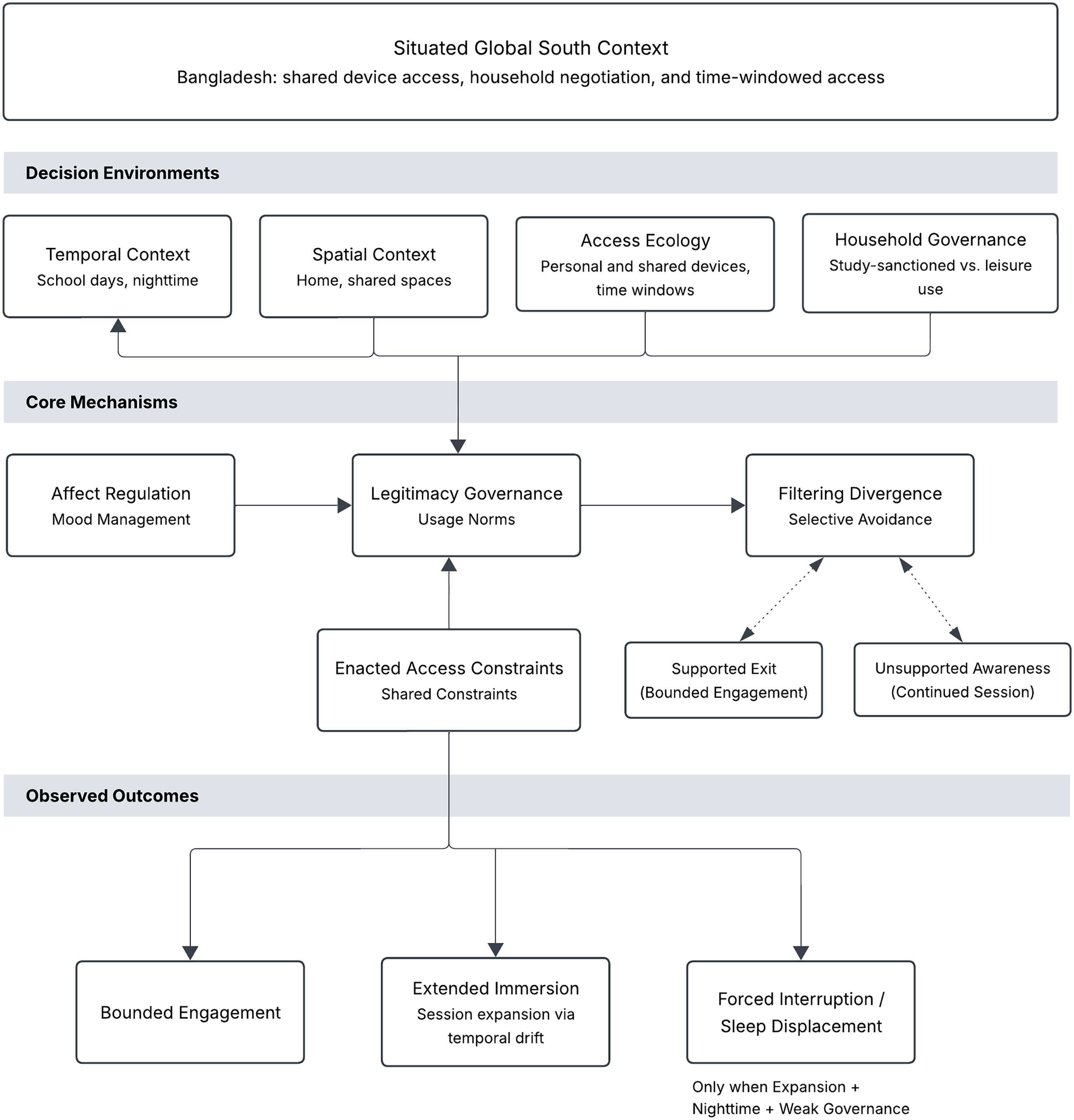
Mobile media use as a mechanism-driven process embedded in everyday routines.
Figure 1 summarizes how adolescents’ mobile media use unfolds through interacting mechanisms within everyday decision environments shaped by mobility and access. The top contextual box situates the model within Bangladesh as a Global South context, where shared device access, household negotiation, and time-windowed access make the sociomaterial conditions of mobile media use especially visible. Decision environments include temporal context, spatial context, access ecology, and household governance, which together condition when mobile communication is permissible, prolonged, or interrupted. Core mechanisms include affect regulation, legitimacy governance, filtering divergence, and enacted access constraints. Different configurations of these conditions and mechanisms produce divergent trajectories of use, including bounded engagement, extended immersion, forced interruption, and sleep displacement.
Discussion
Reframing Mobile Media Use as Governed Routine
This study reframes adolescent mobile media use as a governed routine rather than a discretionary activity or an aggregate exposure. Across participants’ accounts, mobile communication was not experienced as a series of isolated choices but as an everyday practice embedded in temporal rhythms, household norms, and access conditions. Governance did not operate primarily through overt control or restriction, but through shared understandings that organized when mobile use was permissible, how long it could continue, and how visible it should be.
Research on mobile communication has long documented how constant connectivity reshapes social coordination, attention, and expectations of availability (Katz & Aakhus, 2002; Licoppe, 2004; Ling, 2004). The findings here extend this work by showing how these shifts are mediated through legitimacy regimes that adolescents actively navigate. Distinctions between study-sanctioned and leisure-contested use structured mobile routines before any specific platform or content came into view. These legitimacy cues operated anticipatorily, shaping entry points, duration expectations, and timing of use even in the absence of direct supervision. Mobile media practices were therefore patterned not only by technological affordances, but by everyday social governance, resonating with domestication-oriented accounts of how communication technologies become integrated into household routines, norms, and moral expectations.
Understanding governance as routine organization rather than episodic intervention helps explain why similar platforms produced divergent trajectories of use. Where legitimacy norms were internalized and aligned with temporal structure, such as during school days or shared household presence, mobile use remained bounded and interruptible. Where legitimacy was weakly enforced or displaced into unregulated windows, such as holidays or nighttime, the same practices expanded through temporal drift and stabilized engagement.
This reframing complicates dominant accounts of parental mediation. It also aligns with recent work that treats parental mediation and digital parenting as dynamic family practices rather than fixed rule systems (Priya & Maheswari, 2025; Ren & Zhu, 2022). Rather than positioning parents as external regulators acting upon adolescents’ media behavior, the findings show governance as co-produced through norms that adolescents interpret, anticipate, and sometimes resist (Livingstone & Helsper, 2007; Symons et al., 2017). External interventions, such as device removal or verbal reminders, were effective in ending individual sessions but did not consistently reorganize routines. In contrast, legitimacy governance operated continuously, guiding self-regulation by embedding expectations about appropriate use within everyday temporal and spatial arrangements.
From Platform Affordances to Conditional Mechanisms
Much research on mobile media use centers analytic attention on platform affordances, such as infinite scroll, autoplay, or algorithmic recommendation, as explanations for extended engagement (Schrock, 2015). While these affordances matter, session expansion, affect regulation, and filtering outcomes did not arise uniformly across participants or contexts. Instead, they operated as conditional mechanisms activated or constrained by everyday decision environments.
This conditional account is consistent with recent scholarship showing that adolescent digital media outcomes are heterogeneous and context-dependent rather than uniform effects of exposure alone (Beyens et al., 2024; Orben & Przybylski, 2019; Valkenburg et al., 2022).
Reframing session expansion as conditional clarifies why extended use clustered within particular temporal windows rather than occurring consistently. Adolescents did not describe being drawn into prolonged sessions simply because platforms encouraged continuation. Expansion emerged most clearly when low-friction design intersected with unstructured time, weak legitimacy constraints, and reduced visibility. On school days or under anticipated supervision, the same affordances were present but did not produce comparable outcomes. Platform features enabled continuation, but did not determine when continuation became consequential.
Filtering processes further illustrate the limits of affordance-based explanations. Adolescents demonstrated evaluative awareness of content they found disturbing, repetitive, or misaligned with their values. Awareness alone, however, did not reliably produce exit. Where decision environments supported disengagement, filtering resulted in session termination. Where such supports were absent, awareness coexisted with continued scrolling. This divergence cannot be explained by platform design alone, since the same interfaces and content were involved. It reflects whether filtering mechanisms were reinforced or undermined by surrounding conditions.
Taken together, these findings suggest that platform affordances are necessary but not sufficient. A mechanism-based approach shifts attention to how everyday routines, norms, and access structures shape the activation of those possibilities.
Mobility, Availability, and Temporal Reorganization
A central insight of this study is that adolescents’ mobile media experiences were shaped less by any specific device or application than by the constant availability that mobile communication enables. Being able to connect at almost any moment reorganized how adolescents experienced time, particularly the boundaries between structured and unstructured periods of the day.
Participants’ accounts show that mobility altered temporal awareness by weakening clear stopping points. When communication and entertainment were continuously accessible, time was no longer segmented solely by external schedules such as school hours or household routines. Adolescents described drifting across moments, with sessions extending into periods that might otherwise have marked transitions, including late evening and bedtime. This reorganization did not require explicit intention to stay connected. It emerged gradually through routine use in contexts where no immediate demands or oversight were present.
Nighttime use illustrates this temporal reconfiguration clearly and supports recent work distinguishing daytime, pre-bedtime, and post-bedtime smartphone practices, where timing of use can matter as much as overall volume (Siebers et al., 2024). Late-night engagement was shaped less by a desire to sacrifice sleep and more by the convergence of constant availability with reduced visibility and diminished external cues. Adolescents often recognized that it was late or that they felt tired, yet continued to engage because nothing in the immediate environment required disengagement. Sleep displacement thus reflected a shift in how temporal boundaries were experienced rather than a deliberate trade-off between rest and media use.
Youth Agency Without Individualization
The findings complicate narratives that position adolescents’ mobile media use as either a problem of individual vulnerability or a matter of successful self-control. Participants demonstrated awareness, evaluative judgment, and intentional action in navigating mobile media environments. At the same time, these capacities operated within decision environments that often limited when and how agency could be enacted. Understanding youth agency therefore requires attention to its situated and conditional nature (Livingstone, 2016).
A key insight is the separation between awareness and exit. Adolescents often recognized when content was repetitive or misaligned with their values, yet this recognition did not always translate into disengagement. Rather than indicating a lack of agency, this pattern points to constraints under which agency was exercised. During unregulated temporal windows, or when legitimacy governance and access constraints were weak, conditions necessary for acting on awareness were limited. Agency was present, but its effects were curtailed.
This perspective challenges individualizing interpretations of extended use or sleep displacement. Adolescents’ decisions were shaped by stopping cues, visibility, and anticipated consequences; agency was negotiated rather than freely exercised.
Access Ecology and Global South Contributions
The findings demonstrate that access ecology is not a contextual detail but a central analytic dimension for understanding mobile media use. Access conditions shaped when mobile communication was possible, how visible it was, and how easily it could be interrupted. These dynamics were especially pronounced in a Global South context where shared devices, conditional access, and household negotiation remain common, and where adolescent digital media research remains comparatively underrepresented (Ahmed et al., 2017; Ghai et al., 2022; Haddon, 2011).
Shared access arrangements functioned as a form of structural governance, embedding supervision into the material conditions of access. Session length, content choices, and timing were influenced by expectations of interruption and justification, illustrating how access ecology reorganizes mobile practices before engagement begins. This supervision-by-structure contrasts with models that emphasize explicit parental control or technical restriction.
Situating these dynamics in Bangladesh demonstrates how inequality and shared infrastructure can make governance and routine more visible. In high-access contexts, similar mechanisms may appear as individual tendencies or platform effects. Access ecology reveals how they depend on structural conditions shaping availability, visibility, and interruption.
Implications for Mobile Media Research
These findings support shifting mobile media research from exposure or platform-specific effects toward the decision environments and mechanisms through which mobile media practices are produced. They also highlight the value of studying mobile media as routine practice across temporal windows, household norms, and access conditions, especially in comparative work spanning Global North and Global South settings. By distinguishing bounded engagement, extended immersion, and forced interruption or sleep displacement, the framework explains divergent outcomes without treating adolescents’ awareness, agency, or platform exposure as sufficient explanations on their own.
Limitations and Transferability
This study has limitations. It draws on a qualitative dataset from Bangladesh and does not aim to establish prevalence, causal effects, or population-level patterns. The findings therefore do not support statistical generalization.
The analysis relies on self-reported accounts, which capture interpretations and routines but not all aspects of use in real time. Observational or longitudinal methods could complement this approach.
These limitations are balanced by the study's analytic aim of transferability rather than representativeness. The mechanisms identified are not claimed to be unique to Bangladesh, but they are especially visible in contexts characterized by shared access, negotiated legitimacy, and uneven availability. Similar configurations may arise elsewhere under different material conditions, including high-access settings where comparable mechanisms may be less visible because personal device ownership and private use are more normalized.
Conclusion
This study examined adolescent mobile media use through a mechanism-centered lens foregrounding everyday routines, governance, and access conditions. The analysis shows how mobile media practices are organized through session expansion, affect regulation, legitimacy governance, filtering divergence, access ecology, and sleep displacement.
Divergent trajectories of use emerged not from differences in awareness or intention alone, but from how mobility, household governance, and access conditions reshaped decision environments across time and space. Mobile media use appeared as a governed routine negotiated within households and embedded in temporal rhythms rather than as a uniform or inherently immersive activity.
By situating adolescents’ experiences within Bangladesh as a Global South context, the study shows how shared devices, time-windowed access, and negotiated legitimacy make the sociomaterial organization of mobile media use visible. The framework offered here is therefore not a claim of universal sameness, but a transferable explanation of how mobile media routines are produced under varying conditions of mobility, availability, and governance.
Footnotes

Ethical Considerations
Ethical approval was obtained from an independent ethics review process prior to data collection. The study involved qualitative interviews with adolescents and adult stakeholders and adhered to established ethical standards for research involving human participants.
Consent to Participate
Informed consent was obtained from all participants. For adolescent participants, consent was obtained from both the participant and a parent or legal guardian.
Consent for Publication
Not applicable.
Funding
The authors received no financial support for the research, authorship, and/or publication of this article.
Declaration of Conflicting Interests
The authors declared no potential conflicts of interest with respect to the research, authorship, and/or publication of this article.
Data Availability
Due to the qualitative nature of the study and the inclusion of minors, interview data are not publicly available to protect participant confidentiality.