






Abstract
The burden of the COVID-19 pandemic has and continues to stretch the healthcare systems and the workforce alike, both nationally and internationally. This is equally true of the dental care systems and the dental workforce which had to respond and act promptly.
This paper examines the perceived impact of the COVID-19 pandemic on the mental health and wellbeing of dental teams in the UK and provides insight into not only this impact, but the early signs of mental ill health commonly triggered by life events, anxiety and fear, and often exacerbated by stresses. A sample of an established body of literature and recognised sources are considered. Finally, extracts of common threads from meaningful conversations will be alluded to, shining a light on the current state of the mental health and wellbeing of many in dentistry and the need for intervention and longer-term plans. We are often reminded that this period in time is a marathon not a sprint, the same could perhaps be said about a national response to mental health and wellbeing, as it will take time, but the time to begin is now.
Learning Objectives
To understand the construct of mental health and wellbeing as an impact of COVID-19 on dental team members
To explore the notion of stress in the workplace as an influencer of mental health and wellbeing
To recognise the value of early intervention and the need to embed mental health and wellbeing in longer-term plans.
Introduction
It has been suggested that SARS-CoV-2 poses the greatest threat to mental health since the second world war. 1 The effects on mental health and wellbeing in frontline healthcare staff has been well published 2 and there are a plethora of literature and studies which consider mental health and wellbeing across several sectors. The health sector features frequently, referring generally to the field of secondary care, and includes the mental health and wellbeing of surgeons, doctors and nurses, and general themes appear to make common links to exhaustion and burnout. 3 Given the current situation of the COVID-19 pandemic, this appears to have been exacerbated and be far reaching, moving into the territory of psychological distress and physical exhaustion for some, and associated with a broader range of work-related stress factors.
In the current pandemic the burden and impact of COVID-19 on the mental health and wellbeing of dentists 4 and dental teams is rapidly becoming a cause for concern. The spread of COVID-19 in early 2020 had enormous implications for dentistry in the UK, albeit that these implications affected the delivery of dental service provision across the four nations in different ways. Nevertheless, the immediate response and action across all nations was to address the risk factors to patients, the dental team and the general public. 5 The immediate risk was identified as transmission and cross contamination due to the close proximity of the team to the patient when undergoing treatment and the nature of certain dental procedures. 6 As such, rapid national control measures were put in place and teams needed to respond quickly, while ensuring emergency care continued to be provided, placing a heavy burden on those involved. Over time, the service provision has moved to a transformational phase of returning to a ‘new normal’, despite the continued outbreaks and new variants of the virus, the increased numbers of individuals testing positive, the continued loss of life and further restrictions imposed by UK Governments. Acknowledging that the vaccination programme is well underway, caution is still paramount. It is against this backdrop that mental health and wellbeing is central to this paper.
The journey
In March 2020, the World Health Organization (WHO) declared a public health emergency of international concern as the spread of coronavirus from Wuhan, China to other countries became apparent. 7 The virus caused significant concern to the field of dentistry as the transmission routes were identified as being through direct transmission, i.e. sneezing, coughing or droplet/aerosol inhalation or via contact transmission through mucosal membranes such as the eyes, nose and saliva. 8 Given that many dental treatments involve aerosol generating procedures (AGPs) and therefore pose an elevated risk of cross contamination and transmission in the dental surgery, different ways of working were deemed necessary. 9 In some circumstances members of the dental team were managing patients remotely, while others transferred into emergency dental hubs, some were redeployed to wider healthcare settings, some were furloughed, and others became unemployed.
As dental services across the UK moved to a period of transition and have found safe ways of working, the provision of dental care has increased, but not without challenges. In brief, much work has gone into implementing the standard operating procedures of each nation of the UK. This has included the fitting and wearing of extensive personal protective equipment (PPE) for identified procedures, the wearing of masks in general, the introduction of fallow times between patients and the need to intensify the cleaning, disinfecting and decontamination procedures, as well as undergoing additional training. In some cases, work hours, workload, responsibility and accountability, and financial insecurities have increased. Teams have needed to be agile and adaptable, as more has been understood about the virus and localised outbreaks have continued, with new variants being identified.
The impact of the pandemic on dentistry and the dental team has been of a magnitude that is unrecognisable, and against this backdrop the need to shine the spotlight on mental health and wellbeing has become apparent, with suggestions that this may need to be considered as part of the longer-term recovery plan. A further point of consideration in the longer-term plan with implications on mental health and wellbeing may well come as a result of a reduction in numbers of those providing NHS care and the added workload pressures on those continuing to do so.
There is a greater need to understand the impact of COVID-19 in the context of mental health and wellbeing, so that there is a shared understanding of the needs of those most affected by the pandemic, support is put in place to ensure that interventions are available at an early stage, and that both the need and demand are addressed with a sustainable long-term provision which goes beyond the recovery plan. More to the point, others have noted that in the face of a prolonged crisis, such as a pandemic, the sustainability of the response relies fully on the ability to safeguard the health of healthcare workers, 10 in this instance the dental team.
While there is light at the end of the tunnel as the vaccines are rolled out, there are still unknowns and unanswered questions and with that often comes uncertainty. It is often this uncertainty that can lead to a rise in mental health and wellbeing issues.
While it is beyond the scope of this paper to enter the debate of the correct definition of mental health and wellbeing, it is helpful to allude to pertinent views.
Definition of mental health
It is initially important to consider the definition of mental health in the context of a pandemic, as the impact of COVID-19 on members of the dental team is explored. What has become clear is that there are multiple definitions of mental health, but there appears to be a lack of consensus. The three most applied are outlined below.
The WHO suggests that: ‘mental health is defined as a state of well-being in which every individual realises his or her own potential, can cope with normal stresses of life, can work productively and fruitfully, and is able to make a contribution to his or her community’.
11
The Public Health Agency of Canada (PHAC) suggest that mental health is: ‘the capacity of each and all of us to feel, think, and act in ways that enhance our ability to enjoy life and deal with the challenges we face. It is a positive sense of emotional and spiritual well-being that respects the importance of culture, equity, social justice, interconnections and personal dignity’.
12
Westerhof and Keyes have defined mental health as ‘the absence of mental disease,’
13
which concurs with the definition from the Mental Health Foundation, who assert that: ‘mental health refers to being mentally healthy and suggests that if you are of good mental health, you can:
Make the most of your potential
Cope with life
Play a full part in your family, workplace, community and among friends.’ 14
This perhaps is portrayed with further clarity by Mental Health Training Online and Face to Face (MHFA) England, who bring consideration to both mental wellness and mental illness. 15
Wellbeing on the other hand is often associated with quality or goodness of life and life satisfaction, feelings of happiness or sadness, and a sense of purpose and meaning in life. Wellbeing appears to integrate both mental and physical health. 16
Worthy of equal discussion is the matter of recovery, and in current times this matter must not be sidelined, as many are unlikely to seek support or even realise that they need support. Therefore, the mental health and wellbeing of those affected must be considered as a critical part of the overall response to the pandemic.
As with many of these complex and extensive fields, opinions on specific definitions will vary depending on the context, the environment or perhaps the given situation or level of expertise.
Influencers of mental health and wellbeing
As stress has been a consistent partner in numerous discussions relating to mental health and wellbeing in dentistry and associated with the impact of COVID-19, as well as being prevalent in much of the literature, old and new, it has been adopted as the cornerstone of the remainder of this article.
Stress as a concept is broadly applied, and this in itself is problematic. For the purpose of this discussion, stress will be considered as ‘a process that includes a stimulus, the perceptual processing of this input and the behavioural . . .output’ 17 in the context of working in the dental setting in the COVID-19 pandemic. In its simplest form, an adverse reaction to excessive pressures and demands placed on an individual, and the related response.
Early intervention
Acting early when workplace stresses are recognised is likely to benefit everyone, but what are the common early identifiable signs?
A change in how someone acts and responds
Increased absence from work
Time keeping, e.g. late arrival to work
Mood swings and increased emotional reactions
Appearing withdrawn
Loss of motivation, commitment and confidence
Lack of engagement and willingness to join in.
Sources of stress 15
Stress is often multifactorial and for some it is often difficult to separate personal and professional stresses, as they become intertwined in the complexity of current day living and functioning (see Figure 1).
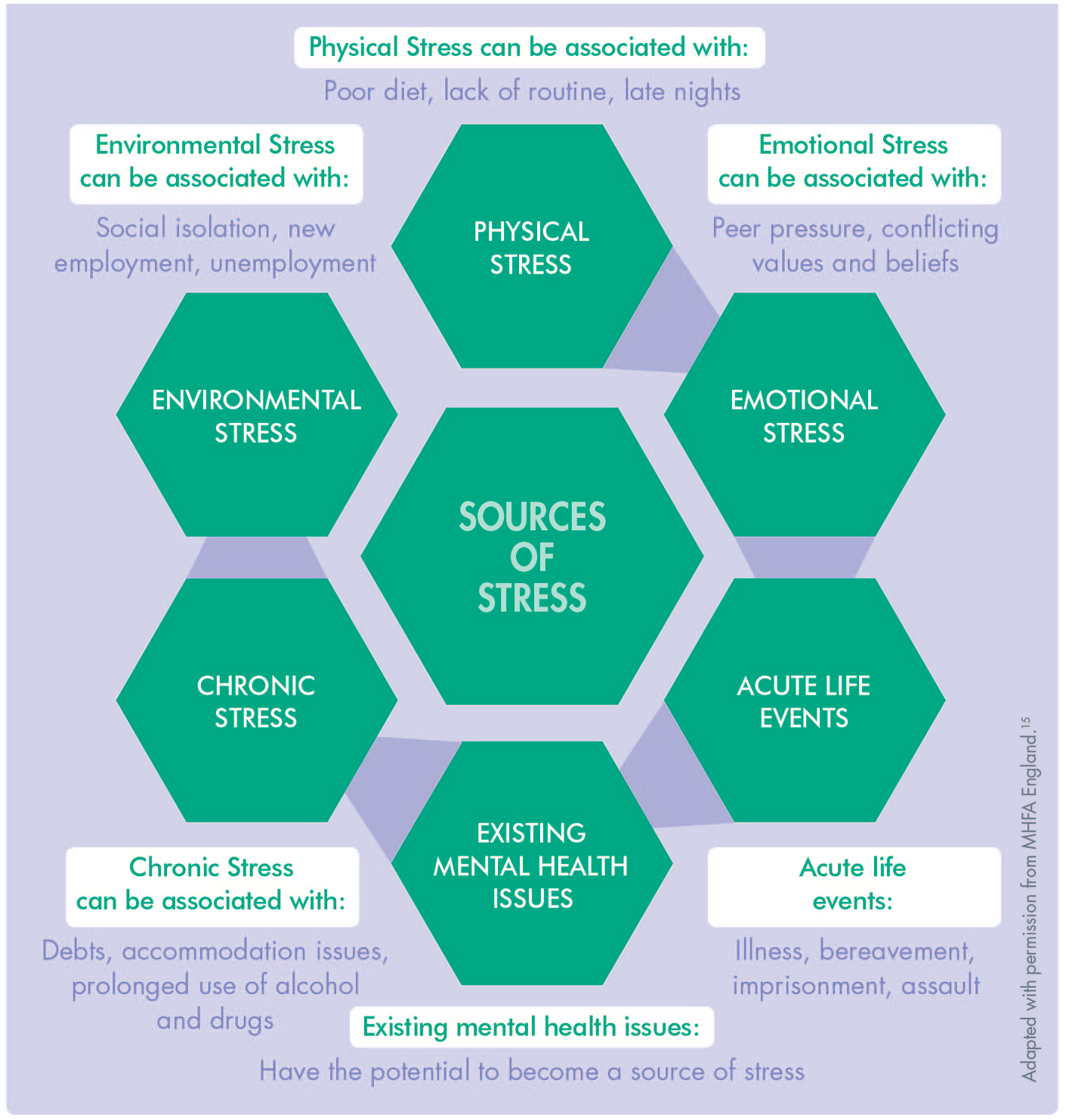
Sources and Associations of Stress
Considering stress at this level, in the context of the pandemic and accepting that not all individuals react in the same way, will serve us all well. What is known is that individual reactions to such emergencies and disasters, i.e. a pandemic, broadly fall into four main groups 10 (see Figure 2):
Ranging from not upset to some distress but will recover quickly.
Proportionately distressed. Able to function in the short and medium term.
Distressed and dysfunctional in the short to medium term. May recover quickly with the right help.
Mentally distressed in the short, medium and longer term. Needs specialist assessment.
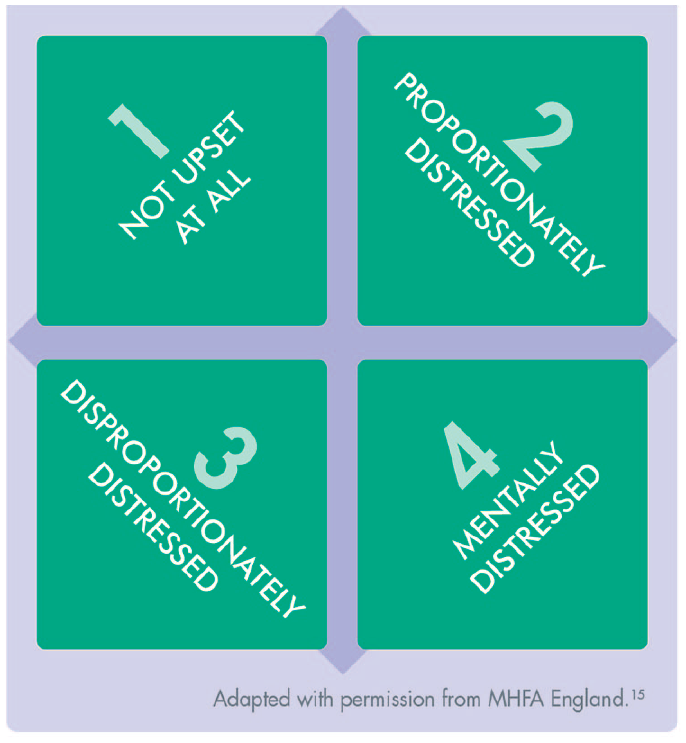
Broad Levels of Stress
Help is at hand
The Health and Safety Executive (HSE) 18 has identified six key areas that need to be managed and controlled so that excess stresses can be prevented, and stress related illnesses avoided in the workplace. This clearly has a heightened priority as part of the pandemic. In the simplest form, HSE outlines the following fields:
Demands – workload, work patterns, work environment
Control – includes how much say a person has in the way they do their work
Support – includes encouragement, sponsorship and resources provided in the workplace
Relationships – includes positive working to avoid conflict and unacceptable behaviour (bullying and harassment)
Role – includes understanding their role within the workplace
Change – includes how organisational change, large or small, is managed and communicated in the workplace
There are several recognised strategies to help combat stress in the workplace. Examples include a safe place to talk, buddy systems, mentoring, understanding and recognising stress strategies, and stress training. In projects, workstreams and episodes of planned or emergency change, managing stress as a risk factor, should be incorporated.
The profession
So, what does all of this say to us in the dental arena more than one year on from the first reported cases of COVID-19 in the UK? In short, the profession has endured a unique and challenging time and members of the dental team, no matter which professional group they identify with, have been affected in some way.
There are common threads appearing in the abundance of papers, reviews and studies – not only are they common within and across dentistry, but they mirror and echo both the sentiment and the spoken language of other healthcare professionals. Many are heartfelt and with this in mind it may be pertinent to ask, as an industry, what do we have in place to navigate and manage this for the short, mid and longer-term plan, given the magnitude of potential mental health issues?
Sharing common threads of recent conversations almost seems superfluous at this point simply because this prolonged crisis is touching more and more dental professionals and those associated with the field. Nevertheless, they do have a place in helping individuals to realise that their thoughts are being experienced by others and that they are not alone in these difficult times.
Common threads and emerging themes
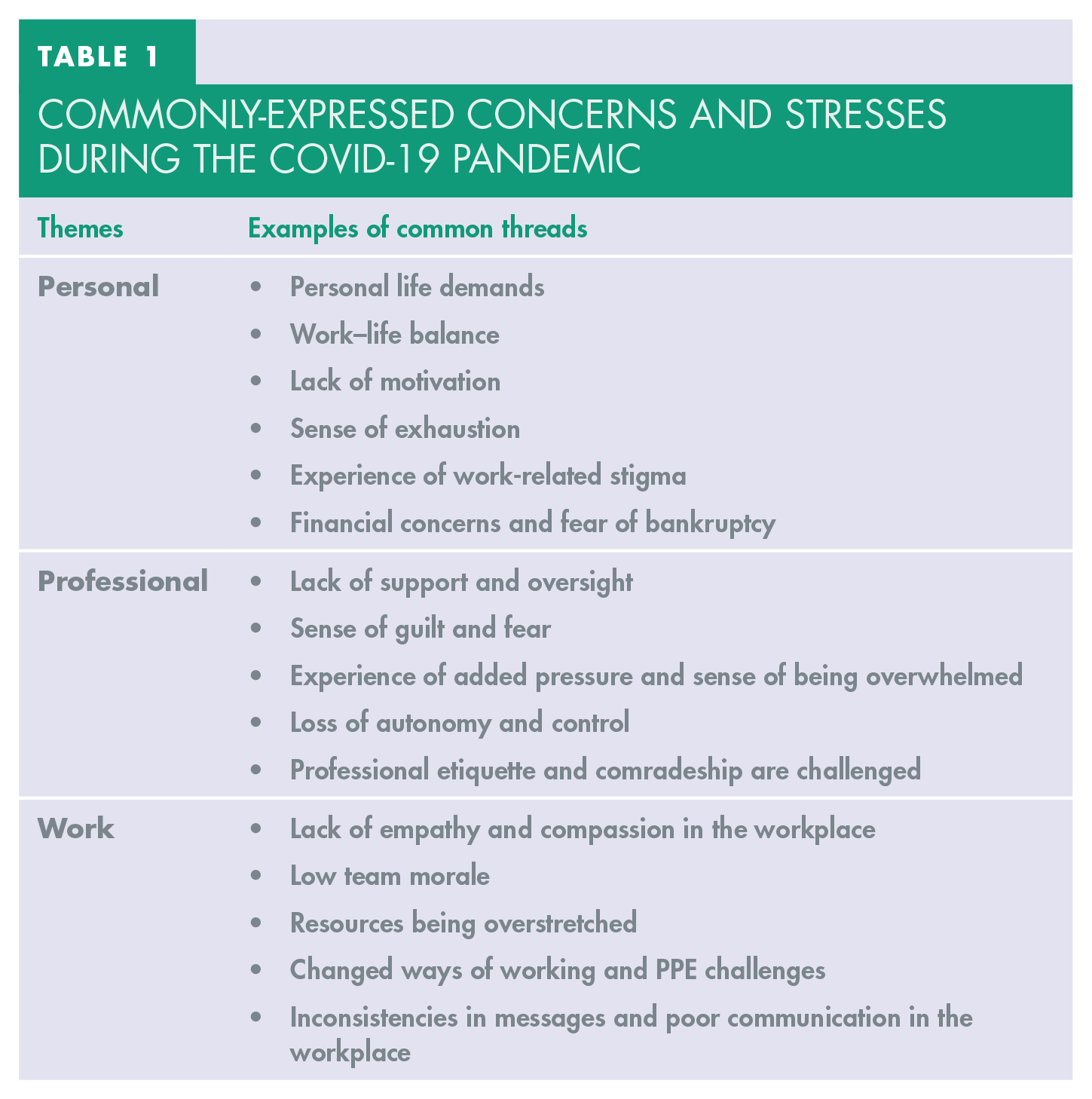
The common threads since the onset of the COVID-19 pandemic have given rise to three core themes – personal, professional and work. Table 1 shows examples of common threads expressed within these three core themes.
Commonly-Expressed Concerns and Stresses During the COVID-19 Pandemic
Positive outcomes
It is important to recognise the good that has come of the pandemic too, whether your glass is half full or half empty, or whether you are simply grateful to have a glass at all, if you look close enough there will be some good in every day. Some ‘goods’ have been captured below as positive outcomes:
Feeling of unrecognised wellness and calm
Family time and rediscovering local places together
Time for friends online and in person, whenever possible
Time to reflect on work-life balance and making important adjustments for the future
Catching up on outstanding jobs
Rediscovering old hobbies
Exploring of new hobbies
New opportunities
Time away from face-to-face working
Early retirement
An ability to participate in a broader range of meetings without travelling
What is apparent is that the very ‘real’ themes and threads that have been experienced since the onset of the COVID-19 pandemic appear to support those within the ever-increasing body of literature and studies.
Future considerations
There is a strong focus within this article on the dental team; of course the impact on dental students at every level is a further area for consideration and for those that support them, and for those in academia who have, in adversity, undertaken rapid research to inform the national responses. A great accomplishment and a great good to come from this, is the work of the Dental Professional Alliance and key stakeholders who have come together to raise awareness of mental health and wellbeing and to give it a firm seat at any table going forward. There is a great need to gather rich data and undertake a structured approach to research across the whole profession, if we are to recover well and sustain a workforce of great value and commitment. In planning for any future mass disaster or emergency frameworks, the risk and impact of mental health and wellbeing must be a key feature.
Conclusion
The mental health and wellbeing of the whole dental team is paramount if a reliable, sustainable and futureproof workforce is to be maintained and their needs met as part of the overall recovery plan from the pandemic. Given the current and unique situation the industry finds itself in, because of the pandemic, this would seem like an opportunistic time to consider embedding mental health and wellbeing into every corner of dentistry, to embrace it in the recovery and transitional phases of returning to a new way of working and within education and training, so that it becomes a norm. There is clearly a need to consider the concept of stress in the workplace and its implications for mental health and wellbeing, furthermore it is clear to see that mental health and wellbeing is everyone’s business, and it should be identified as ‘a real emergency’.
Post-script
As a trained mental health first aider, the author fully accepts the remit and limitations of her role as being that of an individual who supports ‘early intervention and safe signposting’, with no claim of being an expert in the arena of mental health other than to have a special interest and lived experiences that have been far too close to home.
Further support
If you have been affected by this article consider reading the recently published guide ‘Dentistry during COVID-19: Psychological advice for dental teams, policy makers, and communicators’ 19 and become familiar with the recent publication ‘Wellbeing Support for the Dental Team’. 20
Footnotes
Footnote
This is a collective group made up of the Presidents of: Society of British Dental Nurses, British Society of Dental Hygiene and Therapy, British Association of Dental Therapists, Orthodontic Therapists Society, Orthodontic Technicians Association, British Institute of Surgical and Dental Technology and the British Association of Clinical Dental Technology. It was formed in 2019 and is open to all dental care professional-registrable group organisations represented by their President. Fiona Ellwood, BEM, and Roz McMullan, Immediate Past Chair of BDA, are chairing the Mental Health and Wellness in Dentistry work in collaboration with the Dental Professional Alliance, an initiative very much needed. The initiative is being supported across all four UK nations and by key stakeholders.