






Abstract
This study used a multidisciplinary approach to map Islamic solidarity within spacetime through tawhidic and embodied epistemologies, using sociological theories and the interplay between collective actions and identity. Through the five pillars, Islam fosters solidarity, enforcing Ummah and brotherhood. Ummah transcends spacetime, encompassing past and future, integrating social responsibilities with divine obligations. Brotherhood is rooted in the present, extending vertically beyond space, enabling Muslims to see themselves as brothers. Both forms coexist, intersecting different levels and dimensions in the present. This solidarity framework supports macro boycotts, leveraging collective religious and social practices. However, the Ummah’s identity crisis stems from the contrast between their tawhidic embodied experience and secular reality, creating dissonance and confusion, sometimes making the body feel alienated.
Introduction
Little is known regarding the initiation, development, and maintenance of solidarity as a dynamically emerging phenomenon. Solidarity is not “an emotional response” but also “a pragmatic response of improving your social environment by assisting your extended community” (Hill, Bell, and Laredo 2024, 448). To uncover its mechanisms, relationships, and supporting structures, it is necessary to investigate religious systems. Given their dual nature, a personal connection to the divine and a source of social solidarity (Eaton 2015, 409), such an investigation can offer insights into unique social experiences, such as solidarity. One of these religious systems is Islam. Sociologists have extensively researched Muslims’ experiences as a distinct group and their relation to Muslim-ness, leading to a reevaluation of concepts like race, racialization, assimilation, multiculturalism, transnationalism, and globalization. However, they fell short of examining spacetime’s role in Islam and how Islamic solidarity is mapped within these dimensions, despite, as Shams (2022, 505) indicates, most Islamic practices being confined to specific space and time. Previous studies have also overlooked the body’s role in shaping Islamic solidarity (Marranci 2008, 104).
To understand religious experiences, the interplay between spiritual, mental, and physical realms needs to be highlighted. Therefore, I integrated Bhaskar’s (2008) framework and Berkmen’s vectorial hypothesis to form a theological reference framework. The Spirit (Real) reflects into the Actual (Mind) and Empirical (Body). Bhaskar provides a comprehensive framework in which real, actual, and empirical converge into the spiritual and its causal powers as a universal force. The living being is seen as the “vectorial sum of the body and the mind; not as a linear sum of both.” The mind and body are “orthogonal components that interact through the spirit at their intersection, or the ‘origin’ of every living being. Thus, every living being may be considered a vector with a different angle” (Berkmen n.d).
Spiritual experiences encompass the state of mind/being, initiated by God’s presence (Thiselton 2002, 224). In each religion, there is a “personal application” aspect that needs examination within a specific belief system and “refers to a higher level of contact and communication established as a result of the belief system” (Pretorius 2008, 151). In this article, these elements—spirit, mind, and body—within religious experiences are necessary to investigate how Islamic solidarity is initiated, formed, and maintained, as Islam is also a lifestyle (Heiman et al. 2004; Salehudin and Luthfi 2011). Therefore, this study aims to establish the framework and foundational concepts of Islamic solidarity, explore how this framework can serve as a mobilizing force during crises, and situate the theoretical framework within its broader historical and political context, illustrating the dichotomy between theoretical ideals and empirical realities, which causes the crisis of the Ummah (Muslim community) identity. It is worth noting that the notion of Ummah lacks a direct equivalent in Western languages and cannot be classified as a state or community, as community refers to a group of individuals in a defined geographical location (Akram 2007).
Below, I mapped the theoretical spatiotemporal infrastructure of the macro and micro aspects of Islamic solidarity within Islam tawhidic (oneness) epistemology (spiritual and mind) and the five pillars, using spacetime and Durkheim’s (1960) solidarity theory. It is worth noting that the five pillars were selected for three reasons. First, they are the basic practices for individuals to be considered practicing Muslims and Islamic societies. Second, they are viewed as commitments that construct cohesive communities and demonstrate solidarity when implemented. Third, they are often performed in congregations, involving embodied actions. Additionally, “in the pre-modern and globalized world ummah consciousness was largely determined by the observance of the practice of the ‘five pillars’ of Islam” (Hassan 2011, 54). Therefore, these pillars represent a praxis of solidarity and can cultivate sustained and unconditional solidarity. I also examine the body’s role in shaping micro-Islamic solidarity through the five pillars based on embodied epistemology. I discuss how this double-aspect solidarity, spatiotemporal tawhidic and embodied epistemological infrastructure, mobilizes collective effort across spacetime, leading to organized macro boycotts. Lastly, I argue that this structure caused the current dichotomy Muslims face between their embodied experiences and sociopolitical realities, exacerbated by spacetime constraints, leading to an identity crisis.
Spatiotemporal Tawhidic infrastructure of Islamic solidarity
As noted earlier, religion has a dual nature/connection: personal/vertical with the divine and horizontal with society (Eaton 2015, 409). In Islam, the horizontal relationship also encompasses a vertical dimension, reflecting interconnectedness of social duties and divine obligations. It is “derived from the individual relationship to God and not by old primordial loyalties” (Hassan 2018, 57). Islam encourages responsibilities that transcend spacetime and are not confined by geographical constraints. Therefore, a spatiotemporal perspective uncovers the dynamics within Islam, revealing how its two forms of multilevel Islamic solidarity operate within spacetime, as illustrated in Figure 1. Mind-Body Dichotomy (Berkmen, n.d.).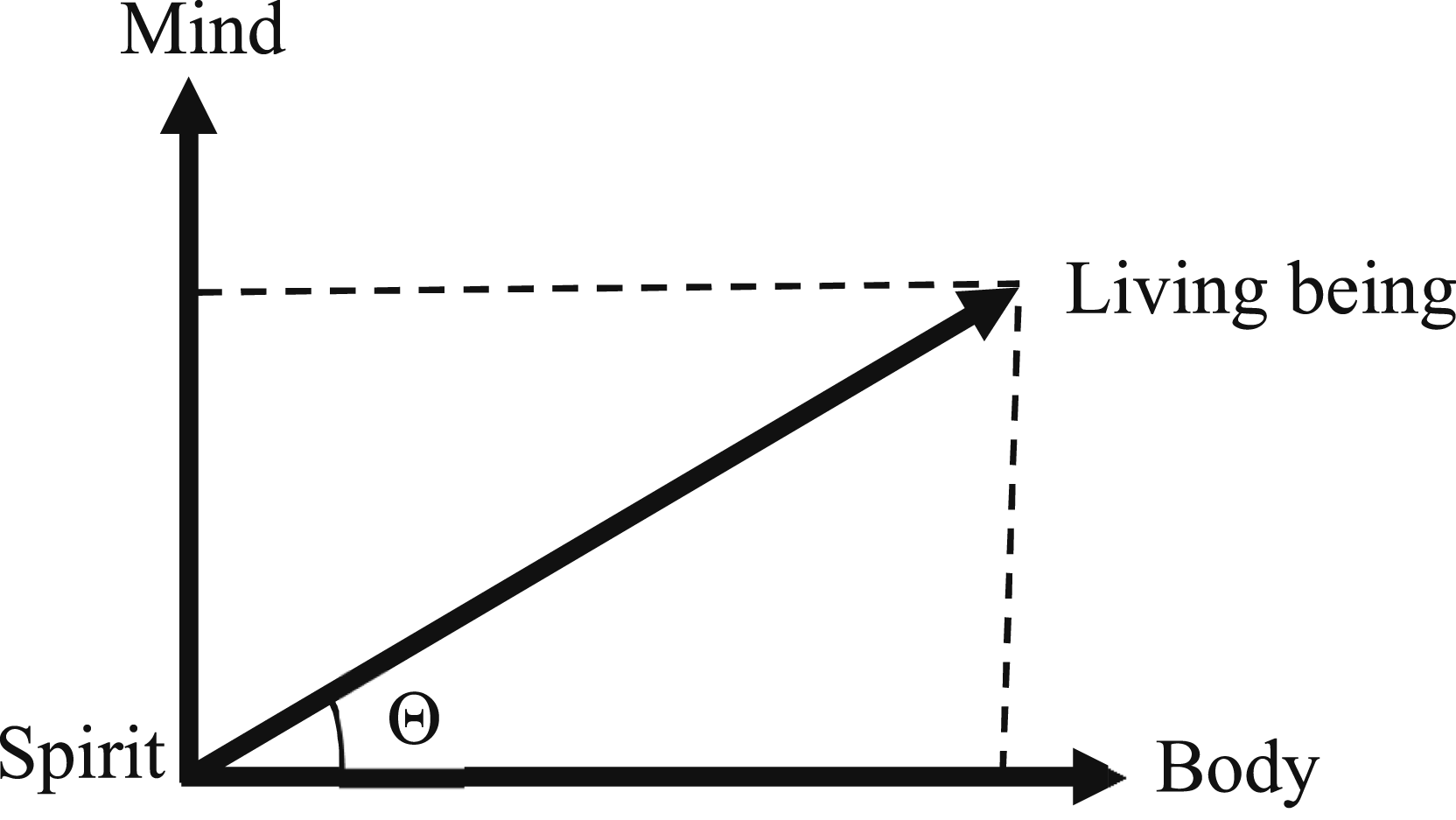
Figure 1 shows both forms of Islamic solidarity: Ummah and brotherhood. In a global context, Islam is organized around central concepts, with Ummah (transnational solidarity) representing the imagined global Muslim community that extends beyond geographical boundaries and connects Muslims through shared beliefs, values, and customs (Shams 2022, 509). Ummah “expresses the basic unit of all Muslim faithful without geographic divisions and despite differences between peoples and communities, or the gradations and nuances within Islam” (Yegar 2002, 11). It is a universal term extending beyond ethnic, social class, language, or culture-based unity (Hayette 2018, 77; Momin 2017) and influencing “Muslim political behavior” (Akram 2007, 382). It “is ‘not a cultural entity patterned upon the norms of any one dominant group’ but ‘exists within and is expressed through diverse cultural groups’” (Sardar 1991, 227). The Muslim Ummah fosters a supernational identity that challenges divisions based on nationality or ethnicity (Mohammed and Jureidini 2022, 7).
In spacetime, Ummah is timeless. It extends vertically beyond the present to encompass the past and future, drawing from collective history and forming the foundation of future communities. This allows Muslims to be part of their past while considering future generations. It also integrates social responsibilities with divine obligations, as vertical relations along the time axis. “And those who came after them say, ‘Our Lord, forgive us and our brothers who preceded us in faith’” (Quran, 59: 10). Additionally, Ummah is spaceless along the time axis, as it is not tied to a specific location. A fundamental aspect of transnational spaces is their independence from space (Fischer 2009). Thus, Ummah enables Muslims to develop identities across multiple spaces, rejecting “all such limits and its universalism and implicit expansionism is constantly reiterated” (Sayyid 2014, 103).
Conversely, Islamic brotherhood is rooted in present times. It extends vertically beyond spatial boundaries, enabling Muslims to view themselves as brothers. This connection confers mutual rights and obligations, imbuing it with spaceless quality. It can also be timeless along the space axis, with no specific association with a particular moment. Brotherhood also surpasses the boundaries of the mortal realm and is realized on the Day of Resurrection; it is not only a religious construct but also a social one that can be viewed as a debias strategy, implying equality (Jamil et al. 2023, 2).
Spatiotemporally, both forms coexist complementarily, occupying different levels within and beyond spacetime and intersecting different dimensions. The Ummah and brotherhood axes are interdependent. Ummah provides a context for brotherhood, while brotherhood strengthens Ummah. Without Ummah, brotherhood lacks progression or connection to the past, and without brotherhood, Ummah is static and irrelevant. Both support each other in forming a coherent framework for Islamic solidarity, intersecting in the present, reinforcing each other, and contextualizing brotherhood within Ummah. Etymologically, Ummah derives from the Arabic root umm, meaning “mother,” whereas brotherhood represents Muslims as brothers sharing the same Ummah/mother. Both forms are non-hierarchical and can be described as “a state of equality in solidarity,” using Karaliotas and Kapsali’s (2020) notion.
Tawhid (oneness) is the main principle of Islam, representing the Islamic unity of action, values, thought, future, and God. It gives it “concrete meaning and expression through Islam’s nature and structure as a religion and its pervasive concern with knowledge” (Bakar 2014, 446). Moreover, tawhidic epistemology integrates mind and spirit, building a unified view of knowledge and acknowledging the oneness of God (Tawhid), extending to holistic human understanding. Thus, Ummah is founded on “the qur’anic tawhidic epistemology” (628). It is central to the Ummah’s identity and civilization (Al-Faruqi 1982; Bakar 2014), sustaining the Ummah’s identity as a knowledge-community (Bakar 2014, 446). Many qur’anic verses highlight this, for example, “The believers are but brethren, therefore make peace between your brethren and be careful of (your duty to) Allah that mercy may be had on you” (Quran, 49:10). “Indeed this, your religion (ummah), is one religion (ummah), and I am your Lord, so worship Me” (Quran, 21:92). Additionally, hadiths (a collection of the prophet’s sayings) encourage Muslim unity, for example, Prophet Muhammad (PBUH) stated, “The believers, in their mutual love, mercy, and compassion, are like a single body: if one part of the body feels pain, the whole body responds with sleeplessness and fever” (Sahih Muslim, 2586).
Islamic brotherhood, encompassing sisterhood, also differs from the Western notion of brotherhood, often linked to “secret societies, fraternities, the military, and outlaw biker communities” (Sundberg 2019, 271). These similarities create a communal bond among individuals rather than a connection to specific people. It thrives in groups with a strong collective identity and unity. Islamic brotherhood disregards variables, such as socioeconomic status, political beliefs, race, ethnicity, culture, and history to achieve equality, minimize differences, and foster unity, allowing brotherhood to be a comprehensive umbrella of solidarity, embracing all differences by focusing on shared unity. The bond of Islamic brotherhood is more profound as it is reciprocal and exclusively rooted in faith, transcending all differences (Jamil et al. 2023, 3). Despite this unity, diversity exists among Muslims, including cultural, racial, ethnic, and linguistic differences, as well as various schools of jurisprudence offering distinct interpretations of the Qur’an and the Hadith (The Pluralism Project 2023). It is worth noting that many studies have shown that religions other than Islam also facilitate solidarity formation, resulting in collective actions to address social issues (i.e., Ahn 2019; Hein and Niazi 2016; Kyriakidou 2021; Kyriakidou 2021; Mim 2020).
Islamic solidarity within Durkheim’s thought
Durkheim’s forms of solidarity offer insights into Islamic solidarity. Durkheim’s (1960) mechanical solidarity exists in primitive societies with shared values and beliefs and has strong community bonds and familial ties, often resulting in uniformity to maintain identity. It is reminiscent of the Ummah concept, a global Muslim community with a shared religion yet diverse individuals. Ummah corresponds to mechanical solidarity on a larger scale, as it unites all Muslims across spacetime. However, while mechanical solidarity is static, Ummah is dynamic, embracing differences, transcending national and ethnic boundaries, forming organic Islamic solidarity, and showing diversity not typically observed in Durkheim’s concept.
In contrast, Durkheim’s organic solidarity refers to social cohesion in complex societies from mutual interdependence, where diversity is the norm, and individuals leverage labor differences for survival. Collective consciousness in organic societies is more general, uncertain, and limited (Gofman 2014, 46). Organic solidarity resembles brotherhood, fostering connections among diverse individuals. Nevertheless, brotherhood, like Ummah, is faith-based and binds Muslims within communities beyond the present space. Mechanical Islamic solidarity, Ummah, is the foundation for organic Islamic solidarity, brotherhood, and transcending differences. Unlike Durkheim’s mutually exclusive forms, Islamic solidarity is non-hierarchical and thus coexists, as it considers both spatial and temporal dimensions. According to Durkheim, societies evolve, from primitive to modern transforming collective conscience. In mechanical solidarity, collective consciousness is prominent, while in organic solidarity, it is less significant and adaptable. Therefore, they are incompatible.
Accordingly, Islam recognizes both uniformity and diversity among Muslims, establishing various forms of solidarity for different groups. Brotherhood aims to create micro-connections across levels, spaces, and times, providing reasons for these connections. This shows the unique aspects of Islamic theology in understanding social cohesion and addressing modern challenges. Thus, the concept of collective conscience of Ummah remains unchanged in brotherhood, as both faith-based forms are complementary and intersecting, experienced in the present. Furthermore, Islamic solidarity addresses both collective and individual needs. Individuals’ motivation to participate in the community is sometimes necessary to perform Islamic worship. Both forms exhibit a dual nature of being exclusive and inclusive. While they encompass individuals from diverse backgrounds, resulting in inclusive solidarity, they remain exclusive to Muslim communities.
Mohammed and Jureidini (2022) argued that the inclusion of non-Muslim minorities as part of the Ummah remains a subject of debate, referring to opposing perspectives in the Islamic literature discussed by a number of scholars. Nevertheless, “[b]elonging to the Islamic umma accommodates Muslims and non-Muslims” (Al-Qaradawi 1995, 18), including those who believe in one God, Jews and Christians (Hwang 2019, 73). Therefore, this inclusive Ummah can lay the foundation for interfaith dialogue to address misconceptions, build bridges, and cultivate peace and tolerance. Throughout history, the Muslim community coexisted with people of other faiths who are integral parts of the community and share a national identity. They are not the “Other,” as in some non-Muslim communities where Muslims are the “Other.” Including non-Muslims in the Ummah facilitates cohesion in the Muslim community, contributing to global social cohesion and conflict resolution.
Spatiotemporal sustainability of Islamic solidarity
Mapping the five pillars within and beyond spacetime revealed essential temporal aspects, including regularity, frequency, and continuity, as shown in Figure 2. This may have pivotal implications for understanding spacetime roles in collective social actions and solidarity. It revealed four levels of strength emanating from frequency: perpetual, daily, yearly, and one-time. Leveraging these levels can help establish connections among individuals to overcome differences and promote integration, particularly in brotherhood. The evolving significance of spacetime, influenced by cultural and social differences, may give rise to specific social requirements, identities, relationships, and preferences unique to certain regions. This suggests that our understanding of spacetime can evolve across various cultural settings (Figure 3). Forms of solidarity in Islam within spacetime. Solidarity & the five pillars of Islam beyond/within the current space & time.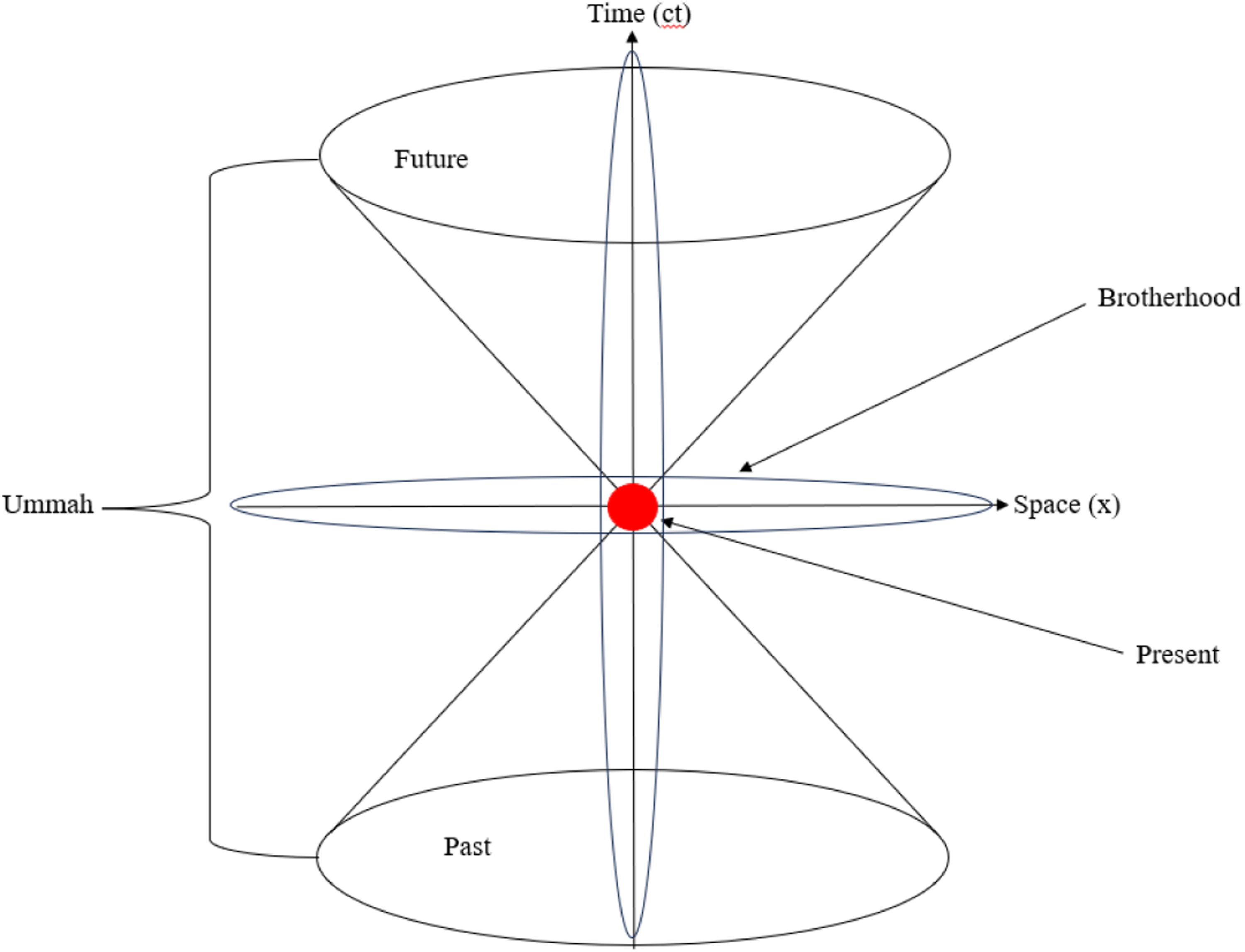
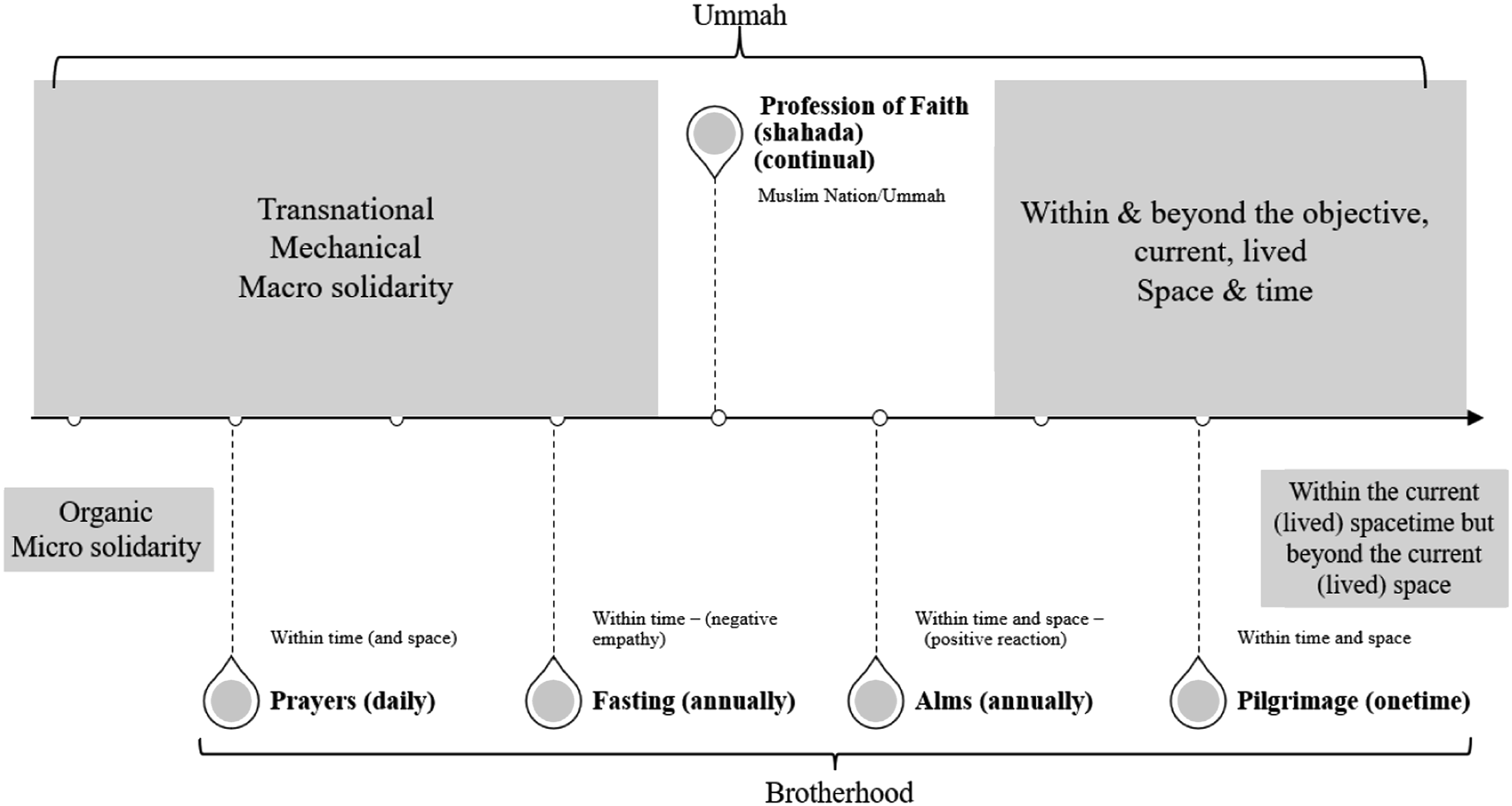
The first pillar of Islam, the profession of faith (shahada), is the essential declaration of Islamic beliefs. It states, “[t]here is no God but God, and Muhammad is His prophet,” emphasizing monotheism (Schumm and Kohler 2006, 127). This pillar, characterized by acts of the heart and potentially expressed verbally, does not require immediate action during social interactions. It only allows individuals to establish rapport based on shared beliefs, creating Islamic macro solidarity, the Ummah. The shahada, rooted in tawhid (Kounsar 2016, 103), is not confined to space, allowing connections across spaces; however, new Muslims often take their shahada in a mosque, the initial spatial point of contact with other Muslims. It is a powerful social tool and an implicit promise to support Muslim communities. “When an individual accepted Islam, the Ummah would have accepted him as having a primary commitment to Islamic law rather than to tribal customary law” (Al-Ahsan 1992, 110). Muslims perceive themselves as individuals “inhabiting the moral space shared by all who are together bound to God” (Asad 1993, 219).
Although the Ummah is generally egalitarian, socio-economic disparities persist (Bearman et al. 2004, 552), which are addressed through brotherhood, by adhering to the remaining four pillars of Islam: prayers, Ramadan fasting, zakat (almsgiving), and Hajj (pilgrimage), which require specific times and often spaces. These pillars encompass actions in interactions that occur within the current time but extend beyond the current space, as discussed below.
Spatiotemporal embodied epistemology of Islamic solidarity
The mind knows the world through contact (or embodiment), which “is direct, relational, embodied, and recognizes wholes and connections. Awareness through contact enables a broader view, connected with the world and the body, scanning for changes in the environment” (Hart 2014, 6). Embodiment refers to being and participating in the world, promoting collective awareness and consciousness, where the body and mind are connected within a group. It is one of “the crucial dimensions of perception, awareness, knowing and being” (Lehner 2022, 44). The body plays a crucial role in social interactions and cognition, with a strong connection between embodied and cognitive states (Lindblom and Ziemke 2008, 53-54). Thus, the significance of embodied actions in cognitive processing is no longer hypothetical (Carro and Lozada 2016; Glenberg 2010).
“Embodied cognition” posits that individuals’ thoughts, feelings, and behaviors partly result from their body experience and physical position in a given context as well as mental activities and information processing (Winter and Granqvist 2023, 2). Face-to-face interactions, through bodily resonance, lead to embodied interaffectivity, creating a foundation for intuitive empathy (Fuchs 2017, 196). “[B]odily states produce affective states,” highlighting the body’s functions in social interaction as a representational device, social-resonance mechanism, means and end in communication, and in shaping, expressing, and sharing thoughts (Lindblom and Ziemke 2008, 53-58). “[A]ctive participation benefits cognitive processes in learning contexts, promoting autonomy, and agency during childhood” (Carro and Lozada 2016, 1). Therefore, embodied knowledge endures through individuals; each person holds parts of it, reflecting the entire system (Yunkaporta 2019, 18-19). Additionally, knowledge is partly derived from experiences, which when embodied, impact our perceptions and cognition, highlighting that sensorimotor experience is rooted in our mental process as “the interaction between the body and the environment, communicated through sensorimotor experiences” (Piaget 1952, 2).
Religious frameworks highly value knowledge of the body and environment, shaping interpretations of daily experiences (Barsalou et al. 2005, 14). Embodiments in religion are essential for metaphorically conveying concepts such as purity and grounding them in memory, extending to non-religious knowledge and experience, exemplified by ablution and purity. Although religious practices involve both the mind and body, literature on religion often focuses on the mind, overlooking the body’s roles (Soliman, Johnson, and Song 2015). Therefore, I emphasized that micro-Islamic solidarity, brotherhood, is characterized by embodied concrete actions through regular practices of Islam’s fundamental pillars. This differs from conventional secular solidarity, often equated with sympathy for underprivileged groups, rather than being rooted in tangible bases cultivating meaningful actions. Empathy is unidirectional, sometimes passive, and inherently hierarchical, whereas solidarity is reciprocal and non-hierarchal.
Five daily prayers
The second pillar of Islam, prayer, is a communal act of worship performed five times daily, with congregational and Friday prayers being mandatory. As spacetime is significant in Islam, prayers are organized throughout the day (temporal arrangement), with a limited timeframe for mosque performance (spatial arrangement). Lived religion includes personal beliefs, practices, and physical spaces (Ammerman 2014, 190-191). The frequency and consistency of prayers foster a sense of belonging among Muslims, creating a bodily synchronized collective action. Mosques reinforce their space as a symbol of transnational solidarity (Fischer 2009). They are inviolable public spaces that convey a unifying message (Astor 2011, 10; Hayette 2018, 77), serve as sanctuaries, facilitate socialization, association, commerce, and symbolize community presence (Eroğlu and Sevim 2020, 139).
These prayers, performed in congregational settings, are predominantly embodied acts where Muslims line up facing the qibla (the direction facing Mecca), following the Imam leading the prayer. The Imam executes the motions, and the congregation follows precisely. The Imam says “Allahu Akbar” when changing positions, and all Muslims repeat it. They also say “Amen” upon concluding Al-Fatihah, a mandatory chapter, in unison. This state of physical congregation can be seen as a heightened level of intersubjectivity (collective experience and consciousness) with two primary factors contributing to this state (Collins 2004). Droppe explained, the first is related to “the performance of actions that contribute to the collective ritual,” intensifying the existent shared consciousness. Through repetitions of the same chorus in rhythm, tone, and gestures, unity is created. “The second factor is shared emotions. . .that harmonize, forming the basis for intensification and mutual exaltation—i.e., collective effervescence,” fostering social solidarity (Droppe 2023, 2). These factors are symbolic but have spiritual and communal significance. During prayers, the integration of physical movements, harmonization of spoken phrases, and standing side-by-side contribute to cohesive group unity. This demonstrates the potential for solidarity to manifest itself through coordinated physical, emotional, and mental actions in which one’s body and mind align with others, resulting in the accomplishment of a shared objective. Finally, prayers can be seen not only as spiritual acts but also as social tools to regulate meetings and strengthen cohesion and communal identity.
Ramadan fasting
The third pillar is abstaining from food and drink (fasting) from dawn to sunset during Ramadan. During this month, Muslims worldwide engage in practices embodying universal values, such as spiritual growth, soul purification, and community bonding (Buitelaar 1993; Hellman 2008). This collective sensation of hunger allows Muslims to empathize with the experiences of needy individuals, thereby promoting social solidarity, serving as an instrument of social transformation (Shalihin and Sholihin 2022), providing space for change (Moller 2005), and encouraging generosity, healthy eating habits, social connections, and modest attire (Antoun 1986; Hellman 2008).
Perceiving Ramadan as a sacred month of forgiveness and divine benevolence significantly impacts Muslim communities’ conduct and influences social behavior and cohesion (Odabasi and Argan 2009). This period intensifies the mosque’s importance as a religious space for rituals, as mosques become gathering places for Muslims to break their fast together, sharing home-prepared food before the maghrib prayer. Additionally, a pivotal religious ritual during Ramadan is the optional tarawih prayers, performed by Muslims at the end of the day, before midnight, following the breaking of the fast. These prayers end with the Imam reciting dua’a (prayers), to which Muslims respond with “Amen” in unison.
Religious rituals during Ramadan, such as fasting, tarawih prayers, and Qur’an recitation, enhance social cohesion within a community. This is demonstrated by voluntary acts of charity that foster unity and cooperation among individuals (Shalihin and Sholihin 2022, 11). During Ramadan, religiosity is displayed in philanthropic activities, encouraging social justice (Fauzia 2017) and reinforcing connections and solidarity. Socio-economic capital, collective action, and identity reformation are intertwined and reinforced within the Muslim community annually, as a reminder of the interconnection and interdependence among Muslims through sharing social capital.
Zakat Fitr (charity)
The fourth pillar, almsgiving, or zakat al-fitr (charity), is mandatory for eligible individuals and involves allocating a portion of one’s wealth to assist those in need within the community (Kuran 2010; Scott 1987). It establishes vertical relationships between Muslims and God and horizontal connections among Muslims, especially between rich and poor, serving as a source of funding for Muslim welfare (Al-Ayubi and Herindar 2022, 464-474). It is performed on the last day of Ramadan and before Eid al-Fitr, the festival concluding the month-long fast. It is confined to a brief period, allowing Muslims in the same location to perform the act collectively, while needy individuals receive donations simultaneously. This demonstrates that Muslims must prioritize supporting needy families before celebrating, enabling them to partake in Eid festivities. This coordinated collective act promotes social solidarity and indicates self-discipline attained during Ramadan.
From a psychosocial perspective, hunger during fasting internalizes empathy and externalizes wealth through zakat. It effectively achieves equitable wealth distribution and reduces poverty within the Muslim community (Suzuki and Uddin 2017, 372). Zakat, on the other hand, is socio-economic capital based on networks among Muslims through Islamic solidarity. It is carried out voluntarily without a government mandate. This activism increases social responsibility and creates a communal welfare system to ensure social justice and cohesion. Briefly, Ramadan and zakat are complementary social tools that create a balanced dynamic. Ramadan places wealthy individuals in the position of the poor, encouraging them to empathize with the poor’s struggles. Conversely, zakat elevates the poor, providing tangible support and allowing them to enjoy some of the wealth that the rich possess. Australia and other commonwealth countries have Boxing Day, the day after Christmas, to give alms to needy families and workers. Unfortunately, Boxing Day has become a secular holiday celebrated by shopping, post-Christmas discounts, and sporting events.
Hajj (pilgrimage)
The fifth pillar, Hajj or pilgrimage to Mecca, is mandatory yet conditional due to physical and financial demands. It requires Muslims to follow Abraham and Hajar’s footsteps, experiencing their hardships collectively. Hajj is “a multi-layered and complex event encompassing a range of behaviors and practices, many spatial in nature” (Juraev, Ahn, and Hyun 2023, 5). During Hajj, Muslims from diverse backgrounds gather globally in shared spaces to engage in various physical rituals, fostering connections with their past as part of the Ummah.
Juraev, Ahn, and Hyun (2023, 1) investigated the behavioral geography of the Hajj pilgrimage by exploring the impact of the physical environment on pilgrims’ behavior. These spaces are “places of behavior” during Hajj (Elgammal, Alhothali, and Sorrentino 2023). Environmental factors, such as crowds and noise, affect pilgrims’ experiences, evoking anxiety while enhancing Hajj spiritual significance. The Tawaf experience (the act of walking around) is influenced by large crowds and ambient noise. Navigating through crowds was challenging, as pilgrims need to coordinate their movements with fellow Muslims performing the same act, requiring them to maintain collective speed and personal space. Background noise and the atmosphere contribute to spiritual significance. The seven sites have corresponding behavioral consequences, resulting in distinct experiences or challenges that enable Muslims to bond and reinforce their collective consciousness as shared adversity fosters unity (Juraev, Ahn, and Hyun 2023). Hajj “renders the Ummah visible” (Marranci 2008, 26), uniting Muslims from diverse backgrounds worldwide, converging at the same place and time, to engage in collective action promoting collaboration, unity, and a sense of belonging.
The five pillars: A praxis of double-aspect solidarity
Durkheim (2008) emphasized the importance of collective action in religious rituals. The significance of human interaction goes beyond co-presence, as society is fundamentally embodied. Physical proximity evokes sensations and feelings, leading bodies to respond to each other and forming the basis for social interactions (Collins 2004, 43). Thus, physical congregation is essential for collective experience, as Droppe (2023) explained; collective experience requires “interpersonal attunement, and the formation of a common emotional state, which Durkheim called collective effervescence.” Essentially, collective effervescence fosters social solidarity (Draper 2014, 229). Draper found a consistent relationship between effervescence and solidarity in religious organizations, noting longer rituals elicit more emotional satisfaction, while crowded rituals are more rewarding. Incorporating senses within these pillars enhances the embodied experience. During prayers, synchronized vocal rituals and body movements deepen the connection to the community. This synchronization during communal prayers visually represents unity for Muslims. Thus, this embodied experience is sense-based (visual, auditory, and kinesthetic).
Goodwin (2017, 1) distinguished between co-operative action and cooperation, stating that co-operative action extends beyond mutual aid and “more crucially it provides, in the midst of action itself, a systematic mechanism for progressive accumulation with modification on all scales, from chains of local utterances, through tools, to the unfolding differentiation through time of human social groups.” Therefore, daily prayers shape Muslims’ interaction, reinforcing belonging. When Muslims gather in mosques to pray, they transform the space into a tool for specific interactions. Ramadan fasting unites Muslims globally through a shared experience and can be a tool for spiritual growth and compassion. Additionally, zakat is an economic tool designed to meet the Muslim community’s needs. Finally, Hajj, with its utterances and global Muslim gatherings, is another Islamic tool representing solidarity as a cooperative action.
The wisdom of collectivity lies in its ability to resist religious changes, compelling members to follow the group and preserve practices and communities. It acts as a resistance and self-preservation tool. I argue that the embodied experience of collectivity in Islam precedes the development of solidarity, creating a global network capable of forming collective identity and consciousness. Islamic solidarity emerges from past and present collective embodied actions, memories, and shared experiences, shaping future collective actions that continue in the past and respond to present and future incidents. In contrast, secular solidarity shapes future collectively embodied actions based on shared interests and values.
Mobilizing identity during crisis
In modern times, solidarity is viewed as a politically charged notion. However, Islamic solidarity is grounded in religious practices and principles. It is constructed through collective embodied actions, enabling it to extend to socioeconomic dimensions when necessary, such as in boycotts, guided by the principles of community support and collective responsibility. This makes the Muslim community easily mobilized for religious causes; hence, it is more active and engaged. Islamic causes often serve as a basis for social mobilization and humanitarian aid, prioritizing collective welfare rather than special interests.
Studies have shown that collective action based on a specific identity can reshape and strengthen that identity, thereby increasing future participation in similar group activities. This is a reinforcing loop: collective action redefines identity, fueling more collective action (Subašić, Reynolds, and Turner 2008; Subašić et al. 2008, 343). Additionally, new experiences requiring new actions are constructed by deconstructing, reusing, and transforming resources from earlier actions, experiences, and interactions (Goodwin 2017, 1). In this context, socio-economic or political activities are always organized “by groups and organizations, not individuals. Presumably, this is because the outcome of pooled efforts is usually larger than the sum of individual efforts” (Esteban and Ray 2001, 663).
With reference to boycotts, they involve a “concerted refusal to do business with a particular person or business to obtain concessions or to express displeasure with certain acts or practice of person or business” (Garrett 1987, 46). They are a “tool for consumer protest groups and are likely to become even more significant in the future” (John and Klein 2003, 1208). As a phenomenon, they can be examined through the prism of solidarity, as they require coordination and commitment among participants. They are motivated by various reasons, including religion, when followers of a faith take issue with the actions of a company or nation (Swimberghe, Flurry, and Parker 2011).
Muslims and Christians are the primary religious groups involved in boycotts. Both participate in micro-boycotts (targeting specific products or companies); however, macro-boycotts (boycotting an entire country) are unique to Muslim consumers. As Yusuf (2024) argued, Islam showed exceptional tendencies to mobilize collective action. Baig (2019) pointed that Muslim consumers initiate all identified religious macro-boycotts, noting “boycotting a country and its firms’ products is complex.” Abosag (2010) argued that from 1948 to 1996 all Arab and Muslim countries boycotted Israel. Additionally, the September 11 attack began a series of incidents intensifying religious tension, including the 2003 US invasion of Iraq, Israeli attacks on Gaza in 2004, 2008, 2012, 2014, and 2016, the publication of Danish cartoons depicting the Prophet Mohammed as a terrorist in 2005, the British government’s honoring of Salman Rushdie in 2007, the portrayal of Islam in the Dutch film Fitna in 2008, the banning of Hijab in France in 2008, and the release of the anti-Islamic American movie, Innocence of Muslims, in 2012. Denmark’s boycott, responding to the Jyllands-Posten cartoons, exemplifies the adverse effects of such measures. All Danish companies exporting to Muslim countries were affected, with Arla Foods experiencing the most severe consequences as their sales diminished to zero within a brief period (Abosag 2010). The 2000 Al-Aqsa Intifada initiated unprecedented solidarity with Palestinians, leading to massive protests with slogans like “Each dollar spent buying an American product is transformed into a bullet to kill our brothers in Palestine.” Lexical selections, such as “our brothers in Palestine,” demonstrate solidarity in the Muslim community (Knudsen, Aggarwal, and Maamoun 2008).
Israel’s 2023 Gaza war led to a widespread boycott of companies worldwide that were believed to provide any form of support—whether moral or financial—including high-profile companies, causing missed sales targets and losses, particularly in Muslim countries. Twenty days after October 7, Al-Khamees, a Muslim scholar, urged Muslims to boycott products supporting Israel’s war efforts, in solidarity with Muslims in Gaza. He emphasized that the boycott is the least duty that Muslims can perform, since they cannot physically fight alongside Palestinians. He advised boycotting as many brands as possible or at least avoiding those they could do without. Al-Khamees stressed avoiding harming uninvolved companies (YouTube 2023). A recent poll by the Middle East Eye (2004), including 15,000 consumers in five countries, revealed that more than one in three people participated in boycotts.
A Google search for “Ummah” in Arabic yielded 583,000 hits between October 6, 2022 and October 6, 2023, increasing to 2,110,000 hits between October 7, 2023 and October 7, 2024. In English, “Umma” returned 2,100,000 hits and its variant “Ummah” got 1,990,000 hits from October 6, 2022 to October 6, 2023, and 5,240,000 and 6,060,000 hits respectively from October 7, 2023 to October 7, 2024. Regarding “boycott,” between October 6, 2022 and October 6, 2023, Arabic variants generated 2,240,000 and 2,900,000 hits, while English yielded 6,140,000 hits. From October 7, 2023 to October 7, 2024, Arabic variants of boycott resulted in 5,590,000 and 5,030,000 hits, respectively, and English generated 12,600,000 hits. Interest and usage more than doubled in both languages, particularly in the concept of “Ummah,’ as it relates to seeking solidarity for boycotts.
To counter these macro boycotts, the Anti-Boycott Act of 2018 in the US was proposed but deemed unconstitutional and did not pass. The Act aimed to prohibit Americans from participating in actions “with intent to comply with, further, or support any boycott fostered or imposed by any foreign country, against a country friendly to the United States, and not itself the object of any boycott pursuant to United States law or regulation” (US Code 2018). Through macro boycotts, Muslims aim to economically impact selected companies to address their concerns and seek to be active, not complicit, in actions against other Muslim interests (Nasir 2016a, 177).
Muslim macro-boycotts are financially significant for several reasons. Muslims can coordinate movements that often persist, becoming more powerful over time. Their boycotts have a global reach because Muslims live across the world. They comprise 25% of the world population and possess approximately 46% of the world wealth (Khan 2006, 69). This makes their boycotts extremely costly, causing companies to experience significant drops in market capitalization. For example, the Danish cartoon controversy led to worldwide protests and a boycott lasting almost seven months, costing Danish businesses around 134 million euros ($170 million) compared to the same period the previous year (BBC News 2006).
Accordingly, I argue that macro-boycotts, including their coordinated global behaviors, may be attributed to the spatiotemporal tawhidic and embodied epistemological solidarity that Islam fosters among Muslims through collective worship. These macro boycotts emerge from the Ummah consciousness, allowing Muslims to identify with hardships due to oppression, violence, and injustice (Hassan 2006, 317). The moral basis of Ummah offers the ideological meaning of boycott initiatives (Nasir 2016b, 400). “[C]onsumer boycotts attract more participants when they provide outlets for articulating moral visions than when they simply ask for changes in purchases” (Jasper 1997, 266). Islamic solidarity can be viewed as an inbuilt, self-regulating, self-preserving, and self-mobilizing mechanisms within the Islamic structure. With the Internet and social media, Muslims can organize global boycotts more efficiently. The first boycott utilizing the Internet for communication was the Danish boycott. Future studies need to highlight the importance of these new communication methods in building solidarity.
Mobilizing identity in crisis
The previous theoretical sections showed how Islamic solidarity is founded on spatiotemporal tawhidic and embodied epistemology, rooted in knowledge gained through bodily practices and interconnected with members’ religious lived experiences. This may explain why Muslims “always subscribed emotionally to the Ummah identity” (Al-Ahsan 1992, 4), as “Islam neither existed nor could it exist without the Ummah. Islam is constitutive of the Ummah.” (Mahomed 2022, 36). Despite this solidarity, many scholars have highlighted the Ummah’s identity crisis. Bakar (2014, 650) referred to this as “an epistemological crisis” resulting from a clash of “religious” and “secular” epistemologies.
Understanding the Ummah’s identity crisis requires historical context. Sociologically, the Ummah transformed Arab tribes into a community and, as Islam expanded, united Arabs and non-Arabs into a community of believers (Hassan 2018, 57). Islam has established a religious and cultural identity, creating cohesion regardless of Muslims’ locations (57). Defining the Ummah’s borders was initially easy but became harder after the expansion of Islam. Although the principle of Ummah persists, “it was divided into different authorities, making the implementation and application of Islamic teaching diverse” (Robby 2020, 72). The Muslim Ummah remains a community with shared values and consciousness, but with diverse contexts, giving it a unique translocal character (Widhiyoga 2017). This led to various intellectual schools with respective epistemologies, which highlighted differences rather than similarities, causing division. This, in turn, led to the decline of tawhidic epistemology before the colonial period. Western colonial rule exacerbated the decline due to internal factors (Bakar 2014, 649-650).
Later in history, the Muslim Ummah underwent three significant colonization phases: the British conquest, the European Empires, and the Ottoman Empire, followed by the First World War (Esposito 1999, 552). Under colonial rule, many Islamic countries attempted to rebuild themselves after experiencing war, famine, and cultural domination. During this period, Muslim countries were shaped by economic collapse and forced migration, creating new identities (Mohammed and Jureidini 2022, 7). The Ummah identity crisis was caused by Muslim society “accepting the domination of European secular ideas but not abandoning its Muslim identity” (Al-Ahsan 1992, 113). Several transnational Islamic groups from the Middle East believe, “the dignity and political authority of the ummah have been severely undermined by the last five centuries of Western political and military domination” (Hassan 2018, 57).
Islamic expansion has led to linguistic diversity among Muslims, many of which are non-Arabs or Arabic speakers. Western cultural dominance in Muslim countries has weakened Arabic and Muslim identity (Obead and Ali 2023, 592). Over time, the Ummah evolved into “a state of mind, a form of social consciousness, or an imagined community, uniting the faithful to lead virtuous lives and safeguard the autonomous ummah. It became a framework for maintaining religious unity while accommodating cultural diversity” (Hassan 2018, 57). Nationalism and the nation-state system challenge the Ummah concept, promoting division and undermining solidarity among members (Mohammed and Jureidini 2022, 9-11).
Mapping Islamic solidarity forms and their corresponding epistemologies showed how these epistemologies have contradictory dual experiences leading to a gap and dichotomy. That is, within spacetime, tawhidic epistemology concerns the spirit and mind, while the embodied epistemology is concerned with the body. In Figure 4, the orthogonal components (the body and mind) intersect in the spirit. The two vectors, representing different experiences in space, create a vector space gap. This gap illustrates the dichotomy with which Muslims struggle. The spirit and mind are torn between the ideal of a unified Ummah and fragmented reality, causing a spiritual crisis. The identity crisis of the Ummah.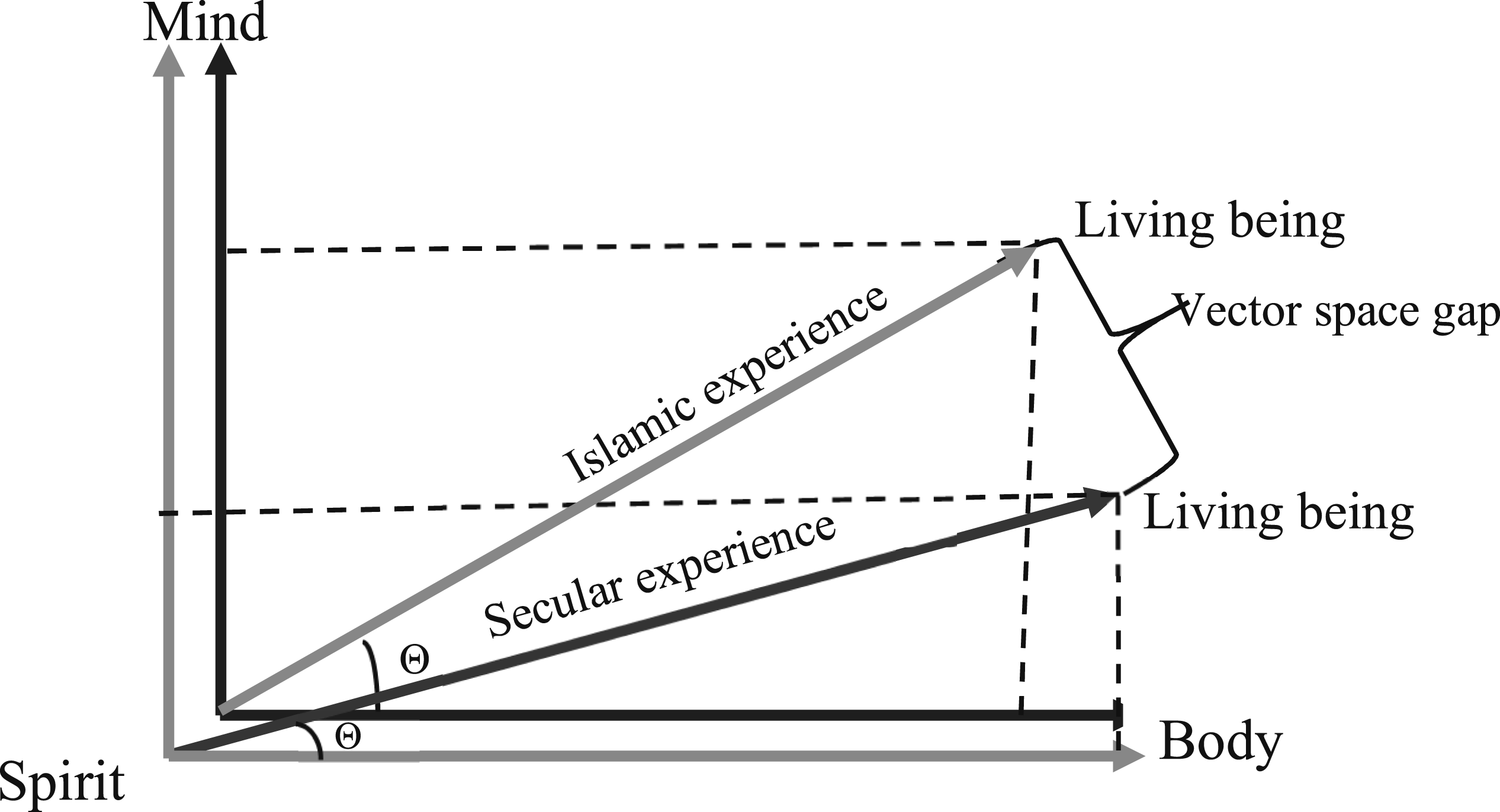
This dissonance between tawhidic and secular realities creates mental tension, leading to an intellectual crisis. For the body, embodied religious and secular experiences cause alienation, suggesting a dual embodied experience exacerbated by the spirit-mind-body dichotomy in the Muslim world. The religious/Islamic experience is higher in values, whereas the secular experience may seem more advanced. Hence, its vector is longer than that of the religious experience. This dichotomy may be less prevalent in modern contexts. However, the religious vector has a larger angle, generating a higher vector overall and demonstrating greater inclusiveness. This diagram represents any religious experience compared to a secular experience. The inclusivity of Islamic solidarity, which units unites Muslims globally, further highlights this gap.
It might be true that the Muslim Ummah identity is in crisis; yet, during crises, Muslims react to boycott calls as a reflex. During boycotts and crises, the dichotomy fades, and the crisis is resolved. Only then do they realize the need to activate the Ummah identity to pursue a collective Muslim cause, leading to a more organized community. This is because Islamic solidarity is deeply rooted in Muslims’ lived experiences, combining epistemologies to facilitate a deeper level of consciousness.
Conclusion
This study decoded complex philosophical and theological concepts, offering a framework for understanding religious experiences, particularly Islamic solidarity. Theoretically, I demonstrated how Islamic solidarity is mapped within spacetime through two epistemologies projected from the spirit: tawhidic and embodied epistemologies. This showed how spacetime serves as a container in which Islamic solidarity intertwines. Tawhidic epistemology unifies knowledge under one God, whereas embodied epistemology unifies bodies that emphasize lived experiences, focusing on the practical and physical aspects of Islamic faith. These epistemologies provide a holistic view, connecting spiritual elements and physical realities. The spatiotemporal overview successfully revealed why Islamic solidarity is timeless, universal, and not limited by temporal or spatial contexts.
The results demonstrate the potential of repurposing the idea of spatiotemporal structure and its operational mechanisms in alternative contexts beyond its traditional scope. This study encourages exploring the feasibility of expanding the current model to delve into realms beyond their implications for scrutinizing social behaviors and solidarity, thereby revealing new insights into the role of space and time. It may uncover weaknesses and limitations within the social fabric of communities and highlight immigration concerns. Furthermore, more studies are needed on boycott calls to examine how concepts such as Ummah and brotherhood are utilized. Additionally, comparative studies between Islamic and secular discourse on boycotts can enhance our understanding of the various methods of building solidarity.
Needless to say, the impact of spacetime can vary significantly among different cultures within the Muslim communities. Accordingly, further research is required to explore the role of spacetime in specific contexts. For instance, in non-Muslim countries, the importance of mosques as spaces may be heightened. Moreover, the significance of time may vary depending on the location. Additionally, empirical research must be conducted to investigate the effectiveness of embodied actions in cultivating solidarity and their relationship with space and time.
Footnotes
Acknowledgement
I thank the reviewers for their invaluable feedback and insightful comments. Their constructive suggestions have significantly enhanced the quality of this paper and helped me organize my ideas. Special thanks to the editor, Dr. Warren S. Goldstein, for his time, patience, and guidance. I also thank my colleagues, Luca Magni, Professor of Practice at LUISS Business School, and Giorgio Marchetti, a theorist of the mind, for their feedback, which helped resolve the difficulties in addressing the reviewers’ comments. I would also like to express my gratitude to Imam Abdulrahman Bin Faisal University for their support during my difficult times. Their assistance is invaluable.
