






Abstract
Objective
Patient information leaflets (PILs) are commonly used to improve the understanding of conditions and treatments. The Flesch-Kincaid Grade Level (FKGL) is a test used to evaluate the readability of a text with the score corresponding to the grade level of a student in the United States. The objective of our study was to assess the readability of PILs produced by the British Association of Urological Surgeons (BAUS), patient.co.uk and the American Urological Association (AUA).
Methods
All PILs from the BAUS and AUA websites and urology-related PILs on the patient.co.uk site were assessed. PILs were individually analysed to derive the word count, number of characters per word and the FKGL (readability score). The mean values from each source were compared.
Results
Patient.co.uk PILs were significantly the most readable on average with an FKGL of 8.09 (p value < 0.0001). The mean FKGL of PILs by BAUS was 11.61, which was insignificantly lower than that of AUA (mean 11.94; p value 0.059). Overall, only 54 (16.4%) of all 330 PILs had an FKGL less than 10, the readability level for a 15-year-old.
Conclusions
Although PILs produced by these large organisations may be easily readable by well-educated adults, comprehension may be difficult for a significant proportion of the United Kingdom adult population.
Introduction
Information leaflets (PILs) are commonly used by patients to improve the understanding of urological diseases and treatments. Patients will commonly seek information independently, which, together with information received from healthcare professionals, leads to improved patient satisfaction. With a vast amount of information available to patients, aided immensely by the emergence of the Internet over the past decade, it is of great importance that patients be provided with high-quality comprehensible material.
A recent survey showed that just under six in ten adults in England achieve a literacy level of 2 or more, a level equivalent to an educated child in England of age 12.1,2 It is estimated that 5.1 million people aged 16-65 have a literacy level of less than 1, 1 therefore lacking functional literacy. 2 National Literature Trust reported that one in six adults in the United Kingdom (UK) have a literacy level below that expected of an 11-year-old. 1 It is therefore of great importance that patient information be written in an easily readable format to be comprehensible by lesseducated patients.
The Flesch-Kincaid Grade Level (FKGL) is the most well-known and commonly used readability test. 4 The purpose of this test is to indicate comprehension difficulty of a passage written in contemporary English. The FKGL is calculated with a formula using the number of syllables, words and sentences to derive a number corresponding to the United States (US) grade level (see formula in Appendix); i.e. a text with an FKGL of 6 (UK equivalent grade 7) is appropriate for a child aged 11-12 (see Table 1). Hence, lower scores correspond to material that is easier to read. Readability formulae are used by some reputable patient information suppliers, including the McMillan Cancer Support. 4
The Flesch-Kincaid (F-K) Grade Level with the corresponding age group and the equivalent of an Englandeducated person.
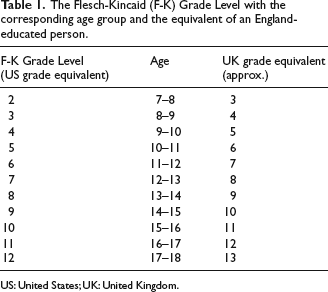
US: United States; UK: United Kingdom.
The recommendation by the Patient Information Forum UK is that information be written at grade 8 equivalent readability or less 4 while the American Medical Association 5 and the National Institutes of Health 6 recommend readability level up to UK-equivalent grade 7 (up to 12 years old). A National Health Service (NHS) Foundation Trust has set a target to produce PILs for patients at a reading age of 12. 7
The scope of PILs is to provide information that is easy to read and comprehend. The aim of this study was to assess the readability of PILs for urological conditions and treatments provided by the British Association of Urological Surgeons (BAUS), the American Urological Association (AUA) and Patient.co.uk.
Methods
Samples
We analysed all PILs accessible in the last week of November 2012 on the websites of the BAUS, the Urology Care Foundation of the AUA and PILs on urological topics from the Patient.co.uk site.8-10
Data analysis
The full body of each PIL was individually extracted into Microsoft® Word 2010. Each document was processed using built-in features of the software to derive the word count, number of characters per word and the Flesch-Kincaid Grade Level. All text was included in processing, including disclaimers, figure legends and links to related literature. Internet links and tables were removed. Comparison between sources was performed using the two-sample t test. P values of less than 0.05 were considered non-significant.
Results
A total of 167 BAUS PILs were analysed, 153 of which explained urological treatments and procedures, and the rest explained conditions. We found 29 PILs related to urology on Patient.co.uk. The AUA website provided 134 PILs. The mean word count for PILs by BAUS was 768 (95% confidence interval (CI) 765-771) with FKGL 11.6 (95% CI 11.55-11.68) (see Table 2). Compared to BAUS, PILs produced by Patient.co.uk had more than double the word count (1729 words per PIL (95% CI 1704 to 1753; p value < 0.0001) but were significantly easier to read (FKGL 8.1 (95% CI 7.99-8.18; p value < 0.0001)). The average FKGL for the AUA information leaflets was insignificantly higher than that of BAUS (mean 11.94; 95% CI 11.87-12.01; p value = 0.059).
Mean word count, word length and readability of PILs by each source, including 95% confidence intervals.

PILs: patient information leaflets; BAUS: British Association of Urological Surgeons; AUA: American Urological Association.
The information leaflets by the AUA had the highest word length with an average of 5.08 (95% CI 5.05-5.11) compared to those by BAUS with 5.00 (95% CI 4.97-5.02; p value = 0.002) and those by Patient.co.uk with 4.64 (95% CI 4.59-4.70; p value < 0.001).
None of the PILs scored an FKGL of 5 or less. While 93.1% of Patient.co.uk PILs could easily be readable by a patient of literacy equivalent to that of a UK grade 11 student (age 14-15), only 11.4% of the BAUS PILs and 6% of the AUA PILs could be readable by this patient group (see Figure). All PILs by pPatient.co.uk scored an FKGL of less than 12 while 58.1% of those by BAUS and 46.3% of those by the AUA scored above 12, deeming them difficult to read even by those age 17-18.
Discussion
Our study has shown that international urological associations and a reputable UK patient education provider supply patients with information that may be too difficult to read for a large proportion of the population. The readability level exceeds significantly that recommended by various health organisations.5-7,11 Our finding is consistent with that of similar studies on readability of PILs related to other surgical specialties including ear, nose and throat (ENT),
12
vascular surgery
13
and orthopaedics.11,14
Percentage of PILs readable to patients appropriate for different Flesch-Kincaid Grade Levels (FKGL). PILs: patient information leaflets; BAUS: British Association of Urological Surgeons; AUA: American Urological Association.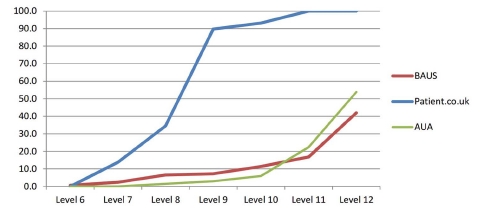
We also found a considerable number of excessively long PILs. An example was the AUA patient information on prostate cancer with a word count of 8865, equivalent to that of a “novelette”. 15 Interestingly, the six longest AUA PILs added up to a word count surpassing that of Roald Dahl's Charlie and the Chocolate Factory! Lengthy information leaflets are likely to make patients unattracted and disinterested or make them read only parts, risking missing important information.
We observed the lack of visual aids in most PILs, most notably in the majority of the BAUS articles. This was the case for information on procedures such as ureteric stent insertion and percutaneous nephrolithotripsy, where a simple diagram would likely make the explanation more coherent. There was use of unnecessary, unexplained jargon, especially in the AUA PILs, with words such as “musculanization”, “agenesis” and “electromyography”. We thought there was unnecessary detail in some articles. For example, the AUA PIL on neurogenic bladder discussed the observations of Dr McGuire in 1981 “that upper tract deterioration occurred when the detrusor leak point pressure exceeded 40cm/H20 measured by Urodynamics”. This information will be of interest to a medical professional but is likely to confuse a newly diagnosed elderly patient with neurogenic bladder.
There is a positive link between low health literacy and poor health outcome. 16 Medical professionals should avoid assumptions on patients’ understanding of basic anatomy and physiology. The general population have a poor knowledge about urological issues especially – a recent survey suggested that more than half the population do not know that urology involves surgery and most are unable to name a single urological disease. 17 It is also important to appreciate that there is an increasing use of the Internet in the older population. A study in a London hospital outpatient urology clinic showed that 75% of patients age 65-69 and 55% of patients over 80 access the Internet. 18
Readability scoring systems, including FKGL, can be useful tools but should be used only as a guide as limitations do exist. 4 Readability formulae address only certain aspects that contribute to actual information comprehension. Aspects such as PIL layout, presentation, the use of visual aids and difficult terminology are important but more complex to quantify. Comprehension levels may therefore actually be different from reading or education level. 19 In addition, comprehension is reduced when one is under stress, which is possible after a new diagnosis. 19
The Crystal Mark is a “seal of approval” by the Plain English Campaign. It recommends the use of “everyday English”, consistent and correct use of punctuation and grammar, the use of “active” rather than “passive” verbs and the explanation of technical terms. The Campaign also recommends the use of sentences no longer than 20 words as well as a clear typeface with clear headings that stand out from the text. 20 Several NHS Trusts and certain medical associations have obtained the Crystal Mark for the use of plain language in documents, including the British Association of Otolaryngologists and the British Heart Foundation. 21 To the best of our knowledge, no urological society uses this service.
Conclusion
PILs produced by reputable British and American urological societies fail to meet the expected readability ease. We recommend that patient information providers take into consideration the significant proportion of the UK population with low literacy levels and the increasing number of foreign-born UK residents in order to provide more easily readable material, which is likely to improve patient satisfaction and health outcome. Publications produced for patients should therefore be clear, specific and concise, containing short sentences and words in plain English language while avoiding the use of jargon. BAUS and AUA should redesign their PILs and consider using professional services, such as those of the Plain English Campaign, to ensure clarity of their documents.
Footnotes
None declared.
Appendix
Flesch-Kincaid Grade Level (FKGL) = (0.39 × average number of words per sentence) + (11.8 × average number of syllables per word) – 15.59.