






Abstract
Aim:
To investigate the clinical effectiveness and cost-effectiveness of robotic technology in robotic-assisted radical prostatectomy in comparison with laparoscopic radical prostatectomy and open radical prostatectomy.
Methods:
Cochrane, Medline and Embase databases were searched for randomised controlled trials to date on robotic-assisted radical prostatectomy versus laparoscopic radical prostatectomy and robotic-assisted radical prostatectomy versus open radical prostatectomy to assess clinical effectiveness. The British Association of Urology Surgeons database (2014–2016) and Cancer Research UK (2012–2014) were accessed in conjunction with media; keywords included: ‘Da Vinci’, ‘first robotic prostatectomy’, ‘hospital’ to estimate the cost-effectiveness of robotic-assisted radical prostatectomy in the National Health Service.
Results:
Functional outcome rates improved with robotic-assisted radical prostatectomy; this benefits the National Health Service financially although the clinical effectiveness may not meet the threshold of clinical importance. Regarding cost-effectiveness, approximately 12/43 (27.9%) centres achieved 150 robotic-assisted radical prostatectomies per year while 26/43 (60.4%) centres have managed to meet 100 robotic-assisted radical prostatectomies per year in 2014–2016. A national mean of 120–130 robotic-assisted radical prostatectomies per year for 2014–2016 was estimated.
Conclusion:
The cost of robotic-assisted radical prostatectomy is adequately justified if a high volume of surgeries (>150) are performed in high volume centres by high volume experienced surgeons per year. This can be achieved by subsidising the cost of robotic technology, centralisation and establishing robotic training centres.
Introduction
The debate between robotic-assisted radical prostatectomy (RARP) versus laparoscopic radical prostatectomy (LRP) and open radical prostatectomy (ORP) has been ongoing. Many ‘robosceptic’ articles have criticised the cost (£1.7–2.5 million) of robotic technology despite Da Vinci robots proving to be the sine qua non of minimal-access surgery. The technology gives a three-dimensional view, greater dexterity and tremor-free benefit to surgeons. 1
In urology, the National Institute for Health and Care Excellence (NICE) have only supported RARP based on health technology assessment (HTA) reports by providing an estimate of relative clinical effectiveness and cost-effectiveness within specified margins of uncertainty. 2 Clinical effectiveness is assessed by safety and efficacy of a technology whereas cost-effectiveness is determined by allocating resources to the technology that yields maximum benefit. 2 Patient demand always exceeds supply, therefore NICE applies the ‘£ per quality adjusted life years (QALY)’ metric to justify the cost-effectiveness of a technology. 2 Hence, this paper will evaluate the clinical effectiveness and cost-effectiveness of RARP versus LRP and RARP versus ORP to justify its expense in the National Health Service (NHS).
Methods
A single reviewer performed a literature search on the Cochrane Database of Systemic Reviews (up to March 2018), Medline (1946 to March 2018) and Embase (1974 to March 2018) with an identical search strategy to that of Salinas et al., 2013. 3 Abstracts that were included were screened with identical eligibility criteria in Wang et al., 2017. 4 PRISMA guidelines were followed for gathering clinical evidence, as demonstrated by the flow chart below (Figure 1).

Flow chart of included studies.
Clinical effectiveness of RARP
Current systematic reviews and meta-analyses have been inadequately robust to prove the superiority of robotic outcomes as they include low quality non-randomised trials.5–7 Furthermore, the UK Laparoscopic, Open, and Robot-Assisted Radical Prostatectomy (LOPERA) RCT study of prostatectomy was discontinued because only a quarter of men were willing to be randomly assigned. Only RCTs available to date (Table 1) were used as a goal standard to assess the efficacy and safety for RARP versus LRP and RARP versus ORP based on perioperative, oncological, postoperative and functional outcomes.
Description of studies.

IIEF: international index of erectile function questionnaire; IPSS: international prostate symptom score; LRP: laparoscopic radical prostatectomy; MRI: magnetic resonance imaging; PSA: prostate-specific antigen; ORP: open radical prostatectomy; PSM: positive surgical margin; RARP: robotic-assisted radical prostatectomy; TNM: tumour staging (tumour, lymph node, metastasis).
Analysis
RARP versus LRP RCTs show no significance between perioperative, postoperative and oncological outcome measures contrary to a HTA report 8 that found less positive surgical margins in RARP versus LRP. Only non-randomised trials with a low risk of bias in another HTA report showed similar oncological outcomes to the RCTs. 9 Of note, the functional benefit of continence in RARP versus LRP was statistically significant at 12 months in one RCT, 10 although both RCTs10,11 showed 11% greater urinary continence recovery at 12 months. Both RCTs showed statistically significant benefit of erectile function recovery in favour of RARP at 12 months.10,11 Achieving continence (odds ratio (OR) 2.47, P<0.021) and potency (OR 2.35, P<0.028) was also more than doubled in favour of RARP over 5 years. 12
A phase 3 RARP versus ORP RCT suggested a statistically significant benefit of RARP in reducing hospital stay and decreasing blood loss similar to observational studies.13,14 Positive surgical margins and functional benefit at 12 weeks were statistically insignificant. 15 Although a multicentre retrospective study found no change in erectile function up to 6 months (P=0.076), a statistically significant change at 12 months (52.5% salvage RARP having no erections vs. 69.8% in salvage ORP, P=0.03) was noted. 16 Continence function was also improved with salvage RARP at 6 months (22.3% vs. 38.1% in salvage ORP having severe incontinence using three or more pads per day, P=0.02) and 12 months (severe incontinence 9.8% vs. 34.2% salvage ORP, P=0.04). 16
QALY re-evaluation
Ramsay et al. 17 used costs and QALY to determine if the expense of RARP is justifiable compared to LRP. A limitation in the HTA analysis was that the QALY calculated was heavily influenced by positive surgical margins and biochemical recurrence. Although the costs for continence and erectile dysfunction were modelled for, they were not included in meta-analysis as studies were unreliable and paucity of data had implications on the economic evaluation. 17
Despite the limited sexual function benefit of RARP versus LRP (P=0.004) and RARP versus ORP (P=0.002), 18 in 2012 the NHS spent over £80 million on erectile dysfunction treatment. 19 Forty per cent of patients who were sexually active preoperatively will experience worsening sexual function postoperatively. 17 While the RCT for RARP versus ORP might be too early to suggest no functional improvement over 3 years, 20 RCTs for RARP versus LRP definitively show a 26–45% (P=0.02) (Table 2) improved erectile function postoperatively at 12 months. This could save the NHS £20–36 million annually, suggesting that a revised QALY is timely. 21 Potentially, fewer than 150 RARPs per year may be the case for RARP to be cost-effective.
Comparison of prostatectomy outcomes.

ORP: Open radical prostatectomy; LRP: laparoscopic prostatectomy; RARP: robotic-assisted radical prostatectomy; POP: postoperative. Values expressed as numbers (percentage) or mean (standard deviation) accordingly.
Nerve-sparring surgery subgroup (on each arm).
Cost-effectiveness of RARP
The economic evaluation by Ramsay et al. also attempted to estimate the costs of robotic surgery. 17 In two studies identified from the HTA report, despite excluding capital purchasing costs, RARP was $500–700 more expensive compared to LRP per surgery 17 and a base case analysis of another HTA report (Ontario) shows that RARP is $6234 more expensive per ORP patient performed. 4 The additional maintenance costs of a single Da Vinci robot is approximately $340,000 per year depending on the model used. 17 Ramsay et al. also concluded that the incremental cost per QALY was less than £30,000 provided 150 RARPs per year were performed, 17 which was supported by NICE in 2014. 2
The British Association of Urology Surgeons (BAUS) prostatectomy audit 2014–2015 showed 13,920 radical prostatectomy procedures were performed by 179 surgeons across 86 centres, of which 65% were RARPs. 22 The median radical prostatectomies performed over 2 years were 63.5 per surgeon and 164 per centre; however, the RARPs per year were not identified. To justify the expense we must assess RARPs per year as per NICE guidance. 23
Analysis
This study has identified the main reasons why fewer than 150 RARPs per centre were achieved, as stated below:
Saturation of RARP centres (Figure 2).
Recent procurement of Da Vinci robot (blue zone, Table 3).
Surgeons with lack of RARP training.

Estimated robotic-assisted radical prostatectomies (RARPs) per year in centres by region based on the British Association of Urology Surgeons database in 2014–2016. 24
Total RARP performed from 1 January 2014 to 31 December 2016 (BAUS database).
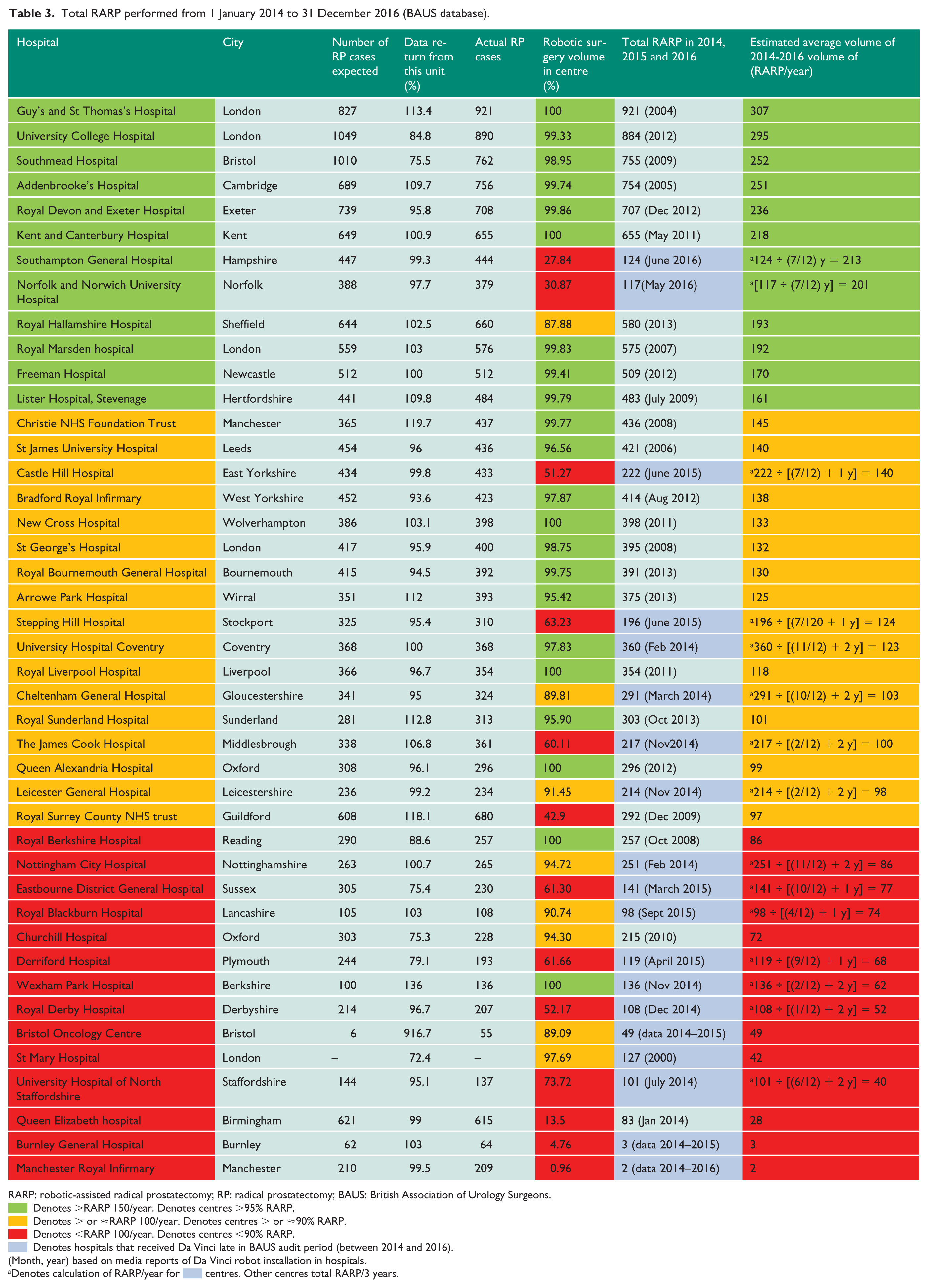
RARP: robotic-assisted radical prostatectomy; RP: radical prostatectomy; BAUS: British Association of Urology Surgeons.
 Denotes >RARP 150/year. Denotes centres >95% RARP.
 Denotes > or ≈RARP 100/year. Denotes centres > or ≈90% RARP.
 Denotes <RARP 100/year. Denotes centres <90% RARP.
 Denotes hospitals that received Da Vinci late in BAUS audit period (between 2014 and 2016).
(Month, year) based on media reports of Da Vinci robot installation in hospitals.
Denotes calculation of RARP/year for centres. Other centres total RARP/3 years.
Centralisation of RARP
Centralisation of complex cancer surgery between 2010 and 2017 has seen robotic centres more than triple from 12/65 in 2010 to 42/49 in 2017. Fewer high-volume complex cancer centres and a rise in the number of men approaching robotic centres have prompted the installation of Da Vinci robots, seeing that 16 centres that did not closed. 25 In 2018, approximately 60 robotic centres exist, 20 more compared to previous recommendations. 26
Most centres in the red and amber zone (Table 3) are affected by the incidence rates of prostate cancer (Figure 2) as it is proportional to case volume. Red arrow regions have a greater case volume compared to green arrow regions; however, the saturation of RARP centres in the south west, south central, west midlands and north west results in insufficient RARPs performed. Da Vinci robots should be distributed according to geography and population density. 26 Centres performing RARP should also consider the incidence rates of prostate cancer. The uptake of second Da Vinci robots should only be focused at centres already achieving more than 150 RARPs per year (e.g. Southmead Hospital, Guy’s and St Thomas Hospital). 26 Three to four centres in red arrow regions and two to three centres in amber and green arrow regions are ideal.
Cost subsidisation
Approaching charities and capitalising on fundraisers with other multiple specialties strengthening the business case to raise a minimum £1 million of donations is pivotal to guarantee the service contract and Da Vinci instrument costs for a defined period beyond installation. 27 The Clinical Commissioning Group has also approved reimbursing providers as per the national tariff for da Vinci robotic-assisted surgery 2014–2015 28 provided centres:
meet RARPs 150 per year;
establish robotic-training programmes;
conduct local audits;
participate in national audits (e.g. BAUS audits).
Joint partnerships with private companies can be a good investment by sharing facilities, for instance with 2 days use in NHS at NHS tariff ratings. 29 Intuitive surgical has also released an interim cost-effective model Da Vinci X (2017) for prostatectomies. Additional Xi functions can be added on or X can be upgraded to Xi later on with this system. 30 Furthermore, CMR surgical (UK) has also released Versius, which has good potential in reducing the cost of robotic technology in the NHS.
Training centres
BAUS have proposed a five-stage robotic surgical curriculum 31 to increase RARP because ORP was found to be dominant in lower-volume surgeons and centres. 22 While the learning curve for RARP is shorter than for LRP, it is postulated that 50–200 cases is ideal before urologists are proficient in performing RARP. 32 The skills learnt are also transferrable to other robotic urology procedures such as partial nephrectomies. 33 The study by Yaxley et al. 15 is unique as it compares the outcome between senior and junior surgeons. The early findings demonstrate that RARP is only cost-effective in the hands of an experienced surgeon. 34 Hence, training centres should invest in dual consoles for each robot to increase the quality of training of junior surgeons as a senior and junior surgeon may operate simultaneously, which can reduce the learning curve. 35
Conclusion
While the clinical effectiveness only shows that RARP has a marginal advantage compared to LRP and ORP, the financial implications of the marginal benefits could save the NHS millions. The future shows that robotic technology has a place to stay, with the caveat that the uptake per centre is carried out responsibly and we look to newer cost-effective models such as Versius. Robotic technology can be sustainable following the proposed algorithm in Figure 3.

Flowchart to sustain the expense of robotic-assisted radical prostatectomy (RARP).
Footnotes
Acknowledgements
The author would like to express his gratitude to Professor Toby Page for assessing his BAUS essay and providing valuable feedback. He would also like to thank Professor Hashim Hashim for his guidance and the opportunity to participate in the BAUS medical student essay prize 2018.
Conflicting interests
The author declares that there is no conflict of interest.
Funding
This research received no specific grant from any funding agency in the public, commercial, or not-for-profit sectors.
Ethical approval
Ethical approval was not required in the manuscript. All data used from the BAUS prostatectomy database and respective studies had previously undergone appropriate ethical approval.
Informed consent
Not applicable.
