







Abstract
The marketing literature on the graphical representation of the online consumer and its effects on consumption and exchanges is still in its infancy. This article contributes by carrying out a multidisciplinary synthesis on this theme. The proposed integrative model focuses on the identification with the avatar, its antecedents and consequences in a commercial context. Based on this framework, the article concludes with specific propositions for future research in this domain.
Introduction
The use of avatars on the internet takes many forms: from film heroes, game characters and inhabitants of virtual worlds to online models for trying on clothes, participants in a virtual world of education, work-group members in a virtual world of collaborative tasks, or representations of internet users on a forum, these many uses of avatars are increasing. After long being criticized for its virtuality and its ‘inhumanity’, the internet now enables users to be represented on the screen and to interact with other ‘representations’. Over 12 million people in the world play World of Warcraft (WoW), 1.4 billion people inhabit virtual worlds, 1 over 900 million are Facebook members: there are over 2 billion internet users worldwide each of whom can potentially be represented online by one or several avatars, through or on whose account they can act, communicate and consume. As early as the 1980s, Turkle (1984, 1995) stressed the evolution of our society towards a postmodernist culture of simulation: the rapid development of computer technology and the importance given to the internet in everyday life means that ‘people are increasingly comfortable with substituting representations of the reality for the real’ (Turkle, 1995: 23), including the representation of oneself and one’s body. Besides this, virtual worlds are becoming an important part of business and merchant life (Parmentier and Rolland, 2009). The market for virtual goods devoted to avatars has been growing by 30% per year (2010–11) and had an annual global turnover of $7.3 billion in 2010. 2 The turnover of actors in the gaming sector or that of virtual worlds results largely from this type of good: in 2011, this was worth $100 million for Second Life (SL) alone. A true market has thus developed around these goods, which relies largely on the avatars created by consumers. Moreover, these hyperreal (Baudrillard, 1981) worlds and their ‘inhabitants’ can also impact our reality.
Whether in virtual worlds or as a tool used in online merchant contexts, the avatar appears as the key element of users’ experience (Biocca, 1997; Tisseron, 2009) because it represents the individual on the interface and reintroduces the body into a universe from which, unlike traditional commercial settings, it is a priori absent and not much called upon (Vicdan and Ulusoy, 2008).
In this virtual universe, the avatar plays the role of mediator between the individual and the company: it influences individuals’ experience and their decision-making process (Kolko, 1999) in the commercial exchange. Besides, through enabling individuals to ‘play’ with their bodies and identity, the avatar can also influence the way individuals consume and what they consume through links between identity and consumption (Belk, 1988). Finally, avatars enable individuals to immerse themselves more easily into the experience of online consumption (Taylor, 2002), thus inducing positive consequences for the purchasing process and the consumer–company relationship (Charfi and Volle, 2011).
The challenges of using avatars in marketing are therefore a topical issue for both management and academia, particularly with a view to improving the online experience – a crucial challenge for the growth of e-business (Rose et al., 2012). Avatars offer marketing practitioners new perspectives for creating consumer experiences in trade, culture, entertainment and/or social activity, while for academics, new avenues of research are opened up to increase knowledge in this domain and provide concrete results to support effective practice. Even if the theme of the avatar has already been widely covered in the academic literature from psychology, sociology, information systems, human–computer interaction and the education sciences, research in marketing is still limited both in quantity and reach. This subject is recent, innovative and has important managerial implications offering many perspectives for research. This article proposes an integrated synthesis on the theme of the avatar; it aims to shed light on current knowledge and suggest avenues for further reflection for researchers and marketing practitioners.
The first part of this work deals with the main research questions associated with the avatar in marketing. An integrative model is then proposed and discussed. The final section formulates perspectives for concrete research in order to stimulate further knowledge on the theme of the avatar in marketing.
The avatar in marketing: Conceptual framework
Definition of the avatar and distinction between avatar and virtual agent
The term avatar comes from Indian mythology (from the Sanskrit avatāra) designating the descent to Earth of the god Vishnu and his ten incarnations. As a term of information technology, the avatar is defined as a static or animated graphic representation (often a character) of the internet user or a video game. When this representation is animated, it is controlled (movements, changes of scene, reactions and expressions) by the internet user. By extension, the term avatar is also used to designate representations or graphic personalizations of computers or processes that work through computers (Halfhill, 1996), such as virtual salesmen or advisors, called Embodied Virtual Agents (EVA) in a merchant context and Non Playing Characters (NPC) in games. EVAs have been widely covered in marketing (Diesbach, 2003; Ben Mimoun, Poncin and Garnier, 2010, 2012; Lemoine and Notebaert, 2011; Viot and Bressolles, 2012). However, a distinction must be made between avatars and EVAs: as Nowak (2004) underlines, the EVA is a particular type of avatar whose ‘puppeteer’ is the computer. There are important differences between EVA and avatar; these are mainly related to the control of the virtual character (Bailenson et al., 2006) and lead to different theoretical and strategic issues. Because of this divergence, this synthesis does not deal with EVAs. 3
The avatar in a commercial context
The use of avatars on the internet is increasing (see Appendix 2 on the different types of avatar and their uses) and raises questions for researchers and practitioners about the humanization of the internet thanks to these virtual characters, the reintroduction of the human body into a domain from which it had been absent, the identity that consumers can express using these graphic representations of themselves or even the interest of avatars in a perspective of a commercial experience. Researchers need to understand these phenomena and practitioners need to be able to draw on this knowledge to apprehend their consequences on commercial relationships and related decision-making.
Current state of marketing research
In order to explore the current state of knowledge about avatars, we carried out a literature review 4 that highlighted the recent nature of this research theme and the relatively small number of marketing studies on the subject. Although all the uses of avatars have been studied (Appendix 3 classifies the articles identified by type of avatar), it seems that research in marketing has concentrated on two types of avatar:
1. Model-avatars
The interest of these particular avatars can be explained by their explicit utility on sites specialized in online sales of clothing (Nantel, 2004), and also by their entertainment value (Kim and Forsythe, 2008, 2009; Malter, Rosa and Garbarino, 2008). They provide an answer to the absence of touch (Rosa, Garbarino and Malter, 2006) and the lack of direct experience of online purchases (Crete et al., 2008). They are therefore highly realistic (Merle, St-Onge and Senecal, 2011; Suh, Kim and Suh, 2011) and raise questions about the relationship of consumers to their bodies in a virtual context (Malter, Rosa and Garbarino, 2008; Merle, St-Onge and Senecal, 2009, 2011).
2. Avatar inhabitants of virtual worlds simulating life
The special attention researchers have paid to virtual universes such as SL is essentially justified by their commercial interest 5 (purchase of virtual products, presence of virtual brands, products or stores). Most of the questions deal with the identity construction and symbolic of the representation of an individual (Vicdan and Ulusoy, 2008; Parmentier and Rolland, 2009; Rhee, Sanders and Simpson, 2010; El Kamel and Rigaux-Bricmont, 2011) and with the purchase of virtual products (Chung, 2005; Hemp, 2006; Jin and Bolebruch, 2010; Animesh et al., 2011). Indeed, in these universes, as in games, one of the most important activities consists of buying virtual goods and accessories that construct the character in question, equipping him/her with clothes, accessories and arms, and/or personalizing him/her through hairstyle, changes to body shape, powers and/or skills. According to Greengard (2011), 21% of internet users buy or exchange virtual goods. Often, these virtual goods are a precise representation of a real product that inhabitants can buy for their avatar or ‘for real’. In the first case, the avatar is the subject of the consumption (El Kamel and Rigaux-Bricmont, 2011), whereas in the second, he/she is the mediator. Both cases raise the question of the effect of this intermediation on the consumer decision-making process.
We should also mention the emergence of studies such as those of Garnier and Poncin (2009) and Poncin and Garnier (2010) on 3D shops/shopping malls; these studies deal with questions related to avatars in the context of virtual commercial reality.
However, the use of avatars is far broader than the reach of anything studied by marketing so far, and there are still many managerial and research perspectives concerning questions associated with avatars, consumption and the commercial context.
Avatars and contexts of use: The specific characteristics of the commercial context
The use of an avatar representing an internet user has been shown to be inseparable from its context (Kang and Yang, 2004; Vasalou and Joinson, 2009; Sung et al., 2011) and from the task in hand (Lim and Reeves, 2010; Suh, Kim and Suh, 2011). There are considerable differences between avatars for SL, Ma Bimbo or WoW. These differences cover their design, use, and objectives, all of which are intrinsically linked to their respective contexts: interaction and attractiveness, individual accomplishment or gaming and collaboration (Voisenat, 2009). It thus appears important to consider right from the start the particularities of a commercial context that might influence or be influenced by the use of an avatar.
Indeed, any commercial context involves specific concrete consequences: purchasing a real product with home delivery, financial transaction, contacts and relationships with the company, social relationships among consumers and also the wish to visit the commercial, cultural or touristic destination ‘for real’. Besides their obvious useful aspect, 2D and 3D internet sites may comprise pleasurable, social and ‘fun’ aspects: the pleasure of online shopping, entertainment, social interaction through discussions, etc. The virtual commercial context can thus have real implications for the purchase itself and for commercial and/or social relationships. Representation through an avatar is thus not only a parallel life that is unconnected from the individual’s real life – it can also have a concrete impact on reality. This gives rise to a great many avenues for reflection and further research on avatars. Indeed, it is important to question about the impact of such intermediation on traditional consumer behaviors (decision and purchasing processes, post-purchase attitudes and behaviors, relationships with companies), and in the first place to question about the central role of the creation and identity embodiment in a virtual body and the consequences of this for the experience of online consumption. These areas cover essential questions both for marketing practitioners and academics.
The avatar as an expression of identity
Considered as tools for identity construction that enable individuals to experiment with identities and express multiple aspects of the self (Turkle, 1994, 1995; Tisseron, 2009), avatars and their links to identity, the construction of identity or identity role-playing have received particular attention from research, notably in psychology. On the contrary, although the links between identity and consumption need no further demonstration (Belk, 1988), the impact of this identity play when individuals consume (a site, service or product) through the intermediary of an avatar, and on their online or off-line commercial relationships has not yet been studied in depth in the marketing literature.
The studies that have been carried out deal essentially with individuals’ self-representation strategy during avatar creation; these studies agree overall on the typology of different possibilities for self- representation: a real self vs. an improved or idealized self (Taylor, 2002; Tisseron, 2009; Sung et al., 2011), ‘the chosen identity that may or may not be congruent with the real identity’ (El Kamel and Rigaux-Bricmont, 2011). In the same line, Parmentier and Rolland (2009) point out four dynamics of avatar identity construction on SL: duplication, improvement, transformation and metamorphosis, within a dynamic process of identity construction (reinforcement vs. openness). Underlying motivations refer either to an optic of self-confirmation or to one of simple improvement (positive promotion) or compensatory improvement (positive distortion of negative information) (Messinger et al., 2008). Related to the maintenance of the self-concept (Sirgy, 1982, 1986), empirical results show that individuals tend to design avatars that resemble them physically (despite potential improvement or idealization) and whose personality is globally close to their real personality, despite minor differences if the avatar represents an improved self (Vasalou and Joinson, 2009; Aas, Meyerbröker and Emmelkamp, 2010; Rhee, Sanders and Simpson, 2010; Sung et al., Moon, 2011). These results seem logical for, to explore and construct his/her multiple identities, the individual ‘still exposes certain traits of his/her real personality’ (Cogerino, 2009: 625) and plays a role vis a vis him-/herself (Tisseron, 2008). Virtual identity is thus never totally separate from real identity (Kang and Yang, 2004) and individuals creating avatars display the essential characteristics of their own identity (Schroeder, 2002; Taylor, 2002); too great differences could decrease satisfaction towards using the avatar (Ducheneaut et al., 2009). The individual’s identity is thus transmitted by this constructed image.
Nevertheless, one paradox should be mentioned. If in theory, virtual worlds enable individuals to free themselves from the physical constraints of their body and become a flying troll or a rabbit, Yee, Ellis and Ducheneaut (2009) and Schultze (2010) ponder the tendency of virtual universes to replicate physical reality with its codes and artifacts. Yee, Ellis and Ducheneaut (2009) mention the ‘tyranny of physical incarnation’: it is generally expected that avatars have a human (or humanoid) form. However, at what degree of abstraction or difference do we consider that an embodiment is not human (Yee, Ellis and Ducheneaut, 2009)? Although it is clear that an animal or a table are not human, do we consider that a troll or a fairy are human, albeit in fantasy form? 6 The avatar’s anthropomorphism 7 is an avenue of reflection that should be followed up. Although this characteristic was studied in the context of EVAs (Nowak, 2004; Nowak and Rauh, 2006), it has not yet been explored for other types of avatar.
Yee, Ellis and Ducheneaut (2009) also highlight that some universes are better suited to needing the representation of humans and familiar artifacts. The work of Carù and Cova (2003, 2006a, 2006b, 2006c) shows that, in order to live an experience to the full, individuals must be able to appropriate or take on the experience and its environment, notably through past experience and the familiar artifacts that anchor them to it. Thus the realism of virtual environments and avatars seem a priori to be pertinent to the commercial universe and this has already been shown in the case of model-avatars (Malter, Rosa and Garbarino, 2008; Kim and Forsythe, 2008, 2009). Nevertheless, is such realism necessary for avatars in a forum, a 3D shopping mall or a visit to a virtual museum? In these cases, the avatar could be metaphorical or fanciful while still representing the individual’s identity (Béliard, 2009), as long as the individual concerned is able to personalize it and create the identity he/she wants. The important thing, over and above the actual form of the representation, thus seems to be the elements that the individual projects onto the virtual body (concept of self, values, characteristics) and how far he/she identifies with it; ‘with virtual images, it is clear that the model of the image is no longer the real world but the interior reality, that is, the psychological image’ (Tisseron, 2009: 595). The question of reintroducing a body into the virtual experience, the balance between needing to humanize this embodiment and the idea of identity/identification must be discussed in a context of the experience of consumption.
The avatar and re-introducing the body into the virtual experience
Numerous studies in social and cognitive psychology confirm the importance of the body in any human experience qualified as ‘embodied’ (for a summary, see Niedenthal et al., 2005). As underlined by Biocca (1997) or Schultze (2010), the body is an information processor and vector of our experience of the world. In a marketing perspective, researchers have dwelt on the importance of the body in the experience of consuming. Thus Joy and Sherry (2003) have shown the importance of bodily incarnation in the experience of visiting a museum. This perception of embodiment is achieved through the stimulation of the senses and has positive effects on the museum experience. The body of research showing the importance of direct experience or emotions and physiological feelings and sentiments, follows this tendency. Moreover, in the literature of psychology, sociology and marketing, the body is seen as a way of presenting the self, a means of socialization and communication (Thompson and Hirschman, 1995). It is a primary marker of identity (Schultze, 2010) and a tool for rhetorical expression (Kolko, 1999), for it makes the individual visible in the eyes of the world (Anderson, 2000). In a postmodernist approach, the body is also seen as an experience in itself (Schouten, 1991; Vicdan and Ulusoy, 2008).
Now, the virtual experience was for a long time perceived as a disembodied experience – the physical body being hardly used and cyberspace enabling individuals to be free of physical constraints and the finite nature of the body (Turkle, 1995). Beyond discussions on the essence of the body and the relationship between body and mind, 8 the use of avatars today calls into question this idea of disembodiment and asks more generally about the place of the body in the virtual experience (Turkle, 1995; Biocca, 1997; Schultze, 2010). In the domain of health, it has been observed that using a virtual body can result in physiological reactions (Fox and Bailenson, in preparation) and help promote behavioral changes (Cui et al., 2009; Fox and Bailenson, 2009, 2010; Jin, 2010b). Similarly, a whole section of the literature shows that like the real body, strong physical and emotional reactions can be provoked by an experience mediated by an avatar (Turkle, 1994; Voisenat, 2009; Von der Pütten et al., 2010).
The digital body thus anchors the self in virtual and social space (Taylor, 2002; Tisseron, 2009) and can be considered as a mediator (Kolko, 1999), reconciling internet users with an inherent need of physicality in a virtual space (Meamber and Venkatesh 1999; Vicdan and Ulusoy, 2008). The avatar thus enables the individual to be re-embodied in virtual experience and engaged in corporal practices (Schultze, 2010). Today, it is therefore essential to understand how the virtual body impacts the consumer experience. We do not pretend to resolve the debate on the embodiment/disembodiment of virtual experience, nor that of the mind/body duality. We simply wish to underline the importance of an increased understanding of the impact of avatars on the virtual experience. Indeed, in as much as they reintroduce the body and the image of an individual on the internet, this can influence internet users’ merchant behavior. The reality of the virtual world (in the broadest sense of the internet) is such that researchers and practitioners must take into account that individuals can today create one or several virtual bodies (or images), project themselves onto these and use them for different experiences, including consumption. Avatars will thus influence today’s consumers’ production and evaluation of the virtual experience.
Avatars, virtual experience and their consequences
Since Holbrook and Hirschman’s (1982) seminal article, the consumer experience has been the subject of an extensive literature in traditional merchant and consumer situations; since the works of Hoffman and Novak (1996), consumer experience on the internet has also been studied. Consumers not only seek utilitarian and material benefits from purchasing, visiting sites or participating in other activities of online consumption; they also seek physical and psychological comfort, entertainment, escape, esthetic and emotional pleasure, social interaction and manipulation of products at the point of sale. Improving this virtual experience has thus become one of the main preoccupations of marketing practitioners. The literature identifies elements constituting the online experience: entertainment and escapism, immersion, interactivity, sensory richness, the feeling of being active and in control, (tele)presence, learning and knowledge, personalization and even aestheticism (Steuer, 1992; Pine and Gilmore, 1999; Li, Daugherty and Biocca, 2001; Fiore and Jim, 2003; Fiore, Jin and Kim, 2005; Fiore, Kim and Lee, 2005; Fiore and Kim, 2007; Song, Fiore and Park, 2007; Rose et al., 2012). These have positive results on the pleasure of shopping, foster favorable attitudes and behaviors (satisfaction, loyalty, purchase intention, recommendation intentions), all of which are approaches and factors of performance sought by web practitioners (Fiore and Jin, 2003; Harris and Goode, 2010; Rose et al., 2012).
Besides purely utilitarian aspects, consumers thus seek sense, emotions, multi-sensory stimulation and immersion in extraordinary experiences within a scenario of which they are at once producer and actor (Carù and Cova, 2006b; Bourlakis and Papagiannidis, 2009). The avatar, as a tool of virtual reality, was very early identified as a key factor for engaging the individual in the virtual universe (Biocca, 1997; Taylor, 2002; Tisseron, 2009). Indeed, avatars enable consumers to play an active and productive role in the experience, this involvement being a key factor of successful consumer immersion in a merchant space (Carù and Cova, 2006c). Beyond the positive impact of avatars on the overall virtual experience (Feldon and Kafai 2008; Lim and Reeves, 2010), research has specifically dealt with their impact on two components of virtual experience: immersion (Choi and Kim, 2004; Davis et al., 2009; Garnier and Poncin, 2009) and presence (Taylor, 2002; Jin and Bolebruch, 2010; Lim and Reeves, 2010; Schultze, 2010). The positive effect of avatars on these concepts that are central to the virtual experience has been observed in those works. Being represented by an image, a body or an avatar, thus seems to lead individuals to disconnect themselves more easily from physical reality, ‘plunge’ into the virtual universe or activity and feel themselves to be present in this virtual world. In this way the experience is more enriching because of its immersive nature, and more realistic from a physical and sensorial viewpoint (through the reintroduction of a body); it thus seems to provoke favorable responses towards the company.
This first section has enabled us to pose the main issues about the use of avatars in a commercial context to which existing marketing research has not yet offered satisfactory answers. These issues are partly related to the creation of the avatar and the consumer’s identity and partly to its embodiment and the consumer’s experience. The second part of this article presents an integrative model allowing to study avatars that represent consumers. Each section of the model is discussed and suggestions for further research formulated.
The study of avatars in commercial contexts: Proposal for an integrative model
Our multidisciplinary literature review (see Appendix 4 9 ) identifies 65 variables related to avatars. Our integrative model is constructed according to three objectives to highlight the most important elements for studying avatars representing consumers: (1) respond to the questions raised by the analysis of the conceptual framework; (2) confirm, in the commercial context, certain relationships established in other contexts; and (3) explore new avenues for which knowledge is as yet limited. Figure 1 presents the proposed integrative model that focuses on the processes allowing us to understand the role of avatars in the commercial context. This goes from the antecedents to the consequences of the relationship between the individual and his/her avatar, made manifest by the construct of identification with the avatar. It is important to point out that the commercial vocation of the context is a condition sine qua non of the model and thus this context is not represented as a moderating variable.
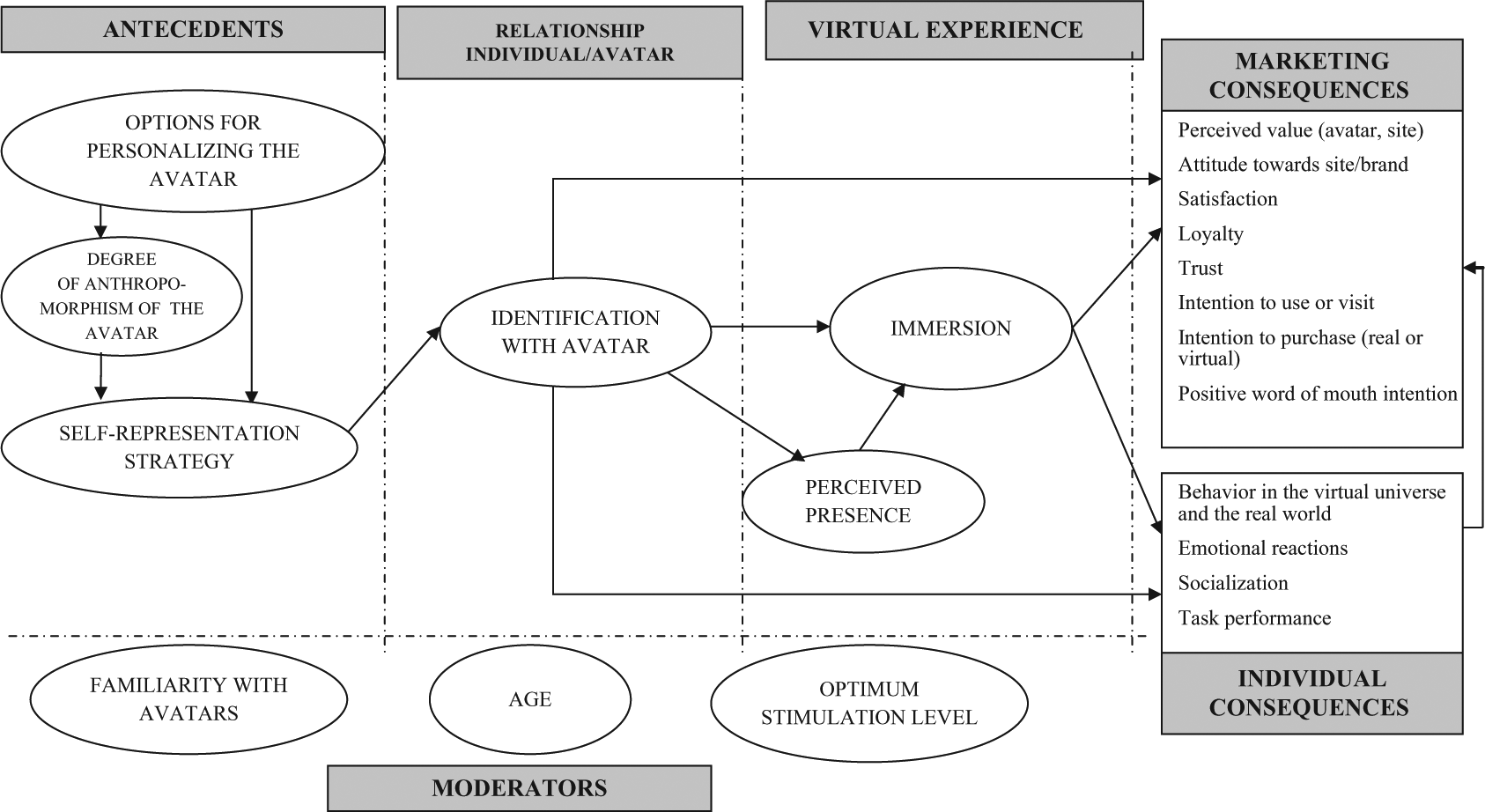
Integrative model for the study of the impact of an avatar in a commercial context. 10
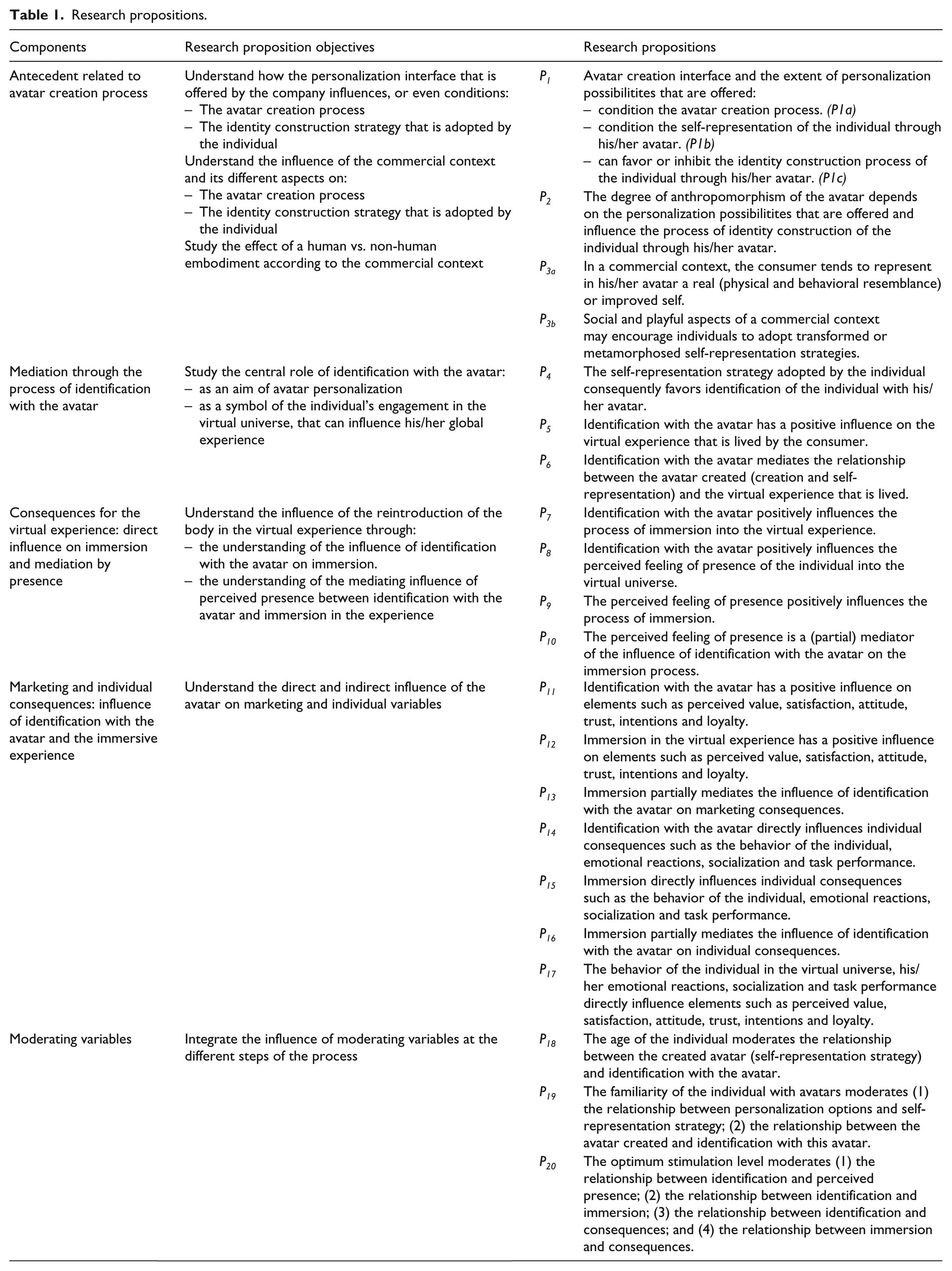
The model is made up of five parts: the antecedents related to the design of the avatar; the mediating role of the relationship individual–avatar (materialized by the concept of identification with the avatar, the central process of this model); the virtual experience seen through the concepts of immersion and perceived presence, both being consequences and mediators; the ‘marketing’ and individual consequences related to identification with the avatar and the virtual experience; and finally, the potential moderating variables. Below we detail the variables considered and justify the research propositions relevant to the relationships between the variables in the model shown in Table 1.
Research propositions.
Antecedents: Designing the avatar
Designing a virtual body is often seen as an experience in itself, symbolic (Vicdan and Ulusoy, 2008) and constructed (El Kamel and Rigaux-Bricmont, 2011). It is also the internet user’s first point of contact with the virtual universe and the first action he/she undertakes. Kim and Sundar (2012) have shown the impact of the fact of creating an avatar or not, creation having a positive effect on the relevance of the mental images related to the body. Because of this prime importance, designing the avatar is key to the model we propose.
Avatar design: Personalization options
Different sites and contexts offer different degrees of personalization. These vary according to technological capabilities and the reasons for using an avatar. Although the possible representations are most often humanized, certain contexts propose more unusual representations: fantastic creatures, human/animal mixes, animals or sometimes objects (Yu, 2007). The creation of this visual representation enables individuals to express their values and characteristics (Kang and Yang, 2004; Suh, Kim and Suh, 2011); it is a decision-making process that can be relatively long (Tisseron, 2009; Duchenaut et al., 2009). Thus, (new players or those arriving in the virtual world) ‘devote a great deal of their time to making their avatar special; this is perceived as essential in order to really exist’ (Tisseron, 2009: 599). This creation process is also dynamic: regular modifications are observed to be made to the avatar, depending on context, profession and competences, and relative as much to appearance as to the character’s personality (Bessière, Seay and Kiesler, 2007).
This stage of creation and personalization of the avatar is very important in as much as the experience and presence in the virtual universe is ‘regularly undermined by poorly executed systems, or those in which designers have not paid full attention to the complex ways bodies can be formulated’ (Taylor, 2002: 58). The results obtained by Garnier and Poncin (2009) follow this line: an avatar with poor graphic qualities and limited personalization is considered by respondents as too ‘virtual’ and insufficiently specific. This average quality avatar thus has a harmful effect on users’ experience (weak immersion and lack of credibility of the 3D store). Besides technical studies in computer sciences on the modeling of avatars (Gratch and Marsella, 2005), research has also dealt with how avatars are created and personalized according to what the company’s interface offers (Kafai, Fields and Cook, 2007). These studies show that the amount of time spent and the degree of avatar personalization obviously depend on this factor (Ducheneaut et al., 2009). They also underline that individuals spend more time personalizing those characteristics of the avatar that they consider to be the most important depending on the context (hair and clothes in WoW for example). The contribution of Pace, Houssian and McArthur (2008) shows that the avatar creation interface can force users to conform to values and perspectives chosen by the designing company. This company thus has a direct means of conditioning consumers’ entire experience through their avatars. This means that the range of personalization offered could influence the entire process of avatar creation, impacting individuals’ possibility of representing themselves in a realistic or fantasy fashion, and their self-image in an idealized or metamorphosed form. Individuals are thus more or less free to represent themselves as they wish. We can therefore suppose that an interface with limited personalization, (such as may be found on certain sites proposing virtual models or social games), does not enable individuals to fully realize the process of identity construction they aspire to, thus preventing them from identifying themselves in a satisfying way with their avatar (Propositions P1a to P1c, cf. Table 1). So far, no study has been carried out on avatar design in a commercial context, and nothing enables us to estimate the necessary/optimal range of personalization, or the most important attributes that consumers wish to be able to personalize in direct commercial contexts such as online sales, or indirect ones such as virtual visits of tourist destinations, museums or brand communities.
Degree of avatar anthropomorphism (human, humanoid or non-human)
Studies dealing with anthropomorphism have generally been carried out relative to EVAs or social interactions with an avatar; such studies deal with realism and attractiveness of appearance (Nowak and Rauh, 2006; Van Vugt et al., 2007) and only consider the human, or at least humanoid forms of avatar. Nowak (2004) thus uses representations that are strongly or weakly anthropomorphic, but all represent a human face in a more or less abstract manner. In their debate about the tyranny of human embodiment, Yee, Ellis and Ducheneaut (2009b) underline that, so far, no study has considered the impact of a totally non-human embodiment or of fanciful humanoid embodiments. Even though their reflection is based on the virtual universes of collaborative work, in which there is a priori a great need to be anchored in physical reality, Garnier and Poncin’s (2009) results lead us to suppose that a realistic human embodiment would also be encouraged in the commercial context. It is clear that such a question does not arise for model-avatars used for buying clothes, where human embodiment is necessary. However the existence of fanciful avatars in virtual communities and the potentially hedonic and playful character of commercial universes lead us to examine the impact of the degree of anthropomorphism of avatars representing consumers. This variable is directly impacted by the possibilities of personalization offered and influences the possibility of representing a self-image that may be real, improved or idealized. We propose that this mediates (a priori partially) the influence of personalization of the avatar on the possibilities of self- representation (P2).
Identity strategy of self-representation
Results have already been obtained on the different modes of self-representation and the underlying motivations of individuals’ identity construction through avatars in non-commercial contexts; it is worth considering whether these results can be adapted to commercial contexts. Existing typologies of identity construction, such as that of Parmentier and Rolland (2009) are presented as being adaptable to any other context; such typologies deserve to be replicated in a context of consumption, and their consequences on the consumer experience estimated. What type of ‘self’ will consumers seek to express? How is this impacted by the process of avatar design (P1 and P2)? We include the strategy of self-representation adopted as an antecedent variable of the model. In a commercial context and a utilitarian perspective, individuals should adopt a strategy of realistic self-representation. However, the playful and social aspects of shopping cannot be eliminated and might lead individuals to adopt more radical transformation strategies. The choice of avatar is not only an individual one: it is also a social process, for it is a choice made depending on others and the image one wishes to project (Coulombe, 2010). P3a and P3b thus suggest studying strategies of self-representation in a commercial context and according to an orientation that may be more or less utilitarian, social and/or entertaining.
Whatever personalization strategy is adopted in the personalization process considered in the model’s antecedents, the objective is that individuals feel themselves to be represented and embodied in the avatars they will use. Thus the identification with the avatar is the variable that translates the central notion of the relationship between the individual and his/her avatar and, as such, it is the key mediating variable of our model.
Mediator: The individual–avatar relationship seen through identification with the avatar
Numerous studies highlight the importance of the resemblance and physical similarity between an individual and his/her avatar (see Appendices 4a and 4b). Nevertheless, as the identity approach suggests, individuals’ embodiment with their avatar goes far beyond this: the avatar enables the individual to represent and symbolize his/her psychological image (Tisseron, 2009), his/her private self (emotions, values, goals; Morin (2004) in Suh, Kim and Suh, 2011). The term symembodiment (Vicdan and Ulusoy, 2008) designates the presence of the body in the virtual environment, without physical constraints but with the body’s symbolic and identity-related meanings. We suggest that beyond human vs. non-human embodiments, resemblance and individuals’ self-representation strategies, the important thing is that individuals project themselves sufficiently into the avatar to identify with it. Identification with the avatar thus offers a broader conceptual view than that of similarity or resemblance. Suh, Kim and Suh (2011) define identification with the avatar as ‘the cognitive connection between an individual and his/her avatar, resulting in the individual considering the avatar as a substitute for him/herself or that he/she has such an illusion’. Identifying with one’s avatar, considering one’s avatar as an extension of oneself or indeed as oneself is thus the logical concrete conclusion of the avatar personalization process; this close link enables the individual to have a full consumer experience. Surprisingly enough, this variable has been little studied in the literature (Suh, Kim and Suh, 2011; Poncin and Garnier, 2012), with researchers focusing rather on the coherence of the identity, personality or resemblance. It seems to us essential that research deals more concretely with this aspect, and we thus include identification with the avatar as a proxy between the antecedents related to designing the avatar and the consequences related to the virtual experience. We envisage identification with the avatar as the total mediator of the relationship between the avatar created and the virtual experience encountered (research propositions P4 to P6).
Consequences of avatars: Mediation through virtual experience
As mentioned in the first section, there have been regular studies of the positive effect of avatars on the virtual experience through their influence on immersion and/or perceived feelings of presence; however, these studies have been essentially in non-commercial contexts. We thus include these two concepts in our model as variables that can measure the virtual experience undergone in commercial contexts. Here the model suggests a double mediating effect in as much as (1) immersion is envisaged as a partial mediator of the relationship between identification with the avatar and consequences; and (2) within this process, perceived presence is envisaged as a partial mediator between identification with the avatar and immersion.
Immersion
Generating immersive experiences is a major preoccupation of marketers because of the positive results of such experiences on the consumer experience. Charfi and Volle (2011) highlight the probable resulting behaviors: ordering a product or service on the site, filling in a form to enter a relationship with the company, direct contact and positive word of mouth. Added to this is the probability of purchasing virtual goods, already shown in the context of online gaming (Koufaris, 2002; Wu, Li and Rao, 2008; Guo and Barnes, 2009; Cha, 2011). Fornerino, Helme-Guizon and Gotteland (2008) define immersion as ‘the state of intense activity in which consumers find themselves when they access the experience in full’. Immersion may appear when the individual is plunged into, involved with or absorbed in a totally different world. It may be partial or total, long lasting or of short duration, actively desired or passively undergone. For the internet user, immersion thus consists of abstracting oneself from one’s physical environment and preoccupations in order to devote oneself and be absorbed by visiting a site and/or purchasing on it. Certain authors link this to flow (Hoffman and Novak, 1996), a state of total immersion in which the concentration on the surfing experience is so intense that the attention remaining available is not enough for the individual to think about anything else: he/she is thus disconnected from the events occurring in his/her physical environment (Novak, Hoffman and Yung, 1999). 11 On the basis of the literature we thus propose that identification with the avatar has a positive influence on immersion 12 (P7 – detailing P5 and P6).
Perceived feeling of presence
Embodiment and the feeling of being present are closely related (Schultze, 2010). Using a virtual body appears to enable individuals to feel that they exist or are ‘there’ in the virtual universe; they thus have the illusion that the experience is not computer-mediated (Biocca, 1997; Lombard and Ditton, 1997; Kim and Biocca, 1997). Although there are numerous 13 conceptualizations and definitions of presence (Schultze, 2010) and the debate on the direction of the relationship between immersion and presence has not been completely resolved, we adopt the position found in the majority of the literature. It seems to us logical to consider that the more individuals identify with their avatar, the more they will have the feeling of existing and being present in the virtual universe and the more they will be able to be immersed in it. Presence can thus be considered as a meditator between identification with the avatar and immersion (P8 – detailing P5 and P6 – to P10). At this stage, the literature does not say whether this mediation is total or partial. We suppose that identification with the avatar has a direct influence on immersion, but that perceived presence is an enlightening and interesting detail as to the mechanism of the avatar’s influence on immersion.
The preceding components of the integrative model should thus enable us to understand how individuals’ creation of their avatar and the subsequent identification process can lead to consumers living a more immersive virtual experience. The model thus ends with the ‘marketing’ and individual consequences of the experience of immersion and the reintroduction of a body into the experience.
Consequences of identification with the avatar and immersion
Approach responses and behaviors favorable to company performance
The use of avatars raises questions about our knowledge of well-established concepts in marketing (Barnes and Pressey, 2011) and the impact of such technology on factors of commercial performance sought by firms must be studied. The improved and more immersive experience thanks to avatars is likely to have positive consequences on the overall assessment of the virtual universe (Fiore and Jin, 2003; Harris and Goode, 2010) and encourage behaviors favorable to a commercial context (Charfi and Volle, 2011). Rose et al. (2012) show, for example, the positive effect of the virtual experience on perceived consumer benefits (convenience, fun, deeper relationship between consumer and company) and favorable behaviors towards the company (satisfaction, trust and repeated purchase). Besides, since avatars encourage interactivity, feelings of control, involvement and fun, they may, like other virtual reality tools, positively influence overall attitudes, intentions to purchase and re-visit, and the probability of increased spending and recommendations (Fiore and Jin, 2003). Furthermore, because they enable consumers to know more about the company environment and products (Pine and Gilmore, 1999; Suh and Lee, 2005), avatars are likely to increase the time spent on the site, facilitate the decision-making process and have a positive influence on perceived quality and trust as has been shown for 3D technology (Algharabat and Dennis, 2012). Finally, the avatars’ utilitarian and entertainment values (Kim and Forsythe, 2008, 2009) may have a positive influence on the overall perception of the value of the commercial experience. However, the avatars’ efficiency on these performance factors that favor the firm has not yet been adequately demonstrated. The lack of an integrative model has, until now, meant that the path from the avatar to its consequences could not be established. In our model, we thus integrate a set of ‘marketing’ consequences that, without seeking to be exhaustive, include traditional marketing-dependent variables: perceived value, satisfaction, loyalty, trust, attitude and intentions of favorable behaviors. We suppose there to be a direct positive influence of identification with the avatar and immersion in these elements, as well as the partial mediating influence of immersion (cf. mediation by virtual experience mentioned above) (P11 to P13).
Individual consequences
Finally, issues of self-presentation and identity role-play are not without consequences for the individual. According to Yee and Bailenson (2007), Yee, Bailenson and Ducheneaut (2009) and Yee, Ellis and Ducheneaut (2009), the identity process is a dual one: the avatar as the representation of the self, has as much impact on the level of an individual’s behavior as on that of the behavior of others. Self-perception and the physical and verbal behaviors that result are therefore likely to be influenced by the characteristics of the avatar. Thus, a good looking avatar is socially more attractive and can lead the user to behave in a more extrovert way in his/her social interactions with other avatars. This produces a phenomenon of behavioral confirmation (Snyder, Take and Berscheid, 1977; Snyder and Swann, 1978) called the Proteus effect 14 relative to the avatar’s appearance. It has been observed (Yee and Bailenson, 2007, 2009; Messinger et al., 2008; Peña, Hancock and Merola, 2009; Yee, Ellis and Ducheneaut, 2009; Merola and Peña, 2010), and shown that, in a variety of contexts, these effects are liable to spill over into the real world. Numerous studies (Appendix 4c) also confirm this impact of avatars on socialization, communication, behavior and language, as well as on the respect of social norms in virtual universes. As mentioned in the first part, the effects produced on physiological sensations and emotions during an experience mediated by an avatar have also been observed, as well as an impact on the user’s performance in carrying out a given task (Mikropoulos and Strouboulis, 2004). Because a commercial context can take on aspects that are both utilitarian, social and playful, it seemed worth including individual consequences in our model (for example, the incidence of an online relationship mediated by an avatar on the behavior of consumers in one of the firm’s real stores) (P14, P15). We also envisage the partial mediating nature of immersion between identification with the avatar and individual consequences (P16). Finally, these individual consequences can in turn impact the above-mentioned marketing consequences (P17).
Moderating variables
Other moderating variables can be proposed beyond those at the heart of the model. If we envisage moderators for different contexts and study objectives (gender, involvement, innovativeness, expertise, personality traits, need for control, self-esteem/body esteem, capacities for mental imagery, situational variables, etc.) we suggest three moderating variables that are more generic and that could be influential in all contexts. These moderators have only very little, if ever, been taken into account so far in relation to avatars:
The diversification of profiles of internet consumers leads us to wonder about the effect of age 15 (Kolo and Baur, 2004; Blinka, 2008) related to familiarity with the technology, avatar creation, self-representation strategies and the capacity to identify with a virtual character: we may suppose that the younger the individual concerned, the more strongly he/she will be able to identify with his/her avatar (P18).
(Familiarity with avatars or experience of avatars could modify the process of avatar creation: individuals who are very familiar with avatars could be more likely to create fanciful avatars, whereas those less familiar would tend to represent themselves more realistically. This factor could also influence the individual’s capacity to identify with his/her avatar (P19).
The Optimum Stimulation Level (OSL), defined as individuals’ general response to environmental stimuli, and their preference to a given level of stimulation (Zuckerman, 1971), could influence the relationship between identification with the avatar, presence, immersion and consequences as well as the link between immersion and consequences. We could effectively suppose that individuals with a high OSL who seek variety, exploration, innovativeness and who are curious by nature (Raju, 1980) would better appreciate stimulation related to their avatar and would be more likely to feel present and immersed with positive consequences. On the contrary, individuals with a low OSL might find the experience unpleasant because of over stimulation, with harmful effects in terms of immersion and consequences (P20).
We wanted this model to be suited to different commercial contexts and to all types of avatar. Nevertheless, its non-exhaustive nature means that supplementary adaptations could be made: (1) by including particular moderators and/or (2) by including consequences specific to each of the contexts and types of avatar.
The last part of this summary formulates concrete avenues for research, based on (1) the proposed integrative model and its potential applications; (2) the impact of these research paths for the progression of general knowledge on avatars applied to marketing; and (3) the interest of these themes in the short and medium term for researchers and practitioners.
Research perspectives for marketing
There is much research to be carried out. Here we present two areas that are particularly important for researchers and practitioners: the personalization of the avatar and how this is linked to identity and consumption, and a reflection on methodological considerations in research on avatars. These avenues of research show the concrete use of our model to study the process starting from avatar design right up to the incidences of avatars on the commercial relationship. This process, which is the basis of any experience carried out through an avatar, has not yet been studied nor understood in the commercial context.
Personalization of the avatar, identity and consumption
The most important perspectives of studies for immediate concern relate to the upstream part of the model, the personalization of avatars in a commercial context. Even if studies have been carried out on the importance of physical resemblance in task-oriented contexts or on identity strategies in life-simulation universes, deeper studies on how individuals go about creating their avatar in a commercial context seem necessary.
Studying avatars in a context of online shopping
What identity strategy will an individual adopt when window-shopping in a virtual shopping mall? Can the company leverage this strategy in its proposals for personalization? What identity strategy will be adopted for visiting a virtual museum? In as much as most current studies use preconceived avatars that are imposed on participants, a deeper study of individuals’ own personalization process and its consequences seem necessary. The particular nature of the commercial context (compared to games or SL) is that the individual generally has only one account, and thus only one avatar through which the whole of the identity dynamic will be expressed. These questions thus open different perspectives for research on the influence of avatar creation on the expected commercial relationship: (1) research that tests different offers of levels and attributes of personalization with different possibilities for self-representation (realistic or fanciful); (2) research that tests the impact of non-human embodiment in a commercial universe and on different levels of usefulness/entertainment (for example, a shop vs. a museum); (3) research that manipulates the objective of shopping (utilitarian vs. social vs. entertaining) and estimates the effect on avatar design; (4) longitudinal research on the use of the same avatar, observing its creation, related motivations and eventual modifications in a dynamic of identity linked to consumption. Finally, certain personalization tools might include product/brand placement (similar to product placement in games (Lehu and Bressoud, 2008)) on the avatar’s clothes or accessories; another interesting approach would be one linking avatar, identity and brands. What attitude do individuals have towards this process? How far do brands and products participate in the expression of an identity through an avatar (Jin and Bolebruch, 2010)? Are these similar to the strong links between identity and consumption widely identified in non-virtual contexts (Belk, 1988)? What is the impact of these relationships that are expressed and created in a virtual world on real-world consumption, and on the real relationship between the individual and the brand?
Studying ‘static’ avatars in virtual communities or service/sales live chats
Today, virtual communities and social networks are a recognized field for identity experimentation, interpersonal socialization and relationships between individuals and brands. Research on the virtual identity, especially in social networks has already established typologies of expression of identity. However, some questions remain unanswered. Could the effect of a static or animated avatar be different? What can we learn from the avatars of participants in a virtual community? The works of Bélisle and Bodur (2010) show how an avatar can be a source of information for a firm. Besides, Béliard (2009) highlights a typology of avatars used in virtual communities that enables community participants to be categorized through their avatar as a tool for identification. Thus, important and promising perspectives of research are to be found in studying the impact of avatars on virtual communities, brand pages on social networks or even on recommendation tools and comments by internet users on merchant sites. Such research is facilitated by our model, which allows both researchers and practioners to study avatars from their creation to their consequences.
The issues of presence, social presence and all the themes linked to the influence of avatars on behaviors and language should also be studied in more depth in the particular context of brand community. Finally the question of representation in these communities is also arises for the community manager (CM) or for a distance salesman on a commercial live-chat. What kind of avatar could represent this person? What would its impact be on the relationship with clients? What is its impact on the role of CM or of distance salesman (Proteus effect)?
Adopt longitudinal methodologies
Our final research perspective has to do with methodology. Much research on this subject is undertaken as a snapshot of momentum; it may be that this moment is the first and only use of an avatar, and often one that has been imposed. Now, like any product, and as is shown by research on the dynamics of identity, representation through an avatar is part of a process over time that may have repercussions on reality. Moreover, certain authors present immersion as a process leading to the immersive experience (Ladwein, 2003; Carù and Cova, 2003, 2006a, 2006b, 2006c). 16 Although we did not follow this theory in our model, we nevertheless think that it is theoretically and empirically appropriate. The model could thus be applied longitudinally.
Longitudinal research would also enable us to study the process of learning to use an avatar as well as the effects of the avatar over time. For example, does the Proteus effect evolve as the avatar is used? Do the effects of using a model-avatar change after several uses? Which of these effects are lasting, and how far do they affect experience with the brand and the firm in the real world? Theories such as the model of human capital (Ratchford, 2001) applied to utilitarian or hedonic consumption (Murray and Bellman, 2011) could, for example, integrate the effects of learning and ‘practice’ with the avatar into research.
Conclusion
The number of avatars on the internet is increasing: these may be a source of useful and experiential value in a marketing context. This study has brought together existing work on the very recent field of research on avatars in marketing. It has highlighted the practical and academic potential of avatars, particularly through their effects on the online experience, its immersive nature and the resulting positive consequences for firms. For those seeking ways of improving the consumer online experience, this synthesis shows how and why the avatar is a present-day pertinent option that nevertheless deserves to be better understood. We have seen that the academic literature in other domains, already largely developed on this subject, can be the source of inspiration and theoretical bases for marketing researchers. This study highlighted the major research questions linked to identity expressed through avatars in a commercial context; it then discussed the potential effects of reintroducing the body into the virtual experience and finally proposed an integrative model focused on the process of identification with the avatar in a commercial context, its antecedents (the creation of the avatar) and consequences (the feeling of presence, immersion and the consequences of this immersion or the use of the avatar, for both the individual and the firm and the commercial relationship). For us, understanding this process, as yet not studied in marketing, is a fundamental step to a better understanding of the interest and effects of avatars in the commercial context. Without being exhaustive, we have suggested several propositions and concrete research perspectives as priorities, integrating the specific characteristics of the commercial context and the use of avatars within it. We deem this research necessary today if knowledge of marketing and consumer behavior on the internet is to advance. From a managerial point of view, such research would also enhance the successful development of these new commercial tools and worlds, and would bring practitioners concrete responses as to setting up avatars on their internet sites.
Footnotes
Appendix 1. Distinction between avatar and embodied virtual agent (EVA)
More particularly the conceptual frameworks will mainly be related to:
Research on avatars questions how individuals personalize their avatars and the consequences that result in terms of identity, self-image or behavior in virtual universes, whereas research into EVAs mainly questions the appearance to give to the agent that symbolizes the firm and undertakes the services rendered, as well as the consequences of this appearance.
The EVAs here relate to a conceptual framework linked to artificial intelligence, its functioning and performance; this is not the case of the avatar, controlled by a human being. In this case it is a matter of questioning how individuals act towards others or towards the company in the virtual environment through their avatars and enquiring about the relationship between individuals and virtual characters. As suggested by the first point about the design of the virtual character, the avatar relates to questions linked to self-expression and the relationship with the self and this extension of the self, whereas the EVA relates to a conceptual framework of relationships to others and interactions with ‘the other’.
Although both domains may converge on certain consequences related to the use of the site or the virtual universe, such as perceived social presence, immersion, satisfaction, intentions to returning or to purchase, research on EVAs relate these to the performance of the agent, or the quality of the interactions, whereas the consequences of using an avatar will more likely be related to individuals’ attitudes, feelings and behaviors: identification with the avatar, feeling of self-presence, perception of the experience itself, etc.
The main questions put forward in the literature on EVAs are then intrinsically linked to the design of the agent (appearance), to the control and the quality of the computer entity (intelligence, autonomy, etc.), the agent’s function (presence vs. absence, appearance and related perceptions – credibility, perceived expertise, coherence with the firm, image, performance, satisfaction) and to the relationship with others in a commercial context of advice and sales.
Appendix 2: Different forms and uses of avatars
This table shows:
It should be noted that within a same generic category of avatar, the personalization options can be very different from one site to another, particularly according to the possibilities offered for creating the avatar (depending on its technological level, graphic qualities and the needs of the site). Thus, in SimsSocial, the possibilities for personalization are confined to a limited number of characteristics (sex, face, clothes – with a finite number of possibilities that mostly require payment, for example height or weight cannot be personalized); in City of Heroes or Second Life, each body characteristic can be personalized (height, weight, hair, face, costume) and the options offered (mostly free) are extremely numerous and detailed. Thus, although in SimsSocial, one avatar can be the twin of another, this is impossible in City of Heroes or Second Life, because personalization solutions make it possible to design millions of different avatars.
As for the appearance, the functioning and range of control over the avatar depend on the solution offered by the site or the software. Movement may be effected either by click-to-move (clicking on the desired destination) or by using keyboard arrows. Sometimes it is possible for the avatar to run, jump or fly, according to the type of universe inhabited. Gestures and emotes are also more or less numerous and developed. Finally, emotional facial expressions are generally little developed: indeed, many users use the first- or third-person view, a situation in which they cannot see the avatar’s face. In the context of emotional reactions towards others (for example towards other avatars), emotes are used to translate the emotion desired by the user.
Appendix 4: Summary of academic publications on each theme and group of variables
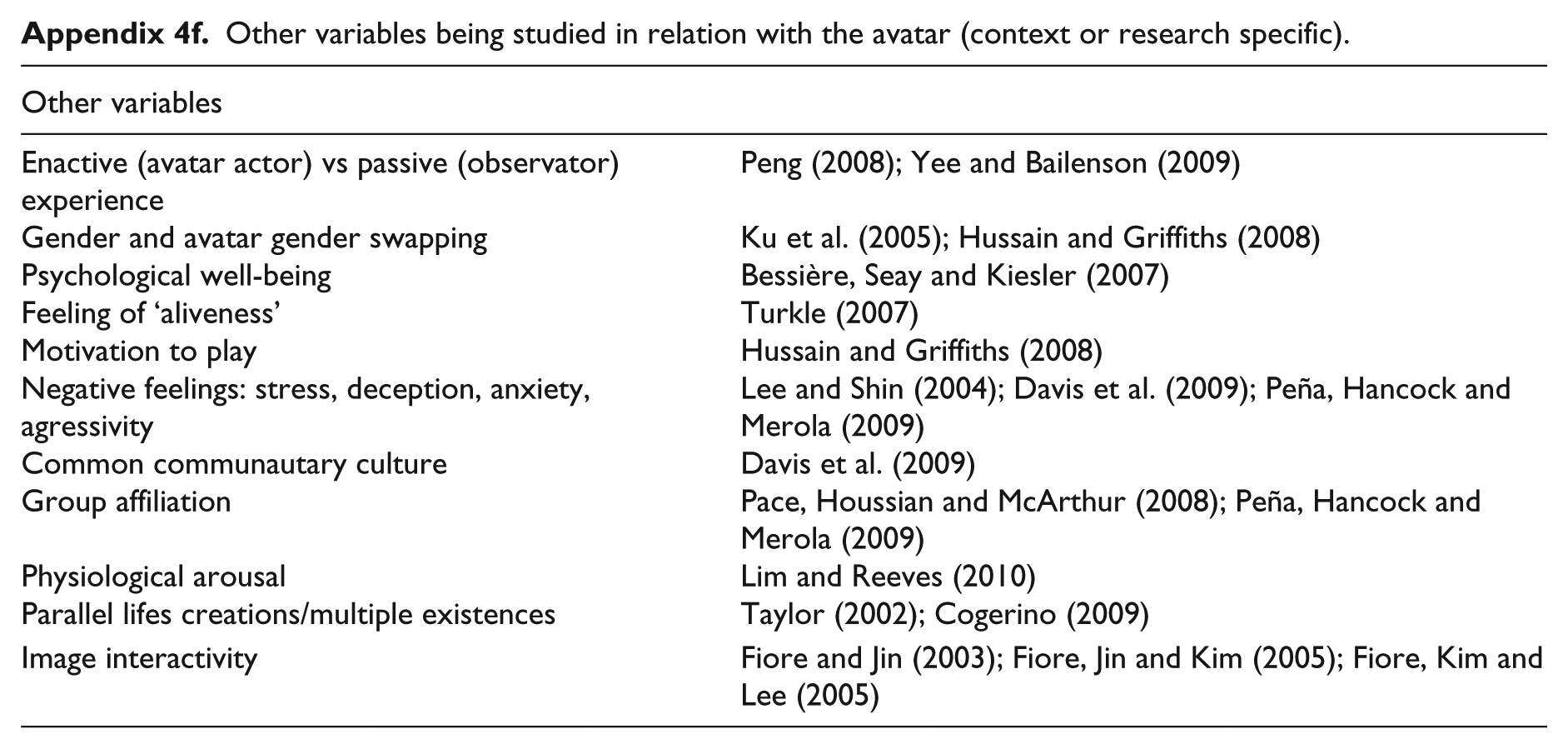
Other variables being studied in relation with the avatar (context or research specific).
| Other variables | |
|---|---|
| Enactive (avatar actor) vs passive (observator) experience | Peng (2008); Yee and Bailenson (2009) |
| Gender and avatar gender swapping | Ku et al. (2005); Hussain and Griffiths (2008) |
| Psychological well-being | Bessière, Seay and Kiesler (2007) |
| Feeling of ‘aliveness’ | Turkle (2007) |
| Motivation to play | Hussain and Griffiths (2008) |
| Negative feelings: stress, deception, anxiety, agressivity | Lee and Shin (2004); Davis et al. (2009); Peña, Hancock and Merola (2009) |
| Common communautary culture | Davis et al. (2009) |
| Group affiliation | Pace, Houssian and McArthur (2008); Peña, Hancock and Merola (2009) |
| Physiological arousal | Lim and Reeves (2010) |
| Parallel lifes creations/multiple existences | Taylor (2002); Cogerino (2009) |
| Image interactivity | Fiore and Jin (2003); Fiore, Jin and Kim (2005); Fiore, Kim and Lee (2005) |
Acknowledgements
Authors would like to thanks the three anonymous reviewers as well as Joël Brée, redactor-in-chief, who, by their comments, suggestions and encouragements, contributed to a significant improvement of this article.