







Abstract
Most prior studies obtained that a congruent sponsorship leads to higher sponsor awareness. The experiment conducted here shows that a brand is better identified following an incongruent sponsorship. Moreover, when the opportunity to process the sponsorship is low, the competitors of incongruent sponsors are also harder to identify.
Brands are increasingly interested in sponsorship, particularly in the field of sports. For example, brands such as Castrol, Continental or Adidas spent between 10 and 44 million dollars a year (a four-year contract from 2007 to 2010) on sponsorship rights for the 2010 FIFA World Cup in South Africa, which represents an increase of 80% compared to the previous World Cup in Germany (Humphries, 2010).
The success of this type of communications operation is often measured by an increase in brand awareness for the sponsors (Herrmann et al., 2011a; Lardinoit and Derbaix, 2001; Walliser, 2003). Researchers have therefore examined the factors that encourage unaided and aided recall of the sponsors’ brands (e.g. Walliser, 1996). Several authors have shown that an increase in congruence between the sponsor and the sponsored entity improves unaided and aided awareness of the former (e.g. Cornwell et al., 2006; Grohs et al., 2004; Quester and Farrelly, 1998; Rodgers, 2004). Congruence can be defined as the perceived fit between the sponsor and the event sponsored (Speed and Thompson, 2000). One might therefore conclude that sponsorship of the FIFA World Cup would be more effective, in terms of memorization, for Adidas than for less congruent brands such as Continental or Castrol.
However, as suggested by the contradictory results of certain studies (Olson and Thjømøe, 2009; Wakefield et al., 2007), both theoretical and methodological limitations strongly restrict the impact of this assertion. As various authors have pointed out, the theoretical bases are weak or fragmented (Jagre et al., 2001; Stangor and McMillan, 1992). In their meta-analysis Stangor and McMillan (1992) illustrate, in particular, the limitations of various theoretical models used to explain the influence of congruence on memorization. The main aim of this article is to reassess the impact of congruence on sponsor memorization from a robust theoretical foundation. The encoding flexibility model, which has been validated in social psychology for stereotypes (Sherman et al., 2004; Sherman et al., 1998), is introduced and combined with the associative network model (Srull, 1981; Stangor and McMillan, 1992). These theoretical frameworks postulate that the influence of congruence on memorization depends on the opportunity to process the message, i.e. the extent to which distraction or limited exposure affect the amount of attention the individual can devote to the message (MacInnis et al., 1991).
No other study on sponsorship has taken this variable into consideration. This is all the more surprising in that during many events, such as the World Cup, the spectator’s attention is above all focused on the event itself, to the detriment of the sponsor, to whom little notice is paid (d’Ydewalle and Tamsin, 1993). The theoretical frameworks selected for this study therefore involve the study of the moderating role of opportunity to process sponsors.
In addition to their theoretical limitations, existing studies also have methodological shortcomings. These stem from the fact that traditional measurements of sponsor memorization (i.e. recall and recognition) are often biased by the implementation, in the respondents’ minds, of constructive processes (Johar and Pham, 1999; Johar et al., 2006). In particular, consumers tend to identify brands that are congruent with an event as the sponsors even when this is not the case. Therefore the consumer’s response is not based on recovering information from memory, but on the use of a congruence heuristic: consumers believe it is more likely that an event is sponsored by a congruent brand than one that is not.
In order to compensate for these methodological limitations, we use implicit measures of memory (Herrmann et al., 2011a). Unlike traditional explicit measures – recall and recognition – measures of implicit memory are not influenced by information recovery strategies (Trendel and Warlop, 2005; Von Hippel et al., 1993). In particular, when these measurements are taken, individuals cannot use a congruence heuristic that strongly biases consumer responses.
Globally this article proposes (1) to apply and validate, in marketing, and specifically sponsorship, the encoding flexibility model developed in social psychology by Sherman and his colleagues (1998, 2004), (2) to test the moderating role of opportunity to process the message on the influence of congruence between the sponsor and the event on sponsor memorization; and (3) to avoid measurement biases evoked in past studies.
We start by underlining the role of congruence in the field of sponsorship and, in particular, its influence on memorization. Then we present the associative network model used in existing studies. After that we introduce the encoding flexibility model and develop our research hypotheses. This is followed by the methodology of the experiment, with a detailed description of the implicit memory measures, and the results obtained. Finally, the general discussion puts our results in perspective with regard to those obtained in prior studies and managerial implications are detailed.
Congruence and sponsorship
Congruence in sponsorship
Consumers assess the level of congruence between the sponsor’s brand and the sponsored event based on expectations and perceived similarities in their characteristics 1 (Maille and Fleck, 2011). Aquarius brand sports drinks, for example, would be perceived as congruent with a cycling event, but not with riffle shooting, as cycling requires endurance and energy while riffle shooting requires calm and concentration. The characteristics the event and sponsor have in common can be the products, attributes, markets, positioning, mission or any other shared associations (Gwinner and Eaton, 1999; Simmons and Becker-Olsen, 2006). Depending on the nature of these associations some authors have suggested distinguishing several dimensions of congruence (e.g. Fleck and Maille, 2010; Fleck and Quester, 2007; Gwinner and Eaton, 1999; Maille and Fleck, 2011), but most studies do not specify the theoretical bases of congruence. In this study we will consider congruence between the brand and the sponsored event more globally as the degree to which the sponsor and the sponsored entity fit well together (Speed and Thompson, 2000). This conceptualization incorporates, in particular, the dimensions of relevance of the association and consistency with expectations (Maille and Fleck, 2011).
Many researchers have studied the influence of congruence between the brand and the event on sponsorship efficiency. Most of these studies indicate that an increase in congruence improves the impact of sponsorship (Cornwell et al., 2006; Gwinner and Eaton, 1999; Rifon et al., 2004; Simmons and Becker-Olsen, 2006). Simmons and Becker-Olsen (2006) have demonstrated that, compared to congruent sponsorships, incongruent partnerships reduce the clarity of the sponsor’s positioning and induce a less favourable attitude towards the sponsorship and, consequently, a decline in brand equity. However, results concerning the influence of congruence on sponsor memorization are not as clear.
Congruence and sponsor memorization
Recall and recognition are used to measure sponsor memorization in most prior studies (e.g. d’Ydewalle and Tamsin, 1993; Lardinoit and Derbaix 2001; Walliser, 1996). The vast majority of these studies has shown that a high level of congruence between a brand and a sponsored event facilitate memorization of the sponsor–event link, using either the sponsor or the event as a cue (Cornwell et al., 2006; Grohs et al., 2004; Johar and Pham, 1999; Rodgers, 2004). For example, Grohs et al. (2004) have shown that consumers recognize and recall congruent sponsors more easily than less congruent sponsors during the FIS Alpine World Ski Championships. Moreover, it seems that the only way for less congruent sponsors to reach the same level of memorization as obviously congruent ones is to explain the reasons behind the sponsorship operation via costly advertising campaigns (Cornwell et al., 2006; Simmons and Becker-Olsen, 2006).
However, Jagre et al. (2001) indicate that less congruent sponsorships could be preferable because incongruence attracts spectators’ attention, which should increase the intensity of cognitive processing and therefore encoding and recollection of the sponsor. The results obtained by Olson and Thjømøe (2009) support this hypothesis by observing a higher rate of recognition for incongruent sponsors featured on players’ jerseys or on the playing field. Wakefield et al. (2007) have also found a higher recall rate for certain incongruent sponsors. Contradictory results therefore exist and it appears that strong congruence between a brand and a sponsored event is not always desirable, at least not when the aim is to increase sponsor awareness.
The associative network model can help explain these contradictions. We now present this model, which suggests that in order to understand the influence of congruence on memorization we need to consider the level of opportunity to process the message.
The associative network model of memory
Until now, the associative network model of memory is the only theoretical framework that has been used to provide an information encoding account that can justify the influence of congruence on sponsor memorization (Cornwell et al., 2006; Rodgers, 2004). Since experiencing a sponsored event activates notions that are semantically linked in memory, this model stipulates that brands are encoded more effectively, and therefore recalled more effectively as well, when they share several associations with the event. Congruent brands should therefore have an advantage compared to less congruent ones, as the latter share fewer associations with the event (Cornwell et al., 2006; Rodgers, 2004). However, researchers in psychology indicate that this explanation, which only concerns recall and not recognition, depends above all on the opportunity to process the message during encoding (see, in particular, Stangor and McMillan’s 1992 meta-analysis). Yet, no prior study on sponsorship has taken this variable into consideration. Therefore the application of the associative network model in the sponsoring domain has been incomplete.
When an individual cannot process a message in depth, a congruent piece of information is easier to understand and stronger associations are created with other information present in the person’s memory. This leads to more efficient encoding of the congruent information. But when the opportunity to process the message is high, incongruence will rather attract attention and the attended information will be processed in more depth (particularly in an effort to solve the problem of incongruence, see Fleck and Maille, 2010). Consequently, many new cognitive associations will be created between the non-congruent information and other information. These associations allow the individual to easily retrieve incongruent information from his/her memory (Crocker et al., 1984; Stangor and McMillan, 1992). Thus the model predicts an advantage in terms of spontaneous recognition for semantically congruent information only when opportunity to process the information is low.
Therefore our research uses the associative network model of memory to examine, in the field of sponsorship, the moderating effect of opportunity to process the sponsor on the link between congruence of the sponsorship and sponsor memorization. However, this model is limited to recall, a measurement that can be biased by the implementation of constructive processes during recovery of information (Stangor and McMillan, 1992). We therefore introduce the encoding flexibility model (Sherman et al., 1998), which is not limited to recall and can be used to complete and refine the predictions of the associative network model, particularly when opportunity to process the sponsor is low.
The encoding flexibility model
It has been shown that schemas – memory structures of abstract knowledge within which information is linked – guide attention, encoding and retrieval of information (Von Hippel et al., 1993). The encoding flexibility model was developed by Sherman and his colleagues (Sherman and Frost, 2000; Sherman et al., 2004; Sherman et al., 1998) to explain the relative encoding of congruent and incongruent information with regard to schemas when opportunity to process a message is low. It should be possible to apply this model to sponsorship. Indeed, it has been demonstrated that consumers have expectations regarding the various components of a sponsored event and therefore schemas concerning them (McDaniel, 1999). In particular, consumers develop schemas regarding brands or product categories through repeated exposure to advertising during such events that they associate with traditional sponsors.
According to this model, when the opportunity to process a message is low, the use of schemas is guided by efficiency goals, i.e. the information gained compared to the energy spent to acquire it. In order to maximize efficiency when opportunity to process information is low, an individual will encode various aspects of congruent and incongruent information with a schema. Therefore processing will not be entirely dedicated to congruent or incongruent information. This model predicts that, when the level of opportunity to process is low, congruent information benefits from better conceptual encoding, i.e. an advantage in encoding its meaning that involves integrating the information with semantically linked concepts. Information that is not congruent, on the other hand, benefits from better perceptual encoding, i.e. an advantage in encoding the physical properties of the stimulus that involves encoding associations between the stimulus and the simple geometric shapes it consists of.
The reason for this is that information that is congruent with an existing schema is easily interpreted (i.e. integrated in existing memory structures by association with semantically linked concepts) and benefits, therefore, from a conceptual encoding advantage. Since a congruent piece of information is easy to understand and confirms existing knowledge, the encoding flexibility model stipulates that the information will receive little attention and its perceptual details will not be well encoded. Thus, after extracting the essential meaning from congruent information, an individual can turn his/her attention to other information that is more difficult to understand such as, for example, incongruent information. When opportunity to process the message is low, incongruent information cannot easily be integrated in existing knowledge structures (hence weak conceptual encoding), but the effort required to integrate it allows for encoding of perceptual details. Thus, when opportunity to process a message is low, attention and perceptual encoding will be greater for incongruent information. Thus, these flexible processes maximize encoding of congruent information (conceptual encoding) and incongruent information (perceptual encoding).
This model’s predictions therefore concern situations where an individual has little opportunity to process a message. When opportunity to process a message is high, Sherman and his colleagues rely on the associative network model of memory to explain why conceptual encoding should be greater (or at least the same) for incongruent as for congruent information. Moreover they rely on the work of Von Hippel et al. (1993) and Johnston and Hawley (1994) to justify that perceptual encoding should be greater for incongruent rather than congruent information. In this study we adopt the same perspective.
The encoding flexibility model supposes, therefore, distinguishing perceptual encoding, i.e. (as seen above) encoding of physical details, from conceptual encoding, or the encoding of meaning. Traditional measurements of memorization (i.e. recall and recognition) cannot be used to distinguish these two types of encoding. Only measurements of implicit memory allow this (Roediger, 1990). Before presenting our research hypotheses, we define implicit memory and its two forms.
Implicit memory
Compared to explicit memory, which is based on tasks (e.g. recall and recognition) involving intentional and conscious retrieval of information, implicit memory 2 is defined as unintentional and unconscious recovery of information stored in memory (Schacter, 1987). Implicit memory is measured in two stages. First (in the study stage), respondents are exposed to a target stimulus (consciously or not). In a second stage (test stage), respondents must execute a task, without any reference being made to the prior exposure stage (Schacter, 1987). Then the respondents’ performance is compared with that of a control group that has not been subjected to the study stage. Implicit memory is inferred by an improvement in performance.
There are two forms of implicit memory: perceptual and conceptual memory (Cabeza and Ohta, 1993; Lee, 2002). Perceptual implicit memory is based exclusively on encoding the physical properties of a stimulus (shape, colour, modality…). Conceptual implicit memory, on the other hand, is based on encoding its semantic properties. In the case of sponsorship, conceptual implicit memory of a brand stems from the creation/reinforcement of associations between the sponsor and associated semantic concepts, while perceptual implicit memory stems from the creation/reinforcement of associations between the brand and letters corresponding to it, but also between each letter and the simple geometric shapes that comprise them (Bower, 1998).
Using implicit measures of memory eliminates the bias involved in constructing a new response at the time of measurement and, in particular, bias linked to the use of a congruence heuristic (Von Hippel et al., 1993). Indeed, measures of implicit memory can be used to check encoding of information and are not influenced by information retrieval strategies. This is particularly important because the use of a congruence heuristic strongly biases traditional measures of memory (Stangor and McMillan, 1992), especially in the field of sponsorship (Johar and Pham, 1999; Johar et al., 2006). In sponsorship the use of a congruence heuristic corresponds to the fact that consumers identify sponsors based on their intuition that congruent brands are more likely and appropriate for a given event, whether this is true or not. In their meta-analysis of 54 experiments, Stangor and McMillan (1992) have shown that elimination of bias linked to the use of a congruence heuristic produced opposite results in terms of recognition: when this bias is present, recognition is higher for congruent information, while after eliminating the effects of this bias, recognition is higher for incongruent information.
Research hypotheses
Whatever the level of opportunity to process sponsors during encoding, perceptual encoding should be greater for incongruent sponsors than for congruent ones. Indeed, the encoding flexibility model makes this prediction when opportunity to process sponsorships is low, and the work of Von Hippel et al. (1993) and of Johnston and Hawley (1994) suggests that, when opportunity is high, individuals should also make relatively more effort to encode the physical details of incongruent information than congruent information. In the end, as perceptual implicit memory can be used to assess perceptual encoding, we put forward the following hypothesis:
Furthermore, the encoding flexibility model predicts that when opportunity to process the sponsorship during encoding is low, conceptual encoding will be greater for congruent sponsors than for incongruent ones. Since conceptual implicit memory can be used to assess conceptual encoding, we put forward the following hypothesis:
Finally, when opportunity to process sponsorships during encoding is high, the individual will be capable of understanding and searching for solutions to solve inconsistencies in incongruent schemas. This process produces many associations between incongruent items and other components of a schema. This should, at the very least, neutralize the conceptual encoding advantage for congruent information (Sherman et al., 1998), and even lead to more effective conceptual encoding of incongruent information (Stangor and McMillan, 1992). The associative network model of memory predicts, in particular, that when opportunity to process information is high, incongruent information benefits from a conceptual encoding advantage compared to congruent information. Indeed, the model makes this prediction in the case of recall, and recall is a measurement of memory based to a great extent on conceptual processes (Roediger, 1990). A major drawback for recall is that it can be polluted by constructive identification processes, which is not the case for conceptual implicit memory. Therefore we hypothesize:
Methodology
In order to test our hypotheses we conducted a laboratory experiment on field sponsorship. 3 We chose sports as our sector and sponsorship by brands rather than products or organizations. Finally, the sponsored entities are events. These choices can be justified by the fact that this type of sponsorship involves the greatest investments (Kotler and Keller, 2012).
The experimental design (2 × 2 × 2) used is as follows: congruence between the sponsor and the sponsored entity (low/high) × level of opportunity to process the sponsor during encoding (low/high) × measure of implicit memory (perceptual/conceptual). The two final factors are between-subject factors and congruence is a within-subject factor. The dependent variable is the proportion of brands accurately identified. We start by detailing the implicit measures of memory selected and their relevance.
Implicit measures of memory
This study evaluates perceptual as well as conceptual implicit memorization of sponsor brands. The measures of implicit memorization selected for this experiment are identification tasks of brands presented very briefly on a computer screen. During the test phase of perceptual implicit memory, participants must identify the same sponsors they were exposed to during a previous study phase where the sponsorships were presented to them. This measure only requires the activation of a perceptual representation of the sponsor’s brand (reinforced by encoding the sponsorship) and is often referred to as a measure of perceptual identification (Jacoby and Dallas, 1981). Perceptual identification is based on perceptual fluency, which reflects the ease with which consumers can process and identify a stimulus when they are exposed to it a second time.
The measure of perceptual implicit memory selected for this experiment is particularly relevant for supermarket brands. Indeed, when different alternatives are physically present at the moment of choice, speed or ease in identifying a brand name or logo is crucial (Alba et al., 1991). Easily identified brands are the ones most likely to be chosen on the shelves (Ferraro et al., 2009; Lee, 2002).
During the conceptual implicit memory test phase, participants must identify brands competing with those of the sponsors they were exposed to during the previous study phase. Identifying a competing brand is a conceptual task as it requires, at the very least, that the relationship between this brand and the sponsoring brand (as a member of the same product category or competitors for the same usage) has been activated in the subject’s memory. This measure is based on conceptual fluency, which reflects the ease with which the stimulus comes to mind and therefore requires processing the meaning of stimuli during the study phase (Lee and Labroo, 2004).
Measuring ease of identifying the sponsor’s competitors outside the context of sponsorship is relevant, as spectators attending an event often make mistakes when identifying sponsors (Johar and Pham, 1999; Johar et al., 2006). If sponsorship by brand A facilitates identification of competing brand B, the positive effect of sponsorship may be cancelled out or even be reversed.
In order to select the various pairings (i.e. congruent and incongruent) of sponsor brands/sponsored event, we conducted a pre-test.
Pre-test
The first aim of the pre-test was to identify, for several product categories, brands with a spontaneous awareness rate of 20–40%. This was done to avoid threshold effects 4 during brand identification tasks (cf. Lee 2002). The second aim of the pre-test was to identify two sports that were congruent and incongruent with the brands of a given product category. Indeed, in the main experiment congruence is counterbalanced between subjects in such a way that a given brand is a congruent sponsor for half of the individuals and incongruent for the other half.
For 28 product categories we asked 94 students 5 enrolled in a major European university (1) to indicate all the brands they could recall; (2) to indicate three sports (from a list of 56 sports) that fit well (i.e. that are congruent) with all the brands cited; and (3) to indicate three sports that do not fit (i.e. that are incongruent) with the same brands. For these two questions the participants had to imagine that the brands sponsored these sports. We kept 14 product categories for which at least two brands had an awareness rate of 20–40% and for which there was the strongest consensus regarding a congruent and incongruent sport. For each product category a sponsor brand and a competitor were chosen at random (for the conceptual implicit measure) among the brands with an awareness rate from 20% to 40%. Each sport selected had been cited by at least 19% of participants. On average the sports selected had been cited by 27% of respondents in the pre-test. Moreover, none of the sports selected as congruent (or incongruent) had been cited by the participants as incongruent (or congruent). Table 1 shows, for these 14 product categories, the congruent and incongruent sport as well as the sponsor brand and the competitor (within the same product category).
Experimental stimuli.
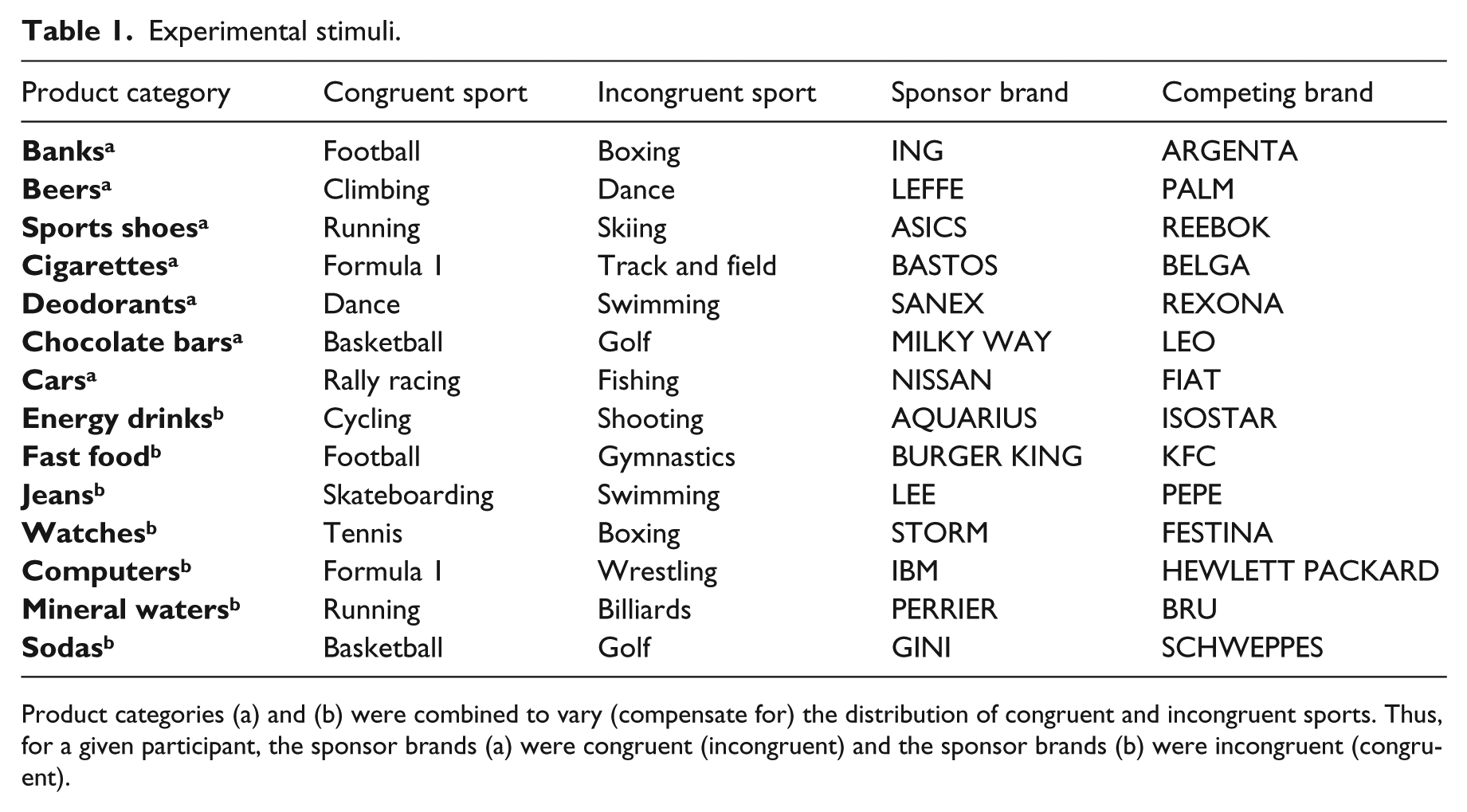
Product categories (a) and (b) were combined to vary (compensate for) the distribution of congruent and incongruent sports. Thus, for a given participant, the sponsor brands (a) were congruent (incongruent) and the sponsor brands (b) were incongruent (congruent).
We collected a second data set to confirm the level of congruence of the associations between the selected sports and product categories. We used a global congruence measurement with an item from Speed and Thompson’s (2000) scale. Twenty-five students from the same population indicated on a seven-point Likert scale the degree to which each sport selected and the corresponding product category fit well together (e.g. ‘to what extent do a swimming competition and a brand of jeans go well together’). All congruent associations have significantly higher scores than incongruent associations (Table 2) and all congruent associations have a score higher than 4 (pmin = 0.10 for the difference between 4 and the score for the association of cigarettes and formula 1 racing) and incongruent associations have a score lower than 4 (pmin = 0.07 for the difference between 4 and the score for the association of sports shoes and skiing).
Global congruence scores in the pre-test.
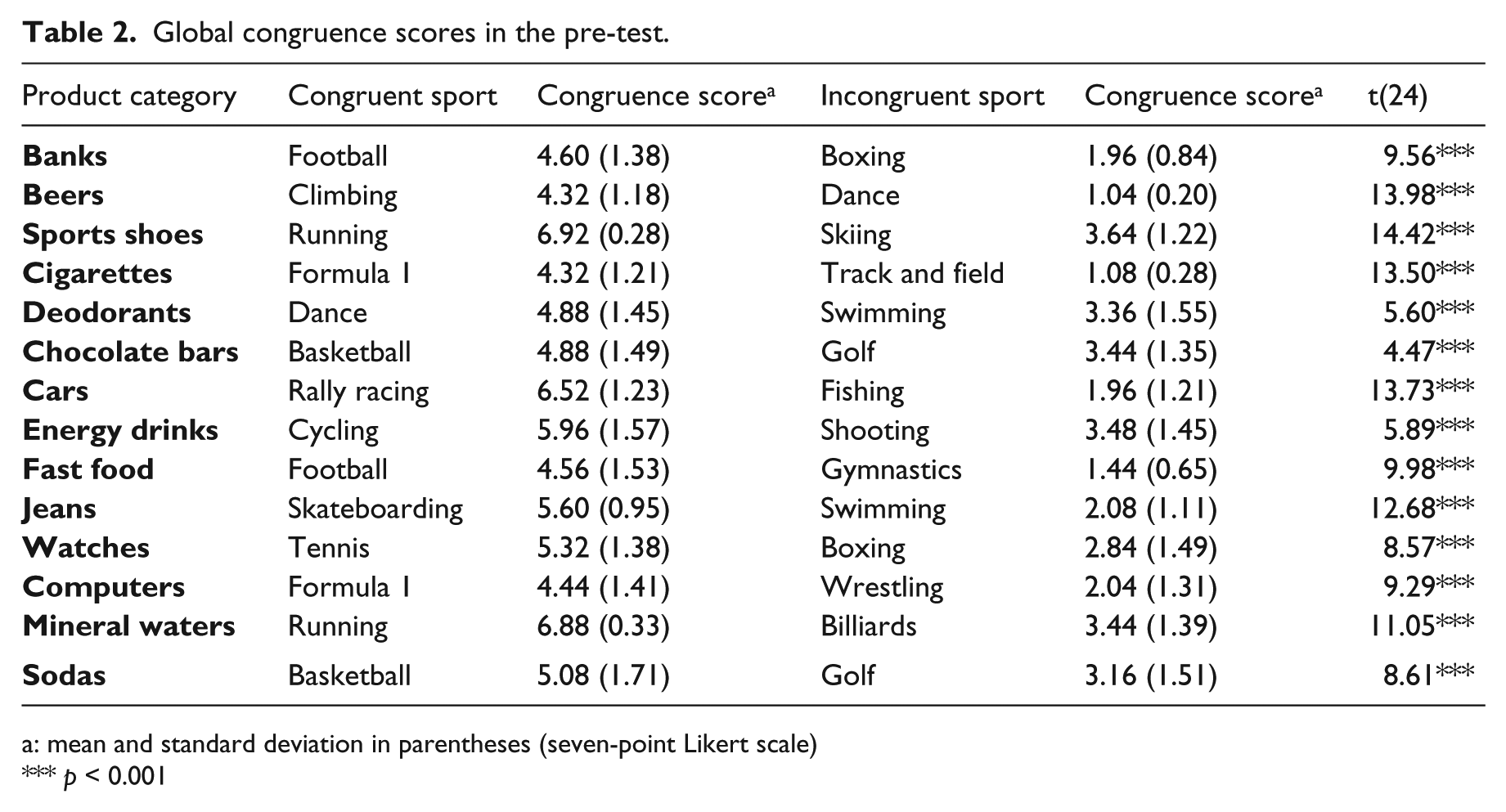
: mean and standard deviation in parentheses (seven-point Likert scale)
p < 0.001
Main experiment
231 students (126 male) from the same population as the pre-test took part in this experiment in exchange for course credits. The average age of the sample was 19.6 years. The experiment was conducted in groups of no more than eight people in a room reserved for this purpose (i.e. physical separation of each workstation). The participants were told they were going to take part in several short independent studies and the first of these concerned sponsorship. They were going to view several sponsorships of international events. After this presentation, they were to answer questions concerning these campaigns and sponsorship in general. Each participant was exposed to 23 sponsorships on a computer screen (14 target sponsorships, including 7 congruent and 7 incongruent sponsors and 9 filler sponsors). Each sponsorship was presented for 6 seconds. The participants were divided into two groups in such a way that each sponsor was associated with a congruent event for half of them and with an incongruent event for the other half (Table 1). For example, half of the participants were exposed to the Aquarius brand of energy drinks as a sponsor for the European Shotgun Championships (incongruent sponsorship) while the other half was exposed to the same brand, but as a sponsor of a cycling event: the British National Time Trial Championships, (congruent sponsorship). The sponsored events were all real international events. The filler sponsors were cities or regions (e.g. the city of Paris as sponsor of the Prix d’Amérique harness race). The sponsorships were presented on a computer screen using action shots of sports taken at each event. In keeping with the pre-test, and in order to encourage participants to use product category in their assessment of congruence, the name of the product category was cited alongside each sponsor’s brand. Thus the name of the sponsor’s brand and the product category were displayed above each photo (font: Arial bold, size 24, capital letters for the brand and lower case letters for the product category e.g. LEFFE beer) and the name of the event was displayed below the photo (font: Arial bold, size 18, lowercase letters). In order to increase sponsorship credibility, several photos showed the sponsor’s name on signs on the site of the event (Appendix 1).
To manipulate level of opportunity to process the sponsorship during encoding we varied the level of cognitive resources available. We told half of the participants that another aim of the experiment was to study their ability to perform several tasks at once. We asked these subjects to keep an eight-digit figure in mind during the entire duration of the presentation (Gilbert and Hixon, 1991). When the presentation of the sponsors was finished, the subjects were asked to provide the number they had memorized. They were informed that both tasks were equally important.
After exposure to the sponsorship, the subjects responded to several questions. The first goal was to have them believe that the study about sponsorship was finished after these questions. The second goal was to measure involvement toward sports in general using the six-item scale developed by Strazzieri (1994). Indeed, involvement can influence sponsor memorization in a positive (Lardinoit and Derbaix, 2001) or negative (Walliser, 1996) way. The other questions only served as fillers and did not refer to the exposure phase. Then the participants performed another distraction task for 10 minutes, which consisted in calculating sums as quickly as possible, the aim being to erase their short-term memory.
The next phase consisted in measuring implicit memory. This task was introduced as a test of a new measure of brand awareness. These measures consisted in identifying brands that were displayed very briefly (40 ms) in the centre of the screen. The participants were simply asked to write down the name of the brand they thought they saw on the screen. The brands were preceded and followed by a line of hash signs (##########) (Jacoby and Dallas, 1981). The fonts were the same as those used during the sponsorship exposure phase. Participants had to identify 67 brands, including the 14 target brands (seven congruent and seven incongruent). The first 18 brands allowed the participants to practice the exercise. The other brands were divided into seven random blocks in such a way that each one included five filler brand and two target brands (one congruent and one incongruent). Within a single block the two target brands were never presented in consecutive order. Brands were presented in a random manner and the filler brands did not belong to the same product categories as the target brands. The significant number of filler brands served to diminish the risk of participants making the connection between this measure and the sponsorship exposure phase. Half of the participants performed a task that consisted in identifying the sponsors’ brands presented in the sponsorship exposure phase (measure of perceptual implicit memory). The other half performed a task that consisted in identifying the competitors’ brands within the same product category (conceptual implicit memory). The proportion of congruent and incongruent target brands correctly identified served as dependent measurements.
Then the participants indicated their familiarity with the sponsor brands. Familiarity with the sponsor brand was measured using a single-item scale with seven levels ranging from ‘not at all’ to ‘very’ familiar.
Finally the subjects filled out a questionnaire whose aim was to ascertain whether they had guessed the objectives of the study and, above all, to identify respondents who had noticed a link between the sponsorship exposure phase and the brand identification task. This funnel questionnaire included the recommendations of Bowers and Schacter (1990), which aim to check the subjects’ awareness.
Results
Four participants in the condition of low opportunity to process the sponsor could not provide the eight-digit number they were supposed to memorize (i.e. they made more than two errors when trying to write it). They were eliminated from the analysis, 6 which is therefore conducted with 227 subjects. A principal components analysis confirms the one-dimensional structure of the scale for sustained involvement in sports (minimum observed communality of 0.699). A confirmatory factor analysis using maximum likelihood shows the satisfactory character of this scale (all t values are greater than 2). Finally its reliability is good (α = 0.93).
We also evaluated the reliability of measures of implicit memory using the Kuder-Richardson 20 coefficient (KR20) 7 . For the two groups of seven sponsor brands, the KR20 is 0.51 and 0.54. For the two groups of seven competing brands, the KR20 is 0.67 and 0.53. While these reliability levels may seem low, they are significantly higher than reliability scores for implicit memory obtained in previous studies and are comparable to those for traditional measures of recognition (Buchner and Wippich, 2000). Furthermore, this type of implicit measure is one of the most reliable measures of implicit memory (Buchner and Wippich, 2000).
During the tests of implicit memory, the participants must not be aware of the link between the test and exposure phases. After analysing answers to the post-experiment questionnaire, 111 subjects (49%) were qualified as unaware of the link between the different phases in the study. This figure may seem low, but the fact that the questionnaire was administered after measuring familiarity with the target brands is very conservative. Indeed, when these measures were taken the subjects could have realized that the target brands were displayed several times during the different tasks and therefore, at that point, notice a link between these tasks. 8 The analyses are therefore performed with these 111 subjects. However, we will also indicate and comment on the results for the entire sample.
In order to test our hypotheses several analyses of covariance (ANCOVA) were performed: 2 (available cognitive resources during encoding: high vs. low) × 2 (measures of implicit memory: identification of sponsor brands – perceptual implicit measure – vs. identification of competing brands – conceptual implicit measure –) × 2 (sponsor presentation group 9 ) × 2 (brand categories: congruent vs. incongruent) were performed on the transformed proportions of correctly identified target brands. Following the recommendations of Cohen (1988, pp.180–182) we transformed these proportions using the function 2 x arcsine (square root (proportion)). 10 Brand category is a within-subject factor. Sustained involvement regarding sports was used as a covariate in these analyses. 11
In order to evaluate the nomological validity of the implicit measures, we studied the influence of the level of cognitive resources on the two brand identification measures. As a measure of perceptual implicit memory, identification of sponsor brands should not be influenced by a reduction in cognitive resources while, as a measure of conceptual implicit memory, identification of the sponsor’s competitors should be negatively influenced (Mulligan 1997, 1998). Interaction between the level of cognitive resources and the type of measure is indeed (marginally) significant (F (1, 102) = 2.96; p = 0.09). We therefore compared the simple effects of level of cognitive resources for the two identification measures. As expected, the level of cognitive resources does not influence identification of the sponsors’ brands (F (1, 102) = 0.19; p = 0.66) whereas it does influence identification of competitors’ brands (F (1, 102) = 5.81; p = 0.02) in such a way that conceptual implicit memory is greater when opportunity to process the message is high (M = 0.418 12 ) than when it is low (M = 0.326) (Figure 1).

Influence of the level of available cognitive resources on identification of sponsor brands and competing brands.
Interaction between the brand category and the type of measure is significant (F (1, 102) = 6.24; p = 0.01). It is therefore legitimate to study the simple effects of congruence for both measures of implicit memory (Page et al., 2003). For identification of the sponsor brands, we observe a main effect of congruence (F (1, 103) 13 = 9.65; p < 0.01) such as incongruent sponsors are more easily identified (M = 0.534) than congruent ones (M = 0.435). This remains the case when available cognitive resources are low (F (1, 103) = 7.35; p < 0.01) and also when they are high (F (1, 103) = 2.75; p = 0.05). 14 Moreover, we do not observe an interaction between level of cognitive resources and brand category (F (1, 103) = 0.59; p = 0.445) (Figure 2). Hypothesis H1, which stipulated that perceptual implicit memory (identification of sponsor brands) is greater for incongruent sponsors than for congruent ones, whatever the level of opportunity to process the sponsorship, is therefore supported.
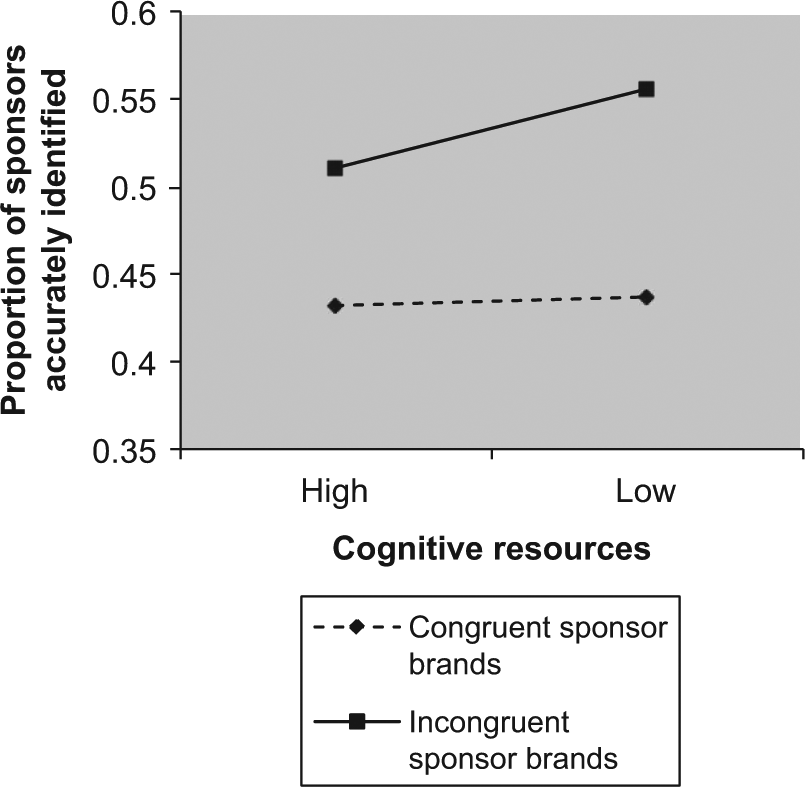
Identification of congruent and incongruent sponsor brands.
For identification of competing brands (conceptual implicit measure), we do not observe a main effect of the factor ‘brand category’ (F (1, 103) = 0.03; p = 0.86) and there is a significant interaction between brand category and level of available cognitive resources (F (1, 103) = 8.18; p < 0.01), in such a way that when cognitive resources are high, identification of competing brands is better for incongruent brands (M = 0.436) than for congruent ones (M = 0.399) (F (1, 103) = 3.60; p = 0.03) 15 and when cognitive resources are low, identification of competing brands is better for congruent brands (M = 0.335) than for incongruent ones (M = 0.318) (F (1, 103) = 5.30; p = 0.01) 16 (Figure 3). Hypotheses H2 and H3 are therefore supported.
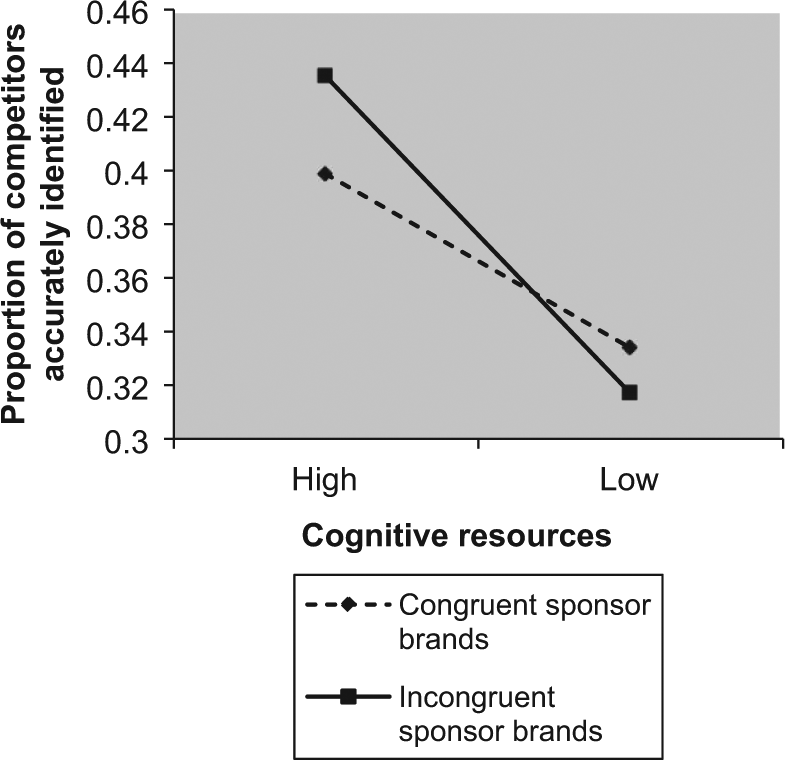
Identification of brands competing with congruent and incongruent sponsor brands.
It is also interesting to note that hypotheses H1 and H3 are also supported when the analyses are conducted using all of the participants (n = 227). The previous results also remain valid when we add a new factor to the ANCOVA model corresponding to awareness, or not, of the link between exposure to sponsorships and the brand identification task. Nevertheless, awareness of the link between these two parts of the experiment interacts with the type of measurement (F (1, 210) = 7.10; p = 0.01), in such a way that awareness increases identification of sponsor brands (F (1, 210) = 5.27, p = 0.02) but has no influence on identification of competing brands (F (1, 210) = 2.53; p = 0.11). This suggests that some participants who had to identify sponsors’ brands and who were aware of the link between phases in the experiment, intentionally tried to recall the sponsors’ brands they were exposed to initially. This strategy was somewhat detrimental (but not significantly so) when it came to identifying competitors’ brands. However, similar results between aware and unaware participants suggest that, like the participants who were unaware of the link, the vast majority of those who were aware did not deliberately try to recall information from the exposure phase (Richardson-Klavehn et al., 1994).
Discussion
Results and managerial implications
This study re-examined the influence of congruence between the sponsor and sponsored entity on sponsor memorization by using an encoding flexibility perspective (Sherman et al., 1998). We have confirmed the moderating role of level of opportunity to process the message, which has already been suggested by other researchers (e.g. Fleck and Maille, 2010), while controlling for methodological biases with implicit measures of memory. In particular, these measures were used to avoid reliance on a congruence heuristic, a heuristic that strongly biases measures of sponsor recall and recognition (Johar and Pham, 1999; Johar et al., 2006). We have distinguished between perceptual and conceptual encoding by taking into consideration, on the one hand, perceptual implicit memorization, which is based solely on the encoding of the physical properties of the stimulus, and, on the other hand, conceptual implicit memorization, based on the encoding of the meaning of the stimulus. The measures selected were identification tasks of brands presented very briefly on a computer screen in a context devoid of any references to sponsorship. The measure of perceptual implicit memory of a sponsor’s brand consisted in identifying the brand in question, while the measure of conceptual implicit memory consisted in identifying a competitor’s brand.
Four results stand out as particularly important. First, we found that perceptual implicit memorization is greater for incongruent sponsors than for congruent ones. This means that the physical characteristics of the sponsor’s name or logo are more effectively encoded. More specifically, our results show that incongruent sponsors benefit from an advantage during a brand identification test. For the sponsor, choosing an incongruent event can therefore be a viable strategy if the main objective is increasing brand identification. This objective can be vital for a lesser known sponsor and for when its products are selected from among a large number of physically present alternatives such as products sold in supermarkets. Indeed, consumers identify and select brands with greater ease after encoding their physical details (Alba et al., 1991; Ferraro et al., 2009; Lee 2002). It therefore seems relevant for a brand of lubricant such as Castrol to sponsor the FIFA World Cup. Moreover, the effect of sponsorship on brand identification does not depend on the level of opportunity to process sponsorships. This is particularly remarkable as the level of opportunity to process sponsor brands during an event is typically very low (d’Ydewalle and Tamsin, 1993).
Second, our results show that when the level of opportunity to process sponsors during an event is low, incongruent sponsorships make identification of competing brands more difficult. Conversely, when the level of opportunity to process sponsorships is high, identification of incongruent competitors’ brands is easier than those of congruent competitors. Nevertheless, as processing of sponsorships during an event is often minimal, these results also suggest that it may be relevant for sponsors to opt for less congruent events. The competitors of less congruent brands are less easily noticed when choices are stimuli based and are more difficult to recall during memory-based choices (when the different alternatives are not physically present at the moment the selection is made; Lee, 2002). Moreover, these results are consistent with those of Herrmann et al. (2011b) obtained in a real exposure situation during a tennis tournament. These researchers showed that when spectators are exposed to an incongruent sponsor’s brand, but are not aware of this, they are less likely to select the brand’s competitors among all the choices under consideration (a measure of implicit memorization) than spectators who are not exposed.
We should note that for less congruent brands sold in supermarkets, the interest of other, complementary, advertising campaigns in addition to sponsorship should be seriously assessed. Campaigns leveraging the sponsorship not only increase explicit memorization of the sponsor but also perceived congruence (Cornwell et al., 2006; Simmons and Becker-Olsen, 2006). Hence, they reduce perceptual encoding of the sponsor and increase the chance of identifying competing brands.
Third, our results show that brand identification does not depend on awareness of the link between sponsorship exposure and the identification task. Therefore consumers do not need to remember that a brand sponsored an event in order to be influenced by the sponsorship (see also Herrmann et al., 2011a, 2011b). Given the very low rate of memorization concerning the link between sponsor brands and events (Johar and Pham, 1999), this should reassure sponsors.
Finally, these results represent an initial empirical validation of the encoding flexibility model in the context of consumer behaviour. This model had already been validated for encoding schemas in social psychology (Sherman et al., 2004; Sherman et al., 1998) and is among the models that question theories based on a cognitive miser system such as the schematic filtering model (e.g. Taylor and Crocker, 1981). In particular, this model suggests that consumers seek to maximize the amount of information gained according to the cognitive resources at their disposal. These results are consistent with research in neuroscience on the arbitrage between stability and plasticity of cognition (e.g. Johnston and Hawley, 1994).
Relationship between past and present results
Our findings seem to contradict some existing results that indicate that a strong congruence between a sponsor’s brand and an event improves sponsorship efficiency (e.g. Cornwell et al., 2006; Simmons and Becker-Olsen, 2006). Several arguments can explain these apparent contradictions. First, our research concerns only sponsor memorization and not other cognitive, emotional or conative objectives. Compared to less congruent sponsors, congruent ones seem, for example, to benefit from a better transfer of affect between the event and the brand (e.g. Gwinner and Eaton, 1999). It would nevertheless be interesting to assess this transfer of affect using implicit measures.
Second, our research is one of the rare studies on the effectiveness of sponsorship to use implicit measures of memory that are less sensitive to constructive processes than measures of recall and recognition (for two notable exceptions see Herrmann et al., 2011a, 2011b). In particular, explicit measures of memory are strongly biased in favour of congruent sponsors (Johar and Pham, 1999). The use of strategic decision processes in previous studies can thus explain certain disparities between our results and previous findings.
Third, our results concerning conceptual implicit memorization (i.e. identifying competitors) are consistent with existing findings that show an advantage in terms of spontaneous awareness for congruent sponsors when opportunity to process sponsors is low during encoding (e.g. Rodgers, 2004). These findings are consistent with predictions of the associative network model of memory and can be explained by better conceptual encoding of congruent brands compared to less congruent ones. Indeed, recall is a measure of memory that relies on conceptual processes (Richardson-Klavehn and Bjork, 1988; Roediger, 1990). Identifying competitors is also a conceptual task because exposure to a sponsorship can only favour identification of competitors if an association in the individual’s memory between the sponsor’s brand and its competitors has been activated before. Our findings show that when the level of opportunity to process sponsors during exposure is low (high), identifying competitors, and therefore conceptual encoding, is better (worse) for congruent sponsors than for incongruent ones. In prior studies it seems that measures of sponsor recall were influenced in a similar way by opportunity to process information. In a field study regarding sponsorship of baseball games, Wakefield et al. (2007) found that for top-tier sponsors recall does not depend on the level of congruence while for second- and third-tier sponsors, recall is greater for incongruent sponsors. Spectators have a much higher level of opportunity to process top-tier sponsors who are present around the playing field than tier 2 and 3 sponsors only present on the façade or backstage areas of the stadium. These results are therefore consistent with the moderating effect of level of opportunity to process sponsorships during encoding in our study.
Limitations and future research
The limitations of the experiment presented here represent opportunities for future research. It would, for instance, be interesting to study the effect of a more significant period of time between exposure to sponsors and the test phase. We used a timeframe of 10 minutes, combined with a cognitive interference task. An anchoring point for this research could be the fact that the effects of previous exposure on perceptual identification can be observed after a period of several months (Sloman et al., 1988).
Furthermore, in this study congruence is principally based on perceived fit between a sport featured in an event and the sponsor’s product category. The characteristics the event and sponsor have in common are not, however, limited to these two dimensions (Simmons and Becker-Olsen, 2006). Swatch brand wristwatches can, for example, be perceived as congruent with the World Snowboard Tour because the event has the same personality traits as the brand i.e. youth and trendiness. This study used overall congruence based on the assessment of judges during a pre-test. In future studies it could be possible to consider different dimensions of congruence. One example is the distinction between expectations (i.e. the degree to which the sponsorship falls within a predetermined schema) and relevance (i.e. the degree to which the sponsorship makes sense) (Fleck and Maille, 2010; Fleck and Quester, 2007; Heckler and Childers, 1992). In our study congruence encompassed these two dimensions 17 and neither our experiment, nor our theoretical framework, allowed a distinction between their relative influences. For example, it would be interesting to compare perceptual and conceptual encoding of an unexpected but relevant sponsorship with one that is also unexpected but not relevant.
Our methodological setting only presented one sponsorship at a time and thus several sponsorships did not vie for the spectator’s attention. In real life many sponsors are present at an event and it would be interesting to conduct a study in such a context. The encoding flexibility model predicts that, when opportunity to process sponsors is low, this context should be particularly detrimental for perceptual encoding of congruent sponsors. Indeed, in our experiment the participants could devote the same amount of attention to congruent and incongruent sponsors. However, when sponsors are competing for attention, incongruent sponsorships should attract more attention (Sherman et al., 2004). Spectators should devote very little attention to congruent sponsors; just enough to reactivate existing links in memory between the brand, product category and type of event.
Finally, it is important to emphasize that good conceptual implicit memorization does not necessarily have negative consequences. Good conceptual encoding of a sponsor can activate links between the sponsor and the product category in memory, or between the sponsor and product usage, and this can positively influence sponsor evaluation (Lee and Labroo, 2004). Thus, instead of choosing a measure of competitor identification, we could have selected a measure of sponsor product category identification. Our choice can be explained by our main objective, which was to demonstrate that lack of congruence (even strong incongruence) between a sponsor and an event can sometimes be advantageous, at least when the goals pursued involve memorization (see also Herrmann et al., 2011b; Rodgers and Bae, 2005). Future research should explore whether it is possible to find positive effects as a result of an absence of congruence for other communication objectives. The theoretical framework developed by Fleck and Maille (2010) and Maille and Fleck (2011) seems promising in this respect.
Footnotes
Appendix 1
Example of a photo used to present the events.
Acknowledgements
The authors would like to thank Sonia Capelli, Nathalie Fleck, David Gotteland, Shanker Krishnan, Marc Mazodier, Daniel Ray and Carolina Werle for their comments on the previous versions of this article and/or their valuable advice.