







Abstract
The practice of social marketing is based on a set of underlying principles that have not yet been tested. In the future, a series of experiments will be necessary to bring the application of social marketing to its peak. This article outlines an action plan for research in social marketing in order to push its limits.
Initial definitions of social marketing were focused on the notion that ideas could be promoted (e.g. Kotler and Zaltman, 1971). Today our understanding of social marketing has expanded and we now understand the main focus of social marketing is on the broad application of a wide range of well-known marketing tools and techniques (i.e. delivery of a full marketing mix) to foster social change (Wymer, 2011). In 2015, social marketing is widely recognized as a credible behavior change discipline with governments across the globe acknowledging the importance of social marketing as a discipline that can change behaviours for the better.
A consensus definition (see www.i-socialmarketing.org/assets/social_marketing_definition.pdf) of social marketing was reached in October 2013 between peak social marketing bodies across the globe, namely the International Social Marketing Association (ISMA), European Social Marketing Association (ESMA) and the Australian Association of Social Marketing (AASM). The consensus definition states that ‘social marketing seeks to develop and integrate marketing concepts with other approaches to influence behaviours that benefit individuals and communities for the greater social good’.
Over the past 40 years as the discipline of social marketing has grown and evolved a range of frameworks outlining the series of activities that constitute social marketing have been put forward (examples include Andreasen, 2002; French and Blair-Stevens, 2005; Lefebvre and Flora, 1988; Robinson-Maynard et al., 2013; Walsh et al., 1993). None of the social marketing frameworks proposed have been empirically validated. Recent systematic literature evidence of social marketing interventions indicates the majority of social marketing interventions do not adopt social marketing to its full extent (for example see Carins and Rundle-Thiele, 2014; Kubacki et al., 2015). Moreover, empirical evidence arising from a recent systematic review of healthy eating interventions (see Carins and Rundle-Thiele, 2014) suggests that social marketing interventions employing more of the six social marketing benchmark criteria proposed by Andreasen (2002) are more likely to change the targeted behavior. Taken together, previous studies indicate there is a possibility that social marketing may be operating under false assumptions and perhaps, more importantly, by empirically examining the assumptions underlying social marketing there may be room to increase the efficacy of social marketing interventions by understanding what works (and what does not).
Advancing the social marketing knowledge base
The characteristics of social marketing have been defined most notably by Andreasen (2002) when he set down six benchmark criteria, stating that social marketing must have:
Behaviour change as the objective.
Audience research to understand audiences during design, pretesting and monitoring.
Audience segmentation to ensure maximum efficiency and effectiveness.
The creation of attractive and motivational exchanges with target audiences.
A marketing mix (not just advertising or communications).
An awareness of the competition faced by the desired behaviour.
Andreasen’s (2002) criteria, when first penned, aimed to give social marketing a clear structure, to distinguish it from other approaches (e.g. public health), and to help propel social marketing into another phase of development. As outlined by Carins and Rundle-Thiele (2014) Andreasen’s (2002) six criteria act as a check that an intervention has a consumer focus, as each criteria redirects the focus back to the goals of both the program sponsor and the consumers the intervention seeks to influence – a behavioural objective reminds social marketers that their goal is to change behaviour, not just educate or inform. Additionally, audience segmentation requires clear thoughts about who the efforts are aimed toward while formative research helps ensure an understanding of the consumer and orientation of the intervention toward them. Next, creating an exchange requires consideration of what has to be given up by the target audience in order for them to undertake the desired behaviour while the marketing mix pushes social marketers to present holistic solutions that are attractive and valuable, assisting to induce both trial and repeat behaviour. Finally, consideration of the competition gives a cognizance of the competing pressures faced by consumers (many of which are far more appealing than the behaviour social marketers are attempting to change) and how social marketers might be instrumental in reducing some of those pressures in favour of the behaviour they are trying to influence.
Others have articulated similar aspects or elements of social marketing (LeFebvre and Flora, 1988; Walsh et al., 1993) which have great similarity but different emphasis on consumer orientation and evaluation. French and Blair-Stevens (2005) adapted Andreasen’s (2002) criteria in order to set down national guidelines in the UK. Their social marketing benchmarks extend to a total of eight benchmark criteria offering two additional benchmark criteria for social marketers to adopt. Figure 1 sourced from Carins (2012) illustrates the various criteria, indicating areas of common understanding.
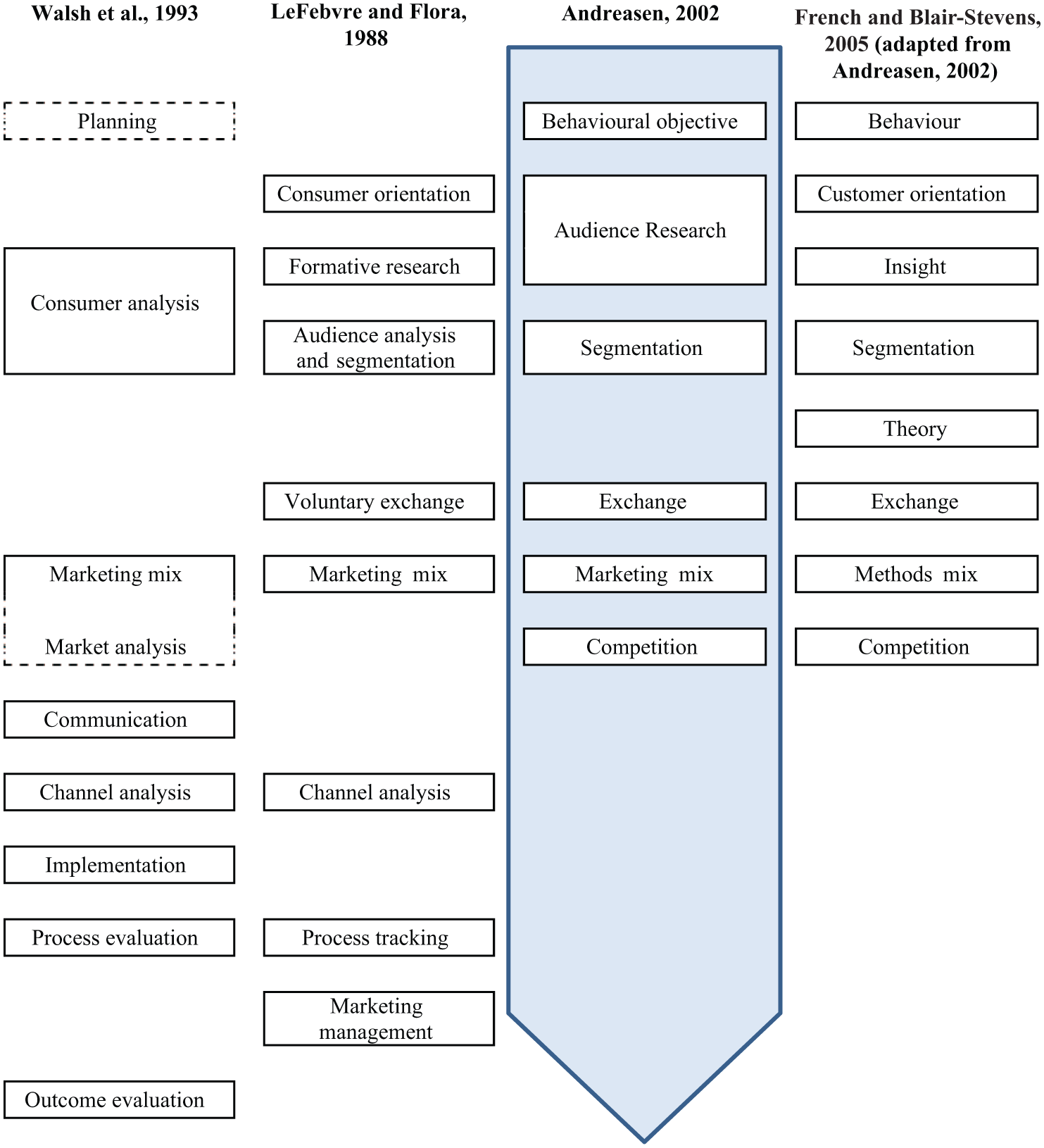
Characteristics of social marketing.
As outlined by Carins (2012) each of the four social marketing frameworks displayed in Figure 1 indicates an involved and considered process, with a clear orientation towards the target audience. There is also a consistent focus on having a marketing mix, or mix of strategies within the intervention, clearly distinguishing social marketing from social advertising. It is important to note that the two earlier frameworks reflect the early focus of social marketing, which suggested that marketing can be used to promote products and ideas that can benefit the society as a whole (Andreasen, 1994). Today, this is commonly recognized as social advertising. Process management and evaluation feature heavily in the first two frameworks, whereas Andreasen (2002) discusses the importance of evaluation, and the challenges associated with evaluation. However, evaluation is not included in Andreasen’s (2002) framework. French and Blair-Stevens (2005) also stress the criticality of planning, review and evaluation but consider evaluation or planning and review as universally important to all interventions, while the social marketing benchmark criteria proposed are distinguishing features of social marketing. Certainly evaluation is vital for funding bodies and governments to determine whether interventions are successful, and calculations of return on investment (ROI) are clearly necessary to demonstrate the case for continued support of programs (Lee, 2011). Inclusion of evaluation in social marketing benchmark criteria may be warranted in future and the inclusion or not can be empirically evaluated through analysis of the current evidence base. Finally, French and Blair-Stevens (2005) suggest that social marketing is more effective when theory is implemented suggesting that Andreasen’s (2002) social marketing benchmark criteria may be improved with the addition of a seventh or eighth criteria, namely theory use. Understanding whether additional criteria should be included or not in social marketing frameworks can be empirically evaluated following the procedures employed in Carins and Rundle-Thiele (2014). Evaluations of the current evidence base offer considerable opportunities for future research in the field of social marketing that are capable of guiding and informing future practice.
Taken together, early frameworks were put forward at a time when social marketing was largely considered as idea promotion while later benchmark criteria focus on social marketing as an agent to change behaviour for the better.
Close examination of Andreasen’s (2002) and French and Blair-Stevens (2005) indicate that Andreasen’s six criteria offer the strongest starting point for empirical examination as the framework offers mutually exclusive benchmark criteria. Two categories (consumer orientation and insight) in the French and Blair-Stevens (2005) social benchmark criteria are not mutually exclusive, thereby not meeting criteria needed for classification (Fern and Brown, 1984). Therefore, Andreasen’s (2002) six social marketing benchmark criteria are proposed as a first means to advance understanding of the successes, failures and limitations of social marketing benchmark criteria. Following the procedure employed in Carins and Rundle-Thiele (2014) systematic literature reviews can be undertaken by researchers to look backwards. Systematic reviews of the evidence base formed over 40 years permit us to understand the extent that Andreasen’s six benchmark criteria have (or have not) been used in social marketing interventions to identify which social marketing benchmark criteria contribute (or not) towards program effectiveness. By looking back at studies undertaken, systematic literature reviews reveal the extent that social marketing benchmark criteria have been employed to date. A review of social marketing interventions encouraging healthy eating suggest that the use of between one and three benchmark criteria were dominant (Carins and Rundle-Thiele, 2014) while the Kubacki et al. (2015) review identified that on average three out of six social marketing benchmark criteria were used in social marketing programs seeking to change behaviour in children aged 12 years and under.
Moving forward: Is social marketing operating under false assumptions?
As outlined earlier, frameworks outlining the series of activities that constitute social marketing are available, (examples include Andreasen, 2002; French and Blair-Stevens, 2005; LeFebvre and Flora, 1988; Walsh et al., 1993) yet none have been empirically validated. Social marketing practitioners adopt benchmark criteria assuming these are validated and that collectively the criteria contribute to program success. To date, studies have not been undertaken to examine whether the application of a unique benchmark criteria enhances program effectiveness.
One of the six benchmark criteria, namely segmentation, will be used to outline how social marketing assumptions can be empirically examined. One key social marketing benchmark criterion (Andreasen, 2002; French and Blair-Stevens, 2005), segmentation, is proposed as a means to ensure maximum efficiency and effectiveness for social marketing programs (Donovan and Henley, 2010, Lefebvre, 2013). Market segmentation techniques help decision makers strategically define target consumer groups and subsequently direct the available resources to the most promising segments (Elliot et al. 2014). According to the segmentation assumption, theoretically social marketers should deliver tailored interventions to different segments thereby catering to different audience needs and wants. Taken together, this would generally mean that different segments (as identified in segmentation studies) will require different intervention designs (target marketing). A rigorous segmentation study process identifies homogenous subgroups within a target audience and it provides insights for the different strategies and approaches to reach and motivate each target group (Kotler, 1980).
Consider programs targeting alcohol delivered in school settings where the notion of segmentation remains largely untested and unexplored (Mathijssen et al., 2012; Moss et al., 2009). Alcohol programs delivered in school settings are either delivered as a one-size-fits-all approach (one program to all students) or one program is developed that aims to change the behaviour of the group most at risk (Botvin and Griffin, 2007). Alcohol programs in school settings are not alone. A recent literature review (Kubacki et al. (2015)) indicates that only two out of 23 interventions targeting children aged 12 years and under adopted segmentation. Segmentation studies based on multiple segmentation factors, namely psychographics, demographics, geography and behavior, could identify homogenous sub-groups in the target population. If different segments differing in motivations, needs, wants and behaviours are identified, social marketing theory states that a different intervention design tailored to each segment may enhance effectiveness of the intervention (Donovan and Henley, 2010). This assumption needs to be empirically tested and validated in a broad range of contexts. An important first step involves understanding whether segments respond differently to social marketing programs (see Dietrich et al. (2015) who examine segment differences). To test the assumption that use of segmentation to identify unique groups and subsequent catering to group differences can deliver better outcomes an experimental design is needed. An experimental design would examine whether targeted programs that are differentially designed to meet the needs and wants of identified segments deliver more change than one program delivered to the target population.
Segmentation is not the only social benchmark criteria that needs to be empirically tested and evaluated. A series of studies is needed to examine whether each individual criteria proposed by Andreasen (2002) contributes to (or limits) intervention success. For example, studies are needed to evaluate the assumption that exchange is needed to underpin social marketing effectiveness. For example, an experimental design can be used to examine whether a program that delivers exchange to its target audience (Rothschild et al. 2006 offers a clear example of exchange – delivering a limousine service for a fee to prevent drink driving) delivers superior change outcomes to a program that does not offer an opportunity for tangible exchange as occurred in Rothschild et al. (2006). Further opportunities exist to examine whether social marketing programs designed to deliver a full marketing mix (a clear example of full marketing mix is once again outlined in Rothschild et al. 2006) are more effective than information only or social advertising programs (examples of programs that deliver one marketing P only include Atlantis et al., 2008; Croker et al., 2012). Similar opportunities exist for the remaining three social marketing benchmark criteria.
Research seeking to understanding how behaviour change can be maximized serves to directly benefit our community in two ways. First, direct changes will be observed in people participating in the programs that are being evaluated by researchers (Rundle-Thiele et al. 2013). Secondly, extensive testing of underlying assumptions of social marketing will enable improvements to social marketing practice over time. Improvements to social marketing practice that occur over time enable both practitioners and researchers to extend the degree that social marketing programs can change behaviour based on empirical evidence of what works (and what does not).