






Abstract
This research aims at understanding the role of market offers constructing a stigmatised identity for consumers with disabilities; it further underlines the conditions under which these consumers may manage this stigma effectively. After a literature review focused on stigmatised identity construction through a symbolic interactionist perspective, the authors describe a qualitative study carried out with motor-disabled consumers. The results illustrate how both standard offers and those specially designed for the motor disabled lead to a dead end that contributes to stigmata construction. They also point out how these consumers manage to develop other identities.
In summary, from my own experience and research and the work of others I have found that the four most far-reaching changes in the consciousness of the disabled are: lower self-esteem; the invasion and occupation of thought by physical deficits; a strong undercurrent of anger and the acquisition of a new, total, and undesirable identity.
The French law of 11 February 2005, ‘for the equality of rights and opportunity, participation and citizenship of the disabled’, was intended to render all establishments open to the public accessible from 1 January 2015. This implies that all consumers, whether disabled or not, should have access to the same diversity of choice. Individuals’ real and potential freedom to choose among several alternatives is qualified as ‘capability’ by Sen (2012) who makes it a central condition of well-being.
According to this approach, individuals could be disadvantaged if they have fewer choices or fewer possibilities to do things to which they attribute value (Sen, 2012: 284). This lack of capabilities may result from the lack of financial means, because invalidity reduces the possibilities of making a (good) living (‘earning handicap’ according to Sen, 2012). It may also come from the difficulty of transforming financial resources into freedom of action or choice (‘conversion handicap’ according to Sen, 2012). In fact, a disabled person needs a higher income (because of expenses related to aid, treatment, modifications of equipment, etc.) to achieve a freedom of action equivalent to that of a person who is not disabled. This observation implies looking at social justice in terms of freedom of action rather than financial resources, because equivalent financial resources do not necessarily provide the same freedom of action.
The stream of research devoted to vulnerable consumers has raised the above questions of consumers’ well-being and freedom of action. Although not making use of Sen (2012), this research also focuses on the loss of autonomy resulting from an unsuitable market offer (Baker et al., 2005). Disabled persons, especially the visually impaired, have been the subject of several studies (Baker, 2006; Baker et al., 2001, 2002; Baker and Kaufman-Scarborough, 2001; Childers and Kaufman-Scarborough, 2009; Kaufman-Scarborough, 1999, 2000; Mason and Pavia, 2006). These studies suffer from several limitations. They are often highly descriptive and rely little on theoretical frameworks (e.g. Kaufman-Scarborough, 1999). They have frequently been carried out in reaction to an American law encouraging accessibility to public spaces (Americans with Disabilities Act), which leads them, with the exception of Mason and Pavia (2006), to focus only on the purchasing process. They thus neglect the actual use of goods and services in an everyday context. Indeed, although these studies recognise the necessity of going beyond the simple question of accessibility, they fail to question the tensions resulting from either ‘standard’ offers or from offers created specifically for the disabled. Finally, although Peñaloza (1995) and Baker et al. (2005) consider that vulnerability results from a combination of factors, their research tends to analyse the behaviour of these consumers only through the prism of disability, thus neglecting their other characteristics. Financial resources are notably little taken into account, even though the ‘earning handicap’ and ‘conversion handicap’ resulting from physical disability (Sen, 2012) mean that such resources play a cardinal role in access to capabilities for the motor disabled.
Sen (2012) and other studies on vulnerability (Baker et al., 2005) deal with the impact of disability on well-being through these consumers’ reduced autonomy. Such viewpoints, however, fail to take account of the ways in which actually being faced with the offer leads in itself to the construction of a stigmatised identity that will also weigh heavily on these consumers’ well-being.
Our study seeks to go beyond these limits by using case studies of persons with motor disability, a population so far little considered by both marketing practitioners and researchers. Among the articles mentioned above, only that of Kaufman-Scarborough (1999) focuses specifically on this population. The fact that a great number of individuals are concerned implies that these consumers should be better taken into account both by marketing and by researchers (Gardou, 2012; Vignier et al., 2007).
Our research is rooted in the interpretive approach that specifies that knowledge can only be attained from informants through an emic approach (De Sardan, 1998) in other words, by considering the researcher as a co-participant. Our research falls within the scope of studying consumers’ identity construction (Arnould and Thompson, 2005). More generally, although consuming has been studied as a means to get closer to a desired identity (Firat and Venkatesh, 1995), the marketing literature has dealt very little with identity tensions that might appear (Bannister and Hogg, 2004; Hirschman, 1992; Odou and Bonnin, 2014; Üstüner and Holt, 2007). The literature on stigma raises these questions, but the attributes studied often seem easy to conceal (Adkins and Ozanne, 2005; Argo and Main, 2008; Henry and Caldwell, 2006; Kozinets, 2001; Sandikci and Ger, 2010; Tiercelin, 2013) unlike the unconcealable stigma related to motor disability rendered even more evident by wheelchair use.
This research thus aims to understand the role played by the offer of goods/services in the process of stigmatised identity construction and the conditions under which stigmatised individuals may manage their stigma effectively by being able to develop other facets of their identity. More specifically, we wish to show the dead-end situation resulting from the current market offer – whether this be a standard offer or one specially adapted for the motor disabled – and how individuals might find an escape from this stigmatised identity.
Construction of stigmatised identities and consumption
In this first subsection, we adopt a symbolic interactionist approach to identity. This perspective submits identity to others’ approval, thereby granting social interactions pride of place. This results in rendering identity construction particularly difficult for stigma-bearing consumers. In a second subsection, we deal with studies on stigma and then proceed to a third section where we detail the links between consumption and stigmatised identities.
Identity seen through the lens of symbolic interactionism
Various research traditions have focused on ‘identity’ as illustrated by the use of different expressions (‘identity’, ‘me’, ‘self’) in broadly equivalent ways (Kaufmann, 2004). However today, the existentialist approach is the subject of a relative consensus (Dubar, 2010). This approach conceives of identity as the result of a process of identity construction, as opposed to an essentialist approach that tends to reify identity as existing ‘in itself’.
In this study, we adopt a symbolic interactionist approach to identity in line with the work of Cooley (1902) then Mead (1934). The research from this school considers that actors act according to the meaning they attribute to things and that these meanings are built up through interactions (Nizet and Rigaux, 2005). According to this view, ‘the social world does not pre-exist like a structure that one has to adapt to; it is constantly being created and recreated by interactions through mutual interpretations that result in actors adjusting to each other’ (Le Breton, 2012: 6). The authors associated with this perspective are notable for their microsociological approach that gives an important place to fieldwork and informants’ own words.
According to the symbolic interactionist view, identities thus appear as constructed and negotiated with the environment during social interactions on the basis of individual and collective identity markers (Kaufmann, 2004). One’s identity ‘for the self’ is constructed in interaction with one’s identity ‘for the other’ (Goffman, 1975), making people mutually vulnerable. This therefore implies saving one’s own ‘face’ (in the sense of not losing face according to the rule known as ‘self-esteem’) while still saving the face of the other. Therefore, saving the face of both parties relies on setting up and respecting norms of interaction that limit the risk of embarrassment. It also implies managing and mastering the impressions that will be produced in the other (impression management) through various means that expose the individual to the other (speech, posture, behaviour, clothing, etc.). Goffman (1974) calls the set of material or symbolic resources that enable an individual to save face ‘ceremonial grounds of selfhood’.
The interactionist perspective, especially Goffman’s, 2 subjects identity to the approval of others and highlights the importance of norms of interaction. It implies that individuals with a stigmatised attribute will find it difficult to construct an identity.
Stigma
Goffman (1975) defines stigma as a marker that disqualifies the individual and prevents him/her from being completely accepted by society. The state induced by stigma leaves all other social roles in suspension, the stigma becomes the focus of all the stigmatised person’s thoughts and thus the most important component defining the individual. A great many stigmas have been studied, among them are mental illnesses (Phelan et al., 2000), urinary incontinence (Sheldon and Caldwell, 1994) or even the job of strip teaser (Lewis, 1998). After a review of this varied literature, Link and Phelan (2001) propose updating the concept according to the following four criteria:
Distinguishing and labelling a difference. Among the numerous differences that exist among humans, only some are socially prominent. The word ‘label’ is preferred to ‘attribute’ by these authors to underline its socially constructed nature.
A link between this labelling and undesirable representations. This dimension of stigma has been present since the works of Goffman (1975), and it is particularly emphasised in psychology research that seeks to understand the process of categorisation and stereotype association and their influence on judgement.
An identity separation leading to a distinction between ‘us’ and ‘them’. This dimension is found particularly in interaction with the other elements of the stigmatisation process. Indeed, attributing undesirable beliefs to stigmatised individuals helps to make them into ‘others’, to separate them on the level of identity, and this in turn facilitates the attribution of stereotypes. This identity-based dimension of stigma can be illustrated by the use of the verb ‘to be’ rather than ‘to have’ (‘he has a cold’ but ‘he is schizophrenic’).
A loss of status and a discrimination that affect interactions and lead to inequality. Stigmatised individuals tend to see their status lowered in more or less explicit ways. Various discriminations can be mentioned: individual, on the basis of beliefs or structural because institutionalised or materialised.
In a way that cuts across these different criteria, the existence of a stigma implies a situation of lack of power that usually translates into discrimination in terms of access to social, economic and political spheres. From a symbolic interactionist perspective, a stigmatised individual constructs his/her identity by positioning himself/herself vis-a-vis the negative representations conveyed by the social environment. The stigmatised individual may interiorise these representations either by adopting behaviour that conforms to the image projected by the social environment or on the contrary, by seeking to dissociate himself/herself from them (Dubar, 2010). A frontier is thus drawn between individuals qualified by Goffman (1975) as ‘discredited’ (whose stigma cannot be hidden, for example, by wheelchair users) and ‘discreditable’ (whose stigma can be concealed, for example, the deaf). Since they are necessarily identified as stigmatised, discredited individuals will have fewer opportunities to distance themselves from the representations projected by their social environment. On the other hand, ‘discreditable’ individuals are able to enter into interactions where they are not categorised as ‘stigmatised’, and thus they may stand back from the representations associated with their stigma.
Beyond the representations it conveys, stigma entails tensions through the denial of the normative expectations on which social interactions rely (Goffman, 1975). This uncertainty as to suitable behaviour causes embarrassment and endangers the ‘face’ of all involved. These tensions are likely to vary according to contexts and individuals. They appear especially during ‘mixed contacts’ or when stigmatised individuals and ‘normal’ people, unfamiliar with the stigma, share the same social situation. When faced with such situations, ‘discreditable’ individuals can develop techniques to hide the stigma, while ‘discredited’ individuals have to learn to face the awkwardness that is generated.
Consumption and the development of stigmatised identities
The links between identity and consumption have long and often been studied in marketing using different approaches that contribute to the ‘fragmented, incoherent and diffuse’ nature of this research (Sirgy, 1982: 287). These enquiries continue to be the subject of research, especially regarding consumers’ identity projects in Consumer Culture Theory (Arnould and Thompson, 2005). Despite the diversity of research, consumption tends to be studied only from a positive angle (Hogg and Michell, 1996) as an enabling factor for reaching a desired identity (Marion, 2003; Schouten, 1991) or as a means to reconcile multiple identities (Fabricant and Gould, 1993). In fact, although the eventuality of an undesired extended self has been left open by Belk (1988), the literature has scarcely tackled the tensions between consumption and identity. The few studies undertaken focus on matters of congruence between product and self-concept (Bannister and Hogg, 2004), on drivers of addictive/compulsive behaviours (Hirschman, 1992), on labelling of a behaviour considered as deviant (Garcia-Bardidia and Nau, 2012; Odou and Bonnin, 2014), on consumers out of synch with the values and codes of a dominant culture (Üstüner and Holt, 2007) or on the adoption of life styles as an expression of opposition (Holt, 1997). These tensions between consumption and identity have also been studied regarding the matter of stigmata, as shown in Table 1.
Summary of main studies on stigmatisation and consumer behaviour.
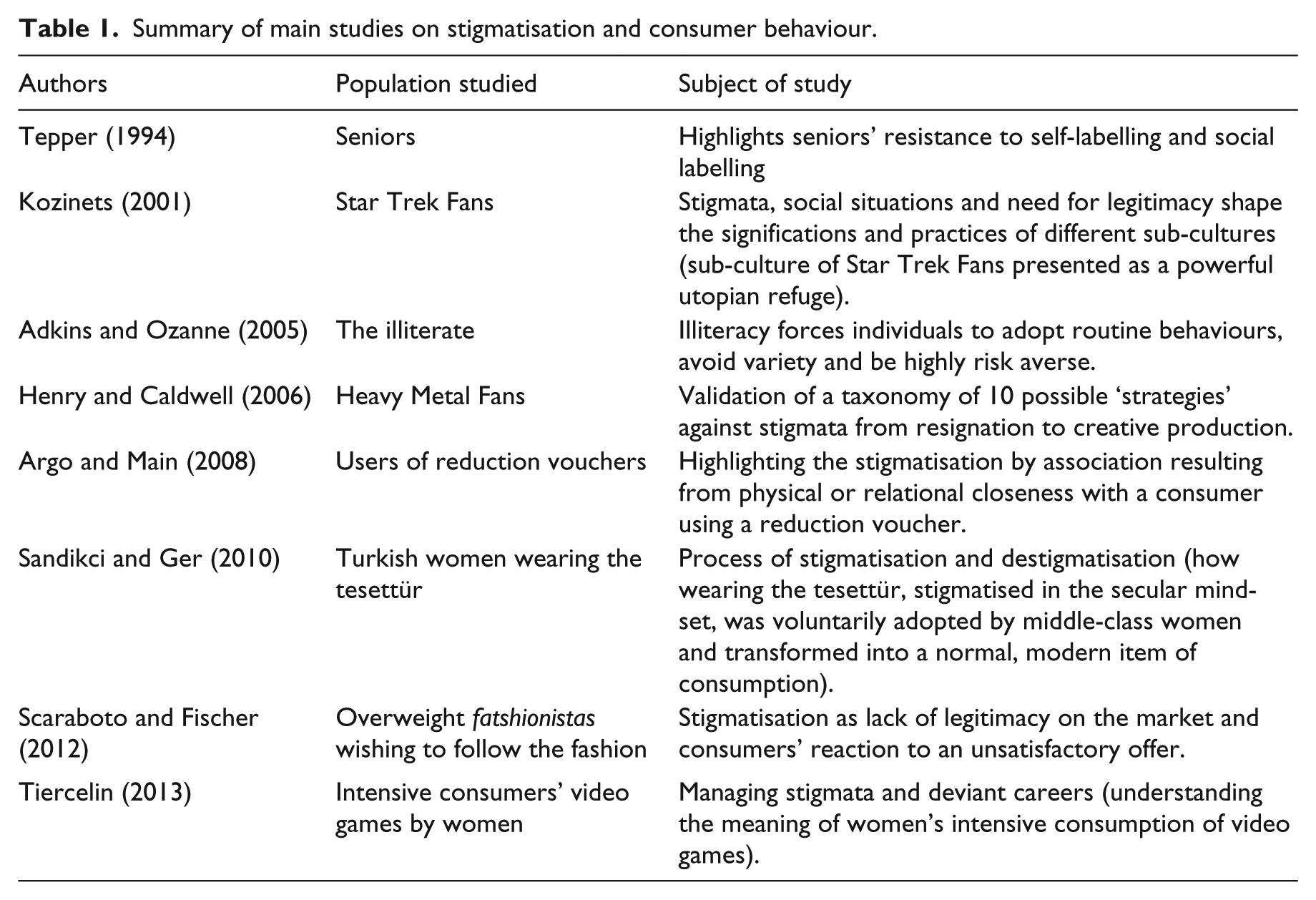
Even if all these studies cite Goffman (1975), they sometimes move away from him in terms of discipline and methodology, relying mainly on the literature of psychology and experimental protocols (Argo and Main, 2008; Tepper, 1994). Other research remains more in line with Goffman, emphasising the strategies for managing stigma (Adkins and Ozanne, 2005; Henry and Caldwell, 2006). These studies have contributed to the emergence of three types of response: accepting stigma, renegotiating its meaning or rejecting it. Adkins and Ozanne (2005) identify three locations for stigma management: the environment, the self and others. These echo Goffman’s (1973a) theatrical metaphor that considers interactions to take place in a decor where individuals play a role in front of an audience.
Research on stigma in consumer behaviour either focuses on how people manage stigma at an individual level (Adkins and Ozanne, 2005; Henry and Caldwell, 2006; Tepper, 1994) or it explores more macrosocial processes that result in destigmatisation (Sandikci and Ger, 2010; Scaraboto and Fischer, 2012). Research on stigma construction is less frequent. Sandikci and Ger (2010) take a historical and macrosocial perspective but existing research provides few elements as to how the market offer and marketing contribute to constructing stigma. Furthermore, the above studies are mainly about individuals whose stigma is easily concealed – ‘discreditable’ in Goffman’s (1975) terms – whereas the impact of the stigmatised attribute is likely to be stronger when it is hard to conceal. Our research proposes to use an interactionist approach focusing on motor disability and aims to fill these blind spots by studying the construction and management of an unconcealable stigma. Our perspective is microsocial, that is, it focuses on the individual in interaction (Rigaux, 2012).
Here, we examine how the market offer and marketing contribute to constructing the stigma of ‘discredited’ individuals and how these contribute to conveying an undesired identity through social interactions. We also aim to identify the conditions under which individuals may escape from this stigmatised identity.
Methodology
Establishing a protocol of data collection to explore the consumption of the motor disabled necessitates limiting the population to be studied, since the notion of motor disability covers a very wide range. On 11 February 2005, French law defined disability as follows:
According to the present law, disability includes any restriction of activity or participation in social life suffered by individuals in their environment because of a substantial, durable or definitive alteration of one or several physical, sensory, mental, cognitive or psychological functions, a multidisability or a health problem resulting in disability.
In view of the large number of different situations covered by this notion, we chose to carry out our research on motor-disabled consumers who use wheelchairs either permanently or occasionally. This situation corresponds to a corporal stigma that is visible and hard to conceal, producing ‘discredited’ individuals (Goffman, 1975).
This research adopts a comprehensive perspective in the sense of Kaufmann (2007). This view postulates that individuals are active producers of the social and in this sense, understanding the person is a tool for understanding the social. This position is illustrated here through our choice of a qualitative study carried out through semi-structured interviews involving a dynamic where ‘the interviewer engages actively with the questions so as to provoke the engagement of the interviewee’ (Kaufmann, 2007: 19). The objective is to trigger a dynamic of conversation rather than one of mechanical response to questions.
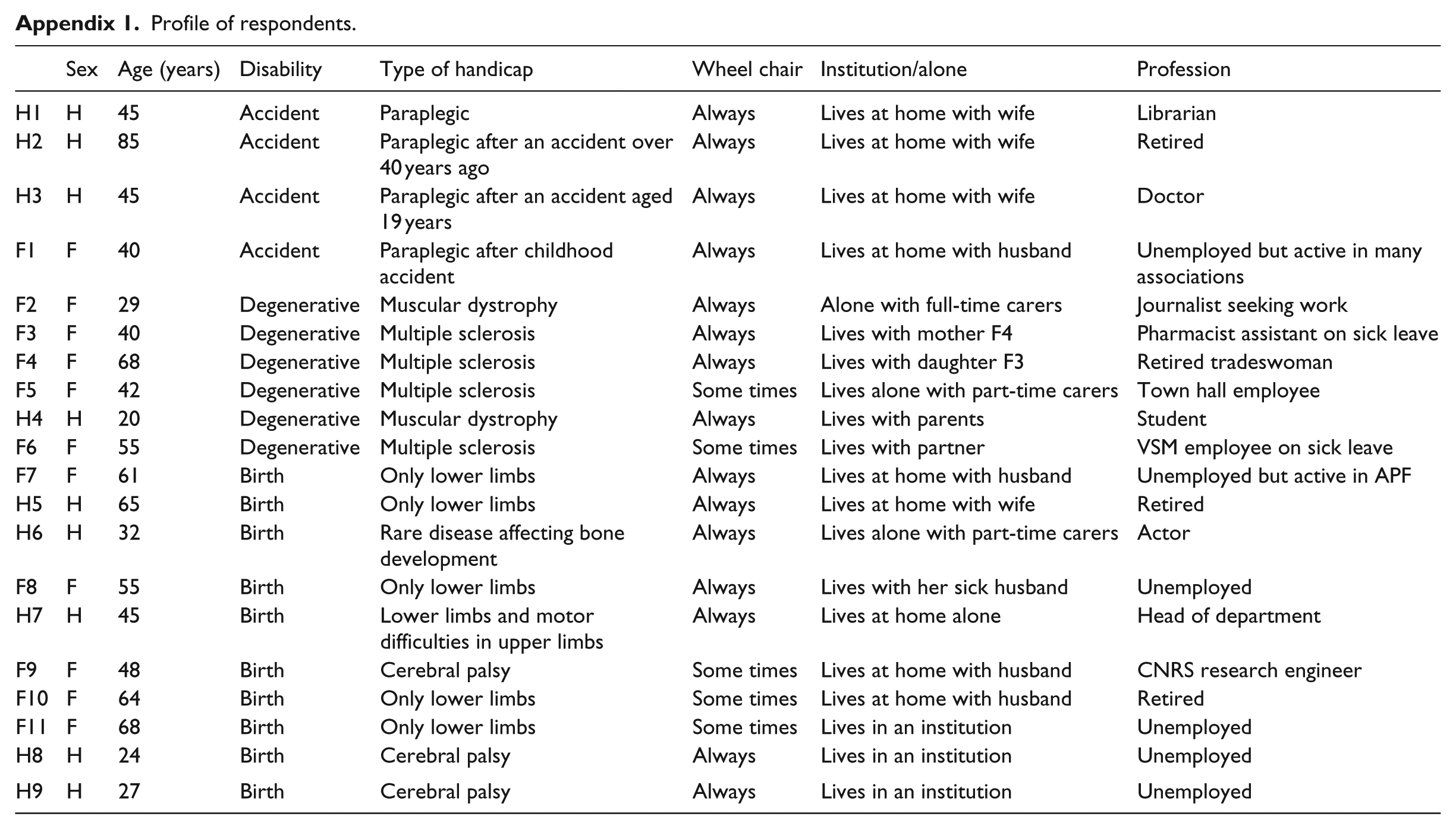
We therefore interviewed 20 motor-disabled individuals whom we contacted through various associations, professionals who work with this public (ergotherapists, doctors, physiotherapists, etc.) and our own networks. We were careful to vary the profiles by diversifying the categories of age (from 19 to 85 years), sex (9 men and 11 women), socio-professional categories (unemployed, doctor, pensioner, employee, actor, student) and also the types of disability: since birth (muscular dystrophy, myopathy) or following an accident (motor neuron disease, paraplegic) (cf. list of profiles in Appendix 1).
The interviews were based on an informal guide covering four main themes: accessibility, appropriation of products, interpersonal relations (sales personnel, clients, service providers) and resources available (economic, social and cultural capital) for each individual. In line with the comprehensive approach, plenty of time was devoted to actively listening to respondents and trying to understand their value system, operational categories and particular characteristics in order to guide the interview.
The stigmatised nature of the interview subject sometimes made it difficult to trigger the conversational dynamic. In this sense, we took time for unrecorded informal discussion whenever necessary and possible, often with a coffee and/or a cigarette. After this, the exchange generally began with descriptive and predictable questions in order to create a comfort zone so that subsequently, more unexpected and intimate themes could be explored. When contradictions were noticed, they were mentioned in order to provoke thought and show up mechanisms or conflicting social roles, in line with Kaufmann’s (2007) recommendations.
Interviews lasted an average of 55 minutes and were undertaken whenever possible at respondents’ homes. After each interview, notes were taken immediately so that the co-authors could share first impressions and advance their ideas collaboratively. The interviews were then entirely transcribed for deeper analysis through the prism of the symbolic interactionist approach. Other sources of data were also used in order to become familiar with the field and for triangulation purposes. To this end, we made observations and took notes while participating in association activities related to motor disability. We also carried out interviews with experts from the Association des Paralysés de France 3 (the national consultant for accessibility, head of regional department and legal director of the association) and the Vice President of Alteo, a Belgian association active in the domain of motor disability who herself uses a wheelchair to get around. A watch was also set up around a specialised magazine edited by the Association des Paralysés de France (Faire Face), as well as on various individual or institutional Internet sites.
Regarding data analysis, several readings were carried out by each of the authors. These resulted in constructing thematic units of meaning. The data were coded independently by the three authors going from the most descriptive to the most interpretative, from the most concrete to the most abstract and from ‘experience-near’ to ‘experience-distant’ (Geertz, 1973). The three authors discussed their interpretations in order to reach a consensus of reliability through convergence and/or complementarity. Our research can also be appreciated with regard to the criteria of Lincoln and Guba (1985) or Denzin and Lincoln (1994). Credibility was respected through triangulation among researchers, their regular interaction in the field and their prolonged commitment to the study. Integrity was ensured as far as possible by the climate of confidence during meetings and Saturation was shown by ensuring that the iterations between collecting and analysing data did not contribute more than one piece of already-known information. As for transferability, we ‘brought it up’ by examining certain points (only certain points, because the studies had different objectives) where there were some similarities between our research and that carried out in a neighbouring country. 4
Results
After showing how the market offer contributes to constructing stigma for the motor disabled, we now focus on how individuals’ own resources can facilitate stigma management.
A standard offer or ‘adapted’ offer: Two sources of stigma construction
Link and Phelan’s (2001) elements for defining stigma (socially visible characteristic, attribution of undesirable representations, identity separation, discrimination and loss of status) can be identified in informants’ consumption-related discourse. Although all these dimensions are interrelated, some of them appear more salient in certain situations. A standard offer (i.e. one not designed specifically for the motor disabled) in fact contributes to making the disability more socially visible through discrimination affecting the status of these consumers. The segmentation of the offer resulting in products and services deemed ‘adapted’ also contributes to the construction of identity separation and conveys undesirable representations. Consuming both these types of offers thus contributes to stigma construction and highlights the dilemma facing the motor disabled.
A standard offer that renders the disability visible and affects the consumer’s status
Disability studies traditionally oppose an individual model that sees disability as an individual characteristic, to a social model that sees disability as constructed by interactions with an unsuitable environment. (Baïdak, 2007). Our data in the French context clearly support this social model regarding consumption. Thus, the norms and standards of commercial premises, products and services often turn out to be unsuitable, in reality they confine individuals within a ‘disabled’ situation that renders their stigma socially visible.
As already illustrated by Kaufman (1995) and Kaufman-Scarborough (1999) in the American context, these problems appear recurrently in interviews regarding matters of accessibility that are omnipresent in all sectors (supermarkets, cultural venues, banks, travel, transport, medical care, etc.) and at all levels (steps, kerbs, shelves, cash desks, freezers, car parks, etc.). These difficulties can make the practicality of a consumption venue a central criterion of deciding to use it (Burnett, 1996) and be a source of loyalty (Burnett and Baker, 2001). For example, a cinema with steps precludes the motor disabled from certain screens and contributes to highlighting the visibility of their stigma:
I’ve got lots of friends [in wheelchairs] for example at the Cameo [cinema], they can’t go because there isn’t a lift […] you only have access to the ground floor screens, the guys don’t let you in … (H1)
The environment also contributes to creating a situation of disability and making it socially visible in the home. F4 can no longer get around without her wheelchair because her multiple sclerosis is at a more advanced stage than that of her daughter F3 who also suffers from this disability. The standards in terms of furniture and home layout contribute to making it extremely difficult for F4 to visit another of her daughters, Fédérique, and also makes certain interactions there impossible:
F4: When I sleep at Frédérique’s, there have to be two of you to get me out of bed. F3: Because I have a sister who still lives in Epinal, it’s true in fact we go there … F3 and F4: less and less … F3: because mum doesn’t have a hospital bed […] they did put in toilets on the ground floor, that’s good but there’s a piece of furniture in there, so it’s too narrow for the wheelchair […] so there have to be two of us to lift her up. […] To go to my sister’s, I mean, it’s a whole expedition, they have one of those island things in the kitchen … well for mum, the table comes up to here [too high]. So she can’t eat with us.
These standards thus exclude the motor disabled. They also result in highlighting stigma visibility and contribute to countering the ‘civil inattention’ (Goffman, 1973b) in force in public areas. The face of those interacting may thus be endangered by a situation in which the norms of interaction are not clear. Thus, a feeling of embarrassment occurs when F1 finds it difficult to get into her car. Without wishing to do so, she attracts the attention of passers-by who in turn do not know if it is appropriate to offer help:
Well, cars go by and well, anyway, you can’t afford to be too proud because I do struggle a bit when I get out of the car and there are people who see me, and when they see that I’m having a hard time, it’s not easy for them either, so well, I do it with a smile, but …. (F1)
Besides highlighting the visibility of stigma, the standard offer entails discrimination that does not allow the motor disabled full access to the status of ‘consumer’. Objectively, this can translate into a lower quality of service and on a more subjective level into a feeling of exclusion. Thus, F2 does not have access to the same flexibility as other consumers when taking the train:
For the SNCF … [French national railways] you have to arrive in advance so that they have time to get me up there, otherwise they refuse if you’re not there 30 minutes early … […] with the train there’s not much room for spontaneity … […] when you go on holiday, in any case you plan it, but if one day I want to go to Metz or Strasbourg and I want to take the train, well then it’s incredibly complicated. (F2)
Faced with an unsuitable standard offer, disabled consumers often find themselves obliged to delegate their purchasing acts and this in turn leads to the disappearance of whole facets of their status as consumers. The experiential dimensions of shopping as well as the capacity to choose are also clearly diminished and contribute to the experience of vulnerability defined as a loss of control (Baker et al., 2005) illustrated in the following verbatim:
I make a shopping list […] And they’re the ones [the carers] who buy my … you know, sometimes I’d like to go and have a look err … is there are things that interest me […] No, so it’s a bit of a problem for me […] those carers don’t really know my taste. (F8)
Home services that are part of a ‘standard’ offer in the sense that they have not been specially developed for the disabled can in certain cases be an alternative as Burnett (1996) found in a quantitative survey made in the United States. If some respondents are satisfied with this offer (H9) and see it as a way of recovering their full consumer status, others perceive these services as yet another source of exclusion (F3):
For everyday shopping, I’ve solved the problem because more or less like everyone else, I either use home delivery systems or I order by Internet and because I’m fortunate enough to have a car, I go to the drive part of these places and they load it directly into the car, so there you are. (H9) [The hairdresser] is going to come home – And is this a good solution for you ? For me no, because it used to get me out to go to the hairdresser and see something other than these four walls, so there you are. It’s true, we used to chat, there were other clients, but now she’s going to come to the house so that will be one less opportunity to get out. (F3)
An ‘adapted’ offer that contributes to developing negative representations and identity separation
Various adaptations in the form of special arrangements or offers suited to the motor disabled exist. In general, they are relatively satisfactory on a functional level, but they are often perceived as contributing to a categorisation that assigns the motor disabled to an identity of ‘disabled’ and thus conveys undesirable representations.
The desire to cater for all potential consumers or the accessibility constraints of the 2005 law have led to adapting spaces for disabled consumers. Although functionally speaking, these are perceived positively, and they result in categorising the motor disabled as ‘mobility-challenged individuals’ and as such assigning them to the identity of ‘disabled’. These specific spaces result in dissociating individuals from their family and associating them instead with strangers who share their motor disability. (F1) This distribution of space materialises a separation of identity that leads to a feeling of relegation as illustrated by the verbatim below from F3 and F4:
Cinemas have special places; for example, there are three. So there are three of us, next to each other even if we don’t know each other. There is only one who can be next to the ordinary seats on the side, so there is only one who can see the film together with his family. (F1) F3: At the concert, we were parked, literally parked, yes, that’s it; F4: we really feel the difference; F3: then we felt behind; F4: parked there so everyone has to look at you.
Adaptations can also be the opportunity to objectify the undesirable representations associated to stigma. Various criticisms have thus been levelled against the expression ‘mobility-challenged individuals’ that suggests a homogeneous population (Saillant and Fougeyrollas, 2007) as well as a certain passiveness or against the spaces that suggest individuals’ sexlessness (toilets for the motor disabled that are mixed or situated in the women’s toilets).
5
The interviews highlight the tensions around these representations when the motor disabled escape from the roles they have implicitly been assigned:
I’m an actor, with a friend, and most of the stages are not accessible, they are much too high and all that, and the law, on the other hand, even if it did a good job by making theatres accessible to the audience, didn’t think of doing it for the actors, in fact, so it’s more or less implied that the disabled are just onlookers of their life. (H7)
The paramedical sector, omnipresent in the lives of the motor disabled, is often presented as specific. Here, besides the already mentioned feeling of loss of status, the individual may be assigned to the identity of ‘patient’ and to a separation of identity between expert and layman (Akrich and Rabeharisoa, 2012). The respondents regret not being treated like full consumers as the following verbatim illustrates,
They are incapable of being in the slightest adaptable … being sales people in fact … we are considered as patients […] it’s an area [the paramedical sector] where strangely enough, we would like to be more consumers, be able to say what suits us and that at the top of the little paramedical company, they don’t necessarily know what we are looking. […] an ergotherapist … if I want a desk like that with an adjustable top, they’ll give me one of their things saying ‘I know what an adjustable table top is and you’re all the same you disabled people’ […] it’s obviously a question of culture being with the disabled, I mean, I don’t really know what goes on in their head, but the more disabled you are [the less they listen to what you have to say]. (F2)
The design of paramedical products often reflects a desire to be functional and sober rather than to seek aesthetic, hedonic or symbolic aspects. The materials and colours are often strongly associated with the medical domain which contributes to conveying undesirable representations and assigning the ‘patient’ identity. Furthermore, the quality of these offers is often criticised as illustrated by the H1’s verbatim:
We are a captive market: there is only one manufacturer in Europe of shower cabins with no threshold. Its just a bit of plastic and they sell it for 1000€ […] they’re laughing! […] it’s not even good plastic, it cracked after a year […]; the adapted tricycle […] they sell that already for 2000 to 3000 € and it’s worth about 500 […]; those handles to pull you up all over the house […] the thing is that it doesn’t look very nice. (H1)
Adapted offers could contribute more fully to increased autonomy on a functional level by compensating more effectively for the disability and on a symbolic level by facilitating self-expression through increased personalisation. These two developments would thus be likely to counter both the representations of dependence associated to the motor disabled and the experience of vulnerability faced by this population (Baker et al., 2005).
Stigma management that varies according to individuals’ resources and competences
The motor disabled develop different types of reactions in order to face stigma. Our microsociological approach sheds light on the place of individuals’ resources and competences in managing stigma. By resource, we mean economic, social or cultural capital, and by competence, the know-how and attitude (savoir-faire and savoir-être) the consumer develops.
Resources and competences: A necessary requirement to escape from the ‘disabled’ identity
Dubar (2010) notes that given the impossibility of having no identity, the failure to develop the desired identity results in adopting an acquired identity. In this sense, the differences in reaction seem to be linked to individuals’ assets in terms of economic, social and cultural resources and in terms of competences enabling them to break free from the stigmatised identity that they see themselves assigned.
Like other stigmatised populations (Crockett and Wallendorf, 2004), the motor disabled find themselves confronted with a ‘conversion handicap’ (Sen, 2012) when it comes to converting their resources into freedom of action, as illustrated by this verbatim:
A specially adapted vehicle, and there the cost is exorbitant. I can give you an example, erm, for example, an adapted Kia 60 000€ […] a wheelchair, well I stand up, they call me an ‘upright’, 14 000 € reimbursed 5 000€. The fact is that often, to be disabled, you almost have to be rich. (H2)
So, even if H3, a specialised doctor, declares that he has no major problem to consume, this is not the case for all consumers. Being disabled thus entails, over and above the stereotypes associated to stigma and embarrassing interactions, a more restricted access to the resources necessary for managing one’s impressions, the ‘ceremonial grounds of selfhood’ and thus limits the possibilities individuals have to choose the mask, the face they will present to others. In fact, the ‘conversion handicap’ implies that in order to have the same range of choice as a ‘non-disabled’ consumer, and thus be able to pursue the same diversity of identity projects, the motor disabled have to dispose of greater economic resources.
When one lacks sufficient means, it is possible to set up certain tactics or do-it-yourself solutions. Some motor-disabled individuals manage to construct an offer that suits them (H1) or call on their social capital (F6). Although neglected by Sen (2012), individual and social resources make it possible to compensate for a ‘conversion handicap’ or an ‘earning handicap’ as well as more generally filling gaps in the market offer. They also enable the motor disabled to counter the representations of passivity associated to disability (Ville et al., 2014) by hooking up with the positive figure of the ‘clever consumer’ (Clochard and Desjeux, 2013) who in this case knows how to overcome the market offer’s limitations:
It’s weird, I prefer a standard product that I arrange to be how I want rather than going for a specialised product that will be pseudo-adaptable and not necessarily because they haven’t understood … (H1) [I know] some of those engineers who go in for do-it-yourself […] And there, they have to re-modify my bathroom […] I have a friend who’s an engineer and his son is the same, a real brain […] ‘and anyway, an electric wheelchair, I’ll make you one, I’ll design one that’s just right, you’ll!’ that’s what he told me! […] let’s say in inverted commas that I’m a bit privileged, then to have spent some time in the world of mechanism. (F6)
If financial resources allow individuals to resort to professional help, this can nevertheless be perceived as intrusive or only capable of responding to respondents’ functional needs; expressive or hedonic needs are more difficult to formulate; for these, social capital plays a central role because it enables individuals to receive help from those with whom a trusting relationship has been built up and who know the individual intimately. Thus, the difficulties related to delegating purchases to third parties mentioned above by F8 are reduced when relatives or close friends can do the job:
No, well, then It’s a bit difficult, OK, I have my sister and my close relations … they know a bit about my taste so … they buy things for me, but when it’s the carers, they don’t know my taste. (F8)
These resources and competences can also reduce the stigmatising nature of having to ask for help:
Frankly [people’s reaction] depends on how you ask them, if you ask them complaining and aggressive, but if you are nice and polite …if you are the one who is asking […] They give of their best and then I tell myself that sometimes […]if I just need something at the supermarket or sometimes it’s a bit high, well I wait until someone comes by so I can say ‘ excuse me, please’ … even if the person might be one of those idiots, sometimes I say to myself … And finally, psychologically, I get the most out of people, it’s true. (F1)
Resources and competences thus appear to play an important role in managing stigma through different mechanisms. Financial resources enable individuals to access more capabilities through compensating for ‘conversion handicap’. Social capital provides personalised assistance that gives the consumer more freedom especially in terms of self-expression and adapting the offer. Individuals’ competences also facilitate stigma management. Thus, know-how enables them to personalise a non-adapted offer or attitude helps to build up widespread social capital. These different resources and competences offer individuals more freedom of action and expression. This facilitates the development of other facets of identity suited to each person’s identity projects rather than being assigned the ‘disabled’ identity. Thus, H8 can represent himself as a clever do-it-yourselfer, H6 and F1 as artists or even H2 as a person of action associations and politics.
Resources and competences constructed during personal history
An individual’s resources and competences appear to be marked by their personal history. The duration of the disability seems to have a variety of influences. A congenital disability may lead to the development of know-how that can facilitate life for the motor disabled. However, it is also likely to block processes of socialisation and training that foster access to social and economic resources facilitating the development of other identity facets. Thus, H7 was able to start training as a doctor before his accident; this enables him today to possess two doctorates, a comfortable income and the status of specialist doctor:
There are totally different profiles, there are people who are into their disability … having a disability leads to totally different situations … there are people who before they were … the disability gives them a place in society, it gives them a status. The disabled, finally that gives them. An identity? yeah, yeah […] I realise that I’m lucky … you know, that I, in inverted commas, was lucky to have my accident … I had just finished my second year of medicine, so I had already got over that stage … So I could do the job that I wanted and the speciality that I wanted in the right conditions … I have an income that is, in fact, nothing like that of other disabled people … so now I if I was paralysed in all my limbs in an electric wheelchair with 800 euros a month, I wouldn’t be speaking like this […] I am a medical doctor and a doctor in science. (H7)
For the oldest respondents, these life histories are marked by prolonged stays in institutions that probably encouraged socialisation around the identity of their disability. This scenario is characteristic of a fraction of our sample (F8, F10, F11 and H5) who are fairly lacking in resources and socially isolated and find a form of comfort in the activities specially organised for motor-disabled persons.
It thus appears that virtuous – or on the contrary vicious – circles can be set in place and that individuals’ life histories enable us to understand their capacity for stigma management at least as much as the degree of their disability. Possessing resources facilitates the development of alternative facets of identity to that of ‘disabled’. This overcoming of stigma in turn encourages the development of resources that enable individuals to attach themselves to other identities. F1 thus developed cultural resources through writing, and this enabled her to develop social resources, all of this being facilitated by the presence of economic resources. More generally, the whole of the interview as well as the inside of the home bear witness to the importance of the ‘artistic’ facet of the informant who runs theatre workshops, writes and exhibits sculptures:
And so I set up in Nancy and there I met people because since I always wrote when I was in the hospital, I didn’t go to school, but I wrote, I did poetry contests, and one thing and another. […] I was free as well because financially, I could do it, […] and I did have the disabled adult allowance but not any more because I got compensation so then I was renting a place, I never had a fancy lifestyle but it was quite comfortable just the same. (F1)
Conclusion and implications of the research
Our results show how the offer and consumption of standard products and services or those designed specifically for the motor disabled contribute, each in its own way, to constructing stigma and setting these consumers against a dilemma. Stigma thus translates into blocking the motor disabled into a ‘disabled’ identity. Nevertheless, individuals are not all equal when confronted with managing their stigma: only those consumers with the most assets in terms of resources and competences are able to develop other facets of their identity. These results are summarised in Figure 1.

Process of stigmatisation of the disabled vis-a-vis standard and specially adapted offers.
Our results complete the approach of Sen (2012) by showing that over and above a restriction of capabilities that affect consumers well-being, the situation of disability leads to stigmatisation constructed just as much through ‘standard’ offers as ‘specially adapted’ offers (Link and Phelan, 2001). This assignment to a stigmatised identity can only be foiled by those consumers with the most assets in terms of resources and competences. Although this must be confirmed empirically, this process seems applicable to many other situations of disability (deafness, blindness, etc.).
On a theoretical level, this study contributes to research on stigma, on the relation between consumption and identity and on vulnerable consumers. First, our study completes the work already done on stigma. It shows how individuals’ resources and competences can influence stigma management, an aspect neglected by Goffman (1975). In marketing, the microsociological perspective enriches the research that Scaraboto and Fischer (2012) carried out on a more macrosociological scale about other consumers with non-concealable stigma. In that study, Scaraboto and Fischer (2012) use a neo-institutionalist approach to highlight the strategies set up by the movement of fatshionistas (overweight women wishing to dress fashionably), so as to be better taken into account by market suppliers. Our work provides a complementary view by showing how, on an everyday basis, consumers manage their stigma on an individual level.
Second, our results contribute to the debate about the relationship between identity and consumption (Shankar et al., 2009). They refine the post-modern hypothesis of consumption as a source of emancipation (Firat and Venkatesh, 1995) by underlining the role of resources and competences in the development of other facets of identity. The products on offer, whether they are standard or specifically adapted for this target, contribute to the assignment of a stigmatised ‘disabled’ identity from which only those consumers best equipped in resources and competences manage to free themselves. Consumers thus find themselves faced with a dead end between products that are functionally unsuitable or others that convey negative representations. The logics of segmentation appear in our research as questionable and at times contribute more in terms of stigmatisation (by objectifying representations, discriminating among consumers, etc.) than in terms of responding to these consumers’ needs. It thus appears that only those consumers the best equipped in terms of resources and competences would be able to attain the figure of new consumer presented as creative, emancipated and integrating resources (Cova and Cova, 2009).
Third, by recalling that even within a stigmatised population consumers are not all equal in terms of resources and stigma management, our work contributes to research on vulnerable consumers. In fact, although Peñaloza (1995) highlighted the multifactor nature of vulnerability, studies undertaken since in this research dynamic often reduce the individual to his/her disability, ignoring other characteristics. Not only do such studies prevent a full understanding of these consumers’ vulnerability but they also contribute to stigmatisation by restricting the individual to his/her stigmatised attribute. We should thus follow Sen (2012) and focus on capabilities, that is to say, potential and effective freedom, without forgetting that this freedom of action may be affected upstream of a ‘conversion handicap’ by an ‘earning handicap’, that is, by being under equipped in terms of resources. We should mention that although Sen’s (2012) work focuses essentially on economic resources, our study shows the capacity of other, notably social resources, to reduce these ‘conversion handicaps’. In this context, it seems important to examine intersectionality. According to this view, the individual is recognised as belonging to different social categories (e.g. disabled or not, social class, ethnic group and gender) that are likely to bring advantages and disadvantages and that are combined (Gopaldas and Fischer, 2011).
At a managerial level, this study recalls that including the motor disabled is a more complex question than is apparent from an approach merely based on accessibility. In fact, the French law of 11 February 2005 ‘for the equality of rights and opportunities, participation and citizenship of the disabled’ needs to foster setting up offers that do not only guarantee accessibility but that also guarantee the same quality of service and the absence of discrimination. The approach of universal design that seeks to put in ‘products, facilities, programmes and services that can be used by all as far as possible without needing to be adapted nor specially designed’ (High Commission of the United Nations for Human Rights, 2006 – article 2) seems to be a way for companies to be socially responsible and better respond to the needs of almost 1 person in 10 who is disabled (Gardou, 2012). Certainly, it is utopian to think that these offers could be suited to all consumers, but it is nevertheless possible to imagine integrating more varied consumer profiles during pre-tests and market studies. Handeo and the National Institute for Consumption (l’Institut National de la Consommation) test ‘standard’ market offers from this perspective (from reading lamps to micro wave ovens) on a sample of people with various disabilities to determine which product within a category is the best suited to the greatest number. Different applications have shown that it is possible to extend the number of individuals concerned by an offer without withdrawing any of the product or service’s attractive features. 6 For example, this approach was used in the domain of rail transport by Alstom in designing seats, doors, corridors and toilets. These particular designs correspond as much to someone in a wheelchair as to the elderly or someone using a push chair or any other apparatus. Our research also highlights needs that remain unsatisfied in symbolic, hedonic and experiential terms for the motor disabled, particularly in the paramedical field. If certain initiatives exist in this direction such as the brand U-exist that manufactures ‘fashion’ prostheses, these are little developed.
Our study suffers from several limitations that call for a programme of research on disabled consumers. On the methodological level, our wish to restrict our sample to wheelchair users inevitably raises the question of the transferability of our results. Thence, it is interesting to compare our data to those about other populations with stigma that are hard to conceal. Furthermore, the constitution of such a sample in itself entails a form of stigmatisation, for the person knows that they are being contacted ‘as’ a disabled person. Still on the methodological level, our study captures social interactions through interviews. The technique of critical incidents (Flanagan, 1954) could be used to highlight situations that respondents perceive as emblematic. It would be interesting to complete our discourse-based data by observations of interactions in an ethnomethodological perspective (Garfinkel, 1984).
On a theoretical level, this work suffers from the limits associated with Goffman’s theoretical framework by not putting enough emphasis on the socio-historical dimension of stigma (Kaufmann, 2004; Nizet and Rigaux, 2005) especially that studied by Stiker (2013). Such an approach puts forward a temporal perspective, allowing, for example, to capture how the representations associated to this stigma were constructed and how they have evolved.
For the motor disabled, this longitudinal perspective raises the question of inversing the stigma. Many stigmatised populations have managed, at least occasionally, to reverse their stigma by making it a source of pride and belonging to a sub-culture. Star-Trek fans (Kozinets, 2001) get together during conventions, Heavy Metal fans (Henry and Caldwell, 2006) have their own festivals and homosexuals have Gay Pride. Nevertheless, Disability Pride never seems to have encountered comparable success. The constitution of a collective identity necessary to increase legitimacy (Scaraboto and Fischer, 2012) can be halted by a fragmented institutional scene. At a more microsociological level, it would be interesting to identify the role played by the unconcealable nature of their stigma in the history of individuals. Concealing the stigma, even occasionally, may make it possible to avoid discrimination and thus facilitate access to resources (social, economic, etc.) that may make stigma reversal possible. In fact, if the studies carried out in the framework of disability studies have criticised the treatment of the disabled as ‘passive victims facing the interiorisation of a role’ (Ville et al., 2014), this propos should be qualified by highlighting the way in which this ‘passivity’ or ‘activity’ depend on acquiring resources and competences that facilitate (or otherwise) a biographical work (Corbin and Strauss, 1988) that can resolve identity tensions.
Our results illustrate how the material environment, through its capacity to enable and constrain consumer behaviour, leads to stigma construction. Research paths are thus open for a better recognition of the often under-estimated impact of materiality (Borgerson, 2005; Schouten et al., 2015). In particular, it would be useful to study the empowering and constraining nature (in terms of consumption) of the wheelchair by following up the work begun by Winance (2003, 2006) and Mialet (2012).
Like Argo and Main (2008), it would also be interesting to study the size of the phenomenon of stigmatisation by association, but this time in the case of the disabled. In other words, we can ask whether there exists a potential halo effect and a transfer that generates an extension of stigmatisation to people who, although without objectively having a stigma, have physical or relational closeness with stigmatised individuals.
The behaviour of consumers faced with a limited market offer has been studied in marketing at macroscopic level by Scaraboto and Fischer (2012) and Crockett and Wallendorf (2004), using the neo-institutional theory through Hirschman’s (1970) ‘Exit, Voice, Loyalty’ typology. An alternative often observed in the field, and one that very often proves essential, is creating a satisfactory offer oneself. It would be interesting to go more deeply into such do-it-yourself practices in terms of the objects created as well as the shared know-how to which they might be related.
Footnotes
Appendix
Profile of respondents.
| Sex | Age (years) | Disability | Type of handicap | Wheel chair | Institution/alone | Profession | |
|---|---|---|---|---|---|---|---|
| H1 | H | 45 | Accident | Paraplegic | Always | Lives at home with wife | Librarian |
| H2 | H | 85 | Accident | Paraplegic after an accident over 40 years ago | Always | Lives at home with wife | Retired |
| H3 | H | 45 | Accident | Paraplegic after an accident aged 19 years | Always | Lives at home with wife | Doctor |
| F1 | F | 40 | Accident | Paraplegic after childhood accident | Always | Lives at home with husband | Unemployed but active in many associations |
| F2 | F | 29 | Degenerative | Muscular dystrophy | Always | Alone with full-time carers | Journalist seeking work |
| F3 | F | 40 | Degenerative | Multiple sclerosis | Always | Lives with mother F4 | Pharmacist assistant on sick leave |
| F4 | F | 68 | Degenerative | Multiple sclerosis | Always | Lives with daughter F3 | Retired tradeswoman |
| F5 | F | 42 | Degenerative | Multiple sclerosis | Some times | Lives alone with part-time carers | Town hall employee |
| H4 | H | 20 | Degenerative | Muscular dystrophy | Always | Lives with parents | Student |
| F6 | F | 55 | Degenerative | Multiple sclerosis | Some times | Lives with partner | VSM employee on sick leave |
| F7 | F | 61 | Birth | Only lower limbs | Always | Lives at home with husband | Unemployed but active in APF |
| H5 | H | 65 | Birth | Only lower limbs | Always | Lives at home with wife | Retired |
| H6 | H | 32 | Birth | Rare disease affecting bone development | Always | Lives alone with part-time carers | Actor |
| F8 | F | 55 | Birth | Only lower limbs | Always | Lives with her sick husband | Unemployed |
| H7 | H | 45 | Birth | Lower limbs and motor difficulties in upper limbs | Always | Lives at home alone | Head of department |
| F9 | F | 48 | Birth | Cerebral palsy | Some times | Lives at home with husband | CNRS research engineer |
| F10 | F | 64 | Birth | Only lower limbs | Some times | Lives at home with husband | Retired |
| F11 | F | 68 | Birth | Only lower limbs | Some times | Lives in an institution | Unemployed |
| H8 | H | 24 | Birth | Cerebral palsy | Always | Lives in an institution | Unemployed |
| H9 | H | 27 | Birth | Cerebral palsy | Always | Lives in an institution | Unemployed |
Acknowledgements
The authors would like to thank Mme Agnès Lemoine, vice-president of the association Alteo, for her help in this research, the evaluators who appreciated our article after leading us to make significant improvements as well as the editor whose summaries clarified certain points that had to be reworked.