







Abstract
In the mainstream of green consumption literature, it is asserted that information on eco-certification, brand, and country-of-origin has certain effects on consumer behavior. This study explores how eco-certification origin and brand origin would interact and influence the consumers’ purchase intent for green products. To achieve this objective, the authors conducted a 2 (eco-certification: domestic vs foreign) × 2 (brand: domestic vs foreign) between-subject experiment with 640 Vietnamese respondents. The results indicate that Vietnamese consumers are more inclined to purchase green products with domestic brands, while eco-certification origin has no main effect on such behavior. Moreover, a moderate incongruity effect between eco-certification origin and brand origin is partially confirmed. These effects are moderated by the product involvement, brand familiarity, product familiarity, and individuals’ demographic characteristics. The authors consequently draw theoretical and managerial implications from the results obtained.
Keywords
Introduction
A recent survey on sustainability concerns around the world (Nielsen, 2018) involving 30,000 respondents in Asia-Pacific, Europe, Latin America, North America, the Middle East, and Africa showed that the adoption of eco-friendly practices by companies was considered by 81% of the consumers interviewed as being very important. In particular, emerging market consumers seem highly concerned about environmental and social issues (Leiserowitz et al., 2005) because of problems related to rapid urbanization and high pollution that they are facing in their everyday lives (Nielsen, 2018).
In response to the consumers’ concerns, we now have a plethora of regulations (McDonagh and Prothero, 2014) that conducted to the commitment of companies both in developed and developing countries (Hart, 1997), and to a growth in the flow of sustainable goods worldwide. Due to the globalization trend, the market share of imported green products is increasing. Even when companies decide to opt out of the global marketplace, they still face fierce competition in their home markets from local and foreign competitors reaping benefits of global strategies (Burgess and Steenkamp, 2006). Domestic consumers are nowadays exposed to a variety of items with different origins (Nuttavuthisit and Thøgersen, 2017). In this context, they are likely to develop preferences based on the country-of-origin (COO) characteristic (Nuttavuthisit and Thøgersen, 2019; Okechuku, 1994). But despite the growing importance of imported products in many sustainable markets, the relevance of COO cue in the valorization of green products is little known (Thøgersen et al., 2017). In a recent review of the literature on COO effects, Thøgersen et al. (2017) underlined the lack of consensus regarding the COO impact on consumer behavior. If some authors noted its exaggerated effect related to experimental bias (Samiee et al., 2005), the globalization phenomena seems to enhance its role in indicating products’ quality and reassuring consumers who have moved away from producers (Koos, 2011). The COO role would be even stronger in the case of green products, mainly for two reasons: first, consumers are more involved in the purchase of green than conventional products, which can increase the attention given to products’ quality cues (Thøgersen et al., 2017); second, COO constitutes an indicator of the environmental footprint related to the product’s transportation (MacGregor and Vorley, 2006).
To convey products’ green characteristics, corporations adopted eco-certifications. However, a multiplicity of labels delivered by different certifiers (the States, NGOs, companies, etc.) with various levels of requirements was observed, conducting to their distrust by consumers (Dekhili and Achabou, 2014). This problem is compounded at international level in view of the heterogeneity of labeling programs among countries (Koos, 2011). Consequently, some initiatives such as the European ecolabel program emerged with an aim to install international ecological standards and alleviate the effect of COO information. While practical considerations provided some information on the link between eco-certification and geographic origin, academic literature gave little attention to this issue (Thøgersen et al., 2017). This article addresses this research gap by investigating how COO embedded in eco-certification (in terms of eco-certification origin) would affect consumers’ purchase intent for green products. To achieve this objective, our study will be conducted in the context of Vietnam, an Asian emerging country where the green market is growing fast (Willer and Lernoud, 2018). Most of the existing studies in the responsible consumption literature are prevalent in developed countries, ignoring the interest of developing countries in the sustainability trend (Hamdoun et al., 2016). Developing countries usually have common characteristics of low standard-of-living, high population growth rate, large rural population but rapid rural-to-urban migration (Todaro and Smith, 2015). While sharing these common features (Pham et al., 2018; World Bank, 2018), Vietnam gathers other important characteristics that make it a highly appropriate locale for exploring the role of geographic origin in influencing green consumption. On one hand, it benefits from high economic growth rate (over 6% annually for three consecutive decades) and represents one of the most dynamic emerging economies in the Southeast Asia region. This enabled it to develop stronger investments, including in green-field, compared with other developing countries in Asia (UNCTAD, 2019). On the other hand, Vietnam has a large population (nearly 100 million people) accompanied with a political stability that helped the country to hold a robust domestic market with high consumer confidence (Deloitte, 2020; World Bank, 2018). Even if the current market share of green products is still low (about 10% of GDP 1 ), Vietnamese consumers are considered as the top most socially conscious ones in Asia-Pacific region (Nielsen, 2015). They associate green products to environment preservation, health security, quality, and animal welfare (Nguyen and Dekhili, 2019). Green consumption in Vietnam is encouraged by significant efforts carried out by the government, with setting up sustainability legislations (e.g. law on environmental protection, national action plan on sustainable production and consumption), creating green demand with public procurement, and offering fiscal facilities to enterprises engaged (The Prime Minister, 2016). Accordingly, in the food and beverage industry, Vietnamese green companies registered higher growth (from 2.5% to 11.4%) compared to the whole industry (Nielsen, 2017). In construction, projects acquiring green building certifications (e.g. LOTUS, LEED) 2 have developed more than 5 folds during 2014–2018 (VnExpress, 2019). Our research considered two Vietnamese eco-certifications delivered by an independent third-party that are well-known in the country: one specific to food (PGS Hữu cơ Organic Certificate) and one applied in the case of non-food products (Vietnam Green Label). In addition, eco-certifications from developed foreign countries have been taken into account by considering EU organic label and EU Ecolabel that are disseminated on the Vietnamese market. By doing so, we investigate an unexplored aspect of how imported (vs domestic) green products would be evaluated by consumers (Thøgersen et al., 2017).
In addition to eco-certification, consumers may need further cues for their decisions. Brand is considered a quality contract between the enterprise and consumers for offering goods (Kapferer, 2008). It may play a heuristic role of anchoring in the product evaluation to the detriment of COO (Odou, 2005). In the same way of considering the origin of eco-certification, we propose in this study to explore how COO embedded in brand (in terms of brand origin) would affect consumers’ purchase intent.
To our knowledge, only the studies of Dekhili and Achabou (2014, 2015) suggested a possible interaction effect between eco-certification and brand cues. The authors, however, did not test empirically how information on brand could affect the ecolabeled products’ evaluation. This is what we attempt to do in this research. When presented together, a mismatch between the origin of the brand and that of the eco-certification may create a moderate incongruity compared to the case of same origins. In the field of advertising, some scholars (Mandler, 1982) have showed that message effectiveness increases when the mobilized cues are congruent or moderately incongruent. In the case of labeling, however, there has been no empirical evidence into the impact of “eco-certification,” “brand,” and their congruity in the explanation of the evaluation of eco-certified and branded products. Therefore, some authors called for further empirical examinations in both congruity and moderate incongruity effects (Blasche and Ketelaar, 2015; Dahlén et al., 2008). Our study contributes to the congruity theory of Mandler (1982) by investigating in which levels of congruity the combination of eco-certification origin and brand origin is more efficient.
This research has been guided by the following question: To what extent does the congruity between eco-certification origin and brand origin influence consumers’ purchase intent for green products?
To answer to this question, an experimental study with 640 Vietnamese consumers replicated in two green product categories of high (organic milk) and low (LED light bulbs) involvement. Dairy products are considered by Vietnamese as high involvement because they are high priced and produced specifically for children and elderly (Nguyen and Tran, 2014).
The study begins with an overview of prior studies on eco-certification origin, brand origin, and moderate incongruity. Then, it details the methodology employed, and presents and discusses the main results obtained. Finally, the study offers recommendations for managers and looks at the limitations, together with further lines of research.
Literature review
Eco-certification origin and consumers’ purchase intent for green products
With the rise of ecolabels, the International Organization for Standardization (ISO, 2012) has classified ecolabeling schemes into three types (Appendix 1):
Type I: Environmental labels award a mark or a logo based on the fulfillment of environmental standards respecting a transparent process;
Type II: Self-declared environmental claims made by manufacturers and businesses;
Type III: Environmental declarations include a formalized set of environmental data describing the environmental aspects of a product.
Among these, consumers seem to have higher trust for Type I ecolabels thanks to the control process from a third organization (Atkinson and Rosenthal, 2014). This article focuses on Type I ecolabels only, called “eco-certifications.”
Green attributes are often evaluated by the consumers based on eco-certifications. They express a need of information on the certifier to judge labeling credibility (Dekhili and Achabou, 2014). Between eco-certifications issued by organizations in developed countries and those delivered by certifiers in developing countries, the former might have advantages in winning consumers’ trust due to the stringency and consistency in assessment practices. A study conducted in Thailand (a developing Asian country) showed that domestic consumers have a higher trust in organic certifications from developed countries. In contrast, they expressed much skepticism toward certifications from their home country and those associated to other developing countries (Nuttavuthisit and Thøgersen, 2019). As Vietnam is a developing country, we posit the following hypothesis:
Brand origin and consumers’ purchase intent for green products
Effects of brand and COO on consumers’ behaviors have received much attention from researchers (Bilkey and Nes, 1982; Samiee et al., 2005; Schuiling and Kapferer, 2004). However, the way that COO embedded in a brand would impact consumers’ reactions is underexplored (Balabanis and Diamantopoulos, 2011). “Brand origin can be thought of as the country a brand is associated with or the headquarters of where the brand’s owner is perceived to be located” (Samiee et al., 2005: 382). Schuiling and Kapferer (2004) found that domestic brands usually receive higher preference from consumers in developed countries than foreign brands. The opposite trend, favoring foreign brands from developed countries, is observed among consumers from developing countries, especially when they have great admiration for the lifestyle of those developed countries (Batra et al., 2000; Bilkey and Nes, 1982), and when they express a need for social status, related especially to products with high conspicuousness (John and Brady, 2010). Another reason for such opposing trends is attributed to the product’s quality. Consumers in developed countries believe that products from their home countries have higher quality than imported ones (Elliott and Cameron, 1994). Meanwhile, consumers in developing countries have a positive attitude toward foreignness (the case of developed economies) conducting to devaluate domestic goods (Kinra, 2006; Nuttavuthisit and Thøgersen, 2019). Such attitude could be explained by a “colonial complex” (Batra et al., 2000; Ger et al., 1993). Individuals who have had a history of being colonized may express an “inferiority complex” toward the former colonizing country that they compensate through an imitation behavior in terms of foreign-origin products and people (Batra et al., 2000). Thus, we formulate the following hypothesis:
The moderate incongruity between eco-certification origin and brand origin
Congruity construct have been the subject of an important literature in the consumer behavior field (Fleck and Maille, 2010). It describes the deliberate fit, similarity, match-up, or suitability (Blasche and Ketelaar, 2015). Positive evaluations usually arise when there is a high “fit” (the congruity) between cognitions, or between the evidence and expectancy. However, such situation is rare as it is hard to find that the expected features and the actual ones map exactly one into the other (Festinger, 1957). Thus, Mandler (1982) argued that the distinction in congruity–incongruity is arrayed on a continuum, and a moderate incongruity generates more positive evaluation than congruity. Figure 1 illustrates the Mandler’s congruity theory.
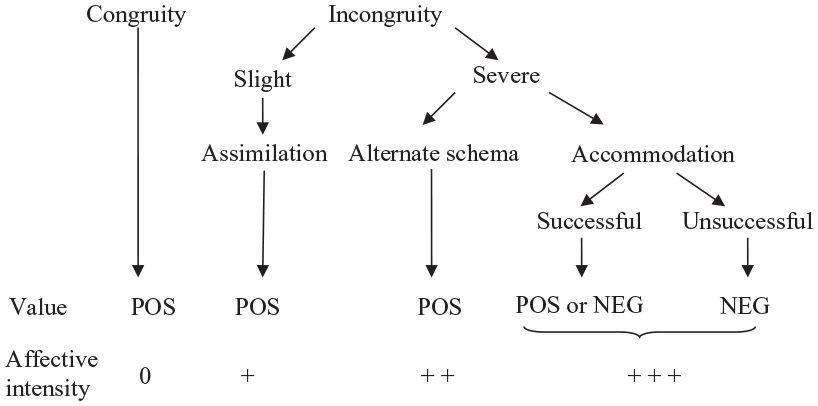
Outcomes of schema congruity and incongruity of Mandler (1982).
In Figure 1, from left to right, the first case is the high schema congruity; all the remaining cases have some degree of incongruity, which would create the autonomic nervous system (ANS) arousal. ANS activity in turn determines the intensity of emotions (which is shown to vary from 0 to +++). In the case of high schema congruity, no ANS is generated, thus the affective intensity is equal to 0 and the value associates to positive evaluation. In the case of slightly incongruity, assimilation process, which provides cognitive continuity and integration for the new information and the schema, will occur. A person can perform the assimilation with little effort, which results in little ANS arousal and low degree of affective intensity. Slightly incongruous events are usually seen as interesting, and thus evaluated positively. When the incongruity increases, a more complex assimilation is needed. If the assimilation fails, an individual may continue his or her effort by alternating or modifying the schema; this process of modifying is called “accommodation.” In this case, the effort is huge, ANS arousal is intense, and the intensity of experienced affect is greater. Most of the times, the value in the accommodation process is negative, since the severe schematic incongruity leads to the sense of helplessness. From this model, Mandler (1982) argued that a severe schema incongruity leads to a positive or negative judgment, while a high congruity creates a mild positive evaluation. The positive effect of moderate incongruity was confirmed in later studies (Dahlén et al., 2008; Meyers-Levy and Tybout, 1989). By combining “relevant” (vs irrelevant) and “expected” (vs unexpected) characteristics, Heckler and Childers (1992) distinguished different types of congruity/incongruity: (1) congruity that occurs when both relevant and expected characteristics are associated; (2) strong incongruity that results from an association of irrelevant and unexpected characteristics; and (3) moderate incongruity issued from relevant-unexpected or irrelevant-expected cases.
In the case of green consumption, some authors (Dekhili and Achabou, 2015; Thøgersen et al., 2017) stressed the role of eco-certifications and geographic origin in influencing consumers’ behavior. In addition, very few studies (Dekhili and Achabou, 2014, 2015) suggested that brand attribute could impact the evaluation of ecolabelled products. However, the academic literature paid little attention to the congruity between eco-certification origin and brand origin. It is usual that a brand from a developing country adopts domestic eco-certification, and a brand from developed economy prefers an eco-certification from its area. But in a globalization context, brands may decide to adopt cross-border certifications for various reasons. Domestic firms in developing countries are often seen to be little able to meet global standards (Husted et al., 2016), while multinational subsidiaries located in the same area are expected to implement practices that support local communities and protect the environment (Gardberg and Fombrun, 2006). Thus, in developing countries, domestic brands can adopt foreign certifications to overcome the weakness of their images and to increase the perceived quality of their products (Batra et al., 2000). With regard to brands originated from developed countries, even if they usually benefit from favorable perceptions when located in developing countries, they could need to overcome the liability of foreigners by adopting domestic eco-certifications (Husted et al., 2016).
By considering the typology of Heckler and Childers (1992) and the Mandler’s congruity theory, we offer unexpected (but relevant) combinations in origins of eco-certification and brand would create a moderate incongruity compared to the case of same origins, conducting to an increase in consumers’ purchase intent. Hence, we propose the following hypothesis:
Moderator variables impacting the effects of eco-certification origin, brand origin, and their congruity on consumers’ purchase intent
From the literature, it is realized that the effects of eco-certification, brand, and COO on consumers’ purchase intent may vary according to several variables. First, consumers’ attitude toward foreign-made products is usually negatively affected by consumer ethnocentrism, although such effect may be weaker (or absent) in developing countries (Batra et al., 2000; Wang and Chen, 2004). A large survey conducted in the US context (Shimp and Sharma, 1987) confirmed that the general attitude of individuals toward foreign-made products is negatively correlated with ethnocentric tendencies. Consumers with the highest degree of ethnocentrism are those who prefer the most domestic products. Wang and Chen (2004) explored Chinese reactions. Their study underscored, specifically, that the impact of consumer ethnocentrism on willingness to purchase domestic products is weaker in the case products with low (vs high) quality, and for consumers who hold high (vs low) conspicuous consumption. Batra et al. (2000), however, did not find any significant moderating effect of ethnocentrism level on Indians’ attitude toward brand origin. Second, the mention of an eco-certification may generate dissimilar reactions depending on the product category. According to Atkinson and Rosenthal (2014), individuals tend to pay more attention to the information on eco-certifications in the case of food products. For electronic items (e.g. smartphones), environmental information becomes secondary in comparison with other product’s features as warranty and performance. Third, the level of familiarity with eco-certification, brand, and the product itself would affect the consumer purchase of green products. For eco-certification familiarity, it was found that the higher the Norwegian consumers’ familiarity with labels, the more important are their association with sustainability (Hanss and Böhm, 2012). Brand familiarity has a positive effect on consumers’ attitude and confidence toward that brand, which in turn influences the intention to purchase it (Laroche et al., 1996). Besides, per Phau and Suntornnond (2006), the COO effect is stronger when associated with familiar (vs unfamiliar) brands. Concerning product familiarity, it is suggested that consumers who are less familiar with the product tend to use more the COO cue in their purchase decision (Batra et al., 2000). Fourth, the credibility of certifications is crucial when exploring the role of green information in influencing consumer behavior (Atkinson and Rosenthal, 2014; Tung et al., 2012). More specifically, a low credibility of eco-certifications can reduce consumers’ expectation regarding green products’ benefits, and lower their willingness to purchase (Nuttavuthisit and Thøgersen, 2017). The study by Tung et al. (2012) that was conducted in Taiwan added that a low credibility of eco-certifications decreases the consumers’ willingness to pay a premium for organic products. Fifth, food miles in the case of imported products may increase environmental pollution and conduct consumers with high environmental concerns to prefer domestic items (MacGregor and Vorley, 2006). Finally, the importance of COO, brand, and green information in consumers’ purchasing decision tends to vary according to individuals’ demographic characteristics (Diamantopoulos et al., 2003). In particular, consumers who have higher purchase intent for green products and are willing to pay a premium for them are in general young people with high income and educational level (Ibrahim and Sothornnopabutr, 2006); most of them are females with children (Daniela et al., 2012; Tung et al., 2012).
As the variables described above could influence the results, their inclusion in our study as moderator variables would enhance the study’s reliability and validity.
All the hypotheses considered in this article are summarized in Figure 2.
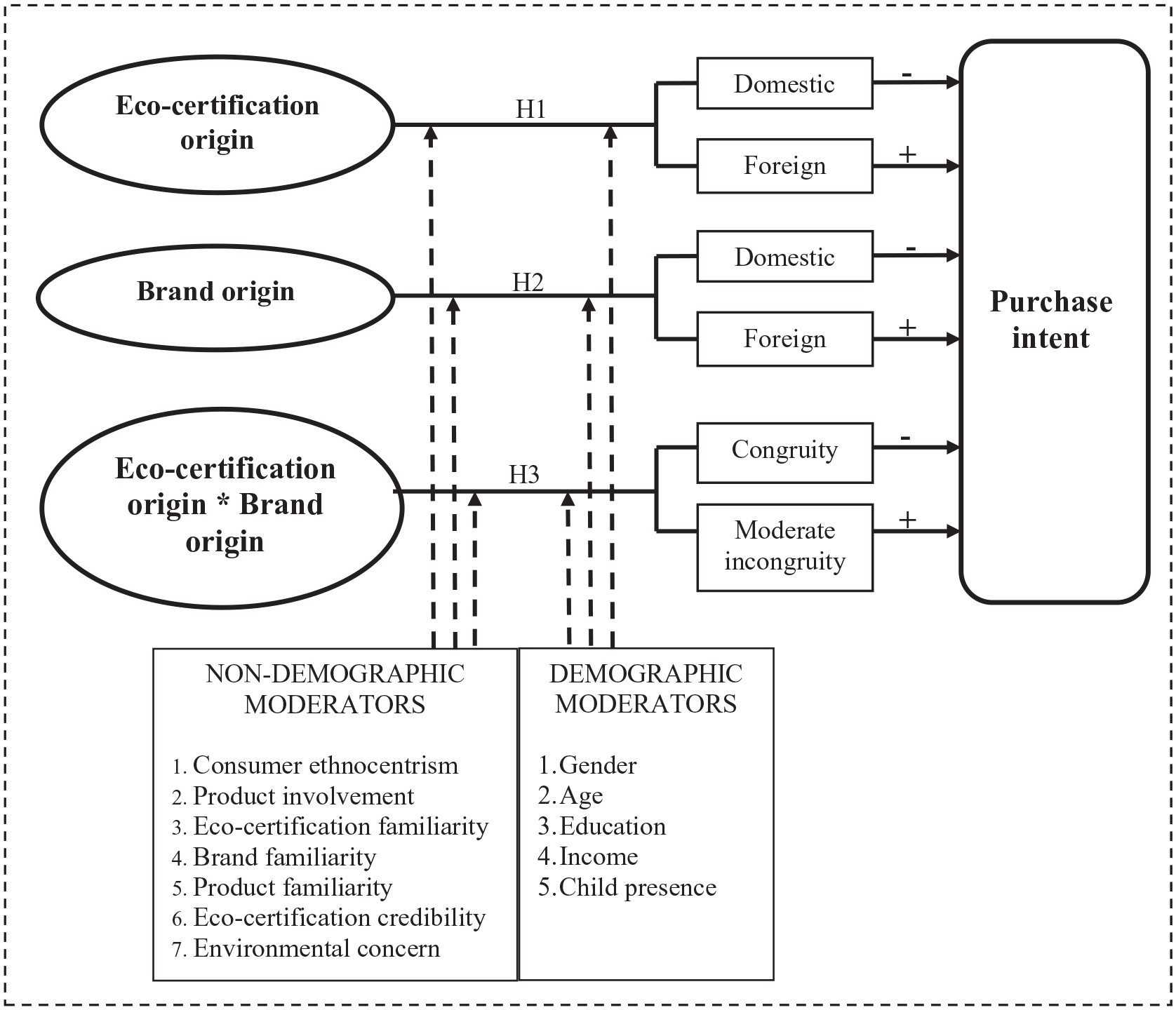
Conceptual model of the effects of eco-certification origin, brand origin, and their congruity on consumers’ purchase intent.
Method
This study was designed to determine how eco-certification origin and brand origin might enhance the consumers’ purchase intent for green products. A 2 (eco-certification: domestic vs foreign) × 2 (brand: domestic vs foreign) between-subject experimental design was conducted with 640 Vietnamese consumers in April and May 2018. The experiment, including existing eco-certifications and brands on the Vietnamese market, has been analyzed with factorial between-subject ANOVA technique.
Manipulation
Prior studies have revealed that, under high cognitive load, packages depicting several ingredients (3–5) induce more purchase intent; whereas under low cognitive load, the consumers’ purchase intent does not depend on the number of ingredients depicted (Thomas and Capelli, 2018). Thus, we set up restricted information about green products in each scenario, including health benefit, product quality, environmental impact and eco-certification. All scenarios were identical except for the product involvement and manipulations (Appendix 2).
Product involvement
Two products with different levels of involvement were defined by 53 Vietnamese students from Foreign Trade University (HCMC campus) and HCMC University of Technology and Education. Student samples in the pretest can be accepted since they are catalysts for change and knowledgeable about green alternatives (Atkinson and Rosenthal, 2014). The respondents were asked to classify the whole of green product categories benefiting from third-party eco-certifications that are commercialized in Vietnam: five non-food products (paper, detergent, light bulb, ink, and battery) and two food organic products (milk and cereal). More specifically, the non-food products selected are sold in the Vietnamese market with the “Vietnam Green Label” and the “EU Ecolabel,” whereas the two organic food products tested are associated with the “EU Organic Label.”
For product involvement, a five-item scale by Zaichkowsky (1985) was utilized; it was measured on a 7-point Likert-type scale ranging from “strongly disagree” to “strongly agree” (Appendix 3). Milk was considered by respondents as a high-involvement product, significantly different from light bulb that is judged as a low-involvement item. In Vietnam, milk consumption level is quite low (about 17 liters/person/year) compared to that of neighboring countries (Thailand: 35 liters/person/year, Singapore: 45 liters/person/year) (Forbes Vietnam, 2018). This is due to the food habit of using less milk in Vietnamese cuisine and to its high price. Milk is still considered as a product aimed exclusively at children and elderly (Nguyen and Tran, 2014). By contrast, light bulbs have a reasonable price and a good lifespan, conducting consumers to be less likely to spend much time for selecting it. Moreover, milk and light bulb represent two distinct branches of green products: organic food and non-food green products, which may make differences in consumer behavior (Achabou and Dekhili, 2013).
Eco-certification origin
We varied eco-certifications with different origins (domestic vs foreign) that (1) are delivered by a third-party organization and (2) have appeared in Vietnamese market for years to guarantee a certain familiarity of the respondents with these cues. Four eco-certifications meeting such criteria have been considered: two Vietnamese eco-certifications of PGS Hữu cơ Organic Certificate (launched in 2008) and Vietnam Green Label (introduced in 2009), and two EU eco-certifications of EU organic label and EU Ecolabel (Appendix 4).
Brand origin
We manipulated brand origin by considering two options: domestic vs foreign. For organic milk, we selected Vinamilk (domestic brand) and HIPP (foreign brand from Germany). The two brands are currently sold in supermarkets throughout Vietnam by proposing organic products certified by third-party eco-certification as EU organic label. Vinamilk and HIPP are also brands engaged in responsible activities. For example, both of them exploit natural resources sustainably, adopt environmentally friendly packaging, and express concerns for animal welfare (HIPP, 2020; Vinamilk, 2019).
For the light bulb, we chose DienQuang (Vietnamese brand) and Philips (foreign brand from Netherland). Both brands propose environmentally friendly LED light bulbs, which are sold in Vietnam. DienQuang has adopted the Vietnam Green Label and CE 3 claim (Dienquang, 2020). For Philips, numerous activities in favor of sustainability have been performed by the brand (e.g. its circular economy business model, the program of “healthy people, sustainable planet,” the carbon neutrality operation), enabling it to reach the second place in the 2018 Dow Jones Sustainability Index (Philips, 2020). The brands considered are illustrated in Appendix 5.
Finally, as milk and light bulb are related to ordinary consumption contexts, and are widely disseminated in supermarkets, the following sentence have been used to introduce the scenarios to respondents: “You are in a supermarket, and are looking for milk/light bulb. Then, you see the product with information as described in the following picture.”
Data collection
Respondents were recruited in Vietnam via the snowball sampling technique. This procedure is well suited to studies with sensitive topics (here green consumption) and requires the knowledge of insiders to locate respondents (Biernacki and Waldorf, 1981). As individuals with high educational level and young generation seem more concerned about eco-friendly activities (Nielsen, 2018), a snowball sampling with the focus on young and above-average educated people was conducted. From the initial 50 consumers invited by the authors, the final responses returned were 746, but only 640 questionnaires were brought into the analysis due to missing data, unengaged and outlier responses.
The literature has shown that in self-report measurements, especially in the area of responsible consumption, social desirability biases usually occur as respondents try to avoid the embarrassment and would project a favorable image to others (Fisher, 1993). To reduce such possible biases, we preferred collecting data via Internet (with anonymous) by avoiding face-to-face interactions. With the help of Survey Monkey software, consumers received a link to access an online questionnaire, in which they were randomly assigned to one of the four scenarios considered for each type of product.
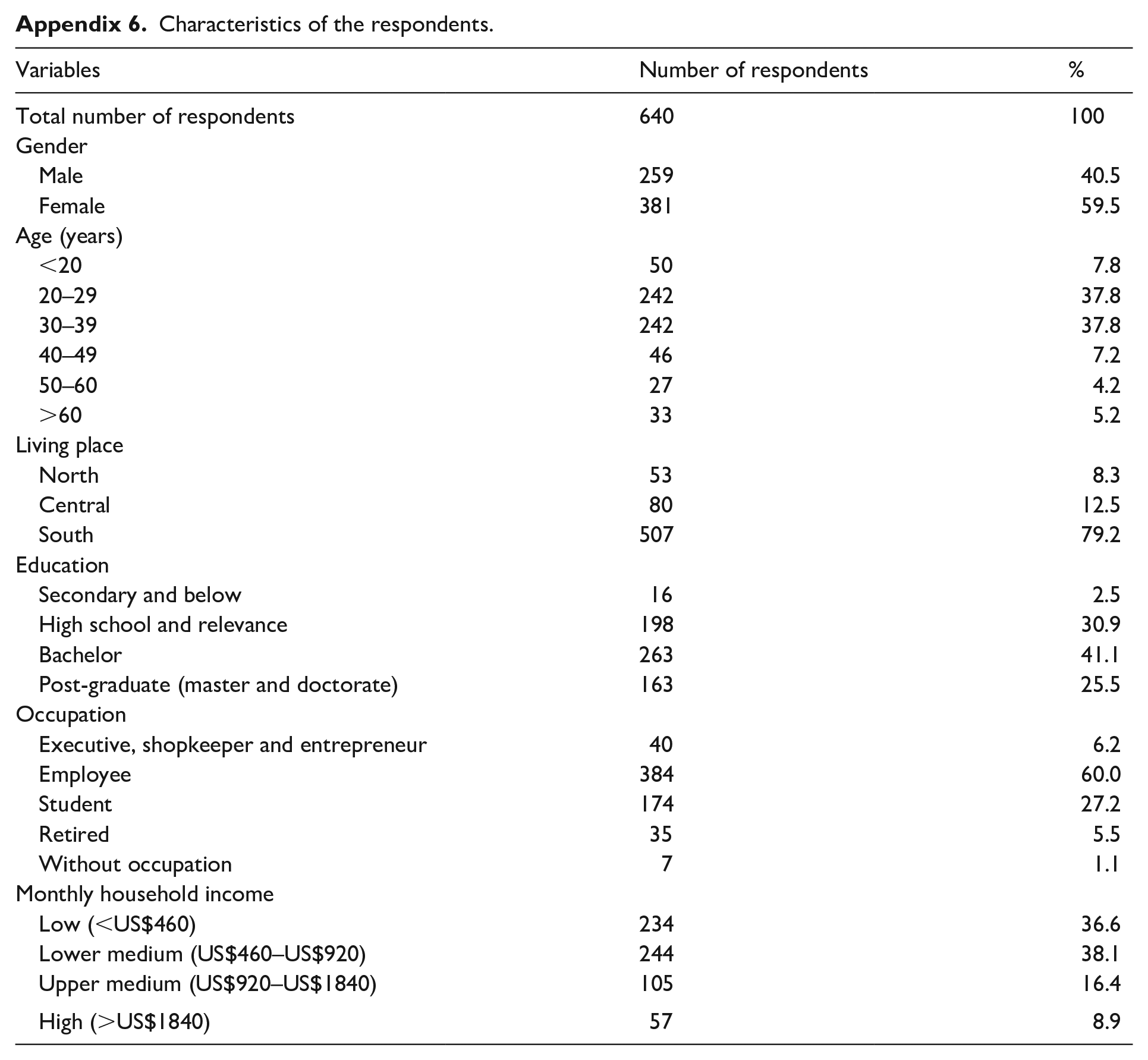
The respondents were all Vietnamese with an average age of 32, and more than the half (59.5%) were female. In terms of educational level, two-third of the sample (66.6%) has bachelor or post-graduate degree 4 (Appendix 6).
Measurement
As illustrated in Appendix 3, all survey items were adapted from established scales.
Moderators
Items measuring the consumers’ ethnocentrism, eco-certification credibility, and environment concerns were measured with 7-point Likert-type scales ranging from “strongly disagree” to “strongly agree.” Consumer ethnocentrism was defined by five items from CETSCALE by Shimp and Sharma (1987). Eco-certification credibility was measured by six items drawn from Moussa and Touzani (2008). To measure environmental concerns, the six items by Haws et al. (2014) were adopted. The familiarity with eco-certification, brand, and product was measured by a single item of Marbach-Ad et al. (2008), ranging from “not at all familiar” to “very familiar.”
To investigate their effects, two levels of moderator variables (high vs low) under the median split of Iacobucci et al. (2015) have been considered, except for gender and child presence.
Purchase intent
The dependent variable was measured on a single 7-point Likert-type scale adopted from Dekhili and Achabou (2015). The respondents expressed their purchase intent from “definitely will not buy” to “definitely will buy.”
Manipulation checks and congruity levels
Over time, the use of manipulation checks has become more and more common. However, the appropriate timing of manipulation checks is still under considerations. Perdue and Summers (1986) highlighted that their inclusion within the main experiment might create a temporary change in the level of independent variables, and/or a possible bias in the individuals’ responses to the dependent measures. Also, Hauser et al. (2018) asserted that embedded manipulation checks within an experiment might amplify, undo, or interact with the effects of manipulations. To avoid such flaws, it was suggested to conduct manipulation checks in pretests. According to Perdue and Summers (1986), the use of pretest for manipulation checks in experiments has increased over time. For example, by reviewing experimental studies in the Journal of Marketing Research from 1987 to 1996, Khan (2011) found that out of 44 articles, 31 conducted manipulation checks in pretest, and only 5 researches adopted this procedure during the main experiment. By following this trend, we conducted in this study a pretest with 82 consumers, in Ho Chi Minh City, to check manipulations. Besides, during this phase, the respondents were asked to evaluate the congruity levels between origins of eco-certifications and brands. For this, the three-item scale by Keller and Aaker (1992) was applied and a 7-point semantic scale was utilized.
Results of manipulation checks
Respondents were asked to judge whether eco-certifications and brands tested are domestic or foreign. We conducted cross-tabulations with manipulation check questions among eight scenarios. All manipulations were successful with significant Pearson’s chi-square (p = 0.000). Most consumers recognized correctly origins of eco-certifications and brands: PGS Hữu cơ Organic Certification and Vietnam Green Label as domestic eco-certifications (85% and 100%, respectively); EU Organic label and EU Ecolabel as foreign eco-certifications (89.5% and 90.5%, respectively); Vinamilk and DienQuang as domestic brands (100%); HIPP and Philips as foreign brands (89.5% and 100%, respectively).
Regarding congruity levels, Cronbach’s alpha indicated good reliability for the three-item measure of congruity (α = 0.977). We thus calculated the composite index for the subsequent one-way ANOVA analysis by averaging the individual item scores. A significant difference was observed between congruity levels of origins (F(1, 80) = 12.752, p = 0.001). As expected, brands and eco-certifications that have the same origin show a higher congruity level (M = 5.72, SD = 1.15, 95% CI = (5.35, 6.08)) than those with different origins (M = 4.67, SD = 1.49, 95% CI = (4.20, 5.14)). Thus, the pretest results illustrate our assumption suggesting that a mismatch in the origins of eco-certification and brand would create a moderate incongruity.
Findings
To assure the homogeneity of variance among groups, Levene’s test was performed with levels of eco-certification origin and brand origin. The result was insignificant (F(3, 636) = 0.558, p = 0.635), confirming that the error variance of the dependent variable is equal across groups (Field, 2009), which enables us to conduct further analyses.
Main analysis: Effects of eco-certification origin and brand origin
H1 supposes that eco-certification origin has an effect on the consumers’ purchase intent, with a favor for the foreign origin. However, the result did not yield a significant impact and conducted to reject H1 (Table 1).
Main analysis: Effects of eco-certification origin and brand origin on purchase intent.
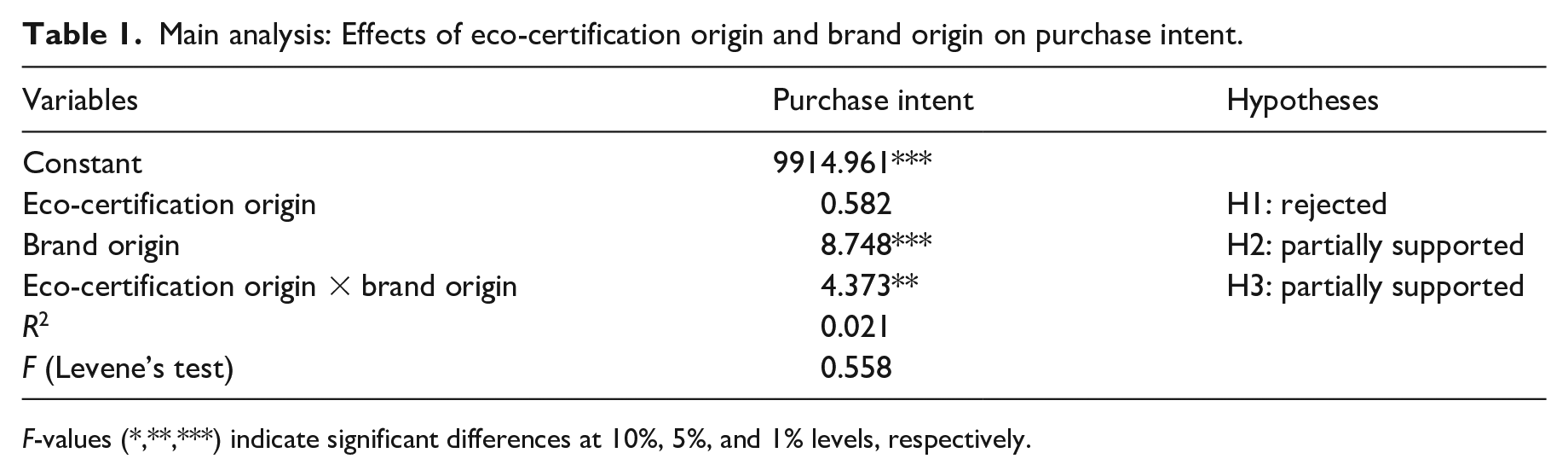
F-values (*,**,***) indicate significant differences at 10%, 5%, and 1% levels, respectively.
In H2, we assumed that foreign brands yield more positive purchase intent. However, the result contradicted our expectation as consumers exposed to domestic brands had significantly higher purchase intent (F(1, 636) = 8.748, p = 0.003, M = 5.091, SD = 1.229) than those exposed to foreign brands (M = 4.798, SD = 1.288) (Tables 1 and 2). This result partially supports H2 and infers that brand origins can be used to predict the consumers’ purchase intent, yet in a surprising effect.
Mean values of eco-certification origin and brand origin and their effects on purchase intent.
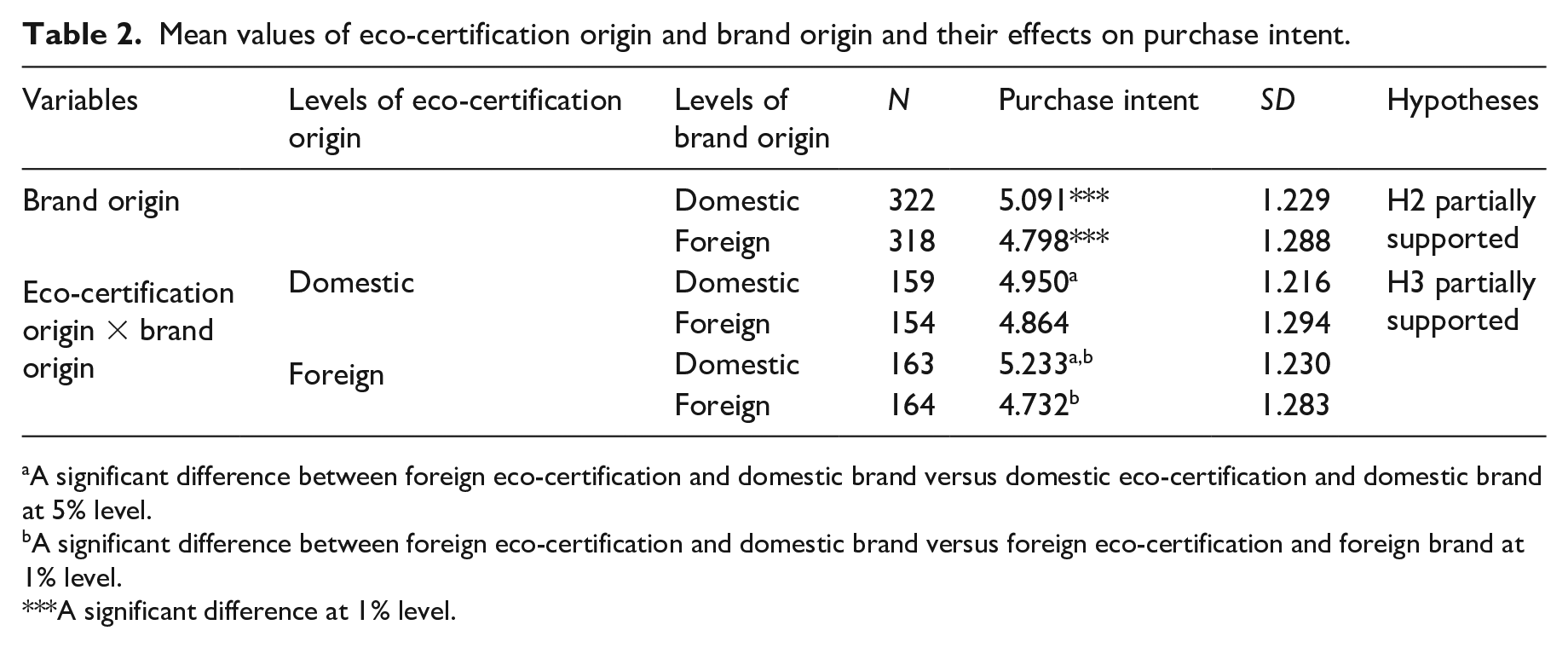
A significant difference between foreign eco-certification and domestic brand versus domestic eco-certification and domestic brand at 5% level.
A significant difference between foreign eco-certification and domestic brand versus foreign eco-certification and foreign brand at 1% level.
A significant difference at 1% level.
H3 tests the impact of the interaction between eco-certification origin and brand origin on purchase intent. The results showed a significant effect (F(1, 636) = 4.373, p = 0.037) (Table 1). Consumers were more inclined to purchase domestic green brands endorsed by foreign eco-certifications (M = 5.233, SD = 1.230) than by combinations of domestic eco-certification–domestic brand (M = 4.950, SD = 1.216, p = 0.043) or foreign eco-certification–foreign brand (M = 4.732, SD = 1.283, p = 0.000) (Table 2). This confirms that a moderate incongruity in eco-certification origin and brand origin favors higher purchase intent than a congruity. Nevertheless, such an effect did not appear in the case of a domestic eco-certification–foreign brand (Table 2), conducting to partially confirm H3.
Effects of eco-certification origin, brand origin, and their congruity under moderators
All moderator variables measured by more than one item were checked by calculating their reliability and validity with Cronbach’s alpha and factor analysis. Results revealed that they all had good reliability and validity (Cronbach’s alpha > 0.6, one factor extracted only) (Nunnally and Bernstein, 1994) (Table 3).
Reliability and validity of multi-item moderators.
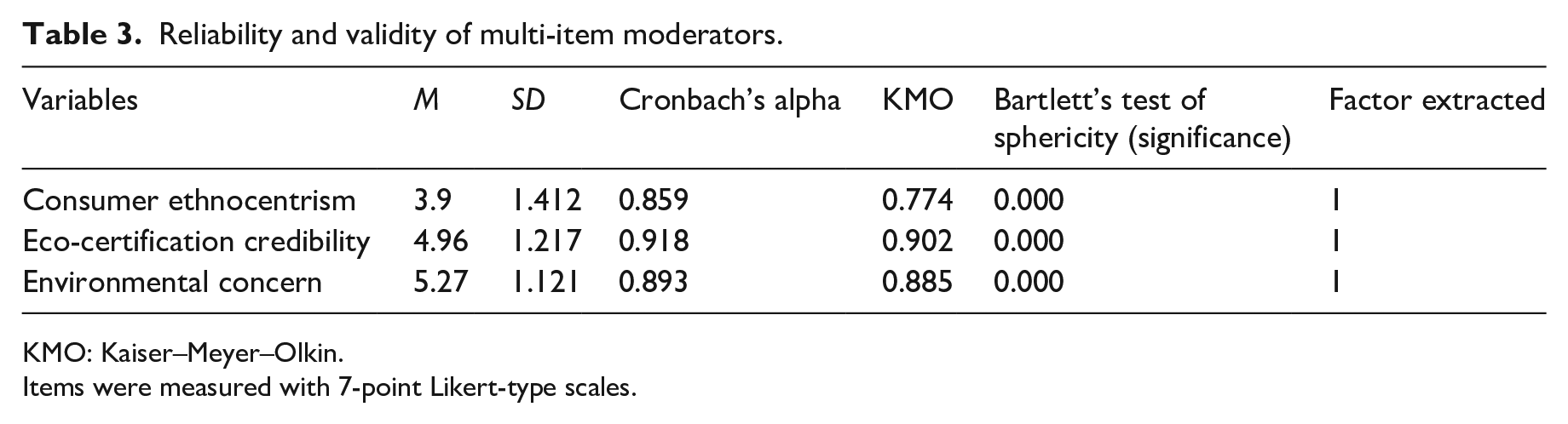
KMO: Kaiser–Meyer–Olkin.
Items were measured with 7-point Likert-type scales.
Three-way ANOVA was then performed to explore the effects of moderators. Only regression models for product involvement, brand familiarity, product familiarity, gender, age, and education were significant (Table 4). They mainly magnified the effect of brand origin on purchase intent, except for brand familiarity that influenced the congruity effect too.
Conditional effects of Xi on purchase intent at values of moderators.
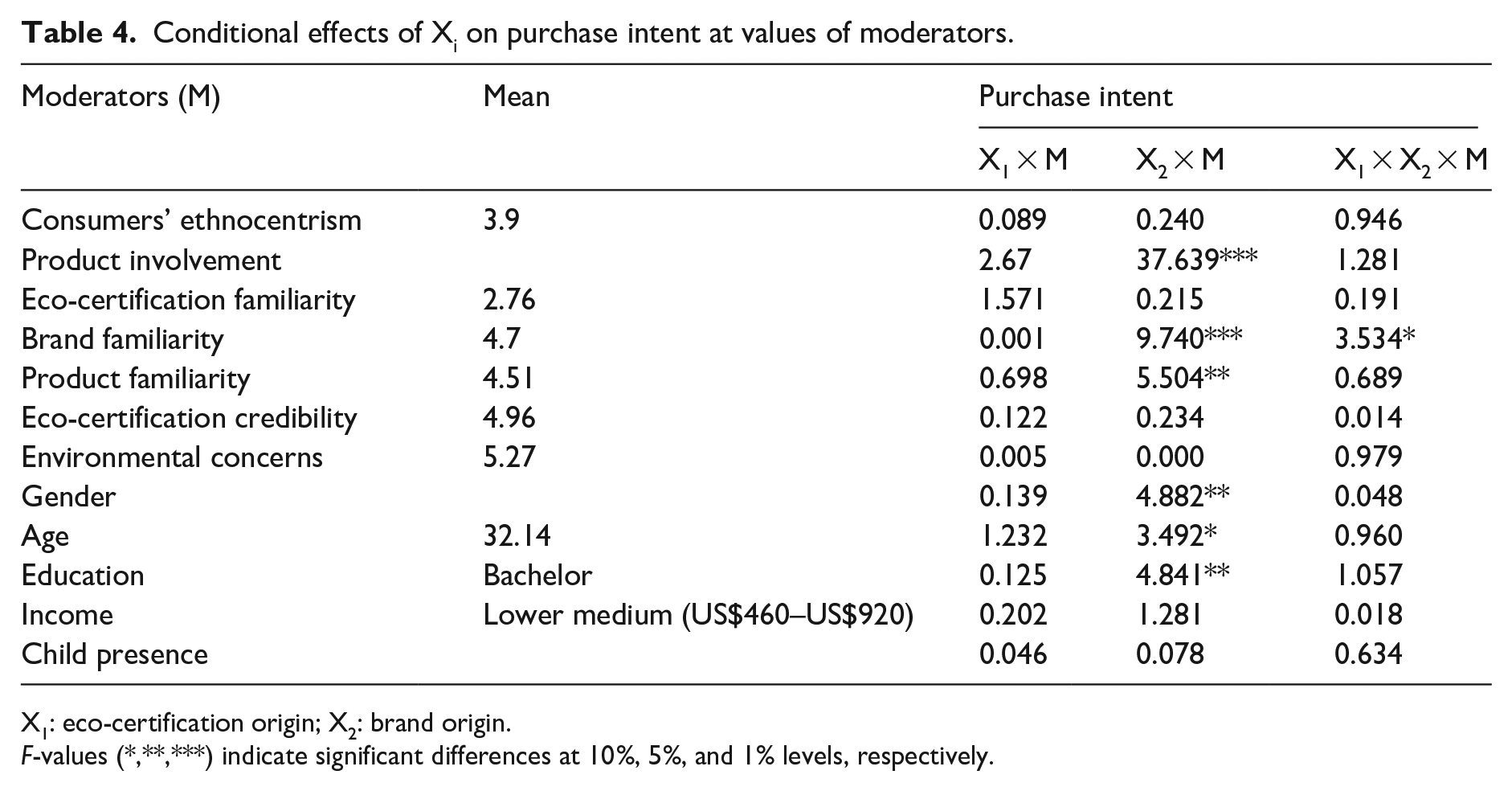
X1: eco-certification origin; X2: brand origin.
F-values (*,**,***) indicate significant differences at 10%, 5%, and 1% levels, respectively.
Vietnamese consumers expressed a higher purchase intent for domestic brands in the case of high-involvement green products (organic milk: M = 5.245, p < 0.01) and an increased willingness to purchase foreign brands (from developed countries) in the case of low-involvement items (LED light bulbs: M = 5.227, p < 0.05) (Table 5). More particularly, old (M = 5.438, p < 0.01), highly educated (M = 5.308, p < 0.01), and females (M = 5.116, p < 0.01), expressing low familiarity with the brand (M = 4.781, p < 0.01) and the product (M = 4.828, p < 0.01), are more willing to purchase domestic brands (Table 5). However, in the cases of low product involvement and high brand familiarity, consumers tend to purchase foreign brands from developed countries.
Mean values for the main effects of Xi on purchase intent at values of moderators.

F-values (*,**,***) indicate significant differences at 10%, 5%, and 1% levels, respectively.
The examination of congruity showed that consumers expressing low familiarity with brands tend to favor domestic brands endorsed by foreign eco-certifications (M = 5.072, p < 0.01) than those associated with domestic eco-certifications (M = 4.491). Nevertheless, this effect did not exist in the case of foreign brands and that of high brand familiarity (Table 6).
Mean values for the congruity effect at values of brand familiarity variable.
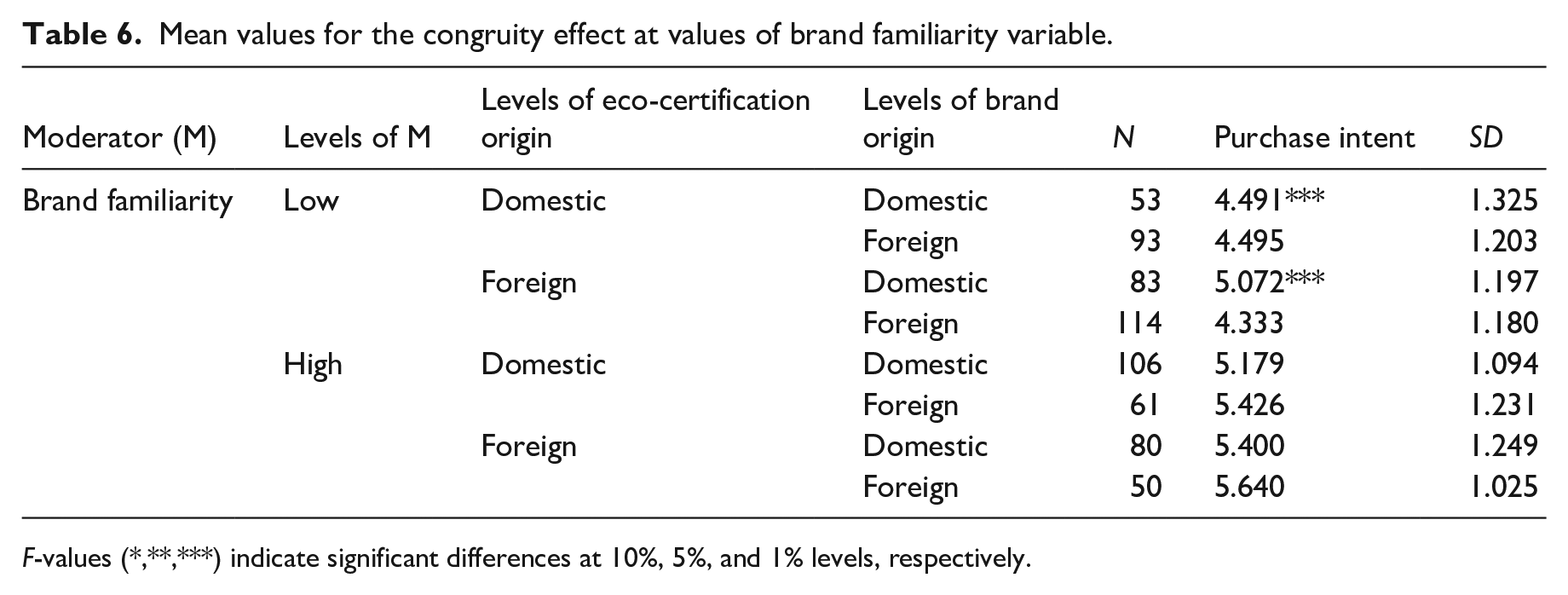
F-values (*,**,***) indicate significant differences at 10%, 5%, and 1% levels, respectively.
Conclusive discussion
Contrary to expectations, the results of this study indicate that there is no main effect of eco-certification origin on purchase intent. This is inconsistent with previous conclusions (Nuttavuthisit and Thøgersen, 2019) mentioning that consumers in developing countries are inclined to favor products with eco-certifications from developed countries. Although eco-certifications considered in this study have been introduced in the Vietnamese market for years, the degree of consumers’ familiarity with them is still low. Consequently, consumers may not give much importance to eco-certifications when purchasing green products. Such low familiarity might come from a lack of information delivered to consumers on eco-certifications, identified as a barrier to recognize and consume green products in Vietnam (Nguyen and Dekhili, 2019). The negative impact of the lack of information on green behavior has been confirmed both in the context of developed and developing countries (Pickett-Baker and Ozaki, 2008). More specifically, few studies (Rashid, 2009) confirmed in the context of Asian countries (Taiwan, Malaysia) that the lack of information makes consumers unable to differentiate between ecolabels.
Nevertheless, when eco-certification origin is combined with brand origin, the interaction between the two cues affects the Vietnamese purchase intent for green products. More particularly, consumers tend to favor domestic brands with foreign eco-certifications (from developed countries), partially confirming the moderate incongruity effect of Mandler (1982). We may assume that Vietnamese view in international eco-certifications a higher ecological quality of products. As shown by Husted et al. (2016), who conducted a study in Mexico context, domestic firms tend to adopt global eco-certifications to overcome the disadvantage of localness in terms of responsible practices.
Contrary to the eco-certification origin, brand origin has significant impact on the purchase intent. This is in line with prior studies asserting that brand cue is much more powerful than eco-certification in influencing consumer behavior (Ahmed et al., 2004; Thøgersen et al., 2017). In general, it is consumers in developed countries who express higher preference for domestic products than foreign ones, often due to a high perceived quality (Elliott and Cameron, 1994). This trend was, however, observed in the case of Vietnam (developing country). One possible explanation of this result is related to the product categories tested. John and Brady (2010) highlighted the importance of product conspicuousness. They found that consumers from developing countries tend to choose domestic brands especially in the case of private mode of consumption and prefer imported products in a public consumption context. Milk and light bulb are both ordinary products that are used in private contexts with low conspicuousness level, which could encourage the consumption of domestic brands. Another possible explanation is that the origin information in our study was embedded in brand names, and that disclosing could depend on individuals’ familiarity with brands. By exploring 84 well-known brands, Samiee et al. (2005) found that consumers have modest knowledge of the origin of brands, and that brand origin recognition is based largely on the consumers’ associations of brand names with the language suggesting the COO. In our experiment, domestic brands had the term of VINA (VINAMILK) – implying to Vietnam, or written in Vietnamese language (Điện Quang). This would play an important role in the recognition of COO for domestic brands, which is not necessary in the case of foreign brands. For HIPP and Philips, there is no specific designation of the brand origin. However, as mentioned by Nuttavuthisit and Thøgersen (2019), our results indicate that consumers with high brand familiarity would be better aware about the origin of the brands tested and tend to have higher purchase intend for foreign products. A last explanation of the preference for domestic brands observed could be related to cultural identity, which is very important in collective cultures. It makes consumers love national brands for their symbolic cultural meanings, but does not conduct them necessary to reject imported brands (contrary to consumer ethnocentrism) (He and Wang, 2015). The country explored in this study – Vietnam – is a strong collective society (Hofstedensight, 2019)– where cultural identity may lead to enhance purchase intent for domestic brands. In particular, consumers with low brand and product familiarity could prefer domestic brands because of the localized commercials that naturally embody cultural traits (Pae et al., 2002). The preference of Vietnamese for domestic brands may also be viewed being in contrast to the globalization trend. This result is in line with Robertson (1995) who underscored the interest of a glocalization approach – a blend of globalization and localization in promoting foreign brands. He and Wang (2015), through a study conducted in China, identified a preference for domestic products. The authors argued that, in this case, multinational companies (e.g. Nike, Adidas) need to incorporate in their marketing strategies local cultural elements and well-perceived national icons.
The results obtained also suggest that the impact of brand origin on Vietnamese consumers’ purchase intent depends on the product investigated. Consumers tend to choose domestic brands for organic milk and foreign brands for LED light bulbs. Organic milk is a high-involvement food in Vietnam. Previous literature indicated that consumers generally express higher trust toward local food, especially when they are organic (Merle et al., 2016). Organic food is perishable, and spoilage would be a concern in the case of foreign products with high food miles. Thus, the result obtained in the case of milk may be extended to other types of food products. For LED light bulbs, our results showed higher purchase intent for foreign brands over domestic ones. But Ahmed et al. (2004) indicated that the effect of origin in the case of low-involvement products (coffee and bread) varies accordingly to the product tested. Consequently, it seems important to explore conditions under which COO could have an effect in the case of low-involvement products.
Furthermore, our findings confirm that consumer ethnocentrism has no moderating effect. Ethnocentrism is especially prominent among individuals whose livelihoods are threatened by foreign competition (Shimp and Sharma, 1987). Vietnam, however, is more likely to benefit from international trade with thousands of jobs have been created for low-skilled labors. In addition, foreign products that could create fierce competition with domestic industries are less preferred by ethnocentric individuals (Balabanis and Diamantopoulos, 2011). As organic milk and LED light bulbs are not Vietnamese typical products, foreign offers may not threaten domestic industries to trigger a significant impact of consumer ethnocentrism. Finally, the lack of consumer ethnocentrism observed in this study may come from the fact that a general origin of foreign brands were given (EU), instead of a specific country, which may evoke the hostility of ethnocentric consumers (Batra et al., 2000).
Academic contributions
The research offers important contributions to the COO and responsible consumption literature with an empirical examination in the context of Vietnam, an emerging Asian country. First, it answers the call from prior studies of exploring the effects of COO, especially when it is embedded in other extrinsic cues (Balabanis and Diamantopoulos, 2011; Samiee et al., 2005). The results obtained showed that the effects of COO are much affected by consumer familiarity with extrinsic cues that it is embedded in. In particular, a low eco-certification familiarity tends to neutralize the effect of both eco-certification and COO embedded in it. In addition, a low brand familiarity would lead to a preference for domestic goods, whereas a high brand familiarity can increase the effect of foreign origin on consumers’ purchase intent. Second, by indicating that eco-certification origin has no effect on purchase intent, our research enriches the literature on ecolabeling effectiveness (Dekhili and Achabou, 2014, 2015; Koos, 2011). If previous literature has mainly focused on the certifier nature (third-party organization vs company) and, globally, confirmed the superiority of official eco-certifications, our study offers that further information on the origin of eco-certifications does not add any value to the offer. This may mean that consumers establish a hierarchy between information around eco-certifications with a little importance given to their origin. Third, our study partially confirmed the moderate incongruity effect of Mandler (1982) in the field of responsible consumption. Specifically, an offer characterized by a domestic brand endorsed by foreign eco-certification from developed countries favors higher purchase intent, compared with the cases of congruity in origin between eco-certifications and brands. However, a combination of foreign brand endorsed by domestic eco-certification does not create a significant effect on purchase intent for green products. In view of the very little insights in the literature on the relationship between eco-certification and brand cues (Dekhili and Achabou, 2014, 2015), our study helps to understand how brand interacts with eco-certification and the situations in which this conducts to enhance consumer responsible behavior.
Managerial implications
The study shows that Vietnamese consumers are, in general, unfamiliar with eco-certifications, which might come from a lack of information. We suggest setting down this barrier before trying to change any consumer behavior. In this vein, policymakers should release more information about green products and eco-certifications available on the market (both domestic and foreign ones) to help consumers when purchasing ecolabeled products. Next, our study addresses that a moderate incongruity effect would exist between domestic brand and foreign eco-certification. Vietnamese firms should take advantage from such favorable interaction by adopting foreign eco-certifications from developed countries. For this, managers have interest to opt for professional global organizations, such as Control Union Certifications, that offer a wide range of certification programs. This is particularly well illustrated by Vinamilk. Another option for Vietnamese enterprises consists of creating collaborations with foreign firms that hold the targeted eco-certifications. A well-known example of collaboration is that of VinFast LLC, in the automobile industry (a subsidiary of Vingroup – a Vietnamese corporation). The company collaborated with foreign firms in different domains to take advantages from developed countries technologies and certifications. More precisely, VinFast LLC established a joint-venture relationship with LG Chem (a subsidiary of LG Group) to be able to adopt international standards and produce environmental friendliness lithium-ion batteries (VinFast, 2019).
Even though developed countries are in general associated with positive images, the results suggest that foreign firms do not benefit from this advantage enough as COO cue influences consumers with high brand familiarity only. Thus, to better valorize the foreign origin, companies need to increase their notoriety. By placing more emphasis on the brand origin in their communication (e.g. disclose the COO information separately instead of embedded it in the brand), they can trigger the COO effect on consumer’s purchase intent for green products. It is what Steba, the kitchenware German brand, did on the Vietnamese market by adding in its communication the COO to the brand name “Steba GERMANY” (Steba, 2020). A second solution to strengthen its notoriety and make known its origin is joint-venture partnerships (or Mergers and Acquisitions “M&A” strategies) with domestic firms. The Danish Carlsberg Group, for instance, established in 1994 a joint venture with a well-known Vietnamese beer brand – Bia Huế – and opted in 2011 for M&A strategy. Colgate-Palmolive, and Dạ Lan (a Vietnamese toothpaste brand) adopted a similar penetration path (Vietnamnet, 2014). Such strategies supported by a strong communication helped to make these global corporations become famous among Vietnamese.
Moreover, our study indicates that domestic brands have significant effect on consumers’ purchase intent, especially in the case of organic milk. Vietnamese enterprises, in particular those in dairy sector, should promote their domestic origin and exploit local cultural traits, by using surface-level language characteristics. Brand names should consequently mobilize terms sounding Vietnamese (e.g. Long Thành milk, Đà Lạt milk, Mộc Châu milk). Also, symbols of Vietnamese culture should be used (e.g. Ao dai costume, Lotus flower, Dragon image, and Red and Yellow colors).
Finally, Vietnamese consumers who are highly educated, females, and above-average aged seem the most inclined to purchase domestic green products. To target such consumers, domestic firms could make use of digital marketing tools, especially social media. Individuals in high collectivist societies are very interested in social comparisons that permit self-improvement (White and Lehman, 2005). Vietnam ranked seventh in terms of Facebook audience size with 63 million users (Le, 2020). In addition, the same trend of using social media is in evidence for old generation in collectivistic cultures as it helps them to feel less lonely by connecting with their peers and families, and updating information and entertainment programs (Le, 2020). Using Facebook ads should help Vietnamese companies to identify micro-targets based on individuals’ age, gender, and educational level.
Limitations and future research
Although this research offers numerous contributions, it has limits that call for further investigation. First, our study focused on the consumers’ purchase intent, instead of consumers’ actual purchase decision. While this variable can provide valuable insights for future consumers’ purchase behaviors, there could still be biases in the prediction due to the gap between intention and actual behavior. Second, products covering both high- and low-involvement levels that are certified by Vietnamese third-party organizations are limited. At the time of the experiment, only few green products comprising Vietnam Green Label and PGS Hữu cơ organic certification existed. The expansion of Vietnamese certifications would enable us to explore in future studies a largest range of green goods, varying not only in terms of product involvement but also in terms of conspicuousness. In addition, although Vietnamese are currently much more used to purchase their products in supermarkets rather than in specialized stores (Deloitte, 2020), 5 further research should take into account the point-of-sale that could affect the offer of green products and the consumers’ trust toward them (Dekhili, 2016). Third, considering a large geographic area (EU) as foreign origin, rather than a particular country, may reduce the COO effect. Besides, the lack of consumers’ knowledge both on the origin of brands and certifications, and on the territorial expanse of certifications should be considered. A future study needs to include in experiments control groups who will not be exposed to any eco-certifications and test groups who will examine eco-certifications from selected specific countries. In the case of hybrid products with multiple origins (country-of-design, country-of-brand, country-of-manufacture, etc.), the associations consumers are making with the facets of COO (Chao, 2001) should be explored. Also, in order to gain a deeper understanding of the consumers’ evaluation of home countries (vs foreign countries) when purchasing green products, we believe it would be fruitful to consider the ecological image of countries. COO has been suggested to confer an ecological image that could help to prefer eco-products coming from countries with competitive advantages in terms of sustainability (Dekhili and Achabou, 2015). Fourth, a snowball sampling technique has been used to collect data. Although this method is well suited for identifying respondents based on the purpose of the study (young and above-average education), it conveys certain issues in controlling the sample once the referral chains started (Biernacki and Waldorf, 1981). Therefore, stratified sampling is encouraged in future studies to better take into account the heterogeneity of consumer behaviors. In addition, even if efforts have been made to reduce the social desirability bias, mainly by avoiding face-to-face interactions with respondents, it is hard to exclude it entirely. In this vein, it is suggested that indirect (e.g. structured, projective) questions could be useful when exploring socially sensitive topics (Fisher, 1993) as responsible consumption. Fifth, as the moderate incongruity effect is only partially confirmed in our study, we call for further investigations in this area to gain a better understanding of consumer behavior in moderate incongruous situations. Finally, although Vietnam has common characteristics with other Asian developing countries (mainly with lower-middle-income group characterized by high economic growth rates and large populations), results obtained in this single context are unlikely to generalize exactly to all developing countries. There will obviously be differences in how consumers in different contexts respond to the domestic (vs foreign) nature of certifications and brands. The preference for domestic brands observed in Vietnam, for instance, might be reduced in countries with a lower level of collectivism as India (Batra et al., 2000; Hofstede-Insight, 2019). We strongly recommend future studies to extend this topic to other Asian areas with various cultural traits, by including countries economically equivalent (e.g. Philippines, Bangladesh) and superior (e.g. Thailand, Malaysia) to Vietnam.
Footnotes
Appendix
Characteristics of the respondents.
| Variables | Number of respondents | % |
|---|---|---|
| Total number of respondents | 640 | 100 |
| Gender | ||
| Male | 259 | 40.5 |
| Female | 381 | 59.5 |
| Age (years) | ||
| <20 | 50 | 7.8 |
| 20–29 | 242 | 37.8 |
| 30–39 | 242 | 37.8 |
| 40–49 | 46 | 7.2 |
| 50–60 | 27 | 4.2 |
| >60 | 33 | 5.2 |
| Living place | ||
| North | 53 | 8.3 |
| Central | 80 | 12.5 |
| South | 507 | 79.2 |
| Education | ||
| Secondary and below | 16 | 2.5 |
| High school and relevance | 198 | 30.9 |
| Bachelor | 263 | 41.1 |
| Post-graduate (master and doctorate) | 163 | 25.5 |
| Occupation | ||
| Executive, shopkeeper and entrepreneur | 40 | 6.2 |
| Employee | 384 | 60.0 |
| Student | 174 | 27.2 |
| Retired | 35 | 5.5 |
| Without occupation | 7 | 1.1 |
| Monthly household income | ||
| Low (<US$460) | 234 | 36.6 |
| Lower medium (US$460–US$920) | 244 | 38.1 |
| Upper medium (US$920–US$1840) | 105 | 16.4 |
| High (>US$1840) | 57 | 8.9 |
