







Abstract
In a context of ecological crisis, new economic models have developed based on the replacement of ownership by access. While they have been studied at length, the very idea of ownership, which is supposed to be abandoned in this process, has rarely been questioned. This is the aim of our research, which investigates the meanings of the concept of ownership for consumers. A socio-anthropological investigation and an ethnographic study on various sharing systems (for houses, boats and clothes) reveals the development of a relationship to ownership, which differs from the one that prevails in the society. In this paradigm, which questions possessive individualism, the owner appears as the ‘custodian’ of his possessions. The identification of his expectations opens managerial and societal perspectives to build the offers that will enable him to fulfil this role.
Introduction
‘This is just the beginning of a revolution that that gives precedence to usage over ownership’, declared Fabrice Mazzella, founder of the Blablacar platform in 2015. Variously termed ‘collaborative consumption’ (Belk, 2014c; Botsman and Rogers, 2011), ‘access-based consumption’ (Bardhi and Eckhardt, 2012) or even the ‘sharing economy’ (Eckhardt et al., 2019), this ongoing revolution has great appeal and expectations are high. The replacement of the trans-historical ideal of property ownership by a logic based on access is clearly asserting itself as a radical socio-economic alternative, and one with a great deal of environmental promise (Frenken and Schor, 2019). A paradigmatic opposition between two societal models is emerging, in a discourse that has drawn much media attention, which sets the old world, which places an ideological premium on ‘having’, against a romantic, post-ownership alternative that exalts ‘being’.
Numerous studies have taken a critical look at the actual economic, environmental and social impacts of this phenomenon (e.g. Binninger et al., 2015; Frenken, 2017; Parguel et al., 2017; Schor, 2014). Others have questioned whether prophecies of the demise of ownership are realistic – studying consumers’ motivations in choosing usage, examining their expectations (e.g. Bardhi and Eckhardt, 2012; Herbert and Collin-Lachaud, 2017; Lamberton and Rose, 2012; Price and Belk, 2016; Privat et al., 2020; Rudmin, 2016). One question, however, seems rarely to have been raised in the development of this new programme of research: the very definition of subjective relationships to ownership. Most of the attention has been focused on its alternatives – usage and sharing – alternatives presented as revolutionary in their socio-economic effects, with the emphasis on these points obscuring the questioning of the experience of ownership, which is assumed to be well known. It is this gap that this study proposes to fill. It therefore aims to examine, in the current societal context of the development of collaborative consumption, the meanings that being an owner can take on.
After setting out in a first, theoretical part the way in which possessive individualism, the pillar of the currently dominant social paradigm, is being challenged by the development of the collaborative economy, and after highlighting the paucity of investigation into the cultural dimension of this phenomenon, we will present the methodology of the research based on a socio-anthropological approach to consumption. The results, which reveal some new representations of the ‘owner’ and ownership, will then be discussed to highlight transformations in the concept of possessive individualism and the dynamics of these cultural changes.
Construction of the research project
Dominant social paradigm and new ecological paradigm
The concept of the ‘dominant social paradigm’ or DSP (Pirages and Ehrlich, 1974) defines a structure of values and beliefs that are passed down the generations, shared by the great majority, and operate as a common fund of self-evident notions that are not normally questioned, influencing the way people ordinarily interpret the world and act. In particular the DSP determines the way institutional arrangements are constructed and the way people are bound to them. The earliest research undertaken to analytically define its content and genealogy (e.g. Kilbourne and Carlson, 2008; Kilbourne and Mittelstaedt, 2012; Kilbourne et al., 1997) identified three essential dimensions, namely political, economic and technological dimensions. The content of the first consists of various notions originating in the British tradition of political philosophy, going back to Locke in the 17th century. These form the basis of various institutions relating to what Macpherson (1962) named ‘possessive individualism’ – promoting the right to private ownership and considering as an essential duty of any government the protection and guaranteeing of the performance of contracts. As for the economic dimension of the DSP, it is based on philosophical concepts developed by Adam Smith in the 18th century, which promote opulence, growth, personal interest and the free and competitive operation of markets for the optimum allocation of resources and the coordination of activities. Finally, the technological dimension of the DSP promotes scientific progress as a means of materially resolving any societal problem. To these three dimensions – political liberalism, economic liberalism, technological optimism – one more can be added, anthropocentrism (Catton and Dunlap, 2017; Lundmark, 2007). And so the DSP asserts, first, the exteriority of humankind relative to nature, second the subordination of nature to humankind and its existence as a source of material resources for the achievement of human projects and, finally, the belief in the unlimited nature of those natural resources.
If the idea put forward by Pirages and Ehrlich (1974) that the DSP poses ecological problems has been variously tested, with positive results (e.g. Nash and Lewis, 2006; Schaefer and Crane, 2005), a very substantial field of research has examined the content of its cultural competitors and their relative importance. An alternative paradigm has thus been identified, dubbed the ‘new environmental paradigm’ (Dunlap, 2008; Dunlap and Van Liere, 1978) or the ‘new ecological paradigm’ (NEP; Lundmark, 2007). Variously studied (e.g. Amburgey and Thoman, 2012; Hawcroft and Milfont, 2010; Schleyer et al., 2016; Xiao and Buhrmann, 2017), the NEP comprises four fundamental dimensions: (1) awareness that humankind faces a risk of exposure to major environmental disasters (ecosystems are in a situation of fragile equilibrium and are liable to be dramatically disrupted by humans); (2) rejection of anthropocentrism (humankind is part of nature); (3) awareness of the finite and not unlimited nature of the natural world (economic growth is restricted by the existence of ecological limits); and (4) finally, pessimism with regard to humankind’s ability to control it.
In the final analysis, the research points to the coexistence of two competing paradigms. A study of the research reveals a positive dynamic for the NEP (Combes, 2005) – to the extent that for some the NEP prevails over PSD (Lundmark, 2007), and is asserting itself as a socio-cultural norm (Félonneau and Becker, 2008). What is considered as giving the NEP the advantage in this competition is sometimes the existence of a profound cultural shift away from anthropocentrism (Lundmark, 2007), sometimes the development of technology pessimism (Kilbourne and Carlson, 2008).
From valuing to devaluing possessive individualism
Another factor that has recently worked against the DSP is the new cultural questioning of ‘possessive individualism’. As noted above, according to Macpherson (1962), this fundamental feature of the DSP is in line with the political philosophy developed by Locke in the 17th century – which developed a socio-cultural concept of the person that emphasises their status as an owner. Freedom is therefore presented as indissociable from ownership. An individual’s freedom depends on whether or not he has self-ownership; it is therefore based on the preferred mode of ownership. Private property is considered to be a condition necessary to a person’s self-realisation, with the freedom to engage in contractual and trading relationships (the freedom to sell, to buy, etc.). A line of ideas which, incidentally, leads to focusing thinking about purchasing behaviour on the issue of the transfer of ownership rights. Locke thus considered property rights as natural rights, an attribute of being that preceded any social conventions; an idea that was to be enshrined as one of the natural and imprescriptible rights of man. Possessive or ‘proprietary’ individualism (Audier, 2018) thus embodies an ékhō-logic (from ékhō in Greek meaning ‘have’), a way of thinking of the dominant relationship to the world under the category of ‘having’ (Chaput, 2016), a way of thinking that is institutionalised and even constitutionalised.
This ékhō-logic is currently being challenged, for ecological reasons. It is being challenged by the development of so-called ‘voluntary simplicity’ movements, which advocate frugality and explicitly favour being over having (Robert-Demontrond, 2011, 2015) as well as denouncing the ‘malaise in the consumer society’ (Ladwein, 2017) more generally. The ékhō-logic is also being challenged by socio-economic movements proposing alternatives to having. There are many expressions in circulation, which have not crystallised into a consensus (Massé et al., 2016), to name and describe the ‘sharing turn’ (Grassmuck, 2012): ‘functional economy’ (Gaglio et al., 2011; Robert et al., 2014), ‘access-based consumption’ (Bardhi and Eckhardt, 2012) or ‘collaborative consumption’ (Belk, 2014c; Decrop, 2017; Ertz et al., 2019; Scaraboto, 2015), ‘sharing economy’ (Eckhardt et al., 2019; Frenken and Schor, 2019). What is concerned, in each case, is either the development of alternatives to individual, exclusive ownership as modes of access to tangible and intangible consumer goods, or the development of alternatives to the individual, exclusive use of goods owned. In the first case, the emphasis is on the position of borrower and the transformations of usus – the repeated possibilities of using goods without the right of ownership. This is the case, for example, of systems of renting or borrowing goods (e.g. houses, bicycles, cars, boats, clothing, and tools) for short periods. In the second case, the emphasis is on the position of lender and the transformations of fructus – the transient opening to others of possibilities of using owned goods. In particular this concerns schemes allowing owners to rent or lend their property when they are not using it themselves.
The collaborative economy relative to the DSP and the NEP
The collaborative economy constitutes an important step towards a more sustainable way of life (Albinsson and Perera, 2012; Belk, 2014a; Prothero et al., 2011; Schor, 2014) by encouraging the development of goods with a longer lifespan and by recycling waste, by absorbing the surpluses generated by overproduction and increasing use of unproductive objects (Botsman and Rogers, 2011). This movement shares with the NEP the awareness of the limited nature of natural resources and the non-sustainability of current development models in this context, it still remains deeply rooted in the DSP. In particular due to continued and unwavering belief in technological progress. The collaborative economy is therefore presented as a ‘reservoir of innovations for sustainable development’ (Demailly et al., 2016), based on the development of digital platforms. The new consumption practices that arise out of this are presented as the reinvention of sharing thanks to technology (Botsman and Rogers, 2011) and the advent of an ‘age of access’ (Rifkin, 2000), an essential step in the ‘third industrial revolution’ (Rifkin, 2012). Far from challenging the DSP and its economic and political foundations, the collaborative economy, which claims to go beyond the consumerism of neoliberal capitalist societies, likely contributes, on the contrary, to its radicalisation (Caillé et al., 2014; Martin, 2016). As its business models are often being based on the transformation of private property into productive capital (Perret, 2015), the collaborative economy also contributes to the reinforcement of possessive individualism, even though it defines itself as an alternative to ownership. Although some highlight these ‘paradoxes’ (e.g. Jacquet, 2015), it seems mainly to be a matter of ambivalences, observed not only at the individual level, with a diversity of consumer motivations (Herbert and Collin-Lachaud, 2017), but also at the organisational or socio-cultural level, with initiatives resulting from different logics of action and different ideologies (Massé et al., 2016; Robert et al., 2014). There are indeed different, more discreet forms of collaborative production and consumption, often presented as archaic as they depend on more traditional forms of sharing and exchanging and are not intermediated by digital platforms (Guillard and Roux, 2015). A study of these forms reveals that they are in line with a logic of resistance to the market (Albinsson and Perera, 2012, 2018; Ozanne and Ballantine, 2010) on one hand, and to the transformation of individual possessions into productive capital (Dabadie and Robert-Demontrond, 2016), on the other hand.
The limits of the questioning of possessive individualism
At the emic level, whereas we could see the discourse of the promoters of collaborative consumption, advocating sharing rather than having and claiming that access takes precedence over ownership, as a reassessment of possessive individualism, it actually reveals an inability of the actors concerned to envisage ownership as anything but individual and exclusive. The development of collaborative practices is thus often assimilated with the end of ownership (FING, 2014). At the etic level, the question of the very meaning of ownership is rarely raised, as research on collaborative consumption remains largely focused on the study of the development of alternatives to it. Many studies have therefore attempted to understand the motivations behind ‘consuming without possessing’ – which include the search for a balance between economy and ecology, the desire to be free of the weight of ownership and to create social ties, or the desire to resist consumerism (e.g. Bardhi et al., 2012; Belk, 2007, 2010, 2014a; Lamberton and Rose, 2012; Lawson et al., 2016; Moeller and Wittkowski, 2010; Ozanne and Ballantine, 2010; Philip et al., 2015; Schaefers et al., 2016) – or they look at the imposed or chosen nature of non-possession (Gorge et al., 2015; Lindblom and Lindblom, 2017; Robert-Demontrond, 2015). This common presupposition that there is an antagonism between ownership and sharing – typically manifested by the question asked by Belk (2007: 137), ‘why not share rather than own?’ – is, however, contradicted by the existence of a wide variety of collective ways of possessing goods. Indeed, those who practice collaborative consumption are manifesting not the abandonment of ownership but rather the choice of different forms of common ownership (Herbert and Collin-Lachaud, 2017) or transient possession (Bardhi and Eckhardt, 2012; Jenkins et al., 2014).
Different studies, however, have looked at the evolution of the place that ownership occupies in consumption practices. Some therefore suggest that it is no longer the ultimate expression of consumer desires (Chen, 2009), that they now favour access to usage of goods over their possession (Heilbrunn, 2016), while others demonstrate that ownership remains an ideal (Bardhi and Eckhardt, 2012), pre-eminent (Herbert and Collin-Lachaud, 2017) and that the relationship that consumers maintain with it has not fundamentally changed (Peugeot et al., 2015). The question of ownership has also been explored from another angle, that of the relationship to possessions, already widely studied in marketing before the advent of collaborative consumption (e.g. Belk, 1988; Hill, 1991; Hill and Stamey, 1990; Richins, 1994), exploring the notions of acquisition, appropriation, object attachment phenomena (Wallendorf and Arnould, 1988), circulation of objects (Albinsson and Perera, 2009; Cappellini, 2009; Cherrier, 2009; Coulter and Ligas, 2003; Lastovicka and Fernandez, 2005; Ozanne, 1992), their accumulation (Beldjerd and Tabois, 2014; Guillard, 2011, 2014; Guillard and Pinson, 2012; Maycroft, 2009) or the influence of materialism on relationships to material possessions (Ladwein, 2017). It has been revived by the development of this movement, giving rise to the production of some original insights into the relationship to possessions (e.g. Bardhi and Eckhardt, 2012; Bardhi et al., 2012; Belk, 2014c; Philip et al., 2015; Watkins et al., 2016) and the appropriation of shared goods and spaces (e.g. Dehling and Vernette, 2020; Jenkins et al., 2014; Toussaint, 2016).
This review of the literature shows that there is no clear boundary in many marketing studies between the concepts of ownership and possession. In order to explain the purpose of our research in the clearest terms, we present the way these two notions are conceptualised in law and in marketing (Box 1) and we propose to distinguish clearly between ownership (referring to a legal situation and an objective, formal relationship between a person, the owner, and the thing possessed) and the concept of possession (referring to a factual situation and a subjective, psychological relationship between the owner and the thing possessed). Once this distinction is made, the importance given in marketing to the study of the relationship to possessions and to the psychological dimension of ownership to the detriment of its legal, institutional dimension becomes clear; this is the theoretical gap that our research is aiming to fill (Figure 1). What also appears, through the review of the literature on collaborative consumption, is a focus on the motivational and structural aspects to the detriment of the cultural dimension of this movement. Studies that have been attentive, as here, to the ideological dimension of the phenomenon, have variously highlighted the politically or ethically marked nature of the practices (e.g. Badot and Moreno, 2016: 76; Borel et al., 2016; Dubuisson-Quellier, 2014; Ozanne and Ballantine, 2010), the influence of the axiological reference systems on the adoption and dissemination of these practices (e.g. Binninger et al., 2015; Piscicelli et al., 2015), the existence of contradictions between discourses advocating a morality of disinterestedness and hypercapitalist behaviours (e.g. Borel et al., 2015; Jacquet, 2015). But none of these studies, to our knowledge, has questioned in any greater depth the world views of the consumers engaged in these practices. It is therefore from this perspective that we will examine the meanings of the idea of ownership for them. Our research aims to answer the following questions: (1) against the background of an economic and ecological crisis and the increase in the discourse asserting the superiority of the logics of sharing over having, what does the concept of ownership represent for collaborative consumers?; (2) what belief and value systems do these representations configure?; (3) do they reveal a profound reappraisal of possessive individualism, pillar of the dominant social paradigm?
Box 1
Ownership versus possession, legal vision and marketing vision
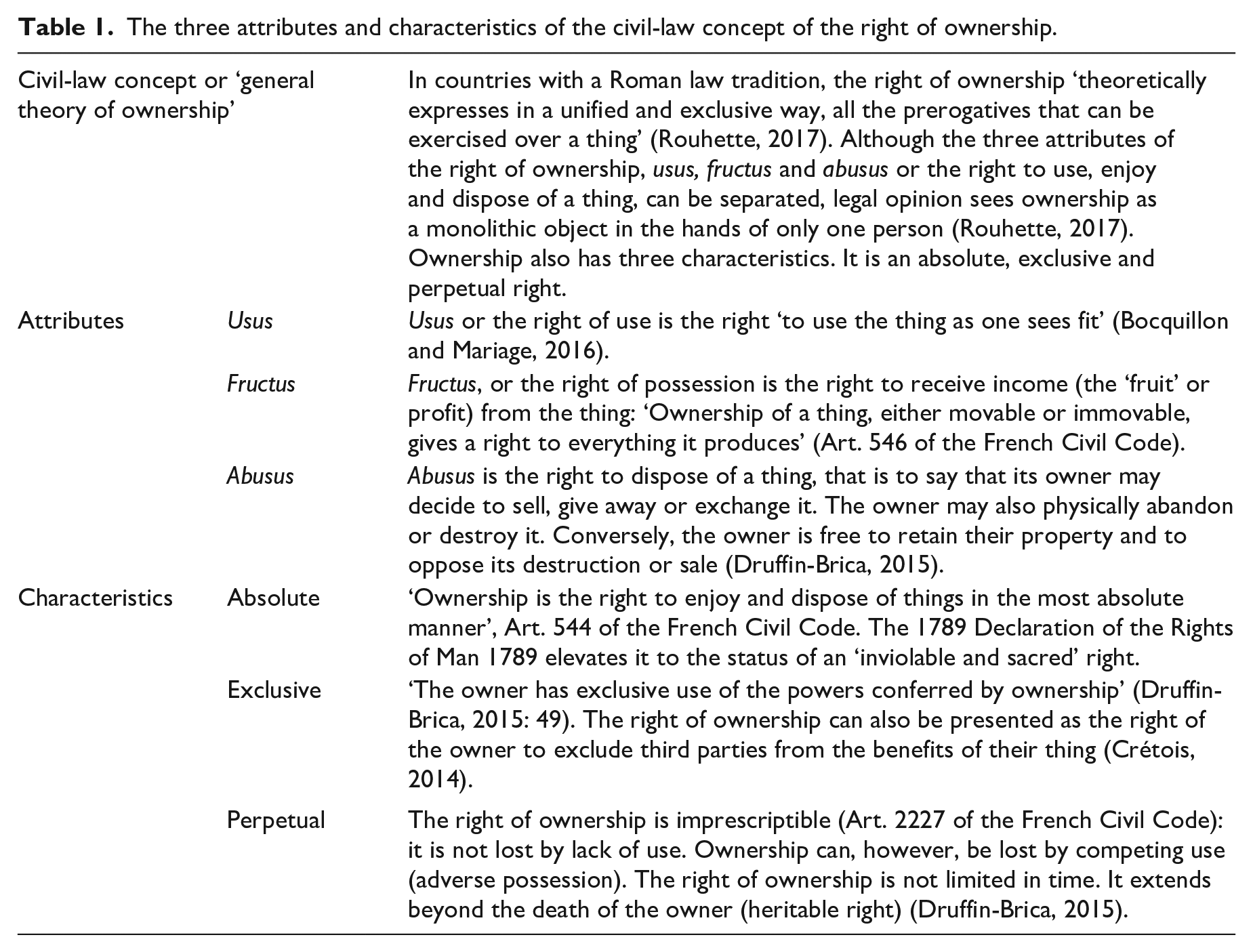
.Although often confused in common parlance, ownership and possession are two distinct concepts. From a legal point of view, ownership is a ‘legal concept’ consisting of three prerogatives – usus, fructus and abusus (cf. Table 1). Possession, on the other hand, is a ‘factual concept’. ‘It corresponds to a de facto power exercised by a person over an object, in contrast to the legal power conferred by ownership’ (Druffin-Brica, 2015: 69). Possession consists of two components, a material component, corpus, which is the physical control over the thing possessed and a psychological component, animus, which corresponds to the intention to behave as the owner of the right in rem (Druffin-Brica, 2015: 75). Although possession encompasses a number of characteristics, it can also produce legal effects, in particular by virtue of Article 2276 of the French Civil Code, which provides that ‘as far as movables are concerned, possession equals title’, which means that the possessor of a movable acquires ownership of it. In marketing, the boundary between these two concepts is more blurred. There are two categories of studies. The first consists of those which, studying the relationship to possessions, focus on the psychological dimension of ownership or the ‘sense of ownership’. They consider this as multidimensional, including at once a legal aspect and a psychological aspect (Pierce and Peck, 2018) or that alongside legal ownership there is ownership of a psychological, moral and emotional order (Dehling and Vernette, 2020), considering in both cases that the two forms of ownership can exist independently of each other. The second category corresponds to studies which, focusing in particular on the opposition between ownership (or possession) and sharing (or access), assimilate ownership and possession. The definition of ownership proposed by Bardhi and Eckhardt (2012) is illustrative of this approach: ‘Ownership expresses the special relationship between a person and an object called “owning”, and the object is called “personal property” or a “possession”’ (Snare 1972, 200). What is being talked about in each case, whether reference is made to the concept of ownership or possession, is clearly the psychological or psycho-cultural dimension of ownership.
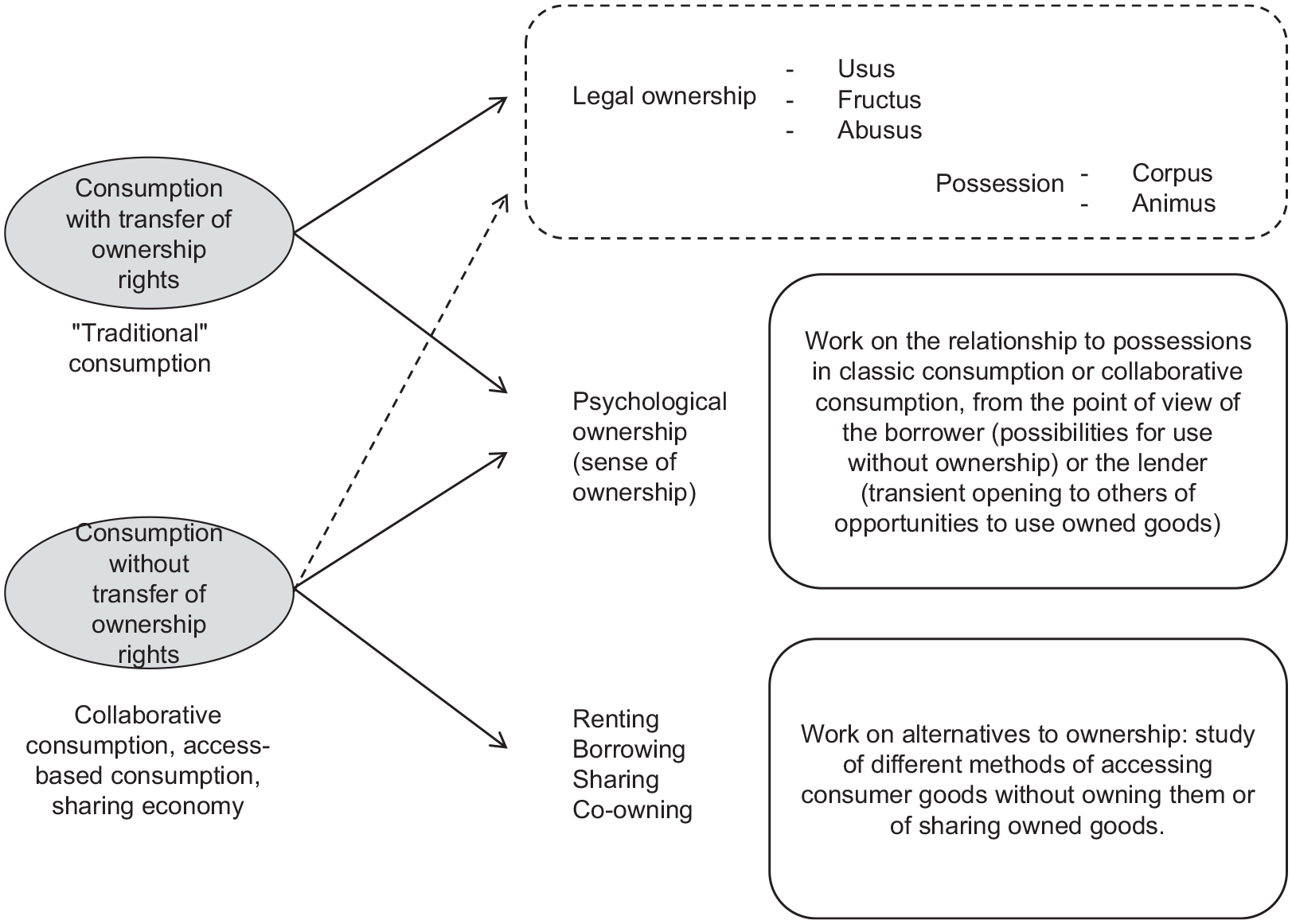
‘Legal’ ownership – a blind spot in marketing research.
Methodology
To answer these questions, the research undertaken follows a socio-anthropological investigation protocol, attentive to the meaning of consumers’ experiences (Okely, 2013; Robert-Demontrond et al., 2018). In order to understand the meanings attributed to the ideas of ownership and possession, we conducted an ethnographic field survey of the collaborative economy, a method particularly suited to this investigation in that it places the question of ownership – or rather the calling into question of ownership – at the heart of its model. As this field covers a very wide variety of practices, we approached it through three types of goods (housing, boats, clothing), which, on one hand, give rise to strong emotional commitments and, on the other, are seeing the development of new markets that represent a strong departure from conventional practices and traditional expectations (e.g. shared housing, boat sharing, fashion libraries). In the different fields surveyed, we were able to observe the practices of and speak to consumers who have chosen to move on from possession or the exclusive use of certain types of goods, and who occupy different positions in their relationship to the objects: owners, co-owners, tenants, co-tenants, lenders or borrowers (cf. Table 2). In each of these fields, the goods considered (housing, boats, clothing) provided access to interesting informants due to the novelty of these practices, with the survey looking at all of their collaborative practices, then exploring their relationship to property on a more general level, even outside of any collaborative practices. The investigations were completed by continuing the empirical investigation in secondary fields (community gardens, peer-to-peer rentals, car-pooling, etc.).
The three attributes and characteristics of the civil-law concept of the right of ownership.
Complementarity of fields in view of the object of the research.
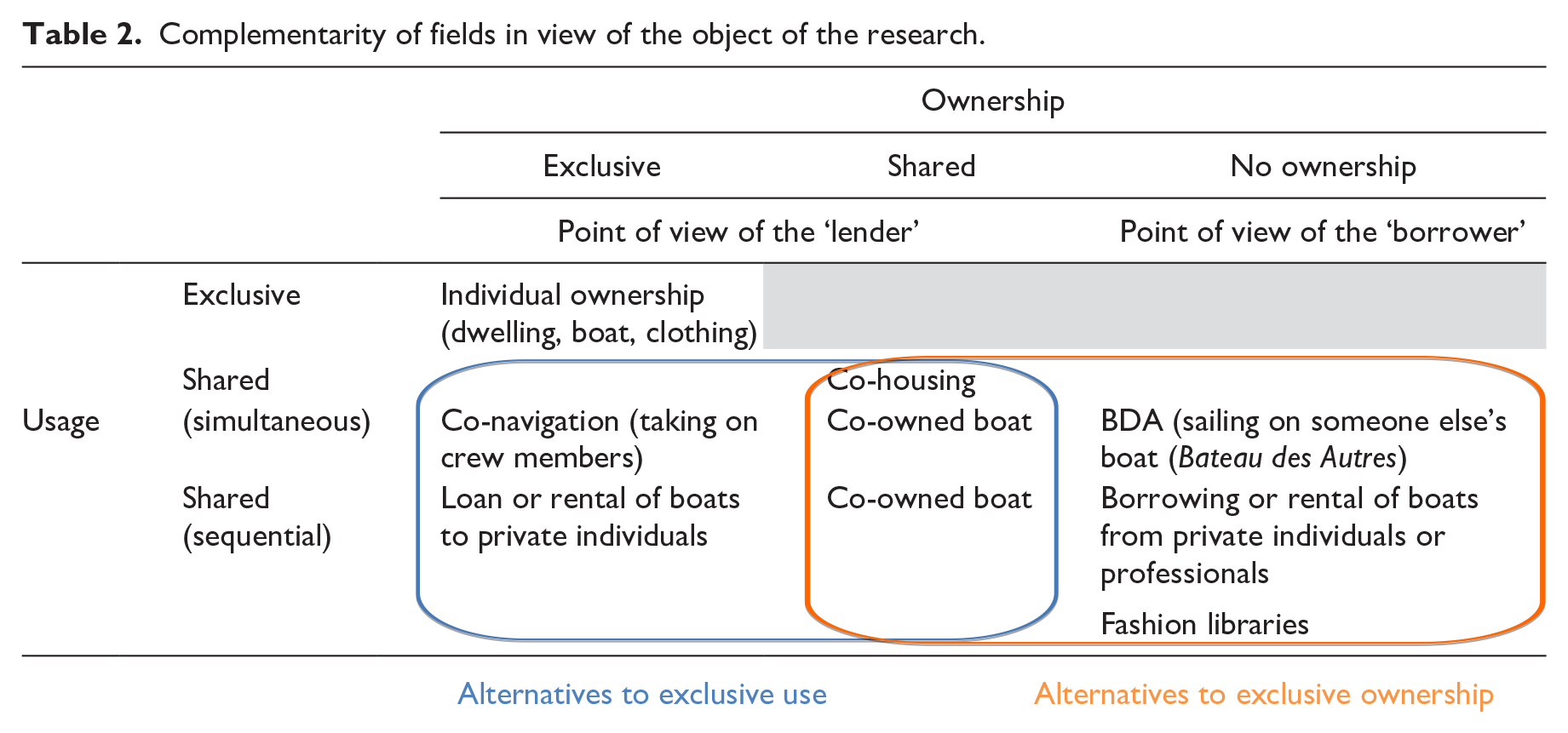
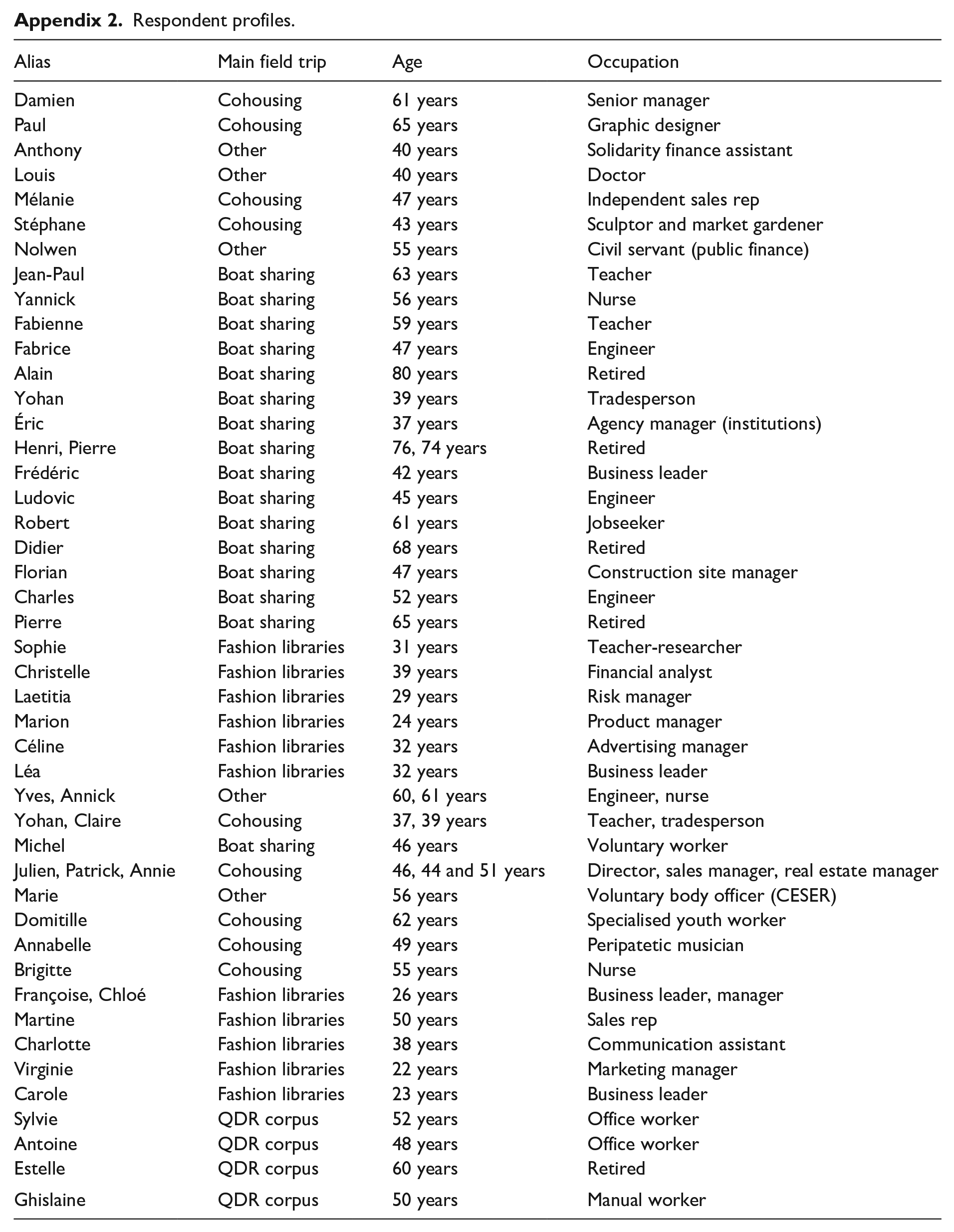
Altogether, the production of the information drew on several methods, which were cross-checked by triangulation: (1) observations (floating, participant and non-participant); (2) phenomenological interviews covering the meaning that consumers (in the three fields surveyed) give to the concept of ownership (n = 41), which lasted on average 1 hour 28 (min 26 minutes, max. 3 hour 30 minutes); (3) virtual ethnography (Hine, 2015); (4) qualitative data reuse or QDR (Bishop and Kuula-Luumi, 2017), concerning ownership and the sharing of movable goods (n = 16) and immovable property (n = 18). The floating observation (Pétonnet, 1982) was extended from 2014 to 2019, and participant and non-participant observation was also carried out over the same period (cf. Appendix 1). The phenomenological interviews carried out in our three fields were conducted with a sample of consumers with a variety of socio-demographic profiles in terms of age, gender and occupation (cf. Appendix 2). These interviews were completed with discussions, between 2014 and 2017, with professional informants (real estate professionals involved in cohousing projects, founders of boat sharing platforms, sailing professionals, founders of fashion libraries). The virtual ethnography consisted of extending the observation by studying debates and accounts given in discussion forums and blogs dedicated to new ownership relationships to objects – while keeping the focus on housing, boating and clothing.
The analysis and interpretation of the qualitative data are in line with the paradigm proposed by Spiggle (1994). Implemented as the data were produced, without relying on any pre-ordained categories, the approach followed the protocol proposed by Paillé and Mucchielli (2012), proceeding by thematic analysis and then by construction of conceptualising categories in order to give meaning to the data collected. The coding was done manually and therefore evolved with the continuous back-and-forth between empirical field work and theorisation, progressively constituting the corpus of data and successive interpretations. The quality of the coding process was assured by following the protocol for checking the clarity of the categories identified (Thomas, 2006). The analysis of the data having revealed an opposition between a dominant paradigm and an alternative paradigm in connection with the relationship to ownership, we used a theoretical framework based on the opposition between DSP and NEP in order to go further in the problematisation of the research findings. Triangulation of the researchers involved in data collection and interpretation provided empirical and theoretical perspectives as well as varied insights and also guaranteed the robustness of the analyses by continuous discussion. A focus group was organised with the informants on completion of the analysis to inform them of the research findings and get their comments.
Results
The first finding of our empirical work is that, in spite of the development of collaborative practices, ownership still plays a central role. Although it is sometimes ‘replaced by usage’ (to use the expression used by actors in the collaborative economy) for certain goods and in certain situations, many objects remain the property of a single person. When that person chooses to make them available to other users, individual ownership remains; it is the use of the thing owned that changes. Furthermore, in spite of the increase in the possibilities for renting or sharing, most of the individuals met in our different research fields remain the owners of the majority of the objects they use in their daily lives and are – or would like to be able to be – the owners of their homes. Although no significant decline in the importance given to ownership was observed, our empirical work did reveal a change in the way it is viewed. This survey, which enabled us to explore the representations connected to the concept of ownership, did in fact reveal the emergence of some cultural changes in this field. Here we present the deviations observed from the DSP and its concept of ownership as an absolute, exclusive, ‘inviolable and sacred’ right. The first part of these findings looks at the meanings of the status of owner, the second at the transformations of the concept of ownership, with a focus on the gaps found between the representations emanating from the field and its institutionalised definition.
What being an owner means here
Our ethnographic survey and the anthropological analysis of the data collected have enabled us to better understand what is concealed behind the apparent devaluing of the notion of ownership conveyed in the discourse of the promoters of collaborative consumption. We present here the representations observed using the analytical framework developed by Gosselin (2010), which distinguishes three modalities (and six sub-modalities) in the statements. The first corresponds to descriptive statements and assertions (here, about what being an owner means) for which the validating instance is objective (‘alethic’ statements) or subjective (‘epistemic’ statements). The second modality corresponds to value judgements, that is to say to objectified evaluations of the laudable or blameworthy nature of the thing judged, with reference to norms, legitimacy criteria related to moral, legal institutions, and so on (‘axiological’ statements) or to subjective evaluations of whether or not it is desirable (‘appreciative’ statements). Following this model, we set out here the representations of the ‘good’ and the ‘bad’ owner, but also the conditions that enable ownership to be legitimised. The final modality corresponds to injunctions, referring sometimes to the expression of a subjective wish (‘boulomaic’ modalities) and sometimes to a moral or social order, a system of rights and duties (‘deontic’ modalities) to express what ought to be (i.e. here, what an owner ought to be). These findings reveal, in the representations of ownership, both a line of continuity with the DSP and some signs of breaking away from it.
Descriptive level
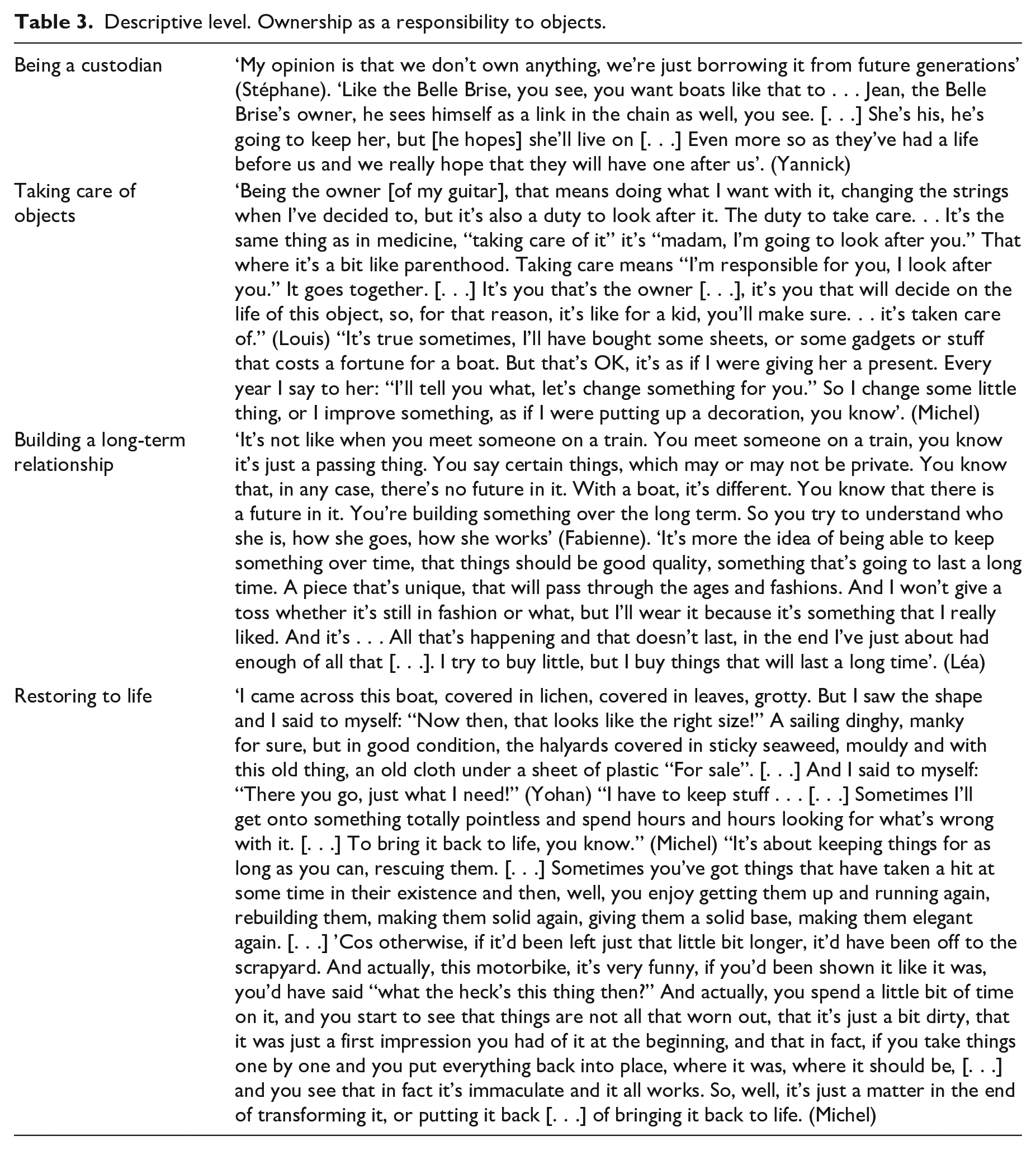
In spite of the socio-cultural development of discourses positing the idea that possessions can individually constitute a burden (financial in particular) or a physical impediment to mobility – contrary to the ideology of ‘agility’ – the notion of ownership, being an owner, turns out to be largely tied in with a feeling of freedom – the freedom experienced in the relationship to the things owned. The second idea is that being an owner is also associated with the search for security, particularly in the housing field. However, our survey reveals the emergence of other meanings that do not exclude the first ones, but profoundly change the way ownership is seen. Indeed, beyond the security and freedom that this status can provide, ‘when you are an owner, for a start you’re ultra-responsible,’ explains Jean-Paul. If in the dominant paradigm, being an owner is often associated with a notion of responsibility – that of managing your assets well, leaving them to your children, and so on – the meaning given here is different. It fits in with a vision of the world characterised by a realisation that, unlike consumption, ‘the planet is not getting any bigger’ (Stéphane). Since resources are limited and starting from the principle that ‘there isn’t just you on the planet’ (Louis), being an owner represents a responsibility towards the objects and towards other people (Table 3). From this perspective, considering that any object that is damaged or abandoned is depriving the rest of humanity of access to the resources it represents, the owner is in fact only the custodian of the goods they possess. Put another way, being an owner here means being responsible for the transmission of the goods owned to their future owners, and more widely to future generations, which in practice means fulfilling the duty of taking care of them. It means building a relationship with the objects over the long term and, when the opportunity arises, knowing how to bring them back to life.
Descriptive level. Ownership as a responsibility to objects.
Evaluative level
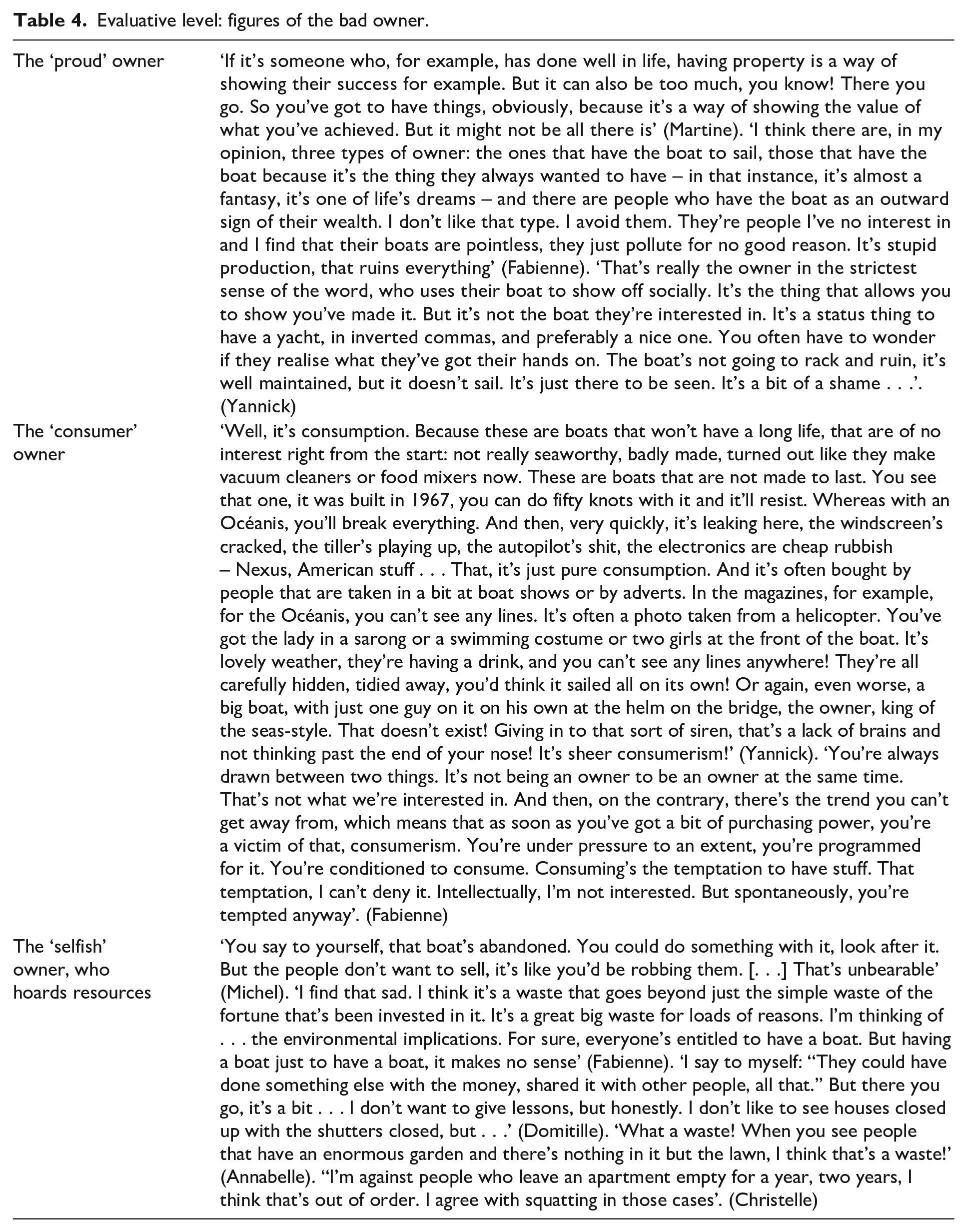
In the dominant social paradigm, being an owner is associated with a sign of success. The development of forms of collaborative consumption rooted in the DSP has created a new form of distinction, which values the figure of the ‘smart owner’, who optimises the usage and profitability of their goods and, on the contrary, devalues the owner who leaves their investment to lie dormant. Our field work shows that there is a quite different hierarchical configuration. In this configuration, the good owner is presented as ‘someone quite responsible, [. . .] someone who wants to share the benefits, [. . .] someone generous’ (Michel). As for the bad owner, they are portrayed as (1) proud, drawing satisfaction from the ostentatious nature of ownership; (2) a consumer, someone who acquires objects that will not last, after giving in to the sirens of the consumer society; and (3) selfish, someone who is only interested in the pleasure they can get out of goods, without worrying about the waste of resources that their exclusive nature and the resulting non-use may represent (Table 4).
Evaluative level: figures of the bad owner.
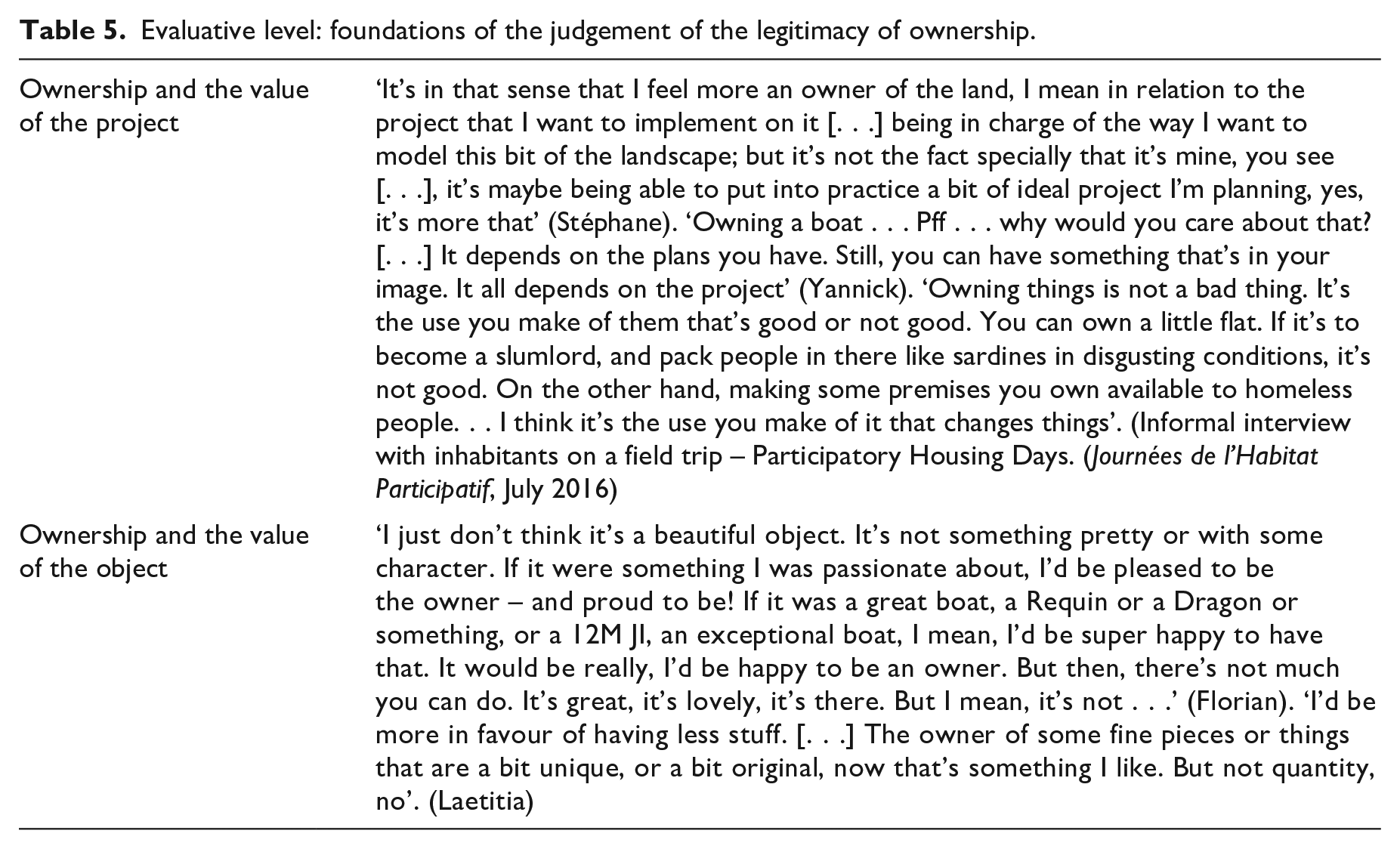
Ownership is found to be legitimate here subject to certain conditions, all of them linked to an idea of vulnerability: vulnerability of projects on one hand, vulnerability of objects on the other. The first point corresponds to a characteristic feature of the DSP: the idea that only ownership allows the actor full control over the material resources required to implement their projects. Ownership is the guarantee of instantaneous availability that means projects can be implemented at any time. As long as there is actually a project: this is an important requirement, which distances the relationship to ownership observed here from the DSP. In the absence of a perceived project to be secured or guaranteed, ownership is not justified. The second of the conditions identified is to do with the vulnerability of objects. Possessing an object perceived as unique, needing to be protected or safeguarded because it is irreplaceable and perishable, is therefore found to be justified here. Owning it is entirely legitimate when one is its custodian – when one has a project for it, not a functional one, but one of conservation, preservation. The relationship to time then becomes central: if ownership allows an object to last over time, then it is moral, a good thing (Table 5).
Evaluative level: foundations of the judgement of the legitimacy of ownership.
Injunctive level
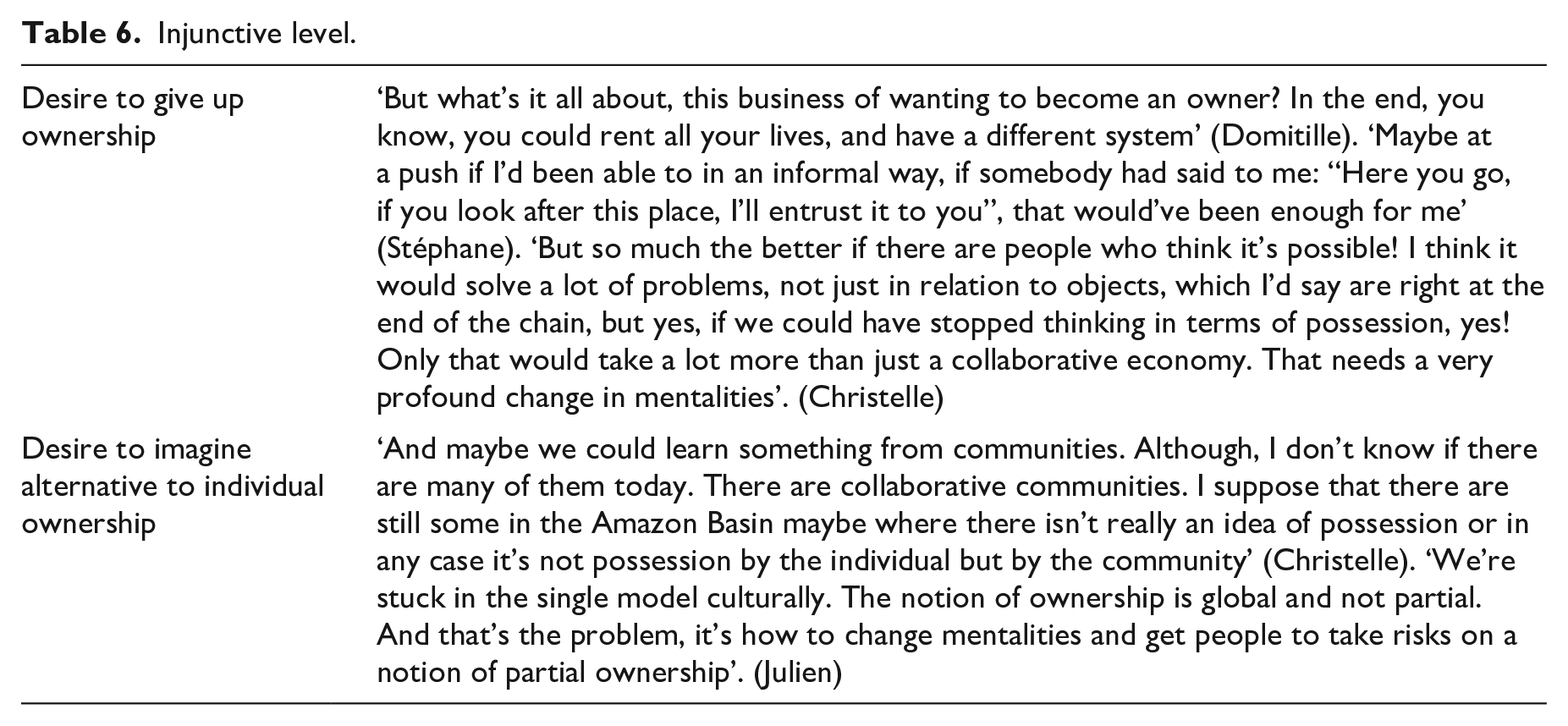
Whereas the dominant discourse of the collaborative economy presents ownership as an idea from another age (Posséder c’est dépassé! (owning is out of date) FING, 2014), our survey shows, first, the expression of a questioning of its still unavoidable nature in many areas and a desire to find viable alternatives to it, and second, a desire to invent new forms of ownership that are less individualistic (Table 6). On the first point, independently of the utilitarian, economic or social dimensions that justify the ownership-usage trade-off in the dominant paradigm, what is involved here is a desire to ‘stop thinking in terms of possession’ (Christelle), in spite of the difficulty that this change in the way of thinking represents. Domitille, who expresses her desire to leave behind the societal model of ownership as the only defence against insecurity, is aware of the difficulty it represents: ‘I could have stayed with that idea, told myself that I would always be renting, but I just can’t. I need that security’. On the second point, in view of these findings, the expression of a wish to invent new forms of ownership is emerging, intended to be more collective and inclusive than individual and exclusive, such as the residents’ cooperatives that are developing in cohousing projects. In this field, our observations (Box 2) reveal a constant concern to combine private spaces and shared spaces as harmoniously as possible, with the idea that the two forms of ownership involved are complementary. In co-housing, where a common slogan is chacun chez soi, tous ensemble (everyone in their home, all together), individual private ownership is intended to enable individual fulfilment and preserve the necessary degree of privacy, while collective ownership is intended to facilitate living together and allow better use of resources by sharing them.
Injunctive level.
Box 2
Observation notes – articulation of private and shared spaces in cohousing projects
8 February 2014 – Visit to two cohousing projects Several associations that promote cohousing regularly organise visits to projects where construction is complete and the residents have moved in, as well as to projects still under construction. We were able to visit two sites in February 2014, where we were shown around by the residents.
The visit to the first site revealed a genuine porosity of the borders between private ownership and collective ownership.
- Description of the sites:
○ Private spaces: two buildings consisting of adjoining houses
○ Shared spaces: boiler room, laundry room, garden, vegetable patch, common room
- Distinction of private/collective spaces:
○ Private space opening onto collective space: small private garden adjoining the house with a ‘no fences’ rule, but privacy protected by shrubs/hedges; when the group of visitors walked past, one resident watched us as we passed by, another closed her curtains.
○ ‘Privatised’ collective space: shared vegetable patch divided into individual plots; here people exchange seeds, there is a shared composting area, but everyone grows whatever they want on their plot.
- Distinction of private/collective times:
○ Private use of a shared space: everyone can ‘privatise’ the common room in turn.
○ Shared use of a private space: no common guest rooms here. If needed, neighbours will lend each other a bedroom, or even a flat.
- The architecture of the site, ownership of the premises (individual or collective) and the rules that apply to their use are designed to preserve the freedom and privacy of each resident, whilst fostering a collective life, and facilitating the sharing of resources (laundry room) and the use of common areas (common room).
The visit to the second site revealed a clever articulation between the spaces: heads private, tails shared!
Guided tour given by Jean-Charles, resident.
Four houses arranged around a garden. Each house has a ‘tails’ side facing outwards, where the front door is situated, shielded from the neighbour’s view, and a ‘heads’ side facing the garden, which is the shared living space and onto which the common room opens. Therefore, everyone can come and go without having to worry about what the others see. All the houses also have patios, whose heights vary by a few centimetres. Jean-Charles is proud to tell me that when he is sitting on his patio with a cup of coffee, he cannot see his neighbour. But when he stands up, he can say to the neighbour ‘pass me the sugar’!
Transformations of ownership
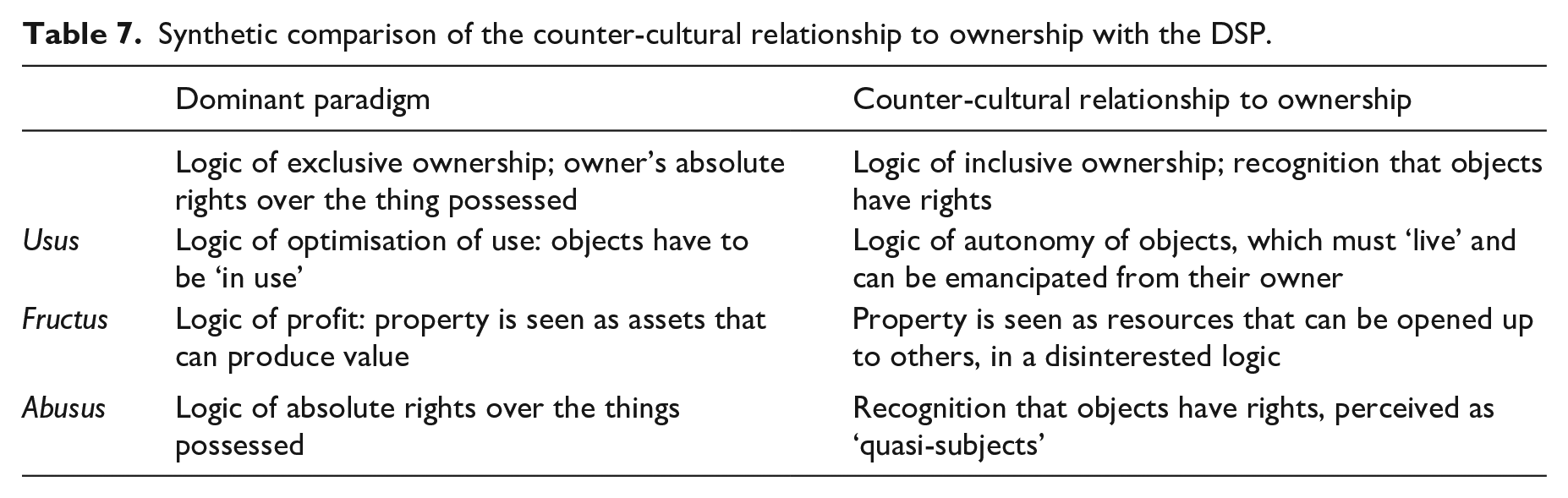
Henri reminds us of the fundamental nature of ownership: ‘It’s in the Declaration of the Rights of Man. I discovered that a few years ago, I was totally surprised. Because, for me, the Declaration of the Rights of Man was about liberty and equality. But in fact, in the second paragraph, there’s the right of ownership. So the word “ownership” comes up straight away – that proves it’s a fundamental thing!’ Although our findings show that – contrary to what is claimed by certain promoters of a system supposed to be founded on the renunciation of ownership in favour of usage – ownership remains a pillar of our society, they reveal that the meanings associated with this concept are changing. In the dominant culture, ownership remains, above all, the right to do what you want with what you own. Including neglecting or leaving your property unused, as Michel points out. ‘It’s like a second home, where the shutters are closed all the time. But at the same time, the owner, if they have the means and they want to, can live perfectly well with the shutters closed and never come to their home. [. . .] You can’t stop someone owning something and doing what they want with it’. The development of collaborative consumption, but also, at a deeper level, a realisation that the world – and the objects that make it up – cannot belong to us completely, are instilling changes in the way people think about ownership. Indeed our study reveals deviations from the institutionalised definition of ownership. These findings are reported here broken down into the attributes of ownership derived from Roman law: usus, fructus and abusus.
New forms of logic and practices relating to usus
With the development of collaborative consumption, the multiplication of the possibilities for optimising the use of goods is tending to transform into an injunction the idea that they must be ‘in use’. Accordingly, the idea of ‘sleeping’ boats, empty flats and houses, and even unworn clothes is more and more difficult to accept. Beyond any economic considerations, the under-utilisation of goods is also criticised due to the social and ecological consequences. ‘In the city, I find it terrible: vacant offices, empty flats and people who say: “Yes, but it’s too much worry! Regulations for this, regulations for that . . .” For goodness’ sake, it’s not right! They should get rid of them in that case!’ says Domitille indignantly. Having become aware of the environmental impact of the textile industry, Virginie thinks that clothes should not go unused and has even set herself targets in terms of usage. On the feelings that the clothes hanging in her wardrobe inspire, she explains: ‘Now, I find it’s a shame. Before, I used to like it, because I was saying myself: “Wow, I’ve got lots of choice”. Whereas now, I think it’s just a waste. [. . .] When I see the clothes sleeping in my wardrobe, I say: “No, somebody should be wearing them, at least fifty per cent of the time, I mean”. “If we can see this a sign of the balance tipping towards the NEP, another, deeper change is at work, in the relationship to objects: beyond the idea that they should be “in use”, for some the idea that they should “live” is imposing itself. “Keeping them alive is very important to me. There are people who have loved these objects and rather than being thrown away, they will live on’ (Estelle). In the field of boat sharing, some respondents point out that the strong relationship of attachment – an intimate, even osmotic relationship – that is established between a boat and its owner cannot exist when you are just a crew member or renting it. Ownership gives objects a soul and allows the establishment of a living relationship between them and their owner. Fabienne explains the lack of a living relationship with the boat someone lent her: ‘I wasn’t intimate with this boat [. . .]. And then there was no commitment. It wasn’t “my” boat. I wasn’t the owner, so it was just a thing. It was less alive, so to speak’. In the fashion libraries field, the idea is expressed that clothes have their own lives and therefore never belong completely to their owner. Clothes must not stay in a wardrobe. For Martine, ‘an item of clothing is something that has to live. [. . .] It’s something that has to continue on its way and in fact, precisely [. . .] What I mean is if somebody else is wearing it, it’s living’ (Martine). Ownership is no longer thought of as an absolute, exclusive right to the thing: the object possessed must be able to regain its autonomy and go on its way. For Virginie, fashion libraries are interesting because they allow clothes to ‘exist in different outfits’ and to be emancipated, in a way, from an owner who would claim exclusive rights to them. Objects, finally, have a life that deserves to be known: ‘I’d like, I’d like to know. And then [this chest of drawers] I’d like to see it, if could, but it’s impossible, at the time it was made in its first room [. . .] that it was designed for. And then see it every year, through the centuries, what objects were placed on top of it, how it has lived, in the end’ (Ghislaine).
New forms of logic and practices relating to fructus
The rise of the collaborative economy, which is enabling consumers to turn their goods to profit (by renting them out, for example), is tipping a large number of consumer goods into the ‘means of production’ category. Henri’s account is particularly revealing of this vision of things: ‘I don’t know how many hundreds of thousands of boats there are in French marinas that only sail one week a year . . . It’s grotesque, the Return On Investment! You’ve got a mooring in the marina that costs a fortune, and personally, it turns my stomach when I see all these boats that don’t move. I already find it a shame if a factory isn’t working day and night, with all its great machines, but boats that go out one week in fifty-two, it’s a disgrace! I think there must be ways . . .’ Our empirical work reveals the emergence of alternative logics relating to fructus, disconnected from any search for profit. Alain, who for a long time rented out his boat, and who can no longer go sailing very often, keeps it and take great care of it, in spite of all the expense involved. It is the existence of the boat in its own right that takes precedence over the rest: ‘in the end that’s why I used to rent her out. I was pleased for her to know that she was out sailing’ (Alain). The logic of profitability sometimes gives way to a logic of sharing. Rather than being means of production, the goods owned then become a medium for social relations based on solidarity. Within cohousing projects, the common areas allow residents to ‘share time together, share values, open up to others, discover another way of life and [. . .] create a space where everyone can come’ (Julien). Sharing objects also strengthens the bonds between residents: ‘if you’re haven’t got a tool, you go next door [. . .] it’s not much, and yet it’s a big thing. And it creates ties’ (Domitille).
Reconsidering abusus
In the DSP, ownership is commonly associated with the idea that everyone is free to do what they want with the goods they possess, including to give them away or sell them to anyone they choose, or even to destroy them. Which historically and institutionally, corresponds to the right of abusus. ‘Then you can do what you like. If you destroy it, that’s your problem, you own it’ (Sylvie). If, structurally, the development of the collaborative economy does not alter this logic, it does make the destruction of goods less culturally acceptable. ‘I find that we’re in a society where we consume, we take things, then throw them away, we take them, we throw them away, we don’t repair things, as soon as something’s damaged we chuck it in the bin, we waste a lot and I think it’s a shame’, says Laetitia, who prefers to sell or give away things she no longer needs. Our empirical work shows, however, there is a deep break from the cultural norm in terms of ownership (Table 7), by revealing that some people are even questioning the right to ‘dispose’ of their property. This is in line with a vision of the world marked by the finite nature of the planet’s resources, in which the notion of respect for objects dominates. ‘You have to be careful what you do. We destroy everything. It’s what I was saying. It’s housing, it’s food, it’s clothing’. (Martine). This idea of paying ‘attention’ to things leads to a calling into question of the very idea of selling. Talking about the acquisition of his boat, which he bought second-hand, Yannick explains that the previous owner ‘didn’t sell it like you sell a second-hand car. He passed it on to us, transferred it – I don’t know what word to use – he transmitted it, more than sold it. And I think that’s an important notion’.
Synthetic comparison of the counter-cultural relationship to ownership with the DSP.
Discussion
According to Rouhette (2017), ‘the outline of ownership is analysed as a relationship of belonging between an object and a subject; but is clear that both the subject or object and the relationship can cover widely varying realities’. This is precisely what is highlighted by our findings: the co-existence, interpersonal and intra-personal, of varied interpretations of the relationship of ownership, of the definition of belonging, of the subject’s rights and duties towards the object, of the very definition sometimes of which, subject or object, is owned by the other. Our ethnographic observations thus reveal the presence on the sidelines of the dominant social paradigm, of ‘singularities’ – concepts of unexpected ownership relationships, in light of the academic literature. These relationships consist not only of rights, but also duties – duties of the ‘owner’ subject towards others, towards other subjects, present at the horizon of possession and conditioning its exercise; duties to the object itself, treated in practice as an ‘other’, acquiring during the course of its existence a relational status as a quasi-subject. Here we have a whole range of ‘paradigmatic anomalies’, which open up new perspectives on the possible alternatives to the DSP.
Singularities of the possessive in ‘possessive individualism’
Whereas, according to the DSP, ownership is above all envisaged from the perspective of the exclusive rights of a subject over an object, the ethnographic study of the experience of this relationship reveals the existence of an intersubjective dimension – of an inclusive logic. This relational regime with regard to objects envisages ownership according to an imagined construct other than that of exclusivity and the all-powerfulness of the individual over the objects, and other than that of the sharing of objects by the collective opening up of a logic of access to their usages. What is involved in this alternative, which has been thought out and put into practice, is a regime of subjective rights and duties, attentive to the interest of the other, who takes it into consideration by assigning a self-limitation on the possibilities of action on the object. From this perspective, the experience of ownership is completely out of step with the institutionalised definition – summed up by Bocquillon and Mariage (2016) in a formula that neatly outlines the paradigmatic situation: ‘the notion of ownership/property [the French word propriété meaning both] is based etymologically on the uniqueness of the owner; the word comes from the Latin proprius meaning particular, not shared. Indeed ownership allows the owner to manage their property according to their own plans, protecting it from interference by third parties’. Unlike this primary concept, what we have seen in our ethnographic fields is the deployment of a relational regime with regard to objects where ownership is experienced as something open to others – and not closed off from them. Ownership is experienced here with a continuous sense of the other, an expectation of their future presence, the acknowledgement of their right to use the object owned. The owner here does not think of themself as such – they do not think of their relationship to the object on the institutionalised register of rights – in particular they reject abusus. The owner here simply sees themself as a ‘custodian’. Or better still they see themself as someone who ‘passes on’ objects. This status, based on an intuition of duties towards future subjects, confers on them some immediate duties towards the objects owned, to pass them on to others, to transmit. Duties of preservation, upkeep, conservation, which position the relationship to objects in total contradiction with the DSP, as enshrined in legal doctrine: ‘the owner bears no duty to conserve them to comply with rights higher than their own’ (Rouhette, 2017).
What is interesting in this inclusive ownership regime is the definition of the future other to whom the owner sees themself as passing on the object. The other here is not the socially usual ‘aggregate extended self’ constituted by one’s relatives, with whom ‘sharing in’ can be envisaged as a form of joint possession (Belk, 2010). Nor is it ‘sharing out’ (Belk, 2010) or ‘stranger sharing’ (Schor, 2014), strangers to whom the collaborative economy extends the sharing circle – until now limited to known people and often even trusted people (Frenken and Schor, 2019). It is a radical, anonymous other that is envisaged. The perceived duty of transmission is thought of as concerning an indefinite circle, wider than the family circle. And that in itself generates a deep break with the individualistic, Roman law-based imagined construct that currently dominates. What comes through, in our observations, is an alternative imagined construct in which ownership is relativised by ‘regard for others’ and moralised by the idea of a ‘right of scrutiny by others’.
Ownership is relativised by ‘regard for others’: custodian-owners spontaneously reduce their rights over things in favour of an unknown other, whose advent is expected – respect for their potential needs dictates the appropriate usages, which are limited. Ownership is moralised by the image of others, by imagining that there is a ‘right of scrutiny by others’. Here the scarcity of resources is a salient issue in the imagination of consumers. It does not activate, as the DSP predicts, a logic of competition – of which private-exclusive ownership is one of the expressions. On the contrary, scarcity induces a logic of cooperation which is expressed in a private-inclusive concept of ownership. It is about giving others shared rights over objects.
Singularities of the individualism in ‘possessive individualism’
Discourses on the development of the collaborative economy have focused attention on the idea of a break between two types of relationship to objects, one resting on ownership, the other on access, the former valuing possession, the latter dispossession. Our findings reveal a more complex reality, which goes beyond the binary opposition between the regime of ‘having’ and that of ‘being’, and show that they coexist with a third regime: that of ‘being with’ – ‘being with objects’, ‘being with what we have’. In the same way as we highlighted the existence of an inclusive ownership regime as a third way, on the sidelines of the dominant models of exclusive ownership and the sharing economy, the ‘being with’ regime is presented as an alternative to absolute ownership and to the demise of ownership in favour of access. In this regime, scale is not measured in terms of the extension of material possessions, nor of diversity of experiences – multiplied, thanks to collaborative consumption, by the possibility of accessing without possession the material media for these experiences. It is measured instead according to the quality of the relationship to the object and rests on a vision of ownership that is not a relationship in which the subject has power over the object, but is a symmetrical relationship between subject and object.
Our results coincide in this respect with the studies on the renewal of ownership that highlight the calling into question of the dominant ownership model – ‘which identifies the owner with a sovereign and creates an exclusive link with the object for the subject’ – and outlines it, in legal thinking, as ‘a progressive abandonment of the idea of the absolute power of a person over an object’ (Guibet-Lafaye and Vanuxem, 2014: 269). The representations of ownership presented in our findings do indeed demonstrate the importance of the respect owed to objects, whose owner is a simple custodian, as well as the renunciation of abusus. The destruction or abandonment of an object are indeed not acceptable in a world where resources are limited. The owner therefore no longer exercises absolute power over the goods they own, and the owner’s duties towards the object give the object rights in return. The symmetrisation of the relationship to objects renews the concept of the owner as it does that of the user. Indeed, beyond the legal and economic shift that devalued the status of owner in favour of that of user, we can see here an anthropological change that devalues, not ownership, but the asymmetrical logic in the relationship to things that exists in the traditional concepts of owner and user.
Although numerous marketing studies have shown the strength of the relations that can be established between objects and their owners, particularly for ‘special’ possessions (e.g. Hill, 1991; Price et al., 2000; Wallendorf et al., 1988), for sentimental reasons, or because objects have come to be viewed as part of the extended self (Belk, 1988), our research reveals another facet of this attachment, which resides in the moral contract and the resulting notion of responsibility that binds owner and object owned. Thus, as our respondents mentioned, it is important that objects live and thrive in a protected framework. Here we find an idea that has been developed in studies on the life of objects (e.g. Beldjerd and Tabois, 2014) which highlights in certain hoarders of domestic objects a form of benevolence towards objects, which can go as far as a ‘concern for the fulfilment of “domesticated” goods’ (p. 56), as well as the ‘existence of obligations generated by the objects themselves, and, in addition, situated beyond a strictly instrumental and egoistic horizon’ (p. 58). Our work goes further, revealing the nature of the link established by the relationship of ownership, which could be compared to a marriage contract, to which both parties commit for better or for worse. Ownership is a binding link, and what our respondents are refusing is the idea denounced by Saint and Exupéry (1943) that ‘the ties of love that bind the man of today to Beings and to things have so little tenderness, so little density, that the man no longer feels absence as he once did [. . .]. In this age of divorce, we divorce from things with the same ease. Refrigerators are interchangeable. And so is the house, if it is no longer any more than an assembly’.
This third ownership regime, which is neither that of absolute ownership nor that of its eviction by usage, rests not only on different representations of the subject–object relationship, but also on different representations of the subject and the object. In this symmetrical relationship which binds it to the owner, the object acquires rights. It is no longer thought of as an object, but as a quasi-subject to which the owner owes respect and protection, like spouses who ‘owe each other respect, fidelity, support and assistance’ (Article 212 of the French Civil Code). In this paradigm, which is at variance with the traditional vision of the social world as a world of interpersonal relationships, it is important to defend things (Olsen, 2003), to make them manifest and enable them to be respected (Miller, 2005: 38). It is about ‘widening the circle of the human’ (Holbraad, 2012) – revisiting the ontological division between things and humans, erasing the line that divides them (Latour, 2005; Pinney, 2005). It is about thinking of things as having ‘biographies’ (Kopytoff, 1986), or recognising that they have their own ‘social lives’ (Appadurai, 1986). It is about considering that things have histories, futures – that they evolve.
Our empirical work materialises the proposals of theoreticians who defend the plan to extend human rights to things (e.g. Sørensen, 2013), an idea that relies in particular on the observation that heritage management already elevates certain non-humans to the status of respectable ‘beings’. This proposal to develop a new ethics, which demands that things be admitted ‘to the privileged house of humanity’ (Olsen and Witmore, 2015), seems to be materialised in the vision of the world of individuals that extends to objects a posture already commonly admitted for nature. That is to say ‘the questioning of a hypostatised nature from which humans have stepped back to regard it from above so as to know and control it better’ (Descola, 2015). And in the same way as a certain popular wisdom acknowledges that ‘we do not inherit the earth from our parents, we borrow it from our children’, we also borrow from them the objects that constitute the material world, giving the owner the status of ‘custodian’.
A model of cultural change in progress
At another level of analysis, our observations allow an original model to be drawn of the opposition between the DSP and this socio-cultural alternative that the collaborative economy wishes to constitute – a descriptive model of the dynamics of that opposition (Table 8).
Analytical framework of the counter-cultural dynamic.
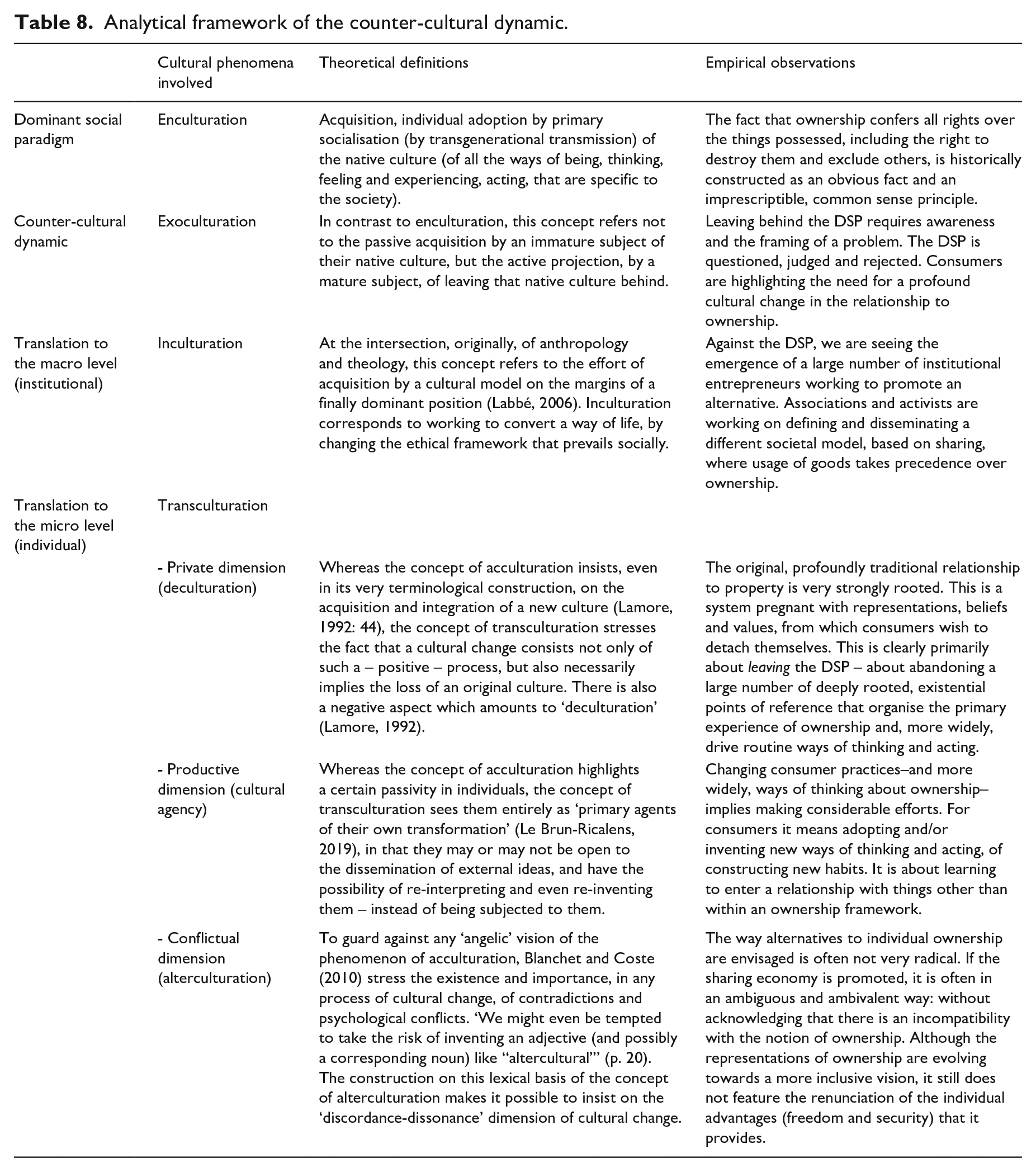
The original relationship to ownership, possessive individualism, is typical of a logic of enculturation. Framed by legal institutions that are part of the DSP, the relational regime with regard to objects thus learned tends to see the exclusivity of private ownership of objects and the absolute nature of the attached rights as obvious common sense (George, 2016; Girard, 2016; Guibet and Lafaye, 2014). The collaborative economy, on the contrary, in its development, is a product of the invention of a new ‘Form of Life’ to use the expression coined by Wittgenstein (1953) – in a counter-culture logic explicitly opposed to the dominant culture (Combes, 2005). This opposition operates on different scales – institutional and individual, respectively.
At the first macro level, the relational regime with regard to objects projected by the collaborative economy, an alternative to the original regime, is vying for hegemony by seeking to erase the notion of ownership in favour of logics of access, usage and sharing (Belk, 2010; Botsman and Rogers, 2011; Rifkin, 2000). What we are then dealing with, typically, is a socio-anthropological process of the ‘inculturation’ type. At the second micro level, the current prevalence of the concept of acculturation in the academic literature means that we are inclined to think only from this theoretical perspective about the ongoing process of acquisition by consumers of the ideas associated with the collaborative economy. However, what our ethnographic study reveals invites us to mobilise a different conceptual scheme. What is happening today corresponds more precisely to a logic of transculturation. This concept, which captures the phenomenon of cultural change across several dimensions (private, productive and conflictual), allows a more accurate description of the efforts made by the actors observed, and their difficulties, to change their consumption practices and, more widely, their way of thinking about ownership.
The weight of the historically dominant culture is evident in our ethnographic observations. Both the discourses and practices scrutinised highlight, even with the people seeking to invent or develop other relationship models, other ways of being and doing things, the prime importance of a representation of ownership as an absolute and exclusive relationship. Their imagined construct remains heavily marked by the persistence of an ‘absolutist’ concept of the right of ownership – and by the very particular place still given today by legal doctrine and by case law to the ‘right to exclude’. What our ethnographic study reveals therefore is the development of a logic of ‘exoculturation’, a neologism we propose to use to refer to this deliberate desire to break out of the dominant social paradigm.
Contributions and perspectives
Theoretical contributions
In response to the economic, environmental and social crisis facing the capitalist system, various alternatives have recently been put forward, all of which advocate the idea of a break with the ékhō-logic – a break with the societal model centred on individual ownership. Sharing economy (Novel and Riot, 2012), collaborative consumption (Botsman and Rogers, 2011), access-based consumption (Bardhi and Eckhardt, 2012): behind all these different expressions lie projects that make great economic, environmental and social promises. A great deal of academic research has recently been devoted to grasping the dynamics of these projects. From this perspective, the founding principles and the ideological frameworks of these projects have been examined particularly carefully – the meaning taken contextually of the terms ‘sharing’ and ‘collaborative’ has been substantially questioned (Arnould and Rose, 2016; Belk, 2010, 2014b; Frenken and Schor, 2019). Curiously, the issue of ownership has until now remained in a blind spot of this developing current of research. Yet it is clearly an essential aspect. Understanding what the ‘end of ownership’ promised by these projects might mean in concrete terms implies defining what ownership means – what meanings, concepts, representations, imagined constructs are culturally attached to it. This is the central theoretical contribution of our work, which highlights the different meanings of ownership: those, deeply rooted in the dominant social paradigm, that consider ownership as an absolute, exclusive right of a person over a thing, resting on the idea of an all-powerful owner, and those arising out of an alternative paradigm, marked by an awareness of the limited nature of the planet’s resources and the end of anthropocentrism, in which humankind thinks of itself as belonging to the world and not owning the world. This takes us from a logic of exclusion to a logic of openness and solidarity, from a logic of rights to a logic of duties, the owner becoming a ‘custodian’ who passes objects on to an other that represents future generations. However, this is not a binary opposition between two systems of representations, one focused on having and the other on being, one part of the DSP, the other part of the NEP. If possessive individualism is challenged, it is because its individualistic nature is being replaced by a more altruistic dimension, and the possessiveness of ‘having’ by the importance of ‘being with’. The attachment to ownership – with a renewed meaning – on the contrary, is not diminishing, and ownership, a fundamental right, remains strongly associated with notions of freedom and security, pillars of the DSP. The highlighting of these representations of ownership, which are part of both the DSP and the NEP and marked by the difficulty of breaking away from the dominant paradigm and of thinking of ownership outside this framework, illustrates another contribution of our work: the analytical framework proposed allows any situation in which an alternative paradigm is at variance with the dominant paradigm to be studied. The problem concerning ownership, with the emergence of the NEP, lies not in the difficulty of breaking away from the system, from an ownership-based model, but of breaking away from an imagined construct of ownership, that of absolute, exclusive ownership.
Managerial and societal contributions
In spite of the multiplication, with the development of collaborative practices, of alternatives to individual ownership, this concept retains a central place in consumption. Within the scope of the collaborative economy itself – considered in its broadest sense, which includes donations and the buying/selling of second-hand goods – many transactions rest on a transfer of ownership. In the more restrictive definitions, centred on practices where consumers offer other consumers – free of charge or for a consideration – access to under-utilised goods (Frenken and Schor, 2019), the former are still the owners of the goods concerned. Finally, other forms of collaborative economy such as the cohousing project observed in the field, also rest on ownership, which can in these cases take different legal forms (e.g. the residents’ cooperative). Getting an in-depth understanding of the relationship to ownership therefore seems essential, both for the actors in the traditional economy and those in the collaborative economy, who should not let themselves be taken in by discourses announcing a loss of interest in ownership. This knowledge is a precious asset from a strategic point of view for the segmentation of the market, the identification of the sources of value for the targets chosen and the development of positions in line with these different representations. On the operational side, it is useful to develop offers in tune with consumer expectations.
In the collaborative economy field, numerous initiatives allowing peer-to-peer sharing or exchanging of goods have adopted a positioning centred on offering consumers the opportunity to optimise the use and return on investment of the goods they own. Rooted in representations of ownership that belong to the dominant paradigm, the objects concerned are often presented as assets that can produce value, that must be ‘in use’ to generate profit or reduce the cost of ownership for their owner. The highlighting by our research of imagined constructs of ownership in which objects, perceived as quasi-subjects, can take on a form of autonomy, opens up perspectives for the construction of marketing strategies – attentive to these weak signals – targeting consumers for whom it is important, above all, to allow objects to exist. Thus, the challenging of abusus and the transformations of usus revealed by our work open the way to the defining of original positioning that emphasise the possibility of ‘giving life’ to objects. This could involve, taking the examples from our field work, presenting collaborative initiatives as ways of allowing houses to breathe by opening their shutters, boats to go out on the open sea again, clothes to thrive by coming out of their wardrobes.
Our research findings identifying new meanings associated with the status of owner are also opening up perspectives at operational level. To meet the aspirations of consumers who envisage ownership as a responsibility to objects, it is up to marketing to devise offers that will enable them to fully embrace that responsibility. Thus, beyond the reflections already undertaken on the longevity of products, new avenues are emerging to allow consumers – in both collaborative models and traditional consumption models – to assume their role as ‘custodians’ by offering them the chance to invest in objects while facilitating their transmission. We could imagine, for example, in peer-to-peer rental or buying/selling systems, the possibility of adding to the description of the objects put into circulation a presentation of their ‘biography’. Objects, upstream, could also be designed to enable relationships to be built with them over the long term, and so that they can be looked after. This could be updated with objects designed to acquire a patina with time or that can be improved. It is also possible to imagine developing toolboxes, tutorials or even services to embellish, restore or bring them back to life.
Finally, our work makes a particular managerial contribution in the real estate field. Faced with the difficulty of managing co-owned properties due to a lack of collective mobilisation for their maintenance, taking into account the transformations identified relating to fructus, as well as the desire to break away from individual, exclusive ownership patterns could help with devising forms of ownership designed to foster openness and sharing. By encouraging better maintenance of the property which is then perceived as common property, these could constitute a response to the expectations of residents, landlords and local authorities wishing to foster harmonious living together and a collective mobilisation to ensure good maintenance of premises.
This research also makes societal contributions, which are inseparable from the managerial contributions. ‘Marketing [being] at the heart of human trading activities [doing things together], it can and must participate in the implementation of a more sustainable economic system producing and integrating the links that are lacking for the definition of the planet as a common asset’ note Béji-Bécheur and Özçağlar-Toulouse (2014: 8). Among the perspectives opened up by these authors, the first consists of ‘reinventing marketing in a context of limited resources’. This is precisely where the contribution provided by our work is situated. By highlighting the cultural changes relating to ownership – and more widely, to the emergence of a new ecological paradigm – it gives marketing the keys to construct offers, of which to date there are still only a few, which will enable consumers to maintain and share goods that constitute humankind’s common assets.
Limits and avenues for further research
In spite of the multiple fields investigated and the triangulation of our sources, our work had some limits, which therefore constitute avenues for further research in the future. As in any ethnographic approach, this research remains conditioned by the fields chosen, which are each encapsulated in their own culture. The ownership question is, moreover, marked by the French cultural, historic and legislative framework within which we studied it. A first avenue for expansion could then consist of carrying out a comparative study to compare with cultures which historically have had a different relationship to ownership. A second avenue might consist of varying the methodological approaches by carrying out a quantitative survey, for explanatory purposes, to identify the moderator variables of the new relationships to ownership, focusing on the generational aspects in particular.
Other research projects with a view to continuing the work done here in more depth should also be envisaged. This could involve continuing the exploratory research on the meanings maintained with regard to objects perceived as quasi-subjects, working within a current of research on maintenance, the logic of care and concern for objects and in connection with the ontological turn (Latour, 2005). Another avenue would be to go further in studying the dynamics of the cultural change allowed by Gosselin’s reference framework on the statement modalities of the representations. A closer analysis at sub-modality level would indeed allow an observation of the passage from subjective to objective in judgements, a sign of the construction of a new common meaning in relation to ownership.
Footnotes
Appendix
Respondent profiles.
| Alias | Main field trip | Age | Occupation |
|---|---|---|---|
| Damien | Cohousing | 61 years | Senior manager |
| Paul | Cohousing | 65 years | Graphic designer |
| Anthony | Other | 40 years | Solidarity finance assistant |
| Louis | Other | 40 years | Doctor |
| Mélanie | Cohousing | 47 years | Independent sales rep |
| Stéphane | Cohousing | 43 years | Sculptor and market gardener |
| Nolwen | Other | 55 years | Civil servant (public finance) |
| Jean-Paul | Boat sharing | 63 years | Teacher |
| Yannick | Boat sharing | 56 years | Nurse |
| Fabienne | Boat sharing | 59 years | Teacher |
| Fabrice | Boat sharing | 47 years | Engineer |
| Alain | Boat sharing | 80 years | Retired |
| Yohan | Boat sharing | 39 years | Tradesperson |
| Éric | Boat sharing | 37 years | Agency manager (institutions) |
| Henri, Pierre | Boat sharing | 76, 74 years | Retired |
| Frédéric | Boat sharing | 42 years | Business leader |
| Ludovic | Boat sharing | 45 years | Engineer |
| Robert | Boat sharing | 61 years | Jobseeker |
| Didier | Boat sharing | 68 years | Retired |
| Florian | Boat sharing | 47 years | Construction site manager |
| Charles | Boat sharing | 52 years | Engineer |
| Pierre | Boat sharing | 65 years | Retired |
| Sophie | Fashion libraries | 31 years | Teacher-researcher |
| Christelle | Fashion libraries | 39 years | Financial analyst |
| Laetitia | Fashion libraries | 29 years | Risk manager |
| Marion | Fashion libraries | 24 years | Product manager |
| Céline | Fashion libraries | 32 years | Advertising manager |
| Léa | Fashion libraries | 32 years | Business leader |
| Yves, Annick | Other | 60, 61 years | Engineer, nurse |
| Yohan, Claire | Cohousing | 37, 39 years | Teacher, tradesperson |
| Michel | Boat sharing | 46 years | Voluntary worker |
| Julien, Patrick, Annie | Cohousing | 46, 44 and 51 years | Director, sales manager, real estate manager |
| Marie | Other | 56 years | Voluntary body officer (CESER) |
| Domitille | Cohousing | 62 years | Specialised youth worker |
| Annabelle | Cohousing | 49 years | Peripatetic musician |
| Brigitte | Cohousing | 55 years | Nurse |
| Françoise, Chloé | Fashion libraries | 26 years | Business leader, manager |
| Martine | Fashion libraries | 50 years | Sales rep |
| Charlotte | Fashion libraries | 38 years | Communication assistant |
| Virginie | Fashion libraries | 22 years | Marketing manager |
| Carole | Fashion libraries | 23 years | Business leader |
| Sylvie | QDR corpus | 52 years | Office worker |
| Antoine | QDR corpus | 48 years | Office worker |
| Estelle | QDR corpus | 60 years | Retired |
| Ghislaine | QDR corpus | 50 years | Manual worker |
