






Abstract
Recent research studies have explored what digital platforms do as well as the behaviour they generate among users. This article builds on the existing literature by studying how P2P digital platforms are speeding up market activities and how this acceleration is shaping inter-user relationships. A qualitative ethnographic study was conducted on the secondhand clothing market from 2013 to 2020. Drawing on social acceleration theory, we show how the affordances of digital platforms encourage an acceleration in the pace of life, an acceleration in the renewal of items owned, and a technical acceleration across multiple domains. These accelerations are inciting speed-based competition between users, who must now be more responsive, more trend-conscious, and more savvy than others. The platforms also constitute a particular digital space that invites us to rethink the notion of alienation in various forms, specifically spatial and temporal alienation. In addition to these theoretical contributions, this research offers societal insights that will help users become more aware of the scale of their sped-up activities on digital platforms.
Introduction
The dawn of the 21st century was accompanied by climate change and rising inequality, 1 both consequences of a capitalist model based on competition between economic players and the over-exploitation of human and environmental resources (Klein, 2019; Latour, 2015; Piketty, 2013). Against this backdrop, the emergence of digital platforms was perceived as a virtuous alternative to the traditional commercial economy (Botsman and Rogers, 2010), particularly in environmental (Chen and Kockelman, 2016) and social terms (Belk, 2014; Robert et al., 2014). Yet it seems that those very platforms are also resulting in faster and easier commercial transactions between users. For example, in the case of secondhand clothing, P2P digital platforms encourage users to be responsive, explain how to sell their items quickly and impose fast delivery times for items sold. While we know that P2P digital platforms are having an impact on the pace of people’s market activities (Denegri-Knott, 2011), we do not yet know the effects of this acceleration on inter-user relationships. This article builds on the existing literature, showing how sped-up commercial transactions are generating competition between P2P platform users. It is important to analyse this competitiveness between users because, although competition may be an inherent part of neoliberalism, it alienates individuals without them realising it (Keucheyan, 2019). Through unveiling and objectivation (Bourdieu, 1981), we aim to help platform users perceive the social mechanisms of which they are a part so they can take informed actions. Ultimately, we wish to generate an awareness with ‘a societal dimension that directly contributes to the well-being of society in the short, medium or long-term’ (Parguel et al., 2018: 14).
The existing literature tells us that digital platforms have an impact on users (Benavent, 2016). Not only do they orient their behaviours (Kenney and Zysman, 2016) but they also monitor the extent to which they respect the rules of the game (Möhlmann and Zalmanson, 2017) and shape the type of exchanges they undertake (Perren and Kozinets, 2018).
Platforms have an impact on users, but they also offer them the potential to act through the functions made available, known as ‘affordances’ (Gibson, 1977; Light et al., 2018). Affordances make some actions possible and prevent others (Akrich and Latour, 1992). While we know how digital platforms act on individual behaviours and exchanges, very few studies have explored how they accelerate commercial transactions. Only Denegri-Knott (2011) has directly addressed the question of temporality, demonstrating that affordances speed up the cycle of desire in consumers. The author shows that by continually presenting new desirable items and enabling their rapid acquisition, platforms constantly provoke and extinguish the desires of consumers. However, she only explores the relationship between the user and the desired object, overlooking the network of users. Our article aims to fill this gap in the literature by studying the impact on inter-user relationships of the acceleration of buy-and-sell activities as driven by affordances.
To do this, we carried out a qualitative ethnographic study on the secondhand clothing market between May 2013 and May 2020. Over this 7-year period, we collected data through interviews, observations and log entries which were then examined in light of Rosa’s (2012) social acceleration theory. Our empirical study shows that P2P digital platforms are fuelling several types of acceleration, giving rise to a form of speed-based competition between users. One set of affordances is driving an acceleration in the pace of life, causing users to compete to be the quickest to respond. A second set of affordances is encouraging an acceleration in the renewal of items owned, stimulating competition to be the most trend-conscious user. The third set of affordances is driving a technical acceleration across multiple domains, leading to competition to be the most savvy user.
This research makes both theoretical and societal contributions. In theoretical terms, we highlight the mechanism of speed-based competition, contributing to the literature on digital platforms.
We show that beyond speeding up the cycle of desire among individual users, platforms have a broader impact on the network of users. Their relationships are now of a competitive nature, which runs counter to the existing analyses that underscore the formation of warm social links between platform users (Barraud de Lagerie and Sigalo Santos, 2018; Garcia-Bardidia, 2014). We further show that inter-user competition is the engine behind a self-propelled commercial system in so far as the actions of users are actually spurred on by the platforms themselves. Finally, we contribute to the literature on social acceleration by showing that platforms are a particular digital space in which we are invited to rethink the notion of alienation in various forms, specifically spatial and temporal alienation. Our research also makes practical contributions with a societal dimension. We encourage public authorities to compel platforms to add new affordances that reveal to users the scale of their sped-up commercial activities and their competitiveness.
We begin by presenting the existing literature on P2P digital platforms and their affordances, before introducing social acceleration theory. We then outline the methodology used to collect and analyse our data. Next, we provide the results of our field study in detail, before finally outlining the theoretical and societal contributions of our research.
Literature review
Agentic digital platforms intermediating market activities
Digital platforms are ‘complicated mixtures of software, materials, transactions and networks’ through which exchanges between users take place (Kenney and Zysman, 2016: 64). These exchanges come in many forms: selling, renting, lending, bartering, or giving (Jacquet, 2015; Peugeot et al., 2015). The type of access to the item or service being exchanged depends on the presence or absence of monetary compensation and the transfer of property rights (Bardhi and Eckhardt, 2012). The number of digital platforms has risen significantly since the late 2000s (Beauvisage et al., 2018; Decrop, 2017), particularly those serving as intermediaries for commercial exchanges between private users (Perren and Kozinets, 2018). The rise in these P2P digital platforms is particularly visible in the following sectors: accommodation, transport, fashion, arts & crafts and minor services (Beuscart and Flichy, 2018; Luckman, 2013; Zervas et al., 2017). When they started out, these platforms were seen as an alternative to the traditional economy because of their positive environmental impact and their capacity to create social links (Botsman and Rogers, 2010; Ertz et al., 2018). However, users primarily resort to these platforms for individual, utilitarian and economic reasons (Bardhi and Eckhardt, 2012; Padmavathy et al., 2019). Online selling provides additional revenue to the vendors (Barraud de Lagerie and Sigalo Santos, 2018; Beuscart and Flichy, 2018), enables smart consumers to find good deals (Peugeot et al., 2015), and offers unique consumption opportunities to users with limited purchasing power (Benavent, 2016; Robert et al., 2014).
Each platform has an architecture that channels the flow of information and users’ activities (Benavent, 2016). A platform’s architecture is indissociable from its affordances. First used by Gibson (1977), the term ‘affordance’ initially referred to the material properties of an artefact which open up possible ways to act (Leonardi, 2011). Later re-appropriating the concept, Norman (1988) specified that the goal of an affordance is to signal to users what the technologies available can do and how the individual can complete their actions. The concept’s subsequent diffusion led to debate and semantic nuances (Parchoma, 2014), but there is now a consensus in the literature on two core aspects. First, affordances are relational (Leonardi and Vaast, 2017). They are not merely material properties of technologies; they exist in the relationships between individuals and the materiality of the artefacts with which they interact (Hutchby, 2001). Second, affordances are preconditions of activity (Greeno, 1994). They offer users the potential to act (Leonardi and Vaast, 2017); they prevent certain actions and make others possible (Akrich and Latour, 1992). They therefore at once serve as guides and constraints for users (Bardini, 1996; Suthers, 2006). In marketing, the affordance concept is used to define the functions available on platforms that support the different possible actions users can complete (Denegri-Knott and Molesworth, 2013). So looking at affordances means paying attention to what a platform’s architecture allows and prevents users from doing, and how it guides the actions that are authorised (Light et al., 2018).
The literature has highlighted the effects of digital platforms’ capacity to act and cause others to act via their affordances. First, the affordances of digital platforms shape the format of the exchange (Peugeot et al., 2015). This format will depend on the level of the platform’s intermediation and the level of consociality it enables (Perren and Kozinets, 2018). Furthermore, digital platforms monitor users (Möhlmann and Zalmanson, 2017). Using rating systems and the ability to trace activities, platforms can monitor their users and exclude those who break the established rules of the game (Rosenblat and Stark, 2016). Finally, the affordances of digital platforms relieve users of the emotional and cognitive investment inherent in commercial activity (Denegri-Knott and Molesworth, 2013). For example, on eBay wish lists, filters and personalised recommendations reduce the level of effort required to search for desirable items (Denegri-Knott and Molesworth, 2013). In summary, affordances ensure the smooth running of platforms by guiding individual behaviours and structuring the format of the exchanges that take place.
Although we know that digital platforms steer individual behaviours, little is known about the way in which they shape the timeframes in which commercial transactions take place. As far as we are aware, Denegri-Knott (2011) is the only one to have investigated this question. She demonstrates that the affordances of eBay speed up the cycle of desire. By continually displaying desirable items, its technology fuels the passion for consumption (Kozinets et al., 2017). The platform feeds the cult of newness and constantly initiates new desires (Belk et al., 2003). However, the rapid acquisition of goods transforms the relationship between the purchaser and the object in question: very quickly obtaining what one desires diminishes the excitement generated by the desire to acquire the object (Galluzzo, 2020). Paradoxically, platforms just as quickly bring an end to the cycles of desire they have initiated and encourage the creation of new cycles (Denegri-Knott, 2011). By exploring this acceleration in the cycle of desire, Denegri-Knott (2011) takes the consumer-desired object dyad as her analytical unit. As instructive as it is, her analysis overlooks the network of users. Our objective is to pursue her reflections by studying the consequences of an acceleration in commercial activities for the network of users. Specifically, we draw on social acceleration theory to study how the sped-up transactions driven by platforms are shaping inter-user relationships.
A high-speed modern society
Rosa (2012) sees social acceleration as a characteristic of late modernity. He says it is a combination of three forms of acceleration. The first is technical acceleration, which is the ‘intentional acceleration of goal-oriented processes’ (Rosa, 2012: 18). For example, in production, this represents an increase in the number of objects produced each day thanks to the development of new machines and the adoption of more efficient organisational approaches. The second is the acceleration of social change, which is the increasing speed with which changes occur over the course of one’s life. This might be changing partners in one’s private life or changing jobs in one’s professional life. The third is the acceleration of the pace of life, which he defines as the tendency to ‘compress actions and experiences’ (Rosa, 2012: 27). This increase in the number of actions per unit of time involves shortening the breaks between two tasks or carrying out several tasks at once.
According to Rosa (2012, 2017), in late modernity people are in a constant struggle to maintain their place in the social arena. They must deploy more and more energy to remain competitive and be recognised socially. One’s social position is now indexed according to one’s accomplishments, and these must be ceaselessly repeated for people to retain their place in the world (Rosa, 2017). Because stopping inevitably results in being overtaken, each of us is forced to go faster and faster if we want to stay in the race (Rosa, 2017). The social logic of competition has generated a daily struggle that enables the fast to triumph over the slow (Rosa, 2012). This phenomenon of social acceleration governs individual behaviours in many spheres, in particular the professional, personal, political, and commercial spheres.
This general acceleration has many consequences, the first of which is the emergence of situations of desynchronisation (Rosa, 2012). This arises, for example, when human beings extract natural resources at a pace that is greater than their renewal, or when an individual works at a level of intensity that is greater than that which her body can tolerate. Such desynchronisation is a source of temporal friction and leads to a range of problems like exhaustion, confusion, and stress (Husemann and Eckhardt, 2018; Rosa, 2012). The other consequence of social acceleration is alienation, defined as a change in the way we relate to the world that favours muted and cold relationships at the expense of significant and resonant ones (Rosa, 2017). Rosa (2012) identifies five forms of alienation. Alienation from things relates to our relationship with material objects whereby these remain external, detached and non-responsive due to our tendency to get rid of them quickly without appropriating them. Alienation from actions describes our tendency to forget what we really want to do and instead engage in actions that we feel compelled to do (e.g. ticking off each item in a to-do list) and ‘consumption activities with immediate gratification’ (Rosa, 2012: 127).
Alienation from time relates to our propensity to accumulate a series of experiences that are disconnected from one another (e.g. leaving work, listening to a podcast on the subway, attending a play, calling a loved one while in public transport, etc.). Alienation from others describes our tendency to meet a large number of people without building intense and meaningful relationships with them. Finally, alienation from space describes our disengagement or disinvestment from the physical or material space in which we live as a result of increased mobility. Our research builds on the work of Rosa (2012) by studying the sped-up market practices on platforms in an effort to understand how these different forms of alienation manifest themselves, in particular alienation from space where the space concerned is a digital one. Following this literature review, we ask the following research questions: How are digital platforms contributing to the acceleration of buy-and-sell activities? And how are these sped-up activities shaping the relationships between users?
Context and methodology
To answer these research questions, we decided to explore a major market: secondhand clothing in France. The increasing levels of interest French consumers are showing in secondhand clothing and the economic stakes driven by the rise of digital platforms selling these items explain why we chose this study context. This market had an estimated value of €1 billion in 2018, and its popularity is growing according to the Institut Français de la Mode, with 39% of French consumers reporting they had purchased secondhand clothing in 2019 and 48% saying they intended to buy more in 2020. 2 This increase in popularity is fuelled by the rise of digital platforms, which facilitates smoother transactions (Benavent, 2016), offer producers direct access to their customers and allow private users to engage in buy-and-sell activities (Hamari et al., 2015). The first digital platforms specialising in secondhand clothing appeared in 2008 and since then have enjoyed rising levels of success. For example, Vinted – the market leader – is gaining 23,000 new users every day in France, with a total of 10 million.3,4 More than 400,000 items are put up for sale every day, 5 with a total of 120 million. 6
To investigate this empirical context, we conducted a qualitative ethnographic study from May 2013 to May 2020. Throughout this 7-year period, several methods were employed jointly (see Appendix 1). We conducted 19 individual in-depth interviews with female users of secondhand clothing platforms (9 interviews in 2013, 2 in 2014, 2 in 2016, 2 in 2017, and 4 in 2019). Spreading the interviews out over a long period in this way enabled us to mutually adjust our research question and data collection process as prescribed by Arsel (2017). These platforms attract young women for the most part 7 (‘Users are mostly women, and almost 60% of them are aged 18 to 29’ 8 ), so we recruited participants whose sociodemographic profiles reflected that of the majority of people who engage in these practices (Maciel and Wallendorf, 2017) (see Appendix 2). Our recruitment process combined opportunism and snowball sampling (Royer and Zarlowski, 2007). In a public location of their choosing (cafe, bar or fast-food outlet), participants were asked about their definition (perceptions and representations) of online buying and selling of secondhand clothing, about how they started out in this commercial activity (motivations, difficulties, and initial practices), about their current practices (practicalities, relationships with other users, and relationships with the platforms), and about their wardrobe (number and types of items, brands, and content management). As they all had their mobile phone with them during the interview, they were able to show us how they use the platforms. Interviews lasted between 62 and 94 minutes, with an average duration of 67 minutes, representing a total of 21.5 hours of recordings and 140 pages of transcriptions.
We complemented the interviews with online observations of three secondhand clothing platforms: Vide Dressing, Vestiaire Collective, and Vinted. There were two reasons for choosing these platforms. Not only are they the ones mentioned by participants during the first interviews, but they also correspond to the characteristics listed by Bernard (2004): (1) broad communities, (2) very active and specialised in the sale of secondhand clothing and accessories, and (3) with a core set of members. There were three objectives underpinning our online observations, conducted on the websites and mobile applications. First, they allowed us to familiarise ourselves with the practice and thereby engage with the participants during the interviews in relevant ways. Next, they generated diversity in our data to counterbalance the homogeneity of our respondent profiles (Barraud de Lagerie and Sigalos Santos, 2018). To achieve this, we paid close attention to user profiles (e.g. gender, size, region, and country) and the specificities of their practices (number of articles for sale and/or already sold, sale price, ratings, number of followers and subscriptions, and time of last connection). Finally, the online observations allowed us to analyse the affordances of the platforms. To do this, we set up a user account and navigated on the platforms as both purchaser and vendor, thereby exploring the interfaces using the ‘walk-through method’ (Light et al., 2018). We paid attention to what the different functions encouraged or forced users to do or prevented them from doing. Specifically, we identified the registration procedures, the number and position of buttons and icons, content of user profiles, alerts, pop-ups, mandatory fields, terms & conditions of sale, and payment and delivery methods available (Light et al., 2018). We browsed the platforms for a total of 550 hours between 2013 and 2020 and took 230 screenshots.
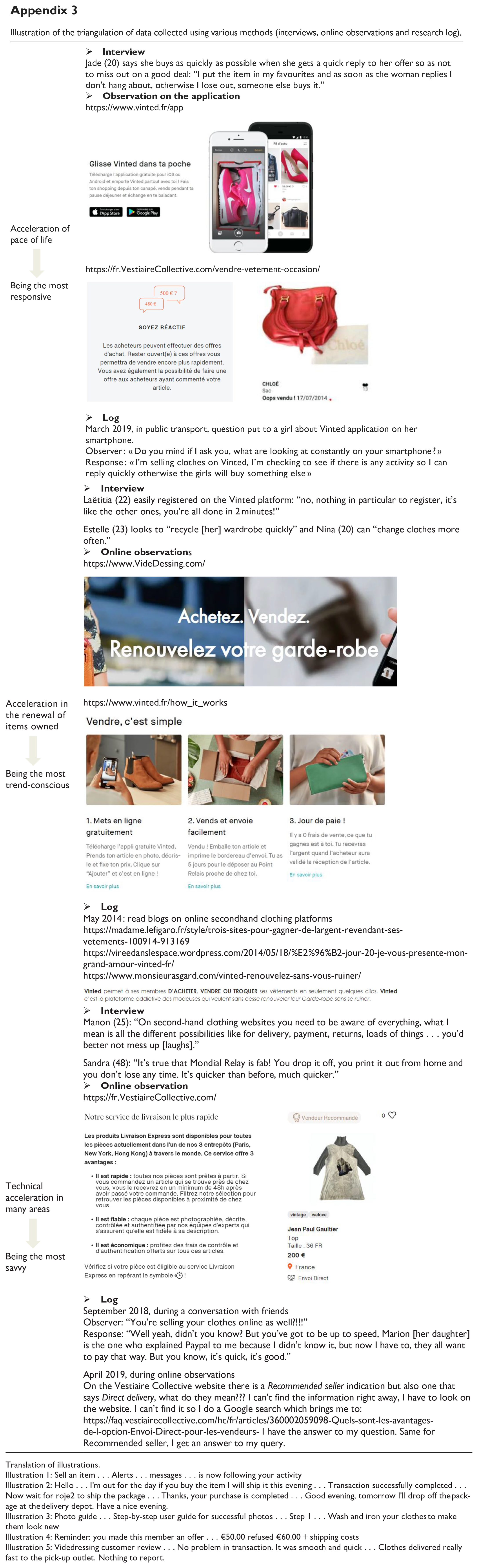
A log book was kept during the 7-year research period. Several details were meticulously recorded, in accordance with the methodology recommended by Groleau (2003). The log contains 107 pages including our online observations, memos about the users, including verbatim comments, and preliminary analyses. These details related as precisely as possible the actions and interactions recorded during our observations, as well as the informal relationships maintained with privileged informers (Badot et al., 2009). The log book facilitated our understanding of the research topic as well as offering perspective for reflections during the data collection and analysis phases (Allard-Poesi, 2015). The combined use of various data collection methods enabled us to form a consistent corpus and triangulate the data, thus ensuring robust results (Arnould and Price, 1993) (see Appendix 3).
We analysed our data using an iterative process, moving back and forth between our comprehensive corpus and the literature (Sandikci and Ger, 2010), as required in interpretive approaches (Arsel, 2017). We started with a ‘floating reading’ phase (Dumez, 2013) to understand the data in depth. We then began the decoding process with a theoretical objective to organise and give meaning to our empirical sources (Miles and Huberman, 1994; Point and Voynnet-Fourboul, 2006). For the interviews, we identified homogeneous text units from a semantic point of view and categorised them, that is, attributed a label to each one (Spiggle, 1994). For our observational data, we identified all of the affordances both in the screenshots and in our log and kept those that appeared in all three platforms studied. We also regrouped those with similar roles into analytical categories. Both for the interviews and observations, the abstraction phase allowed us to move from empirical categories to more analytical constructs (Spiggle, 1994). By comparing the literature on exploration, our interviews and the observational data, we gradually saw the emergence of links between our analytical categories and were able to highlight the mechanism that generates speed-based competition.
Findings
The affordances of the platforms studied favour three forms of acceleration that encourage speed-based competition between users.
This is visible through three imperatives: being the most responsive, the most trend-conscious and the most savvy. Although these three imperatives are empirically intertwined, we separate them for analytical purposes in the interests of clarity.
Being the most responsive
The digital platforms we studied have affordances that favour an acceleration in the pace of life. First, they use temporal markers that provide information about each user’s activities. For example, the last time they logged in is shown on Vinted, while each message sent has a time stamp on Vide Dressing and Vestiaire Collective. This information allows them to calculate a user’s response time, as shown in the following field notes: I click on her username and send her the following message (16:03): ‘Hi, I think the Sézane trousers you’re selling are really pretty! I do have one small question about the cut: is it a 7/8 cut that stops just above the ankle? Thanks, have a nice day’ [. . .] At 16:28, I receive an email from Vide Dressing entitled ‘new comment on the item Sézane carrot trousers’. I check the page directly and see that the seller has replied: ‘Hi, yes it’s a 7/8. At least for me, and I measure 1m65. Here are some photos of me wearing it to give you a better idea’.
The messages posted by potential buyers and the seller can be seen by all because the messaging system on Vide Dressing is public. Each comment shows the user name of the person who wrote it as well as the date and time it was posted. 25 minutes elapsed between the time my question was posted and the seller’s reply.
All three platforms also have a ‘holiday’ mode that allows the user to disable posts and thus avoid skewing their responsiveness indicators if they are absent. These temporal markers suggest that speed and responsiveness are useful criteria for defining users and back up their qualification as agents with a temporal dimension (Callon et al., 2000).
Furthermore, the platforms impose temporal conditions of validity on transactions, forcing users to finalise them as quickly as possible. Vide Dressing requires sellers to send their items in less than 3 days or risk the transaction being cancelled. Vinted sets a deadline of 5 days, as Charlotte (28) told us: There’s pressure when it comes to delivery. [. . .] I mean, Vinted condition you so it happens quickly. I’ve got 5 days max to send the items, otherwise the transaction is cancelled. Personally, I send them the next day at the latest.
These temporal conditions of validity create a form of situational time pressure that is released once the package is posted, but it becomes a chronic time pressure when commercial transactions are repeated over time (Gourmelen et al., 2016). Temporal conditions of validity also apply to promotional offers, all of which have a duration limited to just a few hours or days. Furthermore, the platforms constantly send out alerts via the application and by email. These alerts are sent out on several occasions: to confirm your registration, to share a promotional offer, to inform the user of the new sale, to alert you that another user is now following your profile (Illustration 1), and to warn you that a price has been dropped or a desired item has been posted for sale. Finally, the platforms adopt a normative discourse in which constant monitoring is held up as a key to success. For example, Vestiaire Collective specifies the right behaviours to adopt to increase your chances of selling: ‘be attentive’ (by activating alerts), ‘interact’ (by answering questions as quickly as possible) and ‘be responsive’ (by being open to offers received). These affordances contribute to the acceleration in the pace of users’ lives, defined as an increase in the number of actions completed per unit of time (Rosa, 2012). The discourses and behaviours observed show that users constantly keep an eye on their phone to check for new alerts. This leads to an intertwinement between their buy and sell activities and their daily lives. Our participants are permanently in multitasking mode, whether at work, at home or in public transport. Julie (22) explains: I’m on there every day, usually 15 to 20 minutes in the morning, on the metro, and during my coffee break, and in the evening after the news on TV, in front of the telly on the couch. At lunchtime I also take a look and show my colleagues, I show them and ask them what they think.

Alert received via Vestiaire Collective.
Like Julie, the users we interviewed emphasise the time-consuming dimension of selling secondhand clothes online, as well as how hard they find it to disconnect from the platforms. The pace of their online shopping activities has therefore become very much part of their temporality (Michaud-Trévinal and Stenger, 2018). The fact that they access the platforms via applications on their phone changes the way they allocate time, their efficiency while completing other tasks at the same time, and the amount of available time they have (Lallement and Gourmelen, 2018). Some interviewees told us they put off important tasks not linked to their online buy and sell activities. For example, Manon (25) told us she was making no progress on her search for accommodation because all of her attention was focused on the sale and purchase of secondhand clothing. This is an example of alienation from one’s actions (Rosa, 2012): her buy and sell activities, which provide immediate gratification, take up the bulk of her daily actions.
The acceleration in the pace of users’ lives gives rise to speed-based competition between them. For sellers, this means reacting immediately to alerts, being the fastest to respond to questions from buyers, and also being quicker than average when it comes to sending sold items. Our interviewees seem to have internalised this speed-based competition and sanction those who do not comply. Sandra (48) explains: Nowadays 3 days seems really long to me, when a girl asks me a question I answer really quickly, I imagine she is in a rush just like me, and the same applies when it comes to sending it on quickly so she can receive it quickly [. . .] It counts towards your rating on Vinted, if you don’t move quickly enough, girls will complain and give you a bad rating.
As for buyers, their primary objective is to be the fastest at ‘shopping for a good deal’ (Inès, 22). Nina (20) emphasised that she buys as soon as she gets a favourable response from the seller: ‘I’m on the Vinted app on my mobile, I have a quick look on the couch in the evening. I send the message, the person replies and BAM I buy the item!’ Whether buying or selling, users try to move faster than others so they don’t miss out on a transaction opportunity. The affordances force them to be unfailingly assiduous and hold up responsiveness as a key to success (Illustration 2).

Sample exchange by one of the authors.
Being the most trend-conscious
The three digital platforms we studied display affordances that favour an acceleration in the renewal of items owned. The first of these is the intuitive interface. It is very quick and easy to set up a user profile, even without advanced computer skills, meaning there are very few barriers to accessing these platforms (Filser et al., 2019). Julie (22) commented on how easy it was to create her profile and post offers: ‘It’s really practical, when I started I posted everything and in 20 minutes I was done. [. . .] It’s really practical, in two shakes you’ve posted your thing and it’s done. They help you and guide you’. This ease-of-use is corroborated by our field notes: I want to sell a pair of earrings on Vestiaire Collective that I don’t wear any more. I click on the big button ‘sell an item’ and it takes me to a page that lets me enter the product info. [. . .] The instructions are very clear, I don’t have any questions. For example, for step 1 I have to enter the material the earrings are made from and the colour. The platform gives me the choice between several options, all I have to do is take the one that most closely matches my earrings. It takes 2 seconds to find the material, ‘yellow gold’ and 2 seconds to find the colour ‘golden’.
Added to this is the fluidity of transactions once the user profile has been set up. Purchasing an item only takes a few clicks thanks to filters that refine your search. The three platforms we studied offer filters by gender, product category, brand, size, colour and price. This simplicity of the buy-and-sell process is accentuated by the tutorials and advice sections, which are the second affordance. This advice clarifies the expectations when it comes to photos of items for sale (number, focus, and clarity) and how to describe them (brand, size, material, and any defects). For example, Vide Dressing gives 10 pieces of advice with illustrations to explain best practices when it comes to taking photos (Illustration 3). The tutorials and advice help standardise the descriptive files and create a shared evaluation space to facilitate comparisons between items (Callon and Muniesa, 2003). As well as the intuitive interface and tutorials, the three platforms include novelty markers that highlight items recently uploaded. Vinted allows users to sort requests from newest to oldest; Vide Dressing has a dedicated page for new items, a selection of ‘our latest top picks’ and adds ‘NEW!’ labels to the most recent offers; Vestiaire Collective has a dedicated page for new items and a ‘new’ section broken down into product categories. All three platforms’ newsletters further highlight new items. Finally, they display markers of interest. These include a wish list, a virtual space in which users place items they are interested in so they can find them more quickly, receive updates about them and perhaps buy them. The wish list also enables them to preselect settings for requests generating automatic searches. On Vinted, one finds the following: ‘Sign up for searches –You can sign up for searches and come back later to check if any new items have been posted that match your searches’. This means that if the item is not immediately available, users can be informed in real-time as soon as a similar item becomes available. Indeed, all three platforms specify the number of users who have placed an item in their wish list. This is an indicator of the level of urgency of a potential purchase: an item desired by a large number of users is one that may be quickly acquired by a competing buyer.
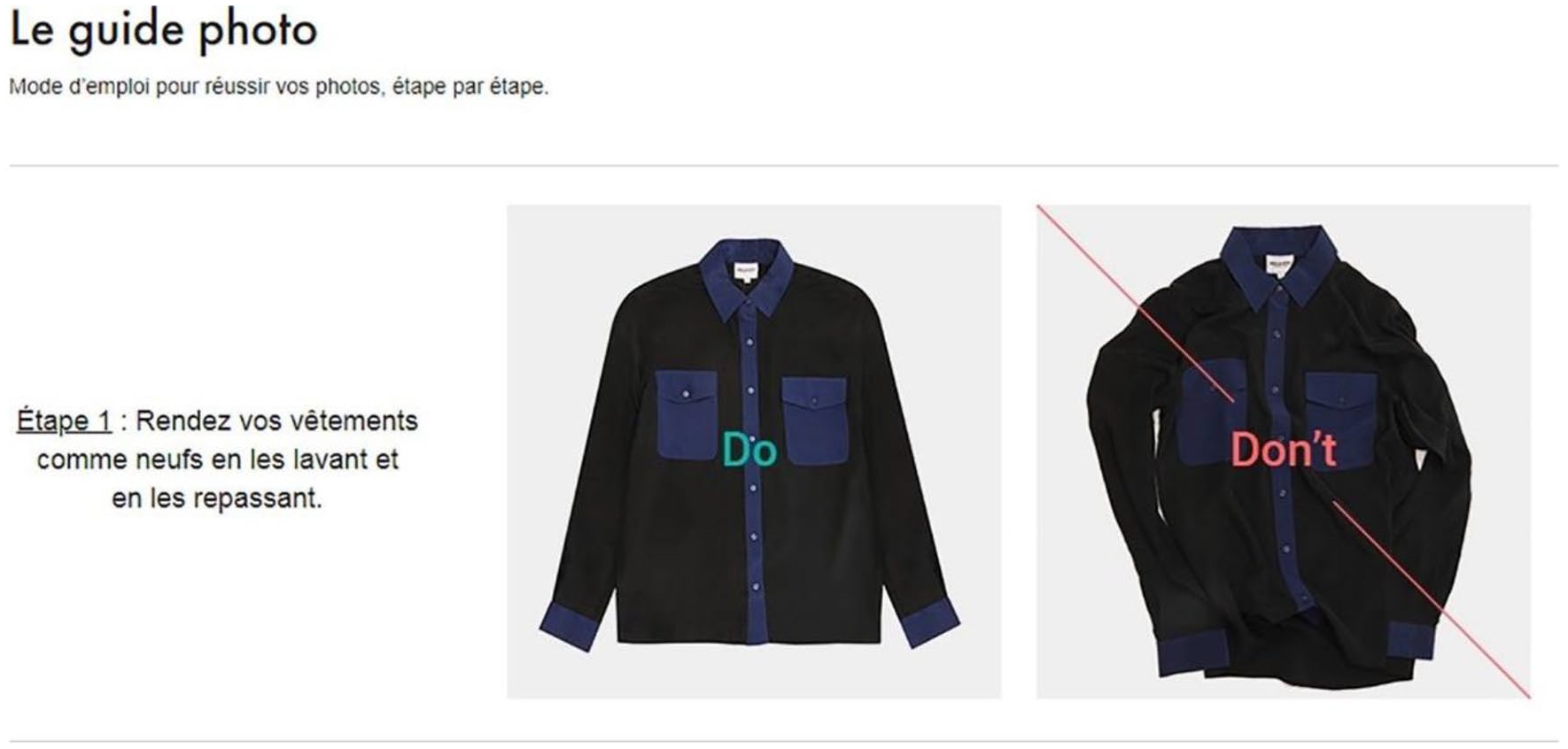
Extract from Vide Dressing’s photo guide.
The affordances we identified contribute to the acceleration in the renewal of items owned. The interviews revealed that users’ modus operandi is not one of accumulation: they do not increase the number of clothing items they own. For example, Nina (20) emphasised that the items she buys are intended to be sold on a short time later: ‘Oh, things don’t spend long in my wardrobe, 4 or 5 months, I know I won’t wear them anymore afterwards anyway, and above all I know they’re things that will sell quite easily and still at a reasonable price’. Nor do platform users reduce the number of items they own: they sell items with a view to buying more. For Ophélie (23), selling is about freeing up space in her wardrobe so she can take in new items: ‘I’m going to make some room [laughs] to buy more! [laughs]’. In other words, users buy and sell so they can regularly renew their selection of clothes. Manon (25) explained that these platforms are the ideal way to change her wardrobe regularly: ‘[the] pleasure of easily refreshing my wardrobe at a low cost, yes, regularly refreshing it!’ Like Manon, Estelle (23) seeks to ‘recycle [her] wardrobe quickly’ and Nina (20) can ‘change clothes more often’. This rapid renewal of wardrobes shows that the clothing items they contain quickly shift from being a commodity to personal belongings before once again becoming a commodity with an exchange value (Denegri-Knott and Molesworth, 2009; Kopytoff, 1986).
The acceleration in the renewal of items owned leads to speed-based competition in an effort to be the most trend-conscious. Inès (22) told us that by refreshing her wardrobe via digital platforms, she manages to keep up with the latest trends: ‘I can treat myself and change my clothes all the time to be fashionable’. Claire (20) shares the same desire to be with it: ‘Empty your wardrobe, change, fashions are always changing anyway, you always have to be tiptop, you have to be fashionable!’ Platforms work as allies in this quest, allowing users to follow short fashion cycles and replace items whose aesthetic obsolescence is a powerful driver of consumption (Assouly, 2010). Some users buy clothes without wearing them, simply because they are fashionable and can easily be sold on at a higher price. These items are simply ‘profit opportunities’ (Chabault, 2020: 94; Juge et al., 2019). Speed-based competition is therefore about the art of decoding and anticipating trends: it involves identifying that which is or will soon be fashionable in order to buy the must-have item of the present or near future; it also involves identifying that which has fallen or will soon fall out of fashion in order to sell an item before no-one is willing to buy it. One consequence of the competition to constantly update one’s stock of possessions is the impossibility of developing a resonant relationship with them, leading to alienation from things (Rosa, 2012). An extract from our log written immediately after our interview with Shéhérazade in 2013 referred to the sense of detachment observed in users from their clothes: Users seem ‘detached’ from their clothes, they take pleasure from buying and selling. There is no emotional attachment – no ‘I love this sweater, it reminds me of .’. ., just ‘this sweater is worth so much, the brand is sought after . . . I can sell it for.’
Users maintain their clothes in a state of exteriority and detachment which Rosa (2012) describes as alienation.
Being the most savvy
The three digital platforms display affordances that favour technical acceleration in three areas: communication, transport, and payment. In terms of communication, we observed an evolution in the contact between users towards more efficient formats with more scripted content. In 2013, users used to write out the messages they exchanged in full in a private space (their personal email for example). This meant they spent much more time writing and replying to the messages of other users. Léonie (24) explained the difficulties she had managing the profusion of emails and the risk of a poor rating which weighs heavily on slow users: I remember, early in the morning, once for a backpack they were selling at [store name], I posted it at €20. They were selling it for €55. I received at least 200 emails, and you have to reply! Because if you don’t reply, you get a bad rating . . . Some of them are really persistent, if you don’t answer straightaway, they’ll harass you with emails. So yes, it takes up time.
The changes in the affordances were able to resolve this problem and speed up communication between users via an automated contact system. For example, on Vestiaire Collective, by clicking on the button ‘make an offer’, the user accesses a ‘negotiating room’ and simply enters the price she is willing to pay for the item, perhaps lower than the price indicated in the offer. The seller is then free to accept or reject the proposal, without providing an explanation. This affordance can also be found on Vinted, as Illustration 4 and the following field notes reveal: I decide to click directly on ‘make an offer’. A small box appears with the figure 80 and the button ‘submit’. I can change the amount and put 50 for example without any explanation for the seller. The seller then proposes 65 without any further explanation.
This affordance allows the seller to enter into contact with the buyer without having to invest the time and energy needed to build up a meaningful commercial relationship, a marker of alienation from others (Rosa, 2012).

Screenshot from the Vinted application.
Affordances have also enabled an acceleration in the transport of items. One such affordance is the ability to choose from multiple delivery options when placing an order. In 2013, users had to go to the post office to send their parcel or deliver it in person. Djamila (39) explained all the time taken up by the logistics of deliveries: ‘I might spend 3 hours on a Sunday, but the hardest part is wrapping items, cashing cheques and going to the post office’. Deliveries have become faster and less of a chore with the possibility offered on these platforms of using a delivery service like Mondial Relay, which has a dense network of contact points with generous opening hours and a delivery slip that can be printed at home. As Julie (22) explains: Personally I love Mondial Relay, when I make a sale all I have to do is print something and drop it off at the corner of my street. They are open late, 7 or 8 PM. Going to La Poste in the morning at 8:30 or at 5 PM when you work is more of a hassle.
Sandra (48) shares this view: ‘It’s true that Mondial Relay is fab! You drop it off, you print it out from home and you don’t lose any time. It’s quicker than before, much quicker’. This delivery method using an intermediary reduces the amount of time between the moment of purchase and the delivery. It is different to in-person delivery, which can potentially be a rich and enjoyable social encounter between buyer and seller (Garcia-Bardidia, 2014). As well as the diversification of delivery options, the three platforms we studied provide delivery information with estimates of the transport time when the order is placed and an option to track the parcel.
Our corpus also shows that the time devoted to payment has been compressed with new affordances that facilitate the purchase procedure. All three digital platforms offer the choice between multiple payment options, including credit card, PayPal and a virtual wallet which they manage themselves. Vestiaire Collective promotes its virtual wallet by emphasising the speed of money transfers: The wallet allows you to receive the money generated from your sales as soon as the transaction takes place without further delay. You can add money to it to pay for future purchases on Vestiaire Collective, or alternatively transfer it to your bank account.
As well as speeding up money transfers, the virtual wallet allows users to make ever-faster purchases and ‘succumb’ more easily. Referring to the money she earns through items sold, Julie (22) explains: Initially I had to put it into my bank account . . . You get sucked into the game on Vinted, you buy. Now I leave it on Vinted. I reuse it. I leave it on Vinted, in any case I’m going to buy something else.
The virtual wallet facilitates subsequent consumption based on the revenue generated through sales (Denegri-Knott and Molesworth, 2009). For those who always use their credit card, recording their bank details is a way to make purchases very quickly. All of the users we interviewed mentioned the speed of payment on digital platforms. Here’s what Nina (20) had to say: I click on ‘buy’, then you have to enter your bank details if you haven’t already put them in. Mine for example are already on the application, so I just click on ‘buy’ and validate the purchase and that’s it, in 30 seconds or less it’s done!
This control over data is one of the key factors of these platforms’ success (Filser et al., 2019).
The technical acceleration across a wide number of areas encourages speed-based competition structured around the constant discovery and mastery of new affordances that allow the user to act more quickly. Indeed, Vinted even offers an alert that informs users about new functions as they become available on the platform. Understanding and using these affordances offers a competitive advantage. Savvy users are better equipped than others to carry out their buy-and-sell activities. In contrast, those who fail to master affordances are slower, which can generate disappointment among other users frustrated by their slow pace, and therefore the loss of sales. For example, in the case of transport, not choosing the fastest delivery option can cause dissatisfaction in buyers accustomed to receiving their items very quickly. Nina (20) mentioned one sale for which she was given a bad review by the buyer, who felt the delivery time was too long: ‘I got a bad rating because I didn’t send the parcel quickly enough. She didn’t feel like waiting’. Our observations confirm this, revealing that fast deliveries are appreciated (Illustration 5). And so, mastering the latest functions is a way to be more competitive and avoid being dropped out of the race.

Screenshot from Vide Dressing.
The analysis of the data shows that the affordances on the platforms studied favour speed-based competition between users. This competition manifests itself through three imperatives: being the most responsive, the most trend-conscious, and the most savvy. Figure 1 summarises the results presented in this section. As already explained, we have presented the three types of speed-based competition separately in the interests of clarity. Nonetheless, they are empirically intertwined.
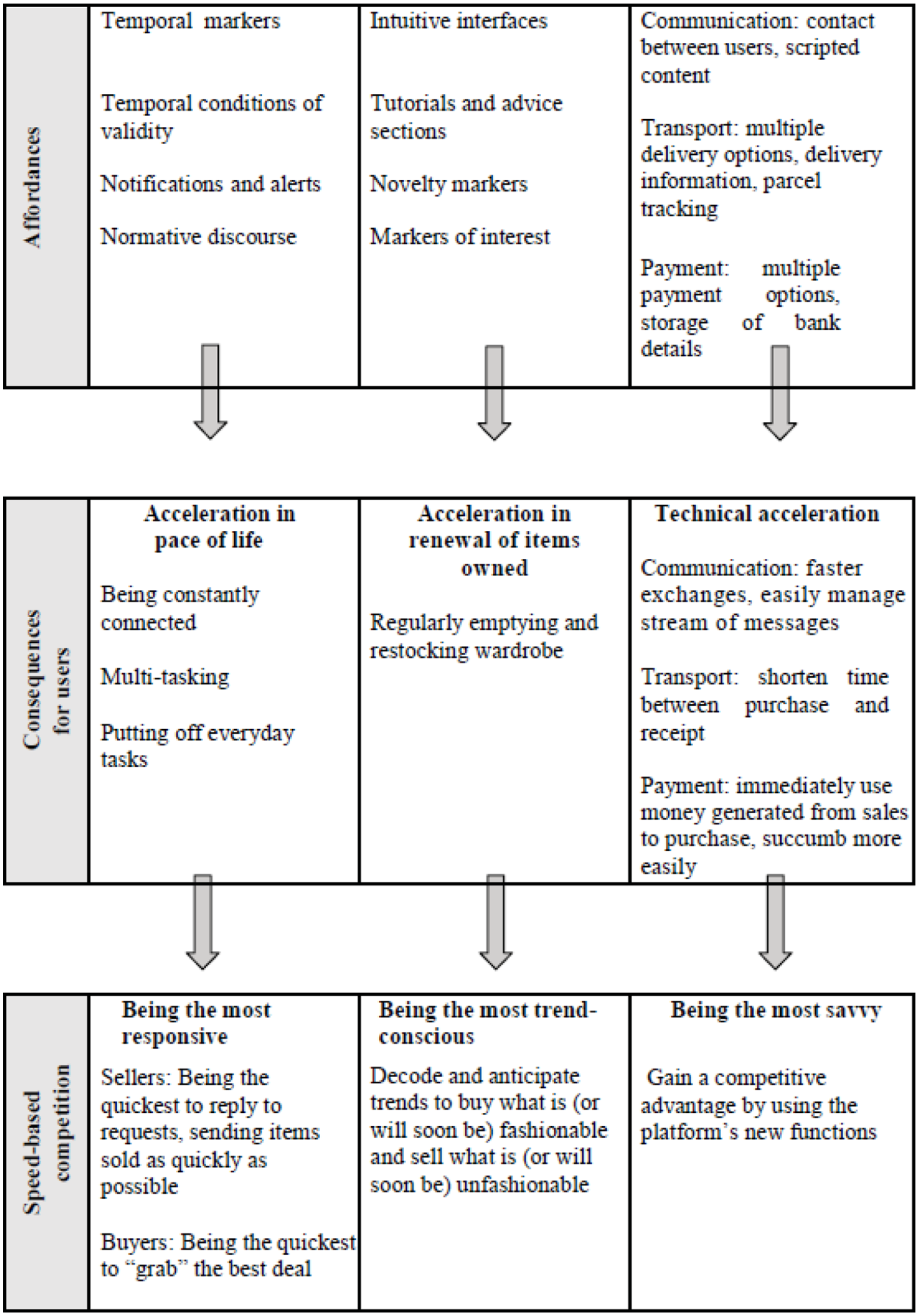
Summary of results: affordances, effects on users, and speed-based competition.
For example, items just placed online appear both in the ‘new’ sections on the platforms (‘novelty marker’ affordance) and in the alerts received by users (‘alert’ affordance); the latter systematically provide access to the former via a link. This means the acceleration in the pace of life generated by alerts goes hand-in-hand with the acceleration in the renewal of items owned brought about by novelty markers, and together they make users more assiduous. Being the most trend-conscious user also means being the most responsive. Similarly, users’ response times (‘temporal marker’ affordance) are compressed by the contact process on these platforms, which suggest pre-written messages or even do away with the need to write a message altogether (‘contact between users’ and ‘scripted content’). As a result, the technical acceleration brought about by communication processes is linked to the acceleration of the pace of life brought about by temporal markers. Being the most savvy user also allows you to be the most trend-conscious. Finally, the platforms explain to users how to use the different parcel delivery methods ( ‘multiple delivery options’ affordance) in their help sections ( ‘tutorials and advice’ affordance). This means that the technical acceleration in transport is linked to the acceleration in the renewal of items owned generated by the advice available on the platforms. Being the most savvy allows you to be the most trend-conscious. The different forms of acceleration and manifestations of speed-based competition are therefore intertwined with one another.
Discussion
Having presented our main findings, we will now interpret them in light of the existing literature, to which we make three contributions. Our first theoretical contribution is to reveal the consequences of the acceleration driven by platforms for inter-user relationships. This builds on the pioneering work of Denegri-Knott (2011), who explored the consequences of acceleration in terms of the user-desired object relationship. By broadening the scope, we show that the acceleration brought about by platforms encourages competitive relationships between users. In this respect, our results stand in contrast to previous studies that have underscored the capacity of platforms to create communal social links between users. Some researchers have highlighted the formation of relationships built on mutual assistance. For example, Barraud de Lagerie and Sigalo Santos (2018) show how a platform becomes a warm social space in which users support each other in difficult times. Uber drivers informally share tips to help each other out and protest against a shared enemy: the platform, which drastically restricts their activities (Möhlmann and Zalmanson, 2017). Social links also form between buyers and sellers. Repeat transactions generate mutual trust which encourages individuals not to respect all of the restrictive prescriptions imposed by the digital platform to the letter (Bailly and Boudot-Antoine, 2018). Even when interlocutors are dealing with one another for the first time, their face-to-face encounter can be a pleasant social experience, especially when the seller receives the buyer in his or her home and is hospitable (Garcia-Bardidia, 2014). However, being affable can become an imperative, as in the case of Airbnb hosts who must show their guests that they are convivial (Jacquet, 2015), or drivers of vehicles for hire, who must also include an emotional dimension in dealing with their passengers if they are to get good ratings (Rogers, 2017; Rosenblat and Stark, 2016). Nonetheless, not all platforms encourage their users to create social links. Some are marked by a low level of consociality, in that they offer few opportunities to communicate, interact and thereby generate social benefits (Perren and Kozinets, 2018). This is true for example of Zipcar, whose users are neither looking to connect with one another nor to meet up and socialise (Bardhi and Eckhardt, 2012). In the literature, the question of social relationships fuelled by platforms has therefore been approached from the perspective of their intensity or spontaneity, but not of their nature: whether numerous or few in number, spontaneous or carefully nurtured, social relationships carry a positive connotation because they include mutual assistance and conviviality. But our research shows that the social relationships between users can be of a different nature when they bring into play sped-up market activities and become competitive. Studying these inter-user relationships in light of this acceleration reveals the diversity of social relationships encouraged by digital platforms.
Our second theoretical contribution is that we consider speed-based competition as a driver of the intensity of activities on digital platforms. The literature has already highlighted several reasons for the intensity of exchanges on platforms. One is the large number of economic opportunities that resonate with the utilitarian motivations of most users (Padmavathy et al., 2019). Platforms enable individuals with limited purchasing power to consume, they offer many ‘good deals’ to smart consumers, and generate additional revenue that can be used to consume more (Benavent, 2016; Peugeot et al., 2015; Robert et al., 2014). Another reason is the way users perceive digital platforms. They easily succumb to the temptation of consumerism because they see platforms as sustainable and believe that they generate less waste (Parguel et al., 2017). Yet another reason is the acceleration in the cycle of desire among users (Denegri-Knott, 2011). Platforms frequently initiate new cycles of desire by constantly flagging up new acquisition options and offer the chance to easily fulfil immediate pleasures (Denegri- Knott, 2011; Moati, 2016). We build on this previous research by proposing another reason – not incompatible with those we have just seen – for the intensity of market activities and hyper-consumption observed on digital platforms: they encourage speed-based competition between users, who compete to be as responsive as possible so as not to miss out on any opportunities; compete to make sure the items they own are updated as soon as possible, thus keeping up with the latest trends; and compete to discover the latest functions available on platforms and thereby gain a competitive advantage over other users. This permanent speed-based competition maintains users in a state of intense commercial activity, even though their desire to consume can be eroded due to rapid cycles repeated too often (Denegri-Knott, 2011). Keeping up with the tempo dictated by platforms becomes an end in itself, as their desire switches to the rapid acquisition and sale of items rather than any prolonged and meaningful use (Rosa, 2017). And so digital platforms have become ‘self-propelled’ commercial systems. ‘Self’ because it is their own affordances that generate the competition; ‘propelled’ because they spur into action alienated users intent on not being overtaken. Far from being an alternative model to the capitalist economy, digital platforms are an extension of it (Chabault, 2020; Juge et al., 2019).
Our third contribution is to enrich the literature on acceleration. Rosa (2012) tells us that social acceleration causes five types of alienation in people: alienation from things, from actions, from others, from time and from space. The results of our research reveal the manifestations of the first three of these, but raise questions about the last two. We observed that users are constantly connected to the digital platforms they use, regardless of which activity is ongoing. In other words, their commercial activities are a common thread that runs throughout their everyday life, linked to various moments in the day (work, public transport and home). This brings a nuance to the notion of alienation from time defined by Rosa (2012) as the propensity to accumulate a series of short experiences that are disconnected from one another. It would appear on the contrary that the acceleration of activities on digital platforms generates continuity between experiences that are segmented and independent from one another. What is more, several of the affordances identified in the data enable users to appropriate the digital space that is the platform: the alerts they receive are based on personalised requests, the content of their wish lists depends on the items they add, and their transaction history, bank details and delivery address are specific to each user. In other words, the affordances are common to all users but allow each individual to personally invest in the platform and transform it into a unique personal space. This brings a nuance to the notion of alienation from space defined by Rosa (2012) as a disengagement or disinvestment from one’s physical or material space as a result of increased mobility. It would appear on the contrary that the more users spend time browsing on these platforms, the more they invest and appropriate them.
Conclusion
Practical recommendations
Our research offers practical contributions with a societal dimension. We propose tangible ways to reveal to users the scale of their sped-up market activities and the fact that they are being pushed into speed-based competition. It is true that none of the users we interviewed complained or referred to any suffering as a result of this need for speed, but ‘one feature of alienation is that it keeps its victims unaware of their condition’ (Keucheyan, 2019: 45). We do not claim that being made aware of this will eliminate the alienation (Keucheyan, 2019) or supplant the pleasure of buy-and-sell activities. As pointed out by Béji-Bécheur and Özçaǧlar-Toulouse (2014), hoping that consumers will adopt responsible and sustainable behaviour would no doubt be in vain. Our aim is simply to enable users to take informed actions. We therefore invite the public authorities to regulate digital platforms so they modify their affordances.
In order for users to be aware of the way in which digital platforms make them compete to be more responsive, we suggest creating a new affordance that indicates the amount of time spent on the application. This would give users an objective measurement of the scale of their activities. It would help them disconnect from the platforms and thereby contribute to a technological deceleration (Husemann and Eckhardt, 2018). Spending less time connected to platforms would also allow them to reduce the time spent in front of a screen and thereby lower their energy consumption. This consumption is linked to data centres with huge energy needs, as well as browsing on pages containing several photos, and the storing of data and all the messages sent and received as part of transactions.9,10
In order for users to disengage from the acceleration in the renewal of the items they own, we suggest modifying one of the existing affordances. As things stand, every item added to a wish list and purchased by another faster user continues to appear in the wish list alongside the word ‘sold’. This means users have no choice but to see all the missed opportunities due to their lack of responsiveness or indecision. We suggest deleting these frustrating ‘missed opportunities’ from wish lists as they are likely to encourage users to purchase items without necessarily taking the time to reflect, simply out of fear that another user will be faster than them.
In order for users to become aware of the way in which the technical acceleration of payment methods is intensifying their market activities, we suggest creating a new affordance. Currently, users see the balance in their account generated from sales and the price of each item already purchased. This gives them the impression that they have earned a lot of money through the items they have sold. To counterbalance this effect, we suggest adding an affordance that would indicate all of the accumulated expenses to tell users how much they have spent since setting up their account. Since the items available on digital platforms are less expensive than on the market for new goods, users are not necessarily aware of the total amount of money spent. This new affordance would show users that while they are generating additional revenue through the platforms, they also are spending just as much, if not more.
Limitations and future research
Despite the wealth of our corpus and contributions, this work presents three primary limitations. The first is the composition of our sample, which is exclusively made up of women, most of whom were young in the case of the interviews. Although our choice only to interview female users can be justified by the minor presence of men on online secondhand clothing platforms, 11 it nonetheless renders invisible the small proportion of men who are active on these platforms. One research avenue would be to explore the behaviour of male users to develop a comprehensive and inclusive picture of this commercial practice. Again with a view to adopting a more inclusive approach, it would also be useful to interview older women, who, although they represent a minority on digital platforms, are believed to have a less fluid relationship with new technologies (Ritzer and Miles, 2019). The second limitation is that our study is restricted to just one market. It would be interesting to complement our analysis of the secondhand clothing market by exploring platforms that operate in other sectors such as online dating, transport and accommodation. Studying other platforms may identify other manifestations of speed-based competition and thus improve our understanding of the mechanism highlighted in this article. The third limitation relates to the constant evolution of functions on digital platforms. It is possible that new affordances appeared or disappeared once our data collection process ended. One research path would be to continue to study this evolution over time in an effort to understand how affordances reinforce or, on the contrary, decrease speed-based competition.
One possibility would be to answer the following question: to what extent is Covid-19 transforming the online sale of secondhand clothing? Given that economic motivations are preponderant in secondhand purchases (Padmavathy et al., 2019), it is possible that the economic crisis 12 is generating an increase in the number of users on these platforms and thus exacerbating speed-based competition. As the number of competitors rises, it may be that they have to move even faster to keep up. Lockdown has caused some French people to question the foundations of their lifestyle and of society. 13 A slower, simpler and more environmentally friendly lifestyle has emerged as one possible scenario for the post-Covid world. 14 It may be that some French people, keen to step back from consumerism and slow down, will move towards secondhand clothing platforms. It would be interesting to study how these newcomers react to the unexpected level of speed-based competition on websites that promote community values and the collaborative economy, how fast users and those looking for a slower pace cohabit on these platforms, and how their cohabitation may generate temporal frictions.
Another research avenue would be to address the following question: what are the mechanisms that lead to the exclusion or self-exclusion of users from secondhand clothing platforms? It is possible that some sellers will be unable to match the pace required and that their lack of responsiveness will generate poor ratings, leading to a lack of confidence among buyers, gradually reducing the number of transactions completed and pushing users towards the margins of the platform until their de facto exclusion. Similarly, buyers may also find it difficult to keep up, consistently being outmanoeuvred by faster buyers, which would decrease the number of their transactions and lead to their de facto exclusion. Other users may become aware of the burden of this speed-based competition and no longer be able or willing to put up with the fast pace imposed by platforms. They could reject the rules of the game and walk away from the commercial environment. It is worth exploring these cases of de facto exclusion and self-exclusion and endeavouring to better understand the ‘losers’ of the poorly named ‘collaborative economy’.
Footnotes
Appendix
Illustration of the triangulation of data collected using various methods (interviews, online observations and research log).

|
Translation of illustrations.
Illustration 1: Sell an item . . . Alerts . . . messages . . . is now following your activity
Illustration 2: Hello . . . I'm out for the day if you buy the item I will ship it this evening . . . Transaction successfully completed . . . Now wait for roje2 to ship the package . . . Thanks, your purchase is completed . . . Good evening, tomorrow I'll drop off the package at the delivery depot. Have a nice evening.
Illustration 3: Photo guide . . . Step-by-step user guide for successful photos . . . Step 1 . . . Wash and iron your clothes to make them look new
Illustration 4: Reminder: you made this member an offer . . . €50.00 refused €60.00 + shipping costs
Illustration 5: Videdressing customer review . . . No problem in transaction. It was smooth and quick . . . Clothes delivered really fast to the pick-up outlet. Nothing to report.