







Abstract
The historical approach is too rarely used in our discipline, while it offers many advantages for marketing and consumer research. In particular, the historical approach offers the following contributions: (1) to grasp the density and discontinuities of consumption phenomena, which is necessary for the mobilisation of certain theoretical perspectives; (2) to challenge new theoretical proposals and instituted chronologies and (3) to feed managerial thought through the historicising of marketing and consumption issues and strategies. Based on these reflections and a review of the work in our discipline, we propose research programmes that deserve to be developed and enriched by the historical approach.
The field of research on consumption and marketing has gradually opened up to multiple multidisciplinary approaches, integrating, for example, sociology, anthropology and psychology. The ‘conceptual and methodological apparatus’ (Badot et al., 2009: 94) of our discipline continues to grow. But in this development, history remains neglected. Or, when it is adopted, the historical approach is often reduced to a preliminary and superficial contextualisation, and is not exploited to its full potential.
However, the historical approach has long been fully mobilised and legitimised in certain sub-disciplines of management sciences, such as accounting or organisational theory (Cailluet et al., 2013). Long neglected by business history, the history of marketing and consumption was mostly explored by historians until the 1990s (e.g. Ewen, 1976; Laird, 1998; Marchand, 1986; Sivulka, 1998). However, the 2000s and 2010s marked a turning point: articles dedicated to marketing and consumer history have increased considerably in journals such as Journal of Macromarketing (e.g. Eckhardt and Bengtsson, 2009; Witkowski, 2020), Business History (e.g. Alexander, 2011; Bailey and Alexander, 2019) and Journal of Consumer Research (e.g. Belk, 1992; Humphreys, 2010; Karababa and Ger, 2011; Tse et al., 1989) and a journal specifically dedicated to this topic, Journal of Historical Research in Marketing, that appeared in 2009. However, this recently proliferating literature reveals many disparities. Some research questions, such as those relating to the brand and its origins (e.g. Duguid, 2003; Eckhardt and Bengtsson, 2009; Petty, 2010) have been frequently addressed. Other issues, such as those related to the symbolic value of objects and the construction of consumer subgroups, have been the subject of very few historical studies. Beyond putting these disparities into perspective, a reflection seems necessary to introduce and legitimise the historical approach: how can history contribute to a deeper knowledge of consumption and marketing, or even renew it?
The articles that have so far helped to start this reflection have mainly focussed on discussing the methodological aspects of implementing a historical approach in marketing and consumer behaviour (e.g. Firat, 1987; Fullerton, 2011). But they have not explained the conceptual contributions of the historical approach and have not suggested clear research directions for consumer and marketing research. This article sets out to fill these gaps. In the first section, we detail the reasons why the historical approach deserves to be addressed in our discipline, highlighting the following contributions: (1) history allows us to grasp the density and discontinuities of consumption phenomena, which is necessary to mobilise certain theoretical perspectives; (2) it offers a reflexive approach to our discipline and its development, in particular to introduce new theoretical proposals and challenge established chronologies and (3) it feeds managerial reflection through the historicising of marketing and consumption issues.
In the second section, we present research programmes that aim to put these three contributions of historical reflection into action. These programmes were identified through a systematic review of publications that integrate a historical approach to marketing and/or consumption. We collected and read 221 articles, mainly from eight journals (Journal of Historical Research in Marketing, Journal of Macromarketing, Business History, Journal of Consumer Culture, Consumption Markets & Culture, Journal of Consumer Research, Marketing Theory and Enterprise & Society). We then included an additional 50 articles in this review, published in journals where historical methodologies are not widely used, but which were regularly referenced in the first corpus or in review articles (Tadajewksi, 2014; Witkowski, 2006). These 50 articles come from a wider range of sources, including Business History Review, Journal of Marketing, Journal of Advertising and European Journal of Marketing. Articles from economic history and fields of management research other than marketing and consumption (strategy, management and accounting) were excluded from our review. The identified research programmes contribute to the advancement of several central themes in our discipline, such as the understanding of market development, the construction of the brand, and the institutionalisation of marketing.
The three main contributions of the historical approach to marketing and consumer research
The historical approach opens many perspectives to marketing and consumer research, both theoretical and managerial. As several authors have already argued (Golder, 2000; Hunt, 2011; Nevett, 1991), history proves to be quite compatible with the approaches and objectives of our discipline. Yet it remains peripheral in much research (Arsel and Thompson, 2011; Giesler, 2008; Giesler and Veresiu, 2014; Holt and Thompson, 2004; Thompson, 1997; Thompson and Tian, 2008), often confined to secondary contextual points of illumination, or nestled in short methodological preambles. Bucheli and Wadhwani (2014) evoke a reluctance among scholars in business-oriented disciplines to undertake rigorous historical analysis of any breadth and based on real archival work. Yet most questions in the humanities and social sciences are framed in time and therefore contain a historical dimension. Adopting this dimension would enrich research work according to three main contributions that we present in this section.
Understanding the density and discontinuities of consumption phenomena
History allows us to understand an event, a phenomenon or an action in the light of their antecedents but also of their subsequent developments. As a science of change, history is particularly suited to understanding market phenomena and consumer behaviour (Chessel, 2012; Trentmann, 2012). It permits to assess the role and influence of a multitude of actors and institutions in the dynamics and evolution of markets; to explain, through diachronic analysis, continuities and ruptures, persistence and upheaval. Bucheli and Wadhwani (2014: 14) refer to the possibility of using the ‘temporal glasses’ that history offers us ‘to understand the significance of an event, its causes, consequences, meanings and implications for future developments’.
In fact, to understand how a market develops, strictly economic and technological perspectives remain insufficient. Products and uses develop according to a complex socio-cultural dynamic that goes beyond the simple consumer-marketer dyad (Karababa and Ger, 2011; Peñaloza, 2000; Thompson, 2004). Institutional processes are multiple and complex (Chaney and Ben Slimane, 2014), they involve many actors whose action can be documented and analysed via historical investigation, as Gaytan (2014) shows in his history of tequila, a product that was given credibility by the actions of the Mexican government.
Beyond the longitudinal approach, history allows us to understand moments of rupture and continuity, to grasp consumption not as a linear process, but as a succession of ‘regimes’ in the history of our societies (Daumas, 2019). Zhao and Belk (2008), for example, illuminate the promotion and growth of a global consumer culture in 1930s China, and its tensions with traditional Chinese culture. Similarly, in her research on gambling, Humphreys (2010) shows the semantic logics around this consumer practice, to explain how it could be valorised while going through periods of rejection. The historian’s comparative work thus aims to ‘establish contextual kinship’ (Cailluet et al., 2013: 3). The historical approach is therefore necessary to allow the incorporation of certain theoretical perspectives such as neo-institutional theory (Chaney and Ben Slimane, 2014), which refers to an illumination of the changes and continuities that run through organisations and markets.
As JWadhwani and Jones (2014) explain in relation to entrepreneurial theory, putting history into context improves our understanding of market phenomena on three levels. First, at a structural level, history allows us to grasp the development of the various organisations driving the market over the long term. Second, at a sequential level, history allows us to reconstruct a set of sequences and chain reactions that have led to the establishment of market situations. Finally, at a third cognitive level, the historical approach helps to put into perspective the market agents, their identity and their positioning in the entrepreneurial process.
This multilevel historical contextualisation could be further applied in our discipline, for example, with regard to the development of intellectual biographies. Numerous research articles (e.g. Harris, 2007; Jones, 2011; Shaw and Tamilia, 2001) have portrayed professionals and researchers who have made a mark on the history of marketing. These portraits are often criticised for their propensity to approach their objects as irreducible historical singularities, around which a linear life narrative is built, ordered by the biographer according to a chronological sequence (Le Ny, 2004). This process is deployed at the risk of finalism and sometimes at the expense of an understanding of the structures and contexts of change in marketing thought. However, the academic field, and more broadly the field of intellectual production (Bourdieu, 1984), is crossed by inter-individual and inter-institutional rivalries and conflicts, which we should be able to account for to understand how certain theoretical oppositions are related to political rivalries. Adopting a temporal perspective, whether structural, sequential or cognitive, or even all three at once, would make it possible to fill these gaps.
Through this first contribution, the historical approach can answer the call for greater contextualisation of consumption phenomena in our discipline (Askegaard and Linnett, 2011). History indeed helps to produce contextualised generalisations, rather than universalist interpretations which, as Braudel (1969) pointed out, cut events off from their multiple and complex temporal determinants.
Challenging new theoretical proposals and established chronologies
By extending this first contribution, we can see that the historical approach also allows us to deconstruct assumptions and ideas commonly held in marketing and consumption. Indeed, marketing research can be criticised for it’s a-historicity, or even its ‘amnesia’ (Wooliscroft, 2008). Our field of research does not seem to be sufficiently involved in a regime of cumulative knowledge (Tadajewski, 2010). This deficit of memory leads to two pitfalls: the overestimation of new theoretical propositions and the repetition of questionable chronologies.
According to Tadajewski and Jones (2008), multiple theories, concepts and methods are regularly reinvented in the literature of our field. But history can serve as a ‘robust methodological approach’ to sifting through potential contributions (Witkowski, 2005). An example of theoretical testing through history is the work done by Wooliscroft (2008) on Vargo and Lusch’s (2004) award-winning and often cited article, that explains how the founding principles of the new mainstream logic correspond to those outlined nearly 40 years earlier by Wroe Alderson (1965).
This testing of theoretical constructs can lead to both challenges and corroborations. For example, in studying the material possessions of a group of Mormons in the mid-19th century, Belk (1992) sought to test a range of assumptions about the role of material culture that had been established in the literature to date by. So he studied a context that was both remote in time and a priori hostile, Mormon religious culture, ‘emphasising the afterlife and discouraging the overemphasis on material possessions’ (Belk, 1992: 341). The value of using history to test theoretical constructs is also well established in strategy, where Chandler’s (1977) work on the history of management has had considerable resonance. For example, Chandler’s ideas on the development of modern organisational structures have been an important input to transaction cost theory (Williamson, 1981). Chandler’s theorisations are themselves regularly challenged and refined in light of new historical datasets (Aupperle et al., 2014; Raff, 2019; Van Driel et al., 2007).
The historical method can also be used to question established chronologies and conceptions that are commonly accepted. It reports the long-standing existence of certain marketing practices, such as the lifestyle consumption perceptible in department stores at the end of the 19th century (Parker, 2003), relationship marketing at the same time (Tadajewski, 2008), segmentation from the middle of the 19th century (Bakker, 2003; Fitzgerald, 2005; Fullerton, 1986; Germain, 2000; Jones and Richardson, 2007; Kleindl, 2007; Neilson, 2003; Parker, 2003) or branding from the beginning of the 20th century (Petty, 2010). More generally, historical research helps to address misconceptions. Tadajewski (2010), for example, reacted to the often-postulated idea that marketing is an acritical discipline by taking stock of the field’s internal criticisms since the beginning of the 20th century.
Historical work can thus help us to improve the perspective of our discipline. Understanding the evolution of our discipline and its dynamics (see Bartels, 1962; Barth, 2006; Cochoy, 1999; Maillet, 2010; Marco, 2006; Tadajewski and Jones, 2008), as well as its anchorage in other sciences, would not only allow us to question certain established chronologies and make new theoretical proposals, but also to reinforce marketing and consumer research legitimacy. Volle (2011) reminds us that our discipline, wrongly perceived as particularly recent, often suffers from a legitimacy deficit that history, by inscribing it in the long term, could resolve.
The deconstruction of established chronologies can be inspired by Fullerton’s (1988) seminal work on the ‘myth of the production era’, this myth being long been maintained as accepted knowledge, particularly in marketing textbooks (see Jones, 2007: 16 for a review). Other narratives and misconceptions could be further deconstructed. Finally, the historical approach reinforces the accumulation of knowledge in the field of marketing and consumer research, by tracing the genesis of the various theories that pepper this field and by analysing their borrowings and relationships.
Feeding managerial reflection through the historicising of issues and strategies
Finally, history also provides food for managerial thought. As Godelier points out (in Cailluet et al., 2013: 61), “corporate culture is not only a new food for the historian to satisfy his insatiable desire to grasp the facets of the past and the happy opportunity to have new archives opened. It can also enable him to assist company managers. This may seem counter-intuitive, since management as a whole is a science oriented towards operationalisation, whereas history is based more on a description of past phenomena. But looking at the past also allows us to assess the important issues of our time, and thus to help shape the future of many organisations such as businesses.”
The historian Daumas (2019) notes in this regard that contemporary developments in the field of consumption, particularly those related to the challenges of sustainable development and the criticism of overconsumption, can only be understood in the light of dynamics initiated in the past. Understanding the sensibilities and cultural references of contemporary consumers requires historical contextualisation. This work would thus compensate for the a-historicity of modelling approaches often dominant in our field (Zimnovitch, in Cailluet et al., 2013: 99).
It is also possible to feed future decision-making with historical reflection: by drawing lessons from the past successes or failures of certain strategies, by grasping what may have reassured and attracted consumers or, on the contrary, destabilised them, for example. This is the meaning of the work undertaken by Holt (2004) in his study of iconic brands. Through a historical perspective, the author details how brands can establish their success by being in phase with the socio-cultural context and the implicit expectations of consumers, and by even becoming vectors of new cultural propositions. From these historical perspectives, Holt (2004) draws managerial recommendations that apply to current brand strategies.
Another managerial interest of historical enquiry is to capture blind spots in past corporate policies (e.g. Branchik, 2008). By confronting the history of companies and consumers, the researcher is able to develop scenarios such as how markets have collapsed or atrophied as a result of intra-sectoral decisions and movements. Like economists and political scientists studying path dependence (Palier, 2010), the marketing researcher, thanks to the historical approach, could understand how certain marketing and commercial policies, as well as certain generalised managerial practices, have contributed to the establishment of markets in their current forms. The researcher could push further in this direction by adopting the counter-factual approach advocated by the history of possibilities (Deluermoz and Singaravélou, 2016), which consists in developing hypotheses about the potentialities of the past and about the futures that did not happen. The effort to imagine alternative historical developments is not, in fact, confined to alternate history literature. It is particularly useful in historical thinking to assess the factors of change, the causal forces at work in a given situation. Applied to marketing and consumption, the counter-factual approach, sometimes also called ‘virtual history’ (Ferguson, 1997), makes it possible to question univocal representations.
Proposals for marketing and consumer research programmes adopting a historical approach
In view of the various contributions we have just presented, the historical approach is of undeniable interest to marketing and consumer researchers. However, it is not always easy to know which research themes and questions it is most relevant to. In this section, we propose, in a non-exhaustive manner, the main research programmes that can be developed in relation to each of the contributions of the historical approach identified above. As stated in the introduction, these programmes were identified through a systematic review of publications in our field. We have structured our programmes around three major axes: the history of consumption, the history of marketing thought and the history of marketing practice.
Within each agenda, we highlight the main research questions that need to be addressed, and suggest sources of historical data. Table 1 summarises these research agendas by connecting them to the main contributions of the historical approach and to the data sources to be favoured.
Synthesis of research programmes.
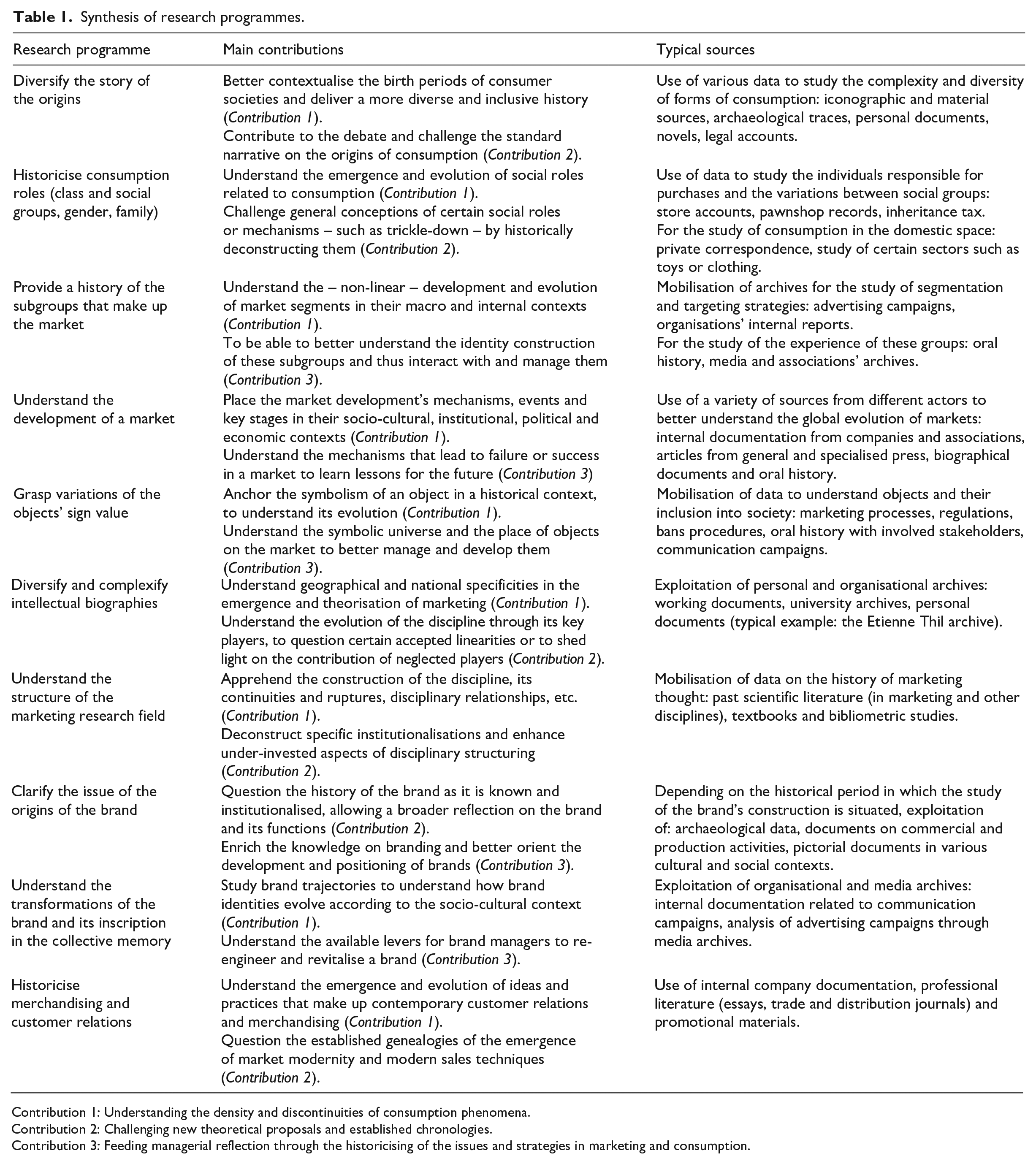
Contribution 1: Understanding the density and discontinuities of consumption phenomena.
Contribution 2: Challenging new theoretical proposals and established chronologies.
Contribution 3: Feeding managerial reflection through the historicising of the issues and strategies in marketing and consumption.
History of consumption
Diversify the story of the origins
When can we start talking about consumers? Recent historiography places the birth of the consumer phenomenon in the second half of the 19th century in the West, due to the many technical, industrial and demographic developments (Leach, 1993; Rioux, 1971; Strasser, 1989; Verley, 1997), the appearance of department stores and merchandising (Parker, 2003) or the first multidivisional companies and brands (Chandler, 1977; Koehn, 1999). This story of the origins seems to have become a standard narrative but has been strongly criticised by McKendrick et al. (1982) for its economism. According to them, the industrial revolution presupposes an earlier consumer revolution, which they observe in 18th-century England. Karababa and Ger (2011) trace the emergence of the figure of the consumer to Ottoman cafés in the 16th and 17th centuries. They argue that ‘the fluidity and variety of roles, authorities and discourses, as well as tactics of resistance, indicate that the active consumer may not be as recent or datable a phenomenon as many consumer scholars believe’ (p. 756). Part of the difficulty in producing a genealogy of the consumer figure is that the very notion of consumption carries many representations and can be criticised for its polysemy (Graeber, 2011).
Based on this observation, several lines of research could be followed to answer the following questions: what were the forms of consumption before the 18th century? What forms of consumption have historically appeared outside the Western world? What are the different dynamics that have contributed to the spread of consumption at an international level? To what extent has consumption contributed to the political project of a society, to its cultural and social changes – to the development of capitalism, for example? What does ‘consuming’ mean in various historical contexts?
The interest for the goods that individuals consumed in pre-18th-century societies is relatively recent among historians (McDonald, 2013). Moreover, this interest focusses primarily on the upper social classes, with greater means of acquisition and who have left more exploitable traces of their consumption. However, it seems important to broaden the spectrum of historical enquiry and to incorporate more social categories as well as national and geographical contexts into the analysis, to renew the narrative on the origins of consumption. To do this, researchers need to take a relativist view to understand the multiple influences of consumption and markets. This research perspective can be invested by exploiting, as Karababa and Ger (2011) have done, a diverse set of data, including: diaries, correspondence, travelogues, iconographic data, legal accounts or even novels.
Historicise consumption roles
Another question that has received little historical investigation is the interaction between the market and social identities. In the end, we have some information on how consumer roles emerge. In his research on the child consumer, Cook (2003) raises the question of the weight of consumption in the emergence of the modern figure of the child. Witkowski (1999, 2004); discusses the relationship between gender norms and consumer roles in 18th-century American society. He argues that by becoming shoppers in the 19th century, women gained a power that was kept by their husbands. The history of gender in consumer roles requires further investigation, since Witkowski’s work (1999, 2004) contradicts well-established interpretations in historiography. Indeed, the role of the mother as the family’s purchasing agent has often been described as a mark of her social inferiority (e.g. Charpy, 2010; Veblen, 1970). Broadly, consumption roles still have to be historicised through different questions: how have consumption practices evolved in their capacity to signify social roles? How have the roles of women, men and children evolved over time and across societies? How have the relationships between social groups evolved and how have these relationships been expressed through consumption? How has the relationship to the body reflected these social dynamics and their mutation? Does the hypothesis of the trickle-down of commodities hold true over time, or did the lower classes also contribute to the diffusion of consumer goods to the upper classes? On the latter question, Chessel (2012) mentions the examples of make-up and cinema at the turn of the century in France, but other objects of consumption would deserve to be examined. The history of consumer roles should thus be further explored, across different countries, periods and social classes, to understand how power relations are expressed.
To initiate research on these topics, the consumer historian can draw on a vast feminist literature (e.g. Brumberg, 1998) that partly documents the historical interplay between gender identity and consumer role. In terms of data collection: estate tax reports, registers of pawnshops or other pawnbrokers, private correspondence, but also shop accounts or newspaper advertisements, as well as other advertisements or shop catalogues can be relevant sources. The role of women can be particularly questioned to understand the development of department stores, since they were at the centre of attention in the discourses of politicians, advertisers, media and entrepreneurs at the time of their emergence. But other spaces, such as the domestic space, should also be examined. In terms of research on youth, the history of the toy, clothing or children’s literature markets, all of which developed strongly in the 19th century, may provide relevant contexts for data collection.
Understand the history of the subgroups that make up the market
The study of the consumer subgroups that make up the market has generated a large body of literature, but one that neglects the emergence and history of these consumers, and both the structural and cognitive elements in this development (Wadhwani and Jones, 2014). This contrast was initiated by Branchik (2002, 2008, 2010), 1 who undertook a history of several market segments: homosexuals, the African American elite and senior citizens. According to him, a market segment is analysed as much by the process through which suppliers differentiate their products and services to meet the specific needs of a group of buyers, as by the search of these groups for offers corresponding to their needs. Three potential contributions of the historical method to the study of market segments can be identified. (1) Documenting the existence of a market segment, as this may be a matter of debate, such as the gay market which exists for Peñaloza (1996) but not for Fugate (1993). Future research could answer the following questions: what are the historical criteria for the emergence of a market segment? What are the roles of supply and demand in the development of this segment? How have these roles interacted or not? What are the symbolic or initiating products of these segments? (2) Understanding the development and evolution of segments. According to Branchik (2002), the development of a market segment is not necessarily a gradual evolutionary process. Its growth can be erratic, punctuated by regressions, stagnations and accelerations that the historical survey can identify. What are the different periods that punctuate the constitution of segments? According to which historical influences do they develop? What is the role of the political, economic and social context and what are the elements of rupture? Who are the key players in the formation of a segment? (3) Understanding the structuring and internal oppositions of the segments. These ones can be broken down into sub-segments, which are addressed unevenly by merchants. For example, Branchik (2008) shows that the Afro-American elite segment can be broken down into three sub-segments: the conventional upper-middle class, the traditional elite and the nouveau riche. These sub-segments have different value systems and do not respond to the same symbolisms. Historical studies would address the following questions: what are the potential sub-segments of a group? How does the market discourse identify them or not? How do they relate to each other? What are the possible blind spots in the communication of the market players, and what can explain them?
Apart from the perspectives suggested by Branchik’s work (2002, 2008, 2010), the historical approach can allow for a more in-depth study of market and consumer communities (Burr, 2011), which at the moment are almost exclusively analysed with an ethnographic perspective, their history being relegated to a simple contextualisation. What are the changes that characterise communities? How stable or unstable are they over time? What are the interactions they have with producers or with brands? Do they undergo episodes of reinforcement or disintegration? What are the driving mechanisms in their development? And are there any failures in segmentation attempts on the producer side? The study of consumer segments and groups can draw on sources produced by market players, such as advertising campaigns and internal strategic reports of companies, as well as on political speeches, public policy decisions and media descriptions, to better understand the representations of these groups. To study the experience of these groups, it is possible to draw on ‘indigenous’ literature (associations’ archives, fanzines, mailing lists, scrap books, published and self-published works). It is also possible to draw on oral history (collection of testimonies) as well as the archives of magazines.
Understand the development of a market
As pointed out in the first section, the institutionalisation of markets constitutes an increasingly rich literature, which makes considerable use of the historical approach. However, consumers are not often mentioned in the institutional perspective. Yet, they are the catalysts and receivers of institutional change, and can even influence the institutional game, as studies on contraceptive products (Latham, 2012) and bicycles (Burr, 2011) have shown. One of the challenges of institutional and historical research on markets is to identify the variety of actors (religious organisations, media, non-governmental organisations and intellectuals, see Galluzzo and Gorge, 2020; Gao, 2013; Humphreys, 2010; Sandikci and Ger, 2010; Thompson, 2004) that contribute to the legitimisation of products and practices, and the relationships that may bring them together or oppose them. From this perspective, Petty (2019) has, for example, analysed the actions of doctors and pharmacists, as well as those of the state, in the patented drug industry in the late 19th century. Thus, we can ask ourselves the following questions: who are the different actors involved in the institutionalisation processes? What are their place and their roles? And in particular, how do these actors interact with each other and what are their power relations? More specifically, what are the expectations of consumers and what power do they have in these institutionalisation processes?
Historical research also helps to understand the strategies that firms use to influence the institutional process, as in Munir and Phillips’ (2005) study of Kodak. The historical method helps to retrospectively evaluate the changes brought about by firms, and to know which ones proved to be the most beneficial to the institution of a market (Tate, 2000). Conversely, how does an institutionalised consumption practice disappear? What are the forces acting on social and legal norms? Ivory and Genus (2010) studied the case of the electric car, which was very popular in the early days of the car industry and then fell out of favour. Thinking about the revival of the electric car in the 21st century requires, he argues, tapping into the historical knowledge that led, a hundred years ago, to its delegitimation. Collecting data for these different questions is often an opportunity to investigate one or two key organisations that sought to market a product or service. Potentially useful data include strategic reports and other types of internal organisational documents that substantiate decision-making in that market, campaigns launched, and consumer reactions. This information should be supplemented with data that provides the socio-cultural, technological, political, associative, and economic contexts of the time. Thus, articles on the sector of activity or the product in question from the media, especially specialised media, can be a good complement. The same applies to biographies of entrepreneurs or books and reports on the sector. Oral history can also be used, for example, by interviewing experts to test the comprehensiveness of the research and to provide them with emerging interpretations.
Grasp variations of the objects’ sign value
The symbolic life of a product, product category, brand or consumer practice is deeply unstable and embedded in a broad social, political and economic context (McCracken, 2005). However, this context is often neglected in object research. The diachronic approach can help to understand some of the symbolic reversals, as in the case of the Reingold beer brand in the United States, where sales remained low in the 1960s before taking off during a revival in the 1970s (Smith and Lux, 1993). Some of these reversals can be very violent for brands, as Gao (2013) shows in relation to McDonald’s fast food in China, which was positively associated with Western prosperity, civilisation and modernity in the 1990s, but is now linked to junk food and to a nationalist and anti-American reaction. The historical approach also makes possible to question the factors leading to the local prestige of objects that are seen elsewhere as commonplace, like the refrigerator in Argentina (Perez, 2012). These questions deserve to be explored in greater depth: how do meanings around objects evolve? How do certain symbolic associations emerge, either opportune or harmful for the development of a product or product category? Who are the actors involved? These questions echo the process of legitimation for which the historical approach seems obvious (see Ivory and Genus, 2010; Petty, 2019:): for example, how does an institutionalised consumption pattern disappear? The links between product and regulation could also be the subject of more research: how does a product come to be considered harmful to the point of being restricted or even banned? What institutional entrepreneurs lead to the implementation of a regulation or even a product ban? The historical study of delegitimations, regulations and bans could feed our current reflections on the tightening of certain regulations (e.g. tobacco) and on the questions that regularly emerge around new products (e.g. vaping machines).
History of marketing thought
Diversify and complexify intellectual biographies
The most common form of the history of marketing thought is the intellectual biography. According to Jones (1998: 162) and Bourassa and Cunningham (2007), the intellectual biography is a long-standing tradition in marketing research, that intends to provide a better understanding of our discipline by studying its key thinkers. It is often rehabilitative in nature, seeking to highlight the pioneering nature of a theorist, as in the work of Eighme and Sar (2007) or Fullerton (1990). However, there are many gaps in the biographical work undertaken so far. In the list of candidates for biography (Wright, 1989), 2 Parsons (2013: 335) noted the absence of women, who in his view have been ‘erased from history’, and the scarcity of non-American figures. Yet from the work of Fullerton (1986), we know the influence of German and Austrian emigrants (e.g. Robert Neischlag, Paul F. Lazarsfeld, Karl Knies) in the development of marketing in the United States. Another blind spot in the intellectual biographies undertaken so far is the near absence of strategic considerations. For example, Kotler’s great influence in the development of marketing can be explained by his ability to aggregate the knowledge produced by the researchers surrounding him (Bourassa and Cunningham, 2007).
Several questions deserve to be raised by future research: have French, German or Italian practitioners and academics, for example, made fundamental and specific contributions? Or are they just importers? Can they reveal national specificities in the development of marketing thought? What is the place of women in the development of marketing thought? But also of other actors such as practitioners, critics, regulators and publicists? How have they worked together?
How do self-promotion and marketing techniques contribute to the influence of an author and his or her ideas? How can the trajectories of marketing practitioners and academics be better networked to extend and even surpass current biographical research? What are the ideological, political, economic and cultural contexts that may have favoured the emergence of certain authors? And how can they be integrated into the biographical narrative? According to what power relations and institutional contexts have certain careers emerged?
In terms of sources, the biographical work can be based on already existing archives. For example, the personal archives of Etienne Thil, the first marketing director of Carrefour, can be found in the Archives Nationales du Monde du Travail. In other cases, it is up to the researcher to gather these documents through partnerships with companies, by investing university archives, or by contacting the actors themselves, or their families in case of death. But ‘the biographer cannot limit himself to the sole sources emanating from his or her subject’ (Kaeser, 2003: 149): it is therefore up to him or her to also turn to third-party sources to contrast them and to better contextualise the life and work of the person under study.
Understand the structure of the marketing research field
Other types of marketing thought histories deserve to be developed: those that move away from the individualistic approach and attempt to write a history of the field as a whole, based on the history of ideas and professional fields. Some studies are focussing on the early influences of marketing, on the disciplines that have contributed to its emergence, such as economics (Buissière, 2000; Jones and Monieson, 1990) and the scientific organisation of work (Graham, 2013; Jones and Tadajewski, 2011; Scully, 1996). Knowing and understanding the history of marketing thought presents important theoretical challenges. By identifying disciplinary kinships, make an inventory of conceptual imports, and analysing epistemological continuities and reversals, we can improve our understanding of how our field has structured and institutionalised itself (Hunt, 2011). More specifically, generating this history allows us to understand the power relations between orthodoxy and heterodoxy, and the reasons why certain research themes have been over- or under-invested. For example, Mason, (1998, 2000); explains the relatively subordinate position of consumer behaviour in the field of marketing research by the economist impregnation of the first marketing theorists. Since the 1950s, economists have tended to favour mathematical explanations and to reject the more ‘irrational’ social and psychological factors weighing on consumption behaviour. Some aspects of the structuring of the marketing research field are underdeveloped. For instance, in what way have geopolitical considerations, notably the exchanges and interrelations between North America and Europe or the prominence of the United States in the globalised scientific publishing sector (Tadajewski, 2008), influenced the historiography of marketing thought? What other fields played a fundamental role in the early days of marketing theory and practice (Scully, 1996; Tadajewski, 2012), especially psychology?
Various sources can be mobilised to carry out these research projects, and in particular all past scientific literature, both in our discipline and in disciplines that have inspired and influenced marketing. So far, the history of marketing thought has made extensive use of past scientific literature, but little use of textbooks, which are nevertheless relevant sources of information for understanding how fundamental patterns and categories of thought have been internalised. Historical research can also benefit from bibliometric approaches, which would make it possible to grasp, over the long term, the thematic, conceptual and theoretical flows that animate our field.
History of marketing practice
Clarify the issue of the origins of the brand
The origins of the brand have long been associated with recent Western history and the development of mass production and consumption (e.g. Koehn, 1999; Strasser, 1989). This association has been challenged by a series of publications highlighting the existence of branding, present in the Mediterranean between 1500 and 500 BC (Twede, 2002), in Mesopotamia between the 7th and 3rd centuries BC (Wengrow, 2008), and under China’s Shang dynasty in the second millennium BC (Moore and Reid, 2008). These works have provoked ‘a debate on the origins of branding’ (Petty, 2010) and led to a distinction between ‘brands’ in the current sense of the term and pre-modern ‘proto-brands’ that convey only information about the logistics, origin and quality of the product (Moore and Reid, 2008), and whose symbolic dimension seems less important (Eckhardt and Bengtsson, 2009; Holt, 2004; Zangger, 2014). The debate on the origins of branding across a variety of historical contexts therefore allows for a reflection on its nature and functions. According to Duguid (2003) and Eckhardt and Bengtsson (2009), branding can be defined as a social practice, which results less from the isolated action of a company than from a power relationship involving the multiple actors of the economic field. There are many avenues of research on this topic, but they are not very well explored: how has brand management evolved historically? What have been the functions of the brand throughout history? In what varied historical contexts have brands evolved? Who have been the different actors who have shaped brands, and how have they contributed to come apart the question of brand management?
Authors interested in the history of branding may rely on secondary sources, such as those from historians or archaeologists. Researchers may also use primary sources, such as documents tracing the activities of traders or producers and pictorial documents, to find traces of a material culture throughout history.
Understand the transformations of the brand and its inscription in the collective memory
The history of entrepreneurs has often been researched, but less so the history of brands (da Silva Lopes and Casson, 2007: 652; Holt, 2004). The historical study of the brand trajectory seems crucial to understand the industries whose sales are based on image rather than product performance and invention (Bellamy, 2017; da Silva Lopes and Casson, 2007; Khamis, 2016). In these industries, a company’s success over time largely depends on its ability to make the brand identity evolving in response to the socio-cultural context (Holt, 2004). The historical study of brand trajectories makes it possible to isolate certain key success factors common to several long-lived companies. Many case studies remain to be done to develop cumulative and comparative knowledge about brands. Historical research is important to understand the transformations of brand image, how it can turn around, and according to which levers the brand manager can contribute to re-engineer it, and potentially save it (Khamis, 2016). For example, historical research conducted by the Aunt Jemima brand (Davis, 2007) during the preparatory studies for its new advertising campaign in 1994 showed that the brand was not, as one might have thought, perceived negatively by African American populations, and that it was possible to expunge its racist and slave symbols and connotations.
How does the brand fit into the cultural history of the groups, ethnicities and nations that make up its customer base? How do brands deal with societal issues such as gender and ethnicity? According to what factors have the notions of authenticity and value evolved? How is the imaginary surrounding brands structured over time? How can contested brands become legitimate, and vice versa?
To conduct research on brand transformations, da Silva Lopes and Casson (2007) propose a method: establish a sample of brands specific to an industry; classify the cases according to a typology of trajectories; and then understand the interrelationships between the life of the brands, the types of entrepreneurs and the mobilised resources. The inscription of the brand in a socio-cultural environment can also be apprehended by drawing on the work of Holt (2004) on this subject, which traces the trajectory of several brands in the United States and the reasons why they have gained the status of iconic brands. The sources of data should be multiple and may include the communication campaigns of the brands and internal documents of the companies and advertisers managing these brands. They should also allow for a broader understanding of the socio-cultural context, and in particular the meanings emerging from the media and consumers.
Historicise merchandising and customer relations
Sale’s outlets were very early on the subject of historical research. In particular, department stores have been studied by historians from various angles. Their progressive emergence in the 19th century has been the focus of several analyses comparing the English, American and French cases (e.g. Crossick and Jaumain, 1999; Rappaport, 2001). Specific issues have been addressed, such as the management of customer theft (Abelson, 1989) and the invention of merchandising techniques (Parker, 2003). However, the history of department stores has remained largely culturalist. Most research (e.g. Miller, 1987; Rappaport, 2001) on the subject has been conducted by historians who have sought above all to inscribe these new commercial institutions into the history of bourgeois material culture. While these studies provide a great deal of information on the history of consumers, they neglect the history of marketing techniques and practices. What can be said about the way in which sales techniques and the notion of the customer have evolved over time? Department stores are known for widespread free access to goods and refund policies. What other innovations have emerged in the worlds of commerce, through which institutions and according to which temporalities? We would need further historical surveys to enable us to make a generalisation of the multiple ideas and practices that led to the institutionalisation of the customer relationship as we understand it today. We also note that while the literature has devoted a great deal of effort to historically describe the emergence of modern retailing in the form of department stores, more recent retail innovations, such as the super and hyper market (Grandclément, 2008), have been the subject of much less research. To carry out this research from a historical point of view, it is possible to draw on the internal documentation of retail companies, as well as on professional literature (essays, trade and distribution journals). The analysis of the promotional materials distributed by the various retail companies can also be useful.
Conclusion
The historical approach, although offering a significant potential for renewal and extension of work in marketing and consumption, remains under-exploited. In this article, we have highlighted the many contributions of the historical approach to our discipline, and the gaps to be filled in terms of research. A rich agenda is emerging for those who wish to adopt this approach. Over the last 20 years, interdisciplinary dialogue has opened up and marketers are beginning to embrace history. However, they still need to take a new course: to make the most of the expert view of marketing and consumption as a contribution to historians to build a truly interdisciplinary approach. To embark on this approach, it is also up to researchers to understand and articulate the specificities of each of the disciplines as they have different frames, particularly with regard to the ways in which research is formalised. While marketing favours short formats, such as research articles, and emphasises theoretical developments and contributions, particularly managerial ones, history opts instead for long formats such as books, which allow for more detailed sources and results. The lessons learned by business history researchers on this type of questioning (see, for example, Bucheli and Wadhwani, 2014) may be particularly useful to marketing and consumer behaviour researchers.
Footnotes
Acknowledgements
The authors would like to thank the editor, associate editor and reviewers for their helpful comments, which helped to advance the manuscript.