






Abstract
This study explores the drivers of social network site (SNS) users’ purchase intentions for products recommended by influencers. Drawing on social cognitive theory (SCT) and the cognition-affection-behavior (CAB) model, it investigates the factors influencing users’ decisions to follow social media influencers (SMIs) and their affective commitment toward these influencers, which in turn impacts purchase intentions. Specifically, this study examines the roles of social interaction ties, social norms, personal outcome expectations and trust in shaping users’ emotional attachment to influencers. By empirically testing the conceptual framework, this research identifies affective commitment as a key mediator between cognition and purchase intentions. Specifically, the findings show that cognitive evaluations (concretely, trust and personal outcome expectations) significantly drive affective commitment, which in turn strengthens purchase intentions. This evidence underscores the sequential role of cognitive and affective mechanisms in explaining influencer marketing effectiveness. This research contributes to the influencer marketing literature and provides practical insights for selecting influencers who can effectively drive purchase intentions, offering valuable input for brands, influencers, and policymakers in the rapidly growing digital marketing landscape.
Keywords
Introduction
In the current socioeconomic environment, influencers have emerged as a powerful force shaping consumer habits, public opinion and, notably, purchase decisions (Nistor and Selove, 2024; Schaffer, 2020; Wang and Huang, 2023). In today’s digital landscape, individuals are exposed to an unprecedented volume of both explicit and implicit advertising as they scroll through seemingly endless social media feeds (Nistor and Selove, 2024). This heightened exposure raises critical questions regarding the authenticity of these messages, specifically whether they represent genuine communication or constitute a form of manipulative marketing (Wang and Huang, 2023). Consequently, users increasingly scrutinize the trustworthiness of the individuals behind such content (Schaffer, 2020).
Influencer marketing, which combines authentic recommendations and the power of social networks, according to Masuda et al. (2022), has the potential to strongly influence purchase intentions through mechanisms such as trust, perceived expertise, and parasocial relationships with social media influencers (SMIs). However, it is not entirely clear which SMIs have the greatest influence. This article delves into the psychology of this phenomenon, exploring when influencer recommendations really work. According to Farivar and Wang (2022), the key factor for success lies in the sense of belonging to the SMI community and the identification of followers with it, which further strengthens the impact of recommendations on consumers’ behavioral intentions.
Drawing on social cognitive theory (SCT), we examine the mechanisms that link social influence to purchase intentions. Beichert et al. (2024) highlight that while the size of an SMI community is important, the intensity of engagement between SMIs and their followers plays a significant role in driving conversions. However, specific factors, such as strong social connections, personal expectations or trust, remain unclear in terms of their influence on purchase intentions. In this regard, Buckley et al. (2024) emphasize that authenticity and direct interaction, particularly through emerging channels like livestreaming, enhance the perception of sincerity and stimulate purchase intentions. Therefore, it becomes important to investigate the underlying drivers of the seemingly effortless “add-to-cart” decisions. This importance is further underscored by the rapid growth of the influencer marketing industry, which reflects the increasing tendency of brands to invest in personalized and authentic promotions that enable direct influence on their target audiences (Tanwar et al., 2022).
Social network sites (SNS) are today key advertising platforms for brands seeking to engage with consumers online (Jin et al., 2019; Evans et al., 2017). This integration of information technology and marketing has facilitated the development of new marketing models, including viral marketing (Kasabov, 2016; Ketelaar et al., 2016), social media and social network marketing (Shen et al., 2016) and influencer marketing. As a growing trend in promotional strategies, influencer marketing has been described by Audrezet et al. (2018) as a form of product placement, as it strategically integrates brand messages into media content. While there are studies that have developed algorithms to determine who are the most relevant SMIs (e.g., Trusov et al., 2010; Zhao et al., 2018), investigations focused on understanding the underlying mechanisms based on which users of SNS choose a certain SMI, and then follow their purchase recommendations, are still scant (e.g., Casaló et al., 2018; Lou and Yuan, 2019).
Despite the growing body of research on influencer marketing, most prior studies have examined its outcomes (e.g., purchase intention, brand attitude, or engagement) without sufficiently exploring the psychological mechanisms that link environmental and cognitive factors to consumers’ behavioral intentions. Existing research has largely relied on source credibility or parasocial relationship models, while limited attention has been paid to the integration of social influence processes (as conceptualized in SCT) and emotional dynamics (as captured by the cognition-affection-behavior [CAB] model). This integration remains underexplored, even though affective commitment can play a central role in translating cognition into behavioral intention.
Against the above background and drawing on both the SCT and the CAB model, this study aims to empirically examine the drivers of SNS users’ purchase intentions for products recommended by SMIs. SCT (Bandura, 1991, 2001) represents a widely recognized framework that enables to understand the reasons why individuals adopt certain behaviors (Bandura, 1986; Taylor et al., 2010), taking into account both cognitive and environmental perspectives. We apply it with the aim to understand the motives behind the decisions of SNS users to follow SMIs and develop an affective commitment toward them. This process falls under the domain of users’ cognition and can be viewed as a starting point of the CAB model. The CAB model assumes that users’ cognition leads to an emotional or affective reaction, which in this research is seen through an affective commitment toward influencers. This, in turn, can lead to behavioral intention (Da Silva and Alwi, 2006).
Our study contributes to the influencer marketing literature by deepening the understanding of consumers’ behavioral intentions, specifically by first identifying the determinants of affective commitment toward SMIs and, then, positioning such affective commitment as a key link between cognition and purchase intentions. Rather than extending the SCT per se, we complement it by integrating insights from the CAB model, which enables us to incorporate the affective dimension that shapes behavioral intentions. From a managerial perspective, our study provides brands with insights for selecting SMIs who have the potential to drive consumers’ behavioral intentions. In addition, we offer valuable insights for SMIs to enhance the effectiveness of their sponsored activities, as well as key takeaways for policymakers.
The remainder of the article is structured as follows. The next section presents the conceptual framework and the hypotheses. This is followed by a description of the methodology, data analysis, and results. We then provide a discussion of the findings along with the theoretical contributions and managerial and policy implications, and finalize the article with a discussion of its limitations and directions for future research.
Conceptual framework and hypotheses
The business landscape has undergone a profound transformation due to the impact of information technology (IT), with one of the most visible shifts being the evolution of communication channels driven by digital tools (Romaniuk et al., 2017). SNS have become a key social environment in which contemporary consumer interactions and influence processes unfold. Far beyond functioning as mere communication channels, SNS constitute socially embedded digital spaces that enable recurrent interactions, public visibility of social cues, and the formation of social ties among users (Boyd and Ellison, 2007; Ellison et al., 2007). As SNS are deeply integrated into the daily life of millions of users worldwide, they have evolved into influential arenas in which opinions, norms, and consumption-related meanings are continuously co-created and reinforced through social interaction (Borges-Tiago et al., 2019).
SNS have empowered individuals to not only transmit text, but also to share opinions, emotions, and critiques of content in real time, enabling users to act as both consumers and producers of information (Ahmed et al., 2017). Nowadays, user-generated content represents a central consumer practice, shaping how individuals evaluate brands, products, and information sources (Audrezet et al., 2018) within SNS environments. SMIs have emerged as salient actors whose visibility and perceived social proximity allow them to exert substantial influence on consumers’ attitudes and behavioral intentions (De Veirman et al., 2017). Relationships between consumers and SMIs are frequently conceptualized as parasocial relationships, being generally one-sided yet enabling psychologically meaningful bonds that resemble interpersonal relationships in terms of perceived intimacy, emotional engagement, and trust development (Labrecque, 2014; Lou and Kim, 2019).
At the same time, SNS facilitate horizontal interactions among consumers, giving rise to virtual communities in which social norms, shared meanings, and peer validation shape individual attitudes and behaviors (Dholakia et al., 2004; Muniz and O’Guinn, 2001). Importantly, this stream of research suggests that trust, often conceptualized as an individual’s cognitive evaluation, is deeply embedded in social interaction ties and normative pressures within SNS environments (Gefen et al., 2003; Morgan and Hunt, 1994). Visible engagement cues, peer endorsements, and ongoing community discourse contribute to the social validation of SMIs, thereby amplifying their persuasion potential (De Veirman et al., 2017). Consequently, SMIs’ influence should be understood not only as a function of source characteristics, but as an emergent outcome of socially mediated interaction processes unfolding within SNS environments.
On this background, our conceptual framework entails two parts: (1) the environment-cognition part, based on the SCT; and (2) the cognition-affection-behavior part, based on the CAB model. First, we assess the role of environmental factors, namely social interaction ties and social norms, in enhancing SNS users’ cognitions (
Second, in order to relate cognitions to behavior, we use the CAB model, which assumes that affective elements act as a vehicle in this relationship. This model is often used in marketing to study customer satisfaction (del Bosque and San Martín, 2008), corporate branding (Da Silva and Alwi, 2006), consumer loyalty (Yu and Dean, 2001), and trust in the service relationship (Johnson and Grayson, 2005). The idea that some people may create more social influence than others is already well spread. Yet, there are mixed views on the magnitude of the effects (Libai et al., 2010). While some studies suggest that highly connected individuals (so-called “super influencers”) can generate a disproportionate impact on consumer decisions, others argue that their influence is often overstated and that behavioral diffusion depends more on the collective activity of many moderately connected users than on a few central actors. These contrasting perspectives highlight the complexity of quantifying social influence and underscore the need to examine not only who exerts influence, but also how cognitive and affective mechanisms shape its effectiveness. We relate personal outcome expectations and trust (i.e., cognitive factors) to the users’ affective commitment toward the influencers. We focus on these two cognitions in particular because they represent theoretically well-grounded dimensions of the social cognitive process in the context of influencer–follower interactions. According to SCT (Bandura, 1991), personal outcome expectations capture individuals’ future appraisals of the social and personal benefits anticipated from following or engaging with SMIs, while trust reflects belief-based confidence in the SMI’s reliability and credibility as an information source. These constructs encompass both goal-directed and belief-based cognition, which are two complementary mechanisms through which environmental stimuli translate into affective commitment. Finally, we posit that affective commitment is a determinant of the recommended products’ purchase intention. The conceptual framework of this study is portrayed in Figure 1, and the specific hypotheses are developed below.
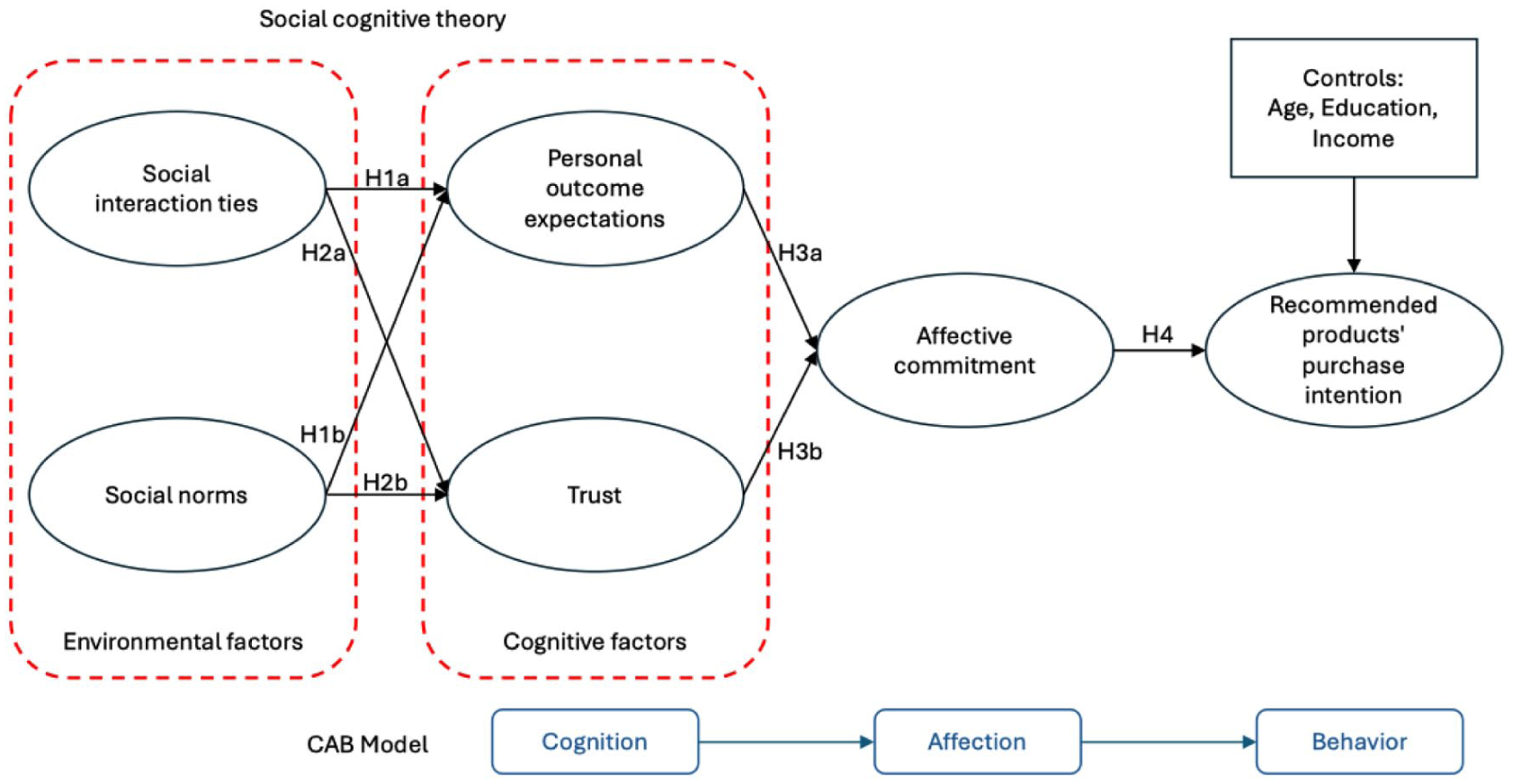
Conceptual framework of the study.
Social experience is a key factor in determining the development of people’s personality (Keiser et al., 2014). A person is not confined to simple reflexes but is able to make an indirect relationship between the incoming stimulus and the response through various intermediary factors (Luria, 1976). According to the SCT, the stimulus is the connection to the social environment, to which the individual responds with cognitive processing, which results in a particular action (Bandura, 2004). In this study, social interaction ties and social norms are considered environmental stimuli, while trust and personal outcome expectations are considered cognitive responses. The concept of behavior as a function of cognitions and socio-environmental factors is well accepted in psychology and consumer research (Sotiropoulos and Astous, 2013).
Social interaction ties refer to the strength of the relationship, the amount of time spent, and the frequency of communication with the social environment (Huang et al., 2009). These ties describe how users are embedded in their social environment. Research on social norms indicates that individuals will take specific actions in accordance with norms if: (1) they think that a specific behavior will yield benefits (outcome expectations); (2) they share a strong affinity with the reference group (a close group of friends); or (3) they identify with the norm (self-concept) (Lapinski and Rimal, 2005; Lapinski and Rimal, 2005).
Social norms refer to “the perceived social pressure to perform or not to perform the behavior” (Ajzen, 1991). In other words, social norms capture the pressure to comply with the expectations of others, that is, the social environment (Taylor et al., 2010). In the context of SNS, social norms represent behaviors on a specific SNS that is socially accepted, or at least accepted within a close social circle (i.e., friends or followers). Specifically, in the context of influencer marketing, social norms can be seen in the act of following certain individuals who are socially accepted in a circle of friends of the SNS user. The personal outcome expectations represent an estimate of the likely consequences that a particular action will produce. Bandura (1991) lists two types of expectations as the main cognitive behavioral forces: outcome expectations and self-efficacy (Bandura, 1991; Chiu et al., 2006). According to the SCT, it is more likely that individuals will take behavioral actions if they expect them to result in beneficial consequences (Chiu et al., 2006).
Most previous studies confirm that social norms are more important than evidence about reality (Taylor et al., 2010; Venkatesh et al., 2003). We argue that SNS users’ cognitions related to their personal outcome expectations related to following a particular SMI will be more favorably evaluated if users have strong social interaction ties within the SNS. Furthermore, SNS users will have more positive cognitions about the consequences of their actions if the SMIs are aligned with the social norms of their social circle. For example, a particular SNS user who follows several other users and influencers will probably find higher personal benefit in following a SMI than a different SNS user who has restricted and low SNS activity. Similarly, since the names of the people who are followed are usually visible and displayed on SNS, an SNS user will likely have stronger personal outcome expectations related to following an SMI who is socially accepted in their social circle (i.e., aligned with the social norms). Hence, we hypothesize that:
H1: When choosing whether to follow a SMI, (a) social interaction ties and (b) social norms are positively related to personal outcome expectations of the SNS user.
Moreover, previous studies in the domain of SMIs (Fink et al., 2018; Lim et al., 2017; Zhao et al., 2018) suggest that the credibility of the influencer is one of the key variables that determine the impact influencers have. In order to become credible, influencers need to gain their followers’ trust. According to McAllister (2018), trust is cognition-based because “we choose whom we will trust in which respects and under what circumstances, and we base the choice on what we take to be ‘good reasons,’ constituting evidence of trust.” Thus, trust can be considered as the readiness of an individual to believe in the posts of the influencer. However, the opinion of an individual is often under the influence of socially acceptable standards. For example, Nadeau et al., (1993) analyzed the change in the thoughts of certain groups due to experimental stimuli and concluded that there was a significant bandwagon effect.
Following the premise of the SCT that socio-environmental stimuli influence the cognitive action of an individual, it can also be argued that trust as a cognitive action is under the influence of social norms and social interaction ties (Ng, 2013). Users with strong social interaction ties tend to spend more time within the SNS environment and actively engage with its social dynamics. As a result, they are more likely to develop trust in SMIs compared to users with weaker social interaction ties. Similarly, a SMI who aligns with the social norms upheld by a user’s social circle is more likely to be perceived as trustworthy than one who deviates from those norms. Therefore, we hypothesize that:
H2: When choosing whether to follow a SMI, (a) social interaction ties and (b) social norms are positively related to SNS user’s trust in the influencer.
Affective commitment refers to the emotional attachment of a person to someone or something (Johnson et al., 2008; Menon and O’Connor, 2007). Thus, affective commitment captures the sense of belonging and, in the case of our study, the identification with a SMI (Hutter et al., 2013). In the field of marketing, affective commitment is central to brand–customer relationships (Iglesias et al., 2019; Markovic et al., 2018; Sierra et al., 2017). In the social cognitive process, social stimuli are likely to increase the affective commitment of individuals toward the influencer through their personal outcome expectations as well as through trust development (Lee et al., 2012).
When it comes to the CAB model, affective commitment represents a mediating variable between the cognitive and behavioral responses to a stimulus (Da Silva and Alwi, 2006). Trust and affective commitment are key factors that contribute to successful relationships (Chih et al., 2015; Keh and Xie, 2009 Li et al., 2006). Numerous studies have revealed that trust has a direct and positive influence on affective commitment (Chih et al., 2015; Markovic et al., 2025). Furthermore, some studies have shown that outcome expectations influence affection or emotions (Forsyth and McMillan, 1981). In the context of SMIs, it can be expected that SNS users with high personal outcome expectations from a certain influencer will develop a stronger affective commitment toward that influencer than those with low personal outcome expectations. Furthermore, SNS users who develop a high level of trust in a certain SMI are likely to have a stronger affective commitment than those users with a low level of trust. Therefore, we propose that:
H3: (a) Personal outcome expectations of an SNS user and (b) SNS user’s trust in the SMI are positively related to the user’s affective commitment toward the SMI.
Finally, purchase intention refers to the mental phase in the decision-making process where the consumer has developed a real willingness to take a purchase action (Hutter et al., 2013). Previous studies have shown that commitment is positively related to behavioral intentions, such as purchase intention (Keh and Xie, 2009). However, while much of the existing literature has focused on the relationship between consumer commitment to a company or brand and the intention to purchase its products or services, this study extends the scope by analyzing the relationship between affective commitment toward a SMI and the intention to buy the products recommended by that influencer. This distinction is critical in the context of influencer marketing, where the consumers’ emotional bond is not with a corporate entity but with a perceived authentic and relatable individual. Importantly, prior research has consistently shown that commitment is a strong predictor of behavioral intentions across various contexts (Hsu et al., 2017; Jani and Han, 2011). By applying this logic to the influencer context, it is plausible to expect that affective commitment toward an influencer will translate into meaningful consumer actions, such as being willing to purchase the recommended products. This is likely to reinforce the role of influencers not just as marketing tools, but as emotionally significant figures capable of driving consumers’ behavioral intentions. Thus, we postulate that:
H4: SNS user’s affective commitment toward a SMI is positively related to the user’s purchase intention of the products recommended by the SMI.
Methodology
To empirically validate the proposed conceptual framework, we conducted a quantitative study using data collected via SNS in 2020. Recruitment was carried out through posts and calls on SNS platforms to ensure that respondents had an active account and a verified presence within the SNS environment. The invitation included a link to an online survey along with a brief explanation of the research purpose. Only individuals who indicated that they followed at least one SMI were eligible to complete the questionnaire.
A total of 300 respondents completed the questionnaire, with missing data at a level lower than 15% (Hair et al., 2014). Most respondents were women (62%), belonging mostly to the age groups of 18–25 (62%) and 26–35 (12%), which is representative of the social media user population since the predominant SNS users are young adults under 25 (Correa et al., 2010). When it comes to education, 45% of respondents completed high school, and 36% completed university as their highest education level.
All constructs from the conceptual framework (Figure 1) were operationalized by using multi-item measurement scales adapted from prior studies (Table 1). Indicators for social interaction ties and personal outcome expectations were adapted from Chiu et al. (2006). Items for social norms and affective commitment were adapted from Taylor et al. (2010) and Chiu et al. (2006). The measurement model for trust was adapted from Braatz (2017) and Ohanian (1990). Finally, for measuring recommended products’ purchase intention, items were adapted from Evans et al. (2017). The questionnaire was back-translated into the respondents’ local language and pre-tested by three academic experts. Participants were asked to express their opinions and evaluations on a seven-point Likert-type scale (1 = strongly disagree, 7 = strongly agree).
Indicators of the measurement scales and standardized loadings.
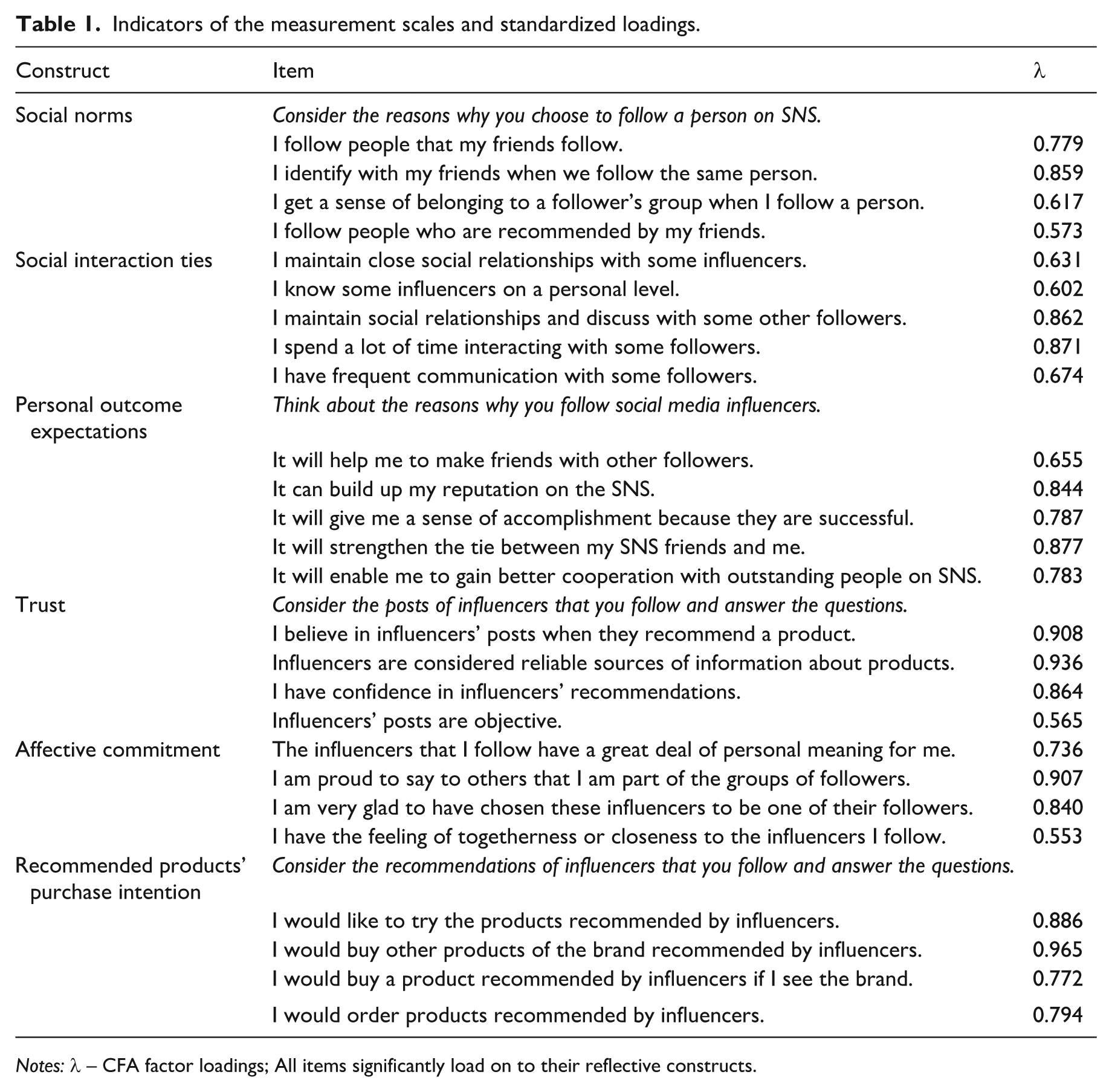
Notes: λ – CFA factor loadings; All items significantly load on to their reflective constructs.
Data analysis and results
Reliability and validity analyses
In order to assess the reliability and validity of the measurement scales (Anderson and Gerbing, 1988) used for constructs’ operationalization, a confirmatory factor analysis (CFA) for social norms, social interaction ties, personal outcome expectations, trust, affective commitment, and purchase intention was performed (Table 1). Specifically, prior to testing the model, a series of CFAs were performed to determine the unidimensionality of the multi-item constructs (Hair et al., 2014). We conducted CFA for each measurement scale, confirming their individual reliability and validity. Table 1 shows the standardized factor loadings from these analyses. CFA showed that all six scales fit the data satisfactorily with χ2/df, RMSEA, SRMR, CFI, and NFI within thresholds adopted from Hair et al. (2014). Then, we did the CFA with all six scales, but without structural relationships, and confirmed the acceptance of the overall model fit (χ2/df = 523.515/284 = 1.84; RMSEA = 0.0531; SRMR = 0.0701; CFI = 0.978; NFI = 0.954). While the SRMR of 0.0701 is not ideal, the value still falls within the acceptable range and indicates an adequate level of fit together with other parameters (Hu and Bentler, 1999; Kline, 2015). The results of the CFAs further indicated that all factor loadings on the respective factor were significant and above 0.5, which confirms the convergent validity of the measures (Anderson, 1987).
The average variance extracted (AVE) values were greater than 0.5, indicating adequate convergent validity (Table 2). In addition, the reliability of the scales, referring to the consistency of the measured variables, was assessed through CFA. The composite reliability (CR) values exceeded the recommended threshold of 0.70, confirming internal consistency (Diamantopoulos and Siguaw, 2000; Hair et al., 2014). Discriminant validity was evaluated using the Fornell and Larcker (1981) criterion, whereby the AVE for each construct must be greater than its squared correlations with any other construct. Both AVE and CR values satisfied the required thresholds, supporting the measurement model’s validity and reliability.
Discriminant validity.
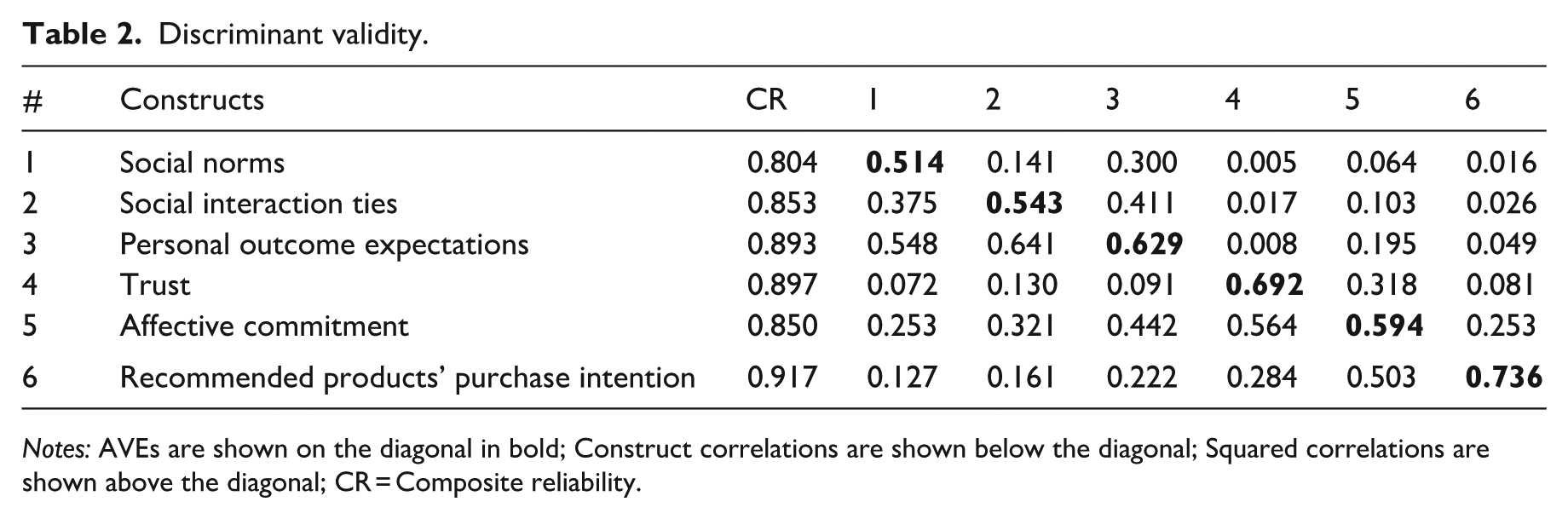
Notes: AVEs are shown on the diagonal in bold; Construct correlations are shown below the diagonal; Squared correlations are shown above the diagonal; CR = Composite reliability.
Since all measures were obtained from the same source, we employed both procedural and statistical remedies to mitigate the potential effects of common method variance (CMV), as recommended by Podsakoff et al. (2003). These steps were taken to reduce the likelihood that CMV would bias the results or artificially inflate the observed relationships among the study’s constructs. Regarding procedural remedies, we advised respondents that there were no good or bad answers, and that only their personal opinions are the ones that matter. Also, we eliminated common scale properties. (Semantic differential scales were used, and Likert-type scale anchors were changed throughout the questionnaire.) Moreover, we scattered reflective items around the questionnaire so respondents could not identify items underlying the same factor. In terms of statistical remedies, we applied a variation of the marker variable test proposed by (Malhotra et al., 2006) who state that “the adjustment of correlations using the smallest positive inter-construct correlation as a proxy marker typically results in only minimal change in the substantive relationship estimates, suggesting that common method variance is unlikely to be the primary driver of observed effects” (p.1874). We used the second lowest positive correlation (r = 0.012) between the observed variables (i.e., indicators) as a proxy for CMV and adjusted the zero-order correlations between all items by subtracting this value from the original estimates. There were no major changes in the significance of the resulting correlations, thus revealing no major threat due to CMV. Based on the different remedies used, it can be argued that it is not likely that the results of our study are affected by CMV (Hulland et al., 2017).
Hypotheses testing
We further proceeded with the empirical verification of our conceptual framework and hypotheses testing. The path analysis was conducted using the structural equation modeling (SEM) technique, which enables the simultaneous estimation of multiple relationships among constructs measured by multiple indicators (Diamantopoulos and Siguaw, 2000). The analysis was performed using the LISREL 8.8 software. The structural model estimation resulted in a model with an acceptable fit (χ2/df = 722.362/360 = 2.01; RMSEA = 0.0580; CFI = 0.966; NFI = 0.936). The estimated standardized path coefficients, t-values, and p statistics associated with this model are presented in Table 3.
Path analysis.
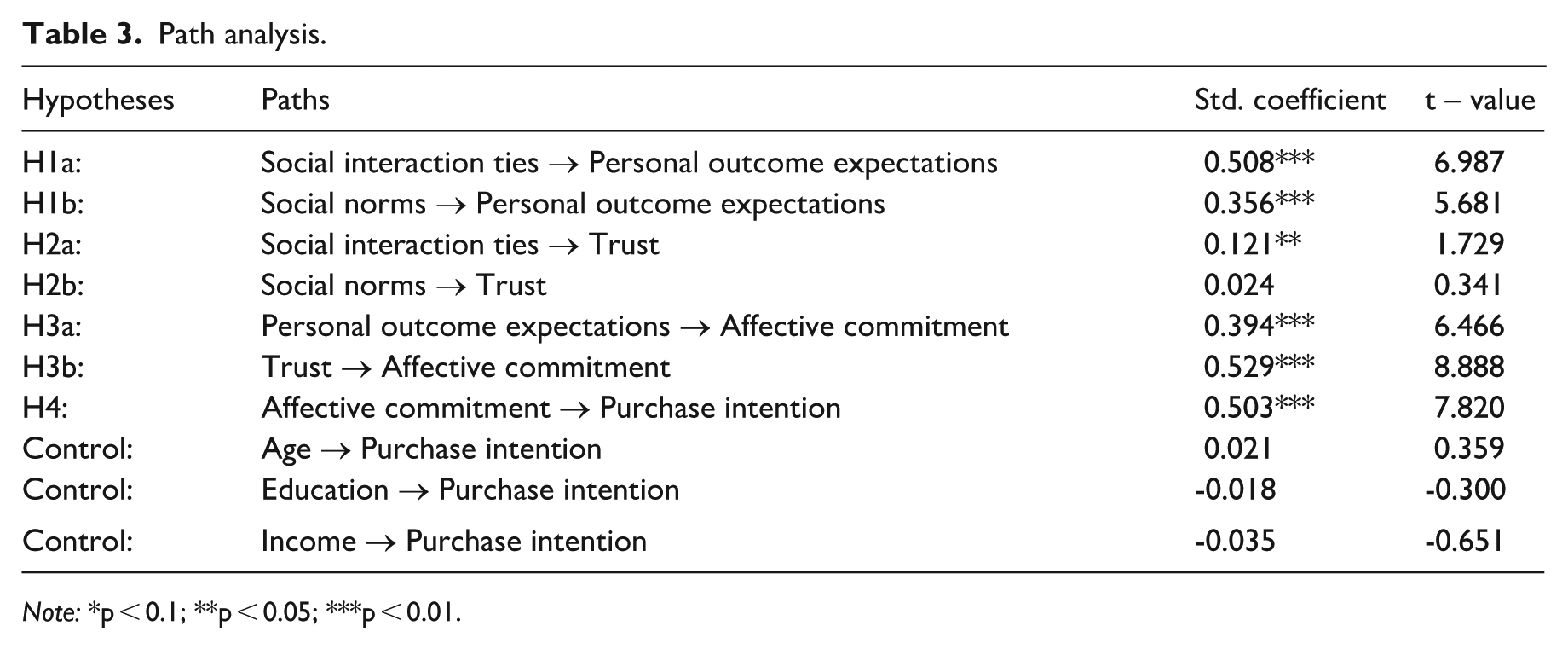
Note: *p < 0.1; **p < 0.05; ***p < 0.01.
The results presented in Table 3 show that the effects of social norms (β = 0.356, z = 5.681, p < 0.01) and social interaction ties (β = 0.508, z = 6.987, p < 0.01) on personal outcome expectations are positive and statistically significant. This means that when individuals realize that the values and perceptions of their friends toward a SMI are positive, they are more likely to be optimistic about that SMI, and that their perception of the benefits of being their follower increases. Besides, the results show that social interaction ties (β = 0.121, z = 1.729, p < 0.05 – one-tailed) are a positive and statistically significant predictor of trust, whereas social norms (β = 0.024, z = 0.341, p > 0.1) are not a significant antecedent. As expected, personal outcome expectations (β = 0.394, z = 6.466, p < 0.01) and trust (β = 0.529, z = 8.888, p < 0.01) have a positive effect on affective commitment toward a SMI, meaning that (a) the extent to which an individual believes that being a follower of a SMI will contribute to their socialization and reputation in the SNS, and (b) the extent to which an individual has trust in the SMI, lead to a significant increase in the affective commitment to that SMI. Further, affective commitment to a SMI has a positive and statistically significant effect on recommended products’ purchase intention (β = 0.503, z = 7.820, p < 0.01), meaning that the extent to which one has affective commitment toward a SMI leads to a significant increase in the purchase intention of the products that the SMI recommends.
We also assessed the indirect effects of our focal constructs to determine whether they are aligned with theoretical assumptions, although these effects were not hypothesized. We decomposed the total effects into direct and indirect effects in the SEM model which allowed us to compute the magnitude and significance of indirect paths and assess them using the z-statistics output. First, in line with SCT, environmental factors (social interaction ties and social norms) should indirectly impact affective commitment and purchase intention (through cognitive factors). Our results show that social interaction ties positively and indirectly impact affective commitment (β = 0.264, z = 4.847, p < 0.01) as well as recommended products’ purchase intention (β = 0.153, z = 4.398, p < 0.01). Furthermore, social norms also positively and indirectly impact affective commitment (β = 0.133, z = 3.174, p < 0.01) and purchase intention for recommended products (β = 0.077, z = 3.037, p < 0.05).
In line with the CAB model, cognitions should be guided through affect toward behavioral intentions. Hence, we assessed the indirect effects of personal outcome expectations and trust on the final outcome. Both cognitive factors have a positive and significant indirect effect on recommended products’ purchase intention; that is, an indirect effect of personal outcome expectations (β = 0.198, z = 5.501, p < 0.01) and trust (β = 0.266, z = 6.774, p < 0.01).
Finally, we controlled for key consumer demographics in relation to the ultimate dependent variable to assess the robustness of the model and to explore the potential existence of distinct consumer sub-segments. Specifically, age, education and income were included as control variables. The results indicated that none of these demographic factors had a significant effect, thereby reinforcing the robustness of the model across different consumer groups. This suggests that the observed relationships hold consistently, regardless of variations in age, educational background, or income level.
Discussion and conclusion
Drawing on SCT (Bandura, 1991) and the CAB model (Huang, 2017), this study proposed a conceptual framework with social norms and social interaction ties as predictors of the cognitive factors of trust and perceived outcome expectations. Furthermore, the framework has been developed in a way that cognitive factors influence affective commitment, which ultimately determines purchase intention. Below, we discuss the contributions and implications of our study, as well as the limitations and associated future research opportunities.
Theoretical contributions
This study advances prior literature in several ways. First, we build on prior research by integrating SCT and the CAB model in a unified framework in the area of influencer marketing. This integration allows us to capture both the cognitive and emotional mechanisms underlying influencer-driven purchase intentions, which, to our knowledge, remains uncommon in influencer marketing research. Specifically, we build on the premises of the SCT by incorporating the affective dimension proposed in the CAB model (Breckler, 1984). This connection does not seek to modify the SCT, but to complement it by recognizing that cognitive factors (i.e., personal outcome expectations and trust) are often translated into behavioral intentions through affective mechanisms. Although previous studies have applied the SCT to social media contexts, few have empirically examined this intermediate affective process as part of the cognition–behavior link. Our results confirm that cognitive factors enhance behavioral intention when they increase affection. Thus, cognition can be a mediator through which the environment shapes an individual’s affection and, ultimately, behavioral intention (Braatz, 2017). Both trust and personal outcome expectations positively influence an individual’s affective commitment toward the SMI, which is consistent with the CAB model that postulates that cognitive factors, such as trust and expectations, impact affective responses (del Bosque and San Martín, 2008). Hence, we build on recent research that suggests that not only cognition, but also feelings can play an important role in consumer behavior outcomes (e.g., Castro-González et al., 2019; Yacout and Vitell, 2018).
Moreover, our findings are aligned with the theory of planned behavior (Ajzen, 1991) which suggests that social norms influence individual attitudes, and cognition is a component of an individual’s attitude (Breckler, 1984). This theory reinforces our argument that social norms operate through cognitive processes that shape affective commitment and, ultimately, behavioral intentions, aligning our findings with well-established behavioral theories. Social norms influence individual behavioral intentions especially through the fear of social sanctions (Bamberg et al., 2007). Our study suggests that individuals are not likely to be associated with a particular person on SNS unless their narrow social circle approves that person, regardless of their own preferences. Hence, our study also contributes to the literature that examines the impact of social norms/social interaction ties on the individual’s expectations/trust (Fisher et al., 2017; Hall et al., 2018).
Finally, considering that influencer marketing expenditures are on the raise (Charlton and Cornwell, 2019) and that influencer marketing is a growing trend in promotional strategies, our contribution is significant because it enhances the understanding of consumers’ behavioral intentions in this context. Overall, we contribute to a better understanding of the intentions to purchase products that influencers recommend on SNS, by identifying the cognitive and affective factors that motivate consumers to follow their recommendations. This further contributes to the understanding of the effectiveness of paid electronic word-of-mouth (eWOM), where influencer marketing is one of the key channels (Evans et al., 2017). Beyond the influencer context, our research contributes to broader consumer behavior research by illustrating that commitment-based affective processes can systematically mediate the impact of environmental and cognitive factors on decision-making. This perspective complements existing applications of the SCT and the CAB model in online environments, offering a transferable approach for examining consumer engagement, digital trust, and other forms of relational behavior across interactive platforms.
Managerial and policy implications
More and more companies decide to use influencers as a tool for promotion. However, with the emergence of this new marketing channel, two important issues arise: first, for the companies, how to choose an adequate influencer; and second, for influencers, how to build a reputation on SNS. In both cases, it is about branding and matching companies with the appropriate influencers. In this regard, the managerial implications of our study are twofold.
On the one hand, managers should prioritize the social acceptability of influencers when selecting individuals to promote their brands. Beyond just follower count or engagement metrics, it is crucial to assess how an influencer is perceived within the target audience’s social circle. Consumers are more likely to engage with influencers who are approved by their peer groups, so understanding the social environment and aligning with the right influencers is essential. In addition, managers should recognize the importance of both cognitive and emotional factors in driving consumers’ behavioral intentions. Influencers who establish trust and inspire positive expectations in their audience are more likely to foster deep emotional connections, which, in turn, can boost purchase intentions.
On the other hand, influencers should be mindful of the significant role that social acceptance plays in building a strong connection with their followers. To enhance their effectiveness, they need to align with the values and norms of their audience, ensuring that their image resonates positively within their followers’ social circles. Trust is a key factor, and influencers should work to establish credibility and maintain authenticity in their content. By consistently fostering trust and managing expectations, influencers can create stronger emotional bonds with their audience, leading to higher levels of engagement and, ultimately, greater success in promoting products. Influencers should also be aware that their ability to shape purchase intentions is influenced not only by what they promote, but also by the emotions they evoke, making emotional connection a critical aspect of their content strategy.
Finally, policymakers should consider the growing influence of social media and influencer marketing on consumers’ behavioral intentions and the potential implications for public trust and social norms. Given the power of influencers to shape consumer attitudes and behavioral intentions, there is a need for regulations that ensure transparency and protect consumers from misleading or manipulative marketing practices. Policymakers should advocate for clear guidelines regarding disclosure of paid partnerships and ensure that influencers are held accountable for the accuracy and authenticity of the content they promote. In addition, as social norms and peer group influences are integral to the effectiveness of influencer marketing, policymakers should examine how these dynamics could be leveraged or regulated to prevent harmful trends or the spread of misinformation. To operationalize these recommendations, regulatory bodies could, for example, mandate standardized disclosure formats (e.g., consistent hashtags or visual indicators for sponsored content) across all major social media platforms, supported by periodic audits and penalties for non-compliance. Educational campaigns could be launched in collaboration with platforms and schools to raise awareness of manipulative content and promote digital literacy among younger audiences. Moreover, policymakers could develop certification schemes for compliant influencers or agencies, incentivizing ethical practices and increasing consumer trust in transparent digital communication.
Limitations and future research
Despite its theoretical contributions and managerial and policy implications, this article has several limitations. One limitation is that respondents were asked to evaluate a specific influencer they personally follow. While this approach enhances ecological validity and allows findings to reflect real-world SMI–follower relationships, it also introduces heterogeneity, as responses may be shaped by individual preferences, prior experiences, and differences among influencers. As a result, the study offers broader generalizability across influencer contexts, but with reduced experimental control. Future research could complement this approach by adopting more controlled designs, such as scenario-based experiments or the use of a single, standardized influencer across participants. Such designs would allow researchers to isolate causal mechanisms more precisely and assess how individuals respond to identical influencer stimuli, thereby strengthening internal validity.
In addition, the reliance on self-reported data presents another potential limitation, as it may not always reflect actual consumer behavior, which is often more complex than reported perceptions or intentions. Future studies could further enhance our understanding of consumer behavior by incorporating objective data sources, such as actual sales data linked to influencer campaigns or specific influencer performance metrics (e.g., engagement rates, reach, and conversion rates). Integrating these objective measures with survey-based data would offer a more comprehensive view of the effectiveness of influencer marketing, bridging the gap between perception or intention and actual consumer behavior. This approach would allow to draw more robust conclusions about the impact of influencer marketing on real-world purchasing decisions and provide actionable insights for marketers.
Another limitation of our study is that we did not investigate the factors that influence the positive or negative image of influencers within particular social groups. While we focused on general perceptions of influencers, future research should explore the underlying social dynamics that shape how influencers are viewed within different communities. For instance, during our data collection, we observed that some individuals frequently visit specific influencer profiles to monitor their content but choose not to follow them due to concerns about how they would be perceived by their social circle. This behavior suggests that social group influence plays a critical role in shaping the image of influencers. Future studies could examine the social and psychological factors that contribute to the popularity and image of influencers, particularly the influence of peer groups, social norms, and the fear of social disapproval.
Moreover, our study primarily focused on a limited set of variables from the perspectives of the SCT and the CAB model. While these frameworks provided valuable insights, future research should explore other social/environmental, cognitive, and emotion-related variables that might influence purchase intentions in the context of influencer marketing. For example, understanding the role of consumer–influencer identification or the emotion of admiration could provide a deeper understanding of how followers develop stronger emotional attachments to influencers, potentially influencing their purchasing intentions and behavior.
Finally, a limitation of our study is the reliance on cross-sectional data, which captures a snapshot of participants’ perceptions and intentions at a single point in time. Consumer attitudes toward influencers, trust, and affective commitment are likely to evolve as individuals are exposed to different types of content and influencers, and as influencers themselves may alter their strategies or personal brand over time. Future research should consider longitudinal studies that track consumers’ interactions with influencers across multiple points in time. This would allow to examine how long-term exposure to influencer marketing impacts consumers’ purchasing intentions and behavior.
Footnotes
Funding
The authors received no financial support for the research, authorship, and/or publication of this article.
Declaration of conflicting interests
The authors declared no potential conflicts of interest with respect to the research, authorship, and/or publication of this article.