






Abstract
Consumers often share their consumption experiences on social media. However, little is known about how they respond to feedback from the online community and how these responses influence electronic word of mouth (eWOM). Addressing this gap, our research draws on self-enhancement theory to examine the mediating role of pride and shame, two self-conscious emotions of particular relevance in identity-driven environments like social media, where public approval or disapproval can elicit strong self-evaluative reactions. In addition, we investigate the moderating influence of narcissism, distinguishing between its grandiose and vulnerable forms. Study 1 demonstrates that feedback impacts eWOM via pride and shame, with divergent patterns for individuals high in grandiose versus vulnerable narcissism. Study 2 replicates these findings and further reveals that these emotions also mediate the effect of feedback on brand evaluations. We conclude by discussing implications for targeting narcissistic consumers through user-generated content strategies.
Introduction
As illustrated by more than 3.3 billion brand mentions in 2.4 billion brand-related conversations per day in the United States, 1 consumers are numerous to engage in sharing their brand experiences socially on Facebook, Instagram, Pinterest, and other social sites. Consumers share their product and brand experiences not only within their own community but also reach an extensive audience, with the potential of their posts going viral (Berger, 2014; Berger and Milkman, 2012). Such informal information exchange has been acknowledged as electronic word of mouth (eWOM), or “any positive or negative statement made by potential, actual, or former customers about a product or company, which is accessible to a multitude of people and institutions via the internet” (Hennig-Thurau et al., 2004: 39). The ability to share content and information with a boundless number of people has made eWOM a key for successful marketing strategies (e.g. Yen and Tang, 2015; Yeoh et al., 2013), with 88% of consumers trusting WOM recommendations more than any other channel (Nielsen, 2021).
Considering the large number of social media users who engage in sharing their consuming experience and their persuasive effects, a growing body of research has examined the motivations behind eWOM behavior (Gvili and Levy, 2018; Wen et al., 2018; Zhou et al., 2020). Beyond altruism and the desire to help others (Hanks et al., 2024; Reimer and Benkenstein, 2016), a sense of belonging to an online community and the relational benefits of being part of a social network (Cheung and Lee, 2012) and intrinsic enjoyment (Hu and Kim, 2018), self-centered motivations—and specifically the need for self-promotion and the desire to get social attention—have been identified as key motivational factors for eWOM behavior (Caprariello and Reis, 2021; De Vries et al., 2017). Users share their experiences to gain positive feedback from the online community, which we define as evaluative cues—such as likes, comments, and shares—that individuals receive in response to their self-relevant posts and which serve as social signals about how others perceive them (adapted from Zell and Moeller, 2018). Such feedback acts as a form of validation from others, subsequently increasing their self-worth (Hussain et al., 2018).
However, despite scarce research showing positive effects of receiving positive (vs negative) feedback from one’s online community in response to shared content (Jackson and Luchner, 2018; Stsiampkouskaya et al., 2021a), important gaps in the literature remain. First, little is known about whether receiving feedback from one’s online community after posting about a consumption experience affects subsequent eWOM and brand evaluations. Second, the mechanisms that explain such feedback effects have yet to be identified. Third, it remains unclear if all individuals react the same way to such online feedback. Hence, in this research, we draw on self-enhancement theory (e.g. Epstein, 1973; Sedikides and Gregg, 2008)—which posits that individuals are motivated to increase their feelings of personal worth—to propose that feedback from the online community can either affirm or threaten a consumer’s identity depending on its valence (positive vs negative), thus shaping their emotional responses and future eWOM intentions toward brands. Considering that brand evaluation is linked with a consumer’s sense of self as well as social standing (e.g. Berger and Heath, 2007; Kirmani, 2009), feedback from others may not only affirm or challenge consumers’ self-worth but also shape how they subsequently evaluate the brand in question, and we therefore also examine how such feedback impacts consumers’ evaluation of the brands they share about. Further, we draw on the notion that not all consumers react similarly to feedback (Finkelstein and Fishbach, 2012) to examine narcissistic tendencies as a boundary condition. Given that people high on narcissism are highly sensitive to social evaluation (e.g. Atlas and Them, 2008; Neave et al., 2020), narcissism likely strengthens the relationship between feedback, self-conscious emotions, and eWOM behavior.
Therefore, in this research, we aim to answer the following question: how does audience feedback on consumers’ consumption-related posts influence their self-conscious emotions and, in turn, their subsequent eWOM intentions and brand evaluations? Although prior research has started to examine consumers’ motives for engaging in eWOM (Gvili and Levy, 2018; Wen et al., 2018; Zhou et al., 2020), it did not provide a psychological understanding of the impacts of online feedback on eWOM. Yet, from a theoretical point of view, uncovering the emotional mechanisms that explain how receiving feedback influences subsequent brand-related eWOM and evaluations is crucial for advancing our understanding of consumer behavior in digital environments. Prior research has emphasized that feedback can influence highly arousing emotions such as excitement (Stsiampkouskaya et al., 2021a) and other positive emotions like joy (Pütten et al., 2019), as well as negative emotions such as depressed mood (Li et al., 2018) and anxiety (Lee et al., 2020). However, the role of self-conscious emotions—those that evolve from one’s own feelings, thoughts, and experiences, such as pride or shame (Tracy and Robins, 2011)—in the context of online feedback remains unexplored. This lack of examination is surprising, as self-centered motivations are central to understanding both why individuals share their consumption experiences online and how they respond to such sharing (e.g. Chu et al., 2019; De Vries et al., 2017; Yan et al., 2018). Therefore, a deeper investigation appears to be needed to uncover the role of specific emotions like pride and shame in the context of online feedback. From a managerial perspective, identifying these mechanisms could help brands to make better decisions regarding their social media engagement, encouraging positive audience feedback while reducing the risk of negative emotions among consumers.
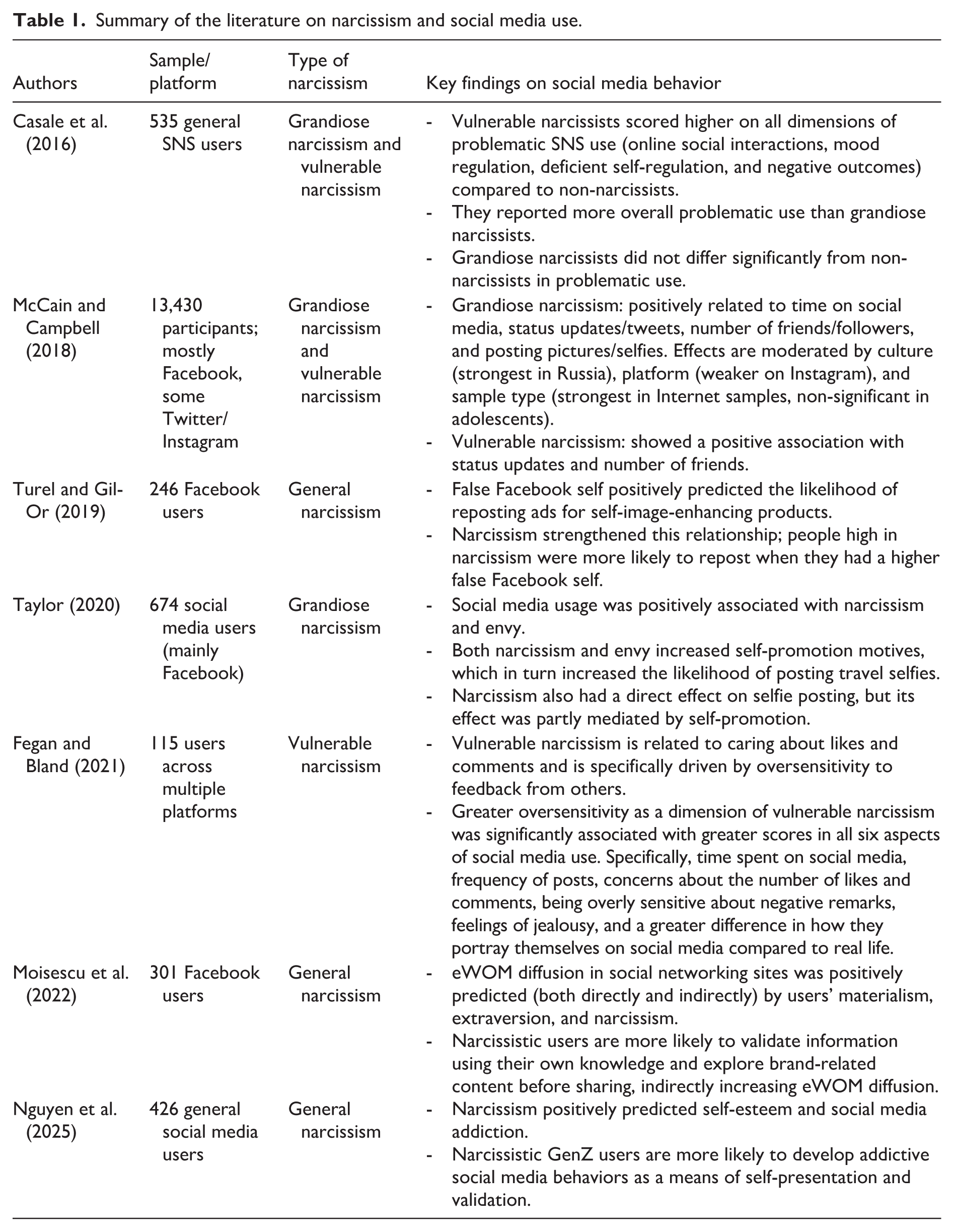
In addition, and given the suspected role of narcissism discussed above, this study also addresses a second question: how are the effects of online feedback on eWOM consistent across consumers who differ in their narcissistic tendencies? To answer this question, we build on the notion that consumers share their personal online experiences to receive positive (vs negative) feedback (Caprariello and Reis, 2021; De Vries et al., 2017). Such consumers are thus often characterized as having narcissistic tendencies (Singh et al., 2018; Weiser, 2015), exhibiting strong self-love and grandiose thoughts about themselves (Dumas et al., 2017) and expecting rewards from others (Paulhus and Williams, 2002). Consistent with prior research and with the common practice in consumer research of treating narcissism as a subclinical trait (Mahadevan, 2024), we conceptualize narcissism as a continuous personality tendency rather than a clinical condition. Further, and in line with meta-analyses on narcissism (Gnambs and Appel, 2018; Grijalva et al., 2015), we consider two forms of narcissism—grandiose and vulnerable—and the notion that people with grandiose traits are more oriented toward self-gratification than those characterized by vulnerable traits (Dickinson and Pincus, 2003; Neave et al., 2020). Both types of narcissism seek to get continued admiration from others, but individuals with grandiose narcissistic tendencies tend to exhibit higher self-love compared to those with vulnerable narcissistic tendencies (Miller et al., 2017). From this distinction, we predict that such individuals with grandiose narcissistic tendencies react more strongly to the positive emotion of pride that they experience as a response to positive online feedback, leading to more eWOM. Conversely, those with vulnerable narcissistic tendencies may reveal more sensitive to negative feedback, such that their eWOM is more strongly shaped by the experience of shame induced by such feedback. By making these predictions, we contribute to the body of literature revealing a robust association between narcissism and increased social media engagement (see Table 1 for a review) but extend it by distinguishing between grandiose and vulnerable forms of narcissism in the context of social media use.
Summary of the literature on narcissism and social media use.
In what follows, we first build on self-enhancement theory to predict that pride and shame mediate the effect of audience feedback and eWOM intentions. We then move to the literature on the dark triad (Paulhus and Williams, 2002) to make predictions about the role that the two distinct forms of grandiose versus vulnerable narcissism play in consumers’ responses to audience feedback. We then present two studies that provide evidence for our theorizing before we conclude with the three implications of our work for researchers. First, we enrich the current knowledge of the mechanisms underlying the impact of feedback on eWOM behavior. Importantly, our research is the first to offer empirical evidence showing that self-conscious emotions play a key role in prompting eWOM intentions when individuals receive online feedback. By proving that self-conscious emotions specifically drive eWOM intentions, we offer a comprehensive understanding beyond the traditional focus on general emotional responses to audience feedback. Second, we identify the moderating role of the distinct dimensions of grandiose versus vulnerable narcissism in relation to emotions and eWOM intentions, thereby extending current knowledge of the robust association between narcissism and online behavior. By distinguishing between the grandiose and vulnerable forms of narcissism, we advance the literature, which has often treated narcissism as a unidimensional construct (Gross and Lunardo, 2024; Lunardo and Gross, 2024; Lunardo et al., 2021; Sedikides et al., 2007). Third, this work advances and extends the current literature (Tang et al., 2022; Zhu et al., 2019) of how posting online content and gaining positive (vs negative) feedback contributes to strengthening customers’ relationships with brands by providing strong evidence that brand evaluation—presented here as consumers’ subjective perception toward a brand—is shaped by audience feedback and explained by self-conscious emotions.
Conceptual development
Online feedback and eWOM behavior
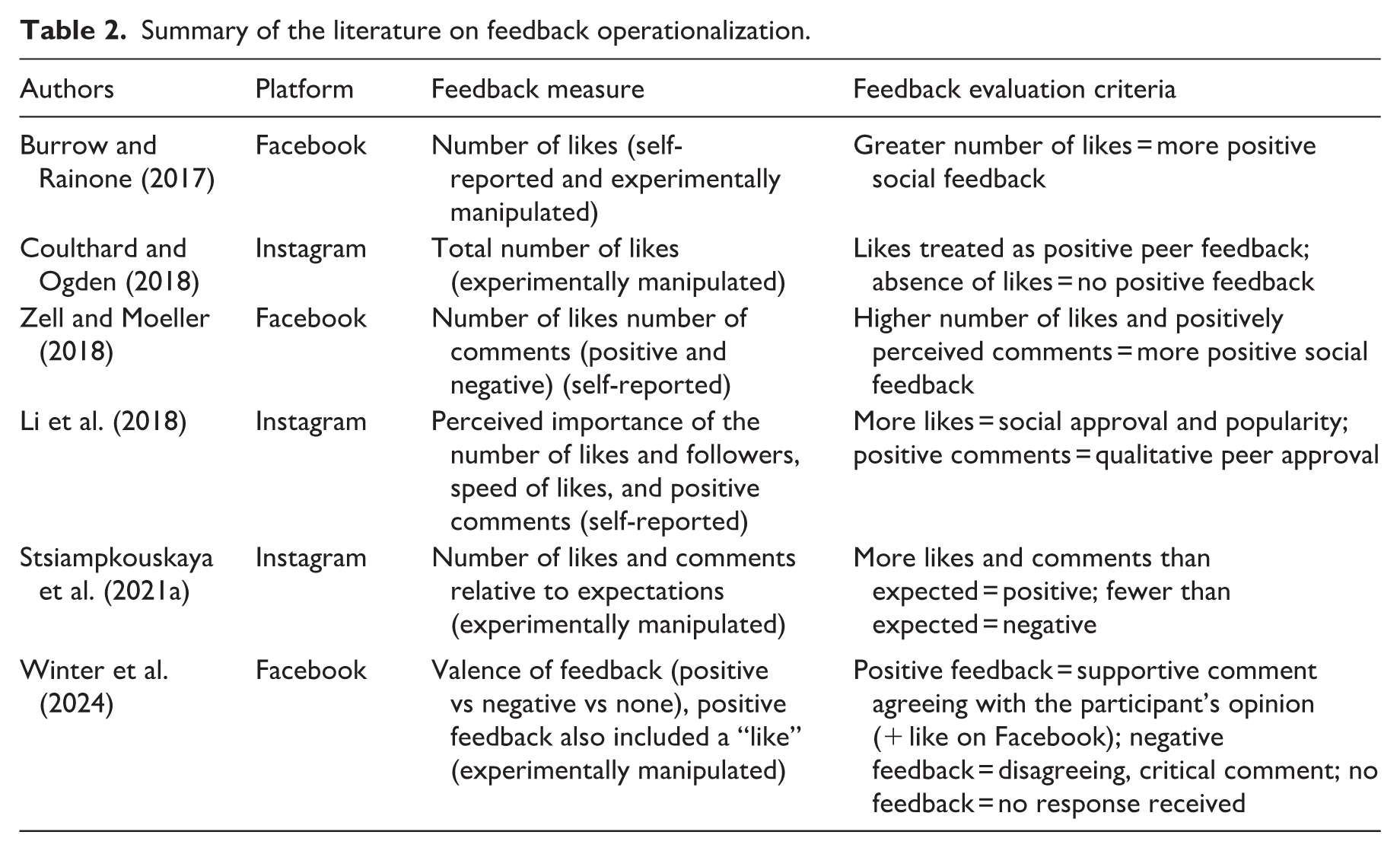
Feedback from the online community on social media platforms constitutes a form of social media engagement. Such engagement in response to a post can take four primary forms: like, comment, share, and react (Swani and Labrecque, 2020). Typically, engagement through liking or sharing is recognized as taking less activity and effort than does writing comments or reacting, which prompts more elaboration and reflects more profound (vs shallow) engagement (Gross and Lunardo, 2024). Feedback from the online community as a form of social media engagement can thus take on multiple forms and plays a central role in reflecting the poster’s status and how popular they are (Chua and Chang, 2016). It is typically measured using either a quantifiable approach (e.g. number of likes or comments) or a qualifiable approach (e.g. the content or tone of comments). Prior research has approached positive (vs negative) feedback in various ways, which Table 2 summarizes.
Summary of the literature on feedback operationalization.
In relation to feedback and posting behavior, prior research highlights the self-presentation role-played by social media engagement with brands (Gross and Lunardo, 2024; Swani and Labrecque, 2020). Hence, and not surprisingly, receiving supportive feedback has been found to increase users’ feelings of joy (Pütten et al., 2019), happiness (Marengo et al., 2021; Zell and Moeller, 2018), and love (Gumparthi and Patra, 2020), which leads to an increase in online posting behavior (Eckles et al., 2016). Receiving positive feedback also evokes emotions related to one’s sense of self-worth, such as pride, a positive emotion which—like joy, amusement, and happiness—increases consumers’ likelihood of engaging in eWOM behavior (Septianto and Chiew, 2018), and authentic pride, encouraging users to generate positive and constructive eWOM (Liu et al., 2022). On the contrary, non-supportive feedback is associated with depressed mood (Li et al., 2018), anxiety (Lee et al., 2020) and other negative emotions (Hayes et al., 2018; Poon and Jiang, 2020), and behavioral responses like reduced posting frequency and trying a different type of content in one’s future posts (Stsiampkouskaya et al., 2021b).
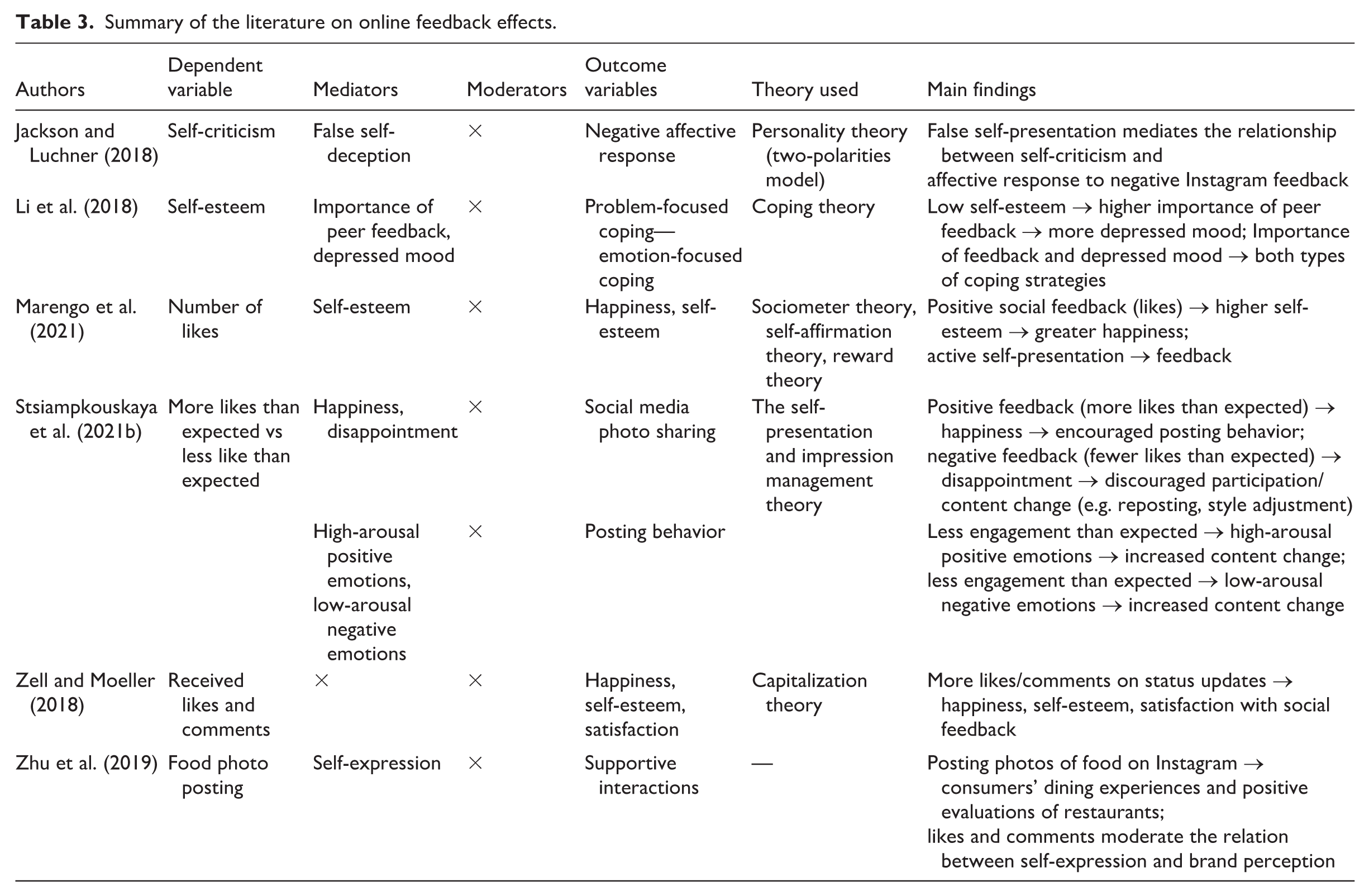
Interestingly, although limited, existing research has begun to highlight the role of self-focused emotions in shaping brand evaluations. For example, studies have shown that users who express pride tend to form more positive perceptions and evaluations of the associated brands (Griskevicius et al., 2010). According to a study by McFerran et al. (2014), pride represents a key predictor of brand connection and plays a central role in shaping consumer–brand relationships. Beyond emotional drivers, only a limited number of studies have examined the direct influence of feedback on brand perception. For instance, Zhu et al. (2019) found that social interactions—such as likes and comments—moderate the relationship between self-expression and brand perception. Similarly, Bao (2015) showed that positive feedback on user-generated brand content enhances both brand attitude and purchase intention. These findings reinforce the aforementioned point regarding the scarcity of research on audience feedback in connection with self-focused emotions, eWOM behavior related to consumption or brands, and overall brand perception. Table 3 provides a summary of the literature.
Summary of the literature on online feedback effects.
Self-enhancement theory and online feedback effects
Self-enhancement theory (Epstein, 1973; Sedikides and Gregg, 2008) states that individuals are motivated to increase their feelings of personal worth. Contrary to other self-related theories like self-affirmation theory (Steele, 1988), which focuses on moral values and individuals’ affirmation of core values to preserve self-integrity, self-enhancement, by contrast, is more about strategies to boost or protect self-esteem, for instance, by dismissing negative feedback or exaggerating one’s strengths (Sedikides and Gregg, 2008). Importantly, self-enhancement can be conceptualized as varying along different dimensions (Sedikides and Gregg, 2008), which we believe are of particular interest for the investigation of consumers’ reactions to online feedback. First, self-enhancement can be achieved by self-advancing (i.e. augmenting the positivity) or self-protecting (i.e. diminishing the negativity) the self-concept (Arkin, 1981). Thus, self-enhancement can result from a range of behaviors, such as participating in activities that strengthen one’s self-concept or receiving affirming feedback from others (Blanton et al., 1997). The need for a positive self-image becomes even more apparent when the ego is threatened. In such situations of self-threat, individuals try to restore the integrity of the self (Sherman and Cohen, 2006) and cope with threats through (1) avoiding or disconnecting from the source of threat, (2) rejecting the information that threatens their self-worth, or (3) promoting information that boosts their self-worth (Toma and Hancock, 2013). For instance, consumers tend to choose products with an attractive design to affirm their sense of self (Townsend and Sood, 2012) or denigrate mannequins as normative standards of beauty to restore their self-esteem (Argo and Dahl, 2018).
Second, individuals can self-enhance either publicly or privately (Sedikides and Gregg, 2008). This suggests that consumers may use social media as a form of public exposure to present themselves in a favorable manner and self-enhance. In this regard, prior research has identified the role of social media in self-enhancement behaviors (Carr et al., 2016, 2018; Marengo et al., 2021; Reich et al., 2018). When seeking feedback online, consumers engage in different activities and share general or brand- related content such as pictures, videos, and personal disclosure, expecting that others will engage with them and show their approval (DiTunnariello and Farrell, 2015). For example, Hollenbeck and Kaikati (2012) found that individuals use brands on Facebook to showcase positive aspects of their identities. Similarly, De Vries et al. (2017) showed that self-expression is a key motivator for consumers to engage in brand-related content creation, such as posting about brands or writing reviews. Li et al. (2018) further demonstrated that adolescent girls who post selfies often seek frequent feedback, driven by a desire to maintain a positively reinforced self-image.
Third, individuals differ in terms of which domains matter most to them (Sedikides and Gregg, 2008), and some feedback—like comments received online—may thus positively affect some consumers while negatively affecting some others depending on its content. Hence, online feedback may not always be perceived positively. For instance, when individuals engage in risky self-presentation, they may receive criticism or disagreement (Koutamanis et al., 2015), which can lead to negative emotional outcomes such as sadness and stress (Vonk et al., 2017). Although such negative feedback creates strong negative emotional experiences and might affect how people engage in social media, little is known about the relationship between how positive (vs negative) feedback affects how people react and engage in the consumption and brand-related eWOM behavior, and self-enhancement theory may thus help to investigate this phenomenon.
Pride and shame as self-centered emotions mediating the effect of online feedback on eWOM
Self-enhancement works by increasing positive feelings (Armitage and Rowe, 2011). Among such feelings, pride and shame are two self-conscious emotions (Tracy and Robins, 2004) that share a social component, focusing simultaneously on the self and on others (Van Osch et al., 2013). Consequently, pride and shame can be classified as both self-conscious (Tracy and Robins, 2011) and social emotions concerning one’s relationship with others (Williams and DeSteno, 2009). Individuals experience pride as a self-inflating emotion (Van Osch et al., 2018) after a valued achievement and when they positively appraise their personal competence, behaviors, and achievements (Griskevicius et al., 2010). On the contrary, they feel shame when they perceive a self-related failure and that they have caused socially undesirable outcomes (Tracy and Robins, 2004).
Although clearly distinct, these two emotions have in common that their experience is linked to social influence: people feel pride or shame depending on how others perceive them, and these emotions then affect social behavior. Unlike other self-conscious emotions, such as guilt, pride, and shame, are closely tied to perceived success or failure in meeting personal or social standards (Tracy and Robins, 2004), making them especially pertinent in response to positive or negative feedback. For instance, people experience pride when they make social comparisons (Webster et al., 2003), and they tend to make people perceive themselves as more similar to strong others than weak others (Oveis et al., 2010). In contrast to pride, which acts as a reinforcing cue that encourages people to persist in their actions (Williams and DeSteno, 2008), shame causes people to withdraw and hide (Tangney and Dearing, 2003). With respect to online pride and shame, the construction of self-identity on social media is influenced by the reactions and feedback of others (Michikyan et al., 2015). Receiving sympathetic feedback online boosts self-worth and validates one’s self-view (Burrow and Rainone, 2017; Yurchisin et al., 2005). In this regard, Kırcaburun and Griffiths (2019) showed that receiving likes and comments from others on Instagram boosts one’s sense of presence. However, negative feedback leads to depression and feeling stressed (Lee et al., 2020; Vonk et al., 2017), as well as causing embarrassment (Chua and Chang, 2016). For instance, Reich et al. (2018) found that not getting likes on Facebook threatens users’ sense of self-worth and belonging. Based on what precedes, we propose the following hypothesis:
Turning to how individuals respond to feelings of pride and shame following feedback on social media and drawing on self-enhancement theory (Sedikides and Gregg, 2008), we propose that positive emotions serve as key drivers of online content sharing. Specifically, because pride represents a socially sanctioned feeling of doing well (Kauppinen, 2017), this emotion is often the source of social media engagement and sharing. For instance, in the context of parenting, research shows that mothers who are proud of their own behavior toward their loved child share content online that serves to show them as “good” mothers (Lazard et al., 2019). On the contrary, and turning to the emotion of shame, people tend to resist messages that are shame-inducing (Agrawal and Duhachek, 2010), a negative emotion that strongly affects reactions to such messages (Baek and Yoon, 2017; Fisher et al., 2008). Therefore, people might be willing not to post any content that might exacerbate their feelings of shame. Building on what precedes, we posit the following hypothesis:
Further, and following prior research on the effects of incidental emotions like pride on brand evaluations (e.g. Yang and Zhang, 2018), we build on appraisal tendency theory (Han et al., 2007)—which posits that emotion-eliciting situations provide appraisal information that predicts subsequent judgments and behaviors—to predict that the emotions of pride and shame will affect brand evaluations beyond mere eWOM intentions. In this regard, prior research showed, for instance, that positive feelings about self-expression after posting online a photo of a restaurant result in more positive brand evaluations about that same restaurant (Zhu et al., 2019). More generally, prior work highlights the role of discrete emotions in shaping brand relationships. For instance, Feng et al. (2021) showed that when users feel pride after sharing online reviews, such emotion increases their connection with the brand. Further, Griskevicius et al. (2010) revealed that pride increases favorable evaluation of products that could be consumed and presented in public because pride encourages consumers to signal their accomplishments.
Given what precedes, we here again build on self-enhancement theory (Sedikides and Gregg, 2008) to predict that when consumers receive positive online feedback on their brand-related posts and experience pride, it helps them protect their self-worth and validates their consumption choices. Although the feedback may come from the online community and not the brand itself, such feedback and the subsequent emotions of pride or shame may serve as some self-enhancing signals that enhance consumers’ overall psychological state, leading to more favorable evaluations of the brand they publicly associated themselves with. Therefore, and considering our results showing that the positive emotion of pride increases—and the negative one of shame decreases—as a function of feedback valence, we predict that such effects might consequently predict brand evaluation. Specifically, we anticipate that:
The distinct moderating roles of grandiose and vulnerable narcissism
Machiavellianism, psychopathy, and narcissism are known collectively as the dark triad (Paulhus and Williams, 2002). Narcissism refers to a personality trait that is associated with self-aggrandizement and fantasies of admiration (Morf and Rhodewalt, 2001). Narcissism is also associated with higher levels of social activity online (Balcerowska and Sawicki, 2022; Buffardi and Campbell, 2008), with greater self-promoting themes, and arousing communication in posted content (Gross and Lunardo, 2024). Importantly, narcissism has been identified as being composed of, at minimum, two distinguishable dimensions (Miller et al., 2011): the first is grandiose (or overt) narcissism—characterized by high levels of extraversion and self-confidence (Gentile et al., 2013)—and the second is vulnerable (or covert) narcissism, associated with low self-esteem and a high need for recognition (Hendin and Cheek, 1997). Grandiose narcissism has lately attracted wide attention from consumer research because it has been identified as triggering evaluative biases in psychological ownership (Kirk et al., 2018) and food consumption (Lunardo and Gross, 2024) and as a driver of consumption of socially rewarding food items (Lunardo et al., 2021), whereas vulnerable narcissism has been identified as triggering counterfeit luxury purchases (Fastoso et al., 2018).
However, research directly comparing these two forms of narcissism remains limited (e.g. Poless et al., 2018). This gap is consequential, as examining their distinct effects could illuminate specific online behaviors—particularly in such contexts where self-image is highly salient. Importantly, these two types of narcissism differ in their relation to social approval. Specifically, individuals high in grandiose narcissistic traits tend to exhibit a stronger need for social approval, whereas those high in vulnerable narcissistic traits are characterized by a greater need to avoid social disapproval (Neave et al., 2020). In the context of social media, individuals with grandiose and vulnerable narcissistic traits appear to be equally active online (Brailovskaia and Bierhoff, 2016), yet they differ in the strategies they employ to construct and manage their self-image. On the one hand, those high in grandiose narcissism consider their consumption as a tool for enhancing their self (De Bellis et al., 2016) and aim to get positive feedback to reinforce their positive self-views (Andreassen et al., 2017). On the other hand, those high in vulnerable narcissism consume to fulfill their need to avoid social disapproval (Neave et al., 2020). Those higher on this latter form of narcissism are hypersensitive to the opinions of others and exhibit some extreme defensiveness (Dickinson and Pincus, 2003).
More precisely, previous research shows that grandiose narcissism is strongly associated with heightened feelings of pride (Campbell et al., 2004). However, prior research shows that pride can be felt regardless of narcissistic tendencies. Pride is a universal self-conscious emotion that arises from perceived social approval and the validation of one’s competence or status (Tracy and Robins, 2007); hence, because it confirms one’s social value, positive feedback is likely to elicit pride regardless of individual differences in narcissism. This suggests that narcissism may not fundamentally change the relationship between feedback and pride. Nevertheless, due to their strong desire for admiration and validation (Casale and Fioravanti, 2018), people with grandiose narcissism traits are more likely to translate pride into self-enhancing behaviors, leading them to display their achievements through highly visible platforms like social media. In contrast, vulnerable narcissism has been strongly linked to shame (Di Sarno et al., 2020; Malkin et al., 2011) and consumers who exhibit this form of narcissism avoid public engagement when experiencing this type of emotion (Poless et al., 2018). As such, they may be more likely to withdraw from public online activity, such as engaging in eWOM, when experiencing shame.
Building on the above, we predict that for individuals high (vs low) in grandiose narcissism, the pride experienced after receiving positive online feedback will increase eWOM intentions, as it serves as a signal that such engagement helps maintain their self-image. In other words, and following the aforementioned justification about individuals with grandiose narcissistic characteristics being more likely to translate pride into eWOM as a self-enhancing behavior, grandiose narcissism may positively moderate the relationship between pride and eWOM intentions. On the contrary, because individuals with vulnerable narcissistic characteristics are highly sensitive to criticism, the shame that may result from negative feedback might operate as a threat, resulting in decreased engagement in eWOM. Vulnerable narcissism might thus negatively moderate the relationship between shame and eWOM behavior (H4b). 2 Therefore, we offer the following hypothesis:
This set of hypotheses leads to the following theoretical model (Figure 1).
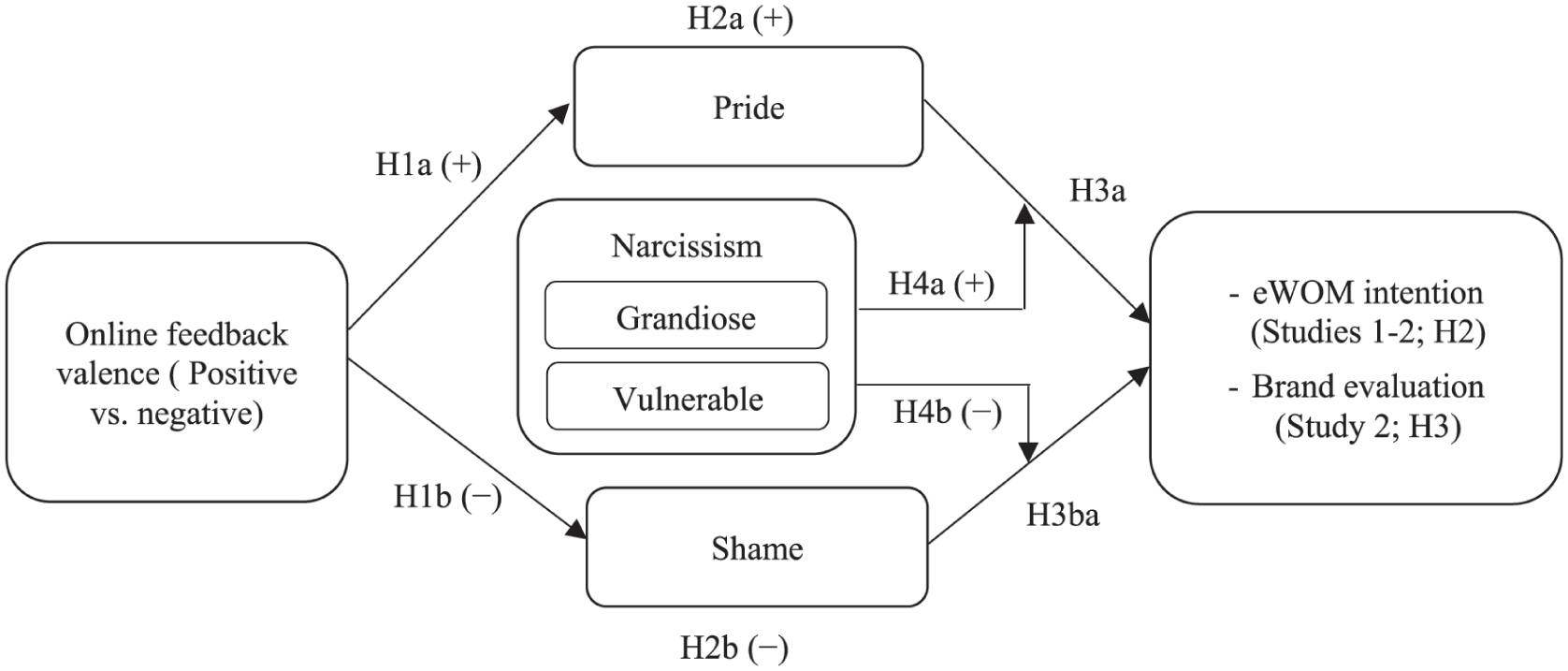
The theoretical model.
Study 1
Procedure
To test our hypotheses, we employed a two-condition between-subjects scenario-based design that manipulated the valence of the feedback (positive vs negative; the dataset is available on the Open Science Framework (OSF)). Specifically, we designed a fictitious scenario about receiving some feedback online after posting some content on social media about a visit to a tourist place. The scenario was presented in a text-based vignette form and included emojis in the comments to mimic the style of realistic Instagram interactions. To avoid selection bias and to get a representative sample of people who regularly post on social media, and because Instagram is widely used as a platform for self-presentation and self-promotion (Sheldon and Newman, 2019), we specifically chose this platform for our scenarios. In order to avoid selection bias, we selected respondents aged between 18 and 34 years old as this age group uses Instagram more than other groups (Statista, 2023). Further, we prescreened participants and selected only those who reported posting as often as a minimum of twice a month on their Instagram page because this study reflects the behavior of active Instagram community members. Therefore, we selected users who are familiar with posting practices and behavior. Finally, we chose respondents who already posted a traveling photo on their Instagram page to make sure that they are familiar with the proposed scenario, so they can better imagine it.
The fictional Instagram scenario and questionnaire items were hosted on Qualtrics. Upon clicking the study link, respondents (N = 323; 63.2% female; MAge = 26.00, SD = 4.46; ranging 18–34 years old) were randomly assigned to one condition of online feedback (positive vs negative). In this between-subjects design, the valence of the feedback was manipulated through the number of likes and the valence of the comments (see Appendix 1 for details). After an online pretest (N = 50) enabling the identification of what can be considered positive (e.g. “Oh wow, this place looks gorgeous”: M = 4.82, SD = 0.44, from “1: Strongly negative comment” to “5: Strongly positive comment”) versus negative (e.g. “So superficial”: M = 1.49, SD = 0.61) feedback, the positive feedback condition (N = 161) was designed such that it featured a high number of likes and positive comments while the negative valence condition (N = 162) employed a low number of likes and negative comments. Our decision to manipulate a high versus low number of likes was made for reasons of ecological validity (Van Heerde et al., 2021), as this approach reflects the inherently subjective nature of social media feedback. The same number of likes may be perceived as sufficient by one user yet inadequate by another (Ferreira et al., 2022). Consistent with this reasoning, we follow prior studies that have examined high versus low numbers of likes as subjectively perceived constructs, without imposing a fixed numerical threshold (e.g. Zell and Moeller, 2018). In addition, by having the number of comments equal across the positive and negative feedback conditions but varying the number of likes (with more likes in the positive condition), we created scenarios that reflect realistic patterns of social media engagement, thereby ensuring ecological validity (Morales et al., 2017). On most social media platforms, especially when users share aesthetically pleasing or socially desirable content (e.g. dining at a trendy restaurant), positive feedback tends to vastly outnumber negative feedback (e.g. Kim and Kim, 2019). This asymmetry in volume mirrors users’ typical online experiences and thus preserves ecological validity, allowing participants to process the feedback in a context that feels familiar and credible.
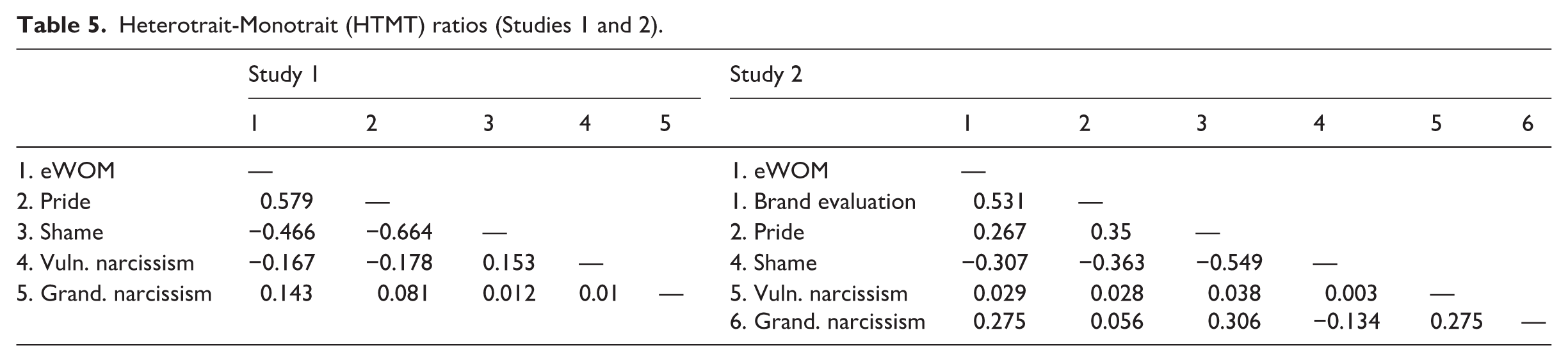
Once exposed to a condition, participants completed a series of measures, all drawn from prior research (Table 4), using five-point Likert-type scales from “1 = strongly disagree” to “5 = strongly agree.” They first rated their intention to engage in eWOM intentions (Kwok et al., 2019; α = 0.75; M = 3.79, SD = .98), followed by their level of pride (introduced with: “After you posted your photo or story, to what extent did you feel . . .”; Tracy and Robins, 2007; α = 0.93; M = 3.27, SD = 1.20) and shame (Agrawal and Duhachek, 2010; α = 0.93; M = 2.44, SD = 1.42). Furthermore, in line with findings from McCain and Campbell (2018), indicating that a large body of narcissism research has operationalized grandiose narcissism using versions of the Narcissistic Personality Inventory (NPI) (Ames et al., 2006), participants completed the NPI-16 as a measure of grandiose narcissism (α = 0.86; M = 2.74, SD = 0.73). They also completed the hypersensitive narcissism scale (HSNS) as a measure of vulnerable narcissism (Hendin and Cheek, 1997; α = 0.65; M = 3.18, SD = 0.80). Of note, due to theoretical overlap between grandiose and vulnerable narcissism (Miller et al., 2011; Weiss and Miller, 2018), five items from the grandiose narcissism scale and four from the vulnerable narcissism scale loaded on more than one dimension and exhibited lower than 0.5, leading them to be removed from the analyses (Hair et al., 2019; see Table 4). In order to verify the dimensional structure of the scales, we conducted an exploratory factor analysis (EFA) and then a confirmatory factor analysis (CFA; Hair et al., 2019). The confirmatory analysis indicated acceptable fit to the data (χ2 = 625.322, df = 349, CFI = 0.944, IFI = 0.945, RMSEA = 0.059). Finally, as a manipulation check, participants were asked the extent to which they would feel their post is liked by others. Results showed that participants in the positive feedback condition reported they would feel significantly more that their post would be liked (M = 4.56) than those in the negative feedback condition (M = 1.16, t = 11.59, p < 0.001), providing support for our manipulation of online positive feedback. Of note, all multi-item scales were subjected to discriminant validity analysis (Henseler et al., 2015), and the heterotrait–monotrait (HTMT) ratios were lower than 0.85, providing evidence for the discriminant validity of the measures, including those of grandiose and vulnerable narcissism (Table 5). Finally, the emotional and narcissism-related variables were mean-centered for further analyses.
Measures and psychometric properties from EFAs (Studies 1 and 2).
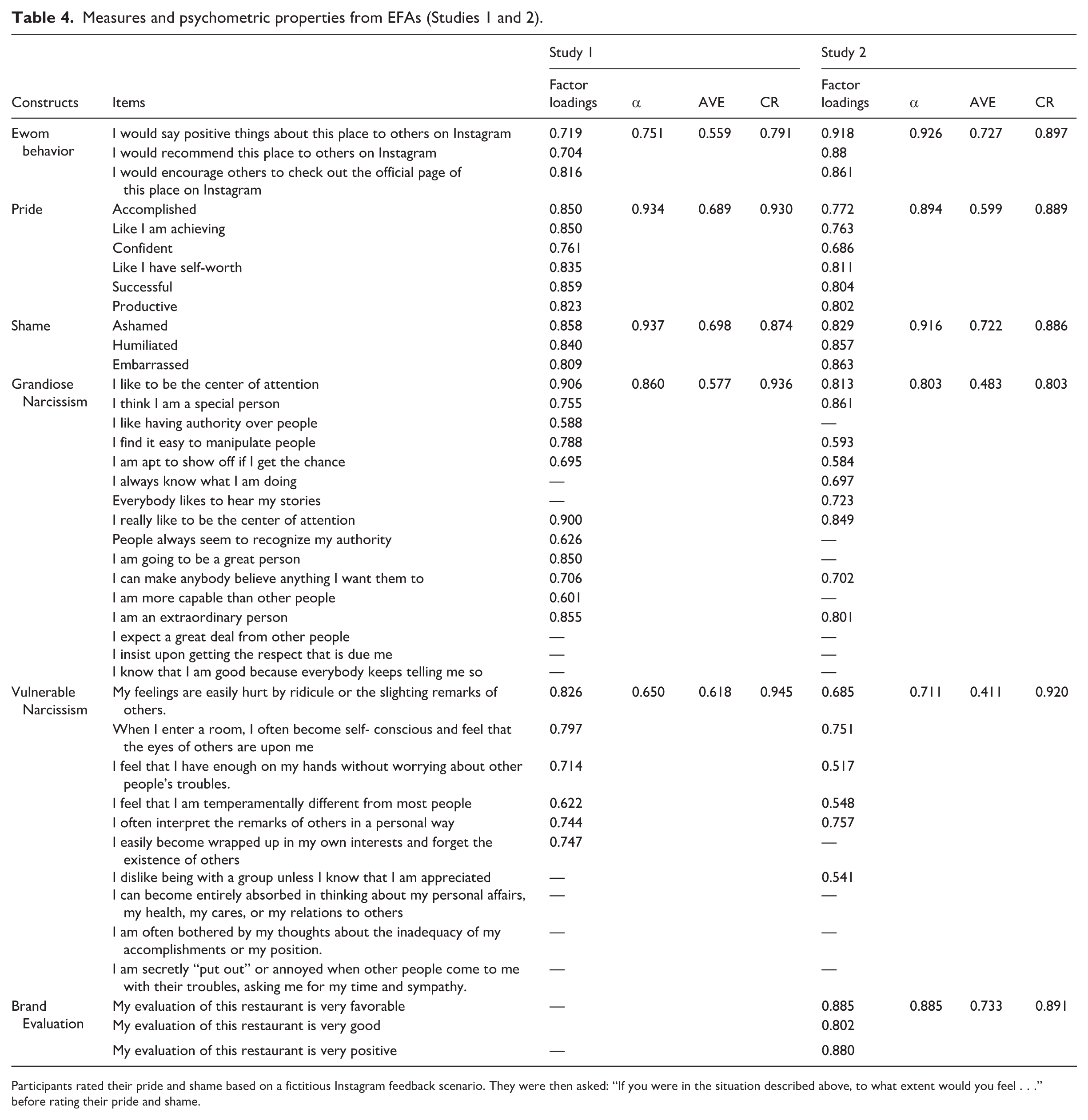
Participants rated their pride and shame based on a fictitious Instagram feedback scenario. They were then asked: “If you were in the situation described above, to what extent would you feel . . .” before rating their pride and shame.
Heterotrait-Monotrait (HTMT) ratios (Studies 1 and 2).
Results
The indirect effect of positive (vs negative) feedback on eWOM intentions through pride and shame (H1–H2) was tested using mediation analyses (PROCESS macro, Model 4; Hayes, 2017). Results revealed that positive feedback had a significantly positive effect on pride (b = 1.42, p < 0.001; Table 6), supporting H1a, and a negative effect on shame (b = −1.79, p < 0.001), supporting H1b. As expected, results also yielded a positive effect of pride on eWOM intentions (b = 0.36, p < 0.001), whereas a negative effect of shame was observed (b = −0.20, p < 0.001). These effects resulted in a significant positive mediating effect of pride (b = 0.52, 95% CI = [0.361; 0.692]) and one of shame that was negative (b = 0.36, 95% CI = [0.195; 0.548]), supporting H2a and H2b.
The effects of online feedback and the emotions of pride and shame, and subsequent eWOM.
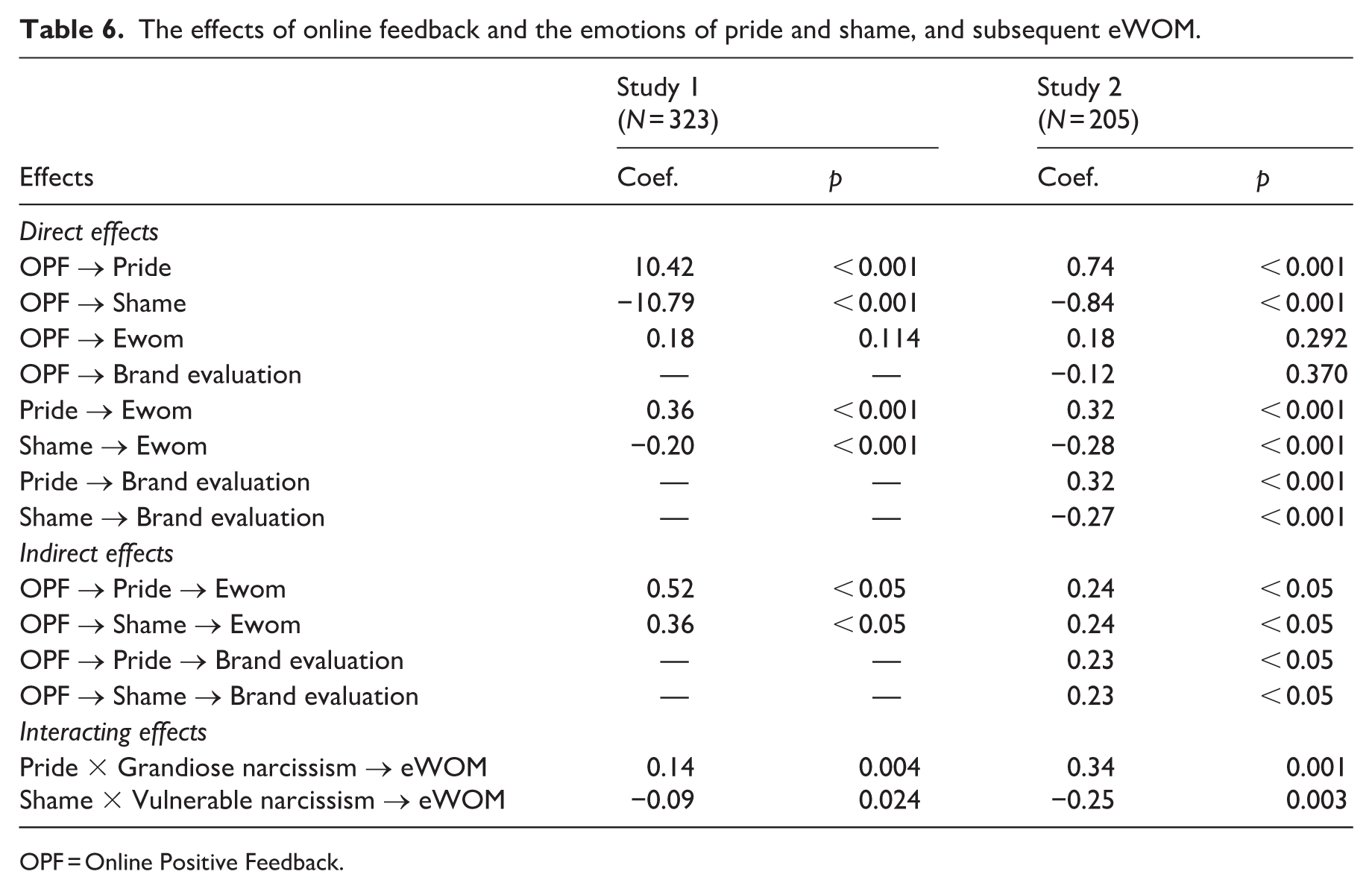
OPF = Online Positive Feedback.
Turning to the moderating role of grandiose and vulnerable narcissism, a moderated-mediation analysis (PROCESS macro, Custom Model; Hayes, 2017; see Appendix 2 for detailed results) revealed a significant interaction between pride and grandiose narcissism on eWOM intentions (b = 0.14, p = 0.004), resulting in a significant moderated mediation (b = 0.20, 95% CI = [0.021; 0.383]). Specifically, as revealed by a floodlight analysis and the Johnson-Neyman point (Spiller et al., 2013), for high levels of pride following online feedback, those consumers whose mean-centered grandiose narcissism is higher than −1.10 (or a value of 1.64 on a 1–7 scale) exhibit stronger eWOM intentions than those who score lower on this form of narcissism (Figure 2(a)). These results support H4a. Further, and importantly, a significant interaction of shame and vulnerable narcissism on eWOM intentions was also revealed (b = −0.09, p = 0.024), leading again to a significant moderated-mediation index (b = −0.17, 95% CI = [−0.001; 0.343]) but here showing that when the level of shame following online feedback is high, people who are high in vulnerable narcissism (i.e. > −0.24 on the mean-centered measure, or > 2.94 on a 1–7 scale) are less likely to spread eWOM activities than their counterparts (Figure 2(b)). These results support H4b.
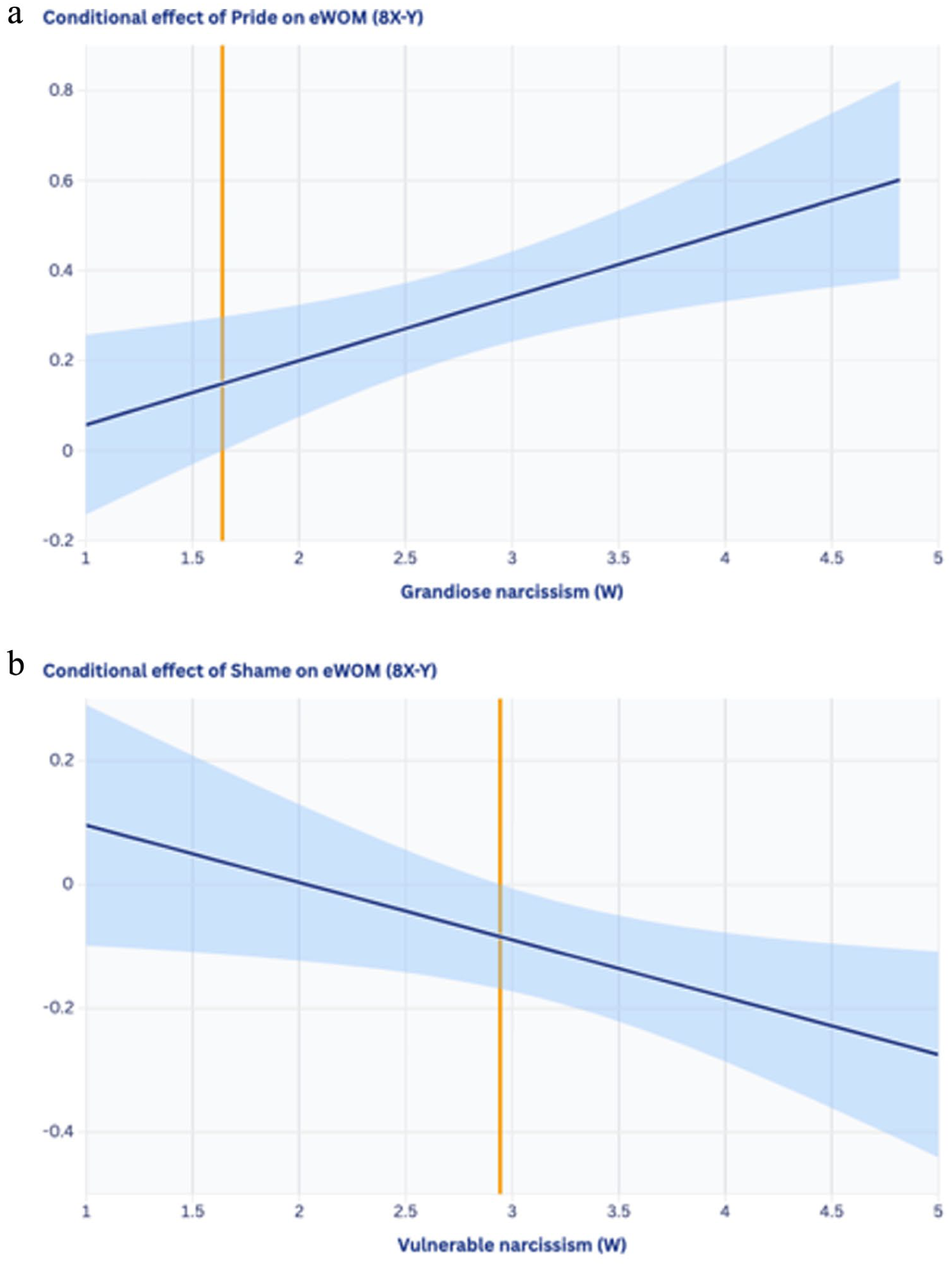
Study 1: The moderating mediating role of narcissism in the relationship between (1) pride and shame as self-conscious emotions and (2) eWOM behavior. (a) Conditional effect of pride on eWOM moderated by grandiose narcissism. (b) Conditional effect of shame on eWOM moderated by vulnerable narcissism.
Discussion
This study brings support to our theorizing by showing that receiving positive feedback following a post contributes to an increase in pride and a decrease in shame, subsequently leading to greater eWOM intentions. Our results extend prior research showing that feedback triggers affective responses (Gunther Moor et al., 2010; Lee et al., 2020; Stsiampkouskaya et al., 2021). In doing so, we extend self-enhancement theory to the digital context by demonstrating that social media feedback functions as a form of identity appraisal that shapes consumers’ emotional and behavioral responses to user-generated content about brands. Importantly, these effects are different between individuals with higher grandiose and vulnerable narcissistic tendencies: whereas those high in grandiose narcissism engage in greater eWOM intentions as a response to an increase in pride, those high in vulnerable narcissism engage to a lesser extent in eWOM intentions as a response to an increase in shame. These results not only confirm earlier work (Kang and Schuett, 2013; Liu et al., 2019) showing that grandiose narcissists are particularly enthusiastic about sharing their experiences on social media (e.g. via photo, video, or comment), but extend it by identifying pride and shame as self-conscious emotions that act as the underlying mechanisms for the effects of online feedback.
Study 2: Replication in the field and the effects of online feedback for brand evaluation
Using another context (restaurants), Study 2 aims to test the full theoretical and the effects of feedback on the emotions of pride and shame and subsequent eWOM and brand evaluation. (The dataset is available on the OSF.)
Procedure
In order to reach the two aforementioned goals, we .here, decided to collect data in the field. Specifically, we relied on actual Instagram posts to gather behavioral data. Through the panelist Prolific, we asked respondents (N = 210, 74.6% female, MAge = 25.66) about the consumption experiences that they share on their Instagram page to test their intentional eWOM behavior and level of evaluation about restaurant brands, as well as their emotional responses to the feedback they received on their post.
With respect to sampling, we employed a prescreening procedure and targeted a segment of US people (1) aged between 18 and 34 years old and (2) who are active Instagram users. Specifically, we selected respondents who (1) shared a photo of a restaurant less than a week previously, so that the emotions of respondents were recent and truthful (Frijda, 2017 [2007]), and (2) posted a minimum of twice a month on their personal page. We asked them about their most recent post they shared on Instagram about a restaurant they visited this choice to use restaurants as our focal setting was driven by the observation that food content is part of a popular trend on Instagram (Demarest, 2020). We also asked participants to report the number of Instagram followers they currently have. In order to ensure comparable exposure to feedback and minimize variability due to audience size, we included only those with 500 to 700 followers. This range was chosen to capture users who are active enough to post regularly and receive a consistent volume of feedback, while remaining below the threshold typically used to classify social media influencers (1,000 followers; Do, 2025). Our focus on this follower range was to study the experiences of typical Instagram users rather than influencers or public figures, whose audience composition and engagement patterns may systematically differ.
Regarding measures, participants reported the number of likes (M = 86.23, SD = 94.54) and comments (M = 10.67, SD = 26.29) they received on their post. To reflect the valence of comments feedback, participants were asked to report how many of the comments they received were perceived as positive (“How many comments that you consider positive did you receive?” M = 10.34, SD = 25.86) and negative (“How many comments that you consider negative did you receive?” M = .33, SD = 1.85). This self-reporting approach is consistent with prior studies that relied on participants’ reports of likes, comments, and shares (e.g. Roberts et al., 2024; Zell and Moeller, 2018). This measure allowed us to assess not only the quantity but also the perceived positivity of the social feedback they received. Given the skewed distribution of both likes and comments (SkewnessLikes = 2.47, SkewnessComments = 6.91), a log transformation was used to normalize the data. Given their positive correlation (r = 0.507, p < 0.001), they were also aggregated to form a measure of positive feedback. Given the cross-sectional nature of the study, precautions have been taken to avoid common variance bias (Podsakoff et al., 2003). Specifically, respondents first rated their evaluations of the restaurant (Lei et al., 2012; α = 0.88; M = 4.07, SD = 0.91), and then only their intention to engage in eWOM intentions (α = 0.92; M = 3.88, SD = 1.08), as well as their feelings of pride (α = 0.89; M = 3.37, SD = 0.78) and shame (α = 0.91; M = 1.67, SD = 0.95). Following a factorial analysis with Varimax rotation (Hair et al., 2019), grandiose (α = 0.80; M = 2.84, SD = 0.65) and vulnerable (α = 0.71; M = 3.09, SD = 0.71) narcissism were measured respectively with nine and six items after deleting items that cross-loaded on multiple dimensions. As in Study 1, we again conducted discriminant validity analysis (Henseler et al., 2015), the HTM ratios were below 0.85, confirming the discriminant validity of the measures (Table 4). Also, the fit statistics indicated that the measurement model was acceptable (χ2 = 727.227, df = 436, CFI = 0.910, IFI = 0.912, RMSEA = 0.057). Further, in order to ensure that our data were not biased by common method variance, a marker variable (“How many kids does your best friend have?”; Lindell and Whitney, 2001) was added and revealed to be uncorrelated with the measures of the model (all p’s > 0.10), suggesting no issue of common method variance. Also, and as in Study 1, emotions and narcissism measures were mean-centered for further analyses. Finally, an attention check was included, resulting in deleting five observations from respondents who failed it (i.e. “Please answer strongly disagree to this item”; Arndt et al., 2022); we retained 205 usable surveys.
Results
We first aimed to observe if the mediating roles of pride and shame in the indirect effect of online feedback on eWOM replicated in the field. From a similar mediation analysis as used in Study 1, results yielded the previously observed positive effect (b = 0.74, p < 0.001; Table 6) and negative effect (b = −0.84, p < 0.001) of feedback valence on the respective emotions of pride and shame, as well as the mediating effects of these emotions (bPride = 0.24, 95% CI = [0.059; 0.458]; bShame = 0.24, 95% CI = [0.093; 0.432]). These results bring further support to H1 and H2. Then, a similar mediation analysis was performed, here with brand evaluation as the dependent variable. As expected, although pride increases brand evaluations (b = 0.32, p < 0.001), shame exerted an opposite, negative effect (b = −0.27, p < 0.001). These results support H3a and H3b. Further, and as with eWOM, pride and shame were found to mediate the effect of online feedback on brand evaluation (bPride = 0.23, 95% CI = [0.054; 0.446]; bShame = 0.23, 95% CI = [0.090; 0.406]).
The last set of analyses pertained to the distinct moderating roles of grandiose and vulnerable narcissism in shaping the effects of self-conscious emotions of pride and shame on eWOM. As in Study 1, a custom model was used (Process Macro, Custom Model; Hayes, 2017; see Appendix 3 for detailed results). A significant interaction between grandiose narcissism and pride (b = 0.34, p < 0.001) was observed, leading to a moderated mediating effect of pride (b = 0.25, 95% CI = [0.046; 0.482]) and indicating that the indirect effect of positive feedback and eWOM intentions through pride was positively moderated by grandiose narcissism. Specifically, and supporting H4a, the Johnson-Neyman point occurs at a mean-centered value of grandiose narcissism of −0.16 (or 2.68 on a 1–7 scale), indicating that for consumers whose grandiose narcissism is higher than 2.68, higher levels of pride following online feedback make them exhibit stronger in eWOM intentions than those who score lower on this form of narcissism (Figure 3(a)). Now turning to shame, a significant interaction was observed with vulnerable narcissism (b = −0.25, p = 0.003), providing further evidence for the notion that the indirect effect of feedback on eWOM through shame is moderated by vulnerable narcissism (b = 0.21, 95% CI = [0.065; 0.375]). Supporting H4b, results yielded a Johnson-Neyman point of −0.32 (or 2.77 on the 1–7 scale of vulnerable narcissism), indicating that when the level of shame following online feedback is high, people who are high in vulnerable narcissism (i.e. > 2.77) are less likely to spread eWOM activities than their counterparts (Figure 3(b)).
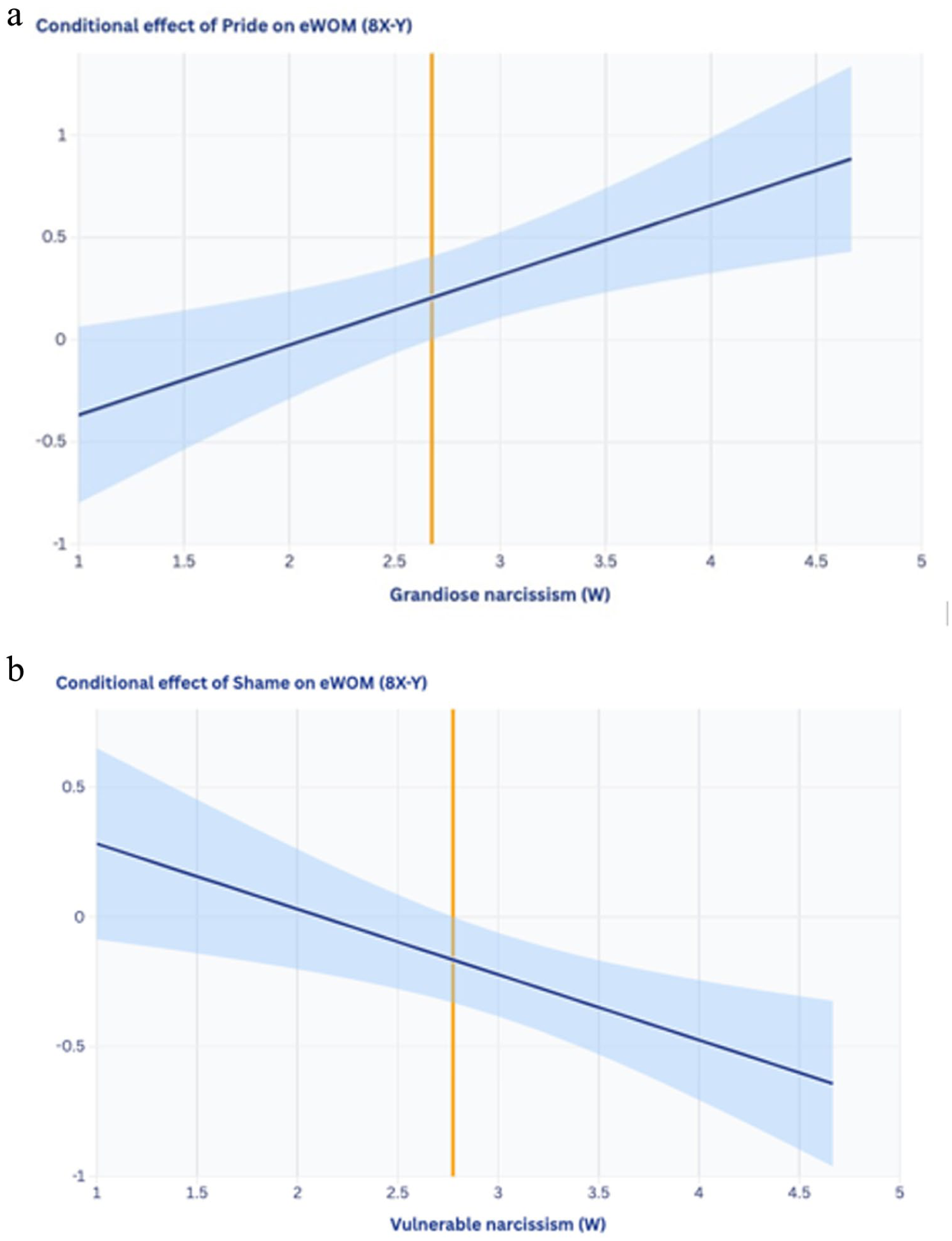
Study 2: The moderating mediating role of narcissism in the relationship between (1) pride and shame as self-conscious emotions and (2) eWOM behavior. (a) Conditional effect of pride on eWOM moderated by grandiose narcissism. (b) Conditional effect of shame on eWOM moderated by vulnerable narcissism.
Discussion
Using another setting (i.e. restaurants) and another method (an online cross-sectional field study), Study 2 provides further evidence for the indirect effect of positive online feedback on eWOM through the respective positive and negative mediating effects of pride and shame. Interestingly, and beyond mere eWOM, Study 2 also shows that these two emotions act as mechanisms that also affect how people evaluate brands. These findings align with prior research showing that pride fosters positive brand evaluations (Griskevicius et al., 2010; Yang and Zhang, 2018) and extend Ferreira et al. (2022) by explaining why user-generated brand content influences attitudes. Specifically, this study identifies self-conscious emotions as the psychological link between social feedback and brand evaluation, advancing self-enhancement theory in the contexts of consumption, digital posting, and branding. Further, and importantly, Study 2 replicates the distinct moderating roles of grandiose and vulnerable narcissism, showing here again that people high in grandiose narcissism exhibit stronger eWOM intentions following pride feelings due to positive feedback, and those who are high in vulnerable narcissism exhibit lower eWOM intentions due to the shame that is induced by negative feedback. Beyond theory, these results suggest that hospitality brands can enhance evaluations by encouraging user-generated content that evokes pride, for instance, through branded hashtags, contests, or small rewards that stimulate positive feedback and strengthen favorable brand perceptions, especially among individuals with high narcissistic tendencies.
General discussion
Theoretical contributions
The central questions of this research were: (1) how feedback from online audiences influences consumers’ emotions, eWOM behavior, and brand-related perceptions and (2) whether such effects differ between consumers characterized by grandiose versus vulnerable narcissism. Drawing on enhancement theory (Sedikides and Gregg, 2008), we specifically hypothesized that the valence of social feedback elicits self-conscious emotions, which in turn shape eWOM intentions and brand evaluations. Building on this emotional mechanism, we made the prediction that such feedback might differentially shape two different social emotions: it might increase the positive emotion of pride but decrease that of shame. Furthermore, we predicted narcissism to have a significant role as a boundary condition for these effects of self-conscious emotions. Drawing on recent work highlighting the need to view narcissism as a two-dimensional construct (Fastoso et al., 2018; Neave et al., 2020), we investigated the moderating effects of grandiose versus vulnerable narcissism. The two studies reported in this article—although of different nature, one being experimental, the other being on the field—support our hypotheses that the positive valence of online feedback indirectly affects eWOM through its effects on pride and shame. The results of Study 2 go further by showing that such mediating effects of pride and shame are also observed when it comes to evaluating brands. Beyond these indirect effects, the results of both studies provide consistent support for the striking opposite moderating effect of grandiose and vulnerable narcissism, showing that although people high in the former type of narcissism respond positively to their pride when deciding to engage in brand-related eWOM, those high in the latter type of narcissism respond negatively to their shame.
From a theoretical standpoint, this research contributes to the psychological literature in two ways. First, and extending prior research on the link between emotions and eWOM (Kim and Gupta, 2012), the current research deepens our understanding of how emotions shape consumer behavior online, specifically through eWOM. While Kim and Gupta (2012) highlighted the importance of emotions in online contexts, they treated eWOM primarily as an information source rather than as an outcome influenced by emotions. Our research extends this perspective by exploring how consumers’ own emotional states actively drive their eWOM intentions. Specifically, the contribution of our article in this regard lies in the identification of the opposite mediating roles of pride and shame in the effect of positive (vs negative) online feedback to eWOM. In line with self-enhancement theory, our results show that because the positive feedback that consumers receive after posting about their consumption experience triggers self-conscious emotions such as pride, it motivates individuals to reinforce their identity by continuing to speak positively about the brand or place. On the contrary, after negative feedback, the negative valence of shame causes brand evaluations to decrease because consumers aim to avoid social disapproval. Although these two emotions are both recognized as self-centered (Tracy and Robins, 2011) and social (Van Osch et al., 2018; Williams and DeSteno, 2009), they have, to our knowledge, never been so far included in a comprehensive theoretical model that would examine their differential effects on consumer responses to social approval. Shame, as a conscious emotion, has often been opposed to guilt ((Duhachek et al., 2012; Han et al., 2014), but the opposition to pride—and its consistent support across Studies 1 and 2—indicates that shame also acts in opposition to this latter emotion. Our results, highlighting the positive mediating effect of pride and shame, corroborate those from Forest and Wood (2012), who showed that getting positive feedback predicts higher self-worth and receiving negative feedback predicts lower self-esteem.
Second, this research contributes to the psychology literature by identifying the differential moderating effects of grandiose and vulnerable narcissism on consumers’ emotional responses. Although most consumer research on narcissism views it as unidimensional and thus focuses on its grandiose trait (Gross and Lunardo, 2024; Kirk et al., 2018; Lunardo and Gross, 2024; Lunardo et al., 2021; Sedikides et al., 2007), here we follow the stream of research initiated by Miller et al. (2011) and distinguish between grandiose and vulnerable narcissism. Interestingly, and in line with previous research supporting the need to distinguish between these two types of narcissism (Fastoso et al., 2018; Lambert and Desmond, 2013; Neave et al., 2020), our results show consistent and remarkably different effects depending on which form of narcissism people are high in. Specifically, we provide evidence that the higher the consumers are in grandiose narcissism, the more they are keen to spread eWOM because of the pride induced by positive feedback on social media. On the contrary, we also found that the higher the consumers are in vulnerable narcissism, the less they are willing to engage in eWOM because of their experienced shame. These results thus confirm the strong difference between grandiose and vulnerable forms of narcissism (Miller et al., 2011; Weiss and Miller, 2018), and more specifically, the fact that although those with grandiose narcissism are confident and oriented toward self-gratification, those with vulnerable narcissism are on the contrary, highly sensitive to criticism and thus more prone to the emotion of shame.
Third, and now turning to how this research contributes to the marketing discipline, our research adds to the consumer literature, our results showing that consumers receiving positive feedback report increased intention to spread eWOM activities about tourism content because of their emotion of pride, and extends prior research about the significant effect of pride on generating positive eWOM (e.g. Liu et al., 2022). However, when individuals received negative feedback, it decreased their eWOM content due to the negative emotion of shame. This finding aligns with previous research from Becheur and Valette-Florence (2014), which demonstrated that the perceived severity of a threat leads individuals to feel shame.
Further, and extending prior research on social media use and brand evaluations (Hudson et al., 2016), our results from Study 2 provide initial knowledge about the connection between received feedback online and brand evaluation. Brand evaluation has long been recognized as a function of consumer online engagement (for a review, see De Oliveira Santini et al., 2020), but how online feedback on social media ultimately affects people’s views of brands has remained surprisingly unexplored. In this regard, our self-enhancement-based framework and results indicate that when consumers receive positive online feedback on their brand-related posts and experience pride, it boosts their self-worth and validates their consumption choices. While the brand itself does not provide the feedback, because some positive online feedback in social media contexts is relevant to the self, it is used as a signal that contributes to protecting or boosting individuals’ overall psychological state, leading to more favorable evaluations of the brand they publicly associate themselves with. In this sense, and in line with prior research (Belk, 1988, 2013; Townsend and Sood, 2012), the brand becomes a vehicle for self-enhancement. As their choice of brand contributed to the social validation they received, consumers may associate those positive self-evaluative emotions with the brand itself. Therefore, our results suggest a pattern of effects of online feedback that is close to those observed with ads. The substantive prior research on ads and direct affect transfer (e.g. Gardner, 1985; MacKenzie et al., 1986; Mitchell and Olson, 1981) shows that emotion-evoking advertising creates a favorable attitude toward a brand through a transfer of affect from the ad to the brand. Our results offer a similar perspective by showing that feeling positive emotions—like pride—after receiving some feedback online transfers to the brand and leads to increased evaluations.
Managerial contributions
These findings offer valuable insights for social media marketers and brands. The results of our studies indicate that self-centered emotions have a significant role in the impact of received feedback on online word-of-mouth activities. To stimulate increased posting behavior among users—and thus more eWOM about their brands—marketers can employ direct and indirect strategies that effectively engage users with their content. One direct strategy involves actively monitoring social media platforms to identify customers who share positive brand experiences. Responding to their posts with personalized messages or comments of gratitude can foster a sense of community and serve as positive feedback that (1) elicits pride, (2) reduces shame, and (3) encourages further eWOM. Marketers might also send personalized messages or emails to customers who share exceptional content, inviting them to join an exclusive group of guests. The resulting sense of belonging and recognition can heighten pride and stimulate continued eWOM, benefiting the brand. However, it is important to note that prior research shows that increased entitlement can lead to inflated expectations and, over time, aggressive consumer behavior (e.g. Boyd and Helms, 2005), and marketers should thus design their recognition programs carefully, motivating content sharing while minimizing entitlement risks.
Furthermore, results found that narcissism played a key role in the impact of feedback on eWOM intentions through pride and shame. It could thus reveal useful for brands to engage narcissistic individuals on Instagram, enticing them to share their “best spot” and receive recognition through likes and comments, thereby increasing their engagement and interaction with the brand’s Instagram page. Although it might reveal difficult to identify narcissistic individuals on social media, as people generally do not openly label themselves as such, recent research from Gross and Lunardo (2024) indicates that a strongly emotional communication style can be used as a proxy to assess grandiose narcissism online. Therefore, to reach this audience, marketers might gain by initiating marketing campaigns and creating content that appeals to their ego and self-importance. For instance, marketers could create a contest centered on narcissistic individuals sharing their favorite spots or experiences using specific hashtags that highlight the vanity and self-importance associated with narcissistic behavior (e.g. #MyBestSpot, #ImTheBest, #LivingLuxury, #TheUltimateMe, or #SpotlightOnMe). Consumers who receive the highest number of likes and comments following the shared post would ultimately experience strong levels of pride that encourage them to engage in eWOM about their experience to get social approval.
Limitations and avenues for future research
Our studies have some limitations that should be noted. From a theoretical standpoint, our research did not account for consumers’ mood prior to receiving feedback. However, theories such as the Appraisal Theory of Emotion (Scherer et al., 2001) offer a compelling lens through which to understand how the valence of feedback can elicit emotional responses and shape subsequent behavior. This suggests that future research should explore the role of mood as a mediating variable explaining the effects of online feedback on both eWOM and brand evaluations. In particular, the congruency between a consumer’s preexisting mood and the emotional states triggered by feedback may help explain variations in behavioral outcomes, and thus warrants further investigation.
Still, from a theoretical standpoint, a growing body of literature (e.g. Fastoso et al., 2018; Kjærvik and Bushman, 2021; Neave et al., 2020) increasingly treats narcissism as a multidimensional construct, often including entitlement as a distinct dimension. In line with this research, we focused on the grandiose and vulnerable dimensions primarily because they align most directly with the mechanisms of pride and shame in the context of online feedback and eWOM. However, entitlement may represent a theoretically relevant facet of narcissism, particularly when it comes to expectations of special treatment in services or in human interactions (Albrecht et al., 2017; Boyd and Helms, 2005). As such, it may play an important role in how consumers react to online feedback, and future research may gain by adding this additional form of narcissism to observe if it reveals explanatory of pride and shame and subsequent eWOM and brand evaluations.
Another promising avenue for future research would be to examine the moderating role of feedback type—distinguishing between factual (e.g. “The place was really dirty”) and emotional (e.g. “I hate this place!”) feedback—in the relationship between audience feedback and subsequent eWOM behavior. Drawing on attribution theory (Folkes, 1988) to explain the link between feedback and eWOM could reveal fruitful. Specifically, according to attribution theory, emotions like pride and shame are linked to how consumers explain events, particularly whether they see their causes as internal or external, stable or unstable, and controllable or uncontrollable. Factual messages may be more likely to be seen as objective and linked to external factors (the product, service, or environment). As such, factual messages are less likely to make consumers getting such feedback feel pride or shame, as the focus is on stimulus (e.g. the hotel’s cleanliness), not the self. An opposite pattern may be observed with emotional feedback. Therefore, further research may gain by investigating the moderating role of feedback types to see how such types moderate the effect of the feedback on consumers’ emotions and eWOM.
An additional valuable direction for future research relates to the consideration of a longitudinal perspective for such a study to observe the posting behavior and emotions over a long period of time through serial posts. A key advantage of such a design is its ability to measure whether a single post triggers ephemeral emotions that nevertheless have lasting effects on brand perception. Emotions can fluctuate over time (Frijda, 2017 [2007]), and a longitudinal perspective could thus offer a more nuanced understanding of how emotional reactions to online feedback develop and influence consumer behavior over time. For example, pride experienced immediately after receiving positive feedback may initially boost eWOM engagement. However, as the emotional intensity fades or is reinterpreted in light of social comparison or delayed feedback, individuals might alter the tone, frequency, or content of their brand-related communication. Similarly, shame might initially reduce eWOM behavior but could lead to compensatory behaviors later on, such as posting more positively to repair one’s image. Future longitudinal research may therefore gain by examining how momentary emotional reactions to online feedback influence consumer behavior over time.
Also, our studies examined shame as the sole negative emotional response. However, prior research (Lee et al., 2020; Williams, 2007) suggests that receiving no reactions in online contexts can evoke feelings of ostracism. Future studies should therefore investigate whether perceived exclusion operates as an additional negative emotion alongside shame and how these emotional responses jointly influence negative eWOM and brand evaluations.
Now turning to the empirical side of this research, our studies focused exclusively on likes and comments as forms of feedback. However, the variety of other forms of feedback on social media platforms could also be tested, such as resharing the posts or using tags or emojis. For instance, Instagram offers various emojis (e.g. hearts, sad faces, …) and non-face emojis that are commonly used to express affection or appreciation and affect eWOM (Orazi et al., 2023). Therefore, investigating whether receiving emoji feedback elicits stronger emotional responses and subsequent eWOM compared to likes and comments—the types of feedback we studied—would be particularly interesting. Replicating our results using such forms of feedback would thus bring further support to our theorizing.
Still, regarding replication, we applied our two studies on the Instagram platform. Although Instagram is commonly depicted as a self-centered platform, where people usually highly share about themselves and their lifestyle—thus making it suitable for the current research on self-centered emotions—testing the proposed relationships on less self-centered platforms, such as TripAdvisor, could offer further validation of these results. On platforms like TripAdvisor, audience feedback is more focused on the quality of the shared experience rather than personal self-presentation, allowing future research to test the robustness of our findings and the role of narcissism across different social media contexts.
Beyond the platform being used, researchers should also take care of using stimuli that reflect the highest possible level of realism. In Study 1, our stimulus was a text-based scenario, and future research could employ more immersive formats, such as interactive mock platforms, to further enhance realism. Also, Study 1 was not preregistered, and future studies could consider preregistration to further strengthen transparency and reproducibility.
Further, in Study 2, all behavioral variables (likes, comments, and feedback valence) were self-reported, and we therefore relied on participants’ honesty. Such declarative measures may be affected by self-report bias and common method variance. Future research could enhance ecological validity by incorporating objective engagement data, for example, by asking participants to provide screenshots of their posts or, with consent, granting researchers access to their actual engagement metrics on Instagram. Moreover, while our study focused on restaurant-related posts, we did not control for the specific photo content (e.g. selfies, friends or family, food items, or restaurant settings). Since prior research indicates that posts featuring people tend to receive more likes and more positive evaluations (Kim and Yang, 2017), future studies should control for photo content to ensure that observed feedback effects are not confounded.
Footnotes
Appendix 1
Appendix 2
Appendix 3

Funding
The authors received no financial support for the research, authorship, and/or publication of this article.
Declaration of conflicting interests
The authors declared no potential conflicts of interest with respect to the research, authorship, and/or publication of this article.