






Abstract
The mĕkônâ is a bronze wheeled stand described in detail in 1 Kgs 7.27-37. This article explores a number of questions that arise when the description in 1 Kings is compared to several bronze wheeled stands that have been found in Cyprus.
The mĕkônâ is a bronze wheeled stand described in detail in 1 Kgs 7.27-37. This article explores a number of questions that arise when the description in 1 Kings is compared to several bronze wheeled stands that have been found in Cyprus.
1. The mĕkônâ briefly described
As part of the account of the furnishings of Solomon’s temple, there is a detailed description of an object called a mĕkônâ (1 Kgs 7.27-37). The mĕkônâ was some kind of “movable stand” (NIV, TNIV), “water cart” (NLT), or “laver stand” (NJPS). 1 Its dimensions are given as “four cubits long, four cubits wide, and three cubits high” (7.27). If we take a cubit as 45 cm., 2 its dimensions are thus 180 cm. long, 180 cm. wide, and 135 cm. high. The object is described as having four wheels attached to it by axles (7.30). The diameter of each wheel is stated (7.32) as being a cubit and a half (70 cm.). Each mĕkônâ was decorated with lions, bulls, and cherubim, as well as wreaths and palm trees (7.29, 30, 36), and supported a basin with a capacity of forty baths (7.38), some 880 litres. Given the fact that the resulting weight of water is 880 kg., the mĕkônâ clearly had to be strong enough to support this considerable weight. The height of each basin is not given, but the width is given as 4 cubits (180 cm.). If each basin were a true hemisphere they would be 2 cubits (90 cm.) high.
2. What was the mĕkônâ made out of?
The mĕkônâ, its wheels, axles, and the basins that it supported were all made of a metal called nĕḥōšet (7.27, 30, 38). Although this word can refer to copper (as in Deut 8.9 where mining is in view), in 1 Kgs 7 nĕḥōšet is rightly translated “bronze”—an alloy of copper and tin 3 —since copper is too soft for such workmanship.
3. What was the mĕkônâ used for?
Although 1 Kgs 7 does not explain the function of the mĕkōnôt and the basins that went on top of them, the parallel 2 Chr 4.6 states that “the work of the burnt offering” (ma‘ăśēh hā‘ōlâ) was rinsed in the basins. This is variously interpreted to mean “the things used in burnt offerings” (NIV, TNIV, NASB, ESV), “the animals for the burnt offerings” (NRSV), or “the parts of the burnt offerings” (NJPS). Clearly the basins had an important role in cleaning up after the sacrifices in the temple.
4. When was the mĕkônâ made?
First Kings 7.27 makes it clear that Solomon had ten of these bronze mĕkōnôt made. Since Solomon’s temple was built between the fourth and eleventh years of Solomon (1 Kgs 6.1, 37-38), that is, 966–959 B.C., the ten mĕkōnôt were made at that time too.
5. How was the mĕkônâ made?
In 1 Kgs 7.46 the writer states that “the king had them [= all these bronze objects] cast in clay moulds in the plain of the Jordan between Succoth and Zarethan.” The re-use of the same moulds produced mĕkōnôt of uniform sizes (7.27), a point emphasized by the writer at the end of his description of the mĕkônâ in 7.37: “all of them were cast alike with the same size and same form.” Indeed, there are two other references to “casting” (7.30, 33) and twice (7.34, 35) the phrase “of one piece” is used. But does this mean that the whole mĕkônâ was cast in one piece? Perhaps some of the parts of the mĕkônâ would have been cast separately and then fitted together on site in Jerusalem (Cogan 2001, 273). Certainly moving parts such as the wheels and axles would have been made individually. The bronze basin on top of the mĕkônâ was also made separately.
6. Bronze stands from Megiddo and Cyprus
Several roughly contemporary bronze objects have been found that may also have been mĕkōnôt. All are much smaller than the mĕkōnôt described in 1 Kgs 7. They have designs that reflect their non-Israelite, pagan origins, and would seem to have been votive offerings. All are roughly cuboid and support a circular ring above. Three examples are preserved with their wheels and three without.
6A. Examples without wheels
A1. Bronze stand showing a priest or worshipper making an offering to a seated deity. Megiddo, 1050–1000 B.C. Height ca. 10 cm. 4
A2. Bronze stand showing female heads at a window (see Figure 1). Tomb 97, Enkomi, Cyprus, ca. 1200 B.C. Height 16 cm., length and width 13 cm. 5
A3. Bronze stand showing a man standing by a tree and carrying a copper ingot. Perhaps from Kourion, Cyprus. 12th c. B.C. 6
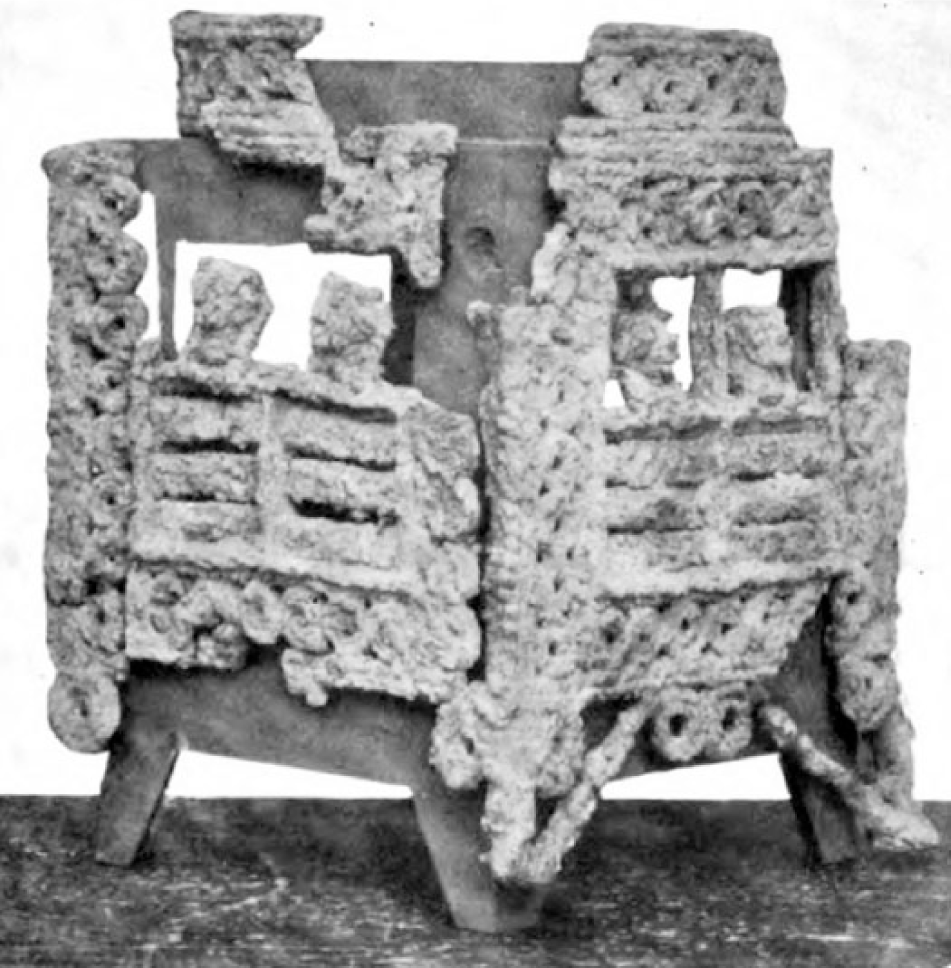
A2. Bronze stand showing female heads at a window. Burney 1903, plate 2 facing p. 92. Public domain. http://babel.hathitrust.org/cgi/pt?id=uc1.b3951260;view=1up;seq=147.
6B. Examples with wheels
Furthermore, three are preserved with their wheels (all of which have six spokes). Each pair of wheels sits on an axle which passes through a round opening at the lower end of a “leg” coming down from the body of the mĕkônâ.
B1. Wheeled bronze stand showing winged creatures similar to cherubim (see Figure 2). Larnaka, Cyprus, ca. 1200 B.C. Height 39 cm., length and width 23 cm. Diameter of the wheels 12 cm.
B2. Wheeled bronze stand showing a harpist, with a goose and fish beneath (see Figure 3). Another panel shows a winged creature similar to cherubim. Bulls are depicted on the upper ring. Unidentified provenance, Cyprus, 13th–12th c. B.C. Height 31 cm. 7 Diameter of the wheels 7.6 cm. 8
B3. Wheeled bronze stand showing lions, bulls, and griffins. Perhaps from Episkopi (near Famagusta), Cyprus, ca. 1200 B.C. Height 19 cm. 9 Diameter of wheels 4.5 cm. 10

B1. Wheeled bronze stand showing winged creatures. Burney 1903, Plate 1 facing p. 91. Public domain. http://babel.hathitrust.org/cgi/pt?id=uc1.b3951260;view=1up;seq=144.
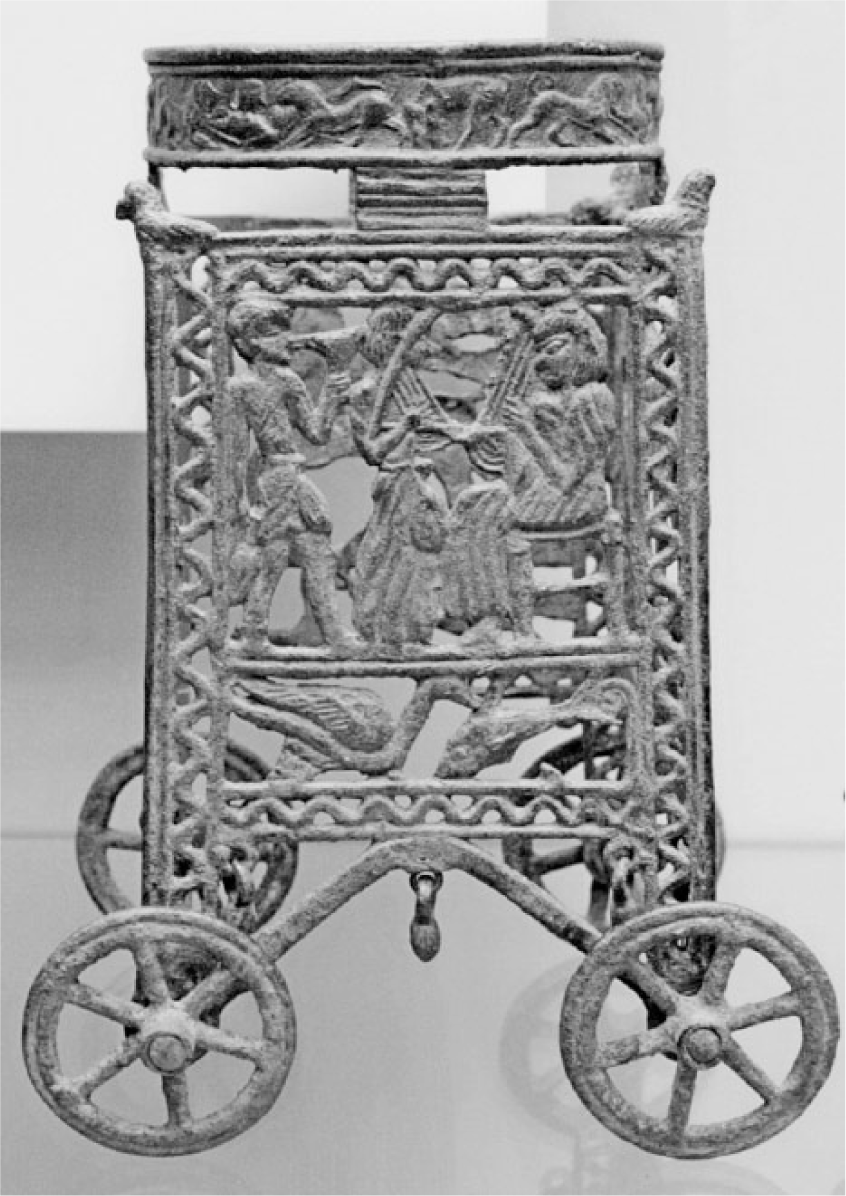
B.2. Wheeled bronze stand showing a harpist. All rights reserved George M. Groutas. http://commons.wikimedia.org/wiki/File:Cypriot_bronze_wheeled_stand_with_an_animal_frieze_on_the_ring_and_figures_in_the_side_panels.jpg#.

This information is presented in summary form in Table 1.
Summary of examples with wheels.

7. Questions thrown up by this data
These examples move discussion of the mĕkônâ out of a purely linguistic domain and raise two questions that may not be apparent if the mĕkônâ is considered only at a linguistic level.
Does the height of three cubits (135 cm.) refer to the height of just the stand or does it include the diameter of the wheels known from 7.32 to be one and a half cubits (70 cm.)?
Does the height of three cubits (135 cm.) include the height of the “upper ring” mentioned in 7.31, which is stated as being one cubit (45 cm)?
Thus the height of the mĕkônâ can be computed variously as:
135 cm.—figure which includes the wheels and the “upper ring”
180 cm.—figure which adds on the “upper ring,” but not the wheels
205 cm.—figure which adds on the wheels, but not the “upper ring”
250 cm.—figure which adds on the wheels and the “upper ring”
The data are summarized in Table 2, with ratios added.
Summary of possible dimensions.

The models from Cyprus with height to diameter ratios varying between 3.25 (B1) and 4.08 (B2) suggest that the “all inclusive” 135 cm. to 70 cm. ratio (1.93) of the 1 Kgs 7 mĕkônâ is too small. 11 Only the ratio (3.57) of the maximum option is within the range of the Cyprus examples 3.25 to 4.08.
But this only throws up another question: How much should be added on for the height of the basin?
It was argued above that the total height of the hemispherical basin was two cubits (90 cm.). Did this basin simply rest on the “upper ring” or did some of the basin go down beneath the top of the “upper ring” and into the mĕkônâ? If the full 90 cm. is added to the maximum figure computed above (250 cm.) the water level at the top of the full basin would be 340 cm. But even if the minimum figure of 135 cm. is accepted for the mĕkônâ and even if the unlikely possibility of half of the basin (45 cm.) going below the “upper ring” on top of the mĕkônâ is accepted, the resulting figure of 180 cm. would still be above the height of the average person. Thus it would seem that whatever the height of the water in the basin, it could only be accessed by a priest or Levite standing on a ladder. Access to the water through an outlet at the bottom of the basin, even if secured by a bung, plug, or spigot, would have increased the possibility of water loss. Besides, such an outlet is nowhere mentioned, neither is there any statement as to how the basins were filled with water in the first place.
8. A chiasm in the text?
At first glance the description of the mĕkônâ in 1 Kgs 7.27-37 seems confused. The writer moves from describing the mĕkônâ (7.27-29) to the wheels and axles (7.30). In 7.31 there is a difficult-to-understand description of the “upper ring.” Then attention shifts to the wheels and axles again (7.32-33) before more detail is given of the mĕkônâ (7.34-37). In fact, far from being confused, there would seem to be a crafted chiastic structure evident here: mĕkônâ (7.27-29) wheels and axles (7.30) “upper ring” (7.31) wheels and axles (7.32-33) mĕkônâ (7.34-37)
Seen this way, the “upper ring” is the climax of the description, perhaps because it was at the top of the mĕkônâ and supported the basin.
The issue that now should be considered is whether the questions above help us to understand more clearly the description of the mĕkônâ in 1 Kgs 7 and whether this in turn affects how certain words in the passage should be translated.
9. Detailed questions regarding the translation of various parts of the mĕkônâ
9A. Misgĕrôt and šĕlabbîm—horizontal frames and uprights?
From the use of the term misgĕrôt in the description of the mĕkônâ we can conclude:
The misgĕrôt are “between” (7.28, 29) the šĕlabbîm. 12
The misgĕrôt are decorated with lions, bulls, and cherubim (7.29).
The misgĕrôt are “square” (mĕrubbā‘ôt), not “round” (‘ăgullôt) (7.31).
The four wheels are under the misgĕrôt (7.32).
The misgĕrôt were also on top of the mĕkônâ (7.35).
Two other Old Testament passages also shed some light on its meaning.
In Exod 25.25 when used of the acacia wood table overlaid with gold, misgeret means “rim,” hence NASB and NRSV “borders” also in 1 Kgs 7.28-35.
Second Kings 16.17 records, “Then King Ahaz took away the misgĕrôt of the mĕkōnôt, and removed the basin from them.”
It seems to us that only one meaning fits all these contexts—a “square frame of horizontal bars,” hence “crossbars” (NLT) and “cross-rungs” (DeVries 2003, 105, 110). Two different misgĕrôt are thus in evidence: a lower frame to which the wheels were attached by supports and an upper frame on the top of the mĕkônâ. It was this upper frame that Ahaz removed along with the basin. 13
The šĕlabbîm thus would seem to be the four “uprights” (NIV, TNIV). The two misgĕrôt are at both ends of the uprights; this is the meaning of “between” (7.27-28).
9B. Kōteret and peh—“upper ring” and opening
First Kings 7.31 mentions the kōteret. This is literally a “capital,” 14 but has been taken variously to mean “crown” 15 (NASB, ESV), “circular frame” (NIV, TNIV), and “rounded frame” (NLT), which was the “protruding part of the laver” (DeVries 2003, 110). We prefer the term “upper ring.” The kōteret projected upwards one cubit (45 cm.). 16 Verse 31 begins with another term ûpîhû, literally “and its mouth,” taken by NIV, TNIV, NASB, and ESV to mean “its opening,” which is described as being ‘āgōl “round,” and “within” 17 the kōteret. This suggests that kōteret and peh “opening” are separate entities, but in all the archaeological examples there is a single ring projecting upwards.
In 7.35 it is stated that on the top of the mĕkônâ there was a “round band” (‘āgōl sābîb) half a cubit (23 cm.) high. This is only half the height of the “upper ring” mentioned in 7.31. This would seem to be an additional ring, but again it should be noted that the archaeological examples show that there was a single ring on top of the mĕkônâ.
9C. Kēn – the pedestal
In 7.31 the word kēn is perhaps best understood as “pedestal” (so NASB, ESV, NLT). 18 It is specified as being a cubit and a half (ca. 70 cm.) high, but since this is half a cubit higher than the “upper ring” mentioned above (7.31), the “pedestal” would thus seem to go down half a cubit (ca. 23 cm.) into the mĕkônâ. 19
9D. Kĕtēpôt and yādōt – supports
In 7.30 mention is made of kĕtēpôt “supports.” These supports bore the weight of the basins carrying the water. Given the weight of water, these supports must have been substantial; “brackets” (NJPS) seem to be too flimsy. The most effective load-bearing place for these supports to be located is at the corners of the mĕkônâ (ESV, NLT), but this involves emending pa‘ămōtāyw “its feet” (HALOT, 952b2) to pinōtāyw “its corners.” 20 We should note that all three wheeled examples (B1-B3) have small projections on each corner, but these appear to be decorative rather than structural.
The same word kĕtēpôt also occurs in 7.34. This could be the same as the kĕtēpôt mentioned in 7.30, but several translations choose a word different from what they used in 7.30: so, NIV, TNIV, and NLT translate “handles.” 21 An alternative is to take the kĕtēpôt of 7.34 as the “supports” (or “legs”) that lead down to the axles, hence GNB, “There were four supports at the bottom corners of each cart” (emphasis added).
In 7.35 and 36 yĕdōtêha, literally “its arms” (already used to mean “axles” in 7.32), would seem to be another kind of support, which 7.35 specifies was on top of the mĕkônâ.
Pa‘ămōtāyw in 7.30 meaning “its feet” might be yet another kind of support, but maybe the emendation adopted by ESV and NLT is to be preferred.
9E. Ōpannîm – the wheels
First Kings 7.33 states that the wheels “were made like chariot wheels.” Mention is also made of “spokes and hubs”; this agrees with the archaeological evidence, where the wheels were not solid, having six spokes each.
9F. Decorations
The archaeological evidence does not shed specific light on some of the decorative features such as the lōyôt “wreaths” (7.29, 30, 36; NJPS “spirals”), but it does give us several examples of bulls, lions, and winged creatures (creatures seemingly similar to cherubim) in the motifs. The evidence is presented in summary in Table 3.
Summary of decorations.

10. Conclusion
It is doubtless too much to expect that the archaeological examples of bronze stands could shed light on all the translational problems evident in 1 Kgs 7.27-37; nevertheless their evidence should at least be considered, not least in helping would-be translators to see beyond the individual words and phrases of the passage in question to the three-dimensional object that is being described in what some would feel to be over-elaborate detail.
If the mĕkônâ was important enough to merit eleven verses from the writer of 1 Kings, maybe it does after all merit such attention from us too, and maybe it would be good to include a picture of one of the bronze wheeled carts from Cyprus next to the text itself. That could certainly help the reader.
Abbreviations
BDB A Hebrew and English Lexicon of the Old Testament (Brown, Driver, and Briggs 1907)
DCH Dictionary of Classical Hebrew (Clines 1993–2011)
ESV English Standard Version
GNB Good News Bible
HALOT The Hebrew and Aramaic Lexicon of the Old Testament (Koehler and Baumgartner 2001)
NASB New American Standard Bible
NIV New International Version
NJPS TANAKH (New Jewish Publication Society Version)
NLT New Living Translation
NRSV New Revised Standard Version
TNIV Today’s New International Version
Footnotes
1
2
The inscription from the Siloam tunnel made by Judah’s king Hezekiah (ca. 701 B.C.) in Jerusalem states that the tunnel is 1,200 cubits long. Since the tunnel itself is 553.1 meters long, a cubit can be computed as 46 cm.
3
The optimum tin content of bronze is 10-12% ( , 157). Bronze was commonly used in Egypt from the Eighteenth Dynasty (1540–1295 B.C.) onwards (Forbes 1972, 160).
5
6
British Museum, GR 1920.1220.1. Picture: http://www.britishmuseum.org/research/collection_online/collection_object_details/collection_image_gallery.aspx?assetId=258515&objectId=464315&partId=1
7
British Museum, GR 1946.1017.1. For more photographs, see Mitchell, 1988; Lawrence, 2006, 74.
8
Diameter measurement supplied by Paul Roberts (British Museum) in a private communication.
9
Cyprus Museum, 1978./XI-21/1.
10
Diameter measurement supplied by Marina Solomidou-Ieronymidou (Cyprus Museum) in a private communication.
11
Only Hoffnung für alle (colloquial German translation) makes a distinction between the “Kesselwagen” (whole moveable stand) and the “Wagenkasten” (wagon chest) in its translation of v. 27 thus: “Als Nächstes stellte Hiram zehn Kesselwagen aus Bronze her. Der Wagenkasten eines jeden war 2 Meter lang, 2 Meter breit und 1,5 Meter hoch.” Translators might consider doing something similar.
12
The word šĕlabbîm is used three times in 7.28-29 without the doubling of the š expected after the definite article (Kautzsch and Cowley, 1910, 74 §20m). Even in its first occurrence it has the definite article.
13
“Panel” is adopted by several translations, e.g., NIV, TNIV, NASB, and ESV, but it should be noted that in the archaeological examples, the “panels” are made up of both bronze motifs and empty spaces, with the proportion of each varying considerably. Examples A2 and B1 have the largest proportion of bronze to empty space.
14
BDB, 509b; HALOT, 507a.
15
A meaning that the related word keter clearly has in Esth 1.11 and 2.17.
16
No number is given with bā’ammâ, “cubit,” but “one” can be supplied.
17
mibbêt la- (DCH, 2:162b).
18
NJPS has “funnel.”
19
NASB and NJPS also translate kēn in 7.29 as “pedestal,” but it is hard to see how a “pedestal” can be placed on the šĕlabbîm “uprights” mentioned there; besides, the normal meaning of kēn is “thus,” “likewise.”
20
See 7.34.
21
NIV and TNIV have these handles projecting from the mĕkônâ.