






Abstract
Hospitality as a metaphor for a new paradigm of Bible translation has been put forward by a number of translation scholars. However, the reasons for their suggestion of hospitality as a new way of thinking are anecdotal and intuitive. This paper aims to recontextualize the problem of hospitality in translation theory using verifiable interdisciplinary approaches, namely evidence from cognitive science and anthropology. These interdisciplinary approaches—specifically, Dunbar’s number and René Girard’s mimetic criticism—will provide a more coherent and verifiable paradigm of hospitality for Bible translation.
Within the last decade, the works of philosophers such as Levinas, Ricoeur, and Derrida have been appropriated by Bible translation (BT) scholars and used as metaphorical paradigms to reconsider the whole enterprise of BT (Maxey 2009, 2013, 2015; Towner 2013; Shadd 2013). Some, like Towner (2013) in his efforts to apply Ricoeur and Lacan to the problems of traditional BT strategies, have gone beyond paradigmatic re-evaluation to translation strategy. These reconsiderations include strategies such as translating alterity and using alternative translation media—moving the focus from print media to non-print, especially through performance criticism (Maxey 2015, 6–7).
A need to move away from the traditional ways of doing BT has been expressed by many, though not all, in the BT industry, as evidenced by the many and varied reactions to Maxey (2015). Maxey’s questioning of three primary principles in BT makes that work a useful starting place for a paradigmatic framework, which will be suggested here. In this paper, (1) Maxey’s re-evaluation is briefly summarized, (2) two criticisms against Maxey are stated, and then (3) some modern principles of anthropology are introduced to provide empirical evidence for the notion of hospitality. The anthropological principles to be introduced are (1) Dunbar’s number and (2) mimetic criticism.
Maxey concludes that the “holy trinity” of BT values—accuracy, naturalness, and clarity—should be replaced with the values of carefulness, authenticity, and transparency (2015, 20). These are said to be more specific ways of talking about how the BT industry can evaluate projects in terms of a hospitality paradigm (although they are still general enough to apply to various kinds of translation media, each of which might have their own standards of evaluation).
However, it must be confessed that these three replacement concepts have not been demonstrated or proven in any verifiable or repeatable fashion. Up to this point, framing translation as a hospitality metaphor comes out of the wise thoughts of Ricoeur, which Maxey has applied and expanded to the world of BT. How have translation scholars arrived at their conclusions regarding hospitality? Maxey (2013, 5–10) is most revealing about this intellectual journey. In the course of his work, he observed a frequently occurring situation wherein translation organizations (represented by translation consultants) impose their agenda on a BT project. The local participants in the target culture behave in a submissive manner to the larger organization that brings the resources to make their project a reality. This submissive attitude satisfies the consultant(s) and BT organization, and then once the project is completed, the local participants have a finalized Bible product that they will use for their own purposes. In the metaphor of hospitality, Maxey calls this phenomenon an interaction between “hostile hosts and unruly guests” and offers his application of Ricoeur’s (2006) work on translation to imagine new ways forward.
Maxey’s description of his field experience is revealing. The conflicts he describes require serious attention, in fact, whole paradigmatic re-evaluation. But these field data are described anecdotally and idiosyncratically by the author. What is being questioned here is not the veracity of the reports from the projects that Maxey (2013, 5–10) cites, but rather, the methodology of how hospitality came to be suggested as a new paradigm for BT. Field data, and systems theories those help explain those data, can be bolstered by empirical evidence from interdisciplinary sources.
Two criticisms of Maxey’s new trinity for translation theory came from discussions in the MAP online community for Bible translators (for MAP, see the URL listed under Maxey 2015 in References, and for the discussion see the comments section in Maxey 2015). (1) Rob Taylor commented that Maxey’s re-evaluation loses accuracy/truth in doing BT and (2) David Frank stated that hospitality as a working metaphor for BT loses translation as a conduit.
Both of these criticisms are based on a defence of equivalence as a goal or primary criterion of translation. In the online discussion, Taylor commented, “In many cultures truth is sometimes sacrificed in the interests of hospitality and in some cultures hospitality frequently trumps truth. How do you envision the interaction between hospitality and truth in your proposal?” Maxey responded, With your focus on accuracy, I am only mentioning carefulness here. First, etymologically, our English word comes from the Latin for caregiving. In that way, these could be considered synonyms. However, from a paradigm of hospitality, caregiving resonates more than accuracy—and in fact, expands possibilities. Second, carefulness is discussed from research on oral tradition (most biblical scholars today would agree that it is from such oral traditions that our printed Bible comes). . . . The shift with hospitality is that it is not those from outside the community who are telling insiders the need to be accurate. Rather the community itself, guided by its understandings of the traditions seeks to treat these traditions with the utmost care. (Maxey 2015)
The notion of equivalence between source and target texts is persistent. A traditional equivalence model insists that the “truth” of the Bible’s Hebrew and Greek testaments is diminished when hospitality, rather than equivalence, is the guiding paradigm. Widening this concern from specifically BT to larger linguistic considerations, Frank commented, “I think the hospitality metaphor is in opposition to the conduit metaphor, not to equivalence. . . . The conduit metaphor and a notion of equivalence in translation are not the same thing. . . . Whatever metaphor we use for translation can and must coexist with a conception of translation as preserving some kind of equivalence at some level” (Maxey 2015).
It is true that the notion of equivalence in translation studies and the conduit metaphor of language (Reddy 1979, 284–324) are not the same thing, not even in scope. Nevertheless, they are related. The conduit metaphor is useful for equivalence theorists since it proposes that language is a more or less stable system of packages or containers into which semantic content can be loaded. In this understanding, language exists in some modular or autonomous way and people come to it and use the pre-existing packaging in order to communicate with others.
There have been numerous criticisms of maintaining equivalence as a translation criterion 1 and of the conduit metaphor of language. It is beyond the purposes of this paper to summarize those. However, these recurring arguments regarding equivalence and the nature of language itself are good grounds for introducing Dunbar’s number and mimetic criticism. These two working principles in anthropology, which are instructive in other disciplines as well, can ground the work of BT within the larger enterprises of the cognitive sciences. This is not an attempt to elevate BT to an academic status, rather it aims to keep BT theory and strategy humble by insisting on interdisciplinary standards of evidence.
Dunbar’s number is a widely held standard of interpersonal engagement that is now used in businesses and corporations throughout the world. Human resource departments consider Dunbar’s number in planning workforce strategies. Advertisers use it when they plan social media campaigns. And political operatives use it when deciding on where to place fake news on Facebook. Dunbar’s number is about social bonding. In his research on why only humans have language, Dunbar (1992, 469–93; 2009, 12–36) explains that language exists for the purpose of social bonding. Animals efficiently communicate with each other all the relevant facts of life, like where to hunt and when to run away from danger, without language. Communication is not the developmental reason for language. Humans speak to each other to form social bonds with one another. The use of language as social bonding is a species advantage which humans have over other mammals, namely primates who are also creatures of social bonds. One way that other primates bond with each other is by grooming each other. Grooming is how young primates bond with their parents and how relationships are established within a particular primate community. While this practice enables various species of primates to bond socially within their groups, it also limits the number of others they may have social bonds with, because grooming is time-consuming. Whereas primates may bond with tens of other primates in a lifetime, humans, by speaking to each other, can bond socially with over one hundred other humans quite easily. Thus “Dunbar’s number” is the number of other humans one individual could likely form lasting social bonds with over a lifetime. Dunbar established that this number is around 150.
Dunbar’s number is relevant for BT because it demonstrates that language is basically relational, not informational. In its origin, language is not a conduit for information. That is not to say that humans have not taken advantage of the ability to share and record information. Dunbar’s number simply acknowledges that like other mammals, humans are social creatures, but unlike other mammals, humans can bond socially with many more individuals than other social mammals because of the role of language in human socialization. For translation theorists, this can potentially reframe how translation is considered. The relational foundation of language demonstrates that hospitality is no mere metaphor in translation projects. Hospitality is vital when two cultures meet. The words that intercultural speakers exchange are not simply the passing on of information in new forms; rather, the speakers are building a social relationship with one another. This relationship can be either a constructive or a contentious one. When cultures meet each other, they can be friends or they can become enemies. When primates meet each other, they can groom each other or they can fight. Hospitality is not only a metaphor for a BT paradigm. Hospitality is literally what happens in good BT projects. When the social bonds of language in a BT project degrade, as the anecdotal evidence shows, there is often the phenomenon of hostile hosts and unruly guests, to borrow Maxey’s terminology. Performing language acts, including translations, means bonding socially.
There are many relationships in BT projects, such as the relationship between the translators and the consultant, the consultant and the wider BT industry (including the consultant’s home organization and its donor base), and also between the translators and their audience who will engage with the final translation product, most of whom the translators will never meet. While a translator might never form a real-life social bond with a user of the end-product, the language of the translation is nevertheless relational. As a language act, translation can be viewed as building a relationship between people who would otherwise not meet. BT translators and consultants help build relationships with their readers using the Bible (actually the whole BT project) as their conversational interaction. While the limitation of Dunbar’s number does not specifically apply to BT theory, the implications of Dunbar’s number for language itself do apply. Dunbar’s work is interdisciplinary evidence for regarding hospitality as fundamental to BT.
Unfortunately, recognizing the relational purpose of language is not enough to solve conflicts in BT projects. This is where strategy comes into play. Towner (2013) has advocated for translating alterity and teaching the target community about the source text and its historical-cultural setting. Van der Merwe (2016, 1–11) argues that a direct translation is a useful way to bring the target culture more into the world of the source text, by using “our words in their time,” as he summarizes the strategy. However, the conflicts that arise in BT projects are not only historical-cultural problems that require innovative consultants and translators to apply a translation strategy. As Maxey laments, the problems are often interpersonal and inter-organizational (2009, 2015). Conflicts and rivalries arise in BT projects, and so the translation strategies needed are more than those that only solve textual problems. Maxey asks, “When does bene-volence become violence? When does hospitable become hostile?” (2015, 9). As with the social nature of language, there is also no need to rely on anecdotal evidence regarding conflicts and violence. Anthropological typologies of violence teach something very profound about human social bonding.
Humans are relational creatures. This is evidenced in the development of human language (Dunbar) and also in human desires. Girard (1977) described the phenomenon of human desire and reciprocal violence in a formal model called mimetic theory. A robust school of thought called mimetic criticism has grown up around his work in anthropology and literary studies. In anthropology, mimetic criticism is a sea-change in the theory of religion, moving from the paradigm of Frazer (1981 [1890])—wherein religion is regarded as the cause of violence among the world’s cultures—to a mimetic theory of religion wherein violence in cultures is viewed as the cause of the world’s many religions.
Mimetic theory predicts interpersonal rivalry that can lead to violence and scapegoating on a larger community level. This community violence has often been ritualized into sacrificial traditions in the world’s religions. Mimesis, in Girard’s use of the term (1977, 1989, 1996), is a way of talking about desire as distinct from appetite. Just as mammals need other individuals with whom social bonds can be formed, desire is also dependent on the presence of multiple individuals (at least two) in a shared space. In this way, mimetic criticism builds socially where Dunbar’s number stops biologically. Our social bonding—via language for humans—is a platform for desire because desire is imitated. Girard observes that individuals do not discover or choose their own desires, but rather copy the desires of their models. Person 1 (in Figure 1) has an object or has access to an object that Person 2 lacks and the fact of Person 1’s possession of the object makes the object desirable to Person 2. In this way, Person 2 makes Person 1 his model. He copies his model and desires the same object because his model’s possession of it must mean that the object is desirable. Now that Person 2 also finds the object desirable, Person 1 is likely to escalate his own desire and sense of possession because Person 2’s desire of the object must mean that the object he possesses is in fact very desirable. Persons 1 and 2 are now in conflict. They are rivals over an object for which there was no rivalry until they learned of each other’s desires and copied them. In real-life situations where the object might be a lover, cattle, land, or many other objects, the object is often lost to both persons. A lover might grow tired of the rivalry and leave. Cattle may die. Land may be seized by invaders. The relationship between the persons and the object is fleeting. The lasting relationship is the relationship of conflict between the parties imitating each other’s desires. This leads to seemingly endless bouts of reciprocal violence.
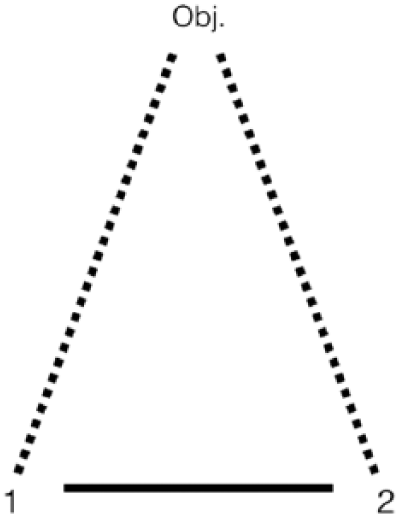
Mimetic triangle.
Mimetic theory explains the problem of hostile hosts and unruly guests as described by Maxey (2013). From the viewpoint of Western BT agencies and their donors, they themselves are the model and they possess the desirable object: the Bible and, of course, the funding and infrastructure for completing a BT project. Vassal partners in host cultures are found who agree to imitate their suzerain Western guests. But as Maxey describes, this agreement is not fully sincere because the vassal hosts actually have their own agendas for the end product of the BT project. The mimetic rivalry begins. They have imitated their suzerain’s cultural expression in BT and desire a unique cultural expression through BT for themselves. But if the suzerain guest learns of the host’s hidden desire, the translation consultants will surely be deployed to fix the situation. The mimetic rivalry escalates. This escalating is a kind of social violence through the necessary social bonds that social creatures create with language. This is building violent relationships of mimetic desire for control of the end use of a Bible product.
Mimetic rivalries, whether physically violent or socially coercive, continue in reciprocity unless peace can be negotiated. The violence of this rivalry is generally solved with more violence, but the violence is sanctioned. In mob violence, a scapegoat can be identified and as long as everyone believes in the guilt of the scapegoat, the scapegoat’s exile or death can be a tool for community peace. Once peace is established, the scapegoat is often then revered as the peacemaker. This phenomenon becomes ritualized in archaic religions. Community leaders choose one victim instead of a potential family or group of victims as the scapegoat. This victim might even be an animal, lessening the violence of interpersonal rivalry. The scapegoat is murdered or exiled, and this murder is believed to be a necessary sacrifice for the good of the larger community. In this way, religious sacrifices have long been a tool for making peace in communities plagued with reciprocal violence.
Dunbar’s research demonstrates that language, and thus translation, is relational. Mimetic criticism demonstrates how these relationships can devolve into reciprocal violence over perceived desires. These can serve as anthropological foundations for considering translation theory paradigms. Or put more simply, relationships and imitation are going to happen. They are essential to the nature of human beings. So, a realistic theory of translation will accept these realities and work within them.
In mimetic theory, the solution to rivalries can be seen when the triangle is reduced to a single line between two bodies. Accepting the other in a relationship of conflict allows for a positive kind of imitation that reciprocates a desire for the relationship rather than for an object. To solve the conflict the mimetic triangle creates, possession of the object must be surrendered. In a mimetic critical approach to hospitality, the desire for control over the end use of Bible products must be replaced with a healthy desire to bond socially with the other and facilitate the other’s social bonding with others through the BT project. In this way, the hospitality metaphor is instructive because it frames the BT enterprise in a fashion that intentionally diminishes rivalries.
However, this does not mean that BT, or the Bible text, may become any and all things that the host or guest may decide. Just as the imitator may become the model in mimetic rivalry, so the guest can become the host in hospitality situations, as Maxey notes (2013, 4). For translation consultants who are tasked with the job of host of the ancient world of the Bible for their translation teams, it would be incorrect to teach their guests to use a Bible product in violent ways that spur on conflicts. This does not mean that the translation consultant should again desire to control the end use of a Bible product. It simply means that translation consultants must be good hosts and not lead guests into conflicts.
A Bible translation case study that exemplifies the mimetic theory involves the translation of “wine” in John 2 in cultures that are socially intolerant of presenting alcohol in a positive light. There are multiple attestations of similar field experience with this issue in different countries. 2 In the case of the World Bible Translation Center (now Bible League International), consultants working in Indian languages such as Hindi, Kannada, and Telugu met with unanimous opposition from translators who refused to render oinos and methuskō in John 2.3 and 10 as “wine” and “to be intoxicated,” respectively. The translators first protested saying if they translated this way, then they might as well leave the translation “on the shelf” when it was completed because no one would read it. Even though Indians indeed drink alcohol, it is still a cultural taboo and is even restricted in some places. There would be no public support for any Bible translation that framed alcohol as anything but a societal evil.
These Indian translation projects began in the 1970s and 1980s and ran their course to completion. In 2017, translation consultants began discussing revision work with new mother-tongue speakers for new revision teams in Indian languages. Much has changed in India since the original translations were made. The new teams were more open to discussing the issue of alcohol with consultants. However, at the end of the conversation, their conclusion was the same as that of the 1970s: no wine in John 2. In fact, some of the team members even pushed back against the consultant, challenging the idea that oinos and methuskō actually meant “wine” and “to be intoxicated” in this passage. They were certain that oinos meant “freshly squeezed grape juice” and that methuskō meant “to be satisfied.” In a polite manner, they questioned the moral character of the consultant, wondering why anyone interested in holiness or godliness would ever tolerate a positive view of drinking alcohol.
It goes beyond the purpose of this paper to detail procedurally how to negotiate such a conflict from a mimetic critical view. Such details are necessary and certainly fall within the domain of mimetic criticism and so should be followed up with more articles. But from a simple viewpoint of hospitality, perhaps two starting places could be offered for future work on mimetic translation procedures. First, forcing something on others creates conflict. The translation consultants tried many tactics to convince the Indian translators to handle wine in John 2 in a linguistically defensible way, but the translators remained unconvinced. It would have been, for example, very inhospitable for them as guests in India to make threats or suggestions that the final decision would have to be their way (like possibly pulling funding from the project if the translators did not obey), which they did not do.
Second, it also creates conflict to allow or instruct others to trust that which is known to be untrustworthy. A good Albanian host does not teach an American guest that it is considered acceptable to venture into a bedroom while still wearing shoes, even though that is the custom of many Americans and even though drawing attention to a practice considered uncouth in Albania might make the American feel uncomfortable. The Albanian host will speak up, and the American guest can decide whether to follow the local custom or to ignore it. But, should the American go to the home of another Albanian host and keep his shoes on in the bedroom, that American cannot rightly blame his first host for not educating him about the custom. In a parallel way, the translation consultants, while surrendering the final decision to the local translators who must live with the consequences of their translation in a way that the consultants do not, continued to teach the translators in India about the facts of biblical languages and ancient Jewish and Greco-Roman customs. Even though the translators had the power to ignore the information from the consultants, the consultants nevertheless continued to insist that the translators wrestle intellectually with the presence of alcoholic wine in John 2. It might be uncomfortable, even painful, for them to do so, but the consultant must be a good host to the ancient Near East in service of their translation team.
The objection against a hospitality paradigm of translation that hospitality allegedly values relationships over accuracy is irrelevant to BT because it is based on an outdated and incorrect view of language and thus of translation. Since language developed for social bonding, a translation paradigm that treats the task of translation as one of building relationships is relevant and commensurate with interdisciplinary empirical data. This is not to say that accuracy is not a priority in BT. As Maxey states (in the quotation above), translators and consultants must be careful in translation work. However, it must be acknowledged that accuracy of communication is not the reason language developed. To hold accuracy as the highest goal of a BT project is to elevate a desire higher than a relationship with the other, that is, the translation team. This position is not only counter to the nature of language as humans use it, but it again falls into the trap of mimetic desire which will likely result in later violence and a symbol of sacrifice to appease the violence. A realistic view of BT recognizes the basic relationship building that happens in BT projects and accepts that as a starting point.
In the comments on the MAP forum, Maxey later replied, The distant cry I hear from classical BT people is: let’s just translate the text. I find such a naive assertion both historically and theoretically untenable. For those who are results-based motivated, hasn’t the past century of BT provided sufficient proof that BT involves so much more than “translating a text”? I am employing performance and hospitality to bolster the BT Industry’s approaches so that we can address much more than “the text” in our work. (Maxey 2015)
There is indeed much more involved in BT projects and in consultancy than simply making corrections of translation drafts. The social bonds that are necessarily established in BT projects must be considered just as strategically as the exegetical, technological, and financial resources for the project. BT theory should take interdisciplinary data into account so that BT theoretical claims can rest more on evidence than on anecdotes. Such a proposal exposes the BT industry to more interdisciplinary scrutiny and re-evaluation. With the current anthropological data in hand, re-evaluations of BT paradigms are well situated to continue exploring the details of hospitality. 3
Footnotes
1.
It should be noted that while many translation theorists and consultants no longer privilege equivalence as a criterion for a good translation, at least not in the same way as the concept once was applied, the equivalence of the authority of sacred text translations will continue to be an issue that translation projects must negotiate with host cultures.
2.
A reviewer of this paper suggested looking at this problem as it occurred in a Nigerian project. Many organizations have their own experiences with this issue all over the world.
3.
A prior version of this paper was presented at the Bible Translation Conference in Dallas, Texas, October 2017.