






Abstract
Interpreting as a form of mediated interlingual communication can be traced back to the third millennium B.C. in the secular sphere. In the Bible Nehemiah 8 shows how Hebrew passages were rendered into Aramaic. Luther’s translation (1984) of Neh 8.8 is compared in the article with RSV (1952), NRSV (1989), and the Russian Tolkovaja Biblija (1904–1907/1987). The emergence of targumim can be attributed to the need to render Hebrew texts into Aramaic, especially in the synagogue service. The Babylonian Talmud acknowledges this as established practice and gives elaborate instructions as to the correct way of delivering the targumim. They are often interpretive to an extent that far exceeds the bounds of translation or even paraphrase because the interpreter (meturgeman) had to transmit the teachings of the rabbi to the common people by placing the original text into a wider context or by amplifying and explaining it.
Dr. David J. Clark was a Translation Consultant for UBS when we met for the first time at a UBS meeting in Spain in 1992. I owe him much gratitude for the many useful discussions we had, for a wonderful friendship that has lasted for twenty-five years now, and for invitations to undertake joint travels with our marriage partners, not forgetting of course his helpful hand whenever a native speaker was needed to check the English-language versions of publications from my pen. 1
In the following I will deal with (1) the origins of interpreting in the Old Testament, (2) the targumim, and (3) the rules for the conduct of the meturgeman in the synagogue. 2
Introduction
Interpreting, as the oral form 3 of mediated interlingual communication, is one of the oldest professions and can be traced back to the third millennium B.C. In Egypt, a class of interpreters, known today as dragomans, emerged as early as the Old Kingdom (ca. 2700–2200 B.C.), their task being to conduct political and commercial transactions abroad, for which purpose they accompanied trading expeditions whose organizers were known as the “treasurers” of God (i.e., the king). The princes of Elephantine, charged with overseeing the “southern gate” of Egypt, proudly bore the title “overseer of all interpreters ” (or in Gardiner’s translation, “overseer of all dragomans”) 4 at the time of the Sixth Dynasty. They held an important position as caravan leaders, members of advance parties sent abroad, heads of expeditions (e.g., famous expeditions to Sudan), and business negotiators (e.g., in the copper mining area of Sinai, where the local population spoke a Semitic language; cf. Pohling 1971, 125).
From the Middle Kingdom (ca. 2050–1610 B.C.) onwards the Egyptians also recruited the sons of foreign princes. And conversely, Herodotus reported (in Historiae, 2:154, quoted in Hermann 1956, 30) that the Pharaoh Psamtik I (seventh century B.C.) had entrusted Egyptian boys to Hellenic settlers in the Nile delta so they might learn the Greek language. Reputedly, these boys were the ancestors of the later dragoman class. 5
That the Egyptians (who regarded themselves as “human beings” and other peoples as “barbarians”) began to learn foreign languages at an early stage can be gathered from excavated clay tablets dating from ca. 1400 B.C. which contained Akkadian inscriptions (cf. Pohling 1971, 125), partly with Egyptian equivalents, suggesting that this may well have been one of the earliest attempts to compile bilingual word lists (cf. Pohling 1971, 155). The interpreter’s role is depicted impressively in the bas-relief scene from the tomb of Haremhab in Saqqâra (14th century B.C.; see Figure 1).
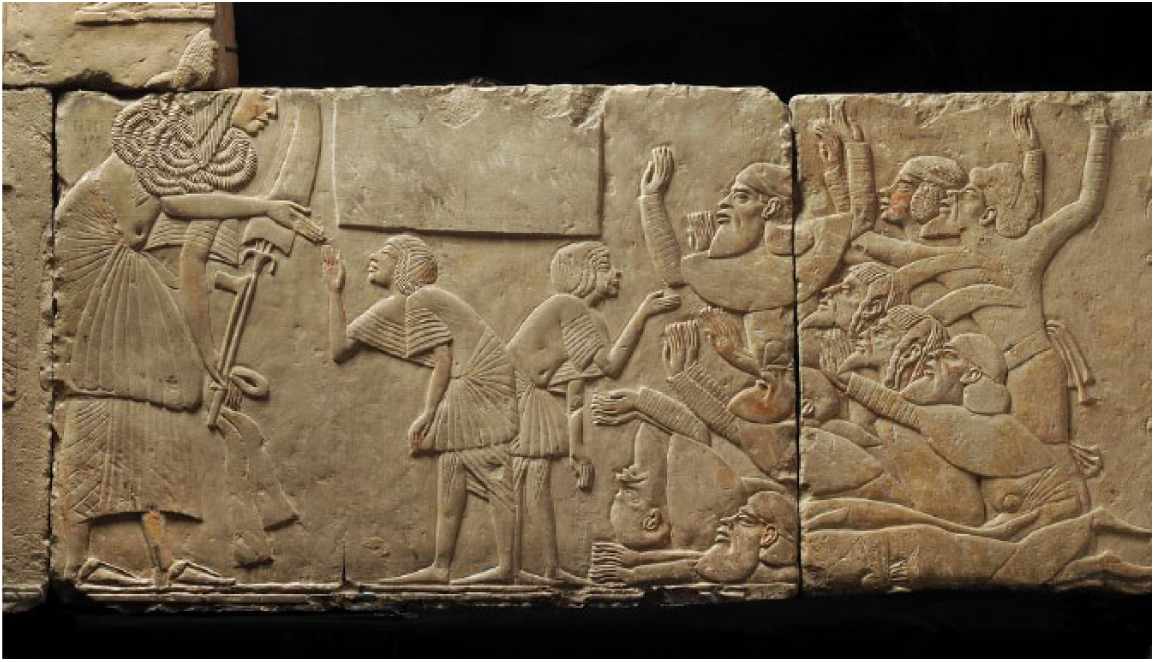
Bas-relief from the tomb of Haremhab in Saqqâra, Egypt, depicting an interpreter in action. Photo courtesy of the National Museum of Antiquities, Leiden, The Netherlands.
1. The origins of interpreting in the Old Testament
The book of Genesis mentions an interpreter acting as an intermediary between Joseph’s brothers, who had left their famine-stricken homeland for the rich country on the banks of the Nile, and their presumed Egyptian host at the court of the Pharaoh (ca. 1700 B.C.): “They did not know that Joseph understood them, since he spoke to them through an interpreter” (Gen 42.23, NRSV).
Nehemiah 8 gives insight into how Hebrew passages were rendered into Aramaic later on in the service in the synagogue (cf. Schäfer 1980, 216). The interpreter, or meturgeman, played a crucial role here. The passage relates that Ezra the scribe
6
gathered the Israelites who had returned from exile (in the last third of the fifth century B.C.) on the square before the Water Gate and, facing them, opened God’s book of the law while standing on a wooden platform. The Levites at his side then helped the people to understand the law. Luther translated this passage as follows:
7
Und sie legten das Buch des Gesetzes Gottes
NRSV provides the following translation for Neh 8.8: So they read from the book, from the law of God,
While the German text uses the words klar und verständlich (in clear and intelligible terms), NRSV renders the passage as with interpretation, which leaves it open as to whether explanation or oral translation is meant. The older RSV (1952) offers two options: And they read from the book, from the law of God, Footnote: *or
In this context it is quite useful to look at the Russian translation in the Tolkovaja Biblija (vol. 1, 1904–1907/1987) and the accompanying commentary. Nehemiah 8.8 there reads as follows: И читали изъ книги, изъ закона Божiя, [Roughly: They read
The commentary starts from the assumption that the Hebrew word meforash (which strictly means “divided into sections” or “laid out for inspection”) here signifies “divided and clear” and emphasizes that the text was being rendered into Aramaic. After presenting counterarguments the commentators concluded that the Levites might have given explanations of the text read by Ezra in the form of a paraphrase, contrasting it with the binding “original text,” which consequently became established as the authentic text (the Egyptian Diaspora excepted) ever since the days of Ezra/Nehemiah.
2. The targumim
Targum 9 means “rendering” and is related to meturgeman, 10 which denotes an “interpreter.” At the beginning of the talmudic period it usually referred to the rendering of biblical passages into Aramaic (see the entry “Targumim” in Schäfer 1980; cf. also Thieme 1956, 13; Ribera 1994).
The emergence of targumim is mainly attributable to two interrelated factors: (1) In Persian times the Aramaic language began to supplant Hebrew as a lingua franca in the ancient Near East. As proficiency in (biblical) Hebrew declined, it became necessary to render texts written in this language into Aramaic.
The Hebrew language used for these books began to die out; it became less and less familiar to the Jews whereas Aramaic, which the inhabitants of Judaea did not understand in Isaiah’s day … , emerged as the vernacular in Palestine even before the Hasmonean period… . Several simultaneous causes were responsible for the ascendancy of the Aramaic language. Following their deportation to Babylonia from Nebuchadnezzar’s reign onwards, the Jews were able to spread undisturbed for a considerable period of time and, during the reign of Cyrus, a steady and often sizable stream of colonists returned to Judea, their mother tongue being Aramaic. (Zunz 1966, 7–8; my translation)
(2) The synagogue service provides the social context, the Sitz im Leben, for the targumim. The public reading of the Torah as the centrepiece of synagogue worship made it necessary (because few people were fluent in Hebrew) to render the written texts into Aramaic (cf. Schäfer 1980, 216). The Babylonian Talmud (b. Megillah 3a) acknowledges the rendering of the Torah passages into Aramaic during the synagogue service as established practice and gives elaborate instructions as to the correct way of delivering the targum. We must seriously consider the possibility that the Sitz im Leben for the oral delivery of the targum (in the synagogue) differed from that for the written targum (i.e., bet ha-midrash, the study centre).
There are targumim for all the books of the Old Testament (with the exception of Ezra/Nehemiah and Daniel). The targum to the Pentateuch is notable for the largest number of differing versions (cf. Schäfer 1980, 218). As an object of study, the targum generally enjoyed the same status as the Scriptures and the Mishnah.
Before A.D. 70, Torah readings in the synagogue were mainly a phenomenon of the Diaspora. With the temple out of reach, they served as a substitute for the sacrificial cult and gave the Jewish communities a sense of identity. It is likely that regular scriptural readings had their origins there. In the first century the Sabbath readings were observed as an age-old custom. Opinions differ on the order in which these readings took place in the oldest times. In Palestine, for example, the entire Torah was read in a triennial cycle. Each Torah reading was followed by the haftarah (reading selection from the Prophets; see Zunz 1966, 3–6).
From an early stage, however, the readings made it clear that it was also necessary to bridge the language gap. Here is what Zunz wrote on this subject: Lessons were given on every shabbat … to expound the Scriptures … , to provide edification … or to instruct the congregation in the application of the law. Preferably, the lessons … took place two or four shabbats … before the three chief festivals to explain the laws concerning these holidays… . It was also common to give lessons on the three chief festivals … , on the intermediate days … , on Yom Kippur … , on Purim … , on days of mourning … and on special fast days … , in the latter cases mostly for edification and comfort… . This office was administered by the head of the academy, the highest-ranking school teacher or, with the permission of the superiors, another rabbi… . The person delivering the sermon … was sitting … on a raised seat … , but for the most part he did not address the congregation; but a rabbi was hired for this purpose and in this capacity was called meturgeman, turgeman or emora, i.e., speaker, expounder, interpreter. Adopting a standing position, he announced to the congregation what the hakam
11
had told him in a whisper. The most prestigious teachers, notably the heads of schools and academies, used to rely on a specific emora … who often expanded on what the hakam had merely faintly suggested. The emora had to make the teacher’s words audible with his loud and pleasant-sounding voice, answer questions for him … and render texts from the learned language into the vernacular, which was necessary in particular when instructing the congregation in the halaka. (Zunz 1966, 349–51; my translation)
Sources outside rabbinical literature also refer to the close link between synagogue and study centre. York quotes Eusebius of Caesarea (ca. 263–339, Bishop of Caesarea Palaestinae from 313), who penned the first history of the church, which contains numerous quotations from early Christian sources that were deemed lost, but now provide valuable information: Moreover, they (the Jews) have certain teachers … of primary studies—for so they like to call the interpreters of their Scriptures—who make clear those things obscurely taught in riddles … by means of translation … and interpretation. (quoted in York 1979, 84)
In the sixth century there were essentially two traditions—the Palestinian and the Babylonian—for reading from the Torah and the Prophets. The difference between East and West mainly relates to the triennial cycle or the annual cycle. In the annual cycle as still practised today the Torah was divided into 53 or 54 pericopes (parashiyot); in the triennial cycle the number of sections (sedarim) was less uniform, presumably about 150 (see Wacholder 1971, xxi–xxiii). Reputedly, liturgical differences between the Palestinian and Babylonian synagogue in Cairo still existed in the twelfth century (Wacholder 1971, xlii–xliii).
Following the Arab conquest of the East, which made Baghdad the centre of the Muslim empire, the annual cycle as practised in Babylonia became firmly established in northern Africa and western Europe. The Palestinian tradition was still alive in the days of Maimonides (1138–1204). 12 Most of the verses were rendered literally or almost literally, some provided with brief additions and others with comments and rhetorical embellishments that sometimes were longer than the verses themselves. This is also confirmed by The Oxford Companion to the Bible: 13 “All translations of the Bible are necessarily interpretive to a degree, but the Targums differ in that they are interpretive as a matter of policy, and often to an extent that far exceeds the bounds of ‘translation’ or even ‘paraphrase’” (Metzger and Coogan 1993, 754–55).
This was especially true of the first and last verse of the pericope. By way of example, let us have a look at how Gen 50.1 is rendered in the Neofiti manuscript. 14
In NRSV it reads: Then Joseph threw himself on his father’s face and wept over him and kissed him.
Here is the corresponding passage in the Neofiti manuscript: And Joseph fell upon the face of his father and wept over him and kissed him.
This example highlights the role of the meturgeman, which Shinan describes as follows: It is clear from these sources that the mĕtûrgĕmān held a professional position and was the bearer of tradition that served, among other things, as a means of transmitting the teachings of the Rabbis to the common people. His audience comprised simple folk who had no great erudition of Torah and whose ability to absorb such learning was quite limited. The Rabbis, for their part, did not overly esteem the mĕtûrgĕmān, and his remarks were subject to their supervision. Nevertheless, they could not ignore the mĕtûrgĕmān’s central role to serve as a kind of popular extension of the scholarly world, who was to mediate between the spiritual leadership and the people. (Shinan 1987, 104–5)
Zunz (1966, 6–9) considers that as long as the Asian Jews spoke Aramaic the custom doubtless subsisted in most places. Where this was not the case this was apparently due to the lack of an appropriate interpreter. It was not until written targumim began to gain currency that interpreting was increasingly neglected, which in Zunz’s view mainly concerned western Asia and Persian and/or Arabic translations.
3. Rules for the conduct of the meturgeman in the synagogue
In marked contrast to the Western tradition, where the translated version of the Bible took the place of the original, the tradition of the Jewish synagogue service was notable for the juxtaposition of the Torah reading and its rendering into the vernacular. As Kaufmann notes, the weekly lesson proceeded as follows. The handwritten sacred text, copied by a scribe versed in the rules of calligraphy on a parchment scroll, was read or chanted by a ba‘al qore. The latter was not allowed to turn his eyes away from the text while reading to avoid any impression that he was improvising. But the principal reason was that the Torah as the “law” which Moses had received in written form should not be passed on orally (Kaufmann 2005, 978).
15
Standing alongside the ba‘al qore was the meturgeman, who was obliged to listen carefully and to interpret without the aid of a written text. He was not permitted to look at the Hebrew text in order that the people should not think that the translation was contained in the Torah. Needless to say, he was not allowed to take notes either, all the more so as writing was one of the thirty-nine creative activities prohibited on the Sabbath (Kaufmann 2005, 978; see also Elbogen 1962, 187).
16
Shinan described the approach to interpreting as follows: The mĕtûrgĕmān had to function by memory only, since it was prohibited to use written texts for translating the Torah in public … ; and the mĕtûrgĕmān, as all oral narrators, had developed a number of devices, such as the rhetorical speech to capture the attention of his audience. (Shinan 1987, 105)
17
Kaufmann points out (with Jerusalem Talmud tractate Megillah 4 in mind) 18 that according to the rule the reader and the interpreter should be two different persons (2005, 979). The reader of the Torah was not allowed to intervene in order to help the meturgeman (2005, 979, with regard to the Babylonian Talmud Megillah 32a). The weekly lessons from the Pentateuch and the Prophets were interpreted from memory in a standing position whereas the reader was seated while reading the text (Elbogen 1962, 187).
Both reading and interpreting were considered an honourable task to be assumed on ceremonial occasions by the most distinguished personalities, with members of the priesthood invariably being the first choice (Elbogen 1962, 188). The entry “meturgeman” in The Jewish Encyclopedia provides the following information: The head of the academy, while seated, would tell him [i.e., the meturgeman] in Hebrew and in a low voice the outline of his lecture; and the meturgeman would in a lengthy popular discourse explain it in the vernacular to the audience… . He did not limit himself to a mere literal translation, but dilated upon the Biblical contents, bringing in haggadic elements, illustrations from history, and reference to topics of the day. This naturally required much time, to gain which the weekly lesson had to be short, so that the Pentateuch was finished only in a cycle of three or three and one-half years; while the portion from the Prophets was frequently abbreviated. The free handling of the text, which frequently changed the translation into a sermon or homily, gave the meturgeman ample opportunity to introduce his subjective views into the lesson; and with the multiplication of sects this became distasteful to the Rabbis. The increase in the opposition to the meturgeman led to the fixation of the Targumim and to the demand that the meturgeman keep strictly to mere translation. But a mere translation satisfied neither the public, who had known the text from early school-days, nor the meturgeman, who was deprived of an opportunity to parade his knowledge and to display his oratorical gifts. As a consequence the “darshan,” or preacher, was introduced; and the literal translation fell into disuse. (Singer 1904, 521)
According to the Mishnah (m. Megillah 3) the reader had to adjust his rate of speech and his pauses to several requirements, especially the absorption and delivery of the text by the interpreter. In other words, the reader was not entitled to begin a new verse before the interpreter had completed his rendering (Kaufmann 2005, 980).
Only a single verse at a time was read when excerpts from the Torah had to be interpreted. By contrast, it was acceptable to read three verses at a time from the books of Prophets before the interpreting. However, if these three verses represented different sections, they had to be read one by one. Moreover, there was a rule to the effect that the haftarah had to comprise at least twenty-one verses if no interpreter was present. When an official meturgeman was available to interpret into Aramaic, it was permissible to reduce the total number of verses to ten or (at the very least) three so as not to draw out the service (Mann 1971, 9; regarding this point see also Kaufmann 2005, 981).
Respect for the sacred text dictated that both the reader and the meturgeman began from scratch if they had committed a mistake (cf. Kaufmann 2005, 982). A rabbi was allowed to rebuke both the reader and the interpreter, in the latter case especially when he disagreed with the interpreter’s understanding of the text (cf. Kaufmann 2005, 983–84). As an example Kaufmann cites Gen 29.17, where Leah’s eyes are described as rakot (soft, tender, weak, gentle, moist), which some view as a compliment, but others as a disparaging remark, the word being derived by folk etymology from arukot (elongated > stupid). The rabbi insisted on the latter interpretation, while the interpreter had offered the former. 19 The interpreter was torn between closely following the text and obeying the instructions of the rabbi who employed him. The interpreter had to take into account the “norms” of the exegetical tradition that held sway in his time and in his sphere of activity.
Conclusion
The foregoing can be summed up as follows: The meturgeman was an important figure, mediating between the immutability of the written word and the adaptability of the spoken word. In the time of Nehemiah this practice was not yet fully established. Taking into account the state of knowledge of his audience, the meturgeman had the task of placing the original text, whenever necessary, into a wider context or amplifying and explaining it. In ancient Jewish times the interpreter in the synagogue was clearly important because he had to express in a different language what the original “was meant to say.”
The office of the turgeman was a prestigious one, a stepping-stone for the career of men of high repute. When the era of the Babylonian Amoraim was over, the office became extinct, and henceforth the preacher addressed the congregation directly once again. (Elbogen 1962, 198; my translation)
Some interpreters became rabbis, as did, for example, Rabbah Jehuda bar Nachmani, who is even said to be the author of laws or exegeses (Kaufmann 2005, 983). It is generally assumed that in the first century A.D. the first turgeman was an ordained rabbi (Gächter 1936). 20
Footnotes
1
The English version of this article was provided by Mr. Bernd Zöllner, graduate interpreter and translator (Berlin).
2
Not all the facts gathered about biblical interpreting are reliable because the sources are, in part, contradictory. I would like to thank the Bible Institute and the Gregoriana in Rome as well as the Theological Faculty of Leopold Franzens University in Innsbruck and the Jesuit College in Innsbruck for granting me permission to use their libraries. I also owe gratitude to the members of the Scholarly Forum of the United Bible Societies (where I had the privilege to represent the discipline of translation studies in the 1990s) and to EUMECOT/UBS for stimulating discussions on issues of Bible translation, discussions that included, notably, Dr. David J. Clark. For a more detailed version of the origins of interpreting, see  , 1–27.
3
This simple distinction between interpreting and translating based on the criterion of oral or written communication is now obsolete given the technical possibilities that exist. The principal difference is that in interpreting, the text cannot be absorbed as a whole and not repeatedly. An interpreter must deal with segments of texts or even utterances. Nowadays even oral texts can be translated, various recording options being available. Translation is used as a generic term covering both interpreting and translating (cf. Salevsky 2002, 95–97; , 282–85).
4
Gardiner 1915, 124. There is disagreement over the translation of this phrase; see the discussion in Falbo 2016. The hieroglyph depicts a loincloth used only by foreigners/people speaking a foreign tongue (see Sander-Hansen 1963, 248, and Brunner 1967, 11). One probably has to make a distinction between the development of the activity of interpreting as a profession (see Salevsky 2002, 15–22) and that of the name for it (see , 22–27).
5
6
For Ezra’s title sofer/safra (“scribe of the law of the heavenly God”; Ezra 7.12), see Schaeder 1930, 51; for Ezra and Nehemiah, see also .
7
The law was written down in Hebrew and read in this form. For the people to be able to understand it, the Levites had to provide an oral rendering. Presumably, this was not because the Jews in Jerusalem had ceased to speak anything but Aramaic by the fourth century B.C., but because the Torah was couched in an archaic scholarly language based on the written language used in the Kingdom of Judah from the eighth to the sixth centuries B.C. (Knauf 2013, 3; see also , 51–61 and 206–20).
8
The Russian word vnjatno can also mean “clear” and/or “distinct.”
9
, 9) draw attention to the fact that the targumim were published for the first time in the rabbinic Bibles and then, with a Latin translation, in the polyglot Bibles of the sixteenth and seventeenth centuries. The discovery of a complete copy of the Palestinian Targum to the Pentateuch in the Vatican Library (1949) and the Qumran excavations (from 1947) generated an increased interest in the Aramaic targumim and, hence, the interactions between Judaism and Christianity. The Aramaic language of the targumim provides insights into the origins of Jewish traditions and the way they were transformed by Christians from Syria, Armenia, and the Orient all the way to Ireland. The targumim tell us much about the history of the Jews in Cairo, Italy, Spain, and Germany, among other places.
10
The oldest sources mentioning the word targumannu (see the entries “Dolmetscher” and “targuman” in Klauser 1959) concern a trading centre called Kaneš (now Kültepe) near Caesarea (now Kayseri) in Cappadocia, a multilingual town containing an Assyrian merchant colony. Even before 1800 B.C. they refer to a rabi targumannē “chief of interpreters” (cf. Pohling 1971, 126). The term melits (spokesman) used in the Old Testament to denote an interpreter was applied to the Babylonian emissaries, i.e., to people who were not only proficient in languages, but also capable of spiritual insights (, 31).
11
According to Cohen (1948, 255) hakam meant “sage,” “Pharisaic teacher” (for the Pharisaic exegetes see, among others, ). The title “rabbi” did not exist before the first century A.D.
12
The Jewish philosopher, scholar, and doctor Maimonides (Moshe ben Maimon) also expressed his views on translating or rendering a text into another language (along the lines of Cicero and Jerome): “Whoever wishes to translate, and purposes to render each word literally, and at the same time to adhere slavishly to the order of the words and sentences in the original, will meet with much difficulty; his rendering will be faulty and untrustworthy. This is not the right method. The translator should first try to grasp the sense of the subject thoroughly, and then state the theme with perfect clearness in the other language. This, however, cannot be done without changing the order of the words, putting many words for one word, or vice versa, and adding or taking away words, so that the subject be perfectly intelligible in the language into which he translates” (Epistle addressed by Rabbi Moses Maimonides to Rabbi Samuel Ibn Tibbon, Sacred Text Archive, Judaism, ).
13
I would like to thank David Clark for presenting me this book as a gift.
14
Codex Neofiti is a Targum manuscript (see ), which was identified as late as 1956 as a Palestinian Targum to the Pentateuch (it was long incorrectly titled as a manuscript of Targum Onkelos). As Schäfer notes, Codex Neofiti is a completely preserved targum to the Pentateuch (1980, 218–19). The manuscript apparently involved three different scribes, with numerous variants inserted in the margin and between the lines. Schäfer (219) regards this as proof that the targumim are not the work of a single author (authorial literature), but reflect divergent traditions from different eras (collective literature).
15
16
In the Hellenistic world, however, the Septuagint represented an exception as it was read in the synagogue from a book, sometimes even instead of the Hebrew text because the Hellenized Jews only spoke Greek. From the ninth or tenth century onwards it was also common in the synagogues to read the Arabic translation of the Bible as a targum (cf. Kaufmann 2005, 979). The Talmud also mentions Egyptian (Coptic), Elymian, and Median translations of the Bible. In later times, Arabic and Persian translations were also used in the synagogue (cf. , 187).
18
Readings from the following sections of the Bible were read on Jewish holidays: Song of Songs on Pesach (Passover), the book of Ruth on Shavuot (Feast of Weeks), Lamentations on Tisha B’av, the day commemorating the destruction of the temple, Qohelet (Ecclesiastes) on Sukkot (Feast of Tabernacles), and the book of Esther on Purim (Festival of Lots). B. Megillah 18a stipulates that scrolls containing the book of Esther may only be read “as written” (i.e., from the scroll in Hebrew).
19
Luther’s version (as published in Luther 1912) of this passage reads, “Aber Lea hatte ein blödes Gesicht, Rahel war hübsch und schön” (roughly: But Leah was misty-eyed, Rachel was pretty and beautiful). The Bibel in gerechter Sprache puts it differently: “Die Augen Leas waren zärtlich, Rahel aber hatte eine schöne Figur und sah gut aus” (roughly: Leah’s eyes were tender, but Rachel had a fine figure and good looks). Leah means “cow” in Akkadian (cf. , at No. 557b). To be cow-eyed was deemed beautiful and expressed approval (cf. for instance Raoul Schrott’s German translation of Homer’s Iliad (Homer, XV, line 34) where he rendered boōpis as “her large cow-eyes”). But for theological reasons such an interpretation was not desirable. Luther’s revised version published in 2017 uses a different wording: “Leas Augen waren sanft, Rahel aber war schön von Gestalt und von Angesicht” (roughly: Leah’s eyes were gentle, but Rachel was beautiful in form and appearance).
20
Republished with the permission of Peter Lang GmbH, excerpted, translated, and adapted from ch. 1 “Die Anfänge des Dolmetschens” of Beiträge zu einer Geschichte der Translation, by Heidemarie Salevsky and Ina Müller, 2015; permission conveyed through Copyright Clearance Center, Inc.
Bibles
Luther 1912 Luther Bible with the text of 1912
Luther 1984 Luther Bible with the revised text of 1984
Luther 2017 Luther Bible with the revised text of 2017
NRSV New Revised Standard Version (1989)
RSV Revised Standard Version (1952)