







Abstract
Pinoy is a heterogeneous language that incorporates elements of English into an oral version of Tagalog, the national language of the Philippines. In 2018 the Philippine Bible Society published a written version of the New Testament in Pinoy. This study seeks to explain the success of the translation. The thesis is that any formulation that deviates from the current and natural way of saying something as articulated in its oral form makes the sentence more difficult to understand. (As in any language, it takes a native speaker to discern if a construction is natural.) The Pinoy New Testament translation was undertaken with the goal of reflecting the spoken form so that it would be easy to read and understand.
1. Introduction
I thought September 13, 2018, would be just an ordinary day of launching a Bible product. Of course, as the translation consultant for the Pinoy version of the New Testament (PVNT), I gave a brief description of the new product. There was no opportunity for immediate feedback and response at the launch, so my brief description was all the rationale that was given. It seemed like all the other launching events of the Philippine Bible Society (PBS). Our production department made sure we had at least two thousand copies for interested buyers. After lunch, I went home with a few others. It was a warm afternoon.
The next day, I got an email from our Translation Supervisor, who sounded concerned because of negative reactions posted on social media. The initial plan was for PBS to provide a response to be posted on the PBS website. I accepted this strategy and I volunteered to write the Frequently Asked Questions (FAQs) on the Pinoy version. I also suggested that I engage with the actual PVNT users in a forum. I wanted to present the Pinoy version in the best way I could, so I could personally hear and respond to people’s comments, questions, and criticisms.
I took every opportunity to talk about PVNT. To help explain the thinking behind PVNT, we held a series of Bible forums, the first of which was at PBS on September 18. It was attended by PBS staff, who we believed should have sufficient product knowledge, being on the front-line to receive queries. The rest of those attending were people who had participated in the exchange of ideas in the social media, Bible users who wanted to know the product well to maximize its full value. Since then I have spoken in nineteen different Bible forums about PVNT: seven times organized by and held at PBS, four times in different universities in Metro Manila, and also at one seminary, two churches, two broadcasting companies, including a cable channel, one publisher, and three youth camps.
Within the five days of the Manila International Book Fair where PVNT was launched, 3,524 copies were sold. And in the many days and weeks after that, PBS was confronted with the problem of not having enough stock because of the high demand for PVNT. Since its launch on September 13, almost a hundred thousand copies had been sold by the end of December 2018. The supply began to catch up with demand only in January 2019, with priority being given to back orders.
We are pleasantly surprised, and we praise the Lord for this development. But we need to know the reasons for this turn of events. Why is this translation of the New Testament selling well?
The theoretical model on which this translation is based started with a descriptive linguistic approach (O’Grady et al. 1997) in order to carry out a synchronic and diachronic analysis of this heterogeneous language (del Corro 2009; 2016; 2018) that combines Tagalog and English. The translation project was an initiative of the Philippine Bible Society, as it contemplated how to meet the challenge of one of the dilemmas of contemporary Bible translation: God does not change but God created a world that constantly changes. God created human beings in God’s image with an incredible propensity for adjusting things to their liking. (Shaw and Van Engen, 2003)
This statement captures the context of Bible translation in our present world. Change is all around, in varying degrees, in varying forms. But the word of God is supposed to be the basis of something that is not expected to change. It should have the same message from the time it was first transmitted till the present time. Something has got to give.
2. Synchronic analysis
The Pinoy Version New Testament (PVNT) is a written translation (based on the Tagalog Bible) that reflects the way speakers naturally speak. A unique feature of this translation is that it uses heterogeneous language, combining Tagalog (or Filipino) 1 and English. This combination is popularly known as Taglish. This phenomenon of mixing the two languages is a result of the social and political changes that transpired within a period of thirty-five years (to be discussed in Section 7). Because of these changes, there is at present a big gap between the way people naturally speak and the way Tagalog Bibles are written.
This is what prompted me to research heterogeneous language (HL) in the Philippines (reported in the articles cited in the introduction). The thesis of this study is that anything expressed in a generally accepted written form that deviates from the contemporary and natural way of articulating the same thing orally makes the sentence difficult to understand. Just as in any language, it takes a native speaker to discern if a construction is natural. PBS wants all Filipinos to read the Bible. They will not read it if it is difficult to read. PVNT has made it its goal to reflect the spoken form so that it will be easy to read.
The relationship between the orthographic symbol and the sound it represents is called
An example of this gap between the spoken and written language will be analyzed below by comparing Magandang Balita Biblia (MBB) and PVNT. MBB, published in 2012, is the most widely used meaning-based Tagalog translation. When the predominant pronunciation of Tagalog words has changed, PVNT spells them in a way that is close to the actual pronunciation. This principle does not apply to words borrowed from English, which retain their normal English spelling in order to make them easily recognizable. The Good News Bible (GNB) is included to give the meaning-based rendering of the verse in English.
3. Examples of how PVNT better reflects natural speech than MBB
3.1 John 3.16
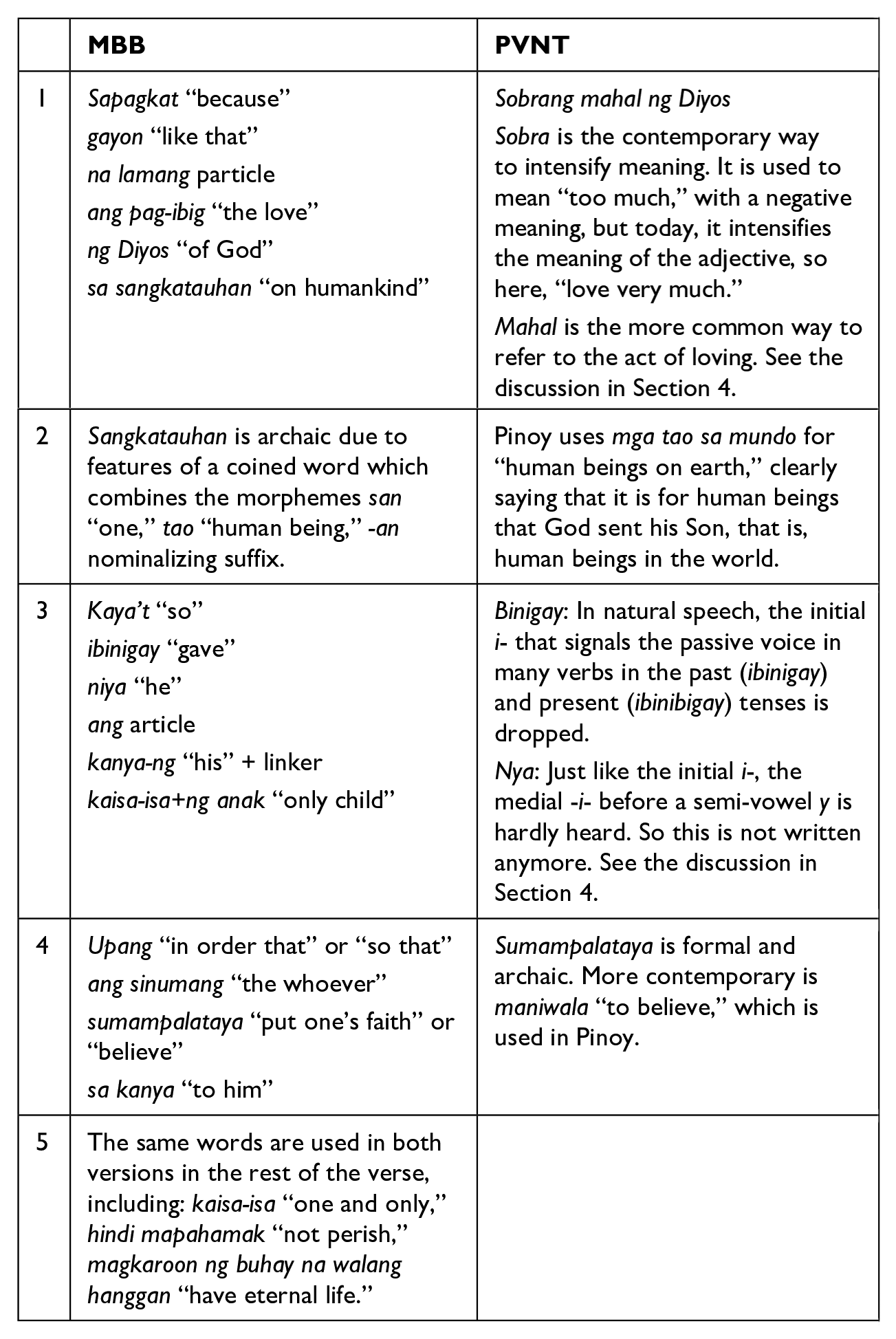
Sapagkat gayon na lamang ang pag-ibig ng Diyos sa sangkatauhan, kaya’t ibinigay niya ang kanyang kaisa-isang Anak, upang ang sinumang sumampalataya sa kanya ay hindi mapahamak, kundi magkaroon ng buhay na walang hanggan.
Sobrang mahal ng Diyos ang mga tao sa mundo kaya binigay nya ang kaisa-isa nyang Anak, para hindi mapahamak ang lahat ng naniniwala sa kanya, kundi magkaroon sila ng buhay na walang hanggan.
For God loved the world so much that he gave his only Son, so that everyone who believes in him may not die but have eternal life.
3.2 John 3.22
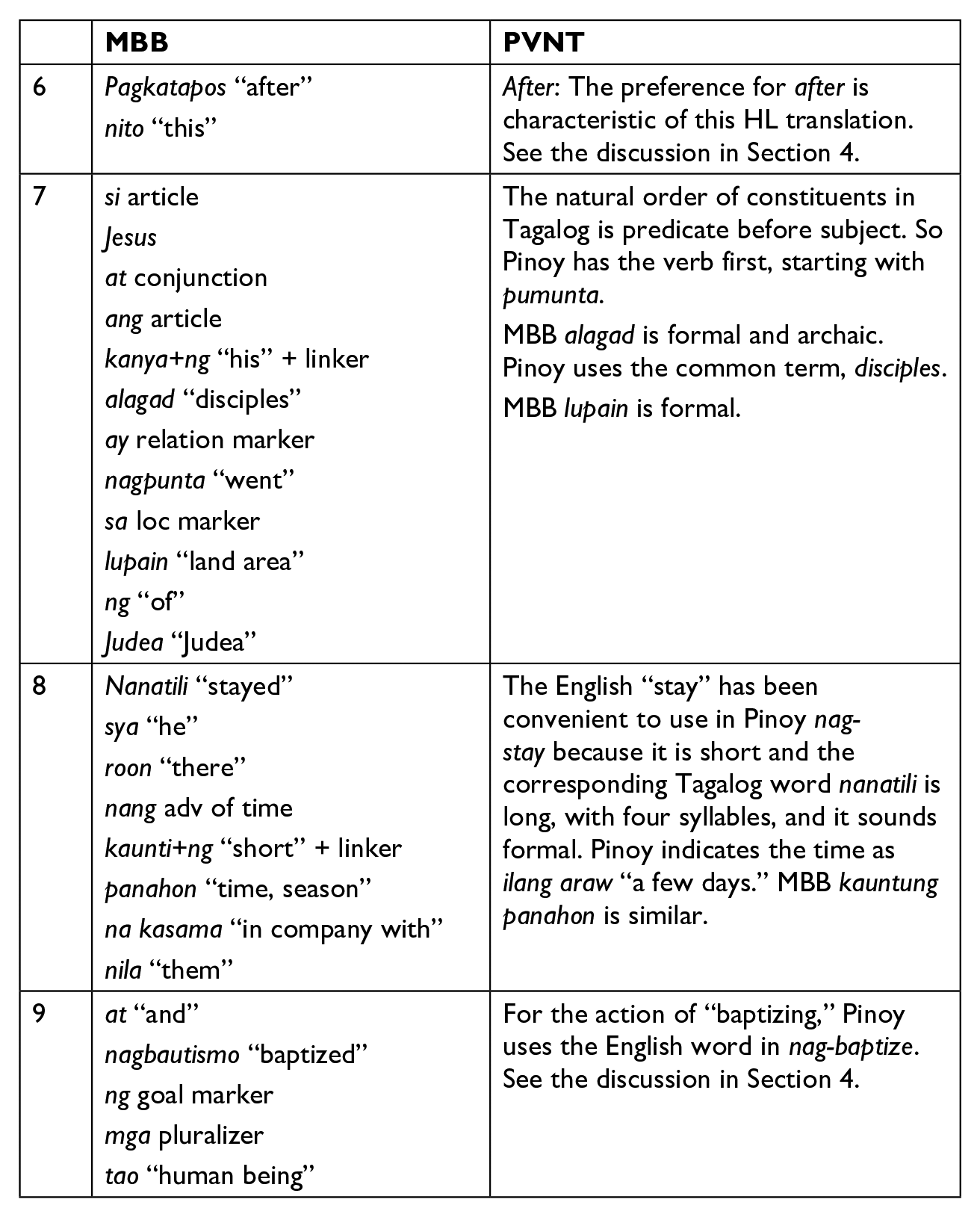
Pagkatapos nito, si Jesus at ang kanyang mga alagad ay nagpunta sa lupain ng Judea. Nanatili siya roon nang kaunting panahon na kasama nila at nagbautismo ng mga tao.
After nito, pumunta si Jesus at ang mga disciples nya sa Judea. Nag-stay sya dun ng ilang araw kasama sila at nag-baptize sya ng mga tao.
After this, Jesus and his disciples went to the province of Judea, where he spent some time with them and baptized.
3.3 Second Thessalonians 1.2
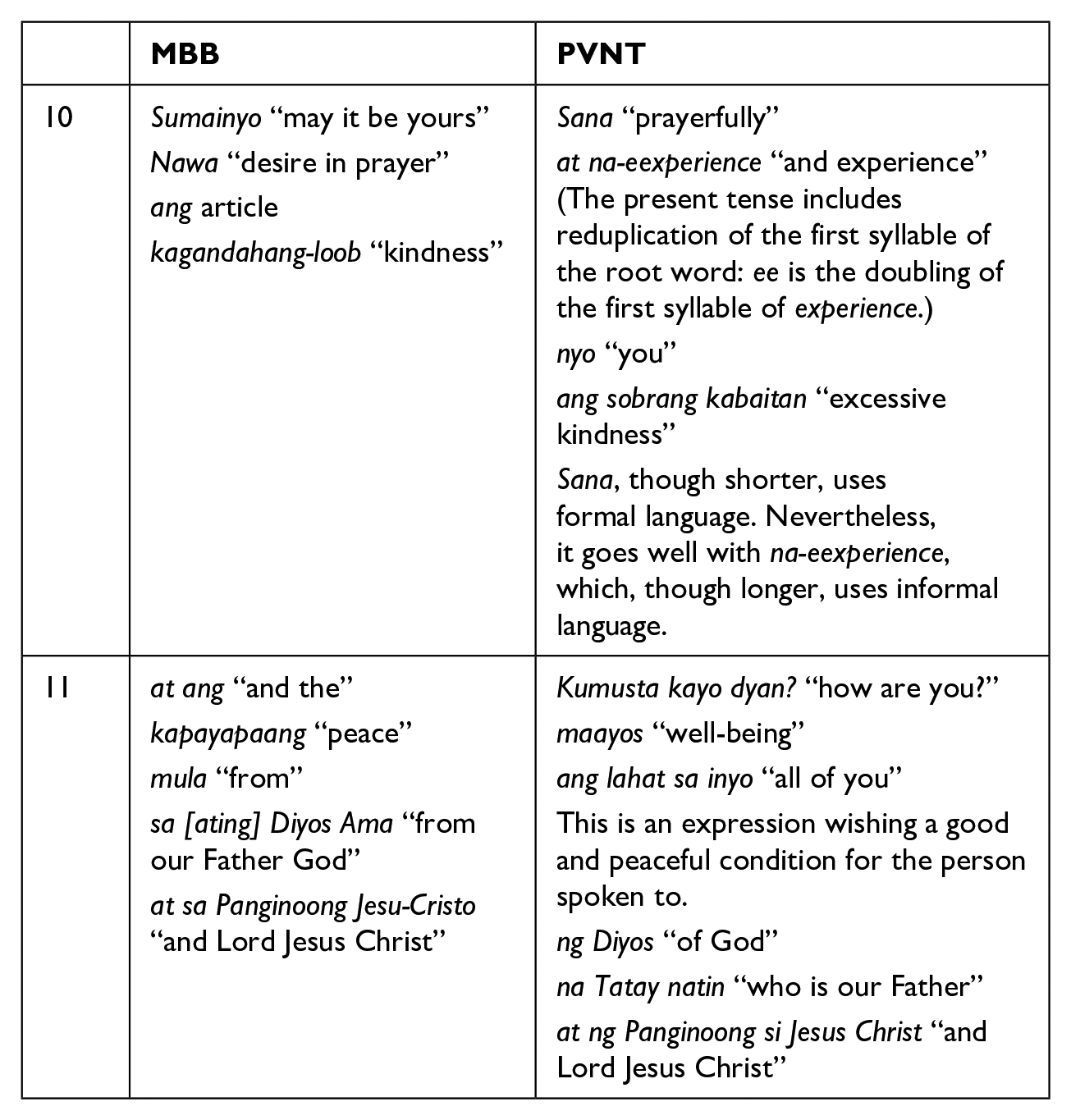
Sumainyo nawa ang kagandahang-loob at ang kapayapaang mula sa [ating] Diyos Ama at sa Panginoong Jesu-Cristo.
Kumusta kayo dyan? Sana maayos ang lahat sa inyo at na-eexperience nyo ang sobrang kabaitan ng Diyos na Tatay natin at ng Panginoong si Jesus Christ.
May God our Father and the Lord Jesus Christ give you grace and peace.
4. Types of language change in Pinoy
We use language for the primary function of communicating meaning. We choose a way to express our meaning to achieve the optimum result or effect on our audience. (This is the principle of relevance; see Sperber and Wilson 1995, 270.) When we prefer a form that is shorter or easier, be it in speech or in writing, we are applying the principle of parsimony or economy. Other principles also come into play, as the examples from the tables above illustrate:
Lexical change by choosing a more contemporary word in John 3.16 and John 3.22: Based on these two short verses, it is evident that the change from MBB to PVNT can be
Shortening in John 3.16: Another type of change is
Preference for an English word in John 3.22 and 2 Thess 1.2: In examples 6 and 9, one finds cases of lexical alternation, showing preference for an English word. After and nag-baptize are used, respectively. These words are very common and thus easier to recall. Also, after is definitely shorter than pagkatapos. In the case of “baptize,” the Tagalog word nag-binyag means “baptized,” but nag-baptize is preferred even though both terms have three syllables. In del Corro 2009, bautismo was used in Pinoy Mark 2008 (see Section 7.6). But in the succeeding release, it was noted that it had become more natural to use baptize. I think the prestige associated with English may be a reason. In example 8, the English word “stay” is used over nanatili, which has four syllables. In example 10, na-eexperience “to have the experience” is used to refer to the effect of God’s grace or kindness in the life of a person. This also shows a preference for an English word.
Word order: In example 7, the Pinoy rendering follows the more natural sequence of putting the predicate before the subject compared to MBB, which has the order subject–predicate. The Pinoy more natural order makes comprehension easy.
5. Target audience
Initially, the target audience was young readers, fifteen to thirty years old, in the National Capital Region.
2
However, users can be classified as either
The PBS Bible Forum had taken us, initially, to Tagalog-speaking areas. But after the launch, even non-Tagalog speaking areas indicated their openness to using PVNT. This was clearly expressed in the Bible Forums held in La Union City, primarily an Ilocano-speaking 3 area. My discussions with the people, especially church leaders, showed that the Ilocano speakers were eager to use PVNT. This is attested by sales figures 4 where PVNT is selling in non-Tagalog areas, such as Visayas and Mindanao.
A deeper analysis of the linguistic situation clearly shows that Tagalog is known by the majority of Filipinos in the whole country. For many years, as a result of legislation promoting the Tagalog language, it has been taught under the name Filipino from grade four in non-Tagalog-speaking areas. 5 So, in practice, students in all parts of the country have learned Tagalog in the classroom. Radio and television have influenced the populace even more in their understanding and speaking Tagalog.
5.1 Direction leading toward a national lingua franca?
A lingua franca is a common language that is spoken among people who are native speakers of different languages. For example, I am a native speaker of Kapampangan. A close associate at work is a native speaker of Sebuano. So, we resort to the common language we both know so we can easily communicate with each other. This is Tagalog. Tagalog functions as the lingua franca among Filipinos in the metropolis who are native speakers of other Philippine languages.
Although Tagalog may be the recognized lingua franca, in practice it is a heterogeneous or mixed variety, Pinoy, which functions this way. And if we accept what is described as the status quo in the Ilocano-speaking area, this Pinoy variety can be called a lingua franca for an area even beyond the Tagalog-speaking area.
In the 1990s, Ernesto Constantino and Consuelo Paz conducted research on the evolution of what they described as the national lingua franca. One of their hypotheses was that a language was evolving that had the deep structure of a Philippine language as described in Constantino 1970. 6 The hypothesis includes a description of the national lingua franca with linguistic features that come from all Philippine languages.
It is not my intention to connect this to the Pinoy variety as I continue to investigate the acceptability of PVNT in other non-Tagalog-speaking areas. There are requests for the Bible Forum in those other areas. The Pinoy variety is seen as a lingua franca for the Ilocano-speaking area. How about the other major languages? I will be carefully looking at the empirical facts before identifying it as a national lingua franca.
6. Important features of PVNT
6.1 Pinoy may borrow one or two words but generally not a string of words
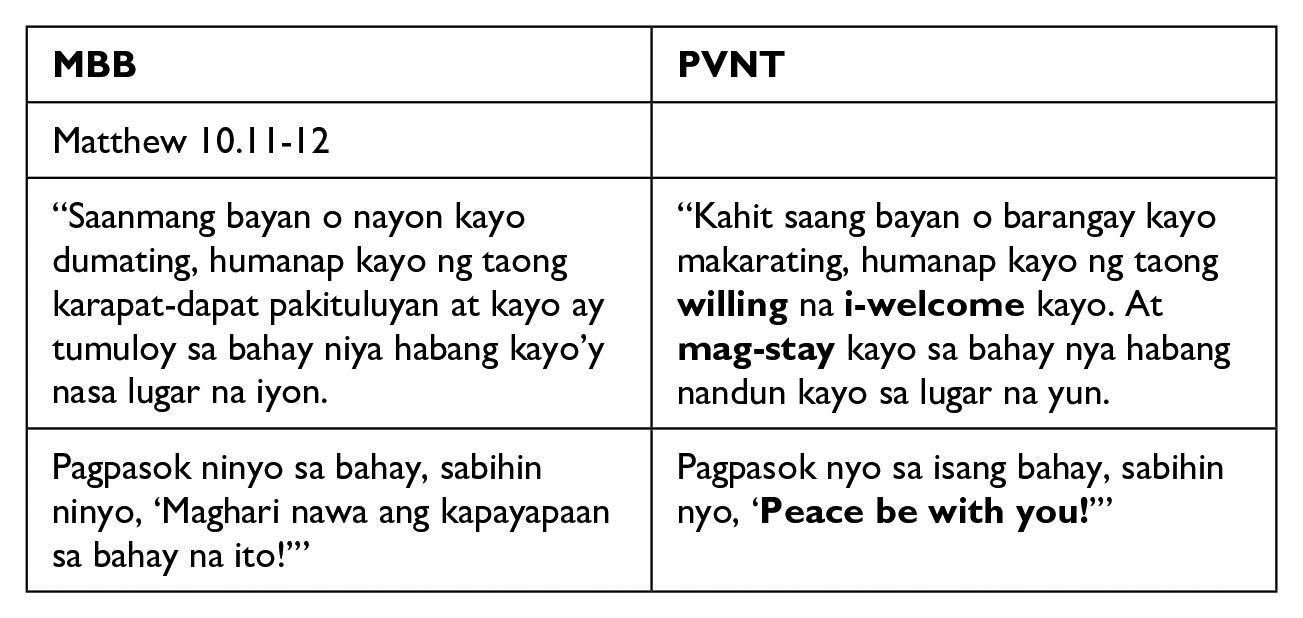
“When you come to a town or village, go in and look for someone who is willing to welcome you, and stay with him until you leave that place. When you go into a house, say, ‘Peace be with you.’”
One of the principles in the translation is to limit borrowing from English to one or two words, and not to a string of words. This reflects Pinoy usage, where borrowing is generally confined to word level for most speakers. Without this policy, the fear is that those proficient in English will dominate and Filipinos with a limited knowledge of English will be alienated and thereby find the New Testament difficult. A special case, however, is the greeting Peace be with you, which is the normal way of expressing the greeting. In Tagalog it is a long expression, as you can read in the MBB.
6.2 English words are incorporated using Tagalog syntax and are treated as single concepts even if they are composed of multiple words
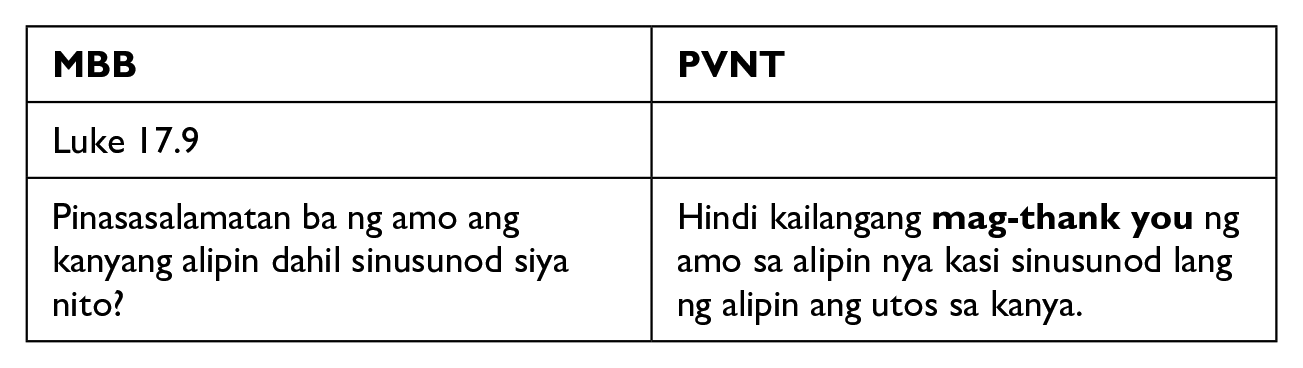
The servant does not deserve thanks for obeying orders, does he?
“Mag-thank you” in PVNT is treated as one word, with the gloss “to say thank you.” It is not composed of two words with the pronoun in the second person. The meaning of this verse does not show any reference to the second person. Thus the syntax is completely Tagalog.
6.3 PVNT uses only words that are stable in the language
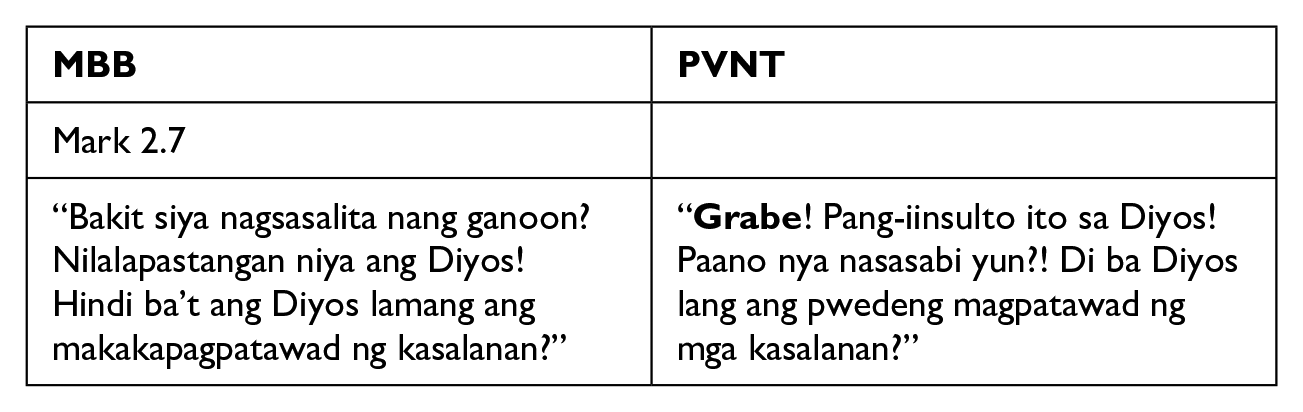
“How does he dare talk like this? This is blasphemy! God is the only one who can forgive sins!”
The Tagalog word grabe, borrowed from Spanish, is associated in the minds of speakers with the English “grave,” with both the negative meaning of a physical grave for the dead, and “serious” as in the phrase “grave concern.” It used to mean only the latter (as in Spanish) and was used as an adjective. But today, the word is used to express an intense emotion that can swing to both extremes from “great, wonderful” to “horrible, what a pity!” It is only the context, accompanied by a particular intonation, that determines the appropriate meaning. In this usage, grabe is new to Bible translation. Many have expressed concern that such newly coined words or words arising from limited sectors in the population might find their way into PVNT.
The policy with regard to such words was that they should be stable in the language. Two words, grabe and pinagtripan, have raised questions in the Bible Forum. My research showed that grabe was used as early as 2008—it was part of the Pinoy Mark. That means it has been used with that particular meaning for at least ten years.
The other word, pinagtripan, is used in Matt 27.29 for the Greek word ἐμπαίζω “to ridicule.” Unfortunately, the root word is trip, which can refer to a particular experience with the use of narcotic drugs. This is the etymology of the word. As a word is used in other ways, it takes on a new life. The etymology will not necessarily be remembered, although it might be remembered by some. But the connection is part of the historical cycle of usage. A perfect example is the association of pagan symbolism with the use of the Christmas tree (History.com Editors 2019).
6.4 The shared opinion that the Pinoy version is easy to use
This opinion has been expressed by actual users of PVNT and this is supported by sales figures. Because the language of translation is a heterogeneous language, the translator is able to choose from words whose roots are English, as well as from the regular Tagalog vocabulary stock. The choice is based on what is commonly used in spoken language, and what seems to be most appropriate in a particular language as perceived by the translation team. A consequence of this is that the translation is easy to read.
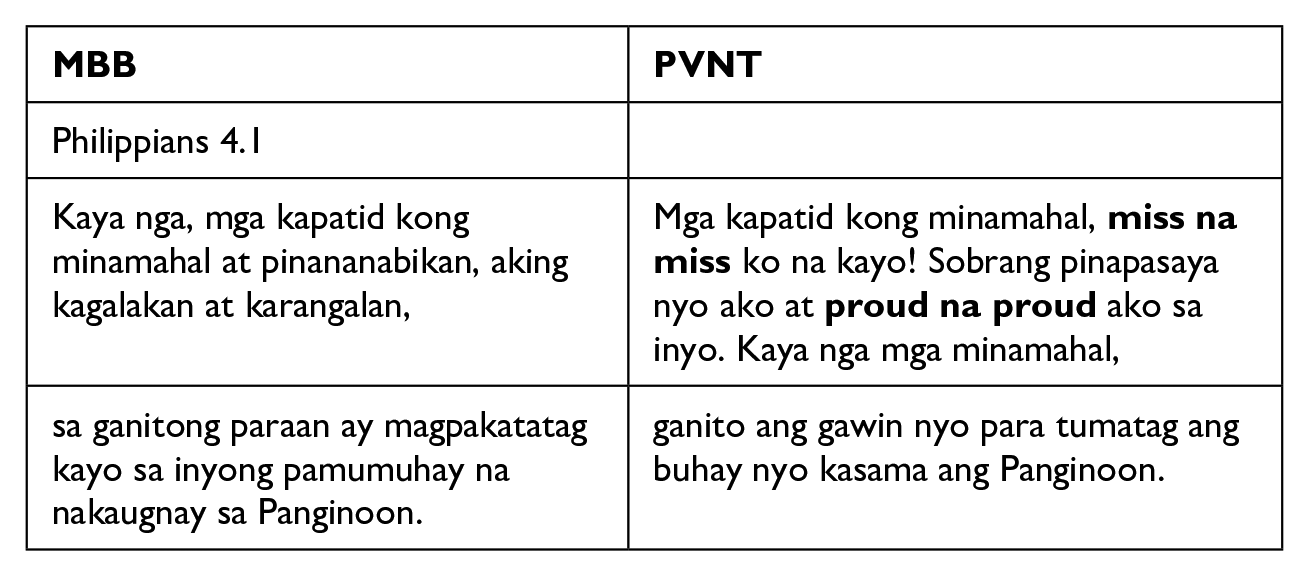
So then, my friends, how dear you are to me and how I miss you! How happy you make me, and how proud I am of you!—this, dear friends, is how you should stand firm in your life in the Lord.
Three intensified meanings are expressed here. Miss na miss “to miss someone” has three syllables compared to the five of Tagalog pinanabikan < sabik “eager.” Proud na proud has a precise adjectival meaning but karangalan < dangal “honor” has an intensified meaning because it is expressed as an abstract noun. The same is true for kagalakan, an abstract noun for “joy” (Pinoy rendering sobrang pinapasaya) meaning “made happy excessively.”
PVNT uses words that reflect the most natural way of speaking, and are consequently easy to understand. English terms are used when referring to the books of the Bible, for example, Luke instead of Lucas, Romans instead of taga-Roma, meaning “coming from Rome.” This was a translation decision for PVNT. (In the same way, numbers are read in English, for example, to refer to the chapter and verse.)
The process of inflecting verbs or deriving other forms from a root word is the best proof that the use of a HL enables the language user to “enjoy the best of both worlds,” English and Tagalog. Examples are given in the next section. English is easy because it is readily accessible to many Filipinos who have retained their use of many English words.
6.5 Morphological derivation made easy in the use of HL
The verbs and nouns are often the more complex parts of speech in many languages. For Philippine languages, it is the morphological derivation involving these that is difficult. But this is made easy in Taglish (Pinoy) by the choice of whichever is easy in either language. Access to a root word in English that might have to be expressed in many words in Tagalog is usually a big advantage. But knowing how to derive the desired morpheme through affixation makes it even easier. This is what Filipinos find very easy because the linguistic pattern is Tagalog, but with the advantage of the English root word. The following are some examples: reding-ready “being ready” 2 Tim 3.16-17 crineate “created” Heb 9.11 ine-expect “is expecting” Matt 9.15 prineach “preached” 2 Cor 1.19 idi-deny “will deny” 2 Tim 2.12 nagshe-share “is sharing” Mark 4.14
Allowing the reader to recognize the root as it is spelled in English is considered a basic principle in reduplication or affixation. As in reding-ready, phonetic spelling is applied in the reduplicated part of the word. In crineate, the infix -in- is inserted after the first consonant or consonant cluster. There are two ways to say this word: kinreate or crineate. A small survey showed that the latter is often preferred. One reason to prefer the latter is that kinreate involves a complication, since c- followed by -i- has the [s] sound.
Take note of these characteristics of the language of PVNT: it is easy, it allows heterogeneous language borrowing, and it is close to how people speak. These are features of informal speech. This is the main criticism from those who say the word of God has lost its holiness in PVNT. 7
My response to this criticism is that God’s holiness is an attribute of God. Nothing can diminish an attribute of God, nothing can change it. But I want to approach God. I cannot approach God if the language of approach is too formal, making God appear to be far off. Relationship is understood in terms of distance. There is a bridge, and that is through language, informal language. The Pinoy way is the most natural way of saying something. It just so happens that the natural way is easy, will allow heterogeneous borrowing, and will reflect the way people speak. At the same time, PVNT is careful to use language with reverence.
7. Diachronic analysis of heterogeneous language as applied in the Pinoy version
In the 1970s, Filipinos spoke either straight English or straight Filipino, with no mixing. There was borrowing as there is in any other language but the borrowed word was usually spelled phonetically. For example, eskwela (from Spanish “escuela”) was the borrowed word even though in spoken language the English “school” was sometimes used. This was the linguistic situation that prevailed up to the 1970s.
7.1 A turning point in the linguistic situation in the Philippines
As I have written elsewhere: A turning point in the linguistic history of Filipinos was the turbulent years of the late 1960s leading to the 1970s. Events in the Philippines were like a reaction to the mood of the times, when Americans, especially students, protested against America’s deepening involvement in the Vietnam War. Ferdinand Marcos was then the president of the Philippines for two consecutive terms, but he became ambitious and wanted to extend his legitimate rule as president by declaring martial law. The growing militarism that tried to subvert student activism led to the declaration of martial law. The language of protest was Tagalog or Filipino. It was convenient not only because of the contrast it showed from English, the language of the establishment, but also because the majority of Filipinos could speak Tagalog well. There was social pressure to speak English but it was not an easy language to learn if one were not immersed in it through exposure and prolonged usage. This is not surprising because English and Tagalog belong to two different language families, the former being Indo-European and the latter Malayo-Polynesian. So, at that point in history when it became an acceptable norm to speak Tagalog, the Filipino person was liberated from the social dictates of an imposed language—such was true freedom. (del Corro 2016)
In the years following the end of the dictatorship and the exile of Marcos, the newfound freedom to use Filipino took root in the society slowly but surely. Gradually, Filipinos overcame the pressure to speak English. By the late 1990s the popularity of the Filipino language could be gauged by the shift of local television channels from English to Filipino in order to compete for viewers. Consequently, there was a drop in the quality and usage of English and the government became alarmed. So English was reinstated as the official medium of instruction in 2005. It was clear that English was no longer the second language even of educated Filipinos.
Nevertheless, English remained a dominant and prestigious language. A complex sociolinguistic situation existed. People wanted to be able to use it well, but this had become more difficult because of decreased exposure to the language, as many Filipinos shifted to television and radio programs in Tagalog. One can confidently say that Filipinos could understand English more than they were able to speak it.
Such is the linguistic dilemma. Filipinos rejoiced at the chance to express themselves in the Philippine language they knew best, along with Tagalog, with ease and confidence, but they wanted the facility to use words and expressions in English they had been exposed to and used in the past. It is not surprising that English syntax was the first thing to be dropped but the English lexicon continued to hang on. Indeed, English has been the first love of many Filipinos. It is difficult to forget.
7.2 Two stages in language shift
There were two stages of language shift before the homogeneous Tagalog and English changed to being mixed or heterogeneous. The first stage covered a period of twenty years, from 1970 to 1990. This was the shift of usage from English to Filipino. The driving force was the political upheaval during the rule of martial law. The language of the establishment, English, was rejected in favor of Tagalog or Filipino, the language of protest.
The second language shift covered a period of fifteen years, from 1990 to 2005. It was characterized by access to an unimaginable amount of information and resources from the internet. These rapid and accelerating changes resulted in the evolution of a heterogeneous language. In my own experience, after I returned from my one year of study in the USA in 2002, I noted the following:
People talked differently although I could not say yet what the difference was.
Cheap love stories, which always reflect the way people naturally speak, indicated a shift in language use. 8
In the text messages projected on the TV screen, the spelling was mind-boggling.
There was a breakdown of boundaries between the spoken language and the written—where was the boundary?
I could sense a convergence somewhere.
7.3 Thomas Friedman’s “flat world”
At the turn of the century, the pleasant surprise to many was that the millennial bug was not about to wreak havoc. Nevertheless, unprecedented change was upon planet Earth as described in Thomas Friedman’s book, The World Is Flat (2006).
Friedman describes a whole new world of communication that makes interaction with people, whether privately or corporately, wherever they may be, as easy and accessible as touching the keys on a computer. One does not have to go anywhere to reach anyone as long as one is connected to the internet. Thus, “the world is flat.” It is this interaction that has generated unprecedented change. Most, if not all boundaries, have been challenged. The norm now is the coming together of what used to be separate.
There are three major converging shifts in this present age, according to Friedman. The first is greater access to knowledge, which leads to the second shift, the attitude that people’s needs can be met through their own initiative, thanks to this access to knowledge. The third is a result of the primacy of the individual because of the first two shifts. With almost everything within reach, if one knows how to search, the challenge to individuals is to perform and accomplish their goals, keeping their own peculiarities, making no excuses, but now competing with anyone out there in the world.
7.4 The case of the Bolinao New Testament
But my testimony 9 is my own research on the Bolinao New Testament. 10 Bolinao is a language spoken in the town of Bolinao in Pangasinan. The translation process took forty-two years (1970–2012). When it was finally published, the majority of the children, and even teenagers, were not speaking Bolinao anymore, but spoke Tagalog. The Bolinao New Testament was still useful to those who were thirty-five years old and above.
Bolinao used to be a vibrant language of the inhabitants of Anda, an island town of Pangasinan. In 1996, a concrete bridge was erected to connect the island to the mainland of the province. I think this contributed significantly to the exchange of information and the economic growth of the town. I find it is significant that this project crossed the turn of the century mark (2000–2005), which I identified in the second stage of the language shift.
7.5 Convergence
Concepts, events, and social forces converged to contribute to the development of the Pinoy variety of heterogeneous language. The first significant contributor was the breaking down of boundaries between spoken and written language. The long-established rules of orthography were abandoned, by some sectors of the population more than others. Thus, for example, word boundary conventions were altered largely because of shortening to achieve ease in pronunciation. At the same time, the huge influx of information resulted in extensive borrowing in vocabulary.
Another significant convergence was the mixing of the two languages, Tagalog and English. The translator always has two options, English or Tagalog, whichever is easier. The separation in the past was clearly signaled by a distinguishing marker, such as quotation marks. But this is not necessary in the current application of rules in PVNT. The English language is nativized 11 when the English word is inflected following the rules of Tagalog. In this context of the population having facility in the two languages, although of varying competence, and wanting to communicate so much and so fast, the situation was ideal for the birth of a heterogeneous language.
A final convergence was the Philippine Bible Society’s goal to help all Filipinos engage with the word of God and the popularity of PVNT because of the accessibility of its language.
7.6 Seven-year gap between Pinoy Mark and the other Gospels
PVNT is the product of at least ten years of research, debate, and discussion, and eventually, the actual work of translation. Pinoy Mark was published in 2008. It was subjected to research because of the novelty of the approach used, specifically, the use of a heterogeneous language. In 2012, the PBS Board of Trustees gave its approval to continue with the rest of the New Testament. The Gospel of Matthew was finished in 2015, followed by Luke and John. There was a gap of seven years between Mark and the remaining three Gospels. Galatians, published in 2012, shared similarities with the later three Gospels, quite distinct from Mark, which had been published in 2008.
7.7 Pinoy, a moving target
Every translation project has a target in mind. For this project, it was to produce a translation that uses consistent language. It could still use heterogeneous language because of the very nature of the project. But comparing Pinoy Mark 2008 with the other Gospels shows that the Pinoy translation was a moving target because Pinoy usage had changed, even in that short period. The following examples demonstrate this fact.
Below is a chart that shows a few examples of what was changed in Mark 2008 to be in line with Pinoy Matthew, in particular.
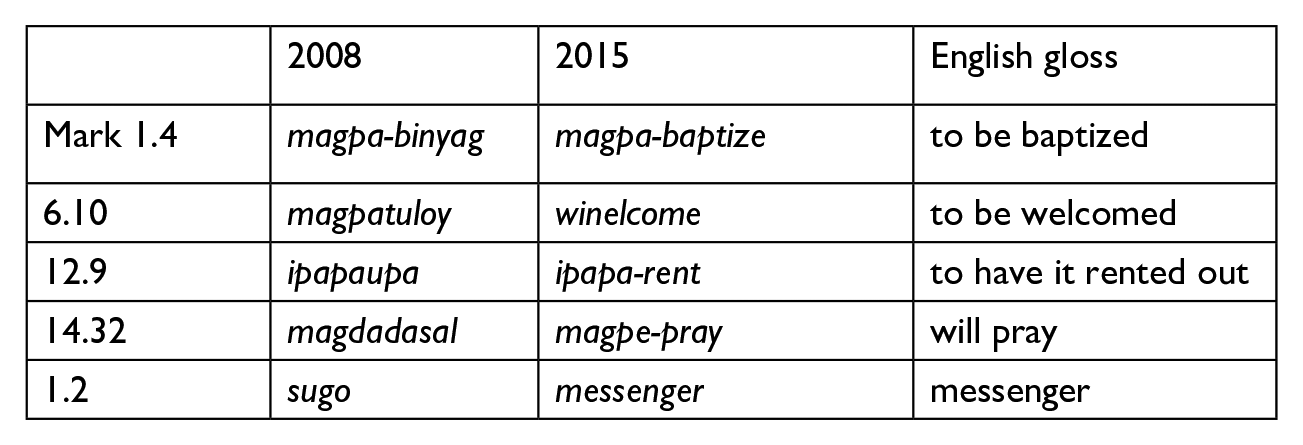
These five examples show that a Tagalog term used in Mark 2008 was changed to a borrowed term in 2015. But it is important to mention that in the example magpabinyag and the now preferred magpabaptize, both are still understood and used. Nevertheless, there is preference for magpabaptize. And both have the same number of syllables, so avoiding difficulty cannot be used as the reason for favoring the latter. It is to be noted that there is informality in the use of magpabaptize. Casual or informal language seems to be preferred because it is easier to use. The use of borrowed terms adds to the informality. This is also the explanation for examples 2–5 in the tables above. What this shows is that after a period of eight years, magpabinyag and magpatuloy, two of the five examples, had undergone a change in how users viewed them. They had developed a tone of being archaic which had not been there eight years earlier.
7.8 How to deal with the moving target?
A readiness to deal with the moving target is the right attitude. There are certainly new structures, such as the application of Tagalog affixes to English roots. Examples are: replyan or replayan (“reply”); inapplyan or inaplayan (“apply”). Will this trigger the use of phonetic spelling? Will phonetic spelling be applied to words when the English spelling is not close to the actual pronunciation of a word? An example of this already happening is pramis “promise.”
We are equipped with the science of linguistics and the Spirit of God to guide our decisions.
8. Why is PVNT a revelation?
The language of Bible translation is often full of regal and formal phraseology. People have accepted this even for meaning-based translations that have been used and appreciated for thirty years or more. The pattern seems to be that after long usage, the dynamic translation becomes part of a tradition and it loses its vibrant and fresh appeal to its users. This is what happened to MBB, first published in 1980. It continues to be a bestseller, and is a good and faithful translation. Compared to the formal translation, Ang Biblia, MBB is still much easier to understand. However, it was around 2002 when a former General Secretary, a visionary of PBS, asked me if MBB could be “simplified.” I thought there was nothing simpler, unless he was referring to the children’s Bible. As I pondered the request and did initial research, the concept of the Pinoy version started to emerge. And the rest is history. The initial popularity of PVNT reveals the following:
1) Today, Filipino Bible readers want a translation that is easy to read and use. This is with the assumption that the reader is first assured of the good quality of the product.
A student is ready to invest time and effort to read a difficult topic such as quantum physics, because that is necessary to pass an examination. But there is no such compulsion to read a book like the Bible—if it is difficult to read—no matter how well one expounds its value for a person’s life. There are exceptional stories, of course, but I am talking of the ordinary. In short, people may no longer use translations that are difficult to read and understand.
2) Especially in the writing tradition, norms are changing fast and people are not displaying strong objections anymore where they used to in the past. We see this in the mixing of two languages, especially with affixation, as seen in Section 6.5. It is to be expected that some sectors, like government institutions, will put up resistance. But that will be an uphill battle because the majority will always prefer what is easier.
“Language in transition” will be the compromise as a stage leading to more radical changes. And the period of transition will be played out by educators, literary boards of different languages, government institutions on language, the church, and the Philippine Bible Society.
Footnotes
1.
Tagalog and Filipino are used interchangeably.
2.
The NCR is mainly Metro Manila. It is composed of sixteen cities. The original inhabitants were Tagalog speakers and had a dominant role especially in government and education. But with the growth of the metropolis, the language profile has become diversified because of Filipino migrants from other parts of the Philippines.
3.
Ilocano is one of the eight major languages of the Philippines.
4.
This information was supplied by the sales staff of PBS.
5.
The current law provides the teaching of the mother tongue when it is different from Tagalog.
6.
Logically, this may mean that it continues to evolve, following their hypothesis.
7.
This is a comment from Facebook.
8.
It has been my habit to read these books when I want to know “the language out there.”

10.
The Bolinao New Testament was not published by PBS.
Abbreviations
GNB Good News Bible (1992)
MBB Magandang Balita Biblia (2012; in References)
PBS Philippine Bible Society
PVNT New Testament: Pinoy Version (2018; in References)