







Abstract
This paper provides a number of cases where early Christian Arabic Bible translators resorted to qur’ānic-sounding language and (later) also a qur’ānic aesthetic in their production of biblical codices. The main purpose of the paper is to discuss various reasons as to why they went so far into the “realm of the other” when producing these translations. The answer to that question is most likely connected to the little-known function of these Bible translations, a topic also addressed in the paper. The adoption of qur’ānic language results in a comparatively high level of intertextuality and the use of codicological features associated with Mamluk Qur’āns also tend to blur religious borders. Thus, the paper also explores the possibility to view a portion of the Christian Arabic Bible endeavour as part of the broader process of “religious co-production.”
It is well known that the Qur’ān is in vivid conversation with biblical and extra-biblical material that originated in various Jewish and Christian communities (Griffith 2013; Reynolds 2008, 2010; Corpus Coranicum n.d.; Neuwirth 2014; etc.). Just as scholars easily find a “biblical subtext” in the Qur’ān, which was composed around the seventh century, so some Christians referenced a “qur’ānic subtext” when they began to translate their scriptural corpus into Arabic around a century or two later (Hjälm 2019). The milieu, characterized by interaction, exegetical engagement, and intertextuality, was thus the same, but the power relations of the players in the field had shifted (Hjälm forthcoming).
In this paper, I will provide examples of when Christians resorted to qur’ānic-sounding language in their translations and to a qur’ānic aesthetic and techniques in their production of biblical codices, and discuss various conceivable reasons as to why they chose to go that far into the “realm of the other.” Such strategies, whether deliberately followed or not, turned the biblical texts into what could easily be identified as objects belonging to a competing actor (Leemhuis 1989; cf. Drint 2020). If deliberately done, this was a truly bold enterprise. Whatever the reasons for such adaptions, it is tempting to see the literary production of sacred Scripture during this age, both the Qur’ān and Arabic Bible translations, as part of the broader process of “coproduced religions,” as aptly coined by Katharina Heyden and David Norenberg (2022) and their research team. To conceive of religious communities as continuously becoming in dialectical processes with both their traditions and their surroundings draws the mind away from categories of origin and vertical influence and captures the vivid and creative atmosphere that characterized and affected religious communities in the Middle East during late antiquity and medieval times.
The first examples we will discuss are rather difficult to contextualize and will thus be our main focus. These examples are found in a number of early (ca. ninth–tenth century) Syriac-based Arabic translations which contain typically Islamic-sounding vocabulary, including quotations or paraphrasing from the Qur’ān, and almost always a number of deviations from the source texts’ formal features. The latter include exegetical and/or stylistic additions and in some cases also omissions and subtle substitutions of textual units. The function of these texts is thus unclear, yet, whatever it was, their translators exhibited a profound interest in exegesis and intellectual boldness.
In the second example, we move away from translational aspects and word choices to focus instead on the materiality of some Arabic Bible translations, as codicological features also affect the experience of the reader or viewer. Here we will primarily discuss cases of codicological imitation of the Qur’ān by a well-trained Coptic scribe, active in the fourteenth century in Mamluk Syro-Palestine, named Girgis.
Qur’ānic vocabulary in Early Christian Arabic Bible translations
The notion that a literary work is never entirely new but always “awakens memories of that which was already read,” as phrased by Hans Robert Jauss (1982, 23), is as true for some Arabic Bible translators as it was for the Qur’ān (Hjälm forthcoming). If the concept of intertextuality is narrowed down to quotations and clear allusions from identifiable texts, it shows us what sorts of transmitted writings a composer of a new text or translation thought it worthwhile to be in conversation with. There are many examples of where Christians use Islamic-sounding vocabulary, which is methodologically safest when represented by phrasings and terminology appearing in the Qur’ān (Zaki 2020, 82–84; Moqbel 2023). For instance, the Syriac versions of the names “Saul” and “Goliath” are ܫܐܘܠ Šaʾūl and ܓܘܠܝܕ Gūlyad, yet as Adriana Drint has shown, they are referred to as طالوت Ṭālūt and جالوت Jālūt in an Arabic translation of 4 Ezra from the tenth century (1999–2000, 171). The same is true for a tenth-century psalter translation in the Mingana collection (Mingana 1939, 3:5; Manuscript Christian Arabic Additional 137). Ṭālūt and Jālūt are the forms of these names that appear in the Qur’ān (Q Al-Baqarah 2.249-51). Apparently, Jālūt takes this form in the Qur’ān to rhyme with Ṭālūt, which means “tall,” since Saul is described as tall in the biblical text (cf. 1 Sam 9.2; Reynolds 2010, 198, 234, 241). In any event, this is a clear example of where the Christian translators chose to use the qur’ānic versions of biblical names rather than closely reflecting the Syriac source text. The latter is more common in Arabic Bible translations, but the use of the qur’ānic versions in some of them make us aware of a diversity in techniques, functions, and audiences. A similar distinction is found in Judaeo-Arabic Bible translations, where, typically, Saʿadia Gaon frequently used Muslim religious terms and expressions, whereas the Karaites tended to avoid them (Polliack 1997, 174).
In many cases, references to Islamic-sounding language are more subtle and it is not clear whether they were intentional or just sounded literary or familiar to the translator. Any Christian Arabic text may sound more or less “Islamic” to the modern reader due to their many shared cultural spheres, and words such as شريعة sharīʿah “law,” صلاة ṣalāh “prayer,” سنة sunnah “tradition/custom,” and مصحف muṣḥaf “volume/copy of a holy Scripture” appear throughout the corpus. The methodological problem here is to know what sounded Islamic to them. The difficulty to discern intention is even more complicated due to the proximity between Semitic languages and the fact that Christian Arabs and Syriac Christians could have influenced Muslim religious terminology in the pre-Islamic era. In addition, there are many references in the Qur’ān to “previous Scriptures,” that is, the biblical texts, just as there are references in late biblical texts to earlier biblical texts. An example that highlights both these kinds of intertextuality—or coproduction—is found in the rendition of Dan 7.22. The phrasing in the Masoretic text here, וּמַלְכוּתָא הֶחֱסִנוּ קַדִּישִׁין ûmalkûtāʾ heḥĕsinû qaddîšîn “the saints possessed/inherited the kingdom,” is similar to (and perhaps a reference to) Ps 37.29 צַדִּיקִים יִירְשׁוּ־אָרֶץ ṣaddîqîm yîrəšû-ʾāreṣ “the righteous will inherit the land.” In the Peshitta, these two passages are brought closer to one another by the use of the one root y-r-th “inherit” whereas the Masoretic text has two different roots (y-r-š and ḥ-s-n). Following the Masoretic text, the Peshitta distinguishes between ܙܕܝܩ̈ܐ zaddīqē “righteous” and ܩܕܝ̈ܫܐ qaddīšē “saints.” Yet the Peshitta-based Arabic rendition in Sinai Arabic 1 does not choose the available Arabic cognate q-d-s as expected to represent the Syriac qaddīšē in Dan 7.22 but ṣ-l-ḥ: صالحين ṣāliḥīn “pious, righteous.” By doing so, the rendition becomes rather similar to the only direct biblical quotation in the Qur’ān, which happens to be a citation of Ps 37.29, ٱلْأَرْضَ يَرِثُهَا عِبَادِىَ ٱلصَّـٰلِحُونَ al-arḍ yarithuhā ʿibādiy al-ṣāliḥūn “My righteous servants will inherit the earth” (Q Al-Anbiyāʾ 21.105). Thus, the Arabic phrasing in Sinai Arabic 1, واورثت الصالحين الملك wa-ʾūrithat al-ṣāliḥīn al-mulk “the righteous will inherit the kingdom” becomes similar to that in the Qur’ān, al-ʾarḍ yarithuhā … al-ṣāliḥūn “righteous … will inherit the earth” (Hjälm forthcoming). Here it is the translator’s seemingly active choice not to exploit the proximity of Semitic languages that hints to an intent to bring the translated text into conversation with the Qur’ān rather than with the Peshitta, or perhaps with both. Still, we do not know whether the translator knew this phrasing was in the Qur’ān and deliberately brought the translated text in that direction, or whether he more or less subconsciously had heard this phrase chanted by Muslims and thus took it for being literary Arabic, or whether he simply considered that this translation best captured the intended meaning of the text.
Additional examples that strengthen the thesis that qur’ānic imitation could have been made consciously have been offered by Vevian Zaki (2020). First, she provides more subtle borrowings from the Muslim Scriptures. The Epistle to the Romans and the First Epistle to the Corinthians transmitted in the tenth-century manuscript Sinai Arabic 310 (which finds its continuation Sinai Arabic 157) contain a substantial amount of qur’ānic terminology. For instance, Zaki notes that the Christian Arabic translator added the adjective “stoned” when describing the demons in 1 Cor 10.20, an adjective also appearing in the Qur’ān: Q Aš-Šuʿarāʾ 26.116 (Zaki 2020, 85; cf. also the connection between stones and demons in Q Al-Ḥijr 15.17 and Q An-Naḥl 16.98):
فلست احب ان تكونوا للشياطين المرجومين شركا
Fa-lastu aḥibb an takūnū l-l-shayāṭīn al-marjūmīn shirkan
“I do not want you to become partners to the stoned devils” (Sinai Arabic 310) قالوا لئن لم تَنتَه يا نُوحُ لتَكوننَّ مِنَ المَرْجُومِين
Qālū la-ʾin lam tantahi yā Nūḥ la-takūnanna min al-marjūmīn
“they said, if thou givest not over, Noah, thou shalt assuredly be one of the stoned” (Q Aš-Šuʿarāʾ 26.116)
Most interestingly, Zaki adds an example of when Christian Arabic translators used سَجع sajʿ (rhymed prose) seemingly to imitate qur’ānic rhyme (2020, 88–89). The use of سَجع sajʿ required more than a subconscious absorption of familiar phrasings; it requires a thorough knowledge of the style used in the Qur’ān. Thus, just like the techniques and aesthetics of qur’ānic codices would later be mastered by Christian scribes and adopted for their Scriptures (see below), some earlier translators mastered and adapted the rhyme used in the Qur’ān. Although we cannot prove definitively that every single (to us) Islamic-sounding rendering in the early Christian Arabic corpus was perceived as such by the translator and intended audience, the appearance of qur’ānic parallels in a number of works show that at least some of these translators tended to cross the literary border of “the other,” and the use especially of qur’ānic rhyme indicates that it was sometimes done deliberately.
Another Arabic Bible translation that contains a notable number of qur’ānic parallels is the so far only extant Arabic copy of 2 Baruch (The Syriac Apocalypse of Baruch), found in manuscript Sinai Arabic 589, also from the tenth century. It was translated from a Syriac copy related to the Vorlage of Codex Ambrosianus (Leemhuis, Klijn, and van Gelder 1986, 12). Both the editors of the text (Leemhuis, Klijn, and van Gelder 1986) and Adriana Drint who later studied it (2020), point out parallels to the Qur’ān. Most importantly, Drint notes that the translator at times freely combined phrasings from different parts of the Qur’ān. For example, the Arabic translation of 2 Bar 77.7 وانه بحق يقبل التوبة ويغفر السيئات wa-innahu bi-ḥaqq yaqbal al-tawbah wa-yaghfir al-sayyiʾāt “and he truly accepts repentance and forgives evil deeds,” combines phrases and words from Q Al-Aʿrāf 7.153 (ٱلسَّيِّـَٔاتِ … تَابُوا … لَغَفُورٌ al-sayyiʾāt … tābū … la-ghafūr) and Q Al-Tawbah 9.104 (هُوَ يَقْبَلُ ٱلتَّوْبَةَ huwa yaqbal al-tawbah) (Leemhuis, Klijn, and van Gelder 1986, 112; Drint 2020, 54) or similar passages in the Qur’ān. Many other examples of qur’ānic parallels are provided as well, including 2 Bar 83.6 فان هذه الدنيا متاع الغرور fa-inna hādhihi al-dunyā matāʿ al-ghurūr “for this world is enjoyment of illusion,” which with minor adaptions parallels Q Al-Ḥadīd 57.20 (وَمَا ٱلْحَيَوٰةُ ٱلدُّنْيَآ إِلَّا مَتَـٰعُ ٱلْغُرُورِ wa-mā al-ḥayāh al-dunyā illā matāʿ al-ghurūr; Leemhuis, Klijn, and van Gelder 1986, 124; Drint 2020, 55), and common phrases such as هو الرحمن الرحيم huwa al-raḥmān al-raḥīm “the Merciful, the Compassionate” in 2 Bar 77.7 (Leemhuis, Klijn, and van Gelder 1986, 112; Drint 2020, 54) and السلم عليكم ورحمة ﷲ al-salām ʿalaykum wa-raḥmat Allāh “Peace be with you and the mercy of God,” in 2 Bar 78.2 (Leemhuis, Klijn, and van Gelder 1986, 116; Drint 2020, 54).
The combination of phrases from the Qur’ān seems especially to indicate a natural, fluent knowledge of the language of the Muslim Scriptures. Indeed, in late antiquity, the use of paraphrases and allusions to classical literature signaled the author’s profound familiarity with the authoritative corpus and gave the impression that he or she and the intended audience were part of the literary elite (cf. Young 1997, 97). If this is true for our times, vaguer allusions and paraphrases would indicate that the Qur’ān was part of the literary canon for these specific Christians.
In contrast to my previous assumption that the Christian Arabic Bible translators used the Qur’ān to mark their territory in imperialistic-theological terms (Hjälm 2018; see also below), Tareq Moqbel argues for a more irenic approach and suggests that they used the Qur’ān as a source of religious knowledge and let it shed light on biblical passages (2023, 53–54). As a source for such influence, he provides a close reading of the Peshitta-based Arabic translation in Sinai Arabic 2 and thus expands on Ronny Vollandt’s findings of qur’ānic phrasings in this tenth-century manuscript (2015, 189). Moqbel shows for instance that in the context of the destruction of Sodom and Gomorra in Gen 19.13, the rendition in Sinai Arabic 2, “for we will destroy the people of this city,” is identical to the rendering in Q Al-ʿAnkabūt 29.31’s account of the same biblical story:
انا مهلكوا اهل هذه القريه innā muhlikū ahl hādhihi al-qaryah (Sinai Arabic 2) ۖإِنَّا مُهْلِكُوٓا۟ أَهْلِ هَـٰذِهِ ٱلْقَرْيَةِ innā muhlikū ahl hādhihi al-qaryah (Q Al-ʿAnkabūt 29.31)
The Peshitta literally reads ܐܬܪܐ ܗܢܐ ʾatrā hanā “[for we will destroy] this place,” which is closer to what is found in another contemporary Arabic translation of the same passage (Sinai Arabic 4). A few lines later, the translation of the angel’s urging to Lot, “Don’t (singular) look back” in Gen 19.17 reflects the exact same wording and expansion into plural that we find in Q Hūd 11.81 and Q Al-Ḥijr 15.65, where the command refers to Lot, his wife, and his daughters:
ولا يلتف منكم احد wa-lā yaltafit minkum ʾaḥad (Sinai Arabic 2) وَلَا يَلْتَفِتْ مِنكُمْ أَحَدٌ wa-lā yaltafit minkum ʾaḥad (Q Hūd 11.81 // Al-Ḥijr 15.65)
Moqbel provides several additional examples of where the Qur’ān is used as a means to correct an “ungrammaticality” in the biblical text, that is, when “a certain awkwardness in a text prompts one to look into another text to resolve the difficulty” (Moqbel 2023, 53–54; following the literary critic Riffaterre’s sense of the term). A good example of the complexity of such intertextuality is the rendering of Exod 4.6 referring to Moses’ hand that was “leprous, like snow” מְצֹרַעַת כַּשָּׁלֶג məṣōraʿat kaššāleg. The meaning of the Hebrew word used for leprous, מְצֹרַעַת məṣōraʿat, which is rendered in the Peshitta as ܡܓܪܒܐ magrabā “leprous,” is in fact uncertain and omitted by/not present in the Septuagint, which renders it simply “his hand became as snow” (ὡσεὶ χιών hōsei chiōn). The latter simplified version, where Moses was not afflicted by any disease, made it into the Qur’ān, where the phrase appears several times, and via the Qur’ān, Moqbel argues, back to the Syriac-based Sinai Arabic 2 (2023, 65–66).
Like our example from Psalms above, Moqbel’s thorough reading shows how intertextuality is used back and forth in the making of sacred Scriptures. In addition, it shows how translators seemed to continue exegetical practice already present in the composing of sacred texts, through their engagement with previous traditions.
To use another community’s sacred Scripture as a basis for exegesis, as shown by Moqbel, is a bold way of using intertextuality. Our next example is no less bold: a Christian psalter composed to resemble a Mamluk Qur’ān.
Beyond the written: Codicological imitation of the Qur’ān
The vast majority of manuscripts containing Christian Arabic Bible translations are written in a rather clear and simple handwriting, include no or limited recourse to ornamentation, and contain a varied number of marginal notes. In short, these are copies written to be read. However, the Christian Arabic Bible tradition has also produced a great number of more elaborate manuscripts which played other or additional functions beside enabling the content of a text to be read by a new audience. Many of these manuscripts are bilingual. Diglot manuscripts may have served several functions, including learning another language (typically Greek), enabling close reading, as a base for the production of biblical texts for export (cf. Hjälm 2023), or perhaps for liturgy (cf. esp. Leeming 2003, 242–43; Griffith 2013, 146). Triglots or polyglots with up to five languages were also produced, which may be seen as “propaganda” documents, reflecting and legitimizing the coexistence of cultures in an empire (Toth n.d.), community, or monastery. Such documents are not only or mainly produced to convey the content of texts but should also be seen as luxury products. Besides a few polyglots, this category includes a number of monoglot luxury manuscripts that were produced during the so-called Coptic Golden Age. We will look especially into the manuscripts associated with the Coptic scribe Girgis bin al-qass (“son of the priest”) Abū al-Mufaḍḍal, who was active in the middle of the fourteenth century. The reason we include his production in this paper is because he produced his copies of biblical texts to resemble Mamluk Qur’āns. Like many outstanding Copts during the Coptic Golden Age, Girgis was likely trained in the Muslim administration and knew both literary Arabic, which for him may have been what we identify as typically Islamic formulations, as well as other aspects of text production.
According to Lucy-Anne Hunt, Girgis was likely active in Syro-Palestine. He left his name in a Pentateuch translation extant in Paris, Bibliothèque nationale de France Arabe 12, finished on July 30, 1353 C.E., and in a translation of the Gospels kept in the Coptic Museum in Cairo, Bible 90, written and illuminated in Mamluk Damascus in 1340 C.E. (Hunt 2009). In addition to these two dated manuscripts, it is highly likely that he also copied the psalter transmitted in London, British Library, Arundel Oriental 15, which is written in the same calligraphical styles as the former two (Hjälm 2022a). We will focus this paper on the Arundel manuscript, which is accessible online. 1 It uses three types of calligraphical styles typical of the Islamic tradition: naskh is used for the main text, kufic normally for main rubrics, and muḥaqqaq typically for sub-rubrics (Hjälm 2022a). On the folio below, we find all three styles (see Figure 1).
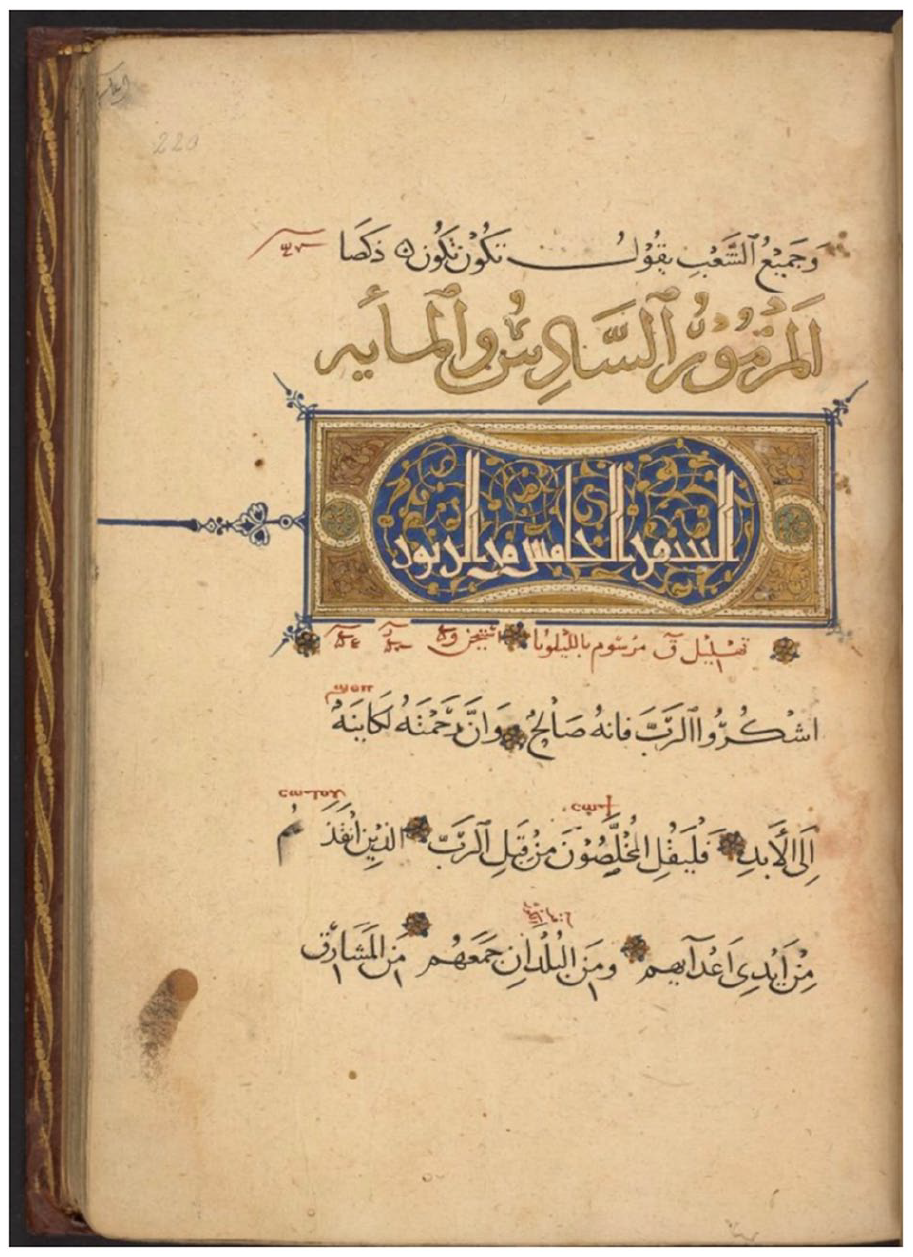
Arundel Oriental 15, folio 220r. Courtesy of the British Library Board.
In addition to using typical styles of writing, the choice of decorations and colors also suggests the scribe’s wish to make the psalter similar in style to Qur’āns in his own (Mamluk) times, that is, to the sacred Scriptures of another community. Compare the headpiece with manuscript Oriental 848, a contemporary (14th c.) Qur’ān, also at the British Library, accessible online (see Figures 2 and 3). 2
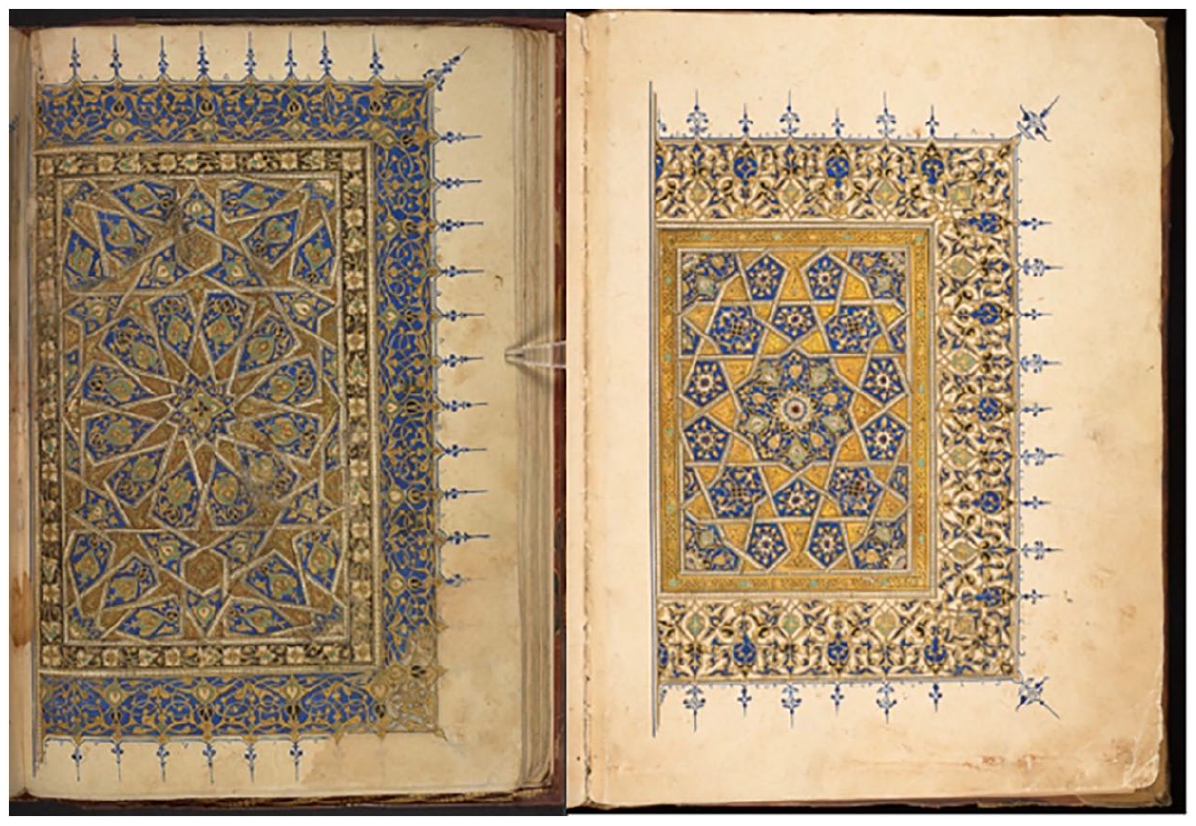
Psalter in Arundel Oriental 15, folio 37v (left); Qur’ān in Oriental 848, folio 1v (right). Courtesy of the British Library Board.
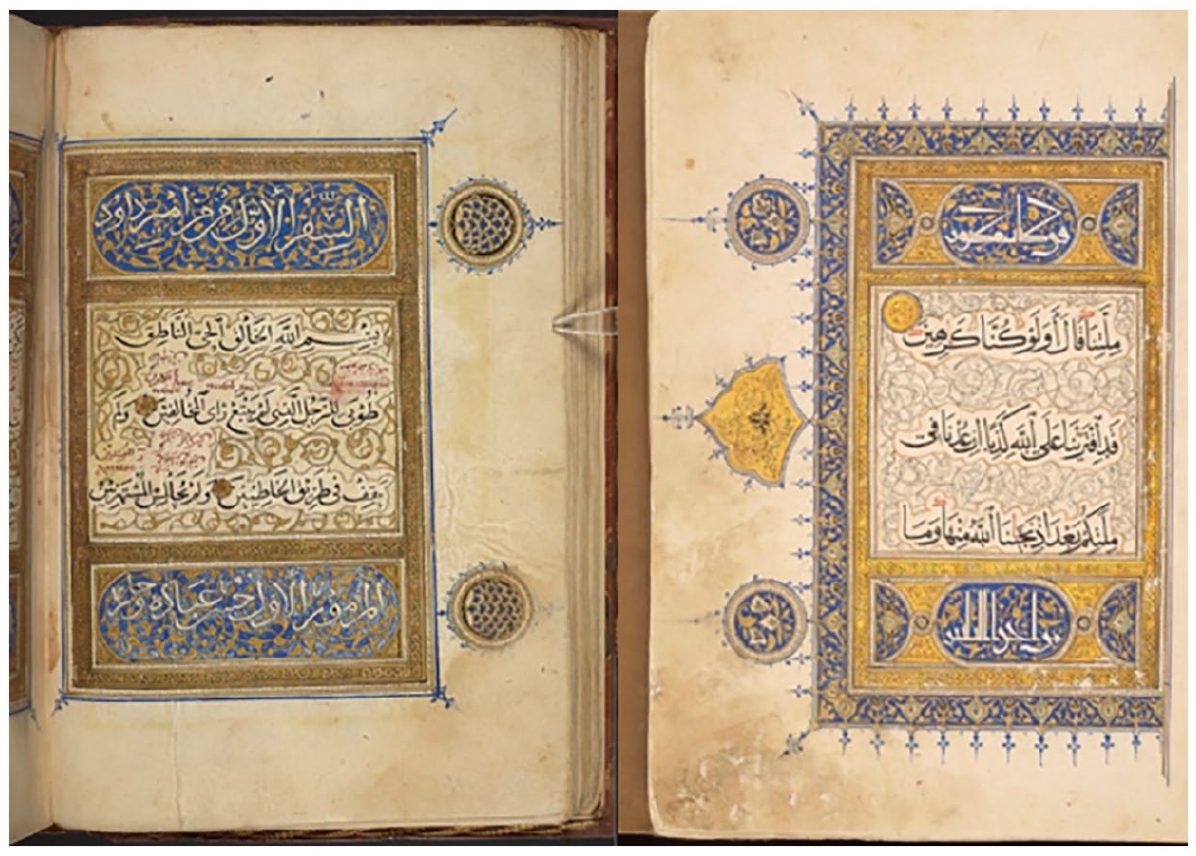
Psalter in Arundel Oriental 15, folio 38v (left); Qur’ān in Oriental 848, folio 2r (right). Courtesy of the British Library Board.
The psalter also contains features that a Qur’ān would not typically include, such as an illumination of King David on folio 38r. Rather than strictly imitating the Islamic Scripture, the scribe’s endeavor was thus to use “the best of words” in order to turn his copy into a luxury object. By making his psalter resemble a Qur’ān, he also made sure to protect its status as Scripture in what was often a highly competitive milieu.
Like many Christian Arabic translators and scribes before him, Girgis did not hesitate to use typically Islamic-sounding phrases. Above the beautiful illumination of David at his writing desk, the rubric reads داود النّبي عليه السّلام Daʾ?dūd al-nabī, ʿalayhi al-salām “David the prophet, peace be upon him,” a phrase often used in the Muslim tradition when relating to prophets.
The copy was presumably intended for an institution or a private library.
A package deal
As we have seen, some Christian Arabic translators and copyists chose to go far into the area of “the other,” the Muslims, in the process of transmitting their own tradition to their readers. Or perhaps rather, they accepted that the Qur’ān had already forced open a common space when appropriating (or coproducing the meaning of) the biblical message and they were now ready to use the same strategy to claim it back. In any event, it should be remembered that these translations represent a minority of the vast number of manuscripts that have come down to us. Thus, we should limit the discussion to a school or tradition of translations, which served a certain function, whereas liturgical reading was probably made from the community’s traditional language or from other Arabic Bible translations.
Before we move on to discussing possible functions of these texts, it should be pointed out that the early Christian Arabic Bible translations that appear to contain more Islamic-colored language than other contemporary translations usually share additional features. Firstly, they are based on the Peshitta rather than the Septuagint or Syrohexapla (Hjälm 2018, 59–60). The use of the Islamic-sounding phrase بسم الله الرحمن الرحيم bism Allāh al-raḥmān al-raḥīm “in the name of God, the merciful, the compassionate” to introduce biblical books appears, in the early corpus, mainly in Peshitta-based Arabic translations, whereas Greek-based translations usually opt for other introductions (Hjälm 2018, 60–61). Secondly, they contain many explanatory and/or stylistic additions or even omissions of text units in the source text. For example, the translator of Daniel in Sinai Arabic 1 frequently adds the Islamic-sounding phrase اللهم Allāhumma “O God” in the translated text, even though there is no translational equivalent in the source text to motivate such an addition (Hjälm 2016, 254). Thirdly, text units in such translations may be substituted and thus brought into conversation, not only with the Qur’ān, but with other dominant trends as well. Most palpably, Christian Arabic translators could “rationalize” the text and cleanse it from theologically questionable phrasing. For instance, the passage “that they might not serve nor worship any god except their own God” in Dan 3.28/95 seems to imply the existence of other gods. The vaguer phrasing in Sinai Arabic 1 appears to rid the text of that interpretative option when rendering it “that they might not bow to anyone but God [لغير ﷲ li-ghayr Allāh]” (Hjälm 2016, 224). Our next example in Sinai Arabic 1 seems to aim at keeping the narrative logical and straight. In Dan 2.1 we read in the Peshitta that “Nebuchadnezzar dreamed dreams and his spirit was troubled and his sleep broke from him.” In Sinai Arabic 1, this text unit is substituted with “Nebuchadnezzar was shown a vision and forgot it.” In this way, the Arabic text answers the unclarity in the original story as to why Nebuchadnezzar asks the wise men not only for the interpretation of his vision but also for the vision itself (Hjälm 2016, 219–21).
Thus, the resort to qur’ānic- and Islamic-sounding vocabulary normally came together with other features, a sort of package deal, which is most certainly connected to the little-known function of these texts and their dynamic relationship with Bible translations in other languages used by these communities (Hjälm 2016, 9–22).
Functions, contexts, and motives
Based on content, paratext, and mise en page, Arabic Bible translations had several functions and may have been composed for liturgy, language study, exegesis, edification, literary purposes, propaganda, or made to impress, which partly seems to have been the case with luxury Bibles. Many Gospel books, epistles, and psalters include instructions for reading and are designed to be used in liturgical settings. Various functions of bilingual manuscripts have been mentioned above. The early translations studied in this paper may fall into somewhat different categories. Some may have been used for edification, which would explain the omissions of some non-essential elements from the main narrative, whereas others include exegetical traits. Some may have wished to dress the Christian Bible in the most literary register of the Arabic language to satisfy their own elite and impress that of “the other.” These categories are surely interconnected and the distinction difficult to uphold as one and the same translation could fall into several categories and an intended function could have changed to another through the ages. However, it is still important to keep the variety of functions in mind when trying to understand the rich and varied Christian Arabic Bible corpus that has come down to us.
As we have seen above, the early Christian Arabic Bible translations that use Islamic or qur’ānic vocabulary often shared additional features. For ease of reference, we may call these translations nonliteral in the sense that they did not aim to adhere to formal aspects of the text such as representing one text unit in the source text with one unit in the target text. Instead, they did not hesitate to add, omit, and substitute text units, which gives an exegetical flavor to them. In the Byzantine-Rūm Orthodox tradition, under the care of which many of these translations were copied, few texts from the Hebrew Bible were used in liturgy, especially in its continuous form (with the notable exception of Psalms, which were read and copied extensively). Those passages that were used in liturgy were normally collected in prophetologia, liturgical books which had begun to spread during this time and which seem to reflect a rather old selection of texts (Engberg 2006; Hjälm 2022b). There is thus little chance that the continuous translations of books such as Daniel or 2 Baruch discussed above were used in liturgy in a strict sense, at least in the Palestinian setting where these manuscripts are found. The chance is higher that books such as these were used as reference works, for study, and perhaps in refectory settings, together with for example hagiographical texts, as a means to edify and educate people in the main narratives of church texts. There are, however, certain intriguing similarities between texts included in prophetologia and those translations in our corpus that often omit material in the source text. These texts were not rewritten in a strict sense but rather refocused on main narratives, so that especially repetitive and other, seemingly pleonastic parts of the biblical texts such as digressive elements, were removed or abbreviated (Barrois 1977, 54–55). As such, our Arabic Bible compositions fall somewhere between translations proper and the handling of running biblical material in prophetologia, where we see an established practice of subtly altering, through omission and short additions, continuous biblical texts.
These kinds of liturgical materials and refectory texts are both semi-oral in the sense that they were made to be heard rather than to be read and thus follow the rhetorical logic of oral communication, which would explain many of the nonliteral features in our Bible translations, if indeed they fall into this category. Yet, it is not clear why such communication would entail Islamic-sounding vocabulary. A question connected to this is where Christian Arabic translators learned to write literary (or Middle) Arabic. It is likely that they were taught it at the monasteries, perhaps by masters (or a chain of masters as time elapsed) who had initially worked in the Muslim administration. As we have seen, this was later the case with our scribe Girgis. In addition, however, Christians, many of whom by then used spoken Arabic as their everyday communicative language, could have been influenced by hearing qur’ānic chanting in their neighborhoods. That is, just as Sidney Griffith claims that the Christian liturgy (which may have begun in the city and finished in the church; cf. Harvey 2023, 51), in early Islamic times, could have been a source for spreading knowledge about the Bible in the time of Muhammad (2013), so Christians could have learned phrasings from the Qur’ān from the streets in cities and villages coinhabited by Christians and Muslims.
Conquer or mediate
Whether knowledge of qur’ānic phrasings came from converts, from hearing Muslim chanting in the streets, or whether it came from training in the Muslim administration or learning from those trained there, we should not simply assume that the Christian Arabic translators were unaware of their usage. As mentioned above, what we do not know is whether they imitated Islamic language because it was regarded as better Arabic (which was sometimes the case for later translators such as Fāris al-Shidyāq; cf. Issa 2017, 315) or whether they used qur’ānic language as a rhetorical device to downplay the differences between the Scriptures. The main follow-up question in the latter case would be whether such a move had universalistic (“Neoplatonic” or “imperialistic”) overtones. I have previously argued that perhaps this usage reflects the typical Christian idea that the Christian message was expressible in any language, including that of the Qur’ān. In that case, they made even qur’ānic language give witness of the truth of Christian Scripture (Hjälm 2018, 68–69). The latter may at first sound far-fetched, yet we do know that the Qur’ān was used to prove Christian doctrines in a similar way in theological treaties, including the famous doctrine of the Trinity in Sinai Arabic 154 (Dunlop Gibson 1899, 5–6, here somewhat modified):
[The Qur’ān] also says, “Believe in God, and in his Word; and also in the Holy Ghost [Q An-Nisaʾ 4.171] … we find in the Law and the Prophets and the Psalms and the Gospel, and you find it in the Qur’ān, that God and His Word and His Spirit are one God and one Lord … so do not reproach us … God has shewn also in all of the scriptures, that the thing is so in guidance and true judgement.
The author launches a forceful, bold rhetorical argument. He claims that all scriptures (may) point to the Christian message. A similar approach is notable in patristic literature where Christians argued that the “universal Logos” inspired Greek classics, such as Socrates, and claimed that Plato had only an imperfect understanding of truth whereas “Christianity was the truth in all its fullness” (Young 1997, 51–53). The trend to distinguish the actual or literal wording of the text and that of which the text speaks, that is, logos (= Christ) or similar terms, was also hinted at by several patristic writers. For example, Origen famously used it to solve contradictions in the Bible, and John of Damascus refers to it when entering the Muslim debate on the creation or non-creation of the Qur’ān. He states in a fictive conversation with a Muslim, “Myself I confess only one Word of God, hypostatic, uncreated, as you also have confessed [O Muslim], but my Scriptures, I do not call Word [logos], but words/utterance [rhemata]” (Sahas 1972, 115).
In any event, the claim we see in the theological treatises in Arabic above is rather imperious, claiming to know the meaning of the Muslim Scriptures better than the Muslims, and knowingly or not, misquoting the Qur’ān: this passage in the Qur’ān (Q An-Nisaʾ 4.171) is inserted to reject the Trinity and yet it is used by Christians to confirm it.
This bold, universalistic claim made a point of showing that the Qur’ān was not necessarily a competing sacred Scripture but one which confirms the Christian message, much like Christians had made the Hebrew Bible as well as Greek classics speak of Christian truths in patristic times and like the Qur’ān had done with the Jewish and Christian Bibles. As in the case of the treatise quoted above, these Arabic Bible translations may have been intended as means to proselytize in their own communities, though it is uncertain whether they ever reached Muslim ears. In any event, the kind of Christianity that we see here is fearless and bold. Yet the resort to this language is not necessarily (only) polemical, supersessionary, or imperialistic, as my previous argument (Hjälm 2018) may have implied. Elsewhere, I have promoted the idea that our specific corpus gives witness to a similar milieu to that in which the Qur’ān was composed, one which was also deeply engaged with exegetical questions and which did not hesitate to interfere with ancient lines of thought and narratives to make them relevant for their own contexts (Hjälm forthcoming). I thus agree with Moqbel who claims that we have to do with a “distinctive approach to biblical exegesis, one that dares to free itself from the confines of traditional exegesis” (2023, 72). As noted above, Moqbel finds several intriguing examples of where the Christian Arabic translator did not hesitate to correct what may have been understood by the translators as “ungrammaticality” in the Bible by keeping an eye on how this was solved in the Qur’ān. The question remains whether such resort reflects an irenic and ecumenical motive or the more pragmatic approach of an elite where the “knowledgeable man” picks what suits him from wherever it comes (cf. Ibn Kabar, in McCollum 2009). In any event, this approach is intriguing also because it partly binds our corpora together. Our scribe Girgis’s Mamluk Bibles are certainly a project of the elite, which took the best not only from Mamluk codicology but also from Byzantine iconography, as well as thoughts reflecting Greek literary and philosophical schools (cf. Faragalla 2019). In such cases, class and profession were as important as religious identity and forged communal interaction through education, financial means, and aesthetics.
Concluding remarks
As we have seen above, some Christian Arabic translations include a notable number of quotations from the Qur’ān and other Islamic-colored phrases and imitations of its rhythm, and some “Mamluk Bibles” were designed after qur’ānic models. It is clear that a number of Christians were aware of and took advantage of practices and expressions easily associated with the Muslims’ holy Scriptures.
Instead of finding one explanation for the use of such features in the Christian Arabic Bible corpus, it may be more fruitful to investigate how several motives may have been combined in the making of these “culturally open” translations. For instance, the wish to proselytize and to produce translations for the elite could go hand in hand, and the resort to qur’ānic exegesis could be part of these motives. What I do not believe is that an extensive resort to Islamic language in Bible translations is simply a sign of capitulation or submission to Islam, as is sometimes implied (cf. van Koningsveld 2016, 31), or something completely natural to any Christian Arabic-speaker, as if they did not have any other translational options, or something accidental, as if Christians never consciously entered this discourse and used its language with intent. To me, Zaki and Moqbel’s findings in particular show that the resort to qur’ānic phrasing was at times carefully and consciously executed. This aspect of coproduction, where the sacred scriptures of different communities were sometimes allowed to merge through the use of intertextuality, is fascinating in itself, and also since it continues a trend, which we also see in the Qur’ān, of claiming the biblical heritage through entering the space of “the other,” or perhaps rather, blurring the differentiation of such spaces.
