







Abstract
In the last three years, the field of Bible translation has seen a growing interest in oral Bible translation. While this has been seen as an advantage in bringing the Bible to cultures where orality is the norm, surprisingly, the oral nature of the biblical text in the Hebrew Bible has received less attention. Usually, indigenous translators have worked from Bible translations that have been produced for written language, making the text more difficult to translate into their languages in an oral way. In this article I advocate for a closer exploration of the Hebrew text, its characteristics, and its oral forms, as a means of facilitating the work of translators in oral Bible translations.
In recent years, interest in oral Bible translation (OBT) has been growing. Translators have discovered how well orally sensitive (especially orally produced) translations engage cultures for whom writing is not the norm. 1 Indigenous communities have welcomed this new form of translation. But, for others, the phrase “oral Bible translation” raises suspicion. 2 This is not surprising. Even in this age in which the Bible is often distributed digitally, the printed Bible has been treated as a sacred object the mere presence of which—even without being read or used—is believed to consecrate both the environment where it is found and the person who possesses it. Still others find it very hard to believe that in the twenty-first century with its almost universal use of the internet, social media, and virtual tools, the oral transmission of ideas is still the norm in some communities. In reality, a good number of communities immersed in oral cultures have little or no interest in written language.
Many of those who live in the bubble of literacy are unaware that many communities in the world today do not transmit their knowledge or culture in written form at all. Another dynamic requires more attention: virtuality is transforming our society into a post-literate 3 world; oral and aural communication is gaining ground over reading and writing; this is especially true among younger demographics.
For the last four years, I have been accompanying a Guatemalan team that includes representatives of three Mayan languages (Mam de Todos Santos, Sipakapense, Ixil de Cotzal) as we translate the Bible orally. When translating into indigenous languages, a Spanish translation provides the starting point for the translators. This is necessary because while they are proficient in their indigenous languages and have some proficiency in Spanish as the language of wider communication, none of them is proficient in Hebrew, Aramaic, or Greek. Translation consultants like myself work alongside the teams of indigenous translators so that they stay close to the meaning of the text in the original languages.
When I first started to work on OBT, the Spanish base texts that our team chose were difficult for the translators to work with. The words and syntax employed were too archaic. Even when we switched to translations of a more dynamic character, the following problems remained.
In passages where the Hebrew text is short, the dynamic translations explain it by expanding the idea and making the text longer. For example, in Gen 4.24:
כִּי שִׁבְעָתַיִם יֻקַּם־קָיִן וְלֶמֶךְ שִׁבְעִים וְשִׁבְעָה׃
kî šibʿātayim yuqqam qāyin
wəlemek šibʿim wəšibʿâ
Traducción en Lenguaje Actual (TLA) has translated this as:
Si el que hiera a Caín
será castigado siete veces,
el que me hiera a mí
será castigado setenta y siete veces.
4
The short poetic text containing seven words in Hebrew has been translated using twenty-two.
In passages where the Hebrew text is longer, the written translations often made the text shorter. For example, Prov 16.33 reads:
בַּחֵיק יוּטַל אֶת־הַגּוֹרָל וּמֵיְהוָה כָּל־מִשְׁפָּטוֹ׃
baḥêq yûṭal ʾet-haggôrāl
ûmēyəhwâ kol-mišpāṭô
TLA translates this as:
El hombre propone, y Dios dispone.
5
The written translations have a large number of connectors that do not have clear grammatical equivalents in these target languages. Even more importantly, the base texts were translated to be read, and as a result contain elements foreign to the spoken languages. Written language has nuanced transitional words that are difficult to translate into languages which do not share this complexity. For example, the Hebrew conjunction vav could be translated as: cuando “when,” entonces “then,” por esto “because of,” desde ese momento “since that moment,” a pesar de “even though,” de esta manera “in this way,” and so on. But when translating it into many oral languages, the term used often corresponds best to the simple Spanish y “and.”
In grappling with the challenges posed by using the suggested base texts, we decided to adapt the text of a Spanish dynamic translation that already exists, TLA, motivated by our desire to align with a known Spanish translation 6 while introducing adaptations in the text to ease translation into the oral target languages. While this decision was successful and has facilitated the translation process, we encountered the following complications.
First of all, we grappled with an ethical dilemma due to the substantial deletions and additions that needed to be made to the Spanish base text (in this case, TLA) in order for it to serve as a “front translation.” So many alterations were made that it could be considered a new translation rather than an adaptation. See, for example, a few verses of the adaptation of the text of Exod 14.5-31 from TLA in Figure 1. The text in red strike-through marks has been discarded; the portion in yellow and between brackets represents additions. The current text shows removal of 20% of the old material and addition of a new 42%.
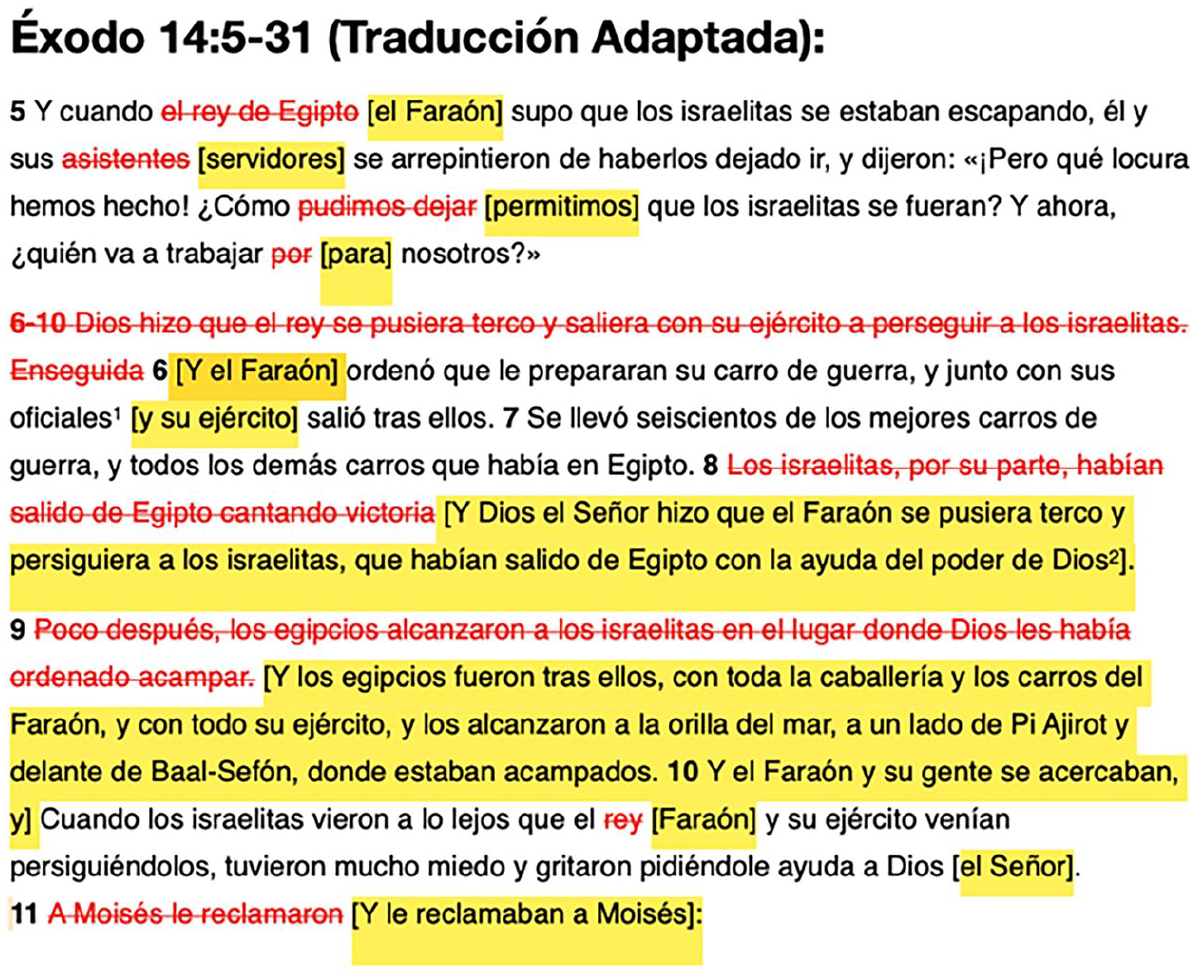
Changes from TLA in front translation
Second, during this process we also realized that the time invested in adapting the translation with the Hebrew text in sight was comparable to the time it would take us to translate the same portion of Scripture directly from the original languages.
Considering that we know of no Spanish translation that preserves the oral elements of the Hebrew Bible or the Greek New Testament, we decided to translate the texts into Spanish from the original languages. In this way we maintain the nuances of orality in the biblical languages, thus facilitating the teams’ work when translating the passages using the oral features of their own languages. The following is a review of some key elements in the orality of the Hebrew Bible that are relevant because of their impact on oral translation.
Shared oral features in Biblical Hebrew, Ixil, Mam, and Sipakapense
If a person has the ability to read the Bible in Hebrew, they can notice the character and oral “flavor” that some texts exhibit, which can be perceived in:
The brevity of many phrases.
The continuous use of formulas in the structure of a passage, as in the well-known case of Gen 1, where each day contains the phrases:
וַיֹּאמֶר אֱלֹהִים wayyōʾmer ʾĕlōhîm “And God said” וַיַּרְא אֱלֹהִים … כִּי־טוֹב wayyarəʾ ʾĕlōhîm … kî-ṭôb “And God saw … that it was good” … וַיְהִי־עֶרֶב וַיְהִי־בֹקֶר יוֹם wayhî-ʿereb wayhî-bōqer yôm ... “And there was evening and there was morning, day …”
Thus, the narrator has the essential structure for the beginning, climax, and conclusion of each day of creation. Oral features can also be seen in the acrostics of Lamentations and some psalms.
The use of names as a mnemonic device. Some scholars, for instance, think that the names in Ruth 1 are a resource so that whoever narrates the book could remember the parts of the story (Campbell 2008, 5–6, 19–23): Elimelech (“my God is king”) and his wife Naomi (“pleasant”) leave Bethlehem (“House of Bread”) because there was a famine (ironically, there is no bread in the “House of Bread”), with their two sons, Mahlon (“sick”) and Chilion (“consumed” or “destruction”), names that reveal in a certain way their destiny: they will die.
Word plays or the use of alliteration (sometimes exaggerated). Some of the best examples can be found in the book of the prophet Isaiah. Let us look at Isa 24.2-4, for example, with alliteration indicated in the transcription:
וְהָיָה כָעָם כַּכֹּהֵן כַּעֶבֶד כַּאדֹנָיו כַּשִּׁפְחָה כַּגְּבִרְתָּהּ כַּקּוֹנֶה כַּמּוֹכֵר כַּמַּלְוֶה כַּלֹּוֶה כַּנֹּשֶׁה כַּאֲשֶׁר נֹשֶׁא בוֹ׃ הִבּוֹק ׀ תִּבּוֹק הָאָרֶץ וְהִבּוֹז ׀ תִּבּוֹז כִּי יְהוָה דִּבֶּר אֶת־הַדָּבָר הַזֶּה׃ אָבְלָה נָבְלָה הָאָרֶץ אֻמְלְלָה נָבְלָה תֵּבֵל אֻמְלָלוּ מְרוֹם עַם־הָאָרֶץ׃ wəhāyâ kāʿām kakkōhēn kaʿebed kaʾdōnāyw kaššipḥâ kāggəbirtāh kaqqôneh kammôkēr kammalweh kallōweh kannōšeh kaʾăšer nōšeʾ bô. hibbôq tibbôq hāʾāreṣ wəhibbôz tibbôz kî yəhwâ dibber ʾet-haddābār hazzeh. ʾāblâ nāblâ hāʾāreṣ ʾumləlâ nāblâ tēbēl ʾumlālû mərôm ʿam-hāʾāreṣ.
And consider Isa 28.10, where unintelligible sounds are used:
כִּי צַו לָצָו צַו לָצָו קַו לָקָו קַו לָקָו זְעֵיר שָׁם זְעֵיר שָׁם׃
7
kî ṣaw lāṣāw ṣaw lāṣāw qaw lāqāw qaw lāqāw zəʿêr šām zəʿêr šām
The prophet repeats this pattern to complete the idea of his oracle (Isa 28.13):
וְהָיָה לָהֶם דְּבַר־יְהוָה צַו לָצָו צַו לָצָו קַו לָקָו קַו לָקָו זְעֵיר שָׁם זְעֵיר שָׁם
wəhāyâ lāhem dəbar-yəhwâ ṣaw lāṣāw ṣaw lāṣāw qaw lāqāw qaw lāqāw zəʿêr šām zəʿêr šām
The Hebrew text also shows important similarities with some of the features pointed out by Walter Ong as characteristic of mostly oral or primarily oral cultures. While acknowledging from experience in other clusters of oral Bible translation projects that these are not universals nor shared by all oral cultures, the Mayan languages mentioned above show the following characteristics from Ong’s list: 8
(1) Like Biblical Hebrew, these languages are paratactic (additive rather than subordinative). It is well known that Biblical Hebrew is paratactic, using the conjunction vav (literally translated “and” or “but”) as a way of connecting phrases, sentences, and/or concepts. If we take, for example, the text of Gen 4.1-10 in the Hebrew Bible, we will notice that it uses vav as a connector about thirty times. For stylistic reasons, translating them all as “and” would be strange in a written English translation, so other types of connectors are substituted. In this passage, Reina-Valera Revisada 1995 translates this vav as: la cual “which,” después “after,” pero “but,” pasado un “past a,” ni a “nor to,” por lo cual “therefore,” entonces “then,” con todo “yet,” and aconteció “it happened,” or simply omits it; and Dios Habla Hoy translates it as: después “after,” se “it,” pasó “happened,” también “also,” pero “but,” por lo que “therefore,” entonces “then,” sin embargo “however,” un día “one day,” and cuando “when.” As can be noticed, both make the text hypotactic, which is the norm in written Spanish but not natural in the languages we are translating into: Sipakapense (one of the Mayan languages from Guatemala) has no connectors, and Mam de Todos Santos (also from the Mayan family) has only one connector (bix) that can be translated as “and” or “but”:
Chuyax qá- xin profeta te Baal bix Asera, twi witz Carmelo, exí laqé Eliasl ti tnom, bix e- xí tqánaxa, jtójtza qélel chniya t′i Dios, qá jaxax Q′man Dios tuj chwitza che lepeca tíjxa, bix q′a jaxa Baal tuj chwitza che lepeca tíjxa. Bix entitl ajtzaq′ben tnom, bix Elias aj tq′ban, nuq′ nayana jun tprofeta te Q′man Dios o che chaj itz. (1 Kgs 18.20b-22a)
Purépecha (from Michoacán, Mexico) only uses a connector ka that could be translated as “and”:
Jántspiri inchaspti k’umanchekuarhu, ka Labani kuerach’akuaspti kameiuechani, ka t’irekua íntsaaspti ka jántspiriri pámpirichani ítsï kéntaaspti enkaksï jupantupirinka. Tátsekua t’irekua jatsirakuaspti. Ka ima no uékaspti t’ireni ka uantaspti … (Gen 24.32-33a)
Using parataxis in a model text for oral Bible translation facilitates rendering the biblical text into these languages.
(2) Redundant. The Hebrew text repeats the same statement multiple times to keep the listener’s attention on the content of what is being said. Consider, for example, Exod 31.13-17, which repeats in each verse the command that they must keep the Sabbath:
אֶת־שַׁבְּתֹתַי תִּשְׁמֹרוּ ʾet-šabbətōtay tišmorû “you must keep my sabbaths” (v. 13) וּשְׁמַרְתֶּם אֶת־הַשַּׁבָּת ûšmartem ʾet-haššabbāt “You shall keep the sabbath.” (v. 14) שֵׁשֶׁת יָמִים יֵעָשֶׂה מְלָאכָה וּבַיּוֹם הַשְּׁבִיעִי שַׁבַּת שַׁבָּתוֹן šēšet yāmîm yēʿāśeh məlāʾkâ ûbayyôm haššəbîʿî šabbat šabbātôn “Six days shall work be done, but the seventh day is a sabbath of complete rest.” (v. 15) וְשָׁמְרוּ בְנֵי־יִשְׂרָאֵל אֶת־הַשַּׁבָּת wəšāmərû bənê-yiśrāʾēl ʾet-haššabbāt “The Israelite people shall keep the sabbath.” (v. 16)
In Gen 45, Joseph identifies himself several times to his brothers and on several occasions also repeats that there are a few more years of famine to come and they must warn their father. He also repeats the statement that he is the second most important person after Pharaoh. Ong discusses this feature of narratives in primarily oral cultures:
In oral discourse … There is nothing to backloop into outside the mind, for the oral utterance has vanished as soon as it is uttered. Hence the mind must move ahead more slowly …. Redundancy, repetition of the just-said, keeps both speaker and hearer surely on the track. (Ong 2002, 39)
(3) Cumulative rather than analytical. Some primarily oral cultures prefer to speak of “not the soldier, but the brave soldier; not the princess, but the beautiful princess; not the oak, but the sturdy oak” (Ong 2002, 38). Biblical Hebrew behaves in the same way: it is not just the rock, but the “rock and fortress” (לְצוּר־מָעוֹז ləṣûr-māʿôz, Ps 31.3); God is not only a shield, but also the “shield of your help” (מָגֵן עֶזְרֶךָ māgēn ʿezrekā, Deut 33.29); God has a “mighty arm” (בִּזְרוֹעַ עֻזְּךָ bizrôaʿ ʿuzzəkā, Ps 89.11); it is not just a sword, it is a “burning sword” (לַהַט הַחֶרֶב lahaṭ haḥereb, Gen 3.24).
Similarly, typical oral cultures:
(4) Conceptualize and express thought with references close to the vital human world. It is not just a difficult situation, it is “Valley of the Shadow of Death” (or “Darkest Valley”; גֵּיא צַלְמָוֶת gêʾ ṣalmāwet, Ps 23.4); it is not suffering, it is “bread of tears” (לֶחֶם דִּמְעָה leḥem dimʿâ, Ps 80.6). In Ixil de Cotzal, for example, “desert” is tz’inliich tzaji txa’ba’ “silence dry soil,” “forest” is xool tzé “between wooden sticks,” and “mountain” is tx’akab’en “[the] abandoned.”
(5) They use somatic locutions or somatic relations to express deep emotions. Thoughts, emotions, and experiences are connected with physical organs. In Biblical Hebrew, the arm is connected with power, the heart with thinking, the kidneys with emotions. Similarly, Ch’ol (a Mayan language from the state of Chiapas, Mexico) connects the heart with thinking, and in Mixe, a language spoken in Oaxaca (Mexico), the stomach (jot) is connected with behavior and will, and most of the idioms related to emotions are formed using the word for this body part:
To be happy = jot kujk
To be honest = winejotpe
Angry = jot’am
To be worried = jot may (lit. “much stomach”)
To remember = jot’at (lit. “to be stomach”)
To be brave = jotmek (lit. “strong stomach”)
The center of something = joty (lit. “inside the stomach”)
The oral character of the biblical text can also be perceived in the work of the prophets in the Bible, where we can see how the call and the task of the prophet is charged with orality (Schellenberg 2010). The prophet is a proclaimer of oracles and prophecies that need the immediate reaction of the people, and he is only sent to write when the Lord wants something to be preserved for posterity (Isa 10.19; Hab 2.2). God calls the prophet (וַיִּקְרָא wayyiqrāʾ “and he called”) not once but several times during his ministry, just as he “calls” the things he creates in Gen 1; God says to him (וַיֹּאמֶר wayyōʾmer “and he said”) continually the word he wants to be proclaimed, or the word just “comes” upon the prophet (וַיְהִי דְבַר־יְהוָה אֶל־ wayhî dəbar-yəhwâ ʾel- “and the word of the Lord came upon”), provoking the people to listen (שִׁמְעוּ šimʿû “listen!”). 9 This is how the prophet, emissary and envoy of the Lord, becomes the book; for this reason his reputation is the cover, his life is connected to the word, and prophecy “is the voice that God has lent to the silent agony, to the plundered poor, to the profaned riches of the world. It is a way of life, a point where God and man intersect” (Heschel 1973, 36).
Our translator-storytellers see themselves as fulfilling this prophetic task. They are called and have the living Word of God coming upon them (וַיְהִי דְבַר־יְהוָה אֶל־ wayhî dəbar-yəhwâ ʾel-), proclaiming the truth and urging the people to listen (שִׁמְעוּ šimʿû). 10
At this point, it is crucial to reiterate that we are not opposing the written against the oral. These are distinct media, each governed by their own unique codes. We echo Loubser’s assertion that “media awareness not only prepares scholars for understanding the codes operating in the texts they are working with, but also helps to assess the ‘gap’ between then and now …. This specially applies because modern scholars are constantly tempted to understand ancient messages in terms of their present literary frame” (Loubser 2013, 4). Lourens de Vries, for example, has critiqued the employment of “oral strategies,” particularly those that assume the universality of Ong’s postulates. However, it is essential to underscore that, in de Vries’s case, the flaw was identified in the chosen medium. In his own words, “The problem with that strategy was that the ‘oralized’ translations became more difficult to read, and to read aloud to listening audiences” (de Vries 2008, 147). Our focus is directed toward a different medium: memorized performance. As the medium used in our translation project is not a printed Bible, nor is it an audio recording, but the memorized performance of the stories, the translator is also the cover of the book. Their lives are connected to the message.
Memory and transmission
As the goal of our translation is memorized performance of the text, a crucial factor has been to study with the translators that, within the Bible itself, memory is an important element for the transmission of traditions or texts, something that is still preserved in mostly oral cultures. The “mouth” repeated below is the key for the people to preserve the knowledge and practice of the law:
11
לְמַעַן תִּהְיֶה תּוֹרַת יְהוָה בְּפִיךָ
ləmaʿan tihyeh tôrat yəhwâ bəpîkā
So that the instruction (Torah) of the Lord [may be] in your mouth. (Exod 13.9) כִּי־קָרוֹב אֵלֶיךָ הַדָּבָר מְאֹד בְּפִיךָ וּבִלְבָבְךָ לַעֲשֹׂתוֹ׃
kî-qārôb ʾēlêkā haddābār məʾōd bəpîkā ûbilbābəkā laʿăśōtô
For the word is very close to you, in your mouth and in your mind, that you may fulfill it. (Deut 30.14) וְאַל־תַּצֵּל מִפִּי דְבַר־אֱמֶת
wəʾal-taṣṣēl mippî dəbar-ʾĕmet
And take not the word of truth from my mouth. (Ps 119.43)
This is not only apparent within the biblical text; there is evidence that for centuries memory was maintained as an essential feature of biblical transmission in Judaism. Kim Phillips has spent years studying dozens of abridged manuscripts of the Cairo Geniza—manuscripts of biblical texts used mostly as mnemonic aids, containing only two or three words of each biblical verse which the student or disciple had to use to recite the rest of each verse. His study highlights the use of these manuscripts for the memorization of biblical texts: “I would suggest that at least some (and probably a very high proportion) of the manuscripts … were used as aides-mémoire [memory aids] for the recitation of the biblical text, both in a private and liturgical context” (Phillips 2022, 32).
Other strong evidence supporting memorization as a liturgical tool or at least as an important part of the interaction with the text can be seen in the use of simanim in the Masorah of the Hebrew Bible, where the reader has to master the Bible in order to connect the words with the passages they are pointing to. 12 And similarly, in the Talmud we find multiple references to individuals who knew the entire Tanakh by heart. 13
The characteristics of orality that we observe within the text of the Hebrew Bible, as well as the tradition of memorizing the text, create the appropriate connection for the translation into these languages that have the same characteristics. In a real sense, OBT brings back the memorization aspect of the liturgical traditions of Judaism. Knowing that there was a culture of memorization within the biblical traditions inspires contemporary oral translators who, as was mentioned above, also dedicate themselves to transmitting the text by delivering public narrations in different spaces in the indigenous communities, and by teaching memorization for performance to additional groups in their villages.
Orality and memory in Bible translation processes
Attention should be paid to the fact that along with the West’s rich literary heritage, there are other forms (“beyond the printing press”) of transmitting traditions and history. In Latin America there are still communities, towns, and languages which maintain an oral tradition and, at the same time, have a continuous creation of new orature 14 (“oral literature”).
Thus, we can take advantage of the fact that the biblical text in the original languages has similar characteristics to the oral features of the languages we are working with, since it is a text that was created in an oral culture or where orality was maintained to facilitate transmission. It is then feasible to produce a Bible translation, directly from the Hebrew (or Greek) text, as a base text for OBT that maintains and preserves the characteristics of orality that the text of the Bible itself contains. In that sense and in our case, the act of translating the text incorporating elements of orality and making the effort to maintain coherence with the text in general has made the translation process into the target languages flow considerably better. Have we faced difficulties? Definitely! Both Hebrew and Greek, along with Spanish (the language of the front translation), are different from those languages into which we direct our efforts to render the original meaning. We are faced with words that pose difficulties and/or are novel terms for the translators. 15 Despite this, from a structural and linguistic point of view, the task as I have outlined it is significantly more efficient and accessible for our teams.
By having the opportunity to translate the biblical text for this particular task, and due to the subtle similarity that these languages have with the original languages of the Bible, we have preserved in the translation certain elements that are not usually translated into Spanish but that contribute to maintaining the coherence sought by the biblical authors. And this is not only from the Old Testament. Writing in New Testament times valued memory and so the grammatical structures (chiasmus, two stage progressions, repetition, linking kai) all make it easier to memorize the narratives. Many of these have been removed in translations to give the passages a more literary feel in a contemporary sense. Most of our literature is not created to support memory, but to fit a very different aesthetic. If current versions had maintained echoes of orality in their translations, there would be less of a need to return to the Greek. 16 A small example of this is that, when translating Mark, we have preserved some parallelisms and elements that do not seem strange in these target languages:
The veil is torn in two at the moment of Jesus’ death (Mark 15.38) and thus we maintain the parallel with the sky being torn (not “open”) when the Spirit descends on Jesus at his baptism (Mark 1.10). 17
Jesus is “cast out” by the Spirit to the desert (Mark 1.12), and he “cast out” demons and unclean spirits.
John is betrayed (not simply “arrested”) just as Jesus is betrayed.
In these languages it is also possible to translate the historical present as present.
Keeping parataxis (present in Mark) is also important.
In that regard, it would be fascinating to have a complete Bible in Spanish that takes into account elements of orality, with a view to being used in the work of other translation teams in the future. The work we have done with the Old Testament and the New Testament (Mark) could be the starting point for this project. Something we need to reconsider is the versification (maybe disposed of), as keeping the verse numbers restricts the translators from pursuing natural word order in their language.
As we said above, it has been essential to share with the translators the history of the oral transmission of the Hebrew Bible and for them to understand in detail how orality has played a crucial role over time in Jewish and Christian communities, the importance of orality in the prophetic office, how the biblical text was memorized as a means of preservation, and how this tradition kept the text alive within the believer, the communities, and the church. This confers significant authority on their work, granting them the certainty that they are translating the Bible itself and not just doing an informal exercise approximating translation. This knowledge instills more enthusiasm in the translators as they realize that, upon reaching their communities, people not only accept the text but consider it sacred, accentuating the need to continue with the oral translation of the Bible and the preservation of the memory it contains.
Our translator-storytellers have managed to translate and memorize twenty-eight chapters of the Bible, which includes the book of Ruth and the first four chapters of Mark. Their set of translated stories amount to three hours of Bible memorization, a remarkable achievement which deserves recognition.
Lord’s words in his book The Singer of Tales (1960, 13) resonate: “We must take a new look at tradition, and consider it, not as the inert acceptance of a fossilized body of themes and conventions, but as the organic habit of recreating what was bequeathed to us and what we must bequeath to others.” There are traditions to transmit, there is a living body that must be maintained, and orality is a medium that should not be discarded.
Footnotes
1
The process of a written translation of the Bible includes, in many cases, the creation of an alphabet, orthography, and grammatical rules, and then working on promoting that language in written form and training literate speakers. This may take some years (five or ten or more) before someone can read the Bible already translated into their language.
2
Well-meaning people show their concern in one or all of three directions: (1) Fidelity: how faithful is the one transmitting a story orally? What variations will there be from narrator to narrator or between telling the story today and telling the story next year? (2) Authorship is another concern together with copyright and registration of the work; and (3) text preservation: how can we save the text from becoming corrupted or changing its form? What has been observed in the field is that the translators of the text (who in the case of our projects are at the same time narrators in their communities) are focused on memorizing the text exactly as it has been translated (although, very rarely they accept slight variation). This is because they believe that the stories from the Bible are sacred.
3
A post-literate society is one where the written medium has been replaced by other media (video, audio, recording, etc.). Marshall McLuhan predicted this post-literate trend in his book The Gutenberg Galaxy ( ), when the means we have today to make it possible had not yet been created and when the factors for the social changes it requires did not exist.
4
“If someone who hurts Cain is punished seven times, the one who hurts me will be punished seventy-seven times.”
5
“Man proposes, and God disposes.”
6
We noticed that the confidence of our partners is high when the base text is an official and well-known translation of the Bible.
7
Lexham English Bible translates this as: “For it is blah-blah upon blah-blah, blah-blah upon blah-blah, gah-gah upon gah-gah.”
8
9
The call of the prophets also includes: the touch of their mouth as a symbol that God’s words will flow through it (Jer 1.9); the touch of their mouth as a symbol of cleansing, since they will be the instrument that God will use to send his message to the people (Isa 6.7); the prophet as the mouth of God (Jer 15.9); and the mouth of the prophet as a “mighty instrument” (Isa 49.2).
10
Like in Biblical Hebrew, in these languages, “listening” is “obeying.”
11
In the Babylonian Talmud, Tractate Eruvin discusses repetition as a means of transmission:
How was the Mishnah ordained [transmitted]? Moses learned it from the mouth of the Almighty. Then Aaron came in and Moses taught him his portion. Aaron then distanced himself and sat on Moses’ left. Then his sons came in and Moses showed them their portion. Then they distanced themselves and Eleazar sat on Moses’ right and Ithamar on Aaron’s left. Rabbi Yehuda said, Aaron was always at Moses’ right hand. Returning, the elders came in and Moses showed them their portion. The elders distanced themselves and the whole nation came in and Moses taught them their portion. The result was that Aaron heard the teaching four times, his sons heard it three times, the elders twice, and the whole nation once. Moses then distanced himself and Aaron repeated his part. His sons then repeated their portion and departed. The elders then repeated their portion and departed. In this way, everyone heard everything four times. (b.Eruvin 54b:11)
12
David Marcus gives a good example of how the simanim work:
In Ezek 16:8 there is a Mm note of the form בִּבְרִית that says: בברית ג לעברך בברית יהוה אלהיך . ואבוא בברית אתך . ועשית חסד על עבדך. that is, “there are three occurrences of בִּבְרִית: De 29:11; Ezek 16:8 and 1 Sam 20.8.” Each of the Hebrew phrases is a clue to the verses where the form בִּבְרִית occurs. The first phrase לְעָבְרְךָ בִּבְרִית יְהוָה אֱלֹהֶ֖יךָ comes from De 29.11; the second phrase וָאָבוֹא בִבְרִית אֹתָךְ comes from Ezek 16:8; and the third phrase וְעָשִׂיתָ חֶסֶד עַל־עַבְדֶּךָ comes from 1 Sam 20.8. (Marcus 2013, 1)
13
See b.Megillah 18b:10-18 for an example.
14
15
Some of these words and terms are: scribe, demons, demon-possessed, devil, Spirit-baptism, baptized with fire, Gospel, law, mercy, justice, Kingdom of God.
16
Many thanks to my colleague Phil Ruge-Jones (an expert on orality and performance) for conversations around this topic that helped me reflect better on the subject as we worked together in Guatemala.
17
Although some English Bible versions use “torn open” in this verse, this is not the case in Spanish. Just two translations render it as “torn” in Spanish (Palabra de Dios para Todos; Reina Valera Revisada 1977).