







Abstract
Three possible candidates are considered as markers in lake sediments and peat for the onset of the Anthropocene. The artificial radioisotopes Americium 241 and Caesium 137, as well as Spherical Carbonaceous Particles, the by-product of fossil fuel combustion, are considered only briefly. They are possible markers for the onset of the Great Acceleration in the mid 20th century. More attention is given to Inorganic Ash Spheres which are mainly by-products of solid fuel combustion, iron and steel manufacture and metal smelting. Their changing contributions to the stratigraphic record can be detected by means of magnetic measurements. The date at which the deposition of inorganic fly ash is recorded varies from the 16th to the mid 20th centuries, depending mainly on location. In evaluating the prospects for using the magnetic record in recent peat and lake sediments as a marker for the start of the Anthropocene, special attention is given to the importance of developing and testing chronologies of deposition, the choice of appropriate locations and the problems posed by dissolution of magnetic minerals over time especially in acid peat.
Keywords
Introduction
At the heart of the original concept of the Anthropocene lie the changes that have taken place in the role of human activities in the Earth System over the last 200 years (Crutzen and Stoermer, 2000) and, more especially, since
Prerequisites
In the search for geological markers for the beginning of the Anthropocene several requirements need to be considered:
Marker materials. These should be linked to and, ideally, generated by the industrial processes that heralded the start and subsequent history of the Anthropocene. They should be capable of being incorporated in and retained in situ by accumulating environmental ‘archives’.
Environmental archives. Ideally, these should be widespread, accessible and contain a record of rapid, continuous accumulation through the time interval of interest. Rate of accumulation is especially important, as it is essential to be able to reconstruct in sufficient detail the successive stages in the deposition and retention of whatever is chosen as a marker.
Methods of detection and ascription. Any markers must be amenable to one or more methods of detection in the settings chosen as environmental archives, as well as unambiguous ascription to the industrial processes involved in their generation.
Dating techniques. These need to be applicable to the archive chosen and capable of generating chronologies of high accuracy and precision over the geologically recent time intervals involved. Many of the conventional methods of dating the geological record would fail the second requirement.
Here, three possible markers are considered, two only briefly as no more than an introduction to possibilities, the third more fully.
Archives, markers and chronologies
Lake sediments and accumulating peat satisfy the criteria for environmental archives. They are widespread especially in areas of early industrialisation, and they generally accumulate rapidly and conformably relative to most other sediments. There are literally many hundreds of scientific articles testifying to the extent to which, over the last four decades especially, both types of archive have been studied for their records of anthropogenic activities, materials and tracers. Peat forms under waterlogged but not permanently submerged conditions, save in reedswamps round the fringes of lakes. Of particular interest are what are termed ombrotrophic peats (Clymo 1984), since these have accumulated under moist temperate and boreal climatic conditions to the point where their surfaces lie above the groundwater-table and they depend entirely on atmospheric deposition for water and minerals. The stratigraphic record they contain of inorganic particles therefore comprises only atmospherically transported material. By contrast, lake sediments contain a mixture of materials derived from biological productivity and chemical processes within the lake and the sediments, as well as particles washed in from adjacent land surfaces that drain into the lake. Particles from both types of source are preserved in the sediments along with the material derived from direct atmospheric deposition. Given the significantly more mixed source of minerals in lake sediments, sites must be chosen where non-atmospheric inputs are either minimal and constant, or can be separately detected and excluded.
Several dating methods have been developed for establishing detailed chronologies of deposition in both lake sediments and peats. Whereas individual radiocarbon dates are of no real value over the last 200 years, a detailed sequence of contiguous dates can be mapped onto tree-ring sequences spanning the same time interval and this can generate a detailed chronology (Bronk Ramsey et al., 2001). Other radioisotopes such as lead-210 (210Pb), caesium-137 (137Cs) and americium-241 (241Am) have also been used to date both lake sediments and peats. The first is a naturally occurring radioisotope with a half-life of 22 years suitable for dating the last 100–150 years under favourable conditions (Appleby and Oldfield, 1992) The other two are artificially generated radioisotopes dispersed into the atmosphere and sediments as a result of weapons testing, nuclear waste disposal and nuclear accidents. All three have been applied to both lake sediment and peat sequences with varying degrees of success (Appleby, 2008; Appleby et al., 1997; Oldfield et al., 1995). In addition, individual marker horizons can sometimes be dated by comparing the pollen record in peats and sediments with historically documented changes in land use (Holmes et al., 2010; Oldfield and Statham, 1963). In the case of lake sediments, the seasonal alternation in depositional processes can sometimes generate annual layers (varves) that can then be counted to provide a chronology (Ojala, 2012). In peats, recent chronologies can also be obtained by counting the annual growth increments in the moss species that often comprise most of the peat (Pakarinen and Tolonen, 1977). In most cases, the key to establishing a secure chronology is to use independent dating methods in combination, allowing them to refine and constrain each other.
The potential markers considered here are the artificially generated radioisotopes themselves, already noted above, and particulates generated and dispersed into the atmosphere through fossil fuel combustion and other industrial activities such as metal smelting. The deposition record for both 137Cs and 241Am begins with the fallout from weapons testing from 1954 onwards, though the clearest indication of their presence is often the result of the peak in release in 1963 (a year later in the Southern Hemisphere). Both radioisotopes are therefore possible candidates for marking the onset and early stages of the Great Acceleration. Whereas 137Cs has a relatively short half-life of 30 years, the half-life of 241Am is 432 years, pointing to its much greater persistence in any environmental archive. It is also chemically less mobile in sediments and peats (Oldfield et al., 1995) giving it an additional advantage partially counterbalanced however by its lower concentrations and consequently greater difficulty in detection. Its potential as a marker may be assessed by consulting several publications by Peter Appleby and colleagues (Appleby, 2008; Appleby et al., 1991).
Coal combustion and many associated heavy industries such as iron and steel manufacture and metal smelting, generate residual, un-combusted mineral particles, many of which leave the site of combustion as particulate pollutants in the atmosphere. These are often referred to under the generic term ‘fly ash’ which may be divided into organic and inorganic fractions, the former comprising Spherical Carbonaceous Particles (SCPs) and the latter Inorganic Ash Spheres (IAS; Figure 1). Both are present in lake sediments and peats from the onset of industrialisation onwards, though the stratigraphic record of the former shows its steepest acceleration alongside the rise to dominance of oil as a major fossil energy source from the mid 20th century onwards. The SCP record may therefore be another strong candidate for marking the onset of the Great Acceleration. Some sense of the widespread nature of the SCP depositional record may be obtained from the publications of Neil Rose (Rose, 1994). The main concern of the text that follows is the stratigraphic record of IAS as decipherable from magnetic measurements of both lake sediments and peats.
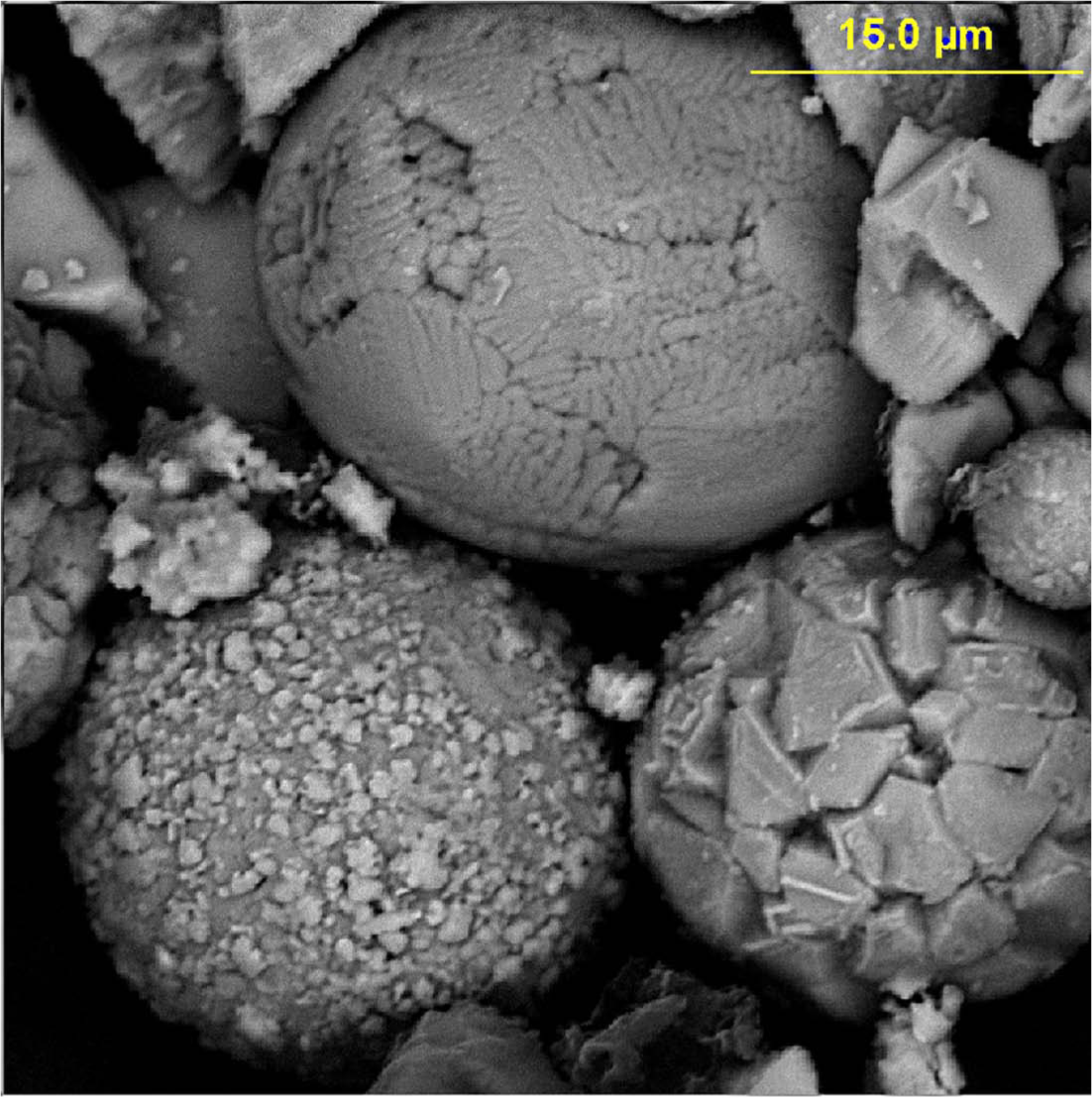
Scanning Electron Micrographs of contrasted inorganic fly ash spherules.
The magnetic record of IAS deposition
Early research ascribed such spheres to cosmic sources, but subsequently it became clear that the dominant source was fossil fuel combustion and industrial activities (Oldfield et al., 1978). Although the spheres may be chemically extracted from sediments, soils and peat (Rose, 1990), a more rapid and non-destructive approach to their detection involves the use of magnetic measurements, since the spheres are rich in both magnetite and haematite (Winburn et al., 2000). The methods of measurement and detection are summarised in Oldfield (1999) and a fuller account of their use in revealing the stratigraphic record of IAS deposition is given in Oldfield et al. (forthcoming). The present paper illustrates and summarises the main results obtained from over 70 sites in the UK, mainland Europe and North America.
Figures 2 and 3 illustrate two aspects of the magnetic record in ombrotrophic peats, the first plotting spatial variations, the second well-dated temporal changes at a single site. Figure 2 uses proportional circles to plot the spatial distribution of cumulative magnetic deposition onto areas of ombrotrophic peat in Great Britain and Scandinavia (Thompson and Oldfield, 1986). Each circle is proportional to the total deposition over a uniform surface area. In the case of the UK sites, this has usually been obtained by carrying out magnetic susceptibility scans of peat cores contained in plastic drain pipes, with the value used being the mean of those obtained from each of four cores. In the case of the Scandinavian data, the values have been compiled from measurements on individual subsamples. The distribution shows a clear link to sites of industry and power generation and a factor of over 30 difference between the values for cores within the most heavily industrialised regions of the UK and those from sites in the far north of Scandinavia and the northwest coast of Scotland.
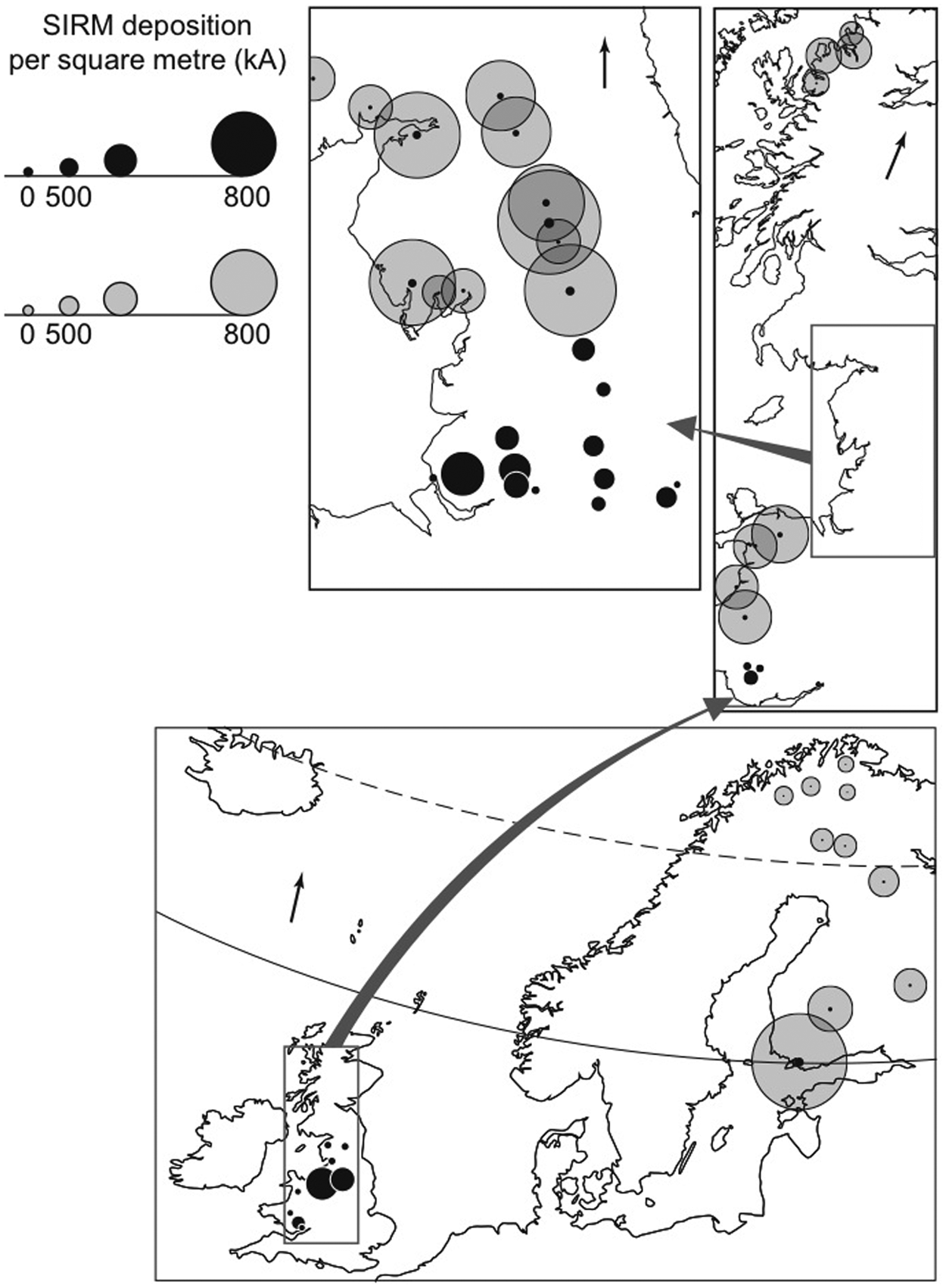
Proportional circles representing the cumulative deposition of magnetic minerals onto ombrotrophic peats.
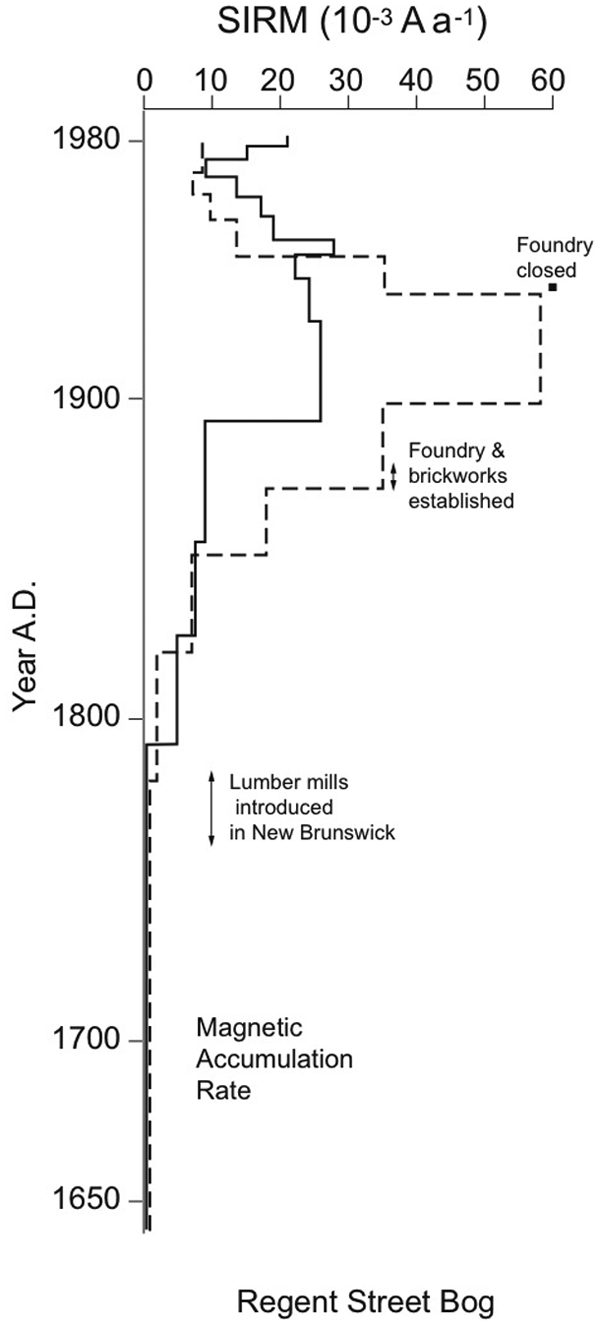
Regent Street Bog, Fredricton, New Brunswick. Canada. Laboratory induced Saturation Isothermal Remanent Magnetization (SIRM) values used to approximate the total magnetic mineral component in the peat, plotted as accumulation rates against a timescale derived from moss increment counting. Dated events in the industrial history of the local area are added.
Figure 3 is based on measurements from a site in New Brunswick, Canada. It has both a detailed chronology derived from moss increment counting in the upper layers and extrapolation downwards using a decomposition model and also a well-documented industrial history for the nearby town of Fredricton. There is a close correspondence between the magnetic record and the local industrial history.
Figure 4a and b shows contrasted examples of deposition records that appear to give consistent indications of the onset of inorganic fly ash deposition without any evidence for selective magnetic mineral dissolution. Figure 4a shows the record of inferred haematite accumulation in two lake sediment cores from a site in the Adirondacks, New York State, USA (Oldfield, 1990). The close parallel between the two records and the detailed chronologies provided by 210Pb point to a credible record of haematite deposition resulting from industrial activities in the region from the late 19th century onwards. The record from Helsington Moss, South Cumbria, UK, despite deriving from an ombrotrophic peat bog, lacks any indication of selective magnetic mineral dissolution. It is one of several profiles from the area that confirm the early onset of inorganic fly ash deposition as a result of iron manufacture.
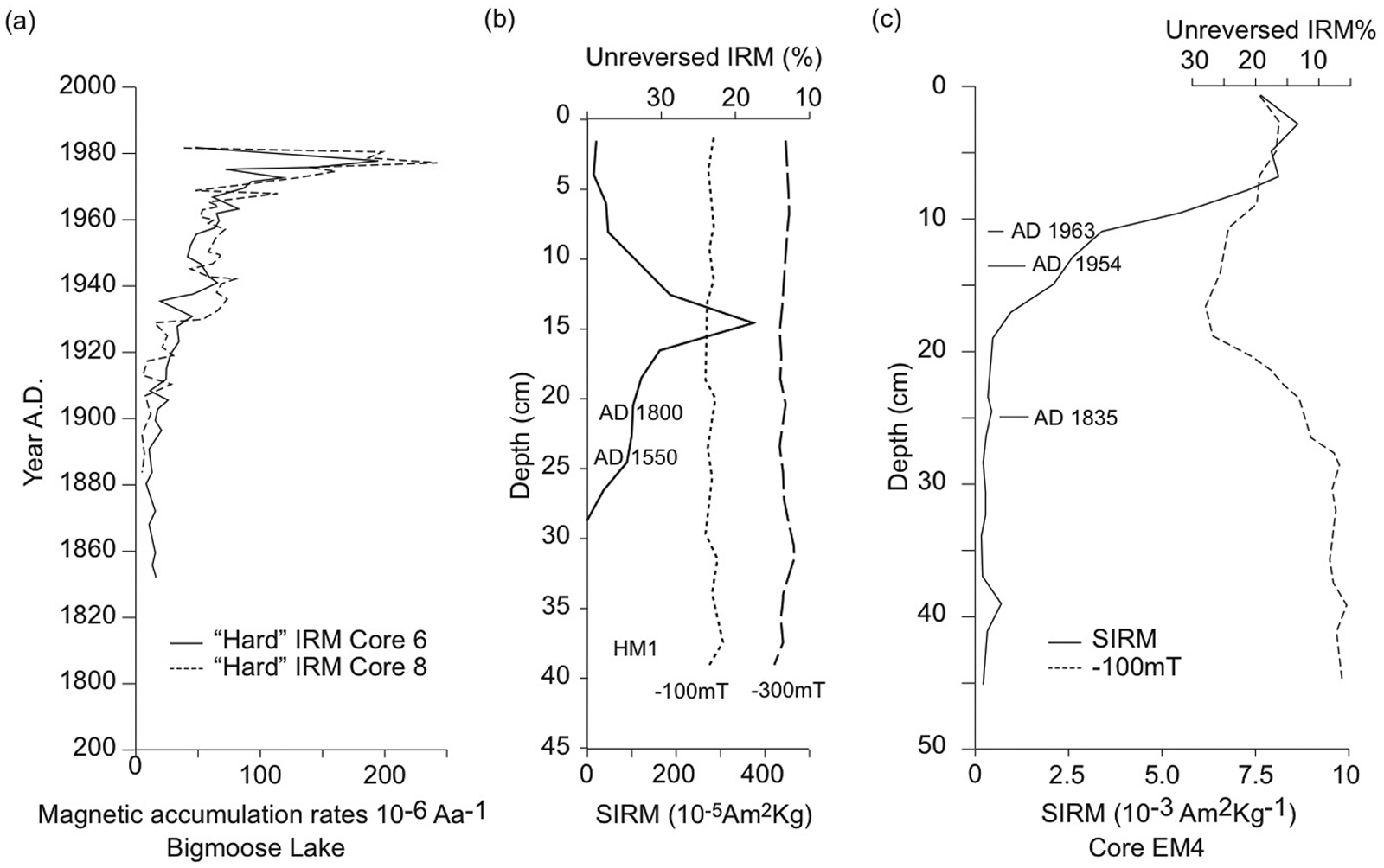
Contrasted examples of records of atmospheric deposition from lake sediments and peats. (a) The record of ‘Hard’ Isothermal Remanent Magnetization (IRM) accumulation in two cores from Bigmoose Lake in the Adirondacks, New York State, USA (Oldfield, 1990). ‘Hard’ IRM is that portion of the SIRM remaining after high reverse magnetic fields have been used to partially demagnetize the sample. In the present case, it represents the haematite component derived from atmospheric deposition. The other part of the SIRM signal has been strongly affected by inwash from the lake catchment. Note the close parallel between the accumulation rates derived from two separate sediment cores. The chronology is based on 210PB measurements. (b) An SIRM profile from Helsington Moss, South Cumbria, UK, a relatively dry ‘rampart’ or peat isolated by peat cutting and reclamation. The dates are based on a combination of ‘wiggle-matched 14C and a comparison between the pollen record and land-use history (Gedye, 1998). The magnetic record of inorganic fly ash accumulation begins in the 16th century. The steep decline in SIRM over the top 15 cm reflects dilution of the signal by rapidly accumulating, undecomposed peat. Compare the lack of inflection in the unreversed IRM% values with the strong ‘kink’ in (c). (c) An SIRM profile from Ellergower Moss, Galloway, SW Scotland. The dates are based on a combination of 210Pb, wiggle-matched 14C and pollen–land-use comparisons (Gedye, 1998). The increase in unreversed IRM% values between 10 cm and 24 cm indicates an increase in the relative importance of haematite relative to magnetite in the record. For reasons outlined in Oldfield et al. (forthcoming) this is taken as a strong indication that at this permanently waterlogged site there has been selective dissolution of the magnetic record. The likely onset of inorganic fly ash deposition is marked by the base of the kink, with a date in the early 19th century.
Together, these figures point to the likely value of the magnetic record in peat as a marker for industrialisation. That said, it should be borne in mind that magnetic minerals and especially magnetite, which is responsible for most of the signal recorded in both figures, can be subject to dissolution under the waterlogged and acid conditions prevailing in ombrotrophic peat (Williams, 1992). Evidence for the likely widespread impact of this process on the record is set out in more detail in Oldfield et al. (forthcoming) and illustrated in Figure 4c, a profile from the wet area of Ellergower Moss, an ombrotrophic bog in Galloway, SW Scotland. Both the spatial pattern and, in many cases, the chronological record appear convincing despite this process.
Evidence for the impact of selective dissolution is less prevalent in the lake sediment records of atmospheric deposition, but it cannot be entirely discounted (Fritz et al., 1989; Oldfield et al., forthcoming). Haematite appears to be more resistant to the dissolution process than does magnetite. Magnetic measurements cannot achieve a completely quantitative discrimination between these two minerals, but they do provide a semi-quantitative record of the changing relative importance of each based on the ease with which magnetic remanence acquired in the laboratory can be reversed (Oldfield, 1999; Thompson and Oldfield, 1986).
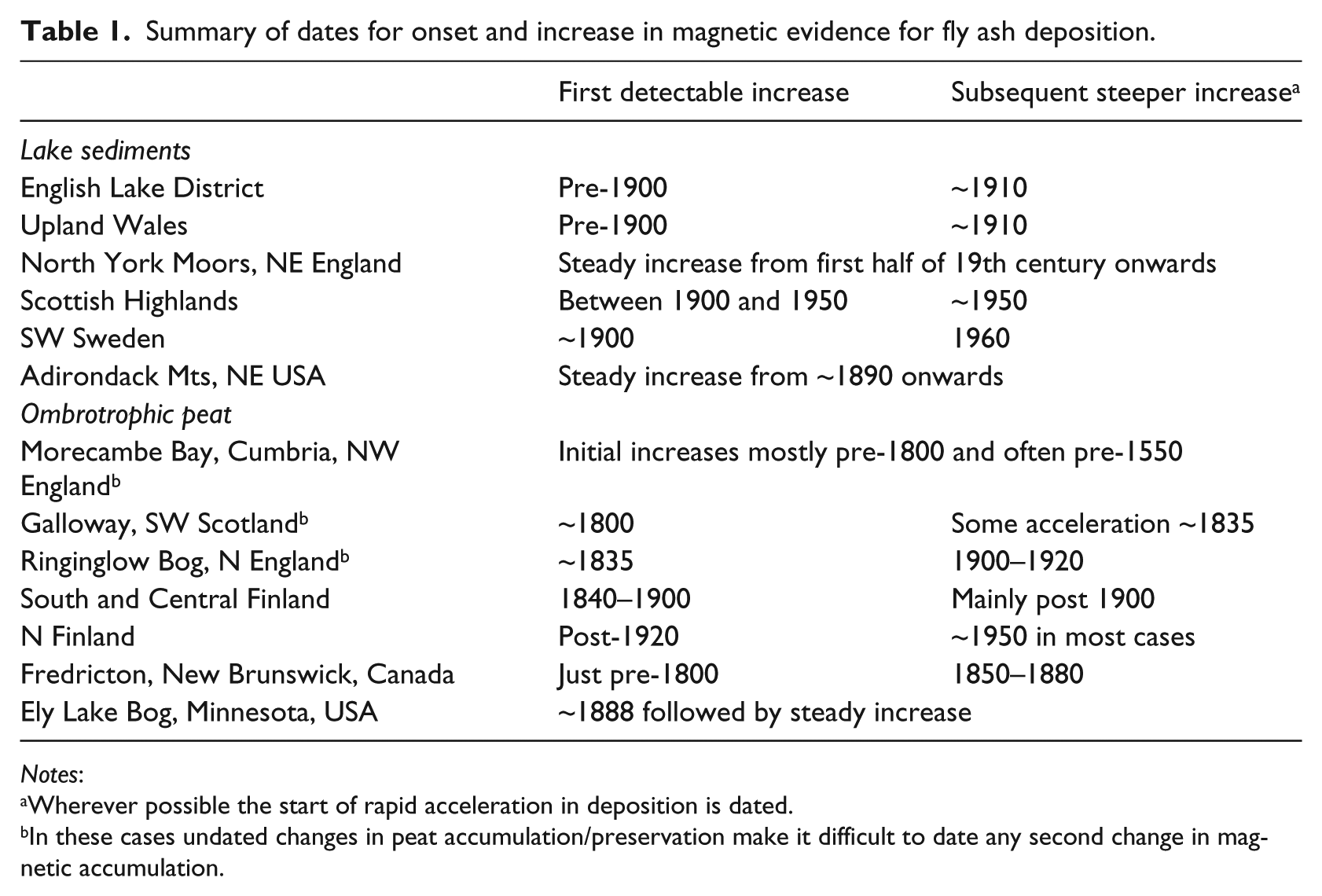
These examples illustrate the potential role of magnetic measurements in defining the onset and history of industrialisation. Table 1 summarises the results from all the sites used in the full analysis of the data considered by Oldfield et al. (forthcoming) and for which chronological control permits dating, albeit rather approximate in some cases, of the first increases in magnetic deposition.
Summary of dates for onset and increase in magnetic evidence for fly ash deposition.
Notes:
Wherever possible the start of rapid acceleration in deposition is dated.
In these cases undated changes in peat accumulation/preservation make it difficult to date any second change in magnetic accumulation.
Depending on location, the dates of initial increase range from the early 16th to the early–mid 20th century. The sites around the head of Morecambe Bay in South Cumbria, NW England show the earliest initial increases, reflecting the early history of iron manufacture using mainly charcoal fired ‘bloomery’ hearths. This early date roughly corresponds with that claimed by Fischer-Kowalski et al. (2014) for what they term the socio-metabolic onset of the Anthropocene. At the other extreme, the latest increases are recorded at sites that are most remote from industrialisation – northern Finland and the far northwest of Scotland. The record as a whole appears to reflect well the influences of proximity to, and the timing of, industrial development with much more variety and a wider spread of onset dates than suggested by Snowball et al. (2014). In view of the wide range of dates for the recorded onset of deposition, use of the magnetic records of inorganic fly ash spheres as markers for the start of the Anthropocene would require the choice of sites close to locations where fossil-fuel based industrialisation began in the late 18th or early 19th centuries and expanded rapidly thereafter. The extensive ‘blanket’ bogs in the southern Pennines of northern England would be an obvious choice. The advantages of the records in these peats would include an absence of measureable magnetic minerals prior to industrialisation, followed by extremely heavy deposition from cities such as Sheffield where early iron and steel manufacture took place. The disadvantages arise from the demonstrable occurrence of selective magnetic mineral dissolution readily detectable in Scanning Electron Microscope images (Oldfield et al., forthcoming; Figure 1). Despite dissolution, use of the magnetic remanence component most indicative of the changing haematite contribution does, especially where atmospheric particulate pollution has been heaviest, appear to provide a starting point for the production and deposition of the inorganic component of fly ash. Evidence from sites in south Cumbria, where the record of magnetic deposition retained at permanently waterlogged sites has been compared with that retained at dried-out sites round the drained margins of the peat show that the latter lack any indication of dissolution (Oldfield et al., forthcoming). A similar conclusion was reached by Rothwell and Lindsay (2007) working on blanket peats in the Pennines, where they found survival of the magnetic record to be much more complete in dried-out peat on the edge of drainage gullies. For any putative ‘golden spike’ to mark the start of the Anthropocene as originally defined, these considerations would point to a choice of site that combined good drainage and the possibility of preserving the peat from subsequent erosion. Reliance on records from peat alone would nevertheless imply the need to know more about the long term survival of the ‘haematite’ record in the peat and to develop accurate and precise chronologies for any chosen sites using a range of complementary techniques – 210Pb, ‘wiggle-matched’ 14C and pollen–land-use history comparisons. Ideally, peat-based records should be complemented by parallel record from lake sediments where non-atmospheric sources of magnetic minerals can be excluded. Sites with sediments rich in carbonates should have a distinct advantage. The high pH precludes dissolution of the magnetic record and the frequent occurrence of fringing carbonate-rich marl (micrite) shelves minimises particulate input from surrounding land surfaces. Similar considerations would apply if the fly ash record were to be considered a possible marker for the mid 20th century ‘Great Acceleration’ though, in all probability, the other potential markers considered only briefly here, radioisotopes and SCPs, would be more appropriate.
It is useful to set the above observations in a wider spatial and temporal context, since they are strongly focused on the areas of ‘Western’ industrialisation and on the period since the start of the Industrial Revolution. Magnetic monitoring of contemporary atmospheric pollution in Asian countries, especially China, confirms that whereas in the developed West, fly ash is now largely trapped electrostatically in coal-fired power stations, it is extremely abundant in heavily industrialised cities and makes a large contribution to the high pollution levels (see, e.g. Wang et al., 2012). Magnetic measurements can readily distinguish the record of industrially generated spherules from particulates arising from soil erosion or the burning of vegetation since these latter are characterized by magnetic minerals with a much finer grain (not particle) size (Lyons et al. 2012; Oldfield and Crowther, 2007; Oldfield et al., 1985, 2014). It follows that the industrial signals considered above are readily distinguishable from those arising from the pre-industrial, agricultural activities from early–mid Holocene times onwards taken to herald the onset of an ‘early’ Anthropocene by Ruddiman (2003, 2013).
Footnotes
Acknowledgements
I would like to thank Andrew Hunt for permission to use his SEM images of fly ash spherules, also Andrew, Sharon Gedye, Jennifer Jones, Mervyn Jones and Nigel Richardson for agreeing to my basing this summary in part on their work. Thanks to Suzanne Yee for producing the diagrams.
Funding
This research received no specific grant from any funding agency in the public, commercial, or not-for-profit sectors.