







Abstract
Planned, state-led population relocation is advanced as an adaptation to climate change. Concerned that climate hazards will threaten settlement viability and provoke widespread, unplanned migration, global discourse overwhelmingly characterizes relocation as a voluntary, “last resort” effort to resettle and rebuild communities in safer areas. Over the past decade, scholars have investigated where and why climate-related relocation materializes and how it functions as an adaptation (or otherwise). This article systematically reviews the scientific literature, concluding that climate-related relocation is a more diverse and complex process than recognized within dominant research efforts and policy narratives. While climate-related relocation is sometimes a function of environmental migration pressures and adaptation imperatives, recent critical scholarship shows that climate-related relocation processes are embedded in historical responses to environment and development problems and unfold through political negotiation, discourse, and the social construction of risk and response. In practice, “adaptive relocation” frequently involves population redistribution (villagization and sedentarization) as well as resettlement, is often proactive and involuntary, and risks (re)producing maladaptive outcomes. Based on this analysis, I argue for an expanded research and policy agenda centered around a pluralistic conceptual framework that respects the diversity of relocation efforts undertaken as adaptation.
Keywords
Introduction
Climate change is expected to provoke the planned, state-led relocation of millions of people this century (Ferris, 2015). International agencies including the United Nations (UNEP, 2011; United Nations High Commissioner for Refugees (UNHCR), 2017) and the Asian Development Bank (Lei et al., 2017) have endorsed relocation in response to climate change, and dozens of countries are already deeply engaged in climate-related relocation (CRR) discourse and practice (Lopez-Carr and Marter-Kenyon, 2015; McDowell, 2013).
The use of planned relocation as an adaptation is a relatively untested concept with high stakes (Ferris, 2014). As sea levels rise, and storms and droughts increase in severity (Intergovernmental Panel on Climate Change (IPCC), 2007), certain places may become intolerable to live in, or even physically uninhabitable (Ferris, 2015). Assisting communities to move away en masse from those environments may be a reasonable option, if undertaken in a truly participatory way (Arnall, 2018). Yet, historically, the economic, social, and political disruption associated with intentionally dislocating human settlements has been profound (Cernea and McDowell, 2000). Equally troubling, many states have previously used planned relocation as a method of population surveillance and biopolitical control (De Wet, 2012); there is evidence that climate fears will be used to legitimize business-as-usual relocation efforts that result in maladaptive outcomes for the most vulnerable members of society (Sherman et al., 2016).
Although CRR is an elevated issue within global discourse (Arnall, 2018), debates rely on insufficient evidence. CRR is under-researched, especially in comparison with the attention paid to other forms of climate-related population movement, that is, migration and displacement (Ferris, 2015; Lopez-Carr and Marter-Kenyon, 2015; Rogers and Xue, 2015). Furthermore, no systematic analytical synthesis of the existing scholarship on CRR has yet been published, nor the conceptual frameworks and underlying assumptions of this research comprehensively assessed. Thus, we have a limited understanding of where (and why) relocation discourse and practice emerge in the context of climate change, and whether (and how) relocation functions as an adaptation.
In this systematic review, I investigate how scholars have conceptualized CRR and examine the implications for research and policy. I examine 55 scientific articles published between 2008 and 2018, finding two competing analytical frameworks. The first views CRR through the lens of environmental migration and adaptation (EMA), conceptualizing relocation as a way of managing population displacement stemming from the threat posed by severe climate hazards to the viability of human settlements. EMA scholars debate the need for and relative merits of CRR. However, their work contributes to a dominant, normative-managerial conclusion that, if conducted voluntarily and as a last-resort, relocation can be adaptive and should be supported. This understanding is reflected in all international policy statements (Arnall, 2018). The second framework approaches CRR through the lens of politics and history (PH), drawing attention to its historically embedded nature and extra-adaptive functions, and to the relationship between climate discourse and CRR. Critical scholarship demonstrates that CRR is not always a response to displacement threats and is frequently undertaken proactively and in ways that do not reflect normative recommendations. These articles have emerged relatively recently, as isolated case studies. They have not yet been analyzed in relation to one another, nor this body of work held up as an alternative to EMA within global policy debates.
The review proceeds as follows. Following a discussion of the methodology, section “The diverse geography of CRR” provides important background for the analysis: I define key terms and relocation forms, propose a comprehensive definition of the phenomenon, and describe the landscape of CRR processes as they are unfolding around the world. In section “Conceptual Approaches and Implications,” I discuss the two competing analytical frameworks and review their findings and implications. In section “Discussion,” I argue that, while critical scholarship destabilizes dominant CRR discourse, both analytical frameworks have merit, with more or less relevance depending on the context. I advance a pluralistic conceptual framing that captures the full gamut of diverse CRR processes and, in section “Conclusion,” conclude the article.
Methodology
A systematic English-language search of ISI Web of Science was conducted in July 2017 following the guidelines of Ford et al. (2011). All years and all social science databases were queried by topic using the terms “climat* resettl* OR climat* relocat*,” producing 1818 records. Abstracts and titles were scanned, and irrelevant articles removed. 1 CRR refers to a process of moving entire groups or communities more or less at once (section “Terms and definitions”), so articles dealing with piecemeal population movement driven by buy-back schemes, zoning, and insurance policies were excluded. At this stage, 67 papers remained and their full texts were reviewed. In total, 39 articles were identified as having a major focus on CRR, defined as either (1) focused exclusively on relocation in the context of climate adaptation or (2) including at least a substantive section on CRR. Subsequently (2018–2019), I identified 16 additional papers through systematic and non-systematic techniques (references and web-based searches) so that, in total, 55 papers were included in the full review. 2 This is not an exhaustive collection of the research, which is typical for a review of this type (Berrang-Ford et al., 2015). Some limits must be placed, and fewer articles (~20–50) are preferred for “qualitative systematic analyses seeking to consider context and apply critical appraisal” (Sherman et al., 2016: 709).
Most of the articles (34 in total) are case studies of contemporary CRR: 25 use primary data and 9 draw on secondary sources (e.g. government documents) and prior literature. A further 11 articles are commentaries and original analyses related to conceptual issues, relocation’s relative merits as an adaptation, and the suitability of existing legal and governance mechanisms for undertaking CRR. Finally, 10 articles seek lessons from historical resettlement efforts. Of the 42 unique lead authors, 18 (43%) are geographers; other social science disciplines including anthropology, sociology, economics, development studies, political science, law, and planning are also represented. Scholarship on CRR accelerated (Figure 1) after the United Nations Framework Convention on Climate Change’s (UNFCCC) formal recognition in 2010 that human migration, including relocation, will result from anthropogenic climate change (UNFCCC, 2011).
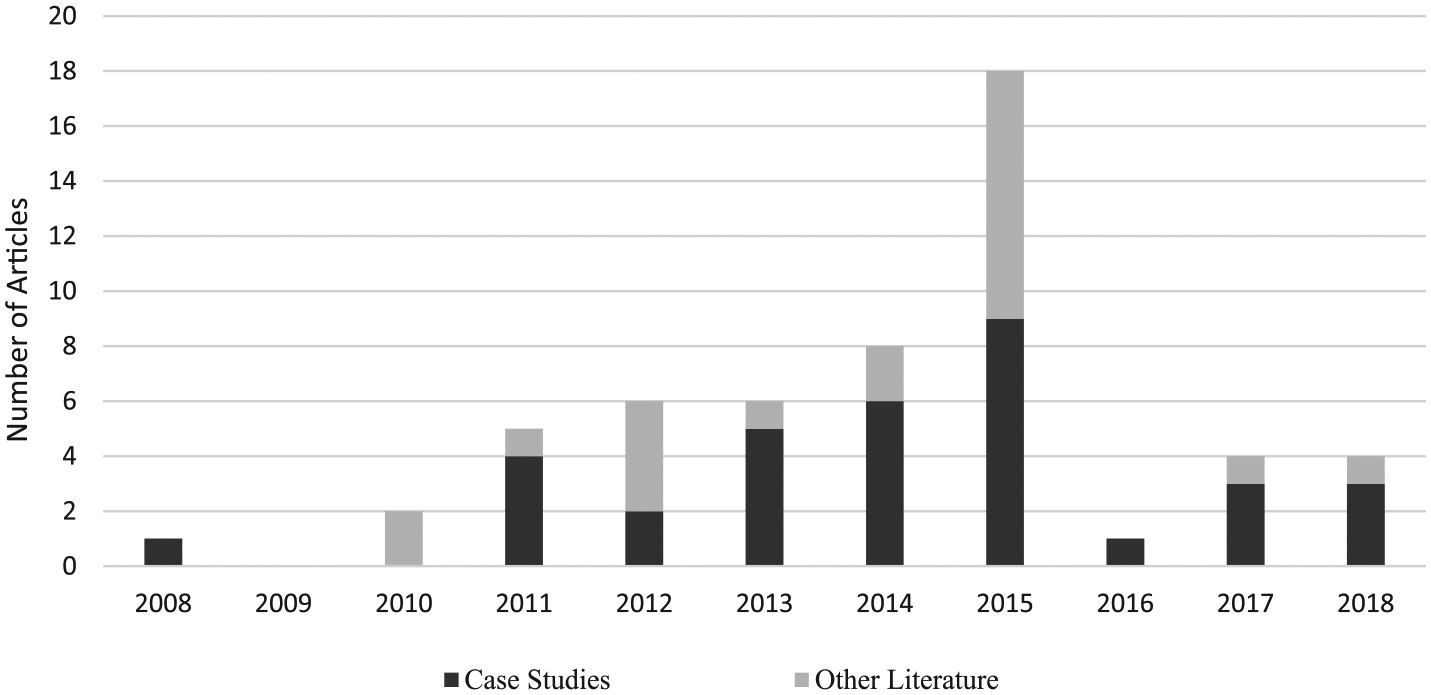
CRR studies by publication year (2008–2018).
The initial analysis assessed basic framing categories including manuscript type, geographical focus, relocation scale and form, research topic and questions, methods, author discipline, and climate hazards. The articles were then analyzed in relation to two specific questions: How did the authors conceptualize the origins of CRR and what were their conclusions about its functions? As themes emerged, I returned to the literature to examine their positions.
The diverse geography of CRR
Certain cases have paradigmatic status in global discussions about CRR (Connell, 2016; Marino, 2012). These include the Inuit villages of Shishmaref and Kivalina in Alaska and low-lying islands in the Maldives, Kiribati, and Papua New Guinea (PNG) which are, on short and long-term scales, respectively, exposed to the dramatic risk of complete abandonment resulting from sea-level rise, storms, and other severe climate-driven hazards (Bronen and Chapin, 2013; Roberts and Andrei, 2015). This review, however, demonstrates that the geographies of CRR discourse and practice extend far beyond these familiar cases.
Terms and definitions
First, it is important to define what CRR is. I begin by distinguishing relocation from other forms of population movement driven by environmental change. I also make a critical distinction between two relocation forms (resettlement and redistribution), which have been overlooked in CRR research and policy. I explain the value of the term “climate-related relocation” and propose a comprehensive definition. Finally, I briefly survey the diverse geographies of CRR according to the reviewed literature.
Environmental change and population movement
Population movement encompasses several overlapping, frequently conflated analytical categories. Following widely accepted definitions within the environment-migration literature, relocation refers to the planned, state-led process of permanently moving people and infrastructure to another place (Bukvic, 2015; UNHCR et al., 2015), while migration and displacement, respectively, refer to primarily voluntary and primarily forced movements stemming from decisions made by dislocated people, not the state (Nansen Initiative, 2015). Relocation is also distinct from evacuation, abandonment, and retreat. Retreat is a form of state-encouraged voluntary migration undertaken in a piecemeal fashion, usually in high-income countries (Abel et al., 2011; Bukvic, 2015); abandonment connotes a lack of planning and a multi-stage process of localized population decline (McLeman, 2011). Evacuation is temporary, initiated rapidly, and targets anyone in harm’s way (including tourists) (McAdam and Ferris, 2015). These are qualitatively different from how CRR is understood, that is, as a planned, permanent, and joint movement of residents (Bukvic, 2015). Finally, CRR refers to the direct use of planned relocation as an adaptation, unlike “second-order” relocation indirectly resulting from mitigation or other adaptation efforts (McDowell, 2013).
Resettlement and redistribution
We must further distinguish two sub-forms of relocation: resettlement and redistribution. Broadly,
Resettlement occurs when governments move people away from places they are not “supposed” to be. 3 Historically, resettlement has resulted from large state projects, like dam construction or national park creation (McDowell, 2013), and often takes place over long distances (Van Leeuwen, 2001).
Redistribution refers to policies that group populations in planned villages, either by agglomerating people previously living in scattered settlements (i.e. villagization) (De Wet, 2012) or constraining mobile people (i.e. sedentarization) (Salzman, 1980). This sociospatial reorganization, which takes place over fairly short distances (Van Leeuwen, 2001), is intended to transform lives and livelihoods in ways that meet state goals associated with development, environmental management, and/or population control (Scott, 1998).
State-led resettlement and redistribution have historically been involuntary (McDowell, 2013; Van Leeuwen, 2001). In the case of villagization, an authoritarian, high-modernist government is typically requisite because, to enact such radical policies, states need organizational capacity, ambition, and the ability to coerce a subdued population (Scott, 1998). Regardless of form, planned relocation has typically resulted in negative outcomes for project-affected people, sometimes catastrophically so (De Wet, 2012). The concept of “adaptive relocation” is therefore inherently somewhat paradoxical.
The distinction between resettlement and redistribution is almost entirely absent in both CRR policy discourse and the reviewed literature. Although several articles discuss CRR efforts involving redistribution (Tables 1 and 2), only one author (Arnall, 2018) makes explicit note of this form. The majority of the literature examines resettlement projects, which are often synonymously termed “relocation.”
CRR literature in inland geographies.
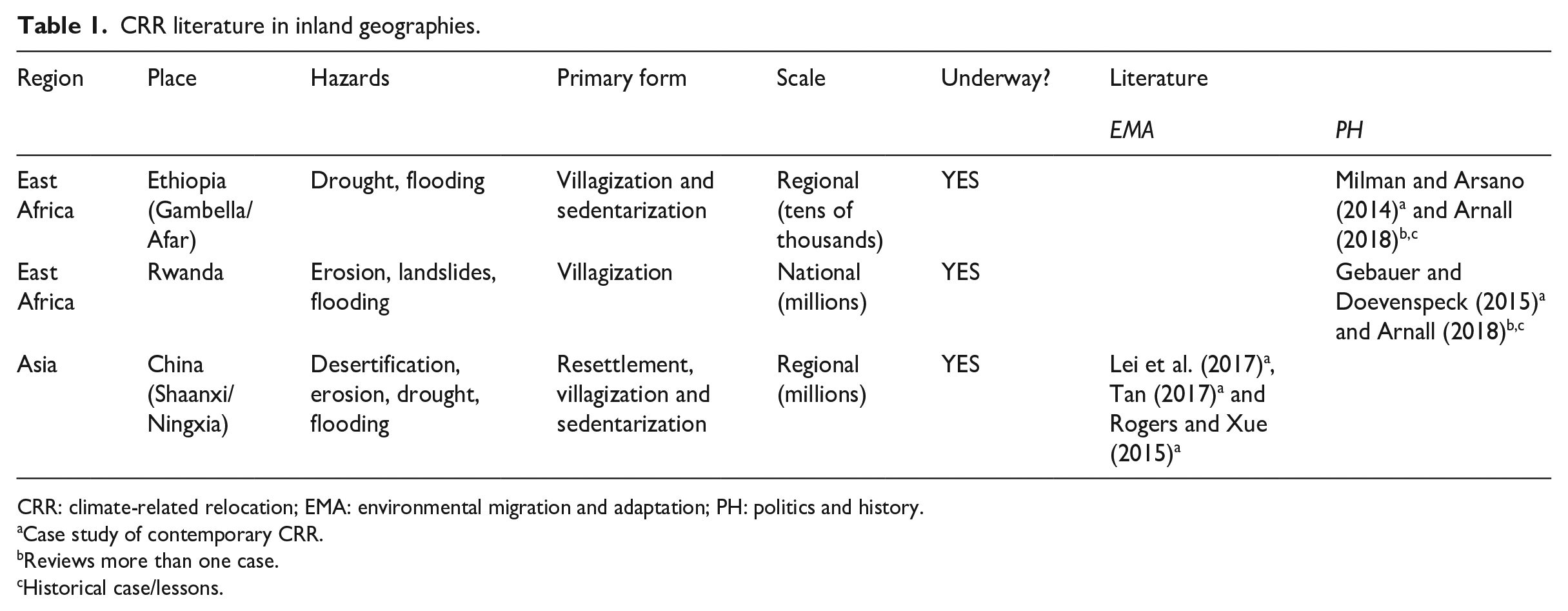
CRR: climate-related relocation; EMA: environmental migration and adaptation; PH: politics and history.
Case study of contemporary CRR.
Reviews more than one case.
Historical case/lessons.
CRR literature in coastal, island, and riverine geographies.
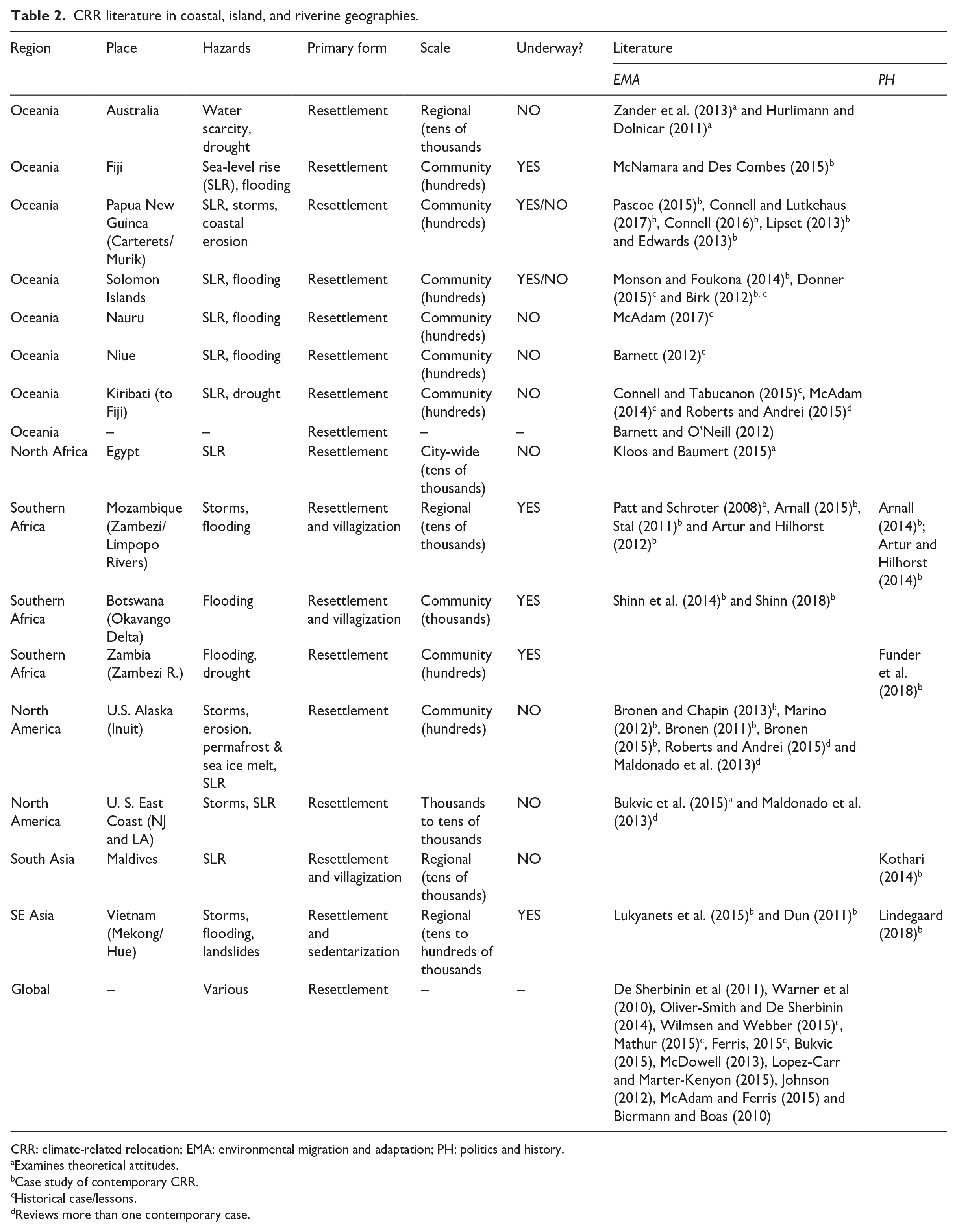
CRR: climate-related relocation; EMA: environmental migration and adaptation; PH: politics and history.
Examines theoretical attitudes.
Case study of contemporary CRR.
Historical case/lessons.
Reviews more than one contemporary case.
This is a critical gap in our understanding (Arnall, 2018). I argue, throughout this review, that relocation form results in significant variation in CRR processes. Climate vulnerability is a combination of exposure to hazard, the sensitivity of socioenvironmental systems to stress, and adaptive capacity, that is, the ability to successfully respond to change (Smit and Wandel, 2006). Climate-related resettlement (section “The environmental migration and adaptation (EMA) framework”), which moves people away from environmentally hazardous areas (often in coastal and island regions), is typically understood as reducing exposure (Artur and Hilhorst, 2014; Bronen, 2011; Zander et al., 2013). Unlike resettlement, climate-related redistribution (section “The political-historical (PH) framework”) reorganizes people within hazardous spaces (often in inland areas) and primarily seeks to address sensitivity and adaptive capacity (Arnall, 2018; Marter-Kenyon, 2018; Milman and Arsano, 2014).
Resettlement often leads to more agglomerated populations, so there is some analytical overlap with redistribution. In the context of adaptation, CRR sometimes involves sedentarizing nomads or resettling people away from floodplains and steep hillsides, then villagizing them in pre-planned settlements (Milman and Arsano, 2014; Rogers and Xue, 2015; Stal, 2011). The qualitative differences between resettlement and redistribution (De Wet, 2012) must be further investigated in this context. For the purposes of this review, however, what matters is that officials in charge of making and financing relocation decisions consider both as adaptive solutions. It is therefore appropriate to combine them under the umbrella of “climate-related relocation.”
Why “climate-related relocation”?
The term “climate-related relocation” best captures the heterogeneous nature of planned movements associated with adaptation. Relocation refers to movement within space but, compared to “resettlement” or “redistribution,” is less associated with a specific form. 4 Here, relocation is understood as “climate-related” when climate risks and opportunities (real or imagined) are mobilized by actors engaged in relocation discourse and practice. Using “climate-related” instead of “induced” or “driven” leaves open the possibility that climate change inspires relocation through physical impacts as well as the social construction of problems and solutions (section “The PH framework”).
Defining CRR
With a few exceptions (e.g. Bukvic, 2015; Ferris, 2015; McAdam and Ferris, 2015; McDowell, 2013), the reviewed articles do not define relocation in the context of climate adaptation. Nonetheless, most scholars (section “The EMA framework”) implicitly share the understanding of CRR as defined by the 2015 Bellagio Consultation of experts (UNHCR et al., 2015: 5; their emphasis): a planned process in which persons or groups of persons move or are moved away from their homes, settled in a new location,
In light of recent research (section “The political-historical (PH) framework”), I propose the following modification: Planned relocation is a state-led or supported process in which groups of people are moved from their homes or territories and settled, villagized, or sedentarized in a new place. Relocation is climate-related when planners cite adaptation as one of the primary drivers of movement. Climate-related relocation occurs within national borders and is intended to be permanent.
In alignment with the reviewed articles (and the Bellagio definition, for the most part), the modified definition characterizes CRR as a planned, state-led, or supported population movement that takes place within national borders. 5 No claims are made about whether relocation decisions are initiated from the bottom-up or top-down, or whether they are proactive or reactive (post-disaster). 6 The definition is also neutral to the scale of CRR, other than that it takes place at the community level or higher.
In other ways, my proposed definition diverges from certain strands of thought. First, it is value-neutral. Since many scholars argue coercive or forced relocation cannot be adaptive, Bukvic (2015) proposes a definition that includes voluntary participation. Others disagree, noting states may assume a moral responsibility to relocate their citizens even when they do not want to go (Arnall, 2018; McAdam and Ferris, 2015). I view the issue of voluntariness as too value-driven: evidence shows CRR is often not voluntary (Gebauer and Doevenspeck, 2015; Lindegaard, 2018; Milman and Arsano, 2014). For the same reason, the proposed definition, unlike the Bellagio definition, is neutral on the question of reconstruction following relocation. In some cases, relocated people are given land but not houses or resources for rebuilding (Funder et al., 2018; Shinn et al., 2014). Second, popular definitions of CRR make normative claims about the relationship between planned movement and adaptation, for example, that it is “undertaken to protect people from risks related to . . . the effects of climate change” (my emphasis, UNHCR et al., 2015). However, recent scholarship (section “Findings”) shows that adaptation discourse can mask ulterior motivations for relocation. In my definition, therefore, relocation is considered “climate-related” when adaptation is cited by planners as a primary motivation. Third, the definition is sensitive to spatial form. Emphasizing that people are moved away from their territories reflects the idea that CRR separates people from their resources, ways of life, and identities, not only their homes (Lindegaard, 2018; Milman and Arsano, 2014). Emphasizing that people may be villagized, or sedentarized draws attention to redistribution, which has been overlooked in CRR research and policy (Arnall, 2018). Fourth, the permanent character of CRR is well-accepted (UNHCR et al., 2015). I qualify that CRR is intended to be permanent because of the observation that the irreversibility of relocation is often undermined by people returning to their original homes (Patt and Schroter, 2008; Shinn, 2018). Finally, this definition is intentionally broad; adjectives can be added to qualify particular efforts, for example, voluntary, coercive, or forced; preventive or responsive.
Where and how is CRR unfolding?
Nearly all of the research (Tables 1 and 2) focuses on CRR in the Global South and/or indigenous communities in wealthy countries; most studies also examine rural areas. 7 It seems reasonable that CRR will primarily affect poorer places (Ferris, 2015), which lack the capacity for in situ adaptations like infrastructural defenses or irrigation systems (Wisner et al., 2003). Countries in the Global South also have a particular proclivity for using relocation to address environment and development problems (McDowell, 2013). Three articles examine urban attitudes to relocation in the United States (Bukvic et al., 2015), Australia (Hurlimann and Dolnicar, 2011), and Egypt (Kloos and Baumert, 2015), finding respondents were reticent—though not entirely opposed—to relocation under future climate scenarios. As climate change progresses, we will increasingly see wealthier communities pushing for relocation support (Bukvic et al., 2015).
A range of landscapes, relocation forms and climate hazards are examined. Notably, 80% of the empirical case studies examine CRR (mainly in the form of resettlement) as an adaptation to sea level rise, erosion, flooding and severe storms in coastal, island, and riverine geographies. The non-case study literature is also heavily skewed toward these places (Table 2). Alaska, coastal Mozambique, and various low-lying island states in the Pacific and Indian Oceans figure prominently. The remainder of the literature (Table 1) focuses on the rural interiors of Africa and Asia, where governments have identified relocation (mainly in the form of redistribution) as an adaptation to deteriorating environmental conditions affecting the viability of pastoral and agriculture-based livelihoods.
The literature also reveals the diverse spatial and temporal scales of CRR discourse and practice (Tables 1 and 2). CRR can be voluntary or involuntary, enacted by authoritarian states (e.g. Gebauer and Doevenspeck, 2015; Milman and Arsano, 2014) or, upending the ordinary story of planned relocation, demanded by communities themselves (e.g. Bronen and Chapin, 2013). Relocation can be highly reactive, enacted as a “last resort” when climate hazards imminently threaten settlement viability (e.g. Marino, 2012). However, emerging research (section “The PH framework”) shows climate change can inspire, and lead to financing for, relocation even when environmental threats do not immediately threaten in situ adaptation. Most studies describe one-off projects targeting small communities (e.g. in Alaska and small island states). In most cases, relocation is a medium- to long-term theoretical concern existing at the level of policy debate or in the imagination (McAdam, 2017). But climate change is also accelerating ongoing redistribution policies. In the parts of Asia and Africa where redistribution is framed as adaptive, CRR is envisioned on massive scales: proactively targeting tens of thousands, even millions, of people (Table 1).
Conceptual approaches and implications
Scholars draw on two competing analytical frameworks to explain the origins and functions of CRR (Figure 2). The first centers the relationship between environmental change, migration, and adaptation (“the EMA framework”). In this framing, relocation is a response to climate hazards threatening widespread displacement; its primary function is to provide adaptation by reducing hazard exposure. The EMA framing contributes to a dominant discourse promulgated by international policy elites, namely that relocation should be a voluntary, last resort effort to preserve lives and human security. The second framing destabilizes this framework and its associated discourse. Drawing on several cases where climate displacement is not the primary driver of CRR, and where relocation is both proactive and frequently coercive, the political-historical (PH) approach shows that history, politics, power, and discourse influence the meaning of climate adaptation, the kinds of interventions enabled, and the varied outcomes that result.
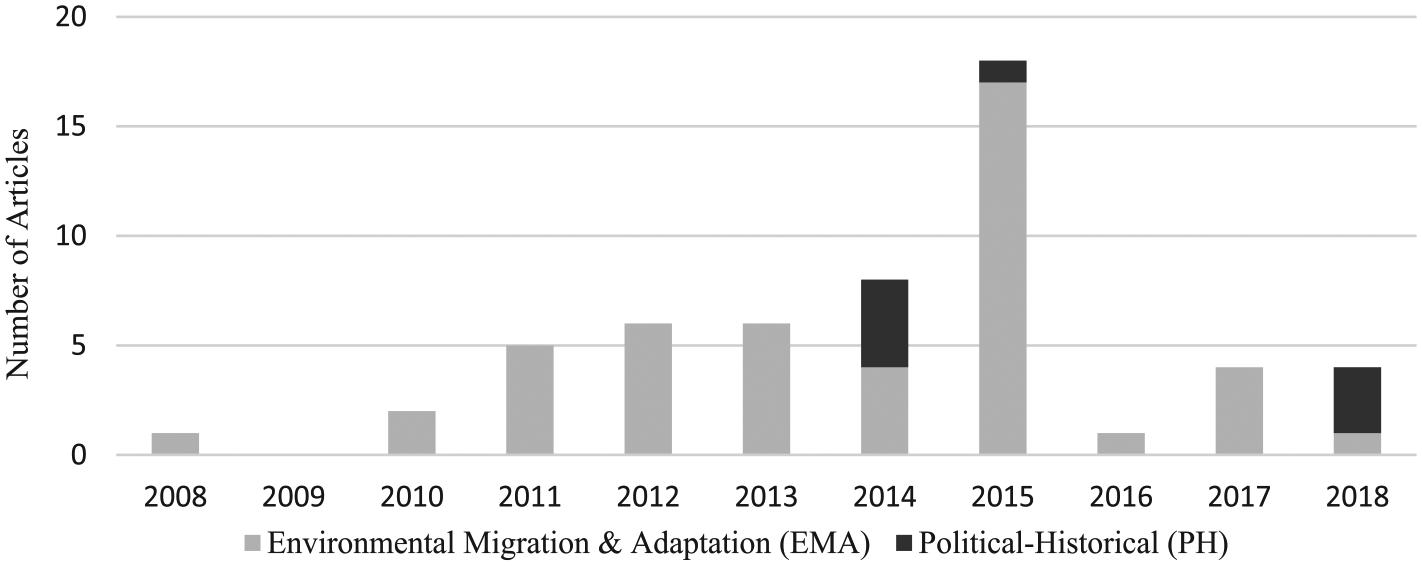
CRR studies by conceptual framework.
This conceptual divide is well-illustrated through the example of the Maldives, one of the most (in)famous cases of CRR (Arnall and Kothari, 2015). From the EMA perspective, CRR discourse is driven by sea level rise, which may eventually make it impossible to live on certain islands. Unmanaged displacement threatens the country’s culture and sovereignty (Barnett and Webber, 2010). The government has therefore framed relocation as a matter of survival (Kothari, 2014). Within the critical PH framework, however, CRR has emerged because the Maldives government faces difficulties managing populations spread over far-flung islands and has, for decades predating climate fears, engaged in efforts to consolidate communities (Kothari, 2014). In this framing, climate change operates discursively, furthering support for a relocation policy which, far from a last resort adaptation, is a proactive method of servicing the state’s political-economic goals.
Whether CRR is driven by environmental hazard or biopolitics (or both) is an interesting analytical problem. It also matters for millions of people around the world. The way CRR is conceptualized determines how its scope, targets, and techniques are defined (Lindegaard, 2018) and, subsequently, the issues, questions, and data that emerge at the forefront of debate. In the following sections, I elaborate on each framework, presenting findings from the literature and their implications for research and policy.
The environmental migration and adaptation (EMA) framework
Within the EMA framing, the logic of CRR is as follows. Climate change produces increasingly hazardous conditions which impact the sustainability of settlements and, in some cases, provoke migration (Gemenne, 2011). Migration can be a positive adaptation (Black et al., 2011). However, if movements are widespread, forced, ill-financed, or unplanned, problems can arise for migrants, receiving areas, and those left behind (Barnett and Webber, 2010). Where change is abrupt, or people are unprepared, migration can be stressful or even impossible, resulting in permanent migration, “trapped” populations, and loss of life, culture, and livelihood (Black et al., 2013). The idea has arisen that it might sometimes be preferable, cost-effective, and ethical for governments to assist vulnerable communities to move en masse, in an organized and externally supported fashion, away from hazardous areas (Ferris, 2015). CRR is therefore understood both as a form of environmental migration itself, and a way of avoiding other, less desirable forms of environmental migration and displacement; in both cases, adaptation is the intended outcome.
Findings
The vast majority (85%) of the literature analyzes CRR through the lens of EMA (Figure 2). Effectively, this work evaluates two central questions: (a) will climate hazards provoke displacement severe enough to demand relocation and (b) what are relocation’s merits as an adaptation? Evidence is mixed, leading to a division between scholars who believe relocation is reasonable under certain circumstances (“strong EMA”), and those who consider it a failure of adaptation (“weak EMA”). Nonetheless, this research has resulted in a fairly cohesive understanding of what CRR is and why, when, and how it should be undertaken (section “Strong” versus “Weak EMA”).
Climate displacement as a driver of relocation
The environment-migration framing prompts an analytical focus on the frequency, timescale, and duration of predicted climate hazards, and their subsequent impacts on population displacement. Physical climate-related impact is thus a necessary precondition of CRR, and relocation is expected to emerge in places where there is a high likelihood of unplanned migration and/or trapped populations (Adger et al., 2015). Debates between EMA scholars largely stem from disagreement about the relationship between environmental change and migration, and the extent to which climate hazards will threaten in situ adaptation (De Sherbinin et al., 2011). It seems obvious that in certain places, at certain times, climate change will force settlement abandonment (McLeman, 2011). According to all observers, this is already the case in parts of the Arctic (Marino, 2012). Skeptics argue that the need for CRR is frequently overstated. They are supported by a large body of evidence highlighting the resilience and flexibility of human systems in response to environmental pressure (see, for example, Adger et al., 2001; Batterbury and Forsyth, 1999; Tiffen et al., 1994). In the context of coastal geographies, researchers have noted that severe storms typically result in temporary, not permanent, displacement (Gemenne, 2011); most scenarios suggest inundation from sea-level rise is still several decades off (Barnett and O’Neill, 2012); and the majority of out-migration is driven by economic opportunity, not the climate (Connell, 2016; Mortreux and Barnett, 2009).
The adaptive value of relocation
EMA scholars debate relocation’s merit relative to other adaptations (Tan, 2017). While relocation may reduce exposure to climate hazards, it is also a violent process (Oliver-Smith, 1991). Researchers draw on evidence from involuntary development-induced displacement resulting from infrastructure and conservation programs (Mathur, 2015; Wilmsen and Webber, 2015), post-disaster relocation (Connell and Lutkehaus, 2017; Ferris, 2017), and colonial resettlement schemes (Birk, 2012; Connell and Tabucanon, 2015; Donner, 2015; McAdam, 2014) which show that planned resettlement unavoidably results in livelihood decline and myriad economic and social costs for affected people (Cernea and McDowell, 2000). Since research indicates voluntariness and self-determination are critical for mitigating the negative outcomes of relocation (Barnett and O’Neill, 2012; Pascoe, 2015), several studies focus on the preferences of people targeted for CRR. Results from Egypt (Kloos and Baumert, 2015), Mozambique (Patt and Schroter, 2008), the United States (Bukvic et al., 2015), and Australia (Hurlimann and Dolnicar, 2011; Zander et al., 2013) suggest climate-vulnerable people prefer not to move. Still, physical and psychological thresholds may be reached when climate impacts become extremely severe: communities in Alaska (Bronen and Chapin, 2013), Fiji (McNamara and Des Combes, 2015) and the Carteret Islands (Pascoe, 2015) have lobbied their governments to assist them in relocation, considering planned migration “the only sustainable option” (Marino, 2012: 374).
EMA scholarship highlights significant practical barriers to CRR. Relocation is expensive: up to $200 million for relocating Shishmaref, an Alaskan village of a few hundred people (US Army Corps of Engineers, 2006). Whether communities can access funding for large-scale relocation is a critical concern (De Sherbinin et al., 2011; Lipset, 2013; McAdam, 2014). A parallel effort focuses on legal and rights issues (Johnson, 2012). Guidelines exist for safeguarding populations exposed to resettlement, 8 but it is unclear how these apply to CRR (McDowell, 2013), especially when sovereign and indigenous rights are at stake (Maldonado et al., 2013; Marino, 2012; Stratford et al., 2013; Warner et al., 2010). Research also highlights institutional barriers to relocation (Monson and Foukona, 2014). The U.S. government has struggled to find a mandate for CRR in Alaska: no agency is equipped to manage preemptive relocation, existing policies encourage in situ post-disaster rebuilding, and the primary hazard affecting settlements—erosion—is not covered under federal statutes (Bronen and Chapin, 2013; Marino, 2012). CRR efforts in PNG have collapsed due to corruption, mismanagement, and land disputes (Connell and Lutkehaus, 2017; Lipset, 2013). Scholars also emphasize the challenge of finding suitable relocation sites (Bronen and Chapin, 2013; Lei et al., 2017; Stal, 2011). While it is short-sighted to resettle people to places that will themselves become hazardous (De Sherbinin et al., 2011), moving them over long distances is also unwise (Barnett and O’Neill, 2012; Zander et al., 2013). Since relocation is costly and people prefer to stay in their original homes, this generates concern for “getting the timing right,” and for ensuring adaptations reflect the rights and preferences of affected groups (including those in receiving areas). Nonetheless, empirical work in Mozambique (Arnall, 2015), China (Lei et al., 2017; Tan, 2017), and Botswana (Shinn, 2018) demonstrates the difficulty of guaranteeing adaptation for everyone given socially differentiated vulnerability and complex local politics in origin and receiving communities.
“Strong” versus “weak” EMA
The EMA literature can be approximately divided into two camps, defined by their stance vis-à-vis whether relocation is a necessary or appropriate response to the physical threats of climate change.
The first group (“strong EMA”) believes that climate hazards will lead, or have already led, to situations where relocation can be a reasonable, even desirable, adaptation option (UNHCR, 2017). Strong EMA focuses on planning ahead, assessing the physical threat and options, and securing the legal structures and institutions that need to be put in place to manage CRR (e.g. Biermann and Boas, 2010). Scholars advancing this discourse comprise an uneasy coalition. One segment—often from the fields of economics and planning (e.g. Kloos and Baumert, 2015; Lukyanets et al., 2015)—fully accepts the theory that climate change will eventually provoke mass displacement; they view relocation as a technical exercise focused on risk management (Sherman et al., 2016). This is the view advanced by most national governments engaged in CRR discourse (see, for example, official statements from the Maldives (Government of Maldives (GoM), 2007) and Kiribati (Government of Kiribati (GoK), 2013)). The other segment attends to the nuanced local contexts that influence relocation processes; they accept the need for CRR, but with less enthusiasm. These researchers work in areas experiencing significant near-term displacement threats, including parts of Alaska and the Carteret Islands. Some are agnostic to the question of whether relocation is just (e.g. Roberts and Andrei, 2015); others believe it to be unjust, but also the only remaining option (e.g. Maldonado et al., 2013). Strong EMA often accepts that the “last resort” has already arrived (Stal, 2011) and urges anticipatory CRR in advance of further disaster (Biermann and Boas, 2010; Bronen, 2015).
The second group (“weak EMA”) finds concern about CRR to be premature, overhyped, and defeatist; they argue relocation should, more accurately, be considered a failure of adaptation. Some weak EMA scholars accept that climate change will drive migration, but are wary of the likelihood that planned relocation can be conducted successfully (Arnall, 2015) and are also concerned that debates ignore the rights of people who either do not want to move (Barnett, 2012) or who traditionally adapt to environmental change through out-migration (Farbotko and Lazrus, 2012). Others—particularly those working in island regions—believe existential displacement is a distant concern, especially when it comes to the need to relocate entire countries in response to sea-level rise (Barnett and O’Neill, 2012; Donner, 2015). They argue apocalyptic relocation discourses may preclude investment in global mitigation and in situ adaptations directed at more immediate problems such as erosion and soil salinization (Connell, 2016).
Producing a normative-managerial discourse
While strong and weak EMA scholars debate the need for CRR, there is significant overlap in their understanding of what it is: an adaptation intended to reduce hazard exposure and unplanned migration by resettling communities and rebuilding them in safer areas. There is also agreement regarding what CRR should aspire to. First, most EMA scholars agree relocation is difficult to implement and should be a “last resort” (McNamara and Des Combes, 2015), with weak EMA specifically urging efforts to avoid that scenario. 9 Second, while weak EMA is more likely to center justice, there is consensus regarding certain norms: namely that, for relocation to be adaptive, it must be voluntary and participatory, and involve reconstruction of lives, infrastructure, and livelihoods (UNHCR et al., 2015). Finally, while weak EMA scholars are cautious about the need for and adaptive potential of relocation, there is consensus that governments have a responsibility to help people move, and that it is important to define financial, legal, and institutional mechanisms for ensuring “good” relocation when governments and communities do decide to move (Bronen, 2015; Ferris, 2017).
This understanding has been adopted, shaped, and promulgated by a discourse coalition that includes international agencies 10 and the vast majority of scholars (Tables 1 and 2) (Arnall, 2018; Arnall and Kothari, 2015). As a result, it has been codified in several normative policy statements, for example, the Sanremo and Bellagio expert consultations (UNCHR, 2014; UNHCR et al., 2015), and the Peninsula Principles on Climate Displacement, which are oriented around the threat that climate change will contribute to population displacement, and assert CRR should only be implemented when absolutely necessary, as a voluntary process involving legal protection, international co-ordination, local consultation, and respect for human rights (Peninsula Principles, 2013).
This perspective is both normative and managerial. It focuses on what should be (on rights and preferences), and priority is given to assessment, consultation, planning, and coordination. As described in sections “The PH framework” and “Incorporating critical perspectives,” the technocratic nature of this discourse may increase maladaptive outcomes following CRR.
The political historical (PH) framework
A budding effort seeks to historicize, politicize, and contextualize the role of climate change in relocation policy (Lindegaard, 2018). In the PH framing, climate-induced displacement is not the central driver of CRR; rather, its emergence lies in historical contingencies, the discursive and social construction of risk, and the (bio)politics of environment and development. PH scholarship also provides a new window into planner’s perspectives on the use of redistribution as an adaptation.
PH scholars work within the “critical adaption” framework (Sherman et al., 2016), meaning that attention is paid to how ideas about climate change and adaptation are developed, and how they encounter, and are modified by, social processes and everyday practices (Artur and Hilhorst, 2012; Hulme, 2009). The reality of climate change is not ignored; rather, its social and political nature is centered (Sherman et al., 2016). Critical adaptation has particular salience for CRR considering much of the discourse, especially in islands, is future-focused, anticipatory, and based in the imaginary more than present reality or empirical observation (Farbotko and Lazrus, 2012).
Of the reviewed articles, I classify just eight (15%) as fully situated in this approach (Figure 2). 11 One article (Arnall, 2018) reviews several, mainly historical, cases of redistribution in Africa and Asia, 12 concluding (as I do here) that this analysis perturbs the normative-managerial understanding of CRR presented in section “Producing a normative-managerial discourse.” The remainder are empirical case studies, of Mozambique (Arnall, 2014; Artur and Hilhorst, 2014), Ethiopia (Milman and Arsano, 2014), Vietnam (Lindegaard, 2018), Rwanda (Gebauer and Doevenspeck, 2015), the Maldives (Kothari, 2014), and Zambia (Funder et al., 2018).
There are several commonalities between the cases: they are all top-down, regional, or national-scale (targeting tens of thousands of people or more); involve at least some element of population redistribution (villagization and/or sedentarization) 13 ; and exhibit strong ties to pre-existing relocation efforts. In Rwanda, Ethiopia, and Vietnam, CRR is an undisrupted continuation of a coercive or involuntary environment and development-related relocation policy reframed as adaptive. Notably, with the exception of the Maldives, the countries examined within the PH framework have progressed to—or even past—the stage of physically relocating people.
Findings
PH scholarship elucidates three interrelated issues: (1) the meaning of CRR as a historical process, (2) the adaptive and extra-adaptive functions of CRR, and (3) the relationship between discourse and CRR practice.
CRR as a historical process
Within the dominant EMA discourse, CRR is typically seen as a relatively novel response to a very novel problem (Arnall, 2018; Kates et al., 2012; McAdam, 2014). Critical perspectives, by contrast, shed light on the relationship between CRR and relocation histories.
States with existing proclivities for relocation as a technique of development and environmental management appear more likely to pursue CRR, as well as more capable of doing so. This is partly self-evident: climate vulnerability reflects, and indeed stems from, the “wicked problems” of poverty and environmental degradation; thus, planned adaptation and state-led development often involve similar activities (Agrawal and Lemos, 2015). States with experience engaging in planned relocation may also be more likely to view CRR as within their remit. Rather than a response to new global adaptation framings, Lindegaard (2018) argues that 21st-century sedentarization of ethnic minorities in Vietnam is an outcome of “long-standing political rationalities of controlled mobility as a fitting power and integrating marginal peoples as an ideal” (p. 169). In the six countries analyzed through the PH framework, relocation histories seem to have engendered a particular set of worldviews and institutions amenable to large-scale movement in response to climate change, allowing them to proceed with CRR whereas, for example, American Inuit communities (Bronen and Chapin, 2013) (who nonetheless face more severe hazards) cannot.
Although EMA scholarship has not prioritized historical relationships, some studies using this lens imply that prior relocation conditions the experiences and perspectives of local people. Sometimes, the history of forced relocation against communities has directly resulted in their vulnerability to CRR. Inuit settlements currently facing abandonment largely find themselves in that situation because they were forced to sedentarize on barrier islands in the early 1900s, undermining the mobility strategies traditionally used to adapt to extreme weather (Marino, 2012). Donner (2015) documents the enduring cultural and psychological trauma experienced by people resettled from Kiribati some 60 years ago. These histories may impact how populations view relocation, influencing their willingness to move (McAdam, 2014; Shinn, 2018; Zander et al., 2013), and perhaps also their capacity to resist.
Significantly, I find that, in almost every case analyzed in this review (regardless of the underlying analytical framework), CRR discourse and practice are in some way linked to historical, state-led programs of population relocation (see Table 3 for example).
Historical resettlement efforts in contemporary CRR-exposed countries.
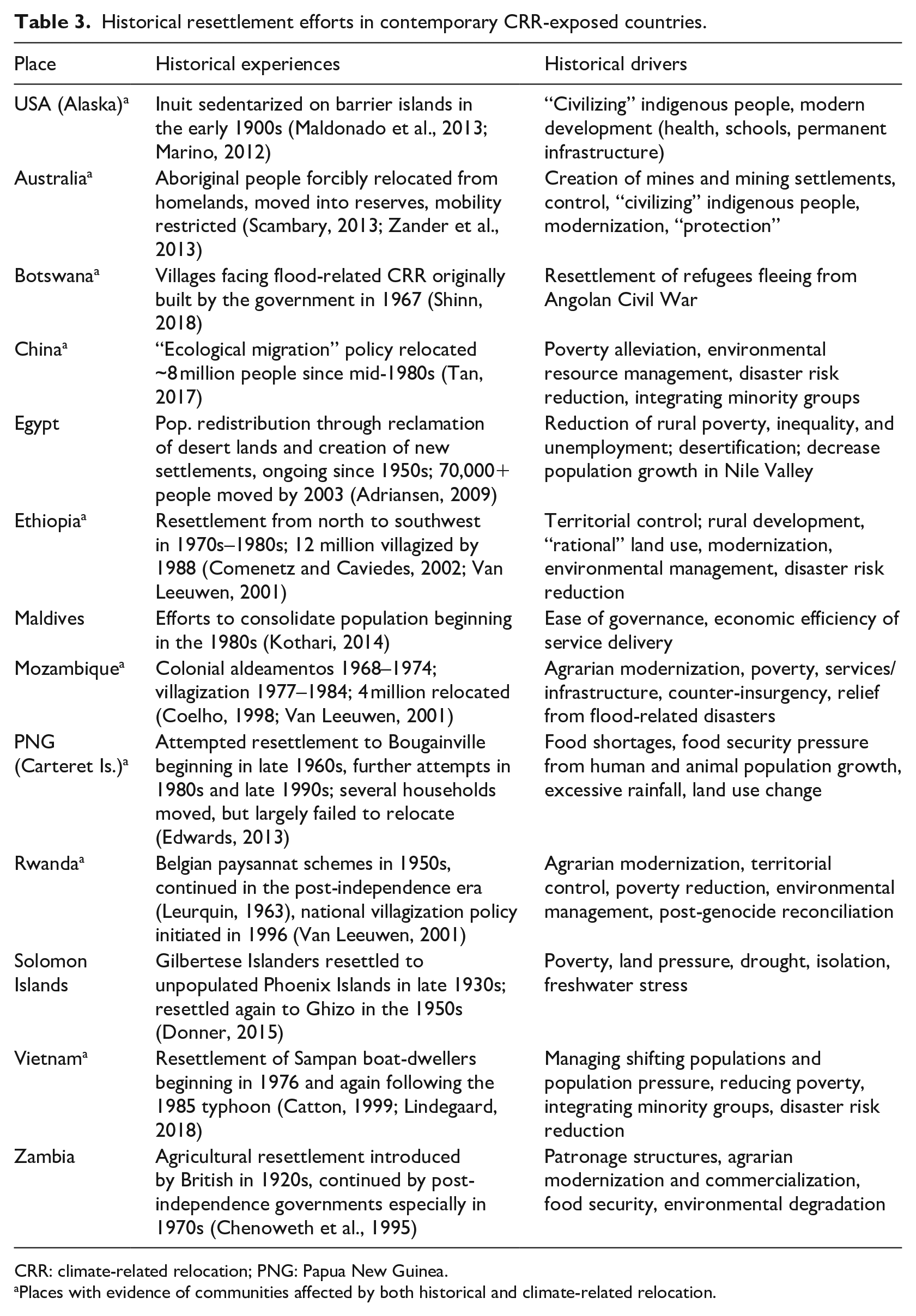
CRR: climate-related relocation; PNG: Papua New Guinea.
Places with evidence of communities affected by both historical and climate-related relocation.
(Extra)adaptive functions of CRR
In the six cases analyzed by PH scholarship, environmental migration figures much less prominently as a driver of relocation, and the functions of CRR extend beyond disaster risk reduction. In three of the cases—Rwanda, Zambia, and Vietnam—planners make no association between CRR and the risk of permanent displacement. 14 Environmental migration is mentioned as a driver of villagization in Ethiopia, but not its primary one (Government of Ethiopia (GoE), 2010a, 2010b). In Mozambique, officials do argue relocation will reduce the cost of flood-related evacuation, but local people, scientists, and donors concur continued habitation is preferable (Arnall, 2014; Artur and Hilhorst, 2014). Although discourse about the Maldives frequently centers on the potential that sea-level rise will force settlement abandonment (GoM, 2007), the threat is not immediate and does not explain the urgency with which the government is pushing consolidation efforts (Kothari, 2014). How, then, can we explain the emergence of proactive CRR discourse and practice in these countries?
In the case of population redistribution, villagization, sedentarization, and consolidation are envisioned as encouraging transitions away from climate-sensitive livelihoods, facilitating the delivery of services and infrastructure, and generally transforming and modernizing rural people in ways that reduce vulnerability (Arnall, 2018). State actors employing redistribution (Tables 1 and 2) advance it as a strategy for addressing sensitivity and adaptive capacity and, to varying degrees depending on the case, exposure as well, for example, by resettling people into organized villages in nearby locations deemed less hazardous (Gebauer and Doevenspeck, 2015; Lei et al., 2017; Milman and Arsano, 2014). Political actors view the development benefits theoretically conferred by ongoing redistribution policies as amounting to improved climate resilience and therefore consider them pro-adaptive (Arnall, 2018). Climate change, in other words, lends additional urgency to existing relocation efforts. Donors have largely agreed, supporting “redistribution as adaptation” in several countries. 15
Beyond this, critical perspectives draw attention to the extra-adaptive functions of CRR, regardless of form. Reflecting the broader history of population relocation, governments view CRR as a multipronged tool for addressing more than just adaptation. Some of these relate to military aims: “adaptive” villagization in Ethiopia addresses political unrest (Milman and Arsano, 2014) among the same ethnic group targeted by earlier forced relocation policies (Human Rights Watch (HRW), 2012). Other goals relate to cultural transformation. Efforts to sedentarize Vietnamese Sampan boat-dwellers are intended to integrate ethnic minorities as well as promote adaptation to coastal hazards (Lindegaard, 2018). CRR can also facilitate conservation and environmental management, as it does in Rwanda (Gebauer and Doevenspeck, 2015), China (Lei et al., 2017), and Ethiopia (Milman and Arsano, 2014).
Most worryingly, relocation can service the political-economic goals of powerful actors. Relocation reorders nature and society in ways that make them more legible and homogeneous (Scott, 1998), thereby facilitating socio-environmental control (Arnall, 2014; Kelly, 2011). Artur and Hilhorst (2014) situate Mozambique’s flood resettlement programs, which are consistently undermined by the affected population, “as a continuation of a history of resettlement to enhance control and modernization of rural folks” (p. 361). Kothari (2014) argues that the Maldives government proposal to relocate its population from 200 islands onto 10–15 central islands has mostly been driven, not by sea-level rise, but by long-standing priorities related to “the diseconomies of scale and the inefficiency of distribution of social services and basic infrastructure on islands with a small population” (Kothari, 2014: 136). Relocation involves land redistribution, often benefiting capitalist production (Oliver-Smith and De Sherbinin, 2014). In Rwanda and Ethiopia, CRR releases land for commercial investment, extending the control of state and corporate actors over land and labor (Huggins, 2014; Milman and Arsano, 2014). In Zambia, adaptation imperatives interact with domestic politics in such a way that relocation furthers the central government’s authority over local chiefs (Funder et al., 2018).
These biopolitical functions help explain the apparent paradox that states continue to employ relocation when its outcomes are often dubious (De Wet, 2012). Interventions that seem to fail in their stated aims (e.g. “vulnerability reduction” or “resilient livelihoods”) may succeed in serving other, sometimes hidden, functions (Arnall, 2014; Scott, 1998).
Discourse and the (anti)politics of adaptation
Global narratives typically present climate change as a generalized, external, and physical threat to static, homogeneous groups of “poor” and “vulnerable” people (Swyngedouw, 2010). The roles of power and politics in the production of vulnerability are subsumed by what Davis (1999) calls “ecologies of fear.” As a result, climate change can “be appropriated uncritically in support of an expanding range of ideologies” (Hulme, 2008: 9). In the case of CRR, and most other responses to environmental crisis, policymakers draw on “apolitical ecologies” (Robbins, 2012) like modernization and eco-security (Smucker et al., 2015). Following the problem-solution formulations inherent to these worldviews, adaptation is framed as a technocratic exercise involving “expertly designed, neutral interventions” (Smucker et al., 2015: 40). This process is what Smucker et al. (2015), following Ferguson (1990), call “the anti-politics of adaptation.”
Reflecting this perspective, and the tradition of critical political ecology scholarship to which it belongs (e.g. Fairhead and Leach, 1995; Forsyth and Walker, 2014), PH scholars demonstrate how narratives of impending climate crisis and simplifying, apolitical framings of adaptation are mobilized to further support for relocation efforts that may have little to do with climate change. As Kothari (2014) notes, “policies based on messages of the clear and present danger of pending environmental catastrophes are perceived as non-negotiable and beyond critique” (p. 137). In many of the examined cases, existing apolitical environmental crisis narratives provide fertile ground for reframing contested relocation policies as adaptive (Table 3). In Vietnam, Lindegaard (2018) finds that the 1985 typhoon “and the specter of similar tragedies in the future, compounded by climate change, are used by officials to justify current [sedentarization]” (p. 166). Research similarly finds that, in Rwanda, global climate concerns are facilely translated though a 100-year old narrative about the relationship between natural disasters, local topography and settlement patterns, poverty, and land use practices; the result is the successful reframing of forced relocation as an innovative adaptation (Gebauer and Doevenspeck, 2015). Research shows state actors use climate threats to legitimize relocation in the Maldives, Mozambique, Zambia, and Botswana too (see Tables 1 and 2).
While policymakers employ the future of crisis as justification for solving present problems, the scientific evidence and common-sense assumptions they marshal do not always reflect reality, nor the perspectives of ordinary people regarding their own lived experience of hazards (Arnall and Kothari, 2015; Patt and Schroter, 2008). In Mozambique, planners cited “inadequate housing” as a driver of vulnerability; in fact, residents intentionally build houses that can be readily taken down, moved, and rebuilt in response to flooding events (Arnall, 2014). By simplifying the complex, political, and socially differentiated nature of climate vulnerability and adaptation, technocratic discourses overlook the spontaneous adaptations already employed by local people to deal with threats they have long faced (Smucker et al., 2015).
Within the PH framework, CRR is reframed as a political arena, that is, a space where actors at multiple levels and varying degrees of power negotiate the meaning of climate change, adaptation, and relocation (Artur and Hilhorst, 2014). Reframing adaptation as a political space helps explain why certain decisions are made and how outcomes are produced (Lindegaard, 2018; Milman and Arsano, 2014; Shinn, 2018). In Mozambique, for example, donors, preferred a “living with floods” approach allowing people to remain in place; in the end, the government implemented relocation without international financing (Artur and Hilhorst, 2014), which surely played a role in the failure of the policy (Artur and Hilhorst, 2012).
Policy implications
The critical framing problematizes the current preferred approach of “mainstreaming” adaptation and development (Milman and Arsano, 2014). In practice, mainstreaming is oriented more toward existing development goals than, for example, planning under uncertain climate conditions (Agrawal and Lemos, 2015). Since development is often not pro-poor (Sachs, 2010), the process of adaptation itself can increase vulnerability (Brown, 2011) when mainstreamed with development policies that do the same (Smucker et al., 2015). Furthermore, CRR can service other goals unrelated to climate change. Clearly, if the central goal of relocation is not adaptation, or adaptation is otherwise ill-conceived, CRR is unlikely to be adaptive. In particular, it is questionable whether population redistribution can ever be adaptive given that polices of this type are typically coercive, result in radical shifts to local coping methods, and fail to address the structural factors of vulnerability (Scott, 1998).
Doubts are also raised about “transformational” adaptation, a category to which CRR has been described as belonging (Kates et al., 2012). The IPCC recognizes the need to go beyond incremental approaches (Klein et al., 2014), that is, “doing slightly more of what is already being done to deal with natural variation in climate and with extreme events” (Kates et al., 2012). Transformational adaptation involves shifting human-environmental systems to a new state (Shackleton et al., 2015), either by introducing incremental adaptations to new places, considerably increasing their intensity and scale, or physically moving locations (Kates et al., 2012). While strong action is necessary in responding to climate threats, transformational adaptation risks (re)creating new vulnerabilities (Lonsdale et al., 2015). The scholarship reviewed here shows that adaptation discourse can enable support for relocation polices that have little to do with climate change, and in some cases produce maladaptive outcomes (Artur and Hilhorst, 2012). Critical adaptation is associated with a more radical approach, “transformative” adaptation, which “seeks to identify underlying structural causes of vulnerability that impact adaptive capacity, and to respond to climate change by directly addressing these differentiated vulnerabilities” (Shinn, 2018: 180).
Finally, PH scholarship undermines the idea that CRR will be a last resort (Arnall, 2018). Motivations aside, many governments do deem relocation a priority adaptation. Global framings of what should be considered “adaptive” are not simply implemented in a cookie-cutter fashion (Gebauer and Doevenspeck, 2015); they are translated through sociopolitical negotiation. Critical scholarship encourages us to pay attention to how CRR operates in reality, and to look for it not just in the most climate-impacted places, but in places where governments have intrinsic interests in pursuing relocation.
Discussion
Critical perspectives destabilize certain core assumptions of the prevailing EMA approach to understanding CRR; they must be incorporated in both research and policy. That said, the EMA framework maintains explanatory and prescriptive value, especially in places where relocation has already emerged as a priority adaptation in settlements whose viability is imminently threatened. Given the complexity and variability of the relationship between climate change and population relocation, a “both/and” analytical approach is requisite. I elaborate these arguments here and present some ideas for a pluralistic way of thinking about CRR.
Incorporating critical perspectives
In the dominant EMA model, CRR is an emergent property of severe climate-related exposure and vulnerability, failed in situ adaptation, and a desire for community preservation; the geography of its discourse and practice is explained by pointing to places where climate change is likely to render land uninhabitable for human settlement. Coastal, island, and riverine geographies become a natural site for discourse and research (Table 2) because the climate hazards threatening them (e.g. sea-level rise, severe storms) exhibit clearer links with climate displacement (and the need for planned relocation) than the creeping droughts or unpredictable rainfall affecting inland areas (Gemenne, 2011).
Recent scholarship based in the PH perspective shows that the EMA framing is, on its own, insufficient for explaining why, where, and when relocation emerges in the context of climate change, the forms it takes, and its intended functions. EMA fails to address why anticipatory CRR is happening in places that are not at risk of disappearing and where hazard-driven displacement is not the leading problem relocation purports to solve (e.g. the cases in inland Asia and Africa discussed in section “The PH framework” and summarized in Table 1). Furthermore, and regardless of the region, I have found that early cases of CRR are situated in places already primed by their relocation histories (Table 3). Many governments engaging in CRR have pre-existing and concurrent rationalities for relocating people, some of which reflect ideologies that have historically been anti-poor (Arnall, 2018). Climate change elevates the urgency of relocation and global attention to adaptation enables new funding streams (Fankhauser and Schmidt-Traub, 2011). Even in places where relocation is characterized as a response to existential climate threats (e.g. the Maldives and Inuit Alaska), it is impossible to separate CRR from long-standing ideologies regarding environment and development problems that involve relocation as a solution (section “The PH framework”).
The EMA literature is disconcertingly quiet on the complex historical and political-economic nature of CRR (Lindegaard, 2018). This lends power to the normative-managerial narratives advanced by strong EMA proponents, who primarily view vulnerability as a product of climate variability and extreme events; thus, solutions “are not found in political-economic transformations, but . . . at the individual/ community level and essentially amount to increasing the ‘resilience’ of the affected populations to ‘external shocks’” (Kothari, 2014: 132). Within this framework, CRR becomes an elite-driven, technical exercise focused on risk reduction, economic analysis, legal and institutional frameworks, site selection, and monitoring and evaluation. When planners acknowledge the dangers of CRR, they are largely seen as resolvable through consultation, design, and compensation (e.g. Kagame, 2012).
While political elites may truly be concerned about the possibility of climate disaster (Ferris, 2015; Milman and Arsano, 2014), an uncritical faith in science and planning is misplaced given that neoliberal fixes to environment-development problems themselves often drive climate vulnerability (Parr, 2012). In places where CRR has already occurred, vulnerability was exacerbated through reduced access to land and other resources, indebtedness, reinforcement of inequitable power relationships, and loss of cultural identity (see e.g. Artur and Hilhorst, 2014; Rogers and Xue, 2015; Shinn, 2018). Critical scholarship shows that when relocation is framed as a technocratic response to novel climate impacts, its political nature and other functions are overlooked (Kothari, 2014). CRR can be maladaptive for relocated people while successfully serving elite goals related to control and management of people and land (Funder et al., 2018). Critical perspectives encourage us to pay attention to the vast influence of underlying structural conditions, history, and politics in driving and conditioning climate relocation policies (Shinn, 2018) and to the fact that “adaptive relocation” can alter, or even reinforce, vulnerability in complex ways (Marino and Ribot, 2012).
Yet, despite the need to incorporate critical perspectives in global debates about CRR, I do not advocate for an abandonment of the EMA framework. The tragic reality is that, in some places at some times, the physical effects of climate change will prompt displacement threats that could be mitigated through planned relocation. There are already cases (e.g. parts of Inuit Alaska) where climate-related hazards threaten settlement viability, in which affected populations desire state-supported relocation, and managerial concerns reasonably come to the fore (Bronen and Chapin, 2013). The EMA framework provides explicit recommendations in cases where relocation is deemed unavoidable: recommendations that can be used, ideally by affected communities, to influence decisions in ways that improve the adaptive potential of CRR. These include that state-sponsored efforts to assist adaptation via relocation should be last resort, well-funded, and respect the rights of climate-affected people and communities to self-determination (Ferris, 2017). Whether or not these normative ideals can be achieved is debatable; their development and promotion is important nonetheless. Furthermore, “urgent” discourses have usefully drawn attention to the severity of climate threats, the importance of achieving global emissions reductions to avoid climate displacement (Arnall and Kothari, 2015; Lopez-Carr and Marter-Kenyon, 2015), and the practical need to address the thorny ethical and governance questions presented by the very concept of adaptive relocation (Johnson, 2012).
Toward pluralism
Scholarship on CRR exhibits the tensions between technocratic and critical approaches observed in other areas of environment-development studies, including climate adaptation (Lindegaard, 2018). When the analytical and ideological lines are starkly drawn, this bifurcation can be unproductive (Sherman et al., 2016). The challenge to scholars is to develop a pluralistic conceptualization of CRR that is generous to the contributions of both perspectives. I present some ideas here.
First, pluralism embraces a “big tent” perspective on the relationship between climate change, adaptation, and planned population relocation. This approach recognizes that relocation in the context of climate adaptation can take the form of redistribution as well as resettlement and is produced through the social construction of risk and response as well as direct environmental impact. CRR is unfolding very differently between places like Alaska and Ethiopia; these differences must be acknowledged. At the same time, it must also be recognized that relocation becomes “climate-related” through political and discursive negotiation. Regardless of their motivations, when planners decide to advance a relocation effort as adaptive, it becomes relevant to CRR research. The term “climate-related relocation” and the modified definition of CRR proposed in section “Defining CRR” are intended to support researchers’ transition to a more comprehensive view of the phenomenon.
Second, a “both/and” approach recognizes that CRR serves multiple functions. EMA research has mainly focused on resettlement, wherein CRR’s adaptive potential is usually understood as related to exposure reduction and the reconstruction of settlements and livelihoods. However, emerging scholarship on redistribution as adaptation demonstrates planners sometimes see CRR as an opportunity to radically restructure settlements and livelihoods. Beyond the question of adaptive potential, CRR cannot be separated from historical processes or its extra-adaptive functions. Sometimes, planners may believe relocation is the best solution. In other cases, climate change can be deployed discursively to justify interventions ultimately driven by other, often ideological, factors (Barnett and O’Neill, 2012). Future research should assess the secondary effects and hidden functions of CRR.
Third, and relatedly, a pluralistic approach understands that “[a]nticipatory resettlement requires a scientific, but also highly political decision that remaining in place is impossible” (Black et al., 2013: 40). Assessing whether relocation is adaptive can be challenging even when physical threats are observable and severe. For instance, it is unclear whether the flooding events precipitating CRR in Mozambique are caused by climate change, or rather dams and normal weather variability (Arnall, 2014). Although local people consider temporary disaster displacement less risky than permanent resettlement, the government believes allowing them to remain in place will eventually lead to greater human and financial costs (Artur and Hilhorst, 2014). Where climate hazards do not lead to displacement or near-term existential threats, the picture is even murkier (Arnall and Kothari, 2015). CRR studies would benefit from further exploration of how planners, donors, and local people perceive, portray, and contest relocation as an adaptive solution (Arnall, 2014); how and why certain discourse coalitions emerge; what political ideologies are reinforced as a result (Kothari, 2014); and how political settlements influence the emergence and outcomes of CRR.
Fourth, pluralism reframes CRR as a geographic arena. Attention should be paid to the contextual nature of related processes (Arnall, 2018): what CRR means, why it emerges, and what it looks in practice. Per the EMA framework, we must take account of social differentiation, as well as how CRR processes unfold in relation to physical (i.e. location, landscape, construction materials), economic (i.e. affordability of adaptations), sociocultural (i.e. place attachment, social identity), and institutional factors (i.e. land tenure, legal systems). Simultaneously, we can draw on PH scholarship regarding the influence of political economy, state–society relationships, and history, particularly how they contribute to present vulnerability, inspire state proclivities for relocation in the context of adaptation, and inform the response of local people. A geographic perspective respects that these analytical frameworks can operate simultaneously, and with more or less relevance depending on the situation.
Blurring the lines between these two conceptual approaches is challenging but feasible. Analytical framework aside, most scholars believe relocation is not an ideal adaptation; this provides useful common ground. Differences in perspective stem partly from the disciplinary backgrounds of researchers and the contexts of their study sites. Indeed, “both/and” approaches can already be found. Several researchers work in places where settlement viability is genuinely threatened, but approach their analyses in recognition of the political nature of CRR, and the relationship between historical relocation and present vulnerability (e.g. Artur and Hilhorst, 2012; Barnett, 2012; Connell, 2016; Maldonado et al., 2013; Marino, 2012).
Conclusion
State-led population relocation has gained prominence within global climate adaptation discourse and practice over the past decade. Evidence from all corners suggests the practice of “adaptive relocation” will increase this century (Oliver-Smith and De Sherbinin, 2014), potentially affecting tens of millions of people. This systematic review of existing literature examined how scholars have conceptualized CRR and the implications for research and policy.
The contours of two analytical frameworks were revealed. Mainly, scholars have departed from the common-sense understanding that planned relocation is a (potentially) adaptive response to the threat of climate-forced settlement collapse and widespread out-migration, often in coastal or island regions. This framework is hegemonic, dominating both the scientific literature (85% of the 55 reviewed articles) as well as international policy statements and guidelines for CRR. Research employing the EMA framework tends to focus on the physical drivers of relocation and engages with practical concerns about the ethics, funding, and management of relocation and its relative merits as an adaptation. The second approach—termed here the PH framework—is ill-reflected in mainstream discourse. Scholars employing this lens focus on the political and discursive influence of climate change, arguing that relocation efforts deemed “climate-related” are often the most recent manifestation of a remarkably continuous series of state-led efforts to control people and territory (Artur and Hilhorst, 2012), and that CRR has functions additional—and frequently opposed—to adaptation. Their work also sheds light on the relationship between climate change and massive state-led redistribution (i.e. villagization and sedentarization policies) in parts of Asia and Africa. The marginal attention that scholars and policymakers have to date paid to the influence of, for example, political economy, history, and governmentality in CRR processes, is troubling; critical perspectives must be better integrated in global discussions.
Taken as a whole, the examined scholarship illustrates that CRR is a complex and diverse phenomenon, certainly more so than has been reflected in international media and policy circles. Resolving disagreements about the meaning, origins, and functions of CRR is crucial for achieving transformative adaptation under a rapidly changing climate (Shinn, 2018). An expanded research and policy agenda is clearly demanded. As we collectively seek to understand the contexts within which relocation can be an appropriate and ethical response to climate change or, rather, a failure to adapt, we must avoid becoming analytically siloed. There is room for a pragmatic and pluralistic approach (centered on the comprehensive definition of CRR presented here in section “Defining CRR”) which respects the historical, political, discursive, and physical dimensions of the relationship between climate change and relocation.
Climate change has not emerged from a vacuum. We should not see reactions—outcries, proposed solutions, famous geographies—as newly or naturally emergent either. Moving forward, it will be important to think in nuanced ways about why certain policies emerge in certain places at certain times, and who or what is targeted by planned adaptation. This will have implications for determining whether efforts should be directed at, or away from, state-led relocation and other interventions defined as climate-related.
Footnotes
Acknowledgements
I am grateful to my funders and to the two anonymous reviewers, whose insights and suggestions greatly improved an earlier version of this manuscript. I would also like to thank the following individuals, who helpfully reviewed drafts of this work and provided invaluable support throughout the research and writing process: Dr. Stuart Sweeney, Dr. Peter Alagona, Dr. Simone Pulver, Dr. Taylor Smith, Mark Kenyon and Justin Mullikin.
Declaration of conflicting interests
The author(s) declared no potential conflicts of interest with respect to the research, authorship, and/or publication of this article.
Funding
The author(s) disclosed receipt of the following financial support for the research, authorship and/or publication of this article: This work was supported by the Society of Women Geographers (SWG) through the Evelyn L. Pruitt National Fellowship for Dissertation Research (grant number 14-3); and the US Agency for International Development through the US Borlaug Fellows in Global Food Security graduate research grant program (grant number A1102.2).
