







Abstract
Since the coinage of the term Anthropocene, scholarly debates have been dominated by critics of the reference to anthropos, the abstract undifferentiated global subject of the new geological epoch. Many humanities scholars objected that this aggregated whole obfuscates inequalities and responsibilities. While the prefix ‘Anthropos’ has been the target of sharp criticisms, the suffix ‘cene’ remained unchallenged. This paper questions the relevance of the chronological timeline divided up into a sequence of epochs differentiated in terms of scales. I argue that the discourse about the ‘great acceleration’ pointing to a clash of tempos relies on the chronological framework. The single uniform timeline covering all events from the origin of the universe to the birth of individual people tends to conceal the variety of timelines whose interplay determines the climate. I suggest that the current ecological crisis calls for a radical revision of our notion of time which is based on the western metaphysics where human subjects reign supreme over nature and the earth. This crisis invites us to adopt a polychronic view, assuming a variety of heterogeneous temporal trajectories. The first section presents the thesis of ‘the great acceleration’ as a grand narrative based on on the western modern framework. The second section disentangles the prerequisites of the construction of this universal timeline: the assumption of a view from nowhere that makes all times commensurable. In the third section I venture the metaphor of timescape as an alternative to the usual timescales of the universal chronology. This notion seems more appropriate to understand the ecological crisis as resulting from conflicting temporalities. The final section tests the timescaping approach on the cases of two technologies that are considered as candidate markers of the onset of the Anthropocene: nuclear technology and plastics.
Keywords
Since the coinage of the term Anthropocene, scholarly debates have been dominated by critics of the reference to anthropos, the abstract undifferentiated global subject of the new geological epoch. Many humanities scholars objected that not all humans were responsible for the disturbances in the economy of nature at the planetary level (Hamilton et al., 2015; Moore, 2015; Newell and Paterson, 2010). The so-called ‘anthropos’ refers to the fraction of human beings who adopted the American way of life, modes of production and consumption based on the idea that nature provides cheap and indefinite resources. Anthropos is a fiction that testifies to the dominant western ethnocentric vision of the world and of history. Assigning climate change to an abstract, decontextualized collective is a way of downplaying, even denying the socio-political dimensions of the ecological crisis
There has been no shortage of ideas for alternative denominations of the new geological epoch among social and political scientists: ‘capitalocene’ is the most widely used (Moore, 2016). Still other candidates have circulated. Bonneuil and Fressoz (2015) ventured ‘thermocene’ (because of the warming effect of greenhouse gases), ‘phagocene’ (evoking the bulimic consumption of natural resources) and ‘polemocene’ (the age of war); ‘technocene’ emphasizes the impact of human technologies (Petit, 2016) and the term “molysmocene” coined in the 1960s by French marine biologist Maurice Fontaine could be appropriate to point the ubiquity and durability of waste; Haraway (2015) has ventured plantationocene (to refer to the exhaustion of soils due to industrial farming and finally settled on ‘chthulucene’, a term referring to an obscure spider named Pimoa Cthulhu to emphasize the intricate trajectories of humans, non-humans, more-than-humans, inhumans and humus.
This flurry of alternative denominations shows how quickly social scientists and humanities scholars embraced the concept of a new geological epoch, while criticising the ethnocentric biases and political blindness of the natural scientists who promoted this concept. This rapid, albeit critical, appropriation of a geological concept rests on the shared conviction that nature cannot be conceived as an autonomous system clearly separated from human affairs. In particular, French philosophers and anthropologists, who for a decade had argued that the ecological crisis blurred the boundaries between society and nature, welcomed the Anthropocene as a confirmation of their criticism of the ontology intrinsic to modern science and philosophy (Latour, 1993; Serres, 1990). Serres, for instance, considered the Anthropocene as the revelation of the actual condition of nature, which is nothing like a passive object investigated by active human subjects. For being agencies, the things that make up the world intrude into our history, and this intrusion is a kind of revenge to the human dream of emancipation from nature. We finally depend on the things that depend on us (Serres, 2009). Latour welcomed the Anthropocene as a confirmation of his view that all modern dualisms (subject/object, nature/culture) are fictions. Like Isabelle Stengers, he identifies the Earth System with the conceptual persona Gaia (Latour, 2017). This ancient mythical figure, used by James Lovelock to describe the Earth system as a metabolic organism, embodies the interwoven and unpredictable consequences of interacting agencies, each of which pursues its own interest in manipulating its own environment.
The convergence of natural scientists and humanities scholars on the blurred boundary between nature and culture clearly challenges the traditional divide between natural sciences and humanities (Chakrabarty, 2009). This metaphysical agreement has encouraged the dialogue between the previously separated ‘two cultures’. While social anthropologists massively entered into the new research field of Anthropocene studies, in turn Earth System scientists quickly took their objections on board. In 2015, they responded to sharp criticisms about their common and abstract treatment of humanity by taking into account the social inequalities between OECD countries and the South in their data about the ‘great acceleration’ (Steffen et al., 2015).
However in my view the rapprochement between the ‘two cultures’ about the concept of nature is only superficial. Their metaphysical assumptions diverge significantly with regard to the place of humans on the planet. More precisely, I claim that the champions of the Anthropocene remain deeply attached to the assumption of human exceptionalism, which is embedded in the modern concept of time as a universal chronological timeline.
I suggest that we have to go further in the revision of the metaphysical roots of modernity and question the prominence of the chronological view of time to face the ecological crisis that prompted the notion of Anthropocene. The current insistence on ‘the great acceleration’, that is the hallmark of the Anthropocene, induces a screen effect on the conflicting temporalities at work in planetary phenomena. The global crisis should accordingly lead us to focus on the co-existence of a variety of heterogeneous timelines of humans, carbon, forests, microbes, rocks. . . The universal chronological timeline is but one way of experiencing time and the current crises invite us to assume a variety of times, to adopt of polychromic view. The first section shows that for the authors of the concept of Anthropocene ‘the great acceleration’ is a grand narrative based on the human exceptionalim characteristic of the western modern framework. The second section disentangles the prerequisites of the construction of a universal timeline: one has to assume a view from nowhere in order to make all times commensurable. To better convey a sense of heterochrony, in the third section I venture the metaphor of timescape, based on the ecological notion of landscape, as more appropriate than the timescales of the universal chronology for assembling the multiple coexisting timelines of all Earth’s dwellers. The final section proposes a kind of test of the timescaping approach on the cases of two technologies currently considered as candidate markers for the onset of the Anthropocene: nuclear technology and plastics.
Great acceleration, grand narrative
To environmental historians, the concerns about climatic variations due to human activities are not new. Locher and Fressoz (2012) traced them back to the late 18th century, when the French natural scientist George-Louis Leclerc de Buffon stated that the entire face of the Earth now bears the imprint of man’s power (de Buffon, 1778). They remind us the alarms caused by deforestation in the early 19th century and argue that modern societies were already aware of environmental damages due to human technology. If worries about the impact of humans on climate were already there, how are we to understand that the emergence of the Anthropocene came to be conceived as a novel understanding of the relations between humans and nature?
In my view, this notion gained traction at the outset of a new millennium because it brought forward the thesis of ‘the great acceleration’. The phrase ‘the great acceleration’, introduced by a 2005 Dahlem Conference on the History of Human Environment relationship (Hibbard et al., 2006), resonates with a number of critical analyses of modern society. Since Toffler and James Gleick’s bestsellers (Gleick, 1999; Toffler, 1970), a number of social scientists have finely described the societal and political impacts of the accelerated rate of technological innovations (Rosa, 2013; Wacjman, 2014). However, unlike those books focussed on the pace of human life, earth scientists built up a grand narrative on the basis of the global approach to the Earth System. The thesis of ‘the great acceleration’ rests on a series of graphs originally construed in the course of the International Geo-Biosphere Program (IGBP) run between 1999 and 2003 to better understand the Earth System as a whole. It is part of the post-IGBP agenda to build a more systematic picture of the human-driven changes to the Earth System.
The thesis is developed in a paper entitled ‘The trajectory of the Anthropocene: The Great Acceleration’ (Steffen et al., 2015) discussing the date on the onset of the Anthropocene on the basis of sound quantitative data. This landmark paper constructs a grand narrative telling a dramatic story whose hero is a mythical anthropos in a Promethean pattern. Humans have got so much power over nature that they become the dominant geological force (Lorius and Carpentier, 2010). The story ends on a note of suspense, as it foregrounds endings such as collapse or survival. More literally, the paper argues that the introduction of a new geological epoch in Earth history is justified by a series of 24 graphs coupling 12 socio-economic trends – like population growth, economic growth, transports. . .- with 12 earth System trends -like the concentration of green-house gases, surface temperature, acidification of oceans (Figure 1). By juxtaposing the graphs recording independent trends from 1750 to 2010 the authors point to a sharp acceleration in the mid-20th century.
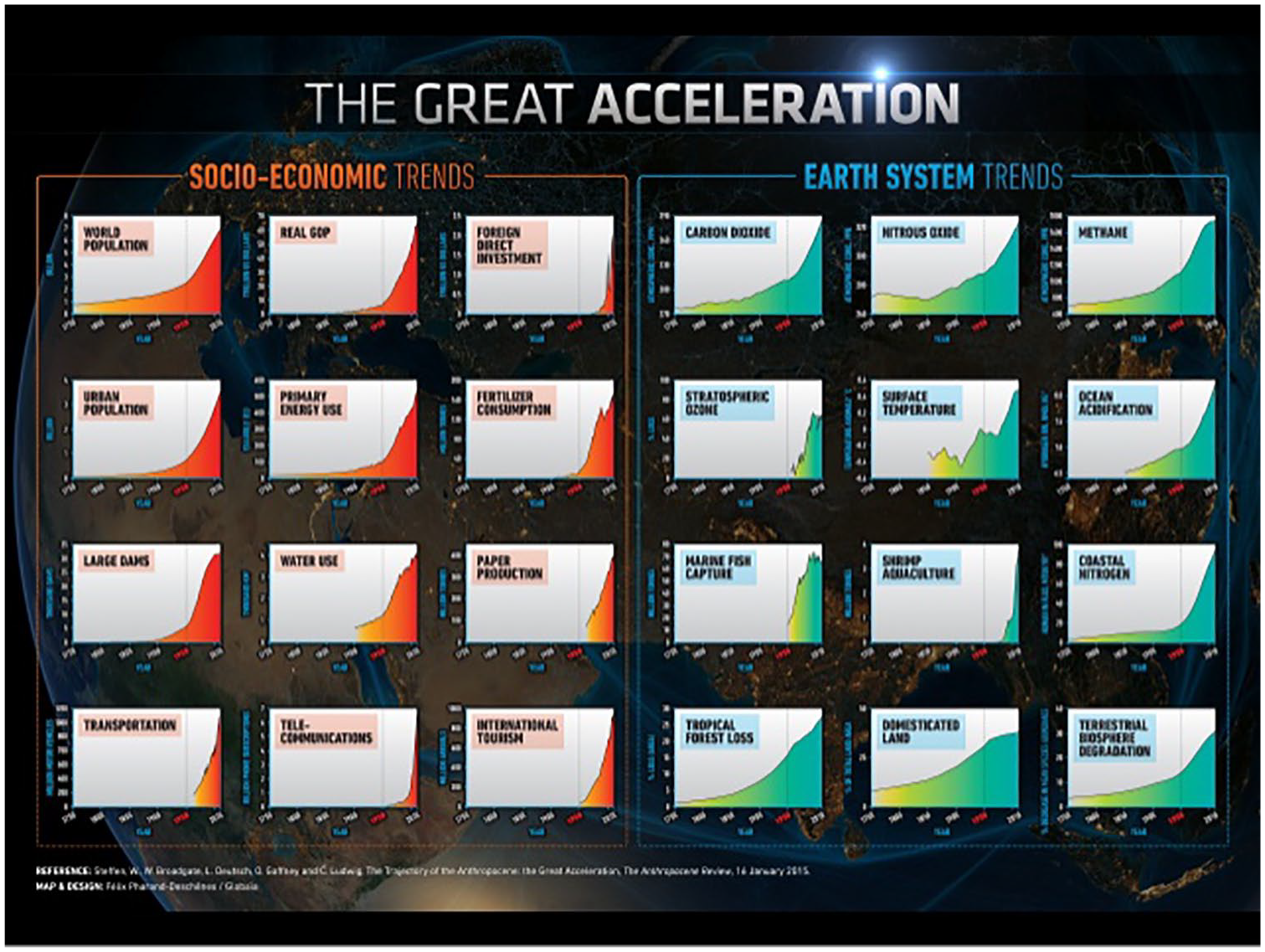
The great acceleration.
The remarkable parallelism of the curves of socio-economic and Earth system indicators is the crux of the proof. Although the authors admit that correlation does not entail causality, they conclude that the parallelism provides a good amount of evidence of the interdependency between these heterogeneous processes, and that socio-economic trends have an impact on the Earth System.
“In little over two generations – or a single lifetime – humanity (or a small fraction of it) has become a planetary-scale geological force. Hitherto, human activities were insignificant compared with the biophysical Earth System, and the two could operate independently. However it is now impossible to view one as separate from the other”. (Steffen et al., 2015: 94)
The authors use the resources of argumentative discourse for constructing a grand narrative structured around a precisely dated turning point. While Crutzen and Steffen (2003) had situated the beginning of the Anthropocene in 1784 (the invention of the steam engine as driver of the Industrial revolution), Steffen et al. argue that the large-scale extraction and consumption of fossil fuel did not have a global impact on the functioning of the Earth System. Looking at the rate and magnitude of growth in all curves by the 1950s, they point to July 16, 1945, the day when an atomic bomb was detonated in New Mexico desert, as the beginning of the geological epoch.
Like all curves of exponential growth the series of 24 graphs suggest that the trajectories of human activities and natural phenomena lead to a tipping point followed by significant and unstoppable changes. Thus an epoch-making event in the past – supposedly coupling human and earth histories – opened up an uncertain future which is already present. To make the story even more dramatic, the paper ends on the following question: ‘Will the next 50 years bring the Great Decoupling or the Great Collapse?’
This quick survey of a landmark paper reveals a number of significant discrepancies between the metaphysical assumptions of the proponents of a new geological epoch and the anthropologists who joined in Anthropocene studies. Earth system scientists debating over the beginning of the Anthropocene clearly presuppose that there was a time when there existed a pristine independent nature, whereas anthropologists assume that nature has never been independent, that the nature/culture divide is a modern myth established by Western philosophy. Moreover to escape the threatening perspective of a global collapse due to the coupling of socio-economic and biophysical systems, Steffen et al. recommend a ‘planetary stewardship’ with a view of going back to the modern configuration decoupling the trajectories of humans and the earth. Although they give up the modern humanist view of humans as master of the planet in favour of the more modest role of stewards, they retain the exceptional status of humans among other living creatures. Whether they be masters of the world or entangled with the world, humans remain central and hold the future in their hands. The centrality of human is unquestioned, it is rather reinforced by the new mission of human stewardship of the planet (Conty, 2016). In other terms, Earth System scientists remain modern in that they preserve the human exceptionalism intrinsic in the modern divide between nature and culture. The persistence of the human exceptionalism associated with the notion of Anthropocene is particularly pronounced in the ecomodernist manifesto for a ‘good Anthropocene’ (Asafu-Adjaye et al., 2015). Ecomodernists advocate more human management of nature to ‘save the Earth’. They ambition to produce technological innovations such as geo-engineering or climate engineering, for decoupling the future of humanity from biophysical constraints. While the anthropocentric perspective embedded in the notion of Anthropocene and its pragmatic consequences have been pointed out (Beau and Larrère, 2018; Fremaux, 2019), its epistemological implications remain largely unnoticed and deserve more attention.
Time in powers of ten
Humanities scholars tend to interpret the Anthropocene as a signal of global interdependence, or as the evidence that we belong to the Earth, that we are ‘earthlings’ as Latour put it. They nevertheless overlook that the proposition of a new geological epoch rests on a strong anthropo-exceptionalist bias. Although it is based on material traces, the construction of the chronological timeline including the geologic timescale with its conventional hierarchical subdivisions – Eonothem, Erathem, Period, Epoch and Stage – rests on the postulate of the singularity of human status. For aligning all times on a continuous scale that builds up a universal chronology, one has to observe the flux of times from a distance, to conquer a gaze from nowhere and from nowhen. This outsider’s position is a prerequisite to construct a unique timeline embracing phenomena from the cosmic scale to the molecular scale. This all-encompassing timeline has to be detached from localities and temporalities. It rests on the fiction of ‘an allegedly disembodied, transcendent objectivity [. . .] is in fact an illusion, a god trick’, as Haraway (1988: 581-82) pointed out. The epistemic posture that sets humans apart from the earth, endowed with a global view transcending time is in stark contrast with the message derived from ‘The great acceleration’: humans and the earth are intimately coupled. There is an ambivalence in the Anthropocene discourse that bears resemblance to the characteristic oscillation that Henri Bergson pointed out in evolutionary philosophy regarding the pretensions of the human intellect: It [evolutionary philosophy] begins by showing us in the intellect a local effect of evolution, flame, perhaps accidental, which lights up the coming and going of living beings in the narrow passage open to their action; and lo! Forgetting what it has just told us, it makes of this lantern glimmering in a tunnel a Sun which illuminates the world (Bergson, 2012: x)
Indeed the group of the International Commission on Stratigraphy, the Anthropocene Working Group (AWG) who tries to identify anthropogenic signatures in order to settle the onset of this human epoch, is not standing outside the planet and talking from nowhere. They work on the basis of material samplings found in various marine and terrestrial deposits, such as lake and ocean sediments, glacial ice, and tree rings. However the very project of identifying and dating a stratigraphic boundary – the so-called Global Boundary Stratotype Section and Point (GSSP) — that defines the beginning of a stage, presupposes the assumption of a unique time scale punctuated by turning points. It relies on the view that time is made of a sequence of distinct non-overlapping phases, distinguished by a singular event that can be precisely dated. For the onset of the Anthropocene, three dates have been proposed: 1492 (discovery of the New World), 1784 (invention of the steam engine) or 1945 (first nuclear bomb). In agreeing on the nuclear marker of the mid-20th century, the AWG conveys a specific articulation of the past and the future along with a specific assignment of responsibilities. However the AWG never questions the presupposition of a single uniform and linear time containing all the events that happened since the Big Bang.
The all-encompassing timeline remains a tacit assumption because it is so deeply anchored in western culture that it seems natural, and obvious. Nevertheless it has been gradually constructed over centuries through the convergence of religious (calendars, almanacs), technical (sundials, clocks), societal (schedules, timetables, hourly wages), and scientific (units and standards) infrastructures (Nowotny, 1994; Birth, 2012).
The historical construction of a linear, uniform, and universal timeline is the precondition to cover time in powers of 10, that is, to think in terms of timescales. Not only the legitimacy of the notion of timescales is not challenged, but it seems more relevant than ever. As Michael Walker, a protagonist of the debate over the start of the Anthropocene noted by the end of his review of the debates: ‘The geologic timescale, in my view, is one of the great achievements of humanity.’ (Monastersky, 2015: 145). The Anthropocene reinforces the relevance of a unique timeline aligning cosmic and geologic phenomena that take billions of years to evolve with socio-historical phenomena evolving over a few centuries or decades.
To be sure, the chronological timeline enables scientists to measure with a relative precision the age of the universe and the fractions of seconds of the lifetime of subatomic particles, is ‘one of great achievements of humanity’. More generally, ‘scalism’ is an indispensable analytical tool for constructing global pictures. However, it is important to make a distinction between analytical tools and ontological categories. This confusion has been criticized by a number of geographers who alert about the political impact of treating all territories as ‘portions of an abstract space’ (Moore, 2008). The construction of a scale admits only quantifiable and hierarchical relations between things. For making a map of Europe, for instance, one has to assume a homogeneous space allowing a continuous circulation between the local and the global. Similarly, the construction of a global timescale rests on the hypothesis of a homogeneous time so that all durations can be counted and compared. To make everything commensurable all trajectories have to be quantified and treated as equivalents. For this purpose, scientists agree on ‘conventions on equivalence’ that make them equivalent according to certain criteria (Desrosières, 1992).
A similar criticism of scalism must be addressed to the overarching chronological timeline that skewers all ages and runs on a single track from the fourteen billion years of the Big Bang, through the three billion years of the emergence of photosynthesis and of Homo around two million years ago, to finally reach the present and predict the future. The chronological timeline underlines the abyss of zeros between geological time and historical time. However, making all times amenable to the measure of the powers of ten along a single line, overlooks the heterogeneity of temporal regimes. This one-dimensional time ignores the diversity of cycles and the complex interactions between the various components of the Earth System. Therefore the privilege of scalability is at the expense of blindness on the variety and heterogeneity of times in nature (Bouton and Huneman, 2017) as well as in culture (Baschet, 2018).
From an ecological point of view, ignoring the singularity of things in order to construct a global picture does not make sense. A number of ecologists deplore that their discipline has been completely transformed by the politics of management of the environment. Projects of stewardship of biodiversity or of greenhouse gas emissions require that everything be decontextualized in order to be quantified and commensurable. Things, such as insects for instance in biodiversity assessments, are detached from their local biosphere, and then recontextualized in a digital sphere allowing them to be standardised and integrated into a huge global database (Devictor and Bensaude-Vincent, 2016; Kwa, 2005). Carbon footprint assessments are also exemplar of this rational strategy aimed at constructing global visions by making everything commensurable. In common phrases such as ‘zero-carbon economy’, or ‘low-carbon energy’, carbon is just an indicator of the human footprint on the environment. It means first, that carbon is identified with one its mode of existence, CO2. Second, this gas has been selected as the standard of all greenhouse gases (GhGs) thus providing a general equivalent to measure the global warming potential all GhGs. For instance methane has a global warming potential of 23 because it creates 23 times more greenhouse effect than an equal volume of CO2 would do over the same period of time. Third, this general equivalent has been turned into a currency, like gold and silver did a long time ago. This aerial money is supposed to help regulate the flux of carbon exchanges and provide control over the climate change and cosmic process. As all equivalents, carbon affords commensurability. It allows quantitative comparison between various gases and between heterogeneous human actions in terms of carbon footprint, such as flying from Paris to New York, burning fossil fuel to heat your apartment, and eating steaks every other day. This abstract carbon equivalent enables setting up the mechanism of compensation. For instance, planting trees, replacing a fuel generator by a wind turbine are supposed to compensate for global CO2 emissions. A certain amount of GhGs emitted in one part of the world is thought to balance an equal reduction in another part of the world. Carbon markets are based on such equations, homogenising all localities and equating the present and the future. In this respect, carbon trading is a reminiscence of the old system of indulgences, the ‘market of pardon’ once established by the Catholic Church (Smith, 2007). By ‘making things the same’ (MacKenzie, 2009), by creating commensurability, carbon trading and timescaling enrol the entire planet in a process of monetisation of the world (Lohmann, 2008).
Conflicting temporalities
We have seen that the great acceleration thesis is based on a scalar vision of time. It relies on the tacit assumption that all kinds of phenomena follow the same uniform trajectory, although they differ in their respective paces. Or to use a music metaphor, all dwellers of the planet are supposed to follow the same rhythm, each one on its own tempo. The Anthropocene results from the critical continuity between the slow tempo of the earth history and the fast changes in historical time.
The linear vision of time as a uniform track along which things move allows us to envisage speed variations alone. Therefore the arrow of time is both a comfortable vision with its orders of magnitude ordered in powers of ten neatly nested one into the other, and frightening because it leaves a narrow margin of manoeuvre. The only possible solution to avoid a global collapse would be to slow down, to reduce our carbon footprint. But given the billions of people on the planet, this future seems rather implausible and a global collapse inevitable.
The future-oriented arrow of progress that prevailed over the past two centuries is now turned towards a threatening dark future due to global warming and cataclysms. Yet the opposing visions of a bright future and of ecological catastrophe are rooted in the same ground: the modern order of time in which the future makes sense of the present and of the past. This future-oriented approach is typical of the ‘modern regime of historicity’ that emerged in the late 18th century (Hartog, 2015; Kosseleck, 2004). In Anthropocene discourses the heritage of past technological choices is interpreted as the dawn of a new era, the human age. And regaining hold on the future and the mastery over nature remains the major objective.
By shifting the attention from the future to the present, from the acceleration of global processes to the diversity of timelines displayed in all local ecosystems, one gets an alternative diagnosis of the current crisis. The clash between the slow tempos of nature and the fast tempos of culture are better understood as a collision between various intermingled rhythms that invites a rapprochement between weather and time, two different notions expressed by one single term in Latin languages: ‘temps’ in French, ‘tiempo’ in Spanish, ‘tempo’ in Portuguese. Chronological time resonates with weather (meteorological time) in the irruption of cataclysms and disruption of seasonal cycles.
Climate disorders, the extinction of biodiversity, and the current sanitary crisis result from conflicting temporalities in various localities that challenge the supremacy of the chronological paradigm of Anthropocene discourses and its underlying assumption of human exceptionalism. Taking seriously the claim that humans are just one among many dwellers on the planet earth, it is easier to assume that every dweller has its own peculiar way of experiencing time. There are multiple, heterogeneous times that intersect, interfere, intermingle. The entanglement of on-going cosmic, physical, chemical and biological processes that make up the history of the Earth generates an ever-changing map of interdependent timelines. The arrow of time pointing towards a decoupled future or a global collapse gives way to a landscape of billions of entangled trajectories composing ramifying webs, that is akin to Haraway’s tentacular Chthulucene (Haraway, 2015).
To face the conjunction of crises that characterize our time, we better give up the grand narratives in favour of small unheroic stories. Thinking in terms of timescapes rather than of timescales opens up a window on the temporalities of things we interact with and the interdependencies created by technological choices. The term ‘timescape’ advocated by Barbara Adam in Timescapes of Modernity extends the landscape perspective to the dimension of time with a view to grasp oecological phenomena as complex webs of interdependent temporalities (Adam, 1998: 9). A timescape is constituted by anthropogenic and natural beings in interaction. In ecology, the term ‘landscape’ refers to a dynamic process resulting from exchanges, conflicts or interactions between biophysical entities and technical or social infrastructures. Patrick Blandin speaks of ‘ecocomplexes’ or ‘localized assemblages of interdependent ecosystems that have been shaped by a common ecological and human history’ (Blandin, 2019: 48). Due to this entanglement of its spatial and the temporal dimensions a landscape is altogether a timescape. It is an alternative way of knowing and experiencing the world we live in. Timescaping the so-called successive phases of nature ‘deep time’ and of cultural history is a good exercise to untie the close association between progress and technology fuelled by the metaphor of the time arrow.
Let us for instance revisit the role of carbon, the bad guy of the Anthropocene responsible for global warming, in a timescaping perspective. Carbon not only invites to think about time in cyclical form but also to consider the assemblage of its various cycles. Carbon trading typically refers to the carbon cycle initiated by living beings: animals burn carbon (calories), they release CO2 in respiration that is broken down by plants in photosynthesis, which releases oxygen. Climate scientists add to this carbon cycle, another cycle controlled by temperature: the CO2 released into the atmosphere by living beings or industrial activities is absorbed into the soil by the biomass or into the oceans by physical-chemical and biological processes (currently ¼ of CO2 resulting from human activities). To these two cycles geologists add the geological carbon cycle: on the scale of one million years, CO2 released into the atmosphere by volcanic eruptions or underwater sources is sequestered in the soil in the form of calcium carbonate in sedimentary rocks. These are dissolved by river water, then by ocean water, which traps carbon, and later on by living organisms with the emergence of photosynthesis.
What the linear scale of successive ages overlooks is that these various cycles are not just a sequence of phases, they operate synchronically. Because each one follows its own rhythm and tempo, they have antagonistic and non-linear effects on the Earth system (Archer, 2004: 16). The CO2 life cycle has a stabilising effect. Therefore it has long been the symbol of the balance of the ‘economy of nature’. In contrast, the climate cycle of CO2 has a destabilising effect. It works in the opposite direction to the geological carbon cycle, which functions more like a thermostat for the planet. The conflicting cycles of carbon lead to the current alarming situation.
The multiple temporalities of carbon have an impact on the governance of the Anthropocene. Emphasising the discrepancy of tempos and calling for ‘ decoupling’ the technosphere and the biosphere is the main concern of the advocates of ‘the great acceleration’. But this is not enough. Instead of thinking of every natural or artificial being as immersed in a single time – the universal timeline – carbon obliges us to recognise and take into account the diversity of time patterns (linear, cyclical, laminated, etc.), in short to realize that our chronology is just one among many times.
The global sanitary crisis due to Sars-Cov2 exemplifies the need to take into account multiple regimes of temporality. Along the 20th century the fight against microbes with antibiotics has been the typical example in favour of the arrow of progress. The invention of antibiotics providing the evidence of the emancipation of humans from nature instantiated progress through decoupling. But with the increasing resistance to antibiotics and the experience of a global contamination of billions of humans, we discover a quite different figure of time: contagion brings forward a time of contingency that leads nowhere, neither to a radiant future nor to a global collapse.
The coronavirus forces us to experience otherness. This undesirable and ‘harmful’ virus has its own time, its own trajectory that uses humans as host. The challenge is to learn how to deal with such parasites, to compose a timescape combining the exponential growth of beings that develop through contamination with the beats of political time, economic time, social life as well as with the time of our individual projects. For this purpose, we have to change our lifestyles, give up the long-distance trips of mass tourism, integrate barrier gestures in our daily routines. We are learning a way of life that is attentive to the infinitesimal beings – viruses, bacteria, plants, insects and others – that populate the planet.
Microbes in general shake up our ontology, and force us to revisit the spontaneous hierarchy that places the ascent of man at the tip of the arrow of time. Microbes have been around long before the emergence of humans. Bacteria have been key actors in the formation of rocks, of oxygen. Germs contributed to the collapse of empires and civilisations. Microbes occupy all environments from the rocks of the earth’s mantle to the ocean floor, glacial deserts, hot springs, acidic or hyper-saline environments. Nothing can stop them, they fit in all environments. Colonising space, microbes and viruses also defy chronological time. They mix up all the time scales that our culture strives to distinguish. They connect biogeochemical history and the history of human civilisations. Indifferent to our taxonomic categories, they move from one species to another. Through their symbiotic or parasitic behaviours, they initiate a cohabitation of quite different temporalities, like the short lifetime of the bacteria that make up the guts microbiota and the longer lifetime of mammals. Symbiosis phenomena in general suggest that evolution reuses pre-existing modules, incorporating the genetic system of microbes in plant and animal cells, instead of reinventing from scratch. By making organisms that are far apart in evolution co-exist and co-evolve in this way, microbes radically challenge the unidirectionality of phylogenetic time towards increasingly complex levels of organisation. The vertical lineage of gene transmission along the family tree crosses another, horizontal temporality, which is shaped by occasional contacts, that is by the contingencies of contagion.
Timescaping technological choices
The alien temporalities of things that we discover in the experience of the climate and sanitary crises could provide guidelines for assessing technological choices. A timescaping approach draws attention to the timelines of the materials engaged in our technological innovations. Consider for instance nuclear technology and plastics, two potential candidate indicators of the beginning of the Anthropocene.
By definition radioactive isotopes like uranium-235 or plutonium-239 are agencies. Far from being passive, inert substances they are always changing through a process of emission of alpha or beta particles. Moreover although the behaviour of individual atoms is unpredictable, statistically the atoms of the same radioisotope have a half-life of their own, which is the marker of its identity. As the half-life of radioisotopes depends solely on the properties of their atomic nucleus, it is constant, and statistically predictable, which is the reason why they can be used as absolute clocks or tracers for dating the age of other things. Unlike most materials used in technological projects, radionuclides have a lifespan unaffected by their chemical environment. At the same time, the process of disintegration that determines their half-lifetime has a strong impact on the environment. It induces mutations in living cells that kill them and cause tremendous sufferings to organisms.
Because radionuclides are pure becoming, they offer an exemplary case for subverting the ontology of modern science that underlies the concept of Anthropocene. They don’t fit in Boyle’s paradigm of a universal, ‘catholic matter’, the passive stuff all things are made of. Time is not the universal container, indifferent to the changes Newton imagined. Time is immanent to beings, to all things whether animate or inanimate. There are as many times, as many lifelines as there are things. Multiple heterogeneous times interfere, thus drawing more or less dense and quiet timescapes.
The timescape created by nuclear technology strikes as particularly disharmonious. For years, the question of waste was considered secondary, an externality that was not supposed to hinder the development of nuclear power. The difficulties of nuclear waste management stem, first of all, from the disparity of timescales. The half-life of Pu-239, the plutonium manufactured since the 1940s to make nuclear weapons, is 24,110 years, about twice as long as the Holocene, whereas the average time of national governments in charge of managing this waste is 5 years. But there is more than the clash of timescales. The difficulty becomes insurmountable because of the toxicity of Pu-239 to all forms of life. Long-lived and highly active products are so dangerous that they cannot enter into any alliance. Containment seems to be the solution. This is why all efforts are aimed at providing durable protective barriers to avoid contact in the present and the distant future. The other obvious solution, particularly pushed by French engineers, would be reprocessing. But the results proved to be limited and in any case using reprocessed products ends up in highly toxic and intractable waste.
The mass production of plastics compose a different timescape, raising other challenges. Their success relies on their protean adaptability that made them ‘materials of a thousand uses’. In addition to their versatility, plastics are advantageous because they are light and cheap. The annual production ramped up from 1.5 million tons in 1950 to 381 million in 2020. Synthetic polymers conveyed a sense of freedom through the control over the material environment. Over decades, the intensive use of plastic commodities has shaped the world we live in and has favoured a culture of the disposable focused on the present and blind to the past and the future of the stuff plastic commodities are made of. Cultural historian Jeffrey Meikle argues that the use of plastics in everyday objects, gradually fashioned a dream world, close to Disney world. Plastics fostered the production of single use commodities, like plastic bags and bottles, Bic pens and razors. Our daily experience of disposable items transformed our way of life, inducing a culture of mobility, of change, and of open possibility for people of all classes (Meikle, 1986). As a result one third of the plastic production is discarded within a year after being manufactured (Barnes et al., 2009).
It gradually became clear that the tremendous success of disposable plastics was at the expense of a dual blindness about their impact, upstream and downstream. Upstream most consumers of plastic toys and packaging look at them as ex nihilo creatures designed for our consumption and convenience. But they do not come into being out of nothing and nowhere. Around 4% of the world oil production is used as feedstock to synthesize plastics and an equal amount is required as energy in the process. Our ephemeral toys or gadgets bound to be discarded after a few months are made of residues of ancient lives – algae and plankton – that have been stored and compressed in the earth crust for more than ten million years. The mass production and consumption of synthetic polymers is strictly speaking chronophagic, eating time.
Downstream the residues are easy to neglect as long as we think of plastics as immaterial objects. For decades we have been encouraged to believe that plastic commodities cease to exist as soon as they are not there. Since they were designed and made for us, once discarded they were supposed to be nothing. As intimate companions to our daily lives, plastic commodities have a shorter life than pets. The life story of plastic bags and bottles entangled with the daily lives of billions people is only one episode in the lifespan of the stuff they are made of. While plastics are photodegradable, plastics debris persist. They are resilient in marine environment and can be transported over long distances by converging currents. An estimation of 100 million tons of plastic litter accumulated in what came to be known as the Great Pacific Ocean Garbage Patch. But the soup of floating plastic debris and pellets covers all oceans.
There is a striking contrast between the perpetuum mobile of our consumption of disposable plastic commodities that makes up a kind of eternal present through repetition, and the resilience of the material locked up in them. Unlike nuclear waste, tiny plastic debris can be ingested by plankton, crustaceans and fish who concentrate the residues diluted in large volumes of water along the food chain. These marine organisms act as ‘carbon workers’ (Gabrys, 2018) but the biodegradation of carbon compounds affects their health because of the various additives mixed with the carbon chains. Resin pellets carry persistent organic pollutants such as polychlorinated biphenyls (PCBs) that can cause severe health damages to wild life not only in the present but in the future as well, since endocrine disruptors affect the reproductive system of all biota.
In conclusion, the modern concept of nature has not been radically challenged in Anthropocene discourses. The blurring of the boundaries between the nature and culture is viewed as a recent and deplorable coupling due to recent technologies. Far from bringing new perspectives, Anthropocene discourses have embedded the ecological crisis in the modern regime of temporality based on a future-oriented chronological timeline. Their diagnosis of ‘the great acceleration’ points to a clash of tempos between the slow pace of the Earth history and the fast track of human technological achievements, along a unique timeline. Despite its familiarity, this chronological approach has produced a screen effect on the diversity of rhythms and temporal regimes of the various components of the Earth. The global approach to the Earth System that inspired the notion of Anthropocene requires that all times be uniform, homogeneous, and commensurable in order to fit in a global chronology. It thus reduces all material and energy traffic to carbon equivalents. In stark contrast, the timescape approach to the current ecological crises highlights the diversity and heterogeneity of temporal regimes and their inclusion in a territory. It commends attention to the potential conflicts between the regimes of temporality of materials and humans in technological activities.
Footnotes
Declaration of conflicting interests
The author(s) declared no potential conflicts of interest with respect to the research, authorship and/or publication of this article.
Funding
The author received no financial support for the research, authorship and/or publication of this article.
