







Abstract
The Anthropocene is generally defined as a postulated new geological epoch, which, according to various authors, began in the 20th century. The postulated Anthropocene Epoch is characterized by a decrease in biodiversity, climate change, transformations of the Earth’s surface, exploitation of natural resources, and environmental pollution. Waste landfills influence some of these features (e.g. biodiversity and climate change, create new anthropostratigraphic geological layers); therefore, they should also be a matter of interest and research conducted in order to become considered as a subsequent postulate confirming the Anthropocene Epoch. This paper draws attention to the fact that environments created and dominated by human activity, such as waste landfills, may be used as an effective starting point to confirm the new Anthropocene Epoch. Waste landfills contribute significantly to geological, climatic, environmental, and ecological changes (modification).
Introduction
Waters et al. (2016) and the Anthropocene Working Group agreed that the Anthropocene Epoch began around 1950 CE. This time interval is linked to the intense and escalating human impact on the environment (Waters et al., 2016), which has left permanent changes in the subsurface part of the lithosphere and will be recognized in the fossil record in the future . Although the definition and acceptance (ratification) of the Anthropocene is still a matter of intense discussion in the geological community, the number of geological and geographical societies leaning toward its official acceptance is steadily rising since the term was introduced by Paul Crutzen in 2000. One of the main challenges related to research on the Anthropocene is that its duration encompasses only a small interval of geological time (Achmon et al., 2018). More and more often, the term Anthropocene is used to embrace geological, ecological, sociological, and anthropological changes in the most recent history of the Earth (Waters et al., 2016; Zalasiewicz et al., 2017, 2021). The postulated Anthropocene Epoch is characterized by a decrease in biodiversity, climate change, transformations of the Earth’s surface, exploitation of natural resources, and environmental pollution. Waste landfills influence some of these features (e.g. biodiversity and climate change, create new anthropostratigraphic deposits) therefore, they should also be a matter of interest and research conducted to become considered as a subsequent postulate confirming the Anthropocene Epoch.
Humans have significantly modified the continental landscape through deforestation, farming, and the construction of settlements and then cities, leaving significant and permanent traces that which may become archeological or geological records in the future (Zalasiewicz et al., 2018). We may thus refer to the “archeosphere” (Edgeworth et al., 2015), which represents a layer of artificially transformed soil containing tools, construction rubble, polluted subsurface soil, but most of all wastes of various origins. Although humans have always produced waste, the intensive increase in the amount of generated waste, as well as the related increase in the amount of landfilled waste, occurred along with the industrial revolution, which dates back to the 19th century. The 20th century was marked by intensive civilization development, two world wars, and many other activities, which intensified the increase in the amount of waste generated and stored. According to the report “What a Waste 2.0: A Global Snapshot of Solid Waste Management to 2050” by the World Bank, approximately 2 billion tons of solid waste are currently generated each year.
Regardless of whether the the fact if wastes are mining, nuclear, industrial in origin, and hazardous, comprising comprise municipal sediments and wastes, are neutralized in landfills, burnt, or buried deep underground, they most probably represent the most common and most durable trace of human existence on Earth (Hird, 2017).
Waste landfills are anthropogenic deposits containing mixtures of natural and novel manufactured materials that are synthesized or modified by humans (generally referred to as wastes), reflecting the intense global dispersal of new materials, as well as their accumulation on and below the surface (Ford et al., 2014). They represent a novel sedimentary environment and include mining, industrial and construction waste, synthetic materials, and mixed municipal waste, which may form “technofossils” (Zalasiewicz et al., 2014, 2016). According to Ford et al. (2014), these anthropogenic deposits are archeologically important can be of archeological importance. Wastes can also represent material (as part of salvage) that is used for engineering constructions (embankments, buttresses), even though these wastes constructions are not landfills, they also permanently also modify the landscape.
This paper draws attention to the fact that environments created and dominated by human activity, such as waste landfills, may be used as an effective starting point to confirm the new Anthropocene Epoch. Waste landfills contribute significantly to geological, climatic climate, environmental, and ecological change changes (modification).
Waste landfill issues
The geological interval in which we live has been deeply shaped by human activity related to farming, construction, and industry, particularly the exploitation of resources. This activity has achieved a level such that contemporary sediments of human origin contain technological traces (Waters et al., 2014; Worm et al., 2017; Zalasiewicz et al., 2014, 2016). Human impacts on the environment are also clearly visible in waste production and management (Gaur et al., 2020; Lestari and Trihadiningrum, 2019; Li and Achal, 2020; Winkler et al., 2021). Solid waste and sediments (also from households) represent an important trace of human activity (Barfod et al., 2022). Landfilling is the oldest and most commonly used waste utilization method in most countries worldwide. Modern landfills are protected in their bases by a complex layer composed of rocks, clay, sand, and geotextile membranes and/or coverings, and have a physical structure of waste layers (Hird, 2017; Vaverková, 2019; Figure 1).
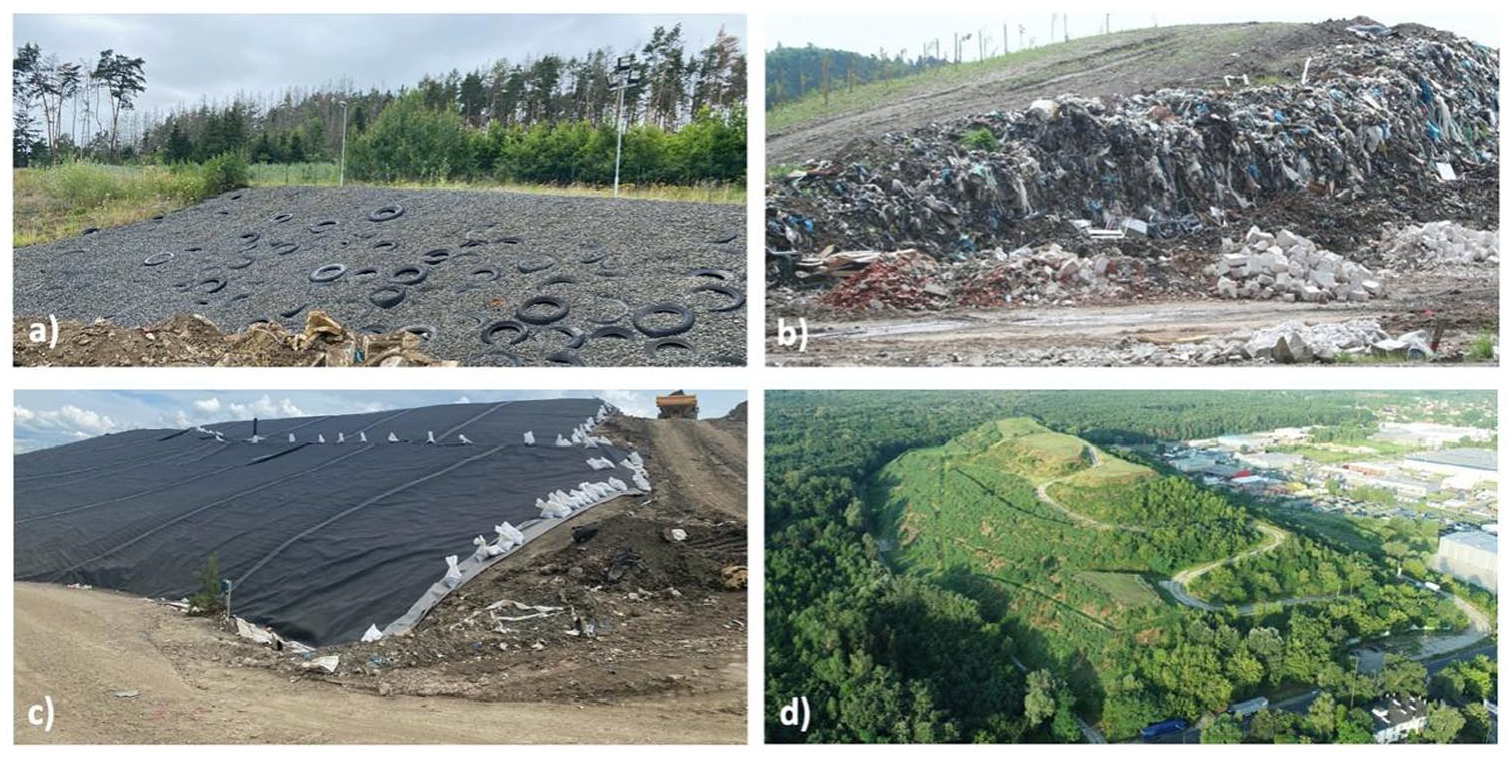
Photos of waste landfills: (a) securing the slope of the landfill basin (Vaverkova, 2021); (b) mixed municipal solid waste at a landfill site containing predominantly synthetic materials (Vaverkova, 2017); (c) use of geotextiles for landfill cover (Vaverkova, 2022); (d) example of a reclaimed landfill (Koda, 2022).
According to Koda (2017), landfills are engineering objects, and their specific characteristic result from their large surface area (up to several tens of hectares), large volume (up to several million m3), large thickness (up to several tens of meters), very long exploitation period, and long-term impact on the environment (even several tens of years after shutdown). The values of these parameters may be much larger for landfills with industrial and mining waste. Waste stored in landfills undergoes physicochemical and biological degradation (Baderna et al., 2019). The main sources of emissions from municipal landfills are a mixture of waste materials, wind-dispersed light waste fractions, silt from the landfill surface, landfill gas and leachates, and emissions and noise from waste transportation (Vaverková, 2019). In the context of confirming that waste landfills may be a subsequent postulate of the Anthropocene, the mentioned features of the largest significance are: (i) waste deposition and landfilling methodology—geological impact; (ii) formation of landfill gas and leachates—environmental impact; and (iii) biodiversity change—ecological impact.
Geological impact of landfills
It is estimated that there are up to 350,000–500,000 landfills in Europe containing various wastes—industrial, commercial, municipal, hazardous, and liquid—(Nicholls et al., 2021). Worldwide, the number of landfills reaches several million. In the past two centuries, landfilling has been the dominant form of waste neutralization. Even though most landfills have been closed and reclaimed during the last 20 years, and their surfaces had been developed for other purposes, they have left permanent traces for future centuries, while the preservation method does not fully protect against emissions. The longevity of landfills is geological in character, and the hazards linked with some wastes may not weaken over time (Beaven et al., 2020). Moreover, layers of human origin rapidly increase in volume as consequence of industrial development, mass production, and increasing consumption (Katsumi et al., 2021). Figure 2 shows a scheme of different landfilling methods, adjusted to the natural landscape and water reservoirs (surface and underground).
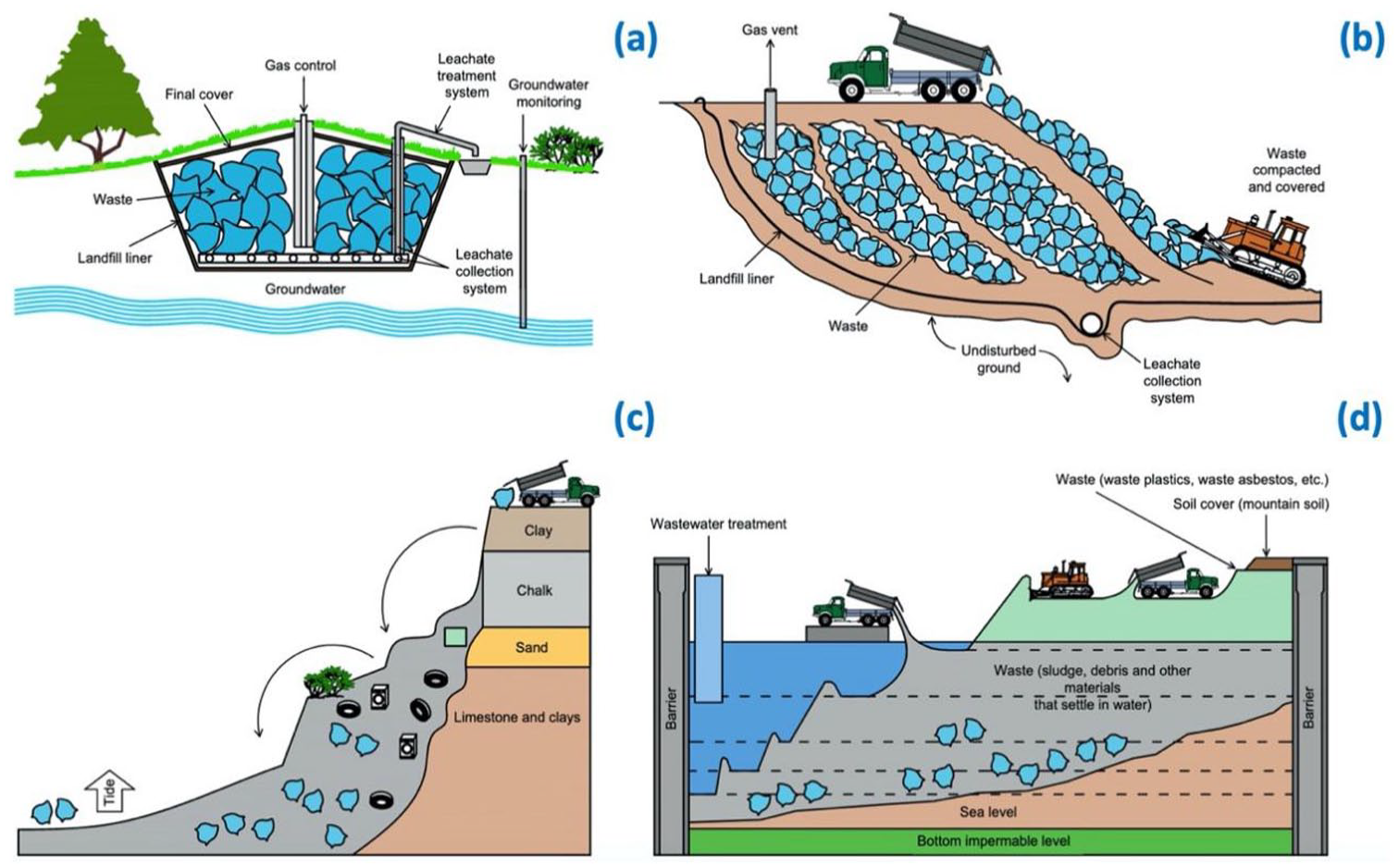
Schematic examples of the possibility of waste disposal in landfills: (a) subsurface landfill, (b) surface landfill (escarpment- and slope-related), (c) historical cliff/coastal landfill, (d) modern cliff/coastal landfill (Adapted from: Nicholls et al., 2021; Okayama Prefecture Environmental Conservation Foundation, 2022; Vaverková, 2019; Worrell and Vesilind, 2012).
According to Statista (https://www.statista.com), the largest landfills, waste sites, and trash dumps in the world in 2019 were: Apex Regional, Las Vegas, Nevada, USA (~890 ha), Bordo Poniente, Mexico City, Mexico (~375 ha), Laogang, Shanghai, China (~335 ha), Malagrotta, Rome, Italy (~275 ha), Puente Hills, Los Angeles, California, USA (~254 ha), Sudokwon, Incheon, South Korea (~230 ha), Delhi Landfills, New Delhi, India (~200 ha), Deonar, Mumbai, India (~130 ha), West New Territories, Hong Kong (~110 ha), and Xinfeng, Guangzhou, China (~90 ha) (Choe et al., 2022).
Artificially developed grounds composed largely of anthropogenic materials include for example closed-down historical landfills confirming the artificial/anthropogenic form: Fresh Kills Landfill and Puente Hills Landfill (New York, USA), considered as the largest man-made structure in the world (Eklund et al., 1998; Melosi, 2016); Puente Hills Landfill (Los Angeles, USA), at present, the largest biogas plant in the world (Themelis and Ulloa, 2007); Teufelsberg and Drachenberg (Berlin, Germany), landfill of war-time wastes (Edgeworth et al., 2015; Thestorf and Makki, 2022); Jardim Gramacho landfill (Rio de Janeiro, Brazil) which was inappropriately located from the geotechnical point of view (da Costa et al., 2018; Tirado-Soto and Zamberlan, 2013); Żelazny Most copper tailings disposal pond (1394 ha, Poland) (Jamiolkowski, 2014), Radiowo landfill (Warsaw, Poland) (Figure 1d), located in the buffer zone between urban development and protected areas, which encompass two natural reserves and the Kampinoski National Park (Koda and Osinski, 2017; Koda et al., 2022).
Other examples of artificially man-developed substrates include coastal and embankment-related landfills. The historical use of coastal areas for the removal of solid waste has left a significant legacy, with a large (but unknown) number of landfills worldwide (Nicholls et al., 2021). In many European countries (e.g. UK, Belgium, France, the Netherlands, Germany, Poland) and the USA (Florida, California) there are many coastal and embankment-related waste landfills (Figure 2c). This form of waste neutralization may also include the presently still used “traditional” waste dumping on the margins of rivers and channels in the Third World countries; in the rainy seasons, the waste is partly washed down by the flow and deposited in the lower stretches, enhancing the pollution of water and bottom sediments. Moreover, according to Canopoli et al. (2020), coastal landfills can be significant sources of marine and terrestrial plastic pollution, affecting ecosystems.
Modern coastal landfills, where the waste is neutralized in shallow coastal areas, artificially closed dumping sites, are increasingly used in coastal areas, where there is very little inland space or where the inland landfills are located at large distances from the sources of waste formation (Figure 2d). Japan, China, and South Korea are countries in which such method of landfilling in urban ports is becoming more and more common (Kavazanjian et al., 2006). Such a method of waste neutralization is often considered a method for “developing new solid areas” for future management for other purposes, particularly in countries with a large number of inhabitants.
In Japan, coastal landfills are particularly important for metropolitan areas, such as Tokyo and Osaka, owing to the limitation of inland space available for waste disposal. Coastal landfill sites account for only 2% of the total number of disposal sites in Japan but receive 28% of the waste produced because of their relatively large capacity (Inui and Katsumi, 2019). In Japan, the use of reclaimed/closed landfills for these facilities is an important consideration, because these coastal landfills are constructed close to metropolitan areas and provide new land for development (Figures 2d and 3) (Katsumi et al., 2021). However, these methods have many disadvantages and are controversial. Coastal landfills include difficulties in monitoring and the possibility of the bioaccumulation of toxic substances as well as their dangerous contact with water.
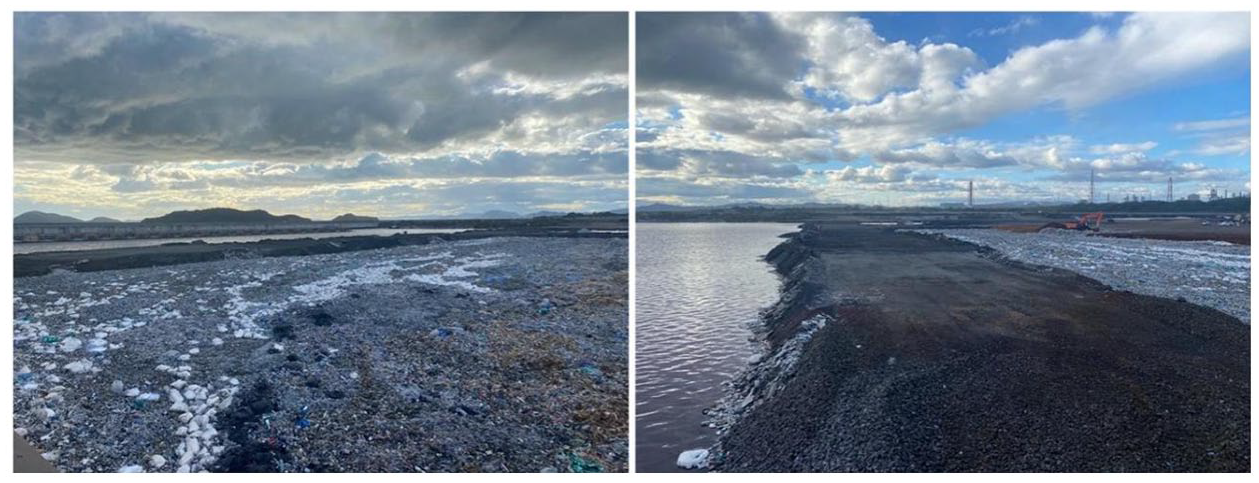
Example of coastal landfill: Okayama Prefecture, Japan (Vaverkova, 2022).
Moreover, landfills in coastal areas modify the coast geomorphology. They also disrupt the littoral drift, modifying the sediment budget. They influence sensitive habitats (habitat exchange, fragmentation, changes in habitat composition, and stress) (O’Shea et al., 2018). It should also be emphasized that the average sea level rises due to climate change resulting from human activity; this process will probably accelerate in the near future. Thus, there is a serious concern that coastal/cliff landfills (both modern and historical ones), and those located close to the coastline and in its vicinity pose a water pollution risk, yet have received little investigation (Beaven et al., 2020; Canopoli et al., 2020; Nicholls et al., 2021; O’Shea et al., 2018).
Many parks, as well as green and recreational areas have been established at former landfill sites. Examples include Ariel Sharon Park in Tel Aviv in Israel, Flushing Meadows—Corona Park in New York, Millennium Park in Boston, World Cup Park in Saul in South Korea (Klenosky et al., 2017), and Albany Bulb in San Francisco Bay Area in Northern California (Krzykawska, 2020). Reclamation is a much-wanted direction for remediation. However, according to Ali et al. (2021) 6.3 billion metric tons of global plastic production from 1950 to 2018 ended as waste and about 4.5 billion tons of total plastic waste ended up in landfills. Canopoli et al. (2020) noted that plastic waste represents a large part of municipal solid waste. In 2016, plastic waste amounted to 27.1 million tones in Europe (EU-28) and 27.3% was landfilled for a total of 7.4 million tones. As a result, the deposited materials remain in a minimally changed or unchanged state for centuries, leaving a permanent fossil footprint in the surface layer of the lithosphere.
Environmental impact of landfills
The products of biological processes in landfills are gas and leachate (Vaverková, 2019). Landfill gas is formed through microbiological degradation of the organic fraction of waste (Chetri and Reddy, 2021; Vaverková, 2019). The decomposition of organic matter under oxygenized conditions begins directly after the deposition of waste owing to the release of trapped atmospheric air. Carbon dioxide is released during this stage, and heat and water vapor are produced (Nastev et al., 2001). Methane is formed during anaerobic degradation and may constitute over 45% of the landfill biogas composition. Methane is a stronger greenhouse gas than carbon dioxide (Omar and Rohani, 2015). Landfills contribute to approximately 5% of global anthropogenic greenhouse gas emissions (Zhang et al., 2019). Landfill gases released into the atmosphere pose a hazard to the environment because methane, carbon dioxide, and water vapor are greenhouse gases that can promote global warming (Bakkaloglu et al., 2021; Chetri and Reddy, 2021; Spokas et al., 2015; Vaverková, 2019).
Landfill leachates are a complex mixture characterized by a dark color and high toxicity and are capable of polluting soils and ground- and surface waters in the vicinity of the landfill (Baderna et al., 2019). They are formed by the biological decomposition of organic waste, which may lead to environmental pollution (Wu et al., 2019). Due to gravitational forces, they may migrate to lower-lying zones, reaching inhabited areas, farmlands, and sources of potable water. Moreover, rain has a large impact on the development of leachates, mainly by leaching pollutants and increasing their volumes.
Precipitation passes through the accumulated deposits, bonding the dissolved and undissolved components of the wastes during physical and chemical reactions (Podlasek et al., 2023). The development of leachates is also influenced by groundwater and surface water inflow, as well as liquid fractions from wastes in combination with the humidity of the soil cover (Podlasek et al., 2023; Vaverková, 2019). They are characterized by compositional variability depending on the type of waste and environmental conditions, and much higher maximum concentrations than sanitary sewage. Leachate toxicity is difficult to determine and may be predicted because of complex geochemical and biochemical processes occurring in landfills, as well as in the substrate below (Anand and Palani, 2022; Baderna et al., 2019; Luo et al., 2020; Mukherjee et al., 2015). Approximately 200 hazardous substances have been identified in leachates including: aromatic, halogen, and sulfur compounds, phenols, pesticides, heavy metals, ammonium nitrate, and others (Jensen et al., 1999). Pollutants have a cumulative, threatening, and harmful impact on the survival of aqueous life forms, ecology, and food chains, leading to public health complications, including carcinogenic effects, acute toxicity, and genotoxicity (Mukherjee et al., 2015).
Ecological impact of landfills
Plants, particularly invasive species can adapt to different and changing environmental conditions (Winkler et al., 2023). Soil degradation linked to landfills is often reflected in the vegetation composition of landfill surfaces (Mao et al., 2018). Landfill sites can contain diverse plant species that are atypical of native vegetation and are characterized by synanthropic flora—non-domesticated species that prosper living in association with humans (Bryant et al., 2017; Koda et al., 2013; Vaverková et al., 2019). According to a study by Wania et al. (2006), Vaverková et al. (2019) and Winkler et al. (2021), the anthropogenic conditions of landfills favor the development of new plant communities composed mainly of neophytes and invasive plant species (Vaverková et al., 2018). Changes in habitat conditions on the landfill surface (temperature, humidity, nutrients, pH, etc.) pose a challenge to vegetation (Álvarez-López et al., 2020; El-Sheikh et al., 2012; Rebele and Lehmann, 2016; Tintner and Klug, 2011). Studies of plant successions in landfills performed in Poland during the last 20 years have confirmed characteristic changes in vegetation composition compared to neighboring ecosystems (Winkler et al., 2021). Moreover, Winkler et al. (2021, 2023) emphasized that humans not only affect landscapes but also, directly create new ecosystems, including geological-pedological layers (layers of the lithosphere).
Waste landfills are a source of food, and breeding and nesting grounds for different vertebrates and insects (Kumar et al., 2014; Plaza and Lambertucci, 2017). According to Doron (2021), landfills are rich animal habitats, with birds, bovines, and pigs, among others, thriving on organic waste and insects available. They are also sites with the occurrence of series of a microbiological factors and interactions resulting from the elution of nutrients from waste, body fluids (of human and animal origin), and chemical toxins. They may be repelled or pose hazards to some species and attract other species. Sediments are deposited in landfills in different states (solid, gaseous, liquid), which favors the development of unpredictable cross reactions and the formation of new zoonotic pathways. They also result in a high probability of infection by pathogens, intoxication, and swallowing of foreign bodies, and also influence species that do not visit such sites. Additionally, they change the pattern of displacements, migrations, range and dimensions of occurrence sites, and the behavior of individuals representing different species. Moreover, landfill sites can sustain introduced invasive species and enhance different kinds of conflicts with humans (Plaza and Lambertucci, 2017; Plaza et al., 2018).
Conclusions
In summary, landfills are temporal indices of deposits accumulated in the past, present and future. Due to landfilling (regardless of the method), new geological layers (anthropogenic deposits) and new areas have been developed and isolated, for instance, from the sea or other reservoirs, in the form of peninsulas, artificial islands, and overbuilding of peat bog areas in river deltas.
Emissions from landfills have a significant impact on environmental conditions not only in the direct vicinity of the landfill but also in migrating and entering flowing water in distant areas. Based on the described environmental influence, it can be concluded that the environmental impact and effects of landfills suggest that landfills as human activity also may be considered evidence of the new Anthropocene Epoch.
Human activities have led to the development of new permanent geological layers. As a result, a new type of geological environment is formed, and thus new habitats for plants and animals are formed, based on allochthonous plant species introduced by humans, as well as invasive plant and animal species. Anthropogenic activity related to landfilling directly leads to the development of new ecosystems, as well as the pedogenic and geological layers of the lithosphere.
Footnotes
Declaration of conflicting interests
The author(s) declared no potential conflicts of interest with respect to the research, authorship, and/or publication of this article.
Funding
The author(s) received no financial support for the research, authorship, and/or publication of this article.
