







Abstract
Since the turn of the century, there has been a developing conversation on where the start boundary of the Anthropocene should be situated in time. The article argues that these discussions have overlooked corporations’ history. Specifically, the Companies Act of 1862 was arguably the most important human invention passed in the middle of the 19th century. Effective solutions to climate change could be overlooked if the 1862 Companies Act is ignored. The Act’s passage and accompanying limited liability through the UK Parliament in 1862 boosted financial flows across international borders. It created the modern multinational corporate structure that dominates global business and politics. The Act also stimulated an unintended share-trading market based on the speculative value of company shares rather than dividends paid on company performance. The 1862 Act is the origin of the modern multinational company, which is held responsible for almost all the ecological harm done to the planet today. By the end of the 19th century, the flaws in the law were becoming apparent, highlighted by the Salomon vs Salomon legal dispute in 1897, which would be a warning for the future. The paper proposes re-imagining wealth distribution strategies that can address some unintended consequences of the 1862 Act. The research interrogates historical records and subsequent political, business, contemporary social commentary and literature, and academic material to investigate the 1862 Act’s impact using the concepts of historical institutionalism to reveal the evolution of the modern corporation.
Keywords
A new way of life spread over the planet with a claim to universality unparalleled since the age when Christianity started out on its career, only this time the movement was on a purely material level.” “Unable to endure the aspect of the being I created, I rushed out of the room, and continued a long time traversing my bedchamber.” “He is eloquent and persuasive, and once his words had even power over my heart: but trust him not. His soul is as hellish as his form, full of treachery and fiendlike malice.”
Introduction
Over the past 20 years, the significance of the Anthropocene has gained traction in academic and popular media (Crutzen, 2006; Davis et al., 2019; Head et al., 2022; Höfele et al., 2022). 1 There is tangible proof that “human activity” 2 is visible in the planet’s geological sediment, showing that the planet has entered a definite geological era (Cline, 1996; Crutzen, 2006; Smith et al., 2008). Evidence in the earth’s crust is proof of the damage that has occurred through the production of greenhouse gases, GHG primarily from burning fossil fuels 3 along with other pollutants (Hayward et al., 1998; Mann, 2013). As proposed by Crutzen and Stoermer (2000), understanding the Anthropocene is critical because it marks the time, an exact date perhaps when human activity became so intense that it would create a discernible layer of the earth’s crust. Since the first discussions of the Anthropocene, there has been an energetic debate over the starting boundary of the new geological epoch and what the impetus was (Angus, 2015; Zalasiewicz et al., 2015). The boundary of the Anthropocene began with “human activity”; what is in dispute is when the activity was so significant that it affected change to geological layers, understanding that human activity extends back thousands of years. The concept has challenged highly credentialed scholars in ecological change (Angus, 2015; Head et al., 2022; Steffen, 2003; Zalasiewicz et al., 2015). Politico-socio-economic arguments over mechanisms aimed at curtailing GHG emissions will be less effective if the root cause of climate change is not identified and used as the basis for real solutions. Several plausible candidates for the Anthropocene boundary were proposed in an article published in 2015 by a group of 26 prominent scholars, asking, “When did the Anthropocene begin?” (Zalasiewicz et al., 2015). The three alternate boundaries proposed in that paper were the James Watt refinement of the steam engine in 1776, the start of the Industrial Revolution at the end of the 18th century and the first atomic bomb blast on 16 July 1945.
This article will submit another likely candidate: the U.K. parliament’s passage of the Companies Act in 1862. Exploring multiple disciplines while investigating the Anthropocene is legitimate because of the socio-political economy and technological nature of the wicked climate change problem (Möller et al., 2021). By 1910, the passing of the 1862 Act was called the most significant human invention by the President of Columbia University, Nicholas Murray
4
;
I weigh my words when I say that in my judgement the limited liability corporation is the greatest single discovery of modern times, . . .Even steam and electricity are far less important than the limited liability corporation, and they would be reduced to comparative impotence without it. (Bainbridge and Henderson, 2016: 2; Hackney and Benson, 1981).
Later, in 1926, it was published by the Economist magazine
5
:
Economic historians of the future may assign to the nameless inventor of the principle of limited liability, as applied to trading corporations, a place of honor with Watt and Stevenson, and other pioneers of the industrial revolution. The genius of these men produced the means by which man’s command of natural resources has multiplied many times over; the limited liability company the means by which huger aggregations of capital required to give effect to their discoveries were collected, organized and efficiently administered. (Gibson, 2008: 17)
Djelic (2013: 595) notes that the laws in England on corporations, particularly regarding limited liability, which is embodied in the 1862 Act, was a ‘turning point in the history of capitalism’ and no doubt responsible for the astronomical accumulation of wealth in parts of modern society. Recognition given to the 1862 act highlights the superiority of this law over its predecessors (Harris, 2020: 658). 6 Before limited liability was embodied in the 1862 Companies Act, the right was implied in company structure unless the alternative concept, unlimited liability was explicitly noted. Not being formalised resulted in many disputes around business debt ended up in the court system.
The mid-19th century Companies Act has been identified as a key driver to an acceleration of industrial activity and global trade (Cassis et al., 2016; Levi, 1870). 7 Global capitalism in its current form and intensity might not have been possible without the conceptions of the modern corporate form and embodied limited liability (Bainbridge and Henderson, 2016; Cowling and Tomlinson, 2005; Halpern et al., 1980; Mikler, 2018; Puig, 2000). Keynes (1926), in his essay on the end of laissez-faire, specifically notes the origin of organised corporate economy starting in mid-19th century England.
The beginning of the modern phase of globalisation can be traced back to the role played by British adventurism just before and during the Industrial Revolution (Bown, 2010). The tension between municipal and nascent international law during the 18th and 19th centuries in England altered the path of the Industrial Revolution and its organisation (Koskenniemi, 2021). Law impacted on the way individuals collaborated and organised themselves into vast national and international collectives (Bainbridge and Henderson, 2016; Micklethwait and Wooldridge, 2003). Mid-19th century laws were the anteriority of what are now the largest, most powerful organisations in the world (Bartley, 2022; Harrison and Mikler, 2022; Korten, 2015; Mikler, 2018; Moran, 2014; Strange, 1996; UN, 2022). Mikler and Harrison provides a term for the enormous size of global corporations, ‘MegaCorps’ and the activity they engage in as ‘CorpoCapitalism’, such is the significance of the particular practice of capitalism (Harrison and Mikler, 2022). An elite cohort of MegaCorps is today bigger than some nations (Mikler, 2018; Saez and Zucman, 2019; Sergeeva and Kapetanaki, 2022). This article offers that climate change can be attributed, mostly, to the modern corporation and its historical roots that have created a system of international resource exploitation and trade. Corporations are, in many ways, independent of national laws (Ireland, 2005). They are answerable to their class of law, beginning with the various iterations of the Companies Act starting from 1844 and arriving at a consolidation of various laws in 1862 8 to set the start date of the modern corporate form and the proposed boundary of the Anthropocene (Cassis et al., 2016; Harris, 1997).
The Anthropocene boundary can be identified as the advent of legal and policy measures in the mid-19th century that were almost synchronous worldwide (Carney, 1998; Harris, 2020; Ireland, 2010; Polanyi, 2001). The Companies Act accelerated the Industrial Revolution to a level that it otherwise it might not have achieved (Halpern et al., 1980). The volume of finance at the start of the 19th century was tempered by the competing need for the finances required to fund the English military against Napoleon (Campbell and Rogers, 2017; Temin et al., 2013). A period of legal and political modernisation evolved between the 17th and the late 19th centuries and was driven initially by an intense period of private naval adventurism (Bown, 2010). The international monopoly policy of the English Crown with early corporation concepts tempered with the introduction of the Bubble Act in 1720 to 1825 was also pivotal in building pressure for legislative changes that needed to occur in the 19th century (Bainbridge and Henderson, 2016; Bown, 2010; Ireland, 1984; Koskenniemi, 2021; Micklethwait and Wooldridge, 2003; Moran, 2014; Phillips and Sharman, 2020). From 1720, with the Bubble Act, only the Crown could provide the right to form a corporation that would be involved in international adventurism benefiting the state or significant infrastructure projects requiring Crown protection, such as canals and railways (Harris, 1994; Micklethwait and Wooldridge, 2003; Poitras and Willeboordse, 2021). After several iterations following the repeal of the Bubble Act in 1825, by 1862, the law allowed for simple company registration – a complete turnaround from the absolute control that the Crown had for over 105 years. The mid-19th century Act also allowed an unlimited number of shareholders, fully tradable shares, and limited liability and immortal corporate personality; the law let corporations loose in society (Poitras and Willeboordse, 2021).
Historical institutionalism
The corporate form quickly became a global institution as a set of rules and norms of business structure. Institutions are naturally stable and resistant to change even when faced with internal or external forces (Thelen and Conran, 2016). The stability of institutions, such as the corporate form, makes their study more interesting because situations can occur when significant events make it essential for an institution to change or, in fact, to resist change reinforcing the current form (Capoccia and Kelemen, 2007). According to Mahoney et al. (2016), forces can be defined as ‘critical junctures’, describing change either occurring as a result of an event over a relatively short time, or as gradual process of change that occurs over a longer period. Further, institutional change is described in terms of ‘path dependence’ where an historical change, or no change in an institution determines the future ‘path’ for the institution (Capoccia and Kelemen, 2007; Mahoney et al., 2016). Path dependence has often been described in terms of ‘lock-in’ where the future attributes of an institution are set by the choices that have been made in the past in response to internal or external pressure (Liebowitz and Margolis, 1995). Capoccia and Kelemen (2007: 354) elegantly use the example of the official ‘keep-right’ rule in Paris in 1794 as the origin of modern driving laws around the world; it would be difficult to find a clearer description of the concept of path dependence and ‘lock-in’.
A critical juncture can be a single significant event or series of events over a short period relative to the life of the institution. However, the effect of the resulting change (or no change) lasts for a considerable time, determining the path for the future. Changing the institution or not changing but reinforcing the status quo proves the resilience of the institution (Mahoney et al., 2016). Capoccia and Kelemen (2007: 346) suggest that critical junctures have been the most useful in studies of ‘entire regimes or regions’. Exploring critical junctures in the case of the corporate form is justified because of the global significance of business organisation in modern society, regardless of how corporate law is interpreted in common, civil and secular legal systems (Pistor et al., 2002).
Institutional change can be gradually brought about by pressures exerted on the institution over an extended time (Mahoney and Thelen, 2009). Change that transpires over time can be an indication of institutional stability. Gradual change ensures the institution’s continuing relevance to its members and the ecosystem within which it exists. Gradual change is a part of institutional stability, just as much as no change in the face of a slowly changing ecosystem (Mahoney and Thelen, 2009). An unchanging, or slowly changing institution facing gradual pressure to change is an interesting field in studying institutions (Capoccia and Kelemen, 2007).
The changes to the corporate form in the 19th century were a function of extended public, legal and political debate, and industry transformation due to technology and the opening of international markets from 1825 to the modern corporate structure in 1862. The choice to make changes to the law was left to a limited number of men 9 in positions of power. At stages during the period, the laws controlling how companies are structured changed, such as repealing the Bubble Act in 1825, simple company registration in 1844 (Harris, 1994), and major act of 1862 that allowed limited liability in a form that suited the people setting up a firm, simple corporate registration, tradeable shares and unlimited shareholders (Bainbridge and Henderson, 2016; Harris, 2020; Ireland, 2010; Micklethwait and Wooldridge, 2003). Today, the corporation is locked into the path that was determined in the mid-19th century due to being dependent on the decisions made then (Ireland, 2010; Renssen and Van Delft, 2023).
The process of path dependency in historical institutionalism
‘Path dependency’ is often seen as an historical point when a choice has been made that will determine a path that an institution continues to take, at least until another choice is made in the future to reset the path. However, path dependency is more than that, it can be used to describe the processes and conditions that lead up to the ‘choice point’, providing an understanding of what processes were involved in the choice-making, what has lead up to cause the change is just as important as the change itself (Capoccia and Kelemen, 2007; Mahoney, 2000). The point needs to be made that those critical events, such as the point of change, do not materialise in isolation. What has been referred to as ‘critical junctures’ are best identified as ‘choice points’, where the individuals who are responsible for making significant decisions for the institution are driven to make a choice because a period of circumstances that have occurred leading up to the need to make a choice (Capoccia and Kelemen, 2007; Mahoney, 2000). Critical junctures are arrived at after some previous event or series of events has occurred, causing some consternation that is enough to cause the decision-makers to consider alternative paths for the institution’s future or, to remain on the current path (Mahoney, 2000). The choice to change is made to prevent the institution from entering terminal decline or to allow the institution to take advantage of the changing ecosystem.
Choice points are at the time of the critical juncture where a response is required to events that are occurring. The response is contingent to the event and remains unclear until the response is known or revealed; it marks the end of the critical juncture. “(T)hese junctures are ‘critical’ because once a particular option is selected it becomes progressively more difficult to return to the initial point when multiple alternatives were still available” (Mahoney, 2000: 513). Alternatives disappear once the choice has been made.
The choice process in setting the path for corporate structure with the 1862 Companies Act is a clear example of the process of path dependency described in Mahoney’s (2000) conception-(see Figure 1). There were several alternative models of company structure and degrees of liability that could have been adopted rather than the absolute or general form, Harris (2020), Blumberg (1985), and also Bainbridge and Henderson (2016) have noted other conceptions of liability that were viable alternatives at the time. However, there was an environment of free-trade, and laissez-faire economics based on the nascent political economy during the period in England (Maloney, 2005a). By the end of the 19th century, the joint stock limited liability company structure dominated the then capitalist world; the path was determined for the reproduction of business organisations into the future (Hansmann and Kraakman, 2000).
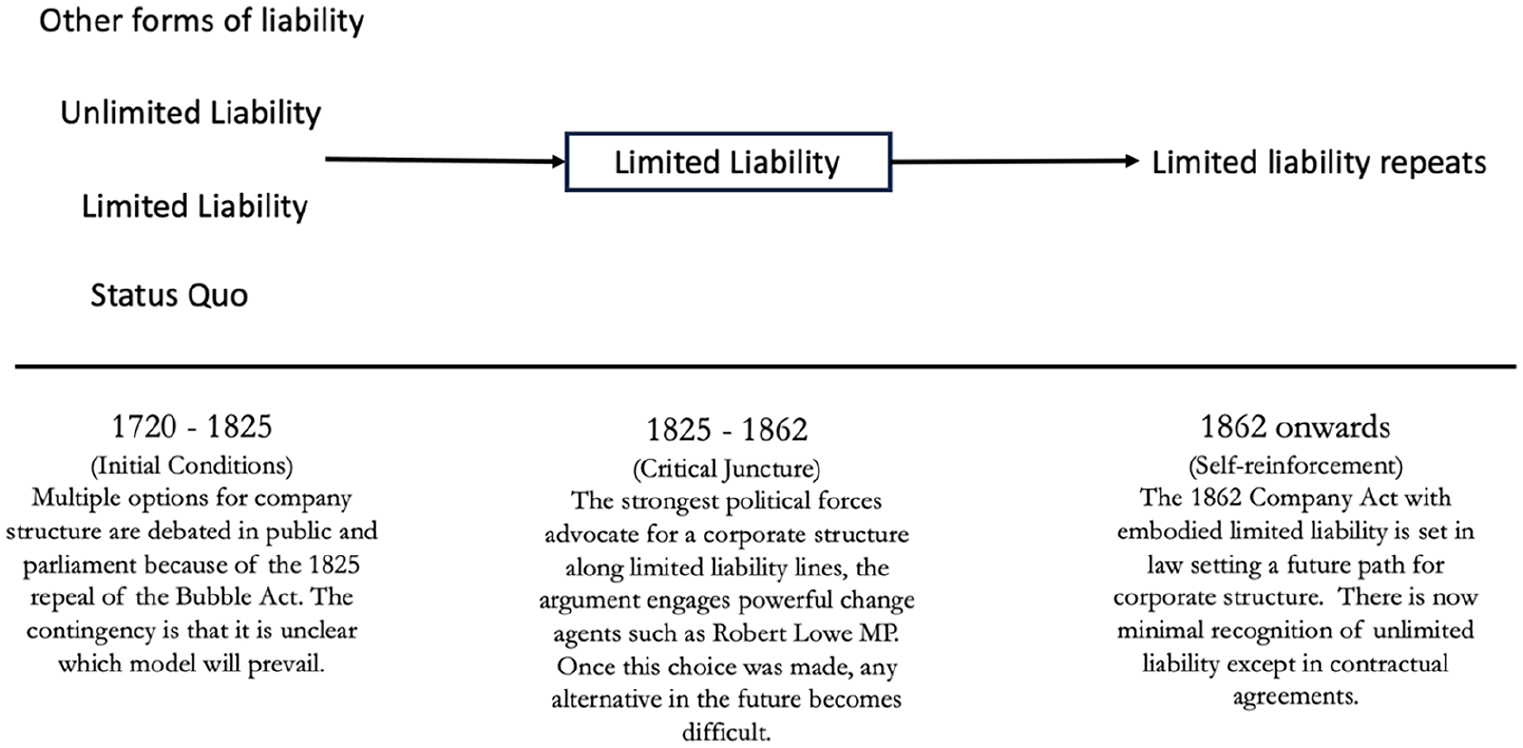
Illustration of contingency in self-reinforcing sequence in the case of the 1862 Companies Act (and the developments in various Acts that lead up to 1862) in England. The illustration is derived from Mahoney (2000, p. 514), where it demonstrates once a choice has been made at the critical juncture, any alternative, (form of company structure) that existed earlier is less viable after the critical juncture.
Global synchronicity of company structure
The synchronicity of company laws following to the 1862 UK legislation was rapid and extended to almost every part of the world (Bainbridge and Henderson, 2016; Carney, 1998; Harris, 2020; Ireland, 2010; Polanyi, 2001). The 1862 Companies Act was the global model for company structures, driven by the extensive British Empire and that nation’s powerful influence due to its naval superiority (Harris, 2020; Polanyi, 2001). The effect of company laws was enough for US President Rutherford Hayes to declare in 1867, ‘It is no longer a government of the people, by the people for the people, but of the corporation, by the corporation and for the corporation’ (Micklethwait and Wooldridge, 2003: 2). John Mikler, more than 150 years later, begins his book, ‘The Political Power of Global Corporations’, paraphrasing others with, “Global Corporations are ‘in charge’” (Mikler, 2018: 1). Some scholars have asked if corporations are evil 10 (Beck, 1992; Crouch, 2006; Ireland and Pillay, 2010; Litowitz, 2003; Little, 2022). Karl Polanyi referred to the ‘social and technological upheaval from which the idea of a self-regulating market system sprang in Western Europe’ (Block, 2001: 5). The Law Times in 1856 called the new company law ‘monstrous in conception’ (Djelic, 2013: 615). It is not to argue that all corporations are evil, however, the structure of corporations’ law with its roots to 1862 has given companies the tools to be evil.
The structure of firms throughout the world mostly follow the model of the share-tradable joint stock-limited liability company based on the 1862 corporate form (Ireland, 2010).
11
In the 1944 writing his iconic work ‘The Great Transformation’, Karl Polanyi described the spread of the British economy and the growth of the mid-19th century so called free market system around the world as evidence of path dependence.
That system developed in leaps and bounds, it engulfed space and time, and by creating bank money it produced a dynamic hitherto unknown. By the time it reached its maximum extent, around 1914, every part of the globe, all its inhabitants and yet unborn generations, physical persons as well as huge fictious bodies called corporations, were comprised in it. A new way of life spread over the planet with a claim to universality unparalleled since the age when Christianity started out on its career, only this time the movement was on a purely material level. (Polanyi, 2001: 136)
Polanyi’s assertion of ‘unborn generations’ goes to the heart of long-term planetary damage, measurable in the geological layers of the earth.
Only through a corporation was it possible for founders of a business to raise the enormous amounts of capital necessary to finance the vast enterprises of the Second Industrial Revolution by selling shares to a great many investors who could put a portion of their savings into the enterprise without fearing that their entire worth was thereby put at risk.
Bourgeoisie socialism
Mid-19th century company laws, according to the House of Commons at the time, would bridge the gap between classes and give the poor a chance to become wealthy through share ownership and speculation to ‘. . .enable the poor to invest their savings, and was the means of effecting that for which social philosophers so much longed – namely, uniting the interests of all classes’, a concept Keynes would respond to in his 1926 essay on Laissez-faire economics (Keynes, 1926). Marx and Engels, in the 1848 ‘Communist Manifesto’, published at the height of the social and political argument on share ownership and limited liability in England, finished their penultimate chapter with, ‘(T)he Owenites in England and the Fourierists in France, respectively oppose the Chartists and the Reformists’ (Engels and Marx, 2004: 256). The Chartists in England were advocating for the complete liberalisation of corporation law that included limited liability to enable the poorer classes to buy and sell company shares (Djelic, 2013).
The importance of the 1862 Companies Act was destined to grow to such an extent that no time should be lost in improving the law before the transactions in connection with it become so large that it would be almost beyond the power of Parliament to deal with, according to the Member for Stockport, Mr Morrison (Hansard, 1867). The Company Act of 1862 and the embodied limited liability characteristics caused a great deal of ‘anxiety’ in England when they were being debated in the parliament and continued after the laws were passed (Guest, 2016: 315). It was just what Marx and Engels (1848) were advocating, only approaching inequality from the opposite direction, suggesting a bourgeoisie socialism, it would only make the capitalist classes more wealthy using small individual investments from the poorer classes.
The debate on the adoption of limited liability as the key element of the simple registration of a company was the subject of intense social and political debate; opposing examples are in the words of Robert Lowe MP, in the House of Commons in 1856, ‘I am arguing in favour of human liberty’ in his reason that it is the natural right of all classes to invest in the nation’s industry (Djelic, 2013: 613). In response, published in the Law Times, in London in 1856, ‘The new joint stock Companies Act not merely introduces a novelty into the morals and commerce – it is as strange in form as it is monstrous in conception. . . Every protection, which the former law (with unlimited liability) had provided against fraud, folly and abuse, has been swept away’ (Djelic, 2013: 615). Robert Lowe was perhaps the most potent political actor of his time, his entry into the argument over the adoption of the forms of the Companies Act in 1855, 56 and 1862 could be seen as a critical juncture in the public debate. The 1862 Companies Act gave individuals starting firms the power to form a structure of their choosing, which would almost always be with limited liability (Harris, 2020). Lowe was a strong advocate for free trade and laissez-faire economics and a student of the nascent political economy ideology, he viewed liability as a constraint to economic growth (Maloney, 2005a, 2005b).
Gilbert and Sullivan’s ‘Utopia’
So significant was the 1862 version of the Companies Act that the British theatrical writers Gilbert and Sullivan were moved to produce a stage musical in 1893, ‘Utopia Limited or, The Flowers of Progress’ about the potential issues that could come from the 1862 law (Gilbert and Sullivan, 1893; Parsons, 1993; Richard, 2016). The chorus at the end of Act one;
Let’s seal the mercantile pact - The step we ne’er shall rue - It gives whatever we lacked - The statement’s strictly true - All hail, astonishing Fact! All hail, invention new - The Joint Stock Companies Act - The Act of 62! (Gilbert and Sullivan, 1893: end of Act 1)
The public and political debate around company structures came at the end of the Napoleonic Wars, the ideas developed by Ricardo on national comparative advantage, an emerging concept of political economy, James Watt’s steam engine innovation in 1776, post-War of Independence in the USA and the trade that followed with the British, the Opium Wars with China, and the vital political arguments of Robert Lowe MP in the UK House of Commons (Maloney, 2005a, 2005b). These would all conspire to create a period of social and economic transformation that has never been seen before and would likely be on reflection more significant than any period since (Bainbridge and Henderson, 2016; Fawcett, 2018; Jones, 2020; Maloney, 2005a; Micklethwait and Wooldridge, 2003; Noell et al., 2013; Polanyi, 2001; Ruffin, 2002). The political machinations of that period would have provided social commentators such as Mary Shelley, and later Robert Louis Stevenson with ample material to develop concepts associated with their creatures and warnings to society about the dangers of creating soulless monsters in the form of joint stock, limited liability companies. Mary Shelley’s father, William Godwin was suggested to have participated in the writing of Frankenstein 12 (Clemit, 1999; Suddaby and Ross, 2022). Godwin, as well as his wife Mary Wollstonecraft were politically active during the period when arguments in the media, society, and parliament over the issue of company structure were at a height (Godwin, 1842, 2018; Keynes, 1926; Philp et al., 2020). Mary Shelley would likely have been influenced by her father’s work during her life, but also her mother’s writing.
The final form of the modern business corporation was completed in 1862 with the passing of the Companies Act (Bainbridge and Henderson, 2016; Micklethwait and Wooldridge, 2003). The law embodied the principle of limited liability, freely tradeable shares, and an unlimited number of shareholders would ‘encourage the demon of speculation’ (Hansard, 1867). “By the last decades of the century, contributors to periodicals such as the 19th Century and Blackwoods were characterising the limited liability corporations as a ‘Frankenstein’ they wreaked havoc on society” (Guest, 2016: 315).
Mary Shelley published ‘Frankenstein: or The Modern Prometheus’ in 1818 during the height of the political debate over concepts of limited liability and the structure of the British economy, specifically regarding corporations (Peters, 2017; Smith, 1992). Robert Louis Stevenson wrote his novella, ‘The Strange Case of Dr Jekyll and Mr Hyde, in 1886, not long after the final structure of the modern corporation had been completed and social commentary was intense. The infamous case of Salomon versus Salomon concluded in 1897 in the High Court was making its way through the London courts in a dispute that would highlight the legal challenges to the concept of the ‘fictious human’ at the centre of corporations law and limited liability (Dhawan, 2018). A review of the Salomon versus Salomon case at the beginning of the 21st century concluded the ‘Salomon’s case endowed the company with all the requisite attributes with which to become the powerhouse of capitalism’ (Puig, 2000: 1). 13 At the end of the century, Gilbert and Sullivan (1893) opened their musical ‘Utopia Limited or, The Flowers of Progress’ at the Savoy Theatre in 1893 in London. The link between corporations and limited liability in literary works during the 19th century has been made (Borowitz, 1973; Farrar, 1998; Guest, 2016; Kimbrell, 1998; Mitchell, 2001; O’Malley, 1988; Seo, 2006).
Economic and industrial growth following the 1862 company act and limited liability
From the mid-19th century, the British stock market went through a period of rapid expansion (Campbell et al., 2021; Levi, 1870; Taylor, 2014; Tzouvala, 2020). Clear from the data following the passing of the Companies Act in 1862, there was a significant upward trend in the value of investment in British businesses. Puig (2000: 1) made the point that nascent law on companies at the time was the fuel for an exploding capitalism that has continued to build up to the present day.
Analysis of the data from the period reveals conflicting interpretations. Campbell et al. (2021), suggest that the noticeable change in the data from the start of the 1869 decade is due to the change in data source, Course of the Exchange, COE to data from Investor’s Monthly Manual, IMM (2021: 650). However, comparing the data from Levi (1870), the same abrupt change in the volume of business is evident with data from a single source. The author concludes that the upturn in business activity is due to the consolidation of the Companies Act with five other related Company Liquidation Acts in 1862, particularly the embodiment of limited liability (Borowitz, 1973). More research needs to be carried out specifically on the growth of industrial activity by consolidating various data sources in this important period of corporation history.
The scale of business increased markedly after the 1862 Companies Act, as evidenced by the study of company registrations at the time (Campbell et al., 2021; Fawcett, 2018; Levi, 1870). The U.K. stock market was by far the largest in the world during the second half of the 19th century, and coupled with the reach of colonial outposts of Britain, it would witness the global domination of British legal and economic structures (Campbell et al., 2021; Koskenniemi, 2021; Smith, 1929). However, it wasn’t until a few years after the law was passed that the volume of share trading grew; this, according to some research, was due to the initial large share denominations, a hangover from the pre-1862 unlimited liability company structure (Maltby, 1998). 14 The world was in a nascent globalisation, emanating mainly from England, which resulted in enormous wealth being made accessible for industrial expansion. The 1862 Companies Act effectively stimulated a second stage of the industrial revolution in England, however, this was not necessarily the case in the USA where at the beginning of the 18th century, unlimited liability remained the standard of the corporate form, although in a relatively short time this would change dramatically when limited liability was made the general rule for new businesses (Bainbridge and Henderson, 2016: 36).
Company law around the globe has been in continuous change since the mid-19th century. It has been influenced by legal structures between common, civil, and secular law systems in different nations. It responded to differing geopolitical circumstances. However, according to Pistor et al. (2002: 871), the changes to company law around the world ‘leave us skeptical (sic) of attempts to improve corporate law. . .’ It seems change is in response to some significant financial/governance/political events that occur, such as the Asian Financial Crisis, Enron, Volkswagen, GFC, and September 11 (Greenfield, 2019). The changes that have occurred are mostly to do with internal governance, mergers, small shareholder protection and or power distribution within the firm (Pistor et al., 2002). The underlying concepts of company/corporate law have remained unchanged over the past 160 years. Although, according to Mikler (2018), the insidious political power of global corporations is continuously being addressed, perhaps unsuccessfully by changing laws, it supports the views of other scholars (Pistor et al., 2002). Climate change and environmental sustainability are the new theatre for company legal action.
Here lays the blame for global climate change
Suggesting climate change has been caused by ‘all’ humans when using the catchall phrase ‘human activity’ would be wrong in recognising the 1862 Companies Act as the most significant human invention and the boundary of the Anthropocene (Dang and Edwards, 2022; Davis et al., 2019). Passing the Companies Act in the mid-19th century means that global climate change has been caused by a particular group of easily identified men who were instrumental in bringing the legislation to fruition and setting the path dependence for corporate structure (Maloney, 2005a). Referring here back to the text from the Economist Magazine in 1926 regarding the impact of the limited liability joint stock company on the natural environment, ‘man’s command of natural resources has multiplied many times over. . .’ (Gibson, 2008: 17). To universally blame many other innocent human groups has only diluted responsibility for addressing the problem of global climate change.
The situation the world faces cannot be blamed on seized Africans forced into slavery by Europeans in the 17th century or on the North American Indian tribes who were forced from their traditional way of living due to the expansion of European adventurism and commerce in the 18th and 19th centuries, or even perhaps on the Chinese who were ripped out of their feudal isolation by the brutal forces of British trade in the late 18th century to well into the 20th century, or on the Australian first inhabitants who lived an ecologically stable and self-sufficient existence for more than 60,000 years, the longest, continuously surviving culture in the world, interrupted when invaded 15 by the British in 18th century (Dang and Edwards, 2022; Davis et al., 2019; Dooley and Clode, 2019). It is worthwhile to note the words of Dr Frankenstein’s creature, ‘I heard the discovery of the American hemisphere, and wept with Safie over the hapless fate of its original inhabitants’ (Crook, 2017: 110). ‘The discovery of America, the rounding of the Cape, opened up fresh ground for the rising bourgeoise. The East-Indian and Chinese markets, the colonisation of America, trade with the colonies, the increase in the means of exchange and in commodities generally, gave to commerce, to navigation, to industry, an impulse never before known. . .’ (Engels and Marx, 2004: 220).
According to Wolff (2014), the most significant changes to the earth’s ecology still lay ahead. Actors in political economy, global governance, corporate, municipal and international law, and national politics need to restructure capitalism such that the activities of the modern corporation can be managed by society addressing climate change, which will likely remain a grim problem (Dang and Edwards, 2022). Until then, the only thing we can do is stand back and exclaim, as perhaps Dr Frankenstein and Dr Jekyll said of their 19th century monsters, ‘What have we created? What have we done?’ Frankenstein’s disgust at his creation is clear when he is ‘(U)nable to endure the aspect of the being I created, I rushed out of the room, and continued a long time traversing my bedchamber’, (Shelley, 1993: 5). Dr Frankenstein later describes his creature, ‘He is eloquent and persuasive, and once his words had even power over my heart: but trust him not. His soul is as hellish as his form, full of treachery and fiendlike malice’ (Shelley, 1993: 159). Shelley wrote her classic work just at the time when England entered the early stages of the Industrial Revolution, a time of significant political and economic turmoil (Byrd and Paquette, 2021; Peters, 2017). It is easy to read from the creature’s words the skilful marketing and greenwashing campaigns of some of the world’s best-known corporations today (Montgomery et al., 2023; Plec and Pettenger, 2012).
‘O my poor old friend Harry Jekyll, if ever I read Satan’s signature upon a face, it is on that of your new friend, Mr Hyde’, noted by Mr Utterson, Dr Jekyll’s lawyer after meeting Mr Hyde for the first time (Stevenson, 2019: 21). The people in the Irish community of Rossport would argue they have seen the face of evil in the way they were treated by Shell Oil (Killian and O’Donnell, 2017).
At the 2022 UN COP27 in Egypt, the U.N. Secretary-General, Antonio Guterres, declared there was a ‘deficit of credibility over net-zero targets of non-state entities’, he went further to demand global corporations stop lying about their environmental achievements (UN, 2022) Companies engage in a process called greenwashing, or as Guterres put it so bluntly – lying, where they claim they are being responsible; in reality, the opposite is the case, in some cases, they are far from being responsible (He et al., 2022). The Volkswagen emissions scandal can be considered the poster child for corporate duplicity, but unfortunately there have been many others involving the likes of Union Carbide, Enron, and seemingly countless others (Beder, 2002; Isacks, 2022; Mačaitytė and Virbašiūtė, 2018; Varma and Varma, 2005; Weick, 2010). Surely, episodes of such corporate behaviour are examples of evil (Little, 2022).
Getting the genie back in the bottle – businesses want civilisation at a discount
The basic structure of corporations has hardly changed from 1862 to today, where the world is dominated by massive multi-national corporations, MegaCorps that are bigger than many nations and have significant influence over national and international politics, particularly regarding climate change (Harrison and Mikler, 2022; Mikler, 2018; Saez and Zucman, 2019; Strange, 1996; Wilks, 2013).
The origins of the modern corporation are likely rooted in self-interested individuals in the mid-19th century creating a corporate structure that would best suit their desire to gain significant personal wealth (Harris, 1997). Since the mid-19th century, the wealthiest people in capitalist economies have mostly been individuals who derive most of their income from shares, the temporary ownership of corporations (Saez and Zucman, 2019). Over the entrance to the US Internal Revenue Building in Washington there is a quote from Mr. Justice Holmes of the US Supreme Court, ‘Taxes are what we pay for civilised society’ (Saez and Zucman, 2019: 48). Most large and global corporations seek to pay as little tax as possible, even to the point where some pay none. According to U.S. Supreme Court Justice Holmes in Saez and Zucman (2019: 48), ‘too many individuals want civilisation at a discount’. Although Justice Holmes noted in his quote ‘individuals’ it could easily include the corporation in his criticism given the evidence and the tax contribution that has come to light over recent years (Elbra and Mikler, 2017). The size of contemporary business corporations’ rivals that of many countries and so large international business organisations are able to exert significant political and economic pressure where they can influence national laws on taxation (Elbra and Mikler, 2017; Feil, 2016; Mikler, 2018; Saez and Zucman, 2019). It is a massive transformation since passing the 1862 Companies Act.
Changing how contemporary business organisations are structured would be a Herculean task, pushing against path dependency and lock-in. It would be impossible to change what has gone before; creating a new class of companies might serve to make the existing cohort even more powerful and larger than they are currently (Carroll and Spainski, 2018; Edwards, 2020; Saez and Zucman, 2019). Dr Frankenstein pursued his creature around the globe, failing to rid the world of the ‘monster’ (Crook, 2017). Dr Jekyll died and in the process of destroying Mr Hyde (Stevenson, 2019). Learning from the historical roots of the modern immortal corporation and the limits to liability, it would seem the only direction for the modern corporation would become even more pernicious, unless there is significant change, but the cost of change will be boundless given ‘lock-in’ through path dependence set in 1862.
Ecological damage by corporations
The link between the growth of firms over the past 161 years, since the 1862 Act 16 and the damage to the natural environment through resource exploitation and climate change has been well established (Beck, 2014; Beder, 2002; Jørgensen and Jørgensen, 2016; Mikler, 2018; Siva, 2022), a list of references to this fact would be inexhaustive as it grows by the day. Corporations continue to damage the world’s ecosystem in the pursuit of profits; the Volkswagen emission scandal is perhaps one of the most repulsive episodes in corporate history, but in reality is one of many 17 (Mačaitytė and Virbašiūtė, 2018). According to Daniel Little’s recent monograph, corporations are not averse to conducting evil, ‘(E)vil actions by states or individuals are actions that deliberately lead to wanton human suffering and death on a large scale with no regard for the human value of innocent human beings who are harmed’ (Little, 2022: 4) Managers of corporations lying about their products processes and CO2 emissions to the extent of the Volkswagen case is well within this definition of evil (Poier, 2020).
The modern period – tax
The description of the historical roots of the modern corporation and the predictive social commentary that accompanied its final form serve to show that the structure of companies was an ad hoc process that was driven by a small group of English male politicians who had a vision of what form the future of the British political economy should be, in their narrow view, one that is based on laissez-faire principles and a nascent concept of political economy (Guinnane et al., 2014; Harris, 2020; Maloney, 2005a, 2005b; Maltby, 1998).
The modern business corporation today, replete with its multinational, MegaCorps form, dominates the world’s economy, having escaped the confines of England. One of the key features of the MegaCorp is its ability avoid what many believe is a fair share of taxation (Elbra and Mikler, 2017; Saez and Zucman, 2019). Several scholars have explored the skill of large businesses in avoiding paying taxes (Clausing et al., 2021; Elbra and Mikler, 2017; Faccio and Iacono, 2022; Piketty et al., 2023). Saez and Zucman (2019) describe in their book, ‘The Triumph of Injustice – How the rich dodge taxes and how to make them pay’, that the extent to which corporations manage to avoid their tax obligations is extraordinary. Many of the world’s largest firms pay little to no tax; they are monsters devoid of a conscience (Clausing et al., 2021; Elbra and Mikler, 2017; Faccio and Iacono, 2022; Mikler, 2018; Piketty et al., 2013; Saez and Zucman, 2019).
The study of the development of laws throughout the 19th century to create business structure and organisation reveals a flawed process building a world dominated by MegaCorps that control almost every aspect of human life, to the point of threatening the existence of life on earth (Lipschutz, 2023). Over the next few decades, the fear is even more wicked domination will evolve as new technologies such as Quantum computers, Artificial Intelligence, transport, energy, cybercrime, and military systems are revealed. Given the role played by corporations and the benefits derived from exploiting and polluting the world’s natural and human resources, it would seem appropriate for them to pay a fair share of taxation. More versions of Dr Frankenstein’s creature and Mr Hyde’s are on their way.
Conclusion
There can be little doubt that the formation of the modern business corporation has significantly affected the world, its people, governments, and the natural environment in both negative and positive ways. It would seem evident that the magnitude of the role played by companies in their various forms is so significant that the earth’s geological layers should bear witness to what corporations have done and, therefore, their legal structure can legitimately be identified as a candidate for the boundary of the Anthropocene.
The path corporations have been dependent was set in the middle of the 19th century. The start of the innovations by James Watt on the steam engine, the Industrial Revolution, the end of the Napoleonic Wars, the repeal of the Bubble Act and the culmination of England’s period of international adventurism created an environment where a new form of company structure would evolve. It would hardly be likely the architects of the corporate structure would have known companies would end up being bigger than some nations and have political power on an international stage. However, some prominent individuals in social commentary in the 19th century were fully aware of the dark potential of the 1862 company structure.
Authors such as Mary Shelley, Gilbert and Sullivan, Robert Louis Stevenson, and Marx and Engels wrote about the dangers of creating fictitious creatures in the corporate personality, and their discussion about limited liability could hardly be misunderstood. The contemporary political debate would refer to the 1862 Companies Act and its accompanying limited liability as a monstrous law, as a Frankenstein. Djelic (2013: 597), ‘limited liability is not a natural attribute of capitalism but a socially constructed feature. . .’
Footnotes
Declaration of conflicting interests
The author(s) declared no potential conflicts of interest with respect to the research, authorship, and/or publication of this article.
Funding
The author received no financial support for the research, authorship, and/or publication of this article.
