






Abstract
In a world where facts are contested, the conceptual tool of the Anthropocene epoch – that is, the dramatic and clearly demonstrable ways humans have changed the Earth system trajectory since the mid-20th century – provides real value for society in general and for education in particular. As a unifying concept, it helps us (a) understand the transformed bioclimatic conditions in which we live, (b) appreciate how fragile they are, how rapidly they are shifting, and their implications for humanity, and (c) explain the importance of containing climatic, biological, and attendant societal runaway effects, through deeper understanding of the Earth system. The Anthropocene as an educational tool can illuminate the web of connections between these themes, but should remain at arm’s length from calls to action.
Keywords
On 5 March 2024, it was announced in the media that members of the Sub commission on Quaternary Stratigraphy (SQS) of the International Commission on Stratigraphy (ICS) had voted against formal recognition of the Anthropocene as a geological epoch. The proposal had been submitted by the Anthropocene Working Group (AWG) at the invitation of the SQS and ICS. In the meantime, a common-sense definition has been proposed (Zalasiewicz et al., 2024a). We do not address here the controversy surrounding the vote (Turner et al., 2024); rather, we emphasise the impact on education communities in many disciplines during the 15-year process aimed at defining the Anthropocene chronostratigraphically.
The Anthropocene epoch, as conceptualised by the AWG, retains great value even without formal ICS recognition. Reasons provided for its rejection are that (a) 70 years is too short for an epoch in the geological time scale, and stratigraphy deals with the past, not the future; (b) human impacts on the planet extend back hundreds of thousands of years and are time-transgressive; (c) the nature of the analysis is multidisciplinary, representing not only geology, but Earth System science, climatology, biology, etc., as well as disciplines within the humanities and social sciences engaging societal reflection; and (d) formalisation has political and economic implications. A set of comprehensive counter arguments are then offered (Zalasiewicz et al., 2024b). It is crucial to note that this remarkable Anthropocene controversy reveals the unquestionable potential of the Anthropocene as an educational tool for mobilising public awareness and generating positive social actions if viewed systemically.
Questions posed by the Anthropocene to educators and teachers
From an educational perspective, the Anthropocene poses a growing number of questions for teacher-researchers of all disciplines in their teaching practice: (a) Does knowledge of dangerous Earth System change lead to commitment or disengagement? Should we be generating anxiety among young people? (b) How can we pass on a well-tuned vision of the world, informed by scientific knowledge, while at the same time encouraging mobilisation and eco-citizenship? How can we ensure that developing a bioclimatic understanding of the Anthropocene stimulates creativity and does not lead to defeatism or apathy? (c) What bodies of knowledge should be passed on to pupils, how should the extent of the risks be addressed, and at what age? (d) How can we fundamentally rethink our teaching of bio geophysical phenomena where science and politics intersect as illustrated in the Anthropocene concept? An axiological approach has been developed, proposing a revisiting of educational thinking in light of the systemic challenges of the Anthropocene, which may concern types of citizenship with reference to which younger generations should be educated. For many researchers, the Anthropocene is, as such, a pedagogical tool that can accompany profound transformations in the organisation of our societies (Wallenhorst, 2023).
A holistic concept with a scientific basis that has rhetorical power
The Anthropocene epoch is characterised by a sharply expressed and lasting change in the habitability of the Earth that is now human-driven (Waters et al., 2024), but in which planetary feedbacks and tipping points will likely become increasingly important. In geological detail, it is a complex and controversial concept. However, in general it is straightforward to communicate to a wide audience, given that many of the component phenomena (e.g. the rises in greenhouse gases) are clearly, even dramatically, expressed. This Anthropocene concept links the global climate, the biosphere, and societies and their respective dominant processes, and includes runaway effects and tipping points, collapse and acceleration (Wallenhorst and Wulf, 2023; Figure 1). Evidence-based and systemic in scope, the Anthropocene epoch also carries an ethical responsibility for conveying the concerns of scientific communities about the worsening of bioclimatic living conditions, and may be aimed at mobilising citizens or challenging public authorities. It also encompasses political and existential dimensions, such as planetary thresholds and limits to habitability (Steffen et al., 2015), biospheric disruption and the sixth mass extinction (Barnosky et al., 2011) and potential transformation of economic systems (Rockström et al., 2023).
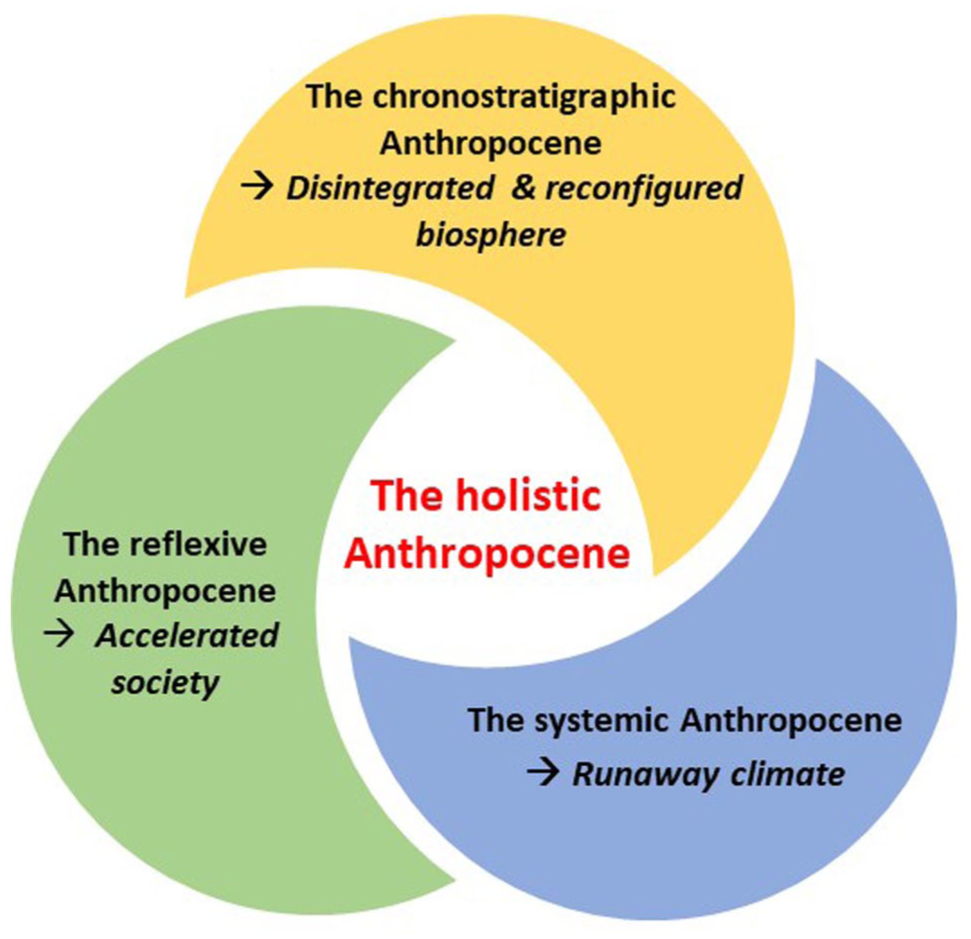
The Anthropocene as a holistic concept Interlinking its chronostratigraphic, systemic, and reflexive aspects.
The Anthropocene epoch as a scientifically grounded holistic concept provides a systemic vision of how the Earth works and how recently it has fundamentally changed, in contrast to the bioclimatic stability of the Holocene (beginning 11,700 years ago) that allowed human societies to develop and flourish, agricultural surpluses to be generated and subsequent civilisations established. In this sense and context, the Anthropocene as an expression of Earth System functionality can be viewed as a rupture (Hamilton, 2016) in planetary history and so exemplifies a boundary between units of geologic time. This rupture is now operating within the Earth System progressively to undermine human and non-human ecosystems. This analysis opens the way to another type of rupture, which may operate within our societies, transforming them to stabilise the Earth System towards conditions that are as near as possible to those of the Holocene, a departure from which inevitably stresses human societies that have evolved under and relied upon no-longer existing conditions.
Chronostratigraphic Anthropocene, systemic Anthropocene, and reflexive Anthropocene
The Anthropocene epoch is one of three levels of comprehension of an integrative Anthropocene concept that presently coexist in the scientific literature. As used here, the Anthropocene epoch refers to the chronostratigraphic Anthropocene, a presently unofficial unit of geological time with an internationally accepted and clearly defined isochronous onset defined in geologic strata at a precise point (Hajmirbaba, 2020; McCarthy et al., 2025): establishing a boundary that helps consistent understanding and communication of the concept, and its analysis in quantitative terms (Zalasiewicz et al., 2024a). The geological debate as to whether the Anthropocene should be formally added to the geological timescale was interrupted by the recent ICS decision, but that interruption does not obviate the strong scientific evidence (including that clearly preserved in the geological record) for clear differentiation of how the Earth System operated before and after the mid-20th century (Syvitski et al., 2020). The systemic Anthropocene emphasises the threat to Earth’s human habitability over the course of this century. It refers to a specific, scientifically-based epistemology of which the main objective is not the production of primary data, but its synthesis and widespread transmission. The researchers who have used it (Rockström, Steffen, Barnosky, Ceballos, etc.) organise knowledge into narratives, enabling such knowledge to be passed on. The reflexive Anthropocene, which refers to the consequential metalevel of the Anthropocene, has been in use in the social sciences, humanities, and in popular parlance for at least the past 15 years (Zalasiewicz et al., 2021). In some interpretations, it has been extended to include all of human history and becomes synonymous with all detectable anthropogenic effects, and so is conceptually far removed from the Anthropocene epoch as used here.
In their epistemic uses, these three conceptual tools are all useful in education and beyond: (a) the chronostratigraphic Anthropocene (or Anthropocene epoch) highlights the profound changes humans have recently made to the planet, and if formalised as part of the Geological Time Scale, will become codified in schools and universities around the world to acknowledge the profound changes humans have inflicted on planetary function; (b) the systemic Anthropocene engages educators, students, and policy makers in many ways already and stimulates societal action (as the Fridays for Future school strike movement); and (c) finally, the reflexive Anthropocene stimulates new ideas and debate in many different kinds of scholarly circles, gives rise to new art and literature, and informs the general public about this transformational time in which we find ourselves.
Some examples of the utilisation of the Anthropocene in education
This conceptualisation of the Anthropocene (with the integration of its three components), illustrates how a science-based concept can inspire us to think, educate, and act differently. A good illustration comes from Bruno Latour, who shows why politics in the Anthropocene epoch should start with the epistemic shift of our understanding of the terrestrial from a dead rock to a habitat for numerous organisms (i.e. the critical zone). Latour also puts himself in collaboration with a scientist, Timothy Lenton, to suggest how humans can collectively become “sensors” of the Earth system changes and thus give valuable informational inputs (Lenton and Latour, 2018). In practical terms, some educational experiments can help understand what kind of action might be catalysed through the Anthropocene notion. A particularly salient one are the workshops developed in France from Latour’s book Down to Earth (2018) by a team of researchers led by Anne-Sophie Breitwiller at the Collège des Bernardins in Paris. These workshops confront participants with such questions as: “Could you describe the territory [territoire] where you live?,” “Could you describe the territory out of which you draw your livelihood?” and “Could you describe the territory you would be ready to protect?” (Hajmirbaba, 2020). These questions, seeking to unearth the inextricability of life, human and non-human, with the planet, and successively more difficult to answer exhaustively, are primarily a strategy to get participants to feel their way into their entanglement with the phenomenon of the Anthropocene, so as to be able to situate themselves in relation to it.
These ideas, which are just some of the non-exhaustive examples of how the concept of the Anthropocene is being used in education, may seem insufficient. To put it bluntly, some might ask: what about saving the world? A question like this often implies a desire to ensure that learning about the Anthropocene will “bring results.” We suggest, though, that if the Anthropocene were simply used to manage people into forms of action that some authority qualifies as desirable (even if this determination came from a completely well-meaning scientific or political authority), this would not make it an educationally effective notion. An “effectiveness” framed in such narrow terms would simply turn the Anthropocene into a more or less useful regulatory instrument. This is why it is necessary to keep the educational effects of the Anthropocene at a healthy distance from the temptation to “automate” the transition from learning about something to engaging in some course of action identified as desirable. Summing up, the educational enterprise can only begin when one starts approaching difficult questions in a spirit of questioning, curiosity, sensitivity and openness. The Anthropocene, as a concept that never ceases to make the familiar unfamiliar, is an inexhaustible source of educational questions and answers about what our world is.
Footnotes
ORCID iDs

Funding
The authors received no financial support for the research, authorship, and/or publication of this article.
Declaration of conflicting interests
The authors declared no potential conflicts of interest with respect to the research, authorship, and/or publication of this article.