






Abstract
Understanding how health care organizations can achieve care coordination internally is essential because it is difficult to achieve, but essential for high-quality and efficient health care delivery. This article offers an answer by providing a synthesis of knowledge about coordination from organization theory, where coordination is a central research topic. The article focuses on intra-organizational coordination, which is challenging especially across boundaries such as departments or professions. It provides an overview of the classic coordination mechanisms, e.g., standardization of work processes, but also of recent insights that have identified the conditions that are required to achieve coordination, and how these conditions can be provided by formal mechanisms, such as standardization, but also informally by drawing on features of the emerging situation. Such research highlights the contribution of, e.g., routines like those guided by care pathways or of artifacts like displays. The coordination insights are also discussed as regards inter-organizational care coordination.
The challenge of providing care coordination
Understanding how health care organizations can achieve care coordination internally is essential because care coordination is difficult to achieve1,2—especially across boundaries such as departments or occupations—but is essential for high-quality and efficient health care delivery3–6 and continuously learning health care organizations. 7
To advance knowledge about how health care organizations can achieve care coordination, this article offers a synthesis of knowledge about coordination from organization theory, 8 where one of the central challenges is how to provide coordination. 9 Organization theory thus has accumulated a comprehensive body of knowledge about the coordination challenge and different coordination mechanisms.10–12
By synthesizing insights about how health care organizations can coordinate care, this article adds an important operational layer to the understanding of what care coordination is. 13 The article is structured in three parts that represent different organization theory perspectives on coordination12,14–17: (1) traditional coordination mechanisms from classic organization theory; (2) insights from a more recent stream of studies of how coordination emerges and gets achieved in practice, which has identified the conditions that are required for coordination to be achieved, and how these conditions can be provided by the classic coordination mechanisms but also in informal ways that draw on features of the emerging situation; and (3) an overview of Okhuysen and Bechky’s 12 integrative framework of coordination which combines the two perspectives and offers a cutting-edge framework of coordination mechanisms.
The article focuses on intra-organizational coordination. Coordination is especially difficult across boundaries such as departments, roles and professions, features that are particularly strong in health care organizations18–20 with high functional specialization 2 and strong professional cultures.7,21,22
Traditional perspectives on how to achieve coordination
Coordination refers to the alignment of actions. 9 It becomes non-trivial when the actions to be aligned are interdependent. 10 In a classic and influential conceptualization, March and Simon 23 distinguished coordination by plan and coordination by feedback. Coordination by plan (e.g., through plans or programs) achieves the alignment of actions beforehand, by prescribing behaviors to the different parties involved that will be coordinated if everyone follows the plan. In the context of health care, clinical pathways 24 and lean processes, 25 for example, represent coordination by plan. Coordination by feedback, on the other hand, aligns actions of different individuals by them adapting through communication (feedback) as action unfolds, for example, during a surgery.
Five traditional coordination mechanisms (Based on Mintzberg, 1979). 11

Mutual adjustment brings about the alignment of action by informal communication, for instance, verbal communication during a surgery or when people communicate in the hallway to update each other. Direct supervision achieves coordination as a supervisor, who has the authority to direct the work of subordinates, provides instructions to them, or monitors their actions, thereby assuring that their actions are aligned. In a hospital, the authority of hierarchical roles such as team leader of a trauma team can bring about coordination through direct supervision.
Standardization of work processes achieves coordination by making everyone accomplish work in a standardized process, which is designed in such a way as to align the actions of the different actors involved. It mirrors what March and Simon, 23 see above, call programs. Standardization of outputs achieves coordination by specifying what the outcomes of work should be (e.g., a production or quality target), but not how to achieve it.
Standardization of skills, finally, aligns actions as everyone with a standardized skill set will accomplish a task in a similar way. It is different from the other coordination mechanisms because the skills are determined by the education, training, and professional norms professionals receive primarily outside the control of the organization 11 ; e.g., medical schools determine the repertoire of skills doctors use to deliver care. As the skills reside in the professional, standardization of skills is consistent with delegation of decision-making autonomy to professionals. Traditionally, standardization of skills represents an important coordination mechanism in hospitals, due to the unique character of health care work.
A fundamental rule for deciding which coordination mechanism to use is that coordination challenges involving high degrees of interdependence require more powerful coordination mechanisms.5,10 Traditionally, coordination by standardization of process or output are better suited for situations of weaker interdependence (lower work complexity), while coordination by mutual adjustment is required in situations characterized by strong interdependence, e.g., where all other involved parties need to adapt when one party changes the way she carries out her work, 11 such as during surgery. Mutual adjustment is also sufficient when work complexity is low and there is no need for more expensive coordination mechanisms, e.g., to develop plans or standardized processes.
In general, the attraction of programmed coordination mechanisms over coordination by feedback is that they are considered efficient and controllable and reduce the need for personal interactions and information processing.26–28 However, recent research insights about how coordination is realized in action have added nuance and new possibilities.
Coordination in action: Recent research on how coordination is achieved in practice
A recent stream of research has studied the process how coordination is actually brought about in practice by people as work progresses, noting the emergent nature of coordination as opposed to simply applying certain coordination mechanisms. 17 This emergent perspective offers a more fine-grained understanding of how coordination mechanisms bring about aligned actions. 12 Three hospital examples about clinical protocols, care pathways, and displays illustrate insights from the emergent perspective on coordination.
Studying trauma centers, Faraj and Xiao 14 find that dialogic coordination (e.g., interventions across professional boundaries and protocol breaking) is used by actors when clinical protocols (an instance of a standardized procedure) are insufficient to coordinate the work, which in this case is saving patients’ lives. Relatedly, Gittell 6 finds that hospital care pathways (instances of standardized work processes that function as process maps) in practice provide visibility into the connections between tasks and actions. This visibility facilitates emergent forms of coordination among interrelated workers because it develops frequent, timely, accurate, and problem-solving communication as well as relationships of shared knowledge, shared goals, and mutual respect. Xiao et al., 29 in the context of a trauma operating suite and an emergency department, also identify how a traditional whiteboard (an instance of an object and representation) serves as a versatile information mechanism to support communication in rapid-paced, highly dynamic collaborative work, which plays an important role in coordination in this context.
Factoring in the emergent perspective on coordination provides a more differentiated understanding of how different coordination mechanisms (can) help to achieve (care) coordination.
An integrative perspective on coordination: Combining the traditional and emergent perspectives
An integrative perspective on coordination (based on Okhuysen & Bechky, 2009). 12
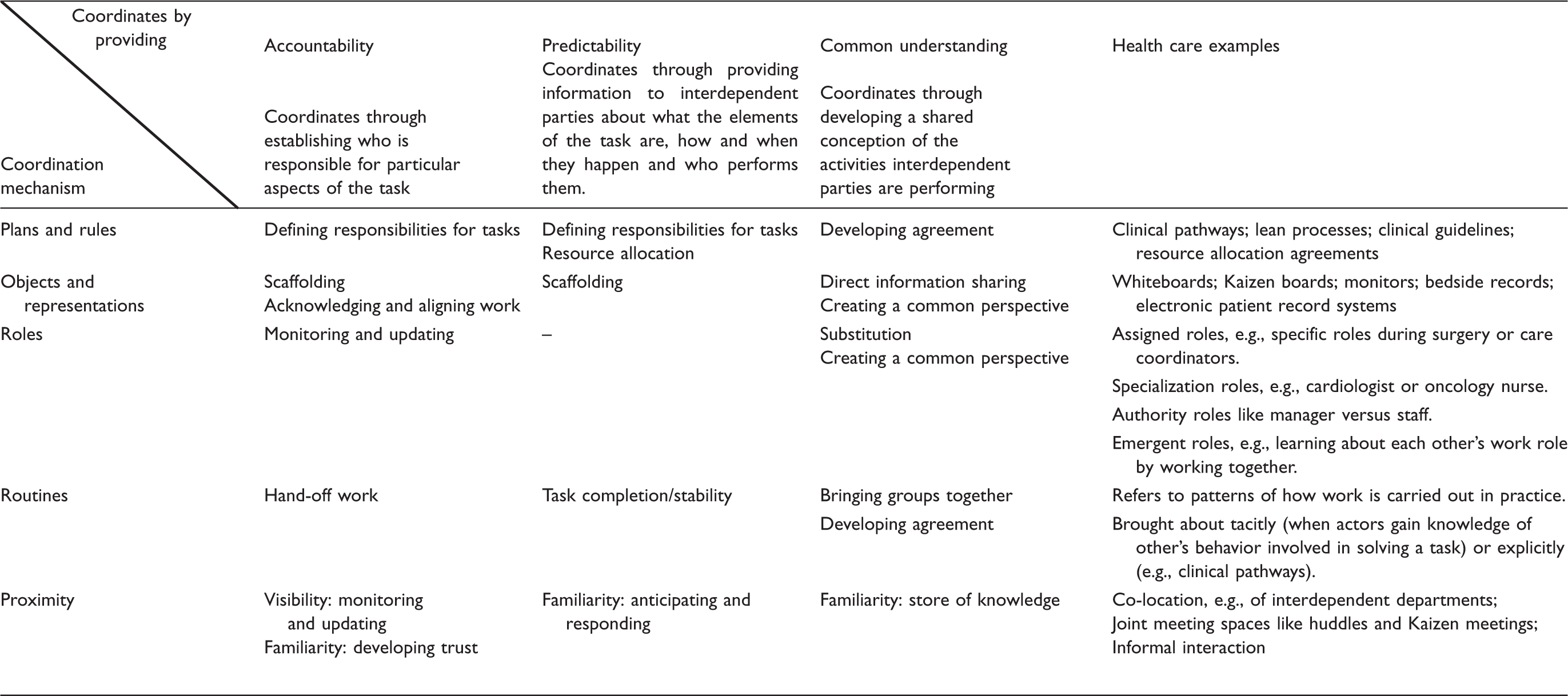
Different ways for leveraging coordination mechanisms: Programmed and emergent
Two of the central insights summarized by Okhuysen and Bechky 12 are that an extended range of mechanisms can bring about coordination, and that the classic coordination mechanisms can also be triggered in emergent ways that had not previously be considered.
Objects and representations refer, among other things, to documents (like bedside records, admission and discharge forms, or clinical guidelines 30 ), displays (such as hospital whiteboards 29 or Kaizen boards used as part of lean health care 31 ), or monitors which act as boundary spanners that can provide information about task status and progress, etc. Such objects and representations provide workers with mechanisms to acknowledge and align work, offer a scaffold that provides a structure for activities, make the progress of a task obvious, create a common perspective, and allow information to be shared directly.
Plans and rules refer to what was above called programs or standardized work processes. This type of coordination mechanism realizes its coordination potential by defining ex ante responsibilities for tasks, allocating resources, and developing agreements among the people involved.
Roles coordinate through the associated expectations people have of the roles, thereby offering the possibility to monitor and provide updates on activities. Roles also make it possible for people to substitute for each other and open for creating a common understanding about the task that needs to be coordinated. Roles can be established formally (e.g., managerial positions, team leader roles, or specialized roles based on job function such as cardiologist) or informally (emergent) when learning about each other’s work role by working together in, for instance, a hospital department.
Routines—stable ways of accomplishing a task32,33—coordinate in programmed or emergent ways “by providing a template for task completion, by bringing people together, and by creating a common perspective across groups.” 12 Routines can be brought about tacitly (e.g., when actors gain knowledge of others’ behavior when solving a task together) or explicitly (e.g., when routines are guided by clinical pathways). The coordination potential gets realized because routines provide a backdrop for handing off work (handoffs in hospitals are crucial to ensure patient safety and care quality34,35) and they foster task completion and stability. Routines also help to develop agreement among people. Interestingly, Greenhalgh 36 argues that organizational routines in the context of health care represent a hitherto untapped research area, that, if addressed, can provide insights about care coordination.
Proximity influences the amount of interaction and communication among people. Proximity can be achieved through co-location 37 or by organizing for interdependent process management by using “process mapping, brainstorming, participatory meeting management, and multi-stakeholder decision-making” 38 or having joint meeting spaces like huddles 39 in the hospital. Proximity aids coordination by providing visibility, which in turn makes it possible to monitor and update each other. Proximity also develops familiarity that builds trust and stores knowledge. Such familiarity also makes it possible for people to anticipate and respond to each other as needed in the situation.
Accountability, predictability, and common understanding: Three integrating conditions
The five types of coordination mechanisms (plans and rules, objects and representations, roles, routines, or proximity that can be brought about in programmed or emergent ways) can lead to three integrating conditions (accountability, predictability, and common understanding) which foster coordination among interdependent people (see Table 2). Accountability coordinates through establishing who is responsible for particular parts of the task. Contrary to traditional perspectives on coordination, accountability “is not only attained through hierarchical authority […] but can also be achieved in other ways, such as lateral interactions in meetings” 12 through which it emerges and becomes clear to people who is accountable for what.
Predictability coordinates through providing information to interdependent people about what the elements of the task are, how and when they happen and who performs them, thereby opening for anticipating subsequent steps. Predictability can be formally established through formal means like hierarchy and top-down plans. However, predictability can also be brought about in emergent ways using, for example, simulations and briefings because “a consequence of building knowledge of one another through emergent interaction is an enhanced level of predictability in the execution of the task.” 12
Common understanding coordinates through developing a shared conception of the activities interdependent parties are performing. This can occur in formal ways when activities are “embodied in assembly drawings, schedules, or other plans drawn up by the organization […] and handed down a hierarchy” or as a lateral process when “members of the groups themselves through an iterative process [interact] to create these plans.” 12
Discussion and conclusion
Improving intra-organizational care coordination and addressing the trends of reorganizing around care processes and delivering patient-centered care
Adding to a well-established classic body of knowledge, organization theory has recently generated important new insights on how coordination is provided inside organizations, 12 opening the door to new developments in organization theory but also offering new possibilities for achieving intra-organizational (care) coordination in practice.
Specifically, recent research in organization theory emphasizes the conditions under which coordination mechanisms bring about intra-organizational coordination—by providing accountability, predictability, and common understanding. It also points out that these conditions can be provided by classic coordination mechanisms such as plans and direct supervision but also by other means such as inter-relational and lateral mechanisms. By establishing this argument, it sheds light on the micro-foundations for coordination and, especially, identifies new possibilities for intra-organizational coordination by directing attention to the question how the processes by which interdependent actors accomplish tasks together offers possibilities for providing accountability, predictability, and common understanding. Identifying such possibilities then provides the potential to strengthen those conditions, thereby leveraging the mechanisms that foster coordination in the specific situation, which might well go beyond the classic set of coordination mechanisms. 40
These new possibilities from organization theory offer useful and novel ways of providing care coordination in hospitals, at a time when hospitals are facing increased coordination challenges brought about by new developments. Hospitals are undergoing a fundamental reorganization from being organized around departments (also known as professional silos) 41 to process-oriented organizations where the focus is on the whole care process.42–44 This process-orientation accentuates the need for finding ways to align the actions of health care staff in order to achieve care coordination throughout the hospital. 45 Similarly, mergers of hospitals into very large hospitals, with the aim of reaping economies of scale and scope,46–48 require a stronger focus on internal care coordination to connect the different organizational parts into an integrated whole.
Another challenge these new possibilities of coordination can help address is the aim of providing patient-centered care 49 and making patients active participants. 7 Gittell et al. 50 have emphasized the relational side of hospital work in which shared goals, shared knowledge, and mutual respect is decisive. Gittell and Douglass 51 highlight relational coproduction between workers (health care professionals) and customers (patients), and the Institute of Medicine 7 highlights the role of patient coaching and question checklists.
The insights from organization theory synthesized here thus offer a structured perspective that allows identifying possibilities for bringing about and strengthening coordination in hospitals as well as meeting current health care challenges.
Inter-organizational care coordination: Applicability of the traditional, emergent, and integrative perspectives on intra-organizational coordination
Intra-organizational coordination is challenging to achieve, but achieving it across organizations is often even more tricky. 52 Coordination across health care organizations and/or care sectors today is an increasing health care challenge that calls for tighter inter-organizational care coordination.53–55 One factor is that more and more “persons with continuous complex care needs frequently require care in multiple settings.” 56 A widely used health care solution to that end is chronic care models/disease management programs.57,58
The integrative perspective on intra-organizational coordination offers potentially valuable insights when it comes to organizing for accountability, predictability, and common understanding across organizations, although it remains largely unexplored. 12 At first, the traditional perspective on coordination (like plans and rules and defined roles) looks more likely to improve inter-organizational care coordination. One reason being that emergent forms of coordination across organizations face greater challenges because working in separate organizations typically provides far fewer opportunities (such as meeting spaces and proximity) to, for example, (a) learn about each other’s work role or (b) gain knowledge of other’s behavior involved in solving a common task.
However, using traditional, formal coordination mechanisms purposefully across organizations (like institutionalizing opportunities for dialogue 38 ) could help to achieve inter-organizational care coordination and potentially serve as a step towards developing emergent forms of coordination across organizations that bring about accountability, responsibility, and common understanding. The latter, for example, by “transforming outsiders into insiders by sharing information about operational aspects or making the project a joint endeavour.” 12 The former, for example, through display practices such as “internal and external networks, electronic mail system, online calendaring tool, and project management system.” 59
Relatedly, Gulati et al.’s 52 review of inter-organizational collaboration (such as alliances and joint ventures) are of interest to the health care sector because it considers not only the role of coordination mechanisms where the challenge is how to manage task interdependencies and uncertainties in alliances but also factors in the importance of cooperation/governance mechanisms such as “legal or private sanctions; social sanctions” (p. 534), which are needed to solve the challenge of how to manage resource dependencies and share investment risk.
Footnotes
Declaration of Conflicting Interests
The author(s) declared no potential conflicts of interest with respect to the research, authorship, and/or publication of this article.
Funding
The author(s) disclosed receipt of the following financial support for the research, authorship, and/or publication of this article: This research benefited from financial support by the Danish Council for Independent Research.