






Abstract

Front Door Wolverhampton is a pilot project for people who are homeless or vulnerable, and it developed out of the Community Asset Feasibility study (CAFs). CAFs was commissioned by the Wolverhampton Neighbourhood Renewal Board and completed by the Wolverhampton Policy and Research Institute. The overarching recommendation of CAFs was that it was now important to join up homeless and allied services and to devise smarter ways for services to work together. The intention being to ensure higher quality services for homeless and vulnerable groups. Front Door Wolverhampton has taken up this challenge and developed integrated care/service pathways as one way to meet these objectives. The use of integrated care/service pathways in a non-health-care setting is to the project's knowledge, unique (Figure 1).
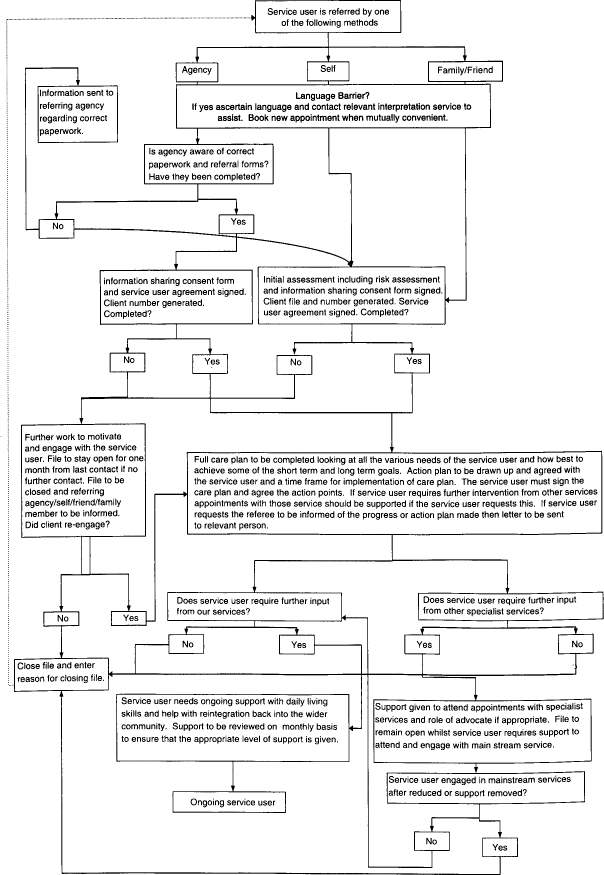
Care pathway journey
Front Door Wolverhampton followed a standard approach to process mapping. This involved a series of mapping exercise afternoons with representation from a wide cross-section of service users and service providers. This ensured the production of shared pathways that are appropriate for use in a wide range of settings. Front Door Wolverhampton soon acknowledged that homeless and vulnerable people have such complex and varied needs that writing a single pathway is not possible. The answer to this was to write a pathway for initial assessment of need and then to have a spectrum of pathways to fit the service user's complexity.
We have primarily looked at initial presentation as the entry point to the pathways for the service user. In the first assessment, personal and essential information is captured to define needs and future services required. The project goes on to use specific pathways that are selected depending on the service users’ needs and the relative priority of those needs. For example, a service user may be homeless, rough sleeping and the immediate need may be a hostel place. A secondary need may be for a legal acceptable identity so that the client can then make a statutory homeless application.
Front Door Wolverhampton has devised specific pathways in partnership for the following needs:
debt
access to health-care
drug treatment access (including alcohol)
homelessness
identity building.
The pathways were piloted for a three-month period and reviewed within this time. A process of continual improvement of the pathways has been followed. The project is now in the process of consulting with other agencies within Wolverhampton, as to how best to share and more widely deliver this potentially very valuable model.
A copy of the initial pathway is shown in Appendix 1.
How to Use this Pathway
Any person working within homeless or vulnerable people's services can use this pathway. All the information needed is given by the client, and the assessment follows a client-centred approach.
At any variance stage, a code should be entered in the tracking form to ensure that the pathway can be audited.
Footnotes
Front Door Wolverhampton Initial Pathway
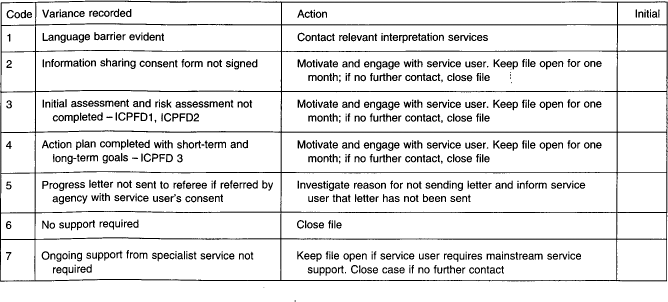
| Code | Variance recorded | Action | Initial |
|---|---|---|---|
| 1 | Language barrier evident | Contact relevant interpretation services | |
| 2 | Information sharing consent form not signed | Motivate and engage with service user. Keep file open for one month; if no further contact, close file | |
| 3 | Initial assessment and risk assessment not completed –ICPFD1, ICPFD2 | Motivate and engage with service user. Keep file open for one month; if no further contact, close file | |
| 4 | Action plan completed with short-term and long-term goals – ICPFD 3 | Motivate and engage with service user. Keep file open for one month; if no further contact, close file | |
| 5 | Progress letter not sent to referee if referred by agency with service user's consent | Investigate reason for not sending letter and inform service user that letter has not been sent | |
| 6 | No support required | Close file | |
| 7 | Ongoing support from specialist service not required | Keep file open if service user requires mainstream service support. Close case if no further contact |