







Abstract
This study examines the dynamics of racial framing contexts taking the case of anti-Asian hate speech and counter-hate speech on social media during the COVID-19 pandemic. Using the COVID-HATE dataset (n = 2,491,405 tweets posted 15 January 2020 to 26 March 2021), we analyze racial framing contests between movements and counter-movements. Through a mixed-methods approach, we find that: (1) hate frames deployed racial projects characterizing Asians as public health and national security threats, while counter-frames either directly challenged these characterizations or bypassed them to focus on systemic racism and (2) hate and counter-hate movements often “spoke past” each other rather than engaging in direct frame–counterframe dynamics as prevailing theories would predict. Counter-movements did not consistently produce opposing frames for each hate frame but rather developed independent messaging focused on combating racism itself. This study advances our understanding of how both hate and resistance operate through racial projects, with implications for theories of social movements, social media, and racial formation.
Keywords
Introduction
Prior studies have shown how social crises unsettle daily life and introduce threats to the existing order (Almeida, 2018; McAdam and Tarrow, 2007; Quarantelli and Dynes, 1977). In turn, uncertain political moments offer opportunities for hate movements to scapegoat racialized groups, attracting supporters and growing their movements. These forms of political communication, or framing strategies, draw on cultural meanings about racial groups that will resonate with publics and help them make sense of the unsettled moment (Meyer and Minkoff, 2004; Meyer and Staggenborg, 1996; Snow et al., 1986). Yet reactionary hate movements can also inspire counter-movements to resist their demonization through counter-framing strategies, working to discredit racial frames and to immobilize the opposition (Feagin, 2020; Yazdiha, 2022). Over the past decade, social media platforms like Twitter—now X—have become central arenas where these battles take place, both influencing collective action offline and shaping public discourse and racial attitudes (Daniels, 2013; Matamoros-Fernández and Farkas, 2021; Perry and Olsson, 2009). Despite a growing body of research on how these movements and counter-movements emerge online, we know less about the relationship between their framing strategies and the underlying racial projects they enact to harden or challenge racial hierarchies.
To examine the relationship between racist mobilization and its resistance, we take the case of emergent anti-Asian hate in the wake of the COVID-19 pandemic. The COVID-19 pandemic was widely considered a severe multifaceted global crisis that caused massive loss of life and disruption of all social systems, including severe economic downturns, strained healthcare systems, and exacerbated social inequality (Luqmani and El Hashim, 2022). With the World Health Organization's declaration of the global pandemic, COVID-19 was widely framed as a global crisis by media, politicians, and public health experts (Borio 2020; Pollard et al. 2020; Spinelli and Pellino 2020) with headlines like “The Great Lockdown: Worst Economic Downturn Since the Great Depression” from the International Monetary Fund to “The 2008 financial crisis did not prepare us for the 2020 coronavirus crisis” in Politico. This widespread crisis framing created what social movement theory identifies as an “unsettled political moment”—a period when routine social arrangements are disrupted and competing groups vie to define causality, assign blame, and propose solutions (McAdam and Tarrow, 2007). Such moments of heightened uncertainty and institutional disruption provide political opportunities for both hate movements to scapegoat targeted groups and for counter-movements to mobilize resistance.
While other indicators such as escalating death tolls and economic disruption also signaled crisis conditions, institutional crisis declarations are particularly significant for political opportunity theory because they provide authoritative signals that legitimize both fear and blame attribution, creating space for competing interpretations of responsibility (Meyer and Staggenborg, 1996). Building on this conception of COVID-19 as crisis, we draw on the COVID-HATE dataset (He et al., 2021), a dataset of anti-Asian hate speech and counter-speech containing tweets posted between 15 January 2020 and 26 March 2021 (n = ∼2.5 M). We trace the relational evolution of anti-Asian racism through hashtags—for example, #AsianVirus—against hashtags of resistance—for example, #StopAAPIHate and #Iamnotavirus—and analyze the relationship between the two groups and their framing strategies on X over time. To test these dynamics, we develop a framework of racial framing contests that bridges theories of social movements, social media, and race to examine (1) the shape of movement–countermovement dynamics online, (2) the content of movement–countermovement framing, and (3) their underlying racial projects. We build on research that examines online social movements not solely as formally organized groups but also as diffuse collectivities enacting diverse actions and expressions towards “some general social change goal” (Jackson, Bailey and Welles, 2020). We also extend frame theory by conceptualizing framing contests not only as oppositional discursive strategies by rival groups but also as forms of communication embedded in larger racial projects that shape the boundaries and relationships between groups.
Our analyses show both how hate and counter-hate evolve relationally and the discursive framing strategies through which each movement draws on racialized meanings to reproduce or contest the racialized system. Here, findings show how racist hate online takes the shape of racial projects that racialize and dehumanize Asians. Yet despite what prevailing theories lead us to expect about a direct relationship between hate frames and counter-frames, the counter-movement does not enact counter-frames for each hate frame and rather, the two groups often “speak past” one another. We argue that without examining the content of racial framing contests, we overlook the underlying racial project(s) that movements and counter-movements advance on social media and the variation within them. In other words, we analyze the attribution of blame for COVID-19 to Asians not merely as hate speech but rather as an expression of a systemic racial project. Given the power of social media for constructing social reality, amplifying social problems, and generating hate that translates to real world violence (Awan 2016; Matamoros-Fernandez 2017; Arcila Calderón et al. 2024) it is essential to understand the deeper political projects advanced through social media. We conclude with how this framework can be extended to broader studies of social movements, social media, and racial politics.
A racial framing contests framework
Social crisis as political opportunity and the role of social media
Social movement scholars document how disruptions of the “quotidian,” the “taken for granted routines and attitudes of everyday life” offer opportunities for mobilization and social change (Borland and Sutton, 2007; Benford and Snow, 2000). When deep structures and cultural norms are unsettled—as in a global pandemic—greater strain on individuals can generate greater perceptions of threat and grievance which may mobilize collective action (Blocker, Rochford and Sherkat, 1991; Buechler, 2008; Hasegawa, 2018). Social movement studies lead us to expect that, in the face of social crisis and an unsettled political and cultural context, political groups may leverage the cracks in the structure as political opportunities to politicize the disaster. This process, coined alternately by disaster scholars as “disaster politicization” (Chung, 2013) and policy scholars as “crisis exploitation” (Boin, Hart and McConnell, 2009), requires a discursive process of drawing symbolic boundaries between culprits and victims to attribute responsibility and assign blame, mobilize fearful publics, and consolidate power (Oz, Zheng and Chen, 2018).
Yet studies also show that political efforts to frame culprits and assign blame are not deployed without resistance. Rather, framing contests will ensue where groups battle for their description of events, their attributions of cause and responsibility, and their vision of what ought to be done to move forward (Boin, Hart and McConnell, 2009). Scholars show that during critical events, counter-movements are even more likely to arise to deploy counter-frames that challenge the dominant construction of reality (Meyer and Staggenborg, 1996). A movement that directly targets and threatens a particular group is likely to generate direct opposition.
Social media is a communicative medium where these movement–countermovement dynamics are particularly pronounced, quickly evolving, and consequential beyond the virtual sphere (Freelon, McIlwain and Clark, 2018; Tufekci, 2017). These “networked publics” need not be formal social movements to engage in impactful forms of collective action. As Elena Pavan and Andrea Rapini show with the case of Italian antifascists on Twitter, unorganized activism can unroll through movement frames that organize disparate movement organizations, activists, and regular citizens (Pavan and Rapini, 2022). Social media offers groups a means to communicate their construction of social reality in real time and to share these frames with broad audiences beyond their individual networks (Nikolayenko, 2020).
Reactionary movements have therefore been particularly effective at using social media to organize around hate, racism, and xenophobia (Daniels, 2009; Matamoros-Fernández and Farkas, 2021; Müller and Schwarz, 2023). At the same time, minoritized groups have also mobilized on social media through what some scholars call “hashtag activism,” a means of forging a shared space for making sense of reality collectively in real time and organizing disparate individuals into an organized movement (Bonilla and Rosa, 2015; Ince, Rojas and Davis, 2017; Jackson, Bailey and Welles, 2020). These counter-frames can be hijacked by reactionary movements who capitalize on the movement's public attention to reframe and redirect support to their movements, as scholars show with cases like #BlackLivesMatter and #MeToo (Klein et al., 2022; Knüpfer, Hoffmann and Voskresenskii, 2022). As a result, through the racialized dynamics of framing and counter-framing, racism can persist, where social media studies require greater examination of the racial systems underlying framing and counter-framing and the communities they create (Clay and Evans, 2017). As critical race and digital studies show, social media is not a race-neutral space, and the racial meanings deployed and contested online play a powerful role in the reproduction and activation of offline racialized systems and inequality (Daniels, 2012; Hamilton, 2020; Noble, 2018).
Through the social movements and social media approaches, we can make sense of how a politicized disaster generates opportunities for hate movements to leverage fear, threat, and uncertainty online. We can also understand these crises as moments ripe for framing contests between movements and counter-movements. The broad frames can be disaggregated through the subframes that constitute them—diagnostic, prognostic, and motivational frames. The Diagnostic Frame identifies the problem and attributes blame, the Prognostic Frame identifies the ideal solution to the problem, and the Motivational Frame makes the emotional appeal, or the “call to arms,” mobilizing publics toward the ideal action (Benford and Snow, 2000). In a framing contest, a counter-movement is expected to enter the dominant movement's arena to challenge its messaging head-on. This counter-framing can challenge the frame's consistency, its empirical credibility, and/or the credibility of the group deploying the frame (Benford and Snow, 2000). This approach leads us to expect the meanings of the counter-frame will be shaped directly in relation to the opposing group's originating frame, as expressed in the following hypothesis:
H1: Hate frames will consist of diagnostic, prognostic, and motivational frames that attribute blame to Asians. Counter-hate frames will counter each framing component either by attributing blame to the hate movement or an alternative target.
This expanded approach better captures both the dynamics of framing contests and their cultural meanings. We know that disaster politicization catalyzes the attribution of blame and framing contests are the means through which movements and counter-movements battle for their interpretation of the crisis and how publics should act. Yet the question that still remains is how these competing cultural meanings are embedded in deeper political projects.
Framing contests as racial projects
Mobilizing groups seek to gain supporters by working to generate the most culturally resonant frames among their targeted audiences (Johnston and Noakes, 2005; Kaplan, 2008). This means that frames that identify problems, attribute blame, and propose solutions will draw from existing cultural systems. These frames will enact cultural meanings that publics will recognize as reflections of their own social reality, meanings to which they will relate. In the United States, this cultural system of meanings is embedded in a racialized system. Race scholars have shown that cultural frames cannot be understood without rooting them in their racial projects (Bonilla-Silva, 2006; Feagin, 2020; Omi and Winant, 2014). Through the process of ethnoracial formation, these racial frames form the structure of a racial project of meaning-making, a means of ordering groups and their social relations in a system of power (Omi and Winant, 2014).
As a result, in the process of identifying scapegoats and assigning blame during a social disaster, framing contests are not inseparable from the process of racial formation. Prior research shows that dominant racial frames that assign groups with racialized cultural meanings—those that demean and subjugate groups as essentially different from the dominant group—are met with counter-frames from oppressed groups (Feagin, 2020; Snow et al., 1986; Carter, Lippard and Baird, 2019). Subjugated groups resist racial frames, their racial projects, and the system of racialization that requires them. We therefore would expect that in a social disaster, the emergence of hate frames would signal deeper racial projects, and that counter-frames would offer oppositional (anti-)racial projects, as expressed in hypothesis two:
H2: Hate frames will function as mechanisms of racial formation by employing racialized language and stereotypes against Asian Americans, while counter-hate frames will oppose these formations by challenging stereotypes and promoting positive representations of Asians.
Anti-Asian racial projects
What would these racial projects look like in the case of anti-Asian hate? Prior studies on Asian racialization offer clues as to the racial frames and respective counter-frames that are likely to emerge through the anti-Asian hate movement (He et al., 2022; Hswen et al., 2021). Historically, Asian Americans have been othered through the attribution of essential cultural difference, the notion that no matter how structurally integrated they are, Asians will always be unassimilable and seen as “forever foreigners,” (Ngai, 2014; Zhou, 2012; Kim, 1999; Tuan, 1998). Through this racial project, racialized stereotypes of Asians most often fall between the threat of the “yellow peril” and the easily-manipulated “model minority,” distinguishing Asians from “real” Americans through the conception of a moral and cultural impurity (Wu, 2014; Lee and Kye, 2016).
Within the racial project of the “yellow peril,” there are three essential frames rooted in cultural racism. First, Asians are framed as culturally and politically inferior to White Americans (Kim, 1999). Second, Asians are framed as a culturally dirty and diseased threat to public health (Fong, 1998). Third, Asians are framed as dishonest, disloyal threats to the economy and national security. The rise of Trumpism has also harkened a return to some publicly acceptable expressions of de jure racism including the return of the dehumanizing frame which compares people to subhuman life, whether animals or insects, describes people as an infestation, and promotes their extermination (Li and Nicholson, 2021; Tessler, Choi and Kao, 2020; Jardina and Piston, 2022). As Li and Nicholson argue, these racial frames become more salient and activated in public discourse in moments of heightened political and economic threat. During these moments, frames are likely to attribute blame to Asians both abroad and domestically. These moments are also likely to give rise to disinformation and racist conspiracy theories that root social problems in plotting, “evil others” (Li and Nicholson, 2021).
At the same time, groups have mobilized to counter racialized anti-Asian frames. At times, the “model minority” frame has been used to counter “yellow peril” frames, arguing that Asians are law-abiding, highly educated, hard-working citizens (Kim, 1999; Bow, 2010). This strategy of countering one racial project with another has been criticized by Asian activists as perpetuating the anti-Black “divide and conquer” strategies of White supremacy (Abad, 2021; Kim, 2018). Other times, the counter-frame takes on cultural racism with a multicultural frame that emphasizes the national value of cultural diversity (Sugino, 2022). These frames are often defensive strategies in reaction to opponents’ racial frames that work with and within racial projects.
Finally, anti-racist frames take on the premise of the racial frame altogether and challenge its systemic roots (Seikkula, 2022; Smith, 2021; Aquino, 2020). These frames discredit the dominant construction of social reality in which Asians must prove their loyalty and humanity and assimilate themselves to a “safe” conception of multiculturalism that internalizes racism to maintain the status quo (Hope, 2019; Trieu and Lee, 2018). Rather, these counter-frames redirect blame and its racialized attribution to discredit the system of racialization altogether (Feagin, 2020).
A framework for movement–countermovement racial framing
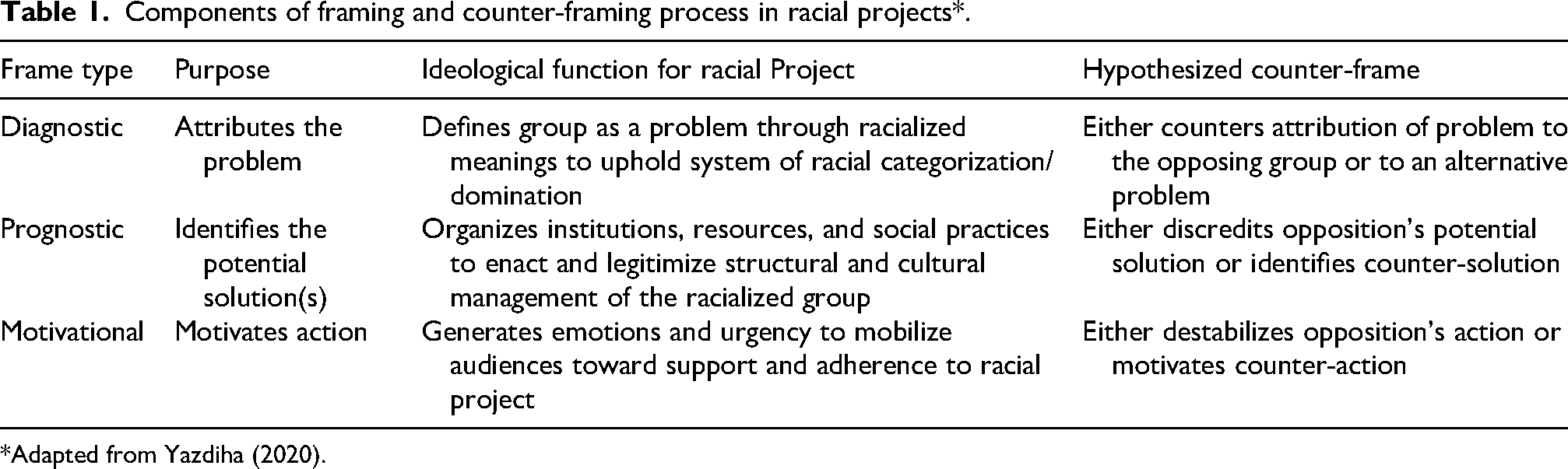
Integrating these approaches, Table 1 shows the hypothesized relationship between framing and counter-framing for racial projects.
Components of framing and counter-framing process in racial projects*.
*Adapted from Yazdiha (2020).
We would expect that through the cleavage of social crisis, hate movements will leverage the opportunity to gain public support by framing the crisis as attributable to a target racial group but also connected to deeper racial projects. First, hate groups will incorporate racialized diagnostic frames that attribute the problem of the social crisis to a target group, defining this group as the social problem at hand. By coupling the group with crisis, the group itself is racialized as a social problem, a process central to the racial projects of racial formation as when Du Bois famously wrote, “How does it feel to be a problem?” Second, hate groups will use racialized prognostic frames to organize political, cultural, and social structures around solutions that monitor and manage the target group. Racial projects are enacted through diagnostic frames that make clear that the solution to the social problem requires the surveillance, domination, and, at times, decimation of the racialized group. Finally, hate groups will use motivational frames to generate emotions and urgency to mobilize audiences toward support and adherence to the racial project. We also expect that targeted groups will fight back. Counter-movements will either counter this attribution of the problem to the opposing group or identify an alternative problem. They will discredit the opposition's potential solution or identify a counter-solution, and they will use motivational frames that destabilize the opposition's action toward the racial project or deploy a frame that motivates counter-action. In this study, we conceptualize competing hashtag communities as oppositional social movements, but we also acknowledge that within each of these movement dynamics there may lie both sporadic reactionary movements and sustained resistance movements. This nuance offers an additional mode of analysis for analyzing framing contests not only between but also within broader umbrella movements.
This framework helps us examine how and when movements and counter-movements engage in racial framing contests but also allows us to investigate: (1) the content of the frames as mechanisms of racial projects and (2) how racial and counter-racial framing works to reproduce or contest larger systems of power. Understanding how these framing contests draw on systems of racial meaning helps show not only that social crises get politicized or that groups have competing interpretations of crises, but also which visions of society groups hope to advance through their strategic frames.
Data and methods
To investigate racial framing contests taking the case of anti-Asian hate, we use data from the COVID-HATE dataset (He et al., 2021), which contains unique, English-language hate and counter-hate tweets 1 posted between 15 January 2020 and 26 March 2021. The project wove together perspectives on machine learning and fairness, COVID-19, anti-Asian racism, social media, and the connection between online discourse and real-world crimes and hate. The dataset was created prior to the takeover of Twitter by Elon Musk and the subsequent removal of many guardrails trying to protect users against hate speech; presumably, the creators of this dataset saw their work aligned with previous efforts to some degree given the scope and breadth of the dataset.
To collect tweets, He et al. (2021) used a set of keywords and hashtags that had either hate or counter-hate connotations. Keywords, phrases, and hashtags (which we collectively call “keywords” in this paper) such as “#communistvirus” and “#chinesevirus”, were used to identify tweets expressing anti-Asian hate. Counter-speech keywords (e.g. “StopAsianHate,” “WashtheHate”) were used to identify tweets opposing hate and supporting the Asian community. Neutral keywords (e.g. “coronavirus”, “COVID19”) were used to identify tweets unrelated to hate or counter-speech but still explicitly reference the COVID-19 pandemic. They also addressed negation when labeling the data as either hate or counter-hate. 2 We include the complete list of keywords from the original paper in the Supplemental Appendix (Table 1A). This keyword-based search yielded a total of 206,348,565 unique tweets created by 23,895,911 unique users.
Given that keyword-based searches may yield irrelevant tweets, He et al. developed a text classifier (macro-F1 score = 0.832) from a subset of 3355 manually labeled tweets to filter the entire dataset, resulting in a total sample size of 1.3 million hate and 1.1 million counter-hate tweets (Table 2) written by 697,098 and 629,029 users, respectively. The rest of the posts, all of which contained at least one keyword related to the pandemic, were labeled as Neutral. The annotation process involved randomly sampling tweets from the larger corpus of +206 million tweets, with over-sampling of tweets containing hate and counter-speech terms to ensure sufficient examples of each category for classifier training. Two undergraduate annotators independently labeled the sampled tweets, achieving inter-rater agreement with Cohen's kappa scores of 0.448 for hate and 0.590 for counter-speech tweets. The final training dataset contained 429 hate, 517 counter-speech, and 1344 neutral tweets (tweets where annotators disagreed were removed). The classifier used BERT base uncased embeddings with fine-tuning and was evaluated using five-fold cross-validation (Full details are available in the original paper).
Description of the tweets in the dataset.
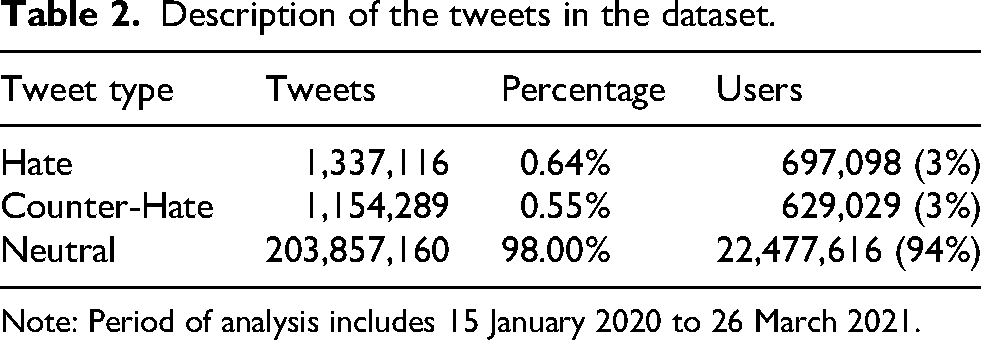
Note: Period of analysis includes 15 January 2020 to 26 March 2021.
While neutral tweets constitute the majority of the COVID-HATE dataset, 3 we excluded them to focus on the interactions between hate and counter-hate frames and yield more specific insights into respective strategies, rhetoric, and temporal dynamics. Including neutral tweets could dilute our analysis of this polarized discourse. Future research might explore how neutral tweets interact with hate and counter-hate tweets, potentially serving as a bridge or barrier between these opposing groups.
While the COVID-HATE dataset allows us to examine racial frames among hate and counter-hate groups, there are several limitations worth noting. First, the dataset uses predetermined hashtags and keywords, potentially limiting our ability to capture organically emerging hate and counter-hate speech that uses different terminology. Second, the dataset is restricted to English-language tweets, limiting our analysis to primarily English-speaking discourse. Third, the dataset does not contain metadata on conversations between users, thus limiting our ability to analyze how these two groups are directly speaking to each other. Despite these limitations, the dataset allows us to make claims about the formation of racial frames during the COVID-19 pandemic.
Analytical plan
To establish the temporal context for our analysis of racial framing, we first examine the volume of hate and counter-hate tweets. We document patterns of hate and counter-hate tweets to describe when and how framing contests between these groups may have emerged.
We also examine whether increases in hate tweets predict subsequent increases in counter-hate tweets using Granger causality analysis. This approach tests whether past values of hate tweets can predict future counter-hate tweet volumes better than past counter-hate values alone, helping us document the temporal relationship between these movements. We focus on short-lag orders (1–3 days) to capture immediate responsive dynamics between hate and counter-hate discourse.
To investigate how hate frames function as mechanisms of racial formation and how counter-hate frames oppose these formations (H1), we employ a multimethod approach combining computational and qualitative methods (Nelson, 2020). Our analysis focuses on semantic motifs to identify textual patterns in how hate and counter-hate groups discuss Asians.
Semantic motifs are linguistic structures that capture relationships between words in a sentence, allowing us to analyze actions, treatments, characterizations, and possessions associated with specific entities (see Supplemental Appendix for motif definitions). Stuhler (2022) used semantic motifs to examine the use of nostalgia in presidential speeches between 1952 and 2020, revealing how presidential candidates leverage the concept of nostalgia to renew or restore perceptions of America, as exemplified by Trump's slogan, “Make America Great Again.”
We utilize the semgram package in R (Stuhler, 2022) to extract motifs from our COVID-Hate dataset. This package requires the researcher to identify an entity of interest (in our case, Asian ethnonyms and demonyms) and then employs a dependency parser to annotate sentences containing the entity. It labels each word according to its direct relationship to other words and organizes this output into specific types of relationships called motifs (Stuhler, 2022).
For our analysis, we specified the following keywords: Asian, Asian American, Chinese, Chinese American, Korean, Korean American, Japanese, and Japanese American. These keywords account for a significant portion of our dataset: 62% of the hate tweets and 57% of the counter-hate tweets. We focus on East Asian ethnonyms and demonyms due to their disproportionate targeting of anti-Asian rhetoric and discourse at this time (compared to say, Pakistanis).
With these terms, we use the semgram package (which leverages the spaCy library in Python) to parse sentences containing these entities, label words based on their relationships within the sentence, and organize these relationships into semantic motifs. These semantic motifs provide insights into subject-verb-object relationships and descriptive language used in reference to Asian people. This approach allows us to identify specific textual patterns used to describe Asians, capturing both explicit and implicit linguistic formations. For example, we can observe patterns in verbs associated with Asian subjects, adjectives used to describe Asians, or objects that Asians are said to possess or lack (see Supplemental Table 2A). In our analysis, we focus on the top 150 semantic motifs, as they account for ∼92% of the words used to describe Asian people.
Second, to uncover broader themes of racialization and stereotypes, we qualitatively code the semantic motifs using an abductive approach to content analysis (Timmermans and Tavory, 2012). With two coders working side-by-side in ongoing discussion, we began with deductive coding drawn from concepts derived from prior studies of racism and anti-Asian racism (Ngai, 2014; Zhou, 2012; Kim, 1999; Tuan, 1998). Based on previous research on anti-Asian racism, we expected that we might find that certain verbs or adjectives associated with Asians in hate frames consistently evoke stereotypes of foreignness or untrustworthiness. Conversely, we might observe that counter-hate frames frequently employ language emphasizing shared humanity or highlighting Asian American contributions to society. Next, we compared results between coders and identified anomalies that extended beyond theoretically given codes like “anti-racism” and distinctions between “yellow peril” as “public health threat” and “suspicious citizen threat.” In this way, our abductive coding was both theory-driven and data-driven, iterating through the coding process to account for emergent concepts. From here, we refined our codes to group them by theme and connect them to the larger theoretical process of framing contests and the dimensions of framing, developing the abductive codebook. Finally, we re-coded the data in full, drawing out diagnostic frames that defined the problem and prognostic frames that proposed solutions, as well as whether and how the racial frames we identified were shaped in relation to one another in movement and counter-movement dynamics. This coding scheme helped us account for both prior theoretical concepts and the novel dynamics that emerged through the data, identifying overarching patterns in theme and meaning and connecting our textual findings to larger racial projects and stereotypes in a theory of racial framing contests.
Third, we conduct sentiment analysis on tweets that specifically mention Asian people or Asian-related topics. This analysis aims to uncover the emotional content and tone in both hate speech and counter-hate tweets. We employ two sentiment analysis tools, both using binary variables. The first is the NRC Emotion Lexicon (EmoLex), which categorizes words into eight basic emotions and two sentiments (Mohammad and Turney, 2013). The second is VADER (Valence Aware Dictionary and Sentiment Reasoner), a rule-based tool designed for sentiments expressed in social media (Hutto and Gilbert, 2014). Both tools use binary coding (e.g. 1 = presence of emotion/sentiment, 0 = absence). VADER in particular was designed specifically for social media analysis. Because of this particular focus, it has been extensively validated in other work and has been deployed to study trends on Twitter during the same time frame as our data, such as COVID-19 vaccines (Kahraman et al., 2025), attitudes about the Metaverse (Gündüz and Demirel, 2023), perceptions of ChatGPT (Demirel et al., 2025), and newsroom-specific sentiment about the COVID-19 pandemic (Kahraman-Gokalp et al., 2024). The same is true for NRC, though to a slightly lesser extent. By utilizing these complementary approaches, we gain a nuanced understanding of the emotional landscape surrounding discussions about Asian people. The list of emotions from EmoLex can be found in the Supplemental Appendix.
Fourth, we synthesize the findings from the previous three steps to address our research hypothesis (H2). We analyze how hate frames employ racialized language and stereotypes against Asian Americans, and how counter-hate frames challenge these stereotypes and promote positive representations. Through this four-step process, we aim to uncover how hate frames employ racialized language and stereotypes against Asian Americans, and how counter-hate frames challenge these stereotypes and promote positive representations of Asians (see Figure 1). The combination of computational text analysis and qualitative coding allows us to move from specific linguistic patterns to broader themes of racial formation, addressing the mechanisms hypothesized in H2.
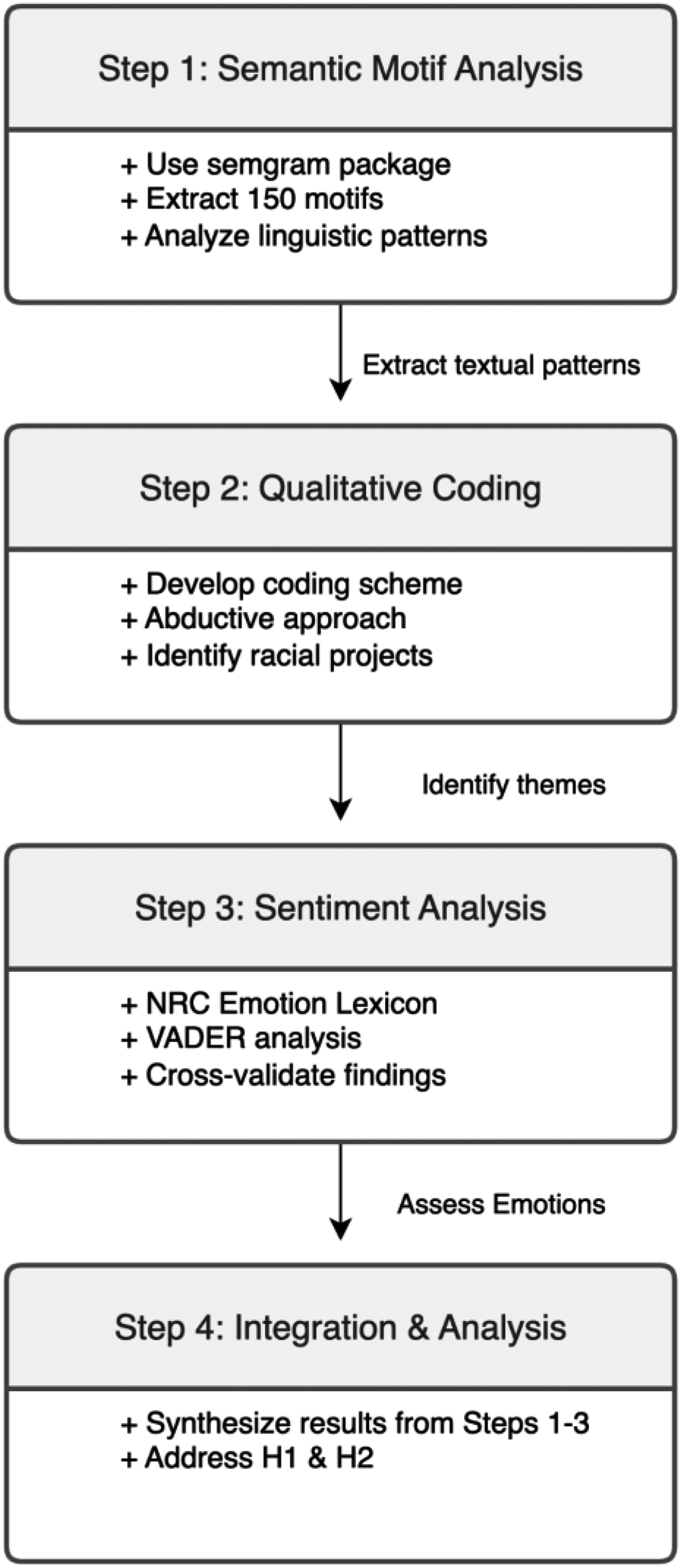
Overview of analytic pipeline for identifying hate and counter-hate frames.
Findings
We begin by describing patterns of hate and counter-hate tweets. We focus on three widely publicized moments in March 2020: the World Health Organization's pandemic declaration on March 11, the United States’ national emergency on March 13, and President Trump's “Chinese virus” tweet on March 16. For each event, the baseline is the mean daily volume during the 14 days that precede the event. Relative to this baseline, we observe sharp, short-run increases in both hate and counter-hate activity. For hate tweets specifically, baseline levels ranged from 2972 to 3674 tweets per day across these events, and peaks ranged from 7809 to 10,732 tweets per day. For counter-hate tweets, baseline levels ranged from 2578 to 2716 tweets per day, and peaks were 4128 tweets per day across the three events. These findings suggest a sensitive relationship between sociopolitical events and the flow of both types of tweets.
Next, we examine whether counter-hate tweets emerged in reaction to hate tweets as prior studies lead us to expect. Our analysis demonstrates a significant predictive relationship between the volume of hate tweets and the volume of subsequent counter-hate tweets. A Granger causality test with a 1-day lag shows that hate tweet volume significantly predicts counter-hate tweet volume (F = 8.72, p = 0.003). This finding indicates that changes in hate tweet volume on a given day can predict changes in counter-hate tweet volume on the following day. The influence of hate tweets on counter-hate tweets extends beyond a single day, though it diminishes over time. We found significant predictive relationships with 2-day (F = 5.46, p = 0.006) and 3-day (F = 3.218, p = 0.023) lags, albeit with decreasing strength. These results suggest that counter-hate speech often emerges as an immediate response to hate speech and are in line with previous studies on the relationality between anti-Asian hate and counter-hate speech (He et al., 2020).
Having investigated patterns of hate frame emergence and counter-framing, we next turn to exploring our integrated theoretical framework for understanding the content of these frames. To investigate the content of frames, we handcoded the semantic motifs, which capture the core actions and relationships in a sentence. To ensure the reliability of our qualitative analysis, two independent researchers analyzed a sample of hate and counter-hate sentence motifs from the COVID-Hate dataset. We calculated the inter-rater reliability using Cohen's kappa (κ) to measure the level of agreement between the two researchers. The inter-rater reliability score was found to be κ = 0.88, indicating substantial agreement (Figure 2).
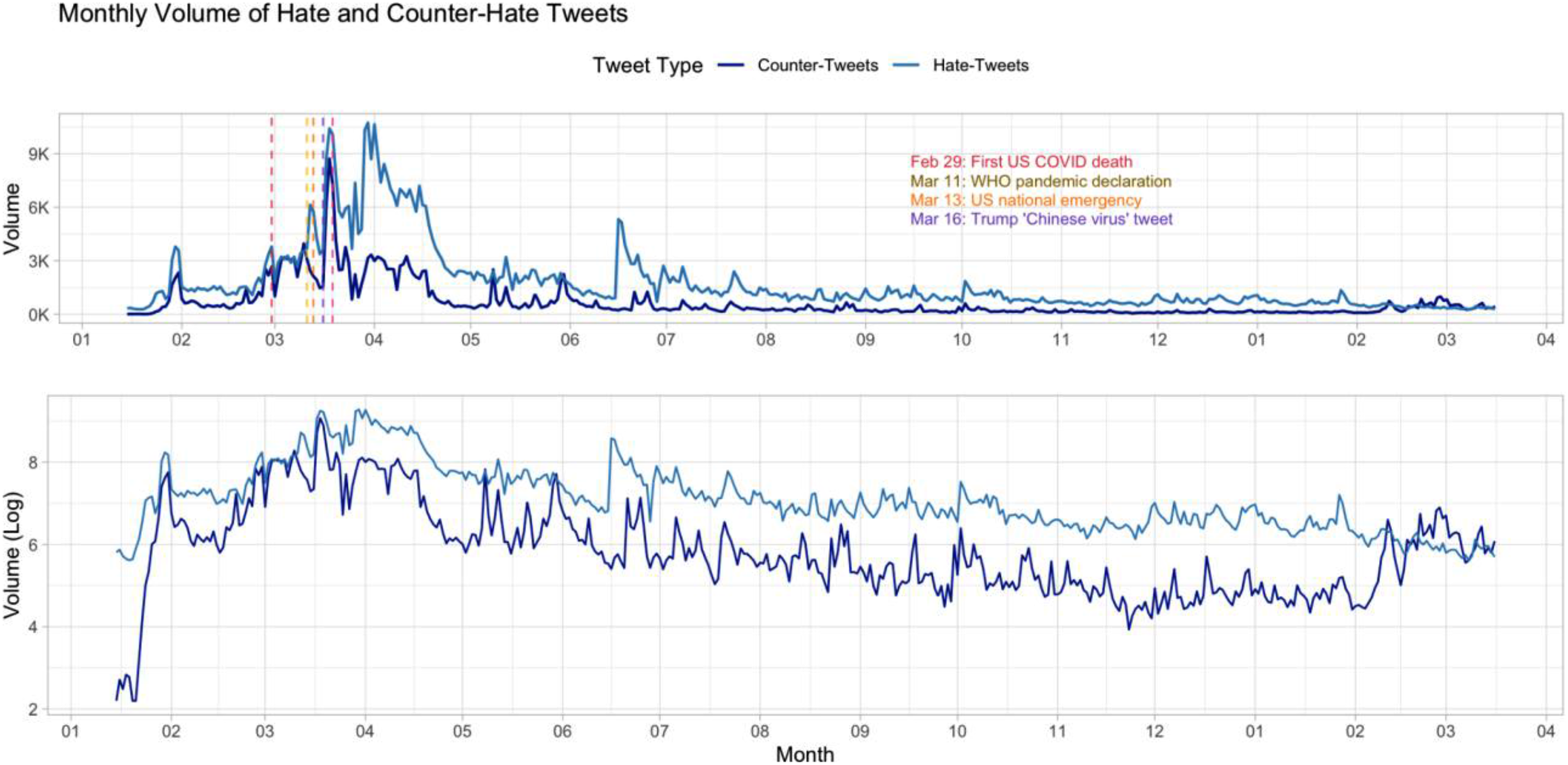
Monthly volume of hate and counter-hate Tweets.
Racial diagnostic frames and counter-frames: Defining the problem
As hypothesized, we found that hate users used diagnostic frames to define the social problem of the pandemic by attributing blame to Asians for the spread of COVID-19 (see Supplemental Appendix for list of top 10 motifs). In particular, we find that 43% of the diagnostic frames blame Asians for the development and diffusion of COVID-19. An example of this can be seen in the following tweet: fuck off china! you are the reason for this mess! they will only bring virus with them here! #ccpvirus #chinaliedpeopledied #chinesevirus #xijinpingvirus.
The most frequently used of these diagnostic frames—drawn from action-patient motifs—blame Asians for “creating,” “spreading,” “making,” “releasing,” “bringing,” “unleashing,” “giving,” and “engineering” the virus. Another 32% of these diagnostic frames—drawn from agent-treatment motifs—blame Asians for “killing” or blame China for “lying” and “people dying.” Similarly, we find that 32% of the agent-treatment frames, which combine agent motifs with their respective treatments contain diagnostic frames. This analysis highlights not only that hate users diffused racial frames but also that the content of these tweets told a very cohesive story constructing Asians as a social problem, a central mechanism of racialization.
As we hypothesized, these racial frames are not unrelated but are rather rooted in the systems of racial meaning generated by sociohistorical racial projects. Notably, hate users deployed multiple anti-Asian racial projects. Diagnostic frames framed Asians as a social problem through long-existing cultural racism narratives that (1) depict Asians as impure, public health threats and (2) national security threats (see Table 3 for Motif Themes).
Anti-Asian racial framing and counter-framing contests on Twitter.

A first set of racial frames roots Asians in the racial project that constructs them as impure pollutants of the nation, depicting Asians as public health threats through accusations, exaggerations, and fabrications of culinary practices. An illustrative example is a tweet from a user expressing hate: It's the Chinese virus, from China, caused by your disgusting eating habits, your cruelty. Boycott anything Chinese #kungflu, #chinaliedpeopledied, #covid.
We find that 52% of diagnostic frames—derived from action-patient motifs—incorporate cultural racism frames. The most frequently used frames include accusations of eating “bats,” “rats,” “creatures,” and “shit” and claiming a relationship between Asian cooking and the virus. Further, 30% of frames—derived from characterization motifs—describe Asians as “dirty,” “filthy,” “disgusting,” “infected,” “uncivilized,” and “creatures.”
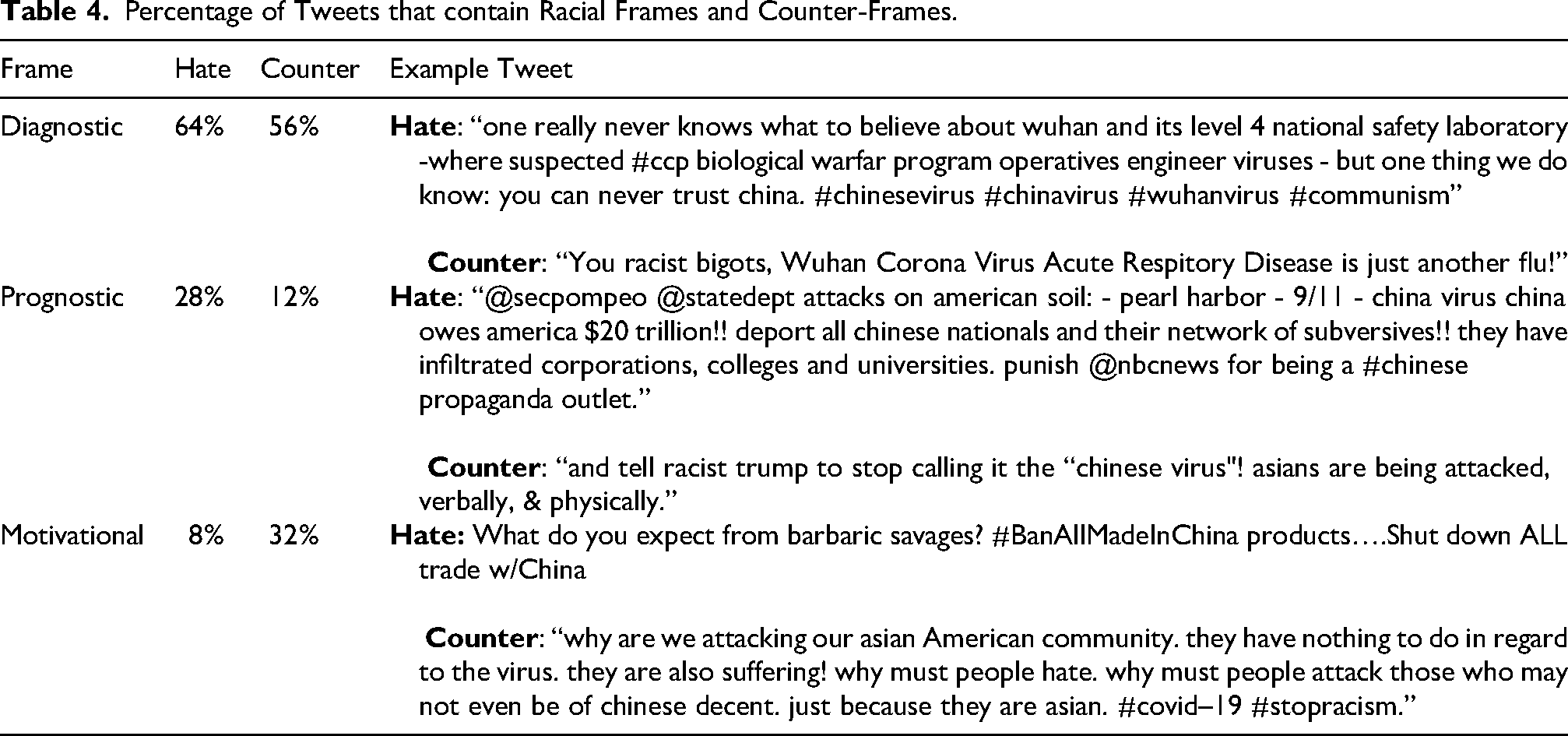
Meanwhile, a second set of racial frames are rooted in a racial project that characterizes Asians as untrustworthy, disloyal, national security threats. These Tweets deployed racial frames—derived from action-patient motifs—that describe Asians as unleashing warfare, weaponizing the virus, destroying the economy, and hiding information. These Tweets used words like “threat,” “liars,” “cunning,” “dangerous,” and “communist” to characterize Asians as national security threats. Some of these diagnostic frames—33% of the action-patient and 25% of the action-treatment motifs—promoted misinformation and conspiracy theories about the origin of COVID-19, accusing Asian people of manufacturing and controlling COVID-19. For example, one hate user tweeted the following: one really never knows what to believe about wuhan and its level 4 national safety laboratory—where suspected #ccp biological warfar program operatives engineer viruses—but one thing we do know: you can never trust china. #chinesevirus #chinavirus #wuhanvirus #communism.
These racial frames accuse Asians of “inventing,” “engineering,” “manufacturing,” “controlling,” and “starting” the virus. Other tweets blame the Chinese Communist Party, Mao Zedong, and other Chinese figures for the deaths caused by COVID-19.
If we looked only at the relationship between the expression of a hate Tweet and a counter-Tweet, it would appear that they are directly related as hypothesized. However, by examining the content of the frames, we find important variation. Some counter-frames take on the content of the hate Tweets, that is the racial projects of public health and security threats. As hypothesized, these counter-frames discredit the racial frames that construct Asians as the social problem, describing the blame attributed to Asians as “unfair,” “hateful,” and “misdirected.” For example: why are we attacking our asian American community. they have nothing to do in regard to the virus. they are also suffering! why must people hate. why must people attack those who may not even be of chinese decent. just because they are asian. #covid–19 #stopracism.
While these counter-frames challenged the attribution of blame, they did not often use the opportunity to reframe the social problem and offer an alternative construction of social reality during the COVID-19 crisis.
However, the diagnostic counter-frames do not counter the content of the hate Tweets to discredit the construction of Asians as the social problem. Rather, they take the very existence of the hate Tweets and specifically anti-Asian racism as the social problem. The most used frames here–drawn from the characterization motifs—describe Asians as victims of xenophobic language and racial slurs. These counter-frames draw from an anti-racist political project that refuses to speak on the hate movement's racist terms, calling out the system of racism that precedes the social crisis. These diagnostic frames identify the problem in the system that generates these racialized meanings, not in the Asian people or the hate users who deploy them (Table 4).
Percentage of Tweets that contain Racial Frames and Counter-Frames.
Racial prognostic frames: Defining the solution
Next, we examine how racial framing contests communicate and debate the crisis through prognostic frames. Our analysis showed that hate Tweets employ prognostic frames that call on social and political entities to deploy racialized projects of control as solutions. These prognostic frames—10% of the action-patient motifs—center on the deportation, exclusion, and punishment of Asians. Examples of these motifs include calling on Asians to “leave the country” and “pay the price” and arguing that they “deserve the virus.” For example, one hate user tweeted: @secpompeo @statedept attacks on american soil: - pearl harbor - 9/11 - china virus china owes america $20 trillion!! deport all chinese nationals and their network of subversives!! they have infiltrated corporations, colleges and universities. punish @nbcnews for being a #chinese propaganda outlet.
Another set of prognostic frames call on Asian people themselves to assume responsibility for COVID-19, effectively “admitting” that the racial frames attributed to them are true. These frames include calls for Asians to “tell the truth,” “accept the truth,” and “take responsibility.” An example of this theme can be seen in the following tweet: @repjimbanks @marshablackburn @gordongchang China created the #chinacoronavirus one way or another & china brought about this mess to the world. Reasonable for them to take responsibility for the mess they created. #makechinapay #chinamustexplain.
We expected that counter-frames would enter hate users’ arena and take these prognostic frames head on. As hypothesized, racial prognostic frames took a defensive stance of calling action against the racial hate itself. Counter-frames identified solutions in relationship to hate. A first set of counter-frames challenge political elites to cease inciting anti-Asian racism, for example: and tell racist trump to stop calling it the “chinese virus"! asians are being attacked, verbally, & physically.
Counter-hate users fought back in direct relationship to hate frames by re-locating the problem and solution in the explicitly hateful actors including Trump and anti-Asian racists. These strategies are more often an individualistic framing of racism within the individual context of the social crisis.
Yet, mirroring the variation in diagnostic counter-frames, prognostic counter-frames too diverge in those that take hate frames head on and those that bypass the hate arena. This second set of counter-frames calls Asian publics to action. These prognostic frames call on Asians to name and share their experiences of anti-Asian racism as a mode of resistance and to adopt a critical consciousness that fights back against racism: many asians have this culture of not fighting back and it's hard for people to take action like this but it needs to be happening. asians are a model minority group whos mistreatment has been ignored because of that status we have.
This variation challenges the expectation that the meanings of frames and counter-frames will be formed relationally. Instead, counter-frames at times deploy alternative meanings that strategically bypass or ignore the terms set by the hate movement.
Racial motivational frames: Motivating action
Finally, we examined how motivational frames and counter-frames were deployed. Our findings indicate that hate groups employ emotions such as fear and disgust in an attempt to generate urgency and mobilize their audiences. These motivational framing techniques work to create emotional states that encourage immediate action against the perceived threat of Asian people.
Emotional intensity is a key component of these motivational frames. Our sentiment analysis shows that 54% of the hate tweets evoke disgust while 67% evoke anger. For example: Let's be clear, China Is 100% responsible for what the world is going through. The virus originated in Wuhan, China lied about it, covered it up; stopped Drs from reporting it. The world has to make them close down those disgusting gross markets.
This intense emotional language serves to create a sense of imminent threat and crisis. Simultaneously, time-sensitive language and phrases suggesting immediate consequences (e.g. [Asians] unleash virus, destroy economy) are employed to create a sense of urgency, further motivating immediate action or support for the racial project.
In response to these motivational frames, counter-hate groups employ their own framing strategies by motivating counter-action. Yet counter-hate framing strategies do not deploy the same emotions as hate users. These counter-action frames frequently emphasize the need to protect Asian communities from violence and combat misinformation regarding Asian people, evoking emotions such as sadness (47%) and fear (51%). In tweets evoking sadness, counter-hate users discussed their reactions to Asian hate crimes and general treatment toward Asian people: important: please protect your asian friends and if you are asian please take care of yourself. there's a lot of racism as a result of covid-19 and it's really important to acknowledge, prevent, and fight against it.
While counter-hate tweets deployed emotions to generate care and sympathy toward Asian communities, their motivational framing did not mirror the intensity of hate tweets and the urgency of racialized fear and racialized anger. By examining the intertwined components of racial frames—diagnostic, prognostic, and motivational—it becomes apparent that racial framing contests sketch a more complex cultural landscape of racial projects and their resistance. Without understanding the underlying racial meanings that groups deploy to generate social action, we might assume movements and counter-movements are two sides of the same coin.
Limitations
Despite the breadth of our data and the multimethod analytic approach, we acknowledge the limitations of the data. First, our analysis was constrained by the lack of access to user-level metadata, limiting our ability to investigate the diversity of users participating in the framing processes we have outlined. This limitation stems from X's (formerly Twitter) restrictions on data availability to academic researchers, which precluded the collection of user-specific data. Future studies might explore the involvement of different user groups (e.g. organizations, public servants, and educators) in framing and counter-framing activities.
Secondly, our efforts to establish a baseline for hate speech on X were hindered by the platform's notorious issue with hate groups (Siegel et al., 2019; Ozalp et al., 2020; Berglind et al., 2019). This challenge was compounded by restricted access to X's Application Programming Interface for academic researchers, making it difficult to determine whether there was a significant increase in anti-Asian sentiment compared to other periods of heightened hate speech.
Beyond methodological limitations, this study raises important ethical considerations about conducting hate speech research. Although we have anonymized all examples, analyzing hate content carries the risk of amplifying harmful narratives, even when the research aims to advance our understanding of online racism. Conversely, analyzing and publishing metadata (e.g. usernames) about counter-hate users risks exposing these users to online attacks. When curating datasets such as COVID-Hate, scholars should keep sensitive information private and/or make it available only upon request.
Discussion and conclusion
While social crises have long been opportunities for reactionary movements to leverage social unrest and scapegoat racialized groups, they have also been moments of uprising and resistance. This study sought to understand the racial meanings underlying these dynamics, specifically how racist hate movements communicate to publics on social media and how targeted racial groups resist. Examining these dynamics through the social crisis of COVID-19, we analyzed framing contests between anti-Asian hate users and counter-hate users on Twitter, comparing both their patterns of communication and the content of their frames. We bridged theories of social movements, social media, and race to develop an approach for understanding racial framing contests between movements and counter-movements from temporal and semantic (i.e. meaning) perspectives. This approach understands racial frames not as disconnected cultural meanings but rather as expressions of the underlying racial projects of racial formation.
Our multimethod analysis showed that through the unsettled moment of social crisis during COVID-19, hate groups leveraged the opportunity to define social reality by scapegoating Asians. Yet, as hypothesized, Asian Americans fought back. We find that counter-hate speech emerged as an immediate response to hate speech. Having established these patterns of communication, we next examined the content of these Tweets.
First, we found that hate groups defined the social problem through racial diagnostic frames that attributed the problem of the social crisis to Asians, defining this group as the root cause. In response, counter-hate frames alternately characterized these attacks as unfair or redefined the problem as one of anti-Asian racism. Meanwhile hate groups use racial prognostic frames to organize political, cultural, and social structures around solutions that monitor and manage the target group. Hate tweets called on authorities to deport and punish Asians and called for Asians to accept responsibility for COVID. In response, counter-frames both called for the cessation of political hate speech and called for Asians to fight back against racism. Finally, racial motivational frames used anger and disgust to motivate action against Asians while counter motivational frames used concern and care to call for the protection of Asian Americans.
Examining only temporal patterns of movement and counter-movement emergence would yield a mostly expected story of the relational dynamics between movements. However, examining the content and patterned meanings embedded within these movements’ strategic frames yielded unexpected findings as racial projects converged and diverged. While the hate movement produced a prolific and multipronged set of racial frames imbued with intense affect, the counter-hate movement had a less cohesive and milder affect-driven approach. These findings raise important questions about the ways we understand the relationality of racial projects and anti-racial projects. At times, the two may not operate on the same plane at all.
This framework has a number of extensions for future studies. Extending framing theory by analyzing racial frames as functions of racial projects, scholars can better analyze how racial and counter-racial framing alternatively work together or separately to reproduce and contest larger systems of power. Studying racial framing contests between differentially positioned groups in society can lend valuable insight into the visions of the future groups mobilize toward and against. Future social movement studies could extend this framework to examine how racial framing contests online vary across time, across different moments of social and political crisis, and across different movements.
Though we did not have access to user-level data, future studies should also examine how the dynamics of framing–counterframing are patterned by users’ social position and geographic location. Given how racial projects vary across place with varied histories of racialized violence and control and how political contexts shape the expression and contestation of these racial projects, we would expect that patterns of hate and counter-hate would also vary across place in interesting ways. Social movement scholars could similarly examine the outcomes of these racial framing contests and analyze the extent to which racial framing contests online correlate to violence offline. Though we did not document this relationship in this study, anti-Asian hate crimes rose post-COVID, and studies could more closely analyze how “real world” action relates to hate discourse online. This framework may also be extended by scholars of political communication and social media. Social media platforms—including X—are constantly evolving, and our framework offers scholars of internet communication technologies a way to compare mechanisms of racialization and contestation across platforms (e.g. TikTok and X). Further, scholars of political communication and social media may examine the networks and communities forged around these framing contests.
Our framework can be leveraged by scholars of race/ism and racial politics. Increasingly, race scholars are conducting studies of comparative racialization that show both how ethnoracial groups are embedded in the same broader system of racialization and how differences in their racialization matter for the distribution of power and resources and the maintenance of White supremacy. Our framework could be extended to examine how framing contests compare both across ethnoracial groups and within them. While our approach examined the anti-Asian hate's resistance as a counter-movement, future analyses might disaggregate between a reactionary movement that arises in the face of hate and a resistance movement that may precede a hate movement and find itself activated in new ways in its advent. There may be multiple and overlapping movements at play within an umbrella movement like the Stop AAPI Hate Movement, and their internal dynamics and framing contests are another fruitful area of study.
Ultimately, a racial framing contest framework understands cultural meanings as central to the mechanisms of racism but also the resistance of racialized groups as a constant tension. As global racisms continue to transform and evolve, diffusing through social media, it is all the more critical to understand how groups use these platforms to organize others to action and the deeper racial projects they enact.
Finally, our findings have important implications for platform governance policies. During political crises, companies should implement crisis-responsive moderation strategies that prepare platforms for potential hate speech surges. Specifically, platforms can use internal and external data sources (e.g. social listening data) to predict and document when hate speech is likely to increase, allowing them to adjust their moderation resources and policies accordingly.
Supplemental Material
sj-docx-1-bds-10.1177_20539517261424160 - Supplemental material for Racial framing contests: How anti-Asian racism and its resistance enacted racial projects during COVID-19
Supplemental material, sj-docx-1-bds-10.1177_20539517261424160 for Racial framing contests: How anti-Asian racism and its resistance enacted racial projects during COVID-19 by Alejandra Regla-Vargas, AJ Alvero and Hajar Yazdiha in Big Data & Society
Footnotes
Acknowledgements
We thank Bing He for the help with the COVID-HATE dataset.

Funding
The authors received no financial support for the research, authorship, and/or publication of this article.
Declaration of conflicting interests
The authors declared no potential conflicts of interest with respect to the research, authorship, and/or publication of this article.
Supplemental material
Supplemental material for this article is available online.
Notes
References
Supplementary Material
Please find the following supplemental material available below.
For Open Access articles published under a Creative Commons License, all supplemental material carries the same license as the article it is associated with.
For non-Open Access articles published, all supplemental material carries a non-exclusive license, and permission requests for re-use of supplemental material or any part of supplemental material shall be sent directly to the copyright owner as specified in the copyright notice associated with the article.
