







Abstract
This article draws on concepts of speculative design and responsible innovation to examine the possible impacts of data-driven precision agriculture on farmers and farm work. We use an innovative mixed-method approach to research design. Using artistic depiction of futures of precision agriculture in design workshop and in-depth semistructured interviews conducted with the farmers in Vermont and South Dakota, we explain how farmers perceive different futures of precision agriculture. Specifically, in our design workshop, we combined visual arts and social science methods, namely Q-method, to explore existing and new relationships between humans, technologies, and environment in the design, deployment, and use of data, algorithms, and automation in agriculture. Results from the Q-method and accompanying interviews reveal four distinct typologies: (a) farmers who believe that no technology can fully control nature but still recognize the value of innovative tools; (b) those who see precision agriculture technologies like grid-mapping as valuable for improving operational efficiency; (c) those who envision automation as central to the future of agriculture; and (d) others who anticipate the growing role of tech-savvy organizations and experts in supporting decision-making on the ground. Our study suggests that despite the techno-optimism demonstrated by farmers, many still desire to stay deeply involved and active in on-farm decision-making. This study shows that inclusive and anticipatory methods such as Q-methodology and design workshops can help surface farmers’ preferred futures while accounting for human–nonhuman interdependencies.
Keywords
Introduction
Precision agriculture (PA), a product of agricultural digitalization, comprises a suite of data-driven technologies that offer site-specific agronomic and financial recommendations to farmers. Advanced sensing and monitoring tools, including remote sensors, drones, and weather stations, enable farmers to collect real-time data on soil health, crop development, and environmental variables (Zhang et al., 2017). For example, soil moisture sensors assess water availability, allowing for precise irrigation management, while drones equipped with multispectral or thermal imaging provide high-resolution insights into crop health. Weather stations further refine decision-making by supplying localized climate data that can be critical for decisions about planting and harvesting crops (Jägermeyr et al., 2021). In the livestock sector, digital tools are aiming to enhance animal and milk productivity and enable early disease detection using wearable technologies, such as smart collars, monitor livestock movement, health, and milk production (Doidge et al., 2024).
For data collection and analysis, PA employs Internet of Things (IoT) devices, big data analytics, and Geographic Information Systems integrated with Global Positioning System (GPS). Internet of Things-enabled sensors continuously track field conditions and machinery performance, transmitting data to cloud-based platforms for interpretation (Lowenberg-DeBoer and Erickson, 2019; Pathak et al., 2019). These systems help farmers identify patterns, forecast crop yields, and optimize resource allocation. Automation and control technologies are becoming increasingly popular as part of PA. Variable Rate Technology (VRT), for instance, ensures the site-specific application, instead of blanket application, of fertilizers and pesticides based on real-time field data (Júnior et al., 2024; Oliveira et al., 2021; Upadhyay et al., 2024).
Increasingly adopted for their predictive capabilities and tailored agronomic insights, these tools promise labor efficiency, resource optimization, and digitally accessible, interactive platforms that can enhance both economic and environmental outcomes at the farm level (Edwards et al., 2015; Kim and Heo, 2024). However, alongside these benefits, PA's adoption is constrained by high implementation costs, concerns about data privacy and security, gaps in digital literacy, and inadequate infrastructure (Gardezi et al., 2024; Lemay and Boggs, 2024; Reichardt et al., 2009). This has led to a growing body of scholarship on how to steer PA development and implementation toward more democratic and ethical outcomes.
The field of speculative design is consistent with this work. It offers new pathways for interrogating and reimagining the futures of PA. Dominant narratives of development, science, and progress are not ideologically neutral but systematically embody technocentric, utilitarian, and patriarchal logics. Winner (1980) argues that technologies and the systems built around them encode social and political values, reflecting the priorities of the dominant groups rather than the universal needs. Shiva (2016) traces how the historical and conceptual roots of development, including modern science and industrial development, are exclusively focused on profits and are based on the assumptions of Western patriarchy, marginalizing subsistence economies and indigenous knowledge systems. Moving beyond dominant narratives, speculative design challenges us to question whose futures are being imagined and for what purposes. It invites interdisciplinary dialogue between art, design, and the social sciences to collectively envision futures that are more inclusive, reflexive, and attuned to ecological and social complexity. Design fictions (DFs), a tool within this broader speculative tradition, enable participatory exploration of future technologies by inviting communities to codesign scenarios and critically reflect on the systems of power shaping those futures. Rather than assuming technology as a neutral fix, speculative design centers on the lived concerns of users, such as farmers, and presents imaginative alternatives to the status quo.
Yet, envisioning alternative futures is not without its challenges. Anticipatory and speculative tools like foresight have long been used to inform policy, guide innovation, and facilitate organizational learning (Djuricic and Bootz, 2019). However, foresight often focuses on what is probable or likely, privileging linear, utilitarian visions that reinforce current trajectories and limit space for dissent or radical reimagination (Akama and Light, 2018; Cork et al., 2023; Pink et al., 2023). Science and Technology Studies scholarship further reveals how sociotechnical imaginaries are closely tied to power, shaping the allocation of resources and institutional infrastructures (Smith and Tidwell, 2016; Tozer and Klenk, 2018). In agriculture, dominant imaginaries often reinforce productivist logics, sidelining more sustainable or equity-oriented pathways (Bronson, 2022; Duncan et al., 2021). The capitalist structures of contemporary agriculture thus make it difficult to imagine or enact futures that diverge significantly from the present. Therefore, in the codesigning process, involvement of the farmers’ imaginaries and its relationship with the complex materialities—such as landscapes, work, and institutions—is important to envision alternative futures and innovate future farming technologies in a responsible and democratic way (Legun and Burch, 2021).
This research contributes to the emerging agenda of speculative design approaches to PA by addressing both empirical and theoretical gaps. Specifically, it asks: (a) What envisioned futures of PA do farmers prefer? and (b) What do these preferences reveal about their relationships with human and nonhuman actors and organizations? To answer these questions, we begin with a review of PA technologies and their intersection with responsible innovation (RI) and speculative design. We then describe our methodological approach, Q-methodology and interviews, for capturing farmer perspectives. The article concludes with a discussion of the implications of our findings for designing more inclusive, reflective, and responsive agricultural futures.
Literature review
Patterns and critiques of PA adoption by farmers
The adoption of PA technologies varies widely, with some tools and approaches being embraced more rapidly than others (Franzen and Mulla, 2015). In the United States, for instance, the usage of autosteer and guidance systems observed a significant surge. Its adoption rate increased from 10% of planted acres in 2000 to well over 50% U.S. acreages in 2023 for crops such as corn, soybeans, winter-wheat, and cotton (McFadden et al., 2023). However, VRT adoption has been slower globally, despite higher use among farm retailers compared to individual growers in the United States (Franzen and Mulla, 2015; Nowak, 2021). Overall, yield monitors and guidance systems lead in adoption rates, whereas technologies such as VRT continue to lag behind. The adoption rates of different PA technologies also vary according to farm size and crop selection. McFadden et al. (2023) observed that the adoption rate of guidance systems for cotton cultivation was 67% among the largest farms, whereas it was 50% for small farms in 2019. In contrast, the adoption rates for soybeans varied significantly between small and large farms in 2018, with 11% and 68% adoption rates, respectively.
Apart from farm size and farming needs, farmers’ adoption of PA technology is also influenced by factors such as heightened surveillance risks, concerns over data ownership, high technological costs, and difficulties in preparing future agricultural workers for the digital transition. The data-driven nature of PA technology presents challenges in terms of interpretation, reliability, and security (Lemay and Boggs, 2024). Large volumes of data generated by tools such as sensors, drones, and machinery require technical expertise to translate into actionable decisions. Lack of knowledge and skills among farmers to interpret these tools leads to poor adoption and adaptation rates (John et al., 2023; Masi et al., 2022). Similarly, increasing reliance on digital platforms raises issues of data security and ownership, including risks of data misuse, limited farmer control over how data are stored, shared, or monetized. These issues are extensively documented by social scientists, who have prompted calls to embed accountability and responsibility into PA innovation processes, ensuring that emerging technologies minimize harm to both people and the environment (Bronson and Sengers, 2022; Carolan, 2020; Stock and Gardezi, 2021, 2022; Wiseman et al., 2019).
Bridging RI and speculative design in envisioning futures of PA
The framework of RI, grounded in the principles of anticipation, reflexivity, inclusion, and responsiveness (Stilgoe et al., 2013), emphasizes the need to steer technological development toward more democratic, ethical, and socially desirable outcomes (Gardezi et al., 2022). In the context of PA, this involves recognizing not only the potential risks of emerging technologies, such as increased surveillance, ecological externalities, and inequitable access, but also the values, expectations, and aspirations that farmers associate with innovation (Bronson, 2022; Prutzer et al., 2023). Responsible Innovation seeks to engage diverse actors early in the design and deployment of technologies, helping to ensure that innovation remains responsive to public concerns and “connects the practice of research and innovation in the present to the futures that it promises” (Stilgoe, 2013: xii).
However, realizing such responsible futures demands more than technical foresight or regulatory safeguards. It also requires the capacity to imagine beyond dominant narratives of efficiency, productivity, and techno-solutionism. This is where speculative design plays a crucial role. It offers tools for exploring alternative futures through DFs, narrative devices, and participatory imagination. Rather than simply offering solutions, speculative design opens space for questioning the assumptions and power structures embedded in current innovation trajectories. By inviting farmers and other stakeholders to coenvision the future of PA, speculative design surfaces not only functional desires but also deeply held relational and ethical values; those that encompass multispecies entanglements and sociotechnical systems (Haraway, 2008; Higgins et al., 2017; Pigford et al., 2018).
While anticipatory approaches like foresight often lean toward forecasting probable and utilitarian futures (Cork et al., 2023; Pink et al., 2023), speculative design reorients attention toward the possible and the plural. Through visual, narrative, and performative techniques, it renders “thinking made visual” (Prince, 2020), allowing participants to articulate latent concerns, explore social trade-offs, and critically reflect on the kinds of futures they wish to inhabit (Agid and Chin, 2019; Dunne and Raby, 2013). In the realm of PA, where visions are often shaped by corporate interests or technocratic institutions (Carolan, 2020; Klerkx and Rose, 2020), this reorientation is essential for restoring farmer agency and grounding innovation in lived agricultural realities.
This shift is also part of a broader transformation in design practice. As Escobar (2018) notes, contemporary design is moving away from expert-driven, top-down approaches toward participatory, situated, and politically attuned processes. These emerging practices emphasize “thinkering” (thinking with your hands), problem-framing rather than merely solving, and the creation of functional social fictions as much as technical artifacts. Speculative design, in particular, redefines the relational qualities of objects and technologies by translating critical thought into material form. It allows users to prototype not only new tools but also new relationships, behaviors, and worlds. This reflective and political orientation toward design makes it particularly useful in grappling with the uncertainties and complexities of agri-tech innovation, including PA.
Speculative design approaches are increasingly seen as well-suited to addressing wicked and undefined problems, offering experimental and iterative methods of cocreation that blend creativity, ethics, and feasibility (Deserti et al., 2020). By embracing the logic of distributed systems, where decentralized networks and actors coproduce knowledge and innovation (Manzini, 2015), such practices also expand the social interface of design. In agriculture, this means creating spaces where farmers, advisors, researchers, animals, soils, and algorithms collaboratively shape the contours of future work and life. For example, Legun and Burch (2021) discuss how farmers’ anticipation of a “robot-ready” agricultural future makes them reassemble their situated material realities, including their farm, soil, terrain, labor, access to resources, and capital. In this article, we draw on both RI and speculative design to ask: What kinds of futures do farmers envision for PA, and what do these preferences reveal about their desired relationships with human and nonhuman actors and organizations? By involving farmers in design workshops, we aim to surface alternative sociotechnical imaginaries and expand the scope of responsibility to include ecological and relational dimensions often overlooked in dominant frameworks.
Method
Participant recruitment
This research is part of a broader transdisciplinary initiative focused on RI in PA, aimed at codesigning AI-enabled Decision Support Systems (AI-DSS) to support more accurate and efficient nitrogen and phosphorus management (Prutzer et al., 2023). The project is situated in Vermont (VT) and South Dakota (SD). A total of 25 agricultural producers were recruited to participate in the Living Lab (LL) component of the study, which uses a user-centered methodology to codesign, test, and refine research outputs in real, dynamic farm environments (Forney and Dwiartama, 2023). Participants were identified through convenience sampling, including personal connections and recruitment flyers distributed through agricultural listservs in both states. Extension teams from South Dakota State University and University of Vermont also assisted in outreach and recruitment efforts. All participant recruitment and engagement followed Institutional Review Board protocols for ethical research with human subjects.
Design workshops
Between March and April 2023, we conducted design workshops with 16 of the 25 recruited participants, 11 in SD and 5 in VT, as part of our broader interdisciplinary research initiative. These workshops were designed as participatory spaces where agricultural producers could collaboratively engage with and inform the development of AI-DSS. The workshops took place at the South Dakota State University and the University of Vermont, representing two distinct agricultural contexts in the United States. South Dakota is characterized by medium- to large-scale operations (ranging from approximately 500 to 10,000 acres), with a strong emphasis on commodity crops such as corn, soybeans, and wheat, as well as livestock and ethanol production (Joshi et al., 2019). Vermont, by contrast, is dominated by small- and medium-sized farms (approximately 15–150 acres), many of which focus on dairy, hay, maple syrup, and other niche or value-added products. These differences in scale, crop focus, and production systems provided a valuable contrast for examining the potential application and reception of digital agriculture tools across diverse farm types. Notably, agriculture remains a vital part of the economy in both states, employing roughly 14% of the workforce in SD and 5% in VT (MPI, 2024; 2022 Census of Agriculture, 2022). Both are ranked among the top 15 U.S. states most economically dependent on agriculture (Farm Bureau, 2019). The current adoption rate of PA is higher in SD as compared to VT as larger farmlands are more favorable to the use of PA (McFadden and Lim, 2024; Sukow, 2024). While technologies like GPS guidance, yield monitors and autosteering are popular among SD farmers, the farmers in VT, constrained by cost, connectivity, and data management challenges, mostly rely on yield monitors and sensors.
Each design workshop followed a structured, three-part process: (a) Decision Mapping: to capture how participants currently make nutrient-related management decisions; (b) Scenario Building: using Q-methodology to surface and interpret participants’ visions of digital farming futures; (c) Requirements Gathering: to explore practical experiences with existing decision-support systems and identify user needs. Prior to participation, all individuals provided informed consent under Institutional Review Board–approved procedures. This article draws primarily on data from the scenario-building/Q-method activity conducted between January and March 2023 and supplements this analysis with interviews and survey responses collected in 2022–2023 from the 25 farmer participants in our LL project.
Q methodology
Q methodology was developed in the 1930s by William Stephenson by combining qualitative analysis tools with factor analysis to study values, opinions, and beliefs across populations. In this article, we used Q-methodology (exploratory analytical technique) to obtain farmers’ subjective views on their future with the digital agriculture technologies. This method follows a three-step process: development of concourse and Q-set; Q-sort; and factor analysis. These steps are described in the next subsections.
Q-set
A Q-set is designed to reflect the broader discourse surrounding a particular topic in both society and literature by presenting a curated set of statements through which participants express their subjective viewpoints (Braito et al., 2020). For this study, we developed 16 statements, referred to as concourses, each representing a distinct imaginary of farmers regarding the future use of AI- and machine learning–enabled agricultural technologies. These statements were paired with hand-drawn visual scenarios (created using Procreate) that depicted prospective futures of farming shaped by one or more automated technologies (see Figure 1). This visual-pictorial method served as an analogue model in Q-methodology, simplifying the complexity of contemporary and emerging agritechnological systems by illustrating interactive relationships between human and nonhuman components. These illustrations helped farmers engage in mental mapping, allowing them to conceptualize the dynamic interplay among technologies, farms, experts, and natural environments, and assign meaning based on their lived experience, technical knowledge, and expectations for the future.

Q-sorting speculative images of future farming (Source: Authors' own). Panel captions: 1) Farm protected by weather shield, soil-monitor drones, and nutrient balance farm-bot to maintain optimum soil nutrients; 2) Aerial drone mapping crop growth into grids, and on-ground farm-bot adjusting specific grid crop nutrition levels; 3) Autonomous tractor-bot using grid-mapping sensing technology for optimizing fall ploughing levels; 4) Autonomous tractor-bot using grid-mapping sensing technology for optimizing liquid manure application; 5) Harvester farm-bot identifying ripe and damaged crops, harvesting, and automatically removing invasive weeds; 6) Farmer getting expert advice at agricultural co-op using augmented reality (AR) diagnostic tools, assisted by farm-bots; 7) Soil sensors making digital field grid, farmer reviewing cover crop options through AR simulations; 8) Agronomist identifying drought-resilient seeds alternatives through head-mounted display to improve crop health; 9) Pumpkin harvest festival brings farmer families together; drones monitoring produce, farm-bots harvesting pumpkins; 10) Smart shields protect covered feed lot in dairy-farm; drones monitoring/containing possible phosphorus run-off in lake; 11) Drones monitoring cow health remotely, with mobile farm-bot milking free range cows in the field; 12) Self-installing smart tile pipes using AR grids to identify best phosphorus run-off paths; 13) Smart farm ecosystem leverages TV white spaces to strengthen device communication network; 14) Smart shields protect farm, controlling farm moisture levels during heavy rainfall and hailstorms; 15) Smart shields protect farm, creating flood protection barriers for crops to remain in silos, unaffected by natural disasters; 16) Smart shields protect farm, during snow storms—enabling year round crop growth, resulting in higher annual yields.
The scenarios were developed using insights from previous research activities conducted as part of our broader project, including interviews, surveys, and secondary data (Gardezi et al., 2024). For instance, our survey results indicated that 84% of participants reported not currently using any DSS to manage their farms (see Supplementary Table B). Despite this, nearly 45% of respondents disagreed with the notion that they lacked the skills to interpret DSS recommendations, and 48% strongly trusted their crop advisors for making informed farming decisions. These findings led us to explore—through visual scenarios—whether farmers envision themselves adopting DSS in the future (e.g., Scenario 7), continuing to rely on trusted human advisors (e.g., Scenario 8), or potentially deferring decision-making entirely to autonomous robotic systems (e.g., Scenario 9). Scenario 13 was inspired by Microsoft's claim that unused TV frequencies, or “white spaces,” could be leveraged to expand rural broadband access (Wood, 2019). Qualitative data from farmer interviews were later used in the article to enrich and validate interpretations of these future-oriented scenarios.
The technologies represented across the scenarios include weather shielding structures (Scenarios 1, 10, 14, 15, and 16); autonomous robots involved in crop harvesting (Scenarios 5, 9, and 11), soil monitoring (Scenarios 1, 2, and 4), and field ploughing (Scenario 3); augmented reality (AR) devices (Scenarios 6, 7, and 12); soil sensors (Scenario 7); aerial drones for crop and nutrient monitoring (Scenarios 1, 2, and 9); drones for livestock health assessment (Scenario 11); and phosphorus runoff monitoring in waterways (Scenario 10). Enhanced broadband connectivity was a focal point in Scenario 13. Each scenario was crafted to highlight either specific technologies in isolation or hybrid configurations combining multiple tools and human expertise under realistic farming conditions. This mix-and-match approach enabled the construction of diverse technological imaginaries grounded in real-world variability.
In addition to smart technologies, the scenarios incorporated institutional elements such as agricultural cooperatives (Scenario 6), representing a conglomerate of advisory institutions including agronomists, extension agents, crop advisors, nutrient planners, and NGOs. Finally, to illustrate how technology could support better work–life balance, Scenario 9 depicted a farmer celebrating a pumpkin harvest festival with their family, while autonomous bots continued with harvesting tasks in the background—an optimistic portrayal of coexistence between farm automation and farmer wellbeing.
In this manner, these scenarios not only depicted the potential future farm environments but also gave farmers a choice to select these futures based on their current social and ethical orientations. For example, scenarios 1–5 portray complete dependence on autonomous machines for farm work in contrast to human expert involvement as seen in scenarios 6–8. Similarly, the use of smart shields in scenarios 14–16 depicts varied weather-related concerns of farmers. These images evoke emotive reflections from farmers, shaped by their specific weather-related concerns and their sense of how to respond responsibly. These reflections highlight how responsibility is understood not only in terms of practical adaptation but also through ethical relationships with nature, that is, whether farmers view emerging technologies as working with the natural and work environment or against them. In this sense, their responses offer insight into how environmental ethics and principles of RI, such as responsiveness, care, and alignment with social and ecological values, shape their engagement with technological futures.
Q-sort
Q-sorting is a structured technique used to elicit and quantify subjective viewpoints by asking participants to rank-order a set of statements (Q-set) within a forced quasi-normal distribution grid (see Figures 2 and 3) (Watts and Stenner, 2005). This method enables participants to reveal their internal frames of reference, how they interpret and prioritize various issues, while minimizing researcher bias in data interpretation (Brodt et al., 2006: 92).
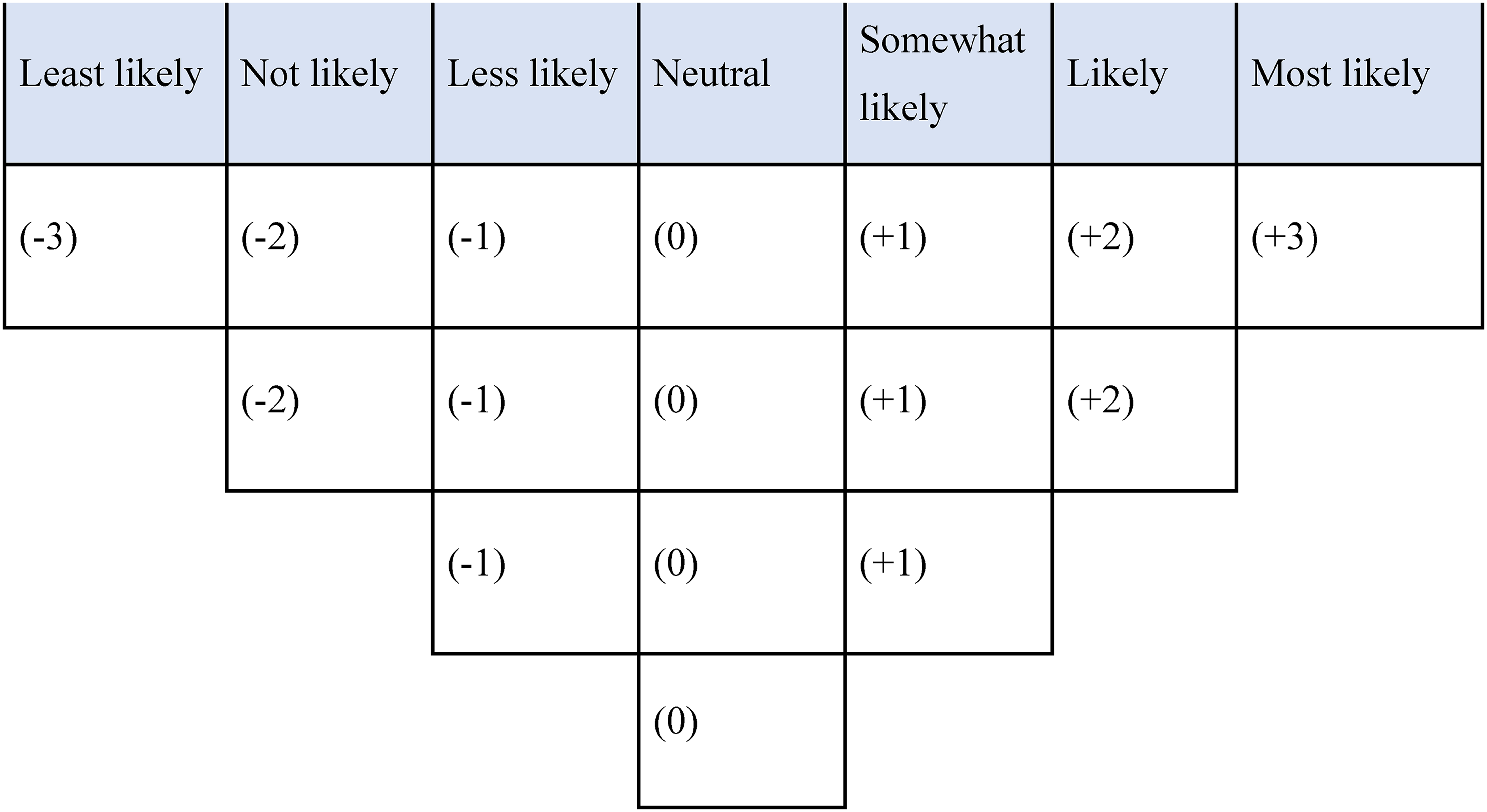
Example of a prearranged frequency distribution (Q-sort) where participants rank order the statements (Q-set) based on their degree of perception of the likelihood of an event occurring in the future. The values are assigned on a scale ranging from −3 to +3, where −3 represents “least likely” and +3 represents “most likely.”
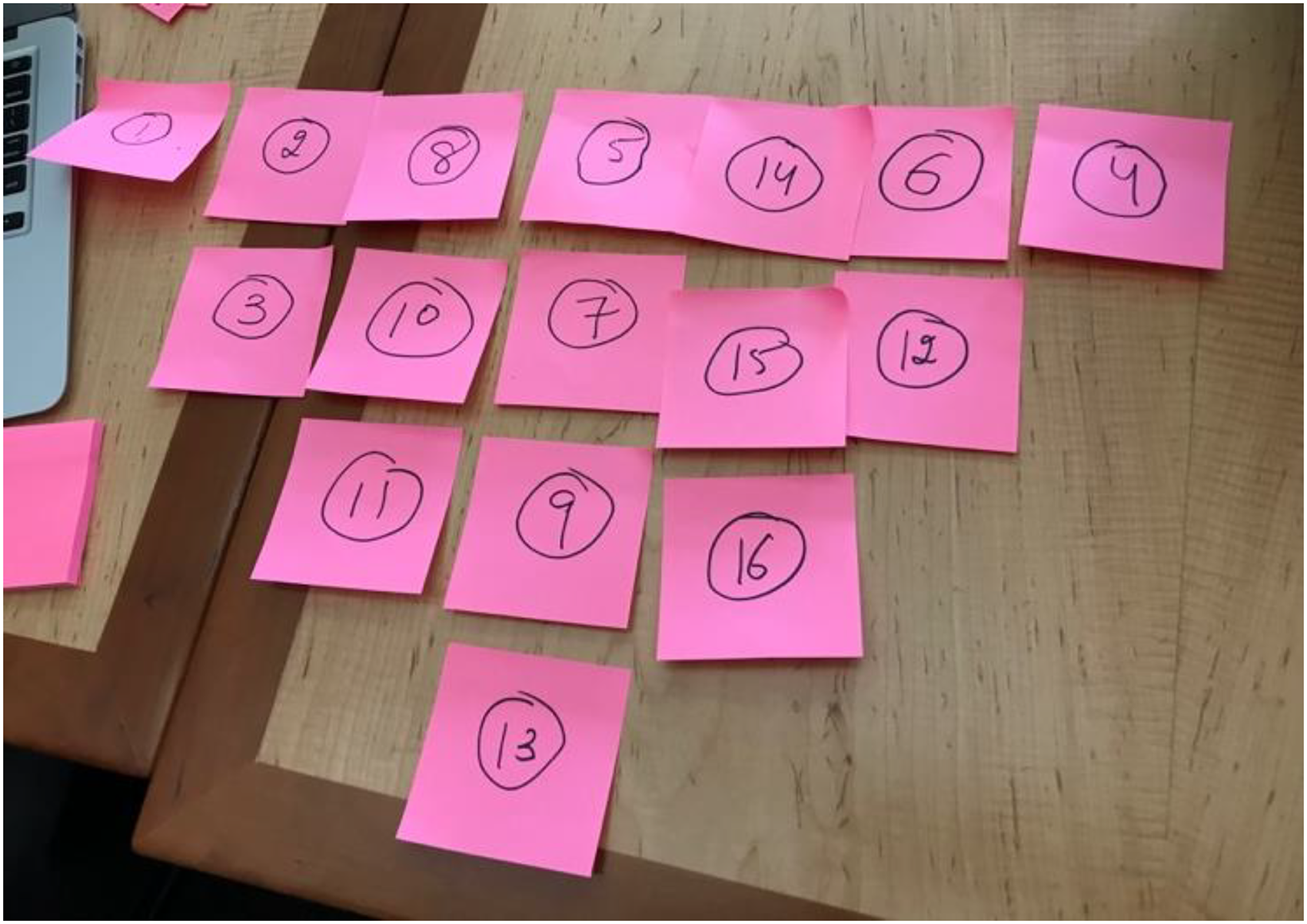
Presentation of a Q-sort done by a farmer using sticky notes. The number on each sticky note represented the statement/scenario number: 1) Farm protected by weather shield, soil-monitor drones, and nutrient balance farm-bot to maintain optimum soil nutrients; 2) Aerial drone mapping crop growth into grids, and on-ground farm-bot adjusting specific grid crop nutrition levels; 3) Autonomous tractor-bot using grid-mapping sensing technology for optimizing fall ploughing levels; 4) Autonomous tractor-bot using grid-mapping sensing technology for optimizing liquid manure application; 5) Harvester farm-bot identifying ripe and damaged crops, harvesting, and automatically removing invasive weeds; 6) Farmer getting expert advice at agricultural co-op using augmented reality (AR) diagnostic tools, assisted by farm-bots; 7) Soil sensors making digital field grid, farmer reviewing cover crop options through AR simulations; 8) Agronomist identifying drought-resilient seeds alternatives through head-mounted display to improve crop health; 9) Pumpkin harvest festival brings farmer families together; drones monitoring produce, farm-bots harvesting pumpkins; 10) Smart shields protect covered feed lot in dairy-farm; drones monitoring/containing possible phosphorus run-off in lake; 11) Drones monitoring cow health remotely, with mobile farm-bot milking free range cows in the field; 12) Self-installing smart tile pipes using AR grids to identify best phosphorus run-off paths; 13) Smart farm ecosystem leverages TV white spaces to strengthen device communication network; 14) Smart shields protect farm, controlling farm moisture levels during heavy rainfall and hailstorms; 15) Smart shields protect farm, creating flood protection barriers for crops to remain in silos, unaffected by natural disasters; 16) Smart shields protect farm, during snow storms—enabling year round crop growth, resulting in higher annual yields.
In our study, participating farmers were asked to individually sort a series of future farming scenarios by ranking their perceived likelihood of occurrence using a distribution scale ranging from +3 (“most likely to occur”) to −3 (“least likely to occur”), with 0 indicating a neutral stance. This sorting reveals the desirability of farming futures based on farmers’ current values, relations, and assumptions about what responsibility means in terms of human, technology, and nature relationships. To initiate the sorting process, farmers first reviewed each scenario and grouped them into three preliminary categories: “likely,” “not likely,” and “neutral,” based on their own expectations about the future (Braito et al., 2020).
Using these initial groupings, farmers then completed a forced distribution of the statements into a fixed sorting grid (Watts and Stenner, 2005), utilizing sticky notes and colored pens to aid creative engagement and facilitate discussion. Throughout the sorting process, researchers asked participants to explain the reasoning behind their rankings, particularly focusing on the statements placed at the extremes (+3 and −3). This step was crucial for capturing participants’ interpretive frameworks and eliciting qualitative insights into the values, beliefs, and experiences informing their perspectives (Braito et al., 2020) (Figure 4).
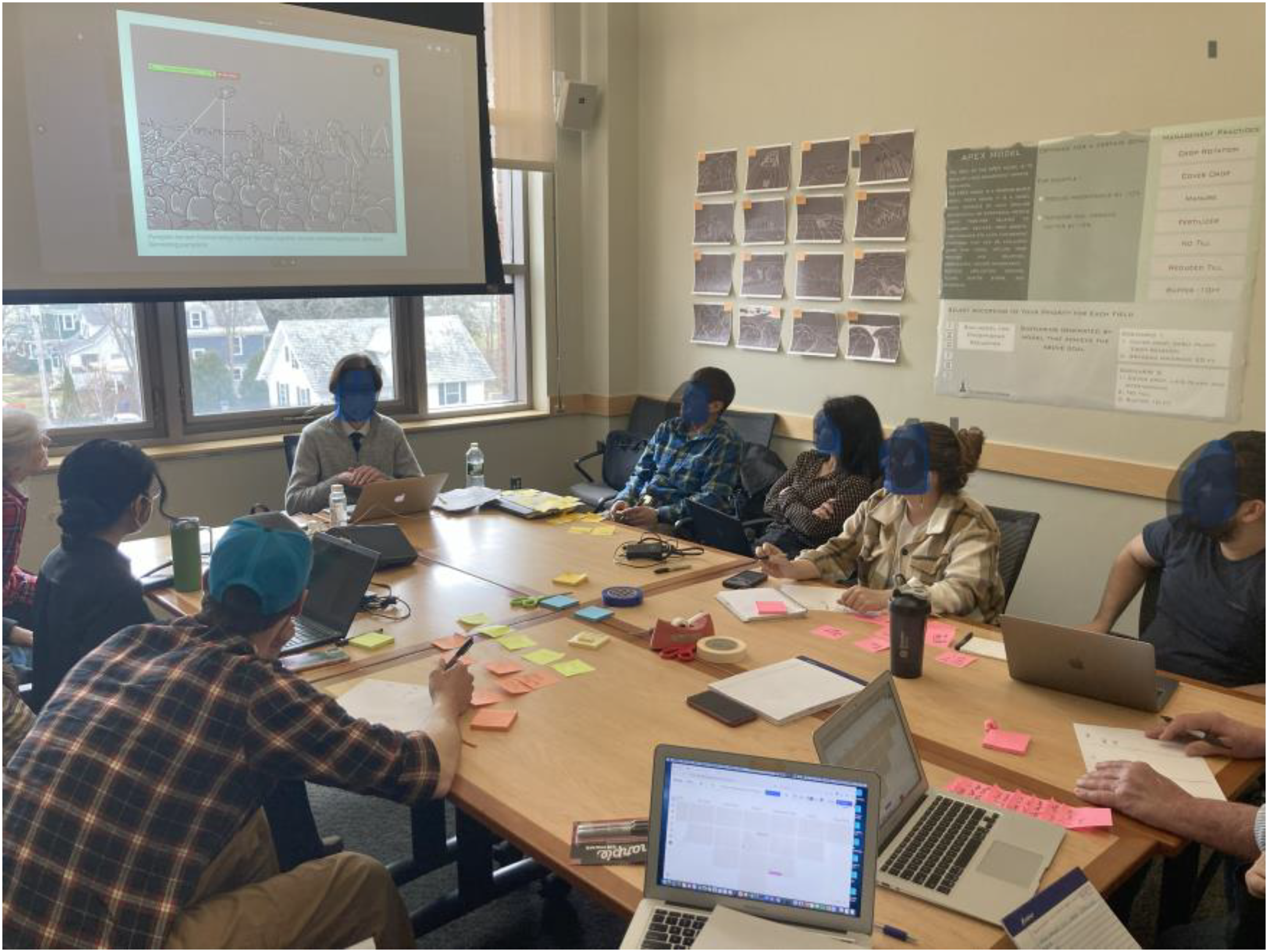
Image from a design workshop in Vermont (April 2023).
Factor analysis
After obtaining the Q-sorts, we performed a by-person correlation and factor analysis of the data using the “qmethod” package (version 1.8.4) of R (Zabala, 2014). The correlation matrix presents the relationship of one Q-sort with every other Q-sort (Watts and Stenner, 2005). Q methodology employs factor analysis at the individual level, where correlation between persons is measured, and the clusters of participants producing the same outcome are identified (Gao and Soranzo, 2020).
After obtaining the correlation matrix, we performed factor analysis by using principal component analysis with a Varimax Rotation (see Supplementary Table C, Appendix). Each participant loads on these factors based on their Q-sort configurations. A positive loading means a positive alignment with the viewpoint, and a negative loading means a negative viewpoint about the statement. The participants with similar item configurations load on the same factor (Watts and Stenner, 2005).
Results
Descriptive statistics
Similar to the 2022 US Census of Agriculture data (2022), our farmer participants were predominantly Non-Hispanic White (96%), with an average age of approximately 51 years. The 2022 census indicates 36% female producers and 64% male producers, whereas our participants predominantly (96%) males. Educational attainment varied, with most participants holding a 4-year college degree (40%) or an associate/vocational degree (28%). Gross operation sales were relatively high, with over half (56%) reporting annual revenues of $300,000 or more, while 12% preferred not to disclose their financial information. The 2022 agriculture census data suggest that per farm average farm-related income in SD is $61,373 and in VT is $25,135. On average, 80.6% of their income was derived from agriculture, though this ranged widely (0–100%).
Regarding land tenure, most participants owned substantial acreage (mean = 801 acres), while many also rented land from others (mean = 490.3 acres). A small number rented their land out (mean = 67.5 acres), suggesting diversified land management arrangements. Participants in SD and VT varied by the size of land on which they farmed. The median acres of land owned or rented in VT was 250 acres, while in SD, it was 1200 acres. This contrasts with the average size of farms in both states, which are 180 acres in VT and 2289 acres in SD, as per census data.
The four farmer types
Using Watts and Stenner (2005) guidelines, we identified four factors for interpretation based on two selection criteria: 1) factors having an eigenvalue of more than 1.00, and 2) at least two Q-sorts load onto the factor. The Varimax Rotation explained a total variance of 81.92% with 13 uniquely and significantly loading Q-sorts (see Supplementary Table D, Appendix). As the final step, farmer imaginaries of the future were interpreted using relative item rankings within the factor array complemented with the narrative descriptions provided by the farmers at the time of Q-sorting and from the interview data. The extreme values, such as +3 and −3 in our article, within each factor array, primarily describe the characteristics of farmers’ viewpoints for that factor (Watts and Stenner, 2005: 82–85). The values other than the extremes, such as the neutral standpoint represented by the value 0, add to the interpretation by capturing subtleties of farmers’ expressions, and therefore giving a clear, gestalt account of the farmers’ identity.
Our Q-methodology analysis revealed four distinct farmer types (see Figure 5), each reflecting a different configuration of human–nonhuman relationships and preferences for the future of PA. These typologies illustrate the social and ethical dimensions of how farmers relate to technologies, nature, and expertise in shaping farm labor, trust, and decision-making.
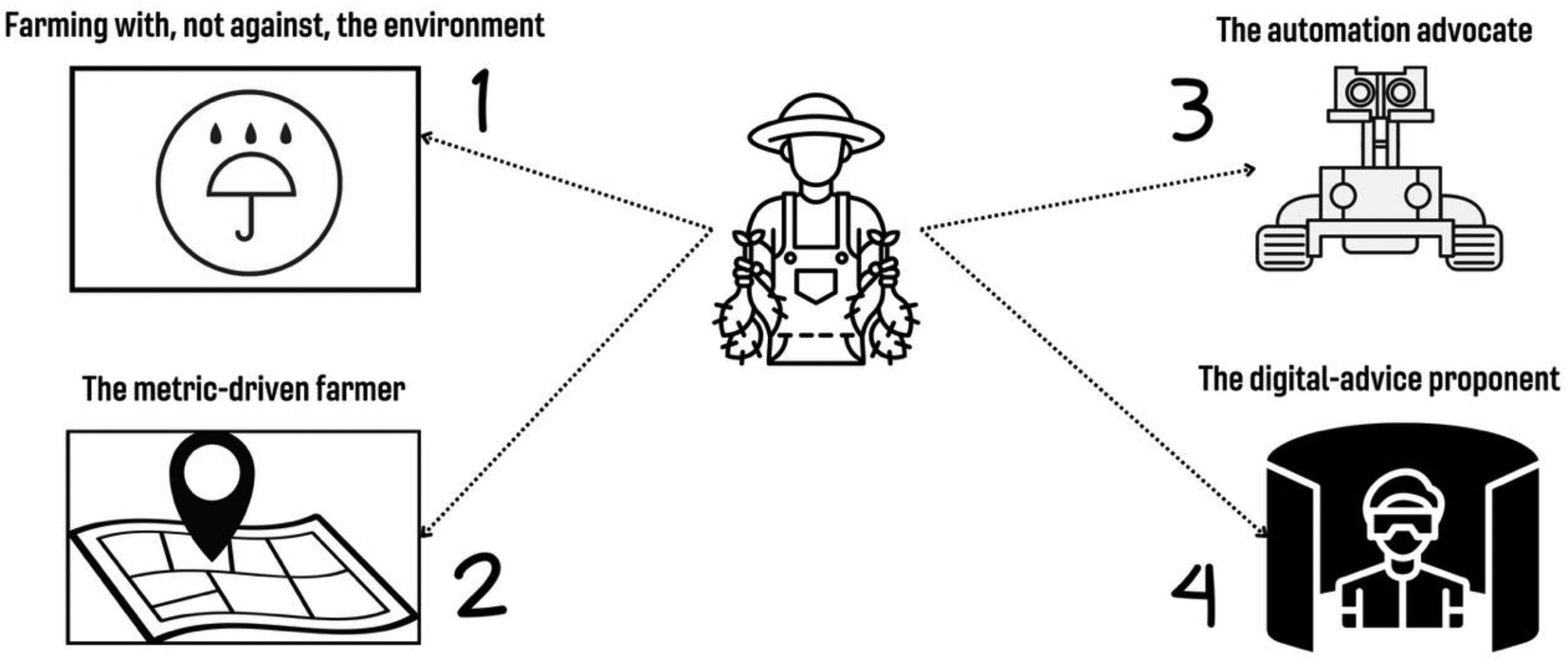
Graphical depiction of the farmers’ anticipation of the future of farming (Source: Authors’ own; the figure was made using icons from Canva).
Type 1: Farming with, not against, the environment: Farmers in Factor 1 envision a future in which technology complements nature rather than attempting to control it. Most of our farmers consider unpredictability of the weather as an important challenge in their farm-based decision-making. VT1 1 shared the complications associated with weather as, “…you got to deal with the weather and mother nature and all that crap. Like I can't say what we're gonna decide for the shit on June 20 this year. It might be fucking raining that day.”
In our results, type 1 farmers expressed skepticism toward the notion that smart shields or automated technologies can override environmental unpredictability. Their Q-sort strongly rejected statements promoting smart weather protection tools (statements 1, 10, 14, 15, and 16). This could be a result of their poor experience with the existing weather forecasting tools. One of our farmers, VT2, explained: “I remember one year we were listening to the weather forecast, zero chance of rain. Before the day was out, you had three inches of rain, and you didn’t even see clouds in the sky. It just fell.” Some farmers also shared their pessimism on the ability of PA tools in mitigating climate change impact. This is clear in SD4's statement, “Precision agriculture will never replace mother nature. You will never be able to beat mother nature.”
The focus of Type 1 is on enhancing observation and preparedness, such as optimizing fall ploughing levels and liquid manure application, rather than protection through automation. These farmers prioritize accurate weather prediction over technological intervention. Factor 1 had an eigenvalue of 5.27 and explained 32.92% of the variance with six Q-sorts loading onto this factor. This group highlights a key insight: nonhuman forces such as climate and weather are perceived as beyond algorithmic control. Farmers in this category seek tools to better understand and adapt to nature, not to dominate it.
Type 2: The metric-driven farmer: Farmers in Factor 2 embrace data-intensive technologies such as drones, grid mapping, autonomous tractor bots, AR tools, and soil sensors. In our results, statements 2, 3, 7, and 4 express a positive attitude of Type 2 farmers toward the use of these technologies, as they see value in tracking crop quality, nutrient levels, and soil moisture to help optimize operations. Our farmers have been using different PA tools for making different decisions. Most commonly, yield monitor results are used for hybrid selection, and grid and zone sampling are employed for optimizing fertilizer use. SD1 discussed how he integrates information from two data sources to make decisions: “I use the yield monitor on the combine and then…compare the two [soil maps and yield data] to decide what areas of the field are more productive.”
Some farmers outsource their soil management decisions to third-party outfits who “…do all the soil sampling, create all the zones first, through imagery, through yield maps, through soil types, through topography, and then the soil type, the soil tests” and verify which variety performed well in each zone of the farm [SD5]. Other farmers consult their agronomists to make decisions about fertilizer applications based on their yield data. These farmers, who invest in technology and/or seek external expert guidance, seek precision, repeatability, and performance-based decision-making. They favor tools that not only measure but also automate farm operations such as nutrient application and fall plowing. Interestingly, when asked about farmers’ preference to get compensated based on their management practices or the performance in achieving these goals, farmers who opted for performance expressed their desire for the creation of accurate performance measurement standards to receive fair payment. This alignment with metrics reflects a desire to reduce uncertainty, improve profitability, and minimize guesswork through data-driven insights. These insights will be beneficial for farmers in the long run, enabling them to receive fair rewards from state and federal sponsored policies. Farmers’ view also suggests that nonhuman actors, including sensors, maps, and data systems, become central decision partners, reshaping the farmer's role from hands-on operator to strategic manager.
Type 3: The automation advocate: Type 3 farmers envision a future where robots and autonomous systems handle much of the physical labor. Their Q-sorts strongly endorsed automation-related statements (scenario 4: z = +3; scenario 6: z = +2; scenario 13: z = +2), indicating optimism about autonomous machinery and improved broadband access to support remote operations. SD2 described his vision about the future PA technology: “I won’t be sitting in a tractor cab… I’ll probably go out and make a broadcast application in the spring. And then I'll turn loose the bots and let them take care of the rest of summer.” This group reflects a growing comfort with robotic labor and a preference for office-based supervision over field-based labor. Their acceptance of AI and automation also points toward changing conceptions of farm work, less manual and more technical, strategic, and observational.
When asked about the future of automation and its impact on farm labor, VT7 shared that automation will be an integral part of farming in the future if it could bring efficiency and scale. To align with technological advancements, the future labor force must acquire the necessary skills to effectively utilize these technologies. However, VT7 also expressed his dissatisfaction with the robot he purchased to feed his cows. He narrated, “It [robot] just seems to not be able to work…the thing needs to be able to find his charging station at the end of every route and stuff. And if it doesn't find it, it's gonna sit there all night and do nothing.” This imagery also implies the need for better infrastructure—power, broadband, and market—to achieve the automation goals.
Type 3 farmer imagines a restructured future workforce: not fewer workers but differently skilled ones, including technicians, programmers, and logistics managers, rather than tractor operators or seasonal field labor.
Type 4: The digital-advice proponent: Farmers in Factor 4 prefer human expertise that is supported by digital tools, particularly those embedded in institutional structures such as co-ops or land-grant universities. This group placed high trust in co-op advisors (statement 6, z = +3), while showing skepticism toward independent advisors using AR (statement 8, z = −1). SD3 commented: “I’ve always been a big believer in extension and land grant universities doing scientific studies. It has nothing to do with money.”
Farmers seek support from co-ops and private seed companies for herbicide management, variable rate fertilizing, zone-mapping, and soil-testing. However, they have mixed reviews of universities and extension. Some farmers believe that universities are slow on research and limited by funding. Similarly, VT8 shared that the value of extension is gradually declining due to slow uptake of advanced technical skills. He shared, “Extension Service used to play a really important role when I was younger and growing up. The Extension Service was where everybody went. Everybody knew their local agent…there were a lot more of them. There was a lot more expertise there…the extension services really been skinny down hand. So, I think there's a vacuum there for knowledge and new practices.” Despite these concerns, many farmers still prefer contacting co-ops, extension, and universities for making crucial farm-based decisions.
Trust plays a central role in Type 4 farmers’ vision. These farmers are willing to share data with their cooperatives and trusted advisors, especially if the relationships are long-term and grounded in scientific integrity and knowledge upgradation. They differentiate between nonprofit expertise (universities, local organizations) and for-profit motivations (private agronomists or technology firms). Yet, trust is not without its limitation. SD3 remarked: “Anytime there is sales involved… there is over recommendation [of nutrients].” This group exemplifies a hybrid model of decision-making, where human–human relationships remain foundational, but are enhanced by digital communication and data interpretation systems. Farmers collaborate with advisors but retain autonomy and apply their own judgment.
Human–nonhuman interactions and the transformation of farm work and labor relations
Farmers in both VT and SD widely anticipate a shift away from manual labor toward more supervisory and interpretive roles. While automation and data technologies are expected to take over routine tasks, the need for human expertise, particularly in interpreting complex and localized data, remains central. VT3 noted: “Will technology replace [my crop advisor]? No. He’ll probably be the one using more of the technology to advise me.” Yet, reliance on human advisors is mediated by affordability and specialization. VT4 reflected: “It's hard for them to charge enough that those service you properly.” This underscores how economic limitations can shape the accessibility of future expertise. SD3 similarly noted that while automation will reduce the need for tractor operators, it will create demand for logistics roles: “You’re not going to need a tractor operator, you’re going to need a truck driver to supply the bots and things like that.” These reflections indicate that while PA may reduce the need for physical farm labor, it will not eliminate human labor. Instead, it may reconfigure labor needs toward tech-savvy, supervisory, or logistics-oriented roles, altering the skillsets and training required for future agricultural work.
Farmers do not see themselves as passive users of technology. Many emphasized the value of local, experiential knowledge and the importance of having autonomy over farm decisions. VT5 reflected: “I want to have that experience and know what I’m doing myself as opposed to just be like, what's my phone say?” Tinkering and adaptation are critical practices. Some SD farmers mentioned modifying machinery with aftermarket parts or avoiding overreliance on digital tools due to young workers’ limited repair skills. Even when farmers consult advisors, they filter information through their own expertise and preferences, tailoring it to their context.
Trust emerged as a central theme shaping the acceptability of future PA tools. While farmers recognize the potential of AI and digital DSSs, they remain cautious about full automation and the opacity of algorithmic decision-making. SD3 remarked: “The AI stuff scares me somewhat… I worry that there’d be too much computer modeling versus actual observation.” Trust is currently anchored in long-standing relationships with crop advisors, veterinarians, and local co-ops. VT6 stated: “We’re not replacing our crop guy or our nutritionist… We still trust them to do the mechanical work on the new technology.” This trust also extends to expectations for governance. Farmers anticipate roles for government in regulating monopolies, ensuring data privacy, and protecting against overreach. Yet, skepticism persists. VT3 voiced: “I find whenever the state is involved… it's an absolute complete waste of time money and resources. I find industry does a way better job.” The implication is that both public and private institutions need to earn farmers’ trust not only through technical reliability but also through ethical practices, equitable returns, and transparency in decision-making processes.
While many farmers see value in automation, they express limits to what they are willing to delegate to machines. Precision agriculture is not perceived as a one-size-fits-all solution. For instance, SD4 noted: “Farming is not an assembly line. It still needs human interaction more than some other things.” On asking which PA tools he would like to use in the future, VT2 responded, “I've been farming for quite a number of years and it's [farming is about] making sure that you are making good use of your natural resources and in an environmentally friendly way and producing the crops that we need to feed our animals throughout the year.” Another farmer from VT, VT5, warned against overdigitizing agriculture given generational and cultural shifts: “I'm not a techie… So making farming aimed more techie, I don’t know if that's really healthy.” These concerns extend to imagine extreme risks of AI. In a moment of exaggeration, SD2 worried about uncontrolled robotic behavior: “Maybe Benny [name given to a fictional robot] could go around and just start shooting people… they probably need to have a way to offset that.” Although rhetorical, this highlights a broader anxiety about relinquishing too much control. Farmers consistently emphasize the importance of human oversight, embodied experience, and cautious integration rather than wholesale transformation.
Discussion: Envisioning human–nonhuman futures in PA
Sociotechnical imaginaries as performative forces of social change
Farmers’ visions of PA are more than predictions; they are performative imaginaries, visions that shape current decisions, behaviors, and policy priorities (Jasanoff, 2015). These imaginaries are embedded in systems of power and knowledge that distribute resources, define responsibilities, and influence the very design of agricultural futures. As seen in our results, farmers’ imagined futures differ not only in terms of preferred technologies (e.g., automation, weather sensors, expert advisors) but also in their desired relationships with human and nonhuman actors, be it soil, climate, AI systems, livestock, or institutional expertise. This work responds to recent calls for examining futures as sites of contestation (Goulet, 2020; Gugganig et al., 2023; Polzin, 2024), especially at the farm level, where the implications of digital transformation are experienced most directly. While foresight research has historically focused on macro-level policy, our study highlights the micropolitical dynamics of how farmers themselves speculate about PA's impact on labor, trust, and agency. By applying a mixed-methods approach, we contribute to a growing body of scholarship using quantitative and participatory approaches to speculative futures (Ruder and Kandlikar, 2023; Sareen et al., 2022), emphasizing that futures are both descriptive and prescriptive: they reveal what is anticipated and prescribe what should be avoided or pursued (Jasanoff, 2004).
The diversity of farmer typologies—nature-aligned, data-driven, automation-oriented, and digitally networked—shows how PA is not a singular pathway but a multiplicity of coevolving assemblages (DeLanda, 2016). These assemblages consist of farmers, advisors, data, crops, machines, and regulatory bodies interacting across spatial and temporal scales.
This understanding of sociotechnical assemblage’s foregrounds a more relational ontology of farm work, where AI-enabled tools, algorithms, advisors, and environmental factors coshape decisions. Farmers’ current experiences, including challenges with broadband, skepticism about predictive models, reliance on co-ops, serve as building blocks for their future digital identities. We present a conceptual framework (Figure 6) that integrates multiple actors and identities and shows how anticipated relationships inform emerging governance structures and values. In this framework, both human and nonhuman actors are dispersed in a sphere comprising of four dimensions: social (knowledge, skills, norms, practices, values, and relationships), political (policies and governance), technical (agricultural technology and innovations), and market (economic structures). Based on access to resources, sociotechnical agency, and decision-making power, these actors engage with each other in heterogeneous and multidirectional ways. These interactions produce temporary assemblages that stabilize over time based on iterative reinforcement of relations among actors.
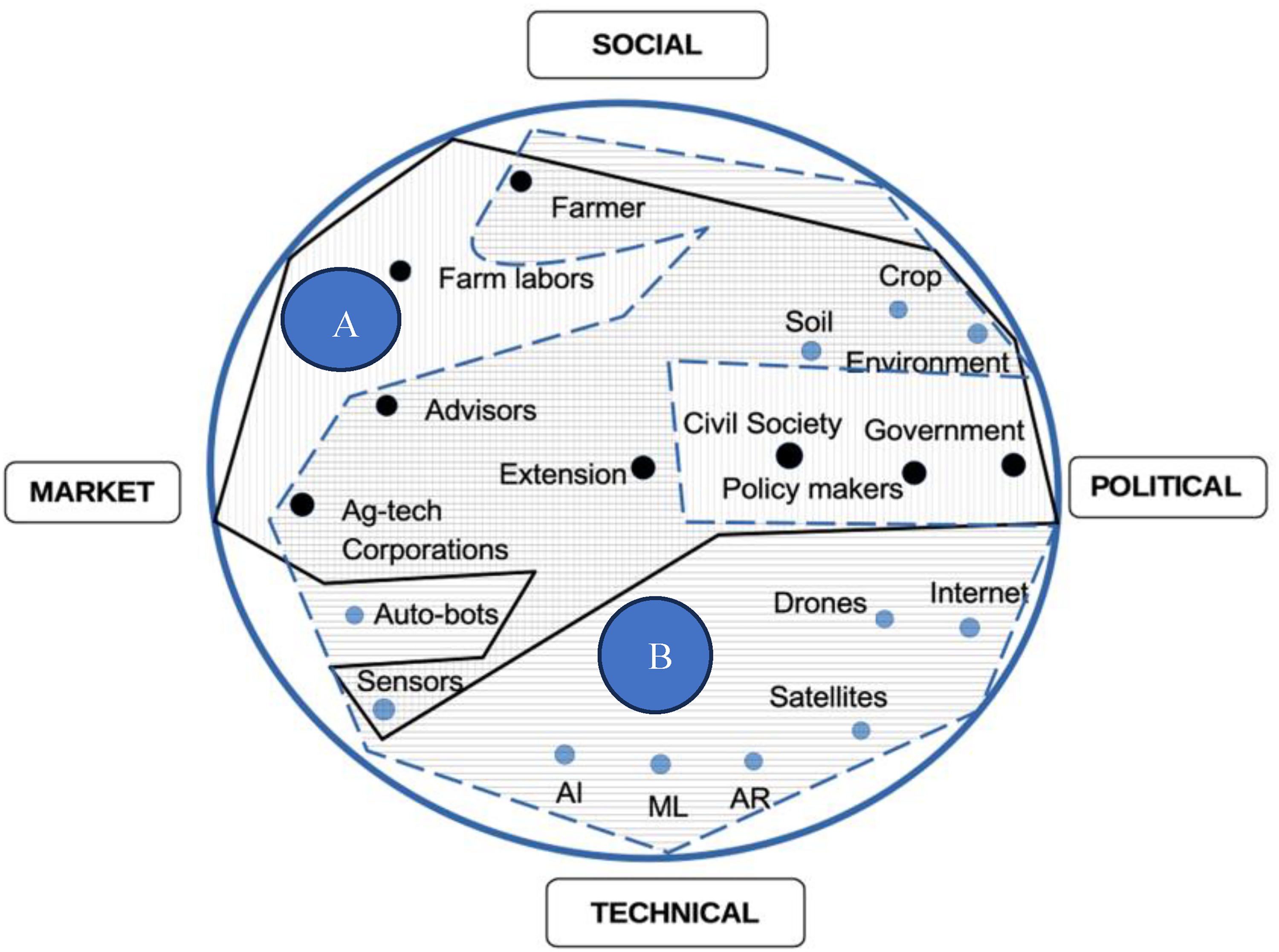
A conceptual model that combines actors and networks of organizations embedded in the precision agriculture space. Dots represent actors within the agro-tech ecosystem (blue dots: nonhuman actors; black dots: human actors). The area under the solid (A) and dashed boundary (B) represents two hypothetical future assemblages of agriculture-based actors. (A) Assemblage representing traditional farming practices; (B) Assemblage with smart-farming technologies. (Source: Authors’ own).
Figure 6 illustrates two hypothetical assemblages (A and B), inspired by Legun and Burch's (2021) “isolated” and “technocratic” assemblage tendencies. These tendencies depict two contrasting futures of farming. Assemblage “A,” similar to the “isolated” assemblages, represents a traditional farming assemblage, with dependency on human labor, advisory group, experiential farming knowledge, government regulations and subsidies, and simple farming technologies such as sensors for farm management and decision-making. Assemblage “B,” inspired by “technocratic” assemblages, represents a modern agricultural assemblage with a reduced dependency on farm labor and more engagement with smart farming technologies using AI, ML, AR, and advanced drones.
Our four farmer typologies could be envisioned as four assemblages comprising of distinct actors. This is analogous to the typologies of farmers proposed by Legun and Burch (2021), wherein farmers exhibit tendencies toward envisioning either technocratic, deliberative, and isolated futures. The technocratic farmers are similar to our Type 2 and Type 3 farmers, who anticipate their futures with advanced PA tools such as drones, AR, IoT, grid mapping, and automated machines, replacing human labor with machines. These farmers seek efficiency and profits guided by the accuracy of measurement, rather than manual human support. However, unlike Legun and Burch (2021), our Types 2 and 3 farmers believe that achieving technocratic futures requires a skilled workforce capable of utilizing and interpreting the outputs of these technologies. An example could be farmers using AR to review cover crop options (as illustrated in scenario 7 in Figure 1). Moreover, in addition to preparing the farm for automation, our farmers emphasize the importance of building a smart farm ecosystem, which includes reliable broadband connectivity, to achieve a technologically advanced future. The assemblage B in Figure 6 represents the relational dynamics between the human and nonhuman actors at the intersection of the four dimensions market (availability and affordability of smart-technologies), technology (development of accurate and reliable technologies), political (infrastructure expansion and stability), and social (upskilling of labor).
The deliberative farmers act as creative agents within their farms, combining elements of human and nonhuman expertise based on their requirements. Type 4 farmers align well with this category, as they do not passively accept technology-dominated change. They tinker, customize, and negotiate the use of PA tools (Higgins et al., 2023), enacting what Comi (2020) terms the “distributed farmer”; a hybrid identity shaped through dynamic relations between human and machine. Type 4 farmers seek technology-based guidance, but under the institutional supervision of co-ops, extension agents, and universities, which are traditionally considered reliable and trustworthy. Most of these farmers favored the use of smart shields to protect their farms from natural disasters such as floods, snowstorms, and hailstorms (see Supplementary Table A), which demonstrates their “experimental” nature (Legun and Burch, 2021) of trying new technology to overcome their concerns about the weather unpredictability. However, in the absence of such uncertainties, Type 4 farmers prefer making their own decisions or seeking expert advice, but they do not fully delegate their farm-based decision-making to the autonomous bots.
Our Type 1 farmers resemble the isolated future envisioned by Legun and Burch (2021) (also represented by assemblage A in Figure 6). These farmers are skeptical of fully automated futures and believe that machines cannot fully comprehend the unpredictability of nature. Such farmers may deploy PA based on specific farm needs, such as optimizing ploughing levels or managing nutrient application (see Supplementary Table A). They may acquire new skills to effectively use these technologies. However, as Legun and Burch (2021) suggested, there is a bifurcation in the nature of work, with some tasks requiring highly skilled labor and others requiring highly unskilled labor. Such farmers are restricted by their ecology or economic conditions, which constraints their ability to fully utilize and shape future agricultural technologies on their own. Such isolated futures are not fixed endpoints but mutable configurations, reshaped by ongoing interactions, events, and discourses.
Speculative design and the imaginaries of RI in agriculture
Speculative design offers an important complement to RI by making futures material and experiential. Unlike linear planning tools, speculative design focuses on questioning the present, exploring the ethical and relational dimensions of what technologies do and who they serve (Dunne and Raby, 2013). As shown in our study, farmers’ visions are not merely utilitarian; they are embedded in social values, historical practices, and cultural identities. Our farmers anticipate wider use of PA in the future. This is evident in their preference for automation and data-driven decision-making for improving crop yield, farm efficiency, and profits. Despite this belief, they do not envision a complete surrender of agricultural work to machines. Rather than fully depending on algorithmic rationality, some farmers emphasize the continued necessity of human expertise, judgment, and experiential knowledge in shaping future farming practices. At the same time, they strongly assert the predominance of nature over technological systems, expressing a notion that machines lack the capacity to fully govern natural processes. In this view, technology is perceived as a supportive rather than a dominant force within agricultural production.
By drawing on new design practices, ones that are participatory, distributed, and ethically grounded (Escobar, 2018; Manzini, 2015), we can cocreate artifacts and scenarios that challenge dominant logics and foreground relational, inclusive, and responsible approaches to innovation. We conceptualize the relational positioning of actors through the assemblages depicted in Figure 6, wherein the farmers’ lives are enmeshed within a network of human and nonhuman actors distributed across the four dimensions. These assemblages are not fixed; rather, they continually territorialize, deterritorialize, and reterritorialize in response to enabling or constraining interactions among actors, shaped by prevailing norms, values, and power relations (Deleuze and Guattari, 1987; Feely, 2020).
In our article, grid mapping, automation, and digital advisory tools emerged as central to farmers’ future imaginaries of technology-driven agriculture. However, farmers did not express similar anticipation for precision livestock farming (PLF) technologies—such as automated milking systems or drone-based remote monitoring of animal health—as depicted in scenario 11 of Figure 1. While PLF technologies are expanding and prioritizing data-centric operations, farmers are divided about the impact of these technologies on their relationship with animals (Kling-Eveillard et al., 2020). On the one hand, advanced technologies such as automated health monitoring systems, GPS collars, wearable sensors, and milking robots enable farmers to effectively monitor livestock's vital signs and location. This real-time data allow for timely feeding, fertilization, and early disease detection, ultimately improving livestock health and productivity (Neethirajan, 2020). Conversely, other farmers assert that modern computer-based monitoring diminishes their traditional, on-site physical caretaking of their livestock, which they consider as an essential attribute of a “good farmer” (Kling-Eveillard et al., 2020). From an ethical standpoint, the design of these technologies often rejects the agency and well-being of animals, transforming them into mere datapoints within the emerging assemblages (Neethirajan, 2025). These differing sociotechnical visions of farmers reflect in our farmers’ skepticism of fully automated livestock futures. Instead, their perspectives align with Schillings et al.'s (2023) argument that future agricultural technologies may function more productively as boundary objects that facilitate ethical and relational connections among farmers, advisors, consumers, livestock, and environment, rather than acting as instruments of control.
Design fictions and narrative-driven speculation can help policymakers and researchers reflect on tensions between control and care, efficiency and equity, automation and autonomy. A one-size-fits-all technological future risks reinforcing inequities and overlooking the diversity of agricultural practices. Ultimately, the visions offered by farmers reveal a desire for just, inclusive, and adaptable futures, not necessarily high-tech but human-centered and context-sensitive. These particularly represent futures imagined by Type 4 farmers where they collaborate with co-ops, interpret data in partnership with trusted experts, and balance automation with local knowledge. Such farmers value human expertise, believe in regular upgradation of skills and knowledge, are sensitive to environmental issues, and can work in institutional frameworks. Speculative design and RI together enable us to “think with” farmers, rather than for them, creating spaces for experimentation, dialogue, and situated innovation. They challenge us to go beyond dominant narratives of precision and efficiency and instead ask: Whose futures are we building? With what assumptions? And for whom? The process of world-making in agriculture, through technologies, imaginaries, and assemblages, can become a site of collective inquiry, enabling democratic participation and accountable/responsible governance. In this spirit, we encourage other researchers, policymakers, and designers to cocreate futures that are not only smart but also rooted in relationships, oriented toward responsibility and justice, and open to the unexpected.
Conclusion
This article demonstrates how integrating speculative design with Q-methodology offers a powerful approach to uncovering diverse sociotechnical imaginaries of PA among farmers. By engaging participants in the cocreation of future scenarios, we not only surfaced distinct visions for PA but also revealed how these imaginaries are shaped by existing relationships, values, and material conditions. The typologies that emerged, from those skeptical of technology's ability to manage nature to those envisioning fully automated or expert-guided futures, highlight the plurality of farmer identities, expectations, and needs in the digital transition. These typologies build on Legun and Burch's (2021) technocratic, deliberative, and isolated assembling tendencies, shaping how farmers perceive their agency within the assemblages of landscape, work, and institutions they are embedded in. Importantly, these futures are not merely abstract preferences; they are performative, influencing how technologies are accepted, adapted, or resisted. Though our classifications are inspired by Legun and Burch's (2021) typologies, our farmer types are not completely dissociated, as compared to the “isolated” futures, from the realities of changing farm technology landscape. Instead, all our farmers are selective about the use of PA technologies based on their farming knowledge and experiences. For instance, both Type 1 and Type 4 farmers recognized the implications of the uncertainty of weather on their outputs. However, the former believes that nature cannot be controlled by technology, and the latter showed confidence in “weather shields” which would protect their farms from untimely natural disasters. These imaginations, shaped by farmers’ beliefs and values, play a big role in acceptance of or resistance against emerging farm technologies by farmers. We argue that designing responsible agricultural innovations requires moving beyond linear models of technology transfer and embracing participatory, imaginative, and reflexive approaches that foreground lived experience, local knowledge, and relational ethics. In doing so, we can build more inclusive and responsive pathways toward climate-smart and socially sustainable agricultural futures.
Our study shows that inclusive, anticipatory methods such as Q-methodology and design workshops can help surface farmers’ preferred futures while accounting for human–nonhuman interdependencies. These futures often call for hybrid systems, where digital tools support rather than replace expertise, and where trust and care remain central to decision-making. The four farmer types reveal how human and nonhuman interactions are reshaping the contours of future farm work. While some farmers view PA as a way to coexist with nature, others see it as a pathway to data-driven control or full automation. Across types, trust, whether in nature, technology, institutions, or advisors, emerged as a critical axis shaping farmers’ orientations toward the future. Importantly, farmers are not passive adopters of digital tools. They interpret, resist, adapt, and tailor technologies to meet their values and goals. These typologies thus highlight the diversity of ethical, practical, and relational considerations that underlie the adoption of PA, providing key insights for RI and inclusive technology design in agriculture. In sum, farmers envision a future where human and nonhuman actors coexist through collaborative relationships rather than replacement. Precision agriculture is welcomed for its potential to enhance efficiency, make the invisible visible in measuring and managing nature, and augmenting local expertise. However, trust, interpretability, cost, and relational knowledge remain central to RI in PA.
Supplemental Material
sj-docx-1-bds-10.1177_20539517261455628 - Supplemental material for Exploring relational farming futures for responsible innovation in precision agriculture through Q-method and speculative design
Supplemental material, sj-docx-1-bds-10.1177_20539517261455628 for Exploring relational farming futures for responsible innovation in precision agriculture through Q-method and speculative design by Bhavna Joshi, Maaz Gardezi, Edward Prutzer, Awais Hameed Khan, Asim Zia, Benjamin EK Ryan, Ali Dadkhah, Donna M Rizzo, John McMaine and David Clay in Big Data & Society
Footnotes
Acknowledgements
This research is based upon work supported by the National Science Foundation under Grant Numbers 2202706 and 2026431 and the USDA National Institute of Food and Agriculture under Award No. 2023-67023-40216. Any opinions, findings, and conclusions or recommendations expressed in this article are those of the authors and do not necessarily reflect the views of the National Science Foundation or the United States Department of Agriculture.

Funding
The author(s) disclosed receipt of the following financial support for the research, authorship, and/or publication of this article: This work was supported by the National Institute of Food and Agriculture, National Science Foundation, (grant numbers 2023-67023-40216, 2026431, 2202706).
Declaration of conflicting interests
The author(s) declared no potential conflicts of interest with respect to the research, authorship, and/or publication of this article.
Supplemental material
Supplemental material for this article is available online.
Notes
References
Supplementary Material
Please find the following supplemental material available below.
For Open Access articles published under a Creative Commons License, all supplemental material carries the same license as the article it is associated with.
For non-Open Access articles published, all supplemental material carries a non-exclusive license, and permission requests for re-use of supplemental material or any part of supplemental material shall be sent directly to the copyright owner as specified in the copyright notice associated with the article.
