






Abstract
Despite a growing interest in how prevailing influences of algorithmic systems are being resisted, debates about algorithmic resistance unfold within conceptually diverse but disconnected scholarly conversations. Adopting a new materialist ontology, this integrative review traces algorithmic resistance's multiple conceptualizations across a growing interdisciplinary landscape. Academic publications are understood and analyzed as the outputs of research-machines: assemblages of theories, methods, technologies, researchers, disciplinary norms, and institutional logics that collectively produce particular visions of algorithmic resistance (while muting others). Reviewing 106 items, this study analyzes how diverging understandings of algorithmic resistance and its properties are territorialized within particular problem spaces: configurations of agencies, problematizations, and locations. Seven contrasting clusters of research-machines are identified (e.g.,Algorithm Aversion, Mundane Opposition, or Epistemic and Ontological Refusal) according to their shared productions of algorithmic resistance. Properties of these outputs are understood along six essential axes (intentionality, scale, visibility, materiality, temporality, relationality) and arranged into a provisional topography of intensities, silences, overlaps, and tensions within current scholarship on algorithmic resistance. This review offers two principal contributions: First, it provides an integrative perspective on the fragmented landscape of interdisciplinary scholarship that reveals how algorithmic resistances are produced within specific problem spaces and unfold along a topography of properties. Second, it advances a conceptual understanding of research-machines that sensitizes toward knowledge practices as sites at which the conditions and capacities of resistance to algorithmic power are constituted and configured.
Keywords
Introduction
As computational systems increasingly permeate all spheres of life, discussions of the (social) power of algorithms have become a central concern of scholarly inquiry (e.g., Beer, 2017; Cardon, 2018). While early analyses of the then-novel technologies primarily portrayed algorithmic systems as structural forces that unilaterally shape subjectivities, economies, and societies (O’Neil, 2016; Pasquale, 2016; Zuboff, 2015), they provided limited agencies for their contestation. Countering determinisms of dominance, it was the emerging field(s) of critical data (Dalton and Thatcher, 2014) and algorithm studies (Gillespie and Seaver, 2015) that also highlighted possibilities of resistance. Today, a growing body of research examines how people push back, subvert, or otherwise dissent from the influence of algorithmic systems or so-called artificial intelligence (AI): how algorithms are created, used, or imagined (Dourish, 2016; Seaver, 2017). Such algorithmic resistance (AR), broadly defined, refers to the myriad ways in which individuals, groups, and institutions challenge or negotiate control exerted or mediated by automated systems, how they refuse, oppose, or counteract their premises, logics, outputs, or the institutions employing them.
Scholarship on AR manifests as an ever-expanding list of labels and concepts: AR is found in quiet disengagement (Magalhães, 2022), subversive gossiping about functions (Bishop, 2019), resignation (Chan, 2021; Woodcock, 2017), gaming (Christin, 2017), the exploitation of systems for personal gains (Cotter, 2019) or activism (Treré, 2018), fostering solidarity (Yu et al., 2022), pursuing legal means (El Bourkadi, 2023), sabotage (Arubayi, 2021), and as reviving Luddism (Charitsis et al., 2024). It is conceptualized as aversion to computational control (Dietvorst et al., 2015), as consequential to the algorithmic management of labour processes (Kellogg et al., 2020), as rooted in conflicting moral economies (Bonini and Treré, 2024), as enactments of users’ agencies and their active embedding of algorithmic technologies (Ettlinger, 2018), as attempts at repairing algorithmic relations (Velkova and Kaun, 2021), or as outright refusal of embodied algorithmic knowledge projects (Ganesh and Moss, 2022). Thus, AR is characterized by a conceptual multiplicity that mirrors the growing reach of automated technologies’ control as experienced by affected communities and researchers alike.
However, like any attribution of resistance, AR is not a fixed object but describes relational, situational, and contested practices (Baaz et al., 2018) that circulate across various disciplines (e.g., media studies, STS, HCI, sociology, or critical data/algorithm studies) and their respective vocabularies. Such growing diversity is a consequence of increasing scholarly engagement and results in both conceptual richness and productive tensions. Yet it also means that shared assumptions, consequential differences, and cross-disciplinary patterns between approaches often remain opaque and unexplored. Distributed across a multitude of practices, theoretical understandings, modes of power, applications, and formations of algorithmic systems, a diversity of competing (and contradictory) conceptualizations of AR risks rendering important questions invisible across disciplinary boundaries: What does it mean to resist? Who perceives and defines resistance as such? What affords AR, and how is it configured by and in relation to algorithmic technologies? What are the targets, outcomes, effects, and achievements of resistance?
The relevance of these questions arises not merely from a general interest in cataloguing variations but from their consequences: As machinic assemblages (Deleuze and Guattari, 1987: 4; Fox and Alldred, 2015b), all research results from specific constellations of methods, theories, technologies, institutions, bodies, and discourses that together shape what studies can find. By linking heterogeneous elements, scholarly inquiries do not simply identify, but produce specific notions of AR; they configure particular problem spaces (Lury, 2021) along problematizations, agencies, and locations of resistances. Such productions are not only generative of knowledge, but territorialize it: they define what is understood as AR (and what is not), what it can (and should) achieve, who resists and for what reasons; they affect whether AR is rendered as silent avoidance, clandestine manipulation, or politically articulated unrest.
Thus, employing a new materialist ontology of social inquiry (Fox and Alldred, 2015a, 2015b) that treats outputs of academic work as the assembled products of research-machines, I conduct an integrative review of AR scholarship (‘Approach: An integrative review of research-machines’ section). This allows for interrogations regarding how, along what elements, and with what implications AR is not merely attributed, but produced. Building on integrative clustering, I identify seven contrasting aggregates of research-machines, each corresponding to studies that produce AR along kindred problem spaces (‘Algorithmic research-machines: Contrasting cases’ section). The ‘Axes of ARs’ section synthesizes these insights not by classifying various forms of AR, but by refining a topography of features. Mapping the outputs of machinic clusters identified along these axes reveals overlaps, patterns, tensions, and analytic frictions.
Departing from earlier works that propose taxonomies of AR (e.g., Bonini and Treré, 2024; James et al., 2023; Kellogg et al., 2020; Milan, 2024), this review instead examines how and with what consequences particular understandings of AR come into being across a growing landscape of scholarship. Illustrating what approaches do in order to produce, stabilize, or marginalize particular forms of resistance accounts for their diverse focal points and acknowledges the peculiarities of their respective fields, disciplines, and research domains. In doing so, the review deliberately expands the locus of conventional literature reviews: rather than summarizing findings, it uses existing scholarship as an empirical site for reflecting on and mapping the effects implied by the productions of a phenomenon. It offers a vantage point for analyzing inclusion and exclusion, empowerments and limitations as outcomes of specific research-machines, as critical reflection on the implications of knowledge production beyond petty criticism of terminological subtleties.
Approach: An integrative review of research-machines
Assemblages, following Deleuze and Guattari (1987), are compositions of elements (bodies, thoughts, objects) along their ‘capacity for affecting or being affected’ (Deleuze, 1988: 124). Research, understood through this lens, can be analyzed as assemblages of heterogeneous elements (methodologies, technologies, data, earlier findings, etc.) that together generate particular forms of knowledge (Coleman and Ringrose, 2013; Fox and Alldred, 2015a, 2015b). Scholarly efforts bring particular objects of inquiry (e.g., of AR) into being and transform them into consequential ways of knowing, knowledge, or policy (Fox and Alldred, 2015b: 411). Law's (2004: 42) proposal of method-assemblages emphasizes how methods craft relations to enact presences and absences. Extending this notion of assemblage to include all elements that contribute to research allows for the consideration of the broader conditions that enable knowledges: theoretical repertoires, disciplinary logics, institutional demands, and the researchers themselves.
Findings thus result from interactions between human and nonhuman elements in the research-assemblage (Fox and Alldred, 2023: 101). Such an assemblage is machinic (Deleuze and Guattari, 1987: 4), as it links elements to do, transform, or produce something. Beyond descriptive accounts of mere composition, this machinic quality highlights how research-assemblages generate analytical possibilities, carve out problems, and shape what can be known through them. Crucially, it emphasizes that research-machines’ outputs are defined by the specific patterns of influence and enablement that emerge from how those components interact: Particular methodological choices (e.g., ethnographic fieldwork) enable certain findings (e.g., situated knowledges) while foreclosing others (e.g., macro-level policy analysis). These configurations shape research-machines’ capacities and define which relations are prioritized and which possibilities are suppressed. In doing so, research-machines mediate micropolitics: the often-invisible ways in which methodological and conceptual choices shape what becomes thinkable and legitimate prior to explicit political articulation (Fox and Alldred, 2015b: 402–403). Micropolitics draw attention to how seemingly technical decisions such as the selection of data sets, methods, or analysis approaches quietly prefigure what can be known and asked long before formal policies or macro-level influences take effect. Understood this way, micropolitics refer to the subtle reaffirmations and reorganizations of power that research-machines enact. By drawing some relations in (and others out), stabilizing certain problem definitions, and privileging some data over others, research-machines’ micropolitics territorialize specific understandings of the phenomena they produce (Fox and Alldred, 2015a); they emphasize inquiry around particular forms of AR while rendering others marginal or impossible.
Attending to these configurations of capacities and reviewing research as a product of machinic assemblage allows for a systematic interrogation of research-machines: their territorialization of particular problem spaces (Lury, 2021), the agencies they assemble, their inclusion and exclusion, their micropolitics of knowledge production, ‘of who gains and who loses in the process of research’ (Fox and Alldred, 2015b: 405). Constructivist and ANT approaches have long emphasized how reality is enacted or stabilized through sociomaterial practices (e.g., Latour, 2005). The perspective of assembled research-machines pursued here sharpens attention to the micropolitical implications such territorializations entail: how particular configurations shape capacities of knowing, how they bound, delimit, and define what counts as resistance and its locations, what falls outside those boundaries, and what versions of AR they preclude or enable, and which remain unthinkable. It thus examines not only how knowledge is enacted, but how it becomes oriented and limited by the conditions of its production.
This stance is consequential, as it allows for analyzing a diverse landscape of research on AR beyond cataloguing practices by type or domain: Asking how a delivery driver deviating from a prescribed route comes to be constituted as avoidant of algorithmic recommendation by one research-machine and as a labour activist by another is not a mere terminological difference resolved through taxonomies. Rather, it is a matter of what agencies are recognized or of what counts as political achievement; it is a consequence of how particular research-machines produce divergent objects of inquiry. Foregrounding these very production processes rooted within similar problem spaces is the central contribution of this perspective: Instead of proposing yet another typology of resistant practices, it interrogates the conditions under which any attribution of AR becomes possible and asks what consequences specific ways of production carry for the resistances they render legible. Analyzing research-machines toward their micropolitics thus provides a diagnostic perspective: it surfaces implicit orientations, reveals how specific configurations shape conceptual limitations, enables productive engagement with the constitutive effects of particular approaches, and thus opens possibilities for alternative reassemblage.
Assembling the review-machine
The machine assembled for the goal of understanding productions of AR is an integrative literature review (e.g., Feldman, 1971) that analyzes how AR is produced across disciplines, designs (e.g., experimental, conceptual, empirical), types of data, methodologies, research interests and questions (Whittemore and Knafl, 2005).
By gathering, synthesizing, and analyzing literature on a topic, this review approach seeks to integrate, map, and bridge in order to generate new perspectives (Torraco, 2005: 356). Reflecting the disciplinary breadth and dispersal of discussions surrounding AR, it attempts to span the diverse conversations across the various communities of practice involved. Examining how and along what research-assemblages a specific understanding of AR is brought into being, how and why it has been studied within a certain problem space can then address needs for ‘review, critique, and the potential reconceptualization’ (Torraco, 2005: 357).
This integrative approach, however, does not claim to be complete, representative, or entirely comprehensive. Rather, the research-machine designed here – comprising databases, search terms, data annotation, and, crucially, the researcher – attempts to provide cartographic richness, to integrate and cluster various approaches to producing AR, and, on that basis, interrogate how and along what dimensions such production occurs.
As all research-machines territorialize knowledges, this work, too, mediates micropolitics and is complicit in generating certain realities at the expense of others. Territorializing the productions of AR is thus in itself reflexive, recursive, rhizomatic, an enactment that is both productive and reductive; it is a specific reassemblage by disssembling with notable limitations: For example, reviewing academic texts as outputs of research-machines allows for tracing territorializations of AR along their identifiable components: fields/disciplines, theories, or methods. Other defining elements, for example, institutional barriers, material constraints, personal motivations of researchers, or political economies of scholarly reception, cannot be accounted for in this way. However, what the integrative review can provide is a comprehensive mapping of how different studies produce a diverse landscape of AR, making the constitutive role of research-machines visible and demonstrable. Conversely, the research-machines lens is what transforms the review from a summary of findings into an interrogation of how those findings came to exist.
Data collection
Initial data were retrieved in January 2025 by identifying relevant publications through searching the ‘Web of Science’ (WoS) database for peer-reviewed publications containing a combination of the words ‘algorithm’ (including variants like ‘algorithmic’) and a signifier for resistance (‘resistance’, ‘refusal’, ‘antagonism’), either in their title or abstract. Since resistances against ‘algorithms’ and ‘artificial intelligence’ are often used interchangeably, a subsequent search refined the results to include the latter term. After screening and filtering, 65 publications were included in the corpus. 1
Analysis of the initial corpus was accompanied by a second step of data collection consisting of forward and backward searches for further resources in the corpus. If an understanding of (algorithmic) resistance was specifically stated or referred to, the corresponding source was selected for screening (backward search). Forward searches using the platforms Google Scholar, ResearchGate, and litmaps.com were conducted if items presented their own understanding of AR to identify papers referencing it. This additional corpus particularly included publications that did not discuss AR as their primary concept, used alternative terminology, or were not listed in the WoS database. Additionally, four articles published during the research process were identified via publication alerts and included in the corpus after screening.
Following the exclusion of duplicates, items that did not adhere to the inclusion criteria, and items that were not retrievable, this yielded 41 additional publications, increasing the total corpus size to 106 (see Figure 1).
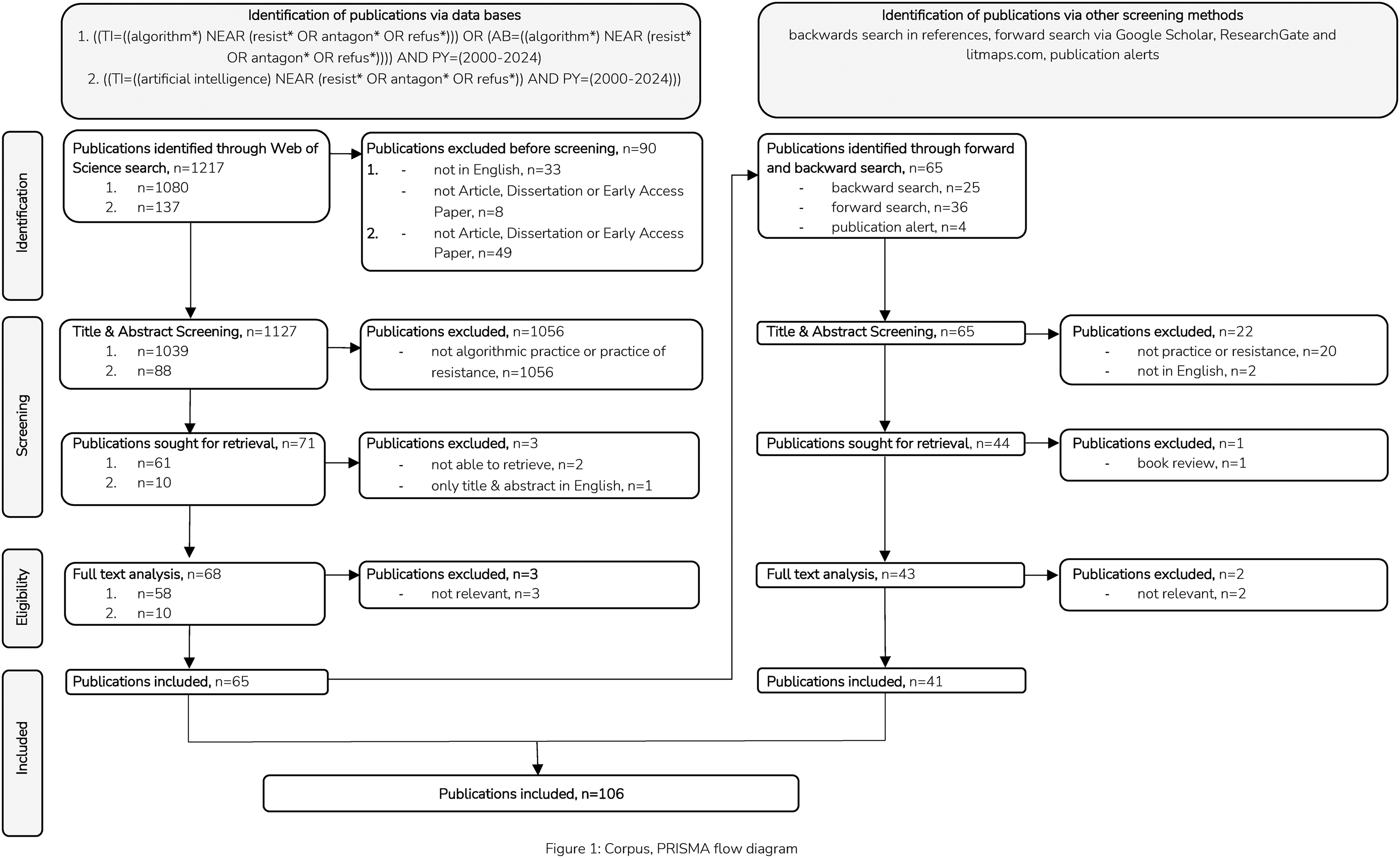
Corpus, PRISMA flow diagram.
Arguably, this approach is flawed in a number of ways. It fails to account for varying terminologies in both technologies (e.g., automated systems) and resistances (e.g., defiance, opposition) and excludes practices that conceptualize regimes of domination (datafication, visibility, labour, capitalism) and their contestations differently (e.g., as ‘People's Practices in the Face of Data Power’, Crooks et al., 2024; or as resisting the ‘data-driven society’, Milan, 2024). However, in attempting to gain a broad (rather than comprehensive) corpus of various ARs, the search strategy provided a potent starting point that was effectively supplemented by the extended screening methods.
Coding and analysis
Items were systematically classified according to their context (based on the disciplinary background of authors and publishing venue), approach (conceptual vs. empirical), methodological choices, and domain of algorithmic application (e.g., recommender systems). Text passages were identified that referred to AR theoretically or described empirical examples. Subsequently, these became subject to an in-depth analysis guided by the research questions and using open coding, identifying practices of resistance, their characteristics, and conditions. Despite this sequentiality, especially during early steps, the coding phase was highly iterative, continuously moving between reviewing items and supplementing or revising codes on the basis of new findings.
However, as conceptual territorializations result from the totality of assembled components rather than singular choices and conditions, analyzing research-machines poses the problem of their comparison. Even if all elements of research-machines are known (which, as described above, was not the case), their influences can only be understood in relation to and through their interactions with all other elements assembled. Yet, adopting the integrative perspective described revealed a kinship across patterns, rhythms, and styles of assemblage. It showcased how related manufacturing processes of AR produce similar outcomes, even despite terminological differences. For example, initial codes such as workers’ tactics and platform gaming were later consolidated into Workers’ Counter-Conduct as shared patterns across labour contexts emerged. Similarly, repair, care, and maintenance initially appeared as separate practices before being recognized as expressions of what was later named Emergent Agencies.
Thus, the analysis revealed genealogical connections that allowed for gathering productions of AR not along terminologies, but along their definition of problem spaces: similar locations, problematizations, agencies, and respective understandings of resistance. These led to the identification of seven clusters of research-machines, each representing an ideal-type of specific territorializations of AR (‘Algorithmic research-machines: Contrasting cases’ section). For example, studies referring to Scott's (1985) notion of everyday resistance, using ethnographic methods, and focusing on creators on social platforms consistently produced AR as embedded opposition rather than overt refusal. The interactions of these elements assembled in the research process defined similar problem spaces that are generative of particular understandings of AR, across vocabularies and without essentializing or limiting practices to specific labels.
Such aggregation, while attempting to account for clusters’ inherent heterogeneity, is necessarily reductive. Items are never entirely representative of one cluster, but frequently span and transgress multiple. Thus, their exemplary classification is to be understood as tentative, as emerging from commonalities in their productions of AR while sustaining difference.
Particular territorializations of problem spaces define the properties of the resistance they produce: whether it is open or clandestine, ephemeral or sustained, seen as unintended or articulated as political intervention. To understand how research-machines produce particular characteristics of AR, subsequent coding was focused on dissecting axes along which these properties manifest (‘Axes of ARs’ section).
Research-machines of algorithmic resistance: Contrasting cases
From activism to appropriation, circuit-breaking to foot-dragging, hijacking to gossiping, manipulating to repairing – the corpus emphasized the multitude of distinct labels for AR enactments. But while all these findings speak of AR, they describe very different practices, from a reluctance to use to organized movements. Beyond the indistinct variety of terms, the analysis revealed similarities within territorializations of problem spaces: compositions of who resisted where and for what reasons. Resistances produced are tied to particular physical or virtual locations (e.g., on- and off-platforms, offices, workplaces, public streets), assemble specific agencies, and are rooted within problematizations. Table 1 summarizes the clusters of research-machines that emerged from the data and maps their shared productions of AR. Clusters were named by aggregation and do not necessarily reflect the terminology used within them, sometimes even contradicting understandings of certain studies. 2
Problem spaces of algorithmic resistance (AR).
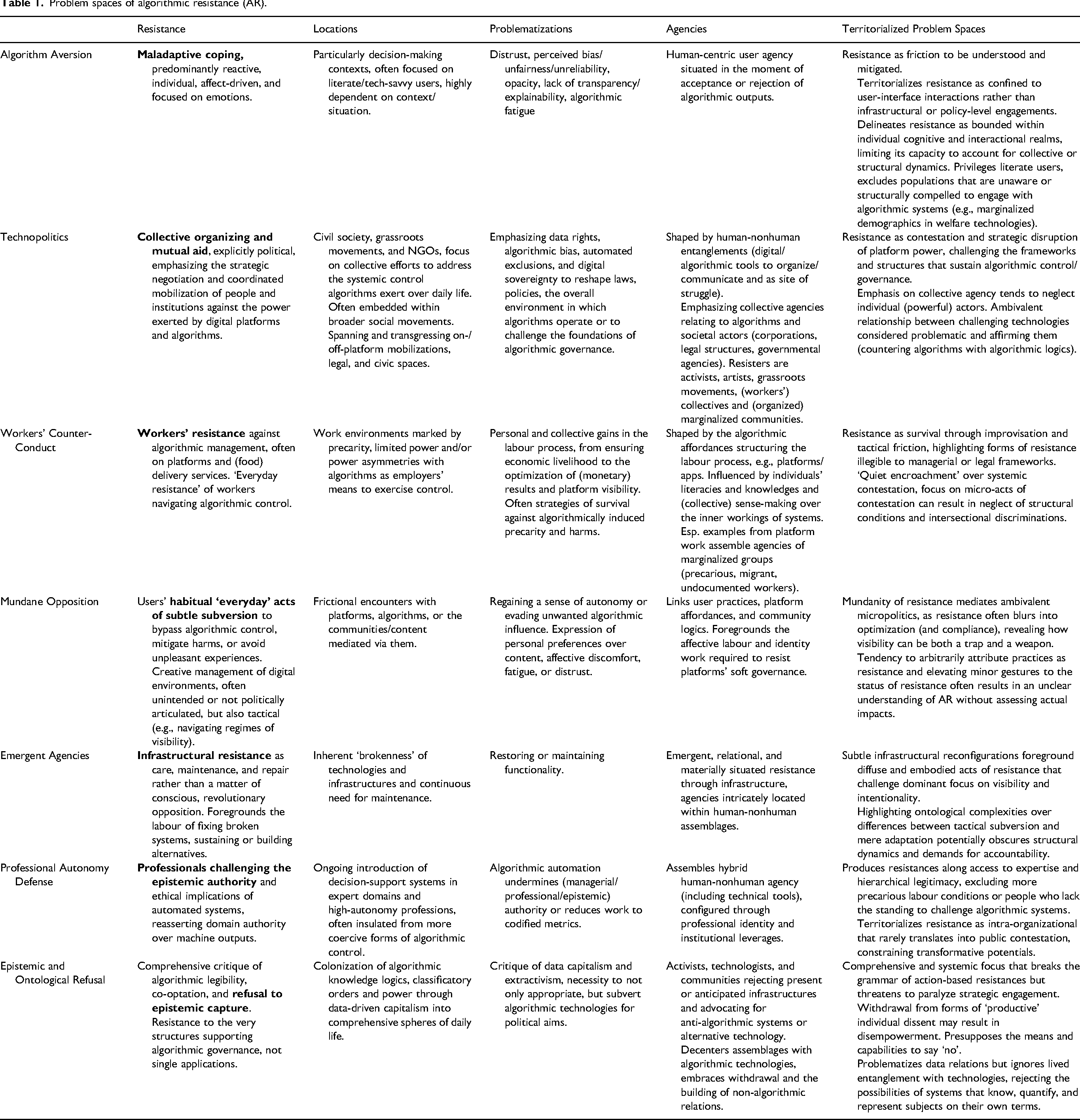
Algorithm Aversion
Aversion-machines focus on AR as users’ expressions of preferences for decision-making in the context of automated systems. Studies in this cluster (e.g., Bankuoru Egala and Liang, 2024; Isaac et al., 2024; Mahmud et al., 2023) construct resistance as a reluctance to adopt algorithmic technologies due to concerns over autonomy, accountability, or unfamiliarity (Dietvorst et al., 2015) as a form of maladaptive coping. Originating in behavioural psychology and technology acceptance research (Davis et al., 1989), these studies follow users’ avoidance of algorithmic recommendations because they perceive them as inaccurate, biased, unfair, or unreliable. They span fields such as (health) information systems research, medical AI, or managerial algorithm aversion, producing resistance mainly as individual and cognitive, structured around questions of attitude and willingness to adopt. AR is thus framed as subtle, cognitive, and affective disengagement from algorithmically mediated processes, positioning agency at the intersection of skepticism, experienced opacity, and a preference for human judgment. While these machines mostly see aversion as a form of resistance, it is sometimes also framed as a passive reaction, contrasting with active forms of AR (Zhang et al., 2024).
For Aversion-machines, resistance is a friction to be understood, factorized (Mahmud et al., 2023), cross-culturally compared (Liu et al., 2023), and ultimately mitigated. Foregrounding professional judgment, risk perception, and trust calibration, they construct AR as an individualized reaction while largely excluding political or collective dimensions. They emphasize human values within specific institutional settings, use cases, or interfaces; however, they remain limited to parameters of usability and acceptance. Grounded in a perspective that seeks to increase efficiency and to allow for ‘better’ decision-making, they enact resistance as human-centric, as a problem to be solved for achieving mutually beneficial human–machine relations.
Technopolitics
Technopolitics-machines explore AR through collective mobilization aimed at contesting digital (platform) power and algorithmic governance. Often embedded within broader political mobilizations (e.g., anti-surveillance campaigns, platform labour organizing, ‘data activism’, Milan and Velden, 2016), such resistance manifests in organized campaigns and legal advocacy through civil society organizations or grassroots movements. It aims to reshape laws, policies, or organizations and emphasizes issues such as data rights, algorithmic bias, digital sovereignty, privacy, and autonomy. Technopolitics-machines construct resistance as a strategic negotiation of power dynamics, wherein various (human and nonhuman) actors disrupt or contest algorithmic decision-making. They assemble agencies as collective and hybrid along the use of technological tools, as embedded in organized actions, and as encompassing institutional actors, legal structures, and corporate and governmental agencies. Localized in movements that span digital platforms and offline actions, they enact AR as political, as practices that challenge conditions sustaining or allowing for algorithmic control.
While Technopolitics encompasses a wide array of practices, their enactments of AR can be further distinguished into subcategories: emphasizing collective struggles against platform power, machines of Algorithmic Solidarity are more likely to be rooted in research on Latin American digital activism or transnational/feminist STS (e.g., Milan, 2015; Yu et al., 2022). These are reflected within conceptions of resistance that centre on mutual aid, networked protests, the formation of horizontal infrastructures of dissent, care, and solidarity as broader movements against extractivism or platform colonialism. By assembling research methods such as participatory design or activist ethnographies, they de-emphasize the role of (formal, hierarchical) organizations. Instead, they highlight mutualism, Indigenous perspectives, intersectional analysis, and communal infrastructures of resistance.
By contrast, Professional Technopolitics can be found in the example of grassroots auditing collectives, networks of activists exposing algorithmic logics (e.g., in hiring, welfare, policing) or arts-based interventions (e.g., Pereira et al., 2022; Wiehn, 2022). While configuring resistances largely similarly, professional approaches often require technical access or literacy and thus preferentially assemble agencies of tech-savvy activists at the cost of broad inclusivity.
Workers’ Counter-Conduct
Algorithmic technologies colonizing workplaces transform the exercise of workplace control (Kellogg et al., 2020). Research-machines of Workers’ Counter-Conduct thus construct resistance as opposition to algorithmic management and the automated enforcement and interpretation of computational metrics. Applied within environments marked by precarity and power asymmetries, algorithmic systems are positioned as means of control and are thus countered with workers’ resistance, for example, through practices of withdrawal, non-compliance, and small acts of sabotage. Examples include Chan's (2021) work on labour control or Arubayi's (2021) study of ride-hailing drivers.
Situated primarily in studies of work, labour, and organizations, these research-machines construct resistances mostly as covert, continuous, and highly adaptive. However, and broadly understood as ‘workers’ attempts to maintain work autonomy and re-claim a sense of control over the labor process’ (Chan, 2021: 7), resistances may also manifest as collective contestations (Kellogg et al., 2020; Novianto, 2024).
Theoretically grounded, for example, in Braverman's (1974) labour process theory and Edwards’ (1979) concept of contested terrain, these studies analyze algorithmic management as the latest iteration of workplace control and position AR as a continuation and reinterpretation of labour struggles. Methodologically, such assemblages rely on ethnographies and (digital) fieldwork, with researchers participating in the work process or within workers’ chat groups (Yu et al., 2022). They foreground precarity and surveillance, and emphasize how workers develop situated knowledges around algorithmic infrastructures and enact tactical agency in the absence of formal protections.
Materially, such resistances are entangled with organizational, physical, and digital infrastructures of workplaces, with workers resisting by manipulating interfaces, slowing down processes, or gaming metrics and systems. As managerial control through algorithms is most clearly and commonly exercised in the gig- or platform economy, numerous studies particularly engage with practices of gig workers, food delivery drivers, or users of freelance platforms (e.g., Arubayi, 2021; Bulut and Yeşilyurt, 2024; Guerra and d’Andréa, 2022; Vasudevan and Chan, 2022). Resistant practices such as refusing certain jobs, altering delivery routes, or using multiple identities are thus intricately entangled with the material affordances of the respective platforms.
Mundane Opposition
Mundane Opposition-machines are documented in the corpus through examples of subtle, non-institutionalized acts of petty defiance on social platforms, within matchmaking systems, or along other forms of algorithmic recommendation. Examples include works on visibility management (Bishop, 2019), algorithmic knowledge practices (Cotter, 2021), or resistance against recommendation algorithms (DeVito et al., 2017). Here, AR results from ordinary users and captures how they challenge or reroute algorithmic influences on their experiences. These machines focus on AR not primarily as politically motivated activism, but as rejection of algorithmic results out of unease, habit, or irrelevance, for example, resulting from a perceived suppression of certain social identities (Karizat et al., 2021). Such resistances are scattered, rhythmic, and deeply entangled with the mundanity of digital life, thus decentering (yet not abandoning) notions of revolutionary or strategic opposition. This frame highlights practices like selective misinterpretation, frictional use, disengagement (Magalhães, 2022), micro-acts of non-compliance, and negotiations to retain self-expression (Chartrand and Duguay, 2025). Here, AR is produced as creatively navigating, managing, and (alternatively) appropriating algorithmically mediated environments, often by making sense of algorithms through concepts such as folk theories (DeVito et al., 2017; Siles et al., 2020) or imaginaries (Bucher, 2017). By capturing AR as an ambient force, woven into the routine of digital life, frequently dismissed or overlooked, yet widespread and sometimes subtly transformative, these machines draw from notions of everyday resistance (Scott, 1985) or mundane tactics of quiet encroachment (Bayat, 2000; de Certeau, 1984).
Mundane Opposition-machines tend to enact inclusion and exclusion fluidly, as nearly all users are seen to engage in some form of everyday resistance. Yet, the meanings, recognitions, and impacts of these acts vary by context. However, and contrary to machines of Workers’ Counter-Conduct, the regimes to which their resistances relate are usually less oppressive, determined less by external necessity, and thus characterized by a somewhat voluntary subordination. Typically constructed as individual or only loosely collective, as uncoordinated and lacking self-perception as resistance, these resistances' visibility is extremely low or covert. However, their material outcomes may cumulatively distort infrastructures and steadily alter the constantly evolving relations between users and platforms. While rarely framed as resistance by users themselves, AR is produced when mundane practices become assembled through research. Researchers thus affect the production of resistance in this cluster even more than within the machines discussed so far.
Alongside everyday users of platforms, it is especially influencers, creators, and marginalized communities whose actions are rendered resistant through this machine (Bishop, 2019; Cotter, 2021). Their tactics particularly include ‘playing the algorithm’, gossiping over functions, ironic subversion, or resigning from platforms. In these studies, often conducted as ethnographies of communities, platforms, or interfaces, the affective labour and the identity work required to counteract soft governance and regimes of visibility are highlighted and entangled with the specific logics of online communities and platform affordances.
Emergent Agencies
Rooted in STS, feminist HCI, and design justice approaches, these research-machines conceptualize AR not as a matter of overt refusal or politically articulated opposition, but as situationally emergent, relational, and material (e.g., Ettlinger, 2018; Qadri and D’Ignazio, 2022; Velkova and Kaun, 2021). Critiquing peripheral and detached notions of resistance, these studies see AR as entangled, as co-produced within heterogeneous assemblages of humans, algorithms, devices, and social structures (Ettlinger, 2018). Within a vocabulary of resistance as practices of care, maintenance, and repair, these machines foreground the labour of fixing broken systems by addressing and mitigating algorithmic harms (Velkova and Kaun, 2021). AR is emphasized as sustained engagement, through and along infrastructures, that results in mutual recalibrations of all elements involved, even when unintentional. Drawing particularly from Foucault's (e.g., 1982) late scholarship, these machines highlight a making-use-of rather than the rejection of digital environments and emphasize productive, cyborg forms of resistance that blur classifications through their simultaneous complicity and opposition (Ettlinger, 2018; Siles et al., 2023).
Machines of Emergent Agencies depart from binaries of power and opposition and offer a perspective on resistance where agency is not portrayed as something that is possessed in advance, but as arising through ongoing, situated practice. Such agencies are highly relational, as they do not reside in users or systems, but emerge through contextual human–nonhuman entanglements. Drawing from notions of inherently broken systems and a continuous demand for their stabilization (Graham, 2010; Jackson, 2014), these machines construct resistances as a creative, reparative practice. As affirmative politics of sustaining alternatives and rethinking infrastructure as a site of struggle, AR emerges as modest, slow, and long-term oriented. Primarily territorialized as ambiguous or ambient, as occurring through mundane interfaces and within daily routines, it departs from a focus on visibility and intentionality strongly emphasized by other research-machines.
Professional Autonomy Defense
Professional Autonomy Defense-machines produce AR as centred on individuals in expert roles and as resulting from frictional relations between institutional and organizational logics, professional ethics, accountability norms, and discretionary judgment (e.g., Hanemaayer, 2021; Jussupow et al., 2022).
AR is portrayed as a struggle over professional epistemic authority that is challenged by automated systems and their ethical implications. It is framed as an attempt to maintain discretion often found within scientific, educational, medical, legal, managerial, and other domains, as the protection of expert legitimacy from algorithmic disruptions (e.g., Christin, 2017). Thus, such machines produce resistances as highly intentional and grounded in (privileged) socio-organizational roles, often leveraging bureaucratic opacity or processual friction. Practices involve subtly ignoring, modifying, or overriding recommendations, with resisters drawing from collective professional norms and ethics to justify their actions. Resistances are inherently embedded, enabled, and constrained within their organizational context and thus assembled in relation to the respective organizational or professional communities.
Because they configure agencies along professional identities and their institutional positions, they privilege actors with access to decision-making positions or credibility within their fields. Thus, while addressing resistance in workplaces, these research-machines neglect workers lacking the standing or opportunities to challenge algorithmic systems and their outputs (e.g., gig- or frontline workers described in by Workers’ Counter-Conduct-machines).
Epistemic and Ontological Refusal
Prominent within critical data studies, post/decolonial media theory, and feminist technoscience, these machines conceptualize resistance not merely as opposition, but as outright refusal: as rejection of the epistemic and ontological terms upon which systems operate (e.g., Ganesh and Moss, 2022; McQuillan, 2022). Here, resistance is situated within a critique of data capitalism, with practices ranging from critical stances toward algorithmic systems to their abolition: non-participating, challenging systems’ terms of legibility, rejecting algorithmic epistemologies, and advocating for a return to pre-algorithmic, human-centred forms of interaction and governance. Such resistance rejects the co-optation into algorithmic logics and instead seeks to unsettle dominant algorithmic knowledge regimes (Jarke et al., 2024) and their capitalist embedding. These machines emphasize struggles not merely against individual applications, but instead oppose wider algorithmic knowledge projects (Ganesh and Moss, 2022): the material and epistemic foundations that support present-day algorithmic infrastructures, their classifications, truths, and legitimacies.
Invoked through theoretical analysis, critique, and speculative advocacy for action, the AR these machines speak of is produced primarily through scholarly debate rather than empirical studies. While providing blueprints for practices, interrogating and disrupting demands for their visibility, legibility, and thus what counts as resistance, their practical examples remain largely conceptual. Moreover, such resistance presupposes the ability to say ‘no’, a capacity particularly constrained for marginalized or vulnerable groups, who often lack both meaningful choice among technologies and any real option to refuse them.
Axes of algorithmic resistance
While clustering research-machines maps shared agencies, locations, and problematizations into a terrain of conceptualizations, it leaves unaddressed how this territorialization affects the properties of AR produced: whether it appears as deliberate or habitual, visible or covert, ephemeral or sustained. Thus, plotting features along specific axes provides a topography: a representation of the properties that make up the landscape of ARs. Through iterative comparison of how different clusters characterized resistance, for example, by asking whether it was conscious or habitual, individual or collective, visible or hidden, six dimensions repeatedly emerged as sites of difference. These became the analytical axes partitioning the topographic spaces of conceptual territorializations that allowed for their comparison: intentionality, scale, visibility, materiality (is resistance symbolic or infrastructural?), temporality (is it episodic or sustained?), and relationality (how are human and nonhuman agencies configured?). Depending on the variety of situated practices produced, resistances may map to a single point on an axis or span across dimensional spaces on it (see Table 2).
Topography of algorithmic resistances (ARs).
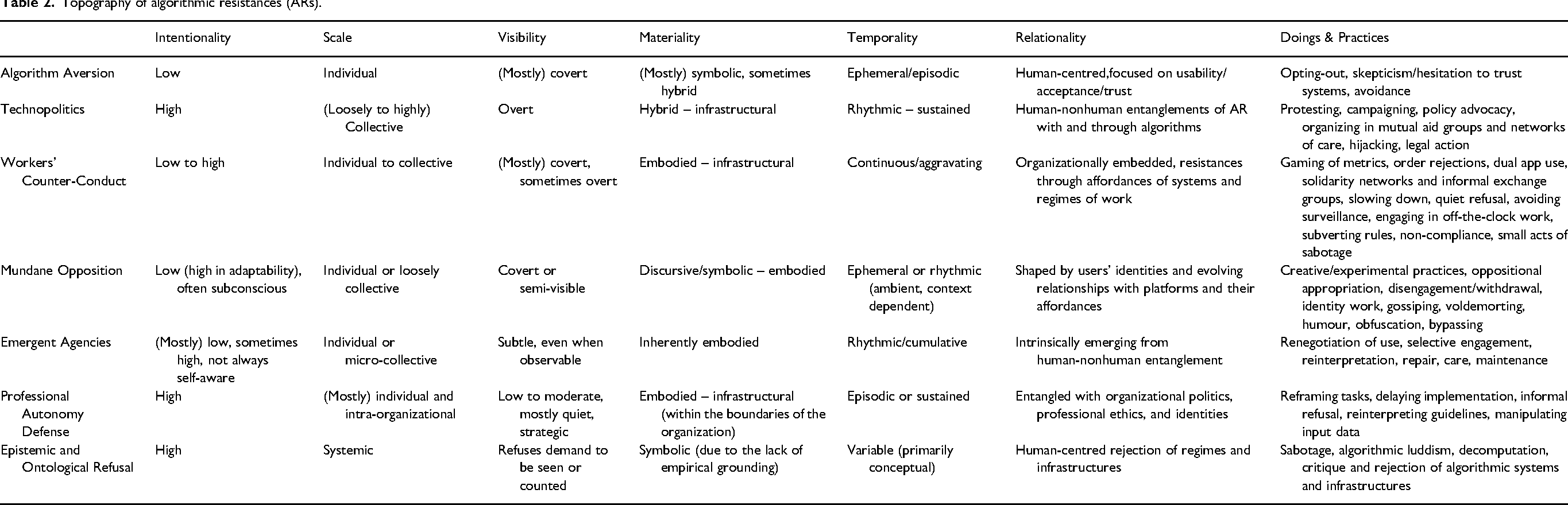
As with the selection of clusters, the identification of axes, too, is not to be confused with an immutable taxonomy or a comprehensive set of dimensions. Rather, axes are a heuristic, highlighting the differences between resistances produced in particularly meaningful ways by mapping their intensities and silences across spectra of possibility. Such topography is never complete, but offers a different perspective on a phenomenon (that may always be expanded).
Foregrounding surface features, this topographical account is exclusively concerned with how territorialized outputs of research-machines shape understandings of resistances along axes of possibilities. For example, regarding intentionality, the rationale for a specific oppositional action could be located in either affective or consciously perceived frictions of algorithmic applications and thus arise from lived precarity or conscious convictions. But assembled through a specific machine, certain ways of knowing and doing resistances are inevitably privileged over others, rendering intentionality in a specific sense (e.g., as conscious or habitual) and thus along particular dimensional spaces.
Intentionality
Intentionality describes the degree to which resistance is produced either as a conscious, deliberate act of opposition or as a habitual, affective reaction. Capturing whether resistance is rendered as an active choice or as a byproduct of routine engagement in algorithmic systems, it fundamentally relates to the ways in which (and for whom) research-machines assemble agencies. Intentionality thus varies across machines that privilege strategic actors and those acknowledging ambivalence and unconscious tactics. Frequently, it relates to requirements of knowledges, literacies, and expertise to distinguish high- from low-intentional resistances. For example, Mundane Opposition highlights resistance primarily as tactical coping rather than premeditated action (as found in Professional Autonomy Defense).
Scale
Resistance is produced at different levels, from individual actions to global movements. This axis considers whether practices are localized in individual refusal, group-based coordination, or systemic/infrastructural transformations and whether they are spontaneous, synchronized, tactical or strategic. Examples of Algorithm Aversion and Mundane Opposition occur primarily at the individual level, as acts of avoidance, rejection, or reinterpretation within personal decision-making spaces. In contrast, Technopolitics moves resistances into collective realms through coordinated campaigns, policy interventions, and global networks of activists. Professional Autonomy Defense typically scales to the organizational level, with pockets of coordination across professional networks or institutions. Scale is prefigured by the assembled agencies of the respective resisters and reflects what constellation of elements is given the capacity to resist (individuals, groups, movements).
Visibility
Resistance can be spectacular and overt (e.g., protests, strikes, campaigns), visible but subtle, or covert, taking forms that escape platform and public detection. While the repair work described in Emergent Agencies is often only produced through careful in-depth investigation, visibility is central to Technopolitics and part of its repertoire to amplify and network resistances. On the other hand, resistances in Professional Autonomy Defense are usually discreet, enacted through bureaucratic maneuvers or interpretive latitude, rather than overt confrontation. Visibility thus also reveals machines’ micropolitics of recognition: What counts as real resistance is not just determined by who is resisting, but also depends on who is watching and what means of making visible (e.g., research methods) are available to them. Furthermore, visibility can be described as a strategic trait: platform workers’ resistances often necessarily remain illegible to platform metrics. While being plotted and shared within clandestine solidarity networks or off-platform spaces, they intentionally reject visibility due to vulnerability.
Materiality
Spanning from discursive interventions to infrastructural dismantling, this axis distinguishes material, embodied doings from symbolic critique, though these often overlap into hybrid assemblages; it refers to the extent and scale to which resistances are assembled from symbols, discourses, physical acts, bodies, technologies, and infrastructures. Emergent Agencies-machines foreground the embodied, infrastructural labour of repair and care, the material practice of correcting flawed systems through interventions or the creation of alternatives. Mundane Opposition engages with tools, apps, and algorithmic materialities as sites of struggle, but can also take symbolic forms (e.g., aesthetics and discursive framings). By contrast, Epistemic and Ontological Refusals operate mainly in symbolic or discursive terrains, resisting the classification of systems and logics of algorithmic governance (at least when not calling for their outright destruction). Materiality is a relevant vantage point for the effects of resistances: As interactions shape, construct, and modify algorithmic systems, resistance can become materially inscribed into them, making them sites of reconfiguration rather than mere negation. This is not restricted to material practices: While resistances can be predominantly symbolic (e.g., advocating for fairer systems), they can shape technological trajectories and thus manifest tangible material consequences.
Temporality
AR is a matter of temporal dynamics, of rhythm and duration. Mundane Opposition and Algorithm Aversion tend to be episodic or ephemeral, linked to specific contexts or moments of friction, while the aversion itself may be sustained as ambient rejection. Professionals’ resistances and those produced within machines of Emergent Agencies are embedded in ongoing negotiations and recurring cycles of decision-making (rather than singular acts), enacting resistances as rhythmic. These modes reveal how resistance becomes part of routine interactions with systems (and their operations) without necessarily being fully oppositional. However, effects may be cumulative, result in outright breakdown or refusal, and thus transform resistances over time. At the other end of the spectrum, Technopolitics supports resistance sometimes as rhythmic (occasionally ignited), but primarily as sustained, sometimes spanning years of campaigning and lobbying.
Relationality
While Materiality reflects material-semiotic questions of resistances, relationality delineates how resistance is configured in relation to (human, technical, institutional) actors and their agencies. For example, Algorithm Aversion-machines explore the technological factors that spark AR, but their resistances remain centred on human experiences and situated in individual cognition. In contrast, Emergent Agencies’ resistances mobilize nonhuman actors as co-constitutive entities, including sensors, interfaces, apps, data, and algorithms themselves. Technopolitics highlights the interdependencies between activists, policy makers, infrastructures, and technological affordances. Both Workers’ Counter-Conduct and Professional Autonomy Defense-machines are relational in a hierarchical sense: their human-nonhuman entanglements occur within power asymmetries structured by their institutional/organizational context. However, while the former focuses on AR in relation to affordances of technologies and work regimes, the latter emphasizes professional ethics and identities.
Discussion: Toward a topography of research-machines’ micropolitics
The integrative map of research-machines and the topography of properties presented do not merely reiterate a multiplicity of practices, but make visible the diverse configurations through which AR is understood, mobilized, and legitimized. Given the impossibility of comparing the various enactments of AR, this review has attempted to order them along their research-machines’ productions. Rather than a taxonomy, this provides shared coordinates for the generative representation of tendencies, intensities, silences, and possibilities of scholarship on AR.
Expressing specific configurations of elements, each cluster mediates micropolitics and thus territorializes problem spaces in certain ways: While Algorithm Aversion foregrounds rational, individual actors, it marginalizes systemic critique or collective resistances; while Mundane Opposition brings to attention those everyday acts of resistance that often evade powerful (algorithmic) gazes, its focus on micro-interactions may disregard their political intentions as expressions of needs for systemic alternatives. Professional Autonomy Defense-machines illustrate algorithmically contested autonomy, yet are restricted to the struggles of somewhat privileged workers and thus offer limited transferability (e.g., into the context of more precarious workplaces). These divergent territorializations produce analytical frictions, revealing how the same practices are constituted differently: Ascribing resistant characteristics through one machine may be perceived as naïve compliance or affirmation of algorithmic exploitation by others. Crediting resistance to unaware resisters might be seen as an initial point of opposition by some, but dismissed as researchers’ projection of desirable results by others. Micro-acts of disengagement may be one machine's source of upheaval, but be considered compliance with algorithmic exploitation by another.
As research-machines territorialize understandings, they negotiate what resistances become possible, legible, or effective in different (disciplinary, domain-, and approach-specific) worlds. Resemblances in terminology produce different meanings: While practices of avoidance are prominent both in Mundane Opposition and Workers’ Counter-Conduct-machines, it is the conditions of algorithmic management in a terrain of economic pressure (as territorialized by the latter machine) that make a difference to experiences, possibilities, and manifestations of resistance. Likewise, both Workers’ Counter-Conduct and Emergent Agencies can revolve around scenarios in the workplace. However, only machines of Professional Autonomy Defense assemble relations (e.g., professional ethics in high-skilled workplaces) that emphasize resisters’ struggle for epistemic authority.
These frictions are analytically rich moments, underlining how research-machines’ various elements intertwine to result in specific territorializations that do not simply document resistant practices, but produce distinct versions of AR. This not only seeks to account for multiplicity, but to reflect upon assemblages’ consequential expressions of disciplinary habits, conventions, logics, and aims, while recognizing the various capacities of specific elements in AR's production. Instead of claiming to resolve (and thus suppress) the productive tensions between approaches, it makes visible the conditions of fragmentation and offers researchers coordinates for situating their own work within a wider landscape.
Studies simultaneously enact machinic clusters in various intensities, in hybrid, overlapping, and intersecting ways: Workers’ Counter-Conduct may also be described as practices of repair (Qadri and D’Ignazio, 2022) or become combined with Technopolitics, highlighting how disagreements with algorithmic management become articulated as broader movements (Bulut and Yeşilyurt, 2024). Algorithm Aversion may be entangled with Professional Autonomy Defense (Bankuoru Egala and Liang, 2024). Thus, while patterns of similarity are evident (e.g., both Workers’ Counter-Conduct and Mundane Opposition emphasize covert tactics), they are never discrete containers, but rather transversal formations available for (re)combination. Taxonomies of AR attempt to synthesize various clusters within unified ways of perception, but inevitably exclude others, grasping only fragments of larger discussions as confined within the (disciplinary) boundaries of their research-machines (e.g., Bonini and Treré, 2024; Milan, 2024).
Beyond portraying AR's productions through agencies, locations, and problematizations, the six axes highlight how machinic territorializations shape properties, activating some dimensional spectra while muting others. They not only illuminate what is made visible, but also reveal what is excluded and rendered unintelligible within particular clusters of research-machines. Technopolitics, for example, is produced as necessarily overt, while Mundane Opposition mainly (and often unintentionally) appears as covert or semi-visible. Considering relationality, resistances produced by Epistemic and Ontological Refusal reject the use of platform affordances which are foundational within Emergent Agencies. Thus, axes serve as analytical tools for comparing across differences, revealing patterns and tendencies while avoiding immutable taxonomies.
While the choice of research-machines discussed here results from frequencies in the corpus, the heuristic presented invites the identification of further machines or other ways of aggregation. This could also reflect upon the exclusions and shortcomings of the approach presented here, which specifically centred on occurrences of the term resistance. For example, gaining critical literacies of algorithmic systems may shape perceptions of their threats and inspire acts of resistance while not being explicitly articulated as a practice of dissidence (and is therefore not considered here, for example, Kozyreva et al., 2023; Low et al., 2023).
Similarly, the axes deduced are not static coordinates, but dynamic, generative points of perception along which different understandings of AR unfold. While future productions of AR or their investigation may map to existing spaces or inhabit new points on existing axes, they might also lead to new ways of sense-making along additional dimensional vantage points.
The reflexive stance advocated here demands that the research-machines lens be turned on this review itself, acknowledging how several constitutive choices territorialize its outputs. Most consequentially, anchoring data collection on the English-language term resistance drew in scholarship that explicitly names its object as such while rendering invisible work that conceptualizes contestation through other vocabularies or within entirely different problem spaces (e.g., struggles against datafication or digital colonialism). Relying exclusively on peer-reviewed publications reifies boundaries between (predominantly) Global North academic ‘knowledge about resistance’ and situated ‘resistant knowledge’ produced by activists, artists, or communities.
However, insisting that research-machines are constituted by other defining elements illustrates not only the perspective's broader analytical potential, but also how it exceeds the reach of the literature review pursued here. For example, the concentration of AR scholarship around certain topics is not coincidental but reflects where research funding, theoretical vocabularies, and methodological approaches are available. Political economies of scholarly reception and researchers’ own positionalities further configure problem spaces before a study begins. Operating through textual analysis of published outputs rather than ethnographic engagement with research practices means that the micropolitics diagnosed are only accessible in their effects, but not directly in their making. Thus, the analysis presented here provides an overview of a terrain of problem spaces, coordinates for cross-disciplinary comparison, and a diagnostic tool for situating research beyond the scope of a conventional literature review. Simultaneously, it points toward the need to complement these findings with in-depth studies of research practices, funding structures, review processes, or incentives. Such investigations could follow how research-machines are assembled in situ, how approaches, compromises, and exclusions are negotiated, and how specific enactments of AR solidify within concrete academic and organizational settings. Other studies might trace circulation patterns or reception dynamics (e.g., through citation network analysis) to further examine micropolitical aspects of the socio-scientific productions of AR.
Conclusion: Reassembling algorithmic resistance
This review has mapped the multiple problem spaces of AR scholarship that unfold across a growing and increasingly differentiated interdisciplinary landscape. It emphasizes how conceptual understandings of AR are produced and territorialized by research-machines comprising researchers, tools, concepts, disciplines, and institutions.
The review's contributions are twofold: First, the integrative approach offers a novel perspective that maps how, why, where, and for whom ARs are produced. The analysis of such productions along their properties identified six dimensions that allowed for their comparison and grouping, often across methodological, theoretical, and disciplinary differences. Providing shared coordinates, this topography seeks to enable approaches within different traditions to locate their contributions relative to one another and to turn fragmentation into a navigable landscape.
Second, the conceptual understanding of research-machines sensitizes to knowledge practices as sites at which the conditions and capacities of resistance to algorithmic power are constituted and configured. Instead of classifying resistant practices into types, this asks how any such classification comes into being and what its adoption makes (im)possible. This perspective does not propose a new definition of AR or compete with existing typologies but offers coordinates for examining research-machines’ affordances and limitations: how the micropolitics of research territorialize resistant agencies, locations, and problematizations, and how they shape the ways in which AR is imagined and made real. What counts as resistance, which practices become visible or legitimate, which are neutralized or remain obscured, and whether they are framed as political, subtle, or (in)effective depends on the constituent relations of methodologies, theories, researchers, and tools. While machines are singular, their integrative review has revealed patterns and intensities that empirically manifest as ideal-type productions of ARs, from maladaptive coping to thorough refusal.
Yet, instead of critiquing studies’ inevitable territorializations (and their respective omissions), this perspective seeks to reassemble. Recognizing research as machinic encourages reflection on research practices and their perpetuation of specific logics and understandings: What kinds of resistance do our research-machines make possible? What relations do they draw into assemblages, which do they exclude? It provides the axes identified here as shared coordinates for cross-disciplinary comparison, enabling scholars working within different machines to identify where their productions converge and diverge. And it surfaces normative stakes: recognizing, for example, that a machine producing resistance only as individual and cognitive quietly places structural transformation outside the scope of contestation. This has concrete consequences for how algorithmic power is studied, as it invites researchers to question how choices of methods, participants, or theoretical framings make certain forms of resistance (il)legible. Such a perspective is necessary precisely because the growing diversity of AR scholarship risks naturalizing the particular visions each approach produces by treating its outputs as descriptions of resistance rather than as constitutive of what resistance can mean.
Rather than merely outlining existing trajectories, this review (and the machine through which it was produced) thus attempts to inspire intervention in the making of ARs: to think resistances otherwise, to complicate binaries of domination and opposition, and to stay with the frictional tensions that animate algorithmic life.
However, the review has not engaged with wider questions of resistance: for example, its relationship to power/domination, its embeddedness within specific economic, political, or organizational conditions, or its relation to other forms of resistance and their analytical frameworks (see the ongoing discussions within ‘resistance studies’, e.g., Baaz et al., 2018). Furthermore, focusing on conceptual territorializations within academic research has neglected broader sources and accounts of AR, for example, emerging from activist and artistic practices, as well as their effect on wider public discourses. These remain crucial areas for future work to complement the conceptual mapping provided here.
What we define as resistance will never be definite, as claiming ultimate demarcations would be an act of hegemonic epistemic ambition (likely to be met with resistance, Baaz et al., 2018: 36). However, asking what resistances our own research-machines enact, exclude, highlight, neglect, and whose voices they amplify and mute, can guide reflexive understandings of our own situatedness and inspire us to reassemble. It is a call to resist resistances by intervening in the very knowledge formations through which algorithmic power (and its contestation) is made intelligible. Doing so means turning to ontologically attentive, politically engaged, and creatively experimental research practices.
Supplemental Material
sj-docx-1-bds-10.1177_20539517261458302 - Supplemental material for (Re)assembling algorithmic resistance: An integrative review of research-machines
Supplemental material, sj-docx-1-bds-10.1177_20539517261458302 for (Re)assembling algorithmic resistance: An integrative review of research-machines by Thomas Zenkl in Big Data & Society
Footnotes
Acknowledgements
The author receives a netidee.at scholarship (scholarship no.: 6194) and acknowledges the financial support from the University of Graz.

Ethical approval
No ethical approval was necessary.
Funding
The author received the following financial support for the research, authorship, and/or publication of this article: This article was supported by the University of Graz to cover the APCs.
Declaration of conflicting interests
The author declared no potential conflicts of interest with respect to the research, authorship, and/or publication of this article.
Data availability statement
Full list of reviewed items is available in the supplemental materials.
Supplemental material
Supplemental material for this article is available online.
Notes
References
Supplementary Material
Please find the following supplemental material available below.
For Open Access articles published under a Creative Commons License, all supplemental material carries the same license as the article it is associated with.
For non-Open Access articles published, all supplemental material carries a non-exclusive license, and permission requests for re-use of supplemental material or any part of supplemental material shall be sent directly to the copyright owner as specified in the copyright notice associated with the article.
