






Abstract
This article explores how the rise of Go AI systems has redefined the expertise and professional roles of human players in the Go community. Historically, professional Go players held jurisdiction over two key tasks: demonstrating ideal gameplay and interpreting games, which are all challenged by the arrival of Go AI since 2016. Drawing on Andrew Abbott's theory of jurisdiction and Gil Eyal's network model of expertise, this article argues that the integration of Go AI did not fully replace human Go experts, but reconfigured their role from knowledge authorities to interpreters of AI outcomes. The scope and content of Go professional's work have changed in response to Go AI's challenge. Meanwhile, the sociotechnical networks that sustain Go AI are selectively displayed to enable the performance of expertise regarding two tasks. The insights from Go community will serve as an early case for other realm where AI exceeds the capabilities of human experts.
Keywords
Introduction
East Asian societies have long regarded mastering the strategy and art of the ancient game of Go as a pinnacle of human intellectual achievement (Moskowitz, 2013). Mastering Go has also long been regarded as a “grand challenge” for AI, due to its vast computational complexity—with more potential board positions than atoms in the observable universe (Tromp, 2016). The cultural significance of Go in East Asian societies is profound. An international community of millions of players, televised tournaments, and thriving clubs in schools and local communities make Go a prominent feature of many people's lives. Go is not merely a pastime but a highly institutionalized profession in East Asia, governed by national associations that traditionally maintained a rigid monopoly over elite gameplay and professional certification. In March 2016, AlphaGo—an artificial intelligence (AI) system developed by Google's DeepMind—unexpectedly defeated Go grandmaster Lee Sedol. Hundreds of millions of people watched the five-game match. AlphaGo's victory (4 games to 1) marked the end of an era in which the world's best “players” were human Go grandmasters. Today, no human can defeat a top Go AI.
The introduction of Go AI offers an excellent opportunity for examining how the human community adjusts when AI demonstrably and decisively surpasses the world's most accomplished humans at a culturally valued task. Since the challenge match, Go AI has been integrated into various well-institutionalized Go community practices, including training players, analyzing games, planning strategy, and preventing “cheating” (i.e. unauthorized, unacknowledged guidance during the game; Egri-Nagy and Törmänen, 2020). Examining Go AI provides an opportunity for an early look at the dynamic adjustments that accompanied the introduction of AI systems that surpass what humans can achieve. It also informs the current debate on AI's impact on work, and on reconfigurations of tasks and professional authority might occur in other domains as powerful algorithms are introduced. While the Go case no doubt has unusual and even unique characteristics, it may shed light on other situations in which AI exceeds human capacities—a development that many observers expect to arise in many domains. The speed and unambiguous nature of the change make Go an especially promising early case for social analysis of issues that are likely to reach far beyond Go. Admittedly, Go represents a “closed system”—a domain of computational expertise defined by a finite board and stable rules, distinct from the “open” systems of medicine or law where high-stakes social variables are ever-present. Yet, it is precisely this structured nature that allowed AI to achieve an incontestable superiority, turning Go into a unique “laboratory” for observing professional reconfiguration in its most extreme and unambiguous form. 1
Therefore, this article asks: Did the introduction of Go AI reallocate the epistemic authority to interpret Go strategy and provide real-time analysis of games? How were professional jurisdictions and tasks reconfigured in the wake of Go AI? What new tasks were created, and who captured jurisdiction over them? What kinds of new arrangements emerged to enable Go AI to perform tasks previously performed by professional experts? Did Go professionals lose their status as professionals, and if not, how did they preserve it?
Such questions speak to fields like studies of AI policy and practice, critical data studies (Boyd and Crawford, 2012; Iliadis and Russo, 2016), and science and technology studies (STS) (Vertesi and Ribes, 2019). As actors integrate AI systems into extant modes of performing work, established practices may be adjusted or disrupted, changing the division of labor, requiring humans to develop new skills, transforming the performance of expertise, and raising ethical questions that society and regulated professions must navigate (Flood and Robb, 2018; Susskind and Susskind, 2022; Wexler and Oberlander, 2023). These developments have the potential to challenge our understanding of the landscape of professions and raise questions about professional responsibility and liability, and how we perceive expertise, authority, and knowledge. 2
This article examines changes in Go community practices accompanying the introduction of Go AI during the 9 years since the AlphaGo challenge match, focusing on changes in the nature of work and the performance of expertise. The analytic approach is to compare two ways of looking at these changes: Andrew Abbott's theory of contested professional jurisdictions (Abbott, 1981, 1988) and Gil Eyal's network model of expertise (Eyal, 2010, 2013; Eyal and Pok, 2011). After introducing theoretical frameworks and briefly describing methods, I systematically compare Go community practices before and after the introduction of Go AI. The article argues that Go professional was not fully replaced by Go AI, but the scope of the Go professional's work and the content of that work changed. An extensive sociotechnical network that supports the performance of Go AI was created, part of which are selectively displayed in performing tasks in Go community.
Professional jurisdictions and algorithmic expertise
Andrew Abbott's (1988) system theory of professions provides a seminal framework for understanding the social dynamics and power relations surrounding expert occupational groups. Unlike earlier sociologists of profession who focused on the process of “professionalization,” (Freidson, 1972), Abbott explicitly rejects the professionalization thesis as a fixed sequence of developmental traits or a linear path toward monopoly. Instead, he conceptualizes professions as dynamic actors competing within an interrelated “system” to control jurisdictions over specific tasks. For Abbott, the primary means in these jurisdictional struggles is the balance between abstraction and practice, the ability of a profession to link its practical activities to an overarching system of abstract knowledge. He also highlights how external shocks, such as technological innovations, can generate “jurisdictional vacancies” or shifts by creating new tasks or rendering old ones obsolete.
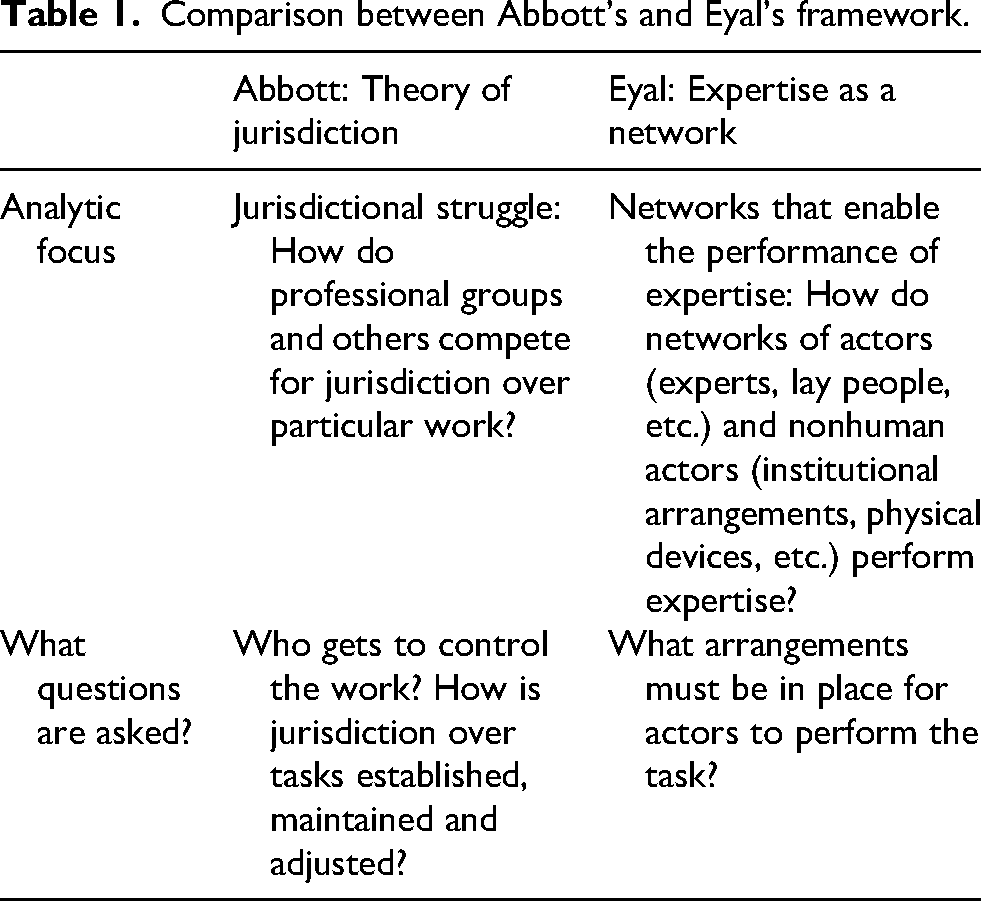
A major critique of Abbott and the broader sociology of professions (such as Freidson, 1972; Johnson, 1972; Larson, 1977) are the focus on formal abstractions, monopoly, and jurisdictions, rather than the spreading of expertise in a network of relations allowing others access to it, recognize and acknowledge it, and even adopt it (Collins and Evans, 2007; Eyal and Pok, 2015). Eyal (2013) proposes shifting from sociology of professions to a sociology of expertise, separating two modes of analysis. One focuses on experts and includes the classic topics in the sociology of professions: credentialing, licensing, jurisdictional struggles, etc. The other concerns expertise, which is regarded as a network “linking together agents, devices, concepts, and institutional and spatial arrangements” (Eyal, 2013) in a manner consistent with actor-network theory (Latour, 1987). Table 1 summarizes differences in the analytic focus of each framework. Abbott's questions center on the control of work and the practices that establish and reproduce control. Eyal focuses on how expertise is performed, analyzing the networks of lay people, institutional arrangements, and nonhuman actors that enable expertise to be performed.
Comparison between Abbott's and Eyal's framework.
Recent scholarship in the sociology of algorithms has moved beyond the simple replacement thesis to explore the nuanced reconfiguration of professional tasks (Christin, 2017; Faulconbridge et al., 2024). This shift is characterized by what Faulconbridge (2025) terms “mediated evolution,” where professionals accommodate machine learning algorithms within existing institutional logics rather than being displaced by them. In domains ranging from web journalism and criminal justice (Christin, 2017, 2020) to big data surveillance and policing (Brayne, 2017; Brayne and Christin, 2021), professional groups engage in a strategic “taming” of algorithms to protect their jurisdictional boundaries. A central challenge in this evolution is the inherent opacity of machine learning algorithms (Burrell, 2016). This opacity—often compounded by corporate secrecy and algorithmic illiteracy (Ananny and Crawford, 2018; Diakopoulos, 2014)—creates a state of “seeing without knowing,” where professionals must manage the “imaginaries of omniscience” (Suchman, 2023) that surround automated systems. In critical domains like medical diagnosis or high-frequency trading, professionals navigate “epistemic friction” by either resisting black-box outputs or performing “repair work” to align algorithmic similarity with human categories of judgment (Lange et al., 2024; Lebovitz et al., 2022; Sachs, 2020). In domains characterized by high algorithmic opacity, professionals often transition from primary knowledge producers to “knowledge brokers” or translators who interpret automated outputs for lay audiences (Lebovitz et al., 2022; Waardenburg et al., 2021). Professionals fill this void by acting as intermediaries, effectively absorbing the algorithm's authority into their own professional judgment (Avnoon and Eyal, 2025; Pullen-Blasnik et al., 2024).
Methodology
This research adopts a qualitative case study approach, including 12 months of multisited fieldwork in Asian Go communities and 44 semistructured interviews conducted between 2022 and 2024. The primary data consists of 44 interviews (Table 2) with stakeholders in the Go community, selected through snowball sampling.
Details of interview.

Complementing these interviews, I conducted ethnographic observations at major international tournaments, most notably the Wu Qingyuan Cup World Women's Go Open Tournament in Fuzhou (August 2022). Based on this material, this article attempts to answer: How did AlphaGo reshape the professional landscape of institutionalized Go in Asia, and what rearrangements of the Go network of expertise have emerged?
Before Go AI
Go has a history of over a thousand years in East Asia, with professional players emerging centuries ago. In Edo-period Japan (1601–1868), the Tokugawa shogunate financially supported Go professionals, who played before the shogun to demonstrate their Go skill (Smith, 1908). This traditional patronage system transitioned into a modern professionalized structure in the late twentieth century, characterized by the rise of prestigious international championships. Today, independent national associations—such as the Chinese Go Association and the Korea Baduk Association—administer separate certification systems and domestic rankings. Professionals compete in top tournaments for significant prizes and earn income through commentary, teaching, analysis, theory development, and writing instructional books. These tasks require skills beyond gameplay, such as the ability to explain games in a language comprehensible to amateur players, teaching, and a range of other related tasks. Go professionals operate as top players, producers of knowledge and theory, and teachers and interpreters.
Go professionals are certified through rigorous qualification systems managed by national or regional Go associations, such as the Chinese Go Association. Successful competition in high-level tournaments, organized by the Chinese Go Association, is the only way to become a professional player in China. The Nihon Ki-in in Japan and the Korea Baduk Association administer similar high-level tournaments. These Go associations enjoy monopoly control over the credentialling process, drawing a clear boundary between professionals and amateurs. The status and authority of Go professionals is reinforced by their certification as top players, exclusive access to top competitions, specialized training, and public recognition.
Data from China's Go Pro Qualification Tournament underscores the difficulty of joining the profession. In 2023, only 36 of 613 participants achieved professional rank. Notably, all 613 entrants already held amateur 5-dan certificates, placing them in the top 1% of amateurs. The new pros included 20 U18 males, 10 U18 females, and only six adults. A primary hurdle for becoming a professional player is the age restriction: 30 spots are reserved annually for youth (U18), with very few remaining for adults. These limits encourage early specialization, often leading gifted players to abandon formal schooling by age 13 to prepare for professional qualification and high-level competition. Conversely, those failing to qualify by 18 typically exit the professional path and return to school. Children sacrifice formal education for early training because professional status grants authority over key tasks in Go practices: competing in elite tournaments, teaching, authoring books, and producing Go knowledge. Even without top competitive rankings, a professional title secures a stable career in teaching, sustained by a continuous stream of aspiring students pursuing the same professional path.
The jurisdiction of the Go professional
Through the lens of Abbott's (1988) framework, we see two tasks that professional players exclusively control before Go AI: (1) playing games that approaches the ideal of optimal gameplay and (2) providing authoritative commentary and theory about the game in general or on specific games. Regarding the first task, before the introduction of Go AI, demonstrating nearly optimal gameplay was exclusively performed by top human players through professional tournaments. Such games were seen as exemplars of Go strategy, serving as benchmarks for players at all levels to study and emulate. Play at this level was not only about achieving victory but also about showcasing strategies and tactics that would advance collective knowledge of Go. Strict credentialing, via pro qualification tournaments, controlled access to elite play and reinforced professionals’ authority.
While expertise at playing Go can be demonstrated publicly by winning games against other top players, the task of commenting and theorizing about Go seems potentially more contestable. How then, before the rise of Go AI, did professional players maintain control over this task? Go tournament coverage requires commentary, as the game is not self-explanatory. Compared to competitive sports, Go's complex strategies and tactical maneuvers are not immediately accessible to the average audience. In sports like basketball, spectators can rely on the score and the players’ dynamic actions on the court to have a personal, intuitive understanding of the game's progress. Even without expert knowledge, sports audiences can still enjoy the game. In the case of Go, however, the absence of expert commentary makes it difficult for most amateur players to comprehend the deeper strategic play. Without professional commentary, a Go game appears to be a mysterious ritual: after hundreds of moves, one player suddenly concedes, leaving the audience puzzled about why that suddenly happened. In this sense, the commentator resembles the role of a doctor in checking an X-ray image. Just as a patient cannot interpret an X-ray without the expertise of a doctor who explains its significance, commentators interpret and articulate the hidden complexities of the game by interpreting the game unfolding on the board. They thus provide narrative frameworks that reveal the strategic intentions, turning points, and potential outcomes embedded within the gameplay. In doing so, commentary does not simply report what has happened but actively shapes the understanding of the game, influencing how audiences perceive the flow and significance of the game. An example of commentary is as follows:
In the opening, Kong Jie (Black) was well-prepared, and the peaceful game was in his favor… White's move 44 was a mistake! After Black's move 45, the entire White group came under attack. … Black's move 141 was a critical blunder, likely due to a miscalculation … White's move 142 delivered a decisive blow, leaving Black no way to live. (Commented by Chang Hao, 9-dan professional player, commentary on the semi-final of Toyota Cup Go World Champion, Kong Jie versus Lee Sedol, 8-30-2004)
The network sustaining professional expertise
Eyal's network model (Eyal and Pok, 2015) shifts the focus to the pre-AI arrangements enabling professional Go expertise. Unlike substantive models (Collins and Evans, 2007), Eyal defines expertise as a network linking experts, laypersons, devices, and institutions. By focusing on invisible negotiations and arrangements, this approach captures how expertise is performed and staged across various contexts and audiences. Expertise in playing Go is demonstrated by winning games, but to demonstrate exceptional expertise, a variety of agents, devices, and social practices have been devised to stage its performance. Organizing international tournaments relied on a network of institutions, including national Go associations and tournament organizers, which were responsible for selecting players eligible for competition. During the match, the presence of physical objects such as the Go board and stones was essential for staging a player's expertise. Beyond the immediate gameplay, game records were documented by official recorders. These records, along with live commentary, were broadcast through the Internet and television, extending the performance of expertise to a broader audience. These elements created a network that not only facilitated competition but also legitimized the display of expertise in playing Go.
Expertise in interpreting games also requires a network to enable its performance. A common setup (Figure 1) shows two professional commentators standing before a demonstration board, mirroring the live game. As in other sports, two commentators assume different roles: the play-by-play commentator, following traditional gender norms, often a woman professional player, tracks progress; the expert, typically a man, allocated the role of top-level player, explains strategy and assesses positions.
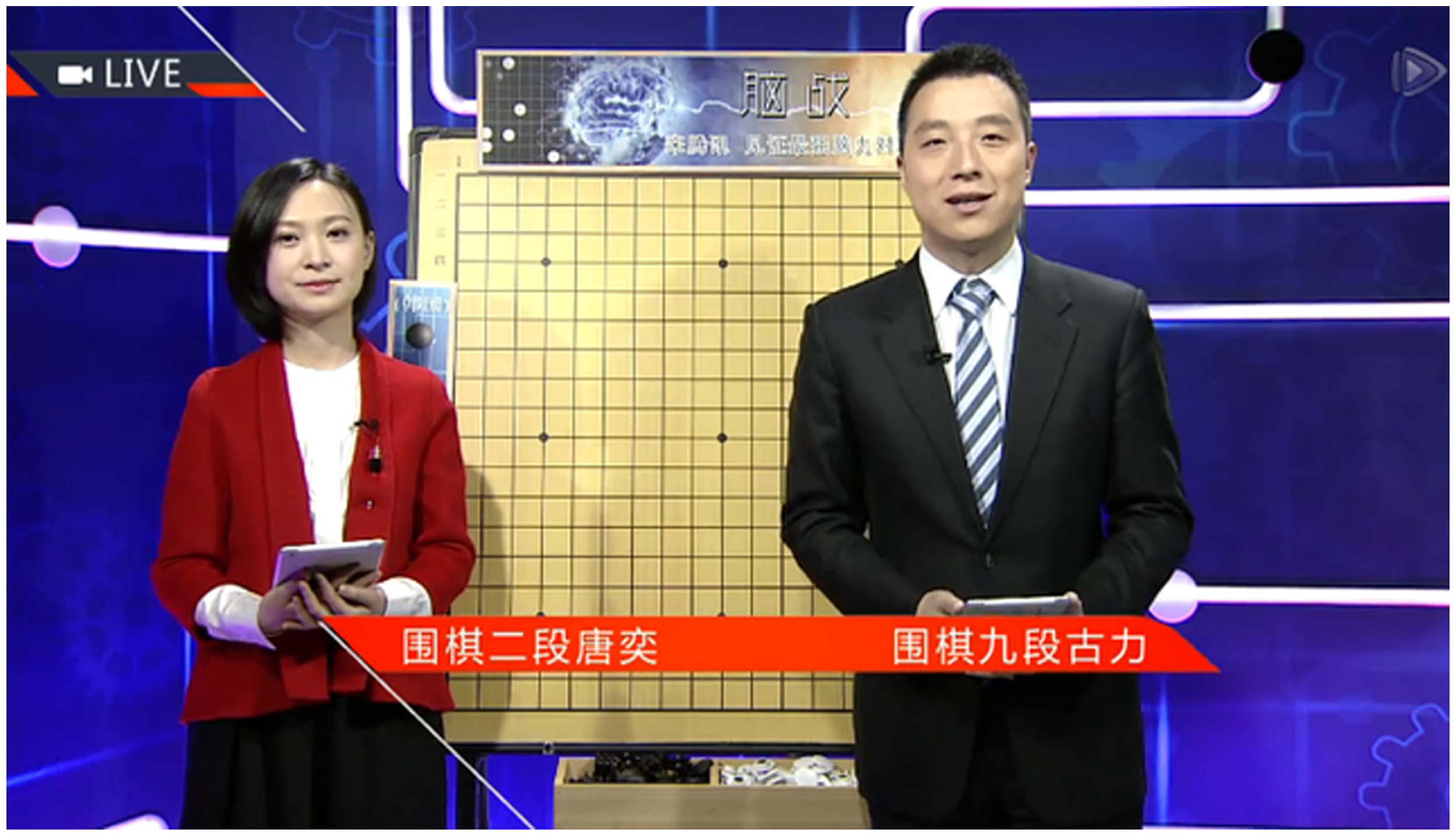
Live commentary of Go tournament. Tang Yi (left) is a 2-dan professional player. Gu Li (right) is a 9-dan world champion. Note: This screenshot is taken from the following video link (0:00:49): https://www.bilibili.com/video/BV18Z4y1P7vY/?spm_id_from=333.337.search-card.all.click&vd_source=743627fa4d5e399fa63042161db7b5b1 (Accessed 4 January 2025).
In addition to tracking the progress of the game, the play-by-play commentator has the crucial responsibility of asking questions at key moments. These questions do not reflect the play-by-play commentator's own curiosity but express the perspective of an amateur or even a beginning Go player to spur discussion of the strategies unfolding on the board. Even if the play-by-play commentator is not among the top-level professional players, the answers to these questions are straightforward for them. Consider the following two examples from a live commentary session.
Example 1:
Zhang (the play-by-play commentator): “So, could White play this move here?” (placing a stone on the board)
Nie (the expert commentator): “No, that won’t work. If White plays there, Black can respond here and capture these three stones in the corner.”
Zhang: “Right, capturing those three stones would be too good for black.”
Nie: “Capturing those three stones would essentially secure the win for black.”
Zhang: “Yes, exactly.” (Live commentary for the second round of Chinese Go League 2016)
Example 2:
Zhang: “What's the life-and-death result in this corner?”
Nie: “In this corner, Black is inevitably dead. This is a classic life-and-death problem—let me show everyone.” (places a series of stones) “The final shape is known as the ‘blade handle’ five-stone dead shape.”
Zhang: “Yes, yes, it's a very classic shape.” (Live commentary for the second round of Chinese Go League 2016)
In the first example, the play-by-play commentator suggests a potential move for White to counter Black's attack. The expert commentator immediately responds by demonstrating Black's counter to White's move and concludes that this sequence would lead to White losing the game. In the second example, Zhang pretends not to know the life-and-death outcome in the corner, prompting further explanation. This, in turn, allows expert commentator to show the audience a classic killing technique commonly encountered in Go. The broadcast room effectively becomes a stage for the expert player to demonstrate their interpretive command of the game. At the same time, through role-playing, the play-by-play commentator prompts the high-level expert to explain complex strategies to a broader audience. These specific arrangements—the structured setting of the broadcast studio, the use of role-playing to simulate a beginner's perspective—allow the expert player to make a small part of their specialized knowledge accessible to the audience. Expertise, therefore, is not merely an internalized skill but is activated and conveyed through carefully staged interactions that reinforce the expert's authority while also demystifying complex strategies for viewers. Expertise is displayed through a dynamic performance, dependent on contextual elements that shape how knowledge is presented and received.
To further illustrate this idea, let us consider another situation in which professional players interpret a game using a very different arrangement. In August 2022, I observed the following interaction during the Wu Qingyuan Cup World Women's Go Open Tournament in Fuzhou.
(Just after the game ended) The two players sat silently in front of the board for about two minutes. A few other players gradually gathered around them, but no one spoke. Due to signal blocking in the tournament room, no one took out their phone to check for an AI's assessment. After a few minutes of silence, the Chinese player pointed to a spot on the board, made a few gestures, and then picked up one of the stones and placed it in a different position, looking up at the Korean player across from her. The Korean player nodded thoughtfully and pointed to another area on the board. The surrounding players occasionally pointed to specific spots on the board as well, sometimes muttering words in Korean or Chinese too softly to hear clearly. This exchange lasted less than five minutes before the two players put away the stones and left the room.
3
These two cases illustrate two different ways to display the expertise of professional Go players depending on the context and arrangements. In televised broadcasts, the two commentators utilize a standing board and stones, cameras, the television network, and interactive role-playing to perform their expertise before an audience of less-skilled amateur players. In contrast, after a professional match, the two competing players communicate using only body language to convey the game's key moments. This contrast highlights how different settings shape how expertise is performed and received. In the broadcast scenario, expertise is formalized and visible, actively constructed through a performative interaction between two professionals. In the postmatch setting, however, expertise operates in a more implicit, almost ritualistic manner, grounded in a shared, tacit understanding, which usually is not observed by the broader Go audience.
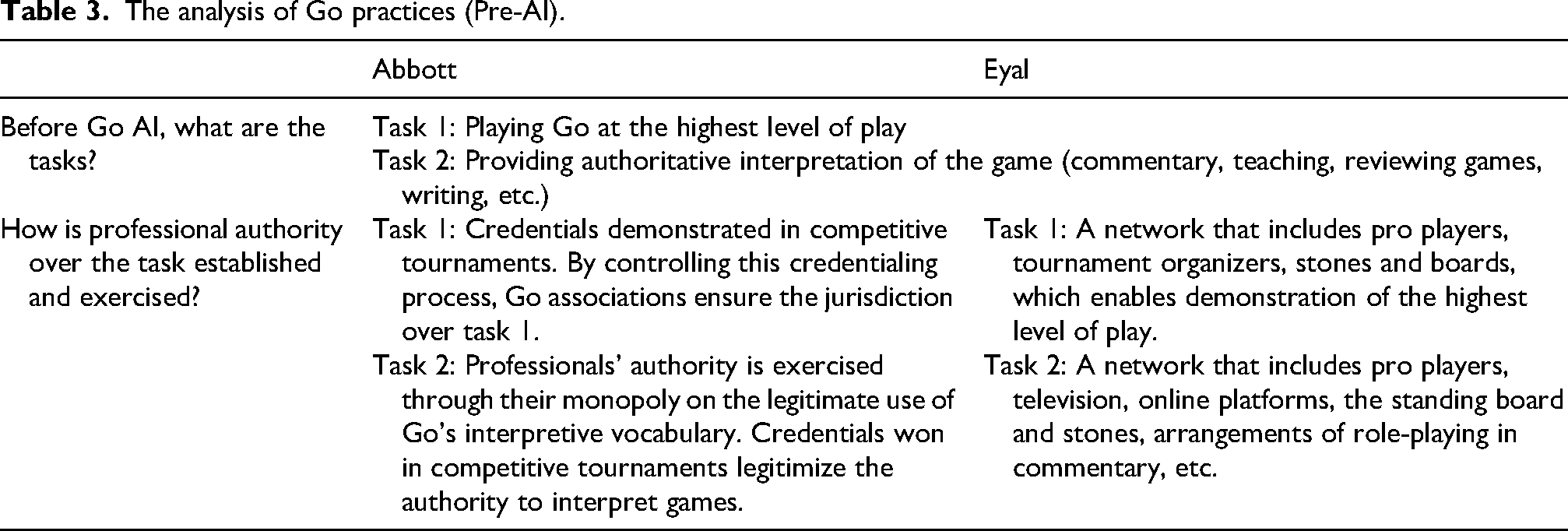
Now, we can compare the jurisdictional and network perspectives in describing Go practices (Table 3). In both theoretical frameworks, the tasks themselves remain consistent. Abbott emphasizes how professionals control and monopolize them, which emphasizes the mechanisms by which professional players assert their authority and maintain control over the allocation of tasks. In contrast, Eyal's network framework shifts the focus to the broader arrangements that enable the performance of tasks. While professional players remain the central actor in performing expert tasks, the network perspective highlights the indispensable role of nonhuman elements, context, and institutionalized practices.
The analysis of Go practices (Pre-AI).
After the Introduction of Go AI
The introduction of Go AI beginning in 2016 profoundly challenged the expertise of professional Go players. First, even the best professional players no longer represent the “best” possible gameplay. Go AI has unambiguously demonstrated its capacity to defeat the strongest human players in the world, thus breaking the monopoly of expert professional players—who we must now refer to as “human experts”—held over the highest level of play. Unlike Large Language Models (LLMs) which are prone to “hallucinations,” Go AI's outputs are treated by the professional community as practically infallible, because the AI has surpassed human calculation by such a vast margin, any potential “errors” in its probabilistic win-rates are often beyond human detection, effectively establishing the algorithm as an absolute epistemic authority. But Go AI has not only surpassed human players in performing this task; it has also rendered professional players’ control of interpreting the game increasingly untenable, especially in scenarios where their human judgments differ from the output generated by AI. Not only were human experts no longer the best players, but the strategies, tactics, and theories long advanced by human Go experts lost credibility. In the following excerpt from an interview, a world champion complained to me about the current situation of professional Go players.
Now, every amateur player uses AI to critique our moves. They only see the number (win rate) provided by AI, whether it has increased or decreased significantly. They don’t see the thought behind each decision. Everyone watches from a god-like view and then criticizes our play. (Interview with an anonymous world champion, 9-dan professional player)
Jurisdictional change
The rise of Go AI undermined both professional players’ ability to demonstrate the “highest level of play” and their epistemic authority over game interpretation. This situation can be analyzed using Abbott's (1988) concept of jurisdictional vacancy. Abbott argues that external forces—like new technologies—can disrupt professions, dissolving existing jurisdictions and creating new tasks and jurisdictional vacancies. These vacancies set the stage for struggle and negotiation among and within occupational groups to redefine the boundaries of their jurisdictions.
Task 1: Demonstrating the ability to play Go at the highest level
After the emergence of Go AI, the jurisdiction of professional Go players over the task of playing games was directly challenged. Matches between top human players, once regarded as the pinnacle of Go mastery, are no longer regarded as the highest level of play. Instead, games played by Go AIs are widely considered closer to the perfect play. However, this shift does not render human tournaments meaningless. Professional Go competitions continue to be held and draw significant attention from the Go community and the public. Tournament organizers have established a clear boundary between human players and AI: Go AIs are prohibited from participating in professional human tournaments, and human players are strictly forbidden from receiving any AI assistance during play. In this way, the task of playing Go has been redefined. Whereas professional tournaments once served both to determine the strongest human player and to showcase ideal gameplay, today they fulfill only the first purpose. The latter—demonstrating the optimal way to play Go—has been effectively delegated to AI systems.
Task 2: Interpreting games
The rise of Go AI also threatened the jurisdiction regarding task 2, interpreting the game of Go for less expert audiences. Using traditional Go theories, human experts could still offer interpretations grounded in human Go theory, but if machines can beat the experts in these theories, then should anyone listen to them? And if so, why?
The answer is that while Go AI has acquired the ability to beat the best human players, it cannot perform interpretive tasks (at least at present). Go AI makes calculations, generating probabilistic outcomes based on its algorithms. For the AI, each board position is simply an input, and the algorithm processes this input to produce an output. First, it generates a probability distribution of all legal moves, indicating the likelihood of each possibility being selected as the next move (Silver et al., 2016). Next, the AI generates another output: the “win-rate” for every possible move. The win-rate of a move is an estimate of the probability of Black (and correspondingly White) winning if that move were to be made. Go AIs select the move with the highest win rate. Go AI lacks the qualitative vocabulary of strategy and tactics, producing only probabilistic win-rates. This creates a stark contrast with the rich conceptual frameworks through which humans understand and communicate the game's strategic intentions. Its output is restricted to probabilistic win-rates—a numerical “oracle” that remains fundamentally unintelligible without the human conceptual narratives essential for strategic understanding. Lacking a framework to contextualize moves within a broader strategic or theoretical narrative, the AI cannot provide an interpretation of Go as a game in the way humans can. Even if we set aside the goal of having AI generate interpretations understandable to humans and focus solely on tracing how a specific output is computed, this remains nearly impossible to achieve. Artificial neural networks (Burrell, 2016), especially deep learning models, consist of billions of parameters that interact in complicated ways. This immense complexity makes it impossible to trace how inputs are transformed into outputs or to understand the role of individual parameters in the decision-making process. Therefore, for both human Go experts and AI engineers, Go AI functions as a black box: we know that an input (the board position) generates an output (the next move and the win rate), but everything in between remains opaque.
To better illustrate this point, let us consider an example of how Go AI interprets a game. Figure 2 is a screenshot of Go AI analyzing a tournament game.
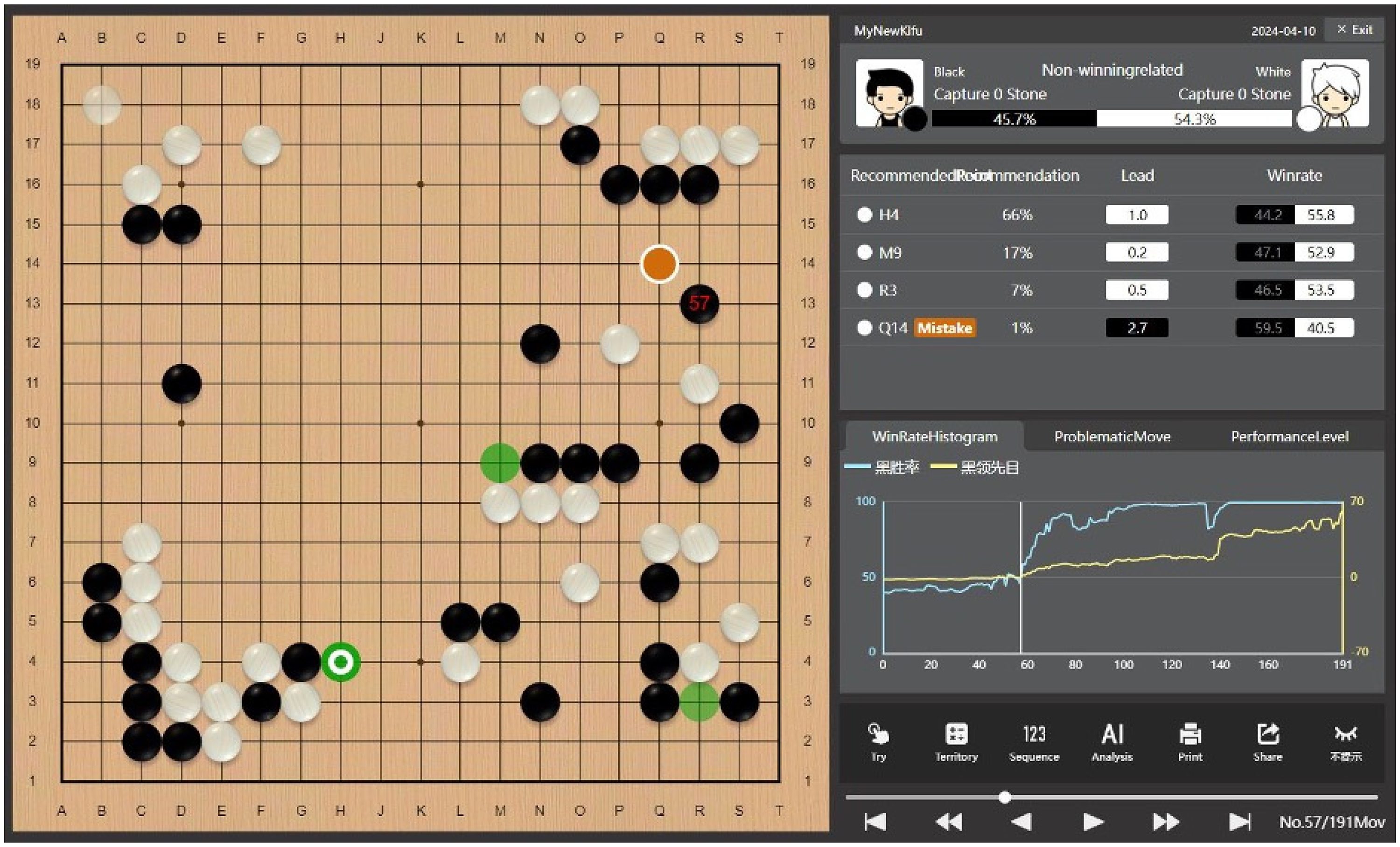
Go AI (Golaxy) analysis of the game between Park Junghwan 9-dan and Dang Yifei 9-dan on 12 February 2023. Note: This screenshot is obtained by the researcher using Golaxy to analyze the game.
In this screenshot, Golaxy suggests the best next move for White (white circle on green) and two alternatives (light green). Yet in the game, White chose a different move (orange point), deemed incorrect by the AI. The information box on the right includes win rate evaluations for these moves: the best move has a win rate of 55.8% for White; but after choosing the mistaken move, White only has a win rate of 40.5%. A graph showing Black's win rate throughout the game appears at the bottom of the box. AI's analysis shows that Black was slightly behind at the beginning but gradually gained an advantage during the mid-game battles. White's mistakes from moves 53 to 70 worsened the situation. Eventually, Black secured a winning position around move 100 (approaching a 100%-win rate). This appears to be a very convincing description of the game, yet the information it contains is quite limited. It is similar to a post-game report of a basketball match that only lists the scores of the two teams tracked over time, without mentioning the strategies or tactics employed during the game.
Human players want to know not only where to place the next stone, but also why. Likewise, they want to understand not only win-rate trends but also why Black fell behind early, why White made mid-game errors, and how Black secured a winning position by move 100. Go AI cannot answer these questions. Table 4 compares the kinds of explanatory outputs generated by Go AI with the types of interpretations human experts typically provide.
AI outputs versus human interpretations of the same game elements.

Tensions arise from the disparate ways AI and humans interpret the game. Human experts possess interpretive tools but lack their former skill-based legitimacy; conversely, AI possesses playing legitimacy but provides only probabilistic outputs. Lacking conceptual understanding, AI cannot offer strategic or tactical explanations. Consequently, the previously unified jurisdiction of gameplay and interpretation has split. Interpretation is now transformed: experts no longer analyze the game directly but decode AI-generated win rates and curves to create human-comprehensible narratives. While the final presentation—reconstructing the match through strategy and tactics—appears unchanged, this similarity masks a fundamental shift. Professionals have changed their attention from the board to algorithmic outputs, “reaching behind the numbers” to produce strategic meanings that are entirely absent from the AI's own calculations.
The following example illustrates how professional Go players perform the interpretive task that defines their new, transformed professional jurisdiction. Commentators today always use Go AI during game analysis, but AI outputs are not constantly displayed to the audience. Commentators control when to show AI suggested moves and win rates (Figure 3). Sometimes, AI outputs are never directly revealed, with the commentators merely relaying them verbally.
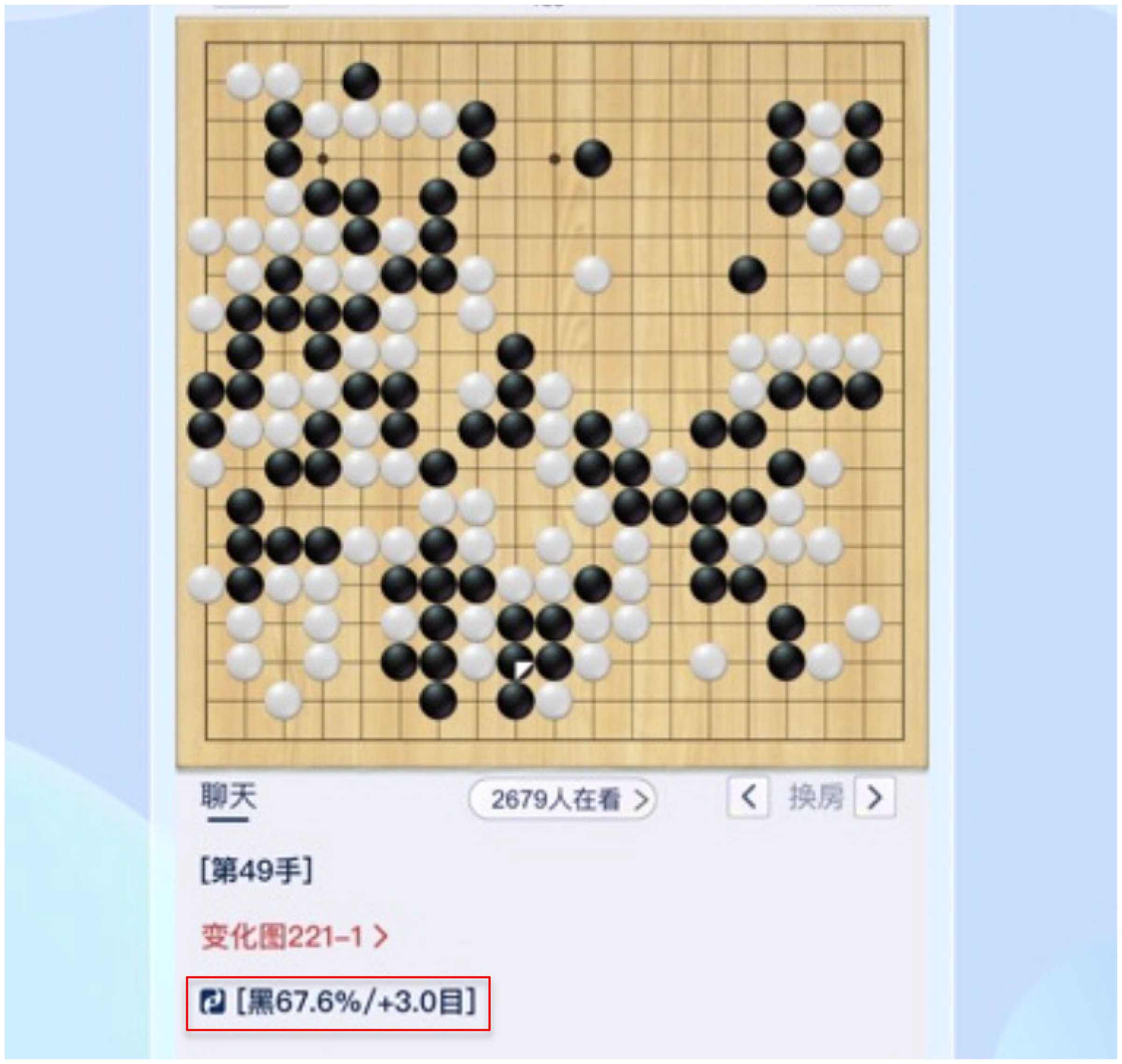
Online Go match screenshot showing AI win rates (red box). Note: This screenshot is from the FoxGo online Go platform, captured by the researcher.
Commentators also use the win-rate graph to produce overall summaries of games. Consider a summary by Li Zehao, a Go professional who was the commentator for a match between Park Junghwan and Dang Yifei:
A complete victory for Park Junghwan. The opening was quite even for both players. Dang Yifei made some mid-game mistakes, and once Park Junghwan gained the advantage, he gave Dang no further chances to come back. (Li Zehao's commentary on FoxGo on Feb. 12th 2023)
Starting from move 58, Dang Yifei's subsequent judgment had some issues, persisting in activating small-value stones, leading to a problem of thinness. After move 62, the situation was already terrible for White. (Li Zehao's commentary on FoxGo on Feb. 12th 2023)
Following this, Dang Yifei fought hard, attempting to fight a Ko in the lower right, but still lost due to significant losses earlier. I am today's commentator, Li Zehao. See you next time. (Li Zehao's commentary on FoxGo on Feb. 12th 2023)
Some human Go experts have resisted the restrictions of their expert jurisdiction to focusing on interpreting AI outputs rather than the game itself. One professional player illustrated this point through the following anecdote:
When AlphaGo first emerged, *** (a famous old professional player) fell seriously ill for a year, and thus, he was not able to follow the AlphaGo challenge match. Upon his recovery, it coincided with the publication of my book analyzing AlphaGo's games. After reading it, he became very upset and gave me a call, questioning, “Meng, how could you write a book like this? Was all the Go we learnt and played wrong?” I couldn’t rebut him over the phone. Instead, I encouraged him to play against FineArts or Golaxy. (Interview with Meng Tailing, 7-dan professional player)
The jurisdictional struggle also involved the main clientele of Go professionals; namely, amateur Go players. Before the advent of Go AI, professional players held unchallengeable authority, meaning their insights were not contestable. However, the Go AI partially blurred the sharp divide the tournament-based credential system had created between professional and amateur players. Amateur players suddenly could interpret games with AI assistance and challenge the expertise of professional players. In an interview, Gu Li, 9-dan world championship, described some awkward situations he encountered:
After the emergence of AI, I've become more cautious when doing commentary in public. In the past, when I say Black is in a good position and, even if it might not be that strong, people wouldn’t really challenge me. Now, if I say Black is leading, someone might pull up AI analysis and say, ‘Teacher Gu, Golaxy, KataGo, FineArt all say you’ve got it wrong.’ Obviously, that's embarrassing for me. So now if we must make a judgment, we definitely need to look at the win rates provided by AI. (Interview with Gu Li)
There's plenty of explainable aspects behind Go AI that most people (amateur Go players) fail to grasp. They do not understand what the professional players are thinking during the game, nor do they comprehend the significance of AI's moves. While AI's analysis appears to be a standard answer, there are many underlying pieces of information that need to be discerned. Professional players are more capable at understanding and assimilating it. (interview with Hu Yaoyu, 8-dan professional player)
A changing network
Abbott's framework reveals that professional players partially retained jurisdiction despite AI-introduced tasks. Conversely, Eyal's network model (Eyal and Pok, 2015) suggests expertise is not a monopoly but a dynamic enactment across human and nonhuman actors. Rather than replacing professionals, Go AI integrated into a broader sociotechnical network—linking players, AI, commentators, and audiences—to produce and validate knowledge. The relevance of human expertise continues, even as AI reshapes the processes of play, analysis, and teaching. The two tasks discussed above—demonstrating gameplay of Go of the highest quality and interpreting the game—remain intact, but Go AI has expanded the network of expertise associated with them.
Task 1: Demonstrating the ability to play Go at the highest level
Adding Go AI to the credentialing tournament system, required adapting its methods. To enable Go AI to present the ability to play Go at the highest level, an appropriate stage for showcasing its performance is essential. The 2016 AlphaGo Challenge Match—staged as a major media event—was designed to dramatically demonstrate AlphaGo's capabilities (Figure 4). But in a world where no human can win against an AI, matches that feature a Go AI system versus a human professional player no longer suffice to establish a model of best gameplay. Instead, a stage is needed where Go AIs can compete against each other—much as top human players once demonstrated mastery of the game in world championship tournaments before Go AI.
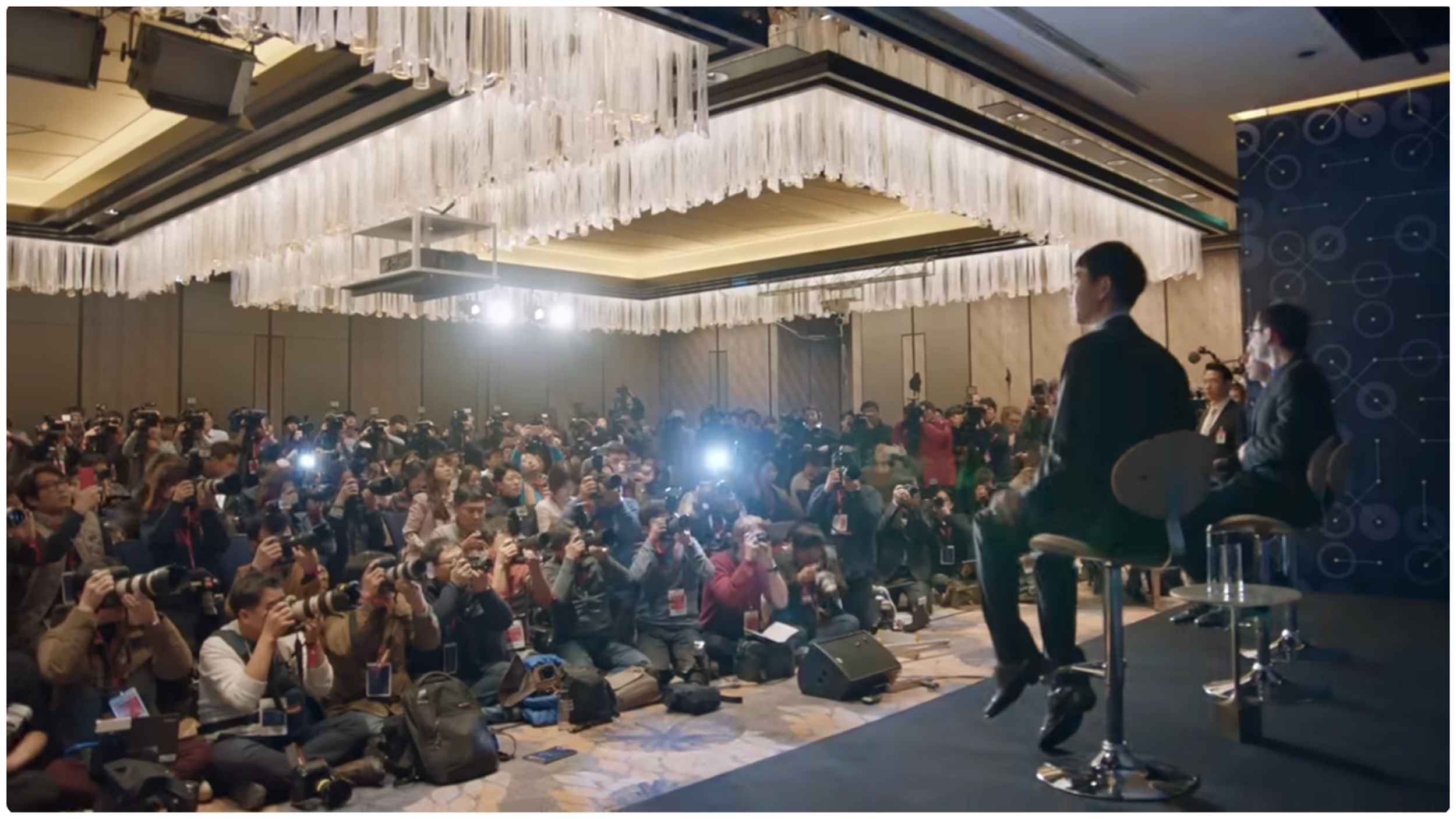
Media presence at a press conference of the AlphaGo–Lee Sedol challenge match, March 2016 (AlphaGo, 2017).
In fact, such a stage has existed since 2007 when the University of Electro-Communications (UEC) in Japan started hosting the annual UEC Cup World Go Computer Tournament, inviting Go AI research teams from around the world to compete. However, before 2016, the UEC Cup was a niche gathering of AI researchers with little impact on the broader Go world. A connection to the Go community was established in 2013, when UEC organizers began inviting renowned Japanese professional players to face off against the top two AI programs, the champion and runner-up. Initially, the AIs were given a five-stone handicap or more. In 2017, the UEC Cup became the first major AI Go event post-AlphaGo and drew wide Go community and media attention. Though AlphaGo did not compete, many Go AIs inspired by it had surpassed human players after a year of training (Wang, 2019).
Since 2017, AI Go tournaments have served as platforms for showcasing demonstrations of the best possible gameplay. Within the Go community, players began to treat these AI tournaments as valuable tools for learning. Professional players have published numerous books discussing the moves from these competitions, examining the distinctive styles of various Go AIs, and analyzing the openings that specific AI programs favor (such as the “Fine Art Opening”). At times, the attention given to AI Go tournaments has surpassed that of traditional human competitions, reflecting the community's recognition of AI-driven play as the new benchmark for understanding and mastering the game.
Another key component in the network that enables top AI gameplay to be demonstrated is the computational infrastructure that powers Go AI algorithms. The following two images contrast AlphaGo's public image in the media with the invisible computational infrastructure operating behind the scenes. Figure 5 shows a scene from the AlphaGo challenge match. In this image, which was repeatedly featured in news articles, AlphaGo is almost invisible and intangible, represented only by a small monitor (Bory, 2019). In contrast, Figure 6, a photo of the DeepMind team's control room, presents an image of a much more tangible system. Here, multiple monitors actively track AlphaGo's operation, surrounded by DeepMind engineers responsible for monitoring system performance, tracking inference statistics and computational parameters. These human workers were indispensable to AlphaGo's performance: the AI's outputs were the product not of an autonomous machine but of a tightly coordinated sociotechnical assemblage involving algorithms, hardware, computing infrastructure, and a substantial team of technical labor. Yet these workers were systematically rendered invisible in public-facing representations of the match: a recurring feature of narratives of technological change (Barley and Orlikowski, 2023).
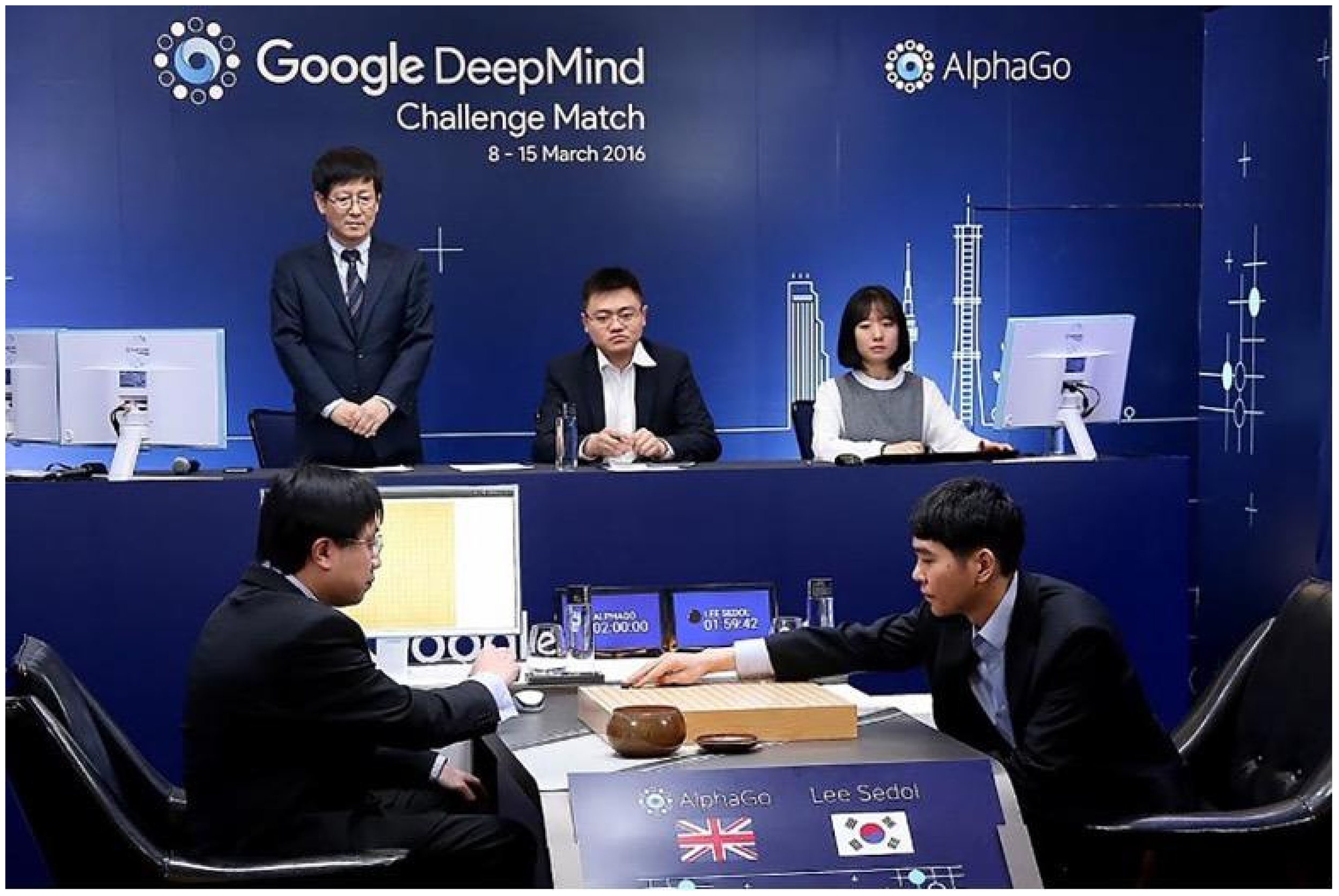
The picture of AlphaGo Challenge Match (Image credit: Press kit of AlphaGo. AlphaGo, 2017) Lee Sedol (right) places a stone on the board. Opposite him, is Dr Aja Huang (left) of DeepMind, whose job was merely to place stones on the board based on AlphaGo's output (displayed on the monitor).
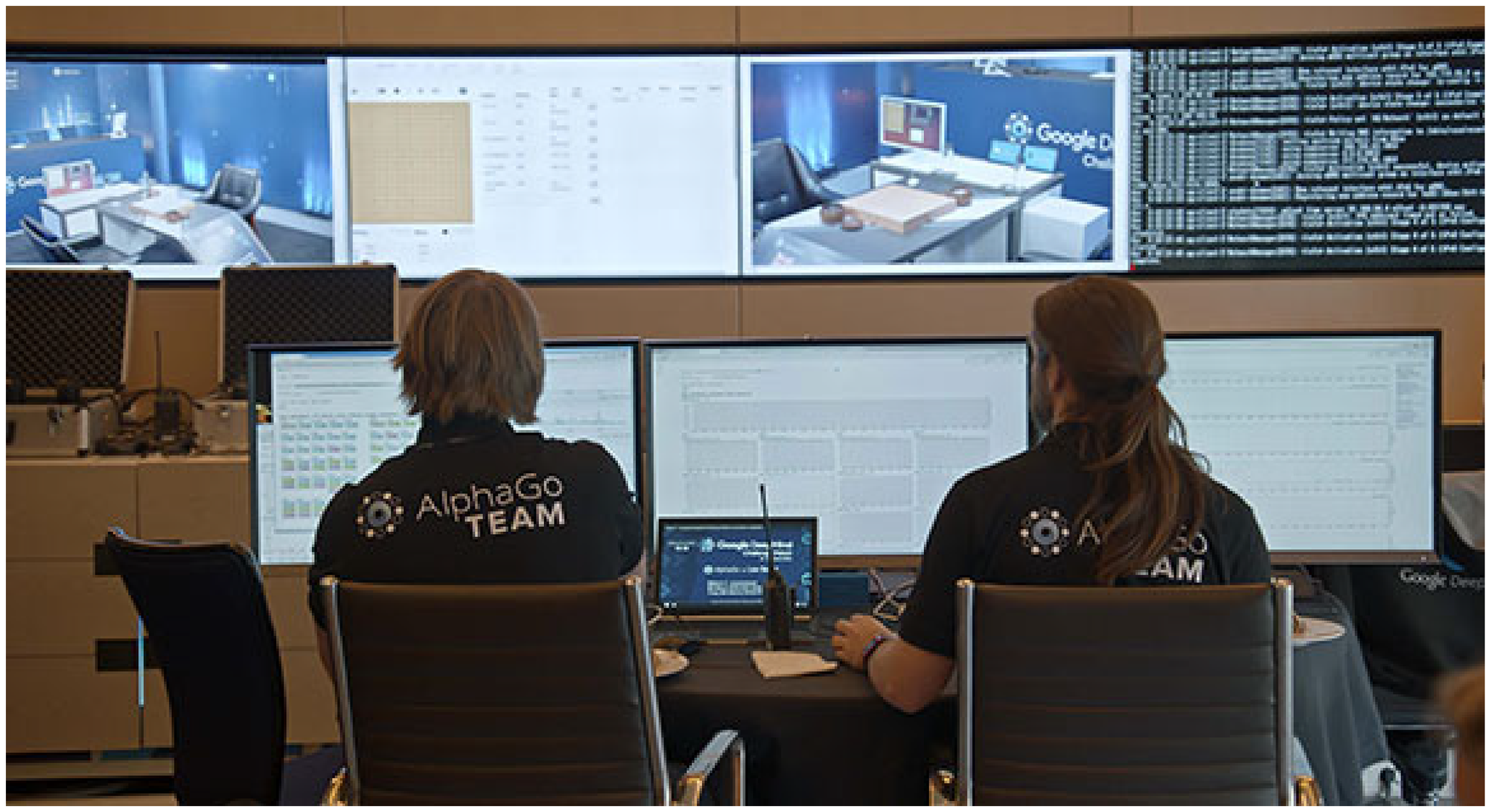
The backstage control room of DeepMind team during the challenge match (AlphaGo, 2017).
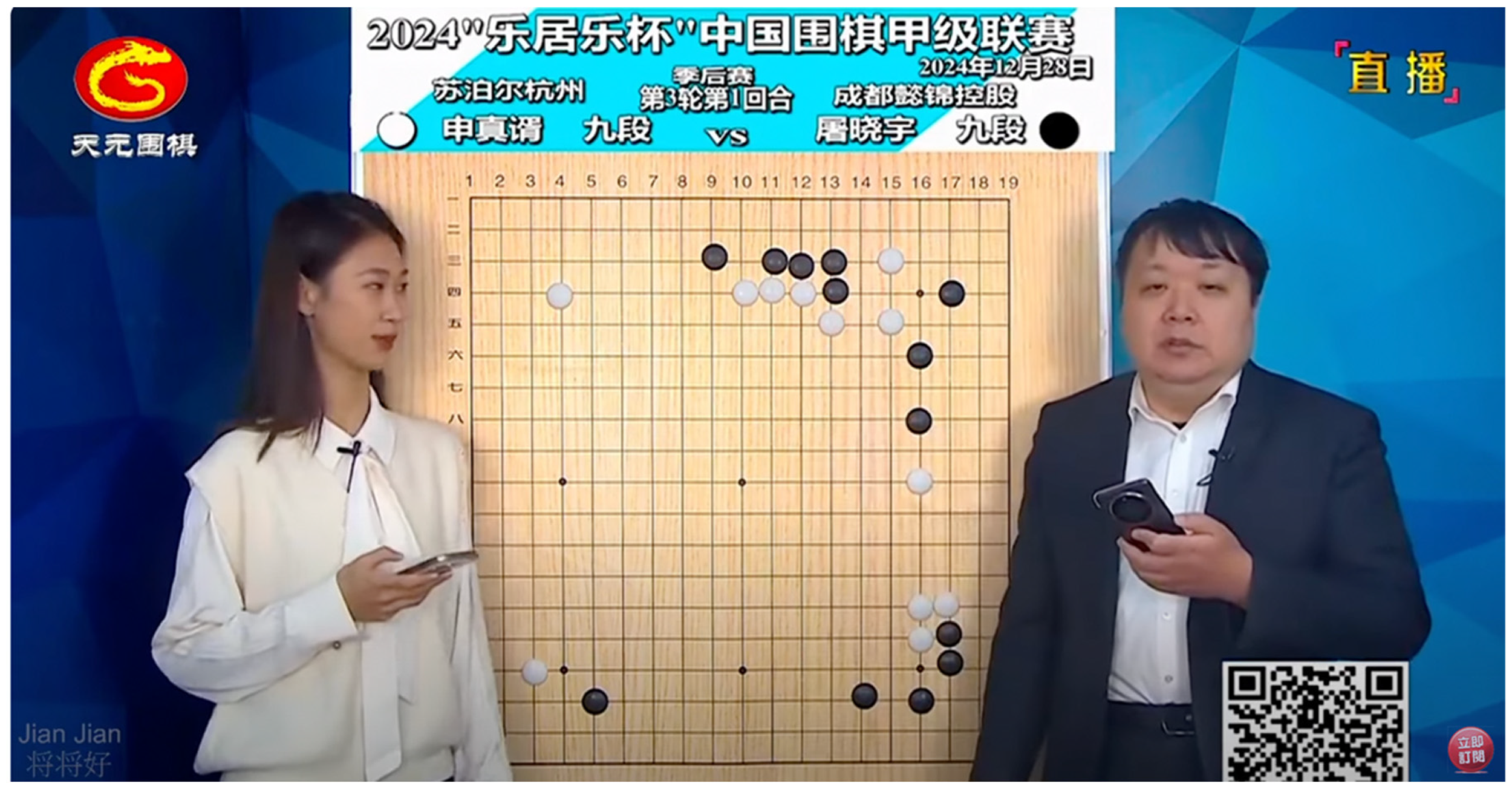
Televised Go game commentary, Shin Jinseo vs Tu Xiaoyu on 28 December 2024. Note: This screenshot is taken from the following video link (0:12:28): https://www.youtube.com/watch?v=33CwUbK7hbU (Accessed 4 Jan 2025).
What's not shown in these images is the Google Cloud Platform, AlphaGo's main computing resource during the challenge match. According to DeepMind (Silver et al., 2016), AlphaGo mobilized 1202 CPUs and 176 GPUs to support its computation during the challenge match. This vast computational infrastructure contrasted starkly against its software-based, transparent image of Figure 5.
As this discussion suggests, the previously existing network of expertise was adjusted as Go AI was incorporated into it. The result: a new network that took shape after 2016, replacing the earlier network dominated by professional players and supported by a different mix of objects and arrangements. In this new network, Go AI generates moves and win-rates supported by computing infrastructure; engineers monitor AI system operation, and tournament organizers stage annual competitions where AIs produce exemplary games. This network is no longer dominated by a single professional group; instead, a diverse array of human and nonhuman actors has been incorporated into it, all of which are indispensable. Human professional players have almost receded from this network. While they still play an important role in helping the community understand these exemplar games, this contribution primarily pertains to the task of interpreting games. Indeed, human experts have been largely excluded from this new network, while new actors from outside the Go community, such as AI engineers and computing infrastructure, have been integrated into it.
Task 2: Interpreting games
As noted in previous section, interpretation is no longer the exclusive domain of professional players. The network for game interpretation that operated before Go AI has been transformed. To be sure, human professional players still play a critical role in this network. However, the mix of actors who play essential roles is fundamentally different. From a sociology of expertise perspective, this raises several questions that a jurisdiction-oriented framework overlooks: In what ways has the redefinition of the task changed the network that constitutes expertise? How are the outputs of Go AI integrated into the commentary on Go matches? How do commentators access real-time information generated by AI? What information is selected and presented to the audience? And in what format?
The answers to these questions differ for the two major modes of Go commentary today—televised broadcasts and online streaming. On broadcast television, the impact of Go AI on the format of commentary appears subtle, if not entirely invisible. The traditional setup remains largely unchanged (Figure 7): two commentators stand before a board, performing the roles of the play-by-play commentator and the expert commentator, respectively. The only noticeable difference from the past is that commentators now often hold a smartphone, which they use to access the real-time analysis provided by the AI. The AI's outputs remain completely invisible. Only on rare occasions do commentators mention that one of the players has a leading win-rate. This setup grants commentators great flexibility in interpreting AI outputs. They can selectively demonstrate those AI-recommended moves that they find easier to explain, while choosing to ignore moves that are more difficult to comprehend. The televised broadcast setup thus makes the process of commentary into a one-directional form of communication: commentators explain, the audience listens. Additionally, because the commentators control access to the AI outputs, they can carefully tailor what they choose to present to the audience to serve their objectives. Commentators thus enjoy considerable interpretive flexibility to, for example, construct narratives that render the game more exciting or to shore up their authority by avoiding unexplainable moves and selectively discussing AI moves that allow them to demonstrate their ability to offer illuminating insights.
The situation is significantly different in online commentary. Here, commentators typically provide interpretations of the game through written commentary. During the match commentary, commentators usually demonstrate AI analysis every five moves and embed links to these analyses within their written commentary. Viewers can click links to access AI outputs, including variations and win rates. The interactive nature of online platforms and the real-time accessible AI analysis enables viewers to leave comments and questions in chat boxes focusing on the rationale behind specific AI-recommended moves. Unlike TV commentators, online commentators cannot easily ignore these difficult-to-explain AI suggestions, as they are directly engaging with audience queries. In our observation, commentators typically label these as “moves only AI can make,” acknowledge their inability to explain the underlying logic, and guide viewers toward slightly suboptimal but humanly intelligible alternatives, on the rationale that imitating incomprehensible AI choices does not advance human understanding of the game.
Table 5 compares how the two frameworks analyze post-AI changes in Go. Following Abbott's approach, the scope and the content of Go professional's work has changed. Go experts lost their jurisdiction over the task 1 and the content of task 2 was reconstructed as well. In Eyal's framework, networks of expertise corresponding to two tasks have undergone significant reconfiguration, in which new actors joined the network while redefining the old actors’ places in the network. Go AI, along with its computational infrastructure, AI engineers, and other supporting components, entered the network. Go professionals find their roles as the interpreter of AI outputs in the network. Notably components of a network are not always equally visible in certain contexts. The selective display of the network become a necessary arrangement that support the performance of Go AI and Go professionals.
The analysis of Go practices (post-AI).

Conclusion
This article has explored the transformation of Go practices before and after the advent of Go AI, using two theoretical frameworks. Abbott's focus on the contestation and maintenance of jurisdiction effectively explains how professional Go players, prior to the emergence of Go AI, maintained their monopoly over Go practices and status as authoritative experts in Go knowledge. After Go AI, the changes led to jurisdictional struggle between a human occupational group and machines. But the outcome of this struggle was not for the machines to take over all tasks. Instead, human Go professionals were not eliminated completely, but both the scope of the Go professional's work and the content of that work changed. The scope of the Go professional's work shrinks as human experts lost their jurisdiction over demonstrating the highest level of Go playing ability, but Go professionals retained control over the interpretation of games. The content of the work of interpreting games was also transformed into a task that had to respond to, align with, and translate AI outputs for human audiences. This transition mirrors recent observations in the sociology of algorithms, where professionals in high-stakes domains increasingly function as “knowledge brokers” (Waardenburg et al., 2021) or “cyborg interpreters” (Pullen-Blasnik et al., 2024), shifting their jurisdiction from primary production to the “mediated evolution” of expert labor (Faulconbridge, 2025).
Eyal's approach provides a different perspective, one that brings out the extensive sociotechnical system underlying Go AI, which includes computing infrastructure, AI engineers, tournament organizers, online Go platforms, and so forth. These assemblages of human and nonhuman actors enable Go AI to take over tasks that were previously controlled by human Go experts. Human professionals are not simply displaced from the networks of Go AI, because they remain crucial to the performance of interpretive tasks. Indeed, the analysis above reveals how the parts of the networks that constitute Go AI are selectively displayed in public demonstrations of AI systems and in performances of tasks that human experts still control, such as interpreting games. In this arrangement, certain human efforts—specifically the commentator's interpretive labor—are pushed to the visible forefront to bridge the “semantic void” of the AI. Conversely, the labor of AI engineers, data curators, and the vast computing infrastructure is systematically backgrounded or rendered invisible to sustain the popular narrative of algorithmic autonomy.
This analysis of how the integration of AI into the world of professional Go provides insights about the redistribution of jurisdictions and professional roles across human and nonhuman actors, and how expertise is sustained within evolving sociotechnical systems. Notably the current settlement of practices between human experts and Go AI within the Go community remains temporary. Further jurisdictional changes, along with transformations in the sociotechnical networks that sustain the performance of tasks remain to be seen in the Go community as Go AI continues to develop. While the “closed” and probabilistic nature of Go facilitated an absolute algorithmic dominance that may not be easily replicated in more volatile social domains, the case remains a vital early indicator. A similar transformation may happen or is perhaps happening in many other realms, where professionals are adapting to their new roles, not only in relation to AI systems, but also within newly configured networks of expertise involving platforms, algorithms, datasets, and audiences. Whether such insights—regarding jurisdictional shifts, the changes of scope and content of professional tasks, and the selective display of parts of sociotechnical networks—will hold in other domains where AI is anticipated to surpass human experts remains a critical empirical question to be answered.
Footnotes
Acknowledgements
I am deeply grateful to Dr Stephen Hilgartner, whose insights into the sociology of professions and expertise shaped the argument of this article. Any opinions, findings, and conclusions or recommendations expressed in this material are those of the author and do not necessarily reflect the views of the National Science Foundation.

Funding
The authors disclosed receipt of the following financial support for the research, authorship, and/or publication of this article: This work was supported by the National Science Foundation (grant number 1926174).
Declaration of conflicting interests
The author declared no potential conflicts of interest with respect to the research, authorship, and/or publication of this article.