






Abstract
Background
Systematic reviews are essential for evidence-based practice but remain resource-intensive, particularly during full-text data extraction and structured risk-of-bias appraisal in prognostic research. These challenges are amplified in complex autoimmune diseases such as systemic lupus erythematosus (SLE). Recent advances in large language models (LLMs) have raised interest in their potential; however, rigorous benchmarking against expert reviewers in real-world rheumatology settings is limited.
Objective
To evaluate the feasibility, agreement, and efficiency of customized GPT-based LLMs across two systematic-review tasks: 1) study-level data extraction in metabolomics studies of SLE, and 2) prognostic risk-of-bias appraisal in rheumatology studies using QUIPS.
Methods
This two-part methodological study was nested within two PROSPERO-registered reviews. For data extraction, fifteen full-text SLE metabolomics studies were processed by human reviewers and by a customized GPT model using a shared, structured template; concordance across predefined fields and extraction time per study were compared. For prognostic appraisal, nineteen rheumatology prognostic studies with adjudicated human QUIPS domain ratings (Low/Moderate/High) were reappraised in 2025 using a customized ChatGPT model (GPT-Reviewer). Agreement with the human reference was quantified using weighted kappa (quadratic weights) with 95% confidence intervals.
Results
GPT-Reviewer generated complete domain-level QUIPS judgments for all 19 studies, with heterogeneous concordance versus adjudicated human ratings. Domain-specific κw was 0.001 for study participation (95% CI 0.000–0.002) and outcome measurement, 0.129 for study attrition (95% CI 0.028–0.241), 0.137 for prognostic factor measurement (95% CI 0.000–0.478), 0.286 for statistical analysis/reporting (95% CI 0.161–0.322), and 0.681 for study confounding (95% CI 0.488–0.847). The mean extraction time was shorter for the GPT model than for human reviewers (5.7 vs. 30.4 minutes per study).
Conclusions
Customized GPT-based LLMs are best deployed as complementary tools within human-in-the-loop workflows; improved handling of tables/supplements and domain-specific calibration are needed before routine use in complex rheumatology evidence synthesis.
Introduction
Systematic reviews are central to evidence-based decision-making in rheumatology, offering transparent methods for identifying, appraising, and synthesizing primary studies for clinical practice and policy.1,2 However, they are resource-intensive, 3 with two particularly demanding steps: full-text data extraction, 4 and structured risk-of-bias appraisal in prognostic research. 5 These challenges are accentuated in systemic lupus erythematosus (SLE) and other multisystem autoimmune diseases, where heterogeneous phenotypes, fluctuating activity, multi-organ outcomes, and high-dimensional biomarkers increase cognitive burden and the risk of inconsistency.6,7
Metabolomics exemplifies the complexity of evidence synthesis in SLE. 8 Studies often use diverse analytical platforms and sample types, with key findings reported across tables, figures, and supplementary materials, making data extraction time-consuming and prone to variability.4,9,10 Similarly, prognostic reviews require structured risk-of-bias assessment using tools such as the Quality in Prognosis Studies (QUIPS) tool, which evaluates six domains of potential bias in prognostic factor research and requires reviewer training and consensus across domains. 9 Against this backdrop, large language models (LLMs) have emerged as promising tools for streamlining systematic review workflows. 10 Recent GPT-based systems can process full-text articles and generate structured outputs, including extraction tables and risk-of-bias appraisals.11–13 However, evidence from real-world biomedical applications remains limited, and current findings suggest that LLMs may complement rather than replace human reviewers, highlighting the need for rigorous benchmarking against expert standards. 14
Recent benchmarking studies have evaluated LLM performance in rheumatology and related specialties, showing potential for information retrieval, clinical reasoning, guideline interpretation, and evidence summarization, but with variable accuracy depending on task complexity and domain specificity.15–17 Similar studies in other medical fields have assessed LLM-assisted data extraction, risk-of-bias assessment, and evidence synthesis, generally reporting efficiency gains but inconsistent agreement with expert reviewers. 18 These findings support human-supervised use of LLMs and highlight the need for domain-specific benchmarking in complex rheumatology systematic reviews, particularly for detailed extraction and QUIPS-based prognostic appraisal. Dedicated systematic review platforms such as Rayyan, Covidence, and ASReview are widely used to support screening, deduplication, reviewer collaboration, and record prioritization.19–23 However, these tools are less focused on flexible full-text extraction and domain-specific risk-of-bias appraisal. Customized GPT-based models may complement these platforms by using task-specific instructions and templates to generate structured outputs from full-text articles. 24 Our study therefore evaluates the added value of customized LLMs for later-stage review tasks, specifically data extraction and QUIPS-based appraisal in complex rheumatology reviews.
Methods
This methodological study was conducted under a protocol approved by the Local Research and Ethics Committee of the Instituto Mexicano del Seguro Social (approval number: R-2025-2106-011). The study involved secondary analysis of published literature and comparison of reviewer-generated and AI-generated assessments. No patient-level data were collected, and the human reviewers served as investigators rather than research participants. Therefore, informed consent was not required.
Study design and selection of studies
This retrospective, two-part comparative methodological study evaluated customized GPT-based LLMs against human reviewers across key stages of rheumatology systematic reviews. Both components were nested within PROSPERO-registered reviews: metabolomics in systemic lupus erythematosus (CRD42024535450) and a rheumatology prognostic review using QUIPS (CRD42021237725). The parent reviews followed predefined eligibility criteria and PRISMA-based procedures; the present analysis reused their final included study sets for methodological comparison.
For the data-extraction component, the sampling frame included all primary studies in the metabolomics-in-SLE review. Fifteen English-language full-text PDF articles were purposively selected to reflect heterogeneity in design (e.g., cross-sectional, case–control, cohort), clinical setting, sample size, biospecimens, and analytical platforms, and to ensure sufficient methodological and results detail for a standardized extraction template.
For the QUIPS component, we included all nineteen full-text studies from the prognostic review that included QUIPS assessments completed independently by at least two trained reviewers. We adjudicated to consensus domain-level ratings (Low/Moderate/High). No additional searches or screening were conducted; adjudicated QUIPS judgments from the parent review served as the human reference standard for evaluating the customized GPT-based models.
Search strategy and eligibility criteria
The studies included in this methodological evaluation were derived from two previously completed PROSPERO-registered systematic reviews (CRD42024535450 and CRD42021237725). Detailed search strategies are reported in the corresponding review protocols. Briefly, comprehensive searches of major biomedical databases were conducted according to predefined protocols and PRISMA recommendations.
Data extraction and QUIPS appraisal procedures
Both customized GPTs evaluated in this study (Systematic Review Extractor Pro and GPT-Reviewer) were developed using the OpenAI ChatGPT platform and were based on the GPT-4o large language model (OpenAI, San Francisco, CA, USA). The customized GPTs were developed and evaluated through the OpenAI ChatGPT Custom GPT Builder interface. In this environment, generation parameters such as temperature are not user-configurable and therefore could not be standardized or reported. All evaluations were conducted using the platform’s default settings. The models were configured through the OpenAI custom GPT framework using task-specific instructions tailored to systematic review data extraction and QUIPS-based risk-of-bias assessment. The complete verbatim instructions used to configure Systematic Review Extractor Pro and GPT-Reviewer are provided in Supplementary File 1. Given the use of customized GPT-based models, reporting transparency was additionally assessed using the CHART checklist for generative AI-driven chatbot studies in healthcare contexts 25 ; the completed checklist is provided as Supplementary File 4.
Both GPTs were developed and accessed through the web-based OpenAI ChatGPT interface using the OpenAI Custom GPT Builder and were not locally deployed. Systematic Review Extractor Pro was configured using task-specific instructions derived from the RISEN (Role, Instruction, Steps, End Goal, and Narrowing) prompt-engineering framework described by Sercombe et al. 26
All evaluations were conducted between September 2025 and October 2025. No additional model fine-tuning was performed beyond the customized instructions provided through the GPT configuration interface. The customized GPTs were accessed through a paid ChatGPT subscription that provided access to GPT-4o and custom GPT functionality. A dedicated new account was not created specifically for this study; however, each article was processed in a separate chat session using the same predefined GPT configuration and task-specific instructions. No study was evaluated within a continuous multi-document conversation. This approach was used to minimize carryover from prior interactions and to standardize the conditions under which the model was evaluated. The models were not allowed to browse the web during extraction or appraisal, and outputs were based only on the uploaded full-text articles and the instructions provided. All AI-generated outputs were independently reviewed against adjudicated human assessments.
The customized GPT workflows were conducted by certified rheumatologists with postgraduate training and experience in clinical research, systematic reviews, and evidence synthesis. These investigators developed the extraction templates, configured the GPT instructions, performed GPT-based evaluations, and verified all AI-generated outputs. User expertise may influence prompt formulation and interpretation of outputs and should be considered when assessing the generalizability of the findings.
For the data-extraction component, selected articles were processed independently by human reviewers and a customized GPT-based model (Systematic Review Extractor Pro). Human extraction was completed in pairs by reviewers experienced in rheumatology systematic reviews, using a prespecified wide-format template that captured study descriptors (e.g., country, design, setting), sample characteristics (e.g., SLE and control sample sizes, age, sex distribution), biospecimens, analytical platforms, and key methodological features.
The complete wide-format extraction template, including variable definitions and coding instructions, is provided in Supplementary File 2.
Discrepancies were resolved by discussion or a third reviewer, and the adjudicated dataset served as the human reference standard.
The same articles were then processed using Systematic Review Extractor Pro, the customized GPT described above. The prompt instructed reviewing all main sections and relevant tables, and, when available, supplementary material, prioritizing completeness and internal consistency. Each study was processed individually, and the exported extraction table was used without modification for comparison with the human reference dataset. Extraction time (minutes) was recorded from the time of file upload to the completion of the output table.
The QUIPS tool is a validated instrument for assessing risk of bias in prognostic factor research. It evaluates six domains: study participation (representativeness of the study sample), study attrition (completeness of follow-up and handling of losses), prognostic factor measurement (validity and reliability of prognostic factor assessment), outcome measurement (validity and consistency of outcome assessment), study confounding (identification and adjustment for important confounders), and statistical analysis and reporting (appropriateness and transparency of analytical methods and reporting). For each domain, reviewers assign a judgment of Low, Moderate, or High risk of bias based on responses to domain-specific signaling questions and the overall likelihood that bias could affect study findings. Domain-level ratings were generated independently by trained reviewers and resolved through consensus, following the recommendations of Hayden et al. 9
The same full-text articles were reappraised using GPT-Reviewer, the customized GPT described in the LLM Configuration subsection. The model was configured with QUIPS-specific instructions to support structured risk-of-bias appraisal. GPT-Reviewer was not fine-tuned on QUIPS-specific datasets; instead, it employed a zero-shot prompting approach in which QUIPS guidance was embedded within the customized GPT instructions, without providing exemplar studies or example domain ratings during inference.
Using structured, stepwise instructions, GPT-Reviewer (1) identified the relevant domain, (2) summarized domain-relevant information from the article, (3) considered QUIPS signaling questions, and (4) assigned a Low/Moderate/High judgment with a brief justification. Each study was appraised domain-by-domain in separate interactions, with outputs recorded verbatim. Time for the GPT-based QUIPS appraisal was measured per study from full-text upload to receipt of the complete set of domain-level judgments.
Concordance assessment
For the data-extraction component, human-adjudicated and GPT-based outputs were aligned by study (first author/year) and variable. For each field, concordance was defined as semantically or numerically equivalent entries between human and GPT outputs (e.g., identical country names, matching design labels, or the same sample size and summary statistics). Fields were coded as concordant or discordant, and domain-specific concordance was calculated as the proportion concordant within each predefined domain (e.g., structural descriptors, sample characteristics, analytical methods). Overall concordance was computed by pooling fields across domains.
For the QUIPS component, GPT-Reviewer domain-level ratings were compared with adjudicated human judgments. Agreement was quantified using weighted kappa for the ordered categories (Low, Moderate, High). We also calculated exact agreement by domain and summarized disagreement patterns, including directional bias (systematic over- or underestimation of risk) and domain-specific concentration of misclassification (e.g., study participation, confounding).
Time measurement and statistical analysis
For both components, time per study (in minutes) was summarized using means and ranges for human and GPT-based procedures separately. Human reviewers evaluated each article individually, and extraction time was recorded on a per-study basis. Articles were extracted independently rather than within a continuous multi-study session. Short breaks or interruptions consistent with routine review practice were permitted; however, recorded times reflected active extraction work for each study. In the data extraction component, differences in mean extraction time between human reviewers and Systematic Review Extractor Pro were evaluated using a two-sample independent t-test, with statistical significance set at a two-sided p-value < 0.05. For the QUIPS component, descriptive statistics were used to summarize appraisal time per study and per domain. Agreement between GPT-Reviewer and the adjudicated human reference was quantified using weighted kappa for the ordered Low/Moderate/High categories, and 95% confidence intervals (CIs) were estimated using nonparametric bootstrap resampling. Weighted kappa coefficients were interpreted according to the Landis and Koch classification: <0.00 poor, 0.00–0.20 slight, 0.21–0.40 fair, 0.41–0.60 moderate, 0.61–0.80 substantial, and 0.81–1.00 almost perfect agreement. 27 All analyses were conducted using SPSS (IBM SPSS Statistics for Mac, Version 26.0. Armonk, NY: IBM Corp.) statistical software.
Results
Data extraction component
A total of 15 studies were included to evaluate qualitative concordance between data extracted manually by human reviewers and data extracted using the customized language model Systematic Review Extractor Pro. The comparison focused on shared extraction domains defined in the prespecified template, including study characteristics, sample descriptors, analytical techniques, and participant demographics.
Concordance between human reviewers and Systematic Review Extractor pro across data-extraction domains in 15 SLE metabolomics studies.
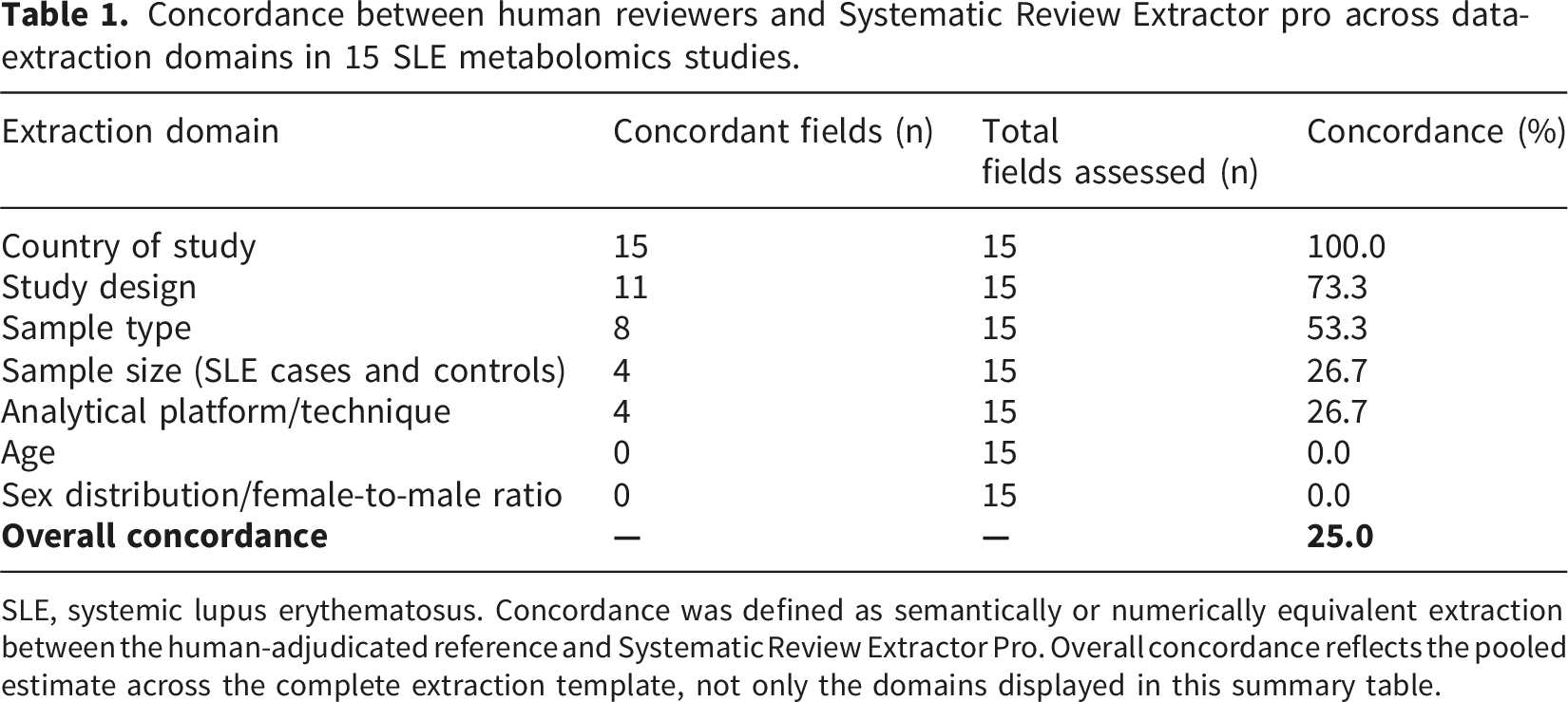
SLE, systemic lupus erythematosus. Concordance was defined as semantically or numerically equivalent extraction between the human-adjudicated reference and Systematic Review Extractor Pro. Overall concordance reflects the pooled estimate across the complete extraction template, not only the domains displayed in this summary table.
When pooled across all fields, mean concordance was 25.0%, indicating low overall agreement between GPT-based and human extractions. Discordance was concentrated in variables requiring interpretation of tables, figures, or supplementary materials: human reviewers consistently captured detailed participant-level data (e.g., age with dispersion measures, sex distribution, and case/control counts), whereas the GPT model frequently omitted or incompletely reported these values when they were not stated in continuous prose. In contrast, Systematic Review Extractor Pro performed better on higher-level methodological attributes (e.g., country, study design, sample type), supporting its potential role in semi-automated extraction of general study descriptors.
QUIPS risk-of-bias appraisal component
GPT-Reviewer successfully reappraised all 19 prognostic rheumatology studies drawn from the prior systematic review without technical failures, and the model produced complete QUIPS outputs with linked textual evidence (supporting quotes and location hints) for each domain. Agreement between GPT-Reviewer and the human reference standard varied across domains, as measured by weighted kappa. Weighted κ values indicated essentially no or slight agreement for study participation (κw = 0.001; 95% CI 0.000 to 0.002), study attrition (κw = 0.129; 95% CI 0.028 to 0.241), prognostic factor measurement (κw = 0.137; 95% CI 0.000 to 0.478), and outcome measurement (κw = 0.001; 95% CI 0.000 to 0.002), fair agreement for statistical analysis/reporting (κw = 0.286; 95% CI 0.161 to 0.322), and substantial agreement for study confounding (κw = 0.681; 95% CI 0.488 to 0.847).
Qualitative inspection of discrepancies showed two dominant patterns: (1) evidence relevant to a given QUIPS domain being confined to tables or figures that GPT-Reviewer either underused or misinterpreted, and (2) interpretive differences around decision rules, particularly in domains where judgments hinge on subtle distinctions between “Low” and “Moderate” risk of bias. Despite these limitations, the model consistently returned structured, domain-level judgments accompanied by traceable evidence, indicating that QUIPS-aligned prompting can standardize the format and transparency of LLM-generated appraisals even when agreement with expert raters is low to fair. Study-level comparisons between GPT-Reviewer and adjudicated human QUIPS ratings are presented in Supplementary File 3.
Time efficiency
For the data extraction component, manual extraction by experienced reviewers required a mean of 30.4 minutes per study (range 26–35 minutes), totaling approximately 7.6 hours for all 15 studies. In contrast, Systematic Review Extractor Pro completed data extraction in a mean of 5.67 minutes per study, for a total of about 85 minutes (Figure 1). A two-sample independent t-test confirmed that the difference in mean extraction time between human reviewers and the GPT-based model was statistically significant (p < 0.00001), indicating a marked efficiency gain with the GPT-based approach. Total data-extraction time for 15 SLE metabolomics studies: human reviewers (456 minutes) versus the customized GPT-based extractor (Systematic Review Extractor Pro; 85 minutes).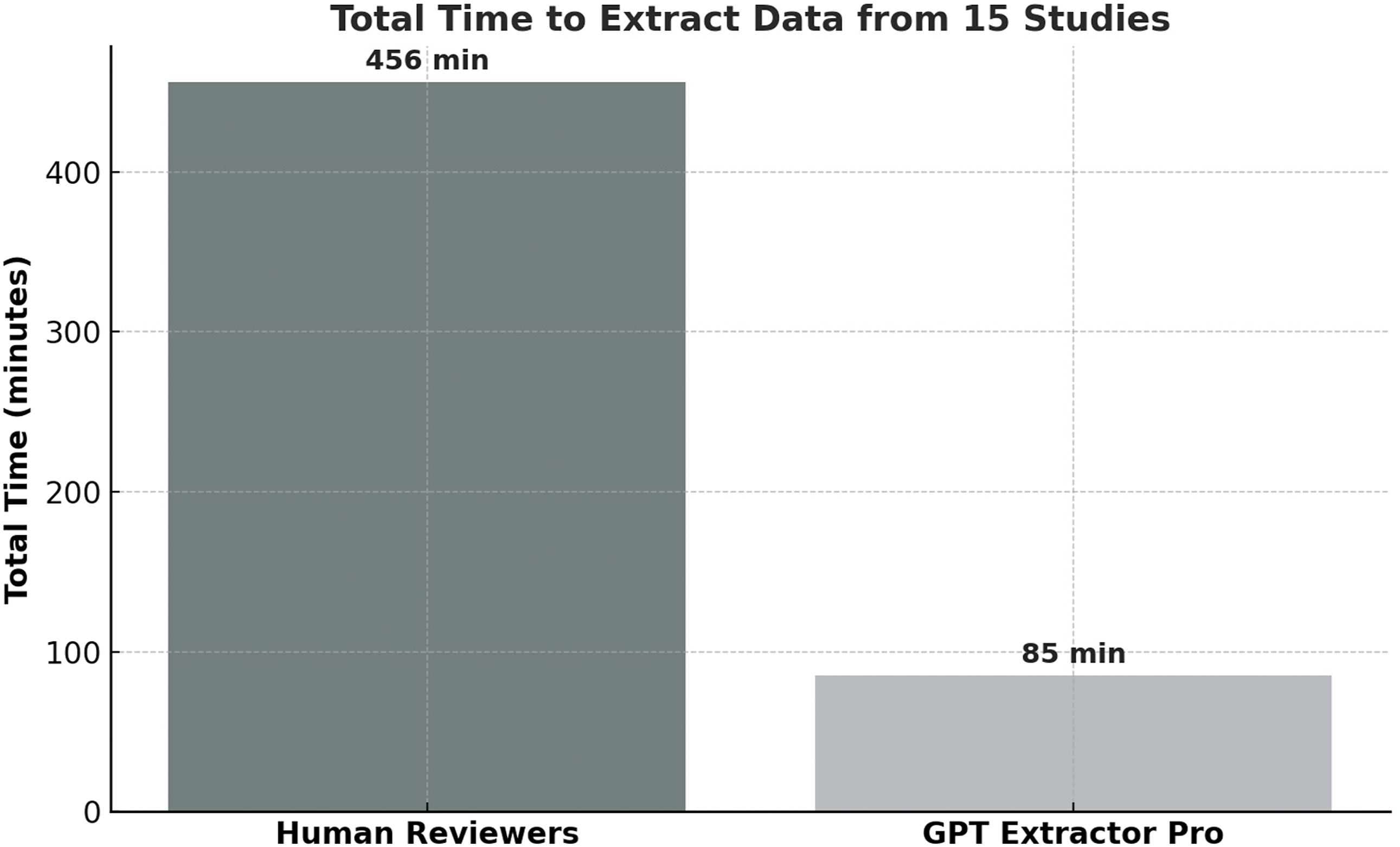
For the QUIPS appraisal component, all GPT-Reviewer runs were time-stamped, and descriptive tracking suggested potential efficiency gains when QUIPS assessments were conducted using LLM assistance plus targeted human verification, compared with human-only appraisal. However, formal paired time comparisons remain exploratory at this stage, and detailed time metrics are not reported here.
Discussion
This study evaluated a customized GPT-based tool (Systematic Review Extractor Pro) for automated data extraction in systematic reviews of metabolomic profiling in SLE. The model produced a five-fold reduction in extraction time compared with human reviewers. Still, concordance was limited for key clinical variables (sample size, age, and sex), particularly when information was embedded in tables or supplementary materials. In contrast, agreement was high for structural study attributes (e.g., country, design, sample type), suggesting greater utility for streamlining general descriptors than for numerically precise fields. In a parallel QUIPS evaluation, the customized GPT reviewer achieved transparent domain-level outputs, yet agreement with adjudicated human ratings ranged from essentially no agreement to substantial agreement, although most domains showed slight to fair agreement. Overall, these findings reflect both the promise and current constraints of LLMs for supporting systematic review workflows in the complex, heterogeneous literature on autoimmune diseases.
The domain-specific variability in concordance emphasizes differences in how LLMs handle narrative versus structured content. High agreement on general descriptors (e.g., country, design, sample type) suggests strong performance when information is presented in continuous text. In contrast, lower concordance for demographic and numeric variables reflects persistent difficulty extracting data from tables, figures, and supplementary materials, where clinically essential details are often concentrated. This pattern is consistent with prior work showing that LLMs excel at natural language comprehension but are less reliable for structured numerical extraction and fragmented reporting.28–30 Given that metabolomics studies commonly present dense tabular results and layered methods, our findings highlight the challenges of using general-purpose LLMs for extraction tasks requiring high numerical fidelity. 31
The marked reduction in extraction time highlights the potential of LLMs to streamline systematic review workflows. With an approximately five-fold decrease in time per study versus manual extraction, Systematic Review Extractor Pro could scale one of the most resource-intensive steps in evidence synthesis. Although concordance was lower for granular participant-level data, the model performed well for general study characteristics, supporting pragmatic use cases such as pre-screening, initial data structuring, and updating reviews, particularly for rapid or scoping reviews where speed is prioritized.26,32 Embedding these tools in human-in-the-loop pipelines, where reviewers verify and adjudicate extracted fields, may improve both throughput and consistency.33,34 Prior work similarly suggests AI-assisted review tools can reduce workload and screening time while maintaining acceptable reliability for higher-level study features.35–37
In contrast to its stronger performance for high-level study descriptors, the QUIPS analysis indicates current LLM limitations for nuanced risk-of-bias appraisal in prognostic research. Agreement between GPT-Reviewer and adjudicated human ratings was essentially absent or slight for study participation, study attrition, prognostic factor measurement, and outcome measurement; fair for statistical analysis/reporting; and substantial for study confounding, despite structured prompts and required justifications. While the model produced clear, QUIPS-aligned outputs, it struggled to integrate dispersed methodological cues across text, tables, and figures and to apply subtle decision thresholds. Accordingly, QUIPS appraisal remains a high-stakes interpretive task best supported, not replaced, by LLMs, which may be most helpful in structuring evidence, pre-populating rationales, or flagging domains for focused human review within a human-in-the-loop workflow.38–40
Systematic reviews of complex diseases such as SLE present unique challenges due to inherent clinical heterogeneity, fluctuating disease activity, and diverse phenotypic expression.6,7,41 The difficulty is further compounded when reviewing studies that employ high-throughput technologies such as metabolomics, which generate high-dimensional, multivariate datasets and often employ diverse analytical platforms, sample types, and statistical approaches.42,43 Synthesizing findings across such heterogeneous sources requires meticulous extraction of methodological and demographic details that are frequently embedded within complex tabular structures or supplementary materials. 4 In this regard, AI-driven tools like Systematic Review Extractor Pro may offer strategic advantages, 44 particularly in supporting the initial mapping of study characteristics, identifying methodological patterns, and flagging gaps in reporting. 10 As the field of precision medicine continues to expand, the application of natural language processing and LLMs in evidence synthesis holds promise for navigating the complexity of omics-based research in autoimmune diseases, facilitating more timely and scalable knowledge integration.45–47
This evaluation has several notable strengths. To our knowledge, it represents the first assessment of a customized GPT-based model for data extraction within a systematic review focused on metabolomics in SLE, a domain characterized by substantial clinical and methodological heterogeneity. The study also leveraged a predefined extraction template derived from a PROSPERO-registered review. 48 It adhered to PRISMA standards, ensuring methodological integrity and facilitating direct comparison between human and AI-based extraction outputs. Furthermore, by incorporating detailed time measurements, the study provides valuable empirical evidence of the efficiency gains achievable with LLMs.
Limitations
This study has several limitations. First, manual extraction and adjudicated human QUIPS assessments were treated as the reference standard. Although these procedures represent current best practice in systematic reviews, human reviewers are themselves subject to variability, interpretation differences, and extraction errors, which may have influenced the measured concordance between human and GPT-generated outputs. Second, this study was designed to evaluate agreement rather than accuracy. Adjudicated human assessments were used as the operational reference standard because no independent gold standard exists for many systematic review tasks, including data extraction and QUIPS-based risk-of-bias appraisal. Consequently, measures such as sensitivity, specificity, or area under the receiver operating characteristic curve were not applicable. The reported concordance and weighted kappa statistics should therefore be interpreted as indicators of agreement with expert reviewer judgments rather than objective measures of correctness. 49 Third, the evaluation was based on a relatively small sample of studies (15 metabolomics studies for data extraction and 19 prognostic studies for QUIPS appraisal). While sufficient for a methodological proof-of-concept, the sample size limits the generalizability of the findings to other disease areas, study designs, and systematic review contexts. Future studies should evaluate customized GPT-based tools across larger and more diverse datasets. Fourth, the customized GPTs were built on a general-purpose LLM rather than a model specifically trained for biomedical evidence synthesis. 50 Consequently, performance was lower for variables requiring interpretation of structured content, including numerical tables, figures, and supplementary materials. This limitation likely contributed to the reduced concordance observed for participant demographics, sample sizes, and other quantitative variables. Fifth, the dynamic nature of commercial LLM platforms presents challenges for reproducibility. The customized GPTs were accessed through the OpenAI ChatGPT environment, and model behavior may vary over time due to platform updates, model revisions, subscription-level access, system instructions, and session context. To reduce contextual carryover, each article was processed in a separate chat session using the same predefined configuration and instructions. Nevertheless, exact replication of outputs may not be possible as underlying models evolve. Sixth, LLM outputs should not be considered intrinsically authoritative. Although the models were restricted to the uploaded study documents and web browsing was disabled, LLMs are trained on large-scale heterogeneous datasets and may generate unsupported, inaccurate, or incomplete responses. Furthermore, the underlying training data of commercial models are not fully transparent and may contain inaccuracies, biases, or outdated information. 51 As a result, complete control over the provenance and quality of all knowledge incorporated into the model cannot be guaranteed. For this reason, all AI-generated outputs required human verification and adjudication.
Another important limitation relates to the use of online, commercial LLM-based systems rather than closed-loop, locally deployed AI models. Because general-purpose LLMs are trained on large-scale online data and operate within proprietary cloud-based environments, their outputs may be affected by training-data bias, unsupported inferences, hallucinations, and limited transparency regarding the provenance of generated content. In addition, online AI platforms may be less suitable for workflows involving sensitive or patient-level information because uploaded data may raise concerns regarding compliance with data protection laws and institutional governance requirements. Recent closed-loop AI models developed in pediatric rheumatology, including Morgaf for childhood-onset SLE, 52 and Maverik for childhood-onset chronic nonbacterial osteomyelitis, 53 illustrate an alternative approach in which data are processed offline or within restricted computer-based environments, without reliance on online databases or external conversational platforms. Such closed-loop models may offer advantages in data security, auditability, and protection from online data contamination or bias. Therefore, although customized GPT-based tools may support evidence-synthesis workflows using published literature, future applications involving sensitive clinical data should prioritize closed-loop, locally governed AI architectures with transparent validation, secure data handling, and human expert oversight. Seventh, internet connection speed and bandwidth were not formally measured during GPT evaluations. Although all analyses were conducted using a stable internet connection and no connectivity interruptions were observed, minor variations in network latency may have influenced recorded response times. Given the substantial difference between human and GPT-assisted extraction times, the impact of this factor is likely to have been minimal. Nonetheless, future benchmarking studies should consider recording network performance metrics to further enhance reproducibility. Additionally, generation parameters such as temperature were not directly accessible within the Custom GPT environment. Consequently, output variability attributable to platform-defined generation settings could not be formally controlled or evaluated. Finally, the extraction and appraisal workflows were not fully automated and required user involvement for sequential PDF uploads, template provision, prompt execution, and verification of outputs. These requirements highlight the continued importance of human–AI hybrid workflows and suggest that current customized GPT-based systems should be viewed as decision-support tools rather than replacements for trained systematic reviewers.
Conclusions
This two-part methodological study supports LLMs as complementary tools in systematic review workflows, particularly for accelerating the extraction of general study attributes and structuring risk-of-bias appraisals. Systematic Review Extractor Pro yielded substantial time savings and high agreement for structural descriptors, but performance was weaker for nuanced clinical variables drawn from complex tables, figures, and supplementary materials. Likewise, the GPT-based QUIPS reviewer produced transparent domain-level judgments. Yet, agreement with adjudicated human ratings ranged from essentially no agreement to substantial agreement, although most domains showed slight to fair agreement.
Future work should prioritize domain-specific optimization and improved interaction with structured content (e.g., table parsers and robust PDF-to-structured-data pipelines), within human-in-the-loop systems where outputs are routinely reviewed and adjudicated. Overall, while these tools cannot replace human expertise for high-stakes tasks, their standardization and time-saving potential support their integration into methodologist-supervised, semi-automated review pipelines.
Supplemental material
Supplemental material - Custom GPT models for complex rheumatology systematic reviews: A two-part evaluation of data extraction and prognosis appraisal
Supplemental material for Custom GPT models for complex rheumatology systematic reviews: A two-part evaluation of data extraction and prognosis appraisal by Pamela Munguía-Realpozo, Edith Ramírez-Lara, Claudia Mendoza-Pinto, Ivet Etchegaray-Morales, Juan Carlos Solis-Poblano, Marco Alejandro Trinidad-González, Jorge Ayón-Aguilar, Máximo Alejandro García-Flores and Álvaro José Montiel-Jarquín in Digital Health.
Supplemental material
Supplemental material - Custom GPT models for complex rheumatology systematic reviews: A two-part evaluation of data extraction and prognosis appraisal
Supplemental material for Custom GPT models for complex rheumatology systematic reviews: A two-part evaluation of data extraction and prognosis appraisal by Pamela Munguía-Realpozo, Edith Ramírez-Lara, Claudia Mendoza-Pinto, Ivet Etchegaray-Morales, Juan Carlos Solis-Poblano, Marco Alejandro Trinidad-González, Jorge Ayón-Aguilar, Máximo Alejandro García-Flores and Álvaro José Montiel-Jarquín in Digital Health.
Supplemental material
Supplemental material - Custom GPT models for complex rheumatology systematic reviews: A two-part evaluation of data extraction and prognosis appraisal
Supplemental material for Custom GPT models for complex rheumatology systematic reviews: A two-part evaluation of data extraction and prognosis appraisal by Pamela Munguía-Realpozo, Edith Ramírez-Lara, Claudia Mendoza-Pinto, Ivet Etchegaray-Morales, Juan Carlos Solis-Poblano, Marco Alejandro Trinidad-González, Jorge Ayón-Aguilar, Máximo Alejandro García-Flores and Álvaro José Montiel-Jarquín in Digital Health.
Supplemental material
Supplemental material - Custom GPT models for complex rheumatology systematic reviews: A two-part evaluation of data extraction and prognosis appraisal
Supplemental material for Custom GPT models for complex rheumatology systematic reviews: A two-part evaluation of data extraction and prognosis appraisal by Pamela Munguía-Realpozo, Edith Ramírez-Lara, Claudia Mendoza-Pinto, Ivet Etchegaray-Morales, Juan Carlos Solis-Poblano, Marco Alejandro Trinidad-González, Jorge Ayón-Aguilar, Máximo Alejandro García-Flores and Álvaro José Montiel-Jarquín in Digital Health.
Supplemental material
Supplemental material - Custom GPT models for complex rheumatology systematic reviews: A two-part evaluation of data extraction and prognosis appraisal
Supplemental material for Custom GPT models for complex rheumatology systematic reviews: A two-part evaluation of data extraction and prognosis appraisal by Pamela Munguía-Realpozo, Edith Ramírez-Lara, Claudia Mendoza-Pinto, Ivet Etchegaray-Morales, Juan Carlos Solis-Poblano, Marco Alejandro Trinidad-González, Jorge Ayón-Aguilar, Máximo Alejandro García-Flores and Álvaro José Montiel-Jarquín in Digital Health.
Footnotes
Acknowledgments
The authors acknowledge that generative artificial intelligence, customized GPT-based models built on OpenAI’s ChatGPT (Systematic Review Extractor Pro and GPT-Reviewer), was both the object and instrument of this research. As described in the Methods, these models supported study-level data extraction and risk-of-bias appraisal. All AI-generated outputs were independently reviewed and, when needed, corrected and adjudicated by the investigators; all final interpretations reflect human expert judgment. The authors designed the study and conducted the statistical analyses, and retain full responsibility for the content.

Author contributions
PMR and ERL contributed equally to this work. PMR, ERL, and CMP conceived and designed the study. PMR and ERL coordinated the systematic reviews, performed human data extraction and prognosis risk-of-bias appraisal, and managed the GPT-based tools. IEM contributed to study selection and data curation. JCSP, MAGF, and MATG performed the statistical analyses and contributed to the interpretation of agreement and efficiency results. JAA and AJMJ contributed to methodological input, interpretation of findings, and critical revision of the manuscript. All authors reviewed and approved the final version and are accountable for the work.
Funding
The authors received no financial support for the research, authorship, and/or publication of this article.
Declaration of conflicting interests
The authors declared no potential conflicts of interest with respect to the research, authorship, and/or publication of this article.
Data Availability Statement
Data are available upon reasonable request.
Provenance and peer review
Not commissioned; externally peer reviewed.
Supplemental material
Supplemental material for this article is available online.
References
Supplementary Material
Please find the following supplemental material available below.
For Open Access articles published under a Creative Commons License, all supplemental material carries the same license as the article it is associated with.
For non-Open Access articles published, all supplemental material carries a non-exclusive license, and permission requests for re-use of supplemental material or any part of supplemental material shall be sent directly to the copyright owner as specified in the copyright notice associated with the article.
