







Abstract
School counselling is a profession characterised by high emotional demands, with occupational stress contributing to risk of burnout, anxiety, and withdrawal from work. This study examined the mediating role of positive childhood experiences in the relationship between occupational stress, burnout, quiet quitting, and anxiety among school counsellors. Participants were 390 school counsellors in Türkiye, aged 20 to 53 years old (Mage = 31.21 years, SDage = 6.59 years; 60.8% female). Standardised psychometric scales were used to assess occupational stress, burnout, quiet quitting, anxiety, and positive childhood experiences. Mediation analyses indicated that occupational stress predicted burnout, quiet quitting, and anxiety. Most importantly, positive childhood experiences mediated these relationships. Specifically, higher levels of occupational stress were associated with lower levels of positive childhood experiences, which in turn were related to higher burnout. Greater quiet quitting, and increased anxiety. Findings imply the need to frame integrated policies to counter occupational stress and its psychological consequences among school counsellors and suggest the need to develop resilience to early childhood experiences.
Keywords
Introduction
School counsellors serve in a complex role that extends beyond students’ academic achievement to supporting their social-emotional and career development. They are tasked with responding to students’ emotional needs, providing support in times of crisis and promoting resilience, consequently their role is critical to shaping a positive school climate (Alexander et al., 2022; Eklund et al., 2020). Given these multifaceted responsibilities, school counsellors are exposed to sustained emotional labour, continuous crisis-driven demands, and relational strain, placing them at heightened risk for work-related stress. Understanding the factors that influence the well-being of school counsellors is therefore essential for both maintaining healthy school environments and effective student support systems.
Occupational Stress in School Counselling
Occupational stress refers to the physiological and psychological reactions that occur when there is an imbalance between workplace demands and the individual’s capacity and resources to meet those demands (Quick & Henderson, 2016). Among school counsellors, occupational stress is largely driven by systemic and institutional conditions that complicate and constrain their professional roles. Research indicates that both structural factors (e.g. excessive caseloads, administrative workload, policy pressures, and limited time or resources) and interpersonal factors (e.g. conflicts with students, parents, educators, and school leaders) contribute to stress, often in ways shaped by role ambiguity, differing values, and competing institutional priorities (Alzouebi et al., 2025; Deng et al., 2022).
In particular, vague job descriptions, role conflict, and excessive workload are the most frequently reported challenges faced by school counsellors (Harrison et al., 2023). They are often required to navigate competing expectations, serving simultaneously as academic advisers and mental health practitioners, administrators, and student advocates, which places them in complex and ethically demanding situations. Higher student-to-counsellor ratios and challenging socio emotional needs, exacerbated by limited resources, further contribute to occupational stress (Korkmaz et al., 2025; Rhames et al., 2025).
The expectations placed on school counsellors, combined with inadequate resources create significant challenges in maintaining professional boundaries (Hemi & Maor, 2023), while the assumption of additional duties beyond the core scope of counselling has been associated with demotivation and stress (Cruciani et al., 2024; Joseph, 2015). Over time, these competing demands can generate a persistent cycle of role ambiguity and heightened professional tension, contributing to elevated occupational stress (Maor & Hemi, 2021), and impede their ability to fulfil their professional responsibilities (Leslie & Oberg, 2025).
Burnout, Quiet Quitting and Anxiety
One of the most significant consequences of long-term occupational stress is professional burnout, especially within the context of high emotional labour and systemic barriers (Collett et al., 2024; Cooper et al., 2009; Gunduz, 2012; Kim & Lambie, 2018; Yıldırım et al., 2024). According to the latest ICD-11 definition, burnout is a syndrome resulting from unaddressed chronic workplace stress. It has three components: exhaustion, increased mental distance or cynicism about work, and reduced professional efficacy (Bianchi & Schonfeld, 2023; Bianchi & Sowden, 2024). The most widely cited model of burnout, identifies emotional exhaustion, depersonalisation, and a lack of personal accomplishment as its core components (Maslach & Jackson, 1981). School counsellors are threatened across three dimensions related to resource deficits, administrative stressors, and professional isolation (Mullen et al., 2017; Zabek et al., 2023). Research in school counsellors has shown that those with weak efficacy beliefs, reduced professional motivation, and dissatisfaction at work are particularly prone to stress, emotional exhaustion, and burnout (Bardhoshi, 2012; Bardhoshi et al., 2022; Lu et al., 2025; Şimşek & Dilekçi, 2025).
Although not unique to school counselling, quiet quitting is defined as gradual psychological disengagement accompanied by the completion of only minimal role requirements and is a potential long-term outcome of burnout and anxiety (Anand et al., 2024). Quiet quitting is characterised by reduced motivation, emotional distancing, and withdrawal from non-essential duties despite continued physical presence (Banerjee & Mehta, 2016). In the context of school counselling, quiet quitting may undermine the continuity and quality of psychological services, reflecting organisational pressures rather than individual shortcomings. High caseloads, administrative burden, and crisis-driven demands render school counsellors particularly vulnerable to emotional exhaustion, which constitutes the core dimension of burnout (Maslach & Jackson, 1981). Over time, this exhaustion may translate into disengagement behaviours associated with quiet quitting (Galanis et al., 2025; Serenko, 2024).
The Job Demands–Resources (JD-R) model offers a framework for understanding the process of quiet quitting, that is, excessive job demands coupled with insufficient resources increase strain and make emotional withdrawal more likely (Bakker & Demerouti, 2007). Research among teachers indicates that occupational stress is a significant predictor of quiet quitting (Dilekçi et al., 2025; Konal Memiş & Tabancalı, 2024). Therefore, given that school counsellors operate within the same high-pressure educational environments, with additional emotional labour, their vulnerability may be even greater. Motivational depletion and weakened professional identity reported in such contexts (Lawless, 2023) most likely jeopardise a counsellor’s sense of fulfilment and the quality of student support, underscoring the need for understanding the predictors of burnout and quiet quitting and informing clinical supervision, workloads, and staffing (Liu-Lastres et al., 2024).
Anxiety is a negative affective state dominated by feelings of inner tension and apprehension propelled by vague fear in the absence of a clear external threat (Crocq, 2015). For school counsellors, anxiety functions as a critical consequence of stress and a reinforcing factor that perpetuates the burnout cycle (Sun & Park, 2024). Clinical levels of anxiety have commonly been reported among educators demonstrating the detrimental impact of working in high-stress environments (Şahin et al., 2022). Anxiety is associated with work-related problems, such as heavy workloads, additional irrelevant tasks, unclear job roles, and lack of support and autonomy, which have potential to reduce confidence and induce stress (Bardhoshi & Um, 2021; Donald & Walter, 2022). Furthermore, in emotionally intense contexts such as those school counsellors are working in, heightened anxiety not only increases emotional fatigue but can trigger identity disruption and harsh self-judgment (Kim & Lambie, 2018).
Mediating Role of Positive Childhood Experiences
Early developmental experiences provide a useful framework for understanding responses to stress. While existing literature historically focussed on adverse childhood experiences (ACEs), there has been a growing emphasis on the long-term benefits of positive experiences during childhood (Bethell et al., 2019; Breedlove et al., 2021; Crandall et al., 2020; Kocatürk & Çiçek, 2023; Şanlı et al., 2024; Ünsal et al., 2025; Zyromski et al., 2022). Lifespan, developmental, and resilience theories highlight that supportive early environments help build core regulatory capacities, such as emotion regulation, coping flexibility, and stress appraisal, that continue to shape functioning into adulthood (Baltes et al., 1998; Cicchetti, 2016; Masten, 2001). Positive childhood experiences (PCEs) refer to a set of protective environmental factors that encompass secure early attachment relationships, emotional support, social acceptance, and a sense of psychological safety (Bethell et al., 2019; Çeri & Çiçek, 2021; Çiçek, 2025; Zyromski et al., 2022). PCEs therefore, can be viewed as early-life resources that potentially influence how adults manage chronic occupational stress, specifically, as resources capable of buffering avoidant workplace responses such as quiet quitting and promoting professional commitment and engagement (Crandall et al., 2020; Liu-Lastres et al., 2024). In line with the JD-R framework, PCEs may be conceptualised as individual-level personal resources that shape how one appraises, regulates, and copes with sustained occupational stress. Research supporting this notion has shown that individuals with higher levels of PCEs demonstrate stronger resilience and reduced susceptibility to emotional exhaustion (Bethell et al., 2019) and are more capable of coping with stress and emotion regulation (Conkey-Morrison et al., 2025).
It is plausible that PCEs are particularly relevant for school counsellors whose work involves continuous emotional labour and crisis management. However, despite working in challenging circumstances, facing heavy caseloads, systemic under-resourcing, and diminished organisational support, some school counsellors seem more robust to the experience of burnout and psychological distress. One reason for this difference might be the role of PCEs, which are increasingly important for building essential mental strengths like self-confidence, resilience, or self-assurance (Breedlove et al., 2021; Kocatürk & Çiçek, 2023; Narayan et al., 2018; Sciaraffa et al., 2018). PCEs may thus play an important role in mitigating occupational stress, burnout, and anxiety experienced by school counsellors.
Current Study
The present study investigated the relationship between occupational stress, burnout, quiet quitting, and anxiety in school counsellors. It also examined the buffering effect of PCEs on these negative psychological outcomes. Moreover, the present study’s particular emphasis on quiet quitting in the emotionally demanding and structurally challenging context of school counselling distinguishes the present study. Accordingly, three hypotheses were proposed:
The proposed mediation framework is presented in Figure 1.

Hypothesised research model.
Method
Design
The present study employed a cross-sectional design to investigate the mediating role of PCEs in the association between occupational stress, burnout, quiet quitting, and anxiety among school counsellors. Mediation analyses were conducted to evaluate whether PCEs, identified in previous literature as a protective factor (Bethell et al., 2019; Brown et al., 2022; Şanlı et al., 2024), buffer the impact of occupational stress on the outcome variables. This design allowed for the assessment of both direct and indirect pathways within a single time point.
Participants and Procedure
The study sample consisted of 390 school counsellors in Türkiye, including 237 women (60.8%) and 153 men (39.2%), with ages ranging from 20 to 53 years (Mage = 31.21 years, SDage = 6.59 years). Professional experience varied with 185 school counsellors (47.4%) having between 1 and 5 years of experience, 102 (26.2%) having 6 to 11 years, 72 (18.5%) having 11 to 16 years, and 31 (7.9%) having more than 16 years of experience as a school counsellor. Educational level varied with 29 counsellors (7.4%) working in preschools, 93 (23.8%) in primary schools, 155 (39.7%) in middle schools, and 113 (29.0%) in high schools. Although participants came from varied school levels and experience groups, the sample was non-probabilistic and should not be considered fully representative of all school counsellors in Türkiye.
Data were collected online between 20 January and 15 March 2025, using a Qualtrics-hosted an online survey. Recruitment comprised distribution of the survey links through social media platforms (e.g. WhatsApp and Instagram) and shared through professional school counsellor networks, regional guidance and counselling groups, and public counsellor communities. Participants were not personally known to the researchers, and no direct personal recruitment occurred. Although this method enabled wide geographic reach across multiple regions of Türkiye (e.g. Marmara, Central Anatolia, Aegean, Mediterranean, Eastern Anatolia, and South-eastern Anatolia), recruitment through social media introduces self-selection bias and limits generalisability. To enhance data quality, incomplete responses, duplicate entries, and cases failing attention-check items were removed prior to analysis.
Prior to data collection, ethical approval was obtained from the Bitlis Eren University Ethics Committee (Ethics Code: 2024/03-43). Participants were informed about the purpose of the study and the confidentiality of their personal information. No compensation was provided for participation.
Measures
Positive Childhood Experiences Scale (PCES)
The PCES (Bethell et al., 2019) is a unidimensional scale consisting of seven items. It is rated on a 5-point Likert scale ranging from 1 (Never) to 5 (Always) and does not include any reverse-scored items. The total scores range from a minimum of 7 to a maximum of 35. The scale is designed to measure individuals’ positive experiences prior to the age of 18. Higher scores indicate a greater number of PCEs. An example item is: “How often did you feel your family stood by you during difficult times?” The PCES was adapted to Turkish culture by Çi̇çek and Çeri̇ (2021). In the current study, the Cronbach’s alpha coefficient was found to be α = .86, indicating high internal reliability.
Perceived Occupational Stress Scale (POSS)
The POSS (Marcatto et al., 2022) consists of four items and uses a 5-point Likert scale ranging from 1 (Strongly disagree) to 5 (Strongly agree). The total scores range from 4 to 20, with higher scores indicating higher levels of perceived occupational stress. An example item is: “I feel under pressure at work.” The scale was adapted to Turkish culture by Yıldırım et al. (2024). In the current study, the Cronbach’s alpha coefficient was found to be α = .86, indicating high internal reliability.
Job-Related Emotional Exhaustion Scale (J-REES)
The J-REES (Wharton, 1993) is a unidimensional instrument to capture emotional exhaustion consisting of six items, rated on a 5-point Likert scale ranging from 1 (Strongly disagree to 5 (strongly agree). The total scores range from 6 to 30, and the scale does not include reverse-scored items. Higher scores indicate a higher level of job-related emotional exhaustion. An example item is: “I feel emotionally drained because of my job.” The Turkish adaptation was carried out by Günay (2021). In the present study, the Cronbach’s alpha coefficient was found to be α = .90, indicating excellent internal consistency.
Quiet Quitting Scale (QQS)
The QQS (Anand et al., 2024) consists of seven items under a single dimension and is designed using a 5-point Likert scale (1 = Never/Strongly disagree to 5 = Very often/Strongly agree). The total scores range from 7 to 35, with higher scores indicating a greater tendency towards quiet quitting behaviour. An example item is: “I often avoid working more hours if there is no additional pay.” The Turkish adaptation of the scale was conducted by Yıldız et al. (2024). In the present study, the Cronbach’s alpha coefficient was found to be α = .82, indicating satisfactory internal consistency.
Depression, Anxiety, Stress Scale (DASS-21)
The DASS-21 (Lovibond & Lovibond, 1995) contains 21 items divided into three subscales: depression, anxiety, and stress, each comprising seven items. Items are rated on a 4-point Likert scale ranging from 0 (Did not apply to me at all) to 3 (Applied to me very much or most of the time), with higher scores reflecting greater symptom severity. The Turkish adaptation of the scale was validated by Yılmaz et al. (2017). In the present study, only the 7-item Anxiety subscale was administered, as anxiety represents a core emotional outcome closely linked to occupational stress and aligns with the study’s hypotheses. Although depression and stress are theoretically related and often comorbid with anxiety, they were not included in the analysis to maintain a focussed model and reduce respondent burden. This decision is acknowledged as a limitation, as depression or stress scores may have served as relevant covariates given their conceptual overlap with anxiety. The Cronbach’s alpha coefficient for the Anxiety subscale in the present sample was α = .87, indicating satisfactory internal consistency.
Data Analysis
Data analysis in the study followed a two-step procedure. First, the normality of the variables, Cronbach’s alpha reliability coefficients, and correlations among variables were examined. In the second step, mediation analyses were conducted using PROCESS macro-Model 4 for SPSS (Hayes, 2022). Model 4 estimates both the direct and indirect effects within a mediation framework. Indirect effects were evaluated using 5,000 bootstrap samples, and bias-corrected 95% confidence intervals were computed to determine statistical significance. An indirect effect was considered significant when the confidence interval did not include zero.
Results
Preliminary Analyses
Initial checks showed that the study variables had a normal distribution, with skewness values between 0.08 and 0.64 and kurtosis values from −0.90 to −0.21, all of which are considered acceptable for normality (⩽ |2|) based on Kline (2005). Correlation analysis revealed a significant negative relationship between occupational stress and PCEs such that higher occupational stress was related to lower positive childhood experiences (r = −.36, p < .001).
Conversely, occupational stress was significantly and positively correlated with burnout, quiet quitting, and anxiety, such that higher occupational stress was associated with higher burnout ((r = .52, p < .001), greater quiet quitting (r = .33, p < .001), and higher anxiety (r = .27, p < .001). The associations among the study variables, together with their means, standard deviations, skewness and kurtosis values, and Cronbach’s alpha coefficients, are reported in Table 1.
Summary of descriptive statistics and correlation analysis results.
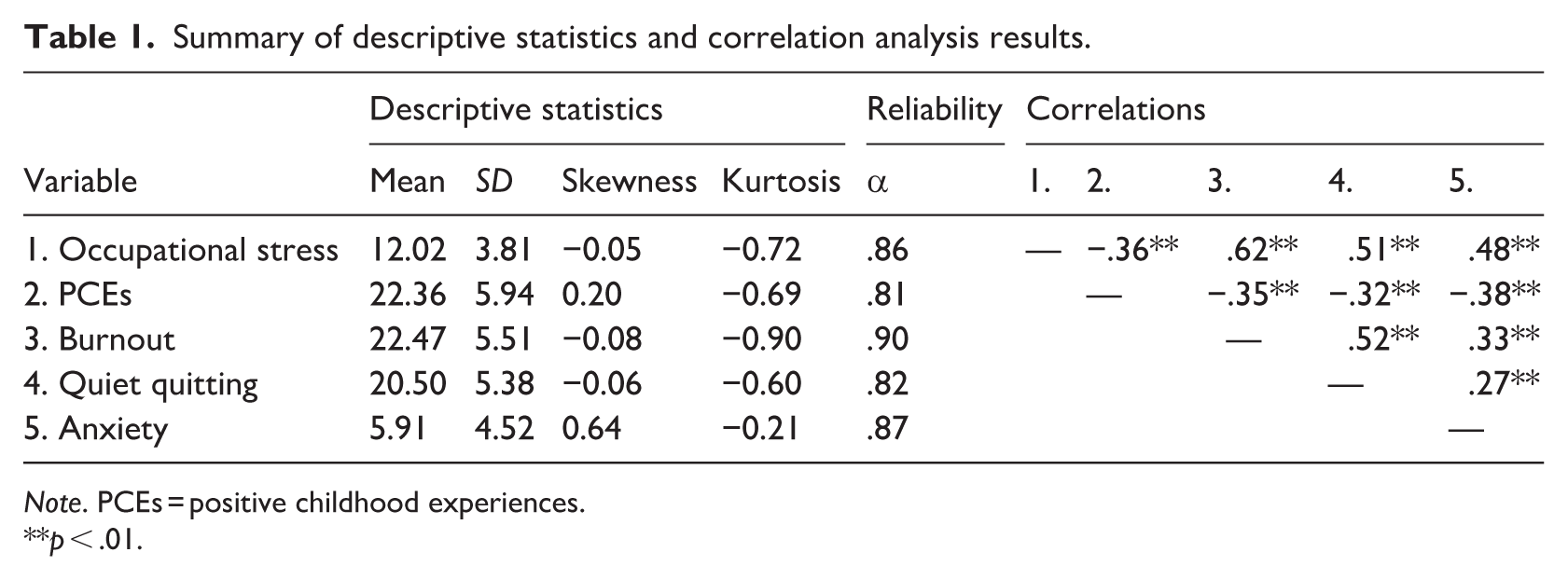
Note. PCEs = positive childhood experiences.
**p < .01.
Mediation Analyses
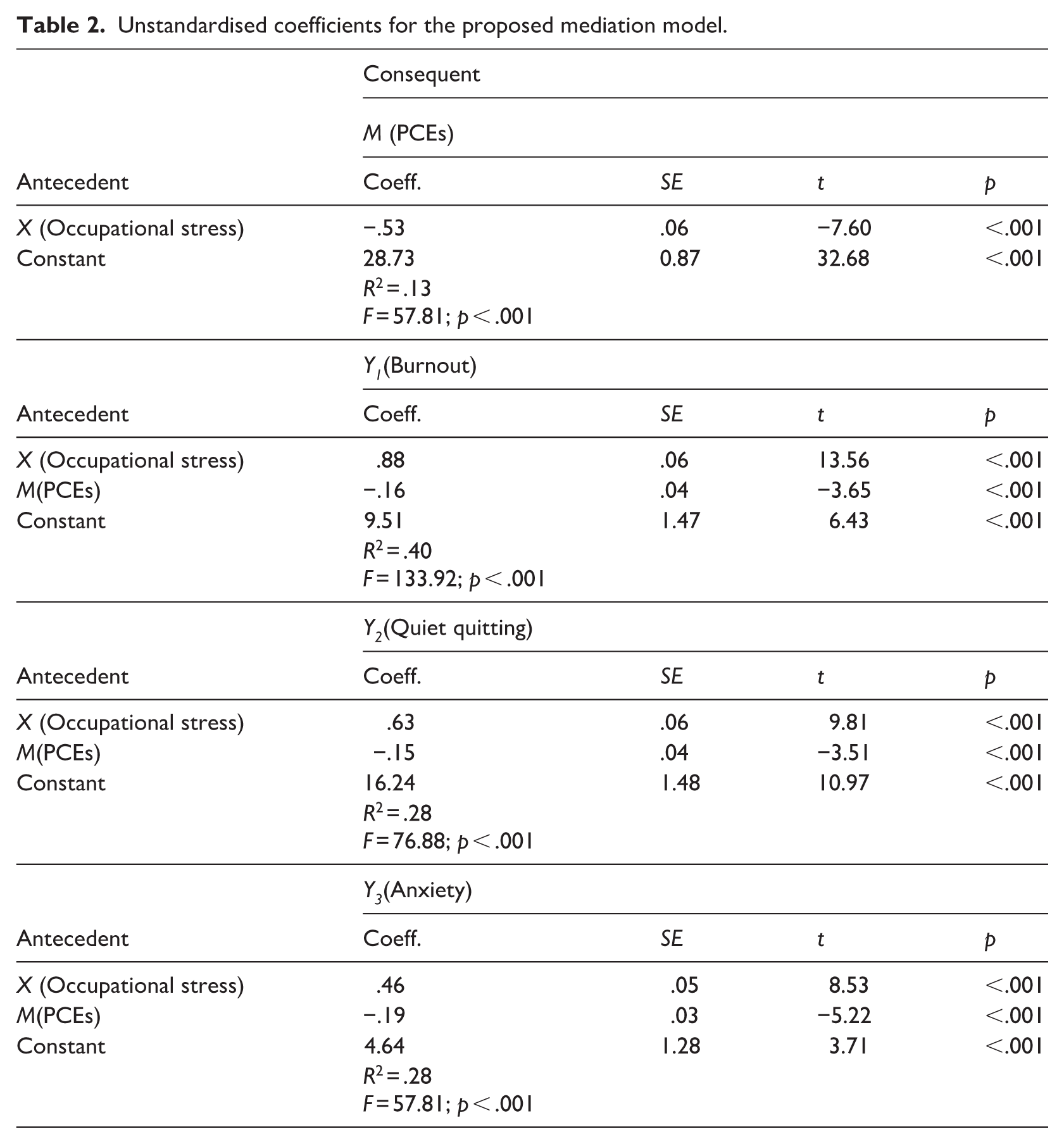
Separate mediation analyses were conducted to examine whether PCEs buffer the link between occupational stress, burnout, quiet quitting, and anxiety. The results are shown in Figure 2, Tables 2 and 3. As can be seen, occupational stress negatively and significantly predicted PCEs (β = −.35, p < .001), explaining 13% of the variance in PCEs. Additionally, occupational stress positively and significantly predicted burnout (β = .59, p < .001), quiet quitting (β = .48, p < .001), and anxiety (β = .41, p < .001). Furthermore, occupational stress together with PCEs explained 40% of the variance in burnout, 28% in quiet quitting, and 28% in anxiety.
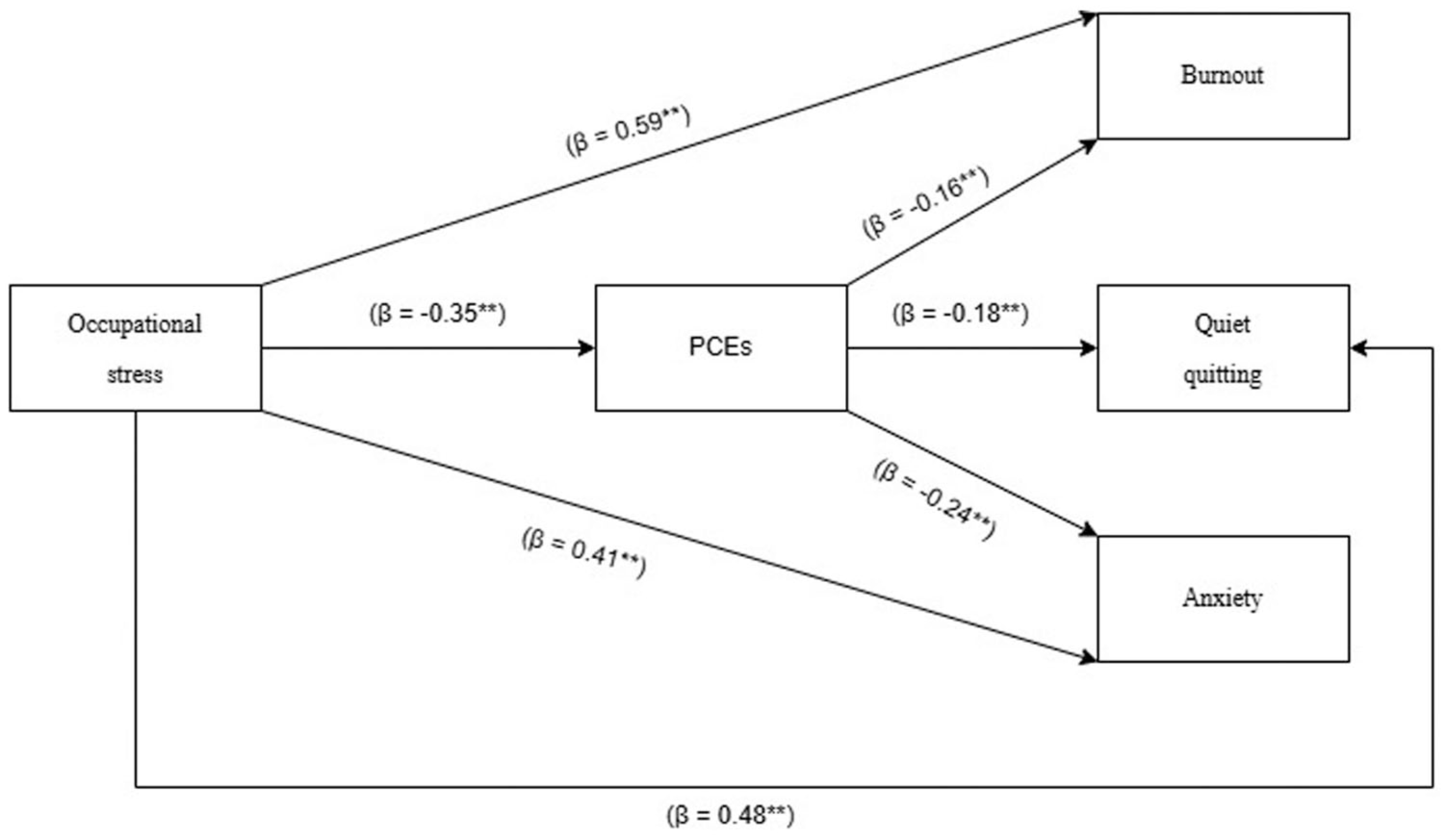
Mediation model.
Unstandardised coefficients for the proposed mediation model.
Mediation model path analysis.
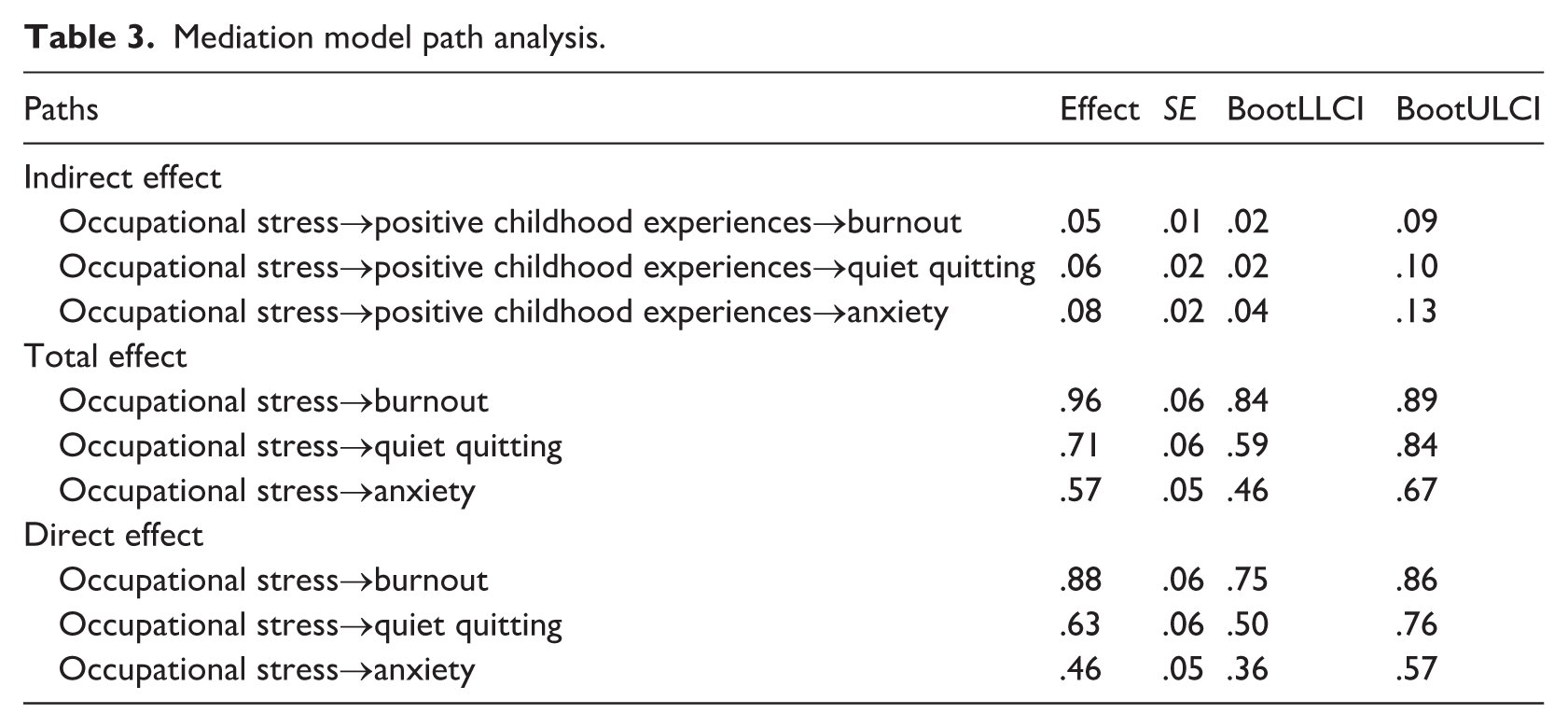
Finally, PCEs were found to mediate the relationships between occupational stress and burnout, quiet quitting, and anxiety. The indirect effects were significant for burnout (effect = 0.02, 95% CI [0.02, 0.09]), quiet quitting (effect = 0.06, 95% CI [0.02, 0.10]), and anxiety (effect = 0.08, 95% CI [0.04, 0.13]). The direct effect magnitudes indicate small-to-moderate effect sizes, consistent with recommended benchmarks for mediation effects. The direct effects of occupational stress on burnout (effect = 0.88, 95% CI [0.78, 0.86]), quiet quitting (effect = 0.63, 95% CI [0.50, 0.76]), and anxiety (effect = 0.46, 95% CI [0.36, 0.57]) was shown to be important (see Table 3).
Discussion
The current study examined the relationships between occupational stress, burnout, quiet quitting, and anxiety among school counsellors, and whether positive childhood experiences (PCEs) mediated these associations. The findings largely supported the proposed hypotheses, indicating that occupational stress was positively associated with burnout, quiet quitting, and anxiety, and that PCEs played a meaningful protective role within these relationships.
Consistent with
The associations observed between occupational stress and burnout are consistent with conceptual accounts indicating that higher levels of perceived stress are related to weaker professional identity and lower perceived competence and accomplishment (Bardhoshi et al., 2014; Maor & Hemi, 2021). Similarly, the positive association between stress and anxiety indicates that higher levels of occupational stress is linked to heightened emotional arousal and greater difficulty maintaining psychological balance (Şahin et al., 2022). Importantly, the present findings indicate that these outcomes co-occur within school counselling contexts, suggesting that occupational stress may be related a broader pattern of emotional and professional vulnerability rather than isolated difficulties.
Quiet quitting emerged as a salient behavioural factor associated with occupational stress. In the present study, higher stress was related to greater disengagement characterised by reduced discretionary effort and psychological withdrawal. This finding suggests that, for school counsellors, sustained stress may not only be associated with emotional exhaustion or anxiety but may also manifest in subtle forms of behavioural disengagement. Conceptually, quiet quitting may represent an adaptive attempt to conserve depleted emotional resources under chronic strain rather than a lack of commitment to professional values. This interpretation is consistent with prior work framing quiet quitting as a stress-related withdrawal response shaped by emotional fatigue and motivational depletion (Bernerth et al., 2011). By demonstrating this association within a counselling sample, the present study extends emerging quiet quitting research into emotionally intensive helping professions.
Support for
It is plausible that in emotional demanding professions such as school counselling, PCEs may function as enduring personal resources that shape how stress is appraised and regulated. Counsellors with higher PCEs may possess greater emotional stability, self-assurance, and relational security, which buffer against emotional exhaustion and anxiety while preserving engagement with professional roles. These findings support the conceptualisation of PCEs as developmental resources that continue to influence functioning well into adulthood, including within complex work environments (Baglivio & Wolff, 2021; Hings et al., 2024).
Consistent with
Although the mediation pattern was observed across all three outcomes, its functional implications may differ. For example, it is possible that positive childhood experiences relate differently to emotional and behavioural outcomes. They may be more closely associated with emotional depletion and heightened arousal in the case of burnout and anxiety, whereas they may relate to motivational withdrawal and psychological distancing in the context of quiet quitting. However, these interpretations are necessarily speculative, as the present study was not designed to test differential mechanisms across outcomes. Accordingly, these proposed distinctions should be interpreted with caution and remain to be examined in future research.
Practical Implications
The present results suggest that school counsellors who have more PCEs can better handle occupational stress, which may assist them to perform their jobs more easily. These findings highlight a clear developmental pathway through which early-life strengths translate into adult occupational resilience. In practice, this highlights the importance of support and training, rather than selection based on background characteristics. Professional development initiatives may benefit from incorporating reflective and trauma-informed components that help counsellors recognise how earlier experiences relate to current stress responses. Supervision and in-service training could place greater emphasis on emotional awareness, boundary setting, and strategies for managing sustained occupational strain. In addition, counsellors reporting greater difficulty coping with stress may benefit from structured supports, such as, peer consultation, or guided reflective practice. Overall, the findings underscore the value of organisational practices that proactively support counsellors’ psychological well-being in demanding school contexts.
Limitations and Future Directions
This present study has several limitations. First, the research exclusively involved school counsellors working in Türkiye, which limits the generalisability of the findings to school counsellors in other countries. Further studies using samples across different countries are required. Second, the data were based on self-reports, which may introduce social desirability bias and subjective perceptual errors. Future research could incorporate supervisor or peer evaluations or utilise multi-source data collection methods to improve the robustness of measurements. Additionally, participants’ potential recall bias and the way they remember their past experiences may have affected the reliability of the PCE’s measurement. To minimise such biases, future studies could utilise more in-depth data collection techniques, such as biographical narrative methods or projective narrative techniques. Third, given that anxiety, depression, and stress often co-occur, future studies should consider including the full DASS-21 (Depression, Anxiety, and Stress subscales) to capture a more comprehensive emotional profile.
Conclusion
The present study highlights the protective role of PCEs as individual resources that buffer the effects of occupational stress on burnout, anxiety, and quiet quitting among school counsellors. Counsellors with higher levels of PCEs demonstrated greater resilience and psychological well-being under demanding work conditions, underscoring the enduring influence of early life experiences on professional functioning. These findings have important implications for organisational practice, suggesting that training, supervision, and well-being initiatives may be strengthened by integrating reflective, resilience-building, and trauma-informed approaches that acknowledge counsellors’ developmental histories.
Footnotes

Ethical Considerations
The research was approved by Batman University Ethics Committee (Code: 2024/03-43). All procedures performed in studies involving human participants were in accordance with the ethical standards the 1964 Helsinki declaration and its later amendments or comparable ethical standards.
Consent to Participate
Informed consent was obtained from all individual participants included in in the study.
Consent for Publication
Participants were informed about the purpose of the study and the confidentiality of their personal information. No compensation was provided for participation.
Author Contributions
All authors contributed to the study conception and design. All authors performed the material preparation, data collection, and analysis. All authors read and approved the final manuscript.
Funding
The authors received no financial support for the research, authorship, and/or publication of this article.
Declaration of Conflicting Interests
The authors declared no potential conflicts of interest with respect to the research, authorship, and/or publication of this article.
Data Availability Statement
The data supporting the findings of this study have not been published or made publicly available. However, they are available from the corresponding author* upon reasonable request.