







Abstract
American public discourse about online misinformation often exaggerates its prevalence and persuasiveness, potentially harming Americans’ evaluations of democratic governance. This project uses two studies conducted during the 2020 and 2022 elections to test whether the presumed prevalence/persuasiveness of online misinformation (P3OM)—the perception that online misinformation is both widespread and persuasive—undermines Americans’ satisfaction with democracy. Fixed-effects regression analysis of an eight-wave online panel survey reveals that both dimensions of P3OM are correlated with reduced democratic satisfaction. A follow-up online survey experiment provides evidence that exposure to messages about online misinformation reduces democratic satisfaction. Theoretical implications and strategies for reducing the presumed influence of online misinformation on democratic satisfaction are discussed.
Keywords
Introduction
The volume of online misinformation in the lead-up to the 2016 US presidential election and the subsequent election of Donald Trump, who benefited from many of those online falsehoods, marked a watershed moment in American politics. The idea that election falsehoods could sway the electorate captured the imagination of the American media, politicians, and the public (Al-Rawi, 2019; Barthel, 2016; Mitchell & Walker, 2021). It also led to an avalanche of related research. Scholars investigated how online misinformation spreads on social media (e.g., Vosoughi et al., 2018), whether individuals are likely to believe it (e.g., Allcott & Gentzkow, 2017; Pennycook et al., 2021), and whether it influences voter behavior (e.g., Gunther et al., 2019). As this literature has grown, however, scholars have begun to question the popular American discourse about the prevalence and influence of online misinformation. Concerns expressed by policymakers and the public about online misinformation appear to exaggerate the risks described in the scientific literature (Altay et al., 2023; Hameleers, 2025; Jungherr & Schroeder, 2021; Mitchelstein et al., 2020). This leads us to posit that the presumed prevalence and persuasiveness of online misinformation among voters pose an equally important and often overlooked threat to American democracy.
In this article, we examine whether the presumed prevalence/persuasiveness of online misinformation (P3OM), particularly regarding elections, harms democracy by eroding individuals’ confidence in democratic governance. To answer this question, we pair an eight-wave longitudinal online panel survey (N = 670) with an online survey experiment (N = 2177) to test whether P3OM affects satisfaction with democracy. Fixed-effects panel-data regression reveals that P3OM is associated with reduced satisfaction with democracy, even after controlling for stable individual differences among participants. The follow-up planned contrast experiment provides evidence that exposure to messages about online misinformation leads to a decline in democratic satisfaction.
Online Political Misinformation: Dangerous Content or Exaggerated Concern?
In recent years, political and media discourse has been inundated with narratives about the prevalence and harmful effects of false and/or misleading online content on American politics and society (Altay & Acerbi, 2023; Hameleers, 2025; Nisbet et al., 2021). Online misinformation is seen as a significant problem by 71% of US journalists (Atske, 2022) and reporting about online misinformation has increased substantially. Between 2001 and 2009, approximately 170 news articles were published about fake news in the United States and the United Kingdom; between 2010 and 2017, this number increased to 1416 (Al-Rawi, 2019). A search of the Internet TV archive news database also shows a dramatic increase in TV news mentions of “misinformation,” “disinformation,” and “fake news.” In 2013, 3428 TV news clips in the archive had mentions of these terms, whereas in 2022, the number of TV news clips mentioning the same increased almost sixfold to 19,032 records, with the most dramatic rise occurring in 2017 after the 2016 presidential election (see Appendix A in supplementary materials; The Internet Archive, 2023).
Public opinion reflects this increased media coverage of online misinformation. In 2022, 70% of Americans saw the spread of misinformation online as a major threat (Silver, 2022). Policy attitudes also reflected the percentage of Americans who believed that either government or tech companies should restrict false information online, rising from 39% and 56% in 2018 to 55% and 65% in 2023, respectively (St. Aubin & Lipka, 2025). This anxiety about online misinformation has emerged even though firsthand exposure to political falsehoods on the Internet is rare (Allen et al, 2020; Budak et al., 2024; Hameleers, 2025). This suggests that a significant source of public fear about the prevalence and persuasiveness of online misinformation is news and public discourse (Altay & Acerbi, 2023; Jungherr & Rauchfleisch, 2024; Nisbet et al., 2021). 1
A body of academic scholarship supports concerns about the prevalence and harmful impacts of online political misinformation. Social scientists have shown that misinformation can spread quickly on Twitter and Reddit (Vosoughi et al., 2018), though whether truths or falsehoods spread more quickly may vary by platform (Bond & Garrett, 2023). Research on the illusory truth effect has shown that the more often one is exposed to misinformation, the more likely they are to believe it (Pennycook et al., 2018). Likewise, others have argued that misinformation influences political behaviors, such as voting behavior (e.g., Gunther et al., 2019; Weeks & Garrett, 2014)—although this scholarship often has weak to moderate leverage for making causal claims.
In contrast, most evidence suggests that online political misinformation is neither widespread nor substantially affects mass attitudes or behaviors (Altay et al., 2023; Budak et al., 2024; Hameleers, 2025). For example, although misinformation on the Internet has been in the spotlight for several years, “fake news” only accounts for 0.15% of the average American’s total media diet (Allen et al., 2020). This does not mean that Americans are never exposed to online misinformation. There is troubling evidence that a narrow fringe of the American public seeks out and is predisposed to believe such falsehoods (Budak et al., 2024). However, fixating on widespread exposure to misinformation online and assuming effects across large segments of the population is itself misleading and potentially harmful (Altay et al., 2023; Budak et al., 2024). Scholars have identified several factors that may contribute to this, including discursive (over)amplification by the media and elites, competing definitions of what constitutes online misinformation, greater vulnerability during high-salience periods such as elections, and individuals’ conflation of prevalence with influence (Hameleers, 2025).
Even when individuals are exposed to online misinformation, research indicates that persuasion is rare. Eady and his colleagues (2023), for instance, suggest that exposure to online misinformation during the 2016 election was concentrated among a subset of Americans, strong Republicans, and there was no meaningful evidence that exposure to Russian foreign influence campaigns influenced political attitudes or voting behavior. Additional empirical work has identified only a small, ideologically and demographically homogeneous portion of Americans who see or share most online political misinformation and are uniquely susceptible to it, suggesting that misinformation is ineffective at misleading most voters (Budak et al., 2024; González-Bailón et al., 2023; Guess, Nyhan & Reifler, 2020; Nelson & Taneja, 2018). 2 In summary, although there is considerable public concern about online misinformation among policymakers, journalists, and citizens, empirical research suggests that such misinformation is less prevalent and impactful than characterized in popular discourse. The perceived prevalence and persuasiveness of online political misinformation are frequently overestimated (e.g., Allen et al., 2020; Altay et al., 2023; Budak et al., 2024; Mitchelstein et al., 2020).
The question we address in this article is whether these (mis)perceptions about the prevalence and persuasiveness of online misinformation, especially in the context of elections, pose distinct risks to individuals and society.
Presumed Persuasiveness/Persuasiveness of Online Misinformation (P3OM)
The Influence of Presumed Influence (IPI) scholarship provides a framework for understanding the effects of perceptions of false or misleading online content (Altay & Acerbi, 2023; Baek et al., 2019; Gunther & Storey, 2003; Nisbet et al., 2021). Derived from the “third-person effect”—people’s tendency to perceive harmful content as more likely to impact others than themselves—IPI argues that media content indirectly influences individuals by shaping their reactions to its perceived harm on others (Davison, 1983; Gunther & Storey, 2003).
Historically, IPI scholarship has focused on the presumed influence of media content, such as pornography or negative political advertising (e.g., Cohen & Davis, 1991; Rojas et al., 1996). When content is viewed as harmful or undesirable, individuals are more likely to advocate censoring or limiting it (e.g., Rojas et al., 1996), even when they do not believe they are susceptible to such outcomes. More recently, IPI has been extended to online misinformation, including political content (e.g., Baek et al., 2019; Jang & Kim, 2018) and COVID-19-related content (e.g., Cheng & Luo, 2020; Matthes et al., 2022). Studies suggest that people overestimate the prevalence of, and/or susceptibility to, online misinformation (Altay & Acerbi, 2023; Hameleers, 2025; Jang & Kim, 2018; Oktavianus & Meng, 2024) and this presumed influence of online misinformation has (harmful) attitudinal effects even among those who are not directly exposed to it or reject it as a false (Hameleers, 2025; Matthes et al., 2022; Nisbet et al., 2021).
Building upon the IPI framework and related scholarship (e.g., Altay & Acerbi, 2023; Nisbet et al., 2021), we propose that perceptions of the threat to society posed by misinformation can be understood through the lens of the Presumed Prevalence/Persuasiveness of Online Misinformation (P3OM). Two sets of perceptions predict whether content will influence attitudes and behaviors via the IPI: (1) how likely people are to be exposed to harmful content (i.e., prevalence) and (2) how likely exposure will lead to undesirable or harmful attitudes or behaviors (i.e., persuasiveness) (Tal-Or et al., 2010). Building on this scholarship, we define P3OM as having two dimensions. The first is the perceived prevalence of online misinformation in the information environment, which increases the likelihood of exposure to inaccurate information and diminishes the proportion of available accurate information (Freiling et al., 2023; Matthes et al., 2022; Oktavianus & Meng, 2024). The second dimension is its perceived persuasiveness, whether individuals believe that the attitudes or behaviors of imagined “others” are influenced by online misinformation (e.g., Altay & Acerbi, 2023; Baek et al., 2019). By distinguishing between prevalence and influence, our conceptual framework deliberately avoids conflating these dimensions in the discourse about online misinformation (Hameleers, 2025).
P3OM and Satisfaction with Democracy
Although research on the presumed influence of online misinformation has primarily focused on outcomes such as support for regulations or censorship (e.g., Baek et al., 2019; Jang & Kim, 2018), we posit that P3OM has the potential to have second-order effects with broader social significance. For example, Matthes and his colleagues (2022) found in a cross-national study that the (mis)perception that many people were swayed by online COVID-19 misinformation heightened pandemic-related worry and made it harder for authorities to slow the spread of the disease.
We assert that the presumed influence of online political misinformation may have similar second-order effects, especially in the context of elections, by altering individuals’ satisfaction with democracy. Democratic satisfaction does not refer to a set of democratic “values,” but rather how well people think democracy works and whether it functions effectively as a form of political decision-making (Anderson & Guillory, 1997; Linde & Ekman, 2003). This satisfaction underpins the perceived legitimacy of a democratic regime. It provides a reservoir of support that democratic governments can draw on during times of crisis or hardship (Tyler, 2006).
Free and fair elections are a key factor promoting democratic satisfaction and the perceived legitimacy of a democratic regime (Norris, 2019). Public perceptions of the procedural fairness of political decision-making (e.g., via voting) and governance have an independent effect, beyond the outcome, on how citizens evaluate the performance of the political system (Erlingsson et al., 2014; Magalhães, 2016; Norris, 2019; Rhodes-Purdy, 2020). Even if citizens have little direct control over politicians’ decisions, the electoral process symbolizes that their voices are heard and increases perceived fairness and support (Lind et al., 1990). However, just as faith in the fairness of electoral procedures and decision-making contributes to the perceived legitimacy of democratic governance, the breaking of this faith weakens democracy. For instance, electoral misconduct may negatively impact attitudes regarding the functioning of democracy (Fortin-Rittberger et al., 2017).
Based on this understanding of procedural legitimacy, we assert that elevated levels of P3OM may undermine confidence in the fairness and effectiveness of voting, for example, as a means of democratic decision-making. Prior scholarship, for example, has shown a positive association between access to accurate political information and a more positive perception of election quality (Cho & Kim, 2016). Conversely, heightened awareness of online misinformation can lead individuals to believe other voters are being misled, creating uncertainty about whether democracy is functioning correctly or fairly (Nisbet et al., 2021). Two recent studies manipulating concern about political misinformation showed that greater concern dampened democratic satisfaction among respondents (Jungherr & Rauchfleisch, 2024; Ross et al., 2022). However, neither study evaluated the theoretical basis for how concern may influence democratic satisfaction, which we argue is P3OM (see also Altay & Acerbi, 2023).
In sum, individuals with elevated P3OM levels perceive online misinformation as prevalent, persuasive, or both. These misperceptions undermine perceptions of democratic decision-making fairness, thereby reducing satisfaction with democracy as a form of governance. These arguments culminate in two predictions, corresponding to the two dimensions of P3OM: (H1) greater perceived prevalence of online misinformation and (H2) greater perceived persuasiveness of online misinformation on others are both associated with less satisfaction with democracy.
We use two studies to evaluate these hypotheses. First, we conducted an eight-wave panel study during the 2020 US Presidential election to assess the relationship between the two dimensions of P3OM and democratic satisfaction. Second, as an initial evaluation of the causal nature of the proposed relationship, we conducted a planned contrast experiment in which we manipulated P3OM levels among participants to assess how its dimensions influence democratic satisfaction relative to a baseline control condition.
Study 1
The panel study was administered by YouGov, a professional survey organization that maintains an opt-in online survey panel of adults. YouGov invited 1780 participants from its US panel in September 2020 to participate in this study; 1400 completed the first wave, yielding a 78% participation rate. Participants were surveyed across eight waves, every three weeks from September 2020 to January 2021, with a 48% retention rate. A total of 672 respondents completed all eight waves of the panel. The panel survey included recruiting new panelists in wave six of the study. However, only panelists who completed all eight waves were included in the analysis to mitigate potential bias from uneven panel attrition.
YouGov constructed a matched sample by drawing a representative stratified quota sample from census data corresponding to the target population, in this case, Americans over 18, then for each member of the target sample, YouGov selects one or more matching members from its pool of opt-in respondents. This matched sample mirrors a representative sample by replicating the properties of a true random sample, thereby enhancing the external validity and generalizability of any conclusions drawn from this study regarding the indirect impact of online misinformation (Rivers, 2007). Descriptive statistics and attrition rates for each wave are included in Appendix B of the supplementary materials.
Measurement
Our approach to measuring the presumed influence of online misinformation operationalizes both its perceived prevalence and persuasiveness. (The complete question wording for all items is provided in Appendix C of the supplementary materials.) Our survey items did not explicitly specify the mode of misinformation exposure, as public discourse during both election periods overwhelmingly associated “misinformation” with social media and online circulation. In Study 2, this is not a concern, as the stimulus materials explicitly focused on online misinformation.
The perceived prevalence of online misinformation in each wave of the survey was assessed by asking participants to rate how widespread misinformation had been to date during the election. We took this approach because actual exposure to online misinformation is rare and affects only a small percentage of US Internet users (Altay et al., 2023; Budak et al., 2024). Thus, we ask respondents for their overall evaluation of prevalence, as it is mainly driven by availability heuristics derived from the salience of the topic in media and public discourse, rather than perceived direct exposure (Nisbet et al., 2021; Oktavianus & Meng, 2024). We also include in the analysis a second question measuring perceived personal exposure to misinformation as a control variable.
Building on prior scholarship, we measured the persuasiveness of political misinformation on others and the self (e.g., Baek et al., 2019; Rojas et al., 1996). We repeated the same battery of four survey items twice, once concerning oneself and once concerning others. We constructed a pair of indices by averaging the four items. Including the two control measures of self-exposure and perceived influence on self means that the coefficients of interest for perceived prevalence and persuasiveness on others are estimated net of respondents’ own perceived exposure and susceptibility, thereby isolating the effects of (P3OM as distinct from perceived effects on oneself. We also included ideology in our analyses by averaging three items that tapped its political, social, and economic dimensions. The outcome variable in this analysis is democratic satisfaction. This measure is an indicator of a generalized attitude toward the legitimacy of the democratic system or the level of support for how democracy works in practice (Kornberg & Clarke, 1994; Linde & Ekman, 2003). Following prior large-scale survey studies (e.g., World Values Survey, Eurobarometer, and American National Election Studies), we used a single-item measure: “How satisfied or dissatisfied are you with the way democracy is working in the United States today?” The descriptive statistics for all focal variables across all survey waves are provided in Appendix C of the supplementary materials.
Analysis
We assess our hypotheses using a fixed-effects regression model (Allison, 2009) implemented in the R package “plm” (Croissant & Millo, 2018). This is a powerful method for assessing panel data in the social sciences, enabling inference despite the lack of random assignment (Allison, 2009; Halaby, 2004; Hausman & Taylor, 1981). By analyzing within-respondent changes over time, fixed-effects models treat unobserved variables as stable parameters, thereby controlling for their influence on the estimates. Model coefficients for fixed-effects models can be interpreted as describing the change in the outcome variable associated with a one-unit change in the predictor, holding constant all stable respondent characteristics. Fixed-effects models cannot estimate the effects of time-invariant variables; therefore, time-invariant controls are excluded from the model. Instead, they are controlled by holding all unobserved variables stable. Our fixed-effects model assesses whether each dimension of P3OM is negatively associated with democratic satisfaction in the months leading up to the 2020 election and in the months immediately after.
Given the ideological asymmetry in content and exposure to online misinformation (Garrett & Bond, 2021; González-Bailón et al., 2023), the study included a time-invariant measure of ideology (measured at Wave 1) as a potential moderator of the effects of perceived persuasiveness and prevalence of online misinformation on democratic satisfaction.
Results
The model encompasses both dimensions of P3OM, namely perceived prevalence of misinformation and perceived persuasiveness of others, and it controls for perceived persuasiveness of misinformation for the self and perceived self-exposure to misinformation (see Appendix D supplementary materials). Results show that both P3OM coefficients are significant and negative. In other words, the perceived prevalence of online misinformation (b = −10, p = .003) and the perception that others are more persuaded by online misinformation than the individual (b =−.13, p < .001) are both negatively correlated with democratic satisfaction during the 2020 election (see Figure 1). These results are consistent with H1 and H2.
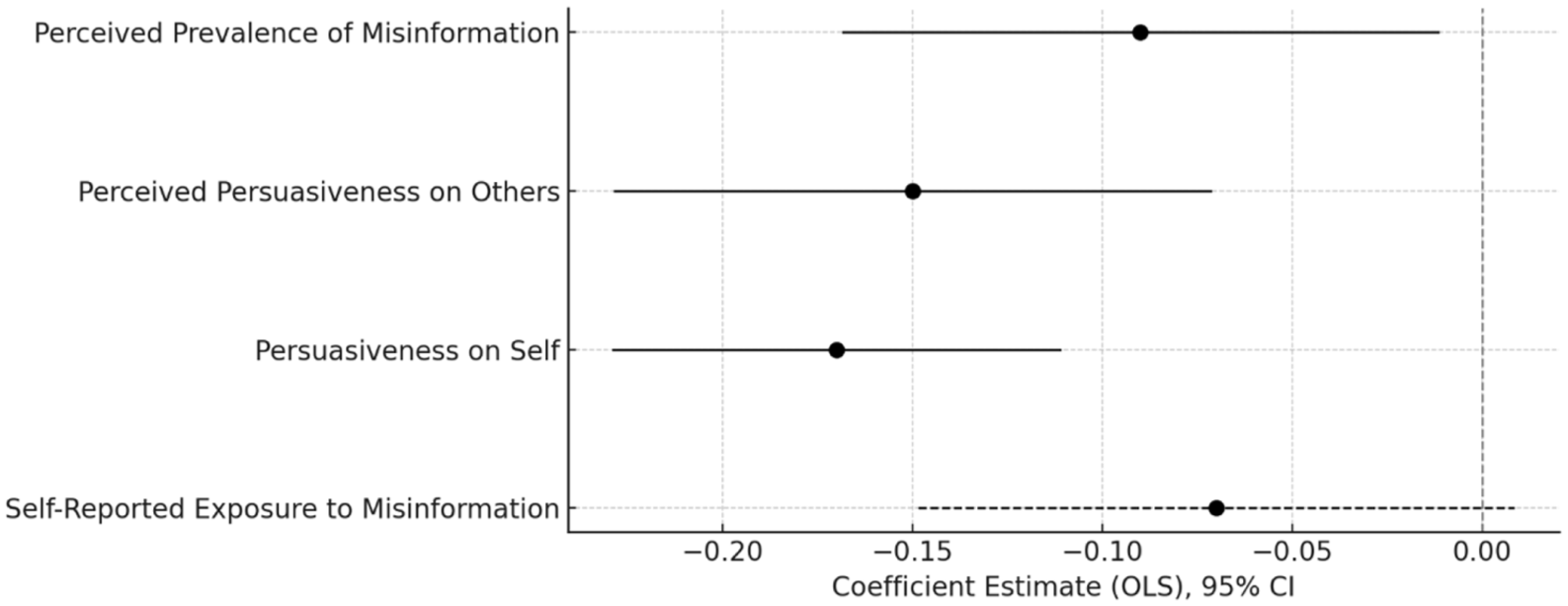
Study 1 fixed effect model predicting satisfaction with democracy (within effects).
We also find that these relationships are contingent on political ideology. The perceived persuasiveness of online misinformation on others is associated with a decrease in democratic satisfaction for both moderates (simple slope = −0.09, p < .05) and liberals (simple slope = −0.25, p < .001), but not for conservatives (simple slope = .08, p = .144). As the perceived persuasiveness of online misinformation on others increases, both moderates and liberals experience a relative decline in satisfaction with democracy relative to their individual means. For conservatives, however, these perceptions are not statistically significantly associated with democratic satisfaction. The results are visualized in Figure 2.

Study 1 fixed-effects model of interaction between ideology and perceived persuasiveness of online misinformation on others.
Study 1
Discussion
Over several months of the 2020 US Presidential election, changes in participants’ P3OM were negatively correlated with democratic satisfaction, especially among moderates and liberals. In other words, a participant who perceived misinformation was more prevalent and/or persuasive on others than on themselves from one wave to the next, expressed a corresponding decrease in their satisfaction with American democracy. This is consistent with our claim that P3OM has the potential to sow doubt about the legitimacy of democratic governance itself.
The panel design, however, is limited by its reliance on self-reported perceptions. Policy and media discourse on online misinformation often conflates prevalence and persuasiveness, thereby blurring the distinction between these two factors in participants’ minds.
More importantly, although fixed-effects regression provides strong protection against bias from stable individual characteristics (because individuals are compared to themselves over time) it does not rule out the possibility of reverse causality. Declining satisfaction with democracy may contribute to the perception that misinformation is both more prevalent and more persuasive. The ecological validity of panel studies also comes at the cost of control.
Study 2
Design and Procedure
Study 2 advances our understanding of causal prediction by evaluating whether manipulating perceptions of the prevalence and/or persuasiveness of online misinformation affects democratic satisfaction relative to a no-message control. The online experiment employed a 2 (prevalence: high vs. low) × 2 (persuasiveness: high vs. low) between-subjects factorial design, along with a control baseline condition in which no stimulus was presented. We constructed a series of infographic-style messages that varied the extent to which online political misinformation was depicted as prevalent and/or persuasive, and we administered the five-condition experiment online. Although the message conditions were structured in a factorial design, our analytic strategy was guided by theory-driven directional hypotheses rather than by an interest in estimating all possible main effects or interactions. Following Study 1, we hypothesized that participants assigned to message conditions that communicate (H1) that online misinformation is highly prevalent and/or (H2) that it is highly persuasive would report lower satisfaction with democracy than participants in the control group. Building on the first study, we also proposed a third hypothesis (H3): that exposure to a message indicating that online misinformation is neither prevalent nor persuasive would enhance confidence in democratic decision-making and thus increase democratic satisfaction relative to the baseline.
To evaluate these predictions, we conducted a series of planned directional contrasts comparing each experimental condition to the control group. Planned contrasts are appropriate when the goal of an experiment is to test specific predictions, as in this case (Kirk, 2019). The four contrasts assess whether perceived prevalence alone, perceived persuasiveness alone, their combination, or reassurance messaging (characterized by low prevalence/low persuasiveness) affects democratic satisfaction, each addressing a distinct prediction derived from our theoretical framework and panel study findings.
Following standard practice (Kirk, 2019; Rosenthal & Rosnow, 2008; Wickens & Keppel, 2004), we treated each planned contrast as the unit for Type I error control and did not apply family-wise corrections, consistent with recommendations for theory-driven designs. This approach aligns with our focus on four a priori contrasts versus all possible pairwise comparisons. We also report additional exploratory post hoc analyses to aid interpretation.
Data were collected in October 2022, shortly before the 2022 US midterm elections. Although concern about misinformation had declined modestly since 2020, a large majority of Americans (74%) still considered misinformation a “major problem” (AP-NORC Poll, 2020, 2022). The experiment was conducted with a diverse sample of adults (N = 2177) residing in the United States, recruited from an opt-in panel provider subcontracted through the survey firm Qualtrics. Quota sampling was employed to ensure the sample was representative of the US population with respect to race, age, gender, and educational attainment. The Internal Review Board of [redacted university] reviewed and approved the study protocol.
After obtaining consent, we randomly assigned participants to one of the five conditions (n = 650 per condition). After attention and comprehension checks, 2177 participants completed the study (see Table G2 in the supplementary materials). We manipulated the perceived prevalence and persuasiveness of online political misinformation during elections by presenting participants with an infographic to review. We varied the information presented in the infographics by characterizing online election misinformation as rare or widespread and by assessing whether it influences voters. This information was conveyed in both text and graphics (see Appendix E in supplementary materials). We also varied whether the prevalence or persuasiveness of misinformation was mentioned first—a form of stimulus sampling—to guard against ordering effects. Participants in the control condition did not view the infographic and proceeded directly to the questionnaire.
After exposure to the stimuli, participants answered a series of questions about the perceived prevalence and persuasiveness of online misinformation (a manipulation check) and about their satisfaction with American democracy. All participants completed a general attention check. Only participants in the stimulus conditions received a comprehension screen for the infographic to ensure induction. Finally, participants were debriefed using a message that included accurate information about the low prevalence and persuasiveness of online misinformation.
Measurement
Measures of prevalence and persuasiveness of online misinformation were employed to assess the strength of the experimental manipulation. The perceived prevalence of online political misinformation was measured more comprehensively in Study 2 than in Study 1, which combined three survey items into an overall index (M = 3.68, SD = 0.95, α = 0.83). Persuasiveness of online misinformation on self and others was assessed in the same manner as study 1, averaging agreement to four statements about electoral misinformation five-point Likert-type scale (persuasiveness on others: M = 4.10, SD = 0.87, α = 0.92; persuasiveness on self: M = 3.5, SD = 1.08, α = 0.93). The complete wording of all questions is provided in Appendix F of the supplementary materials. The outcome variable in this analysis is democratic satisfaction, measured as in Study 1 (M = 4.00, SD = 1.80). Beyond these focal variables, our questionnaire also included a three-item ideology measure like that used in Study 1 (M = 3.9, SD = 1.6, α = 0.96), as well as several other sociodemographic control variables, including age, sex, race, and education (see Table G1 for their descriptives).
Manipulation Check
We first conducted one-way analyses of variance (ANOVAs) and confirmed that our manipulations were partly successful. Results show that perceived prevalence of online misinformation (F(4, 2170) = 21.88, p < .001) and perceived persuasiveness of online misinformation on others (F(4, 2170) = 6.85, p < .001) differed significantly across the four stimulus conditions and the control. The manipulations, however, accounted for only 3.9% of the variance in perceived prevalence and 1.2% of the variance in perceived persuasiveness of others.
The manipulation of perceived prevalence was generally successful (see Figures H1 and H2 in Supplementary materials). Participants in the high-prevalence conditions perceived online misinformation as more prevalent than those in the control group, with the high-prevalence/high-persuasiveness condition producing the largest increase. However, the perceived prevalence in the high-persuasiveness/low-prevalence condition did not differ significantly from the control. The manipulation of perceived persuasiveness was partially effective. Perceived persuasiveness increased in the low-prevalence/high-persuasiveness and high-prevalence/high-persuasiveness conditions relative to the control group. In contrast, the two low-persuasiveness conditions, low prevalence/low persuasiveness and high prevalence/low persuasiveness, did not differ significantly from the control. Overall, these results indicate that the manipulations were more effective in increasing perceptions of prevalence and persuasiveness than in reducing them below baseline levels.
As an additional check, we evaluated whether there was significant variation across our experimental conditions in selected sociodemographic variables (age, gender, educational attainment, race, and ideology; see Table G2 in the supplementary materials for the distribution of these variables across conditions). Analysis revealed a small but significant variation in gender (male) (χ2(4, 2177) = 12.61, p < .05) and participants’ age (F(1, 2170) = 3.23, p < .05) across the conditions. To ensure that minor differences did not influence the results and to control for the influence of ideology in the moderation test, we included controls for age, gender, education, and race (white) in all models.
Results
We assess our hypotheses using planned contrast analysis, regressing democratic satisfaction on dummy variables for the four stimulus conditions, with the baseline control condition as the contrast, while including age and gender as covariates. The results of our OLS regression analysis are presented in Figure 3 (see also Table I1 in the supplementary materials). 3 As expected, participants in the low-persuasiveness/high-prevalence and high-persuasiveness/high-prevalence conditions reported significantly lower levels of democratic satisfaction compared to the control condition (b = −.26, p = .027 for low-persuasiveness/high-prevalence and b = −.26, p = .032 for high-persuasiveness/high-prevalence), supporting H1 and partially supporting H2. The coefficient for the high-persuasiveness/low-prevalence condition was negative but not significantly different from the control (b = −.15, p = .226). The democratic satisfaction of participants in the low-persuasiveness/low-prevalence condition differed significantly from that in the control condition, but in the opposite direction from that predicted (b = −0.38, p = .003), failing to support H3. As a replication of Study 1, we also tested whether ideology moderated any of the treatment conditions (see Model 2 in Table I1); however, none of the interactions were significant.
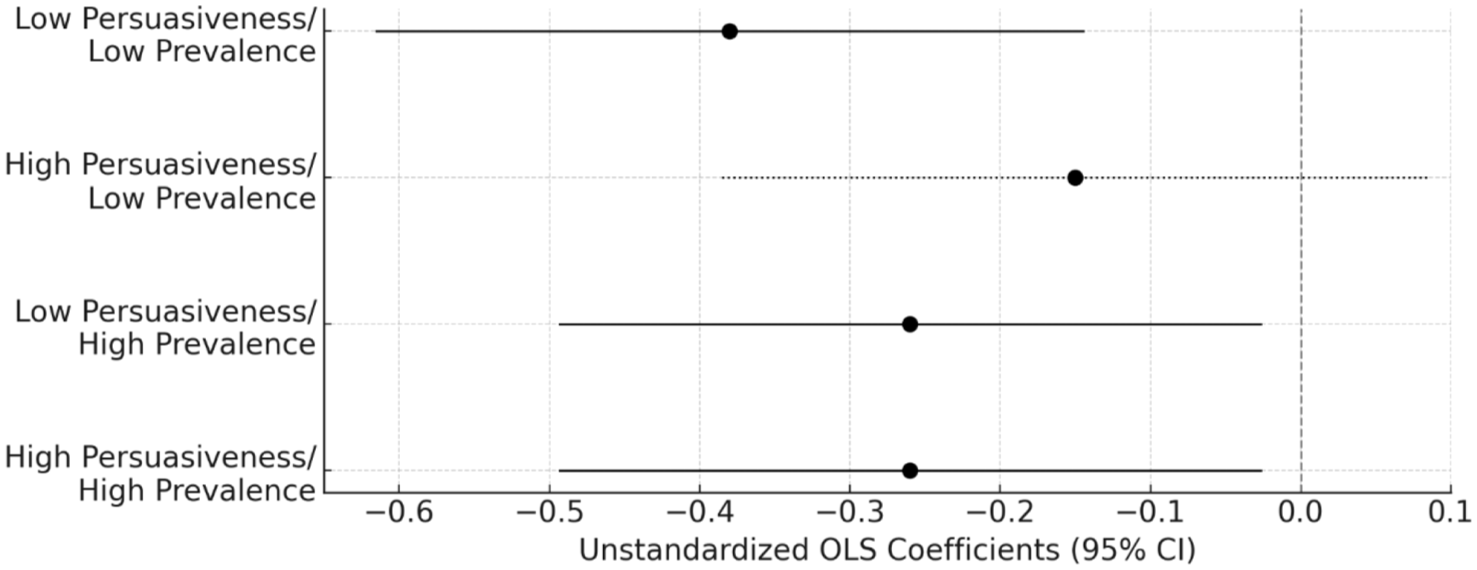
Study 2 OLS regression results predicting democratic satisfaction with the baseline condition as the reference category.
Post hoc analysis
We conducted three exploratory post hoc analyses to provide further context for our experimental findings. First, we reran the regression model, setting the low-persuasiveness/low-prevalence condition as the reference group to evaluate whether its effect on democratic satisfaction differed significantly from that of the other stimulus conditions (see Table I2 in the supplementary materials). The results showed no significant differences in democratic satisfaction between the low-persuasiveness/low-prevalence condition and the other three message conditions.
Following previous work (Tal-Or et al., 2010), the second post hoc analysis employed an exploratory mediation analysis, with manipulation checks of perceived prevalence and persuasiveness as mediators. Although causal evidence is lacking, correlations between mediators and the outcome may help further elucidate the mechanisms at work (Hayes, 2022). We extended the initial regression model by incorporating the P3OM manipulation checks, which served as mediators, as well as the perceived persuasiveness of misinformation on the self, to isolate the unique relationship between perceived influence on others and that of the self (see Table I1, model 2 in the supplementary materials). We also used the PROCESS Macro with bias-corrected bootstrapped confidence intervals (Hayes, 2022) to evaluate the indirect relationship between the experimental conditions and democratic satisfaction via the perceived prevalence and persuasiveness of misinformation on others (see Figure J1 and Table J1 in the supplementary materials).
The regression analysis suggests that only the perceived prevalence of online misinformation (β = −.39, p < .001) was associated with democratic satisfaction in the experiment; the coefficient on perceived persuasiveness of online misinformation was not significant (β = −.05, p = .392). Consistent with this finding, the effects of the high-prevalence/low-persuasiveness and high-prevalence/high-persuasiveness conditions were both fully mediated by perceived prevalence, with significant indirect negative relationships with democratic satisfaction (see Figure J1 and Table J1 in the supplementary materials).
In contrast, the low-prevalence/low-persuasiveness condition differed from the other stimulus conditions in two key respects. First, it had a positive indirect relationship with democratic satisfaction through perceived prevalence (β = 0.03, 95% CI = [0.0034, 0.0592]). This indirect relationship resulted from the perceived prevalence in the low-prevalence/low-persuasiveness condition being significantly lower than in both the control and high-prevalence/high-persuasiveness conditions. Although correlational, this indirect relationship is consistent with our hypothesis that links P3OM to democratic satisfaction.
The second difference is that the low-prevalence/low-persuasiveness condition still had an adverse direct effect on democratic satisfaction after controlling for the two mediators (β = −0.43, p < .001). In other words, even after accounting for correlations between our experimental conditions and the manipulation checks, as well as between the mediators and the dependent variable, the low-prevalence/low-persuasiveness condition still had a significant direct effect on democratic satisfaction, independent of the perceived prevalence or persuasiveness of online misinformation. This suggests that other unmeasured mechanisms may explain its impact on democratic satisfaction (see Hayes, 2022, pp. 90–92).
Our last post hoc analysis used four items to assess reactance to the stimuli. The items asked participants in each stimulus condition whether the infographic was credible, accurate, trustworthy, and believable. Summing these items into a measure of overall message quality (M = 4.3, SD = 1.3, α = .86), an ANCOVA (with gender and age as covariates) and a Sidak adjustment for pairwise comparisons suggest that participants may have experienced reactance. Message quality perceptions varied significantly across the four stimulus conditions (F(3, 1633) = 4.60, p = .003). Pairwise comparisons of the estimated marginal mean message quality across conditions reveal that the low-prevalence/low-persuasiveness condition was perceived as having significantly lower quality than the other three stimulus conditions (see Figure J2 in the supplementary materials).
This suggests that perceived message quality may be associated with democratic satisfaction. We examined this question by regressing message quality on democratic satisfaction in an OLS model, controlling for sociodemographics, condition (with the low-prevalence/low-persuasiveness condition as the reference), and P3OM measures (see Model 2 in Table I2 in the supplementary materials). The results showed that perceived message quality was associated with greater democratic satisfaction (b = −.35, p < .001), although the direction of causality is unknown.
Study 2 Discussion
As expected, exposing participants to messages about online misinformation in elections can reduce democratic satisfaction. However, contrary to our prediction, telling participants that online misinformation was rare and had negligible effects on political beliefs did not promote democratic satisfaction. Instead, we found comparable declines in democratic satisfaction regardless of the message’s portrayal of the prevalence of online misinformation. This empirical result is inconsistent with that of Jungherr and Rauchfleisch (2024), who found that after exposure to a fabricated news story exaggerating the impact of misinformation, participants reported less satisfaction with democracy than after exposure to a more measured news story on the same topic. Study 2 also found no evidence that ideology moderated the effects of our stimulus on democratic satisfaction.
Post hoc exploratory analysis suggests that the condition in which we presented misinformation as rare and unpersuasive may have a positive relative indirect relationship with democratic satisfaction through perceived prevalence, consistent with our hypothesis. However, the low-prevalence/low-persuasiveness condition had a significant adverse direct effect on democratic satisfaction relative to the control, even after accounting for both perceived prevalence and persuasiveness in the analysis. This pattern of results suggests that additional unmeasured mechanisms, beyond P3OM, may have led participants in the low-prevalence/low-persuasiveness condition to report lower satisfaction with democracy than those in the control condition. We speculate about why in our discussion.
General Discussion
The salience of online political misinformation in American elections and public consciousness has increased dramatically since the 2016 Presidential election. Anxiety about the threat posed by online misinformation to democracy has increased over the past decade. At the same time, empirical evidence suggests that the impact of online misinformation on voter beliefs, attitudes, and behavior is small to modest, contrary to conventional wisdom. In this study, we present an alternative proposition: that perceptions of the harmful effects of online misinformation on American politics, conceptualized as beliefs about its prevalence and persuasiveness, may have a broader, more pernicious effect, undermining Americans’ satisfaction with democratic governance. This is not to imply that online misinformation is harmless; in some subpopulations or contexts, its effects may be substantial. Instead, a myopic focus on online misinformation obscures the need to address a broader range of sources and types of malign content in democratic information ecosystems and overlooks the broader structural changes to media and public discourse over the last decade (Altay et al., 2023; Jungherr & Schroeder, 2021).
The results of the two studies presented here, a survey panel conducted before, during, and after the 2020 US presidential election, and a follow-up online experiment conducted shortly before the 2022 US midterm elections, demonstrate that thinking about online misinformation when it is most salient has harmful consequences for Americans’ democratic satisfaction. Analysis of longitudinal survey panel data from Study 1 shows that changes over time in an individual’s perceptions of the prevalence and persuasiveness of misinformation were associated with changes in their satisfaction with US democracy, especially among moderates and liberals. Study 2 provides a more robust test of the causal relation using an online experiment. Results show that exposure to messages about online misinformation in an electoral context reduces participants’ satisfaction with democracy, regardless of whether the message portrayed online misinformation as harmful or harmless; post hoc exploratory analysis suggests that this relationship is at least partially mediated by the perception that misinformation is widespread.
The findings from both studies lend empirical support to Hameleers’ (2025) argument that misinformation operates not only as an informational phenomenon but also as a discursive and perceptual one. First, the relationship between perceived persuasiveness of online misinformation and democratic satisfaction, which is contingent on ideology in study 1, reflects political polarization in American discourse about misinformation, with partisan actors promoting either alarmist or dismissive narratives about its impact. This discursive polarization about online misinformation has also manifested in American public opinion. For example, in 2022, 75% of Democrats/Democrat Leaners believed that the spread of false information online was a major threat to the United States, compared with 63% of Republicans/Republican Leaners (Silver, 2022). Three years later, in 2025, this gap widened substantially, with 80% of Democrats/Democrat Leaners believing it was a major threat, compared with 61% of Republicans/Republican Leaners (Fagan et al., 2025).
Second, it was surprising that participants who were told that online political misinformation during elections was neither prevalent nor persuasive still reported lower satisfaction with democracy than in the baseline control condition. Even when online misinformation was described as rare and not impactful, participants’ satisfaction with democracy decreased. This suggests that exposure to public discourse about online misinformation may cultivate broader distrust and institutional cynicism, as Hameleers (2025) notes.
We offer three possible explanations. First, it could be the result of reasoned consideration: learning that the troubling political times in America cannot be explained by misinformation is disheartening, prompting participants to reflect on what else might be wrong with the country. Once narratives about the prevalence and persuasiveness of misinformation are challenged or debunked, individuals face a more daunting reality: democracy is not functioning as they expect or desire, owing to internal factors and systemic problems rather than to external factors such as political misinformation and information pollution.
This view suggests that online political misinformation effectively distracts people from significant challenges facing democracy. This distraction-based explanation is compatible with critiques made of academic literature about misinformation. For example, Altay and his colleagues (2023) argue that the study of online political misinformation has grown substantially in the scholarly literature because it presents a problem that is methodologically convenient for scholars to assess. They argue that the focus on online political misinformation is simplistic and detracts attention from other modes of communication (e.g., in-person) and types of harmful content (e.g., propaganda, partisan news). The same may be said of attention to the dissatisfaction and dysfunction of American democracy, as policymakers, scholars, the media, and the public debate the harms of misinformation rather than address the fundamental problems of polarization, economic inequality, political disenfranchisement, and institutional dysfunction within American democracy itself.
A competing explanation for why participants in the low-prevalence/low-persuasiveness condition expressed less satisfaction with democracy than the control condition is that this is a methodological artifact (Dillard & Shen, 2005; Rains, 2013). Based on prior exposure to discourse about online misinformation, participants may have perceived the low-prevalence/low-persuasiveness stimulus as not credible, believable, accurate, or trustworthy. These perceptions could reflect reactance, which, in turn, may negatively impact their reported satisfaction with democracy. In this view, the message may have failed to persuade, eliciting a boomerang effect (Byrne & Hart, 2009; Hart & Nisbet, 2012). This is consistent with the results of our regression analysis testing the relationship between perceived message quality and democratic satisfaction.
A third potential explanation for why participants in the low-prevalence/low-persuasiveness condition were less satisfied with democracy than the control group is that they may exhibit an automatic response conditioned by repeated exposure to negative news about misinformation (regardless of whether it is portrayed as prevalent or persuasive). This conditioned response aligns with the idea that the public is primed to be concerned about misinformation due to repeated exposure to alarmist narratives (Hameleers, 2025). The mere mention of misinformation elicits negative perceptions of democracy. However, this explanation is inconsistent with the Jungherr and Rauchfleisch (2024) study, which found that exaggerated reporting about misinformation decreased democratic satisfaction among experimental participants, while more measured reporting did not.
All three explanations are speculative but suggest directions for future research. One approach could test whether dissatisfaction arises from focusing attention on systemic issues, such as polarization or inequality, rather than misinformation. For example, experimental participants could be exposed to messages about the low prevalence or persuasiveness of misinformation, followed by narratives about systemic problems, or by no further explanation, to examine whether democratic satisfaction varies across conditions. Another approach could determine whether individuals experience reactance in response to messages about the prevalence and impact of online misinformation by measuring counterarguing, negative affect, and source derogation across different message conditions. A follow-up experiment could test whether a media literacy intervention ameliorates such reactance. Unpacking the role of reactance is essential, as news coverage or public discourse that offers a more measured depiction of the prevalence or persuasiveness of online misinformation may not be viewed as credible if audiences react negatively to it. A third approach could test whether effects are driven by priming. This could involve exposing participants to distinct types of primes about misinformation, along with a neutral prime, to test whether automatic associations between misinformation and evaluations of democracy are elicited.
Mitigating Exaggerated Concern about Online Misinformation
Online misinformation can be harmful, as illustrated by the online misinformation campaign about election fraud contributing to the January 6 attack on the Capitol Building. However, the constant drumbeat of fear about online misinformation also has significant consequences for democracy. The possibility that merely mentioning misinformation is sufficient to reduce Americans’ democratic satisfaction suggests that it is time for scholars and the press to reflect on their approach to addressing this topic. There are no easy answers here. The threat of misinformation is real, but so too is the danger to democratic satisfaction posed by exaggerated fears about its prevalence and persuasiveness. Tackling this challenge requires the engagement of multiple societal stakeholders, including academics, journalists, and policymakers. Altay and his colleagues (2023), for example, criticize academic researchers for “conceptual and methodological blind spots” that contribute to exaggerated concerns about social media and misinformation and, too often, propose monocausal explanations for complex social issues linked to misinformation. They suggest that scholars need to reconsider how to research the prevalence and impacts of misinformation, as well as how it is communicated to lay audiences.
Nisbet and his colleagues (2021) recommend that media organizations and reporters report on the threat of online misinformation in more nuanced ways. For example, media coverage of online misinformation often reports its prevalence without reference to baselines or to its magnitude relative to the broader online information ecosystem. This may lead to exaggerated misperceptions about its prevalence (e.g., Lyons et al., 2021), which our study findings suggest is a uniquely strong correlate of democratic dissatisfaction (see also Matthes et al., 2022).
Helping journalists develop a deeper understanding of the nature and the extent of misinformation’s prevalence and influence may help promote better coverage of the problem. Media and policy discourse about misinformation should place more emphasis on the rarity of online misinformation, the generally accurate nature of beliefs, and the increasing accuracy of these beliefs over time (Porter et al., 2019). The need for nuanced reporting on online misinformation is particularly salient when examining how emerging technologies, such as artificial intelligence and large language models (LLMs), may affect the prevalence and persuasiveness of political misinformation in elections.
At the same time, our study suggests that merely mentioning online misinformation, even when framed as scarce or having limited effects, may lead to boomerang effects (Hart & Nisbet, 2012). This highlights the need for media literacy and inoculation campaigns targeting the public (e.g., Guess et al., 2020; Roozenbeek et al., 2022; Vraga & Tully, 2019) that could also help people put the threat of information in context and manage public concern.
We also wish to stress that our study’s findings do not lessen social media platforms’ responsibility to moderate and/or remove false or misleading online content. Indeed, concern about online misinformation may only increase as companies behind the major platforms, such as X and Meta, reduce their content moderation and fact-checking, decrease transparency, and restrict the ability of independent third parties, including academics and civil society, to identify, track, and quantify online misinformation on their platforms. Beyond materially contributing to the prevalence of online misinformation, the widespread pullback in content moderation by social media platforms, beginning with Elon Musk’s takeover of X in 2022, may heighten P3OM among large segments of the American public. The perceived abandonment of efforts to address a problem widely regarded as pervasive and deeply harmful is likely to exacerbate the perceived threat posed by misinformation, further eroding satisfaction with democracy among large segments of the public.
Limitations and Generalizability
Both studies had limitations. The fixed-effects regression of the longitudinal panel data controlled for unobserved, time-invariant heterogeneity but could not account for intercorrelation between perceived prevalence and persuasiveness, or for reverse causality between each of the two dimensions of P3OM and democratic satisfaction. The central focus of Study 1 was on within-person processes over time rather than on between-person variability. This provides an opportunity for future research to examine the separation of within- and between-person effects of P3OM on democratic satisfaction, as outlined by Thomas et al. (2021).
Study 2 also had limitations. First, although the manipulations successfully increased perceived prevalence and persuasiveness of online misinformation in their respective conditions relative to the control condition, we did not reduce these perceptions below that baseline. It is unclear whether this failure is due to the efficacy of the stimulus materials or to heightened public discourse and concern about online misinformation that has emerged over the past several years in the United States. Perceptions may have become so hardened that significantly decreasing them is extremely difficult in an experimental context. Our analysis of perceived message quality supports this by demonstrating that participants evaluated the message about the low persuasiveness and prevalence of online misinformation lower than the other messages.
Both studies are also US-centric, focusing on how exaggerated concerns about online misinformation can reduce satisfaction with American democracy. However, the discourse about and impact of online misinformation vary across different global and political contexts, and the generalizability of our study beyond the United States should be carefully evaluated. Recent cross-national scholarship on perceptions of misinformation in other countries offers guidance for this evaluation. These studies reveal a trend like that observed in the United States: although actual exposure to online misinformation may be limited, exaggerated concerns and the perceived influence of online misinformation (P3OM) are prevalent across many countries. This suggests that the relationships we outline in this article, focused on the United States, may be broadly generalizable to other contexts (e.g., Knuutila et al., 2022; van der Meer et al., 2023; van der Meer & Hameleers, 2024).
At the same time, these studies highlight country-level factors associated with P3OM, such as the degree of political polarization, the presence of liberal democracy, and levels of public trust in the media (e.g., Hameleers et al., 2024; Knuutila et al., 2022; van der Meer & Hameleers, 2024). These factors provide a basis for future scholarship exploring how the individual relationships between P3OM and democratic satisfaction, as explicated in this study, may vary significantly across national contexts.
Conclusion
This project examines the impact of online political misinformation on voters through the lens of the presumed influence of online misinformation (P3OM). It seeks to understand how beliefs about their information environment may impact Americans’ political attitudes. Our fixed-effects regression analysis of the eight-wave survey panel suggests that during the 2020 US presidential election, the perceived prevalence and persuasiveness of online misinformation were negatively associated with participants’ democratic satisfaction. In our follow-up experiment, we demonstrated that messages about the prevalence and persuasiveness of misinformation can dampen satisfaction with democracy, even when the message indicates that misinformation is rare and inconsequential. These results underscore the importance of understudied consequences of frequent news coverage and exaggerated public discourse about political misinformation, particularly in liberal democratic contexts characterized by heightened political polarization and low media trust, such as the United States. Taken together, these results suggest that exposure to discourse about online misinformation, beyond any direct effects of online misinformation itself, can erode democratic satisfaction. In this sense, exaggerated concerns about online misinformation may constitute a secondary democratic threat, operating through the very mechanisms of distrust that it seeks to mitigate.
Supplemental Material
sj-docx-1-sms-10.1177_20563051261420610 – Supplemental material for The Presumed Prevalence/Persuasiveness of Online Misinformation and Americans’ Dissatisfaction With Democracy
Supplemental material, sj-docx-1-sms-10.1177_20563051261420610 for The Presumed Prevalence/Persuasiveness of Online Misinformation and Americans’ Dissatisfaction With Democracy by Chloe Mortenson, Erik C. Nisbet and R. Kelly Garrett in Social Media + Society
Footnotes

Ethical Considerations
The research and data collection protocols for this study were reviewed and approved by the internal review boards of the Ohio State University and Northwestern University.
Consent to Participate
All participants were informed about the nature of the study prior to participation. Participation was voluntary, and participants could withdraw at any time or request that their data be removed after participation.
Author contributions
C. Mortenson, E.C. Nisbet, and R.K. Garrett conceptualized the studies and collected the data. C. Mortenson conducted the data analysis for Study 1 and drafted the corresponding results section; E.C. Nisbet conducted the data analysis for Study 2 and drafted the corresponding results section. C. Mortenson and E.C. Nisbet wrote the initial manuscript draft. All authors reviewed and edited the final manuscript.
Funding
The authors disclosed receipt of the following financial support for the research, authorship, and/or publication of this article: This study was supported in part by an unrestricted gift from Meta to Northwestern University as part of their 2020 Foundational Integrity Research: Misinformation and Polarization grant program.
Declaration of conflicting interests
The authors declared no potential conflicts of interest with respect to the research, authorship, and/or publication of this article.
Data availability statement
The data underlying this article will be shared on reasonable request to the corresponding author.
Supplemental material
Supplemental material for this article is available online.
Notes
Author biographies
References
Supplementary Material
Please find the following supplemental material available below.
For Open Access articles published under a Creative Commons License, all supplemental material carries the same license as the article it is associated with.
For non-Open Access articles published, all supplemental material carries a non-exclusive license, and permission requests for re-use of supplemental material or any part of supplemental material shall be sent directly to the copyright owner as specified in the copyright notice associated with the article.
