






Abstract
Recent experimental research suggests that sharing personal stories can foster respect and reduce prejudice in cross-cutting settings. Yet, some studies suggest that personal stories shared on social media, amplified by partisan dynamics and platform characteristics, may deepen divides rather than reconcile differences. We evaluate these seemingly contradictory assessments through a large-scale computational analysis of personal stories shared in 400,000 like-minded and cross-cutting political interactions on Reddit during a time of significant affective polarization in the United States (2015–2021). We find that, in cross-cutting settings, comments with personal stories tend to have a positive effect, receiving more favorable evaluations (via up/down votes) and more responses than other comments. However, this positive reception does not translate into less toxic responses. Moreover, users are less likely to share personal stories in political interactions in general but more so with those holding opposing views, limiting their impact in cross-cutting exchanges. We also observe some differential effects of sharing personal stories based on user ideology. Overall, drawing on small stories research on social media, our findings provide a nuanced view on the role of personal stories in online political discussions.
Introduction
Personal stories offer significant promise for fostering quality political interactions across differences. Recent, mostly experimental research in cross-cutting political contexts suggests that sharing personal stories can increase respect (Kubin et al., 2021, 2023), build trust (Hagmann et al., 2024), and reduce prejudice (Kalla & Broockman, 2023) on deeply polarized topics. Communication scholars suggest two primary routes to narrative persuasion: transportation and identification. Stories can “transport” readers into the story, allowing them to become absorbed and experience events vicariously, which makes them more receptive to alternate views (Green & Brock, 2000). Stories may also encourage readers to identify with the characters, fostering a perspective-taking experience that allows them to become more receptive to the characters’ viewpoints (De Graaf et al., 2012). Furthermore, personal storytelling, which we define as individuals sharing accounts of their own personal experiences, rather than recounting from the news or social media, may be especially well-suited to cross-cutting contexts as personal stories are often perceived as more rational and authentic (Kubin et al., 2021). In contrast, sharing stories from media sources or political elites may be construed as partisan and biased.
However, it is unclear whether personal stories shared in cross-cutting contexts on social media have similar positive effects. Casual everyday stories may not be immersive enough to “transport” readers. Strong partisan identities may also hinder identifying with the characters in stories told by those holding opposing views. Crucially, personal stories are often used to shift people’s attention from individual experiences to collective ones, reinforcing group identities (De Fina, 2003). Salient group identities coupled with existing platform characteristics that amplify inter-group dynamics (e.g., Gaudette et al., 2021) may complicate discussions in cross-cutting settings. Furthermore, while the distinction between personal stories and stories told by media and political elites is conceptually useful, in practice, personal stories also tap into existing broader cultural and media narratives that Hochschild (2016) refers to as “deep stories.” Thus, even when personal stories are grounded in individual experience, they may draw on or allude to these broader narratives, which may reinforce group identities (Polletta & Callahan, 2019). Indeed, as Polletta and Callahan (2019, p. 405) conclude in their analysis of stories shared by Trump supporters and right-wing political elites during the 2016 U.S. elections on social and mass media, “stories may have political impact less by persuading than by reminding people which side they are on.”
Taken together, these studies point to two competing theoretical perspectives: narrative persuasion research, which suggests that personal stories can be beneficial in cross-cutting settings, and research on partisan identity and social media, which suggests that such stories may instead reinforce partisan divisions. This tension motivates our investigation of how personal stories function in real-world cross-cutting discussions during the 2015–2021 period, a time marked by intense partisan conflict in the United States (including the lead-up to the 2016 election, the rise of the Make America Great Again (MAGA) movement, the COVID-19 pandemic, and the January 6th insurrection). We applied large-scale computational analyses to clarify the role of personal stories in cross-cutting discussions on the social media platform, Reddit.
Alternate Perspectives of Personal Stories in Cross-Cutting Settings
One line of mostly experimental research suggests that personal stories may help bridge political divides. Kubin et al. (2021) demonstrate that when individuals anchor their political views in personal stories, they are perceived as more rational, which in turn fosters greater respect among their ideological opponents. In a follow-up study, Kubin et al. (2023) also find that sharing harm-based experiences increases tolerance of political opponents and reduces political dehumanization. Furthermore, they find that political opponents sharing personal stories are perceived as self-disclosing, resulting in increased respect and willingness to interact with them (Kubin et al., 2025). Similarly, Hagmann et al. (2024) find that expressing opposing viewpoints through self-disclosure and vulnerable personal stories enhances trust and willingness to collaborate, even more so than presenting factual data. Wojcieszak and Kim (2016) also find that personal stories outperform numerical evidence when receiving counter-attitudinal messages on controversial sociopolitical topics, especially when primed to view the message with an empathetic perspective. These studies suggest that personal stories may help break down partisan barriers that hinder quality cross-cutting engagement.
An alternate perspective, drawing largely on qualitative studies of personal storytelling on social media, suggests that such stories may mislead users and reinforce divides (Rathje et al., 2021). Prochaska et al. (2023) analyzing Twitter content during the 2020 elections argue that personal stories lent credibility to election fraud claims and fueled participatory disinformation. Polletta and Callahan (2019) also note how personal stories, when incorporated into existing broader narratives of grievances constructed by conservative media and amplified through social media sharing, help form collective identities that reinforce partisan divides. Similarly, social movements scholarship suggests that personal stories mobilize collective action by constructing a collective identity (Mayer, 2014; Polletta, 1998). Collective identity often reinforces an “us versus them” dynamic, delineating group boundaries by fostering group solidarity while emphasizing opposition to outsiders (Polletta & Jasper, 2001). The impact of personal stories on engendering group identity may be more pronounced on social media platforms, where affordances, algorithms, and platform design often strengthen collective identity. Gerbaudo (2024) shows how Twitter’s affordances of replicability and visibility enable aggregating and quantifying personal testimonies, facilitating the construction of collective identities within activist campaigns. Relevant to our study on Reddit, Georgakopoulou et al. (2020) show how the platform’s affordances of subreddit autonomy, anonymity, and visibility shape anti-deliberative storytelling on r/The_Donald through feedback loops of attention and visibility, building a collective identity. Similarly, Gaudette et al. (2021) highlight how members of r/The_Donald, used the up/downvoting features to normalize otherwise unacceptable out-group views and suppress dissenting perspectives, thereby strengthening group cohesion by fostering echo chambers. Such salient group dynamics may be especially problematic in cross-cutting exchanges at a time of affective polarization, when Republicans and Democrats dislike each other largely because of their group (partisan) identities (Iyengar et al., 2019).
One way to reconcile these seemingly opposing perspectives is to consider that the impact of personal stories may depend on platform contexts in which they are shared. While experimental research has recently examined the effects of short, one-line accounts of personal experiences that more closely resemble social media content (e.g., Kubin et al., 2021, 2023), such designs may be less able to capture the group identity dynamics that characterize platform-based discussions as they unfold. As a result, the positive effects observed in experimental settings may not always generalize to real-world, polarized environments. However, there has been limited research examining personal stories within naturally occurring cross-cutting discussions on social media platforms. Studies that examine the use of personal stories do not do so in cross-cutting contexts (e.g., Antoniak et al., 2024). In one study (Polletta and Lee, 2006), analyzing discussions on an online forum, found that individuals used storytelling to express indirect disagreement. However, these discussions were on a unifying topic: rebuilding in the aftermath of terrorist attacks. The authors speculate that “in a polarized setting, deliberators would probably be suspicious of the authenticity of personal stories altogether” (Polletta and Lee, 2006, p. 719). In this study, we evaluate their thesis by empirically assessing the use and role of personal stories in precisely these polarized contexts: cross-cutting political discussions on Reddit at a time of extreme affective polarization.
Personal Stories on Social Media
Social media offers numerous affordances such as persistence, visibility, and replicability that structure how users curate content and connect with audiences in networked publics (boyd, 2010; Treem & Leonardi, 2013). Together, these (and other) affordances shape personal storytelling, as stories are themselves “restricted, enhanced, and adorned by the affordances of these platforms” (Papacharissi, 2018, p. 4). For example, Georgakopoulou (2017a) notes how the affordance of visibility which results in context collapse on Facebook encourages users to adopt more allusive forms of storytelling as a way of implicitly selecting and addressing specific audiences. Similarly, the relative anonymity afforded by Reddit facilitates more self-disclosure in personal stories, as reduced identifiability lowers risk when sharing more sensitive personal experiences (De Choudhury & De, 2014). Beyond affordances, the platform’s algorithmic curation and technical design also influence storytelling practices. For instance, Georgakopoulou (2017a) links the prevalence of brief, sharing-lives-in-the-moment stories on Facebook to platform algorithmic preference for recency of posts. Similarly, Page (2018) highlights how YouTube’s platform design pre-structures storytelling through templates and input formats often prioritizing commercial imperatives over storytelling. Taken together, considering how storytelling is intrinsically mediated by the platforms where they are shared, studies like ours, which evaluate stories within the context of their telling, offer valuable insights that complement experimental research in this domain.
Narrative research examining multiple social media platforms finds that stories shared are often short, episodic, and focused on everyday, mundane personal experiences (Page, 2013). Thus, relying exclusively on structural definitions of narrative (Labov, 1972) to identify personal stories risks overlooking the episodic and nonlinear forms of storytelling prevalent in social media. Therefore, we draw on recent sociolinguistic research on small stories to guide our understanding of personal stories for this study (Bamberg & Georgakopoulou, 2008). The small stories framework defines stories functionally, in terms of how people use stories “to construct a sense of who they are” with an emphasis on their experiential and interactional roles (Bamberg & Georgakopoulou, 2008, p. 382). Under this framework, even brief, fragmented, and incomplete personal accounts that would otherwise be dismissed for the lack of structural elements of a story are recognized as meaningful contributions. When applied to social media contexts, research following the small stories paradigm has highlighted the prevalence of storytelling in such atypical forms in different political contexts including discussions of political crisis events on Facebook (Georgalou, 2015) and protests on Twitter (Sadler, 2018). Thus, for our analysis of personal stories in political discussions on Reddit, we expand our definition of personal stories to include non-prototypical stories that convey the discussants’ lived experience in addition to stories that follow the canonical narrative structure.
Hypotheses and Research Questions
We evaluate the reception and prevalence of personal stories in cross-cutting political discussions. First, we examine how personal stories are received in cross-cutting settings. On Reddit, communities (called subreddits) can upvote content that they view favorably and downvote content they regard unfavorably. Reddit tracks these votes in the form of karma points, which act as a form of social feedback. Thus, a reply that receives high karma points can be interpreted as being viewed more favorably by users on the subreddit. If a reply receives high karma points in a cross-cutting subreddit (meaning the political ideology of the subreddit is different from that of the user who is replying), we can assume those holding opposing views receive that reply favorably. Given the contradictory evidence discussed in the literature review, we propose the following competing hypotheses using karma points as an indicator of cross-cutting favorability:
We also evaluate the effect of personal stories on their ability to engage those holding opposing views. Researchers argue that stories uniquely engage the readers both cognitively and emotionally (McQueen & Kreuter, 2010). In health communication, Miller-Day and Hecht (2013) note stories’ ability to engage hard-to-reach users, such as those with low involvement and less knowledge. Also, stories’ ability to convey disagreement in indirect and less confrontational ways may help manage potential conflict and facilitate higher engagement among even conflict-averse individuals who typically opt out of talking politics (Black, 2008; Groenendyk et al., 2025). Thus, we propose the following hypothesis:
We also examine the toxicity of responses to personal stories. Given the relative lack of research in this domain, we pose the following research question:
Next, we evaluate the prevalence of personal stories. Personal stories, by definition, disclose personal details of the narrator’s life. Although not specific to personal stories, qualitative research suggests that people avoid posting content about themselves in cross-cutting online spaces for fear that such information could be used to attack them (Rajadesingan, Duran, et al., 2021). Instead, personal stories are often shared among others with a common cause to express solidarity and build a collective identity (De Fina, 2003), factors more associated with in-group identification than out-group engagement. Relatedly, research on online self-disclosure suggests that individuals are more likely to disclose personal experiences in supportive forums than in other discussion spaces (Barak & Gluck-Ofri, 2007). Thus, we expect individuals to be more likely to share their personal stories in like-minded settings as opposed to cross-cutting ones. On Reddit, the discussion may be cross-cutting depending on the ideologies of the reply recipient and the community in which the exchange occurs. We therefore evaluate the following hypotheses:
Finally, we examine whether the political ideology of the author of the personal story moderates the associations observed in the above hypotheses and research question. Research suggests that conservatives and liberals tell different kinds of stories, which can have varying effects on their readers. McAdams et al. (2008) find that conservatives heavily relied on the in-group/loyalty, authority/respect, and purity/sanctity moral foundations in their life narratives, whereas liberal narratives emphasized the moral foundations of harm/care and fairness/reciprocity. Similarly, Lakoff (2016) suggests that liberals and conservatives view politics and government through the lens of different family metaphors, resulting in different narratives. Therefore, we propose the following research questions to test political ideology as a moderator:
Data Collection
We analyzed public Reddit comments from 2015 to 2021 using the Pushshift data archive (Baumgartner et al., 2020). We selected political communities from Rajadesingan, Budak, and Resnick’s (2021) extensive dataset, which comprises over 600 political subreddits identified through a large-scale analysis of political discourse on Reddit. From this list, we manually identified and filtered out political subreddits that were not U.S.-based (as our measures of political ideology have been validated only in the U.S. context) or were fictitious (such as model or simulation games), resulting in 524 subreddits. We also removed known bots from the analysis such as the AutoModeratorBot. However, with advancements in artificial intelligence (AI), we acknowledge that at least some data we analyze may have been generated by non-human actors. We discuss this issue in the limitations section.
Methods and Measures
Identifying Personal Stories
Drawing on small stories research (Georgakopoulou, 2017b), we defined personal stories functionally (rather than structurally) as simply accounts of people’s lived experiences. To classify personal stories, we used Chebrolu et al.’s (2025) personal stories classifier for Reddit comments. The classifier identifies if a comment contains a personal story or not, looking for accounts of personal experiences rather than a specific story structure. They finetuned a text classifier on 2000 labeled political comments on Reddit, which achieved an overall accuracy of 83.20%. We performed additional validation of the classifier on our dataset as described in the Supplemental Materials (Section 1). Table 1 in Supplemental Material also provides examples of personal stories identified by the classifier. In our dataset, we found that 4.19% of comments contained a personal story.
Estimating User and Subreddit Ideology
Similar to Barberá et al. (2015) and Bond and Sweitzer (2022), we infer the political ideology of users and subreddits on Reddit from user behavioral patterns driven by political homophily. Specifically, we expect users to connect more often with subreddits that share similar ideological views and less often with subreddits that hold dissimilar ideological views. Such homophilic behavior has been widely observed on major social media platforms such as Reddit (Bond & Sweitzer, 2022), Facebook (Bond & Messing, 2015), and Twitter (Barberá et al., 2015). We detail the steps involved in estimating ideology and the multiple validation approaches we used in the Supplemental Material (Sections 2 and 3). In total, we labeled 738,894 users and 332 subreddits as left-leaning and 275,284 users and 148 subreddits as right-leaning.
Sampling Like-Minded and Cross-Cutting Interactions
We define an interaction as a user replying to another user. From all interactions in left- and right-leaning political subreddits, we randomly sampled interactions in each category: cross-cutting interactions (100,000 right-leaning users replying to left-leaning users and 100,000 vice-versa) and like-minded interactions (100,000 right-leaning users replying to other right-leaning users and 100,000 left-leaning users replying to other left-leaning users). We evaluated our hypotheses and research questions using this 400,000-interaction dataset.
Toxicity of Cross-Cutting Interactions
We evaluate the toxicity of interactions using the Perspective toxicity classifier (Wulczyn et al., 2017). The perspective toxicity classifier defines a toxic comment as a “rude, disrespectful, or unreasonable comment that is likely to make people leave a discussion.” 1 The Perspective toxicity classifier has been previously validated and found to produce accurate classifications on Reddit political comments (Rajadesingan et al., 2020). If the classifier output probability was greater than 0.6, we labeled the comment as “toxic.” Otherwise, we labeled the comment as “not toxic.” 2 In total, we found that about 8.25% of replies to cross-cutting interactions were toxic.
Measurement Variables
Personal Story Indicator
We ran the personal story classifier on the reply comments in the interactions and used the output labels (1 = personal story, 0 = not personal story) as a personal story indicator.
Karma Points
We applied a cube-root transformation to account for the skewness in karma score of the parent and reply comments since the cube-root is well-defined for positive, negative, and zero values, unlike conventional log transformations (Cox, 2011). We applied a log(x + 1) transformation to account for skewness in the score of the top-level posts, as posts on Reddit can only have a value of zero or higher.
Like-Minded Interaction Indicator
If the ideology of the parent user matched that of the replying user, we set the interaction indicator to 1, otherwise we set it to 0.
Like-Minded Community Indicator
If the ideology of replying user matched that of the subreddit where the interaction takes place, we set the like-minded community indicator to 1, otherwise we set it to 0.
Replying User Ideology Indicator
We set the replying user ideology indicator to “left” or “right” if the user replying to the parent comment is determined to be left-leaning or right-leaning, respectively.
Additional Control Variables
We also controlled for the length of the comments (log transformed to account for skewness) and the level of the discussion thread (whether the discussion took place at the top-level thread or at one of the lower levels) as needed.
Results
Reception of Personal Stories in Cross-Cutting Settings
The competing hypotheses, H1a and H1b, concern how personal stories are received by individuals holding opposing views. To test these hypotheses, from the 400,000 sampled interactions, we select only cross-cutting interactions that took place in cross-cutting subreddits, that is, a left-leaning (right-leaning) user replying to a right-leaning (left-leaning) user in a right-leaning (left-leaning) subreddit (n = 97,958). We use a random-effects linear regression to test the competing hypotheses, modeling the karma score of the reply with a random effect for the subreddit where the interaction took place and a personal story indicator. We also control for the karma score of the parent, the karma score of the top-level post under which the comment was made, and the discussion thread level.
Table 2 (left column) in Supplemental Material shows the full coefficients of this regression. We find that comments with personal stories receive a higher score than comments without personal stories in cross-cutting communities. This effect is statistically significant (β = 0.209, standard error [SE] = 0.022, p < .001). Therefore, H1a is supported, and H1b is not supported.
To evaluate RQ2, we include an interaction between the personal story indicator and the replying user’s ideology indicator in the above regression. Table 2 (right column) in Supplemental Material shows the full coefficients of this regression. The interaction is statistically significant (β = 0.114, SE = 0.051, p = .026). Figure 1 shows the corresponding interaction plot of the marginal means. We find that, on average, left-leaning users receive a higher karma score when sharing personal stories compared to when not sharing personal stories in their replies to right-leaning users in right-leaning communities (0.86 vs. 0.57, difference (in cube-root) = 0.121, SE = 0.045, p < .01). This difference is more pronounced for right-leaning users who receive a much higher karma score, on average, when sharing personal stories relative to when not sharing personal stories (0.87 vs. 0.37, difference (in cube-root) = 0.236, SE = 0.025, p < .001).
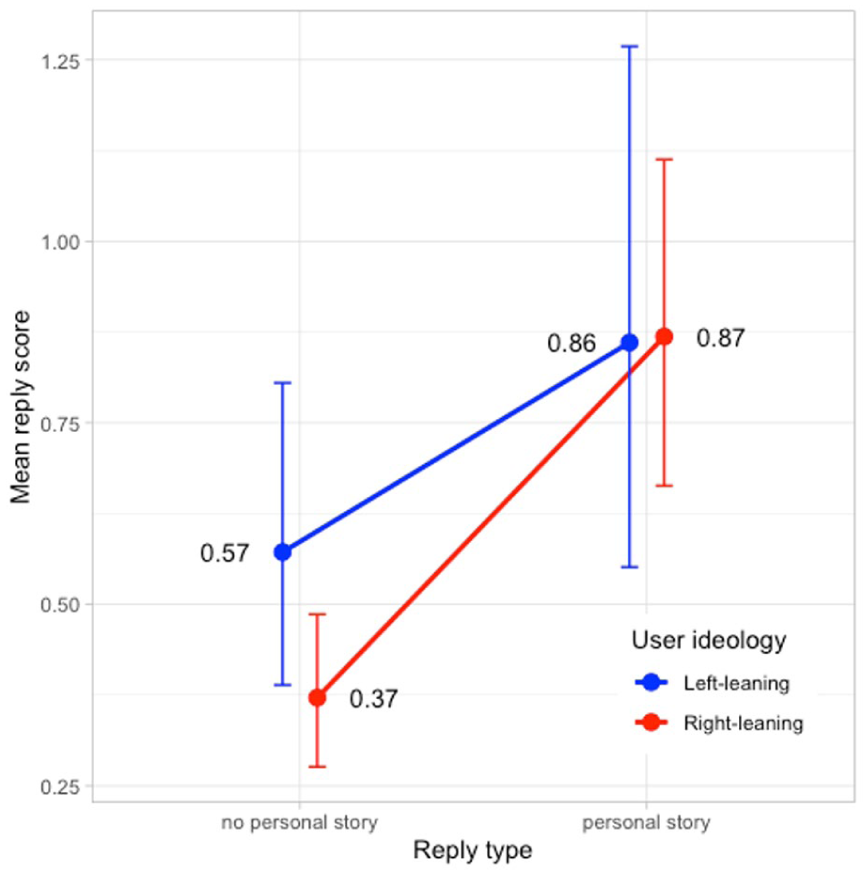
Average karma score of cross-cutting replies in cross-cutting communities when using and not using personal stories (95% CI).
Responses to Personal Stories in Cross-Cutting Settings
H2 predicts that personal stories, on average, receive more responses than other content in cross-cutting communities. Since H2 evaluates the number of replies, we used a hurdle regression which consists of two parts. 3 The first part models the likelihood of receiving a response (logistic regression), while the second part models the frequency of responses conditional on the comment receiving a response (count model, here we use negative binomial regression). We use the same control variables used to evaluate H1a and H1b.
Table 3 in Supplemental Material shows the full coefficients of this regression. The coefficient for the personal story indicator is not significant for the logistic regression (β = 0.037, SE = 0.034, p = .276) but is positive and significant for the count model (β = 0.132, incidence risk ratio (IRR) = 1.141, SE = 0.051, p = .010). The logistic regression results suggest that using personal stories is not associated with an increase in the odds of whether the comment receives a response or not. However, the count model indicates that among comments that receive responses, those that contain personal stories are likely to receive 14.1% more responses than comments that do not contain personal stories. In other words, personal stories do not increase the chances of receiving a response, but when a personal story does receive responses, they tend to receive more responses than comments that do not contain personal stories. Therefore, H2 is partially supported.
To evaluate RQ3, to the above regression, we include an interaction term between the personal story indicator and the replying user’s ideology indicator. Table 4 in Supplemental Material shows the full coefficients of this regression. The interaction term was not statistically significant for the logistic regression (β = −0.104, SE = 0.081, p = .197) and the count model (β = 0.038, SE = 0.128, p = .767), indicating little evidence of user ideology-based differential effects in terms of engagement with personal stories.
Toxicity of Responses to Personal Stories in Cross-Cutting Settings
RQ1 evaluates how the toxicity of responses differs between replies with and without personal stories. For this analysis, we only consider the subset of cross-cutting interactions in cross-cutting communities that received at least one response (n = 58,980). In total, these interactions received 80,966 responses. We use a random-effects binomial regression to evaluate this research question, modeling whether the response to the reply was toxic or not (1 or 0) with the personal story indicator as an independent variable. We used the same controls we used to evaluate H2. Since there can be multiple responses per reply, and as these responses are likely correlated as they are responding to the same reply, we included an additional random effect for the reply id.
Table 5 (left column) in Supplemental Material shows the full coefficients of this regression. The coefficient for the personal story indicator is not statistically significant (β = −0.072, SE = 0.067, p = .285). To evaluate RQ4, to the above regression, we include an interaction term between the personal story indicator and the replying user’s ideology indicator. Table 5 (right column) in Supplemental Material shows the full coefficients of this regression. The interaction was not statistically significant (β = −0.180, SE = 0.158, p = .255). These results suggest that use of personal stories is not associated with differences in the toxicity of responses, nor does this association differ between right-leaning and left-leaning users.
Use of Personal Stories in Like-Minded and Cross-Cutting Settings
We evaluate if personal stories are more likely to be shared in like-minded settings than in cross-cutting settings (H3a and H3b). We use the full 400,000-sample dataset of interactions for these tests. To test H3a, we use a random-effects logistic regression to model the probability of a reply containing a personal story with the like-minded interaction indicator as the key independent variable (Model 1). We include a random effect for the subreddit where the interaction took place, as observations within each subreddit are likely correlated. We control for the length of the parent comment, the karma points on the parent comment, and the discussion thread level. To test H3b, we use an identical regression but with the like-minded community indicator as the key independent variable (Model 2). Because like-minded interactions are more frequent in like-minded communities, these independent variables are correlated (r = .55), motivating Model 3, which included both like-minded interaction and community indicators to disentangle their independent effects.
Table 6 in Supplemental Material shows the full coefficients of these regressions. From Model 1, we find that like-minded interactions have 23% higher odds of including personal stories than cross-cutting interactions (β = 0.210, odds ratio [OR] = 1.233, SE = 0.018, p < .001). Therefore, H3a is supported. From Model 2, we find that personal stories have slightly higher odds (10% higher) of being used in like-minded communities (β = 0.097, OR = 1.101, SE = 0.019, p < .001) than in cross-cutting communities, consistent with H3b. However, in Model 3, the coefficient for like-minded interaction remained positive and statistically significant (β = 0.234, OR = 1.264, SE = 0.021, p < .001), while the coefficient for like-minded community became negative and marginally significant, although very small in magnitude (β = −0.046, OR = 0.955, SE = 0.024, p = .05). This indicates that the positive association between like-minded community and storytelling observed in Model 2 was largely due to the higher prevalence of like-minded interactions in like-minded communities. Once like-minded interactions were controlled for, like-minded communities themselves do not independently correlate with storytelling. Therefore, H3b is not supported.
Next, we examine how user ideology may moderate the use of personal stories in like-minded and cross-cutting settings (RQ5a and RQ5b). To evaluate these questions, we added interaction terms to Model 3 in separate regressions: 4 between the like-minded interaction indicator and the replying user’s ideology indicator (Model 4a) and between the like-minded community indicator and the replying user’s ideology indicator (Model 4b). Table 7 in Supplemental Material shows the full coefficients of these regressions. Both interaction terms, like-minded interaction x user ideology term (β = −0.134, SE = 0.044, p < .01) and like-minded community × user ideology term (β = −0.444, SE = 0.172, p < .01) were statistically significant. Performing post hoc comparisons based on Model 4a, we find that right-leaning users have 16% higher odds of sharing personal stories with like-minded users than with cross-cutting users (4.51% vs. 3.92%, OR = 1.16, SE = 0.041, p < 0.001); this partiality toward like-minded users is significantly more pronounced for left-leaning users who have 32% higher odds of sharing personal stories with like-minded users than with cross-cutting users (4.86% vs. 3.71%, OR = 1.32, SE = 0.035, p < 0.001). Performing post hoc comparisons based on Model 4b, we find that left-leaning users have 20% higher odds of sharing personal stories in like-minded communities (4.45% vs. 3.73%, OR = 1.20, SE = 0.011, p < 0.05); however, right-leaning users have about 23% lower odds of sharing personal stories in like-minded communities (3.65% vs. 4.69%, OR = 0.771, SE = 0.068, p < 0.01). We discuss more about this surprising pattern in the discussion section. Figure 2 shows interaction plots of their corresponding estimated marginal means.

Personal story use by interaction type and community type (95% CI).
Discussion
This study elaborates on the use and role of personal stories in cross-cutting discussions on Reddit. We evaluate two competing theories about the role of personal stories in cross-cutting discussions. On one hand, personal stories may be beneficial through narrative persuasion; on the other, they may, amplified by platform characteristics, exacerbate division by reinforcing strong partisan identities. Our findings provide evidence in support of the former: personal stories are viewed favorably in cross-cutting settings. One possible explanation is that claims about the detrimental effects of storytelling on social media (Polletta & Callahan, 2019; Prochaska et al., 2023), and Reddit in particular (Georgakopoulou et al., 2020), are largely rooted in studies of in-group behavior. However, it is possible that these dynamics may not extend to cross-cutting contexts. Individuals who volunteer to share personal stories in cross-cutting interactions may be less inclined to offer polarizing accounts, resulting in narratives that are perceived as less divisive than other forms of partisan content. Alternatively, personal storytelling may be able to cut through the partisan divide by individualizing the teller, fostering processes of decategorization (Brewer & Miller, 1984) that reduce the salience of partisan identities. While further research is needed to identify the precise mechanisms at work, our findings suggest that personal storytelling represents a promising pathway for improving cross-cutting interactions.
While we find evidence that personal stories in cross-cutting settings are viewed more favorably across the political spectrum, comments without personal stories seem to be less favorably viewed in cross-cutting settings when the author is right- versus left-leaning (Figure 1). Our observational study cannot clarify if these findings are a result of the quality of content (e.g., right-leaning users post low quality non-story content) or the biased perceptions of the posted content (e.g., left-leaning communities are less tolerant of non-story content posted by right-leaning users). However, these results suggest that storytelling makes a bigger difference in terms of cross-cutting community approval for right-leaning than left-leaning users. There has been little prior empirical research on stories told by ordinary conservatives and liberals in cross-cutting settings to understand why this might be the case. However, scholarship on narratives by political elites offers a potential interpretive lens. Conservatives are often characterized as more effective storytellers than liberals, in part because their narratives draw and build on familiar stories that their audiences already know, whereas progressive narratives more often go against those same familiar stories (Polletta, 2008, 2009). Thus, we speculate that, as ordinary partisans often draw on the same shared repertoire of “deep stories” as political elites (Hochschild, 2016), right-leaning users may also be more likely to produce stories that align with broadly recognizable cultural schemas, increasing their resonance across ideological communities.
We find some evidence to suggest a link between sharing personal stories and receiving more responses. We find that sharing personal stories do not increase the odds of receiving a response but increase the number of responses among those that receive a response. This suggests that not all personal stories are engaging but the ones that are engaging may be more engaging than other content. We also find that the toxicity of responses to personal stories does not differ significantly from responses to other types of comments. Replies to personal stories appear to be just as toxic as replies to other content (about 8% of the replies are toxic). While this may be a null result, it raises important concerns about using personal stories in political discussions. Through sharing personal stories, individuals narratively construct their identities and establish a sense of self (Bamberg & Georgakopoulou, 2008). Toxicity directed toward these stories may be received more severely than toxicity toward general arguments, since such attacks are likely to feel more personal, potentially leading to a chilling effect on open, personal expression.
Consistent with our prediction, we find that personal stories are more common in exchanges with like-minded users than those holding opposing views. Furthermore, the like-mindedness of the discussion partner is a larger factor in sharing personal stories than the like-mindedness of the community. We observe some differences in the use of personal stories by political ideology. Moderation analyses suggest that (a) left-leaning users have a larger preference for storytelling in exchanges with like-minded users than right-leaning users, (b) while left-leaning users are more likely to share personal stories in like-minded communities, rather surprisingly, right-leaning users are more likely to share personal stories in cross-cutting communities. Research suggests that Reddit’s affordances and design policies facilitate the production of extreme content against left-leaning users in right-leaning communities (Gaudette et al., 2021) and support a form of “toxic technoculture” that implicitly fosters a denigration of progressive values (Massanari, 2017). We speculate that these factors may disproportionately deter left-leaning users from disclosing personal experiences in cross-cutting exchanges on Reddit. It is less clear why right-leaning users share more personal stories in cross-cutting communities. Our analyses indicate that the personal stories right-leaning users share tend to be received more positively than other content in cross-cutting communities, which could encourage them to share more. Further research is needed to better understand this pattern.
Our findings also have implications for intervention design. While most experimental research has primarily focused on the impact of personal stories on political discussions (e.g., Kubin et al., 2021), our findings point to a more fundamental constraint: the limited prevalence of personal stories in political interactions overall, and particularly in cross-cutting interactions. Although personal stories are associated with more favorable evaluations, they are relatively infrequently shared. This suggests that efforts to leverage storytelling as an intervention should also focus on increasing the likelihood that such stories are shared in the first place. However, we caution that this is not a straightforward task. As discussed earlier, responses to personal stories are no less toxic than responses to other forms of content, increasing the personal cost of sharing. Thus, efforts to promote storytelling in cross-cutting contexts may require complementary strategies such as moderation or other design interventions that can facilitate more storytelling while mitigating potential harms.
This study also makes additional theoretical contributions by connecting small stories research on social media with political communication scholarship. While the small stories approach has been used to study emerging narratives on social media during political events, prior research has focused on stories situated within users’ own timelines or among networks of like-minded users (Georgakopoulou, 2017b). In these contexts, small stories have primarily been analyzed as resources for the co-construction of shared narratives and for fostering “solidarity among members of a group” (Georgalou, 2015). In contrast, this work extends the analysis of small stories to cross-cutting political discussions, where stories are narrated less to build consensus and more to negotiate disagreement across opposing views. The fact that short, relatively straightforward narratives are received positively in cross-cutting context, despite lacking the depth typically required to fully immerse readers (Green & Brock, 2000), warrants more attention. Small stories research has identified alternate storytelling practices on social media such as narrative stance-taking where users do not present a fully developed story but instead signal the presence of a story, leaving the story open to elaboration, updating, or co-construction (Georgakopoulou, 2017b). Future research could explore how such atypical storytelling practices, which are arguably more immersive than simple short-form narratives, shape cross-cutting interactions.
Limitations and Future Work
This research was conducted on a single platform, Reddit, whose platform characteristics may especially affect both the production and impact of personal stories. The anonymity afforded by Reddit likely encourages more storytelling and greater disclosure in personal stories (De Choudhury & De, 2014), making them more impactful (Kubin et al., 2025). However, Reddit’s siloed community structure (Georgakopoulou et al., 2020), karma points system (Gaudette et al., 2021) and its visual anonymity (Postmes et al., 1998) may increase adherence to group norms, tempering the impact of personal stories. In this study, we chose to focus on text-based personal stories as Reddit remains a largely text-centric platform, whereas other platforms include features such as Shorts (YouTube) and Stories (Facebook) that allow for more visual storytelling, which may result in more compelling narratives. Thus, more research on other platforms is required to better understand how platform characteristics can affect the use and impact of personal stories.
Further, we acknowledge the possibility that not all content in our Reddit dataset might originate from human users, especially as recent reporting suggests that researchers have used AI to post personal stories on Reddit. 5 While our dataset spans 2015 to 2021, prior to the widespread availability of advanced generative AI tools (following the release of ChatGPT) in late 2022, it is still possible that some content was produced by non-human actors. In addition, coordinated activity through bots may also influence engagement metrics, including upvotes and downvotes, which we use to measure cross-cutting community approval. Although unlikely, our results could be affected if such coordinated activities were unevenly distributed between comments that include personal stories and those that do not.
While our observational analyses provide insights into the role of stories in political interactions under prevailing platform dynamics, the observational nature of this study precludes us from analyzing the underlying mechanisms and making causal inferences. Furthermore, while we control for numerous potential confounders such as the karma score, discussion thread level and length of the comment, other unobserved variables such as the topic of the discussion and the reciprocal nature of sharing personal experiences (Barak & Gluck-Ofri, 2007) may also shape storytelling practices and warrant future research. Similarly, the current work does not evaluate the content of personal stories. Future research can examine whether aspects of the story such as its perceived authenticity (Kubin et al., 2021) can foster dialogue across divides. Finally, we evaluated only the toxicity of the replies to personal stories. Yet, there are other important deliberative ideals, such as reciprocity and reason-giving, that ought to be examined to provide a more holistic perspective of the role of personal stories (Bächtiger et al., 2018).
Conclusion
Overall, our findings present a nuanced view of the role of personal stories in real-world online political discussions on social media, complementing experimental research. While personal stories are viewed more favorably and elicit more responses in cross-cutting settings compared to other content, their impact is limited by their prevalence and they may not stem the toxicity of cross-cutting interactions. Although we observe some differential effects based on user ideology, overall, our findings reveal that personal stories on social media, even small stories, can have a positive effect in cross-cutting interactions, but only if users choose to share them.
Supplemental Material
sj-docx-1-sms-10.1177_20563051261462091 – Supplemental material for Divisive or Bridging? Personal Stories in Cross-Cutting Political Discussions on Reddit
Supplemental material, sj-docx-1-sms-10.1177_20563051261462091 for Divisive or Bridging? Personal Stories in Cross-Cutting Political Discussions on Reddit by Ashwin Rajadesingan and Tejasvi Chebrolu in Social Media + Society
Footnotes
Acknowledgements
The authors thank Talia Stroud, Gina Masullo, Shengchun Huang, Shuting Yao, Yuting He, Ava Motes, and reviewers at ICA 2025’s computational methods division for feedback on earlier versions of this work.

Ethical Considerations
The IRB at UT Austin determined this work to be exempted from IRB review (ID# STUDY00004697).
Author Contributions
AR conceived and designed the study. TC collected the data. AR and TC analyzed the data. AR drafted the manuscript.
Funding
The authors disclosed receipt of the following financial support for the research, authorship, and/or publication of this article: The authors thank John S. and James L. Knight Foundation for funding that supported this work.
Declaration of Conflicting Interests
The authors declared no potential conflicts of interest with respect to the research, authorship, and/or publication of this article.
Data Availability Statement
Supplemental Material
Supplemental material for this article is available online.
Notes
Author Biographies
References
Supplementary Material
Please find the following supplemental material available below.
For Open Access articles published under a Creative Commons License, all supplemental material carries the same license as the article it is associated with.
For non-Open Access articles published, all supplemental material carries a non-exclusive license, and permission requests for re-use of supplemental material or any part of supplemental material shall be sent directly to the copyright owner as specified in the copyright notice associated with the article.
