






Abstract
Does social commentary influence the effects of political deepfakes? To answer this question, we rely on a survey experiment based in Kenya (N = 7,000). The experiment saw respondents view a generated clip of presidential candidates discussing their role in a fabricated corruption scheme coupled with embedded comments expressing varied levels of skepticism. In line with prior work, we first show that social commentary shapes how audiences interpret media. Next, we go beyond this initial finding to examine how commentary in social environments can shape the perceived authenticity of entire videos by integrating a novel survey instrument aimed at improving the ecological validity of our experimental design. Using this instrument, we find that comments which failed to remark on the synthetic origins of the video reduced support for the politician, while skeptical comments partially restored it. Partisanship also mattered, as respondents more readily dismissed deepfakes targeting candidates they supported compared to opposing candidates. Our findings highlight how the social context in which users view AI-generated disinformation can reshape audience perceptions, particularly in contexts that lack sufficient resources to maintain effective moderation systems. We conclude that audience-driven “collective sensemaking” can critically alter the influence of deepfakes, introducing both challenges and opportunities for the development of countermeasures for mitigating the influence of audio-visual disinformation. Our discussion emphasizes the need for research on deepfakes and related forms of multi-modal AI-generated content to take socio-political contexts into account when considering the direction of influence and potential for harm.
Introduction
Recent technological advances have enabled users to create and disseminate increasingly sophisticated forms of artificial intelligence (AI)-generated content. As the technology has evolved, the tools used to create AI-generated content have become ubiquitous as platforms have integrated AI systems directly into their services, such as Google’s AI summaries or X’s Grok AI (Renault et al., 2025). At the same time, the potential for the abuse of these technologies has also accelerated. AI-generated content has already been used to mislead and manipulate audience perceptions, including the use of augmented messages during Rwanda’s 2024 election (Wack, 2024) and the use of an AI-generated recording of U.S. President Biden to create robocalls in the lead-up to the 2024 U.S. Presidential election (Bond, 2024). Even when this kind of content isn’t overtly deceptive, it often resonates with culturally charged narratives (Paris, 2021), such as anti-immigrant sentiment in the United States (Ingram, 2024) or anti-Muslim sentiment in India (Garimella & Chauchard, 2024).
Of particular concern has been the potential for digitally altered media content, commonly known as deepfakes, to be used deceptively to impersonate politicians and other public figures to create the appearance that they did or said something that they did not. The risks of this type of content, including attempting to damage or improve the reputation of a target, increase as the technology advances and becomes increasingly easier to access, as demonstrated by the use of audio deepfakes in Slovakia’s recent election (de Nadal & Jančárik, 2024). In order to better understand the risks posed by this use of new generative technologies, some researchers have theorized and documented how AI can be, and is, used to spread disinformation (Chesney & Citron, 2019; Goldstein et al., 2023; Wack, Ehrett, et al., 2025). Other researchers have sought to understand how audiences interpret AI-generated content, including work on AI-generated text (Altay & Gilardi, 2024; Jakesch et al., 2023; Longoni et al., 2022; Toff & Simon, 2023) and AI-generated video (Hameleers et al., 2022; Vaccari & Chadwick, 2020). This emerging body of research reveals mixed findings about how audiences perceive different forms of AI-generated content as well as how these new content forms compare to human-created media, highlighting persistent gaps in our understanding of how such content is interpreted.
Exacerbating this problem are common limitations to experimental designs that focus primarily on participants interpreting AI-generated content with little to no social input, limiting external validity. In reality, deepfakes and other forms of AI-generated content are socially spread and interpreted, often via social media platforms. In our attempt to incorporate social feedback into this research we primarily focus on deceptive deepfakes, or deepfakes which are created intentionally to mislead viewers. 1
This study seeks to better understand how audience perceptions of AI-generated content is impacted by the visible comments of other audience members in an uncertain environment. Most social media platforms have reduced the amount of moderation they implement on their platforms (Tenbarge, 2025), and their AI policies rely on self-disclosure of AI content alongside automated detection, which is often inaccurate (Bickert, 2024; TikTok, 2024; X, 2025; Vahdati et al., 2024; YouTube, 2024). To match their inconsistent use online, our experimental design does not incorporate AI labels or watermarks. In the absence of these markers, despite not being prompted to consider the comments, we expect participants to rely on the interpretations of other members of an online audience to inform their own determinations of authenticity and support for the subjects depicted in the deepfakes.
To understand these outcomes, we employ a novel survey instrument designed to improve the ecological validity of estimates of the influence of audience commentary. Consistent with preregistered hypotheses (OSF #182038), we find that comments substantively impact participants’ interpretations and subsequent support of the subject of the deepfake. Specifically, we find that participants’ support for the depicted candidate is reduced regardless of comment condition after viewing the (scandalous) video, but support lowers the most when a credulous comment interpreting the stimulus as authentic is present. We also find that evaluations of support after viewing the deepfake were mediated by partisanship. We discuss implications as AI tools become increasingly accessible, potentially shifting how, and whether, audiences gauge media authenticity online relative to other cues of trust.
Background
Literature Review
Participatory Disinformation and Generative AI
The strategic dissemination of false and misleading information has contributed to diverse negative impacts around the world. Some of the more apparent domains where these phenomena are visible include democratic backsliding (Benkler et al., 2018, 2020; Bennett & Livingston, 2018, 2020; Ong & Cabañes, 2018; Batista Pereira et al., 2022), climate science denialism (Oreskes & Conway, 2010), and health misinformation, especially surrounding vaccine skepticism (Beers, Nguyen, et al., 2023; Moran et al., 2022). Recent reductions in the resources dedicated by social media platforms to moderation have exacerbated these challenges at the same time as the popularization of AI tools has made it easier to produce strategic content at scale.
Generally speaking, disinformation is defined as false or misleading information that is intentionally disseminated to further larger goals, including political or financial gain or simply the disruption of a targeted population’s ability to understand a situation (Jack, 2017). Disinformation campaigns are often conceptualized as including a mix of true and false information, at times obfuscating the nature of the campaign and its apparent goals while making it difficult for the public to make sense of reality. Critically, disinformation, particularly disinformation on social media, is heavily participatory (Starbird et al., 2019). As messages and information proliferate, targeted populations pick up the narratives and amplify the content unwittingly as they begin to believe the messages (Starbird et al., 2019). The processes by which this occurs are diverse, widely studied, and adversarial, meaning that as deceptive tactics are illuminated, propagandists adapt their methods to further avoid detection. Researchers have highlighted numerous tactics utilized by propagandists, including hack and leak campaigns (e.g., Rid, 2020), “astroturfing” which describes the wide use of inauthentic, often bot, accounts that pretend to be real users supporting a message (Keller et al., 2020), and efforts to prompt users to interpret digital affordances, perceived pathways for acting in a digital environment (e.g., a “like” button), in a specific misleading way, such as pushing an audience to misinterpret the significance of a highly cited source on Google Scholar (Tripodi et al., 2023).
Recent work has also highlighted how disinformation targeting U.S. elections often relies on the network structure of social media and its attendant attention economy (Beers, Schafer, et al., 2023) to promote particular false or misleading information. This work emphasizes the adaptive performances of influencers and political elites who strategically amplify certain content in ways that resonate with cultural narratives, capturing the attention of audiences while simultaneously promoting a specific ideological position that is often contrary to existing evidence (Prochaska et al., 2025; Starbird et al., 2023). Modern campaigns are broad, and utilize many tactics simultaneously, making detection and mitigation challenging, especially given that the participation of unwitting audiences makes ascertaining the primary drivers of a campaign difficult.
Context also matters. The impacts of disinformation are expressed differently depending on the unique cultural and socio-political contexts of targeted populations. Previous research has documented disinformation campaigns and their unique expressions across a diverse set of cultural and geographic regions. 2 In addition, an anti-elite, populist tone has been documented in India (Gonawela et al., 2018; Kyle & Gultchin, 2018), Argentina (Centenera & Criales, 2023), and the United States (Gonawela et al., 2018; Hameleers, 2020), suggesting that while disinformation may be regionally specific, there are themes that appear to be widespread globally. This literature highlights the breadth of the problem and demonstrates how mitigation efforts must be relevant to the specific populations targeted while also considering intersections in international discourse, such as populist and anti-media sentiments.
Recent advances in generative AI further complicate mitigation, as propagandists have access to more sophisticated tools to advance their goals. In addition to the potential for AI-generated content to mislead on its own, scholars have discussed challenges like the “liar’s dividend” which describes the potential for the mere existence of AI content to be used by bad actors to claim real content is fabricated (Chesney & Citron, 2019). Recent work has begun to compile an evidentiary base documenting how AI-generated content is being integrated into ongoing disinformation campaigns, highlighting the rapid adoption of novel technologies by propagandists. For example, Wack, Ehrett, et al. (2025) examine how these concerns have already begun to manifest as real-world threats. The authors found that the quantity and breadth of disinformation produced by a known disinformation outlet increased through access to AI tools, and that articles remained persuasive despite the outlet’s use of AI. In light of this evidence, it is more critical than ever that global societies understand how publics make sense of deceptive AI-generated content. The current study provides some initial insights toward this end.
Interpreting AI-Generated Content
The growing prevalence of deepfakes has prompted considerable scholarly attention, including investigations of technical detection methods and a growing body of work examining the psychological mechanisms that guide audience responses despite an initial dearth of studies (Hancock & Bailenson, 2021). A central thread of inquiry has examined whether deepfakes are more credible or persuasive than other forms of disinformation. Early work found that viewers of a viral deepfake of President Obama became more distrustful of news on social media even though they did not believe the video was real (Vaccari & Chadwick, 2020). Barari et al. (2021) conducted a study showing that deepfakes could mislead the public about fabricated scandals, but that their persuasive impact was similar to that of equivalent claims in text or audio. In contrast, Sundar et al. (2021) found that Indian WhatsApp users were more likely to believe deepfake videos than audio or text, and other studies similarly found deepfakes to be more credible than alternative formats (Hwang et al., 2021; Lee & Shin, 2022), particularly in terms of source vividness, which in turn enhanced credibility and engagement intentions (Lee & Shin, 2022). However, Hameleers et al. (2022) found minimal differences in how audiences interpreted deepfakes versus text-based disinformation, and, relevant for our study, observed that credibility and perceptions of politicians were influenced more by social media source cues than by the format of the disinformation itself. In addition, a meta-analysis of 24 experimental studies across 10 countries found that while deepfakes elevated emotional responses, their impact on credibility was not uniform, and that media literacy moderated effects on both credibility judgments and sharing intention (Kang & Valadez, 2025).
Beyond the question of whether deepfakes deceive, a growing body of work has examined the cognitive mechanisms underlying audience judgments. Shin (2026) found that users who view deepfakes as realistic are more likely to consider sharing them, but that reliance on cognitive shortcuts often overrides analytical reasoning, with detection improving when users are exposed to relevant cues and explanatory information. Similarly, Hu and Huang (2025) found that both perceived technical quality and content familiarity function as heuristic cues that increase perceptions of video realness and trust in the source, with content familiarity exerting a stronger effect on trust for synthetic videos than for real ones. Moreover, deepfakes containing obvious lies tend to be perceived as less credible, while subtle distortions are often seen as more credible, especially if they contain figures with whom viewers identify (Hameleers et al., 2024).
Importantly for our current study, credibility judgments are also shaped by system-generated cues such as follower count and popularity, emphasizing the importance of contextual cues for shaping interpretations (Jin et al., 2025). Similarly, a study conducted across eight different countries found that participants who relied on social media for news increased the likelihood that they believed deepfakes after repeated exposure (Ahmed et al., 2024). In addition to context cues, the domain of a deepfake plays a role in how misperceptions are expressed. For example, health-related deepfakes are associated with significantly increased misperceptions about topics such as drinking cold water and cancer (Lee & Hameleers, 2025) and flu vaccines (Lee et al., 2024).
Despite this accumulating evidence, several important gaps remain. The existing literature has largely treated deepfake interpretation as an individual cognitive act, underexploring the social and platform contexts in which audiences actually encounter this content. In addition, cultural differences in the studies reviewed, such as between the Indian WhatsApp users in Sundar et al.’s (2021) study and the Dutch participants in Hameleers et al.’s (2022) investigation, may explain some variation in results, yet relatively few studies account for cross-cultural differences. Most importantly for our study, the majority of studies expose participants to deepfakes in controlled, decontextualized settings, which limits their ecological validity. Some studies have attempted to investigate specific cues (e.g., Jin et al., 2025), but in general, experimental designs fail to fully grapple with how audiences collectively make sense of deepfakes in the social media environments where they are actually encountered, a limitation we seek to fill in our work.
Collective Sensemaking and Rumors on Social Media
Much of the previous work examining how deepfakes are interpreted builds on psychology research seeking to understand how individuals interpret information, with much of this work focused on micro-level processing of discrete pieces of information by individual participants. For example, literature on motivated reasoning (e.g., Xu et al., 2025; see also Kunda, 1990; Pennycook & Rand, 2019) is useful for understanding individualized cognitive effects, but doesn’t always account for the social, discursive processing of information that many people utilize when they make sense of novel or ambiguous information. To fill some of this gap, collective sensemaking theory provides one useful framework for understanding meso-level processing in social settings. We note that other disciplines, including Science and Technology Studies (STS), offer complementary perspectives on how technological artifacts are socially interpreted and contested (e.g., Jasanoff, 2015). However, we adopt collective sensemaking as our primary framework because it most directly addresses the real-time, discursive process by which groups interpret uncertain information in social settings, which is the dynamic that our experimental design is intended to capture.
At its core, collective sensemaking describes the process by which groups make sense of uncertain situations through the interaction of both individual and social processing (Weick, 1995). Much of the theorizing surrounding sensemaking emerges from organizational psychology, seeking to improve the efficiency and accuracy of decision-making in rapidly evolving environments, including in scenarios where human or man-made disasters require a rapid response to minimize loss of life and/or infrastructure (e.g., Maitlis & Sonenshein, 2010; Weick, 1993). Based in part on this intellectual tradition, work from crisis informatics has applied this theory to social media spaces where mass audiences frequently attempt to collectively make sense of emerging events as they happen (Arif et al., 2017; Maddock et al., 2015; Zhou et al., 2023). Much of this work uses qualitative interpretation and computational tools to analyze observational data as opposed to the experimental methods utilized in much of the psychology literature. At times these methodological differences can complicate our understanding of the precise, individualized effects which result from instances of collective sensemaking. However, we believe that it is useful to integrate the theories emerging from experimental work with the mixed-method framework of collective sensemaking to more fully inform the interpretation of our findings by situating them within the digitally mediated, discursive processes documented by crisis informatics work.
Studies that utilize collective sensemaking theory to understand how and why misinformation spreads online often do so by highlighting the relationship between collective sensemaking and rumors (Arif et al., 2017; Chandra & Pal, 2019; Maddock et al., 2015). Rumors are unofficial stories defined by their inherent uncertainty and spread through informal channels (Kapferer, 2013; Shibutani, 1966). Shibutani (1966) proposed that rumors are similar to hypotheses that emerge in reaction to uncertain events, such as elections (Wack, Schafer, et al., 2025), as collectives try to make sense of novel or ambiguous circumstances. Importantly, rumors are not defined by facticity; they can be either true, false, or somewhere in between, as their facticity is often unknown when they begin to spread. Viewed in this light, rumors often emerge as a byproduct of collective sensemaking as groups propose or discard potential explanations for the event in question (Shibutani, 1966).
More recent work applying the concept of rumors to social media discussions has highlighted how sensemaking processes can naturally go wrong (e.g., Arif et al., 2017; Chandra & Pal, 2019), as well as how those processes can be intentionally disrupted and manipulated by disinformation campaigns and propagandists (Prochaska et al., 2023; Starbird et al., 2023). The advances of AI further exacerbate this problem (e.g., Wack, Ehrett, et al., 2025), making it even easier to run disinformation campaigns by easily creating large amounts of strategically useful content. This makes uninterrupted collective sensemaking ever more difficult in social media spaces that don’t dedicate resources to minimizing this kind of manipulation. It is within this context that our study sits, providing insight into how individuals interpret information in the presence of a small number of comments that suggest particular interpretations for participants. Importantly, while our study design does not emulate the full process of collective sensemaking, as that requires iterative discourse, it simulates a critical step of the process by examining how participants’ interpretations are informed by audience commentary.
Disinformation and Generative AI in Low-Resource Contexts
Resistance in the face of constant efforts to disrupt social cohesion and electoral processes requires resources and institutional capacity to identify bad actors and educate the public. Low- and middle-income countries (LMICs) often lack the resources necessary to invest in user-level protections (Nemer, 2021) and broader safeguards such as fact-checking programs (Bowles et al., 2020). These resource deficiencies are exacerbated in part by persistent digital inequalities, including disparities in access to digital technologies and digital literacy (Gondwe et al., 2026). The prominent digital divides present in LMICs, characterized in part by inequalities in access and use of digital technologies, extend beyond mere access to encompass quality of digital resources and critical assessment skills. These disparities result in these populations being particularly susceptible to false narratives, especially during crises such as health emergencies. These structural factors are exacerbated by the persistent effects of historical marginalization and contemporary gaps in funding for regional newsrooms, which have contributed to public distrust in mainstream media sources (Mare et al., 2020).
These foundational vulnerabilities have created an ideal environment for synthetic media, including deepfakes, to proliferate. Where generative AI tools are used to spread disinformation, these technologies can blur the line between authentic and manipulated content. These risks are heightened in LMICs where social divisions and political instability are often present alongside less robust institutional safeguards (Vaccari & Chadwick, 2020). These contextual vulnerabilities are compounded by understudied misinformation ecosystems outside Western contexts (Skafle et al., 2022), with diasporic communities and local populations at particular risk due to the persistence of historical resource divisions (Nguyễn al., 2022). The convergence of pre-existing challenges with advanced synthetic media technologies has necessitated further research into the production of knowledge for informing interventions to manage the threat of AI-enhanced forms of mis- and disinformation. Emerging scholarship from and about the African continent has begun to address these gaps. For instance, Wasserman and Madrid-Morales (2019) document how fake news interacts with pre-existing media trust deficits in Kenya, Nigeria, and South Africa, while Maweu (2019) examines how cyber propaganda shaped the information environment during Kenya’s 2017 elections. More recently, Mudavadi et al. (2025) have explored how Kenyan users interact with misinformation on WhatsApp, and Gondwe et al. (2026) have examined how different demographic groups are exposed to and engage with false information across African contexts. Tully (2022) further demonstrates how everyday news use practices in Kenya shape vulnerability to misinformation. This growing body of work underscores both the severity of the challenge and the active role that audiences in LMICs play in navigating complex information environments.
Case: Kenya’s Political Landscape
Kenya, the middle-income country that serves as the base for the study, boasts one of the most active and well-connected social media user bases in Africa. Despite the recency of the country’s transition to democracy, Kenyan society is characterized by its robust civil society and active participation in democratic politics. We leverage the competitiveness of the country’s politics and the digital participation of the national public to conduct an experiment within the context of a region which has been identified as uniquely susceptible to both misinformation and electoral falsehoods (Badrinathan & Chauchard, 2024). Specifically, we draw on the electoral contest held between the eventual victor and current Kenyan President William Ruto and democratic activist and opposition party candidate Raila Odinga.
Reflective of electoral conditions in other first-past-the-post presidential democracies, the election became a two-party contest pitting the two candidates in direct competition. The narrow margins between the candidates drew increased attention to the contest from both genuine and malicious actors. The level of competition and stakes of the contest were reflected in efforts aimed at distorting the result, including the presence of disinformation campaigns and ubiquitous electoral misinformation (Miyandazi & Thuo, 2025) and the use of deceptive deepfakes and related forms of propaganda developed using Generative AI tools (Owino, 2022; Wack, Mudavadi, & Jalbert, 2025). In using this contest as the context for our study, we were able to ground our experiment in a rapidly digitizing LMIC currently struggling to manage the consequences of widespread AI-augmented electoral disinformation.
Importantly, Kenya’s relationship with AI technologies extends beyond their use as tools for disinformation. Kenyan workers have been at the center of global AI labor dynamics, including the documented exploitation of content moderators and data labelers working for major technology companies under poor conditions and low wages (Perrigo, 2023). This context underscores the importance of ensuring that research on AI in African contexts is not limited to documenting exploitation but also examines how these technologies affect citizens as audiences and political actors. By studying how Kenyan audiences interpret AI-generated content, we contribute to an understanding of AI’s impacts that centers the agency and interpretive practices of those most directly affected by these technologies.
Finally, we use the term “partisan” to describe alignment with one of the two major political coalitions, Kenya Kwanza (led by William Ruto) and Azimio la Umoja (led by Raila Odinga), rather than as a reference to bifurcated ideological partisanship. Political alignment in Kenya is substantially shaped by ethnic and regional affiliations, with Ruto drawing in supporters from the Kalenjin community and Odinga from the Luo community, though both coalitions in this most recent election represented broader multi-ethnic alliances. Our operationalization of partisanship, based on participants’ self-reported candidate support, captures this coalition-based alignment.
Research Questions and Hypotheses
In this highly engaged environment, we expect social context to play a substantial role in the sensemaking processes of the participants. Just as individuals use social cues in the real world to judge content veracity (Traberg et al., 2024), we find it likely that citizens who encounter potential synthetic media are swayed by the social context in which they view the content. Determining whether this is true and the direction of the effects is critical given the growing prevalence of synthetic media in political contexts.
From this background, we formulated the following preregistered hypotheses regarding the influence of the comment conditions:
Where the veracity of content is unknown, we expect the cues provided by the specific comments presented across treatment conditions to influence the impact of the disparaging deepfake.
Research has shown that attitude-aligned misinformation is often more influential than misaligned attitudinal misinformation due in part to confirmation bias (Taber & Lodge, 2006). While we expect there to be an effect across both groups, due to the well-documented finding that users react more strongly to individual opinions of those they view in their “in-group”, it is likely that the cues will be less influential where the audience’s political alignment matches the content in the treatment stimuli.
In addition, in order to better understand how people’s interpretation of deceptive deepfakes may be impacted by online comments, we ask the following research questions:
Research Methods
Data Collection
Participants were recruited using advertisements posted on Instagram, WhatsApp, and Facebook, with targeting for recruitment stratified by region, age, and gender based on information contained in their public profiles (see Rosenzweig et al., 2025 for an overview of online recruitment methods). Participants were remunerated at the rate of 101 Kenyan Shillings (KES) for their participation. With a median completion time of 783 s (just over 13 min), this equates to a rate of 466 KES per hour. As detailed further in the SI Appendix, Section A, participants were extensively debriefed alongside the conduct of post-treatment checks to ensure the origin of the video was clear.
To improve the quality of the content, we consulted several local citizens regarding the realism of both the alleged corruption scheme and the realism of the audio and video content. Adjustments were made based on this feedback to both the visual aspects of the treatment stimuli and the script. Specifically, these consultations involved Kenyan citizens who assessed the plausibility of the corruption scenario within the Kenyan political context, evaluated the quality and recognizability of the AI-generated voices, and provided feedback on visual elements of the video stimuli. Their input led to revisions of both the script content and the visual presentation to ensure contextual appropriateness. Following this initial assessment, participants were recruited to participate in the survey. To improve the quality of this subsequent collection, we removed participants who failed more than one of three included attention checks as well as participants in the treatment groups who reported being unable to access either the audio or video treatments based on self-reported issues interacting with the survey content. These exemptions resulted in the collection of a final validated sample of 7,008 participants. Our preregistered sample size estimate was 3,000 participants, with a recruitment target of 3,400 to account for anticipated exclusions. The final sample substantially exceeds this target, as recruitment was expanded in part to support exploratory extensions of the study. This group was divided into video (N = 2,820), audio (N = 2,733), and control (N = 1,455) groups. Consistent with prior work using online samples in Kenya, our final sample was younger, more educated, and with a larger share of male participants than the general population, although closer to the demographics of the online population (see Supplemental Appendix A10). Critically, this group more closely approximates the set of citizens who use the internet and social media platforms and who are the most likely to encounter online misinformation and generative content.
Treatment Stimuli
Participants were informed that the survey was aimed at measuring reactions to recordings from political figures and contentious claims taken from social media. They were also informed that they would be asked a series of questions after viewing either audio or video recordings. The protocol for the study was reviewed and determined to be exempt by the University of Washington (IRB#: STUDY00018265). Following the survey, participants were extensively debriefed and required to acknowledge the video’s inauthenticity (further details on ethical considerations are provided in SI Appendix, Section A).
Our treatment stimuli were generated using free, open-source, publicly available synthetic video software hosted on GitHub. Specifically, we designed the stimuli using “DeepFaceLab” and “Wav2lip” because of their availability, support, and suite of examples hosted on YouTube that further increased the visibility of the tools. We aimed to use tools that were accessible and didn’t require any major financial or technical barriers to entry, theorizing that the more accessible and visible the tool, the higher the external validity of the stimuli to the context. Although the technology and market have improved significantly since then, at the time, DeepFaceLab and Wav2lip represented the easiest-to-access software capable of creating deepfakes. The stimuli can be found in the accompanying OSF project repository.
To create the deepfakes, we used stock video footage of a newscaster as base footage, used Wav2Lip to generate footage of the caster speaking our script, and then used DeepFaceLab to refine the deepfake by overlaying the face of the lip-syncing caster over the original caster. By overlaying the face of the original actor with a manipulated version of the same face, the quality of DeepFaceLab’s output was significantly higher than that of many of the test cases that used a different person’s face on top of a clip (e.g., replacing Robert Downey Jr. in Iron Man with Tom Cruise).
For the audio portion of the stimuli, we used ElevenLabs, 3 a low-cost subscription software that creates AI-generated voices based on small clips of a voice for training. We used audio from the stock video footage for the newscaster and clips of Odinga’s and Ruto’s voices from YouTube videos of speeches and interviews they had given. After providing basic training audio, we fine-tuned the results based on feedback from people who were familiar with what Odinga and Ruto sounded like. This helped us ensure that the AI-generated audio didn’t have obvious errors such as pronouncing words in an unexpected way.
While the creation of synthetic media for research purposes raises legitimate ethical questions, the experimental approach allows us to empirically verify claims about the influence of deepfakes that have thus far remained largely theoretical (e.g., Chesney & Citron, 2019) or based on observational data. Given the documented real-world use of deepfakes in Kenya specifically (Owino, 2022; Karanja & Nzau, 2026), the controlled study of their effects, which we conducted with extensive ethical safeguards including watermarks, debriefing, and comprehension checks (detailed in Supplemental Appendix A1), represents a responsible and necessary contribution to evidence-based policy responses. Of the three computational tools used, two (DeepFaceLab and Wav2Lip) are locally hosted open-source software, and the third (ElevenLabs) is a low-cost audio service requiring minimal sample audio. By relying on locally hosted tools for the most computationally intensive tasks, resource expenditure was negligible compared with that of large-scale generative AI systems.
The video and audio versions both contained the same “leaked” admission statement. In the audio clip, only the deepfake voice of the selected candidate was presented. In the video conditions, a synthetic news anchor first introduced the clip (see Figure 1). In order to maintain as much external validity as possible, participants were initially unaware whether the deepfake stimulus was real or AI-generated, reflecting real-world environments where authenticity is often ambiguous.
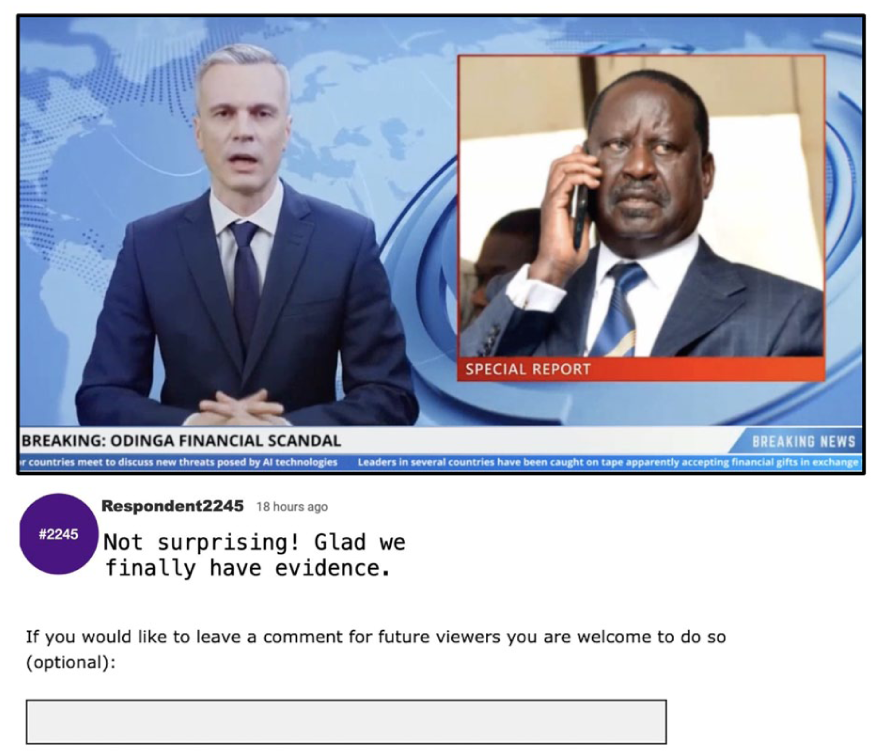
Deepfake stimuli–video condition.
Within each media condition, participants were randomly assigned to listen to a mirrored statement from one of the two Kenyan politicians. The misinformation contained in each condition remained consistent with only minor changes. 4 By controlling for additional factors, this division across political candidates enabled us to assess whether there were differential effects of the treatment among aligned (viewing the candidate they support) or misaligned (viewing the candidate they don’t support) supporters.
Survey Design
The experiment used a between-subjects design, with participants randomly assigned equally across the groups. A control group was not shown a video and was instructed to instead directly answer questions about support for one of the two Kenyan politicians: Raila Odinga and William Ruto. To balance the output by partisanship and modality, we created two versions depicting each politician. The first version of each politician contained only the audio output of the candidates. As depicted in Figure 1, the second video version mirrored the recent real-world use of synthetic news anchors to frame the audio in a news studio context (see Graphika, 2023 for a recent example). A complete version of the survey and related recruitment materials is included in the project OSF repository.
Comment Conditions
As discussed, our treatment revolved around the audience’s interpretation of the multimedia evidence. To accomplish this, we developed the accompanying comments to reflect levels of consensus. Specifically, participants were further stratified into three comment-consensus categories: (a) credulous messaging, (b) incredulous messaging, and (c) mixed messages. Figure 2 presents an example of each treatment comment:
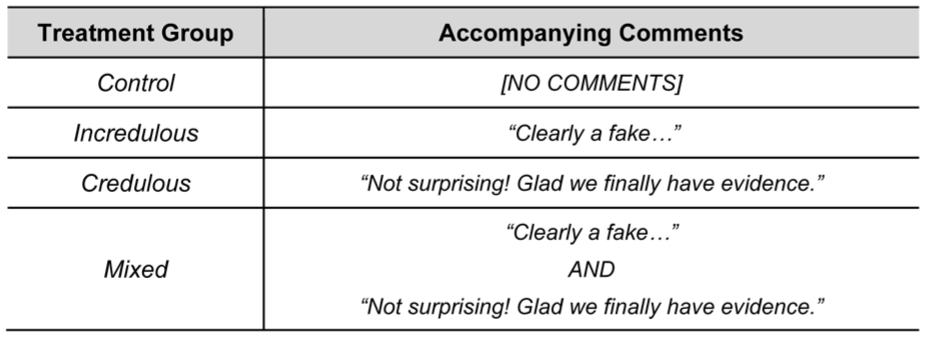
Comment conditions.
As the focus of the study was dependent on the external validity of participant assessments of participant comments, we attempted to improve the verisimilitude of the comments by basing the comment treatment on the internal commenting features present on online platforms, including YouTube. To do so, we developed a novel survey instrument that integrated the comments into the survey flow, which aimed to make the comments appear as natural as possible. This included the integration of an additional option for participants to add their own comment as well as through modeling the comment features on previous surveys conducted on the platform. In addition, participants were informed that they would be given the opportunity to leave comments in an attempt to add to the validity of the experimental design (see Figure 1). While prior attempts to improve the validity of comment conditions have relied on screenshots of social media posts to simulate interactions with stimuli, our design intended to separate the comments from the stimuli for further differentiation.
Immediately after viewing the treatment and reading these related comment(s), participants were asked a series of questions about the media they encountered as well as their perceptions of the wider community’s assessment of the policies discussed in the treatment. To operationalize personal support, participants were asked questions about the candidate they viewed. Specifically, participants were prompted to respond on a sliding scale from 0 to 100 to the following prompt: “Rate how warmly you feel towards the political candidate (0 – cold; 100 – warm)?” 5 In addition, participants were asked to respond to elicitations of accuracy (i.e., “How likely is it that this media source was legitimate?”) as well as questions on trust in institutions and political corruption. Specifically, participants were asked “How much of the time do you think you can trust each of the following groups to do what is right?” Respondents responded to the query with regard to the national government, the media, and ordinary people. Participants were also asked “How many of the politicians running the government do you believe are corrupt?” Responses ranged from “all of them” to “none of them” (full survey questions and responses can be found in the Supplemental Appendix). Finally, participant demographics were recorded. This included participants’ ethnicity, gender, age, and educational attainment.
We acknowledge that the experimental setting may introduce demand characteristics that could affect participants’ self-reporting. Several design features were designed to help mitigate this concern. First, participants were not informed that the stimuli were AI-generated prior to viewing, preserving ambiguity about the content’s authenticity. Second, participants were told they would be viewing recordings from political figures and social media (framing consistent with real-world encounters rather than experimental expectations). Third, the comment conditions were integrated into the survey flow using a novel instrument designed to make them appear as natural social media commentary rather than experimental prompts. Fourth, the 95% correct identification rate during the post-treatment debrief check (reported in Supplemental Appendix A1) suggests participants engaged with the stimuli as intended. Nevertheless, we note this as a limitation in the “Discussion” section.
Analytical Approach
All data processing and analyses were conducted using R. The scripts for each analysis are available via the online OSF project repository. To test our hypotheses, we rely primarily on robust regression analyses that cluster standard errors at the respondent level. For each output, we report in-text standardized regression coefficients (β), p-values, standard errors (SE), and t-values. Further statistics for each model are contained in the associated tables in the Supplemental Appendix.
For each analysis, we present visually both a baseline rate of support and the rate of support for each candidate among the “no comment” control group. Each could be considered a control depending on the comparison. Where relevant, we note whether the baseline or no-comment control is acting as the main comparison. The baseline support rates are used to illustrate the influence of the video in general, while the “no comment” control is used as the main comparison group to interpret the influence of the comments, which are the primary focus of the article. Alternative robustness checks for each output, along with a balance table detailing the efficacy of the randomization procedure, are contained in the Supplemental Appendix.
Results
Personal Support
The main results of the treatment comments on estimated personal support for the politicians depicted in the deepfake are presented in Figure 3.
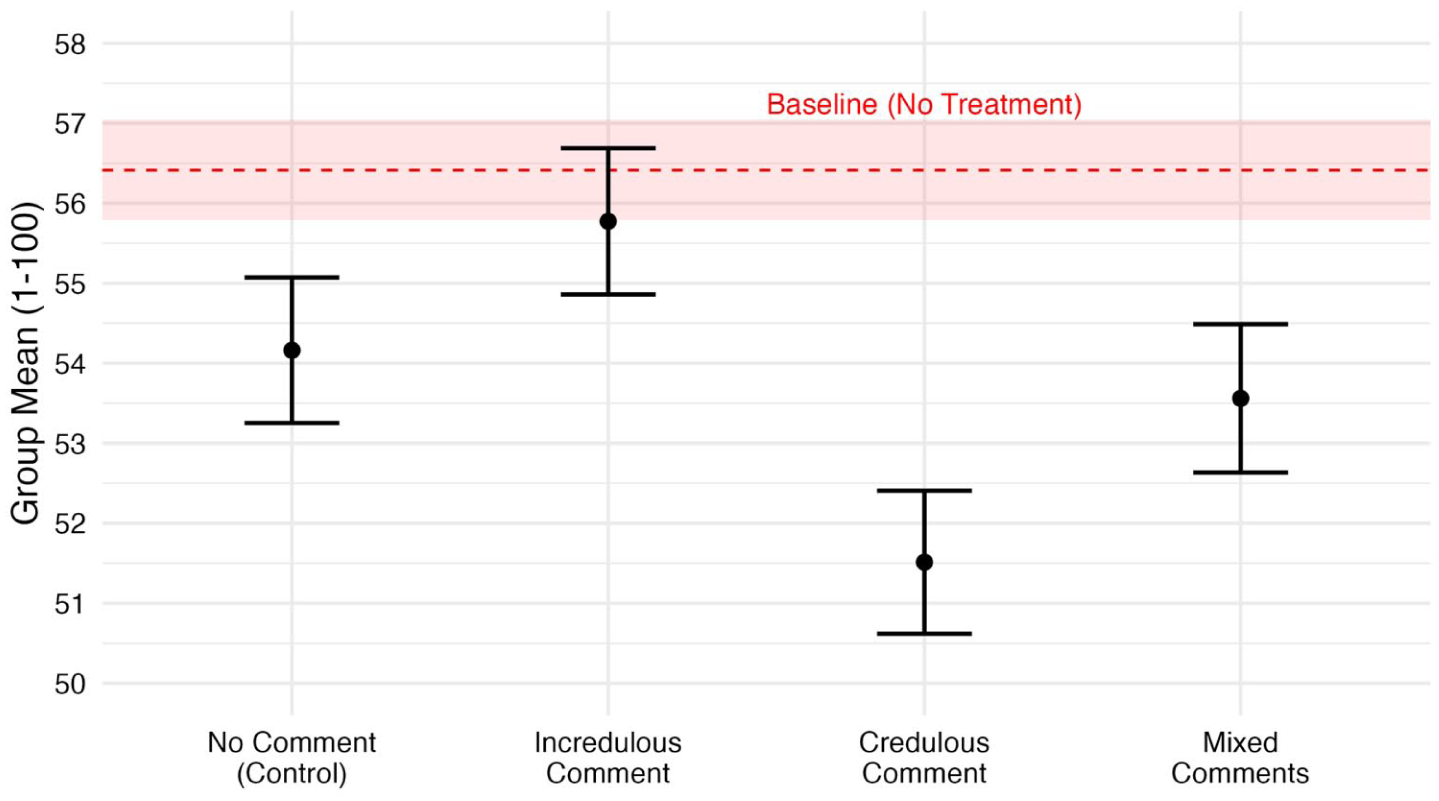
Estimated support for candidate depicted in deepfake.
Support for the candidate declined most sharply when respondents encountered a credulous comment stating the corruption was “not surprising.” Relative to the baseline group that never saw the video, this comment lowered support by almost five points on the 1‑to‑100 scale (β = −4.90, SE = 1.09, t = −4.48, p < .001). Simply viewing the video without any comments also reduced support, albeit more modestly (β = −2.25, SE = 1.11, t = −2.04, p = .04), while the incredulous “clearly fake” reply had no reliable effect (β = −0.64, SE = 1.11, t = −0.58, p = .56). A mixture of credulous and incredulous comments produced an intermediate yet significant drop (β = −2.85, SE = 1.12, t = −2.55, p < .05).
Re‑estimating the model with the no‑comment video group as the reference tells the same story. The incredulous rebuttal yielded a small, non‑significant uptick in support (β = 1.57, SE = 1.24, t = 1.26, p = .21), whereas the credulous “not surprising” remark again depressed user evaluations (β = −2.56, SE = 1.23, t = −2.08, p = .04). The mixed‑comment condition remains statistically indistinguishable from the no‑comment control (β = −0.56, SE = 1.25, t = −0.44, p = .66).
Effects of Partisanship
Our findings also show that partisan alignment moderates support for the candidates depicted in the deepfake (Figure 4). Exploratory partisan-subgroup models reveal that the comment effects are conditioned by whether the respondent is politically aligned with the candidate featured in the clips. Among participants who saw politicians they supported, simply viewing the video without any comment depressed candidate support by a little more than three points relative to the baseline group that never saw the clip (β = −3.11, SE = 1.08, t = −2.88, p = .004). Both the incredulous (“clearly fake”) and the credulous (“not surprising”) replies produced similar reductions (β = −2.97, SE = 1.09, t = −2.72, p < .01; β = −4.14, SE = 1.09, t = −3.81, p < .001, respectively), while the mixed set of comments had no reliable impact (β = −1.24, SE = 1.12, t = −1.11, p = .27). Re‑estimating the model with the no‑comment video as the reference confirms that none of the comment types further shift evaluations among co‑partisans (all β ⩽ 1.89, all p-values > .16).
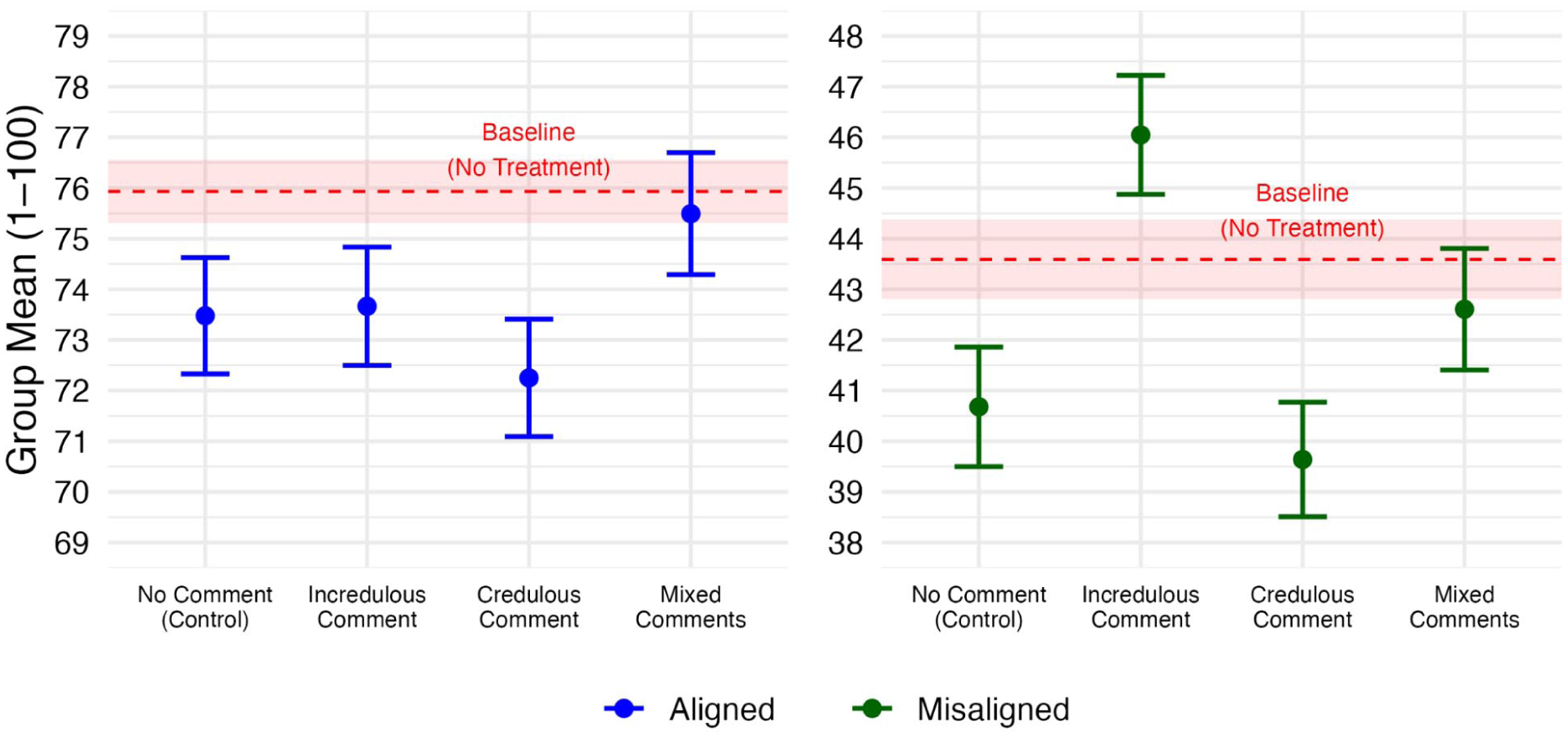
Estimated personal support by condition.
For respondents whose party affiliation did not match that of the politician depicted, the pattern partly reverses. The incredulous dismissal that the clip is “clearly fake” improves candidate evaluations, raising support by 2.78 points relative to the baseline (β = 2.78, SE = 1.49, t = 1.87, p = .06) and by nearly five points compared with the treatment seen without comments (β = 4.77, SE = 1.75, t = 2.72, p = .006). In contrast, the credulous “not surprising” remark reduces support by about three points versus baseline (β = −3.14, SE = 1.45, t = −2.17, p = .03) but does not differ from the no‑comment condition (β = −1.15, SE = 1.72, t = −0.67, p = .50). The mixed‑comment treatment remains indistinguishable from either comparison group (all p-values ⩾ .33).
Taken together, these subgroup analyses indicate that co‑partisans are generally susceptible to the negative tone of the video itself, with little additional movement from comment cues. Cross‑partisans, however, respond positively when another viewer explicitly questions the clip’s authenticity, suggesting that an incredulous counter‑narrative can blunt, and possibly even reverse, the persuasive power of potentially damaging political content among opponents.
Encouragingly, estimates of support are moderated by participants’ perceived accuracy of the video in question. Figure 5 shows that when participants view the video as real, their support for the video’s subject decreases compared to the baseline, while when they view the video as fake, their estimated support for the video’s subject actually increases above the baseline, although this does not reach the standard significance threshold of p < .05.
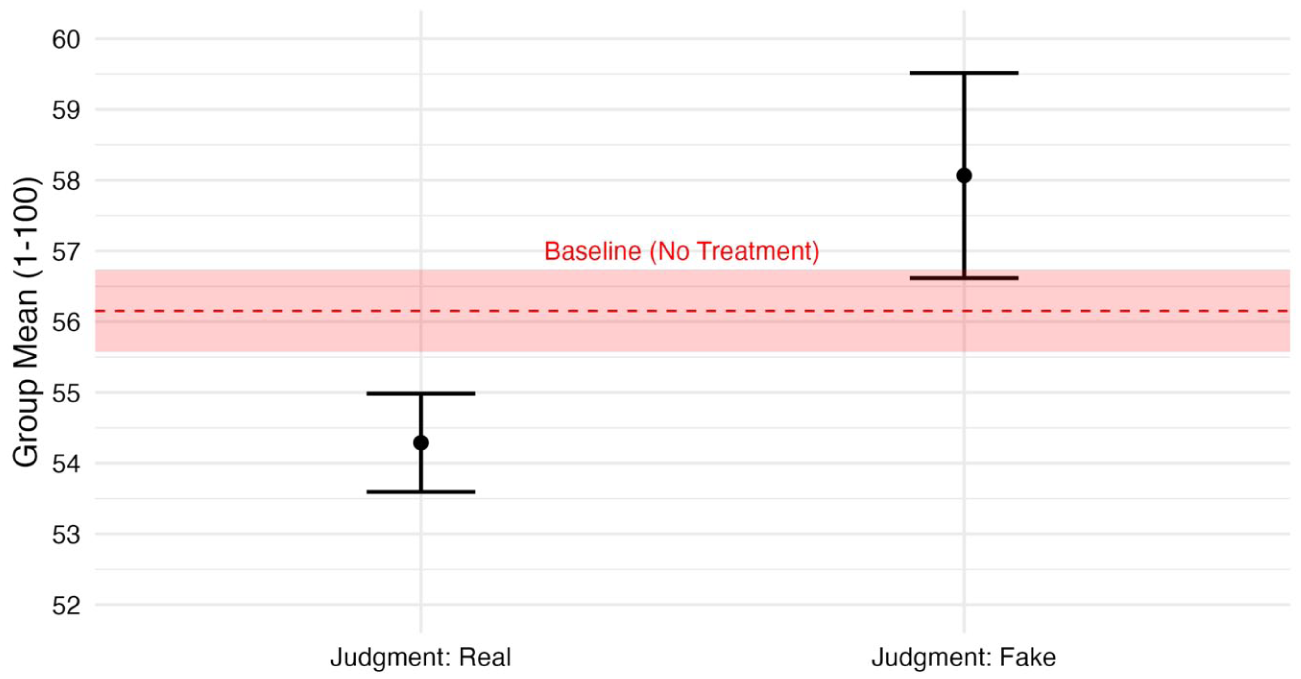
Estimated support for the candidate depicted in the deepfake by whether participants perceived the content to be real or fake.
Discussion
Consistent with prior work (Barari et al., 2021; Hameleers et al., 2022; Vaccari & Chadwick, 2020), our results suggest that deceptive deepfakes can harm trust in targeted candidates. Adding to this finding, we illustrate how the context in which individuals interpret deepfakes and related forms of audio-visual disinformation can influence the direction and size of these effects. These findings are further contextualized by theories of participatory disinformation that highlight how the interpretation of disinformation involves engaging with other audience members’ visible understandings of the content in question (Starbird et al., 2019). Although our study only captures a specific moment in this participatory process, the initial interpretation of content with uncertain authenticity, our findings demonstrate that even at this stage, the social context within which a deceptive deepfake sits shapes its impact. Viewed in this light, our findings highlight how deepfakes are not merely a credibility problem for individual viewers but are instead flexibly deceptive cues that can be complemented by other dimensions of disinformation campaigns, such as inauthentic accounts, to increase their potential reach.
Overall, we find evidence for our primary hypothesis (H1) that personal support for the subject of a deepfake is impacted by contextual factors such as comments from other users when other authenticity cues are missing (e.g., AI labels). Consistent with our first sub-hypothesis (H1a), which examined how expressing doubt about the authenticity of the deepfake would mediate the effects, we find that respondents’ support for the candidate didn’t remain static but instead increased relative to the no comment condition in the presence of an “incredulous” comment, which pointed out the inauthenticity of the deepfake. Moreover, in our test of our second sub-hypothesis (H1b), we find that “credulous” comments that implicitly accepted the deepfake’s validity exacerbated its negative impact on personal support. Crucially, providing scope for these findings, when a set of mixed comments was included underneath the deepfake, respondents overall decreased personal support, but not as much as with the credulous “not surprising” comment on its own (consistent with H1c). As a result, the effect of the mixed set of comments ended up similar to the no-comment control, suggesting that both conditions result in uncertainty about how to interpret the deepfake; uncertainty that appears to result in a decline in support for the depicted candidate. This pattern is also consistent with Vaccari and Chadwick’s (2020) finding that deepfakes may be more likely to generate uncertainty than outright deception, and that this uncertainty itself carries negative consequences; in their case, reduced trust in news media, and in ours, reduced candidate support.
Evidence for our second hypothesis (H2) on the moderating influence of partisanship is mixed. In partial support of our hypothesis, we find more variance in support across comment conditions when opposition candidates were depicted, suggesting that support for opposition candidates was impacted by comments more than perceptions of supported candidates. Consistent with this reading, in the “incredulous” comment condition among misaligned participants, support for the subject depicted in the deepfake actually increased above the baseline. This suggests that, in the absence of contestation represented by the “mixed” comment condition, counter-narratives may be able to limit the negative impact of deceptive deepfakes. These partisan asymmetries are consistent with the broader motivated reasoning literature, which has documented how individuals are more critical of attitude-inconsistent information and more accepting of attitude-consistent information (Kunda, 1990; Taber & Lodge, 2006). Our findings extend this work by demonstrating that motivated reasoning dynamics also shape how audiences interpret AI-generated content in the presence of social cues. This is also consistent with Hameleers et al.’s (2024) finding that subtle distortions in deepfakes are deemed more credible when they feature figures with whom participants identify or feel a connection.
In contrast to this visible shift among the misaligned partisanship cohort, support declined across all conditions among participants who supported the depicted candidate. Although the declines were relatively small, this suggests that deceptive deepfakes can decrease support for candidates even when comments acknowledge their inauthenticity. One explanation for these declines is the view that respondents’ responses were influenced by the prevalence of global, often conspiratorial, narratives about corruption in politics (Plenta, 2020). The prominence of these narratives may play a role in why participants are more likely to reduce support for a candidate in reaction to fabricated “evidence” (i.e., the deepfake) of corruption. This dynamic may also reflect the heuristic processing patterns documented in recent deepfake research. Shin (2026) found that cognitive shortcuts frequently override analytical reasoning when users encounter deepfakes, and Hu and Huang (2025) demonstrated that familiarity with content increases trust even for synthetic videos. Where conspiratorial narratives about political corruption are culturally familiar, they may prime audiences to accept fabricated corroborating evidence more readily, a heuristic pathway that operates generally without reflection. In contrast, we are agnostic as to why the treatment has a negative effect on support-aligned candidates and a positive effect is visible for misaligned candidates in the incredulous comment condition. Future research should examine these differential results.
While informative, the findings should not be interpreted in the absence of the study’s contextual and methodological limitations. Although our within-survey comment design aimed to provide further validity than is typically offered in experiments focused on audio-visual content, it is still an imperfect representation with none of the real interactions that define modern social media use. Relatedly, the conditions with the most dramatic findings of this study (the effects of individual comments) are uncommon on social media platforms due to the size of their userbases. As a result, the “mixed” comment condition is likely to be the closest representation of a natural environment. Future work should iterate on our design, finding ways to increase the similarities between the simulated and real social media environments, including through the introduction of additional cues such as opportunities for engagement (e.g., “like” buttons).
In addition, our study may be influenced by our choice of stimuli and comments. While we elected to conduct the study in Kenya due to the prevalence of social media use and its competitive political environment, the effects we document could be unique to deepfakes about political scandals, the candidates depicted, or the specifics of Kenya’s social media ecosystem. Future work should test additional stimuli and comments focused on different aspects of the deepfakes to better understand the differential effects of diverse subjects and topics. Moreover, as we did not include a real comparison video, it is difficult to determine which effects might be unique to deepfakes and which effects might be caused by participants’ perception of whether a video is authentic or not. Future work focused on understanding effects unique to AI-generated media, instead of media that is ambiguous, should compare interpretations of real videos with similar AI-generated videos. Finally, as with any survey experiment, participants’ awareness of being in a study may have influenced their responses. Although the design mitigated demand characteristics by withholding information about the AI-generated nature of the stimuli and by embedding comments naturally within the survey flow, we cannot fully rule out that the experimental context shaped participants’ self-reported evaluations.
Overall, our study serves to illustrate how the online context in which users encounter deepfakes plays an important role in the judgments people make about the individuals they depict. Importantly, this finding resonates with theories viewing disinformation as participatory. Just as disinformation campaigns depend on audiences to amplify and lend credibility to false narratives (Starbird et al., 2019), our results show that the impact of a deepfake is not fixed at the moment of production but is socially negotiated in the spaces where it circulates. These findings are aligned with long-standing theories of collective sensemaking (Maddock et al., 2015; Weick, 1995) in demonstrating how interpretations of deepfake, like other forms of content, are influenced by the opinions of others. The survey design of our study allows us to see a snapshot of a larger process that has become increasingly common as generative AI has become a feature of social media ecosystems: the initial interpretation of content of uncertain authenticity. We see that at this initial stage of sensemaking, participants’ estimates of support were almost universally negatively impacted, even when another comment suggested that the video was fake. In the absence of clear markers, the social context and platform-specific affordances that determine how content is consumed become increasingly vital for understanding how deceptive deepfakes and other forms of AI-generated content will be interpreted online.
Conclusion
This study aimed to understand how audiences interpreted deepfakes in an environment that simulated the real-world conditions of social media. Our findings demonstrate how even minimal comment conditions can shift interpretations of the content of ambiguous veracity. Our study calls attention to how difficult it is for audiences to evaluate AI-generated content in real-world settings. When platforms and other information systems take no action to help users determine the veracity of media, audiences are likely to rely on the interpretations of other audience members, which, in the context of disinformation campaigns, are likely to contain a mix of both authentic and inauthentic posts. These dynamics are especially pronounced in under-resourced contexts where content moderation capabilities are limited and AI labeling systems are inconsistently applied. Such low-moderation environments represent the experience of the majority of social media users worldwide, making our findings particularly relevant for understanding how generative content spreads in regions with fewer safeguards. As AI proliferates and becomes increasingly integrated into online systems, particularly in environments with limited resources to effectively moderate online spaces, the need to provide cues to aid user interpretation increases. To this end, our study provides an incremental step toward identifying major cues that can be used to guide, or mislead, audience perceptions of AI-generated content.
Supplemental Material
sj-docx-1-sms-10.1177_20563051261462092 – Supplemental material for Making Sense of AI-Generated Disinformation: How Audience Interpretations Influence the Impact of Deepfakes in Kenya
Supplemental material, sj-docx-1-sms-10.1177_20563051261462092 for Making Sense of AI-Generated Disinformation: How Audience Interpretations Influence the Impact of Deepfakes in Kenya by Morgan Wack and Stephen Prochaska in Social Media + Society
Footnotes

Funding
Funding for the survey expenses was covered through grant funding from the Innovation Fund through the University of Washington’s Center for an Informed Public (CIP).
Declaration of Conflicting Interests
The authors declared no potential conflicts of interest with respect to the research, authorship, and/or publication of this article.
Supplemental Material
Supplemental material for this article is available online.
Notes
Author Biographies
References
Supplementary Material
Please find the following supplemental material available below.
For Open Access articles published under a Creative Commons License, all supplemental material carries the same license as the article it is associated with.
For non-Open Access articles published, all supplemental material carries a non-exclusive license, and permission requests for re-use of supplemental material or any part of supplemental material shall be sent directly to the copyright owner as specified in the copyright notice associated with the article.
