






Abstract
Informed by reading comprehension and comprehension strategies research, this study explores the Scripture-reading practices of four Methodist youths. Several rounds of inductive thematic analyses of Scripture-reading protocols revealed a set of five strategic reading practices youths used to understand Scripture. They drew inferences about the Bible’s possible meanings, made connections between the Bible and other texts, made personal comments, recognized when they were confused, and applied prior knowledge. Identifying and naming these five strategic practices can deepen our understanding of the nature of Methodist youths’ Scripture-reading practices and raise important questions about the relationships among youth, religion, and literacy.
Scripture is clearly an important part of many young people’s lives (American Bible Society, 2015; Eakle, 2007; Rackley, 2014; Smith and Denton, 2005), in part because it provides them with tools for developing academic knowledge (Skerrett, 2013, 2014), informs the development of their spiritual and academic identities (Reyes, 2009), and helps them frame and navigate their religious and secular lives (Sarroub, 2002). Scripture can also give youths access to and help them apply knowledge about their respective religious traditions, offer them strength to endure challenges, comfort them during stressful times, and draw them closer to God (Rackley, 2016). Yet, notwithstanding the extant literature’s recognition of the importance of Scripture in youths’ lives, there is a surprising paucity of research aimed at identifying the specific practices youths use to read it. The present study attends to this empirical gap by examining the strategic reading practices four Methodist youths used to understand the Bible.
A clearer understanding of the manner in which youths read Scripture can provide religious researchers and educators with the knowledge to make more informed decisions about what counts as Scripture-reading in a given institutional (or individual) context. Moreover, greater awareness of Methodist youths’ Scripture-reading practices can help clarify broad theories of religious literacy (Pike, 2007; Sullivan, 2007) by providing tools and insights that can be used to inform youths’ Scripture-reading experiences.
To address the purpose of this article, I use relevant literature to outline the theoretical and empirical framework of the study. I then discuss the methods used to gather and analyze the data. The findings detail the five strategic Scripture-reading practices the youths used and how they influenced their reading of the Bible. I then discuss the findings, pose questions this study raises about religious youths’ reading practices, and conclude with some final remarks.
Theoretical framework and relevant literature
Because this study focuses on the practices youths use to understand texts, I frame the article by drawing on reading comprehension and comprehension strategies research.
Reading comprehension
As one of the “higher order competencies” (Pressley, 2002: 12), comprehension is a complex process that focuses on the construction of meaning of texts (Duke and Carlisle, 2015; Pressley and Allington, 2015). Betrayed by the illusion of comprehension (Druckman and Bjork, 1994), readers can mistakenly believe that saying words translates into comprehending ideas. The truth is that readers “must go considerably beyond the words alone” (Schwanenflugel and Knapp, 2016: 196) if they hope to understand what they read. Take the words God, is, and love. On their own, they signify important but decontextualized concepts, states of being, emotions, and so forth. When strung together, however, God is love becomes more than the sum of its parts. The individual words gain a conceptual coherence by sitting next to each other, and therefore signal a series of relationships, ideas, and connections that do not exist in the words alone.
What a text means is clearly informed by the words of the text, but also by the implied relationships among the words, the knowledge readers have about their reading topic, and readers’ lifetimes of experience (Fielding and Pearson, 1994). In a word, we use language, experiences, attitudes, connections, and opinions to construct meaning from texts. To make sense of God is love, for example, readers must draw from their experiences with and knowledge of God and love. These might be informed by what one knows of God, how one feels about love, when one has felt God’s love, and so forth. Readers’ knowledge and experiences also help them interpret possible meanings of God is love, assess the appropriateness and nuances of these meanings, and select the one(s) that appear to work best in the context in which the phrase is used. Readers might also consider what they know about the verb “is,” what it suggests about the nature of existence, and how it functions as the link between God and love. It is these and other relationships, experiences, and connections that can help readers understand the meaning of God is love and other phrases, principles, and truths in Scripture. This view of reading comprehension as language infused with experiences and connections suggests that comprehension is not only “an extraordinarily complex process,” (Lee and Spratley, 2010: 3) but a dynamic and multidimensional one as well.
As the example suggests, meaning does not reside, absolute and fully formed, in texts, waiting to be extracted by readers (Rosenblatt, 1938/1968). Nor do readers impose meaning on texts, interpreting them to mean whatever they want them to mean. Nor does meaning occur in a vacuum, devoid of process or purpose. Instead, what a text means may be seen to develop through the complex interactions of factors within the reading process (RAND Reading Study Group, 2002). Comprehension, then, may be fleeting insofar as what a text means may shift over time as one develops as a reader, one’s purposes for reading change, and one understands the text in light of new knowledge and experiences.
Comprehension strategies
One way to capture readers’ methods of understanding texts is to focus on their use of specific meaning-making practices, or comprehension strategies. As deliberate procedures used to learn from texts (Afflerbach et al., 2008), comprehension strategies are essential tools in the construction of meaning. Since the 1960s, research has sought to identify the specific comprehension strategies readers use to understand texts (Duke et al., 2011; Guthrie et al., 2006; Keene and Zimmerman, 1997; Pearson and Dole, 1987; Pressley, 1976; Robinson, 1961). As a result of this research, we know that skilled readers do the following: create mental images; use prior knowledge about topics, authors, and the reading process; monitor thinking; infer, ask, and answer questions; and summarize. Readers also identify and use text structures, make connections with texts, recognize and clarify confusion, determine importance, and predict what might happen next. Clearly, readers do not use all of these strategies every time they read; instead, one uses them selectively and flexibly to comprehend texts as required by the demands of the texts and one’s own reading purpose. When readers use these strategies, they are more likely to remain engaged with texts, read more purposefully and often, and continue developing their reading skills than they are when they read without them (Guthrie, 2004).
Although there is a “wealth of evidence in support of the effectiveness of [comprehension] strategies” in developing readers’ understanding of texts (Wilkinson and Son, 2015: 366), exactly how this occurs is less clear. One argument suggests that comprehension strategies improve reading because they encourage readers to actively engage with texts—something they might not do (as well or as often) without the strategies (Kintsch and Kintsch, 2005). Another argument posits that comprehension strategies allow readers to have more productive discussions about texts. These discussions can give readers a clearer voice in the construction of meaning and help them learn from each other (Palinscar, 2007). Although research on reading comprehension and comprehension strategies has provided insights into the nature of constructing meaning from texts and the practices readers use to do it, this research has rarely intersected with Scripture-reading. As such, scant empirical evidence exists about the types of strategic tools religious youths use to construct meaning of sacred texts. In this study, reading comprehension and comprehension strategies research provide an empirical frame for examining the intersection of youth, religion, and literacy—namely, the specific reading practices Methodist youths used to understand the Bible.
Methodology
Situated within a larger study that examined religious youths’ Scripture-reading practices and motivations, the present study focuses on youths in one Methodist congregation. Here, I identify the context of the study, the participants, the methods used to collect the data, and the analytic processes.
Context and participants
The study was conducted in a Methodist congregation in a mid-sized, racially diverse, Midwestern city in the United States. The congregation predated the state’s admission to the Union by Congress in the early nineteenth century. As a community, the city is largely middle-class and includes a large, public university that influences the intellectual and economic life of the surrounding area. All of the youths participating in this study were European American, and many of their parents were employed by the university in positions consistent with their advanced degrees. Three of the participants were male, and four were female. All of them were raised as Methodists. Three youths attended local, public schools. One attended a private, Catholic school. All of the youths stated that they planned to attend college after graduation from high school.
Description of participants.

Data collection
In the larger study, data consisted of 59 semi-structured interviews with 16 youths over 2 years, 9 months of observations in various religious contexts, and numerous relevant material artifacts related to Scripture-reading. For the current article, I draw data primarily from the reading process interviews in which youths were invited to verbalize their thoughts as they read Scripture. Verbal protocols of reading are often used to identify reading practices (Davey, 1983; Hilden and Pressley, 2011; Pressley and Afflerbach, 1995). Their value as a research method rests primarily in their ability to provide access to readers’ “conscious comprehension” processes (Pressley and Allington, 2015: 70) by attending to their in-the-moment reading experiences. Because verbal protocols might be especially fruitful when texts align with readers’ knowledge and interests (Wyatt et al., 1993), I invited youths to self-select a text to read for the interview. All of the youths selected different chapters from the Bible.
During the reading process interviews, youths practiced verbalizing their thinking as they read 2 Sam 17:32–37—an excerpt from the Bible about David prior to his encounter with Goliath. As they practiced sharing their thinking, I prompted them with, “What are you thinking?” and “Please keep talking.” We then discussed their experiences reading and verbalizing their thinking, and I answered questions about the think-aloud process. I then invited youths to read their chapters, continuing to share their thoughts as they read. This part of the interviews lasted 12–15 minutes. To conclude the interviews, I asked youths about their experience verbalizing their thinking, including how the process influenced their reading and understanding of the chapter, if at all. All of the interviews were audio-recorded and transcribed prior to analysis.
Analytic procedures
Sample transcription coding.
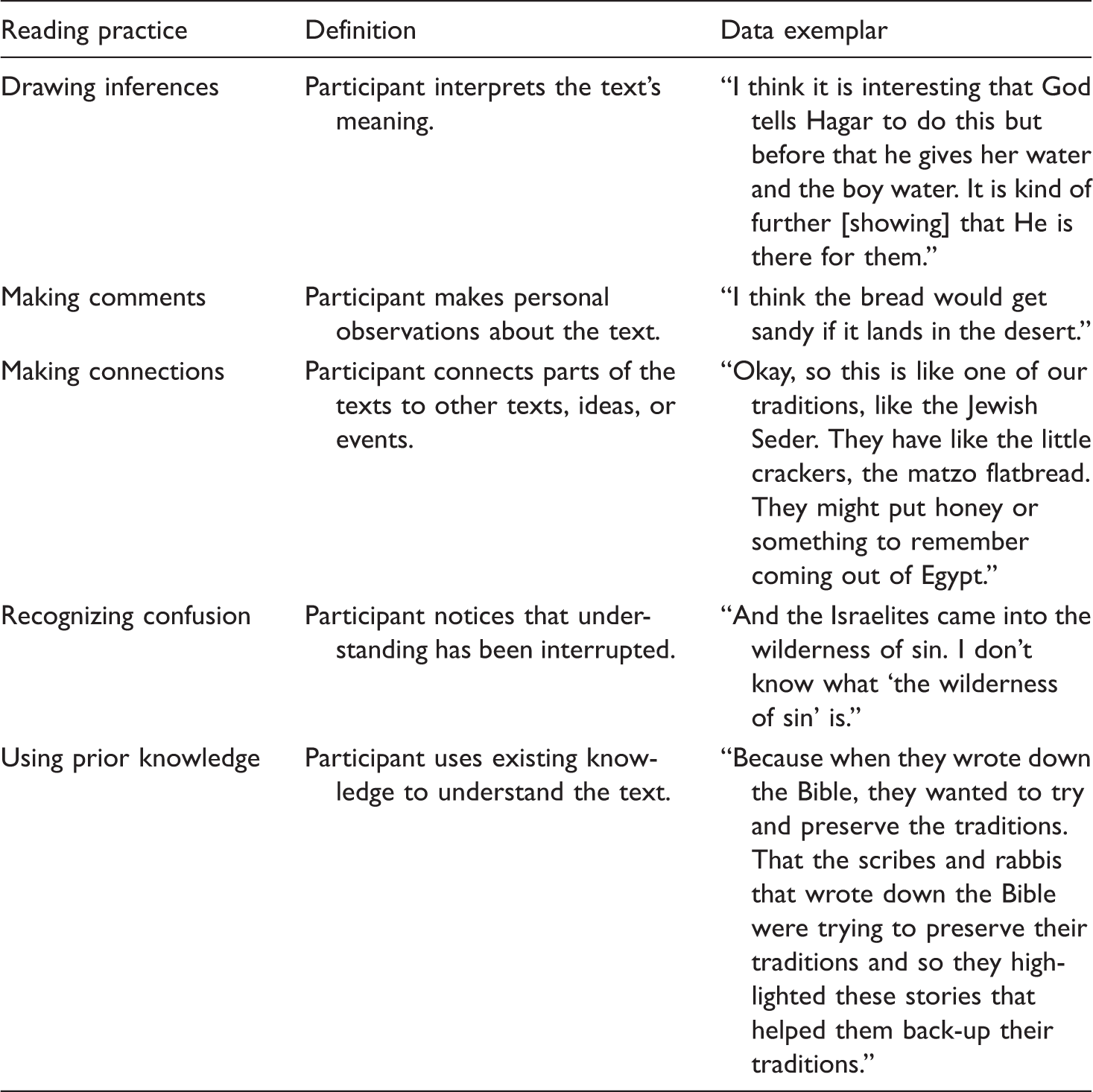
Demonstration of shared Scripture-reading practices by participant.
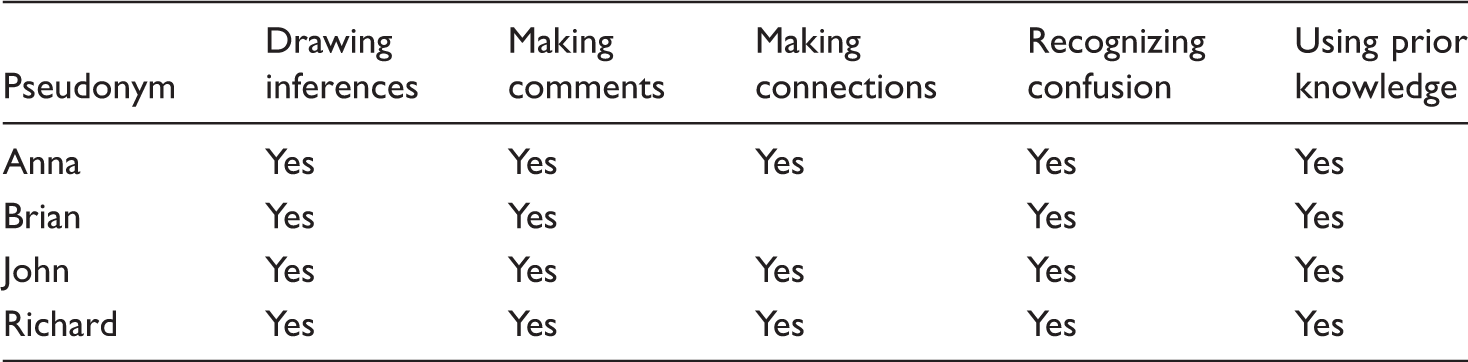
Methodist youths’ shared Scripture-reading practices
Detail of shared Scripture-reading practices.
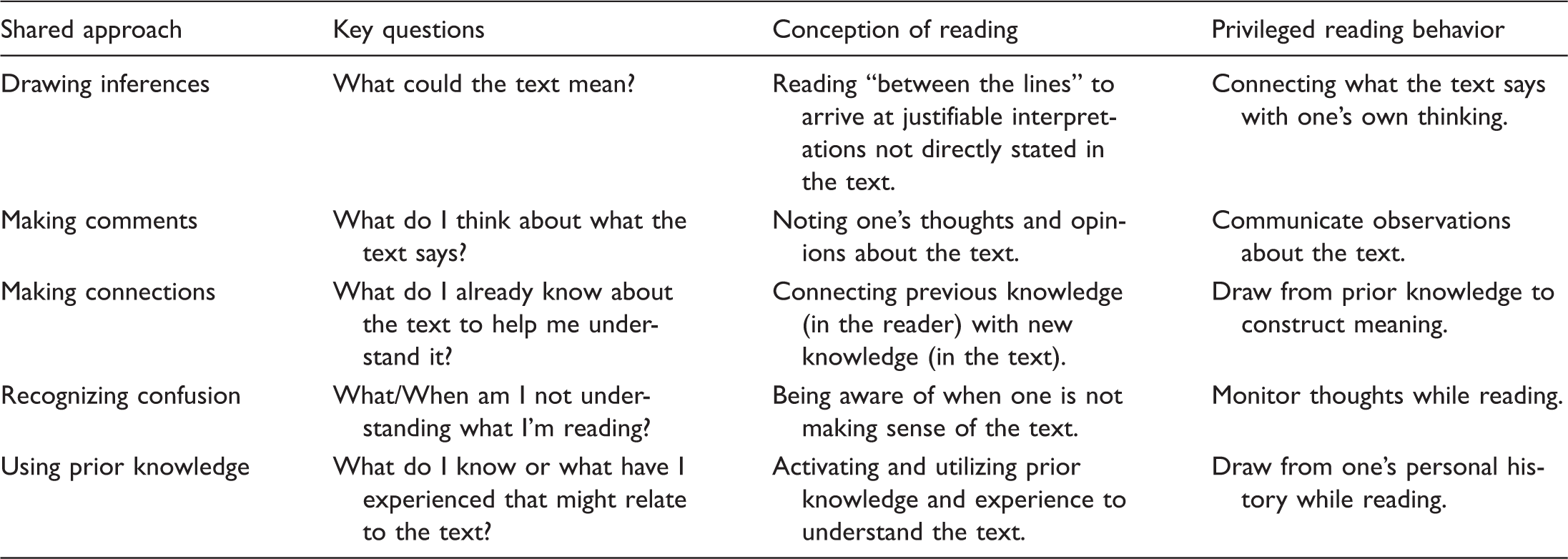
Drawing inferences
All of the youths inferred as they took what they were reading, added their own thinking, and arrived at an insight not explicitly stated in the text. John inferred when he stated that he assumed the “him” the tax collectors and sinners were coming to listen to was Jesus. More substantively, Richard moved beyond referential inferences (Schwanenflugel and Knapp, 2016), trying to make sense of Israel’s need to gather twice as much manna on the sixth day: Huh, why is that important? On the sixth day when they prepare what they bring in … So, they’re preparing bread and it will be twice as much as they got on the other days. So, on the sixth there will be twice as much. So … Oh! Maybe because on the seventh day they’re not supposed to bring any [into their tents]. I bet that’s the test.
Later, when Richard read about Israel following the Lord’s commandment and the manna remaining fresh, he said, “There were no worms in it, kind of like the holy bread. Hmmm. So, I’m kind of thinking they passed the test.” Because Exodus 16 did not directly state that Israel had passed the test—or that there was a test—Richard concluded as much by the condition of the manna, using it as evidence of his inference. Importantly, these inferences developed from Richard’s initial question about the importance of collecting twice as much manna. As a higher-order inquiry about the purpose of the instruction to Israel, Richard’s question encouraged an inference because it required a response that drew, at least in part, from resources outside of the passage. This is not uncommon. Authors of narrative texts never provide all of the information needed to understand a text because they expect readers to infer motives, intentions, and value. Perhaps because inferencing is how readers fill in narrative gaps and develop comprehensible representations of texts’ possible meanings, it has been called the “bedrock of comprehension” (Harvey and Goudvis, 2017: 163). In this study, inferencing allowed the youths to clarify antecedents, determine the purpose of events, and in other ways interpret biblical texts.
Making comments
All of the youths made personal observations as they read Scripture. Often, their comments were a sentence in length and related to what they had just read. The comments appeared to function primarily as opportunities to briefly respond to a passage intellectually or emotionally. Brian’s comments began with the phrase, “I think it’s interesting that,” signaling intellectual curiosity about God’s dealings with Abraham and his family. He stated, “I think it’s interesting that God told Abraham to circumcise his son.” Richard’s comments indicated more emotion. As he read about God sending manna to the Israelites, he said, “That would be weird,” “That would be kind of gross,” and “That sounds pretty good.” Although at times casual in their comments, the youths’ observations represented their authentic—often candid—personal thoughts and feelings about Scripture. For them, making comments seemed to be about staking out a space in Scripture circumscribed by their personal observations, like Richard’s exultant, “Wow! [Forty years] is a long time eating bread that God gave them. Wow!”
Comments also gave the youths a space to demonstrate their attention to detail. John, for example, made an insightful comment about grace when he observed, “You know, [the Prodigal Son] didn’t earn [the grace his father showed him]. It was given to him.” Although John did not take this comment further, it revealed an attentiveness to detail that could serve him well as a reader of the Bible. As he read about Hagar and Ishmael struggling to survive in the wilderness, Brian recognized a simple act of kindness, a detail that could have been easily overlooked. He said, “I think it is interesting that God tells Hagar to [go into the wilderness], but before that He gives her water and the boy water.” This seemingly simple observation led Brian to his larger point about the nature of God. He said that providing Hagar and Ishmael with water “is kind of further [showing] that He is there for them.” For Brian and his peers, making comments about what they were thinking, feeling, or observing may have been a safe, low-stakes way to enter the larger conversation about the Bible. To participate in the conversation, they did not have to be biblical scholars or particularly well-read; they simply had to be observant and honest about what they were thinking and feeling, and offer their personal comments when they could.
Making connections
Making connections involved connecting parts of the text with other texts, ideas, or events. The youths primarily made text-to-text connections. After reading the Parable of the Lost Sheep (Luke 15), John, for example, connected this parable to another: Jesus is emphasizing the importance of every person by using the Parable of the Lost Sheep. Also, the story of the lost child, I mean, the two sons. Why am I blanking on that? The prodigal son. [The Parable of the Prodigal Son] has the message that although one can be right and never sin and leave the flock and be lost, you care about everyone. And getting one back means the world.
Text-to-text connections also helped the youths see common threads between the Bible and other, non-biblical texts. As Richard read that the Israelites preserved manna by placing “it in front of the covenant document for safekeeping” (Exod 16:33–34), he was curious about the “covenant document.” He tried to understand the passage through a connection to another text—in this case, a film. He said, “I wonder if that means the—in Indiana Jones—what was that called? The lost ark? [I wonder if that means the manna was placed in] the Ark of the Covenant for safe keeping.” In this example, connecting to a popular film seemed to be the link Richard was looking for to understand what was happening in Exodus 16. Connecting to the film gave him a physical—and perhaps dramatic—representation of what “the covenant document” could mean. Making connections may have also allowed Richard and his peers to clarify the meaning of what they were reading and see larger patterns within and across the Bible, informing their developing sense of scriptural coherence.
Recognizing confusion
Recognizing when they were confused suggests that the youths were aware of when Scripture stopped making sense. Their confusions revolved around relatively minor scriptural language issues, such as the meaning of a word or phrase. Anna was confused about the meaning of “proverb.” John was confused about the moment the younger son became The Prodigal Son. He said, “I didn’t know that [that happened then], but it makes sense.” Richard struggled with the location of the city of Elim and the meaning of “manna,” “omer,” and “the wilderness of sin.” Brian did not know what “weaned” meant. These were minor reading confusions because the youths did not spend much time dealing with them, nor did these confusions appear to significantly limit their understanding; therefore, resolving them was not required to maintain an acceptable, plot-level understanding of the texts. At most, the youths’ Scripture-reading confusions appeared to be speed bumps rather than detours.
In addition to language-oriented confusions, current research suggests that Methodist youths can struggle with the intratextual and personal contradictions they see in Scripture (Rackley and Kwok, 2016), both of which can limit their willingness and ability to comprehend sacred texts. Although the language confusions were more prominent than the contradictions in the present study, it is important that the youths were able to articulate when they were not understanding Scripture, regardless of the nature of their confusion. Being able to say, “I don’t know what this means” is an important step in constructing meaning of texts (Schoenbach et al., 2012), especially complex texts such as the Bible, where confusion is more likely than when reading less complex texts. Having the ability to recognize their confusion also suggests that the youths could monitor, and to some extent control, their thinking as they were reading.
Using prior knowledge
All of the youths drew upon their prior knowledge and experience by articulating what they already knew about what they were reading. As she read about a pendant, for example, Anna recalled that it was “a prized possession”; therefore, in the context of Proverbs 1 the pendant was “something special.” This insight, informed by her prior knowledge, may have influenced Anna’s conception of the pendant in the verses, which could influence the meaning she drew from the chapter. Brian drew from his prior knowledge about Abraham’s experiences with God to inform his understanding of who Abraham was. He said, “Later in the story Abraham is pretty reluctant to listen to God—to do what God wants him to do.” Contrasting Abraham’s prior willingness with his current reluctance may have helped Brian situate Abraham as a complex, perhaps conflicted man and prophet, offering insight into the tensions Abraham felt as he tried to navigate God’s commandments and his own desires.
Drawing explicitly from his understanding of biblical history, Richard used his prior knowledge to make sense of biblical narratives. He said, “When they wrote down the Bible … the scribes and rabbis … were trying to preserve their traditions and so they highlighted these stories that helped them back-up their traditions.” As an historical frame for the events of Exodus 16, Richard’s prior knowledge offered an explanation for the inclusion of these and other narratives as a way of preserving traditional Jewish beliefs and practices. Using his prior knowledge to justify the presence of biblical stories was particularly important for Richard because he and some of his peers struggled with the veracity of some narratives and “the legitimacy of the number of years they give” for events. Drawing upon his prior knowledge about writing as a tool to preserve tradition seemed to offer Richard a way of interpreting the events in Exodus 16 in ways that made sense to him, or that allowed him to provisionally accept them. More generally, the explicit identification of their prior knowledge signaled where and how the youths were drawing insight and information to understand Scripture; specifically, what they already knew was being used to understand what they were trying to know.
Discussion and implications
This study provides empirical evidence of the practices four Methodist youths used as they read the Bible. With the exception of “making comments,” the youths’ five strategic reading practices are part of the robust reading repertoires of skilled readers (Harvey and Goudvis, 2017; Keene and Zimmerman, 1997; Pearson and Dole, 1987; Pressley, 1976). The current study complements and extends Sullivan’s (2007: 25) “clusters of factors” that can influence students’ religious reading. Sullivan’s factors include the “chance and unforeseen circumstances and connections” (Sullivan, 2007: 36) that serendipity can bring to a reading, students’ “hopes and fears” (p. 35), and their “knowledge, maturity and intellectual capacity” (p. 35). The present study moves beyond broad “clusters of factors” to identify specific religious reading practices. The specificity of these practices not only focuses the lens on the explicit techniques readers can use to enhance their understanding in the moment-to-moment act of reading, but also operationalizes broad-level religious reading factors in terms of precise, practical reading tools youths can use when they engage with religious texts.
The same may be said of Pike’s (2007) transactional view of religious reading. Drawing upon Rosenblatt’s (1938/1968, 1985, 2013) reader-response theory, which suggests that meaning is generated in the transaction between readers and texts, Pike argues that a transactional view of religious reading can inform “how parents and teachers … help children read [Scripture] wisely” (Pike, 2007: 83). Although a long-standing and influential theory of reading, transactional theory has provided less in the way of practical tools for educators and students. The present study complements Pike’s theorization of religious reading by identifying five practices that readers can use to engage with religious texts. How do religious readers negotiate the “complex, nonlinear, recursive, self-correcting transaction” (Rosenblatt, 2013: 930) required to generate meaning of religious texts? They read between the lines to develop justifiable interpretations that are not directly stated in the text, weigh in with their personal observations, make connections between Scripture and other texts, attend to their thinking so they can recognize when they are confused, and draw upon their prior knowledge of what they are reading. As examples of specific methods Methodist youths use to read the Bible, these strategic reading tools afford them clarity in their transactions with sacred texts.
Drawing attention to the manner in which religious youths read Scripture, this study may prompt important questions for religious researchers and educators working at the intersection of youth, religion, and literacy. What, for example, do youths’ reading practices look like across faiths? Across congregations within faiths? Across sacred texts? Across these spaces, there may be points of overlap and departure with regard to youths’ literacy practices. Where might these points be, and what might they look like? Watt and Fairfield (2010: 365) argue that “religious literacy play[s] a significant role in developing committed adherents in a religious tradition.” In light of the present study, one might examine how the nature of reading influences and is influenced by youths’ commitments to their faith. For instance, how does reading Scripture influence youths’ religious commitment? How do committed youths read Scripture? Does this differ by faith? Do committed youths read Scripture differently, or use different practices, than less-committed youths? What motivates committed and less-committed youths to read Scripture, and what are their attitudes toward reading it? How do committed and less-committed youths conceptualize reading for religious purposes, and how does this influence their reading processes and comprehension of Scripture?
Conclusion
Clearly, there is much to learn about youths’ religious reading and the tools they use to construct meaning of religious texts. Given the importance of sacred texts and the critical relationship between sacred texts and faith development (Smith and Denton, 2005), research examining the practices religious youths use to make sense of Scripture warrants serious scholarly attention. Understanding the nature of religious youths’ Scripture-reading practices may be particularly important for religious institutions because Scripture is complex, often anachronistic, and can be frustrating and difficult for youths to understand (Rackley and Kwok, 2016). Therefore, institutions must be attentive to the development of appropriate Scripture-reading practices that provide youths with the skills and opportunities to learn how to read Scripture in ways that cohere with their respective faiths and that allow youths to access Scripture in ways that support their own construction of meaning.
Footnotes
Acknowledgements
The author is grateful for the generosity of the youths who participated in this study and for Christiana Erickson’s assistance in preparing this manuscript.
Declaration of conflicting interests
The author declared no potential conflicts of interest with respect to the research, authorship, and/or publication of this article.
Funding
The author received no financial support for the research, authorship, and/or publication of this article.