







Abstract
A liberal arts education for Christians is about finding God’s truth; therefore, Christian students need to be educated in a broad range of subjects, including music. While a music appreciation course is thought to be about gaining knowledge of music, some music scholars have pointed out that a music curriculum should involve students in experiencing the essence of music through doing. This article discusses God’s invitation for us to music and the value of music in a liberal arts education. In addition, it looks at the integration of a praxial approach (referred to here as musicing) in a music appreciation course.
Keywords
Introduction
Philosophers, historians, and educators have acknowledged the value of music since ancient times. Plato stated the importance of music in the young child’s education, and Aristotle believed that the proper curriculum should include music, gymnastics, letters, and drawing (Stamou, 2002). Luther, who was a proponent of classical Greek education, talked about the importance of music in the letter he wrote to the councilmen of Germany: If I had children and could manage it, I would have them study not only languages and history, but also singing and music together with the whole of mathematics. … The ancient Greeks trained their children in these disciplines. … They grew up to be people of wondrous ability, subsequently fit for everything. (Luther, 1962: 369–370)
Luther’s phrase, “fit for everything,” echoes the goal of liberal arts education; to prepare “people to do well in all that they might be called to do in life” (Ryken, 2012: 19). In today’s rapidly changing society, where practicality and efficiency are highly valued, less importance is attached to being educated in a broad range of subjects than in the past. Unfortunately, many parents and students view a college degree as one of the requirements for getting a job, and students spend their college years just trying to “get their courses done,” rather than taking those years as a time of preparation when they can search, observe, reflect, and come to understand their role as an educated human being.
When music was first included in the education system of the West, its purpose was not to produce performers. The Greek and Roman philosophers thought that, along with other subjects, music education was for the development of one’s character (Abeles et al., 1994; Stamou, 2002). By contrast, the focus of public-school music education in the United States has shifted over time from the learning of music to the performing of music, imposing on students the need to choose their future role as either part of an audience or as a performer. Consequently, many students who now choose not to participate in a school music ensemble for various reasons—for example, to focus on other subjects, to be involved in sports, or because they cannot afford an instrument—drift away from learning music.
If the purpose of a liberal arts education for a Christian is to seek God’s truth and to understand one’s mission in life as a Christ-follower, then a Christian student should engage as an intentional learner in a variety of disciplines. Because all of creation is created by God and points to Him, students must take music, as one of His creations, seriously as a subject for study. With the intention of articulating how Christian students might live as musical beings and see God’s revelation through music, I will use the following questions as a guide: 1. How does God invite His people to worship Him through music and to live musically? 2. What is the value of music in a liberal arts education and the Christian life? 3. How might a music appreciation course engage students in learning to experience music as active musicers?
Then, I will propose a praxial approach (referred to here as musicing but also known as musicking) in a music appreciation course that invites students to engage as musical beings.
Musical order is God’s order
All cultures practice music, and people have shared in it as a social experience throughout human existence. Although the expression “music is a universal language” has been used to describe the intrinsic power of emotional communications that music has, music is a universal phenomenon as is language but not a universal language (Letts, 1997). It is more appropriate to express that different ethnic or cultural groups, or people within the same musical culture (e.g., jazz, hip-hop, classical) develop their own specific musical (and stylistic) languages. The proposition that music is a universal language is problematic because it implies that, for example, if someone has a good understanding of Western classical music, that person could quickly understand the music of Australian Aborigines, which is not true (Letts, 1997). While musical languages differ, the emotive aspect of music is universal, regardless of culture. It could then be proposed that the universal aspect of music is its relationship to human emotion.
The Bible tells us that, before God disrupted the building of the tower of Babel and dispersed the people, the whole world had one language and one common speech (Gen 11:1–9). God created confusion in the language of the world when man “used that language for his own advances instead of using it for its intended purpose—to glorify God” (Drake, 2010: 47). However, God let music remain as His universal communication to us. Drake contends that even if music is not a universal language, it speaks clearly to God’s order and forms. He asserts, “God allows music to be so clear because [H]e wants to let mere mortals communicate together about His glory in general revelation” (Drake, 2010: 82). Because music, as one of God’s creations, reveals His truth, one reason to spend time in musical study would be to understand what God communicates to us through music by placing our attention on His order as it is manifested in music.
How does God’s order manifest in music? Music is composed of sound patterns. People can bring meaning to musical sounds because God designed humans to recognize the order of patterns. Without discernable patterns, the sound is mere noise rather than meaningful music. Here is an example of how people bring meaning to language and music. In English, the individual letters c, a, and t do not mean a thing unless read together as the word “cat” and associated by the reader with the animal “cat.” Similarly, in Western music, individual notes, such as c, e, and g, do not mean a thing unless arranged as a discernable pattern or a chord. In Western music practice, composers arrange pitches, scales, intervals, and chords to create syntax (order) on a temporal continuum. For example, in the oratorio The Creation, Haydn arranged pitches in an order to create a C minor chord to depict darkness, and a C major chord for God’s first creation, light. Haydn’s oratorio points to God because we can observe a manifestation of God through the musical order. Thus, learning music is a beneficial endeavor because “it teaches us about God’s created order and providence (like all aspects of nature do)” (Drake, 2010: 6).
Musical beings
Since ancient times, people have expressed their being through various forms of music making. It is a “highly social and situated form of human practice” (Elliot, 1995: 161). The Bible tells us that the Israelites made music in all situations: in the midst of despair (Jer 20:7–18), in celebration of the rebuilding of the wall of Jerusalem (Neh 12:45–46), to praise God’s victory (Exod 15:20–21; Ps 71:23), and for thanksgiving (Eph 5:19–20; 2 Chr 5:13, Neh 12:27; Pss 9:1, 147:7). The entire Book of Psalms is also devoted to music. In the Psalms, the psalmist laments, cries out, praises, and pleads, expressing all human emotions through music. In fact, as Best (1993: 184) asserts, “The whole counsel of God regarding musical practice can flow out of a whole view of the Bible.”
Scholars from various fields have expressed the view that music is an innate human intelligence or potential. The Norwegian musicologist, Jon-Roar Bjørkvold, asserted that all of us have the “Muse Within.” He remarked, “We all need the Muse Within, for we are what I shall call muse-ical beings. To lose our muse-icality would be to lose a profoundly essential part of our humanity” (Bjørkvold, 1992: xiii). The developmental psychologist Howard Gardner (2011), in his theory of multiple intelligences, proposed that musical intelligence is one of those that humans possess. The music educator Edwin Gordon (2012: 44) asserted that “just as no person is void of at least some intelligence, no person is void of at least some music aptitude. To that extent everyone is musical.” Despite these propositions from scholars that our musical potential is inherent to us, people tend to label themselves either as “musical” or “not-musical,” and this perception determines the level of their musical engagement. Unfortunately, this labeling has been widely accepted without further examination. Many are content with the notion that those who can demonstrate musical talent should pursue music as practicing performers, and those who are “not-so-talented” should be satisfied with being mere listeners, spectators, and consumers.
God’s invitation for us to music
As mentioned, the Greeks, Luther, and advocates of a classical education have considered music as essential to a child’s education and to the proper development of a person’s character. In contrast to this approach to music as a key aspect of education, society has come to see music either as an art (esoteric music) or entertainment (exoteric music). It is not surprising to find that many parents no longer perceive music to be an important part of their children’s education, especially once their children reach middle and high school. It is because these parents have, themselves, often neglected their musical “urge” due to the lack of a safe place to explore and develop their potential. Amongst Christians, little serious thought has been given to the role that God intends music to play in our lives beyond singing in church services. Consequently, most of us engage in music only for entertainment or leisure, forgetting God’s intention that we should allow Him to make music through us. The Bible tells us that God delights in music and invites His people to make music in praise, worship, and living. Then, labeling ourselves as “musical” or “not-musical” is not what God intended when He created us as musical beings; the Bible does not command that only those who are talented should make music to praise God. The scriptures encourage that all His creations should make music: “Let everything that has breath praise the Lord” (Ps 150:6); “… all the earth, burst into jubilant song with music” (Ps 98:4); “Let the sea resound, and everything in it, the world, and all who live in it” (Ps 98:7).
With the advancement of recording technology and the mass distribution of music through digital media, society has come to engage with music more as passive consumers than as musical beings. Harold Best (1993: 15) reminds us, “Music making is neither a means nor an end but an offering, therefore an act of worship.” Music making empowers us to communicate God’s glory to each other using the language of music. The Bible reveals to us the reason to engage in music on this earth, now and in the afterlife; the Book of Revelation prophesies that there will be a huge choir gathered in heaven, and all nations will praise God with their singing (Rev 5:11–13).
The Bible provides us with examples of God inviting His people to engage in purposeful music making. The most notable use of music is praise in worship, but we can worship God in all situations—in hardship and celebration. David, when he fled to the desert to hide from Saul, sang in solitude. He first sang to ease his fear, but his song turned into one of praise (Ps 57:7). We also see God using music for specific purposes; He gives music a therapeutic power to comfort those mourning at a funeral (2 Chr 35:25) or to relieve Saul’s evil spirit through David performing on a lyre (1 Sam 16:23). The trumpet is often used as a signal between the Israelites and God. When the Israelites were fighting wars, God promised that He would remember His people when the trumpet blows (Num 10:9), and we are told that the second coming of Jesus Christ will be announced with a trumpet sound (Rev 11:15). It has been said that “a thousand musical tongues will never be enough to praise him” (Best, 1993: 5). The Bible gives myriad examples that, as musical beings, humans must not stop pursuing the full development of our musical potential—that is, musicing—to praise God.
The place of music in a liberal arts education
“Liberal arts education is comprehensive education” (Ryken, 2012: 18) in which the goal is to make a whole person, someone who can integrate all learning disciplines in such a way that they interact with and reinforce each other. Music should be taken seriously as one of the academic disciplines that contributes to such an education. In describing the importance of the arts (including music), as humanistic education, Kivy (1991: 82) writes, “[It] centers on the belief that works of art are sources of knowledge: that artists, like physicists or philosophers, biologists or economists, are discoverers and teachers of truths.” If acquiring humanistic knowledge—knowledge about ourselves as human beings—is one of the purposes for learning music, then Christian students have an additional motivation for learning music, which is that, through this knowledge, we strengthen our relationship with God who created us.
How should Christian students situate music within their liberal arts education? Wilder (2012: 218) provides practical suggestions on individual learning agendas. First, “seize the invitation to make music,” as the opportunity “to music” is a wonderful privilege. God invites us to make music, but not all of us are aware that it is a privilege. Second, “find your own voice if you have lost it.” Wilder supports his statement by providing Harold Best’s insightful comment as to why we must sing. Best (2003) tells us that God has created a wonderful instrument, the voice, and that no one is excused from singing, because vocal skill is not an essential criterion. Third, “music is a vehicle and not the primary subject itself.” Christians should not fall into the trap of idolizing music itself, no matter how beautiful it sounds, because the role of music is to point to God. Music is a tool for Christians to praise, worship, and communicate with God and other people, learn about life, and express themselves. Music is an important part of human life, but Christians need to put God before music. Fourth, Wilder recommends that we should open our ears to discover music’s potential. In other words, we should not limit ourselves to listening to just one type of music. Wilder (2012: 219) suggests, “Embrace all that is good, true, right, and beautiful in traditional forms of music and, at the same time, celebrate brand-new music that is being created today and music that will be created tomorrow and in the days to come.”
A college music appreciation course
The National Association of Schools of Music (NASM), the accrediting association for music in higher education, recommends that institutions “should provide non-major students with opportunities to develop awareness and understanding of music as an integral part of the liberal education and the human experience” (NASM, 2021: 87). To meet the standards recommended by NASM, and recognizing music as an important component in students’ liberal education, most higher learning institutions in the United States offer a general music course for non-music majors, often known as music appreciation. Despite the prevalence of music appreciation courses in most institutions, there is no standard curriculum that instructors can adopt in teaching the course. Instructors can design the course based on the liberal arts goals of their institutions and departments’ expectations, which gives them the freedom (to an extent) to choose the music content and integrate instructional methods.
Lecture or lecture–demonstration methods have been, and still are, the prevalent mode of teaching in music appreciation courses. In such a course, the instructor provides historical facts, biographical information about composers, and information on various musical elements, such as forms, tonalities, meters, instruments. In conjunction with acquiring historical knowledge, students listen to and watch music excerpts through recordings, and sometimes the instructor will demonstrate at the piano. With the advent of the Internet, video-sharing websites like YouTube have provided more choice of visual material. While the Eurocentric canonic curriculum (Western classical music) is still entrenched in the music appreciation courses in the U.S (Walker, 2020), the calls to reflect the cultural diversity of American colleges have increased as well. In responding to such calls, many instructors include content on popular music, jazz, and world music in their courses and some institutions offer non-traditional music courses to broaden students' musical perspectives.
Very often, students take a music appreciation course simply to fulfill their general education requirements, and some students may not bring an enthusiastic attitude to their learning. The following are some common concerns about music appreciation courses expressed by students that I have observed: they see Western classical music as esoteric and elitist, do not consider themselves musical, and perceive music instruction to be irrelevant to their field or as preparatory to employment. Particularly, tasks that involve listening for musical elements, such as textures, tonalities, meters, and forms, are often overwhelming without musical training and are more challenging than their usual music listening experience, which tends to be intuitive rather than analytical. In other words, the learning content and the teaching methods do not match students’ abilities as beginning music learners. As a result, many students feel that Western classical music is not suited to their taste, and label it as “school music,” and as a result their engagement with the repertoire often ceases upon completing the course.
As I have already suggested, students at a Christian liberal arts college should approach music and music appreciation courses from a different perspective. In addition to acquiring the knowledge of music for their liberal arts education, Christian students should aim to redirect their focus from learning about music to learning about God’s creation by engaging and communicating with Him through musical activity and coming to understand their role in His musical cosmos. If students are willing to approach and learn music from a Christian perspective, how might they see the revelation of God through music? They might, for example, observe that monophonic chant, as was sung in the medieval church, proclaims God’s truth in unison. Diversified voices singing a polyphonic song remind us that Christ is the vine, and Christians are the branches (John 15:5). In a homophonic song, three vocal lines (unique individuals) support the dominant melodic line (Jesus Christ), reminding us that all believers form one church, and work in harmony with one goal in mind—to advance the Christ’s kingdom. If they take this perspective, Christian students would then view music learning as a continuous search for the truth, rather than something to simply “get done” for the sake of a worldly end goal—their degree.
Music as doing: A paradigm shift
Music is different from other art forms, such as painting, sculpture, design, or architecture, because music is manifested on the temporal continuum through sound; thus, not tangible. A musical score or an audio file is a tangible object, but such objects are not music in themselves. As Christopher Small (1998: 2) contends, “There is no such thing as music. Music is not a thing at all but an activity, something that people do.” David Elliot (1995), who coined the term musicing, explains that musicing is a purpose-full and intentional human action. He asserts, “The aesthetic concept of music-as-object obscures the more fundamental reality of ‘music!’ as a form of deliberate doing and making” (Elliot, 1995: 49). Regelski (2016: 12) also argues, “What we call ‘music’ is a thoroughly social praxis. It is not a repository or canon (or museum collection) of traditionally favored ‘works’ that exists to be ‘appreciated’ aesthetically via ‘pure’ (and supposedly purifying) contemplation alone.” While people perceive music as a performing art, the concept of musicing is not limited to performance alone because it encompasses all forms of doing in music, such as listening, singing, describing, dancing, playing instruments, reading, notating, arranging, creating, and even recording using a voice recorder on a smartphone.
The concept of music as something people “do” (Elliot, 1995; Regelski, 2016; Small, 1998), the praxial approach, began to shift the direction of music appreciation (Chenoweth, 2009/2010; Kivy, 1991; Kudlawiec, 2000; Maiello, 2013; Pierce, 2015; Regelski, 2006) from the 1990s onwards. In his article Music and the Liberal Education, the philosopher Peter Kivy (1991) asserts that teaching music appreciation in a similar way to that in which an English department would teach the nineteenth-century novel would result in three crucial mistakes: 1) treating music as a content art, not a ritualistic art; 2) treating music as a private art, not a community art; and 3) treating music as a passive art, not a participatory art. Kivy’s remark on the “three crucial mistakes” implies that the ritual, communal, and participatory (praxis) aspects of music should be the justification for including music appreciation courses in liberal arts curricula.
Responding to Kivy’s article, Mann (1999: 88) characterizes this approach as radical because Kivy is proposing that “music cannot be understood or taught in any meaningful way unless students already have practical musical skills.” While it may sound extreme—as Mann argues—for Kivy to conclude that students must be(come) skillful musicians, his article offers us a way to rethink how we teach music to non-music majors. There is some truth to the contention that we have focused on delivering knowledge about music to non-majors, and that the presentation of music as something that people “do” has been rare. If music manifests through doing, then to do justice to music in the curriculum is to involve students in experiencing the essence of music through “doing” as well. On this premise, the goal of a music appreciation course should not be to focus on educating non-majors to be “experts” or skillful musicians, but rather knowledgeable musicers who can “appreciate” music based on their musical potential, experience, and current level of skill.
Praxis in music and a Christian approach to education
The praxial approach is particularly resonant with a Christian approach to education that teaches students to understand their relationship to God because praxis is crucial to both faith and learning. For example, faith is central to Christian salvation, but having mere faith inside us does not allow Christians to live fully in Christ. The Bible clearly commands that Christians need to act out their faith (Jas 1:22, 2:14–25). Jesus Himself also demonstrated His teachings through doing (e.g., modeling, preaching, speaking, praying, and conversing). If Christ is in us and there is an assurance that we are saved, faith must manifest through praxis: preaching the gospel, reading the scriptures, teaching, engaging in a fellowship, serving others, praying, praising, and worshiping. In other words, just knowing about God does not grant salvation and the enjoyment of living fully in Christ. We must accept Jesus Christ as our savior and live with a purpose (learning every possible way to know our relationship to God) through various “doings” to practice our faith and continue our personal relationship with the Lord.
Just as knowing about God does not allow us to have a relationship with Him without “praxis in faith,” knowing about music does not offer us an intimate experience of music without “musicing.” Musicing allows Christians to understand our relationship to God because it requires us to actively engage in music, one of His Creations that reveals His truth. There could be several consequences if we do not involve in musicing: first, we may not fully know God’s revelation manifested through music; second, we will miss the opportunity to respond to God’s calling for us to live as musical beings; and third, we will not discover the enjoyment of participating in music (the gift of God) alone and with others. The praxis in music (musicing) that I advocate in this article is beneficial to Christians’ education and faith. It allows Christians to have fellowship with God personally and with others in Christ, which demonstrates how we are responding to God’s invitation for us to make music.
The application of musicing in a music appreciation course
Several merits of integrating praxis in a music appreciation (or a music history) class are that it can increase the attention level, inspire student interest, and promote the retention of music-historical knowledge (Lalonde, 2017). Scholars proposed the following curricular models that integrate praxis: performing repertoire studied in the course (Lalonde, 2017; Natvig, 2016; Seaton, 2010; Yang, 2012), songwriting in the popular music classroom (Stimeling and Katz, 2012), composing and improvising in the early music classroom (Grymes and Allemeier, 2014), and improvising and role-playing to teach forms and styles (Knyt, 2014). Yet, most of the proposed models are for the music history courses (for music majors), and the scholars have not discussed the integration of praxis in music appreciation courses (for non-majors) in-depth (Chenoweth, 2009/2010; Pierce, 2015; Roth, 2016). To contribute to the existing music appreciation literature on praxis, I hope to discuss the application of musicing in a music appreciation course, particularly for students who do not have much musical readiness in terms of knowledge and skills. The three main purposes of integrating praxis in a music appreciation classroom are to help students experience musicing within a social context, re-establish their identities as musical beings, and gain confidence about learning music due to understanding the musical elements through doing.
All music appreciation courses touch some level of musical terms, forms, and genres, although not as rigorously as in courses for music majors (Roth, 2016). In a music appreciation course that integrates musicing, no distinction will be made between knowledge acquisition and musicing, because both aspects of music learning facilitate and reinforce each other. As Elliot (1995: 72) writes, “Music making is a matter of musical knowledge-in-action, or musicianship.” For example, one of the important elements of Western music is “tonality” because most Western music (from c.1650 to c.1900) is tonal (using major or minor keys and harmony). Being able to hear tonalities would help students make sense of the flow and structure of a piece of a music, as much Western music involves a progression through a harmonic (tonal) structure. Non-majors do not have as much experience listening in this way as do music majors, so an instructor would need to introduce the elements of music, considering the readiness of the students. As Enz (2013: 36) states, “Recognizing the differences between [music] majors and non-majors is an important aspect of teaching and should guide decisions about course content and methodology.”
When introducing tonality and explaining its prominent role in Western music, the instructor may not need to explain it analytically. Students do not need to know that a minor third interval over a major third interval will create a major chord, for example. Instead, the instructor could make use of musicing to help students aurally differentiate tonalities through comparing. For example, students could be invited to sing a song that they know, such as “Twinkle, Twinkle, Little Star,” then the instructor could sing the same song in a minor tonality. Once students begin to be able to aurally differentiate the tonalities, the instructor can then reinforce this skill by getting them to apply it to excerpts from unfamiliar pieces of music. Teaching it this way offers an optimal learning experience because the student-centered teaching approach, which involves working from students’ present level of understanding and experience (a familiar tune), helps them to understand an unfamiliar and complex concept (tonality).
Integration of musicing
Integration of musicing in a music appreciation course.
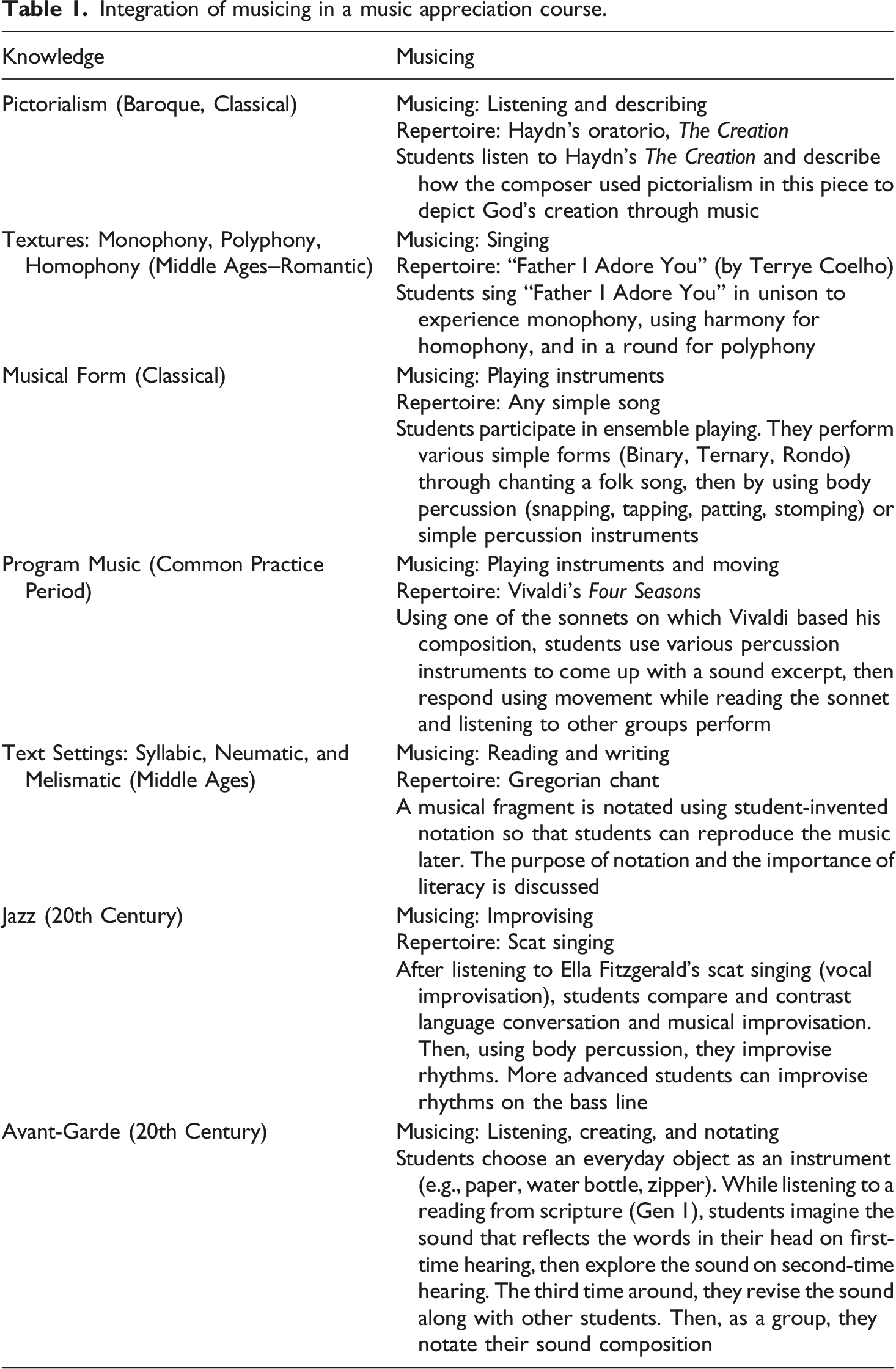
Below is an imaginary vignette of one of the activities described in Table 1 (program music) that incorporates musicing: Small percussion instruments such as castanets, drums, rhythm sticks, and triangles were placed on a table. The instructor assigned three or four students to a group and distributed a card with an excerpt of “Summer”—one of the sonnets that Vivaldi wrote and on which he based The Four Seasons—written on it. Students read the excerpt and aurally imagined how they would paint this poem using musical instruments. The instructor called on Martha, Nick, Susan, and Peter, who had been assigned to depict the verse that reads, “Under the heat of the burning summer sun, Languished man and flock; the pine is parched.” The instructor asked the students to select instruments from those on the table after exploring their different timbres. Martha picked a hand drum to keep the beat in triple meter, Nick chose a bar of chime bells to express “burning summer sun,” Susan picked a triangle to depict sweat dropping, and the teacher gave Peter a wooden xylophone that she set up in a G minor scale to play the descending scales, which was perfect for depicting “parched pines.” Students read the sonnet out loud once again and discussed how they would depict this summer scene using their instruments. When the students finished exploring and creating, the instructor introduced the ritornello (the repeating summer theme) by playing the melody on the piano and asked, “Can anyone tell me the meter and the tempo [from the provided options] of this theme and explain why?” Martha raised her hand and answered, “this piece is in triple meter because I hear three subdivisions for each beat, and the tempo is Allegro non molto, which means not very fast.” The instructor told students to choose a dynamic for their part to provide an emotional effect, and to notate their piece (using their invented symbols) so that they could perform their piece again. Students created an eight-measure long composition and recorded their performance for sharing.
Conclusion
All creation points to God, and music, as one of His creations, reveals God’s truth. The value of including music as part of a liberal arts education is that it teaches students to discover their musical identity and to (re)embark on a musical journey as musical beings. Harold Best describes two purposes for musicing: “to celebrate the uniqueness of music making as part of the larger world of human creativity, and to hold that music making is subordinate to, and informed by, the larger doctrines of creation, worship, offering, faith, grace, stewardship, redemptive witness, excelling, and love” (1993: 7). Knowing about the development of music in history, developing musical ears to appreciate God’s musical creation, and understanding His intention in creating music will allow Christian students to view their engagement in music as ultimately a way to strengthen their relationship with God. Being an active musicer means being attuned to God’s musical order, His creation. In fact, a music appreciation course can be a starting point for a “lifetime of musicing” for those who have forgotten their identity as a musicer. It is also a chance to affirm their musical identity for those who have been only superficial musicers. Along with reading the scriptures, sharing devotionals with others, listening to sermons, and giving time to prayer, Christians must practice our musicality as well because God created us as musical beings and gave each one of us the potential to music. Living musically as musical beings and engaging in music as an act of worship are God’s invitation for us to commune with Him, which we are privileged to practice daily in living.
Footnotes
Declaration of conflicting interests
The author(s) declared no potential conflicts of interest with respect to the research, authorship, and/or publication of this article.
Funding
The author(s) received no financial support for the research, authorship, and/or publication of this article.
